Archive
10/02/2014 – Ephemeris – The gibbous Moon tonight
Ephemeris for Thursday, October 2nd. The sun will rise at 7:41. It’ll be up for 11 hours and 39 minutes, setting at 7:21. The moon, 1 day past first quarter, will set at 1:50 tomorrow morning.
Tonight the moon will be featuring some of my favorite lunar landmarks, and if you spend any time looking at the moon with a small telescope, they become yours. The place to look is at the terminator, the sunrise line on the moon. In the north not far from the terminator is the walled plain called Plato. A bit farther away is a gash in the lunar Alps mountains caller the Alpine Valley. Near the center of the terminator and split by it is the fabulous crater Copernicus with a triple central peak which should poke into sunlight. Near the south pole is the large crater Clavius with an arc of decreasingly smaller craterlets on its floor. A bit north of that is the crater Tycho, which is more prominent when the moon is full than it is now.
Times are for the Traverse City/Interlochen area of Michigan. They may be different for your location.
Addendum
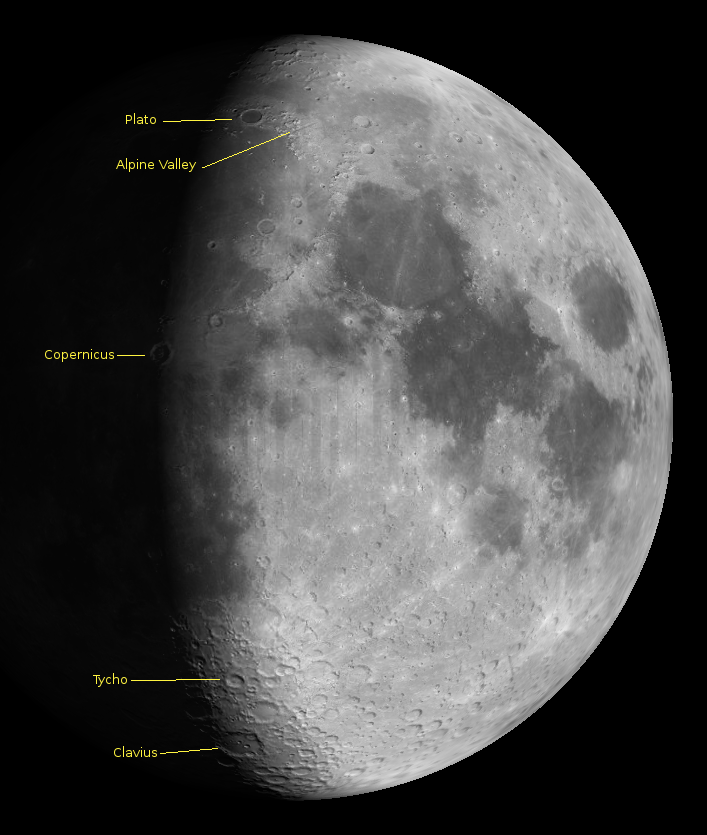
The gibbous Moon one day after first quarter at 9 p.m. October 2, 2014. Created using Virtual Moon Atlas.
09/29/2014 – Ephemeris – The Moon, Mars and Antares will line up tonight
Ephemeris for Monday, September 29th. The sun will rise at 7:37. It’ll be up for 11 hours and 48 minutes, setting at 7:26. The moon, 2 days before first quarter, will set at 10:49 this evening.
Tonight we’ll still have Mars hanging around the star Antares. However we’ll have the Moon joining the party. The three will nearly be in line at 9 p.m. with the fat crescent Moon on top, Mars below it and Antares below Mars. They will be in a straighter line but the Sun out makes them impossible to see. With binoculars or a small telescope the lunar seas visible, kind of in order from the Moon’s sunlit edge are Crises, Fertility, Nectar, Tranquility and half of Serenity. If you’re looking for the Man in the Moon, you’ll have to wait until the Moon is nearly full to completely discern his face. However most of the upside down rabbit is visible. The seas of Fertility and Nectar make up his ears, Tranquility, his head, and Serenity his body.
Times are for the Traverse City/Interlochen area of Michigan. They may be different for your location.
Addendum
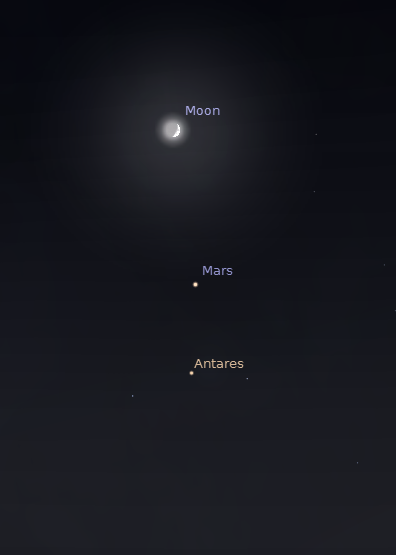
The Moon, Mars and the bright red star Antares line up on the evening of September 29, 2014. Created using Stellarium.
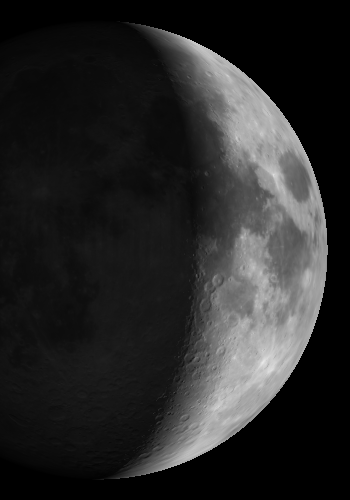
The moon tonight September 29, 2014. Created using Virtual Moon Atlas.
09/11/2014 – Ephemeris – The waning gibbous moon and a strange double crater
Ephemeris for Thursday, September 11th. The sun will rise at 7:16. It’ll be up for 12 hours and 43 minutes, setting at 8:00. The moon, 3 days past full, will rise at 9:30 this evening.
It might be about 10 p.m. before the moon gets high enough to appreciate with a small telescope. The terminator running across the moon is the sunset line. It has gobbled most of the little round Sea of Crises at the upper right of the moon. The Sea of Fertility just below it has two distinctive small craters in it with two parallel streaks of ejecta emanating from the one farthest from the terminator. No one knows exactly what happened here, but it appears that a binary asteroid struck the moon at a low angle coming from the direction of the terminator and gouged out the two small craters, which are elongated in the direction of the streaks. The crater names are Messier and Messier A, named after the French astronomer who cataloged some of the brightest interstellar objects.
Times are for the Traverse City/Interlochen area of Michigan. They may be different for your location.
Addendum
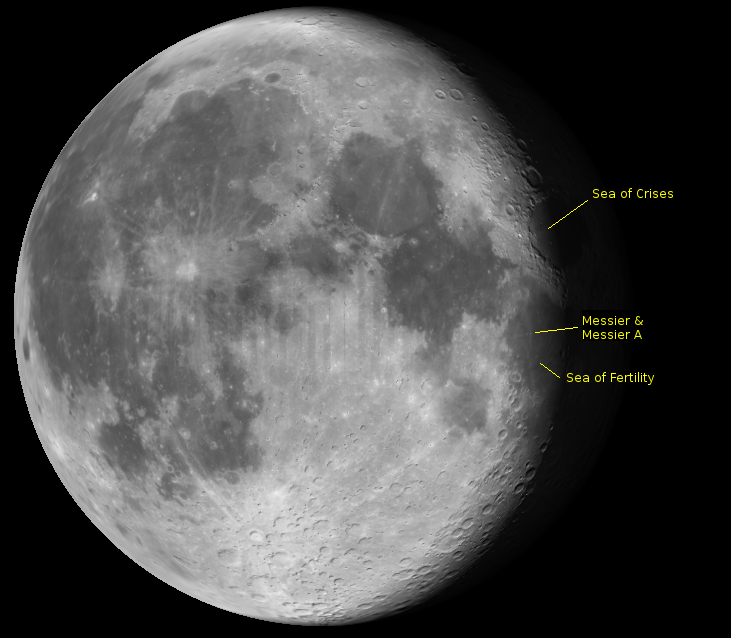
The gibbous Moon at 9 p.m. September 11, 2014. Created using Virtual Moon Atlas.
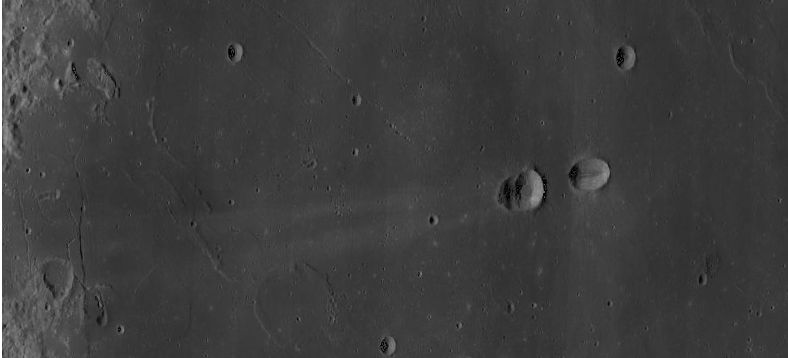
Closeup of Messier (right) and Messier A with the twin ejecta streaks. Credit: Lunar Reconnaissance Orbiter via Virtual Moon Atlas.
These craters were named for the 18th century astronomer Charles Messier whose famous catalog of deep sky objects is a who’s who of the brightest star clusters, nebulae and galaxies for the amateur astronomer. For instance M22 is not only a scenic state road in Michigan, but a beautiful bright globular star cluster in the constellation of Sagittarius. To Messier the objects on his list were a quick check of objects to ignore. He was looking for comets at the Paris Observatory. He found 12 of them.
09/08/2014 – Ephemeris – There’s a super Harvest Moon tonight!
Ephemeris for Monday, September 8th. The sun will rise at 7:13. It’ll be up for 12 hours and 53 minutes, setting at 8:06. The moon, at full today, will rise at 7:44 this evening.
Tonight’s full moon is the Harvest Moon, being the closest full moon to the autumnal equinox. It’s about the earliest Harvest Moon on can get in the year, occurring 14 days before the equinox because the moon’s cycle is 29 ½ days, and the autumnal equinox falls on the 22nd not the 23rd as usual. On top of that it’s another supermoon. Perigee or the Moon’s closest approach to the Earth of the month occurred yesterday. We were all oblivious to the fact until some astrologer wrote about it a few years ago. It’s nice to know. Actually there’s a supermoon every month but it only nearly coincides with the full moon one to three times a year at consecutive full moons. Trouble is the Moon always appears bigger near the horizon. It’s an illusion.
Times are for the Traverse City/Interlochen area of Michigan. They may be different for your location.
Addendum
See here for last month’s discussion about the supermoon.
09/05/2014 – Ephemeris – Supernovae and the Moon this weekend
Ephemeris for Friday, September 5th. The sun will rise at 7:09. It’ll be up for 13 hours and 2 minutes, setting at 8:11. The moon, half way from first quarter to full, will set at 4:07 tomorrow morning.
Tonight the Grand Traverse Astronomical Society will hold their monthly meeting at he Northwestern Michigan College’s Rogers Observatory at 8 p.m. featuring Dr. David Penney, who will talk about Supernovae, the brightest, at optical wavelengths anyway explosions in the universe. These will either completely destroy a star or leave a neutron star or black hole remnant. At 9 p.m. there will be a star party featuring the Moon, Saturn and Mars. The observatory is located on Birmley road. On Saturday the society will celebrate International Observe the Moon Night with telescopes set up on the 200 block of Front street in Traverse City. That event starts around 9 p.m., but only if it’s clear.
Times are for the Traverse City/Interlochen area of Michigan. They may be different for your location.
Addendum
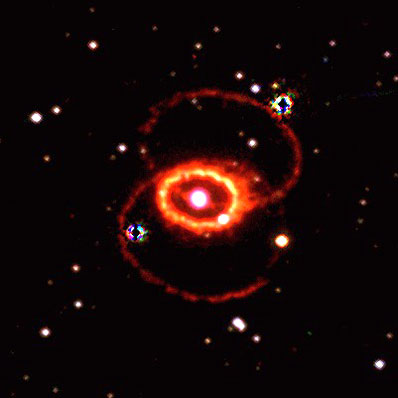
Remnant of SN1987A in the Large Magellanic Cloud, 160,000 light years away taken by the Hubble telescope’s WFPC2 camera on three occasions in 1994 and 1995. The outer rings are light echos of the explosions ionizing clouds ejected thousands of years before. Credit NASA.
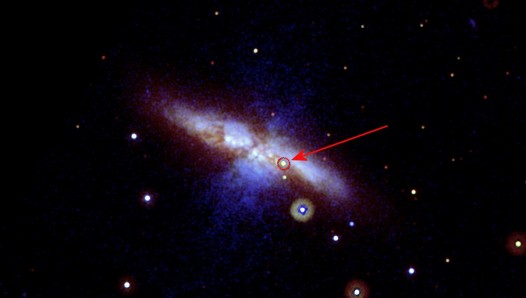
Supernova 2014J in nearby galaxy M82, 12 million light years away. Credit NASA/Swift/P. Brown, TAMU.
09/04/2014 – Ephemeris – Saturday is International Observe the Moon Night
Ephemeris for Thursday, September 4th. The sun will rise at 7:08. It’ll be up for 13 hours and 5 minutes, setting at 8:13. The moon, 2 days past first quarter, will set at 2:56 tomorrow morning.
This Saturday the 6th is International Observe the Moon Night and while some of us amateur astronomers consider it as a big street light we can’t get away from. It does have a hold on most of the rest of the population. It is our closest celestial body and the only one we’ve set foot on. It contains the answers to the creation of the Earth as we know it today. Humankind’s impact on the moon isn’t visible from the Earth, so puny his attempts, so the Moon appears as pristine as it did to Galileo, who first studied it with his telescope. Members of the Grand Traverse Astronomical Society will set up their telescopes on the sidewalk on the north side of he 200 block of Front Street near the Martinek clock. And will start showing the Moon to all comers after 9 p.m. but only if it’s clear.
Times are for the Traverse City/Interlochen area of Michigan. They may be different for your location.
Addendum
Here’s a link to the InOMN’s annotated Moon map (pdf) for Saturday.
Here’s a link to the InOMN’s home page. Expand the global map on the page for the location of the event nearest to you.
09/02/2014 – Ephemeris – Viewing the first quarter Moon
Ephemeris for Tuesday, September 2nd. The sun will rise at 7:06. It’ll be up for 13 hours and 11 minutes, setting at 8:17. The moon, at first quarter today, will set at 12:52 tomorrow morning.
Tonight on the moon there are some very prominent craters on the terminator or sunrise line that’s cutting the moon in half. From the top or north of the moon there’s Plato, which is also called a ringed plain because it has a flat floor. South of there is Eratosthenes, at the end of the arc of the Apennines mountain chain. At the south or bottom end of the moon are two other of my favorite craters. First is the crater Tycho, that doesn’t look spectacular now, but will when the Moon is full with its rays of ejecta crossing a long way across the face of the moon. A little bit farther south, partially entering sunlight is the large crater Clavius. On my blog, bobmoler.wordpress.com, I’ll illustrate what the Moon’s image looks like in different types of telescopes.
Times are for the Traverse City/Interlochen area of Michigan. They may be different for your location.
Addenda
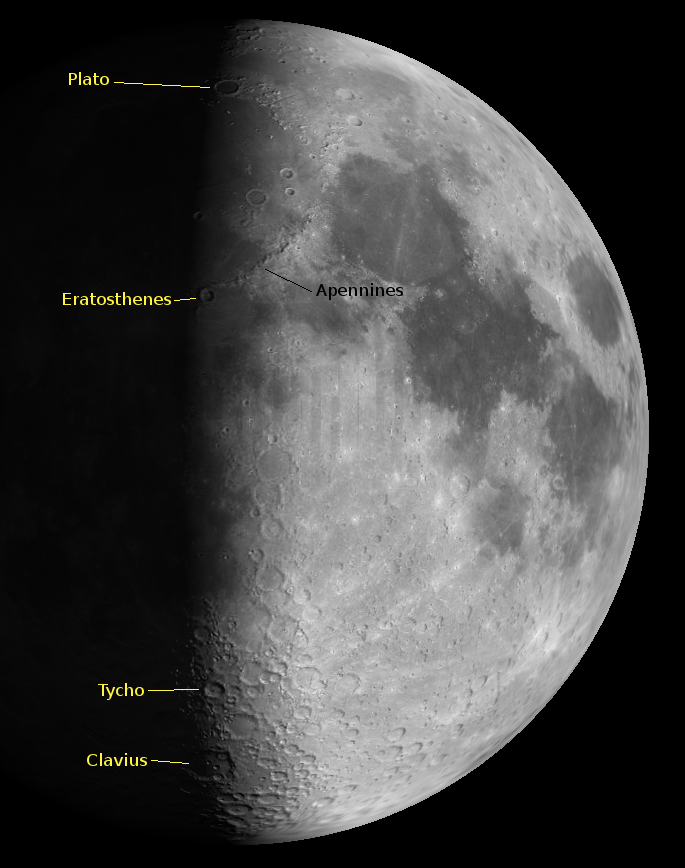
The Moon tonight at 9 p.m. (September, 2, 2014). Created using Virtual Moon Atlas.
Image orientation in telescopes
The orientation of what one sees in an astronomical telescope depends on the type of telescope and the placement of the eyepiece. The orientations shown are for observers in the northern hemisphere. For the images below the moon shown is due south.
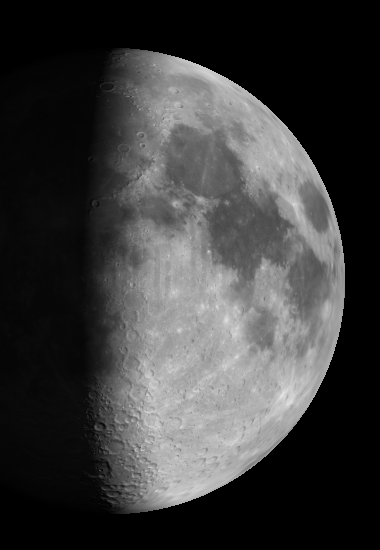
The orientation of the Moon as seen with the naked eye, binoculars, spotting scopes and telescopes with an erecting eyepiece.
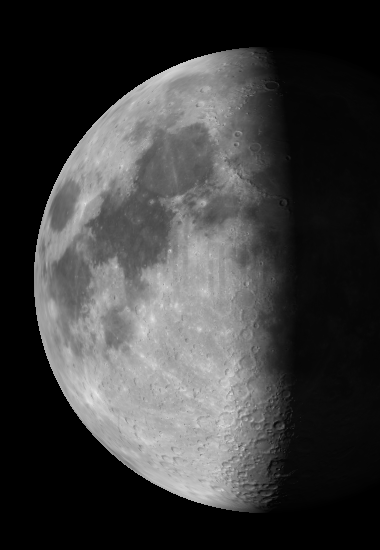
The orientation of the Moon as seen in a refractor or a Schmidt-Cassigrain or similar type reflector with a diagonal at the eyepiece end, and the eyepiece pointing up. This is a mirror image due to an odd number of mirror reflections in the telescope.
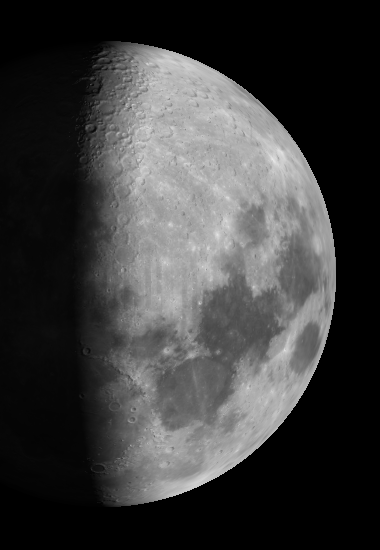
The orientation of the Moon as seen with a refractor or Schmidt-Cassigrain and diagonal with the eyepiece oriented horizontally. It is a n inverted mirror image.
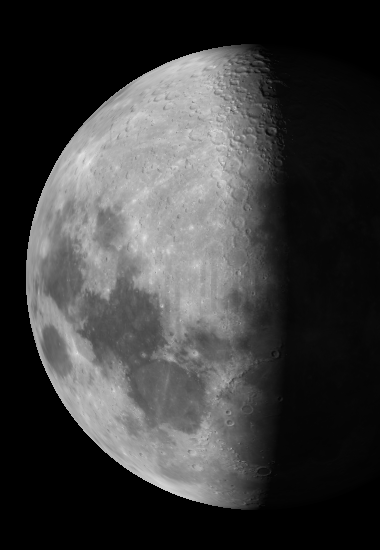
The orientation of the moon through a Newtonian reflector or a refractor without an eyepiece diagonal. It is an inverted image, an image rotated 180 degrees.
For southern hemisphere observers for these images to work the moon would be due north and all the images would have to be upside down.
Correction 09/02/2014 11:07 p.m.
All images created using Virtual Moon Atlas.
08/11/2014 – Ephemeris – The Moon’s terminator is now the sunset line
Ephemeris for Monday, August 11th. The sun rises at 6:40. It’ll be up for 14 hours and 13 minutes, setting at 8:54. The moon, 1 day past full, will rise at 9:15 this evening.
After the full moon the shadow action moves from the eastern or left edge of the moon to the western or right edge of the moon, or if the moon’s low in the east, to the upper right edge. For the first two weeks of the lunar cycle, from new to full we were watching the sunrise terminator slowly sweep across the face of moon. Now, after full the sunrise terminator is sweeping across the Moon’s far side, and the sunset terminator is beginning to sweep across the near side, our side of the Moon. Tonight the terminator is approaching the small Sea of Crises on the upper right of the Moon. By tomorrow night the terminator will be half way across that sea. By Wednesday it will be lights out for the Sea of Crises for two weeks.
Times are for the Traverse City/Interlochen area of Michigan. They may be different for your location.
Addendum
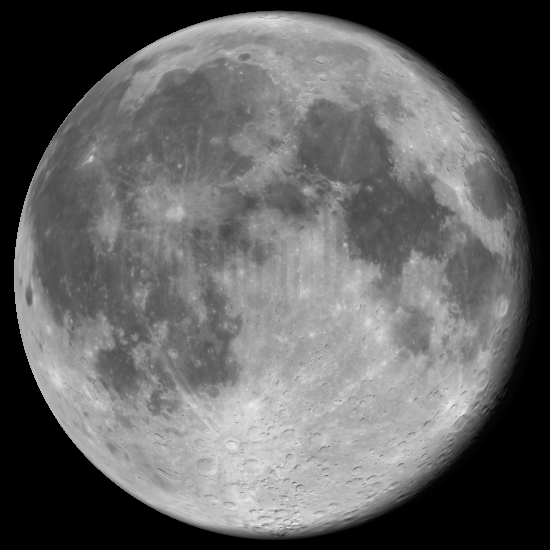
The moon at 10 p.m. tonight, August 11, 2014. Created using Virtual Moon Atlas.
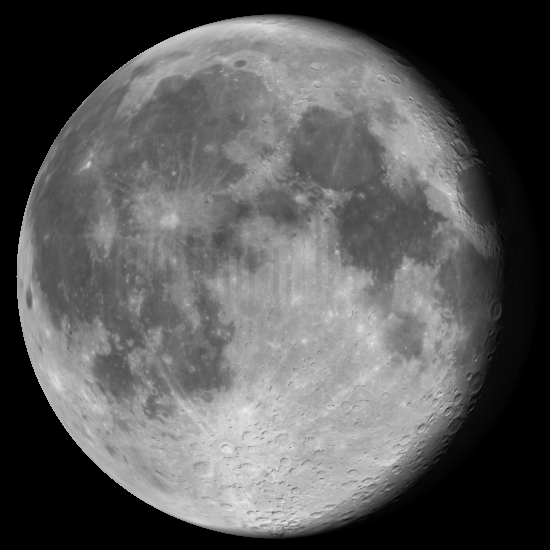
The moon at 10 p.m. tomorrow night, August 12, 2014. Created using Virtual Moon Atlas.
Supermoon, Smoopermoon
Pardon me if I don’t get excited by the fact that we are going to have a “supermoon” August 10th. On the night of the full moon it will be at perigee, its closest point to the Earth in its orbit. The distance according to our Celestial Calendar page is 356,897 kilometers. That’s 221,766 miles. At apogee this month, on the 24th, the moon will be 406,523 kilometers, or 252,602 miles away. That’s somewhat larger than 11 percent difference in distance, due to the Moon’s elliptical orbit. The name for the smallest moon is micromoon. Either is an exaggeration of terms.
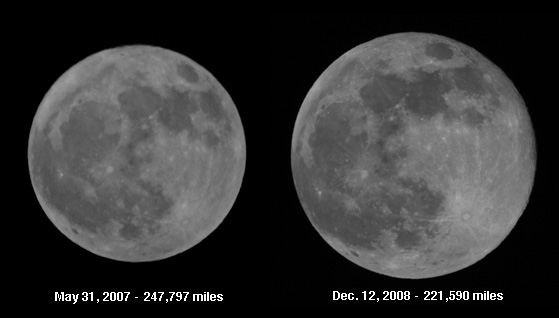
A supoermoon compared to a micromoon. Credit: Michael Myers.
I don’t remember the supermoon term growing up. Wikipedia says it was coined by astrologer Richard Knolle in 1979 according to his web post from 2011. Oooo, an astrologer.
There’s a profession astronomers can respect. </snark>*
Being a relatively old guy, 1979 was well past my formative years as an amateur astronomer and even four years after I started producing my Ephemeris programs for Interlochen Public Radio. Yet I only remember supermoon being a big deal or any deal at all for the last few years.
The actual size of the supermoon aside, folks mistake the normal optical illusion of an enlarged moon rising as the supermoon. The moon always looks larger when it’s near the horizon than when it’s high in the sky. The same thing happens to the sun, it looks larger rising and setting, the when higher in the sky. Caution: Use a solar filter to observe the sun. In photographs the Moon is the same size whether on the horizon or high in the sky. Actually the horizon moon will appear slightly smaller on the horizon. One, it will be squished vertically by the action of the refraction of the earth’s atmosphere. Two, it is nearly 4,000 miles farther away at the horizon than at he zenith, where we’re the radius of the Earth closer to the Moon.
I challenge anyone to be able to actually detect, by looking at the moon in the sky, whether they are looking at a supermoon or not. There’s nothing of comparable size out there. The same thing will happen when one thinks the full moon is so white. OK, there’s some gray too. However the Moon’s total albedo of reflectance is 0.136 or 13.6%. Some say 0.07 or 7%, comparable to a charcoal briquette. If one could get Saturn’s moon Enceladus, with nearly a 100% albedo, next to the Moon without it turning into a comet by sublimating away, the dinginess of our Moon would be immediately obvious.
08/08/2014 – Ephemeris – Supermoon plus astronomical fun in the Grand Traverse Area
Ephemeris for Friday, August 8th. The sun rises at 6:36. It’ll be up for 14 hours and 21 minutes, setting at 8:58. The moon, 2 days before full, will set at 5:17 tomorrow morning.
In two days the Moon will reach perigee within a few hours of being a full moon. This has become known as a supermoon. Perigee is the point where an Earth orbiting object is closest to the Earth. The farthest point is called apogee. The coincidence of full moon and perigee was coined as the supermoon by astrologer Richard Knolle in 1979, but apparently didn’t catch on until he wrote a popular article in 2011. No wonder I hadn’t heard of it, this program had been on for 4 years before the term was even coined. The problem with appreciating the supermoon is the lack of a reference of nearly the same size. The moon always looks large when it’s near the horizon. It’s a well-known optical illusion, It’ll fool us every time.
Times are for the Traverse City/Interlochen area of Michigan. They may be different for your location.
Addendum
Saturday evening the 9th the Grand Traverse Astronomical Society (GTAS) will host a Sun and Star Party at Thoreson Farm at the Sleeping Bear Dunes National Lakeshore. It’s the concluding event at the Port Oneida Fair. Solar viewing will be from 4 to 6 p.m., and the evening event will run from 9 to 11 p.m. with the main attraction will be the nearly full Moon, the planet Saturn and colorful binary stars and bright star clusters. Thoreson Farm is located on South Thoreson Road. South Thoreson Road runs into M22, about a mile west of Port Oneida Road.
Sunday evening the 10th the GTAS will attend the Meteors and S’mores event at the Leelanau State Park at the tip of the Leelanau Peninsula. The event will run from 8:30 p.m. to 11:45 p.m. The Perseid meteor shower will reach peak a couple of days later, but there will still bright Perseids visible to the vigilant.
I’ll have more to say about the supermoon tomorrow in a non-Ephemeris post.
 Bob Moler's Ephemeris Blog