Archive
02/24/2012 – Ephemeris – The moon will pass Venus and Jupiter this weekend
Friday, February 24th. The sun will rise at 7:29. It’ll be up for 10 hours and 53 minutes, setting at 6:22. The moon, 3 days past new, will set at 9:36 this evening.
This weekend we will be able to spot appearances of the moon passing two planets. Tomorrow night Venus will appear below the moon. It should be a spectacular sight with Jupiter nearby to the upper left. Then Sunday night the moon will have moved near Jupiter. This time Jupiter will appear to the left of the moon, their closest apparent approach being after they set Monday morning. Even though the moon will leave these planets, keep watching them. As Venus slowly approaches Jupiter. They will be their closest, called a conjunction on the Ides of March. That’s March 15th using our calendar. These two planet will still be with us for the next few months, with Mars and Saturn appearing later in the evening now.
* Times are for the Traverse City/Interlochen area of Michigan. They may be different for your location.
Addendum
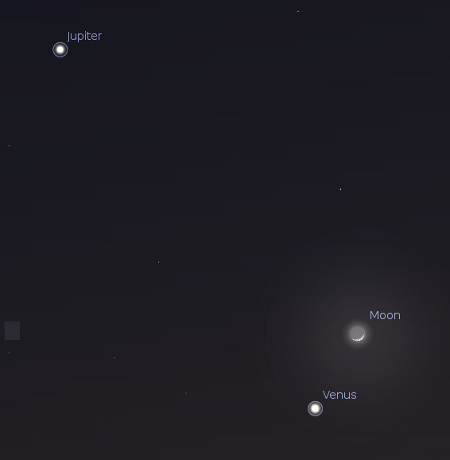
The moon will pass above Venus at 7 p.m. Saturday February 25, 2012. Created using Stellarium.
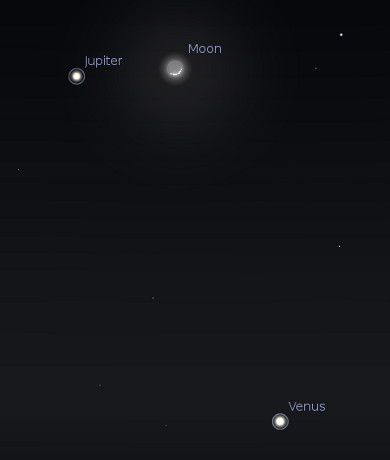
The moon will pass Jupiter, seen at 10 p.m. February 26, 2012. Created using Stellarium.
02/10/2011 – Ephemeris – The moon will be near Saturn Sunday morning
Ephemeris for Friday, February 10th. The sun will rise at 7:50. It’ll be up for 10 hours and 12 minutes, setting at 6:03. The moon, 3 days past full, will rise at 9:52 this evening.
Sunday morning the moon will pass Saturn in our sky. The ringed planet is just to the left of the bright blue-white star Spica in the constellation of Virgo. Saturn and Spica rise around midnight now. Saturn will be best seen in the evening this spring and early summer. Its rings are still opening up from their edge on passage in 2009. Saturn’s rings can be seen in any telescope with 20 power or over. In fact in sturdily mounted binoculars, Saturn will appear not point-like as stars do but may appear somewhat oblong, due to its rings. The rings are not solid, a fact that’s been known for a few centuries. A solid disk would be tour asunder by the tidal forces on it by the difference in the gravitational forces across the rings.
* Times are for the Traverse City/Interlochen area of Michigan. They may be different for your location.
Addendum
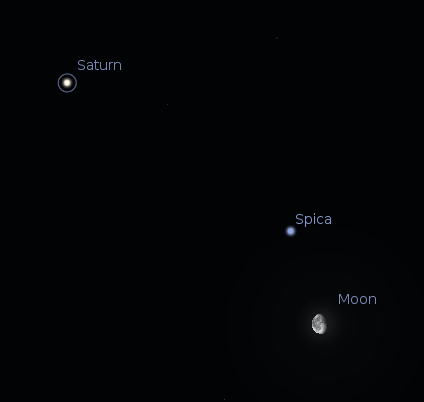
Saturn, Spica and the moon at 6 a.m. February 12, 2012. Created using Stellarium.
02/07/2012 – Ephemeris – The Dark Side of the moon
Ephemeris for Tuesday, February 7th. The sun will rise at 7:54. It’ll be up for 10 hours and 4 minutes, setting at 5:59. The moon, at full today, will rise at 6:11 this evening.
What is the dark side of the moon? If you said it was the part of the moon we don’t see, you are right, but only for today only. The proper name for the part of the moon that doesn’t face the earth is the far side. Every part of the moon has a chance to be on the dark side, which is just the night side, just as any solar system body illuminated by the sun has a day side and a night or dark side. The reason we can see only one side of the moon from the earth is that it’s tidally locked to the earth. The moon is trying to do the same to the earth and is slowing the earth’s rotation down. This is shown by the occasional leap second that’s added to our time. The moon does rotate, but it rotates once as it revolves about the earth once.
* Times are for the Traverse City/Interlochen area of Michigan. They may be different for your location.
01/26/2012 – Ephemeris – The moon will appear near Venus tonight
Ephemeris for Thursday, January 26th. The sun will rise at 8:08. It’ll be up for 9 hours and 34 minutes, setting at 5:42. The moon, 3 days past new, will set at 9:46 this evening.
The waxing crescent moon will appear near the bright planet Venus tonight in the southwestern sky after sunset. They were actually closer earlier today, although not that close. The moon happens to be north of the ecliptic plane, which is actually the plane of the earth’s orbit of the sun. Venus is a bit below. The moon has to be close to that plane at new or full moon for eclipses to take place. The moon’s orbit is tilted at 5 degrees to that plane, and crosses it twice a month. So we get eclipse seasons twice a year. The next eclipse is a solar eclipse May 20th, which we’ll see the start of at sunset here. Venus will be close to that plane at its inferior conjunction June 5th when it passes in front of the sun in transit. We’ll see the first 3 hours of that before sunset.
* Times, as always are for the Traverse City/Interlochen area of Michigan.
Addendum
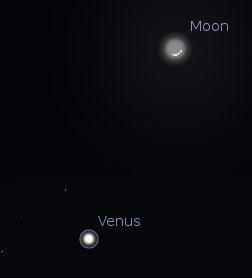
Venus and the moon on the evening January 26, 2012. Created using Stellarium.
01/19/2012 – Ephemeris – The moon will pass the bright star Antares this morning
Ephemeris for Thursday, January 19th. The sun will rise at 8:13. It’ll be up for 9 hours and 19 minutes, setting at 5:32. The moon, 3 days past last quarter, will rise at 5:52 tomorrow morning.
This morning, you might want to take a quick peek outside to the southeast and see, if you can spot the crescent moon. If you can below and a bit right of it is a bright red star. That star is Antares in the constellation Scorpius, one of the first constellations of summer to appear in the evening sky. I thought you’d like the encouragement that summer is coming now that winter has finally come in earnest. The moon passes Antares every month, but this morning it appears especially close, since their actual closest approach was about 2 this morning. The entire moon may be faintly visible this morning as earthshine. Antares itself may be twinkling merrily due to earth’s atmosphere. It sometimes looks like a sparkler in binoculars.
* Times, as always are for the Traverse City/Interlochen area of Michigan.
Addendum
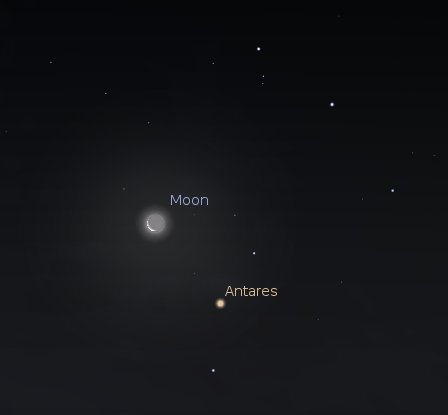
The Moon passes Antares in the morning hours of January 19, 2012. Created using Stellarium.
01/16/2012 – Ephemeris – The moon will appear below Saturn and Spica this morning
Ephemeris for Martin Luther King Day, Monday, January 16th. The sun will rise at 8:15. It’ll be up for 9 hours and 13 minutes, setting at 5:29. The moon, at last quarter today, will rise at 2:31 tomorrow morning. | This morning the crescent moon will appear below Saturn and the bright blue-white star Spica in the southeast before twilight brightens too much. When seen together Saturn and Spica really show the difference in their colors. Saturn reflects the light of our yellow sun, and that’s accentuated by it’s cream colored clouds. Only Saturn’s rings reflect the sun’s light pretty much unaltered because they’re made mostly of ice. Spica has the hottest surface temperature of any first magnitude star and shines with a blue tinge. This came home to me a long time ago, when I photographed a lunar eclipse with color film when the moon was next to Spica. Spica came out looking very blue indeed.
* Times, as always are for the Traverse City/Interlochen area of Michigan.
Addendum
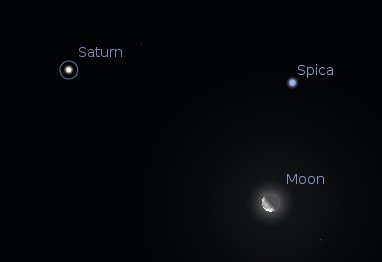
Saturn, Spica and the Moon on the morning of January 16, 2012. Created using Stellarium.
01/13/2012 – Ephemeris – The moon passes Mars tonight
Friday, January 13th. The sun will rise at 8:17. It’ll be up for 9 hours and 8 minutes, setting at 5:25. The moon, 3 days before last quarter, will rise at 10:52 this evening.
This evening the moon will pass below the planet Mars after the moon rises near 11 p.m. Mars is rather distant now, and it won’t be really near in its next close approach to us on March 5th when it will be slightly under 63 million miles away. In telescopes Mars is and will remain a tiny disk with a hint of a white polar cap on one end. Photographers with large telescopes and CCD cameras can capture Mars even better and show some surface detail. We have even closer views of Mars. Of course there is an operating rover called Opportunity still active on the planet and the Curiosity rover on its way plus three orbiting satellites, two US and one European. The satellites will be cruising overhead as Curiosity lands August 5th.
* Times, as always are for the Traverse City/Interlochen area of Michigan.
Addendum
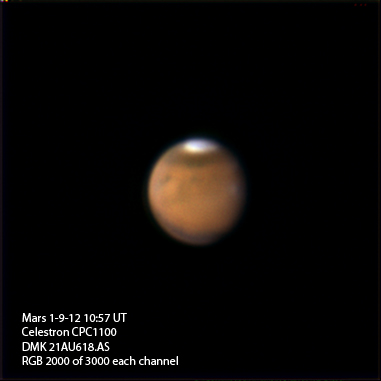
Mars on the morning of January 9, 2012. By Scott Anttila
Here’s Scott Anttila’a image of Mars from Monday morning, the 9th. Note Mar’s gibbous phase. Mars will become full when it’s at opposition from the sun March 3rd. It is only 9.7 seconds of arc in diameter. Also note, beside the northern polar cap that’s quite obvious, there is a hazy patch near the right edge of Mars. It is what telescopic astronomers of a hundred years ago called Nix Olympica, the Snows of Olympus. When the Mariner 9 spacecraft reached Mars in 1971 it found that there was a real mountain there. So the feature was renamed Olympus Mons or Mount Olympus. The white haze isn’t snow but water ice clouds that condense over the mountain peak. Mount Olympus is 14 miles high, three times taller than Mt Everest. The closest earth analog to it is the volcanic peak Mauna Kea on the island of Hawaii. Actually you’d have to throw in the entire island of Hawaii itself from the sea floor on up.
01/06/2012 – Ephemeris – GTAS meeting and viewing night tonight
Friday, January 6th. The sun will rise at 8:19. It’ll be up for 8 hours and 58 minutes, setting at 5:17. The moon, 3 days before full, will set at 6:50 tomorrow morning.
The Grand Traverse Astronomical Society will have its first meeting of the year tonight at 8 p.m. at the Northwestern Michigan College’s Rogers Observatory. Following will be a public viewing night featuring the moon and Jupiter. This year the first viewing night of the month will come at the end of the society meeting at 9 o’clock. Come for both. The presentation for the meeting will be NMC Astronomy Club member Storm Strausheim and her topic will be those mysterious stellar cannibals – Black Holes. The observatory is located on Birmley Road between Keystone and Garfield roads. April through October this year there will be a second viewing night at the observatory later in the month.
* Times, as always are for the Traverse City/Interlochen area of Michigan.
01/02/2012 – Ephemeris – The moon and Jupiter and telescope tips
Monday, January 2nd 2012. The sun will rise at 8:19. It’ll be up for 8 hours and 54 minutes, setting at 5:13. The moon, 1 day past first quarter, will set at 3:04 tomorrow morning.
Tonight the bright planet Jupiter will appear below the moon. This is a great time to try out that new telescope or binoculars, or dig that old one out of the closet or attic. With a telescope use the lowest power to locate the moon and get an overview. The bright southern part of the moon, which may appear at the top of the image, because telescopes normally invert the image is heavily cratered. The other part has several dark nearly flat structures called seas. These are really huge craters that caused the internal lava to well up, making the smooth floors. Recently some astronomers hypothesized that a second moon was created with ours and that it crashed into our moon creating the lunar seas.
* Times, as always are for the Traverse City/Interlochen area of Michigan.
Addendum
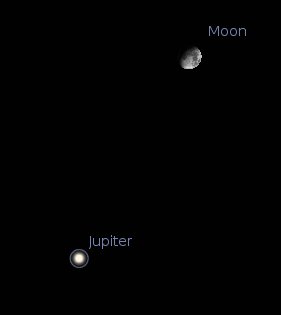
Jupiter appears below moon Jan 2, 2012 9 p.m. Created using Stellarium.
12/06/11 – Ephemeris – Jupiter will appear close to the moon tonight
Tuesday, December 6th. The sun will rise at 8:04. It’ll be up for 8 hours and 58 minutes, setting at 5:02. The moon, half way from first quarter to full, will set at 5:16 tomorrow morning.
This evening the planet Jupiter will appear to the lower right of the moon. They will appear at their closest at 2 p.m., but that’s before they rise. Jupiter is the largest of the planets and three of its four largest moons that we can see in small telescopes, are larger than our moon. Last month I spent a day at the National Radio Astronomy Observatory in Green Bank West Virginia. One of the studies they were doing was a radar study of the Jovian moon Europa to see if the suspected ocean that separates the moon’s core from its surface would cause the surface to slip a bit and show that Europa’s not completely solid. Radar pulses would be sent from Aricebo in Puerto Rico to be received by their GBT 100 meter telescope.
* Times, as always are for the Traverse City/Interlochen area of Michigan.
Addendum
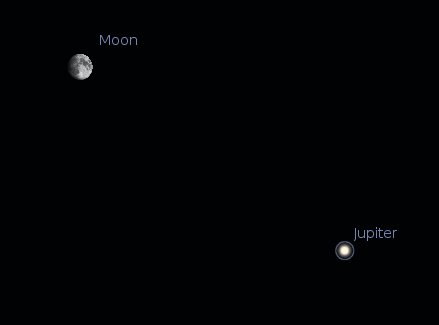
Jupiter and the moon the evening of December 6, 2011. Created using Stellarium

