Archive
10/12/2021 – Ephemeris – It’s Ada Lovelace Day!
This is Bob Moler with Ephemeris for Ada Lovelace Day, Tuesday, October 12th. Today the Sun will be up for 11 hours and 8 minutes, setting at 7:02, and it will rise tomorrow at 7:56. The Moon, at first quarter today, will set at 11:50 this evening.
Saturn has stopped its retrograde or westward motion against the stars of Capricornus and today has resumed its normal eastern motion.
Ada Lovelace, or more properly Augusta Ada King, Countess of Lovelace, was the daughter of Lord Byron and worked for Charles Babbage, and is considered the first computer programmer. She devised a way to use the same punch cards that were used on the Jacquard loom to store and run her programs, even though Babbage was unable to complete his mechanical computer the Analytic Engine in the mid 1800s. This day is set aside to celebrate the accomplishments of all the women of Science, Technology, Engineering and Math, (STEM). The computer language Ada, named after her, was created for the US Department of Defense.
The astronomical event times given are for the Traverse City/Interlochen area of Michigan (EDT, UT-4 hours). They may be different for your location.
Addendum

Ada, Countess of Lovelace (1815-1852) considered the first computer programmer, even though the machine she wrote code for was never completed. Credit: Science & Society Picture Library.
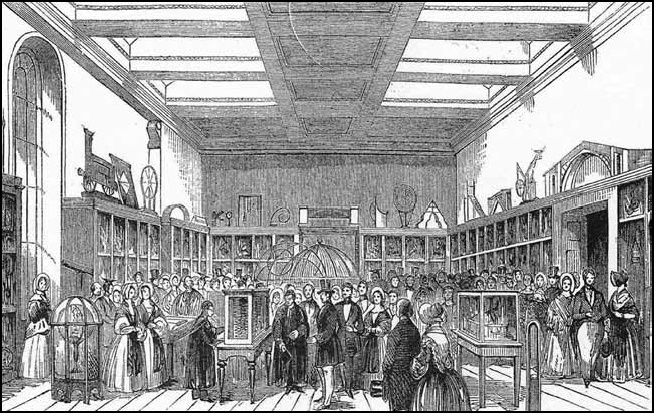
Part of Charles Babbage’s Analytical Engine on display, in 1843, left of center in this engraving of the King George III Museum in King’s College, London. Unknown engraver.
08/11/2021 – Ephemeris – Let’s search for the naked-eye planets for this week, and meteors tonight
This is Bob Moler with Ephemeris for Wednesday, August 11th. Today the Sun will be up for 14 hours and 13 minutes, setting at 8:54, and it will rise tomorrow at 6:42. The Moon will be 3 days past new tonight.
Let’s search for the naked-eye planets for this week. Venus and the Moon will be close together tonight, with Venus below and right of the waxing crescent Moon by 9:30 tonight. Venus will set at 10:18 pm. With the Moon following at 10:50. By 10 pm, Jupiter and Saturn will be seen low in the southeastern sky. The brighter Jupiter will be easy to spot at that hour. Saturn will be dimmer, but a bit higher and to its right. Tonight and especially in the morning hours tomorrow, the Perseid meteors will be at their peak. These bits of Comet Swift-Tuttle, liberated by the comet’s prior passes in through the warmth of the inner solar system, will flash into incandescence as they enter the Earth’s atmosphere at interplanetary speeds.
The astronomical event times given are for the Traverse City/Interlochen area of Michigan (EDT, UT – 4 hr). They may be different for your location.
Addendum
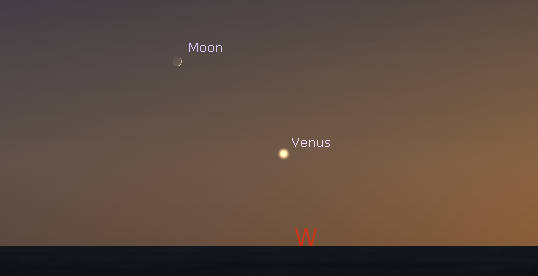
Venus and the 3-day-old Moon ion evening twilight at 9:45 tonight, August 11, 2021. Created using Stellarium.
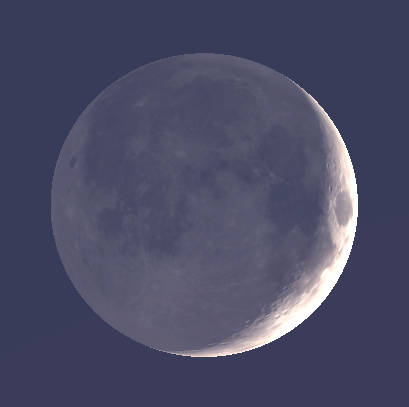
The Moon as it might appear in binoculars tonight, August 11, 2021, with earth shine on its night side, illuminated by the bright Earth in its sky.
Created using Stellarium.
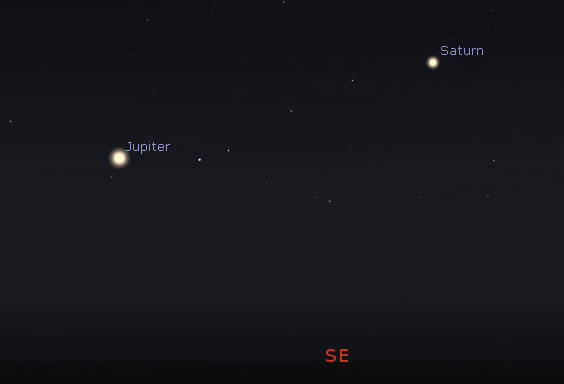
Jupiter and Saturn in the southeastern sky at 10:30 in the evening tonight, August 11, 2021. Created using Stellarium.
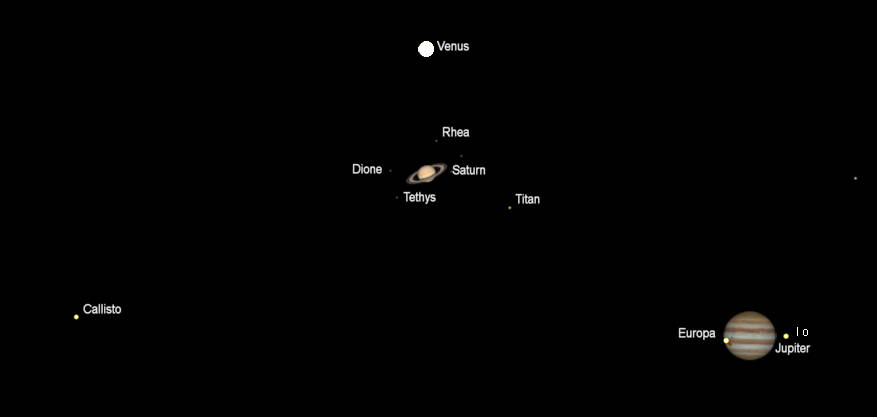
Telescopic view of the bright planets (north up) as they would be seen in a small telescope, with the same magnification, this evening, at 10 pm August 11, 2021. Apparent diameters: Venus, 13.40″; Saturn 18.57″, its rings 43.26″; Jupiter, 49.00″. Jupiter’s moon have a cluster of events in the evening. See below. The ” symbol means seconds of arc (1/3600th of a degree.) Click on the image to enlarge it. Created using Cartes du Ciel (Sky Charts).
                Jupiter's Satellite events
Moon      Event            EDT (pm-11th, am-12th) UT (12th)
Europa    Shadow enters    10:00 pm               02:00
Europa    Transit starts   10:25 pm               02:25
Io        Eclipse starts   10:41 pm               02:41
Europa    Shadow exits     12:51 am               04:51
Ganymede  Occultation ends  1:06 am               05:06
Io        Occultation ends  1:11 am               05:11
Europa    Transit ends      1:12 am               05:12
The above times were determined using Stellarium, and may be off by several minutes.
Shadow events are when a satellite’s shadow is cast onto the face of the planet
Transit events are when the satellite passes in front of the planet
Eclipse events are when a satellite passes through the planet’s shadow
Occultation events are when the satellite passes behind the planet
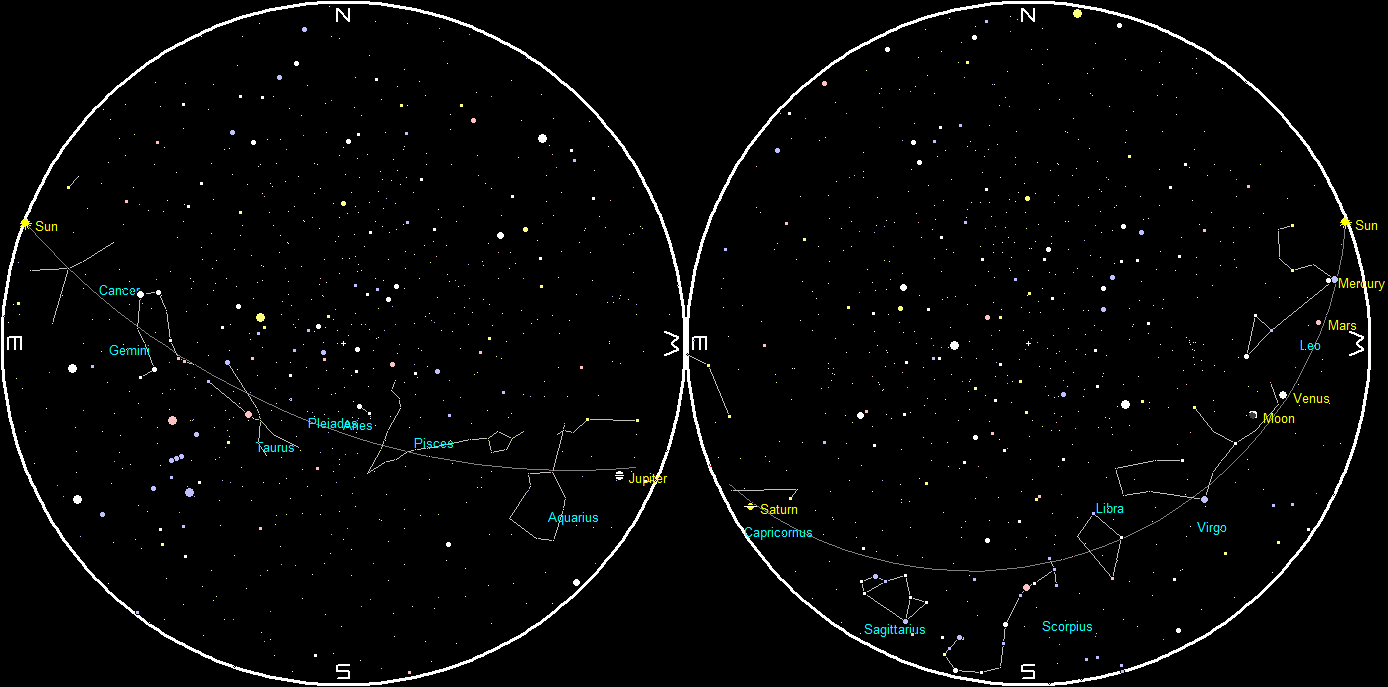
Planets and the Moon at sunset and sunrise of a single night, starting with sunset on the right on August 11, 2021. The night ends on the left with sunrise on the 12th. Click on the image to enlarge. Created using my LookingUp program.
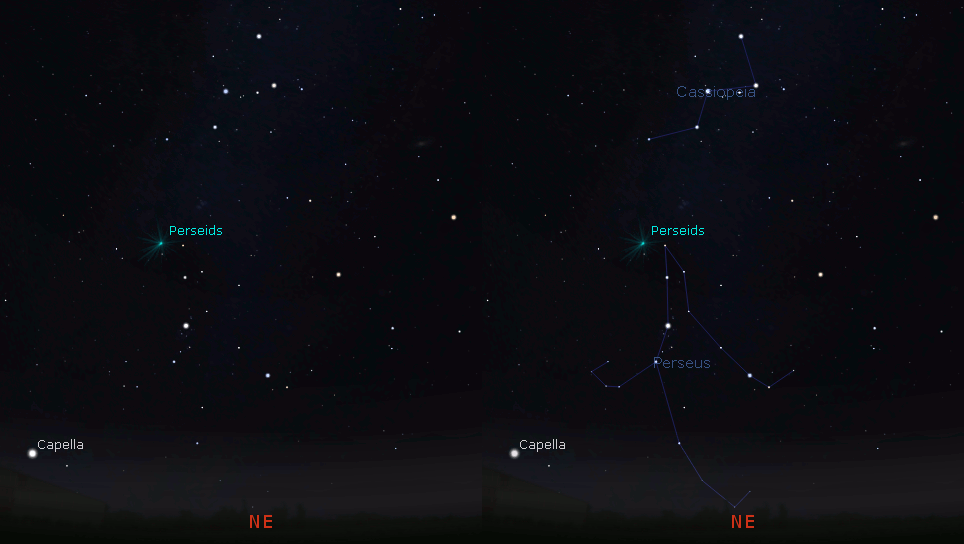
Perseid Radiant finder automation for midnight, August 11th. Created using Stellarium and GIMP.
More on the Perseids on Monday and Tuesday’s posts.
08/02/2021 – Ephemeris – Saturn is closest to us and enters the evening sky today
This is Bob Moler with Ephemeris for Monday, August 2nd. Today the Sun will be up for 14 hours and 36 minutes, setting at 9:06, and it will rise tomorrow at 6:31. The Moon, 2 days past last quarter, will rise at 1:55 tomorrow morning.
Today the ringed planet Saturn is at opposition, that is, opposite the Sun in our sky, rising at sunset and setting at sunrise. Saturn, then, is as close to us as it can get at 832 million miles (1,339 billion kilometers). Its rings are getting noticeably thinner now. Their narrow dimension is less than the planet’s diameter. Saturn’s axis and rings, which orbit over its equator, keep the same orientation in space as it orbits the Sun, just as the Earth’s axis does, giving us our seasons. Saturn’s seasons last nearly seven and a half of our years. Since about 2017, the rings have been closing, imperceptibly at first, but by March 2025 they will be edge-on, and will disappear, since for their great breadth of 175,000 or so miles (282,000 kilometers), they are less than 100 feet thick.
The astronomical event times given are for the Traverse City/Interlochen area of Michigan (EDT, UT – 4 hr). They may be different for your location.
Addendum
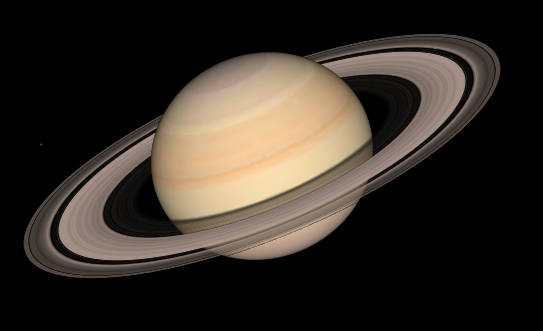
An enlarged view of Saturn and its rings as created by the program Cartes du Ceil (Sky Charts). Note that the globe of Saturn now extends past the narrow dimension of the rings. The rings will continue to narrow until March 23, 2025.
07/26/2021 – Ephemeris – Albireo, a colorful double star in Cygnus the swan
This is Ephemeris for Monday, July 26th. Today the Sun will be up for 14 hours and 52 minutes, setting at 9:15, and it will rise tomorrow at 6:23. The Moon, 3 days past full, will rise at 11:15 this evening.
Alberio is the name given to the star that is in the beak of the constellation of Cygnus the swan, which is high in the east these evenings. It is also at the foot of the asterism or informal constellation of the Northern Cross. To the naked eye Alberio looks like a single star, however even in small telescopes* its true nature is revealed. It is a double star whose individual star colors are strikingly different Its brightest star is yellow, and the dimmer star is blue. While star colors are subtle, these two, due to their apparent closeness, make an obvious color contrast. Unlike what your interior decorator says: In stars blue is hot, yellow, orange and red are cool. Also, it turns out that Alberio’s component stars don’t orbit each other. It is what is called an optical double. The blue star is a bit farther away than the yellow one, though they’re both around 430 light years away.
The astronomical event times given are for the Traverse City/Interlochen area of Michigan (EDT, UT – 4 hr). They may be different for your location.
* It will take at least about 20 power magnification to split. Binoculars won’t do it.
Addendum
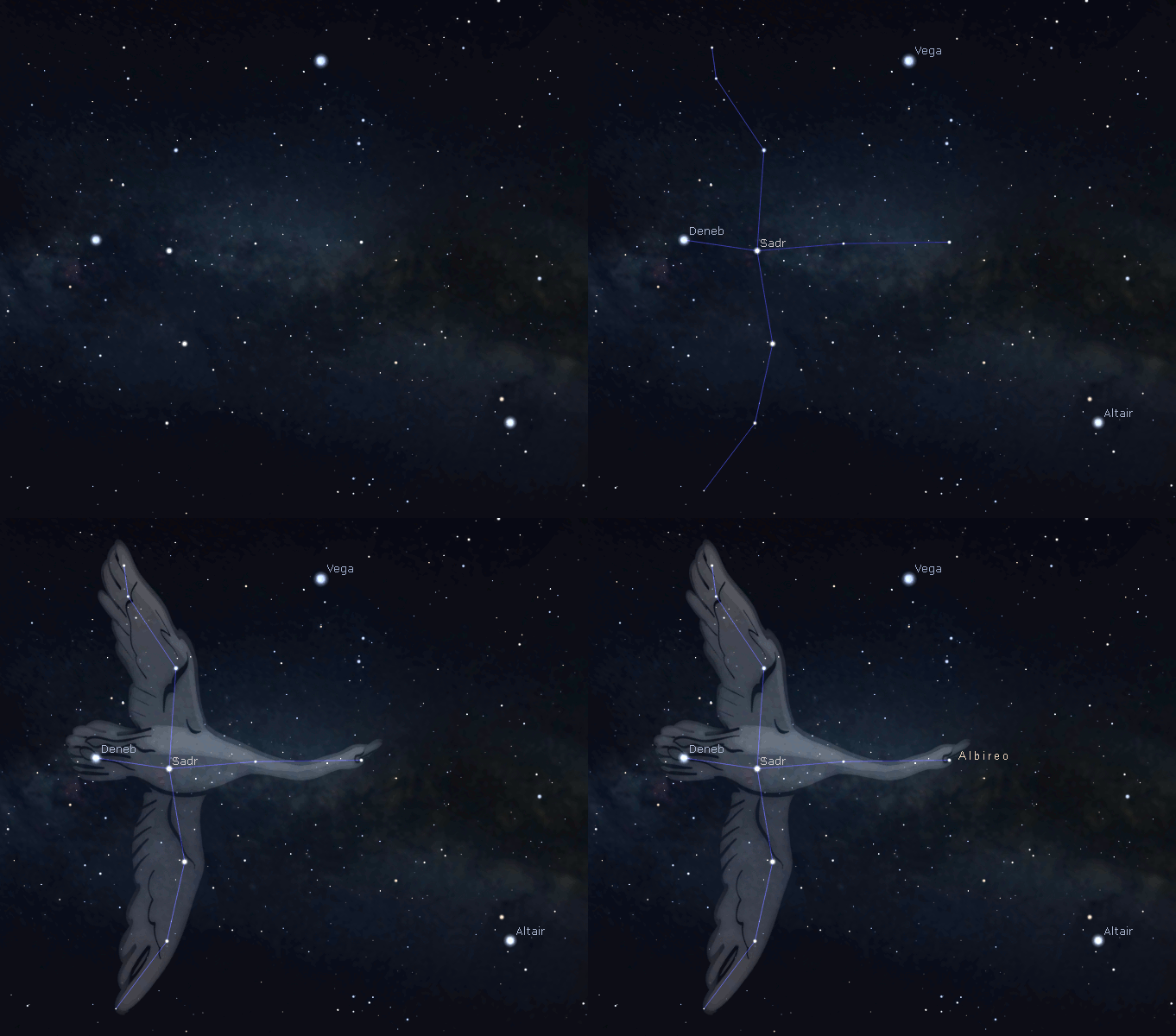
Animated Albireo finder chart. Albireo is located in the head of Cygnus the swan, or at the base of the Northern Cross. Tagged stars are, beside Albireo, the stars of the Summer Triangle: Deneb, Vega and Altair plus the star at the junction of the upright and crosspiece of the cross, Sadr. Created using Stellarium.
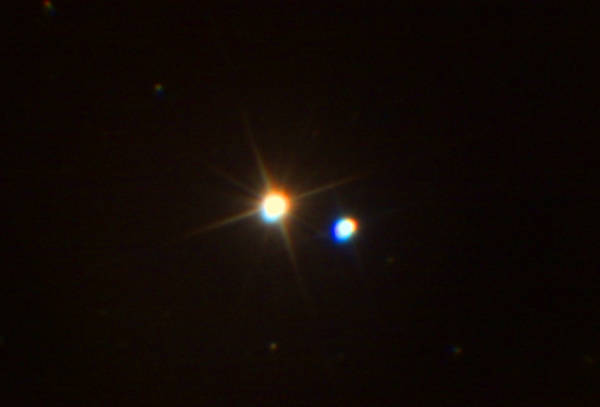
Albireo, captured at high magnification by the staff of the Smithsonian Institution.
07/21/2021 – Ephemeris – Let’s search for the naked-eye planets for this week
This is Ephemeris for Wednesday, July 21st. Today the Sun will be up for 15 hours and 2 minutes, setting at 9:20, and it will rise tomorrow at 6:18. The Moon, 2 days before full, will set at 4:13 tomorrow morning.
Let’s search for the naked-eye planets for this week. Venus can be spotted low in the west-northwest twilight by 10 pm. It will set at 10:49 pm. Venus will be spending the rest of summer low in the western sky, and not be as conspicuous as it usually is as the Evening Star. Mars’ visibility is a real problem. It will be to the right and below Venus in the evening, and will set at 10:35 pm. It’s much dimmer than Venus. The bright star Regulus will be just below and left of Venus tonight. Saturn will be seen low in the southeast in the evening, with Jupiter rising later and best in the morning sky. Saturn will rise at 9:49 pm. Brighter Jupiter will rise at 10:41 pm, both in the east-southeast. By 5:30 am, these two planets will be in the southern sky in the morning twilight.
The astronomical event times given are for the Traverse City/Interlochen area of Michigan (EDT, UT – 4 hr). They may be different for your location.
Addendum
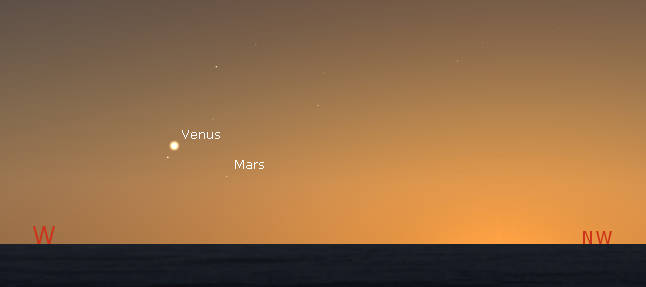
Venus and Mars in evening twilight at 10 pm, about 40 minutes after sunset, tonight, Julyn21, 2021. Regulus, the first magnitude star in Leo, will appear just below and left of Venus. Click on the image to enlarge it. Created using Stellarium.
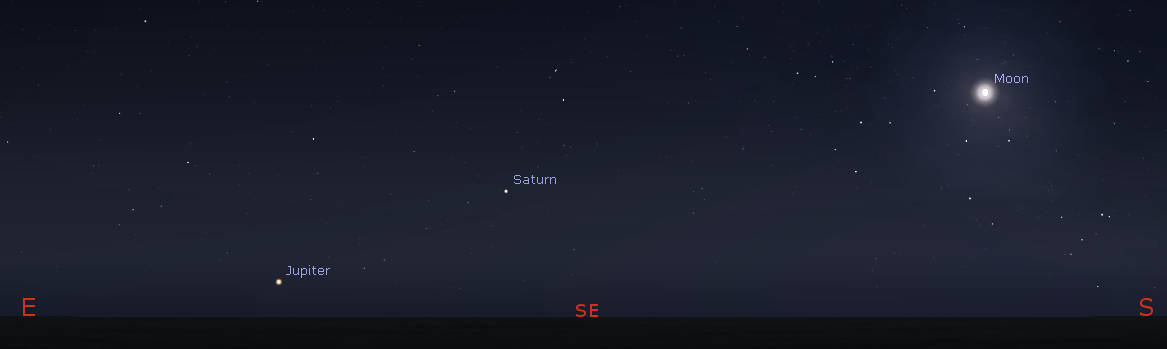
The Gibbous Moon, Saturn, and Jupiter at 11 pm, tonight, July 21, 2021. The Moon is above the spout in the asterism of the Teapot in Sagittarius. Click on the image to enlarge it. Created using Stellarium.
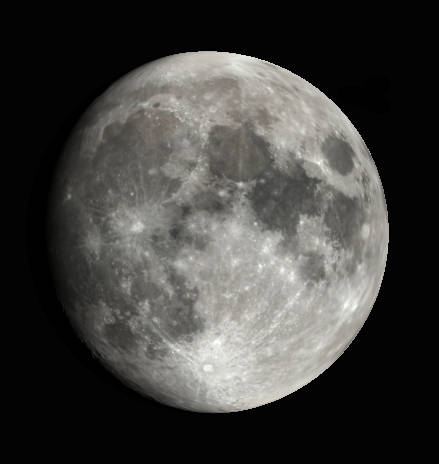
The gibbous Moon as it will look like in binoculars or small telescope tonight, July 21, 2021. Created using Stellarium.
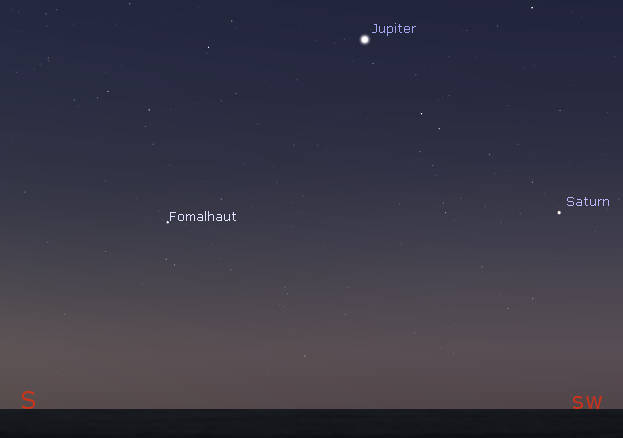
Jupiter and Saturn with the bright autumn star Fomalhaut, seen in morning twilight at 5:30. Created using Stellarium.
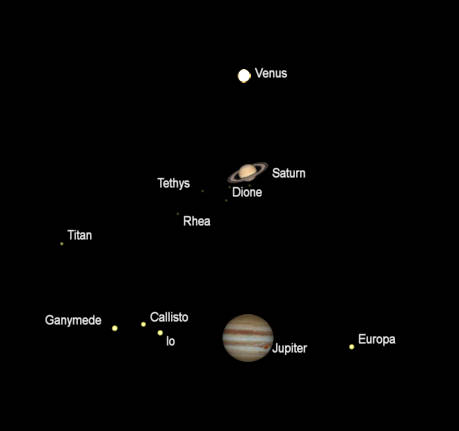
Telescopic view of the bright planets (north up), with the same magnification, this evening, July 21, 2021. Apparent diameters: Venus, 12.17″; Saturn 18.56″, its rings 43.24″; Jupiter, 47.70″. Mars has an apparent diameter of only 3.71″ and is not represented. The ” symbol means seconds of arc (1/3600th of a degree.) Click on the image to enlarge it. Created using Cartes du Ciel (Sky Charts).
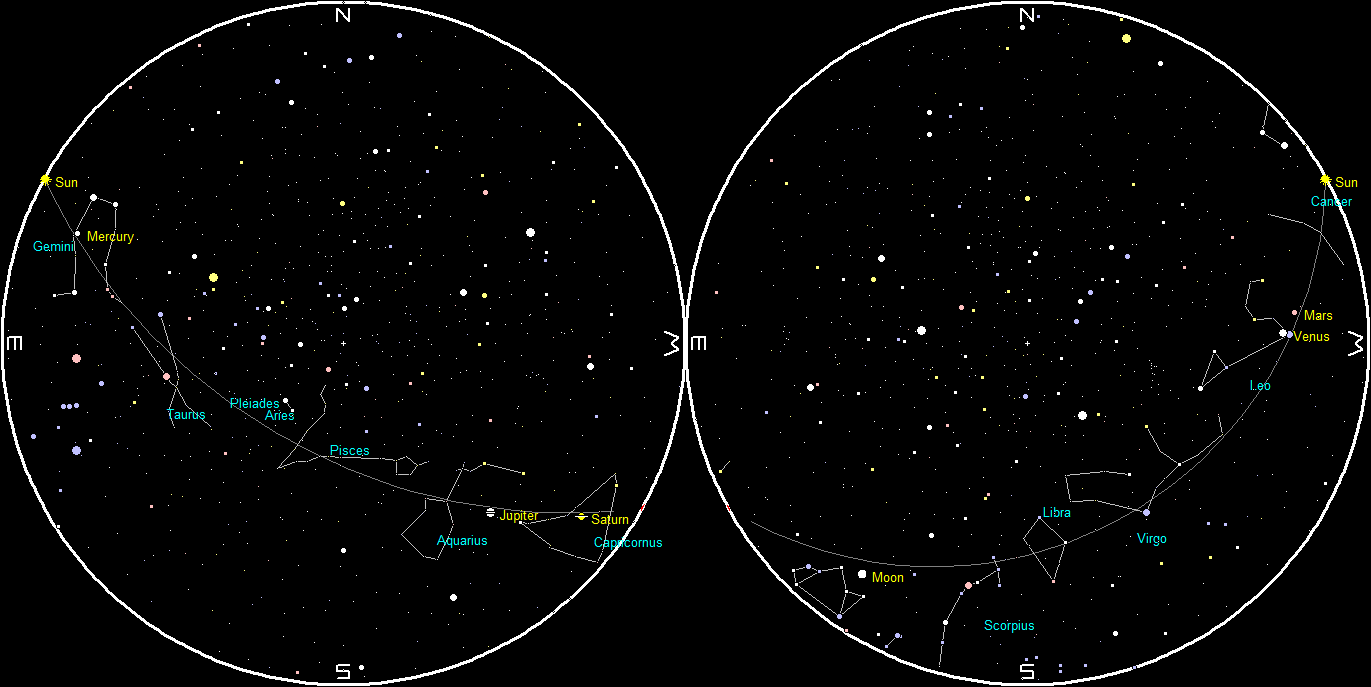
Planets and the Moon at sunset and sunrise of a single night, starting with sunset on the right on July 21, 2021. The night ends on the left with sunrise on the 22nd. Click on the image to enlarge. Created using my LookingUp program.
06/16/2021 – Ephemeris – Let’s search for the naked-eye planets for this week
This is Bob Moler with Ephemeris for Wednesday, June 16th. Today the Sun will be up for 15 hours and 34 minutes, setting at 9:30, and it will rise tomorrow at 5:56. The Moon, 1 day before first quarter, will set at 1:55 tomorrow morning.
Let’s search for the naked-eye planets for this week. Venus can be spotted low in the west-northwest twilight by 10 pm or a little after. Venus will set at 11:04 pm. Mars can be found in the west-northwest at 10:30 tonight, It’s in Cancer and by next Wednesday will pass in front of the Beehive star cluster which can be easily seen in a pair of binoculars. Check it out each night before then and watch Mars approach the cluster, now to its upper left. Mars will set at 11:55 pm. Jupiter and Saturn, are in the morning sky. Saturn will rise at 12:12 am. It’s seen with the stars of Capricornus. Brighter Jupiter, to the left of Saturn, will rise at 1:01 am. By 5 am, these two planets will be in the south-southeast in the morning twilight.
The astronomical event times given are for the Traverse City/Interlochen area of Michigan. They may be different for your location.
Addendum
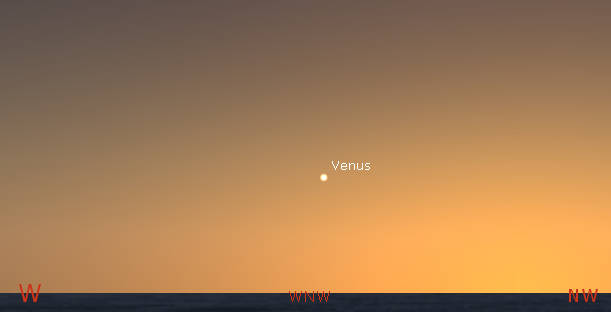
Venus in evening twilight at 10 pm or a half hour after sunset tonight over a sea or Lake Michigan horizon. Venus is a bit less than 10 degrees altitude. Created using Stellarium.
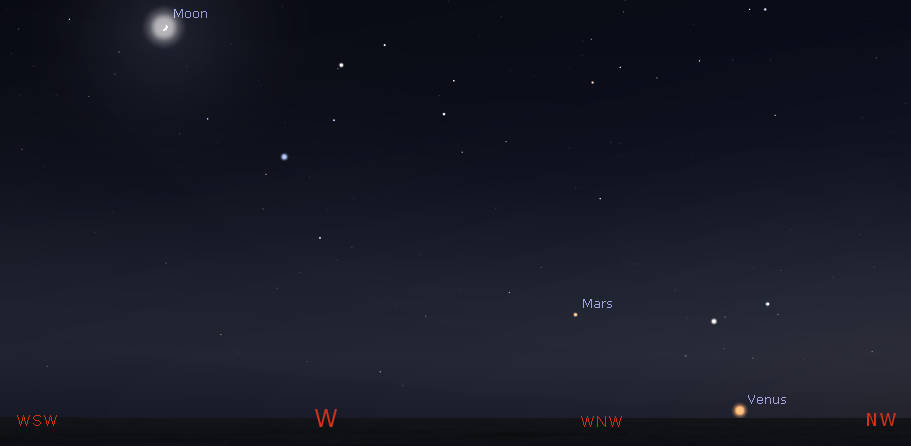
The Moon, Mars and Venus at 11 pm or an hour and a half after sunset tonight over a sea or Lake Michigan horizon. Click on the image to enlarge. Created using Stellarium.
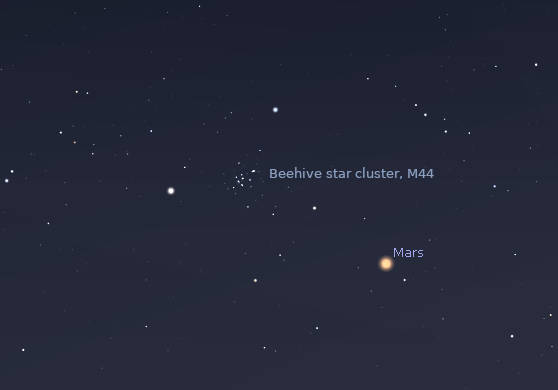
Mars and the Beehive star cluster at 11 pm tonight as they might be seen in binoculars. Created using Stellarium.
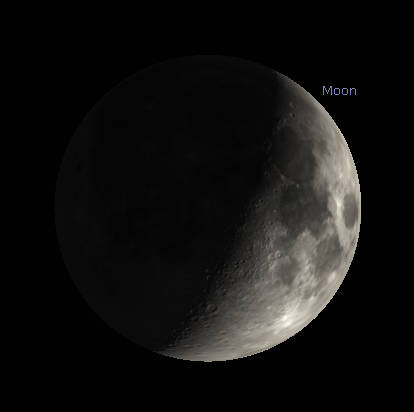
The Moon as it might appear tonight in binoculars or small telescope tonight. Created using Stellarium.
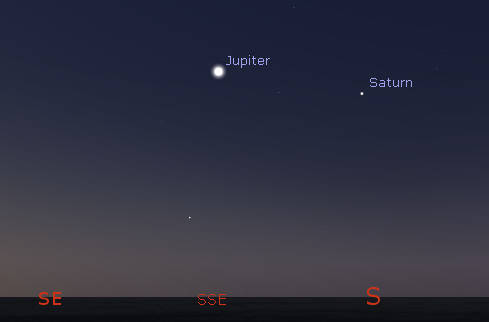
Jupiter and Saturn at 5 am or an hour before sunrise tomorrow morning. Created using Stellarium.
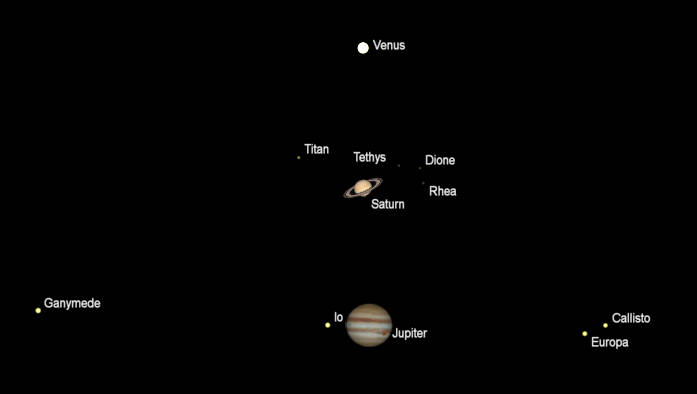
Telescopic views of Venus, Saturn and Jupiter. Venus at the same magnification. Venus, seen at 10 pm, will be 10.72″ in diameter. Saturn at 5 am will be 18.00″ in diameter, its rings 44.43″ in extent. And Jupiter will be 43.43″. The normal cutoff for whether to show a planet here is an apparent diameter of 10″ or greater. Mars doesn’t make the cut, its apparent diameter will be 3.98″ tonight. The ” symbol means seconds of arc (1/3600th of a degree). Created using Cartes du Ciel (Sky Charts).
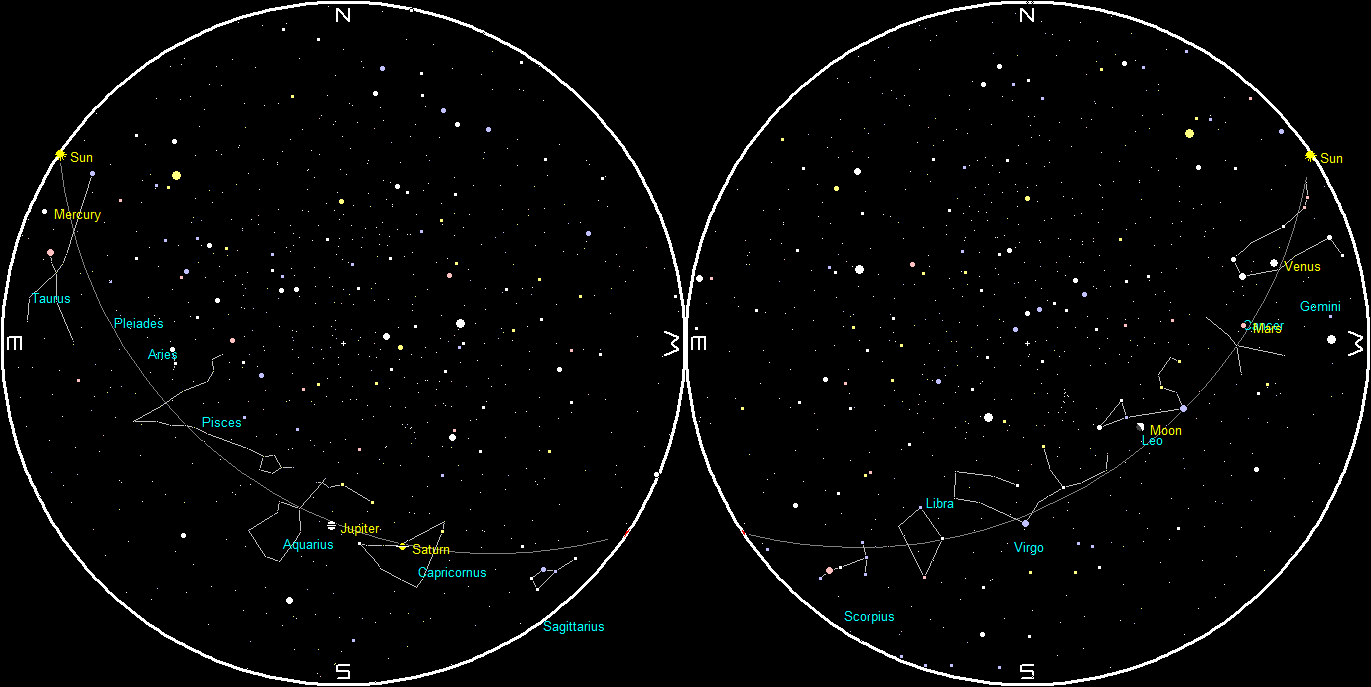
Planets and the Moon at sunset and sunrise of a single night, starting with sunset on the right on June 16, 2021. The night ends on the left with sunrise on the 17th. Click on the image to enlarge. Created using my LookingUp program.
05/13/2021 – Ephemeris – The Moon and Mercury will appear near one another tonight
This is Ephemeris for Thursday, May 13th. Today the Sun will be up for 14 hours and 45 minutes, setting at 9:02, and it will rise tomorrow at 6:15. The Moon, 2 days past new, will set at 11:08 this evening.
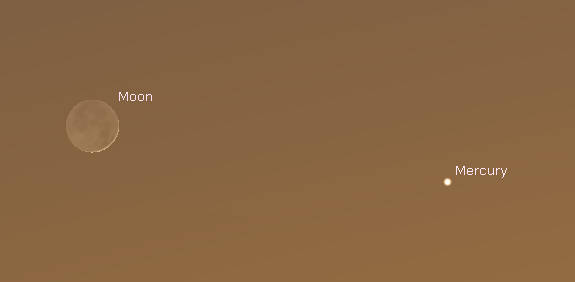
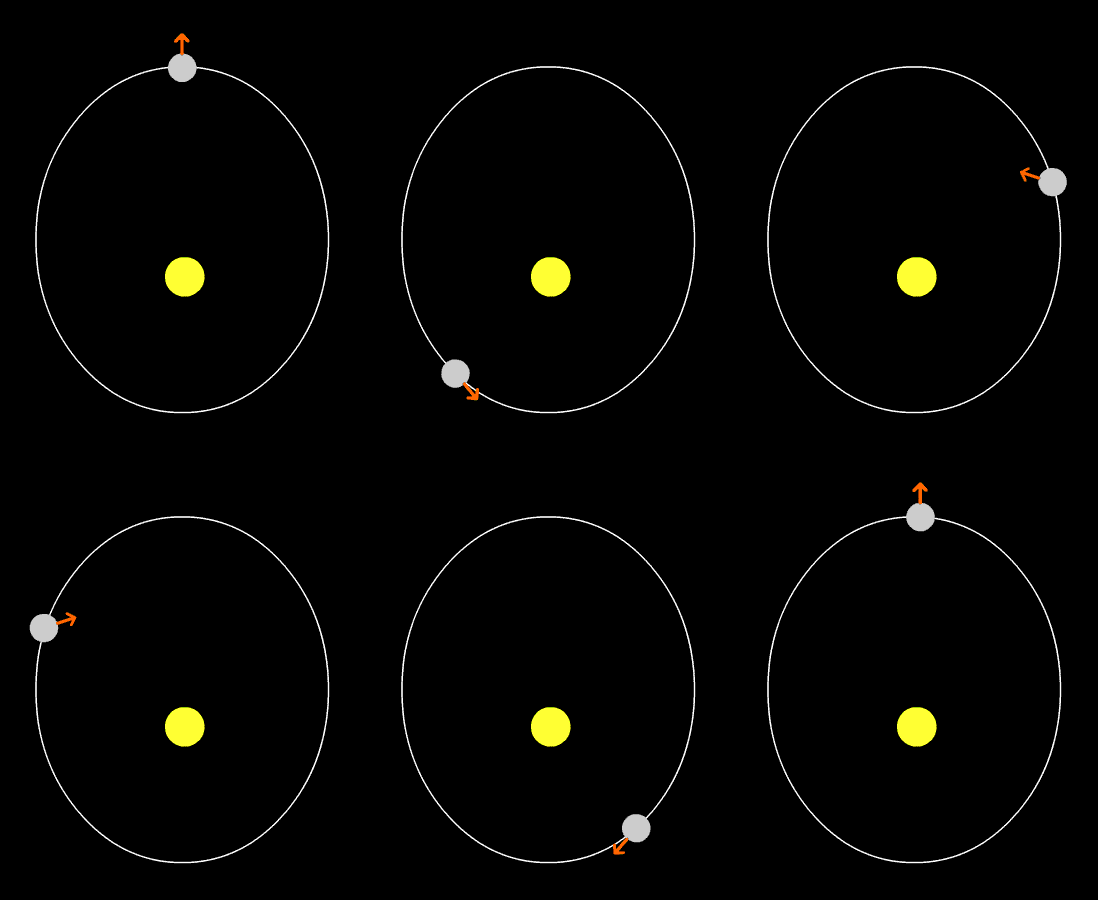
Tonight starting around 9:30, or half an hour after sunset is a good time to spot the thin crescent two day old Moon and the planet Mercury. The tiny and elusive Mercury will be about 7 moon widths to right of the Moon. With the Moon near Mercury, it should be easier to find instead of trying to locate it in the great expanse of featureless twilit sky. Mercury has a weird rotational period. In my youth astronomers thought that Mercury rotated so that one face would perpetually face the Sun, So it would rotate in the same time it orbits the Sun of 88 days. That’s what happens when the Moon orbits the Earth. However, Mercury rotates in exactly 2/3rds of its orbital time, making its solar day two of its years long or 176 Earth days.
The astronomical event times given are for the Traverse City/Interlochen area of Michigan. They may be different for your location.
Addendum
05/05/2021 – Ephemeris – Let’s search for the naked-eye planets for this week
This is Ephemeris for Cinco de Mayo, Wednesday, May 5th. Today the Sun will be up for 14 hours and 26 minutes, setting at 8:53, and it will rise tomorrow at 6:25. The Moon, 2 days past last quarter, will rise at 4:44 tomorrow morning.
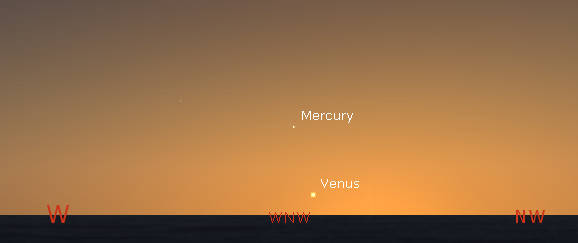
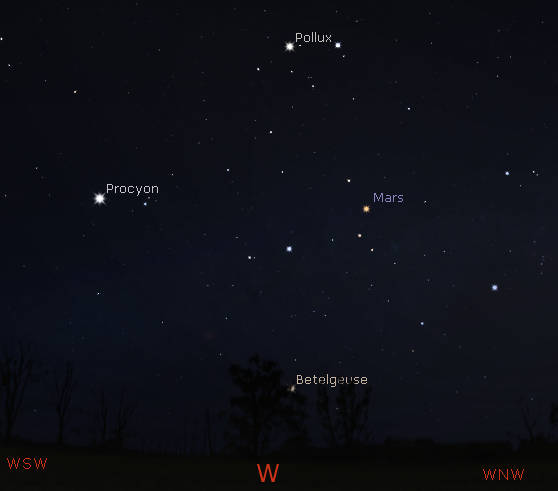
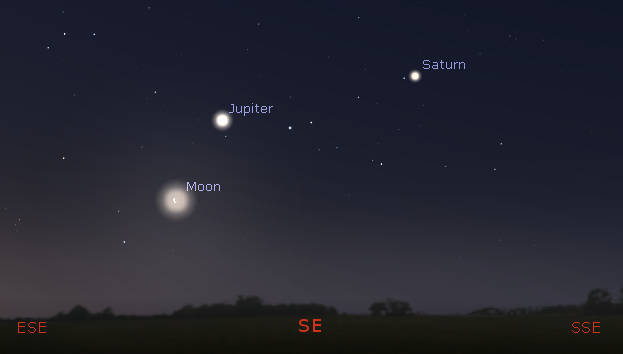
Let’s search for the naked-eye planets for this week. Mars will be joined by one or two more planets, deep in twilight. Both Mercury and Venus are now just above where the Sun set. By 9:30 pm Mercury should be able to be spotted low in the west-northwest. Venus might be spotted lower and somewhat earlier. Venus will be setting at 9:46 and Mercury at 10:33. Mars can be found in the west at 10 pm tonight, in the constellation of Gemini the twins. Tonight it’s just by Castor’s leg. Mars will set at 1:11 am. Jupiter and Saturn, are in the morning sky. Saturn will rise at 2:57 am, with brighter Jupiter rising at 3:38 am. By 5:30 am they will be low in the southeast. The Eta Aquariid meteor shower will reach it’s peak early tomorrow morning.
The astronomical event times given are for the Traverse City/Interlochen area of Michigan. They may be different for your location.
Addendum
01/20/2021 – Ephemeris – Let’s have a lookout for the naked-eye planets for this week
This is Ephemeris for Inauguration Day, Wednesday, January 20th. Today the Sun will be up for 9 hours and 22 minutes, setting at 5:35, and it will rise tomorrow at 8:12. The Moon, at first quarter today, will set at 1:38 tomorrow morning.
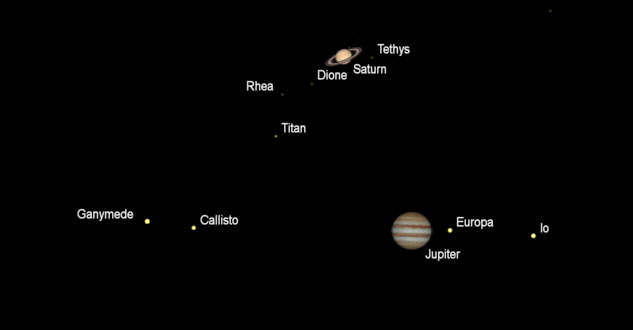
Let’s have a lookout for the naked-eye planets for this week. Mercury has joined Jupiter and Saturn extremely low in the southwestern sky. I’m afraid Saturn will be lost in the twilight, but Jupiter, with Mercury above it might be visible. Both are extremely low in the southwestern sky around 6 pm or a bit earlier. Jupiter will set at 6:04 pm and Mercury will set at 7:06 pm. Mercury might be the only one that can be spotted. Quite high in the south at 7 pm Mars can be found. It will actually be due south at 6:56 pm tonight, and above the Moon. Mars is increasing its speed eastward against the constellations and will set at 2 am. Venus will be hard to spot in the morning twilight after it rises at 7:22 tomorrow morning.
The event times given are for the Traverse City/Interlochen area of Michigan. They may be different for your location.
Addendum
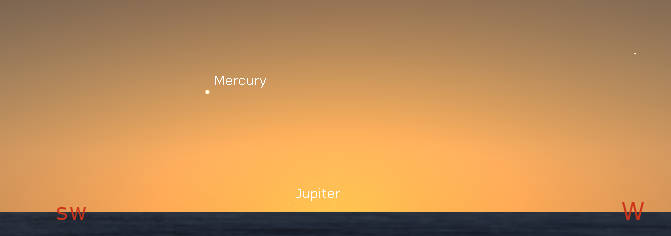
Mercury in the evening twilight at 6 pm January 20, 2021. Though Jupiter is just above the horizon it should not be visible. Created using Stellarium.
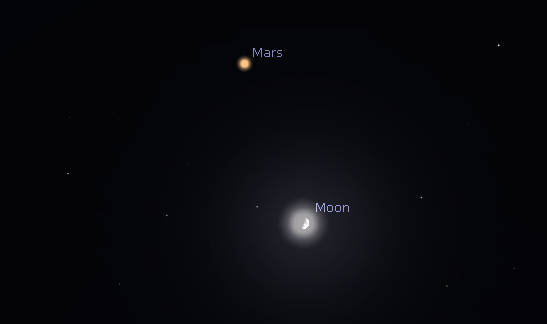
Mars and the first quarter Moon at 7 pm tonight, January 20, 2021. Created using Stellarium.
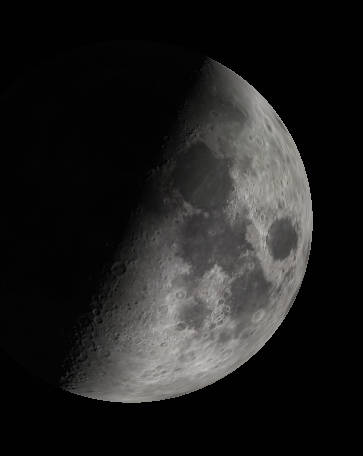
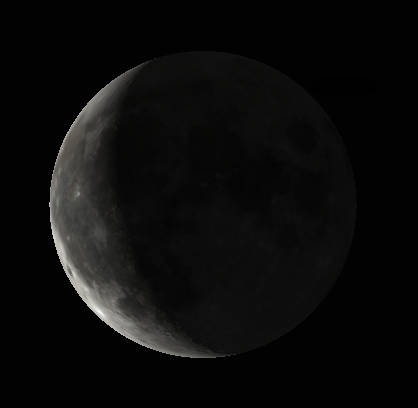
Binocular or low power telescope view of the first quarter Moon. Created using Stellarium.
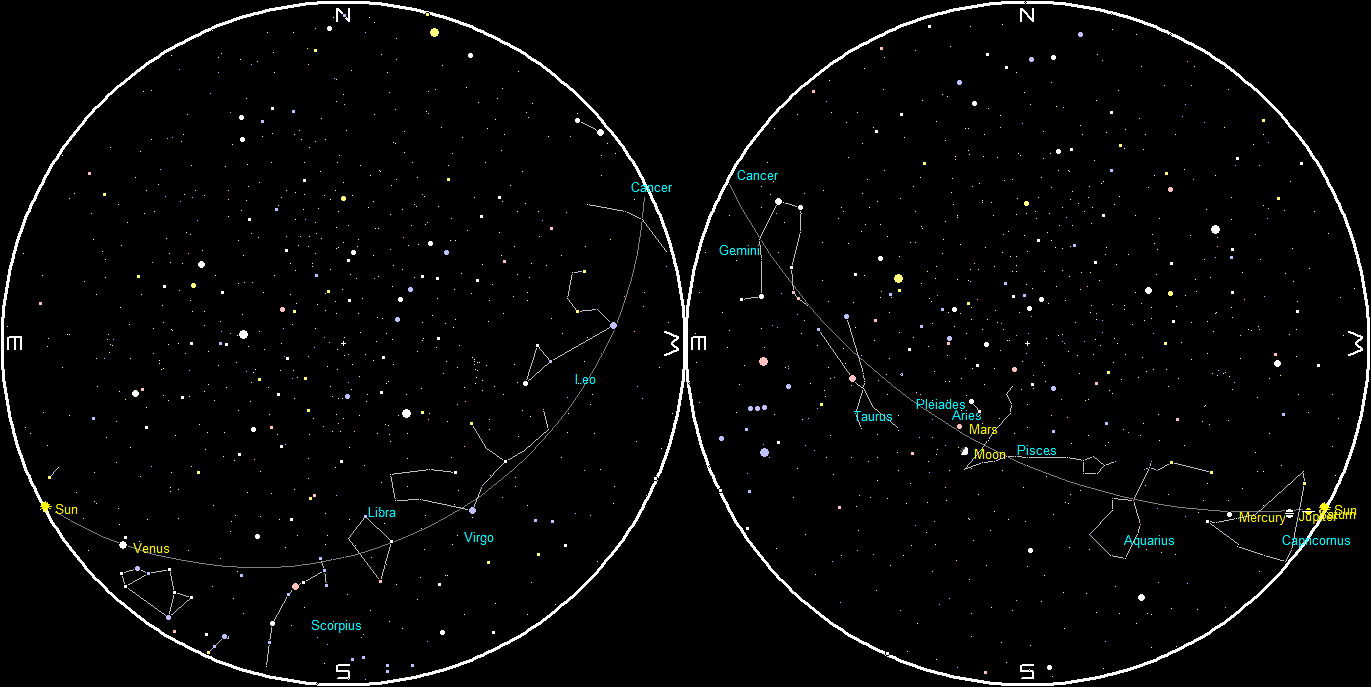
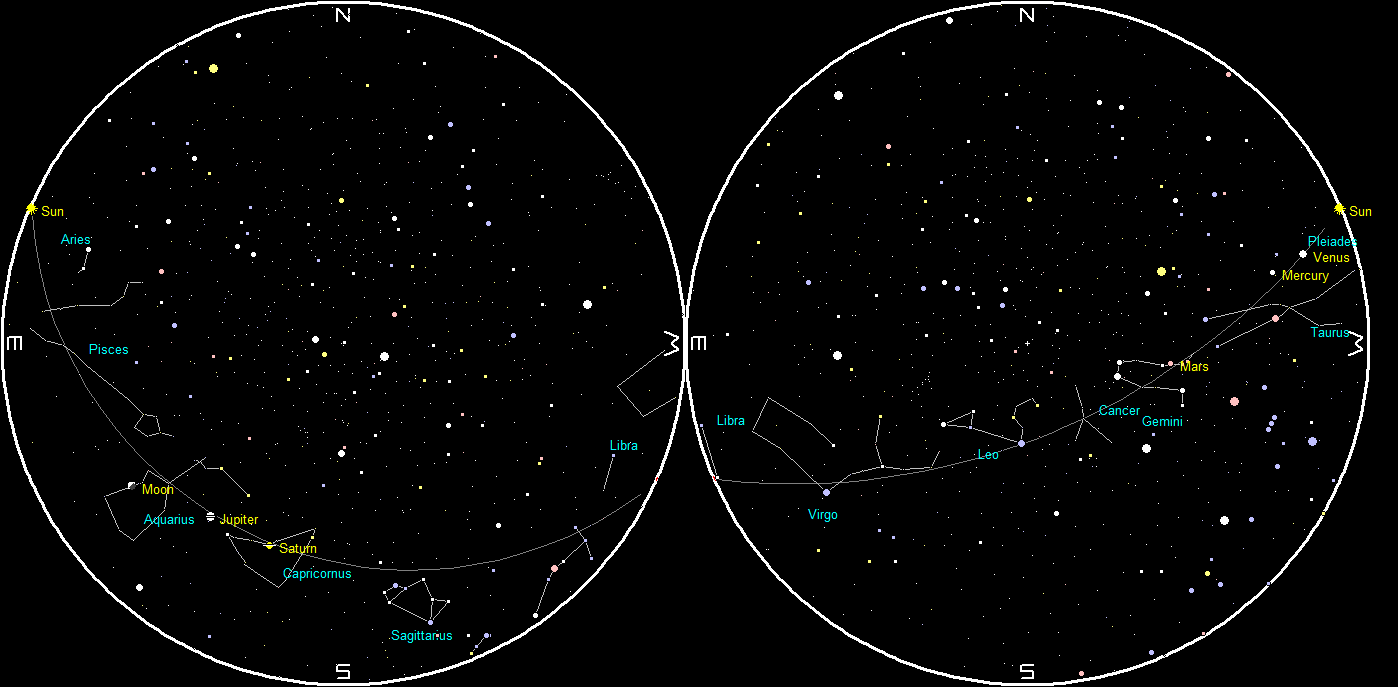
Planets and the Moon at sunset and sunrise of a single night starting with sunset on the right on January 20, 2021. The night ends on the left with sunrise on the 21st. I’m afraid that the labels for Jupiter, Saturn and now the Sun overlap, since the planets and Sun are very close. Click on the image to enlarge. Created using my LookingUp program.
12/01/2020 – Ephemeris – Previewing December skies
This is Ephemeris for Tuesday, December 1st. Today the Sun will be up for 9 hours and 2 minutes, setting at 5:03, and it will rise tomorrow at 8:01. The Moon, 1 day past full, will rise at 6:02 this evening.
Let’s look at December skies. We are now in the holiday season and about to celebrate the southernmost travel of the Sun in the sky and its return northward. So there is not much change in sunrise and sunset times. The Sun will stop its travel south, the winter solstice, on the 21st at 5:02 am. It will make that day the shortest day in terms of daylight hours. However, the earliest sunset will occur on the 9th. The Geminid meteor shower will reach its peak on the evening of the 13th, near new moon. Also in the evening on the 21st Jupiter and Saturn will be in conjunction and will be easily visible in the same binocular or low power telescope field. This month starts out with a surprisingly active Sun at the start of a new sunspot cycle.
The event times given are for the Traverse City/Interlochen area of Michigan. They may be different for your location.
Addendum
December Evening Star Chart
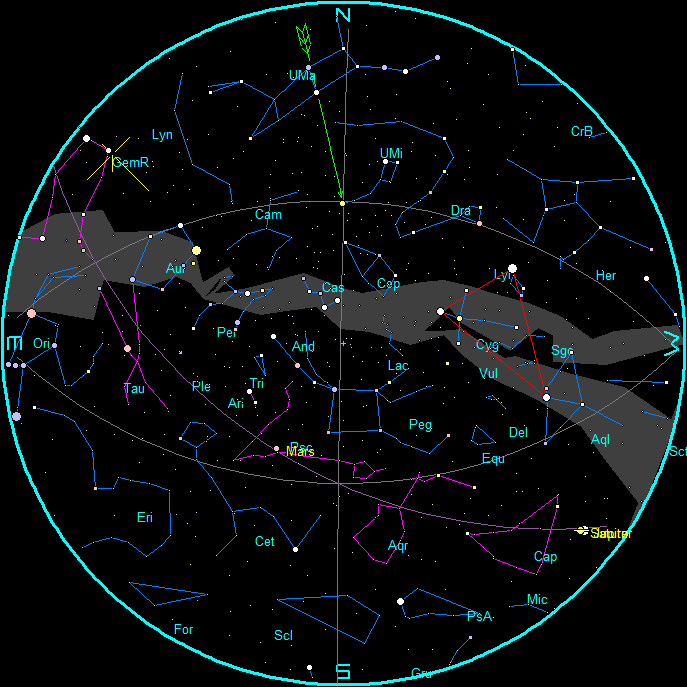
Star Chart for December 2020 (7 p.m. EST December 15, 2019). Click on image to enlarge. Created using my LookingUp program. Click on image to enlarge.
Credit my LookingUp program.
The planets and stars are plotted for the 15th at 7 pm EST (two hours earlier this year to include Jupiter and Saturn) in the evening and 6 a.m. for the morning chart. These are the chart times. Note that Traverse City is located approximately 45 minutes behind our time meridian, West 75° longitude. (An hour 45 minutes behind our daylight saving time meridian during EDT).
December Morning Star Chart
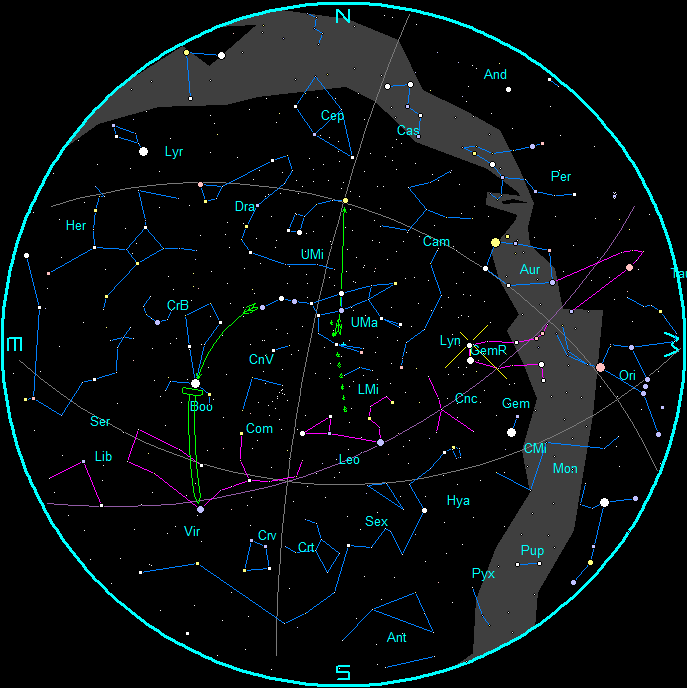
Star Chart for December mornings 2020 (6 a.m. EST December 15, 2020). Click on image to enlarge. Created using my LookingUp program. Credit my LookingUp program.
For a list of constellation names to go with the abbreviations click here.
- Pointer stars at the front of the bowl of the Big Dipper point to Polaris the North Star.
- The leaky bowl of the Big Dipper drips on Leo.
- Follow the arc of the handle of the Big Dipper to the star Arcturus, then
- Follow the spike to Spica.
- The Summer Triangle is in red.
- GemR on the star charts is the radiant of the Geminid meteor shower which peaks on the evening of the 13th.
Twilight Limits, Nautical and Astronomical
| EST | |||||||
| Morning twilight | Evening twilight | Dark night | Moon | ||||
| Date | Astro. | Nautical | Nautical | Astro. | Start | End | Illum. |
| 2020-12-01 | 6h21m | 6h56m | 18h15m | 18h51m | – | – | 0.99 |
| 2020-12-02 | 6h22m | 6h57m | 18h15m | 18h50m | 18h50m | 18h51m | 0.97 |
| 2020-12-03 | 6h23m | 6h58m | 18h15m | 18h50m | 18h50m | 19h48m | 0.92 |
| 2020-12-04 | 6h23m | 6h59m | 18h15m | 18h50m | 18h50m | 20h52m | 0.85 |
| 2020-12-05 | 6h24m | 7h00m | 18h15m | 18h50m | 18h50m | 22h00m | 0.77 |
| 2020-12-06 | 6h25m | 7h01m | 18h15m | 18h50m | 18h50m | 23h12m | 0.67 |
| 2020-12-07 | 6h26m | 7h01m | 18h15m | 18h50m | 18h50m | – | 0.56 |
| 2020-12-08 | 6h27m | 7h02m | 18h15m | 18h50m | 18h50m | 0h25m | 0.45 |
| 2020-12-09 | 6h28m | 7h03m | 18h15m | 18h50m | 18h50m | 1h39m | 0.33 |
| 2020-12-10 | 6h29m | 7h04m | 18h15m | 18h50m | 18h50m | 2h55m | 0.22 |
| 2020-12-11 | 6h29m | 7h05m | 18h15m | 18h50m | 18h50m | 4h13m | 0.13 |
| 2020-12-12 | 6h30m | 7h05m | 18h15m | 18h51m | 18h51m | 5h33m | 0.06 |
| 2020-12-13 | 6h31m | 7h06m | 18h15m | 18h51m | 18h51m | 6h31m | 0.01 |
| 2020-12-14 | 6h31m | 7h07m | 18h16m | 18h51m | 18h51m | 6h31m | 0 |
| 2020-12-15 | 6h32m | 7h08m | 18h16m | 18h51m | 18h51m | 6h32m | 0.02 |
| 2020-12-16 | 6h33m | 7h08m | 18h16m | 18h52m | 19h09m | 6h33m | 0.06 |
| 2020-12-17 | 6h29m | 7h05m | 18h13m | 18h48m | 20h19m | 6h29m | 0.13 |
| 2020-12-18 | 6h30m | 7h06m | 18h13m | 18h49m | 21h29m | 6h30m | 0.21 |
| 2020-12-19 | 6h31m | 7h06m | 18h14m | 18h49m | 22h37m | 6h31m | 0.3 |
| 2020-12-20 | 6h31m | 7h07m | 18h14m | 18h49m | 23h42m | 6h31m | 0.4 |
| 2020-12-21 | 6h32m | 7h07m | 18h14m | 18h50m | – | 6h32m | 0.5 |
| 2020-12-22 | 6h32m | 7h08m | 18h15m | 18h51m | 0h46m | 6h32m | 0.6 |
| 2020-12-23 | 6h33m | 7h08m | 18h16m | 18h51m | 1h47m | 6h33m | 0.69 |
| 2020-12-24 | 6h33m | 7h08m | 18h16m | 18h52m | 2h49m | 6h33m | 0.78 |
| 2020-12-25 | 6h33m | 7h09m | 18h17m | 18h52m | 3h51m | 6h33m | 0.85 |
| 2020-12-26 | 6h34m | 7h09m | 18h17m | 18h53m | 4h54m | 6h34m | 0.91 |
| 2020-12-27 | 6h34m | 7h09m | 18h18m | 18h54m | 5h57m | 6h34m | 0.96 |
| 2020-12-28 | 6h34m | 7h10m | 18h19m | 18h54m | – | – | 0.99 |
| 2020-12-29 | 6h35m | 7h10m | 18h20m | 18h55m | – | – | 0.99 |
| 2020-12-30 | 6h35m | 7h10m | 18h20m | 18h56m | – | – | 1 |
| 2020-12-31 | 6h35m | 7h10m | 18h21m | 18h56m | – | – | 0.99 |
Twilight calendar was generated using Cartes du Ciel (Sky Charts).
See my blog post: Twilight Zone for the definitions of the different periods of twilight here: https://bobmoler.wordpress.com/2018/09/27/.
NASA Calendar of Planetary Events
     Date     Time    Event
Dec 1  Tu            Venus: 27.5° W
    1  Tu  02:46 am  Moon Ascending Node
    2  We  08:22 pm  Moon North Dec.: 24.9° N
    4  Fr  08:10 pm  Moon-Beehive: 2.5° S
    7  Mo  07:37 pm  Last Quarter
   12  Sa  03:40 pm  Moon-Venus: 0.8° S
   12  Sa  03:42 pm  Moon Perigee: 361800 km
   13  Su  07:50 pm  Geminid Meteor Shower: ZHR = 120
   14  Mo  06:03 am  Moon Descending Node
   14  Mo  11:15 am  Total Solar Eclipse
                          (Pacific, S America, Atlantic)
   14  Mo  11:17 am  New Moon
   15  Tu  05:23 pm  Moon South Dec.: 24.9° S
   16  We  11:28 pm  Moon-Jupiter: 3° N
   17  Th  12:25 am  Moon-Saturn: 3.1° N
   19  Sa  09:56 pm  Mercury Superior Solar Conjunction
   21  Mo  05:02 am  Winter Solstice
   21  Mo  06:41 pm  First Quarter
   22  Tu  04:00 am  Ursid Meteor Shower: ZHR = 10
   22  Tu  04:35 am  Jupiter-Saturn: 0.1° N
   23  We  09:48 am  Venus-Antares: 5.6° N
   24  Th  11:32 am  Moon Apogee: 405000 km
   28  Mo  10:03 am  Moon Ascending Node
   29  Tu  10:28 pm  Full Moon
   30  We  02:53 am  Moon North Dec.: 24.9° N
All event times are given for UTC-5 Eastern Standard Time.
Sky Events Calendar by Fred Espenak and Sumit Dutta (NASA’s GSFC),
http://eclipse.gsfc.nasa.gov/SKYCAL/SKYCAL.html.
If you go to the above site you can print out a list like the above for the entire year or calendar pages for your time zone.
Sun and Moon Rising and Setting Events
LU                  Ephemeris of Sky Events for Interlochen/TC
December, 2020    Local time zone: EST
+-----------------------------------------------------------------------+
| DATE |  SUN     SUN  DAYLIGHT|   TWILIGHT*    |MOON  RISE OR    ILLUM |
|      |  RISE    SET    HOURS |  END    START  |PHASE SET** TIME FRACTN|
+=======================================================================+
|Tue  1| 08:00a  05:03p  09:02 | 06:12p  06:51a |      Rise 06:02p   98%|
|Wed  2| 08:01a  05:03p  09:01 | 06:12p  06:52a |      Rise 06:51p   94%|
|Thu  3| 08:02a  05:02p  09:00 | 06:12p  06:53a |      Rise 07:48p   88%|
|Fri  4| 08:03a  05:02p  08:58 | 06:12p  06:53a |      Rise 08:52p   80%|
|Sat  5| 08:04a  05:02p  08:57 | 06:12p  06:54a |      Rise 10:00p   71%|
+------+-----------------------+----------------+-----------------------+
|Sun  6| 08:05a  05:02p  08:56 | 06:12p  06:55a |      Rise 11:12p   61%|
|Mon  7| 08:06a  05:02p  08:55 | 06:12p  06:56a |L Qtr Rise 12:25a   50%|
|Tue  8| 08:07a  05:02p  08:54 | 06:12p  06:57a |      Rise 01:39a   39%|
|Wed  9| 08:08a  05:02p  08:53 | 06:12p  06:58a |      Rise 02:55a   28%|
|Thu 10| 08:09a  05:02p  08:52 | 06:12p  06:59a |      Rise 04:13a   18%|
|Fri 11| 08:10a  05:02p  08:51 | 06:12p  07:00a |      Rise 05:33a   10%|
|Sat 12| 08:11a  05:02p  08:51 | 06:12p  07:00a |      Rise 06:53a    4%|
+------+-----------------------+----------------+-----------------------+
|Sun 13| 08:12a  05:02p  08:50 | 06:13p  07:01a |      Rise 08:11a    1%|
|Mon 14| 08:12a  05:02p  08:49 | 06:13p  07:02a |New   Set  05:06p    0%|
|Tue 15| 08:13a  05:02p  08:49 | 06:13p  07:02a |      Set  06:03p    2%|
|Wed 16| 08:14a  05:03p  08:48 | 06:13p  07:03a |      Set  07:09p    7%|
|Thu 17| 08:14a  05:03p  08:48 | 06:14p  07:04a |      Set  08:18p   14%|
|Fri 18| 08:15a  05:03p  08:48 | 06:14p  07:04a |      Set  09:29p   22%|
|Sat 19| 08:16a  05:04p  08:48 | 06:15p  07:05a |      Set  10:37p   31%|
+------+-----------------------+----------------+-----------------------+
|Sun 20| 08:16a  05:04p  08:48 | 06:15p  07:05a |      Set  11:42p   40%|
|Mon 21| 08:17a  05:05p  08:48 | 06:16p  07:06a |F Qtr Set  12:45a   50%|
|Tue 22| 08:17a  05:05p  08:48 | 06:16p  07:06a |      Set  01:47a   60%|
|Wed 23| 08:18a  05:06p  08:48 | 06:17p  07:07a |      Set  02:49a   69%|
|Thu 24| 08:18a  05:07p  08:48 | 06:17p  07:07a |      Set  03:50a   77%|
|Fri 25| 08:18a  05:07p  08:48 | 06:18p  07:08a |      Set  04:53a   84%|
|Sat 26| 08:19a  05:08p  08:49 | 06:19p  07:08a |      Set  05:57a   91%|
+------+-----------------------+----------------+-----------------------+
|Sun 27| 08:19a  05:09p  08:49 | 06:19p  07:08a |      Set  07:00a   96%|
|Mon 28| 08:19a  05:09p  08:50 | 06:20p  07:09a |      Set  08:01a   99%|
|Tue 29| 08:19a  05:10p  08:50 | 06:21p  07:09a |Full  Rise 04:45p  100%|
|Wed 30| 08:19a  05:11p  08:51 | 06:21p  07:09a |      Rise 05:40p   99%|
|Thu 31| 08:20a  05:12p  08:52 | 06:22p  07:09a |      Rise 06:43p   96%|
+-----------------------------------------------------------------------+
* Nautical Twilight
** Moonrise or moonset, whichever occurs between sunrise and sunset
Generated using my LookingUp for DOS program.
 Bob Moler's Ephemeris Blog