Archive
04/11/2017 – Ephemeris – What’s under Jupiter’s cloud tops?
Ephemeris for Tuesday, April 11th. The Sun will rise at 7:04. It’ll be up for 13 hours and 17 minutes, setting at 8:22. The Moon, at full today, will rise at 8:54 this evening.
I made an error in yesterday’s on-air program which I fixed before posting this blog version. The moon Io will be over the face of Jupiter from when it rises tonight until 8:58 p.m.*, thereafter it will be seen just to the west of the planet. What we see of Jupiter are its cloud tops. Planetary astronomers have some very educated guesses as to what lies beneath them. An atmosphere of mainly hydrogen and helium, ending in a hot liquid ocean of hydrogen. Beneath that a core of metallic hydrogen that generates the planet’s huge magnetic field. Below that maybe a core of solid iron and other metals. NASA’s Juno spacecraft now orbiting Jupiter is tasked with finding out the interior structure by measuring the velocity of the spacecraft as it flies just above the cloud tops of this giant planet.
The times given are for the Traverse City/Interlochen area of Michigan. They may be different for your location.
* Observers in other locations around the world can check out the table from yesterday’s post of other Jovian satellite events after this entry is posted at 4:01 UT, April 11, 2017.
Addendum
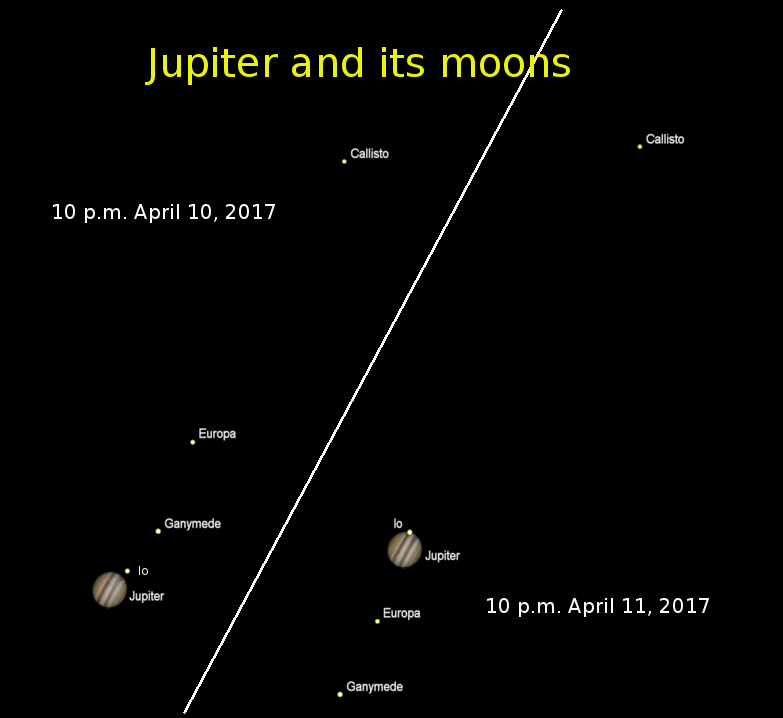
Jupiter and its moons in a telescope at 10 p.m. both April 10th & 11th, 2017. Created using Cartes du Ciel (Sky Charts).
For a year’s worth of Jovian satellite events and when the Great Red Spot crosses Jupiter’s central meridian, go to: http://www.projectpluto.com/jevent.htm.
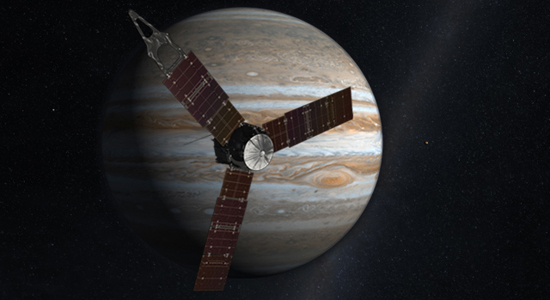
The Juno spacecraft. Credit: NASA.
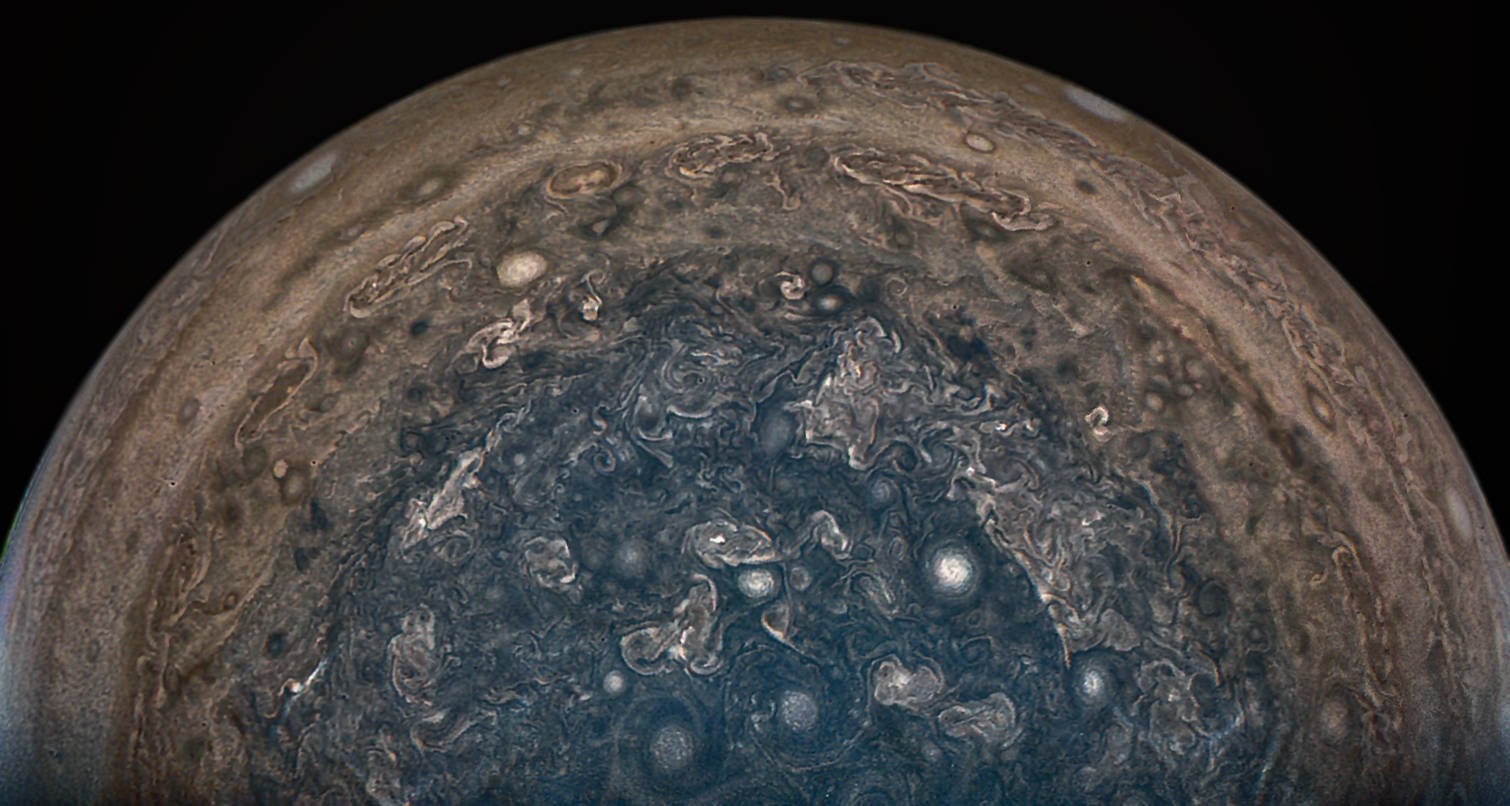
A February 2, 2017 Juno image of Jupiter’s south pole and its chaotic storm clouds. I think I have a paisley tie that looks like that. Credit NASA/JPL-Caltech/SwRI/MSSS/John Landino.
01/01/2017 – Happy Ephemeris New Year
Since the month and year starts on a Sunday, and the Ephemeris program is not broadcast on the weekend I will give you some information that will be part of the January preview program that will run on Monday.
NASA Calendar of Planetary Events
Credit: Sky Events Calendar by Fred Espenak and Sumit Dutta (NASA’s GSFC)
To generate your own calendar go to http://eclipse.gsfc.nasa.gov/SKYCAL/SKYCAL.html
Times are Eastern Time and follow the time change dates.
    Date   Time  Event
Jan 01  Su       Venus: 46.8° E
    02  Mo 04:20 Moon-Venus: 2° S
    02  Mo 13:14 Moon Descending Node
    03  Tu 01:47 Moon-Mars: 0.3° S
    03  Tu 09:10 Quadrantid Meteor Shower: ZHR = 120
    04  We 05:59 Perihelion: 0.9833 AU
    05  Th 14:47 First Quarter
    09  Mo 04:03 Mercury-Saturn: 6.7° N
    09  Mo 09:07 Moon-Aldebaran: 0.4° S
    10  Tu 01:07 Moon Perigee: 363200 km
    11  We 04:32 Moon North Dec.: 18.9° N
    12  Th 06:34 Full Moon
    12  Th 07:59 Venus Greatest Elongation: 47.1° East
    14  Sa 23:07 Moon-Regulus: 0.9° N
    15  Su 05:45 Moon Ascending Node
    19  Th 00:26 Moon-Jupiter: 3° S
    19  Th 04:59 Mercury Greatest Elongation: 24.1° West
    19  Th 17:14 Last Quarter
    21  Sa 19:14 Moon Apogee: 404900 km
    24  Tu 05:37 Moon-Saturn: 4° S
    25  We 06:59 Moon South Dec.: 18.9° S
    25  We 19:46 Moon-Mercury: 4° S
    27  Fr 19:07 New Moon
    29  Su 17:21 Moon Descending Node
    31  Tu 01:12 Jupiter-Spica: 3.5° N
    31  Tu 09:34 Moon-Venus: 4.2° N
    31  Tu 20:09 Moon-Mars: 2.4° N
Feb 01  We       Venus: 45.5° E
January 2017 Calendar
LU                  Ephemeris of Sky Events for Interlochen/TC
January, 2017    Local time zone: EST
+-----------------------------------------------------------------------+
| DATE |  SUN     SUN  DAYLIGHT|   TWILIGHT*    |MOON  RISE OR    ILLUM |
|      |  RISE    SET    HOURS |  END    START  |PHASE SET** TIME FRACTN|
+=======================================================================+
|Sun  1| 08:20a  05:13p  08:53 | 06:23p  07:09a |      Set  08:55p   13%|
|Mon  2| 08:20a  05:14p  08:54 | 06:24p  07:09a |      Set  10:00p   21%|
|Tue  3| 08:20a  05:15p  08:55 | 06:25p  07:10a |      Set  11:06p   31%|
|Wed  4| 08:20a  05:16p  08:56 | 06:26p  07:10a |      Set  12:14a   41%|
|Thu  5| 08:19a  05:17p  08:57 | 06:27p  07:10a |F Qtr Set  01:24a   52%|
|Fri  6| 08:19a  05:18p  08:58 | 06:28p  07:09a |      Set  02:35a   63%|
|Sat  7| 08:19a  05:19p  08:59 | 06:29p  07:09a |      Set  03:47a   74%|
+------+-----------------------+----------------+-----------------------+
|Sun  8| 08:19a  05:20p  09:01 | 06:30p  07:09a |      Set  04:58a   83%|
|Mon  9| 08:19a  05:21p  09:02 | 06:31p  07:09a |      Set  06:07a   91%|
|Tue 10| 08:18a  05:22p  09:04 | 06:32p  07:09a |      Set  07:11a   97%|
|Wed 11| 08:18a  05:23p  09:05 | 06:33p  07:09a |      Set  08:07a  100%|
|Thu 12| 08:17a  05:25p  09:07 | 06:34p  07:08a |Full  Rise 06:04p  100%|
|Fri 13| 08:17a  05:26p  09:08 | 06:35p  07:08a |      Rise 07:12p   97%|
|Sat 14| 08:16a  05:27p  09:10 | 06:36p  07:08a |      Rise 08:20p   92%|
+------+-----------------------+----------------+-----------------------+
|Sun 15| 08:16a  05:28p  09:12 | 06:37p  07:07a |      Rise 09:26p   85%|
|Mon 16| 08:15a  05:30p  09:14 | 06:38p  07:07a |      Rise 10:31p   77%|
|Tue 17| 08:15a  05:31p  09:16 | 06:39p  07:06a |      Rise 11:33p   68%|
|Wed 18| 08:14a  05:32p  09:18 | 06:40p  07:06a |      Rise 12:33a   59%|
|Thu 19| 08:13a  05:33p  09:20 | 06:42p  07:05a |L Qtr Rise 01:32a   49%|
|Fri 20| 08:13a  05:35p  09:22 | 06:43p  07:05a |      Rise 02:30a   40%|
|Sat 21| 08:12a  05:36p  09:24 | 06:44p  07:04a |      Rise 03:27a   31%|
+------+-----------------------+----------------+-----------------------+
|Sun 22| 08:11a  05:37p  09:26 | 06:45p  07:03a |      Rise 04:23a   23%|
|Mon 23| 08:10a  05:39p  09:28 | 06:46p  07:03a |      Rise 05:18a   15%|
|Tue 24| 08:09a  05:40p  09:30 | 06:47p  07:02a |      Rise 06:09a    9%|
|Wed 25| 08:08a  05:42p  09:33 | 06:49p  07:01a |      Rise 06:57a    4%|
|Thu 26| 08:07a  05:43p  09:35 | 06:50p  07:00a |      Rise 07:41a    1%|
|Fri 27| 08:06a  05:44p  09:37 | 06:51p  07:00a |New   Set  05:43p    0%|
|Sat 28| 08:05a  05:46p  09:40 | 06:52p  06:59a |      Set  06:45p    1%|
+------+-----------------------+----------------+-----------------------+
|Sun 29| 08:04a  05:47p  09:42 | 06:54p  06:58a |      Set  07:51p    4%|
|Mon 30| 08:03a  05:49p  09:45 | 06:55p  06:57a |      Set  08:58p   10%|
|Tue 31| 08:02a  05:50p  09:47 | 06:56p  06:56a |      Set  10:06p   17%|
+-----------------------------------------------------------------------+
* Nautical Twilight
** Moonrise or moonset, whichever occurs between sunset and sunrise
08/02/2016 – Ephemeris – Two events for the Grand Traverse Astronomical Society this weekend
Ephemeris for Friday, September 2nd. The Sun will rise at 7:06. It’ll be up for 13 hours and 9 minutes, setting at 8:16. The Moon, 1 day past new, will set at 9:00 this evening.
This is another busy weekend for the Grand Traverse Astronomical Society. Tonight there will be a general meeting of the society at 8 p.m. followed by a star party at 9 p.m. at Northwestern Michigan College’s Rogers Observatory, located on Birmley Road south of Traverse City, to which all are welcome. The featured speaker for the meeting will be Dr. David Penney who will talk about Late Pleistocene Fauna and Extinction and its possible astronomical cause. Saturday there will be a star party at Sleeping Bear Dunes National Lakeshore’s Dune Climb starting at 9 p.m. Both star parties will feature the star clusters and nebulae found in the Milky Way, and views of Saturn and Mars. The dunes are the darkest spot around.
Times are for the Traverse City/Interlochen area of Michigan. They may be different for your location.
02/03/2016 – Ephemeris – Though a morning planet, Jupiter can be seen in the late evening
Ephemeris for Wednesday, February 3rd. The Sun will rise at 8:00. It’ll be up for 9 hours and 53 minutes, setting at 5:53. The Moon, 3 days past last quarter, will rise at 4:27 tomorrow morning.
Let’s check out the whereabouts of the bright naked eye planets. All the classical planets visible from antiquity are officially now in the morning sky. However Jupiter actually will rise at 9 p.m., in the east. Jupiter is still a morning planet since it’s not up at sunset. Mars will rise next at 1:45 a.m. in the east-southeast. It’s left of the bright star Spica. Saturn will rise at 4:05 a.m. in the east-southeast. The Moon will be below, left of it tomorrow morning. Venus will rise at 6:19 a.m. again in the east-southeast. Mercury will rise behind Venus at 6:36. Comet Catalina is up all night and is a binocular object in the dark expanse of the constellation Camelopardalis between the bowl of the Big Dipper and the W shape of Cassiopeia.
Times are for the Traverse City/Interlochen area of Michigan. They may be different for your location.
Addenda
Planets
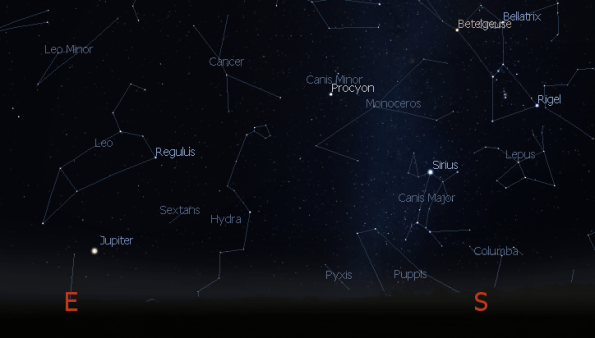
Jupiter low in the east at 10 p.m. on February 3rd, 2016. Created using Stellarium.
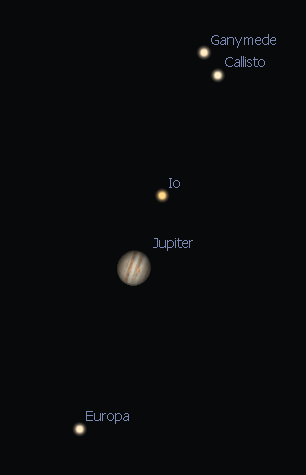
Jupiter and its moons as they would be seen in a telescope, at 10 p.m. February 3, 2016. I’d wait for an hour to let Jupiter rise above the thick atmosphere near the horizon for better clarity. Created using Stellarium.
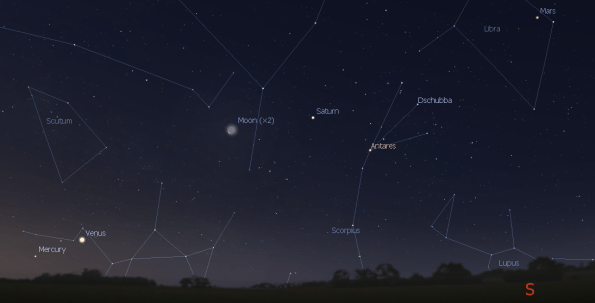
The planets in the morning sky at 7 a.m. on February 4, 2016. Jupiter is far to the west and out of this view. Created using Stellarium.
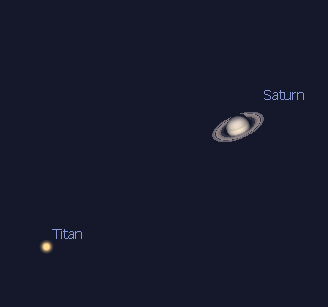
Saturn and its satellite Titan as they should appear in a telescope at 7 a.m. February 4, 2016
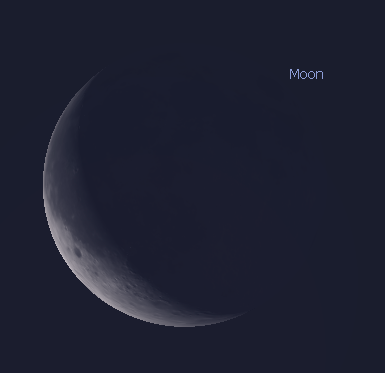
The Moon as it should appear in binoculars tomorrow morning at 7 a.m., February 4, 2016. Created using Stellarium.
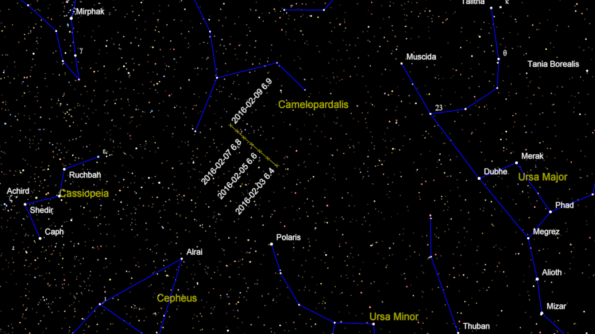
Comet Catalina’s path for the next week. Note that the magnitudes for the comet are about correct. It will take binoculars or a small telescope to spot the comet which will not show a tail visually. Created using Stellarium.
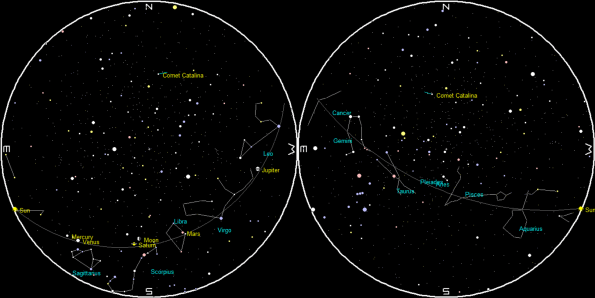
This is a chart showing the sunrise and sunset skies for February 3, 2016 showing the location of the planets, the Moon and Comet Catalina at that time. Created using my LookingUp program.
Off Topic
Stellarium
I’m now using Stellarium 0.14. It can detect older PCs and will not always crash, though I’m not thrilled with how it operates and some screen faults. The Portable Apps version has a patch that can be added to the application. The instructions for the patch are in the download page. Simply search “portable apps” to get started. The portable apps version worked better than the installed version, so I use the portable apps version. It turns out that my laptop can run 0.14, while my desktop cannot. The legacy version of Stellarium is 0.12.5.
It finally cleared up. For a while.
I bought myself a DSLR camera for my birthday/Christmas present a month and a half ago. I used to do a fair amount of astrophotography back before CCDs took over. I had some point and shoot digital cameras, which were not suitable for astrophotography. My last big spurge with film was for Comet Hale-Bopp in 1997.
But with the solar eclipse coming up next year the bug is biting again. I hate to brag but I’ve seen 4 total solar eclipses (1963, 1970, 1972, and 1979), plus 2 annular eclipses. I will recount my experiences with those eclipses in the year leading up to August 21, 2017.
In my film days I had developed a system for setting exposures for the Moon, planets, solar and lunar eclipses, and other possibly faint objects. It took a search to locate the data and used it when it finally cleared up on Ground Hog day. Below is one of the photos.
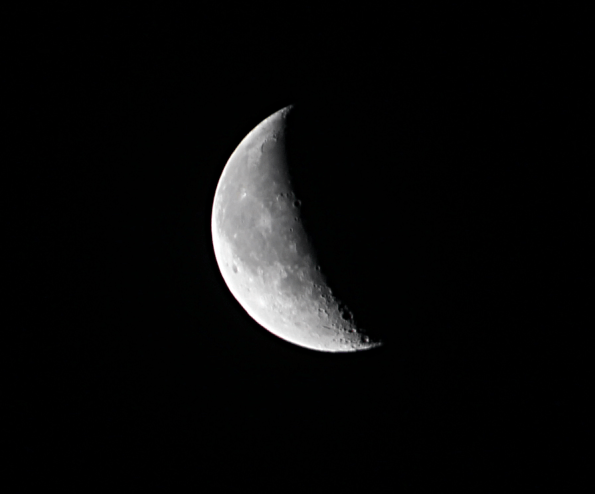
The fat crescent Moon at 7:02 a.m. February 2, 2016. ISO 100, 300mm focal length, f/11, 1/15 second.
09/28/2015 – Ephemeris – The Harvest Moon effect
Ephemeris for Monday, September 28th. The Sun will rise at 7:36. It’ll be up for 11 hours and 52 minutes, setting at 7:29. The Moon, 1 day past full, will rise at 8:00 this evening.
Yesterday’s full moon was the famous Harvest Moon, the nearest full moon to the autumnal equinox. This is a time of the full and waning gibbous moons in the next few days rising in twilight. In the old days before electric lights it helped farmers by effectively lengthening the hours of light to gather in the crops. The Moon on average rises 50 minutes later each night. The interval between tonight’s moon rise and tomorrow’s will be 38 minutes. The interval between Tuesday and Wednesday will be 42 minutes. This year’s harvest moon effect is spoiled a bit because the Moon was at perigee Sunday, the so-called supermoon, so it’s moving faster in its orbit than average. Like the Sun, the Moon always appears orange or red near the horizon.
Times are for the Traverse City/Interlochen area of Michigan. They may be different for your location.
Addendum
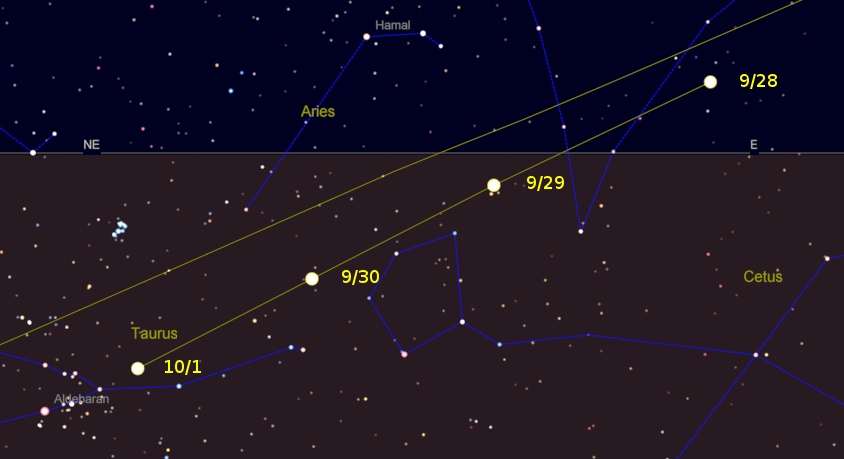
The positions of the Moon from September 28 to October 1, 2015. Note the path of the Moon. At Harvest Moon in northern Michigan time it makes less than a 45 degree angle with the horizon. For other latitudes it’s less than (90 – latitude). shorthand term for 90 – latitude is co-latitude. Created using Cartes du Ciel.
The closer to horizontal the Moon’s path is the shorter the difference in night-to-night rise times.
09/24/2015 – Ephemeris – Looking forward to Sunday’s Lunar Eclipse
Ephemeris for Thursday, September 24th. The Sun will rise at 7:32. It’ll be up for 12 hours and 4 minutes, setting at 7:36. The Moon, half way from first quarter to full, will set at 4:20 tomorrow morning.
Lets check out Sunday’s total lunar eclipse. It will be visible from the entire contiguous United States, and in its entirety from Colorado, eastward. The partial phase will start at 9:07 p.m. The total phase will begin at 10:11 p.m. and extend to 11:23 p.m. when the ending partial phase will start. The eclipse will end at 12:27 a.m. The eclipse is perfectly viewable with the naked eye or binoculars. For those who want company and commentary as to what’s going on, the Grand Traverse Astronomical Society will provide two venues from which to view the eclipse: The Northwestern Michigan College’s Rogers Observatory, south of Traverse City on Birmley Rd. and Platte River Point at the end of Lake Michigan Road off M22, part of the Sleeping Bear Dunes National Lakeshore, weather permitting.
Times are for the Traverse City/Interlochen area of Michigan. They may be different for your location.
Addendum
The following is an excerpt from my September 1 post.
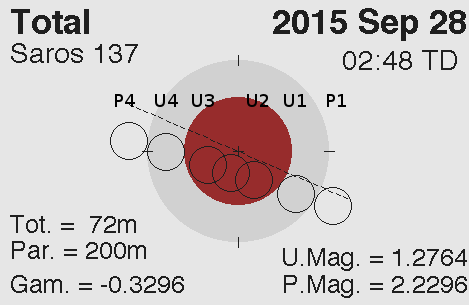
The eclipse occurs on the 28th for Universal Time. It’s the evening of the 27th for us. The Moon travels through the Earth’s shadow from right to left. What are seen are points of contact with the shadow and mid-eclipse. From Five Millennium Canon of Lunar Eclipses (Espenak & Meeus) NASA.
Contact times are labeled P1, U1, U2, U3, U4, and P4. P2 and P3 are omitted because they are synonymous with U1 and U4 respectively:
- P1 – 8:11:47 p.m. Enter the penumbra (unseen). By about 8:30 the duskiness on the left edge of the moon will start to be noticeable.
- U1 – 9:07:11 p.m. Enter the umbra (partial eclipse begins).
- U2 – 10:11:10 p.m. Totality begins.
- Mid eclipse 10:48:17 p.m.
- U3 – 11:23:05 p.m. Totality ends, egress partial phase begins.
- U4 – 12:27:03 a.m. Partial phase ends. The Moon’s upper right edge should appear dusky for the next half hour or so.
- P4 – 1:22:27 a.m. Penumbral phase ends (unseen).
Note: The duskiness of the penumbral phase of the eclipse can be enhanced by viewing through sunglasses.
During the total phase, light leaks in around the Earth due to the bending of light in the Earth’s atmosphere, so the Moon is illuminated by the collective sunrises and sunsets around the globe. This usually gives the Moon a coppery hue, that some are now calling a blood moon. Occasionally, due to volcanic eruptions the Moon can become very dark.
This full moon is also the Harvest Moon and for those who care, a supermoon, it having reached perigee earlier that day.
Weather permitting there will be two GTAS venues to view this eclipse. The first will be the NMC Rogers Observatory. The second will be at the Sleeping Bear Dunes National Lakeshore at Platte River Point at the end of Lake Michigan Road. The site will be open for the visible parts of the eclipse from 9 p.m. to 12:30 a.m.
There’s a severe geomagnetic storm in progress at 7 p.m. EDT (23:00 UT) June 22, 2015
There’s a good chance for auroras (northern/southern lights) tonight at moderate latitudes. In Michigan: we’re under clouds now. Skies may clear by midnight for the west side of the lower peninsula of Michigan according to Anttilla Danko’s Clear Sky Charts, such as this for the Lanphier Observatory in Glen Arbor. Also check spaceweather.com
03/16/2015 – Ephemeris – The bright star Aldebaran
Ephemeris for Monday, March 16th. The Sun will rise at 7:53. It’ll be up for 11 hours and 56 minutes, setting at 7:49. The Moon, 3 days past last quarter, will rise at 5:57 tomorrow morning.
The constellation Orion, is in the south-southwest at 9 p.m. To the right of it, in the southwest is Taurus the bull. The bright orange star in Taurus is Aldebaran. Aldebaran appears at the upper left tip of a letter V group of stars that is the face of the bull. Aldebaran isn’t actually part of the group, called the Hyades star cluster. The cluster is about 151 light years away, while Aldebaran is 65. The star has an orange hue because its surface is cooler than the sun’s. However Aldebaran is 44 times larger in diameter, and shines 518 times brighter than the sun. The name Aldebaran means “Follower” because it follows the Pleiade star cluster through the skies. The Pleiades are to the right of Aldebaran.
Times are for the Traverse City/Interlochen area of Michigan. They may be different for your location.
Addendum
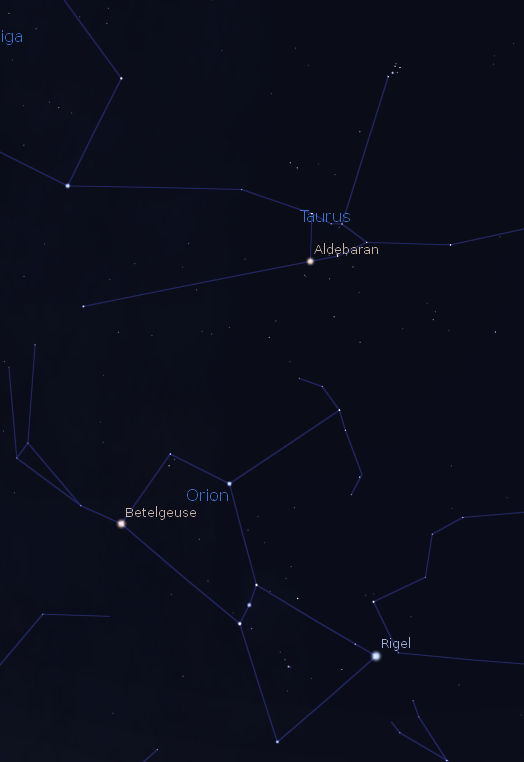
Aldebaran, the Hyades, of Taurus, Orion and the Pleiades. Created using Stellarium.
2014 in review
The WordPress.com stats helper monkeys prepared a 2014 annual report for this blog.

Here’s an excerpt:
The concert hall at the Sydney Opera House holds 2,700 people. This blog was viewed about 59,000 times in 2014. If it were a concert at Sydney Opera House, it would take about 22 sold-out performances for that many people to see it.
2013 in review
The WordPress.com stats helper monkeys prepared a 2013 annual report for this blog.

Here’s an excerpt:
The concert hall at the Sydney Opera House holds 2,700 people. This blog was viewed about 31,000 times in 2013. If it were a concert at Sydney Opera House, it would take about 11 sold-out performances for that many people to see it.
 Bob Moler's Ephemeris Blog