12/03/2020 – Ephemeris Interruptus – I’m in the hospital for tests
Yesterday I developed some symptoms of the stroke I had last January and my daughter took me to the ER where I had a CT scan. I’m waiting on a early am MRI. I should be home later today. I hope to be finishing up my Zoom program In Search of the Star of Bethlehem. If you’re interested go to http://www.gtastro.org Friday. The program will start ar 8 pm EST, though you can join earlier with the GTAS business meeting in progress. I might get the 12/03 post up later in the day.
The audio Ephemeris programs will run on Interlochen Public Radio through Monday regardless of my health issues. They’re already in the can, so to speak.
12/02/2020 – Ephemeris – A look at the naked-eye planets for this week
This is Ephemeris for Wednesday, December 2nd. Today the Sun will be up for 9 hours and 1 minute, setting at 5:03, and it will rise tomorrow at 8:02. The Moon, 2 days past full, will rise at 6:51 this evening.
Let’s look for the naked-eye planets for this week. Jupiter and Saturn are both low in the southwestern sky from 7 to 8 pm. Jupiter is the very bright one. Above and left it by 2 degrees or 4 moon widths will be dimmer Saturn. They are slowly closing, so they will cross paths on the evening of December 21st and be seen in the same telescope field that evening. Jupiter will set first tonight at 8:20 with Saturn following at 8:32. Quite high in the southeast at that hour will be Mars, still in Pisces. Mars’ distance is increasing to 60.2 million miles (97.0 million km) away. Mars will set at 3:27 tomorrow morning. Brilliant Venus will rise at 5:40 am in the east-southeast as it retreats slowly towards the Sun, but actually it’s heading around behind the Sun.
The event times given are for the Traverse City/Interlochen area of Michigan. They may be different for your location.
Addendum
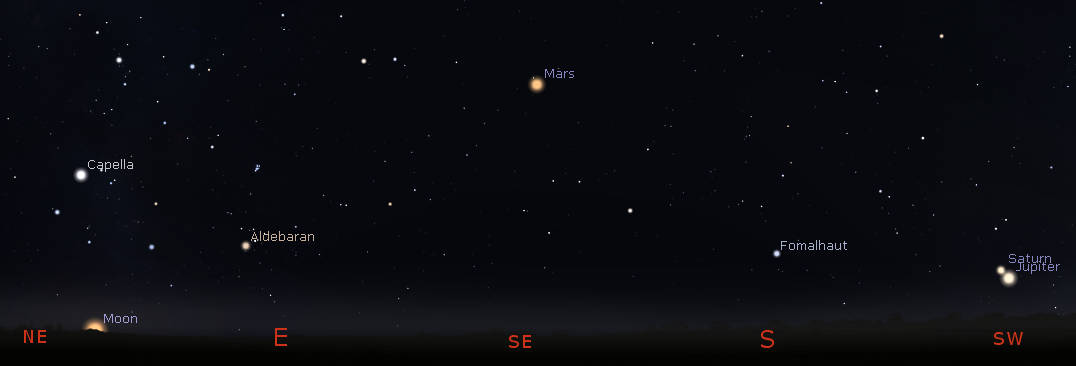
The evening planets with the Mon rising at 7 pm tonight December 2, 2020. Click on the image to enlarge. Created using Stellarium.
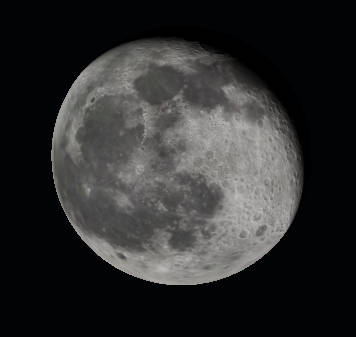
The Moon as it might be seen tonight at 9 pm, December 2, 2020. Created using Stellarium.
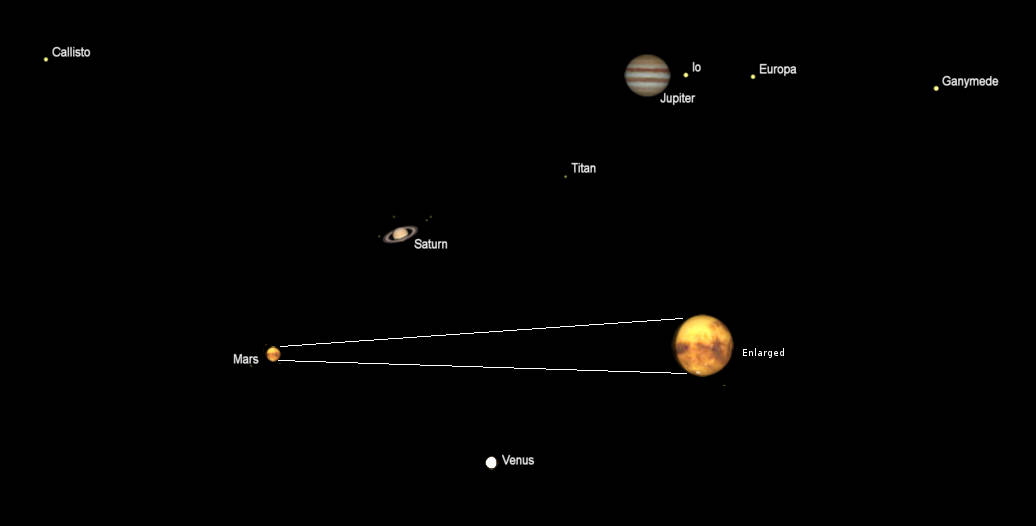
The planets as seen in a telescope (north up) with the same magnification for the night of November 25/26, 2020. Times of the display are: Jupiter, Saturn and Mars, 7 pm; Venus, 6:30 am. Apparent diameters: Jupiter, 34.28″; Saturn, 15.63″, rings, 36.41″; Mars, 14.27″; and Venus, 11.57″. Mars also displays an enlargement showing surface detail. Mars was closest to the Earth this go-a-round on October 6. The ” symbol means seconds of arc (1/3600th of a degree.) Click on the image to enlarge. Created using Cartes du Ciel (Sky Charts).
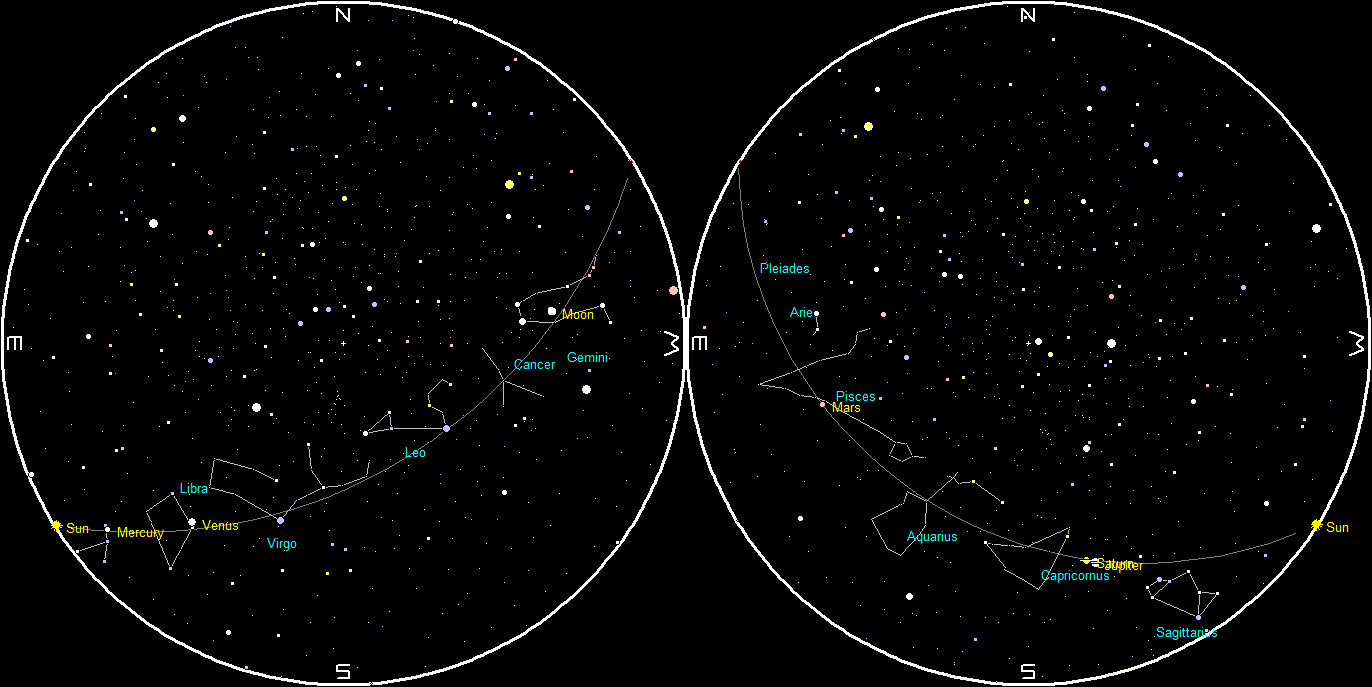
Planets and the Moon at sunset and sunrise of a single night starting with sunset on the right on December 2, 2020. The night ends on the left with sunrise on the 3rd. I’m afraid that the labels for Jupiter and Saturn will overlap, since the planets are getting very close. Click on the image to enlarge. Created using my LookingUp program.
12/01/2020 – Ephemeris – Previewing December skies
This is Ephemeris for Tuesday, December 1st. Today the Sun will be up for 9 hours and 2 minutes, setting at 5:03, and it will rise tomorrow at 8:01. The Moon, 1 day past full, will rise at 6:02 this evening.
Let’s look at December skies. We are now in the holiday season and about to celebrate the southernmost travel of the Sun in the sky and its return northward. So there is not much change in sunrise and sunset times. The Sun will stop its travel south, the winter solstice, on the 21st at 5:02 am. It will make that day the shortest day in terms of daylight hours. However, the earliest sunset will occur on the 9th. The Geminid meteor shower will reach its peak on the evening of the 13th, near new moon. Also in the evening on the 21st Jupiter and Saturn will be in conjunction and will be easily visible in the same binocular or low power telescope field. This month starts out with a surprisingly active Sun at the start of a new sunspot cycle.
The event times given are for the Traverse City/Interlochen area of Michigan. They may be different for your location.
Addendum
December Evening Star Chart
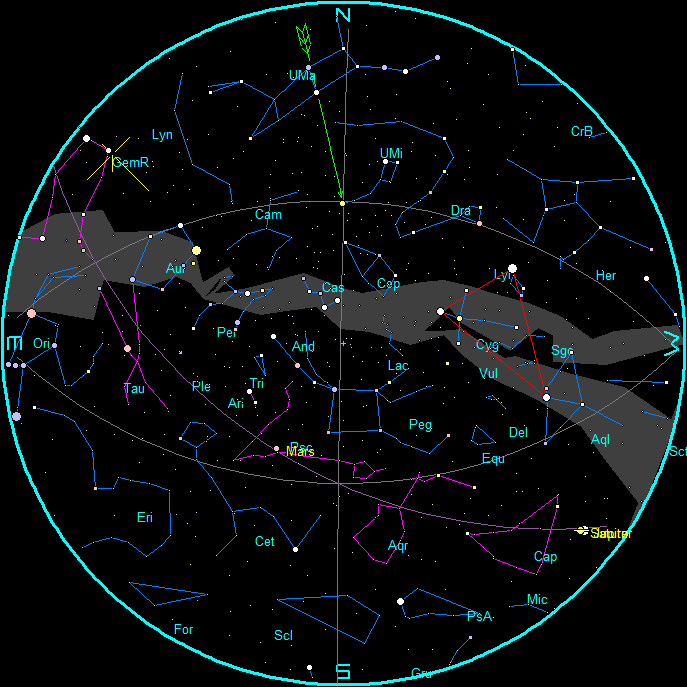
Star Chart for December 2020 (7 p.m. EST December 15, 2019). Click on image to enlarge. Created using my LookingUp program. Click on image to enlarge.
Credit my LookingUp program.
The planets and stars are plotted for the 15th at 7 pm EST (two hours earlier this year to include Jupiter and Saturn) in the evening and 6 a.m. for the morning chart. These are the chart times. Note that Traverse City is located approximately 45 minutes behind our time meridian, West 75° longitude. (An hour 45 minutes behind our daylight saving time meridian during EDT).
December Morning Star Chart
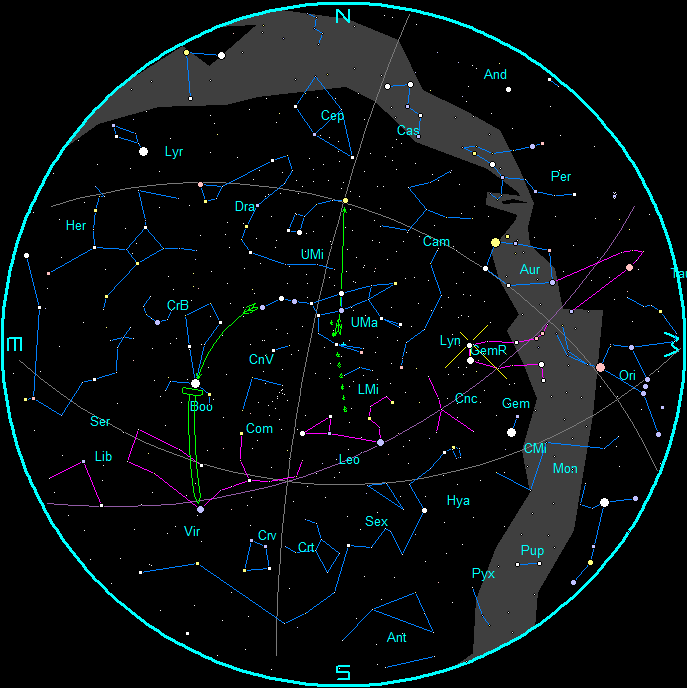
Star Chart for December mornings 2020 (6 a.m. EST December 15, 2020). Click on image to enlarge. Created using my LookingUp program. Credit my LookingUp program.
For a list of constellation names to go with the abbreviations click here.
- Pointer stars at the front of the bowl of the Big Dipper point to Polaris the North Star.
- The leaky bowl of the Big Dipper drips on Leo.
- Follow the arc of the handle of the Big Dipper to the star Arcturus, then
- Follow the spike to Spica.
- The Summer Triangle is in red.
- GemR on the star charts is the radiant of the Geminid meteor shower which peaks on the evening of the 13th.
Twilight Limits, Nautical and Astronomical
| EST | |||||||
| Morning twilight | Evening twilight | Dark night | Moon | ||||
| Date | Astro. | Nautical | Nautical | Astro. | Start | End | Illum. |
| 2020-12-01 | 6h21m | 6h56m | 18h15m | 18h51m | – | – | 0.99 |
| 2020-12-02 | 6h22m | 6h57m | 18h15m | 18h50m | 18h50m | 18h51m | 0.97 |
| 2020-12-03 | 6h23m | 6h58m | 18h15m | 18h50m | 18h50m | 19h48m | 0.92 |
| 2020-12-04 | 6h23m | 6h59m | 18h15m | 18h50m | 18h50m | 20h52m | 0.85 |
| 2020-12-05 | 6h24m | 7h00m | 18h15m | 18h50m | 18h50m | 22h00m | 0.77 |
| 2020-12-06 | 6h25m | 7h01m | 18h15m | 18h50m | 18h50m | 23h12m | 0.67 |
| 2020-12-07 | 6h26m | 7h01m | 18h15m | 18h50m | 18h50m | – | 0.56 |
| 2020-12-08 | 6h27m | 7h02m | 18h15m | 18h50m | 18h50m | 0h25m | 0.45 |
| 2020-12-09 | 6h28m | 7h03m | 18h15m | 18h50m | 18h50m | 1h39m | 0.33 |
| 2020-12-10 | 6h29m | 7h04m | 18h15m | 18h50m | 18h50m | 2h55m | 0.22 |
| 2020-12-11 | 6h29m | 7h05m | 18h15m | 18h50m | 18h50m | 4h13m | 0.13 |
| 2020-12-12 | 6h30m | 7h05m | 18h15m | 18h51m | 18h51m | 5h33m | 0.06 |
| 2020-12-13 | 6h31m | 7h06m | 18h15m | 18h51m | 18h51m | 6h31m | 0.01 |
| 2020-12-14 | 6h31m | 7h07m | 18h16m | 18h51m | 18h51m | 6h31m | 0 |
| 2020-12-15 | 6h32m | 7h08m | 18h16m | 18h51m | 18h51m | 6h32m | 0.02 |
| 2020-12-16 | 6h33m | 7h08m | 18h16m | 18h52m | 19h09m | 6h33m | 0.06 |
| 2020-12-17 | 6h29m | 7h05m | 18h13m | 18h48m | 20h19m | 6h29m | 0.13 |
| 2020-12-18 | 6h30m | 7h06m | 18h13m | 18h49m | 21h29m | 6h30m | 0.21 |
| 2020-12-19 | 6h31m | 7h06m | 18h14m | 18h49m | 22h37m | 6h31m | 0.3 |
| 2020-12-20 | 6h31m | 7h07m | 18h14m | 18h49m | 23h42m | 6h31m | 0.4 |
| 2020-12-21 | 6h32m | 7h07m | 18h14m | 18h50m | – | 6h32m | 0.5 |
| 2020-12-22 | 6h32m | 7h08m | 18h15m | 18h51m | 0h46m | 6h32m | 0.6 |
| 2020-12-23 | 6h33m | 7h08m | 18h16m | 18h51m | 1h47m | 6h33m | 0.69 |
| 2020-12-24 | 6h33m | 7h08m | 18h16m | 18h52m | 2h49m | 6h33m | 0.78 |
| 2020-12-25 | 6h33m | 7h09m | 18h17m | 18h52m | 3h51m | 6h33m | 0.85 |
| 2020-12-26 | 6h34m | 7h09m | 18h17m | 18h53m | 4h54m | 6h34m | 0.91 |
| 2020-12-27 | 6h34m | 7h09m | 18h18m | 18h54m | 5h57m | 6h34m | 0.96 |
| 2020-12-28 | 6h34m | 7h10m | 18h19m | 18h54m | – | – | 0.99 |
| 2020-12-29 | 6h35m | 7h10m | 18h20m | 18h55m | – | – | 0.99 |
| 2020-12-30 | 6h35m | 7h10m | 18h20m | 18h56m | – | – | 1 |
| 2020-12-31 | 6h35m | 7h10m | 18h21m | 18h56m | – | – | 0.99 |
Twilight calendar was generated using Cartes du Ciel (Sky Charts).
See my blog post: Twilight Zone for the definitions of the different periods of twilight here: https://bobmoler.wordpress.com/2018/09/27/.
NASA Calendar of Planetary Events
     Date     Time    Event
Dec 1  Tu            Venus: 27.5° W
    1  Tu  02:46 am  Moon Ascending Node
    2  We  08:22 pm  Moon North Dec.: 24.9° N
    4  Fr  08:10 pm  Moon-Beehive: 2.5° S
    7  Mo  07:37 pm  Last Quarter
   12  Sa  03:40 pm  Moon-Venus: 0.8° S
   12  Sa  03:42 pm  Moon Perigee: 361800 km
   13  Su  07:50 pm  Geminid Meteor Shower: ZHR = 120
   14  Mo  06:03 am  Moon Descending Node
   14  Mo  11:15 am  Total Solar Eclipse
                          (Pacific, S America, Atlantic)
   14  Mo  11:17 am  New Moon
   15  Tu  05:23 pm  Moon South Dec.: 24.9° S
   16  We  11:28 pm  Moon-Jupiter: 3° N
   17  Th  12:25 am  Moon-Saturn: 3.1° N
   19  Sa  09:56 pm  Mercury Superior Solar Conjunction
   21  Mo  05:02 am  Winter Solstice
   21  Mo  06:41 pm  First Quarter
   22  Tu  04:00 am  Ursid Meteor Shower: ZHR = 10
   22  Tu  04:35 am  Jupiter-Saturn: 0.1° N
   23  We  09:48 am  Venus-Antares: 5.6° N
   24  Th  11:32 am  Moon Apogee: 405000 km
   28  Mo  10:03 am  Moon Ascending Node
   29  Tu  10:28 pm  Full Moon
   30  We  02:53 am  Moon North Dec.: 24.9° N
All event times are given for UTC-5 Eastern Standard Time.
Sky Events Calendar by Fred Espenak and Sumit Dutta (NASA’s GSFC),
http://eclipse.gsfc.nasa.gov/SKYCAL/SKYCAL.html.
If you go to the above site you can print out a list like the above for the entire year or calendar pages for your time zone.
Sun and Moon Rising and Setting Events
LU                  Ephemeris of Sky Events for Interlochen/TC
December, 2020    Local time zone: EST
+-----------------------------------------------------------------------+
| DATE |  SUN     SUN  DAYLIGHT|   TWILIGHT*    |MOON  RISE OR    ILLUM |
|      |  RISE    SET    HOURS |  END    START  |PHASE SET** TIME FRACTN|
+=======================================================================+
|Tue  1| 08:00a  05:03p  09:02 | 06:12p  06:51a |      Rise 06:02p   98%|
|Wed  2| 08:01a  05:03p  09:01 | 06:12p  06:52a |      Rise 06:51p   94%|
|Thu  3| 08:02a  05:02p  09:00 | 06:12p  06:53a |      Rise 07:48p   88%|
|Fri  4| 08:03a  05:02p  08:58 | 06:12p  06:53a |      Rise 08:52p   80%|
|Sat  5| 08:04a  05:02p  08:57 | 06:12p  06:54a |      Rise 10:00p   71%|
+------+-----------------------+----------------+-----------------------+
|Sun  6| 08:05a  05:02p  08:56 | 06:12p  06:55a |      Rise 11:12p   61%|
|Mon  7| 08:06a  05:02p  08:55 | 06:12p  06:56a |L Qtr Rise 12:25a   50%|
|Tue  8| 08:07a  05:02p  08:54 | 06:12p  06:57a |      Rise 01:39a   39%|
|Wed  9| 08:08a  05:02p  08:53 | 06:12p  06:58a |      Rise 02:55a   28%|
|Thu 10| 08:09a  05:02p  08:52 | 06:12p  06:59a |      Rise 04:13a   18%|
|Fri 11| 08:10a  05:02p  08:51 | 06:12p  07:00a |      Rise 05:33a   10%|
|Sat 12| 08:11a  05:02p  08:51 | 06:12p  07:00a |      Rise 06:53a    4%|
+------+-----------------------+----------------+-----------------------+
|Sun 13| 08:12a  05:02p  08:50 | 06:13p  07:01a |      Rise 08:11a    1%|
|Mon 14| 08:12a  05:02p  08:49 | 06:13p  07:02a |New   Set  05:06p    0%|
|Tue 15| 08:13a  05:02p  08:49 | 06:13p  07:02a |      Set  06:03p    2%|
|Wed 16| 08:14a  05:03p  08:48 | 06:13p  07:03a |      Set  07:09p    7%|
|Thu 17| 08:14a  05:03p  08:48 | 06:14p  07:04a |      Set  08:18p   14%|
|Fri 18| 08:15a  05:03p  08:48 | 06:14p  07:04a |      Set  09:29p   22%|
|Sat 19| 08:16a  05:04p  08:48 | 06:15p  07:05a |      Set  10:37p   31%|
+------+-----------------------+----------------+-----------------------+
|Sun 20| 08:16a  05:04p  08:48 | 06:15p  07:05a |      Set  11:42p   40%|
|Mon 21| 08:17a  05:05p  08:48 | 06:16p  07:06a |F Qtr Set  12:45a   50%|
|Tue 22| 08:17a  05:05p  08:48 | 06:16p  07:06a |      Set  01:47a   60%|
|Wed 23| 08:18a  05:06p  08:48 | 06:17p  07:07a |      Set  02:49a   69%|
|Thu 24| 08:18a  05:07p  08:48 | 06:17p  07:07a |      Set  03:50a   77%|
|Fri 25| 08:18a  05:07p  08:48 | 06:18p  07:08a |      Set  04:53a   84%|
|Sat 26| 08:19a  05:08p  08:49 | 06:19p  07:08a |      Set  05:57a   91%|
+------+-----------------------+----------------+-----------------------+
|Sun 27| 08:19a  05:09p  08:49 | 06:19p  07:08a |      Set  07:00a   96%|
|Mon 28| 08:19a  05:09p  08:50 | 06:20p  07:09a |      Set  08:01a   99%|
|Tue 29| 08:19a  05:10p  08:50 | 06:21p  07:09a |Full  Rise 04:45p  100%|
|Wed 30| 08:19a  05:11p  08:51 | 06:21p  07:09a |      Rise 05:40p   99%|
|Thu 31| 08:20a  05:12p  08:52 | 06:22p  07:09a |      Rise 06:43p   96%|
+-----------------------------------------------------------------------+
* Nautical Twilight
** Moonrise or moonset, whichever occurs between sunrise and sunset
Generated using my LookingUp for DOS program.
11/30/2020 – Ephemeris – We’ve entered an eclipse season
This is Bob Moler with Ephemeris for Monday, November 30th. Today the Sun will be up for 9 hours and 4 minutes, setting at 5:03, and it will rise tomorrow at 8:00. The Moon, at full today, will rise at 5:22 this evening.
This morning we had a slight eclipse of the Moon, where the Moon entered only the southern part of the Earth’s penumbral or partial shadow. On December 14th, at the next new moon there will be a total eclipse of the Sun that will be visible from South America. We are now in an eclipse season which lasts about 35 days. In that time two or rarely three eclipses can be fit in. The next eclipse season is 5 months and 18 days away in late May and early June 2021. Then there will be, for Michigan, the start of a lunar eclipse visible just before sunrise on May 26th and the end of a solar eclipse visible at sunrise on June 10th. Those two eclipses will just be teasing us. Our next nearby total solar eclipse is less than three and a half years away on April 8, 2024.
The event times given are for the Traverse City/Interlochen area of Michigan. They may be different for your location.
Addendum
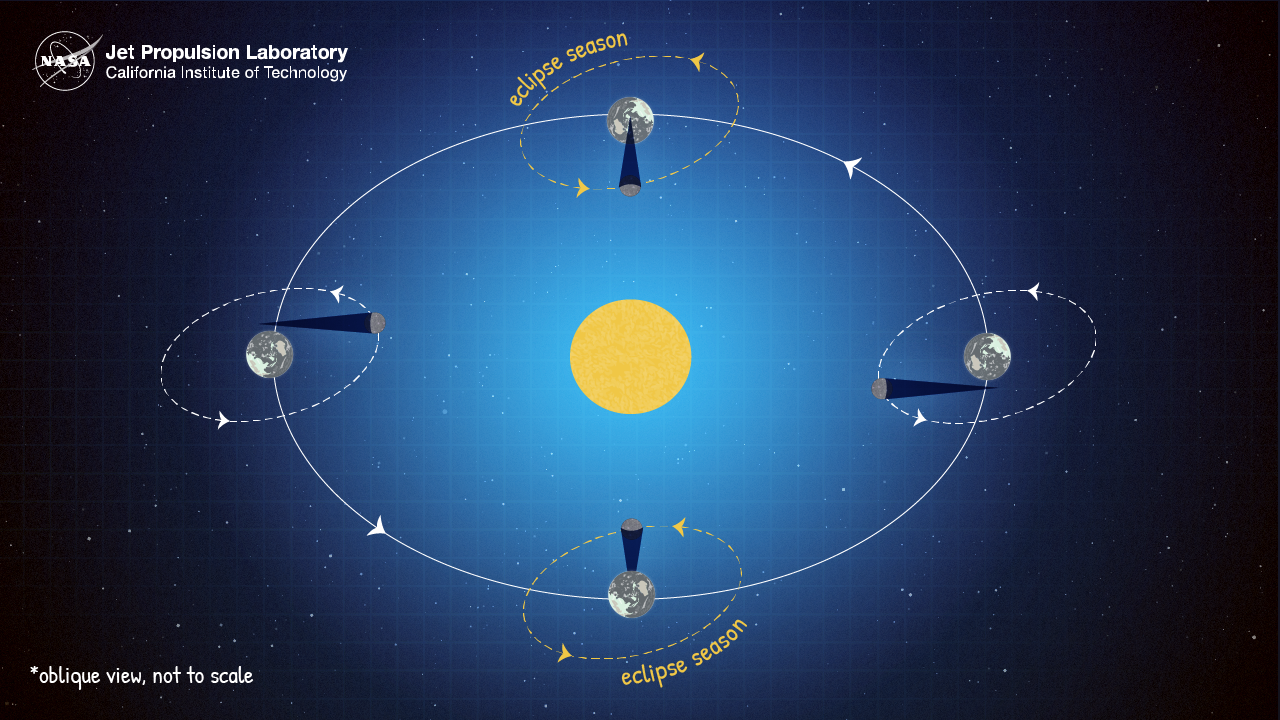
A diagram showing eclipse seasons. Though only solar eclipses are shown, it also includes lunar eclipses. Three months later (actually only a month later) the shadows of each are either too far north or south to fall on the other. Click on the image to enlarge. Credit: NASA/JPL
11/27/2020 – Ephemeris – There will be a slight eclipse of the Moon Monday morning
This is Ephemeris for Native American Heritage Day, Friday, November 27th. Today the Sun will be up for 9 hours and 9 minutes, setting at 5:05, and it will rise tomorrow at 7:57. The Moon, 3 days before full, will set at 6:02 tomorrow morning.
Early Monday morning there will be a penumbral eclipse of the Moon. It’s not much of an eclipse to look at, but it is an eclipse to open the last eclipse season of this year. I’ll have more on that Monday, but the lunar eclipse on Monday will a slight one, where no part of the Moon disappears into the Earth’s inner shadow. The top part of the Moon will look a bit darker than the bottom part for a time, that’s all. The Earth and the Moon are illuminated by the Sun, and it isn’t a point light source. Your shadow isn’t sharp. The fuzziness at the edge of your head’s shadow on the ground in the sunlight is your penumbra. The maximum part of the eclipse will be at 4:44 am (09:44 UT)with the effect seen within a half hour of that time. The effect is best seen with sunglasses to dim the Moon.
The event times given are for the Traverse City/Interlochen area of Michigan. They may be different for your location.
Addendum
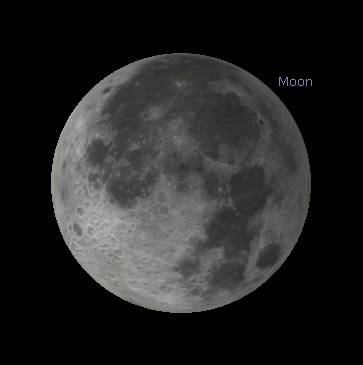
The maximum of the penumbral lunar eclipse at 4:44 am EST (9:44 UT) Monday, November 30, 2020. The upper right part of the Moon will have a dusky appearance. The effect should be visible from about 4:15 to 5:15 am (09:15 to 10:15 UT). I find it’s best to view the Moon with sunglasses to reduce the Moon’s glare to better see the effect. Created using Stellarium.
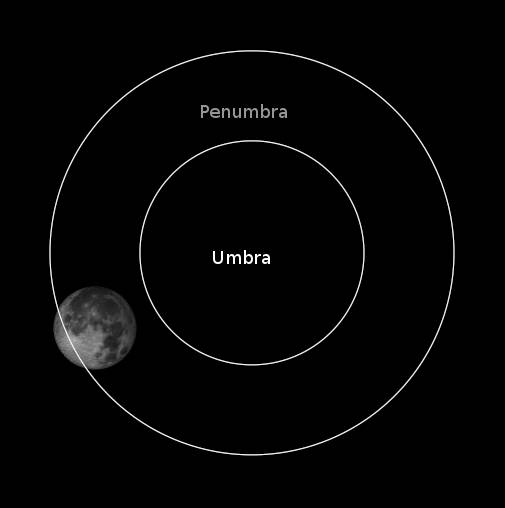
Penumbral lunar eclipse with Earth’s shadow at maximum. The outer ring is the outer edge of the penumbra the Moon’s outer shadow where so little sunlight is cut off as to not be discernible. The inner circle is the edge of the umbra, the darkest part of the Earth’s shadow, where almost 100% of the Sun’s light is cut off. The Moon will be in the western sky at this time, and its motion with respect to the Earth’s shadow is to the upper left. Created using Cartes du Ciel (Sky Charts).
11/26/2020 – Ephemeris – A look at Saturn (planet and god) in mythology
This is Ephemeris for Thanksgiving Day, Thursday, November 26th. Today the Sun will be up for 9 hours and 11 minutes, setting at 5:05, and it will rise tomorrow at 7:55. The Moon, 4 days before full, will set at 4:59 tomorrow morning.
Over the next 25 days Jupiter and Saturn will draw together to be in conjunction. And like I said Tuesday, I don’t know what that means astrologically, since I don’t believe in that stuff. I find the universe quite indifferent to my fate or the fate of anything happening on the third rock. Saturn, which will seem to cross paths with Jupiter on the evening of December 21st, a few hours after winter starts is named after the Roman god of agriculture and periodic renewal among others. He is depicted carrying a scythe, and even today we see him as the Grim Reaper, and at the end of the year as Father Time. The Saturn is the Roman counterpart of the Greek Cronus a Titan, the bringer of old age. It’s a fitting name for the slowest of the naked-eye planets, known from antiquity, taking almost 30 years to shuffle its way around the Sun.
The event times given are for the Traverse City/Interlochen area of Michigan. They may be different for your location.
Addendum
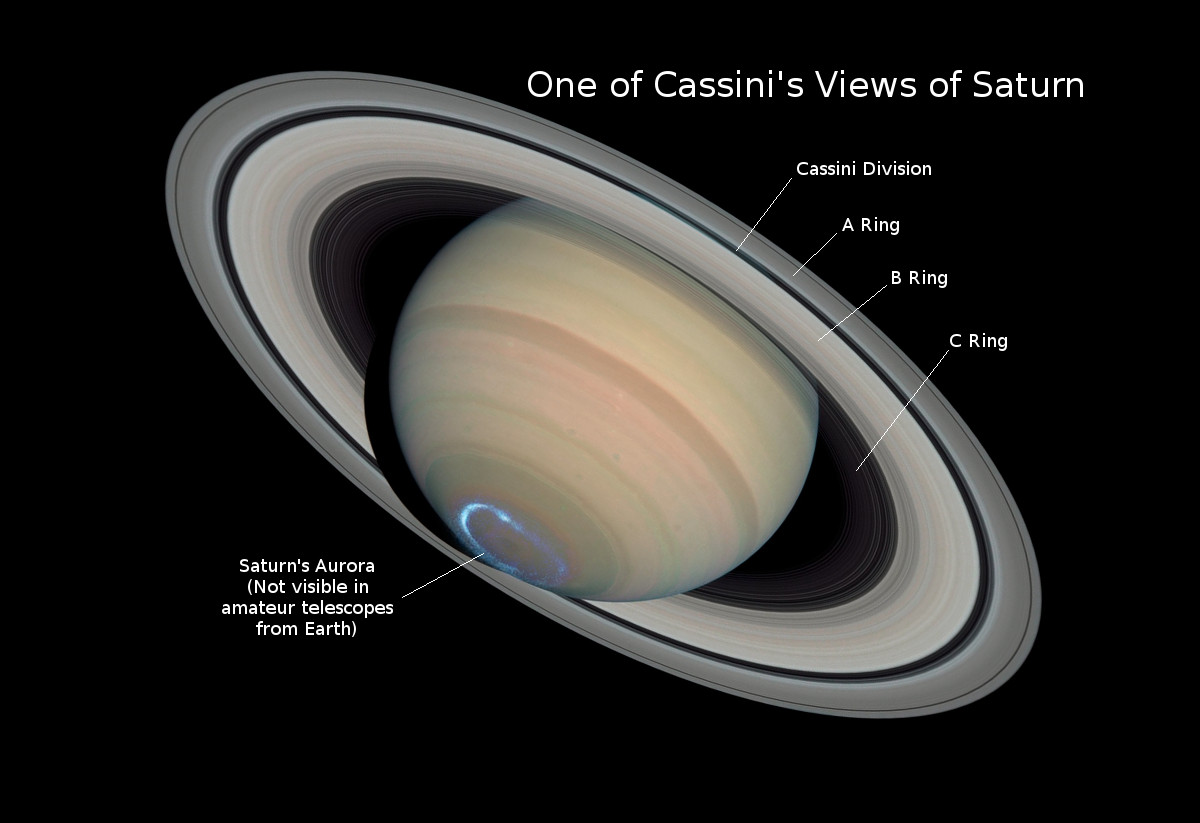
Saturn and rings from the Cassini spacecraft, plus the aurora oval in ultraviolet. Credit: NASA/JPL/Space Science Institute
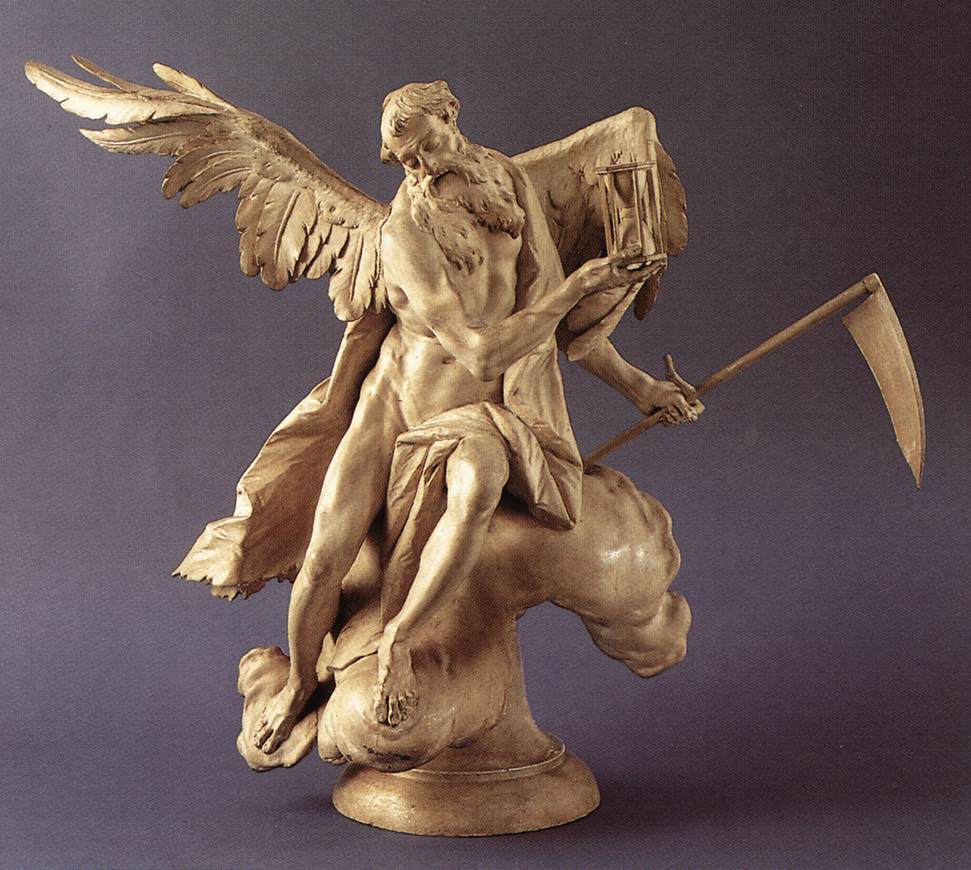
A statuette of Cronus (Saturn) shown holding a scythe and an hour glass. Source: https://respuestas.tips/quien-es-cronos-en-la-mitologia-griega/
11/25/2020 – Ephemeris – Let’s look for the naked-eye planets for this week
This is Ephemeris for Wednesday, November 25th. Today the Sun will be up for 9 hours and 12 minutes, setting at 5:06, and it will rise tomorrow at 7:54. The Moon, 4 days past first quarter, will set at 3:58 tomorrow morning.
Let’s look for the naked-eye planets for this week. Jupiter and Saturn are both low in the southwestern sky from 7 to 8 pm. Jupiter is the very bright one. Above and left will be dimmer Saturn. They are slowly closing, so they will cross paths on the evening of December 21st and be seen in the same telescope field that evening. Jupiter will set first tonight at 8:41 with Saturn following at 8:56. Off in the southeast at that hour will be Mars above the bright gibbous Moon tonight. Mars’ distance is increasing to 55.6 million miles (89.6 million kilometers) away. Mars will set at 3:47 tomorrow morning. Brilliant Venus will rise at 5:21 am in the east-southeast as it retreats slowly toward, but actually around the back of the Sun.
The event times given are for the Traverse City/Interlochen area of Michigan. They may be different for your location.
Addendum
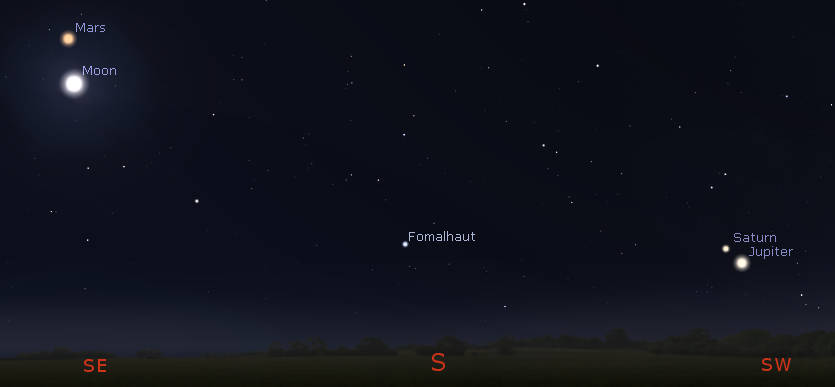
Evening planets and the Moon for 7 pm tonight November 25, 2020. Click on the image to enlarge. Created using Stellarium.
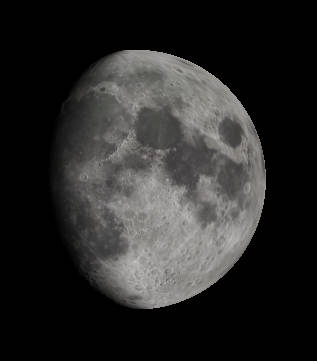
The gibbous Moon as it might be seen in binoculars this evening at 7 pm November 25, 2020. Created using Stellarium.
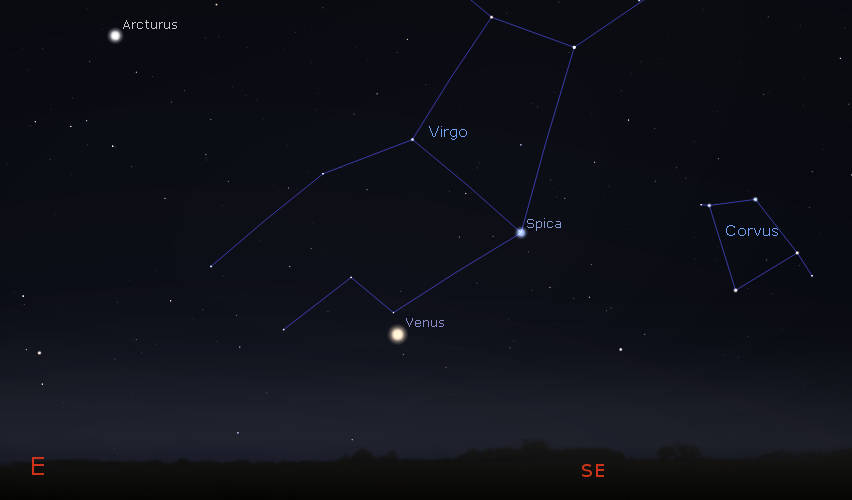
Venus and the morning constellations at 6:30 am tomorrow November 26, 2020. Created using Stellarium.
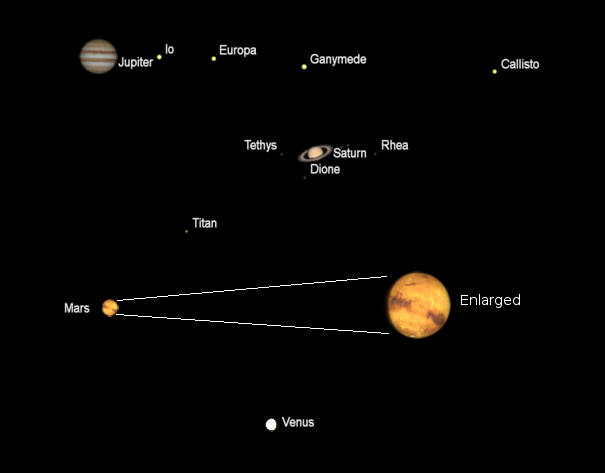
The planets as seen in a telescope (north up) with the same magnification for the night of November 25/26, 2020. Times of the display are: Jupiter and Saturn, 7 pm; Mars, 10 pm; Venus, 6:30 am. Apparent diameters: Jupiter, 34.76″; Saturn, 15.76″, rings, 36.72″; Mars, 15.45″, and Venus 11.85″. Mars also displays an enlargement showing surface detail. Mars was closest to the Earth this go-a-round on October 6. The ” symbol means seconds of arc (1/3600th of a degree.) Created using Cartes du Ciel (Sky Charts).
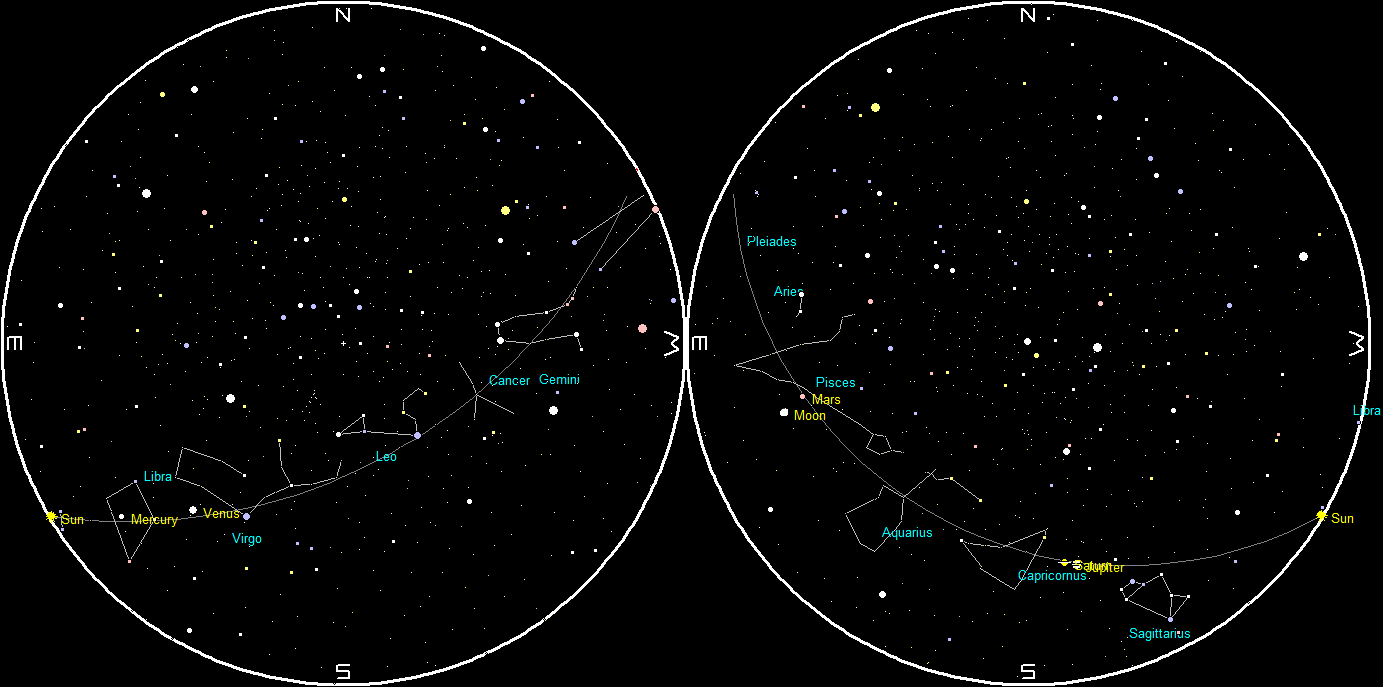
Planets and the Moon at sunset and sunrise of a single night starting with sunset on the right on November 25, 2020. The night ends on the left with sunrise on the 26th. I’m afraid that the labels for Jupiter and Saturn will overlap, since the planets are getting very close. Click on the image to enlarge. Created using my LookingUp program.
11/24/2020 – Ephemeris – Next month’s conjunction of Jupiter and Saturn
This is Ephemeris for Tuesday, November 24th. Today the Sun will be up for 9 hours and 14 minutes, setting at 5:06, and it will rise tomorrow at 7:53. The Moon, 3 days past first quarter, will set at 2:57 tomorrow morning.
Over the next 27 days Jupiter and Saturn will draw together to be in conjunction. I don’t know what that means astrologically, since I don’t believe in that stuff. It just means that Jupiter and Saturn lie near the same line of sight from the Earth. Though they will be almost as close as they get to each other, that won’t be that close. They were closest to each other earlier this month, at about 450 million miles (724 million kilometers). Jupiter is now about 525 million miles (845 million kilometers) away from us. Both, of course, are on the other side of the Sun from us. Jupiter, in its nearly 12 year orbit of the Sun laps the slower Saturn in it’s nearly 30 year orbit about every 20 years. It will do so again on November 5th of 2040.
The event times given are for the Traverse City/Interlochen area of Michigan. They may be different for your location.
Addendum
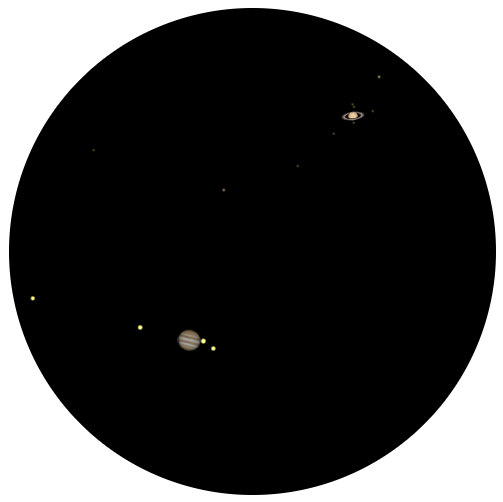
Possible telescopic view of Jupiter-Saturn conjunction 6 pm, December 21, 2020. Created using Cartes du Ciel (Sky Charts).
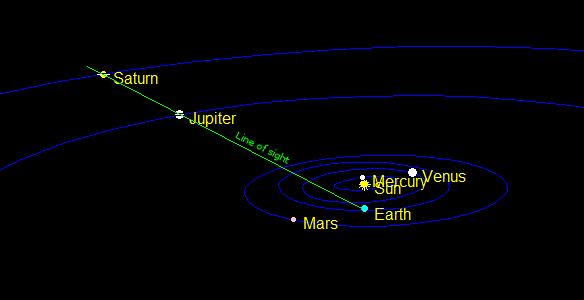
Jupiter and Saturn along the same line of sight from the Earth on December 21, 2020. Created using my LookingUp program.
11/23/2020 – Ephemeris – Our Moon is different
This is Bob Moler with Ephemeris for Monday, November 23rd. Today the Sun will be up for 9 hours and 16 minutes, setting at 5:07, and it will rise tomorrow at 7:52. The Moon, 2 days past first quarter, will set at 1:55 tomorrow morning.
The Earth’s Moon is different from most other moons. First it is very big when compared to the Earth. The Moon is a bit more than quarter the Earth’s diameter. Only Pluto’s moon Charon is larger compares to its primary, being half the size of Pluto. Most big moons orbit over their planet’s equator. Our Moon orbits the Earth close to the plane of Earth’s orbit of the Sun. That’s why the Moon is seen passing the planets each month. The Moon is too big to have been captured by the Earth in a chance flyby. The moon rocks brought back during Apollo showed that the Moon was made of the same crustal material as the Earth, so the impact theory was put forth that the Moon was the result of a collision of the Earth and a Mars sized body soon after they were formed.
The event times given are for the Traverse City/Interlochen area of Michigan. They may be different for your location.
Addendum
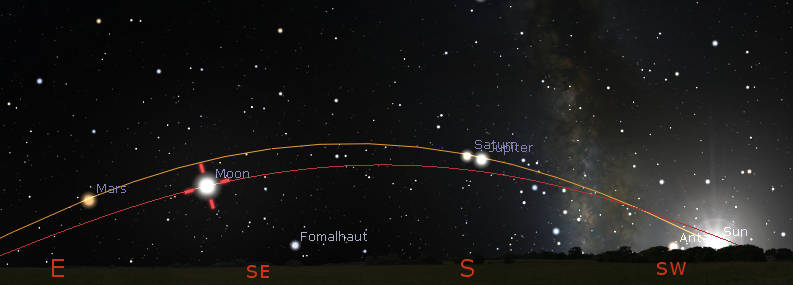
The Moon’s orbit (red) vs the ecliptic or plane of the Earth’s orbit (orange). The Moon’s orbit is tilted to the Earth’s orbit by 5 degrees. This is for 4:30 pm or a little more than a half hour before sunset. The black sky is due to removing atmospheric scattering in the program. Click on the image to enlarge. Created using Stellarium.
In the image note that the Moon’s orbit crosses the ecliptic just east of the Sun’s position. That crossing point is called the Moon’s descending node, since the Moon’s eastward motion will take it from north of the ecliptic to south of it. When the Sun is close to a node eclipses can occur. The ascending node is at the opposite side of the ecliptic so both solar and lunar eclipses occur in an eclipse season that lasts about a month.
An indeed there will be a penumbral eclipse of the Moon on the 30th, and a total solar eclipse for Chile and Argentina December 14th. The nodes don’t stay in one place, but they move westward, making one rotation around the ecliptic in 18.61 years. Since the nodes are moving westward it is called the regression of the nodes. So eclipse seasons occur about every 5 2/3 months, moving backwards in the calendar.
11/20/2020 – Ephemeris – Martian Trojan asteroid may have come from our Moon
This is Ephemeris for Friday, November 20th. Today the Sun will be up for 9 hours and 22 minutes, setting at 5:09, and it will rise tomorrow at 7:48. The Moon, 1 day before first quarter, will set at 10:39 this evening.
The way gravity works there are several gravitational sweet spots called Lagrangian points between orbital bodies. Two of those points, 60 degrees ahead of and behind a planet in its orbit, are called L4 and L5. Bodies at these points are called Trojan asteroids. Because the first ones found in Jupiter’s orbit were named after warriors of the Trojan War. What was discovered recently was that one of the planet Mars’ L5 Trojans is not like the others. It has a different composition as analyzed by a spectrograph. It reflects light like the Earth’s Moon, while the others appear to have come from Mars itself. Perhaps an ejected piece of the Moon made it out to Mars orbit. We know small meteoroids can make it planet to planet, maybe huge chunks can make it too.
The event times given are for the Traverse City/Interlochen area of Michigan. They may be different for your location.
Addendum
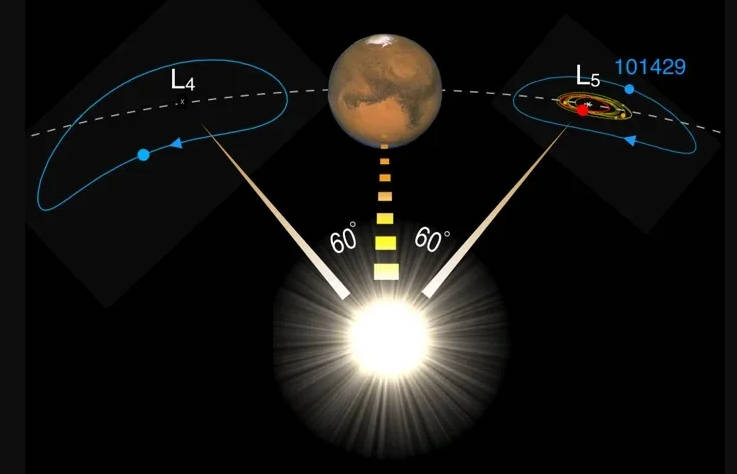
Mars and its Trojan asteroids including 101429 the asteroid that is spectroscopicly like the Moon. The other Trojans appear to have come from Mars itself. I tend to be a stickler for image accuracy: The Mars image is upside down and reversed, while the rest of the diagram is essentially correct other than being way out of scale. Credit Armagh Observatory and Planetarium (AOP) in Northern Ireland.
 Bob Moler's Ephemeris Blog