11/25/2013 – Ephemeris – Comet ISON and the week ahead
Ephemeris for Monday, November 25th. The sun will rise at 7:52. It’ll be up for 9 hours and 14 minutes, setting at 5:06. The moon, at last quarter today, will rise at 12:40 tomorrow morning.
Comet ISON, a bit more than 4 days from its closest approach to the sun on Thanksgiving Day, is now well within the orbit of Mercury only 22 million miles from the sun. The comet should be hard to spot this morning. It rises at 6:58 in pretty bright twilight. The cool thing is that since the tail points away from the sun, it will rise first. That may be something to look for a quarter to a half hour before the head or coma rises, and in darker skies. The tail will point to the upper right of the comet’s head. This too will be something to look for after the comet passes perihelion on Thursday, except the tail will point to the upper left. I’ll have more on comet viewing for Thanksgiving day on tomorrow’s program.
Times are for the Traverse City/Interlochen area of Michigan. They may be different for your location.
Addendum
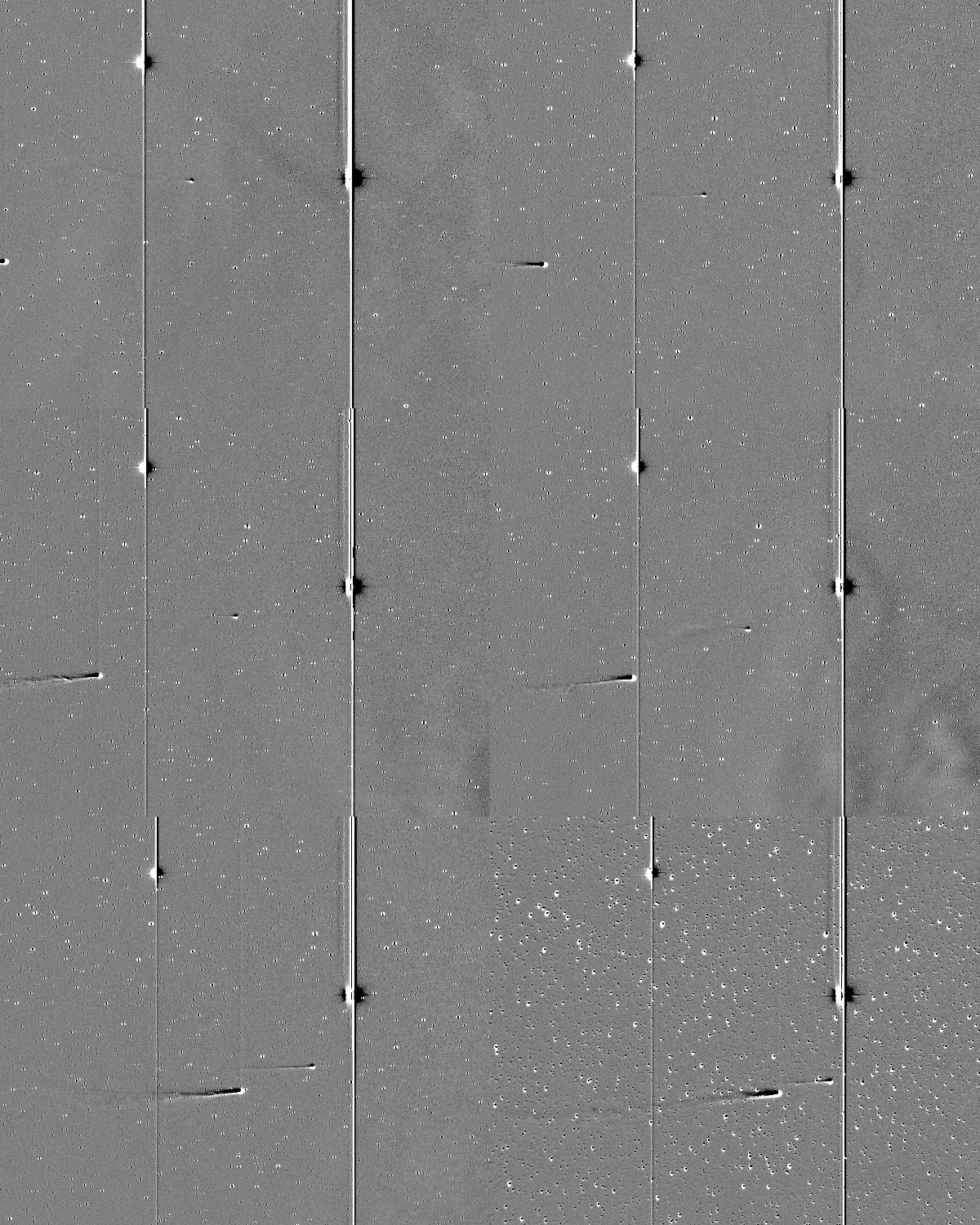
Animation of Comets ISON and Encke for November 19th thru 23rd, 2013 from the STEREO Ahead spacecraft. [Image Credit: Karl Battams/NRL/NASA/CIOC]. Click on the image to start the animation.
11/22/2013 – Ephemeris – President Kennedy and the quest for the Moon plus Comet ISON finder charts
Ephemeris for Friday, November 22nd. The sun will rise at 7:48. It’ll be up for 9 hours and 19 minutes, setting at 5:08. The moon, 3 days before last quarter, will rise at 9:43 this evening.
Today marks the 50th anniversary of the assassination of President John F. Kennedy. Yes I remember where I was when I heard the news. Being a program about astronomy and space I’d like to think about the challenge he laid down “to send a man to the moon and return him safely to the Earth by the end of the decade”. This was in the midst of the Cold War in response to the Soviet’s triumph in sending Yuri Gagarin into orbit. It was made almost a sacred vow due to Kennedy’s assassination. No NASA program since was funded to the extent that the Gemini and Apollo programs were, so that on July 20, 1969 that promise was fulfilled. All of money spent in NASA’s 55 years is actually less than that of the recent bank bailout.
Times are for the Traverse City/Interlochen area of Michigan. They may be different for your location.
Comet ISON
Finder charts for Comet ISON for this morning, Saturday, Sunday and Monday mornings.
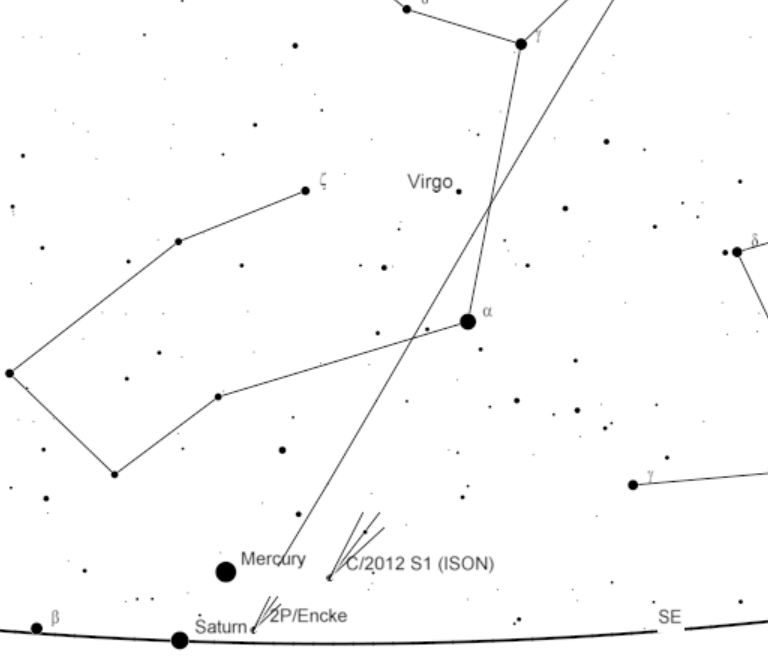
Chart for finding Comet ISON this morning (November 22, 2013 at 6:30 a.m.). Chart created using Cartes du Ciel.
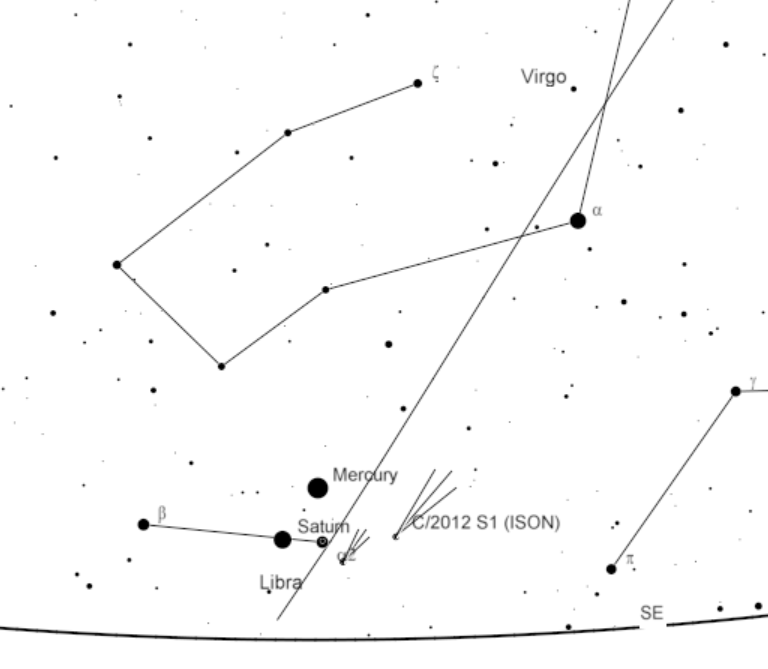
Chart for finding Comet ISON Saturday morning (November 23, 2013 at 7:00 a.m.). Chart created using Cartes du Ciel.
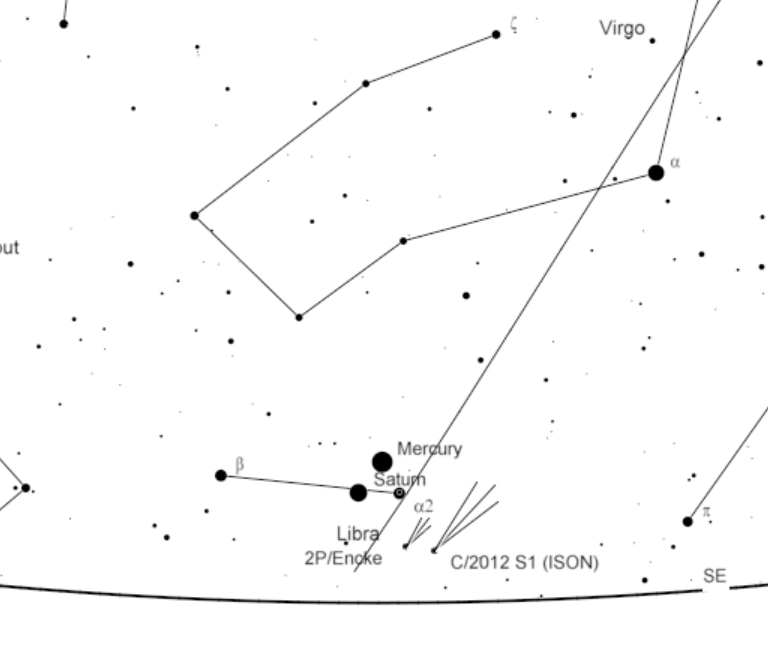
Chart for finding Comet ISON Sunday morning (November 24, 2013 at 7:00 a.m.). Chart created using Cartes du Ciel.
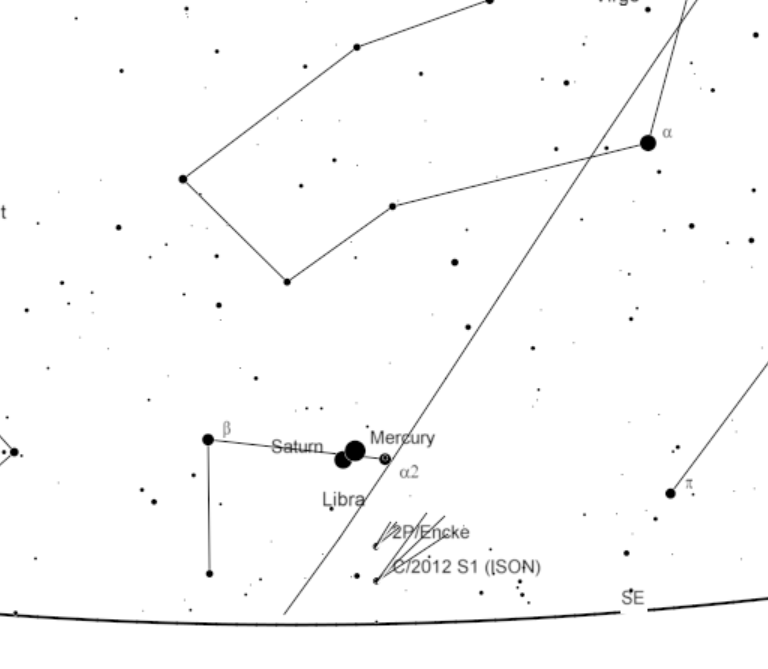
Chart for finding Comet ISON Monday morning (November 25, 2013 at 7:15 a.m.). Chart created using Cartes du Ciel.
11/21/2013 – Ephemeris – Comets are unpredictable
Ephemeris for Thursday, November 21st. The sun will rise at 7:47. It’ll be up for 9 hours and 21 minutes, setting at 5:09. The moon, half way from full to last quarter, will rise at 8:46 this evening.
Comet ISON has been full of surprises. I expect that to continue. I’ve seen quite a few since my first two in 1957. In 1973 the much hyped Comet Kohoutek failed to be spectacular as hoped. Not quite a sungrazer, the comet’s nucleus broke up and it turned out to be a rather dustless comet that, though naked eye was not especially bright. Usually when a nucleus breaks into large chunks it brightens. That was the case with Comet West in 1976. While rounding the sun its nucleus broke into 4 pieces. The three surviving pieces threw out a great sweeping dust tail. That comet had little publicity in the popular media, after being burnt by Kohoutek three years before. It was actually the second comet covered by this program.
Times are for the Traverse City/Interlochen area of Michigan. They may be different for your location.
Addendum

Comet West on March 8, 1976. Image tilted due to the camera being piggybacked on an equatorial mount. Horizon to the lower left. That’s the constellation Delphinus to the upper right. My photo.
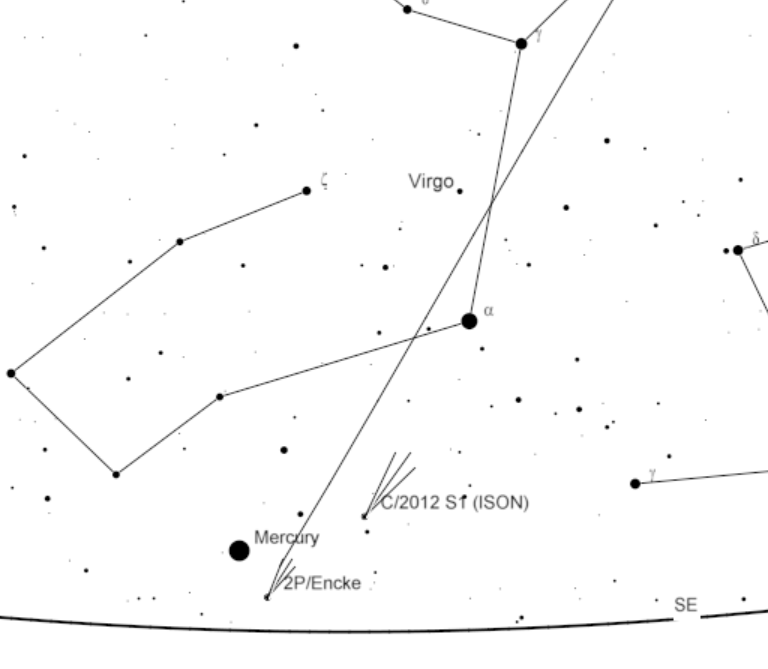
Chart for finding Comet ISON this morning (November 21, 2013 at 6:30 a.m.). Chart created using Cartes du Ciel.
Chart for finding Comet ISON tomorrow morning (November 22, 2013 at 6:30 a.m.). Chart created using Cartes du Ciel.
11/20/2013 – Ephemeris – Where are the bright planets and Comet ISON this week?
Ephemeris for Wednesday, November 20th. The sun will rise at 7:46. It’ll be up for 9 hours and 23 minutes, setting at 5:09. The moon, 3 days past full, will rise at 7:52 this evening.
Let’s see where the bright planets are this week. Venus is brilliant in the southwest after sunset. It will set at 7:52 p.m. The giant planet Jupiter will rise at 8:31 p.m. in the east northeast. It’s cruising against the stars of Gemini now. It will pass due south at 7:47 a.m. Mars will rise at 1:47 a.m. also in the east northeast. Reddish Mars is two widths of a fist held at arm’s length below and left of the bright star Regulus in Leo now. Comet ISON is now about magnitude 5, now meeting current brightness predictions, Officially naked eye, you’ll probably still need binoculars to spot it. Comet ISON is below and left of the star Spica low in the east southeast and will rise about 5:50 a.m. and be visible until around 6:30 a.m. above the planet Mercury.
Times are for the Traverse City/Interlochen area of Michigan. They may be different for your location.
Addendum
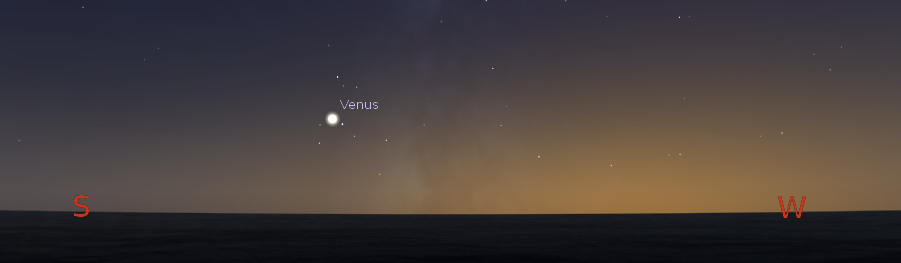
Venus low in the southwest at 6 p.m., November 20, 2013. Created using Stellarium.
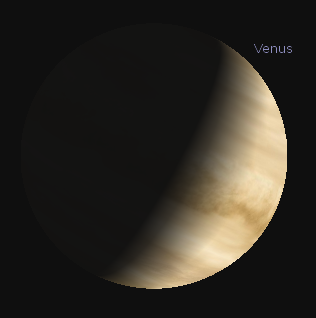
Telescopic view of Venus on November 20, 2013. The cloud banding will not be visible. Created using Stellarium.
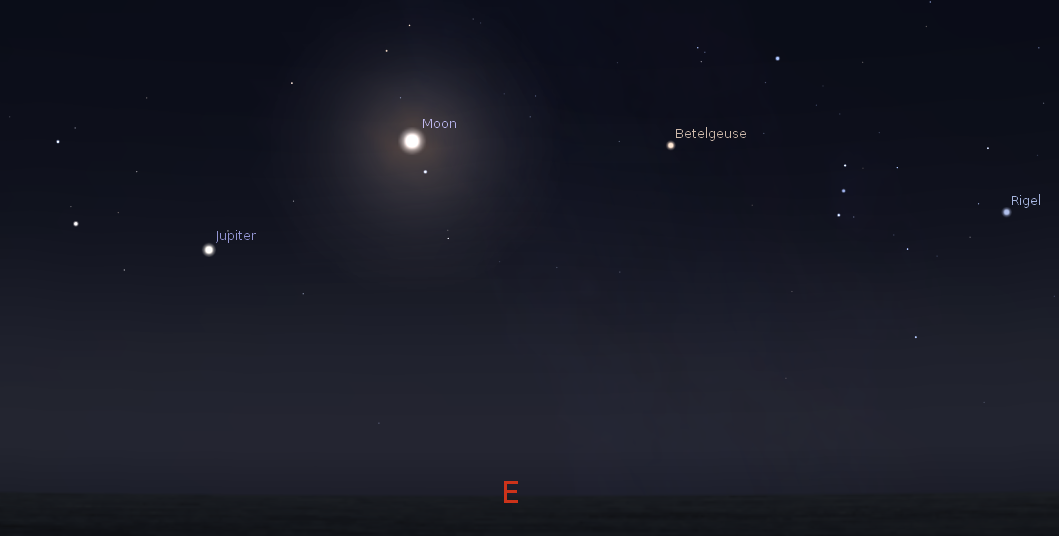
Jupiter in the east at 10 p.m. on November 20, 2013. Created using Stellarium.
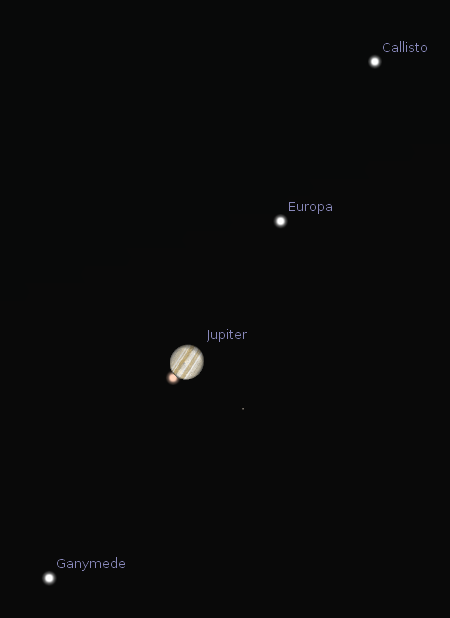
A telescopic view of Jupiter at 10 p.m. The moon Io is peeking around Jupiter. Up is to the top. The view in your telescope may vary. Created using Stellarium.
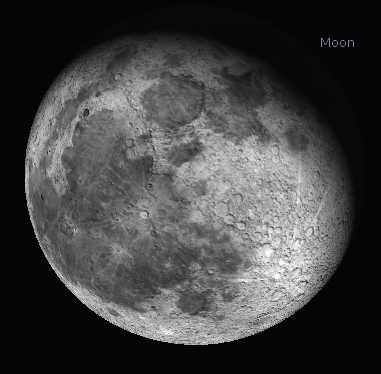
The magnified Moon. Created using Stellarium.
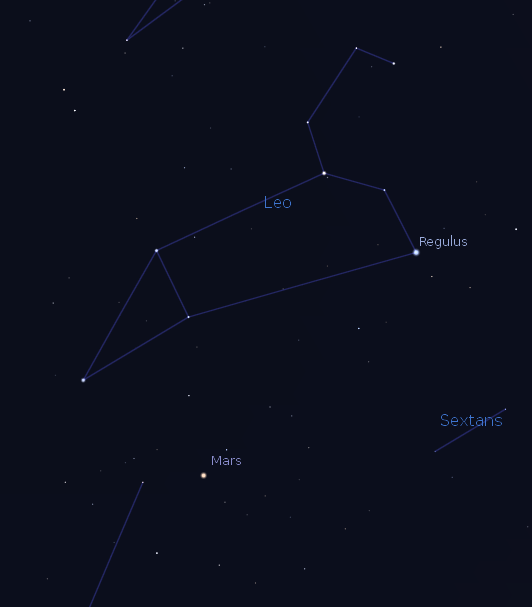
Mars and Leo at 6 a.m. November 21, 2013. Created using Stellarium.
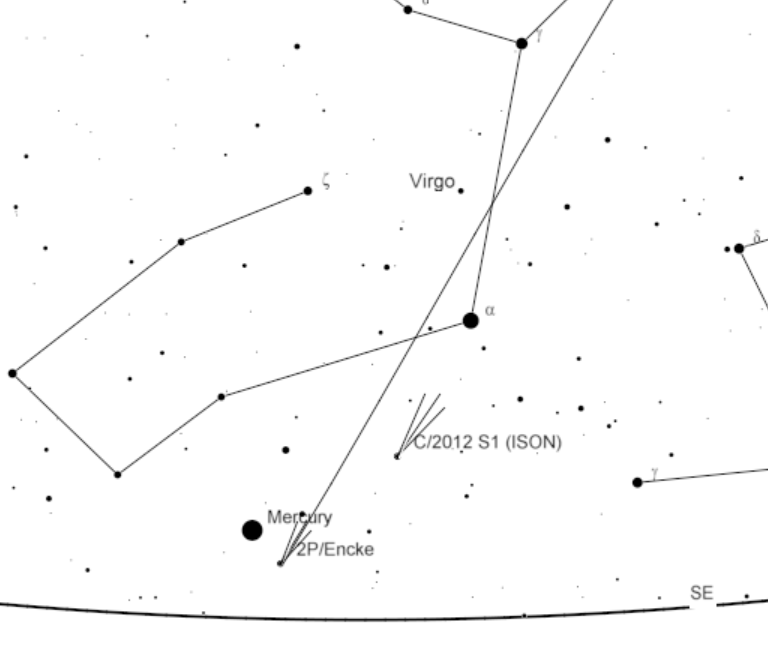
Chart for finding Comet ISON this morning (November 20, 2013 at 6:30 a.m.). Chart created using Cartes du Ciel.
Chart for finding Comet ISON this morning (November 21, 2013 at 6:30 a.m.). Chart created using Cartes du Ciel.
11/19/2013 – Ephemeris – Comet ISON suddenly brightens
Ephemeris for Tuesday, November 19th. The sun will rise at 7:44. It’ll be up for 9 hours and 26 minutes, setting at 5:10. The moon, 2 days past full, will rise at 7:00 this evening
Comet ISON is full of surprises. First, earlier this year, it didn’t brighten at all as it fell toward the sun, Then in August it resumed brightening, but more slowly than predicted. Suddenly between Wednesday and Thursday mornings last week Comet ISON had an outburst and brightened 10 fold. As of this last weekend it had continued to hold its new brightness. It’s too close to the direction of the sun for Hubble to look at, but earthbound amateur and professional astronomers are photographing the comet in beautiful detail. On the Internet go to spaceweather.com or Universe Today for the latest images of Comet ISON. Now the comet is below left of the bright star Spica in the east southeast in the morning twilight.
Times are for the Traverse City/Interlochen area of Michigan. They may be different for your location.
Addendum

Here’s an image linked from November 18th SpaceWeather.com from Michael Jäger of Ebenwaldhöhe, Austria taken on the 17th. The tail is 7 degrees long. Check out spaceweather.com for more images in the Comet ISON Gallery.
Finder Charts

Chart for finding Comet ISON this morning (November 19, 2013 at 6:30 a.m.). Chart created using Cartes du Ciel.
The star marked α is the bright star Spica.
Chart for finding Comet ISON this morning (November 20, 2013 at 6:30 a.m.). Chart created using Cartes du Ciel.
11/18/2013 – Ephemeris – Mercury is visible in the morning near Comet ISON
Ephemeris for Monday, November 18th. The sun will rise at 7:43. It’ll be up for 9 hours and 28 minutes, setting at 5:11. The moon, 1 day past full, will rise at 6:12 this evening.
The planet Mercury is now visible in the morning sky rising at 5:59 a.m. While Mercury is only 19 and a half angular degrees from the sun its direction is closer to the vertical than Venus and the other planets are in the evening sky. That situation will change in 3 months when evening planets will be favored. The star Spica will be above and right of Mercury, along with Comet ISON which will be nine moon diameters below and right of Spica, about a third of the way to Mercury tomorrow. Comet ISON will rise at 5:19 tomorrow morning. Morning twilight will begin at 6:08 tomorrow morning, but remember the moon will still be nearly full so the sky won’t be really dark before twilight begins. The Moon is light pollution you can’t get around.
Times are for the Traverse City/Interlochen area of Michigan. They may be different for your location.
Addendum
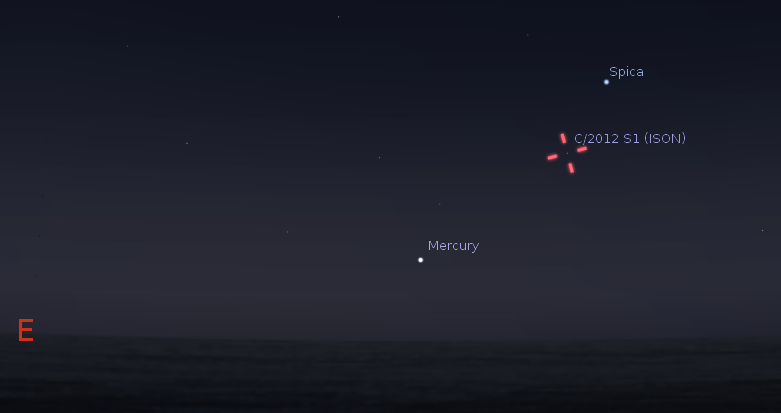
Mercury and Comet ISON at 6:30 a.m. on November 19, 2013. Created using Stellarium.
Comet ISON’s tail may be visible to the naked eye or in binoculars after it’s outburst last Thursday night. The comet may be able to live up to its advance billing after all.
11/15/2013 – Ephemeris – New information on the Chelyabinsk meteor
Ephemeris for Friday, November 15th. The sun will rise at 7:39. It’ll be up for 9 hours and 34 minutes, setting at 5:14. The moon, 2 days before full, will set at 6:34 tomorrow morning.
Articles in Nature and Science bring some precision to the Chelyabinsk meteor of February 15th. Its orbit is very close to a known but unnamed asteroid 86039 discovered in 1999, and may be a piece broken off from it. The meteorite retrieved from the nearby lake broke when it was attempted to be weighed. It turns out that a security camera recorded the splash as the large piece hit the lake and broke through the ice. The fragility of the meteorite testifies as to why it exploded in the atmosphere. The meteor was recorded from satellites, infra-sound recorders from the International Test Ban Treaty Organization, and a host of dashboard cams. The blast, depending on who did the measuring could have been up to 600 kilotons. (The bomb that was dropped on Hiroshima had a yield of 16 kilotons).
Times are for the Traverse City/Interlochen area of Michigan. They may be different for your location.
Addendum

Caption: Witness photo of 2013 Russian meteor event made from Chelyabinsk Drama Theater. Photo by Nikita Plekhanov.
11/14/2013 – Comet ISON has an outburst
Last night Comet ISON suddenly brightened and may be bright enough to be visible to the naked eye.. The comet is now within the orbit of Venus and falling with increasing velocity toward the sun for its November 28th perihelion.
Here’s a link to Universe Today‘s post with lots of photos.
EarthSky also has an entry for it: with a finder chart for naked eye viewing of the comet in twilight.
Here’s SpaceWeather.com‘s entry for today.
This may bode well for the comet’s brightness after perihelion, if the comet’s nucleus holds together or stays in big enough pieces. The next week may tell.
11/14/2013 – Ephemeris – An asteroid with 6 tails.
Ephemeris for Thursday, November 14th. The sun will rise at 7:38. It’ll be up for 9 hours and 37 minutes, setting at 5:15. The moon, 3 days before full, will set at 5:31 tomorrow morning.
Ready for something weird in the sky? Back in August the Pan-STARRS telescope on Mount Haleakala in Hawaii discovered an asteroid with 6 tails. This was confirmed in September by the Hubble Telescope. The tails weren’t directed away from the sun like cometary tails, bur were set off in a range of directions from the asteroid. This was a main belt asteroid orbiting the sun between Mars and Jupiter. It may be that the asteroid was in a collision some time ago which sent it spinning rapidly, so the speed of rotation at its equator is at or above the asteroid’s escape velocity, and dust migrating to the equator is flung off to make the tails. Looks like the hunt for near earth asteroids is picking up some interesting objects.
Times are for the Traverse City/Interlochen area of Michigan. They may be different for your location.
Addendum
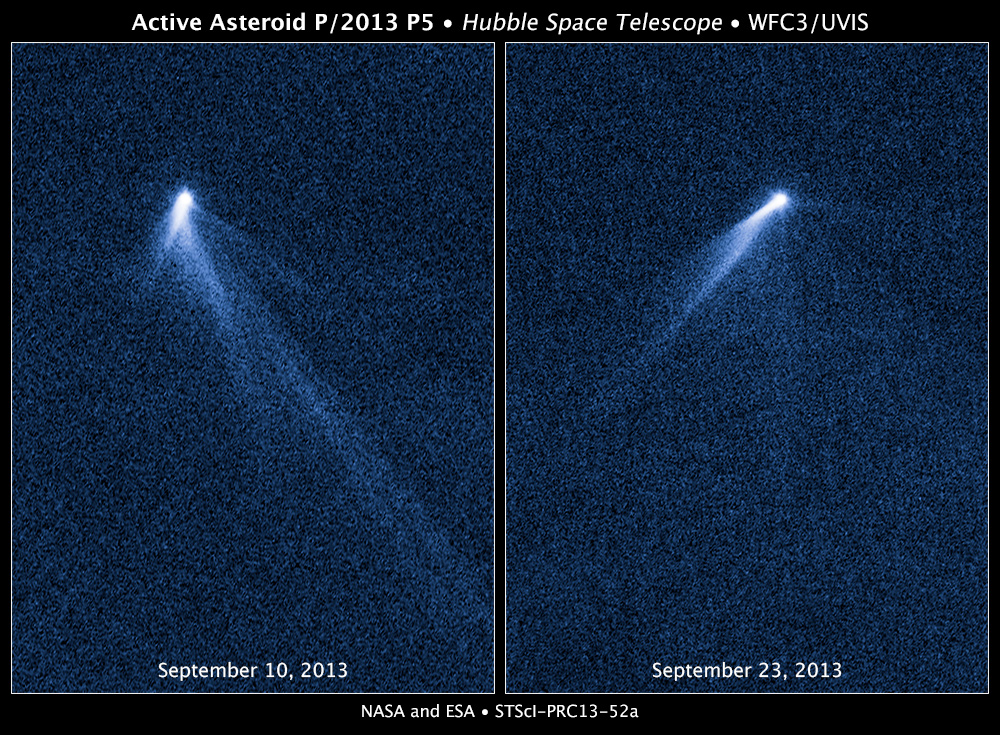
Hubble Space Telescope images of Asteroid P/2013 P5. Hat tip to Universe Today.
11/13/2013 – Ephemeris – Where are the bright planets and comets out this week?
Ephemeris for Wednesday, November 13th. The sun will rise at 7:36. It’ll be up for 9 hours and 39 minutes, setting at 5:16. The moon, 3 days past first quarter, will set at 4:26 tomorrow morning.
Let’s see where the bright planets are this week. Venus is brilliant in the west southwest after sunset. It will set at 7:49 p.m. The giant planet Jupiter will rise at 8:59 p.m. in the east northeast. It’s cruising against the stars of Gemini now. It will pass due south at 4:36 a.m. Mars will rise at 1:55 a.m. also in the east northeast. Reddish Mars is nearly two widths of a fist held at arm’s length below and left of the bright star Regulus in Leo now. Comet ISON is approaching the bright star Spica and will pass it Monday morning. ISON has been hanging around magnitude 8, about half as bright as current predictions, but probably visible in small telescopes. Comet ISON will rise about 4:16 a.m. and be visible until around 6:15 a.m.
Times are for the Traverse City/Interlochen area of Michigan. They may be different for your location.
Addendum
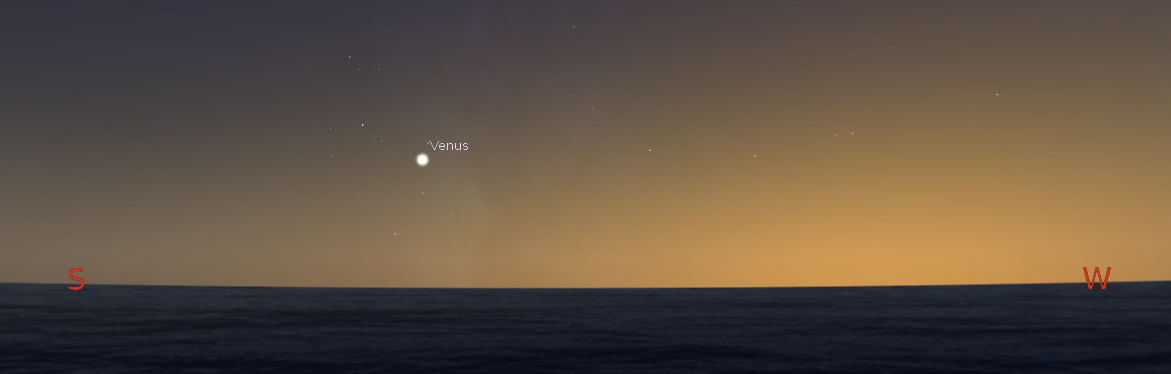
Venus low in the southwest at 6 p.m. on November 13, 2013. Created using Stellarium.
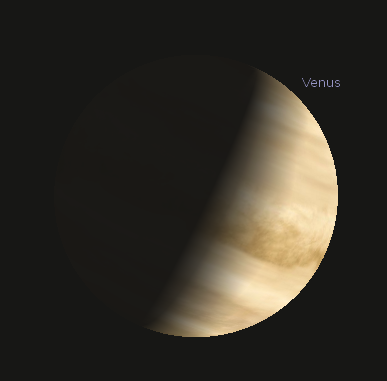
Venus through the telescope. (Note the bands are only visible in UV, not visible light). Created using Stellarium.
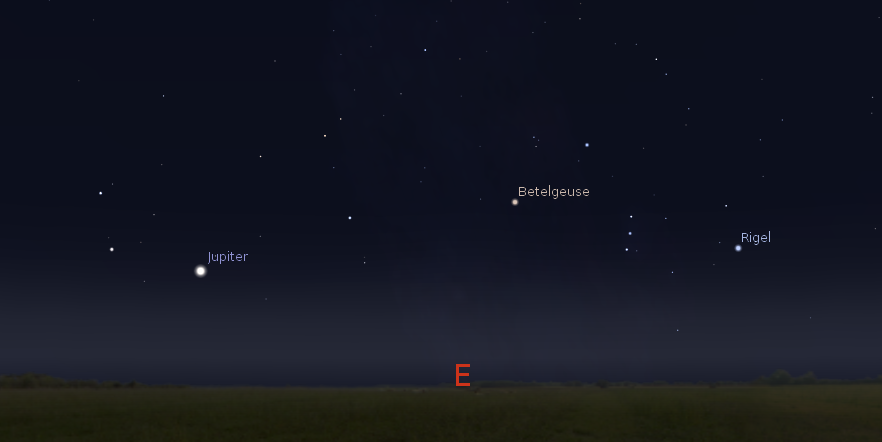
Jupiter rising at 10 p.m. with some of the winter stars. Created using Stellarium.
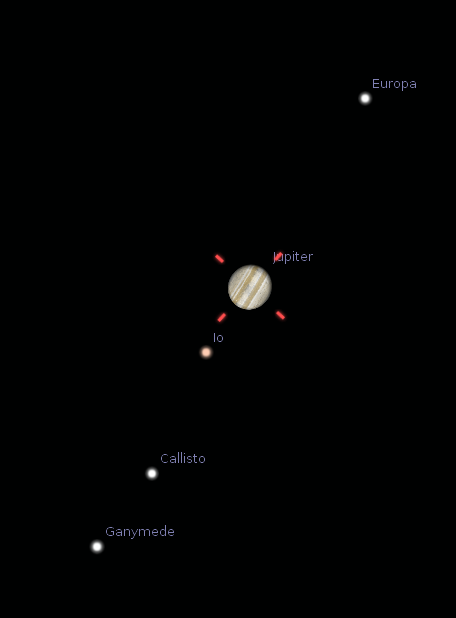
Telescopic Jupiter and its moons at 11 p.m. Created using Stellarium.
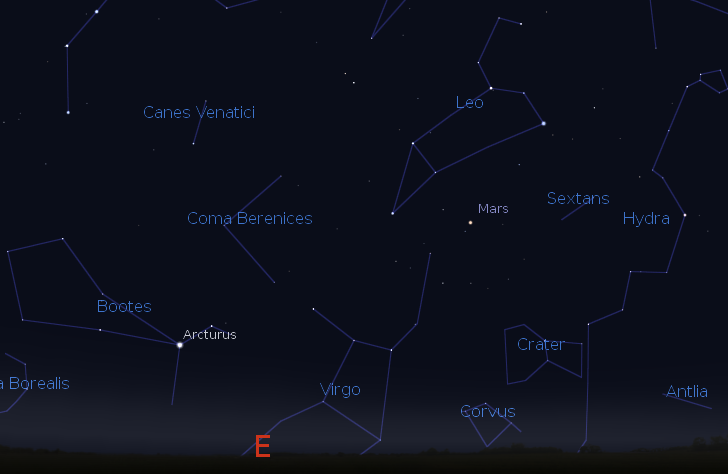
Mars and the spring constellations at 5:30 a.m. November 14, 2013. Created using Stellarium.
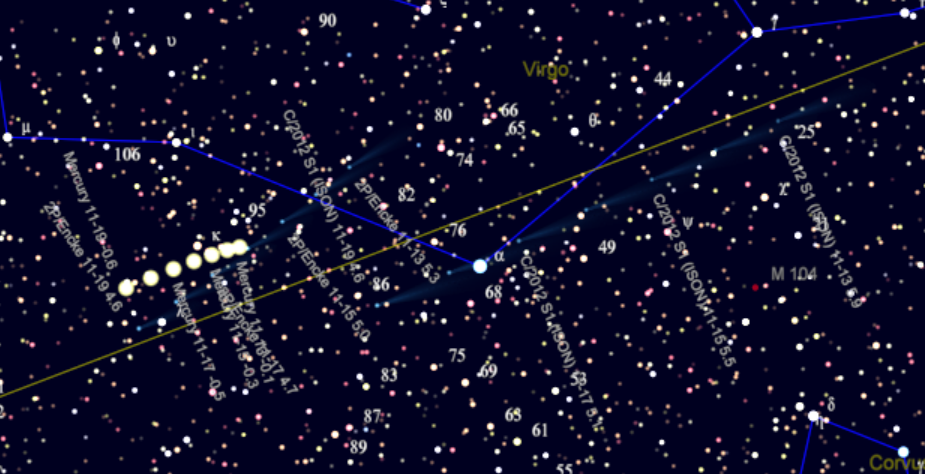
This is a busy chart with Comets ISON and Encke and Mercury for the period November 13th through 19th of November 2013 at 6 a.m. Created using Carts du Ciel.
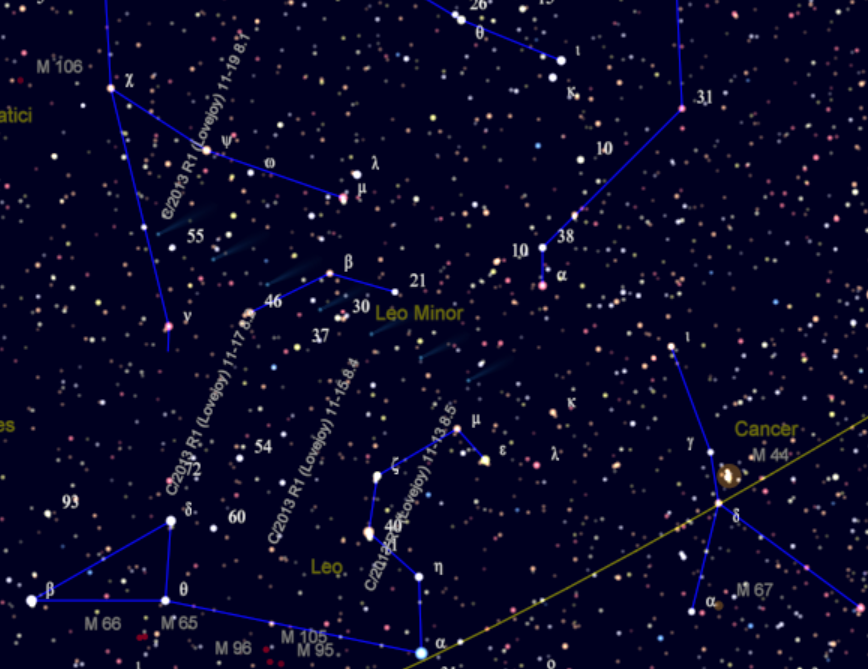
Comet Lovejoy and the constellation Leo for November 13th through 19th, 2013 at 6 a.m. Created using Cartes du Ciel.
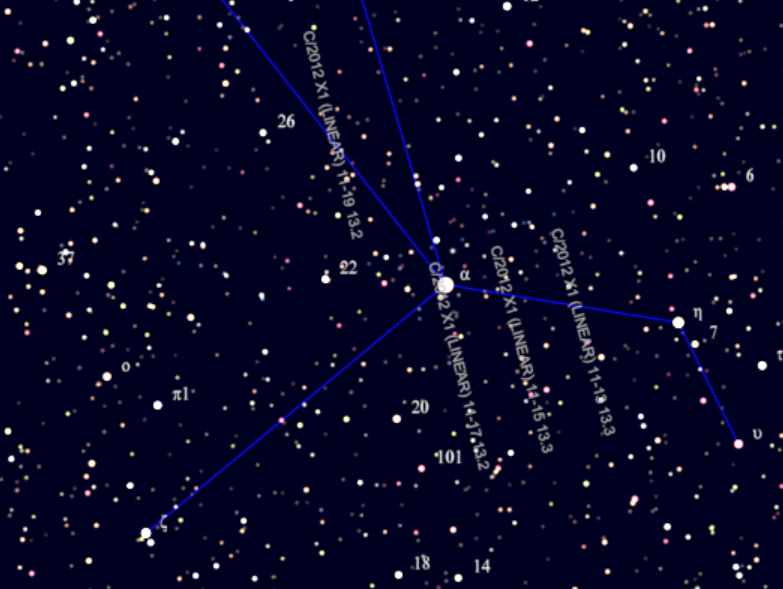
Comet LINEAR track for November 13th through 19th 2013. Created using Cartes du Ciel.
The following are the latest magnitudes (brightnesses) recorded for these comets:
Comet               Magnitude
C/2012 S1 (ISON)    8  (1 magnitude dimmer than predicted)
P2 (Encke)          8
C/2013 R1 (Lovejoy) 6  (2.5 magnitudes brighter than predicted)
C/2012 X1 (LINEAR)  8  (5 magnitudes* brighter than predicted)
* 5 magnitudes brighter = 100 times brighter!

Source is http://www.icq.eps.harvard.edu/CometMags.html.
Search page using the C/???? ?? instead of name.
Comets Lovejoy and LINEAR have multiple entries.

