04/24/2013 – Ephemeris – Where are the two bright planets this week?
Ephemeris for Wednesday, April 24th. The sun rises at 6:43. It’ll be up for 13 hours and 55 minutes, setting at 8:38. The moon, 1 day before full, will set at 6:24 tomorrow morning.
It’s time to check out the two remaining bright planets for this week. Jupiter is located in the constellation of Taurus, above the V shape of stars, the face of the bull and is in the west during the evening. It will set at 12:10 a.m. In the west northwest. Jupiter is still high enough as it gets dark to get a very good view of its cloud bands and satellites. The four moons that Galileo found are easy targets for small telescopes or even sharp-eyed binocular observers. The other bright planet Saturn will rise at 8:43 p.m. in the east southeast. It’s located in eastern Virgo, but us moving back a bit toward the bright star Spica to its right. Tonight the bright moon will be near Spica, so it may make both Saturn and Spica hard to spot.
Times are for the Traverse City/Interlochen area of Michigan. They may be different for your location.
Addendum
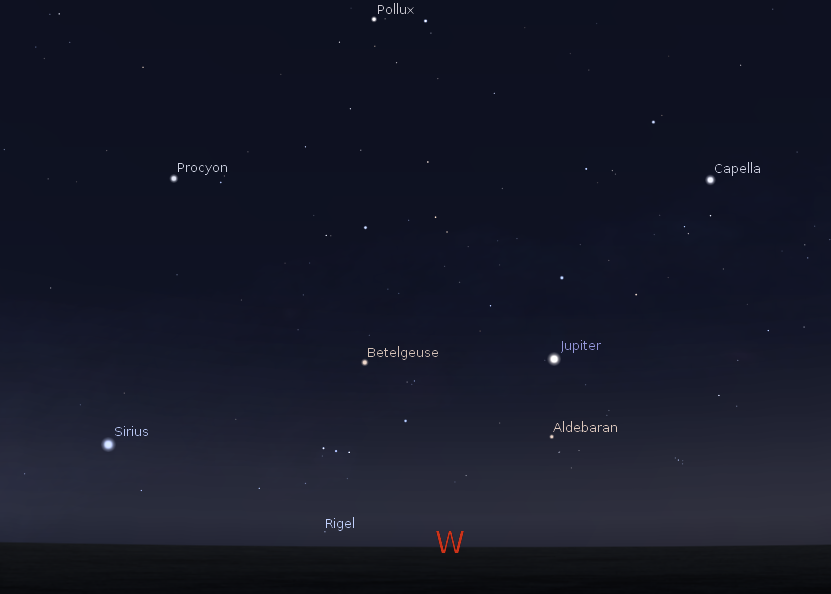
Jupiter and the fleeing stars of winter at 10 p.m. on April 24, 2013. Created using Stellarium.
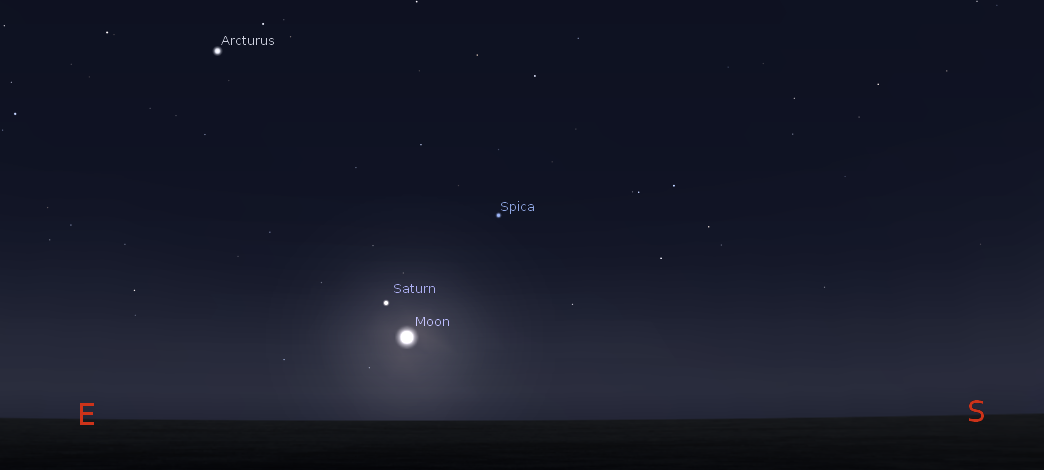
Saturn and the moon at 10 p.m. on April 24, 2013. Created using Stellarium.
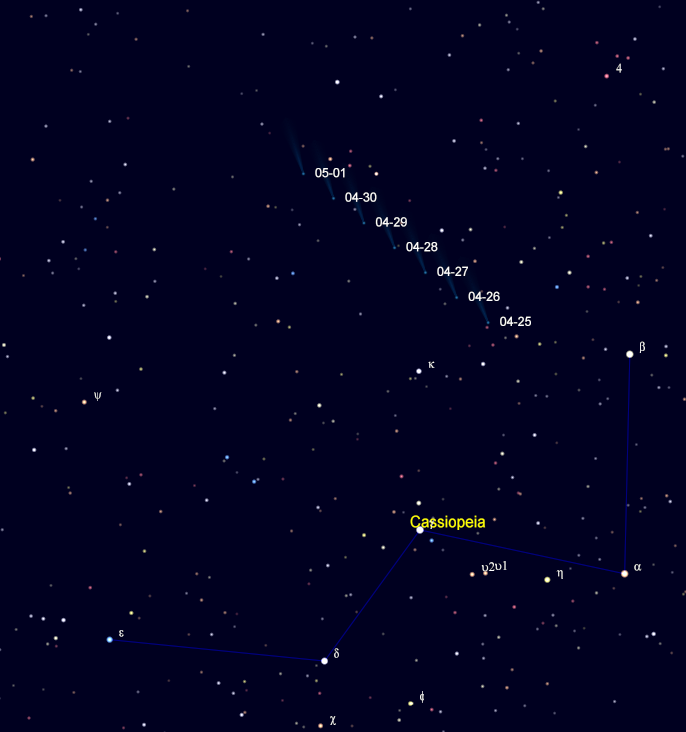
Our last look at Comet PanSTARRS at 5 a.m. on April 25 to May 1, 2013. Created using Cartes du Ciel (Sky Charts).
04/23/2013 – Ephemeris – Orbital Sciences enters the race to supply the International Space Station
Ephemeris for Tuesday, April 23rd. The sun rises at 6:44. It’ll be up for 13 hours and 52 minutes, setting at 8:37. The moon, 2 days before full, will set at 5:49 tomorrow morning.
Sunday afternoon the second winner in the Commercial Orbital Transportation Services or COTS competition held by NASA flew its first test flight. Orbital Sciences Corporation, which has been in business since 1982 developed a new rocket for COTS, the Antares, named after the brightest red star in the constellation Scorpius. It flew flawlessly launching a dummy payload into low earth orbit along with some cube-sats. At least one of these tiny satellites is controlled, not by a specially built computer, but by an Android smart phone. Smart phones are incredibly versatile, but can they stand the rigors and radiation of space? And can they phone home? Orbital will have another test launch later this year with test cargo to the International Space Station.
Times are for the Traverse City/Interlochen area of Michigan. They may be different for your location.
Addendum
Orbital has been in the rocket and satellite business for just over 30 years. As far as rockets go, their expertise was in solid fueled rockets. The Antares is their first liquid fueled rocket first stage. The first stage engines are re-manufactured Russian engines that were destined for the ill-fated Soviet N1 moon rocket engines. The original engines were so unreliable that they couldn’t be tested and mounted on the rocket. The tolerances of the pumps were so bad that they couldn’t be run again. The design bureau for the N1 would order engines six at a time. If two of the tested OK, they would use the other 4. If one of the test engines failed, all the engines in that batch would be rejected.
The Russians marveled at the F-1 engines in the first stage of the Saturn V, which would be tested three times, including a full duration test before installed in the Saturn V first stage. Still the same Russian engines were perfected to become an extremely reliable engine that Orbital is using on their Antares rockets. United Launch Alliance also uses the same engines on their Atlas 5 rockets. It’s rather ironic that the latest members of the Atlas family, that was first built as a weapon against the Soviets are using Russian engines.
Source for the Russian engines: Rockets and People Volume 4, TheMoon Race by Boris Chertok, an ebook downloadable from NASA.
04/22/2013 – Ephemeris – Spaceship Earth
Ephemeris for Earth Day, Monday, April 22nd. The sun rises at 6:46. It’ll be up for 13 hours and 50 minutes, setting at 8:36. The moon, 3 days before full, will set at 5:17 tomorrow morning.
The earth is unique in the solar system. Actually every planet is unique, as we’ve found out with our spacecraft that have at least flown by every planet of the solar system, and we’re two years from flying by the dwarf planet Pluto and its so far discovered 5 moons. But the earth uniquely supports life as we know it. It is the only one. While it is imperative that we colonize the moon, Mars and asteroids and live off the land so no single disaster can wipe us out, we need to take care of the earth, to understand and get a grip on what we’re doing to earth’s climate. We must think of the earth as a spaceship with both renewable resources and limited ones. Our journey is long, the supplies will have to last.
Times are for the Traverse City/Interlochen area of Michigan. They may be different for your location.
Addendum

Our home. Credit NASA.
04/19/2013 – Ephemeris Plus* – Astronomy Day and the Lyrid meteor shower
Ephemeris Plus for Friday, April 19th. The sun rises at 6:51. It’ll be up for 13 hours and 41 minutes, setting at 8:32. The moon, 1 day past first quarter, will set at 3:51 tomorrow morning.
Tomorrow is Astronomy Day 2013. Astronomy Day is generally held on the Saturday closest to the first quarter moon in late April or early May. The Grand Traverse Astronomical Society will celebrate with a star party at Northwestern Michigan College. Tomorrow April 20th, from 9 p.m. to 11 p.m. There will also be activities inside the observatory, so clear or cloudy there will be something to see or do for all ages.
The Lyrid Meteor Shower will be active this weekend and reach a peak Monday morning. The meteors from this shower will seem to come from near the constellation of Lyra the harp, a northern summer constellation, with the bright star Vega with a small and narrow parallelogram of stars near it. We do have a moon problem this year, so it just might be caught by early risers in the next couple of mornings. It is not a super active shower, and has a peak rate of only 18 and hour when Vega is overhead, which it will be at 5 in the morning. With the experience of the bright meteor that broke windows in Russia, be comforted to know that meteor showers members are created with very small grains, not big boulders.
Times are for the Traverse City/Interlochen area of Michigan. They may be different for your location.
*Ephemeris Plus contains more information in the post’s body that could not fit into the time constraints of the Ephemeris program.
Addendum
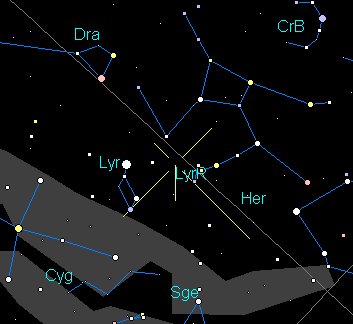
Lyrid meteor radiant. The bright star is Vega
04/18/2013 – Ephemeris – The moon at first quarter
Ephemeris for Thursday, April 18th. The sun rises at 6:52. It’ll be up for 13 hours and 38 minutes, setting at 8:31. The moon, at first quarter today, will set at 3:21 tomorrow morning.
Lets take a look at the moon tonight. It’ll be about 6 hours after first quarter and we’ll see features at the terminator, the sunrise line that cuts the moon in half. In small telescopes, at the north or top end of the moon, the wide flat crater Plato is just entering sunlight. Long shadows from its crater walls will retreat across its flat floor over the evening. If you look closely you’ll notice that the floor of Plato is slightly convex to conform with the curvature of the moon itself. Nearby is the straight gash in the Alps Mountains, called the Alpine Valley. Supposedly the crater Plato formed shortly after Mare Imbrium formed throwing up the Alps and the Apennine mountains to the south. The Straight wall, can be seen on the south end of the moon.
Times are for the Traverse City/Interlochen area of Michigan. They may be different for your location.
Addendum
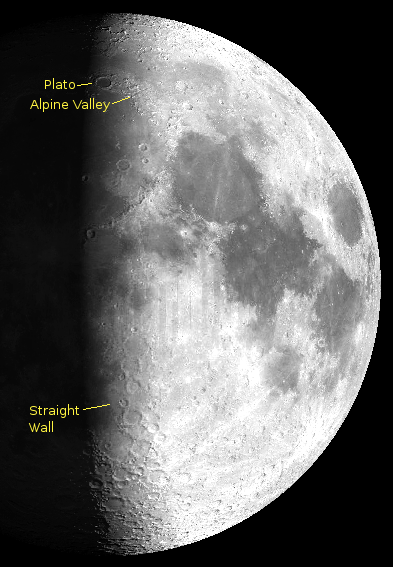
First quarter moon April 18, 2013 Created using Virtual Moon Atlas
04/17/2013 – Ephemeris – Where are the bright planets this week?
Ephemeris for Wednesday, April 17th. The sun rises at 6:54. It’ll be up for 13 hours and 35 minutes, setting at 8:30. The moon, 1 day before first quarter, will set at 2:49 tomorrow morning.
It’s time to check out the two remaining bright planets for this week. I’m no longer going to cover Comet PanSTARRS here, since it has dropped below naked eye visibility, but I will provide finder charts in the Ephemeris blog at bobmoler.wordpress.com for the next few weeks. Jupiter is located in the constellation of Taurus, above the V shape of stars, the face of the bull and is in the west during the evening. It will set at 12:27 a.m. The other bright planet Saturn will rise at 9:13 p.m. in the east southeast. It’s located in eastern Virgo. It will pass due south at 2:27 a.m. Both planets are wonderful sights in telescopes. Jupiter with its cloud bands and moons, Saturn with those fantastic rings.
Times are for the Traverse City/Interlochen area of Michigan. They may be different for your location.
Addendum
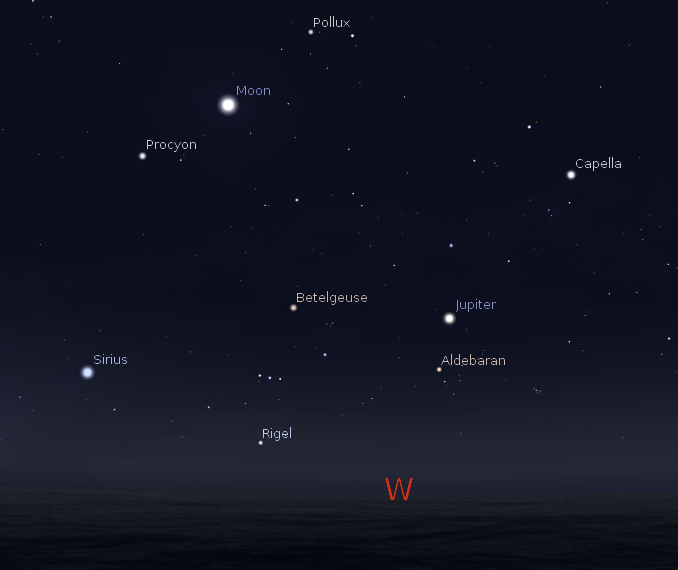
Jupiter and the setting stars of winter at 10 p.m., April 17, 2013. Created using Stellarium.
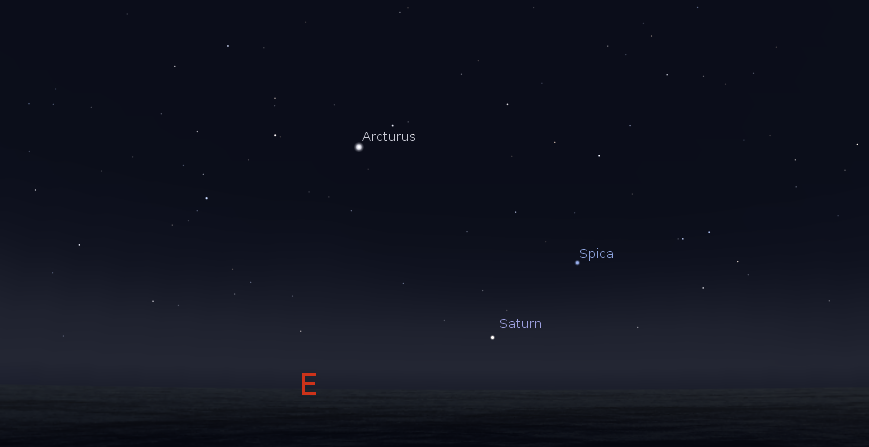
Saturn rising with the bright stars of late spring at 10 p.m., April 17, 2013. Created using Stellarium.
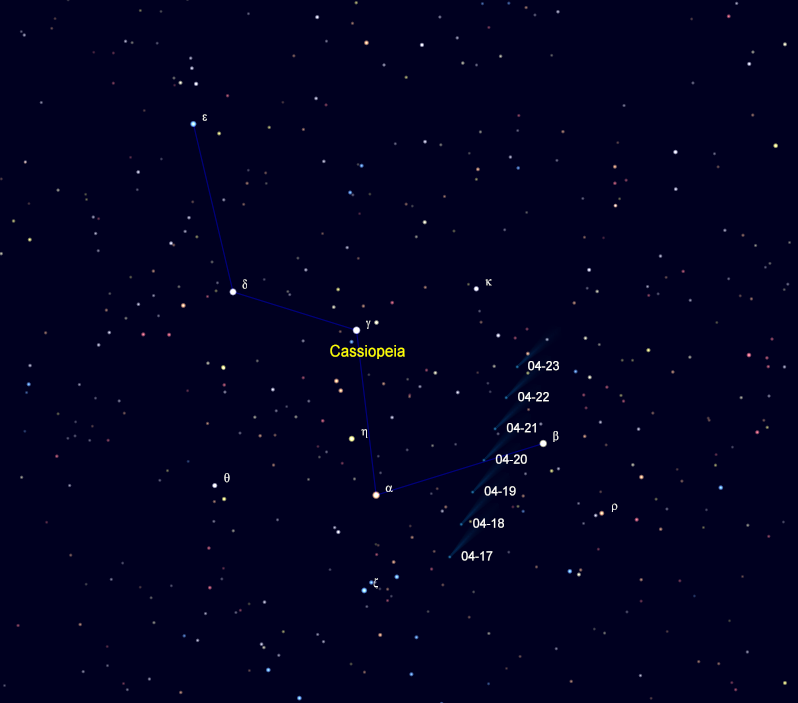
Comet PanSTARRS is moving through Cassiopeia from 04/17/13 to 4/23/13 at 11 p.m. low in the north north-east. Created using Cartes du Ciel (Sky Charts). It requires binoculars or telescope to spot.
04/16/2013 – Ephemeris – The moon’s strange orbit
Ephemeris for Tuesday, April 16th. The sun rises at 6:56. It’ll be up for 13 hours and 32 minutes, setting at 8:28. The moon, 2 days before first quarter, will set at 2:13 tomorrow morning.
The fat crescent moon appears high in the sky. It appears in a part of the sky where the sun will be in early July. The moon follows a path nearly in the plane of the earth’s orbit , but a bit tilted from it by an angle of 5 degrees. This is unusual. Most planet’s major satellites orbit their primary in it’s equatorial plane, like our geostationary communication satellites, though none them orbit in one of their planet’s days. The moon orbits the earth, but due to its great distance of 60 earth radii, or 240 thousand miles also is very much gravitationally affected by the sun. Apparently one of its effects was to pull the moon close to the the earth’s orbital plane. If you like eclipses this is a good thing. It makes eclipses much more frequent than if the moon orbited over the earth’s equator.
Times are for the Traverse City/Interlochen area of Michigan. They may be different for your location.
Addendum
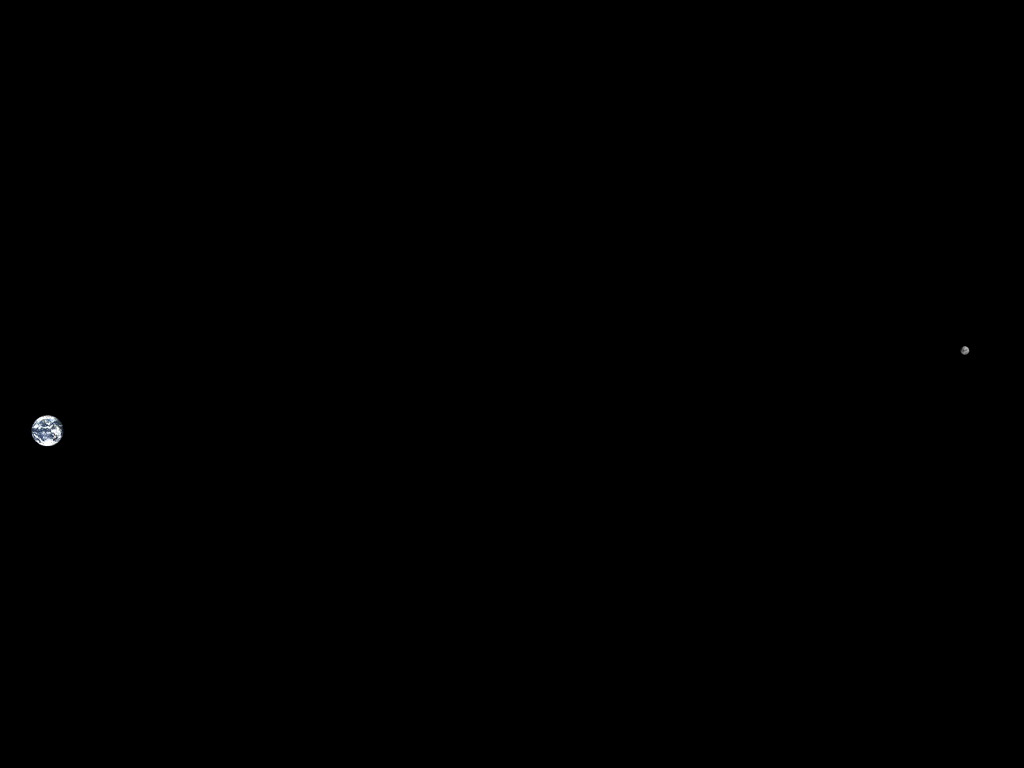
The true scale of the earth-moon system. From Traipse.com
04/15/2013 – Ephemeris – The Big Dipper and the Fisher
Ephemeris for Tax deadline day* Monday, April 15th. The sun rises at 6:57. It’ll be up for 13 hours and 29 minutes, setting at 8:27. The moon, 3 days before first quarter, will set at 1:32 tomorrow morning.
The Big Dipper is nearly overhead in the evening now. The Big Dipper is not a constellation but part of the Great Bear for most peoples, and is enshrined by the International Astronomical Union as Ursa Major. To some of the Anishinabek peoples native to our region the stars of the Big Dipper belonged to a small weasel like animal call the Fisher. In a story I can’t relate here Fisher brought summer to the earth, and for his trouble was killed by an arrow to his only vulnerable spot, his tail. The Great Spirit would not let Fisher fall to earth, but placed him in the sky. His rising in the northeast signals the coming of spring, and when his bloody tail brushes the horizon in autumn his blood paints the autumn leaves red.
Times are for the Traverse City/Interlochen area of Michigan. They may be different for your location.
Addendum
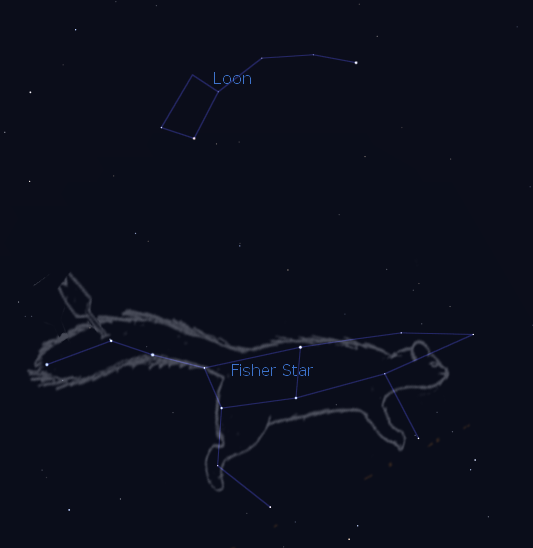
The Fisher or Fisher Star as seen Overhead and the Big Dipper. Created using Stellarium and some other help.
04/12/2013 – Ephemeris – Yuri’s Night
Ephemeris for Friday, April 12th. The sun will rise at 7:03. It’ll be up for 13 hours and 20 minutes, setting at 8:23. The moon, 2 days past new, will set at 11:00 this evening.
A special celebration has been sneaking into my consciousness: Yuri’s Night. It is celebrated in many places around the world, including at NASA. The closest celebration to us is in Ann Arbor. It is the anniversary of Yuri Gargarin’s, and mankind’s first orbital flight around the earth in 1961. These are all in the nature of parties, talks and the like celebrating the beginning of humankind’s first steps into space. Gargarin never flew in space again and tragically died in 1968 when his jet crashed.
NASA has released a series of ebooks about the Soviet space program written by Boris Chertok, one of the rocket designers. It’s in four volumes Rockets and People. I skipped to the 4th, the Moon Race and their heart breaking development of the N1 moon rocket that never really worked.
Times are for the Traverse City/Interlochen area of Michigan. They may be different for your location.
Addendum

Link to NASA’s page to download Rockets and People.
04/11/2013 – Ephemeris – The Big Dipper and Ursa Major the Great Bear
Ephemeris for Thursday, April 11th. The sun will rise at 7:04. It’ll be up for 13 hours and 17 minutes, setting at 8:22. The moon, 1 day past new, will set at 10:01 this evening.
The Big Dipper is now nearly overhead in the northeast at 10 p.m. The seven bright stars are second to Orion in the west as the seven brightest stars in a constellation. If you looked up a list of constellations, you’d find that the Big Dipper isn’t there. Ursa Major or the Great Bear is the constellation of which the Big Dipper is a part. The seven bright stars of the dipper is the rump and long tail of this constellation. The rest of the bear, including his head and legs are delineated by dimmer stars. An anatomical problem is its long tail, which was drawn in by the ancients of the old world. Many Native Americans, also saw a bear in the stars here, but the handle of the dipper became three hunters following the bear.
Times are for the Traverse City/Interlochen area of Michigan. They may be different for your location.
Addendum
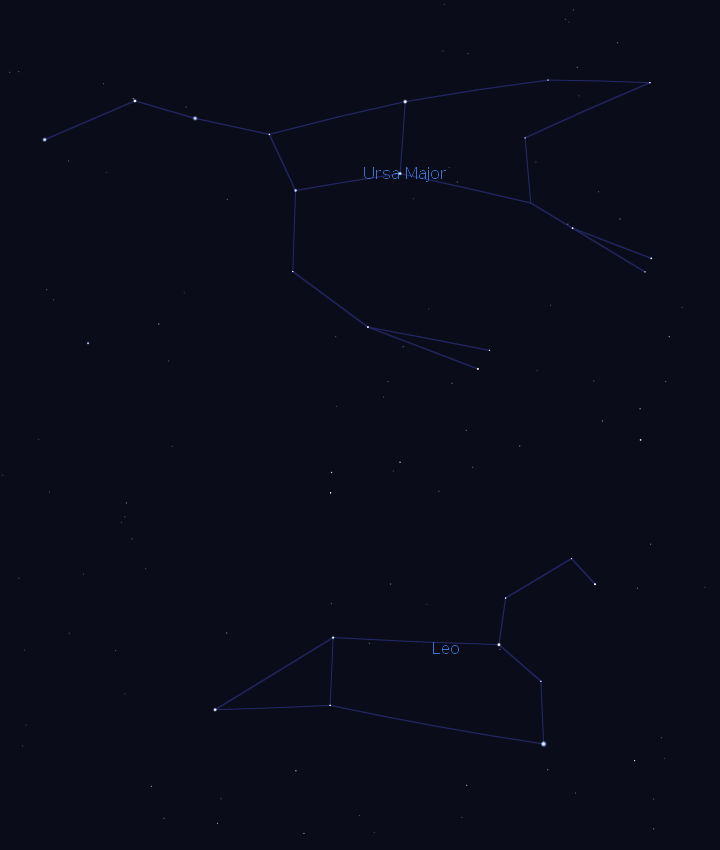
The Big Dipper part of Ursa Major with Leo right below in spill range. This is for 10 p.m. on April 11, 2013. Created using Stellarium.

