Archive
02/12/2016 – Ephemeris – A circle of bright stars in winter
Ephemeris for Friday, February 12th. The Sun will rise at 7:48. It’ll be up for 10 hours and 18 minutes, setting at 6:06. The Moon, 3 days before first quarter, will set at 11:19 this evening.
The winter skies are blessed with more first magnitude stars than any other season. With the moon out these stars will stand out even more, as dimmer stars are suppressed. Six of these stars lie in a large circle centered on the seventh, the Winter Circle.
This circle is up at 9 p.m. Starting high nearly overhead is Capella in Auriga the charioteer. Moving clockwise down to the south, we come to Aldebaran in the face of Taurus the Bull. Then down to Orion’s knee we find Rigel. Down and left is the brightest star of all Sirius in Canis Major Orion’s large hunting dog, lowest of these stars in the southeast. Moving up and left there is Procyon in Canis Minor, Above is Pollux in Gemini the twins. All are centered on Betelgeuse the bright red star in Orion’s shoulder.
Times are for the Traverse City/Interlochen area of Michigan. They may be different for your location.
Addendum
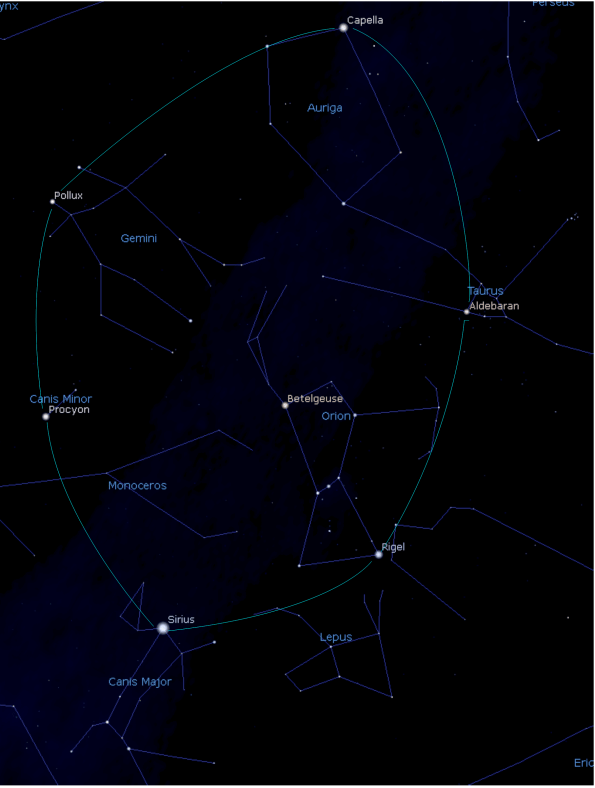
The bright stars of winter arrayed in a circle. Created using Stellarium.
Some also see a Winter Triangle consisting of the stars Betelgeuse, Sirius and Procyon.
01/19/2016 – Ephemeris – The Moon will cover Aldebaran tonight!
Ephemeris for Tuesday, January 19th. The Sun will rise at 8:14. It’ll be up for 9 hours and 18 minutes, setting at 5:32. The Moon, 3 days past first quarter, will set at 4:51 tomorrow morning. | Tonight the Moon will pass in front of or occult the bright star Aldebaran, the bright star in Taurus the bull. The bright Moon will making spotting Aldebaran difficult without binoculars, or better yet, a telescope. Aldebaran will wink out at the Moon’s dark eastern or left edge around 9:06 p.m. The exact time depends on your location. It’s within a minute or 2 for the IPR listening area. Aldebaran will be uncovered by the Moon around 10:25 p.m. at the bright lower right edge of the Moon. Today’s posting on bobmoler.wordpress,com will have much more information on the event, and how to calculate times for other locations along the path of the occultation (see below). This is the best of the four Aldebaran occultations visible this year.
Times are for the Traverse City/Interlochen area of Michigan. They may be different for your location.
Addendum
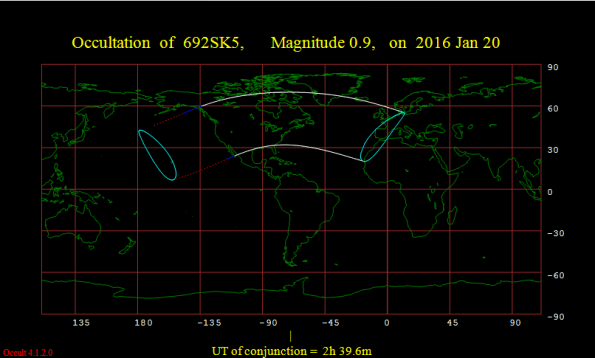
Occultation visibility map for January 19, 2016 EST (January 20 UT). Credit IOTA/Occult4 program. Looks like the followers of this blog in the UK will get a piece of this one too.
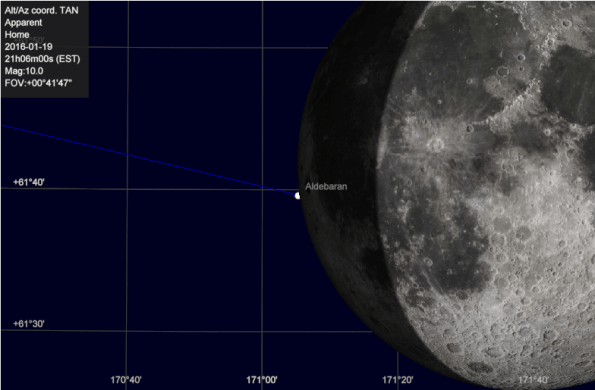
Aldebaran will disappear at the Moon’s dark leading edge at about 9:06 p.m. January 19, 2016. Created using Cartes du Ciel (Sky Charts).
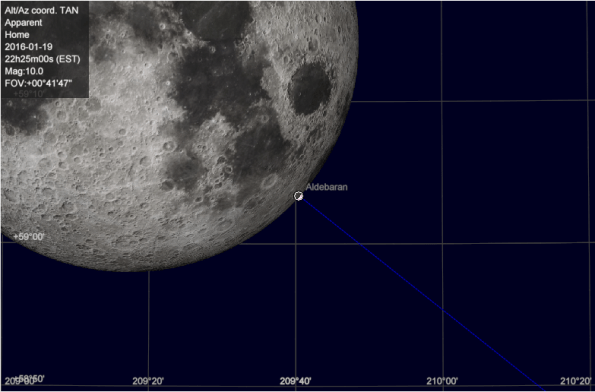
Aldebaran will reappear at the Moon’s bright trailing edge at about 10:25 p.m. January 19, 2016. Created using Cartes du Ciel (Sky Charts).
Estimating timings for your location
I used Cartes du Ciel the free software that I have a link to on the right. Make sure that the program is set for topocentric positions under Setup/Solar System. And you have entered your position under Setup/Observatory. You can find your location in Google Earth.
You can also use Stellarium. Just make sure the Moon is normal sized.
In both programs you can lock the Moon or Aldebaran in the center of the screen Pick a time in advance of the occultation and using the set time window walk the star towards the Moon, mark the time. Then walk the star out from the Moon and record the reappearance time. That’s it.
This should work with other planetarium programs too.
01/01/2016 – Ephemeris – Happy New Year – It’s a busy few days to start off the year
Happy New Year. This is Bob Moler with Ephemeris for New Years Day, Friday, January 1st, 2016. The Sun will rise at 8:20. It’ll be up for 8 hours and 52 minutes, setting at 5:12. The Moon, 1 day before last quarter, will rise at 12:54 tomorrow morning.
It’s always a busy time, astronomically speaking, around the start of the year. This year even more so. Comet Catalina is found near the bright star Arcturus now, which is a good way to find it in binoculars. Tomorrow at 7:59 p.m. (1:59 UT 3rd) the Earth will reach perihelion, the closest point in its orbit to the Sun at about 91.4 million miles (0.9833 AU). It doesn’t add much to the heat we get from the Sun, but it does make winter a couple of days shorter than summer. Monday at 3 a.m. will see the peak of the Quadrantid meteor shower. Unfortunately that’s about the time the Moon will rise. The radiant is north of the handle of the Big Dipper. Good news: tomorrow is the latest sunrise, it should be rising earlier until June.
Times are for the Traverse City/Interlochen area of Michigan. They may be different for your location.
Addenda
January Star Chart
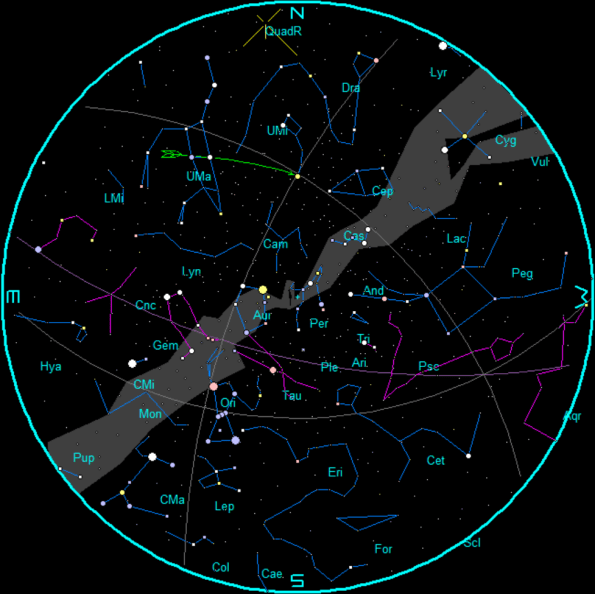
Star Chart for January 2016. Created using my LookingUp program. To enlarge in Firefox Right-click on image then click View Image.
The planets and stars are plotted for the 15th at 9 p.m. EST. That is chart time. Note, Traverse City is located 45 minutes behind our time meridian. To duplicate the star positions on a planisphere you may have to set it to 45 minutes earlier than the current time.
Evening astronomical twilight ends at 6:22 p.m. EST on January 1st, increasing to 6:55 p.m. EST on the 31st.
Morning astronomical twilight starts at 7:09 a.m. EST on January 1st, and decreasing to 6:57 a.m. EST on the 31st.
Add a half hour to the chart time every week before the 15th and subtract and hour for every week after the 15th.
For a list of constellation names to go with the abbreviations click here.
- Pointer stars at the front of the bowl of the Big Dipper point to Polaris the North Star.
- QuadR is the Quadrantid meteor shower radiant
Calendar of Planetary Events
Credit: Sky Events Calendar by Fred Espenak and Sumit Dutta (NASA’s GSFC)
To generate your own calendar go to http://eclipse.gsfc.nasa.gov/SKYCAL/SKYCAL.html
Times are Eastern Time. Some additions made to aid clarity.
     Date   Local      Event
            Time EST
Jan  01  Fr            Venus: 37.9° W
     02  Sa 12:30 a.m. Last Quarter
     02  Sa  6:53 a.m. Moon Apogee: 404300 km
     02  Sa  7:59 p.m. Perihelion: 0.9833 AU
     03  Su  1:45 p.m. Moon-Mars: 1.6° S
     04  Mo  3:01 a.m. Quadrantid Shower: ZHR = 120
     06  We  6:57 p.m. Moon-Venus: 3.3° S
     06  We 11:57 p.m. Moon-Saturn: 3.6° S
     07  Th  6:32 a.m. Venus-Antares: 6.4° N
     08  Fr 12:56 p.m. Moon South Dec.: 18.4° S
     09  Sa  2:42 a.m. Venus-Saturn: 0.1° N
     09  Sa  8:30 p.m. New Moon
     14  Th  9:02 a.m. Mercury Inferior Conj.
     14  Th 10:48 a.m. Moon Descending Node
     14  Th  9:10 p.m. Moon Perigee: 369600 km
     16  Sa  6:26 p.m. First Quarter
     19  Tu  9:16 p.m. Moon-Aldebaran: 0.5° S (Occultation*)
     21  Th 11:41 a.m. Moon North Dec.: 18.4° N
     23  Sa  8:46 p.m. Full Moon
     26  Tu 12:10 a.m. Moon-Regulus: 2.8° N
     27  We  6:58 p.m. Moon Ascending Node
     27  We  8:14 p.m. Moon-Jupiter: 1.6° N
     30  Sa  4:10 a.m. Moon Apogee: 404600 km
     31  Su 10:28 p.m. Last Quarter
Feb  01  Mo            Venus: 31.4° W
* Occultation of Aldebaran For the Grand Traverse Area ± 1-2 minutes:
Disappearance 9:06 p.m. Reappearance 10:25 p.m. I’ll have more information on the 19th.
Occultation Map
Occultation visibility map for January 20, 2016 (UT). Credit IOTA/Occult4 program.
Estimating occultation timings for your location
I used Cartes du Ciel the free software that I have a link to on the right. Make sure that the program is set for topocentric positions under Setup/Solar System. And you have entered your position under Setup/Observatory. You can find your location in Google Earth, or your GPS device or smart phone.
You can also use Stellarium. Just make sure the Moon is normal sized.
In both programs you can lock the Moon or Aldebaran in the center of the screen Pick a time in advance of the occultation and using the set time window walk the star towards the Moon, mark the time. Then walk the star out from the Moon and record the reappearance time. That’s it.
This should work with other planetarium programs too.
For better accuracy go to the International Occultation Timing Association (IOTA) website. Download and install their Occult4 program for Windows computers. Follow the instructions. When I ran the program for my location, the location I use for Interlochen/Traverse City (Since I live approximately half-way between the two). I got results within a half-minute of the IOTA Occult4 program results. So the approximation method using these planetarium programs is valid.
Comet C/2013 US10 (Catalina)
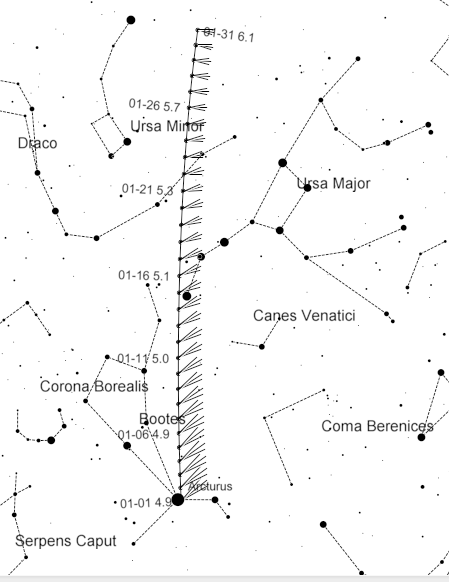
The track of Comet C/2013 US10 (Catalina) for January 2016. Created using Cartes du Ciel (Sky Charts).
The comet is roughly one magnitude fainter than given. Comet is plotted every day at 4 a.m. EST (9 hr UT) with the date and magnitude labeled every 5th day. According to the brightness graph the comet began to under perform in brightness back in September, however, according to a new brightness formula the comet may increase in brightness by a magnitude by late February when it will be well placed for viewing all night. To monitor the brightness reports from observers go to http://www.aerith.net/comet/catalog/2013US10/2013US10.html.
xxxvvvvv
12/17/2015 – Ephemeris – The bright star Aldebaran the “follower”
Ephemeris for Thursday, December 17th. The Sun will rise at 8:14. It’ll be up for 8 hours and 48 minutes, setting at 5:03. The Moon, 1 day before first quarter, will set at 12:07 tomorrow morning.
The central constellation of winter Orion, will be rising the east-southeast at 9 p.m. Above it is Taurus the bull. The bright orange star in Taurus is Aldebaran. Aldebaran appears at the lower left tip of a letter V group of stars that is the face of the bull. Aldebaran isn’t actually part of the group, called the Hyades star cluster. The cluster is about 151 light years away, while Aldebaran is 65. The star has an orange hue because its surface is cooler than the sun’s. However Aldebaran is 44 times larger in diameter, and shines 425 times brighter than the sun, if you include the infrared which our eyes can’t detect, or 150 times brighter in visible light. The name Aldebaran means “Follower” because it follows the Pleiades star cluster above through the night.
Times are for the Traverse City/Interlochen area of Michigan. They may be different for your location.
Addendum
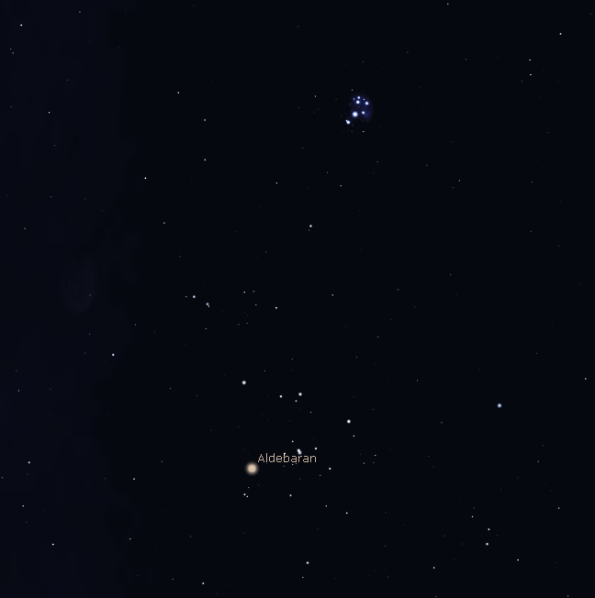
Aldebaran, the Hyades and Pleiades star clusters. Created using Stellarium.
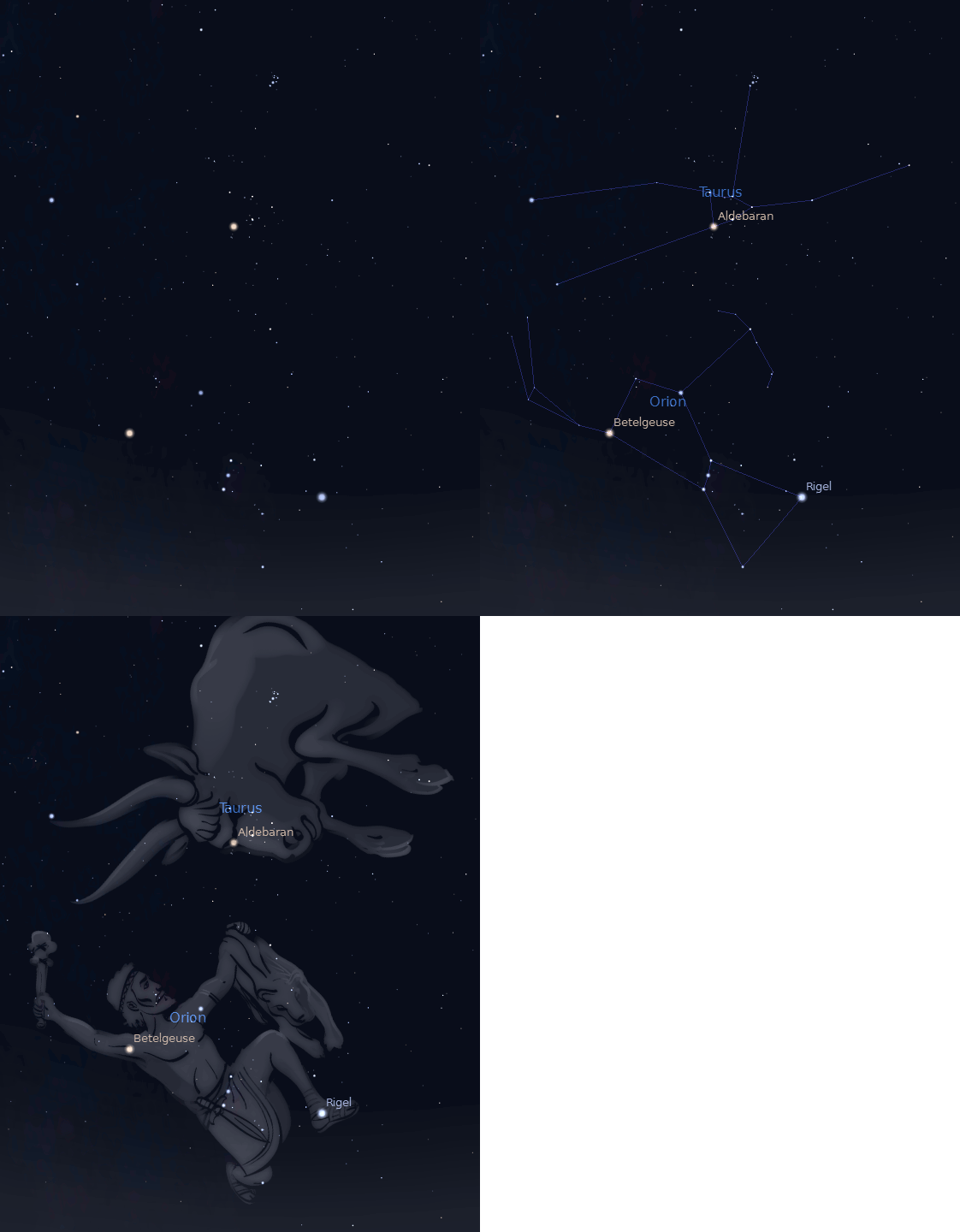
Three views of Taurus the bull and Orion the hunter for 9 p.m. on December 8, 2015. Created using Stellarium and GIMP.
12/08/2015 – Ephemeris – The hard charging Taurus the bull
Ephemeris for Tuesday, December 8th. The Sun will rise at 8:07. It’ll be up for 8 hours and 55 minutes, setting at 5:02. The Moon, 3 days before new, will rise at 6:03 tomorrow morning.
Low in the east at 9 p.m. is the constellation of Orion the giant hunter . Above him is Taurus the bull. His face is a letter V shape of stars lying on its side with the bright orange-red star Aldebaran at the bottom left tip of the V as its angry blood-shot eye. Orion is depicted in the sky facing with club in one hand and a shield in the other the approaching and in some depictions charging Taurus. The V of stars is a star cluster called the Hyades. The Pleiades are in his shoulder above. Taurus in Greek mythology was the guise the god Zeus when he carried off the maiden Europa. Europa’s still with him, sort of, as the intriguing satellite orbiting Zeus’ Roman equivalent Jupiter. In fact the moons around the planet Jupiter are generally named for Jupiter’s lovers and friends. His wife is missing from the entourage, and will be until the NASA spacecraft Juno reaches Jupiter next year.
Times are for the Traverse City/Interlochen area of Michigan. They may be different for your location.
Addendum
Three views of Taurus the bull and Orion the hunter for 9 p.m. on December 8, 2015. Created using Stellarium and GIMP.
11/30/2015 – Ephemeris – Orion Rising
Ephemeris for Monday, November 30th. The Sun will rise at 7:58. It’ll be up for 9 hours and 5 minutes, setting at 5:04. The Moon, 3 days before last quarter, will rise at 10:12 this evening.
We have a few hours of darkness tonight before the Moon comes up. In the east the central winter constellation Orion the hunter throws a leg over the horizon between 8 and 9 p.m. as Robert Frost told in his poem Star-Splitter. The upright rectangle that is his body on January evenings is tilted to the left as he rises, with bright red star Betelgeuse at the top left of the rectangle, his shoulder. At the opposite corner is blue-white Rigel, a knee. In the center of the rectangle is a line of three stars nearly vertically aligned, which represents Orion’s belt. Above Orion is another bright orange star at one end of a letter V shape of stars. That’s Aldebaran the angry eye in the face if Taurus the bull who apparently is none to happy with Orion.
Times are for the Traverse City/Interlochen area of Michigan. They may be different for your location.
Addendum
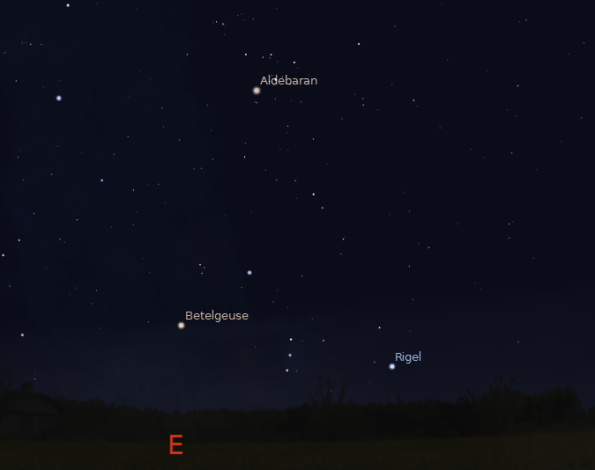
Orion Rising at 8:30 p.m. (3 1/2 hours after sunset) on November 30th. Created using Stellarium.
11/25/2015 – Ephemeris – The occultation of Aldebaran is tomorrow morning!
Ephemeris for Wednesday, November 25th. The Sun will rise at 7:52. It’ll be up for 9 hours and 14 minutes, setting at 5:06. The Moon, at full today, will rise at 5:26 this evening.
Tomorrow morning between about 5:38 and 6:29 a.m. the Moon will pass in front of the bright star Aldebaran. The event is called an occultation. Aldebaran is the bright reddish star in the V-shaped face of the constellation Taurus the bull, which is seen in the sky charging Orion the hunter in the evening sky now. By the time of this event, they will have moved into the west. Aldebaran, though bright, doesn’t hold a candle to the nearly full Moon. I know that a holiday is a good day to sleep in, unless you are getting an early start on preparing the Thanksgiving feast. In any case the earlier you get out to spot Aldebaran the easier it will be to find in the Moon’s glare. Check out my posts on bobmoler.wordpress.com for more information.
Times are for the Traverse City/Interlochen area of Michigan. They may be different for your location.
Addendum
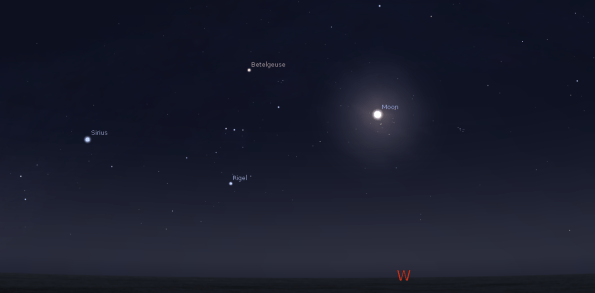
Here’s the Moon hiding Aldebaran in its glare at 5:30 a.m. tomorrow morning November 26, 2015. Created using Stellarium.
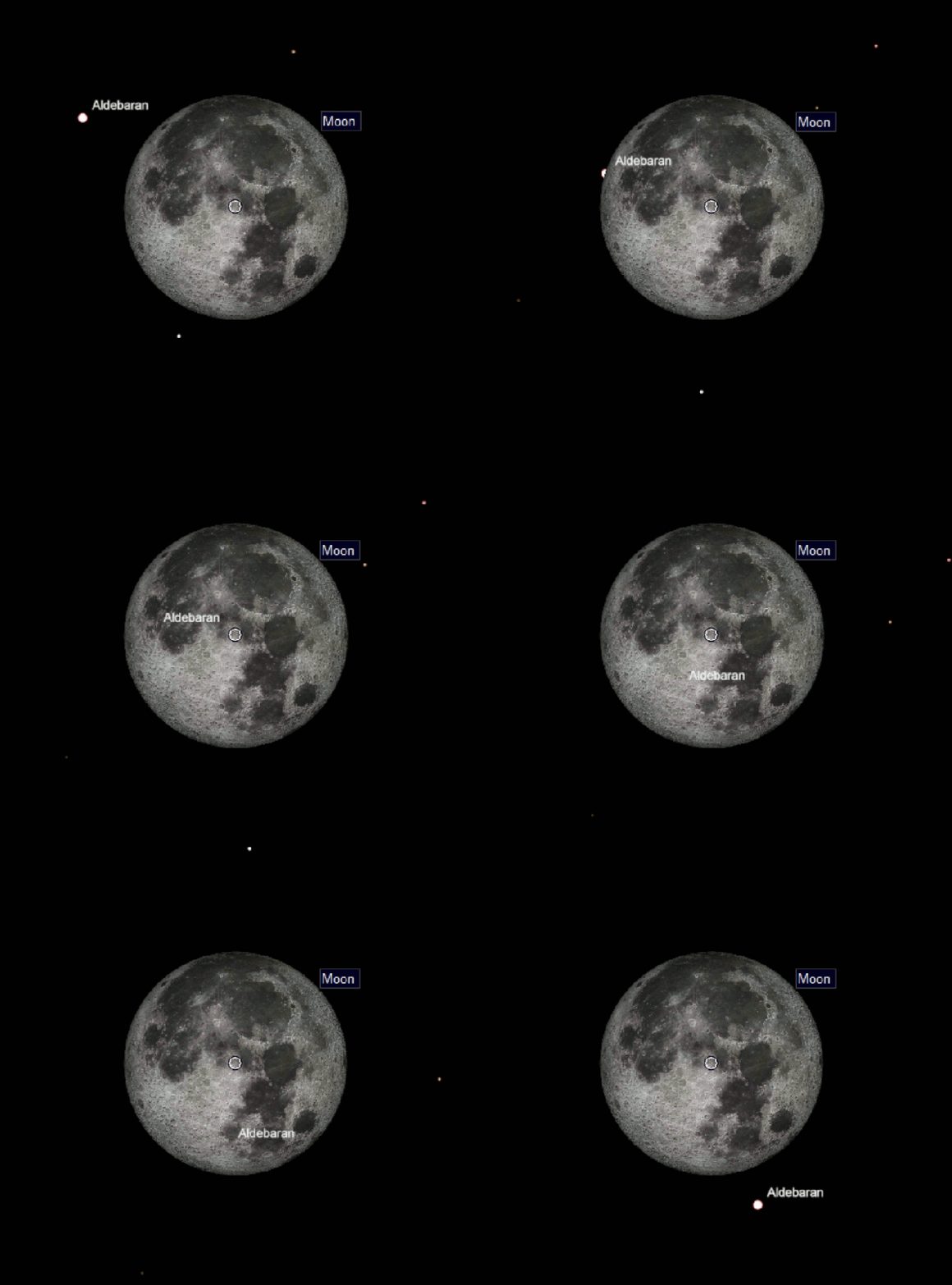
An occultation animation starting at 5:19 a.m. EST showing 10 minute intervals. Computer generated graphics cannot produce a point star. Aldebaran will wink out and back in an instant. Created using Cartes du Ciel (Sky Charts) and GIMP.
11/23/2015 – Ephemeris – An occultation of Aldebaran by the Moon will be visible to much of the northern US Thursday morning
Ephemeris for Monday, November 23rd. The Sun will rise at 7:49. It’ll be up for 9 hours and 18 minutes, setting at 5:08. The Moon, 2 days before full, will set at 5:58 tomorrow morning.
Thursday morning, Thanksgiving Day here in the US, the Moon will occult or pass in front of the bright star Aldebaran for the northern half of the United States, and Canada. I have a special post on my blog dated yesterday, November 22nd. It’s titled Aldebaran Occultation November 26, 2015 from Northern Michigan (click here) with all the details. My blog is bobmoler.wordpress.com, or do an Internet search for Bob Moler, That’s Moler spelled M-O-L-E-R, no extra letters. Aldebaran is the bright orange star in the face of the constellation Taurus the bull. You will need at least a pair of binoculars to pick out Aldebaran next to the Moon. Aldebaran will disappear at about 5:38 a.m. and reappear about 6:29 a.m. for Interlochen and Traverse City.
Times are for the Traverse City/Interlochen area of Michigan. They may be different for your location. The November 22 post has instructions on how to calculate the occultation times for your location, and has a map to see if you can view the occultation at all.
Addendum
An occultation animation starting at 5:19 a.m. EST showing 10 minute intervals. Not that the computer generated graphics cannot produce a point star. Aldebaran will wink out and back in an instant. Created using Cartes du Ciel (Sky Charts) and GIMP.
Aldebaran Occultation November 26, 2015 from Northern Michigan
On the early morning of November 26th, that’s Thanksgiving morning here in the US, The Moon will pass in front of, or occult, the bright star Aldebaran in Taurus the bull. The event is called an occultation.
Three first magnitude stars can be occulted by the Moon, Aldebaran, Regulus in Leo the lion, Antares in Scorpius the Scorpion, and Spica in Virgo the virgin, since these stars lie within 5 1/2 degrees of the ecliptic, the plane of the Earth’s orbit. The Moon’s orbit is inclined to it by 5º 14′. Also because the Moon’s orbit precesses over a period 18.6 years they occur over the Earth in monthly series every 18.6 years. There are 43 monthly occultations that will occur in this series, which actually started in January. This is the best of them so far. We’ll have another on the evening of January 19th next year. Below is a chart of the event from the Astronomical Almanac Online which can be accessed here: http://asa.usno.navy.mil/.
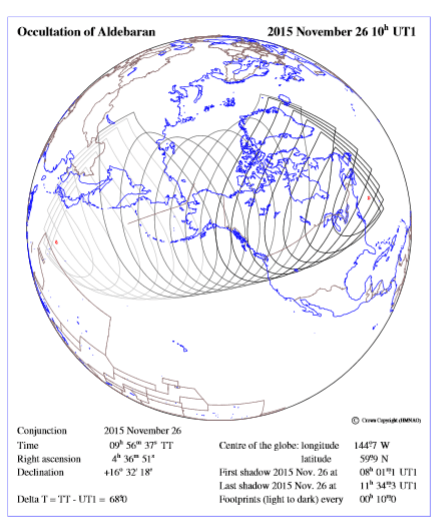
Map of the area where the occultation of Aldebaran is visible. Credit: Astronomical Almanac Online – U.S. Nautical Almanac Office, United States Naval Observatory (USNO), in the United States and Her Majesty’s Nautical Almanac Office (HMNAO), United Kingdom Hydrographic Office (UKHO), in the United Kingdom.
The occultation will be visible for locations within the nested grid of curved lines.
The two important events of the occultation is the star’s disappearance and reappearance. The times of these two events depend on your location, and are scientifically useful in determining the precise position of the Moon.
I’ve worked out the timings for my location about half way between Traverse City and Interlochen, so they should be within a couple of minutes of your observed time if you’re within 30 or so miles. Go out early, the earlier the better. The Moon will be especially bright, being only 12 hours after the instant the Moon will be full. Binoculars or a small telescope will be necessary to spot Aldebaran. The farther away Aldebaran is away from the Moon the easier it can be picked up. Note as a rule of thumb, the Moon moves its own diameter against the stars in about an hour.
For the Traverse City/Interlochen area I calculate the disappearance of Aldebaran at 5:38 a.m.
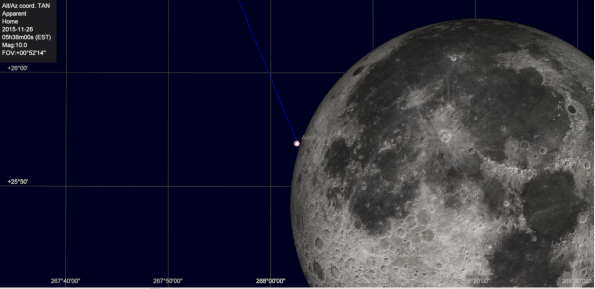
Aldebaran just prior to it’s disappearance behind the Moon from Interlochen/Traverse City. Created using Cartes du Ciel (Sky Charts).
For the Traverse City/Interlochen area I calculate the reappearance of Aldebaran at 6:29 a.m.
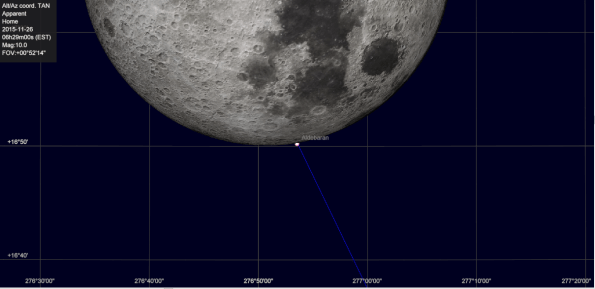
Aldebaran just after it’s reappearance from behind the Moon from Interlochen/Traverse City. Created using Cartes du Ciel (Sky Charts).
The Moon will be low in the western sky.
Timings for 3 locations in Michigan
This can be used to approximate the occultation time for other locations in Michigan.
City(s)                    Disappears  Reappears Location
Ironwood          5:33 a.m.   6:25 a.m. Northwestern corner of the
                                        Upper Peninsula (UP) of
                                        Michigan
Interlochen/      5:38 a.m.   6:29 a.m. Northwestern lower Michigan
   Traverse City
Monroe            5:45 a.m.   6:29 a.m. Southeastern corner of Michigan
Estimating timings for your location
I used Cartes du Ciel the free software that I have a link to on the right. Make sure that the program is set for topocentric positions under Setup/Solar System. And you have entered your position under Setup/Observatory. You can find your location in Google Earth.
You can also use Stellarium. Just make sure the Moon is normal sized.
In both programs you can lock the Moon or Aldebaran in the center of the screen Pick a time in advance of the occultation and using the set time window walk the star towards the Moon, mark the time. Then walk the star out from the Moon and record the reappearance time. That’s it.
This should work with other planetarium programs too.
11/20/2015 – Ephemeris – Finding the bright stars of November
Ephemeris for Friday, November 20th. The Sun will rise at 7:46. It’ll be up for 9 hours and 24 minutes, setting at 5:10. The Moon, 1 day past first quarter, will set at 2:17 tomorrow morning.
The Moon is beginning to brighten up the sky making constellation spotting somewhat difficult, so I thought we’d look for the brightest stars. High in the west are the three stars of the Summer Triangle. At the bottom in the southwest is Altair, the first of these to set. A bit north of west the brightest, Vega. Highest in the west is Deneb, which won’t officially set for those Interlochen northward. Low in the south is the loneliest star Fomalhaut. In the northeast is the winter star Capella, which also doesn’t set for the IPR listener area, but spends summer nights hiding behind hills and trees in the north. Low in the east is the last of our bright stars, Aldebaran in Taurus the bull, which will be playing hide and seek with the Moon next week.
Times are for the Traverse City/Interlochen area of Michigan. They may be different for your location.
Addendum
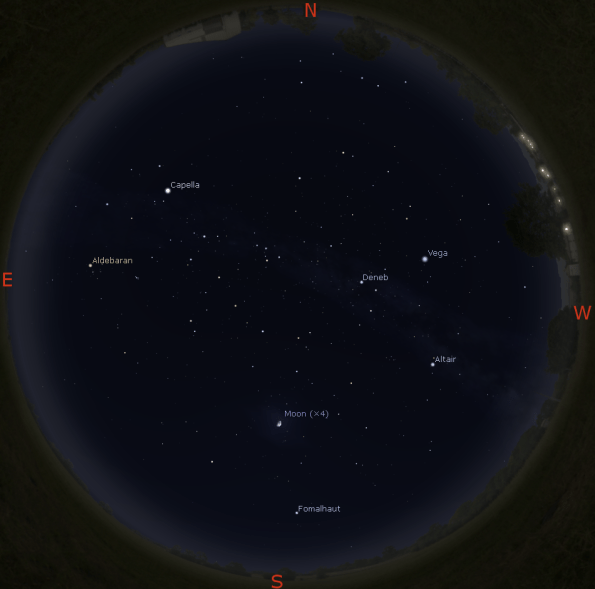
The bright first magnitude stars of autumn shown for 8 p.m. November 20, 2015. If you are closer to your time meridian, we’re 43 minutes behind ours, you will see two more bright stars in the east: Red Betelgeuse and blue-white Rigel. Created using Stellarium.
 Bob Moler's Ephemeris Blog