Archive
07/18/2012 – Ephemeris – Where are the bright planets this week?
Ephemeris for Wednesday, July 18th. Today the sun will be up for 15 hours and 7 minutes, setting at 9:22. The moon, 1 day before new, will rise at 6:53 tomorrow morning. Tomorrow the sun will rise at 6:15.
Let’s see what’s happening with the bright planets for this week. Mars, with its unmistakable bright reddish color, is in the west southwest in the evening in the constellation of Virgo the virgin. Mars will be setting in the west at 12:14 a.m. It is approaching Saturn and Spica just to its left. Saturn will be in the southwest above the bright star Spica now. It will set at 12:59 a.m. Jupiter, now a morning planet will rise at 2:45 a.m. in the east northeast. Venus, is now seen just below Jupiter after it rises at 3:31 a.m. Tomorrow morning, the bright star Aldebaran will appear between the two before twilight gets too bright before 5 a.m. All these planets except Mars, which is too small, are great to view in a telescope.
Times are for the Traverse City/Interlochen area of Michigan. They may be different for your location.
Addendum
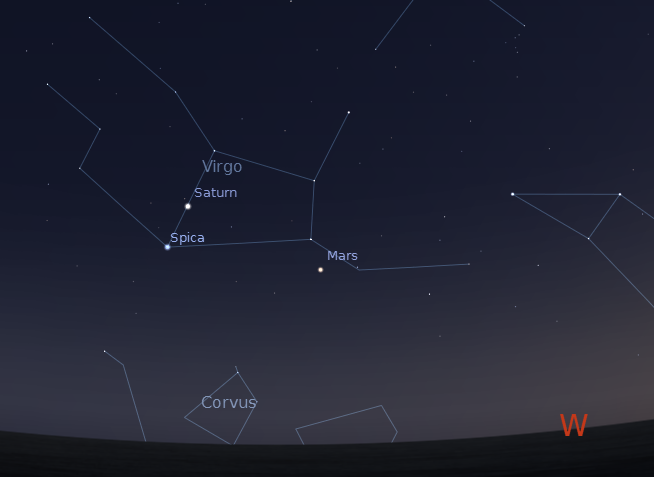
Mars and Saturn in Virgo at 10:30 p.m. on July 18, 2012. Created using Stellarium.
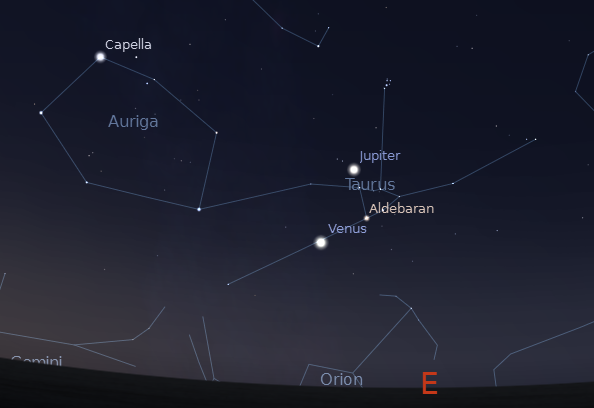
Jupiter and Venus at 5 a.m. on July 19, 2012. Created using Stellarium.
Venus and Jupiter are noticeably separating.
07/11/2012 – Ephemeris – Where are the bright planets this week?
Ephemeris for Wednesday, July 11th. Today the sun will be up for 15 hours and 18 minutes, setting at 9:27. The moon, 1 day past last quarter, will rise at 1:18 tomorrow morning. Tomorrow the sun will rise at 6:09.
Let’s see what’s happening with the bright planets for this week. Mars, with its unmistakable bright reddish color, is in the west southwest in the evening in the constellation of Virgo the virgin. Mars will be setting in the west at 12:34 a.m. It is approaching Saturn and Spica just to its left. Saturn will be in the southwest above the bright star Spica now. It will set at 1:26 a.m. Jupiter, now a morning planet will rise at 3:08 a.m. in the east northeast. Venus, is now seen just below Jupiter after it rises at 3:45 a.m. Tomorrow morning, Venus will appear next to the bright star Aldebaran. The planets are striking in telescopes with Venus as a large thin crescent, and Jupiter with its cloud bands and satellites.
Times are for the Traverse City/Interlochen area of Michigan. They may be different for your location.
Addendum
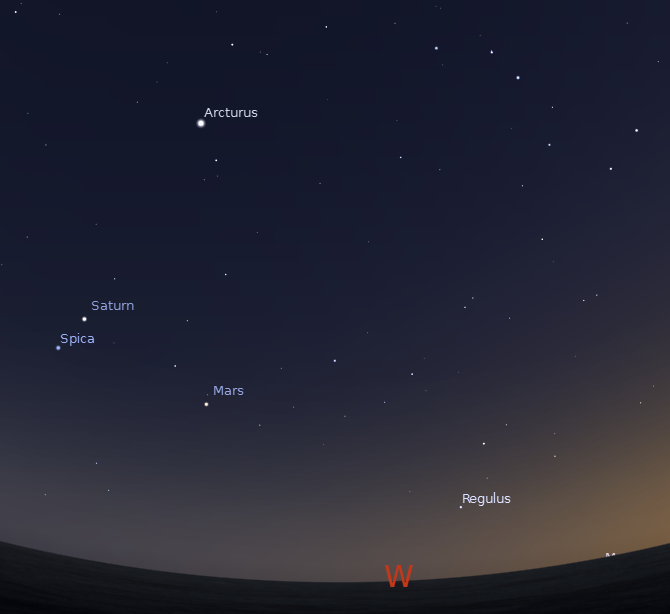
Looking westward at 10:30 p.m. on July 11, 2012. Created using Stellarium.
Click on image to enlarge.
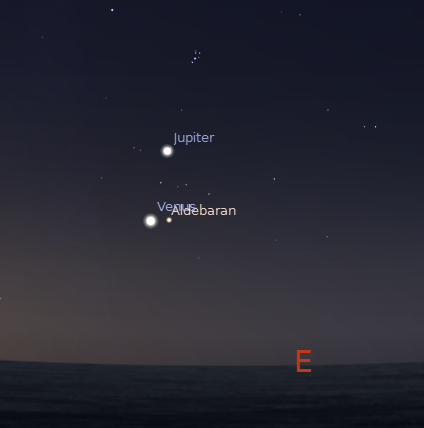
Looking eastward at 5 a.m. on July 12, 2012. Created using Stellarium.
Note Aldebaran near Venus. Aldebaran is the brightest star in the winter constellation Taurus the bull. Note the Pleiades star cluster above Jupiter. Well worth a look with binoculars.
02/20/2012 – Ephemeris – The Winter Circle
Ephemeris for President’s Day, Monday, February 20th. The sun will rise at 7:35. It’ll be up for 10 hours and 41 minutes, setting at 6:17. The moon, 1 day before new, will rise at 7:01 tomorrow morning. | The winter skies are blessed with more first magnitude stars than any other season. Six of these stars lie in a large circle centered on the seventh. This circle is up at 9 p.m. Starting high overhead is Capella in Auriga the charioteer. Moving down clockwise is Aldebaran in the face of Taurus the Bull. Then down to Orion’s knee we find Rigel. Down and left is the brightest star of all Sirius the Dog Star in Canis Major, lowest of these stars in the south southeast. Moving up and left is Procyon in Canis Minor, Above Procyon is Pollux in Gemini the twins. All these are centered on Betelgeuse the bright red star in Orion’s shoulder.
* Times are for the Traverse City/Interlochen area of Michigan. They may be different for your location.
Addendum
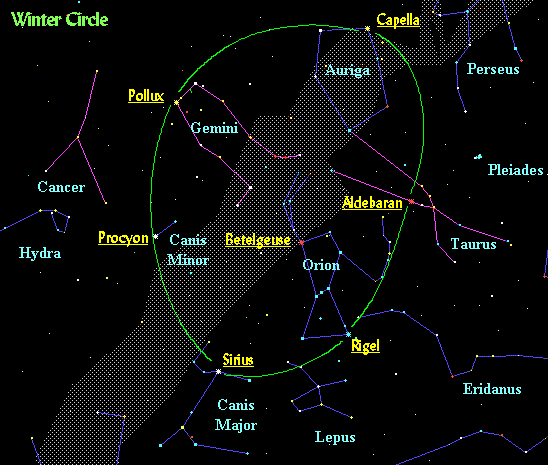
The Winter Circle of 1st magnitude stars
01/24/2012 – Ephemeris – The face of the constellation Taurus – The Hyades
Ephemeris for Tuesday, January 24th. The sun will rise at 8:09. It’ll be up for 9 hours and 29 minutes, setting at 5:39. The moon, 1 day past new, will set at 7:36 this evening.
To the upper right of the constellation Orion in the south in the evening is a letter V of stars with a bright orange star at one tip. This is the face of Taurus the bull. In some constellation depictions the bull is charging Orion who is turned to face him. The V of stars isn’t very bright and are outshone by the Pleiades star cluster to the right in Taurus’ shoulder. In Greek mythology the V of stars are the Hyades, half sisters of the Pleiades. It is a star cluster like the Pleiades and very important, because it is the closest star cluster to us at 153 light years distant. It helped determine the scale of the universe. The bright star at the tip is Aldebaran the follower (of the Pleiades). It is not part of the Hyades and is less than half way to it at 65 light years.
* Times, as always are for the Traverse City/Interlochen area of Michigan.
Addendum
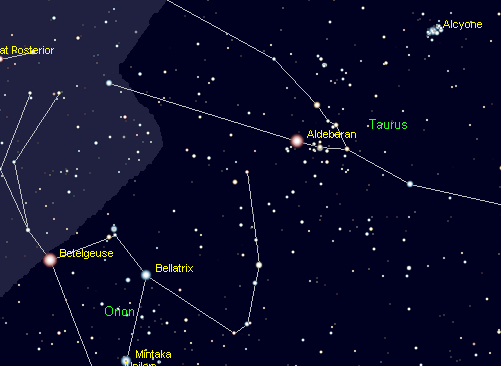
The Hyades, Orion and the Pleiades. Created using Cartes du Ciel
11/18/11 – Ephemeris – Pleiades, Hyades and Orion
Friday, November 18th. The sun will rise at 7:42. It’ll be up for 9 hours and 29 minutes, setting at 5:12. The moon, at last quarter today, will rise at 12:48 tomorrow morning.
The Pleiades or Seven Sisters star cluster is now quite high in the east at 9 p.m. To the Greeks they were the daughters of the god Atlas. Their half sisters, the Hyades is seen below them as the letter V shape of stars that form the face of Taurus the bull, with the bright orange star Aldebaran at one corner. Both are being chased by the giant hunter Orion, now mostly risen in the east. His three belt stars in a row are now oriented vertically. The reddish star Betelgeuse is to their upper left, while blue-white Rigel to the lower right. Rigel may suffer some by being very close to the horizon at the time, but it will come into its own as it rises higher. [Here is our preview of the glories of the winter sky. There is more to come as the night wears on.]
* Times, as always are for the Traverse City/Interlochen area of Michigan. Bracketed passage was omitted from the audio program due to time constraints.
Addendum
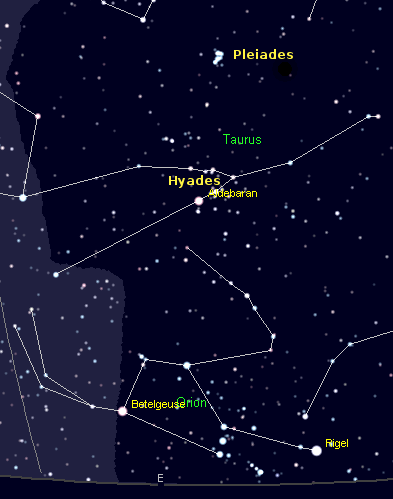
The eastern sky at 9 p.m.
 Bob Moler's Ephemeris Blog