Archive
06/27/2022 – Ephemeris – Finding the Summer Triangle
This is Ephemeris for Monday, June 27th. Today the Sun will be up for 15 hours and 33 minutes, setting at 9:32, and it will rise tomorrow at 5:59. The Moon, 1 day before new, will rise at 5:13 tomorrow morning.
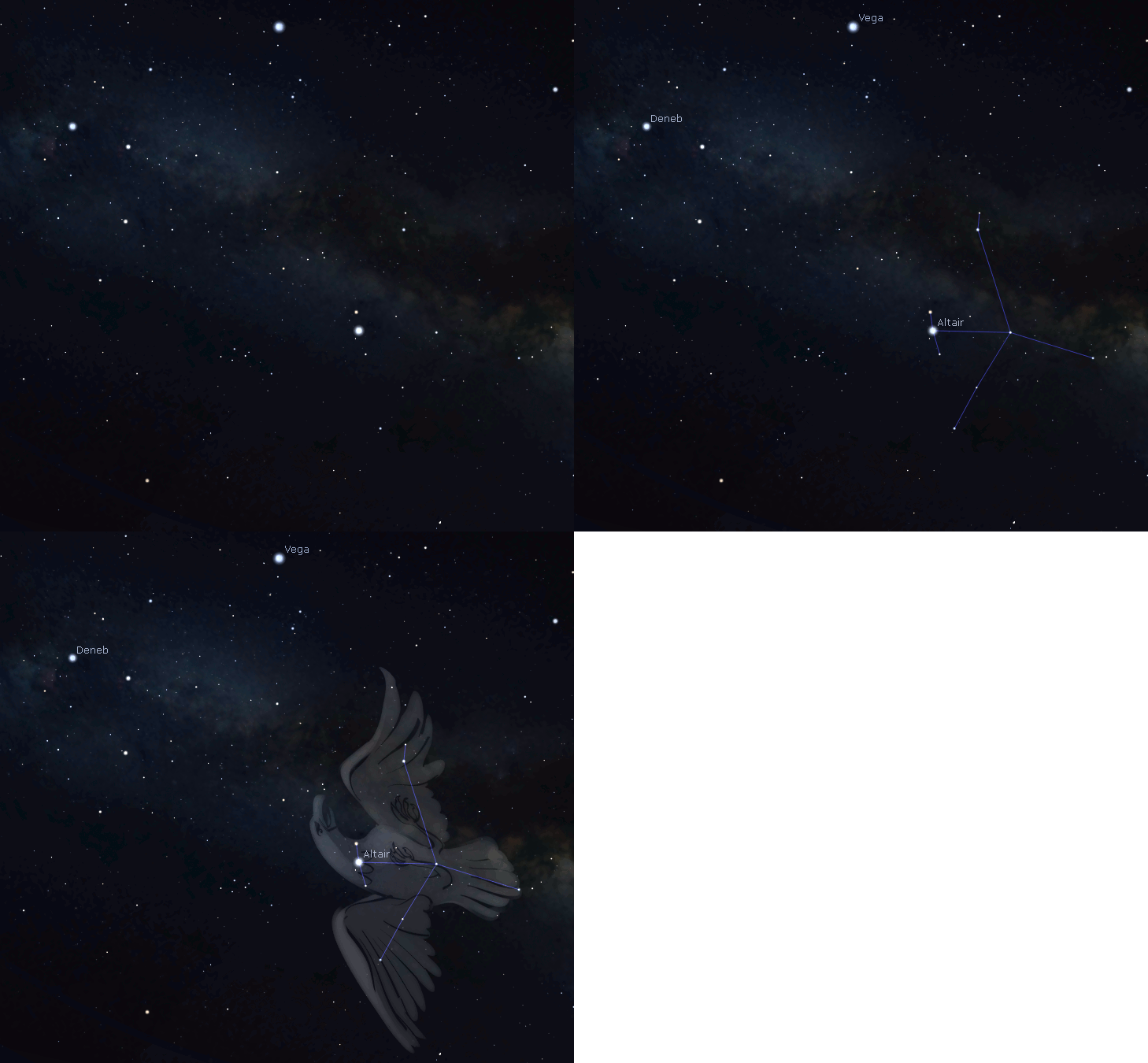
We’re nearly a week into summer, and the asterism or informal constellation called the Summer Triangle can be seen rising in the east as it gets dark. Highest of the three bright stars is Vega in the constellation Lyra the harp, whose body is seen in a narrow parallelogram nearby. The second star of the triangle is Deneb, in Cygnus the swan, lower and left of Vega, It appears dimmer than Vega because it is by far the most distant of the three. The third star of the Summer Triangle is seen farther below and a right of Vega. It is Altair in Aquila the eagle, and the closest. Altair is 16.5 light years away, Vega is 27 light years, while Deneb may be a whopping 2,600 light years away. One light year is 6 trillion miles (9 trillion kilometers).
The astronomical event times given are for the Traverse City/Interlochen area of Michigan (EDT, UT – 4 hours). They may be different for your location.
Addendum

The Summer Triangle finder animation showing first the unlabeled sky, Then the Summer Triangle with the stars labeled, then the constellations of those stars. Created using Stellarium and GIMP.
07/09/2021 – Ephemeris – Finding the constellation of Aquila the eagle
This is Ephemeris for Friday, July 9th. Today the Sun will be up for 15 hours and 22 minutes, setting at 9:29, and it will rise tomorrow at 6:07. The Moon is new today, and won’t be visible.
Aquila the eagle is a constellation that lies in the Milky Way. It’s in the southeastern sky as it gets dark. Its brightest star, Altair, is one of the stars of the Summer Triangle, a group of three bright stars dominating the eastern sky in the evening now. Altair, in the head of the eagle, is flanked by two slightly dimmer stars, the shoulders of the eagle. The eagle is flying northeastward through the Milky Way. Its wings are seen in the wing tip stars. A curved group of stars to the lower right of Altair is its tail. Within Aquila, the Milky Way shows many dark clouds as part of the Great Rift that splits it here. The other summer bird is Cygnus the swan above and left of Aquila, flying in the opposite direction. It was said this was the eagle that attended the god Jupiter.
The astronomical event times given are for the Traverse City/Interlochen area of Michigan (EDT, UT-4). They may be different for your location.
Addendum
Animated Cygnus finder chart. Lyra the harp, Cygnus the swan, Delphinus the dolphin and Sagitta the arrow are also in the image. Can you find them? Click on the image to enlarge it. Created using Stellarium and GIMP.
06/29/2021 – Ephemeris – The Summer Triangle
This is Ephemeris for Tuesday, June 29th. Today the Sun will be up for 15 hours and 32 minutes, setting at 9:32, and it will rise tomorrow at 6:00. The Moon, 2 days before last quarter, will rise at 1:14 tomorrow morning.
Dominating the eastern sky at 11 pm are three bright stars. These are all first magnitude stars, members of the group of 21 brightest stars in the night sky. Highest, in the east, is Vega, the brightest of the three. It and a small, slim parallelogram of stars below it belong to the constellation of Lyra the harp. Below it to the northeast is Deneb, dimmest of the three at the head of the horizontally appearing Northern Cross, an informal constellation or asterism. Properly, Deneb is in the tail of Cygnus the swan flying south through the Milky Way. The third star of the three is Altair, lower still, but in the east-southeast at the head of Aquila the Eagle. These three stars are in a large asterism called the Summer Triangle, which will be with us through summer and fall.
The astronomical event times given are for the Traverse City/Interlochen area of Michigan (EDT, UT-4). They may be different for your location.
Addendum
The Summer Triangle finder animation showing first the unlabeled sky, Then the Summer Triangle with the stars labeled, then the constellations of those stars. Click on the image to enlarge it. Created using Stellarium and GIMP.
08/10/2020 – Ephemeris – The celestial eagle: Aquila
This is Bob Moler with Ephemeris for Monday, August 10th. Today the Sun will be up for 14 hours and 15 minutes, setting at 8:55, and it will rise tomorrow at 6:41. The Moon, 1 day before last quarter, will rise at 12:20 tomorrow morning.
Aquila the eagle is a constellation that lies in the Milky Way. It’s in the southeastern sky as it gets dark. Its brightest star, Altair is one of the stars of the Summer Triangle, a group of three bright stars dominating the eastern sky in the evening now. Altair, in the head of the eagle, is flanked by two slightly dimmer stars, the shoulders of the eagle. The eagle is flying northeastward through the Milky Way. Its wings are seen in the wing tip stars. A curved group of stars to the lower right of Altair is its tail. Within Aquila the Milky Way shows many dark clouds as part of the Great Rift that splits it here. The other summer bird is Cygnus the swan above and left of Aquila, flying in the opposite direction.
The event times given are for the Traverse City/Interlochen area of Michigan. They may be different for your location.
Addendum
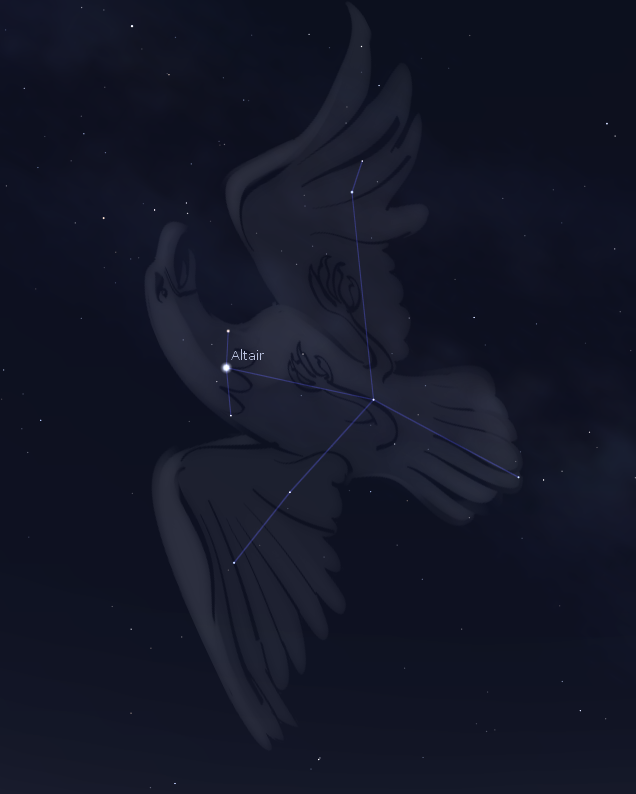
Aquila the Eagle in the southeastern sky. Created using Stellarium.
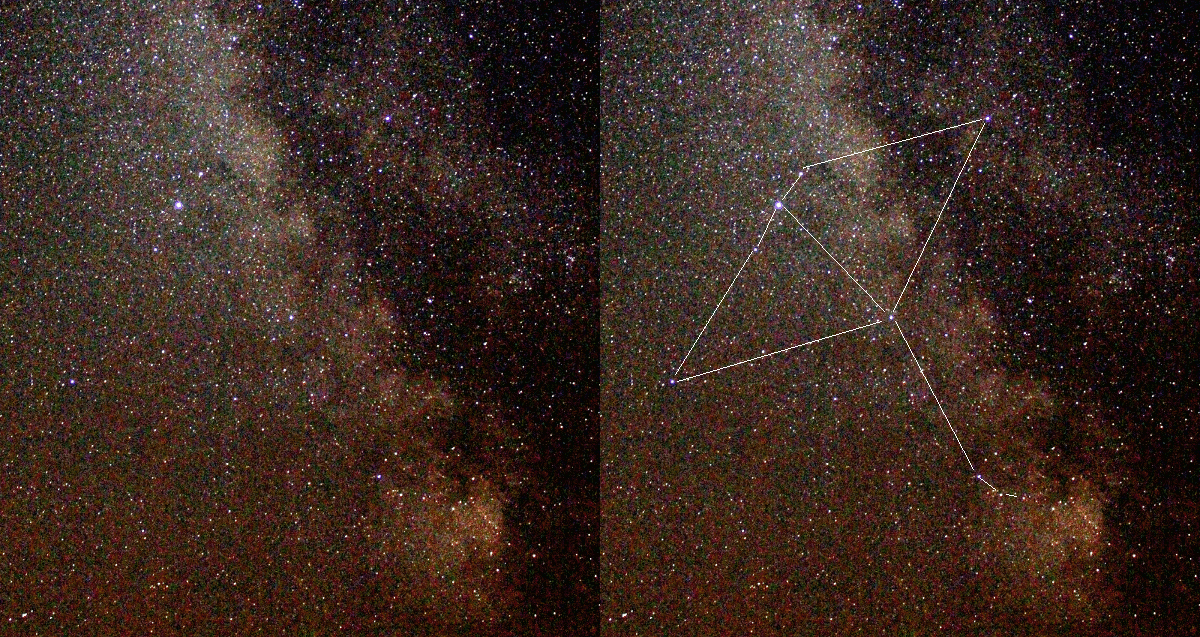
Annotated and animated photograph taken of Aquila August 13, 2018 during the Perseid meteor shower. Alas, no Perseids in this photograph. Taken by me and processed using Registax and GIMP.
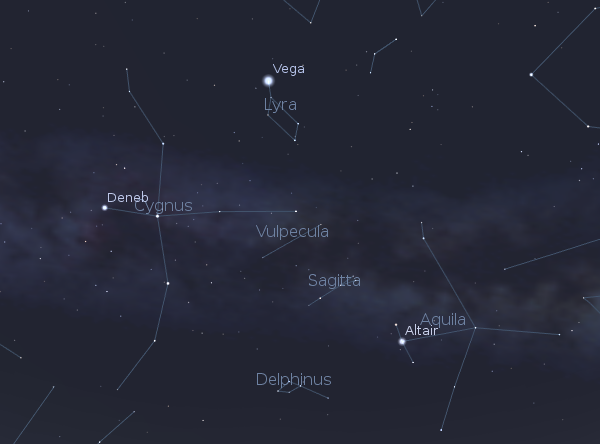
Deneb with the other stars and constellations in the Summer Triangle. Created using Stellarium.
07/06/2020 – Ephemeris – The southernmost star of the Summer Triangle, Altair
This is Bob Moler with Ephemeris for Monday, July 6th. Today the Sun will be up for 15 hours and 25 minutes, setting at 9:30, and it will rise tomorrow at 6:05. The Moon, 1 day past full, will rise at 11:02 this evening.
The southernmost star of the Summer Triangle is Altair, high in the east-southeast. The other two stars of the triangle are Vega nearly overhead in the east, and Deneb high in the east-northeast. Altair is the closest of the three at a distance of 16.7 light years away. One light year is nearly 6 trillion miles. Altair is 10 times the brightness of the Sun. If seen at Altair’s distance, the Sun would only be as bright as one of the two stars that flank it. What is rather different about Altair is its rapid rotation. While it’s almost twice the sun’s diameter, it rotates once in about 9 hours, The CHARA Interferometer at Mt. Wilson has actually imaged its squashed disk in the infrared. Our Sun’s a slow poke, taking nearly a month to rotate once.
The event times given are for the Traverse City/Interlochen area of Michigan. They may be different for your location.
Addendum
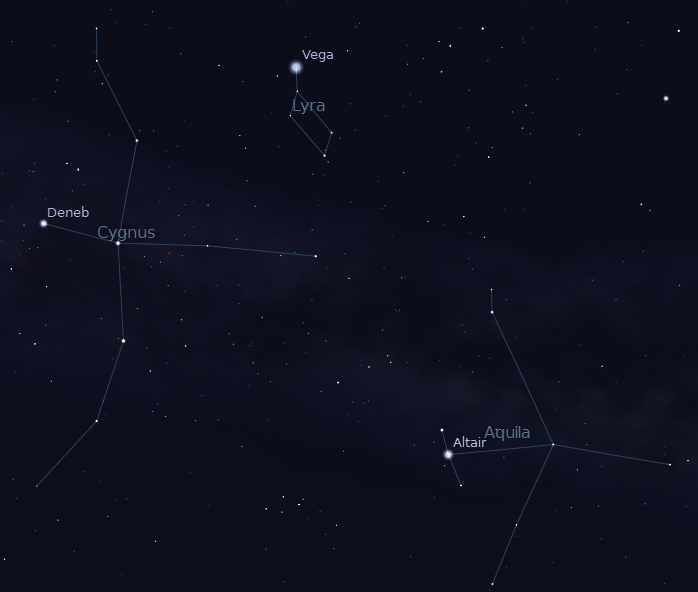
Summer Triangle. Created using Stellarium.
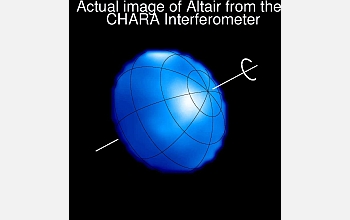
Lines added to show the rotation axis. Credit: Zina Deretsky, National Science Foundation.
06/12/2020 – Ephemeris – The Summer Triangle proclaims that summer is almost here
This is Bob Moler with Ephemeris for Friday, June 12th. Today the Sun will be up for 15 hours and 32 minutes, setting at 9:29, and it will rise tomorrow at 5:56. The Moon, 1 day before last quarter, will rise at 2:27 tomorrow morning.
Summer skies are coming. It’s only 8 days until summer officially arrives. It is a calendar day early this year because of the extra day added in February for the leap year. Looking to the eastern sky at 11 pm are three bright stars in a large triangle. The top star Vega is about half way up the sky to the zenith, and the brightest of the three. It’s in the small constellation of Lyra the harp. Lowest of the stars and just about due east is Altair in Aquila the eagle. Completing the triangle is Deneb in the northeast in the tail of Cygnus the swan or the head of the horizontal Northern Cross. These three stars make up the Summer Triangle. Be that as it may, the Summer Triangle will be in our evening sky moving slowly westward until December.
The event times given are for the Traverse City/Interlochen area of Michigan. They may be different for your location.
Addendum
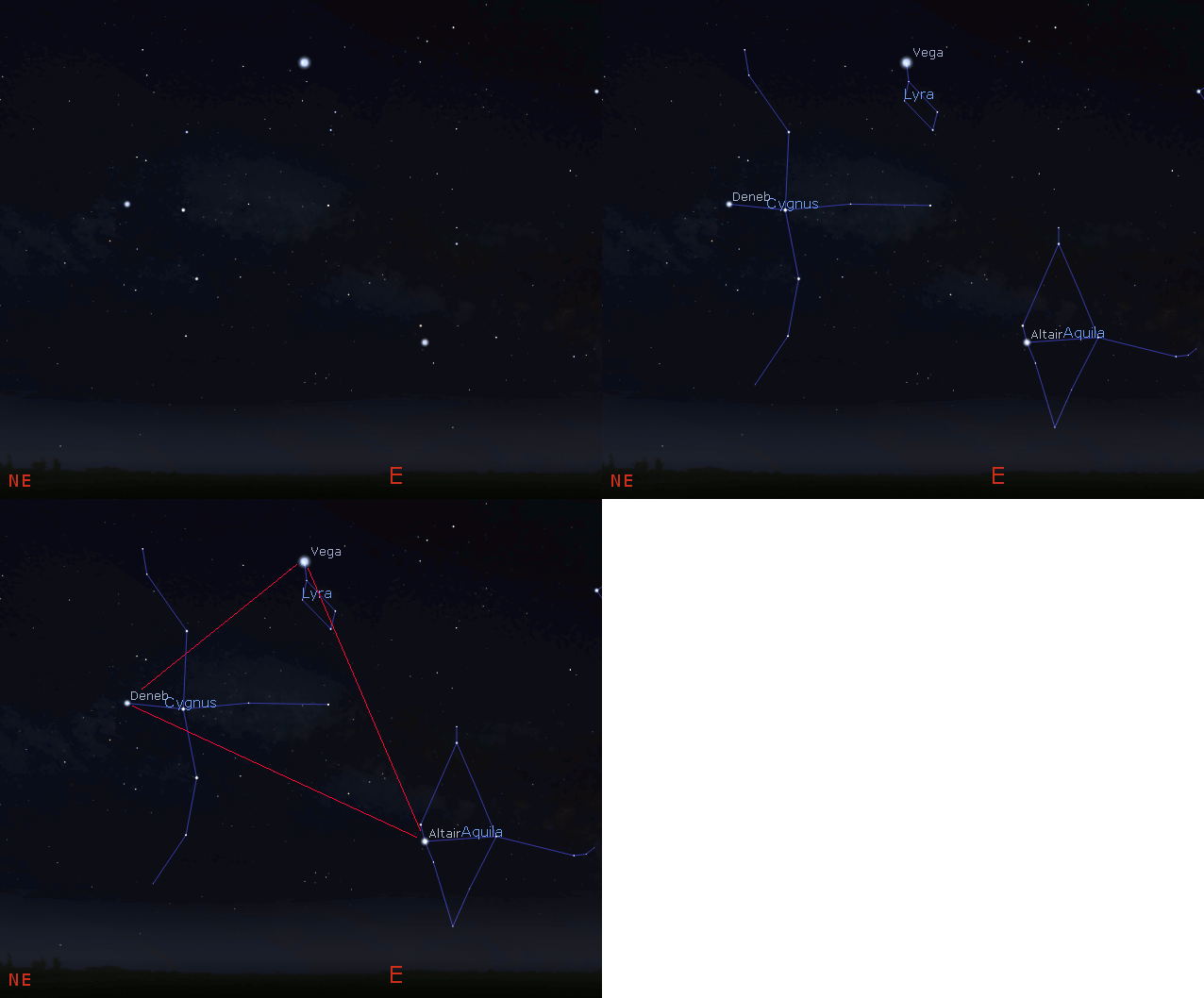
Finder animation for the Summer Triangle, seen in red for 11 pm, June 12th. Created using Stellarium and GIMP.
11/13/2018 – Ephemeris – The Summer Triangle in autumn
Ephemeris for Tuesday, November 13th. The Sun will rise at 7:37. It’ll be up for 9 hours and 39 minutes, setting at 5:16. The Moon, 2 days before first quarter, will set at 10:20 this evening.
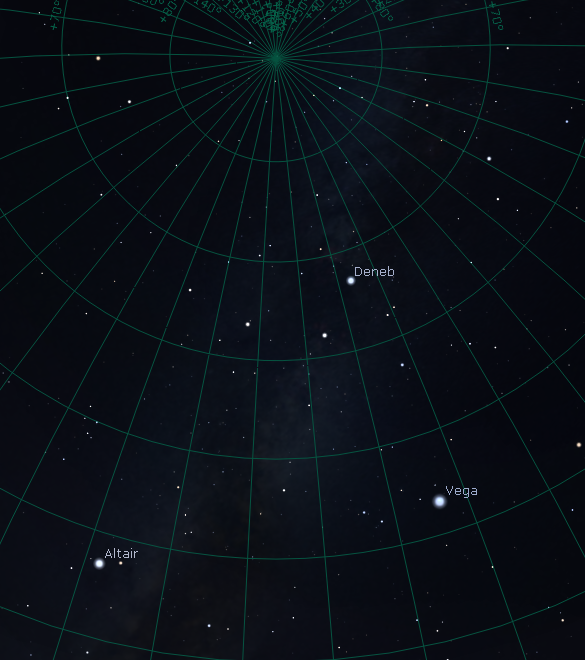
The Summer Triangle is still in the sky at 9 p.m., even though it’s November. These three bright stars that straddle the Milky Way are high in the east for most of the summer, move overhead and begin to slide to the west in autumn. We will lose Altair, the southernmost of the three stars at 9 p.m. on the winter solstice, December 21st. We’ll lose the brightest, Vega in January. For the northern half of the IPR listening area the northernmost of the triangle stars, Deneb won’t quite set below a north Lake Michigan horizon. Next spring we’ll be waiting and watching for these three stars to rise, reclaim the skies, and bring again the warm summer skies. The winter skies do however have more bright stars than the summer sky.
The times given are for the Traverse City/Interlochen area of Michigan. They may be different for your location.
Addendum
07/02/2018 – Ephemeris – The starry triangle of summer
Ephemeris for Monday, July 2nd. Today the Sun will be up for 15 hours and 30 minutes, setting at 9:31, and it will rise tomorrow at 6:02. The Moon, half way from full to last quarter, will rise at 12:19 tomorrow morning.
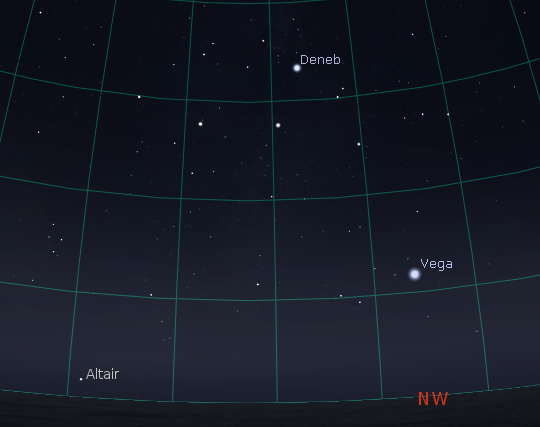
Now that it’s summer it’s time to look for the Summer Triangle in the sky. It’s seen rising in the east as it gets dark. Highest of the three bright stars is Vega in the constellation Lyra the harp, whose body is seen in a narrow parallelogram nearby. The second star of the triangle is Deneb lower and left of Vega, It appears dimmer than Vega because it is by far the most distant of the three. The third star of the Summer Triangle is seen farther below and a right of Vega. It is Altair in Aquila the eagle, and the closest. Altair is 16.5 light years away, Vega is 27 light years while Deneb actually one of the brighter stars known, is 1500 or more light years away. It’s distance is not well known.
The times given are for the Traverse City/Interlochen area of Michigan. They may be different for your location.
Addendum
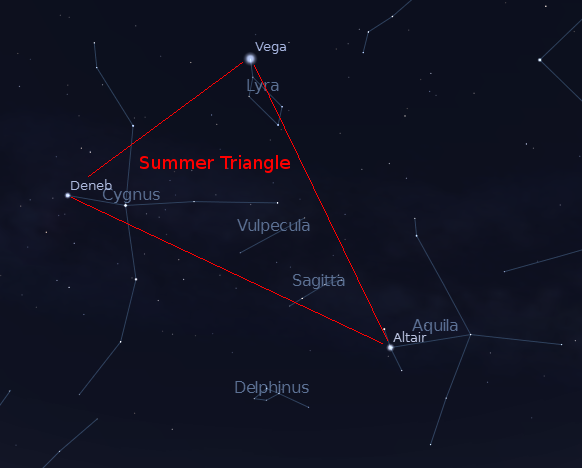
The Summer Triangle. Created using Stellarium.
07/17/2017 – Ephemeris – Constellations of the Summer Triangle III: Aquila the Eagle
Ephemeris for Monday, July 17th. Today the Sun will be up for 15 hours and 9 minutes, setting at 9:23, and it will rise tomorrow at 6:14. The Moon, 1 day past last quarter, will rise at 2:08 tomorrow morning.
Aquila the eagle is a constellation that lies in the Milky Way. It’s in the southeastern sky as it gets dark. Its brightest star, Altair is one of the stars of the Summer Triangle, the group of three bright stars dominating the eastern sky in the evening now. Altair, in the head of the eagle, is flanked by two slightly dimmer stars, the shoulders of the eagle. The eagle is flying northeastward through the Milky Way. Its wings are seen in the wing tip stars. A curved group of stars to the lower right of Altair is its tail. Within Aquila the Milky Way shows many dark clouds as part of the Great Rift that splits it here. The other summer bird is Cygnus the swan above and left of Aquila, flying in the opposite direction.
The times given are for the Traverse City/Interlochen area of Michigan. They may be different for your location.
Addendum
The Summer Triangle. Created using Stellarium and The Gimp.
Animated Cygnus finder chart. Created using Stellarium.
07/11/2017 – Ephemeris – Altair the nearest star of the Summer Triangle
Ephemeris for Tuesday, July 11th. Today the Sun will be up for 15 hours and 18 minutes, setting at 9:27, and it will rise tomorrow at 6:09. The Moon, 2 days past full, will rise at 10:59 this evening.
The southernmost star of the Summer Triangle is Altair, high in the east-southeast. The other two stars of the triangle are Vega nearly overhead in the east, and Deneb high in the east-northeast. Altair is the closest of the three at a distance of 16.7 light years away. One light year is nearly 6 trillion miles. Altair is 10 times the brightness of the Sun. If seen at Altair’s distance, the Sun would only be as bright as one of the two stars that flank it. What is rather different about Altair is its rapid rotation. While it’s almost twice the sun’s diameter, it rotates once in about 9 hours, The CHARA Interferometer at Mt. Wilson has actually imaged its squashed disk in the infrared. Our sun’s a slow poke, taking nearly a month to rotate once.
The times given are for the Traverse City/Interlochen area of Michigan. They may be different for your location.
Addendum
Summer Triangle. Created using Stellarium.

False-color image of the rapidly rotating star Altair, made with the MIRC imager on the CHARA array on Mt. Wilson. Credit: Ming Zhao, University of Michigan
 Bob Moler's Ephemeris Blog