Archive
06/26/2017 – Ephemeris – Latest sunset and the apparent positions of the Summer Triangle stars
Ephemeris for Monday, June 26th. Today the Sun will be up for 15 hours and 32 minutes, setting at 9:31, and it will rise tomorrow at 5:59. The Moon, 3 days past new, will set at 11:40 this evening.
Tonight we have the latest sunset of the year. From now on until December sunsets will become earlier. Other than the sunrise and sunset numbers, we’ll begin to notice it for real in a few weeks. At first that realization strikes me a sad note that summer is beginning to end. However the astronomer in me realizes that means more night-time hours, and that the summer Milky Way is coming. Of the three bright stars of the Summer Triangle overhead and in the east, two of its stars are in the milky band. They are Deneb to the north and Altair to the south. Vega, closest to the zenith is not in the band. Actually all the stars we see with the naked eye or small telescopes belong to the Milky Way galaxy.
The times given are for the Traverse City/Interlochen area of Michigan. They may be different for your location.
Addendum
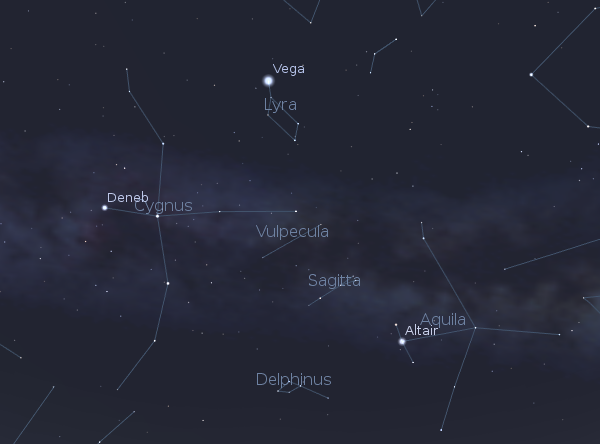
Looking at the stars of the Summer Triangle and their location in and near the Milky Way band. Created using Stellarium.
06/22/2017 – Ephemeris – Now that it’s summer, lets check out the Summer Triangle
Ephemeris for Thursday, June 22nd. Today the Sun will be up for 15 hours and 33 minutes, setting at 9:31, and it will rise tomorrow at 5:57. The Moon, 1 day before new, will rise at 5:45 tomorrow morning.
We’re a day into summer, and the asterism or informal constellation called the Summer Triangle can be seen rising in the east as it gets dark. Highest of the three bright stars is Vega in the constellation Lyra the harp, whose body is seen in a narrow parallelogram nearby. The second star of the triangle is Deneb lower and left of Vega, It appears dimmer than Vega because it is by far the most distant of the three. The third star of the Summer Triangle is seen farther below and a right of Vega. It is Altair in Aquila the eagle, and the closest. Altair is 16.5 light years away, Vega is 27 light years while Deneb may be a whopping 2600 light years away. One light year is 6 trillion miles (9 trillion km).
The times given are for the Traverse City/Interlochen area of Michigan. They may be different for your location.
Addendum
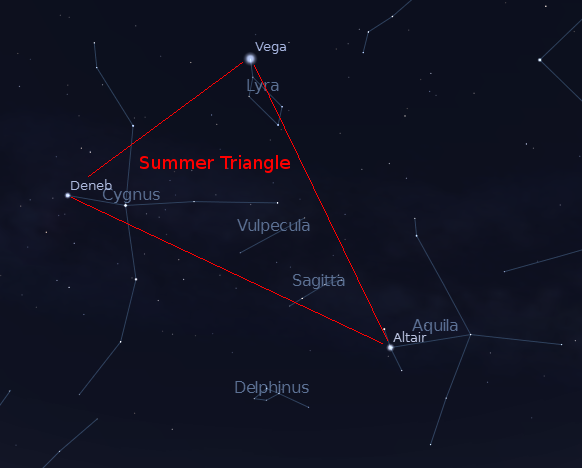
The Summer Triangle. Created using Stellarium and The Gimp.
07/29/2016 – Ephemeris – Aquila the Eagle, third constellation of the Summer Triangle
Ephemeris for Friday, July 29th. The Sun rises at 6:26. It’ll be up for 14 hours and 45 minutes, setting at 9:11. The Moon, 3 days past last quarter, will rise at 3:20 tomorrow morning.
Aquila the eagle is a constellation that lies in the Milky Way. It’s in the southeastern sky as it gets dark. Its brightest star, Altair is one of the stars of the Summer Triangle, a group of three bright stars seen now in the eastern sky in the evening. Altair, in the head of the eagle, is flanked by two slightly dimmer stars, the shoulders of the eagle. The eagle is flying northeastward through the Milky Way. Its wings are seen in the wing tip stars. A curved group of stars to the lower right of Altair is its tail. Within Aquila the Milky Way shows many dark clouds as part of the Great Rift that splits it here. The other summer bird is Cygnus the swan, which I talked about Tuesday, above and left of Aquila, flying in the opposite direction.
Times are for the Traverse City/Interlochen area of Michigan. They may be different for your location.
Addendum
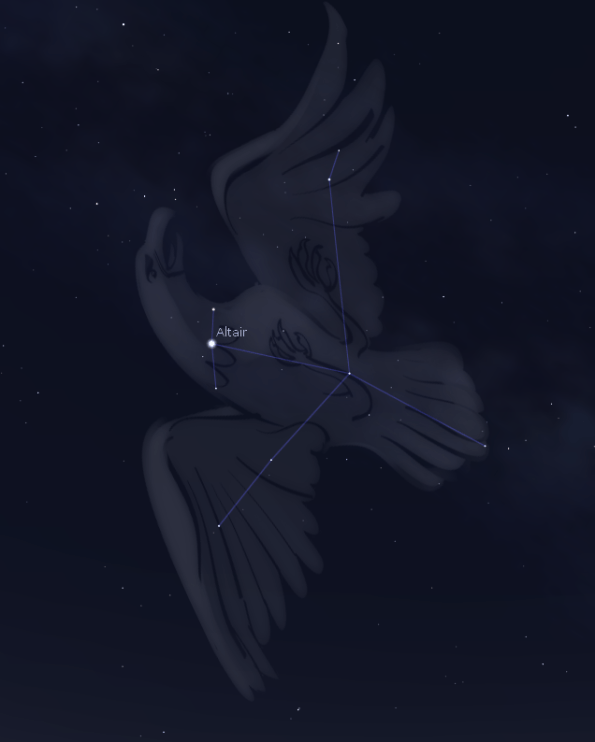
Aquila the Eagle in the southeastern sky. Created using Stellarium.
06/23/2016 – Ephemeris – Tis the season to view the Summer Triangle
Ephemeris for Thursday, June 23rd. Today the Sun will be up for 15 hours and 34 minutes, setting at 9:32, and it will rise tomorrow at 5:58. The Moon, 3 days past full, will rise at 11:43 this evening.
Now that summer is here, the asterism or informal constellation called the Summer Triangle can be seen in the east as it gets dark. Highest of the three bright stars is Vega in the constellation Lyra the harp, whose body is seen in a narrow parallelogram nearby. The second star of the triangle is Deneb lower and left of Vega, It appears dimmer than Vega because its is by far the most distant of the three. The third star of the Summer Triangle is seen farther below and right of Vega. It is Altair in Aquila the eagle, and the closest. Altair is 16.7 light years away, Vega is 25 light years while Deneb may be a whopping 2600 light years away. With a light year at 6 trillion miles. That’s mind boggling to think in miles at least.
Times are for the Traverse City/Interlochen area of Michigan. They may be different for your location.
Addendum
The Summer Triangle. Created using Stellarium and The Gimp.
11/20/2015 – Ephemeris – Finding the bright stars of November
Ephemeris for Friday, November 20th. The Sun will rise at 7:46. It’ll be up for 9 hours and 24 minutes, setting at 5:10. The Moon, 1 day past first quarter, will set at 2:17 tomorrow morning.
The Moon is beginning to brighten up the sky making constellation spotting somewhat difficult, so I thought we’d look for the brightest stars. High in the west are the three stars of the Summer Triangle. At the bottom in the southwest is Altair, the first of these to set. A bit north of west the brightest, Vega. Highest in the west is Deneb, which won’t officially set for those Interlochen northward. Low in the south is the loneliest star Fomalhaut. In the northeast is the winter star Capella, which also doesn’t set for the IPR listener area, but spends summer nights hiding behind hills and trees in the north. Low in the east is the last of our bright stars, Aldebaran in Taurus the bull, which will be playing hide and seek with the Moon next week.
Times are for the Traverse City/Interlochen area of Michigan. They may be different for your location.
Addendum
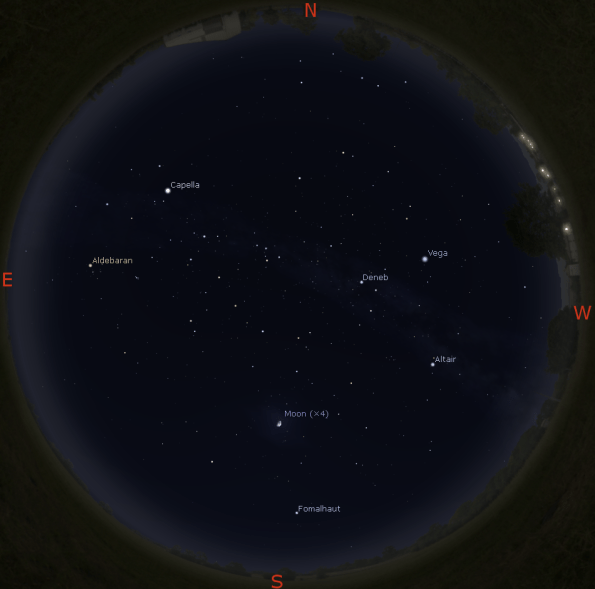
The bright first magnitude stars of autumn shown for 8 p.m. November 20, 2015. If you are closer to your time meridian, we’re 43 minutes behind ours, you will see two more bright stars in the east: Red Betelgeuse and blue-white Rigel. Created using Stellarium.
08/06/2015 – Ephemeris – There’s an eagle in the stars
Ephemeris for Thursday, August 6th. The Sun rises at 6:34. It’ll be up for 14 hours and 27 minutes, setting at 9:02. The Moon, at last quarter today, will rise at 12:46 tomorrow morning.
The southernmost star in the Summer Triangle of three bright stars is Altair, high in the south-southeast in the evening. It’s in the head of the constellation Aquila the Eagle. Altair is flanked by two stars, the eagle’s shoulders, and farther out are the wing tips. Other stars to the lower right are in its body and a last three in its tail. Near the tail binoculars will show a fuzzy spot that telescopes show as a compact star cluster, sometimes called the Wild Duck Cluster for its nearly triangular shape. Aquila is flying northeastward through the Milky Way, where it is split in two by a cloud of gas and dust. According to mythology the Trojan boy Ganymede was taken to heaven at the behest of the god Zeus by this eagle.
Times are for the Traverse City/Interlochen area of Michigan. They may be different for your location.
Addendum
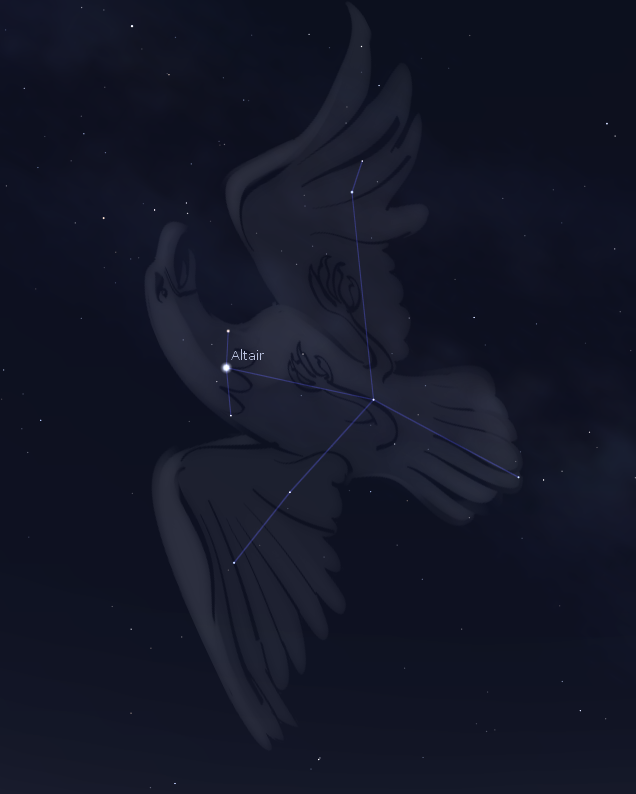
Aquila the Eagle in the southeastern sky. Created using Stellarium.
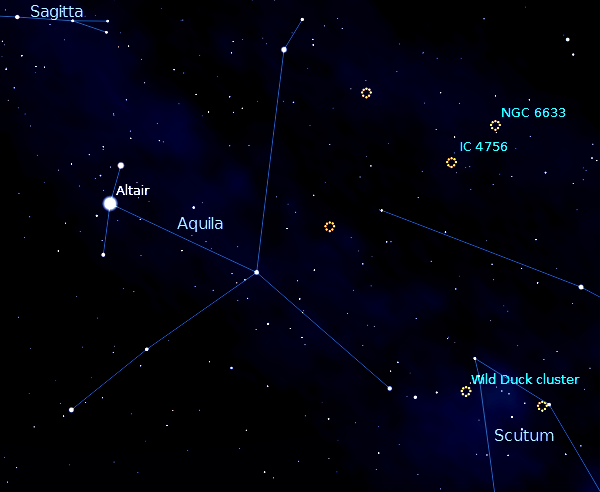
Finder chart for M11, the Wild Duck Cluster, Created using Stellarium.
07/27/2015 – Ephemeris – Deneb, the dimmest of the Summer Triangle stars. But is it really?
Ephemeris for Monday, July 27th. The Sun rises at 6:23. It’ll be up for 14 hours and 51 minutes, setting at 9:14. The Moon, 3 days past first quarter, will set at 3:36 tomorrow morning.
This evening when it gets dark the bright star Deneb in Cygnus the swan will be high in the east northeast. Deneb is the dimmest star of the summer triangle. Of the other stars of the triangle, Vega is very high in the east, while Altair is lower in the southeast. While Deneb’s apparent magnitude, or brightness as seen from earth, makes it the dimmest of the three bright stars, Deneb’s vast distance of possibly 2,600 light years makes it over 100 times the distance of Vega. If brought as close as Vega, Deneb would be almost as bright as the full moon. It is as bright as two hundred thousand suns. It apparently has run out of hydrogen in its core. Once a blue super giant star, it’s currently evolving through the white supergiant stage.
Times are for the Traverse City/Interlochen area of Michigan. They may be different for your location.
Addendum
The Summer Triangle. Created using Stellarium and The Gimp.
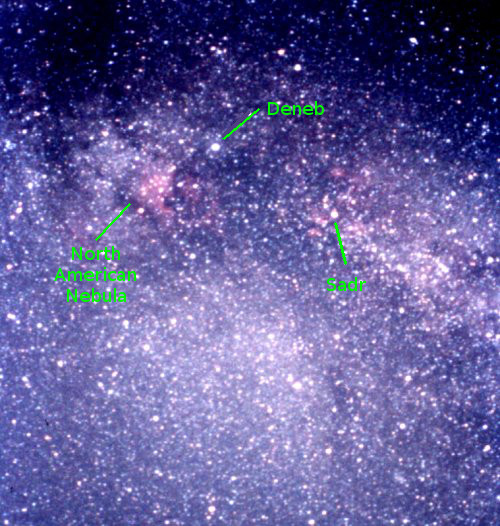
One of my old photographs of Deneb and the North American Nebula digitized from a slide.
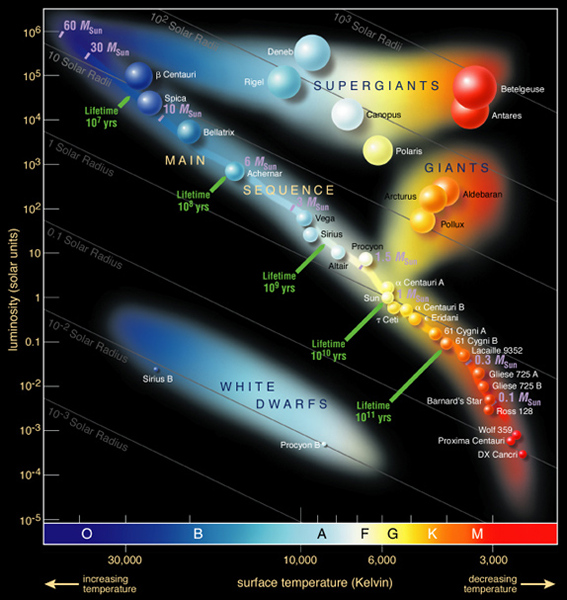
The Hertzsprung-Russell diagram of star luminosity vs. surface temperature. Note that Deneb is at the top center, while the Sun is lower on the main sequence. Credit: European Southern Observatory (ESO).
07/23/2015 – Ephemeris – Altair, the nearest star of the Summer Triangle
Thursday, July 23rd. Today the Sun will be up for 14 hours and 59 minutes, setting at 9:18. The Moon, 1 day before first quarter, will set at 12:57 tomorrow morning. Tomorrow the Sun will rise at 6:20.
The southernmost star of the Summer Triangle is Altair, high in the south. The other two stars of the triangle are Vega nearly overhead, and Deneb high in the east. Altair is the closest of the three at a distance of 16.7 light years away. One light year is nearly 6 trillion miles. Altair is 10 times the brightness of the sun. If seen at Altair’s distance, the sun would only be as bright as one of the two stars that flank it. What is rather different about Altair is its rapid rotation. While it’s almost twice the sun’s diameter, it rotates once in only 8.9 hours, The CHARA Interferometer at Mt. Wilson has actually imaged its squashed disk in the infrared. Our sun’s a slow poke, taking nearly a month to rotate once.
Times are for the Traverse City/Interlochen area of Michigan. They may be different for your location.
Addendum
The Summer Triangle. Created using Stellarium and The Gimp.
Aquila the Eagle in the southeastern sky. Created using Stellarium.
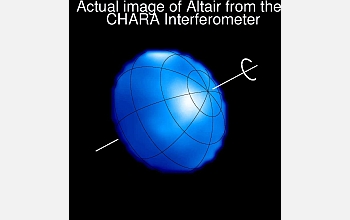
Credit: Zina Deretsky, National Science Foundation
07/16/2015 – Ephemeris – The Summer Triangle is the sign of the season
Ephemeris for Thursday, July 16th. Today the Sun will be up for 15 hours and 12 minutes, setting at 9:25. The Moon, 1 day past new, will set at 9:32 this evening, and tomorrow the Sun will rise at 6:13.
We’re almost a month into summer, and the asterism or informal constellation called the Summer Triangle can be seen midway up the sky in the east as it gets dark. Highest of the three bright stars is Vega in the constellation Lyra the harp, whose body is seen in a narrow parallelogram nearby. The second star of the triangle is Deneb lower and left of Vega, It appears dimmer than Vega because it is by far the most distant of the three. The third star of the Summer Triangle is seen farther below and a right of Vega. It is Altair in Aquila the eagle, and the closest. Altair is 16.5 light years away, Vega is 27 light years while Deneb is so far away that it’s distance is in some doubt and may be 2,600 light years away.
Times are for the Traverse City/Interlochen area of Michigan. They may be different for your location.
Addendum
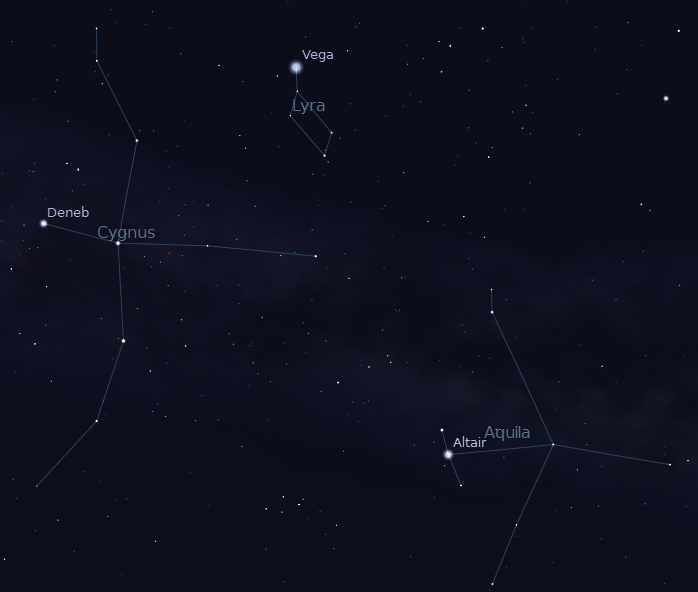
Summer Triangle. Created using Stellarium.
07/09/2015 – Ephemeris – The first stars to appear at night
Ephemeris for Thursday, July 9th. Today the Sun will be up for 15 hours and 23 minutes, setting at 9:29. The Moon, 1 day past last quarter, will rise at 2:05 tomorrow morning, and tomorrow the Sun will rise at 6:07.
Let’s check out all the bright stars in the evening sky, as it gets dark tonight. Low in the west are the planets Venus and Jupiter. High in the west is the bright yellow-orange star Arcturus. In the northwest is the Big Dipper, whose curved handle points to Arcturus. Straightening that curve to a spike will point to Spica a blue-white star low in the southwest. The planet Saturn is located in the south. Below and left of it is the red star Antares which usually twinkles merrily. High in the east is the bright white star Vega. To its lower right is Altair, and to its lower left the star Deneb. Vega, Altair and Deneb make the Summer Triangle, whose rising in the east signals the coming of summer.
Times are for the Traverse City/Interlochen area of Michigan. They may be different for your location.
Addendum
I talked about seeing the first stars a month ago. It seems that in holding star parties this time of year we spend a lot of time watching the first stars appear. I wanted to discuss the Summer Triangle, but it wandered off to what you see above. I’ll get there next week, I promise.
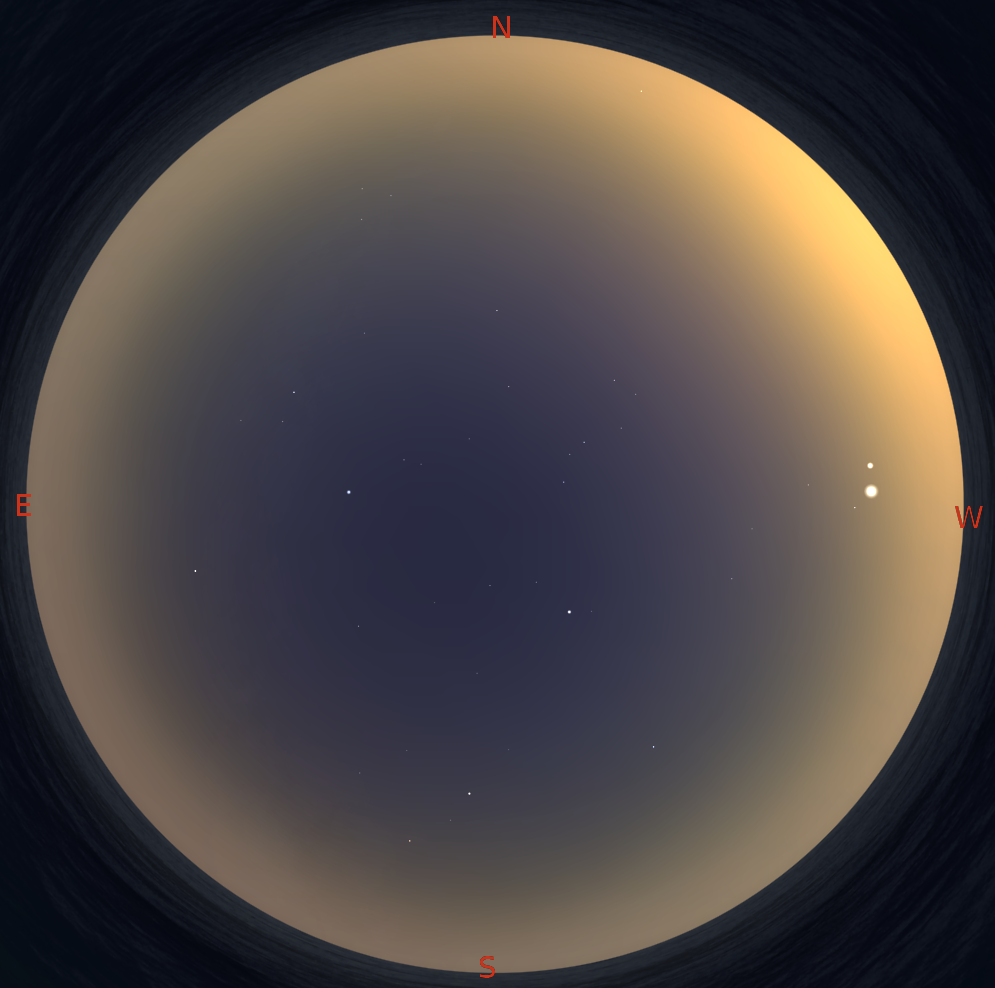
The first stars and planets to appear. See if you can located them from the text. Created using Stellarium for about 10 p.m., July 9, 2015.
 Bob Moler's Ephemeris Blog