Archive
11/24/2014 – Ephemeris – The Summer Triangle is still with us
Ephemeris for Monday, November 24th. The sun will rise at 7:50. It’ll be up for 9 hours and 16 minutes, setting at 5:07. The moon, 2 days past new, will set at 7:29 this evening.
Well it’s almost Thanksgiving and about time that the Summer Triangle of bright summer stars finally set. Except it won’t go just yet. The stars Vega, Altair and Deneb are still hanging around in the west. The bright summer part of the Milky Way is gone. The constellations the three stars are in are Altair in Aquila the Eagle, now flying vertically up, Deneb in Cygnus the swan flying vertically down, and Vega in Lyre the harp, lying on its side. Altair the southernmost of these three will set first, later Vega will also set. What happens to Deneb depends on your location in the Interlochen Public Radio area. It you are north of Traverse City, Deneb will not actually set over Lake Michigan’s northern horizon.
Times are for the Traverse City/Interlochen area of Michigan. They may be different for your location.
Addendum
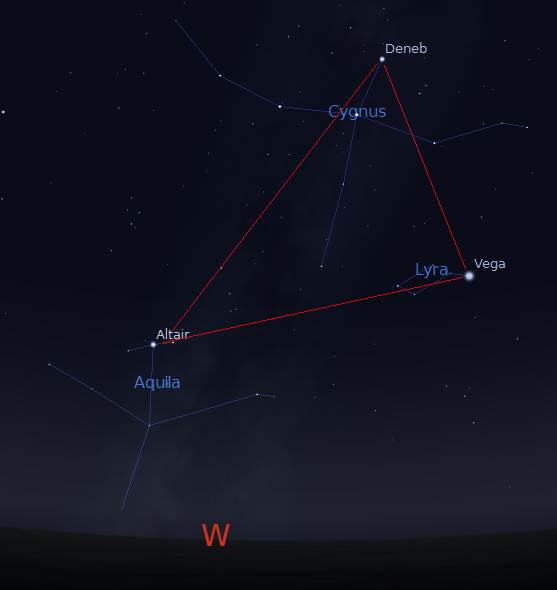
The Summer Triangle at 9 p.m. on November 24, 2014. Created using Stellarium.
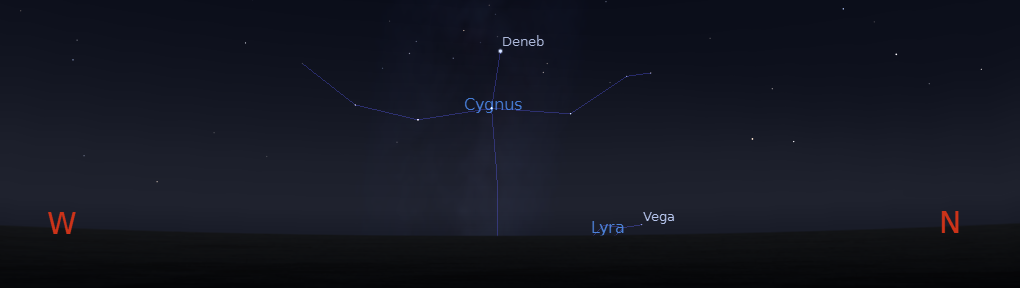
Vega near its setting point at 11:07 p.m. p.m. on November 24, 2014. Created using Stellarium.
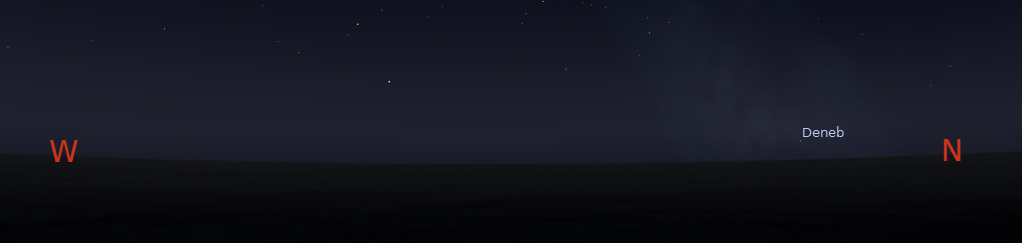
Deneb near its setting point at 5:05 a.m. p.m. on November 25, 2014. Created using Stellarium.
But will Deneb really set for Traverse City. Geometrically it will. However with a flat northern horizon looking northward over the bays to a clean Lake Michigan horizon, atmospheric refraction will bend the light from Deneb making it appear higher in the sky than it really is, so it won’t actually set. On the other side atmospheric extinction, the dimming of stars close to the horizon due to the filtering effect of looking through so much atmosphere would make Deneb impossible to see without a telescope. It might be an interesting challenge to spot.
07/24/2014 – Ephemeris – A look at Altair the third star of the Summer Triangle
Ephemeris for Thursday, July 24th. The sun rises at 6:20. It’ll be up for 14 hours and 56 minutes, setting at 9:17. The moon, 2 days before new, will rise at 5:21 tomorrow morning.
The Summer Triangle Is high in the east to southeast sky in the evening. The southernmost star of the Summer Triangle is Altair, in the southeast. Altair is the closest of the three stars at a distance of 16.7 light years away. One light year is nearly 6 trillion miles, that’s 6 followed by 12 zeros. Altair is nearly 11 times the brightness of the sun. If seen at Altair’s distance, the sun would only be as bright as one of the two stars that flank it in our sky. What is rather different about Altair is its rapid rotation. While it’s almost twice the sun’s diameter, it rotates once in only 9 hours, and would show a decidedly squashed appearance if seen close up. Our sun’s a slow poke, taking nearly a month to rotate just once.
Times are for the Traverse City/Interlochen area of Michigan. They may be different for your location.
Addendum
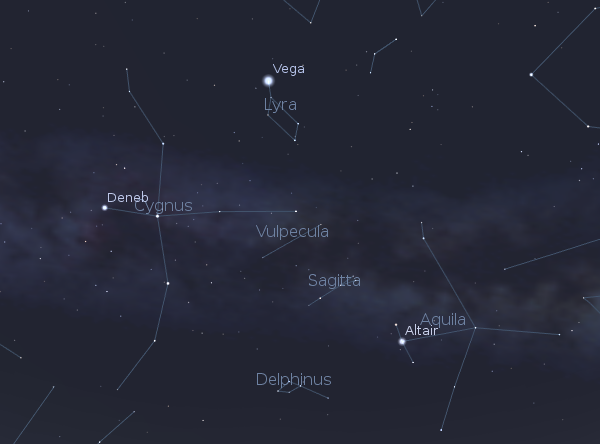
Deneb with the other stars and constellations in the Summer Triangle. Created using Stellarium.
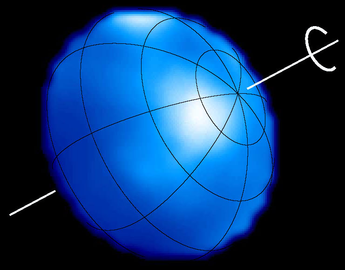
False-color image of the rapidly rotating star Altair, made with the MIRC imager on the CHARA array on Mt. Wilson. Credit: Ming Zhao, University of Michigan
07/21/2014 – Ephemeris – The celestial eagle: Aquila
Ephemeris for Monday, July 21st. Today the sun will be up for 15 hours and 2 minutes, setting at 9:19. The moon, 3 days past last quarter, will rise at 2:52 tomorrow morning. Tomorrow the sun will rise at 6:18.
Aquila the eagle is a constellation that lies in the Milky Way. It’s in the southeastern sky as it gets dark. Its brightest star, Altair is one of the stars of the Summer Triangle, a group of three bright stars dominating the eastern sky in the evening now. Altair, in the head of the eagle, is flanked by two slightly dimmer stars, the shoulders of the eagle. The eagle is flying northeastward through the Milky Way. Its wings are seen in the wing tip stars. A curved group of stars to the lower right of Altair is its tail. Within Aquila the Milky Way shows many dark clouds as part of the Great Rift that splits it here. The other summer bird is Cygnus the swan above and left of Aquila, flying in the opposite direction.
Times are for the Traverse City/Interlochen area of Michigan. They may be different for your location.
Addendum
Deneb with the other stars and constellations in the Summer Triangle. Created using Stellarium.
06/23/2014 – Ephemeris – It’s summer, so where is the Summer Triangle?
Ephemeris for Monday, June 23rd. Today the sun will be up for 15 hours and 33 minutes, setting at 9:31. The moon, half way from last quarter to new, will rise at 4:09 tomorrow morning. Tomorrow the sun will rise at 5:58.
Now that it’s summer it’s time to look for the Summer Triangle in the sky. It’s seen rising in the east as it gets dark. Highest of the three bright stars is Vega in the constellation Lyra the harp, whose body is seen in a narrow parallelogram nearby. The second star of the triangle is Deneb lower and left of Vega, It appears dimmer than Vega because it is by far the most distant of the three. The third star of the Summer Triangle is seen farther below and a right of Vega. It is Altair in Aquila the eagle, and the closest. Altair is 16.5 light years away, Vega is 27 light years while Deneb actually one of the brighter stars known, is a whopping 2600 light years away, give or take. It’s distance is not well-known. (24 08:54 Venus 1.3°N of Moon)
Times are for the Traverse City/Interlochen area of Michigan. They may be different for your location.
Addendum
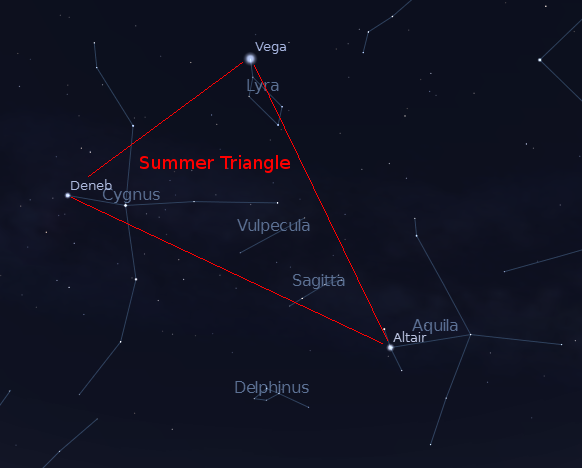
The Summer Triangle. Created using Stellarium and The Gimp.
07/29/2013 – Ephemeris – The constellation Aquila the eagle
Ephemeris for Monday, July 29th. The sun rises at 6:25. It’ll be up for 14 hours and 45 minutes, setting at 9:11. The moon, at last quarter today, will rise at 12:46 tomorrow morning.
Aquila the eagle is a constellation that lies in the Milky Way. It’s in the southeastern sky as it gets dark. Its brightest star, Altair is one of the stars of the Summer Triangle, a group of three bright stars seen now in the eastern sky in the evening. Altair, in the head of the eagle, is flanked by two slightly dimmer stars, the shoulders of the eagle. The eagle is flying northeastward through the Milky Way. Its wings are seen in the wing tip stars. A curved group of stars to the lower right of Altair is its tail. Within Aquila the Milky Way shows many dark clouds as part of the Great Rift that splits it here. The other summer bird is Cygnus the swan, above and left of Aquila, flying in the opposite direction, southward.
Times are for the Traverse City/Interlochen area of Michigan. They may be different for your location.
Addendum
Aquila with the other constellations in the Summer Triangle. Created using Stellarium.
07/18/2013 – Ephemeris – The bright star Altair
Ephemeris for Thursday, July 18th. Today the sun will be up for 15 hours and 7 minutes, setting at 9:22. The moon, 3 days past first quarter, will set at 2:56 tomorrow morning. Tomorrow the sun will rise at 6:15.
Of the three stars of the Summer Triangle Altair in the constellation Aquila the eagle is the farthest one south and the closest. Altair is at a distance of 16.8 light years away. One light year is nearly 6 trillion miles. Altair is 10 times the brightness of the sun. While it’s almost twice the sun’s diameter, it rotates once in only 9 hours, and has a decidedly squashed appearance when seen close up. There are techniques that can actually accomplish this. Our sun’s a slow poke, taking nearly a month to rotate once. In science fiction the Altair system was the scene for the classic film Forbidden Planet, one of the few science fiction classic films of the 1950s.
Times are for the Traverse City/Interlochen area of Michigan. They may be different for your location.
Addendum
The Summer Triangle. Created using Stellarium and The Gimp.
False-color image of the rapidly rotating star Altair, made with the MIRC imager on the CHARA array on Mt. Wilson.

United Planets Cruiser C57-D lands on Altair IV in the 1956 movie Forbidden Planet.
06/26/2013 – Ephemeris – Latest sunset and the Summer Triangle
Ephemeris for Thursday, June 27th. Today the sun will be up for 15 hours and 32 minutes, setting at 9:31. The moon, 3 days before last quarter, will rise at 12:14 tomorrow morning. Tomorrow the sun will rise at 5:59.
Last night we had the latest sunset of the year. The sun is really beginning to head south. Other than the sunrise and sunset numbers, we’ll begin to notice it for real in a few weeks. At first that realization strikes me a sad note that summer is beginning to end. However the astronomer in me realizes that means more night-time hours, and that the summer Milky Way is coming. Of the three bright stars of the Summer Triangle overhead and in the east, two of its stars are in the milky band. They are Deneb to the north and Altair to the south. Vega, closest to the zenith is not in the band. Actually all the stars we see with the naked eye or small telescopes belong to the Milky Way galaxy.
Times are for the Traverse City/Interlochen area of Michigan. They may be different for your location.
Addendum
The Summer Triangle at 11 p.m. Created using Stellaruim and The Gimp.
08/28/2012 – Ephemeris – Altair, fatter in the middle
Ephemeris for Tuesday, August 28th. The sun will rise at 7:00. It’ll be up for 13 hours and 24 minutes, setting at 8:25. The moon, 3 days before full, will set at 4:54 tomorrow morning.
The southernmost star of the Summer Triangle is Altair, high in the south. The other two stars of the triangle are Vega nearly overhead, and Deneb high in the east. Altair is the closest of the three at a distance of 16.8 light years away. One light year is nearly 6 trillion miles. Altair is 10 times the brightness of the sun. If seen at Altair’s distance, the sun would only be as bright as one of the two stars that flank it. What is rather different about Altair is it’s rapid rotation. While its almost twice the sun’s diameter, it rotates once in only 9 hours, and has a decidedly squashed appearance when seen close up. There are techniques that can actually accomplish this. Our sun’s a slow poke, taking nearly a month to rotate once.
Times are for the Traverse City/Interlochen area of Michigan. They may be different for your location.
Addendum
The constellations Lyra, Cygnus and Aquila. Created using Stellarium.
Check out Altair to the lower right.
07/05/2012 – Ephemeris – The Summer Triangle
Ephemeris for Thursday, July 5th. Today the sun will be up for 15 hours and 26 minutes, setting at 9:30. The moon, 2 days past full, will rise at 10:37 this evening. Tomorrow the sun will rise at 6:04.
Now that summer is here, the asterism or informal constellation called the Summer Triangle can be seen high in the east as it gets dark. Highest of the three bright stars is Vega in the constellation Lyra the harp, whose body is seen in a narrow parallelogram nearby. The second star of the triangle is Deneb lower and left of Vega, It appears dimmer than Vega because its is by far the most distant of the three. The third star of the Summer Triangle is seen farther below and right of Vega. It is Altair in Aquila the eagle, and the closest. Altair is 16.7 light years away, Vega is 25 light years while Deneb may be a whopping 1,550 light years away. [One light year is 6 about trillion miles. That’s 6 with 12 zeros after it.]
Times are for the Traverse City/Interlochen area of Michigan. They may be different for your location. Bracketed text was omitted from the broadcast due to time constraints.
Addendum
The Summer Triangle July 5, 2012 at 11 p.m. Created using Stellarium and The Gimp.
08/30/11 – Ephemeris – The bright star Altair
Tuesday, August 30th. The sun will rise at 7:02. It’ll be up for 13 hours and 20 minutes, setting at 8:23. The moon, 2 days past new, will set at 8:48 this evening.
The Summer Triangle of bright stars is visible overhead and to the south.. Vega is highest, nearly overhead, while Deneb is high in the northeast. The southernmost star of the Summer Triangle is Altair. Altair is the closest of the three stars at a distance of 16.8 light years away. One light year is nearly 6 trillion miles. Altair is 10 times the brightness of the sun. If seen at Altair’s distance, the sun would only be as bright as one of the two stars that flank it. What is rather different about Altair is it’s rapid rotation. While its almost twice the sun’s diameter, it rotates once in only 6 ½ to 10 hours, and would show a decidedly squashed appearance if seen close up. Our sun’s a slow poke, taking nearly a month to rotate just once.
* Times are for the Traverse City/Interlochen area of Michigan. They may be different for your location.
 Bob Moler's Ephemeris Blog