Archive
07/02/2015 -Ephemeris – A belated preview of July’s skies
Ephemeris for Thursday, July 2nd. Today the Sun will be up for 15 hours and 30 minutes, setting at 9:31. The Moon, 1 day past full, will rise at 9:48 this evening and tomorrow the Sun will rise at 6:02.
Lets preview July’s skies a day late. Sorry, it’s been a busy week.. The sun, having reached its northern solstice, is beginning to slide southward again, at first imperceptibly, then with greater speed. The daylight hours will decrease from 15 hours and 30 minutes Today to 14 hours 44 minutes at month’s end. The daylight hours will be slightly shorter south of Interlochen, and slightly longer to the north. The altitude of the sun at local noon, when the sun is due south will decrease from 68 degrees Now to 63 degrees at month’s end. The sun will be a degree lower in the Straits area. Despite the warmth, the earth will reach its greatest distance from the sun on Monday the 6th. The range of the earth’s distance from the sun is 3 million out of 93 million miles.
Times are for the Traverse City/Interlochen area of Michigan. They may be different for your location.
Addendum
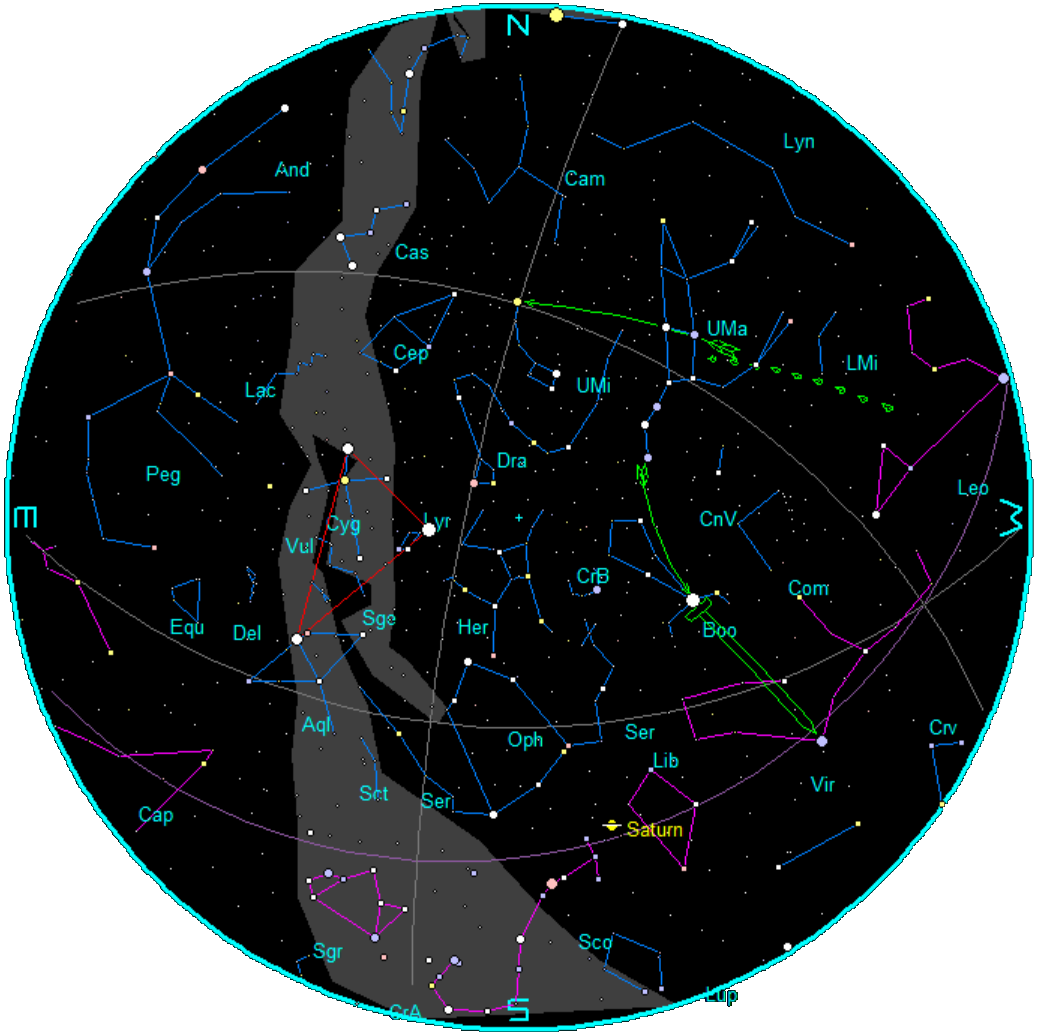
Star Chart for July 2015. Created using my LookingUp program. Click on image to enlarge.
The Moon is not plotted.
The planets and stars are plotted for the 15th at 11 p.m. EDT. That is chart time. Note, Traverse City is located 1 hour 45 minutes behind our time meridian. To duplicate the star positions on a planisphere you may have to set it to 1 hour 45 minutes earlier than the current time.
Evening Astronomical twilight ends at midnight. EDT on July 1st, decreasing to 11:14 p.m. EDT on the 31st.
Morning astronomical twilight starts at 3:32 a.m. EDT on July 1st, and increasing to 4:42 a.m. EDT on the 31st.
Add a half hour to the chart time every week before the 15th and subtract and hour for every week after the 15th.
For a list of constellation names to go with the abbreviations click here.
The green pointer from the Big Dipper is:
- Pointer stars at the front of the bowl of the Big Dipper point to Polaris the North Star.
- Drill a hole in the bowl of the Big Dipper and the water will drip on the back of Leo the Lion.
- Follow the arc of the Big Dipper’s handle to Arcturus
- Continue with a spike to Spica
- The Summer Triangle is shown in red
Calendar of Planetary Events
Credit: Sky Events Calendar by Fred Espenak and Sumit Dutta (NASA’s GSFC)
To generate your own calendar go to http://eclipse.gsfc.nasa.gov/SKYCAL/SKYCAL.html
Times are Eastern Daylight Time on a 24 hour clock. Some additions made to aid clarity.
Conjunctions like the Moon-Jupiter: 4.5° N means Jupiter will appear 4.5° north of the Moon.
 Date       Local   Event
             Time
Jul  01     We    02:48    Moon South Dec.: 18.4° S
     01     We        Venus: 42.4° E
     01     We    22:20    Full Moon
     05     Su    14:54    Moon Perigee: 367100 km
     06     Mo    08:59    Aphelion: 1.0167 AU
     07     Tu    20:07    Moon Descending Node
     08     We    16:24    Last Quarter
     12     Su    13:55    Moon-Aldebaran: 0.9° S
     14     Tu    00:24    Moon North Dec.: 18.4° N
     14     Tu    17:35    Venus-Regulus: 2.3° S
     15     We    21:24    New Moon
     18     Sa    13:34    Moon-Jupiter: 4.5° N
     18     Sa    21:06    Moon-Venus: 0.5° N
     21     Tu    07:02    Moon Apogee: 404800 km
     21     Tu    15:32    Moon Ascending Node
     23     Th    15:18    Mercury Superior Conjunction with the Sun
     24     Fr    00:04    First Quarter
     26     Su    04:43    Moon-Saturn: 2.4° S
     28     Tu    10:23    Delta Aquarid Meteor Shower: ZHR* = 20
     28     Tu    13:34    Moon South Dec.: 18.3° S
     31     Fr    06:43    Full Moon
Aug  01     Sa        Venus: 21.5° E
*ZHR – Zenithal Hourly Rate: Approximate number of meteors per hour when the shower radiant is at the zenith. For more information on this and other meteor showers in 2015 see the International Meteor Organization website calendar section: http://www.imo.net/calendar.
07/03/2014 – Ephemeris – Today the Earth is its farthest from the Sun for this year
Thursday, July 3rd. Today the sun will be up for 15 hours and 28 minutes, setting at 9:30. The moon, 2 days before first quarter, will set at 12:35 tomorrow morning. Tomorrow the sun will rise at 6:02.
Later today the Earth will pass a point in its orbit called aphelion. This is the point where the Earth is its farthest from the Sun. Astronomers measure it in terms of the astronomical units AU), the mean distance between the Earth and the Sun. In astronomical units the Earth will be 1.01668 AU from the Sun at 6:59 p.m. (22:59 UT). Converted to miles it is 94.51 million miles (152.1 million km). The 1.7 percent farther distance from the Sun doesn’t really show up as making a difference in temperature. It is swamped by the greater effect of the Earth’s axial tilt currently giving us our summer season. The one thing about aphelion in summer gives us is a longer summer, than winter. The Earth travels slightly slower when farther from the Sun than when closer to it, so summer is the longest season at 94 days.
Times are for the Traverse City/Interlochen area of Michigan. They may be different for your location.
Addendum
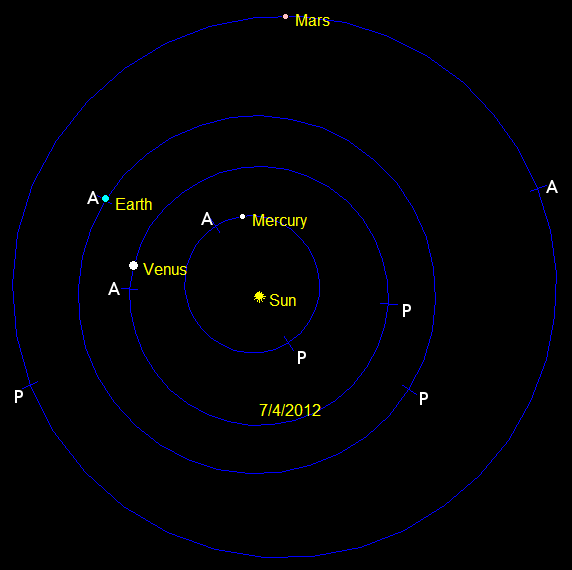
The orbits of the inner planets. (P)erihelion – (A)phelion
Note that the chart is from 2012. The date of aphelion and perihelion varies by a day or two each year. Mars and Mercury have the most eccentric orbits.
07/05/2013 – Ephemeris – Earth at aphelion and astronomy tonight
Ephemeris for Friday, July 5th. Today the sun will be up for 15 hours and 26 minutes, setting at 9:30. The moon, 3 days before new, will rise at 4:52 tomorrow morning. Tomorrow the sun will rise at 6:04.
The earth is as far as it will get from the sun for the year today at 94.5 million miles. Speaking of the sun, the monthly meeting of the Grand Traverse Astronomical Society at 8 p.m. at Northwestern Michigan College’s Rogers Observatory tonight will host local landscape architect Dean Conners an expert on sundials. He created the sundial in the Children’s Garden behind the District Library. who will talk about some interesting sundials. After the meeting at 9 p.m. there will be a star party at the observatory with the planets Venus and Saturn plus some of the bright wonders of the summer sky, like the Ring Nebula, The Great Hercules Globular Star Cluster if it’s clear. There’s other activities if it’s cloudy.
Times are for the Traverse City/Interlochen area of Michigan. They may be different for your location.
07/01/2013 – Ephemeris – July preview
Ephemeris for Monday, July 1st. Today the sun will be up for 15 hours and 29 minutes, setting at 9:31. The moon, 1 day past last quarter, will rise at 2:11 tomorrow morning. Tomorrow the sun will rise at 6:01.
Lets preview July’s skies. The sun, having reached its northern solstice, is beginning to slide southward again, at first imperceptibly, then with greater speed. The daylight hours will decrease from 15 hours and 29 minutes today to 14 hours 40 minutes at month’s end. The daylight hours will be slightly shorter south of Interlochen, and slightly longer to the north. The altitude of the sun at local noon, when the sun is due south will decrease from 68 degrees tomorrow to 63 degrees at month’s end. The sun will be a degree lower in the Straits area. Despite the warmth, the earth will reach its greatest distance from the sun on Friday. The planets Venus and Saturn will be our evening planets this month.
Times are for the Traverse City/Interlochen area of Michigan. They may be different for your location.
Addendum
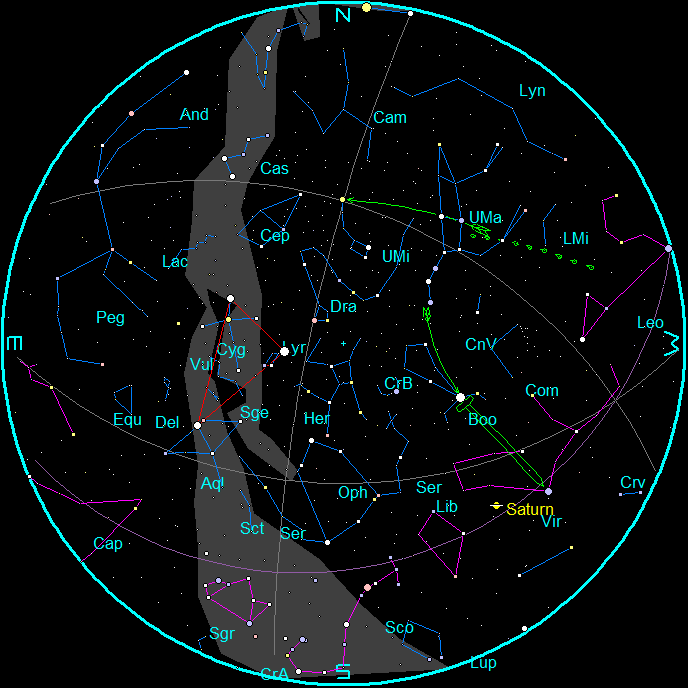
The stars and planets, specifically for July 15, 2013 at 11 p.m.
The constellation abbreviations, names and bright star names are found here.
- The arrow from the pointer stars of the Big Dipper to Polaris the North Star, near the north celestial pole.
- Follow the arc of the handle of the Big Dipper to Arcturus.
- A Leaky Dipper drips on Leo
- Follow the spike to Spica.
- The Summer Triangle (in red)
07/04/2012 – Ephemeris – The earth at aphelion
Ephemeris for Independence Day, Wednesday, July 4th. Today the sun will be up for 15 hours and 27 minutes, setting at 9:30. The moon, 1 day past full, will rise at 10:02 this evening. Tomorrow the sun will rise at 6:03.
Today, Independence Day the earth is at its greatest distance from the sun or about 94.5 million miles from the sun. It doesn’t do much to weaken the strength of sunlight, as you will find out when you go to the beach, But, occurring in summer, makes summer the longest season by a several days over winter. Our calendar tries to keep up with the seasonal or tropical year, while the earths revolution from its farthest or aphelion point to the next is slightly longer. Back in 1776 at the founding of our country the earth was farthest from the sun on June 30th. As we go more centuries into the future summer will get even a bit longer. But remember the poor Aussies whose winter will also get longer.
Times are for the Traverse City/Interlochen area of Michigan. They may be different for your location.
Addendum
The orbits of the inner planets. (P)erihelion – (A)phelion
Perihelion is the closest point in an orbit to the sun, while aphelion is the farthest. The earth and Venus have the most circular orbits while Mars and Mercury have markedly elliptical orbits.

