Archive
Ephemeris: 02/20/2026 – The star that’s called “Before the Dog”
This is Ephemeris for Friday, February 20th. Today the Sun will be up for 10 hours and 43 minutes, setting at 6:18, and it will rise tomorrow at 7:33. The Moon, 3 days past new, will set at 10:21 this evening.
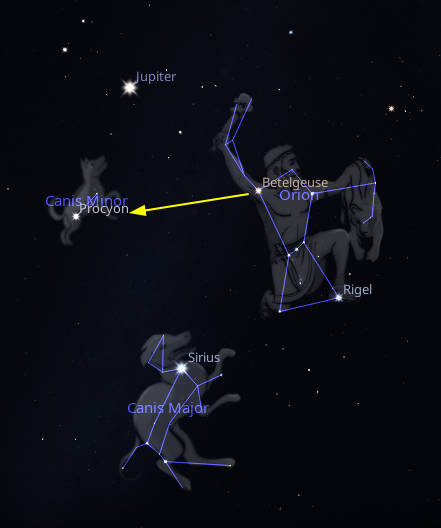
The star Procyon is in Orion’s little hunting dog, Canis Minor, which contains only one other star. It can be found by using the shoulder stars of Orion, Bellatrix and Betelgeuse, pointing to the left and down a bit to Procyon at 9 PM. With Jupiter above, Betelgeuse to the right and Sirius below, it makes an imposing diamond of stars. The word Procyon means “Before the Dog” meaning that rises before the Dog Star, Sirius, even though it is east of it. Procyon is also north of Sirius, which for observers above 30° north latitude, it does indeed rise before the Dog Star. It is a star like Sirius, though it’s not as bright, or white. Procyon is 11.5 light years away while Sirius is 8.6. Both have tiny white dwarf companion stars.
The astronomical event times given in this blog are for the Traverse City/Interlochen area of Michigan (Lat 44.7° N, Long 85.7° W; EST, UT – 5 hours) unless stated otherwise. Times will be different for other locations.
Addendum
Ephemeris: 02/18/2025 – Finding Orion’s greater hunting dog
This is Ephemeris for Tuesday, February 18th. Today the Sun will be up for 10 hours and 37 minutes, setting at 6:15, and it will rise tomorrow at 7:36. The Moon, 2 days before last quarter, will rise at 12:52 tomorrow morning.
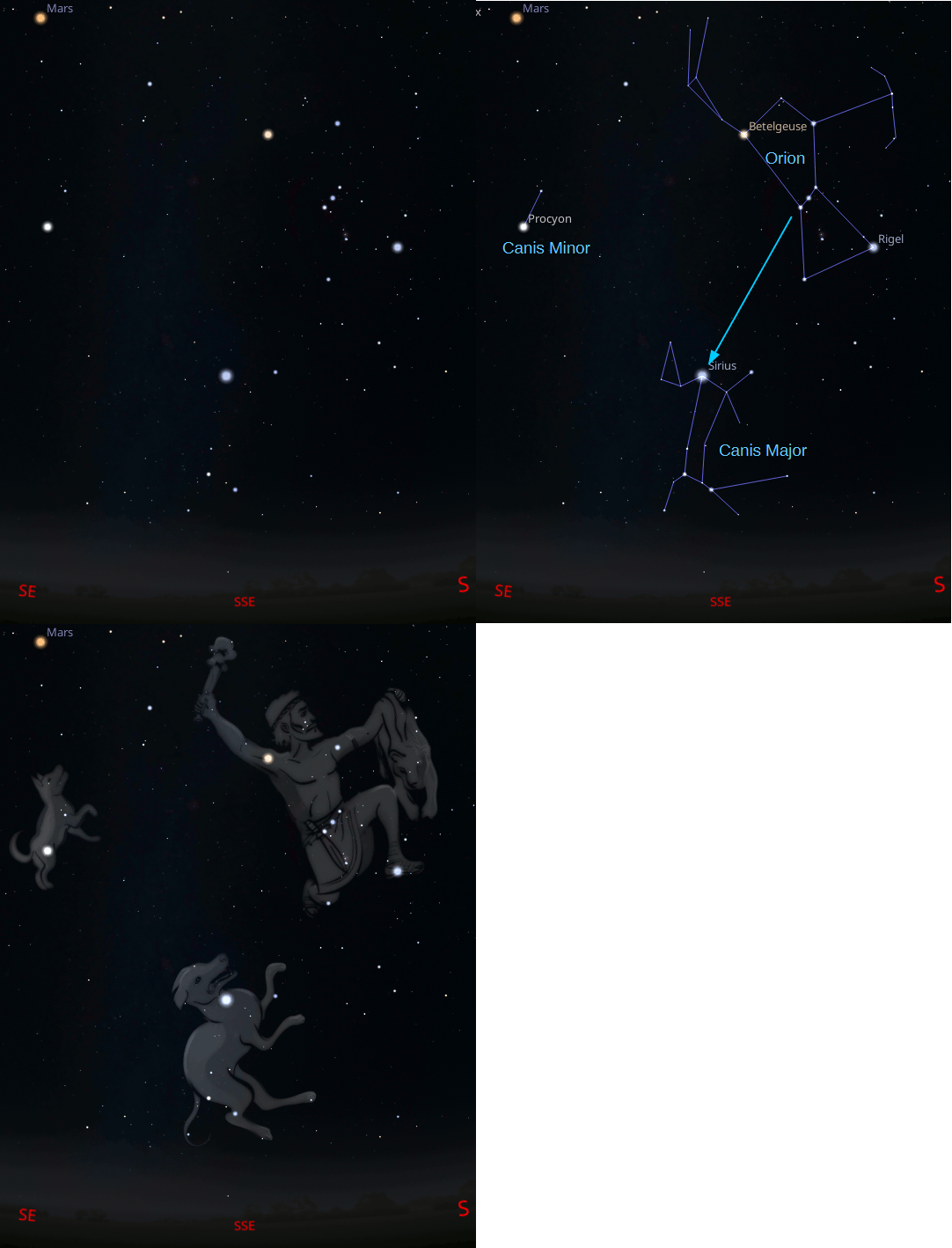
The great winter constellation or star group Orion the Hunter, is located in the south-southeastern sky at 8 p.m. His elongated rectangle of a torso is almost vertical. In the center of the rectangle are three stars in a line that mark his belt. As a hunter, especially one of old, he has two hunting dogs. The larger, Canis Major can be found by following the three belt stars of Orion down and to the left. There lies the brilliant star called Sirius, also known as the Dog Star. It’s in the heart of a stick figure dog low in the southeast, facing Orion, that appears to be begging. There’s a fine star cluster, called M41, at the 5 o’clock position from Sirius, easily visible in binoculars or a small telescope.
The astronomical event times given are for the Traverse City/Interlochen area of Michigan (EST, UT – 5 hours). Times will be different for other locations.
Addendum
Ephemeris: 01/23/2025 – Conflict in the heavens
This is Ephemeris for Thursday, January 23rd. Today the Sun will be up for 9 hours and 28 minutes, setting at 5:39, and it will rise tomorrow at 8:09. The Moon, 2 days past last quarter, will rise at 4:15 tomorrow morning.
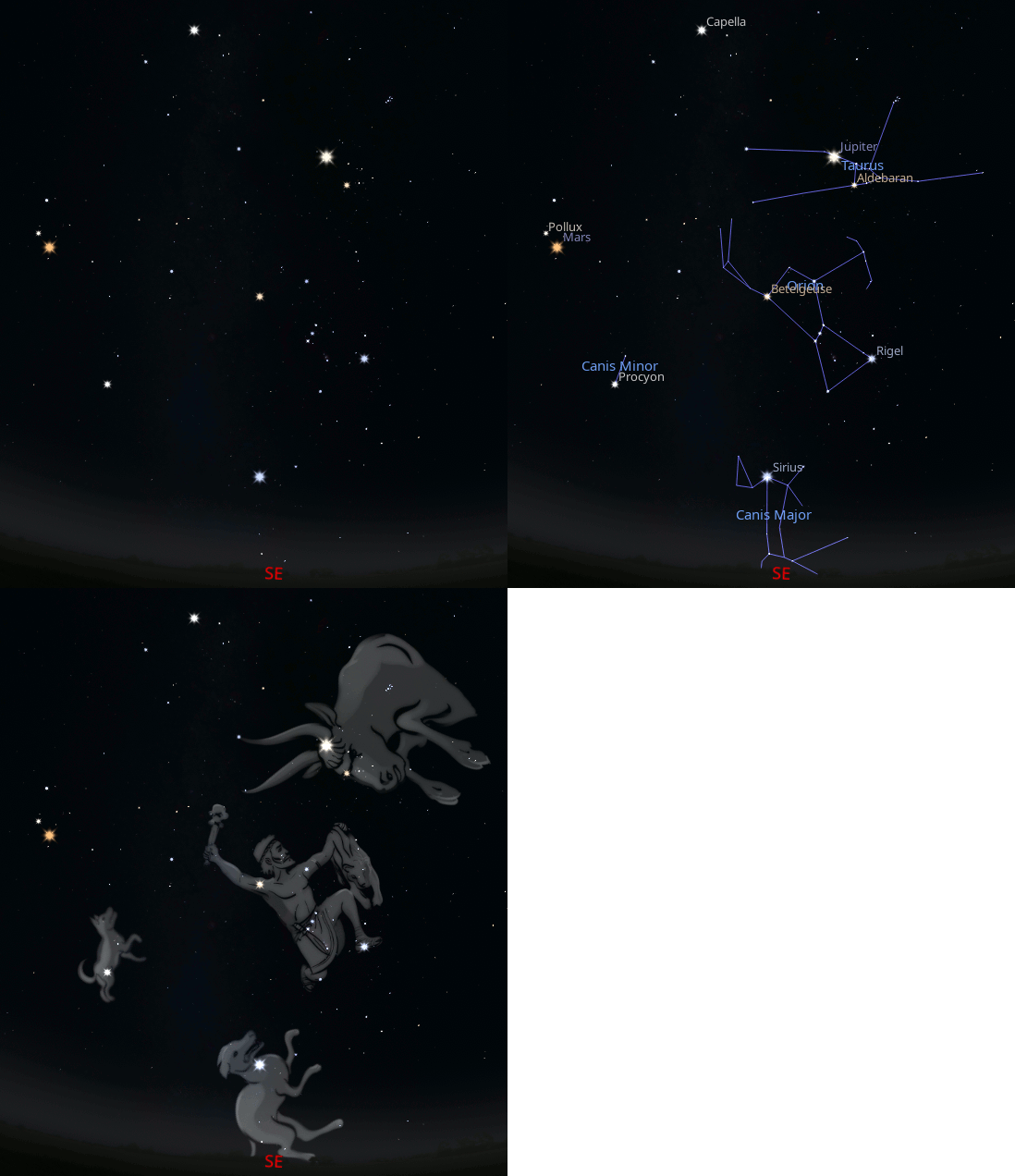
There are several instances in the Greek heavens where constellations appear to interact with one another. This is true with Orion the hunter and Taurus the bull. Taurus, whose face is the letter V of stars, near Jupiter this year. The orangish star Aldebaran as his angry bloodshot eye is charging down on Orion, who has raised a lion skin shield on one arm and an upraised club in the other, ready to strike. They have been frozen in this pose for millennia. Stars below and right of the letter V of the Bull’s face suggest the front part of his body and his front legs charging at Orion. Orion also has two hunting dogs, Canis Major and Canis Minor. Canis Major with its dazzling star Sirius will rise around 6:21 on a line extending down from Orion’s belt.
The astronomical event times given are for the Traverse City/Interlochen area of Michigan (EST, UT – 5 hours). Times will be different for other locations.
Addendum
Perhaps Jupiter is not intruding, because the Roman god Jupiter is the Greek god Zeus, who turned himself into a bull to carry off the maiden Europa. And Europa is with him still as Jupiter’s moon, and target of NASA’s recently launched Europa Clipper spacecraft.
Ephemeris: 03/07/2024 – There’s a unicorn in there somewhere
This is Bob Moler with Ephemeris for Thursday, March 7th. Today the Sun will be up for 11 hours and 30 minutes, setting at 6:39, and it will rise tomorrow at 7:06. The Moon, 3 days before new, will rise at 6:35 tomorrow morning.
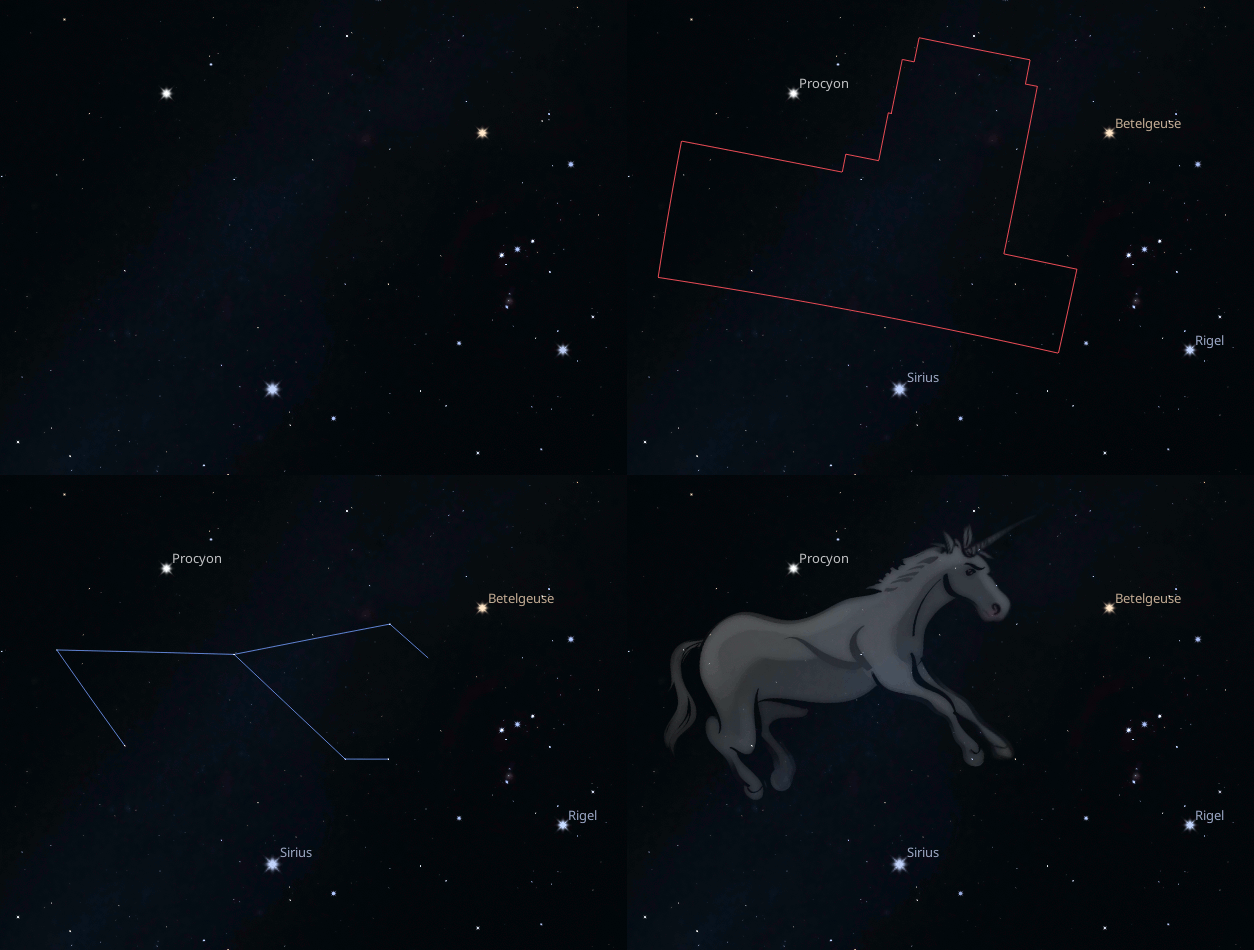
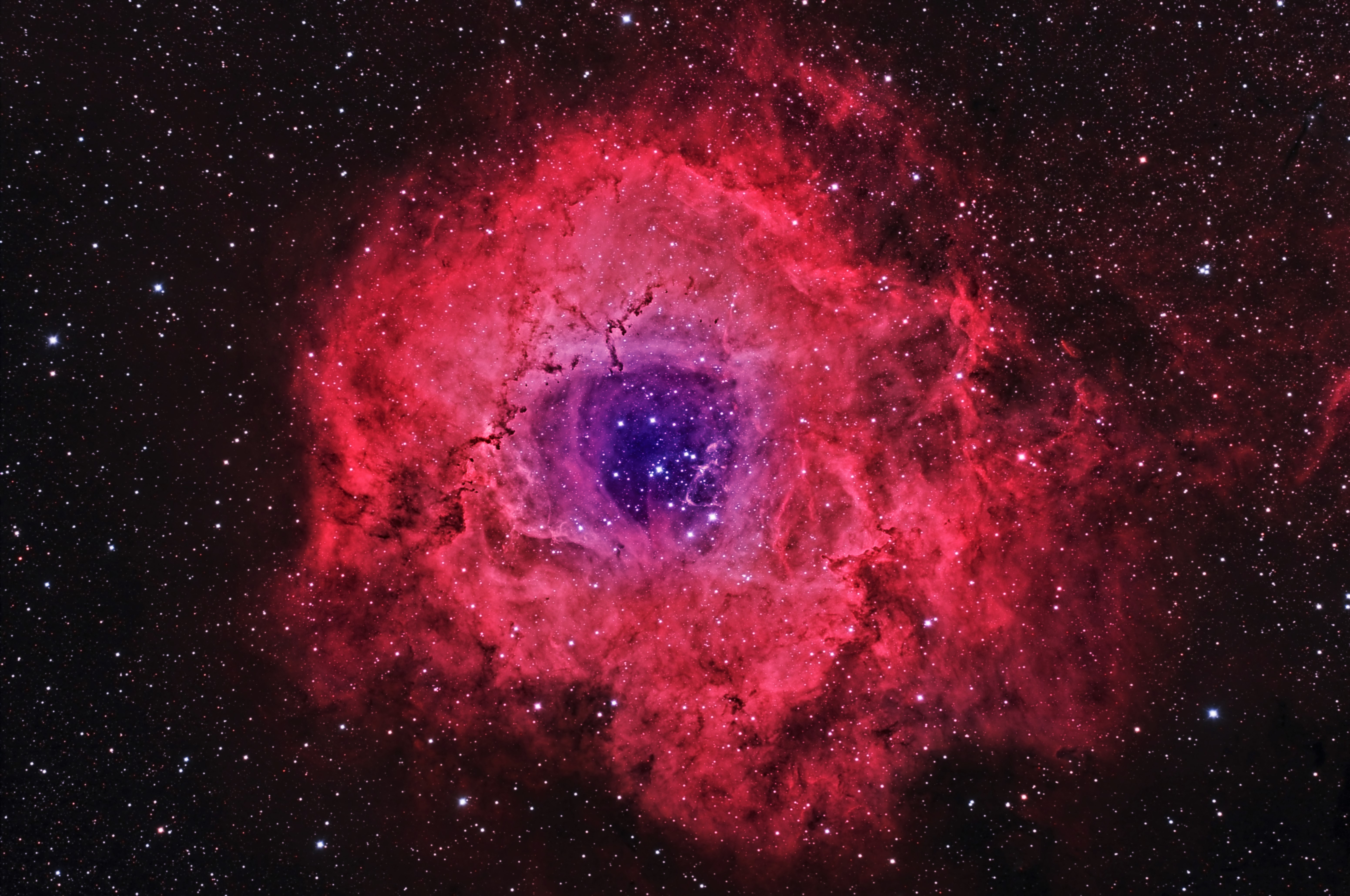
The constellation of Monoceros the unicorn is located in an area of sky to the left of Orion so it’s in the south at 8 pm, inside the Winter Triangle of stars, Betelgeuse in Orion; Sirius in the Great Dog, Canis Major; and Procyon in Canis Minor. If you don’t see anything there, it’s OK. Nobody sees real unicorns any more anyway. Are there any real unicorns? Anyway, there’s a great number of nebulae here in the Milky Way that runs through it, which unfortunately are too faint to be seen with amateur telescopes. However, it is a gold mine for amateur astronomers who are also astrophotographers using time exposures to record the faint nebulae here, including the famous Rosette Nebula!
The astronomical event times given are for the Traverse City/Interlochen area of Michigan (EST, UT –5 hours). They may be different for your location.
Addendum
Ephemeris: 02/05/2024 – Looking at the star Procyon
This is Ephemeris for Monday, February 5th. Today the Sun will be up for 9 hours and 59 minutes, setting at 5:56, and it will rise tomorrow at 7:56. The Moon, 3 days past last quarter, will rise at 5:44 tomorrow morning.
The star Procyon is in Orion’s little hunting dog Canis Minor, which contains only one other star. It can be found by using the shoulder stars of Orion, Bellatrix and Betelgeuse, pointing to the left and down a bit to Procyon in the evening. The word Procyon appears to mean “Before the Dog” meaning that rises before the Dog Star, Sirius, even though it is east of it. Procyon is also north of Sirius, which for observers above 30° north latitude does indeed rise before the Dog Star. It is a star like Sirius, though it’s not as bright, or white. Procyon is 11.5 light years away while Sirius is 8.4 light years away. Both have tiny white dwarf companion stars.
The astronomical event times given are for the Traverse City/Interlochen area of Michigan (EST, UT –5 hours). They may be different for your location.
Addendum
Ephemeris: 01/08/2024 – Orion vs Taurus: conflict for the ages
This is Ephemeris for Monday, January 8th. Today the Sun will be up for 9 hours even, setting at 5:19, and it will rise tomorrow at 8:19. The Moon, 3 days before new, will rise at 6:58 tomorrow morning.
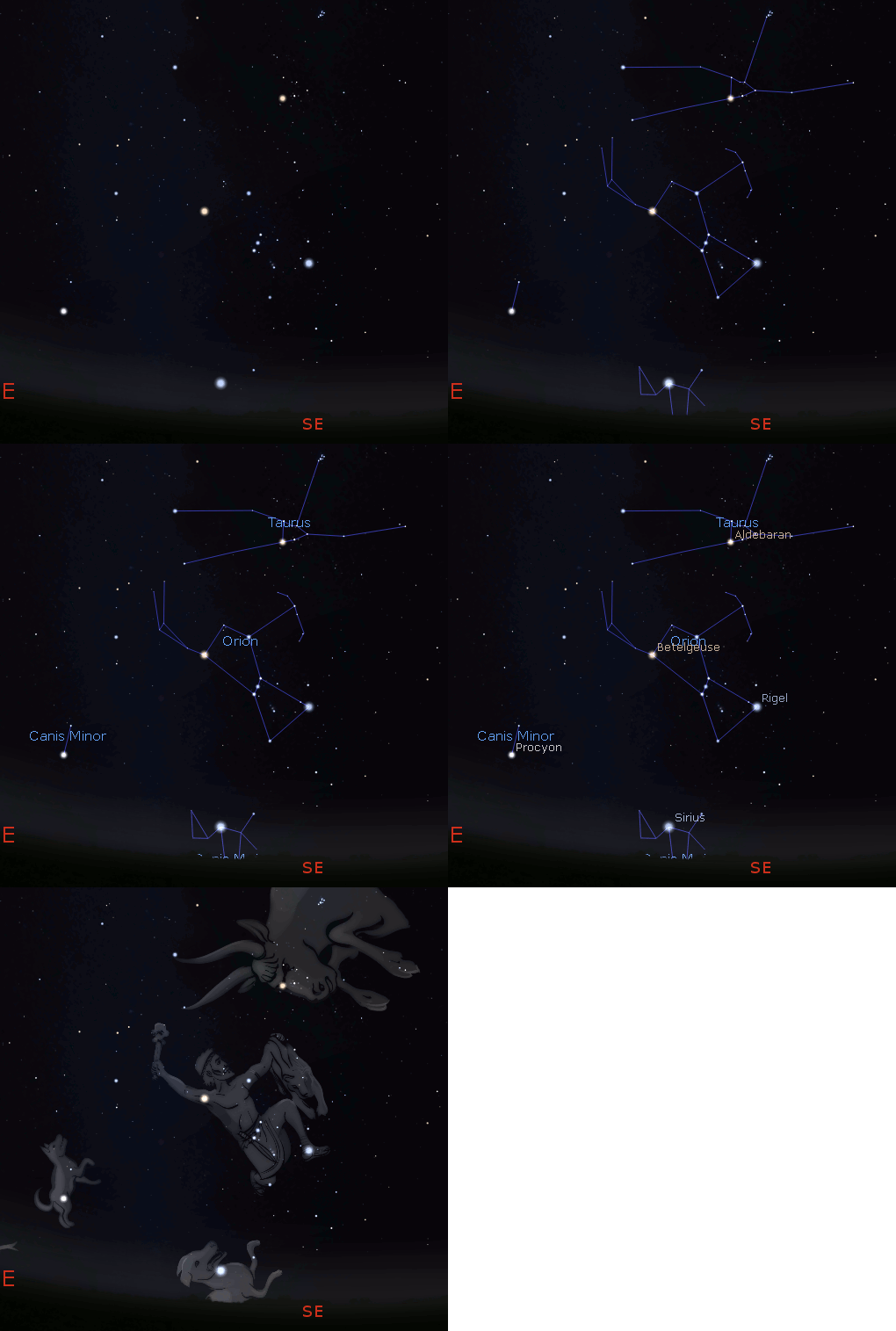
There are several instances in the Greek heavens where constellations appear to interact with one another. This is true with Orion the hunter and Taurus the bull. Taurus, whose face is the letter V of stars with orangish Aldebaran as his angry bloodshot eye is charging down on Orion, who has raised a lion skin shield on one arm and an upraised club in the other, ready to strike. They have been frozen in this pose for millennia. Stars below and right of the letter V of the Bull’s face suggest the front part of his body and his front legs charging at Orion. Orion also has two hunting dogs, Canis Major and Canis Minor. Canis Major with its dazzling star Sirius will rise around 7:30 on a line extended down from Orion’s belt.
The astronomical event times given are for the Traverse City/Interlochen area of Michigan (EST, UT –5 hours). They may be different for your location.
Addendum
02/22/2022 – Ephemeris – The Winter Triangle
This is Ephemeris for Tuesday, February 22nd. Today the Sun will be up for 10 hours and 49 minutes, setting at 6:21, and it will rise tomorrow at 7:30. The Moon, 1 day before last quarter, will rise at 1:26 tomorrow morning.
I’ve talked about the Winter Circle of bright stars already this winter, but some other astronomers talk about the Winter Triangle. The stars involved are Betelgeuse in the hunter Orion, Sirius in Canis Major, Orion’s large hunting dog, and Procyon in Canis Minor, his other small hunting dog. These three stars enclose a rather blank piece of sky with the faint Milky Way running through it and the almost invisible constellation of Monoceros the unicorn. The Summer Triangle has three bright stars with no other close competition. The Winter Triangle has four other bright stars near it. Any three of these would make a nice triangle. One of these constellations, Canis Minor, is tiny with Procyon and one other star. It makes me think of a dachshund, or maybe, if I’m hungry, a hot dog.
The astronomical event times given are for the Traverse City/Interlochen area of Michigan (EST, UT -5 hours). They may be different for your location.
Addendum
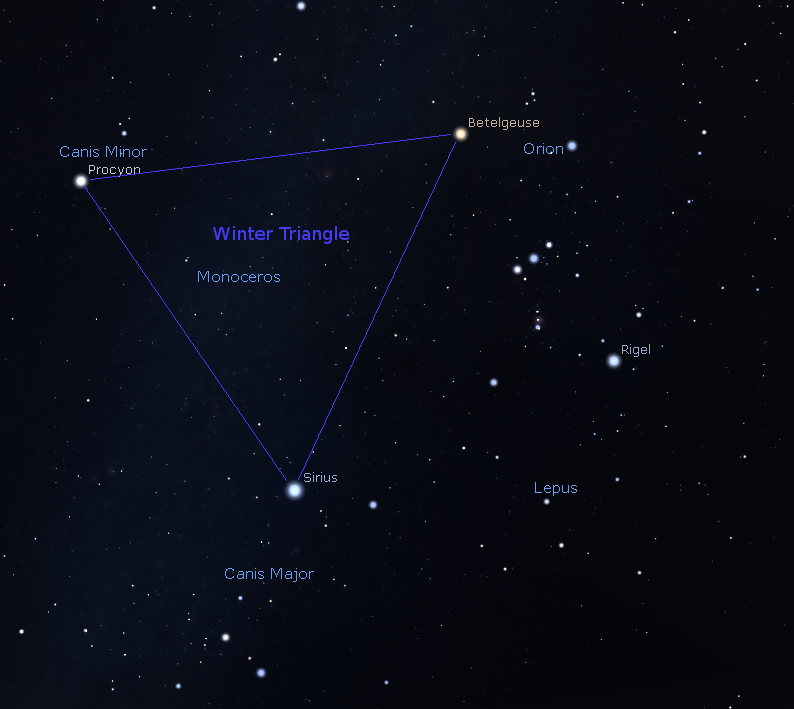
The Winter Triangle. It encloses a pretty blank space where Monoceros the unicorn lies. Created using Stellarium with my annotations for the Winter Triangle.
01/31/2022 – Ephemeris – The winter circle of bright stars
This is Ephemeris for Monday, January 31st. Today the Sun will be up for 9 hours and 47 minutes, setting at 5:50, and it will rise tomorrow at 8:01. The Moon, 1 day before new, will rise at 8:48 tomorrow morning.
The winter skies are blessed with more first magnitude stars than any other season. Six of these stars lie in a large circle centered on the seventh, It’s called the Winter Circle. This circle is up in the evening. Starting high overhead is yellow Capella in Auriga the charioteer. Moving down clockwise is orange Aldebaran in the face of Taurus the Bull. Then down to Orion’s knee, we find blue-white Rigel. Down and left is the brightest star of all the brilliant white Sirius the Dog Star in Canis Major, lowest of these stars in the south-southeast. Moving up and left is white Procyon in Canis Minor, Above Procyon is Pollux in Gemini, the twins. All these are not quite centered on Betelgeuse, the bright red star in Orion’s shoulder.
The astronomical event times given are for the Traverse City/Interlochen area of Michigan (EST, UT – 5 hours). They may be different for your location.
Addendum
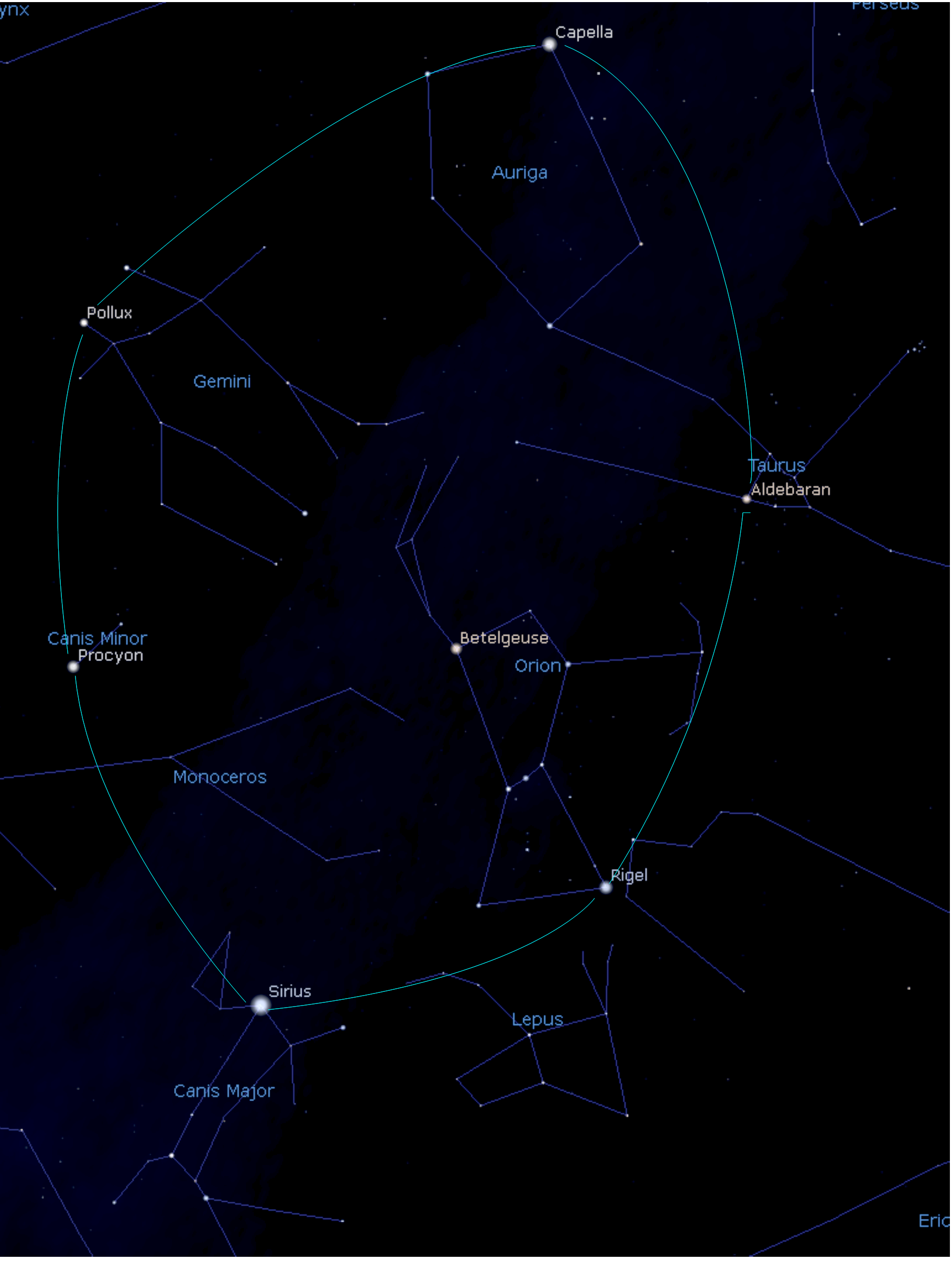
The bright stars of winter arrayed in a not so accurate circle. Some call it the Winter Hexagon. These stars are what make the winter sky so brilliant on the rare clear night in winter. Created using Stellarium.
01/11/2021 – Ephemeris – Procyon, the before the Dog Star
This is Bob Moler with Ephemeris for Monday, January 11th. Today the Sun will be up for 9 hours and 5 minutes, setting at 5:23 pm, and it will rise tomorrow at 8:17 am. The Moon, 2 days before new, will rise at 8:05 tomorrow morning.
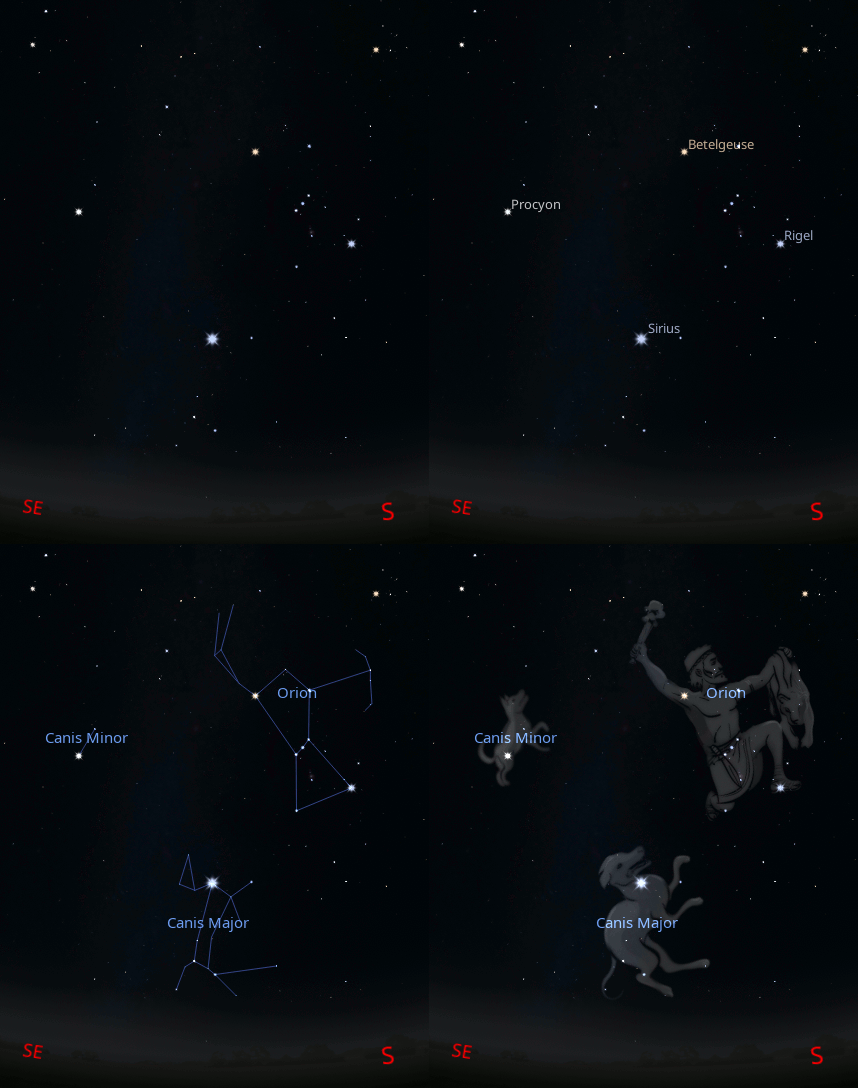
Visible low in the east at 8 p.m. appears the star Procyon. To its right and below is Sirius the brightest night-time star. Procyon is the bright star in the constellation Canis Minor, or lesser dog. I can find only one other star in Canis Minor. Perhaps it’s a hot dog. If Sirius, in Canis major is the Dog Star then Procyon should be the Little Dog Star. However, Procyon is an interesting name. It means “Before the dog”, which is an allusion to the fact that Procyon, though east of Sirius actually rises before it. This is due to Procyon’s more northerly position. This effect doesn’t work south of the equator, however. Sirius will rise at about 7:30 tonight. Procyon is a star much like Sirius but is 32% farther away. It’s 11.4 to Sirius’ 8.6 light years away.
The event times given are for the Traverse City/Interlochen area of Michigan. They may be different for your location.
Addendum
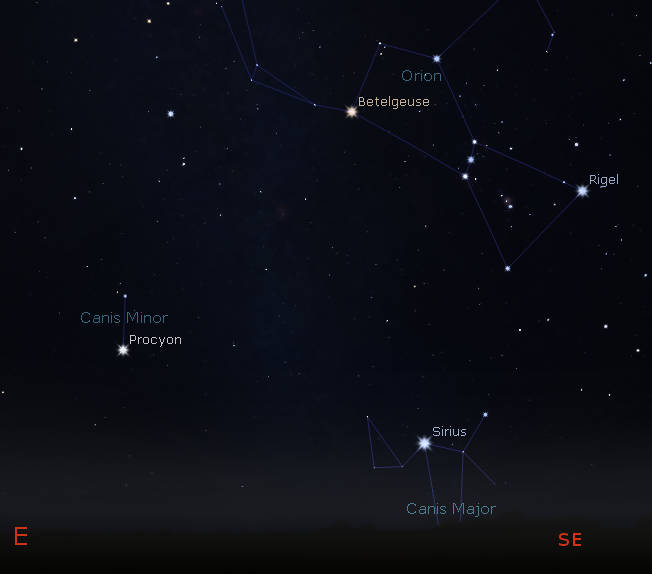
Orion and his hunting dogs in early winter (8 pm, January 11, 2021) showing that Procyon does rise before Sirius.
02/20/2020 – Ephemeris – The Winter Triangle
Ephemeris for Thursday, February 20th. Today the Sun will be up for 10 hours and 41 minutes, setting at 6:17, and it will rise tomorrow at 7:34. The Moon, 3 days before new, will rise at 6:53 tomorrow morning.
I usually talk about the Winter Circle of bright stars, but some other astronomers talk about the Winter Triangle. The stars involved are Betelgeuse in the hunter Orion, Sirius in Canis Major, Orion’s large hunting dog, and Procyon in Canis Minor, his other small hunting dog. These three stars enclose a rather blank piece of sky with the faint Milky Way running through it and the equally invisible constellation of Monoceros the unicorn. The Summer Triangle has three bright stars with no other close competition. The Winter Triangle has 4 other bright stars near it. Any three of these would make a nice triangle. One of these stars, Betelgeuse has been the news recently because it is dimming to an unprecedented degree.
The times given are for the Traverse City/Interlochen area of Michigan. They may be different for your location.
Addendum
The Winter Triangle. It enclose a pretty blank space where Monoceros the unicorn lies. Created using Stellarium with my annotations for the Winter Triangle. By the way, Betelgeuse is currently only as bright as Bellatrix, the star next to the “n” in Orion.
 Bob Moler's Ephemeris Blog