Archive
Ephemeris: 12/30/2024 – Two great astronomical events of 2024
This is Ephemeris for Monday, December 30th. Today the Sun will be up for 8 hours and 51 minutes, setting at 5:11, and it will rise tomorrow at 8:20. The Moon is new today, and won’t be visible.
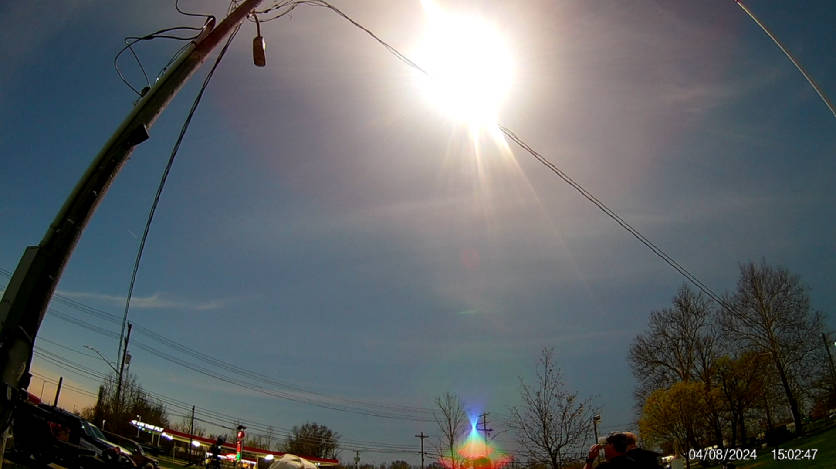
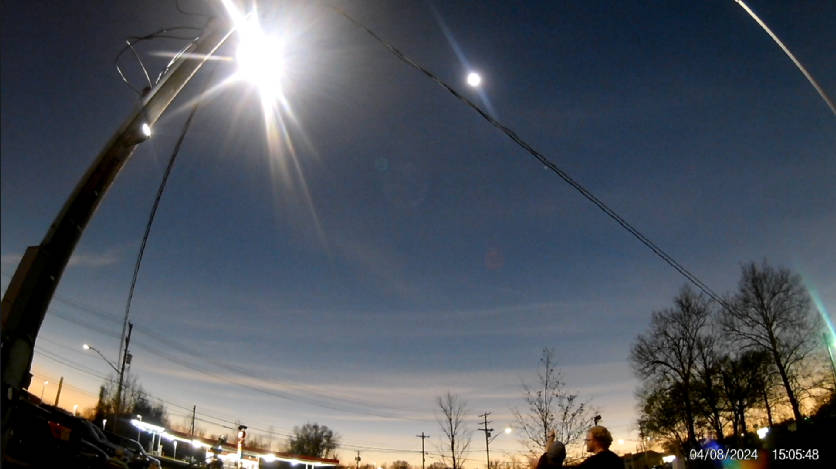
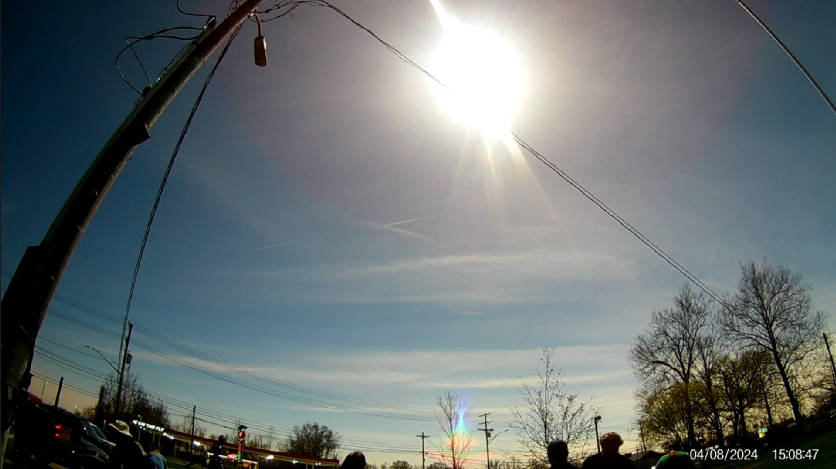
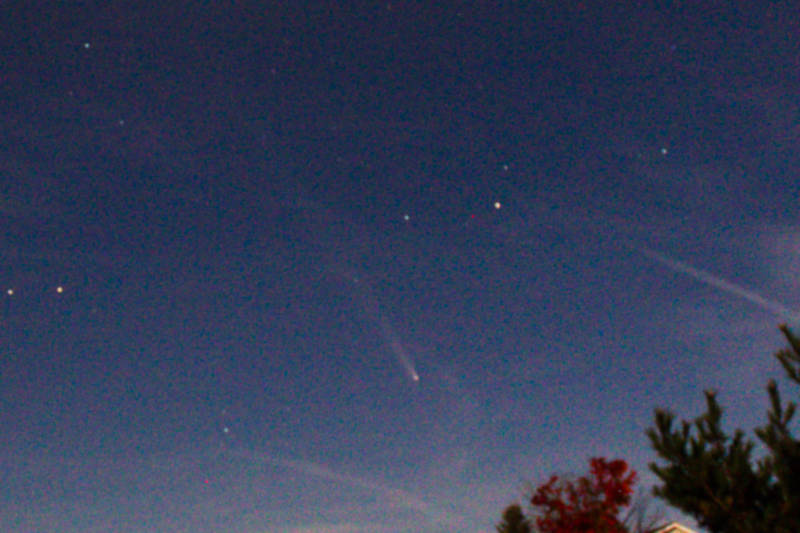
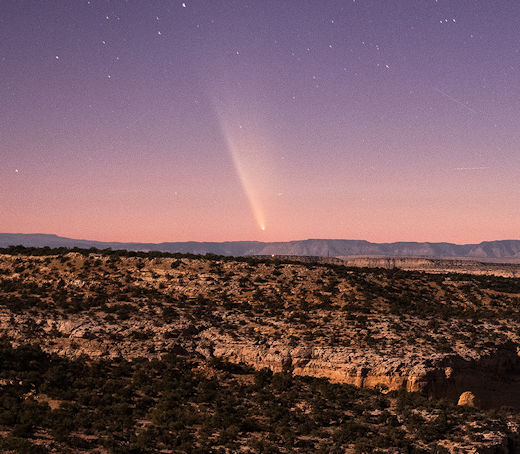
Speaking of new moons, the most spectacular astronomical event of 2024 was the total solar eclipse of April 8th. The path of totality came fairly close to us here in Northern Michigan just clipping the southeastern corner of the state. It was my sixth observation of a total solar eclipse out of six tries and probably my last, because our next total solar eclipse in the contiguous 48 states will be twenty-one years from now in 2045. The other event of 2024 was the appearance of the Comet Tsuchinshan-ATLAS which graced our skies for a few days in mid-October. I have no reports of anybody seeing it with the naked eye, however it was visible in binoculars and easily photographed with a few seconds exposure with a camera. It had a very prominent tail.
The astronomical event times given are for the Traverse City/Interlochen area of Michigan (EST, UT – 5 hours). Times will be different for other locations.
Addendum
Ephemeris: 10/30/2024 – Our weekly look at the whereabouts of the naked-eye planets
This is Ephemeris for Wednesday, October 30th. Today the Sun will be up for 10 hours and 14 minutes, setting at 6:33, and it will rise tomorrow at 8:20. The Moon, 2 days before new, will rise at 7:28 tomorrow morning.
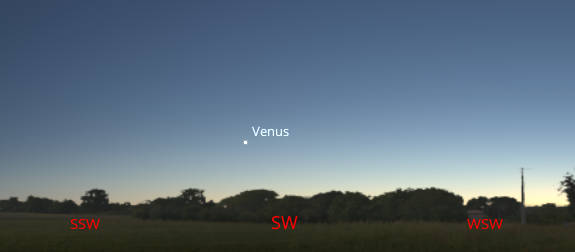
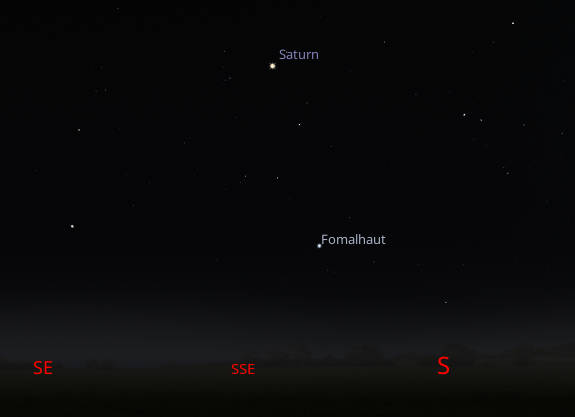
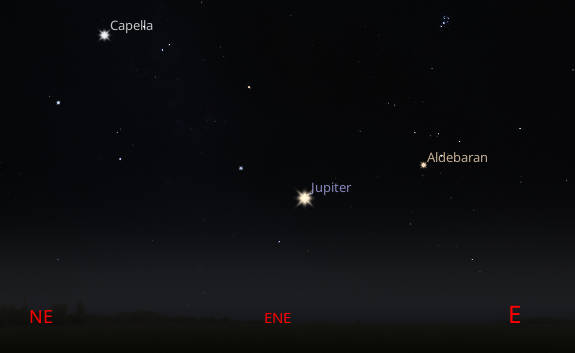
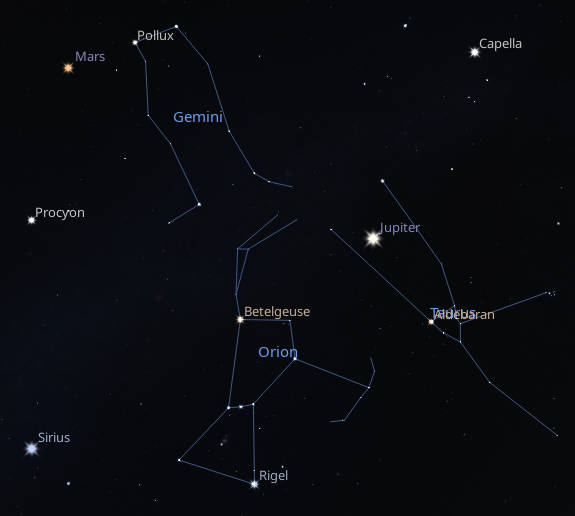
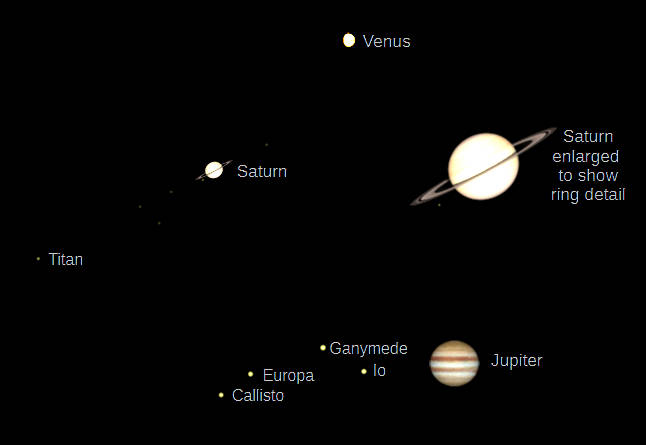
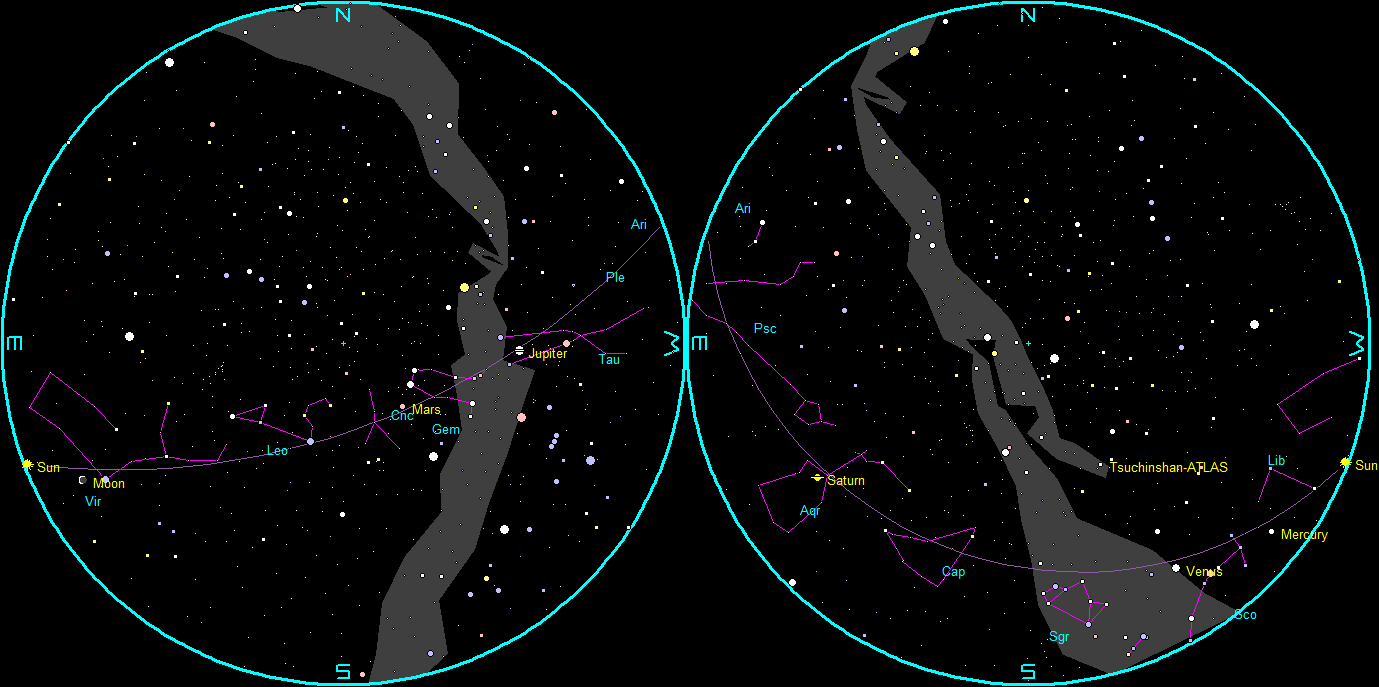
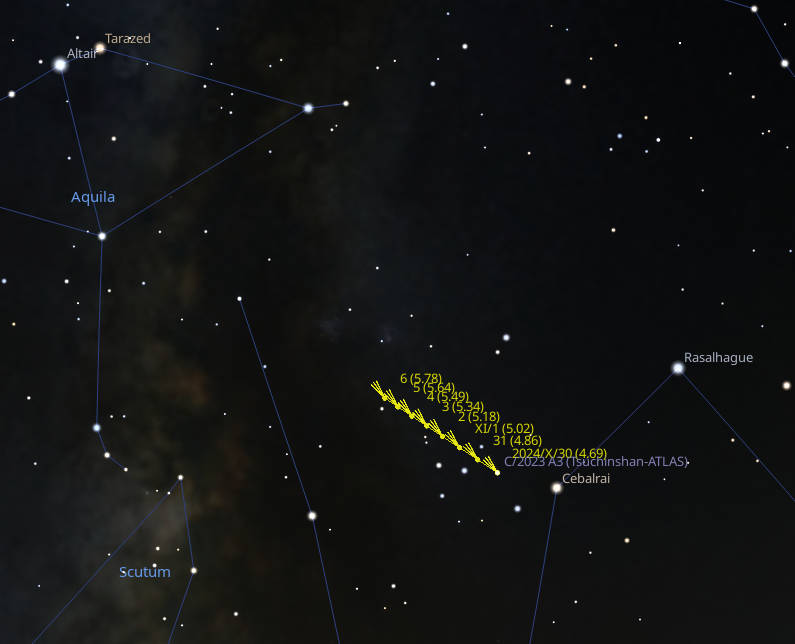
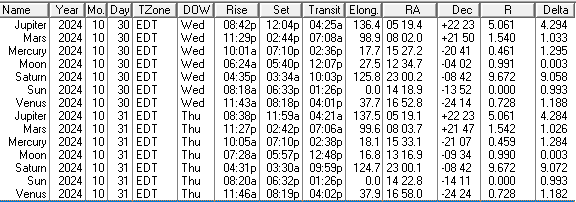
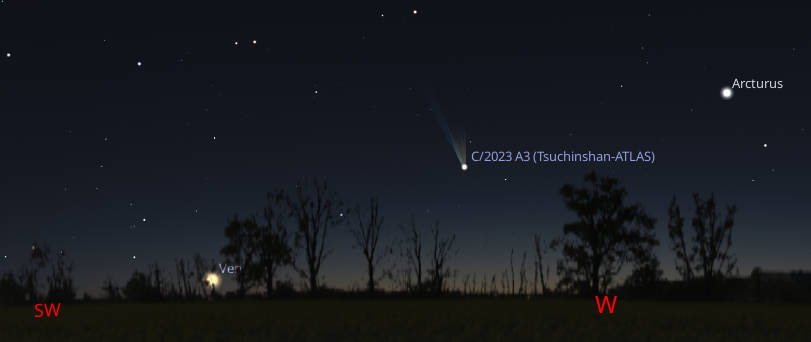
Let’s take our weekly look at the whereabouts of the naked-eye planets. Venus can be spotted low in the southwestern sky by 7 PM, about half an hour after sunset. It will set at 8:18. Comet Tsuchinshan-ATLAS is definitely a binocular object and will be a third of the way up to the zenith in the southwest around 8 PM. It will set at 11:17 PM. Saturn will be in the southeast at 8 PM. Jupiter will rise at 8:42 PM in the east northeast, and be a good object for the small telescope about an hour later. By 7:00 AM tomorrow Jupiter will be high in the west southwest, among the winter stars, while Mars, which rises tonight near 11:30, will be high in the south.
The astronomical event times given are for the Traverse City/Interlochen area of Michigan (EDT, UT – 4 hours). Times will be different for other locations.
Addendum
Ephemeris: 10/14/2024 – The One Who Came From a Shooting Star
This is Ephemeris for Indigenous Peoples Day, Monday, October 14th. Today the Sun will be up for 11 hours and 1 minute, setting at 6:58, and it will rise tomorrow at 7:58. The Moon, 3 days before full, will set at 5:24 tomorrow morning.
I’ll relate it to our comet. Comets are the cause of meteor showers. However, our current comet Tsuchinshan-ATLAS will never produce a meteor shower for us because its orbit doesn’t come close to the Earth’s. The closest it gets is half the distance to the Sun which it did five days ago.
The Anishinaabek have a story about how the Wolverine got its name, in their language, gwiingwa’aage, which means “The One Who Came From a Shooting Star”. An evil star spirit crashed to Earth and created a crater in what is now northern Quebec. Later it filled with water, and sometime later this ill-tempered creature crawled out of it. The University of Michigan’s teams are called the Wolverines, even though the wolverine is not native to Michigan.
The astronomical event times given are for the Traverse City/Interlochen area of Michigan (EDT, UT – 4 hours). Times will be different for other locations.
Addendum
Ephemeris: 10/10/2024 – Where did Comet Tsuchinshan-ATLAS come from?
This is Ephemeris for Thursday, October 10th. Today the Sun will be up for 11 hours and 13 minutes, setting at 7:05, and it will rise tomorrow at 7:53. The Moon, at first quarter today, will set at 12:05 tomorrow morning.
The comet Tsuchinshan-ATLAS will get far enough from the direction of the Sun so we can see it in the evening this weekend. It comes from the Oort Cloud of comets in the far reaches of the solar system probably extends maybe three quarters* of the way to the nearest other star to us Alpha Centauri. Somebody figured out that it has an orbital period of around 80,000 years. Every few million years or so a star comes close enough to the Sun to stir up the comets in the Oort Cloud, sending some of them out escaping the Sun and some sent in towards the inner solar system. This of course is one of the latter. No two comets are exactly alike so they’re quite unpredictable. Some have a lot of dust and some are mostly frozen gases.
The astronomical event times given are for the Traverse City/Interlochen area of Michigan (EDT, UT – 4 hours). Times will be different for other locations.
* On the radio program I stated a “quarter of the way”.
Addendum
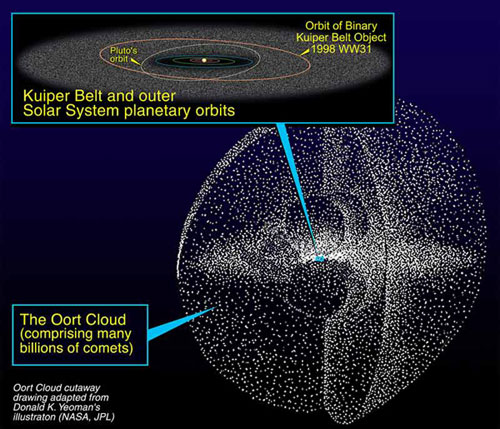
The Oort Cloud is named after Jan Oort, a Dutch astronomer, who proposed a cloud of comets in 1950 as the source of long period comets. The cloud would extend from 2,000 to 200,000 times Earth’s distance from the Sun. The shape of the cloud is roughly spherical. Comet encounters with Jupiter can cause them to become short period comets, or be ejected from the solar system.
Ephemeris: 10/09/2024 – Where are the naked-eye planets this week?
This is Ephemeris for Wednesday, October 9th. Today the Sun will be up for 11 hours and 16 minutes, setting at 7:07, and it will rise tomorrow at 7:52. The Moon, 1 day before first quarter, will set at 10:57 this evening.
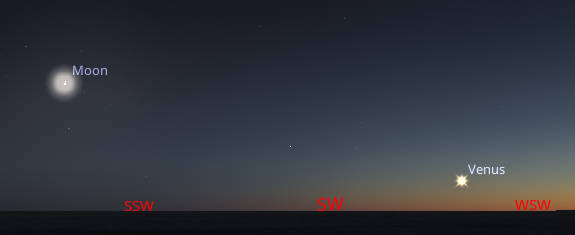
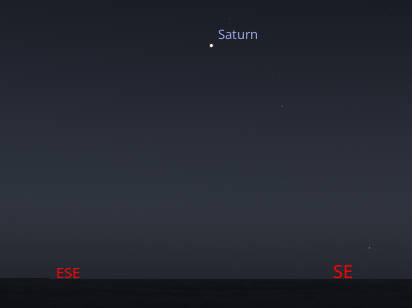
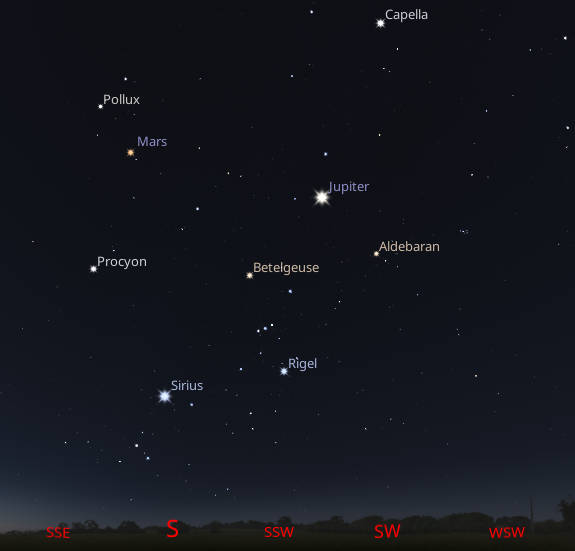
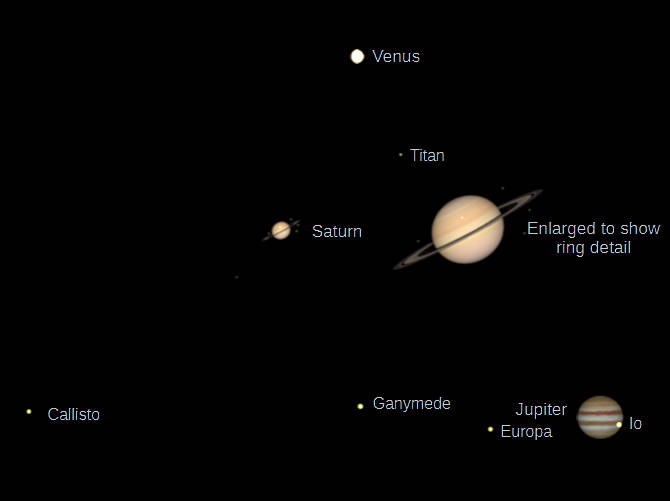
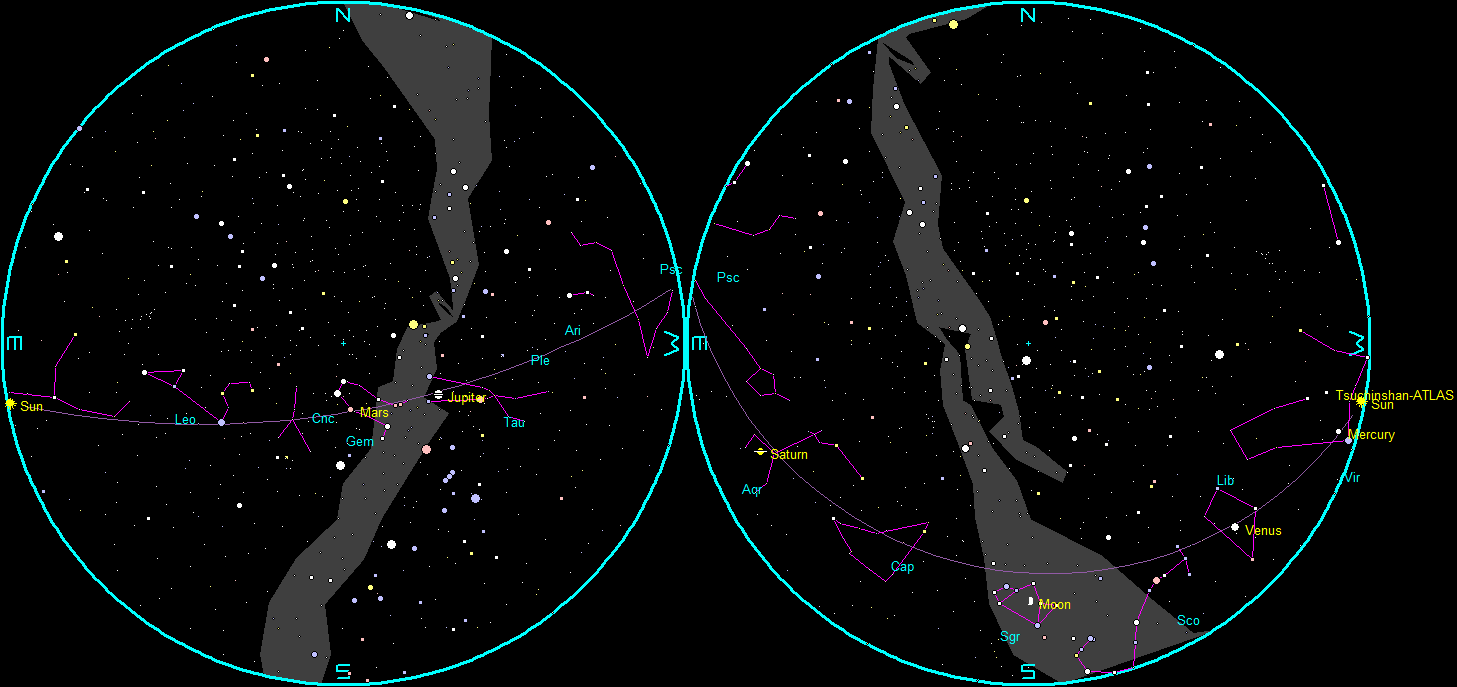
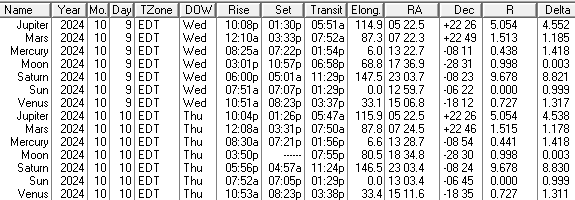
Let’s take our weekly look at the whereabouts of the naked-eye planets. Venus might be spotted in the West southwest only 7° above the horizon at 8 PM, 55 minutes after sunset. It will set at 8:23. Saturn will be in the southeast at that time. Saturn may look disappointing in telescopes this year since its rings are nearly edge on and appearing as a line through the planet like it’s stapled onto the sky. Jupiter and Mars will be up in the morning sky, with Jupiter rising about 10:08 PM in the east-northeast. By 7 AM tomorrow, Jupiter will be brighter than any of the winter stars high in the south. Mars, with its reddish hue, will be to the left of Jupiter. Comet Tsuchinshan-ATLAS will be in the western evening sky starting this weekend. It is expected to be quite bright, I’m betting with a broad tail.
The astronomical event times given are for the Traverse City/Interlochen area of Michigan (EDT, UT – 4 hours). Times will be different for other locations.
Addendum
Ephemeris: 10/07/2024 – Comet Tsuchinshan-ATLAS will be visible starting Saturday Night
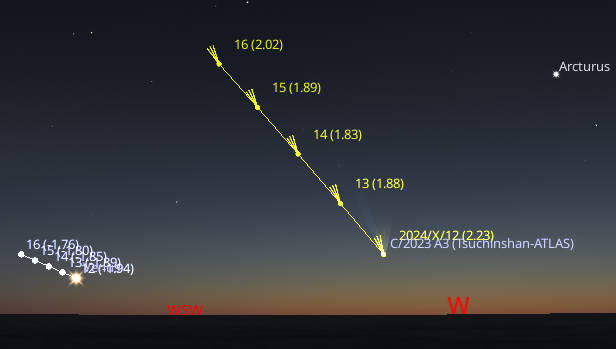
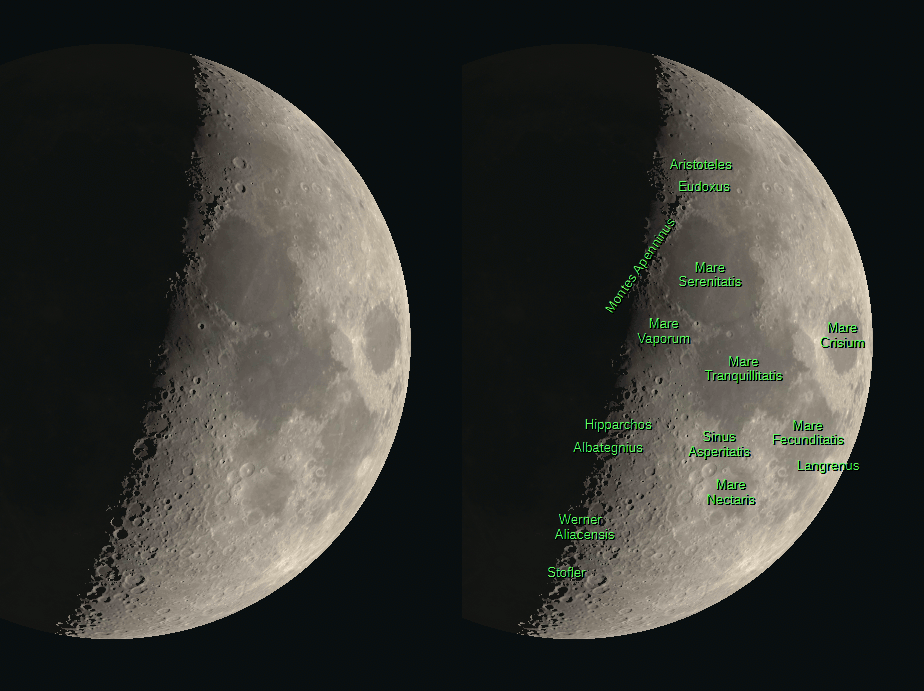
This is Ephemeris for Monday, October 7th. Today the Sun will be up for 11 hours and 22 minutes, setting at 7:11, and it will rise tomorrow at 7:50. The Moon, 3 days before first quarter, will set at 9:15 this evening.
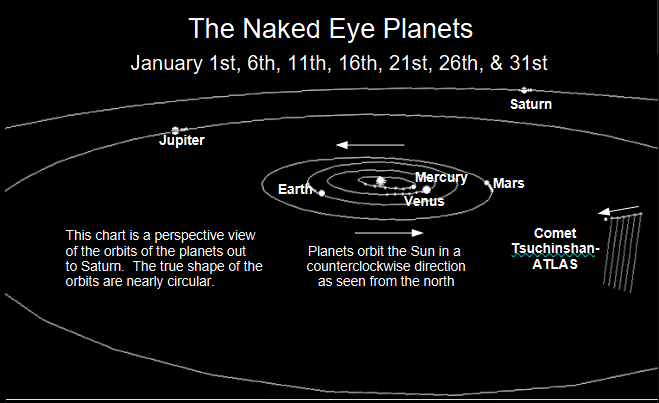
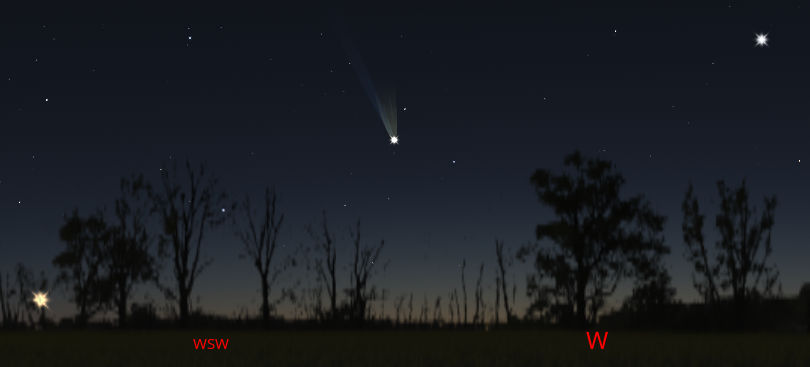
In January of last year a Chinese observatory discovered a comet which was subsequently lost. A month and a half later another observatory in South Africa rediscovered it. That’s why the comet is named, Tsuchinshan-ATLAS after the two observatories. It was soon learned that the comet had a chance of becoming visible to the unaided eye in late September and October 2024, this month. Despite having a dimming episode earlier this year the comet promises to be naked eye and possibly even spectacular. The comet is moving from the south to the north and in a direction counter to the orbiting planets around the Sun. We will begin to see it low in the West after sunset starting Saturday.
The astronomical event times given are for the Traverse City/Interlochen area of Michigan (EDT, UT – 4 hours). Times will be different for other locations.
Addendum
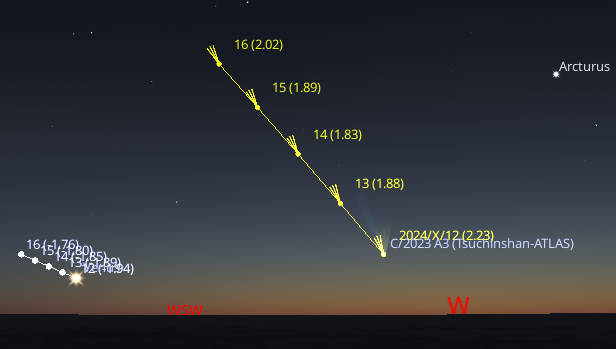
The comet will pass almost directly between the Earth and the Sun on the evening of the 9th. It’ll be about halfway between the Earth and the Sun at that point. It should be picked up by the Solar and Heliospheric Observatory satellite (SOHO) which is orbiting the Earth-Sun L1 Lagrange point a million miles sunward from the Earth with its C3 coronagraph*. Then the comet’s tail should be pointing almost directly at the Earth. As the comet swings out away from the Sun it will also be more rapidly moving away from Earth. This is because the comet has an orbit that is counter to that of the orbits of the Earth and the rest of the planets around the Sun and will rapidly fade as it increases its distance.
A note on the discovery designation: C/2023 A3 is C for comet; 2023, the year of discovery; A3, third object reportedly discovered in the first half of January.
The SOHO Real-time GIF Movies webpage is: https://soho.nascom.nasa.gov/data/realtime/gif/. Select LASCO/C3. It provides a time-lapse image of the Sun’s corona taken at hourly intervals for about the last 4 days.
Ephemeris Extra: 01/02/2024 – Two remarkable astronomical events for 2024
Ephemeris Extra posts are freestanding posts not tied to a specific Ephemeris radio program on Interlochen Public Radio
Total Solar Eclipse, April 8th
The big astronomical event of 2024, for us in Michigan, will be the total eclipse of the Sun, on the afternoon of Monday, April 8th. The path of totality will just clip the southeastern corner of Michigan by a few miles, so if you want to see the best of totality you need to leave the state. Totality is when the Moon completely covers the brilliant face of the Sun and allows the Sun’s silvery corona to be seen. Totality is the only part of the eclipse that can be viewed without eye protection or by projection.
Two relatively nearby large cities that will see totality are Indianapolis and Cleveland. Parts of Indianapolis will get to see more than 4 minutes of totality. Cleveland will see a little less. The closer you are to the center line of that path the longer totality will last.
For an interactive map of the eclipse path on the Internet, go to eclipse2024.org/eclipse_cities/statemap.html
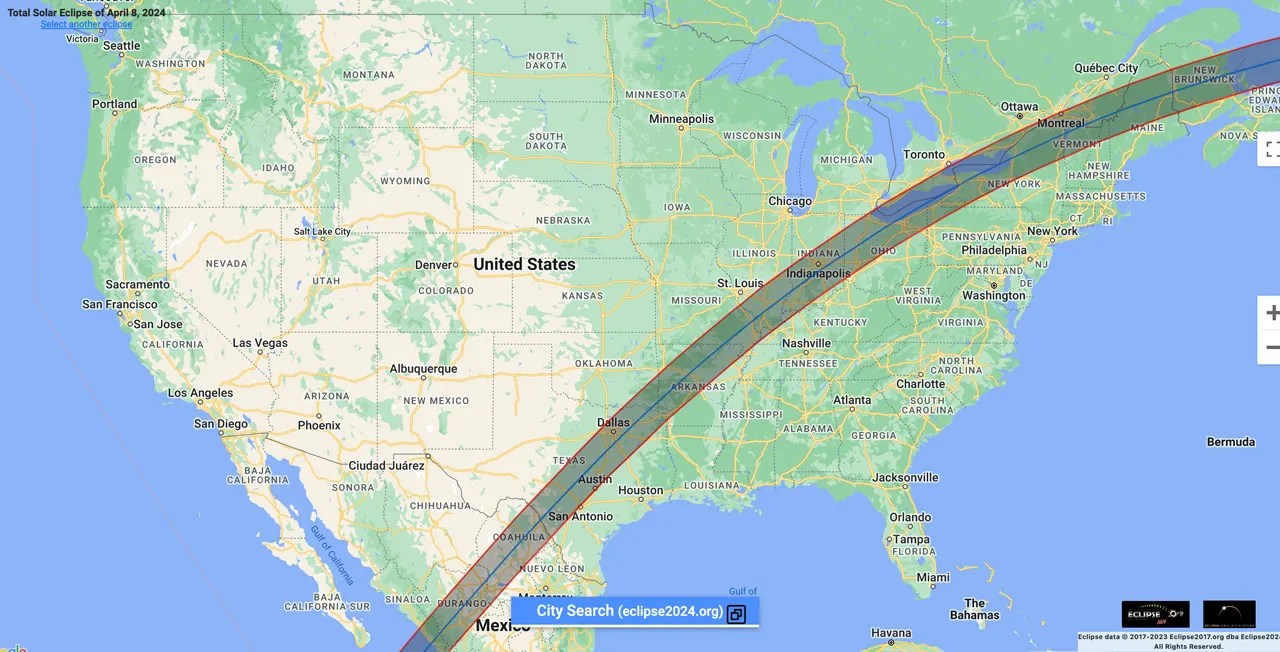
Weather is always a concern for eclipses. In general the farther south one goes the better the chances there are for clear skies. But all bets are off for eclipse day: It’s gonna be is what it’s gonna be. My current inclination is to head southwest along the eclipse path.
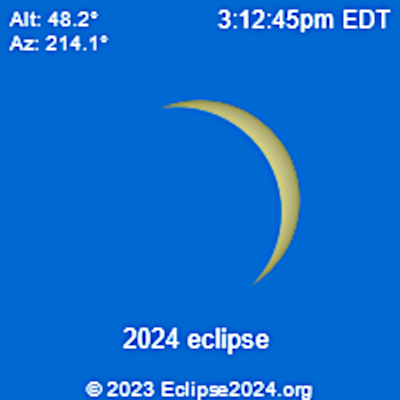
For those staying home and not chasing the shadow of the Moon will see a partial eclipse here with up to 87% of the Sun being blocked by the Moon.
Comet Tsuchinshan-ATLAS
We expect to see a new bright comet in October: C/2023 A3 (Tsuchinshan-ATLAS), otherwise known in this article as A3 for short. It may be the brightest comet to appear in our Northern Michigan skies since Comet Hale-Bopp in 1997, and a good deal brighter than 2020’s Comet NEOWISE. At least we’re hoping.
This comet was discovered last January by the station Xi Yi of the Purple Mountain Observatory in China, and a month later by the ATLAS search program on Maui. ATLAS is an acronym for the apocalyptic sounding Asteroid Terrestrial-Impact Last Alert System.
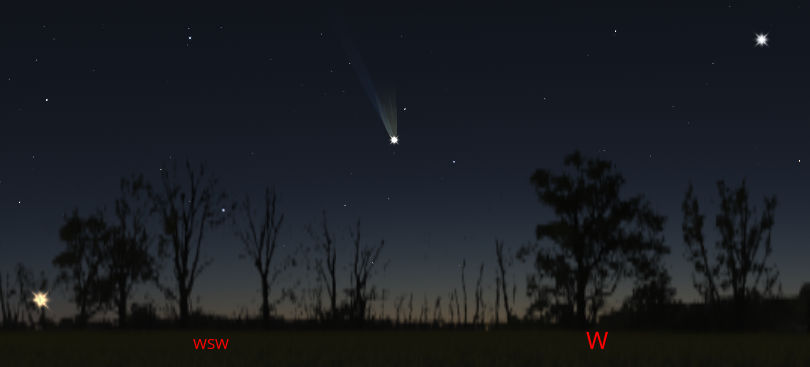
A3 will best be visible from Northern Michigan toward mid-October in the evening, not long after sunset. The comet is expected to reach magnitude 0 at it’s closest to the Sun in late September. However, we will be seeing it best as it’s leaving the vicinity of the Sun. By mid-October its magnitude will have dropped to magnitude 1 which is still pretty bright, and it will be moving at a high angle away from the setting Sun, so it will rapidly increase its distance from the Sun and the horizon faster than it fades in the latter part of October. That is, if it behaves itself. Comets are notoriously fickle in their brightness so we won’t know until we actually see it how bright it’ll be, or how bright or long its tail will be. As of this writing (Mid-December) A3’s brightness is tracking as predicted, at about 16th magnitude. As of January 1st its distance from the Sun was 4.24 AU, about 1 AU inside Jupiter’s orbit. 1 AU (Astronomical Unit) is the mean distance between the Earth and the Sun. The comet can be followed on Seiichi Yoshida’s Weekly Information about Bright Comets webpage: http://www.aerith.net/comet/catalog/2023A3/2023A3.html
Ephemeris: 12/29/2023 – Two great celestial events for 2024
This is Ephemeris for Friday, December 29th. Today the Sun will be up for 8 hours and 50 minutes, setting at 5:10, and it will rise tomorrow at 8:19. The Moon, 3 days past full, will rise at 7:43 this evening.
The year 2024 should give us two great events. The first is a total solar eclipse whose path will pass close to Michigan. It actually clip it by a few miles in the southeast corner of our state on April 8th. The eclipse will be even better here than the August 21st, 2017 eclipse by several percent. About 87% of the Sun will be covered by the Moon in Northern Michigan. In the US the path of totality will run from Texas to Maine, and will pass over the cities of Indianapolis and Cleveland. Then in October a new comet will be in our evening sky, and it might be quite bright. It’s Comet Tsuchinshan-ATLAS. If, and it’s a big IF, its brightness tracks as it has been since its discovery, nearly a year ago, it will rival the average first magnitude star, like Betelgeuse by October, and be easily visible in the west after sunset by mid-month. It won’t be as bright as Comet Hale-Bopp, for those old enough to have seen it in 1997, but hopefully brighter than Comet NEOWISE in the summer of 2020.
The astronomical event times given are for the Traverse City/Interlochen area of Michigan (EST, UT –5 hours). They may be different for your location.
Addendum
 Bob Moler's Ephemeris Blog