Archive
07/22/2013 – Ephemeris – The star Deneb, brighter than it looks
Ephemeris for Monday, July 22nd. Today the sun will be up for 15 hours, setting at 9:18. The moon, at full today, will rise at 9:00 this evening. Tomorrow the sun will rise at 6:19.
At 11 this evening the bright star Deneb in Cygnus the swan will be moderately high in the east northeast. Deneb is the dimmest star of the summer triangle. Of the other stars of the triangle, Vega is nearly overhead, and Altair to the south. While Deneb’s apparent magnitude, or brightness as seen from earth, makes it the dimmest of the three bright stars, Deneb’s vast distance of possibly 2,600 light years makes it 100 times the distance of Vega. If brought as close as Vega, Deneb would be several time brighter than Venus. For all this it is only 13-20 times the mass of the sun. It will have an extremely short life and it will explode, go supernova, in perhaps a few million years.
Times are for the Traverse City/Interlochen area of Michigan. They may be different for your location.
Addendum
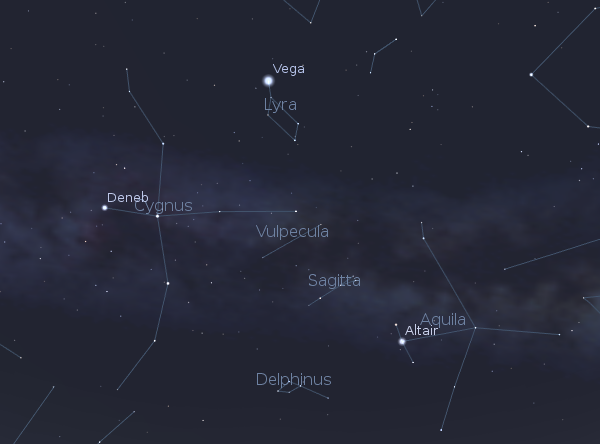
Deneb with the other stars and constellations in the Summer Triangle. Created using Stellarium.
06/26/2013 – Ephemeris – Latest sunset and the Summer Triangle
Ephemeris for Thursday, June 27th. Today the sun will be up for 15 hours and 32 minutes, setting at 9:31. The moon, 3 days before last quarter, will rise at 12:14 tomorrow morning. Tomorrow the sun will rise at 5:59.
Last night we had the latest sunset of the year. The sun is really beginning to head south. Other than the sunrise and sunset numbers, we’ll begin to notice it for real in a few weeks. At first that realization strikes me a sad note that summer is beginning to end. However the astronomer in me realizes that means more night-time hours, and that the summer Milky Way is coming. Of the three bright stars of the Summer Triangle overhead and in the east, two of its stars are in the milky band. They are Deneb to the north and Altair to the south. Vega, closest to the zenith is not in the band. Actually all the stars we see with the naked eye or small telescopes belong to the Milky Way galaxy.
Times are for the Traverse City/Interlochen area of Michigan. They may be different for your location.
Addendum
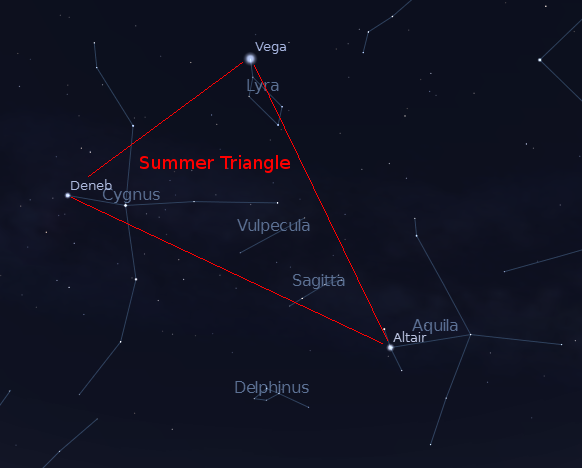
The Summer Triangle at 11 p.m. Created using Stellaruim and The Gimp.
10/11/2012 – Ephemeris – North American Nebula
Ephemeris for Thursday, October 11th. The sun will rise at 7:53. It’ll be up for 11 hours and 10 minutes, setting at 7:04. The moon, 3 days past last quarter, will rise at 4:30 tomorrow morning.
Most of what we see in the Milky Way are just masses of stars, but there are bright clouds of gas , or to name them properly: emission nebulae. These bright clouds are areas of star formation. It is the ultraviolet light from young massive stars that light up the clouds they were formed from. A bright one, easily visible in binoculars is just about overhead at 9 p.m. Called the North American Nebula, a glow shaped much like our continent just east of the star Deneb, the northernmost star of the Summer Triangle, and brightest star in Cygnus the swan or Northern Cross. There are many other nebulae in the Milky Way, visible in binoculars and small telescopes. Many enjoyable hours can be spent sweeping the Milky Way for nebulae and star clusters.
Times are for the Traverse City/Interlochen area of Michigan. They may be different for your location.
Addendum
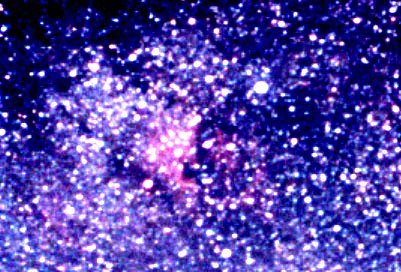
North American Nebula in Red. My old image.
The red object is the North American Nebula. Our eyes cannot perceive the color, due to hydrogen. This was a time exposure on film without telephoto. The bright star to the upper right is Deneb. The orientation is approximately correct if facing south. The photo also shows the stars that make up the glow of the Milky Way to the unaided eye.
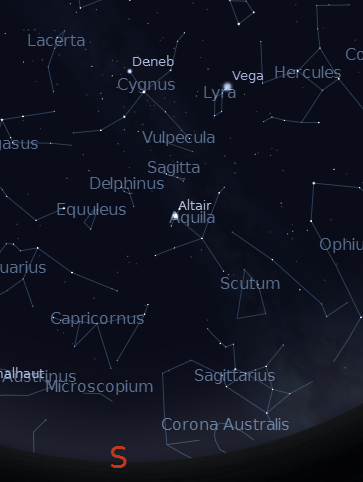
Deneb Overhead at 9 p.m. on October 11. Created using Stellarium.
The North American Nebula is about the size and position of the C in Cygnus.
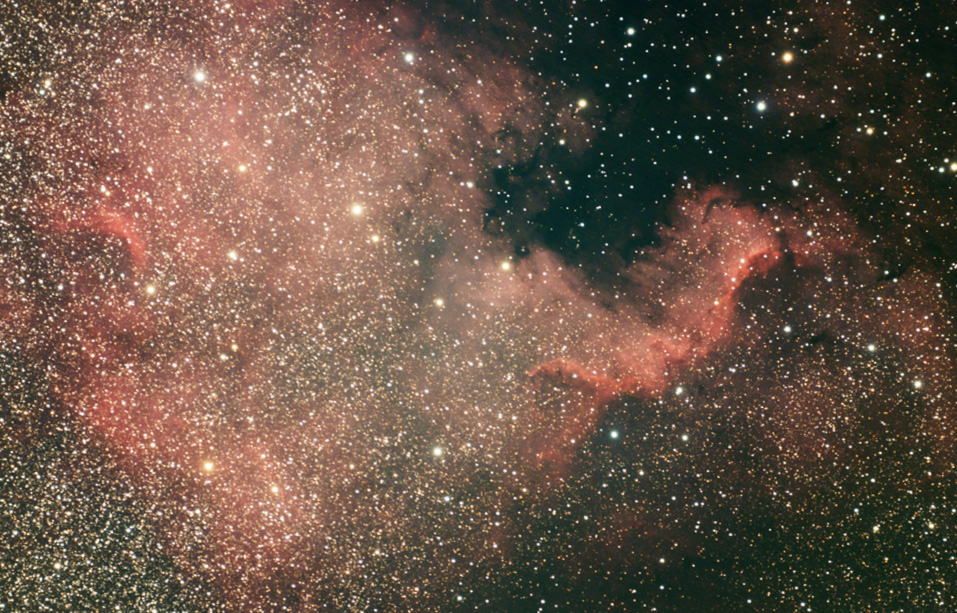
Better view of the North American Nebula taken by Scott Anttila.
This nebula is cataloged as NGC 7000.
07/30/2012 – Ephemeris – A closeup look at the bright star Deneb
Ephemeris for Monday, July 30th. The sun rises at 6:27. It’ll be up for 14 hours and 42 minutes, setting at 9:09. The moon, 2 days before full, will set at 4:47 tomorrow morning.
At 10:30 this evening the bright star Deneb in Cygnus the swan will be high in the east in the tail of Cygnus the swan. Deneb is the dimmest star of the summer triangle. Of the other stars of the triangle, Vega is nearly overhead, and Altair to the south. While Deneb’s apparent magnitude, or brightness as seen from earth, makes it the dimmest of the three bright stars, Deneb’s vast distance of possibly 1,500 to 2,600 light years makes it nearly 100 times the distance of Vega. If brought as close as Vega, Deneb would be several time brighter than Venus. For all this it is only 13-21 times the mass of the sun. It will have an extremely short life and it will explode, go supernova, in perhaps a few million years.
Times are for the Traverse City/Interlochen area of Michigan. They may be different for your location.
Addendum
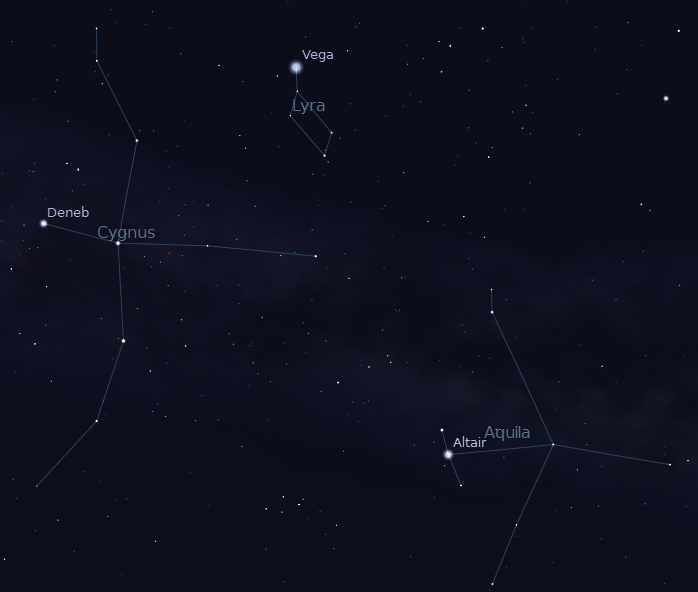
Summer Triangle. Created using Stellarium.
07/05/2012 – Ephemeris – The Summer Triangle
Ephemeris for Thursday, July 5th. Today the sun will be up for 15 hours and 26 minutes, setting at 9:30. The moon, 2 days past full, will rise at 10:37 this evening. Tomorrow the sun will rise at 6:04.
Now that summer is here, the asterism or informal constellation called the Summer Triangle can be seen high in the east as it gets dark. Highest of the three bright stars is Vega in the constellation Lyra the harp, whose body is seen in a narrow parallelogram nearby. The second star of the triangle is Deneb lower and left of Vega, It appears dimmer than Vega because its is by far the most distant of the three. The third star of the Summer Triangle is seen farther below and right of Vega. It is Altair in Aquila the eagle, and the closest. Altair is 16.7 light years away, Vega is 25 light years while Deneb may be a whopping 1,550 light years away. [One light year is 6 about trillion miles. That’s 6 with 12 zeros after it.]
Times are for the Traverse City/Interlochen area of Michigan. They may be different for your location. Bracketed text was omitted from the broadcast due to time constraints.
Addendum
The Summer Triangle July 5, 2012 at 11 p.m. Created using Stellarium and The Gimp.
09/29/11 – Ephemeris – Deneb at the zenith
Thursday, September 29th. The sun will rise at 7:37. It’ll be up for 11 hours and 49 minutes, setting at 7:27. The moon, 2 days past new, will set at 8:28 this evening.
At 10 p.m. tonight the first magnitude star Deneb will be overhead, that is very near the zenith. Deneb is the northern most and dimmest of the three stars of the Summer Triangle. It is at the head of the Northern Cross, which extends to the south. This is an asterism, which is what astronomers call a informal constellation. The Big and Little Dippers are also examples of asterisms. You won’t find them in the list of the 88 official constellations. The actual constellation that Deneb belongs to is Cygnus the swan. In the swan Deneb is the tail. That’s actually what Deneb means. The swan is flying southwestward along the Milky Way with its wings outstretched. Stars can be followed around the wings to make out a very realistic flying swan.
* Times are for the Traverse City/Interlochen area of Michigan. They may be different for your location.
Addendum
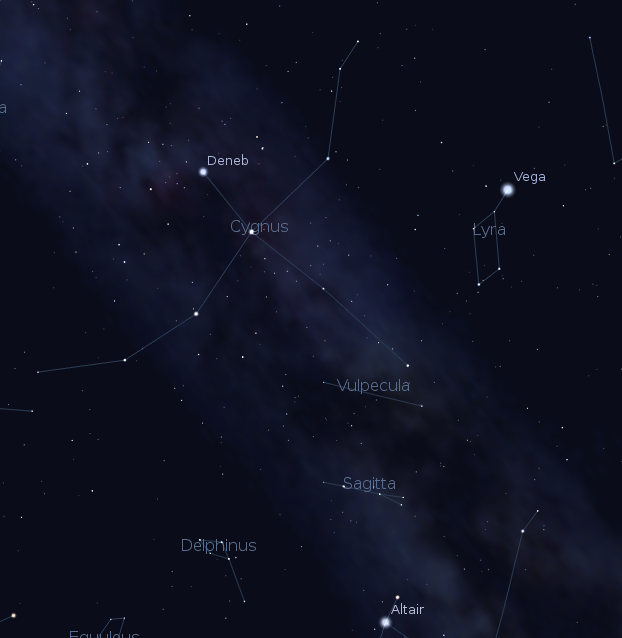
Deneb at the Zenith. Looking overhead while facing south. Created using Stellarium.
The Summer Triangle of bright stars Deneb, Vega and Altair are in this view.
07/21/11 – Ephemeris – The constellation of Cygnus the swan
Thursday, July 21st. Today the sun will be up for 15 hours and 3 minutes, setting at 9:20. The moon, 2 days before last quarter, will rise at 11:56 this evening. Tomorrow the sun will rise at 6:17.
High in the east northeast as it gets dark flies the constellation of Cygnus the swan. This constellation is also known as the Northern Cross. The cross is seen lying on its side with the bright star Deneb at the head of the cross to the left. The rest of the cross is delineated in the stars to the right. As a swan, Deneb is the tail, the stars of the crosspiece of the cross are the leading edges of wings as Cygnus flies south through the Milky Way. There are faint stars that also define the tips and trailing edges of its wings. It is a very good portrayal of a flying swan, like the mute swans we see on the wing. In Cygnus we are looking in the direction that the sun and the earth are traveling as we orbit the center of the Milky Way.
* Times are for the Traverse City/Interlochen area of Michigan. They may be different for your location.
Addendum
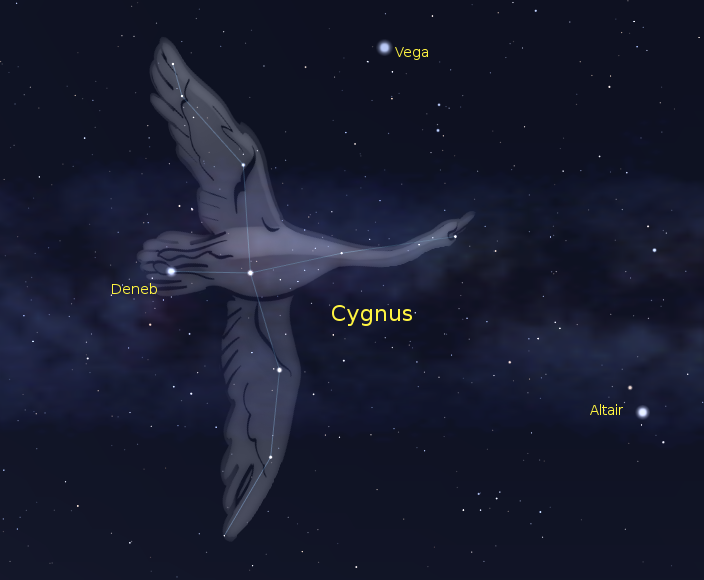
Cygnus The Swan Created using Stellarium.
Click to enlarge.
07/19/11 – Ephemeris – The brightest stars visible now in the evening
Tuesday, July 19th. Today the sun will be up for 15 hours and 6 minutes, setting at 9:21. The moon, half way from full to last quarter, will rise at 11:11 this evening. Tomorrow the sun will rise at 6:15.
Let’s check out all the bright stars in the evening sky, as it gets dark tonight. High in the west is the bright yellow-orange star Arcturus. In the northwest is the Big Dipper, whose curved handle points to Arcturus. Straightening that curve to a spike will point to Spica a blue-white star low in the southwest. The bright star to its right isn’t. It’s the planet Saturn. In the south is the red star Antares which usually twinkles merrily. High in the east is the bright white star Vega. To its lower right is Altair, and to its lower left the star Deneb. Vega, Altair and Deneb make the Summer Triangle, whose rising in the east signals the coming of summer. Always present for us in northern Michigan is Capella very low in the north.
* Times are for the Traverse City/Interlochen area of Michigan. They may be different for your location.
Addendum
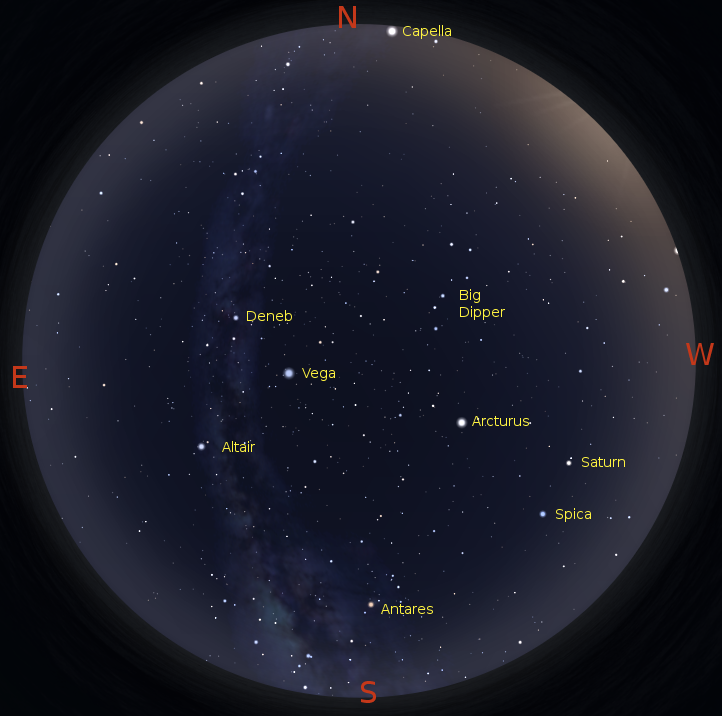
Bright Summer Stars. Created using Stellarium.
Click on the image to enlarge. This is a whole sky chart. The round edge is the horizon. BTW the star Capella, very low in the north, is a winter star, but it’s visible all year round for folks north of 44 degrees north latitude.
 Bob Moler's Ephemeris Blog