Archive
Ephemeris: 02/26/2024 – The angle of the rising and setting planets from the Sun vary with the seasons
This is Bob Moler with Ephemeris for Monday, February 26th. Today the Sun will be up for 10 hours and 59 minutes, setting at 6:25, and it will rise tomorrow at 7:24. The Moon, 2 days past full, will rise at 8:44 this evening.
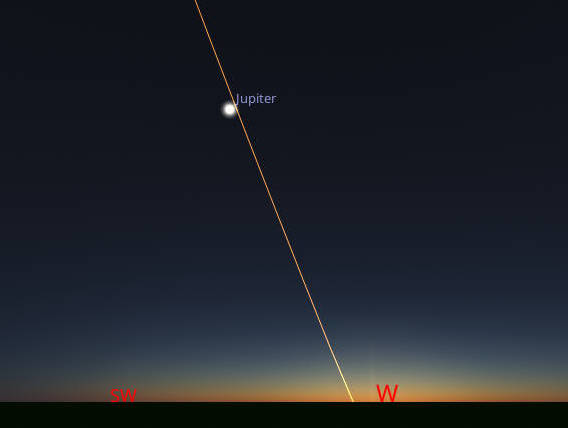
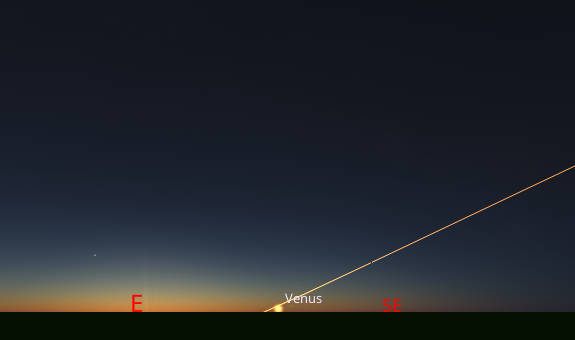
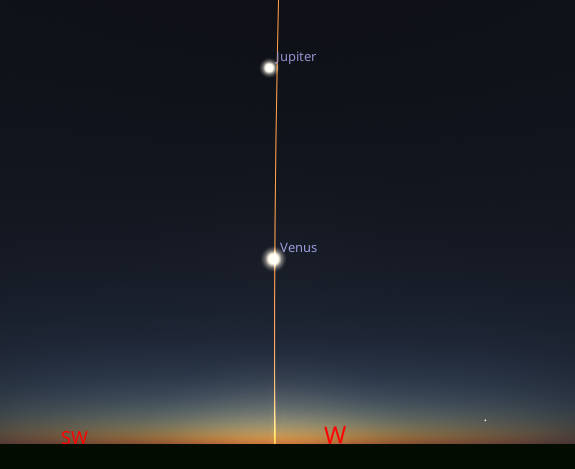
In late winter and early spring dark skies return within a few days after the full Moon. Indeed, this is the first day after the full moon, which was on Saturday morning, that we have dark skies. Well for 40 minutes before the Moon rises. This is because the ecliptic which is the Sun’s path in the sky is as close to vertical as it can get for us. It shows planets near the Sun and the area of the full moon as steeply inclined to the horizon as possible. Twelve years ago this month when my wife and I were on a Hawaiian cruise, I was aboard ship looking at the sky after sunset and was amazed to see Jupiter and Venus* vertically aligned in the west. It was because we were located around the Tropic of Cancer and near the equinox, so the ecliptic was actually vertical after sunset. It was quite a jolt to see that. So this time of year we can see planets close to the sun at sunset and the moon to go away after full rapidly.
The astronomical event times given are for the Traverse City/Interlochen area of Michigan (EST, UT –5 hours). They may be different for your location.
* On the broadcast I said Jupiter and Saturn, relying on my memory. As can be seen below, it was Jupiter and Venus.
Addendum
Ephemeris: 12/15/2023 – Jupiter is seen in Aries this year, also precession
This is Bob Moler with Ephemeris for Friday, December 15th. Today the Sun will be up for 8 hours and 49 minutes, setting at 5:02, and it will rise tomorrow at 8:13. The Moon, 3 days past new, will set at 7:50 this evening.
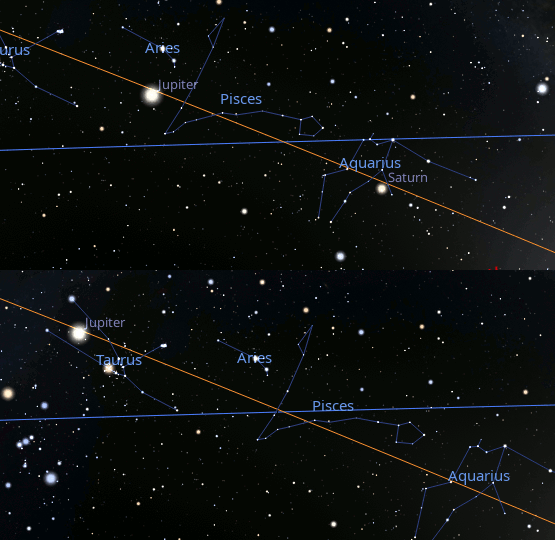
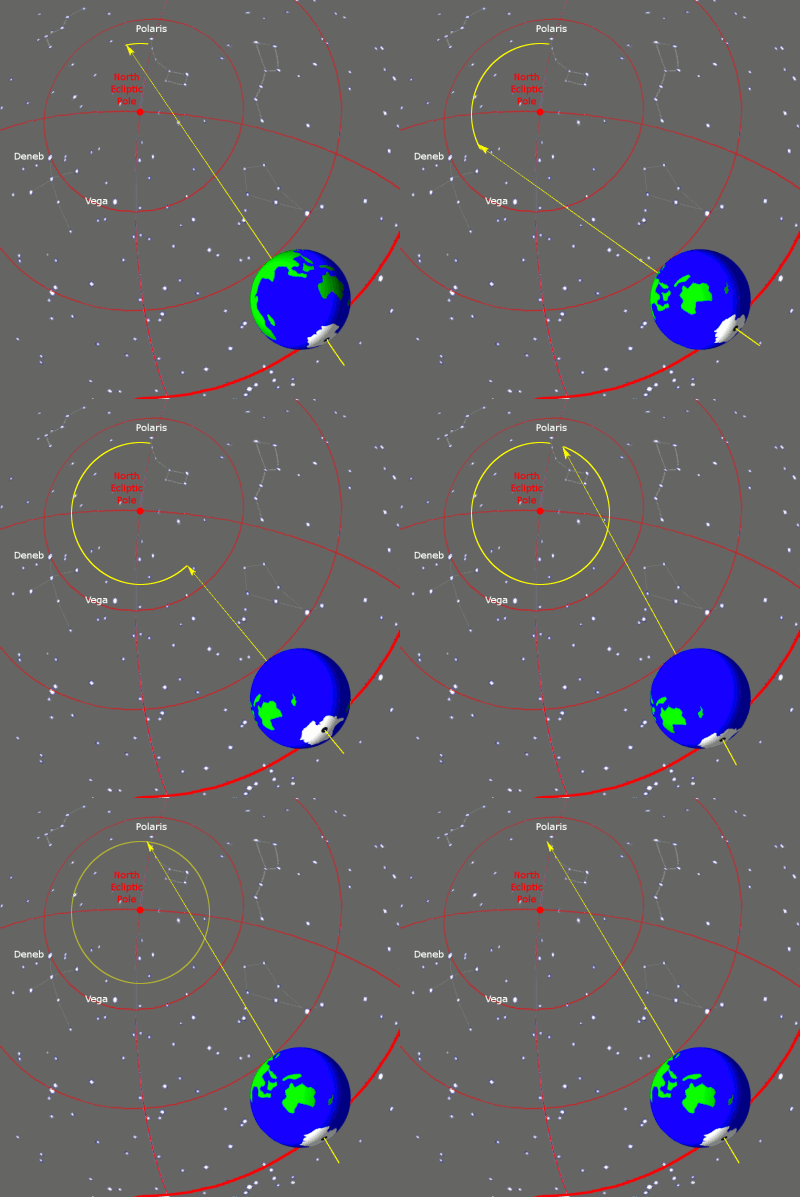
The planet Jupiter is seen against the stars of the constellation Aries the ram this year. The four stars of the constellation are seen above it, two of which are bright enough to be fairly easily seen. The other two are quite dim. The brightest is the star called Hamal. It is as bright as one of the stars of the Big Dipper. Aries used to be the constellation at the beginning of the Zodiac, where the Sun entered on the first day of spring. That honor has now moved westward to the western part of Pisces, the fish. The reason it has changed in the 1900 years since Ptolemy set up the Zodiac in the second century is that the Earth’s axis wobbles and the astrological signs of the Zodiac move with the seasons rather than the stars.
The astronomical event times given are for the Traverse City/Interlochen area of Michigan (EST, UT –5 hours). They may be different for your location.
Addendum
06/11/2021 – Ephemeris – Spotting the one-day-old Moon
This is Bob Moler with Ephemeris for Friday, June 11th. Today the Sun will be up for 15 hours and 31 minutes, setting at 9:28, and it will rise tomorrow at 5:56. The Moon, 1 day past new, will set at 10:56 this evening.
Tonight the thin crescent Moon, some 40 hours old, or more properly 40 hours from eclipsing the Sun, will be to the right and a bit below the bright planet Venus. It might be possible to spot it. I do remember spotting the tiny sliver of a Moon the next evening after a solar eclipse in 1970. But that was in March*, when the ecliptic, the path of the Sun and near the path of all the planets and the Moon, was angled more vertically than it is this time of year. That means that the Moon and planets, when near the Sun, are lower in the sky after sunset than they would be in late winter and early spring. Venus is slowly moving away from the Sun, from our vantage point, while Mars, above and left of it, is slowly retreating toward the Sun. Their apparent paths will cross on July 13th.
The astronomical event times given are for the Traverse City/Interlochen area of Michigan. They may be different for your location.
* On the program, I mistakenly said April.
Addendum
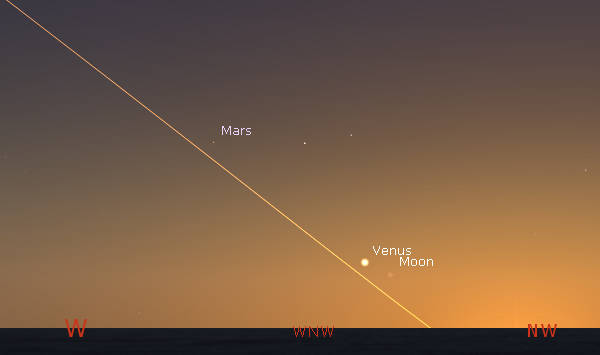
Sunset sky and ecliptic (orange line) 45 minutes after sunset tonight, June 11, 2021. Note the low angle of the ecliptic, the apparent path of the Sun and near the path of the planets. The angle will get even lower as summer progresses. So planets close to the Sun will set shortly after the Sun. Created using Stellarium.
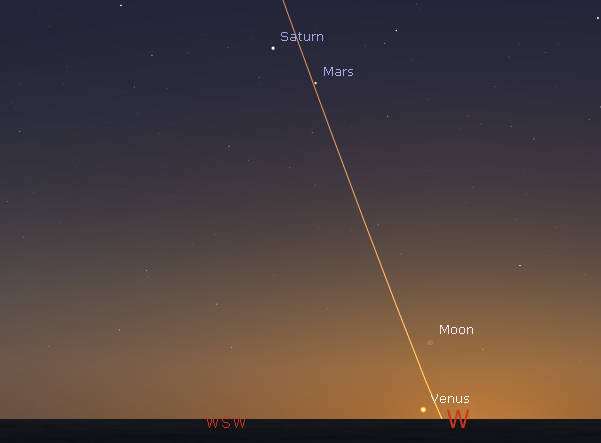
This is the sky one day after the March 7, 1970 eclipse and 45 minutes after sunset. Being March, note how steep the angle of the ecliptic, so planets close to the Sun are higher in the sky. Also, twilight ends quicker in March than in June.
 Bob Moler's Ephemeris Blog