Archive
Ephemeris: 06/26/2025 – Finding the famous Double-Double Star
This is Ephemeris for Thursday, June 26th. Today the Sun will be up for 15 hours and 33 minutes, setting at 9:32, and it will rise tomorrow at 5:59. The Moon, 1 day past new, will set at 11:12 this evening.
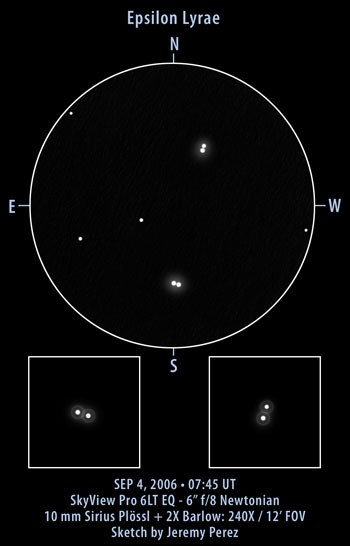
I generally will talk about observing something in the sky, in this program, if it can be seen with the naked eye, or can be seen in binoculars near something that can be seen with the naked eye, or something that can be seen in a small telescope that is visible in binoculars, near a naked eye object. This is of the latter type. High in the east at 11:00 PM or so is the bright star Vega. Just to the left of it in is a faint star, best seen in binoculars. It’s barely visible to the naked eye as a single star. But binoculars will show that it’s two star of equal brightness. However, viewing it with a telescope using probably the most power the telescope is capable, each of those stars is doubled again so Epsilon Lyrae is the famous Double-Double Star. It’s quite a challenge for a small telescope. This is also the time of the latest sunset and end of evening twilight. The last vestige of the glow moves to the north and ends just after midnight.
The astronomical event times given in this blog are for the Traverse City/Interlochen area of Michigan (Lat 44.7° N, Long 85.7° W; EDT, UT – 4 hours) unless stated otherwise. Times will be different for other locations.
Addendum
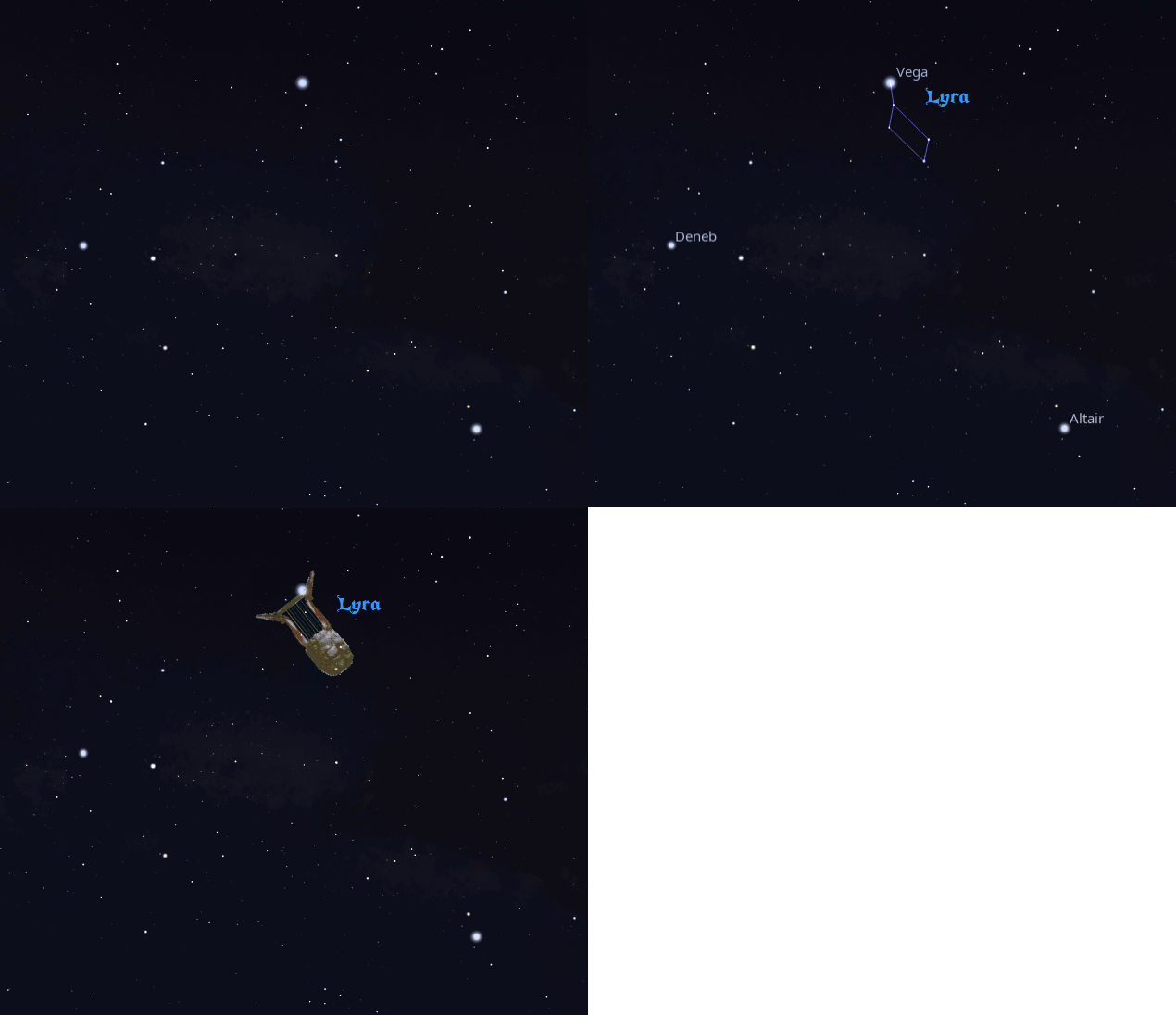
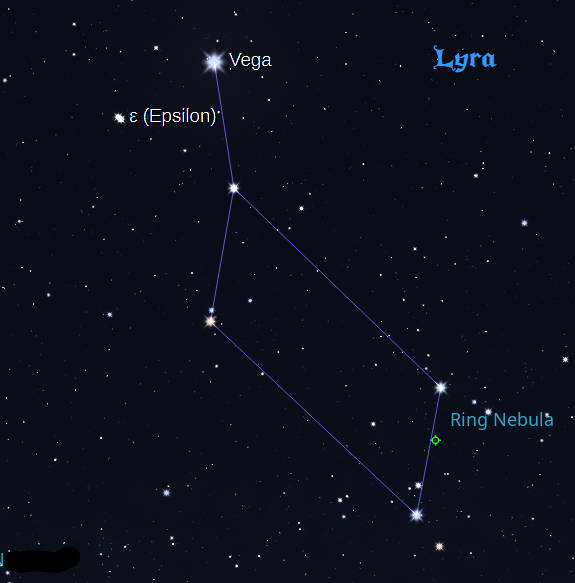
Bonus: A telescope capable of splitting the components of Epsilon should be capable of spotting the Ring Nebula (M57). It is not, however, visible in binoculars or a telescope finder. But it’s easily found by pointing the telescope between the two bottom stars of the Lyra parallelogram. Created using Stellarium, LibreOffice Draw and GIMP.
07/25/2016 – Ephemeris – Hermes’ Harp
Ephemeris for Monday, July 25th. The Sun rises at 6:21. It’ll be up for 14 hours and 54 minutes, setting at 9:16. The Moon, 1 day before last quarter, will rise at 12:34 tomorrow morning.
High up in the eastern sky at 11 p.m. can be found a bright star just north of a small, narrow, but very distinctive parallelogram of stars. They are the stars of the constellation Lyra the harp. The bright star is Vega, one of the twenty-one brightest stars, first magnitude stars. Vega is actually the 5th brightest night-time star. The harp, according to Greek mythology, was invented by the Greek god Hermes. The form of the harp in the sky, is as he had invented it: by stretching strings across a tortoise shell. Hermes gave it to his half-brother Apollo, who in turn gave it to the great musician Orpheus. In binoculars, near Vega, two stars appear together. They barely appear to the unaided eye as one star, called Epsilon Lyrae.
Times are for the Traverse City/Interlochen area of Michigan. They may be different for your location.
Addendum
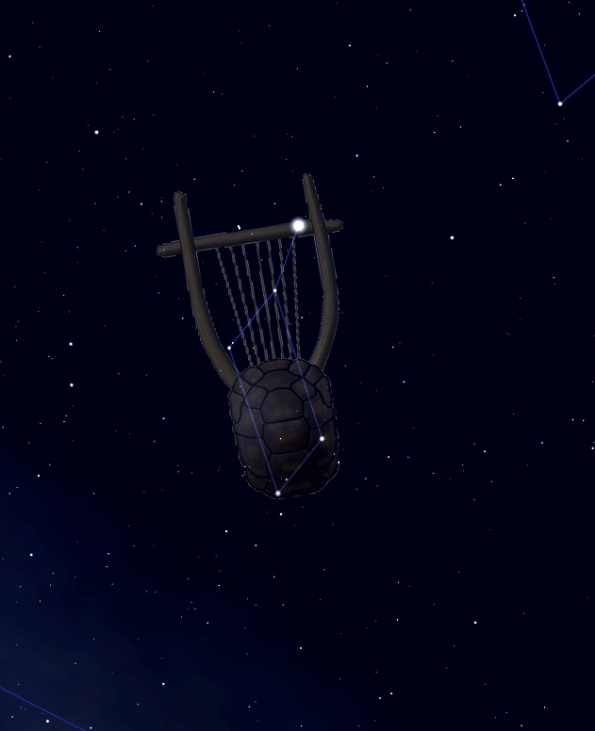
Lyra as a tortoise shell harp. Created using Stellarium and free clip art.
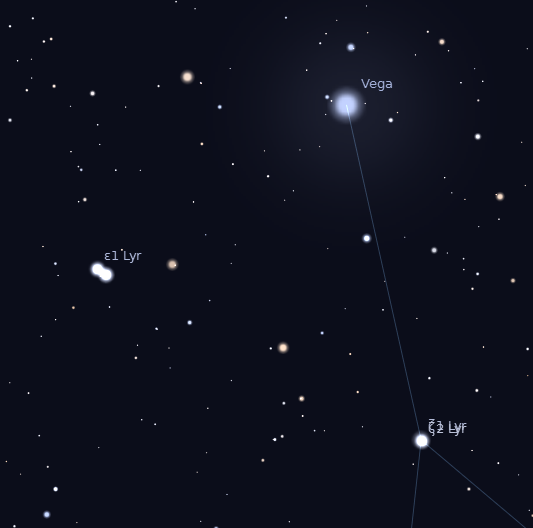
Closeup on Vega and Epsilon Lyrae. Created using Stellarium.
08/25/2014 – Ephemeris – Cool treasures in the constellation of Lyra
Ephemeris for Monday, August 25th. The sun rises at 6:56. It’ll be up for 13 hours and 34 minutes, setting at 8:31. The moon is new today, and won’t be visible.
The bright star Vega will be nearly overhead tonight at 10 p.m. It will be about 6 degrees south of the zenith. That’s quite a stretch of the neck to spot, with its accompanying stars in a small parallelogram that make up the constellation of Lyra the harp. Lyra has some interesting features for a serious observer with and without a telescope. The bottom right star of the parallelogram, if south is toward the bottom, is a star called Beta Lyrae that changes brightness by a factor of 3 in a period of 13 days. Another star near Vega looks like two close stars in binoculars, in telescopes each is again a double stars. That’s Epsilon Lyrae. The jewel of this constellation needs a telescope to find between the two bottom stars of the parallelogram, the famous Ring Nebula.
Times are for the Traverse City/Interlochen area of Michigan. They may be different for your location.
Addendum
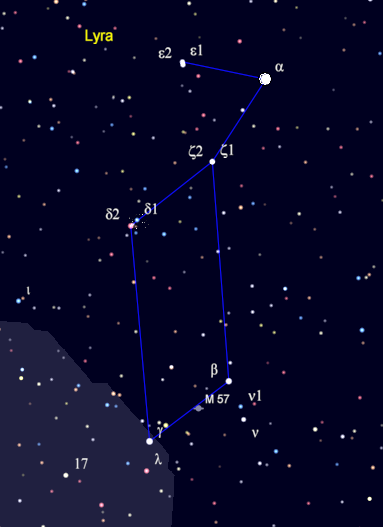
A bi more stars than what will be seen in binoculars of the constellation Lyra. Created using Cartes du Ciel (Sky Charts).
In the chart above:
The star designated α is Vega
The star designated β is Beta Lyrae
The stars designated ε1 and ε1 is Epsilon Lyrae
The object designated M57 is the Ring Nebula
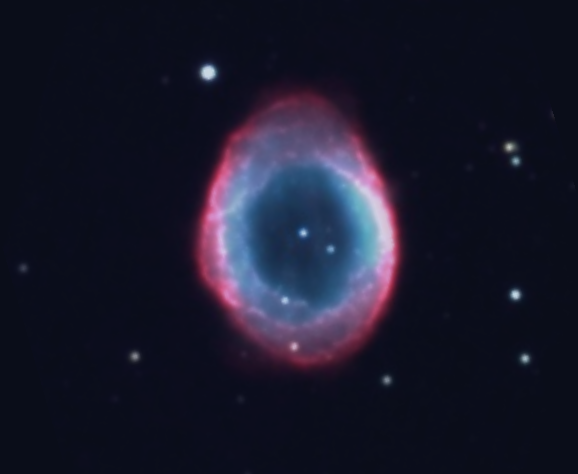
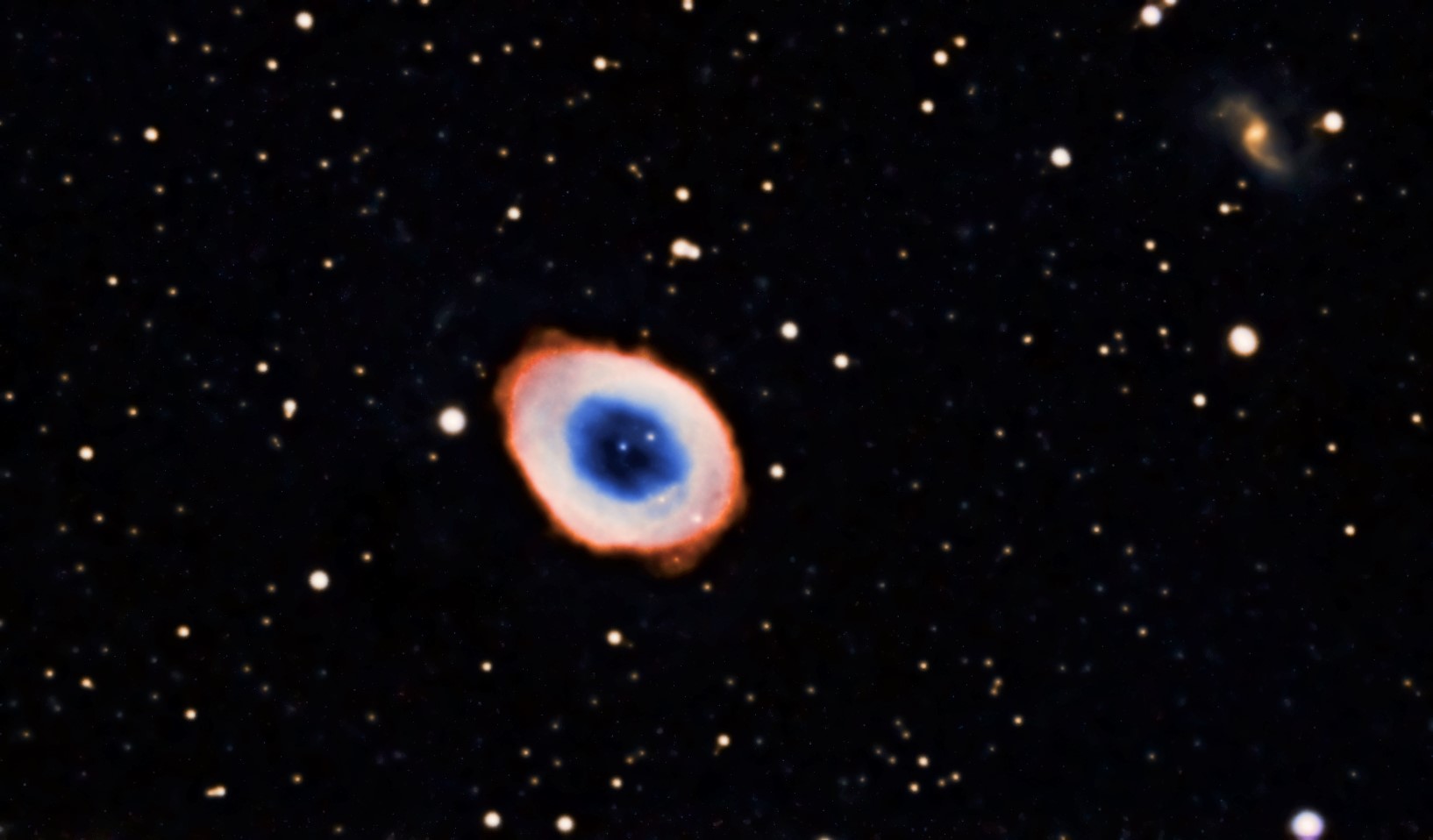
The Ring Nebula. Visually one cannot detect the color. It takes a large telescope to see the central star. Credit: Stellarium.
The Ring Nebula, AKA M57 by amateur astronomers, is a planetary nebula. The name planetary is a misnomer. Many of these objects look like the dim planets Uranus and Neptune. They are really stars like the sun, in their death throes puffing out their outer layers of gas at the end of their red giant stage. See below the latest image of the Ring Nebula I recently found on the Phil Plait’s Bad Astronomy Blog. It includes an explanation of what’s in the image.
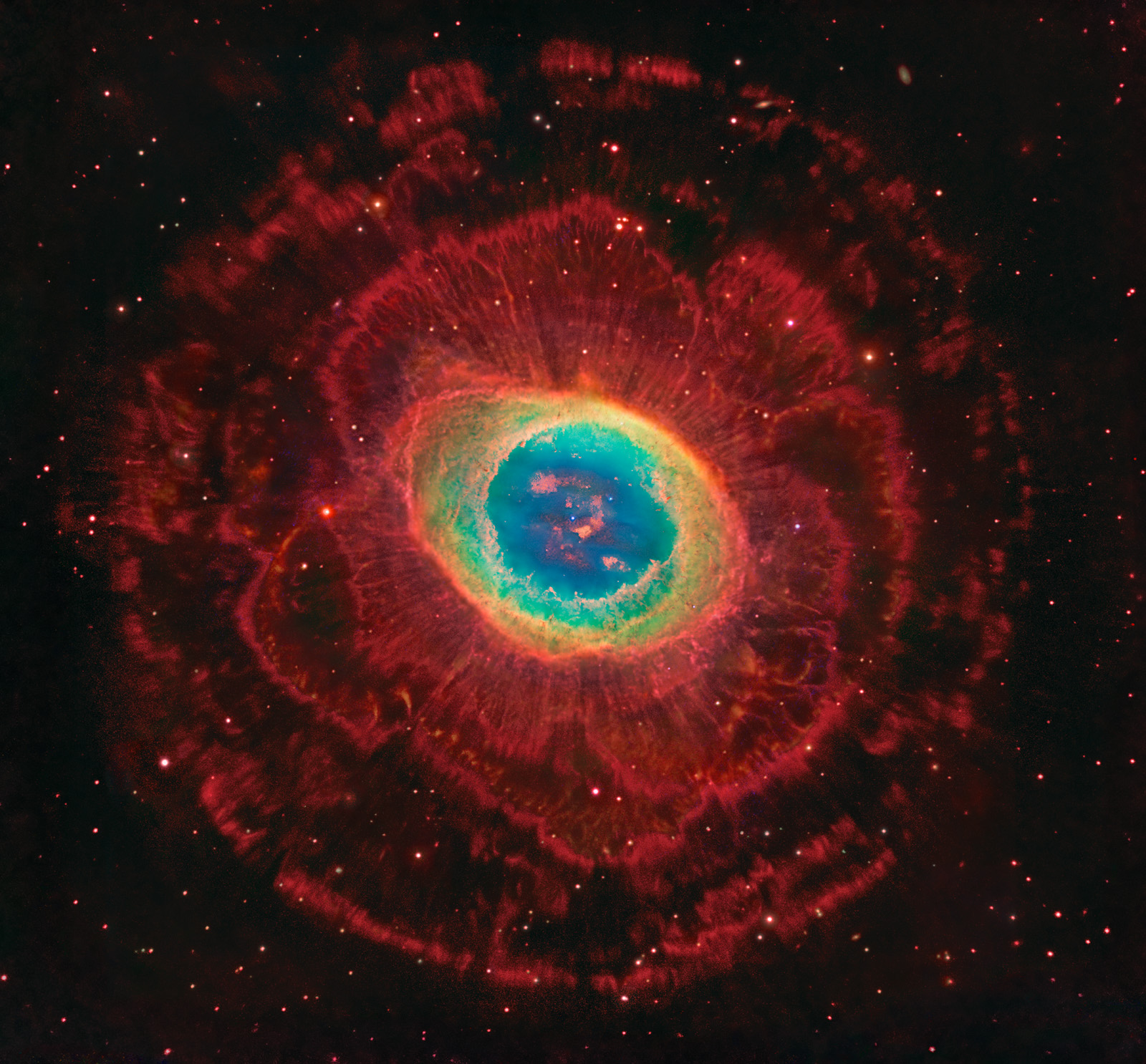
Photo by NASA, ESA, and C. R. O’Dell (Vanderbilt University) and Robert Gendler
Click on the image to get lost in the Ring Nebula!
06/28/2013 – Ephemeris – Vega and Lyra the harp
Ephemeris for Friday, June 28th. Today the sun will be up for 15 hours and 31 minutes, setting at 9:31. The moon, 2 days before last quarter, will rise at 12:43 tomorrow morning. Tomorrow the sun will rise at 6:00.
One of the first stars visible when twilight fades is Vega. It will be east of the zenith and is perfectly white. Another bright star with a yellow-orange hue is to the west of the zenith. That’s Arcturus. We’re concentrating on Vega now. It is in a small constellation called Lyra the harp or lyre. Just off to the southeast of Vega as it gets dark is a narrow parallelogram of stars that make up the body of this celestial instrument. A dim star next to Vega completes the constellation. Take good look at it in binoculars and the star near Vega appears as two. It’s Epsilon Lyrae. Each can be split again in a telescope. Lyra has another wonder, but that will have to wait for another time.
Times are for the Traverse City/Interlochen area of Michigan. They may be different for your location.
Addendum
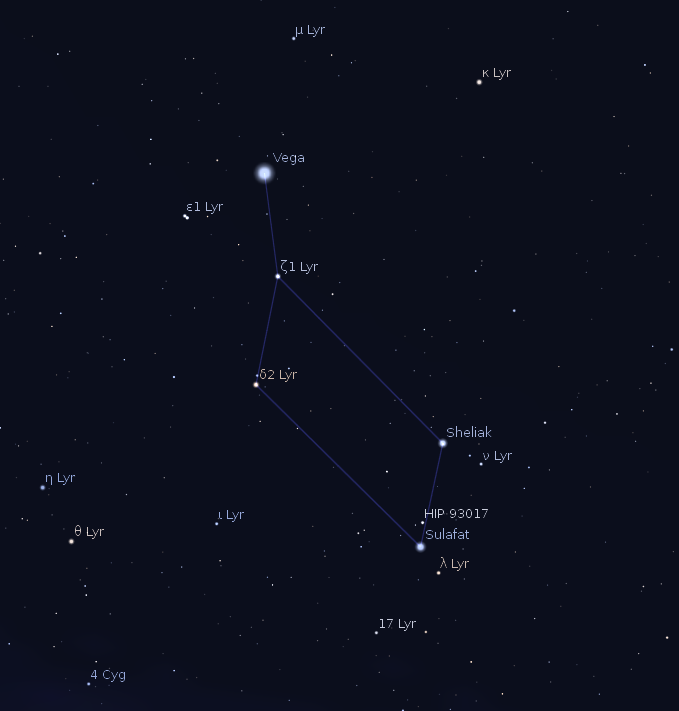
Magnified view of Lyra. Created using Stellarium.
Epsilon Lyra is the closest star to Vega. Look closely, because it’s double. The funny characters next to “Lyr” are lower case Greek letters Epsilon is the Greek letter “e”. The one next to it is the slightly brightest star of the pair. The Greek letter designations are from Johannes Bayer’s 1603 atlas. The number designations are Flamsteed numbers. There’s other stars with proper names. The HIP number is from the Hipparcos catalog, a relatively new catalog.
07/12/2012 – Ephemeris – The constellation Lyra the harp
Thursday, July 12th. Today the sun will be up for 15 hours and 17 minutes, setting at 9:26. The moon, 2 days past last quarter, will rise at 1:50 tomorrow morning. Tomorrow the sun will rise at 6:10.
High in the east at 11 p.m. can be found a bright star called Vega just above a small, narrow, but very distinctive parallelogram of stars. They are the stars of the constellation Lyra the harp. Vega, the 5th brightest night time star, is one of the twenty one brightest stars, called first magnitude stars. The harp, according to Greek mythology, was invented by the god Hermes. The form of the harp in the sky, is as he had invented it: by stretching strings across a tortoise shell. Hermes gave it to his half-brother Apollo, who in turn gave it to the great musician Orpheus. In binoculars, near Vega, two stars appear together. They barely appear to the unaided eye as a single star, designated Epsilon Lyrae.
Times are for the Traverse City/Interlochen area of Michigan. They may be different for your location.
Addendum
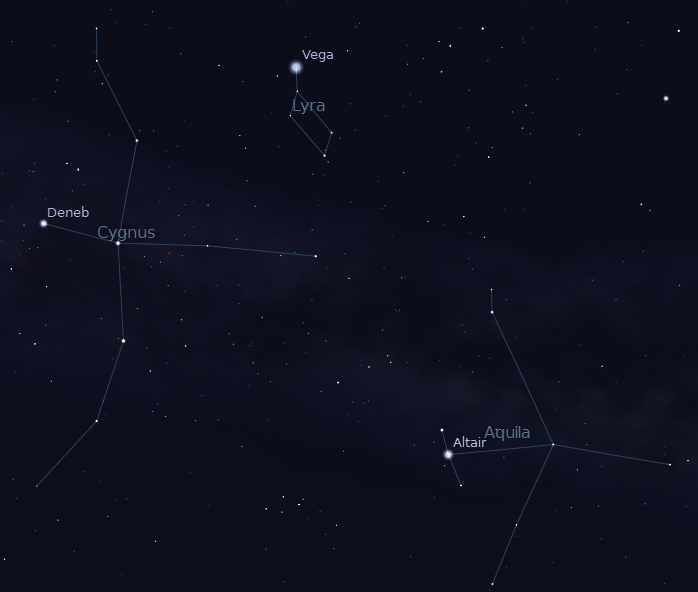
Summer Triangle and the constellation Lyra at 07-12-12 at 11 p.m. Created using Stellarium.
Closeup on Vega and Epsilon Lyrae. Created using Stellarium.
ε1 Lyrae is one of the stars of Epsilon Lyrae. The pair can be split better than this image with binoculars. Looking at the two with a good telescope and over 100 power can split each component into two more stars. We amateur astronomers call it the “Double-Double Star” Note too that Zeta (ζ) Lyrae is also a double star that can be split with a low power telescope.
 Bob Moler's Ephemeris Blog