Archive
02/16/2017 – Ephemeris – The Winter Circle
Ephemeris for Thursday, February 16th. The Sun will rise at 7:40. It’ll be up for 10 hours and 32 minutes, setting at 6:12. The Moon, 2 days before last quarter, will rise at 12:17 tomorrow morning.
The winter skies are blessed with more first magnitude stars than any other season. These are the twenty-one brightest stars in the sky. Six of these stars lie in a large circle centered on the seventh. This circle is up all evening now that we are in the heart of winter. Starting high overhead is Capella in Auriga the charioteer. Moving clockwise, we come to Aldebaran in the face of Taurus the Bull. Then down to Orion’s knee we find Rigel. Down and left is the brightest star of all Sirius the Dog Star in Canis Major Orion’s large hunting dog, lowest of these stars in the south. Moving up and left there is Procyon in Canis Minor, Then above it is Pollux in Gemini the twins. All are centered on Betelgeuse in Orion.
Times are for the Traverse City/Interlochen area of Michigan. They may be different for your location.
Addendum
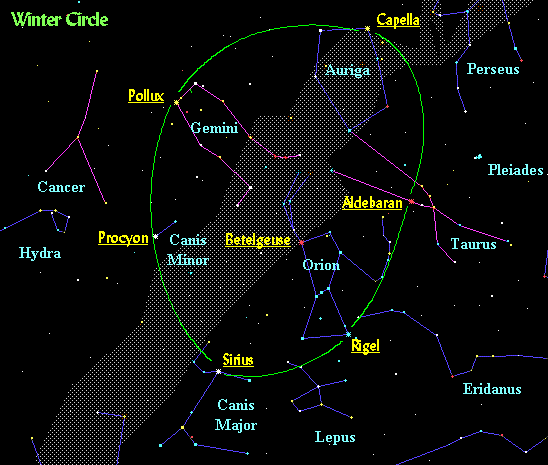
The Winter Circle of 1st magnitude stars. Created using my LookingUp program.
04/04/2016 – Ephemeris – Hydra the water snake will slither along the southern horizon this spring
Ephemeris for Monday, April 4th. The Sun will rise at 7:17. It’ll be up for 12 hours and 57 minutes, setting at 8:14. The Moon, 3 days before new, will rise at 6:18 tomorrow morning.
In the southeastern evening sky can be found the constellation of Hydra the water snake. Unlike the monster of the same name this Hydra has but one head, which is its most distinctive part. At 10 p.m. look to the south-southeast. The head of Hydra is located below a line from the constellation Leo the Lion in the southeast and Gemini high in the southwest. It is directly below Cancer the crab in the south. Hydra’s head is a small but distinctive group of 6 stars that make a loop and the snake’s slightly drooping head. The rest of Hydra wends its way to the southeastern horizon, and eventually ends near the late spring constellation Libra the scales. Over the next few months the rest of Hydra will slither across the southern horizon.
Times are for the Traverse City/Interlochen area of Michigan. They may be different for your location.
Addendum
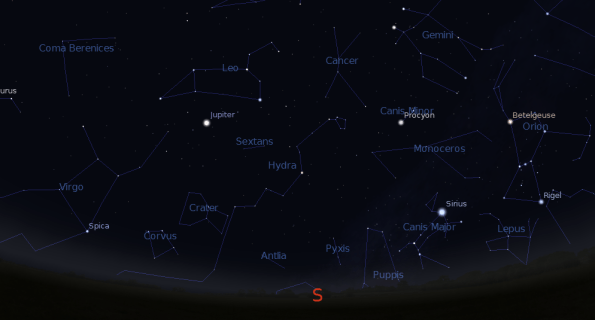
Hydra the water snake raising its head below Cancer at 10 p.m. April 4, 2016. Created using Stellarium.
02/18/2016 – Ephemeris – Castor and Pollux
Ephemeris for Thursday, February 18th. The Sun will rise at 7:39. It’ll be up for 10 hours and 35 minutes, setting at 6:14. The Moon, 3 days past first quarter, will set at 5:28 tomorrow morning.
The star Pollux is at the head of the same named brother of Gemini the twins. Castor is the slightly dimmer star right above it. Pollux is about 34 light years away. It’s twice as massive as the Sun, and has run out of hydrogen in its core and is in the process of evolving into a red giant star. One planet, twice as massive as Jupiter has been detected around it. Castor is at 51 light years away. There are 6 stars in its system. The brightest three are visible in telescopes. Each is a spectroscopic binary, meaning that the companion stars are detected by the Doppler shifts of the lines in their spectra as the stars orbit each other. The Doppler shift is just one of the many pieces of information revealed by the spectroscope.
Times are for the Traverse City/Interlochen area of Michigan. They may be different for your location.
Addendum
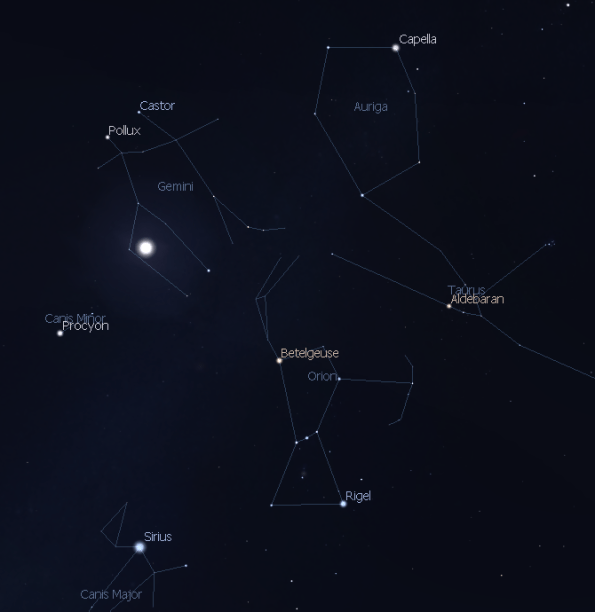
Castro and Pollux with the bright Moon and other bright stars and constellations of winter. 9 p.m. February 18, 2016. Created using Stellarium.
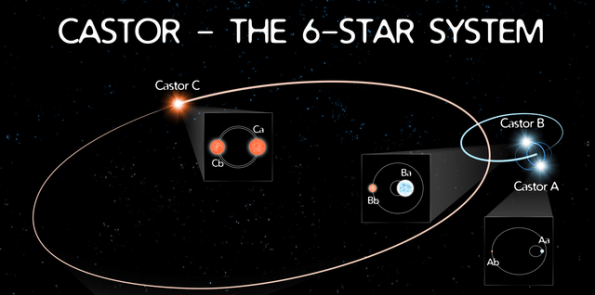
The Castor star system exploded in this JPL/NASA infographic.
The entire infographic is here.
01/11/2016 – Ephemeris – Gemini, the half-brothers that are twins
Ephemeris for Monday, January 11th. The Sun will rise at 8:18. It’ll be up for 9 hours and 4 minutes, setting at 5:22. The Moon, 2 days past new, will set at 7:36 this evening.
Before the Moon brightens the evening sky, lets look at another of the winter constellations. The constellation Gemini, the Twins is visible high in the east-southeast, above and left of Orion the hunter at 9 p.m. The namesake stars of the two lads, will be at the left end of Gemini, vertically aligned. Castor is on top, while Pollux is below. From them come two lines of stars extending toward Orion that outline the two. In Greek mythology the lads were half brothers, Castor was fathered by a mere mortal, while Pollux was fathered by Zeus in the famous Leda and the swan affair, but were born together. When Castor was killed during the quest for the Golden Fleece, Pollux pleaded with Zeus to let him die also, so both appear together in the sky forever.
Times are for the Traverse City/Interlochen area of Michigan. They may be different for your location.
Addendum
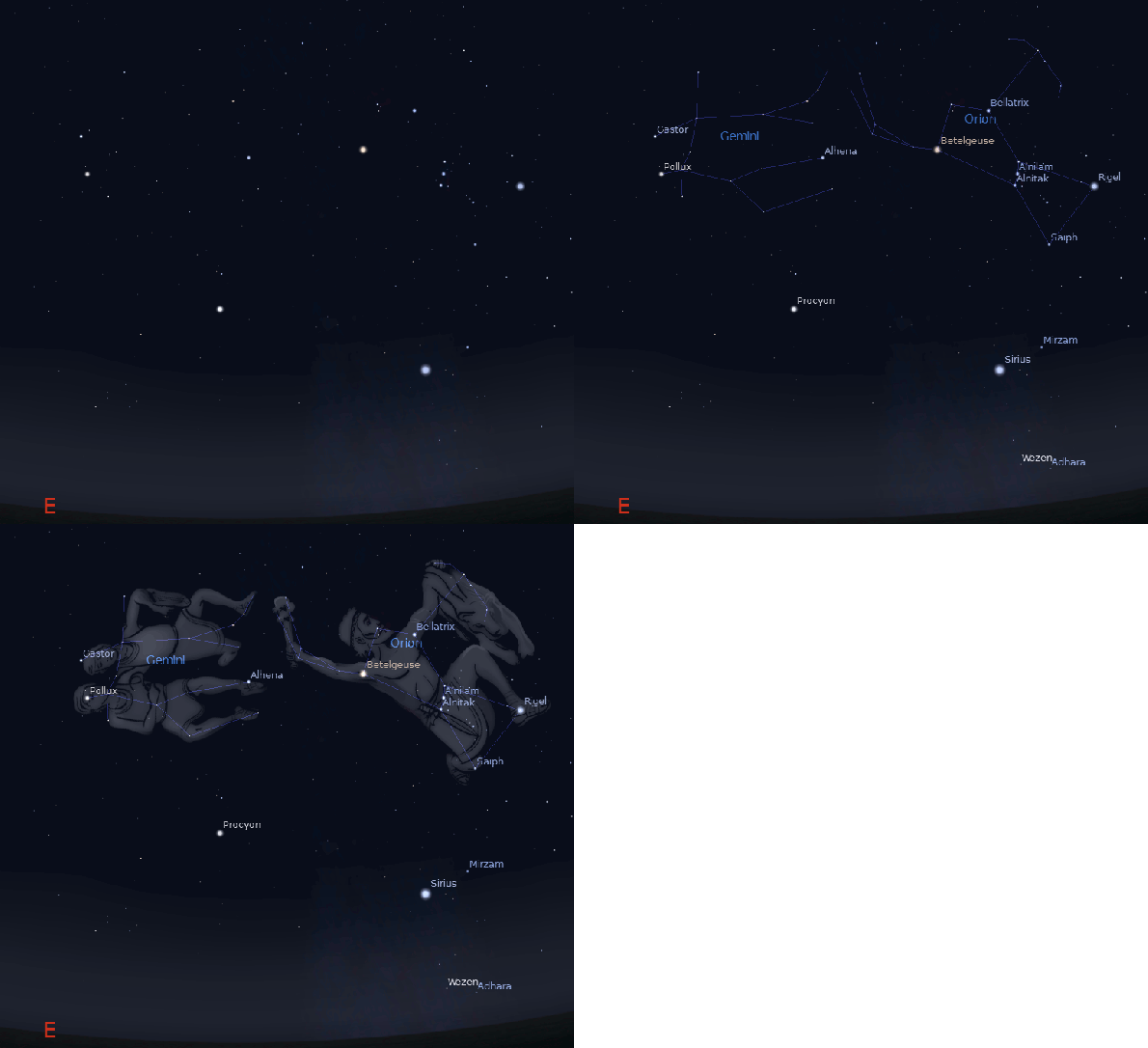
Gemini revealed by animation. Created using Stellarium and GIMP.
12/10/2015 – Ephemeris – What’s a charioteer doing holding goats?
Ephemeris for Thursday, December 10th. The Sun will rise at 8:08. It’ll be up for 8 hours and 53 minutes, setting at 5:02. The Moon, 1 day before new, will rise at 7:59 tomorrow morning.
Rising now more than half way up the sky in the east at 9 p.m. will be the bright star Capella and its pentagonal constellation Auriga the Charioteer. Auriga appears to be hunched down sideways in the sky in his chariot carrying 4 goats. Capella is the mother goat, and a slim triangle of stars near her are her kids. Perhaps the kids in the chariot were such a distraction that he crashed. So maybe the gods placed them in the sky as a warning. In fact that triangle is an asterism widely known as the Kids. The Milky Way runs through Auriga and it is the home of several star clusters that appear as fuzzy spots in binoculars. Capella for us in northern Michigan never sets. It is a winter star that can be seen year round. It’s disconcerting to spot it scraping the northern horizon in July.
Times are for the Traverse City/Interlochen area of Michigan. They may be different for your location.
Addendum
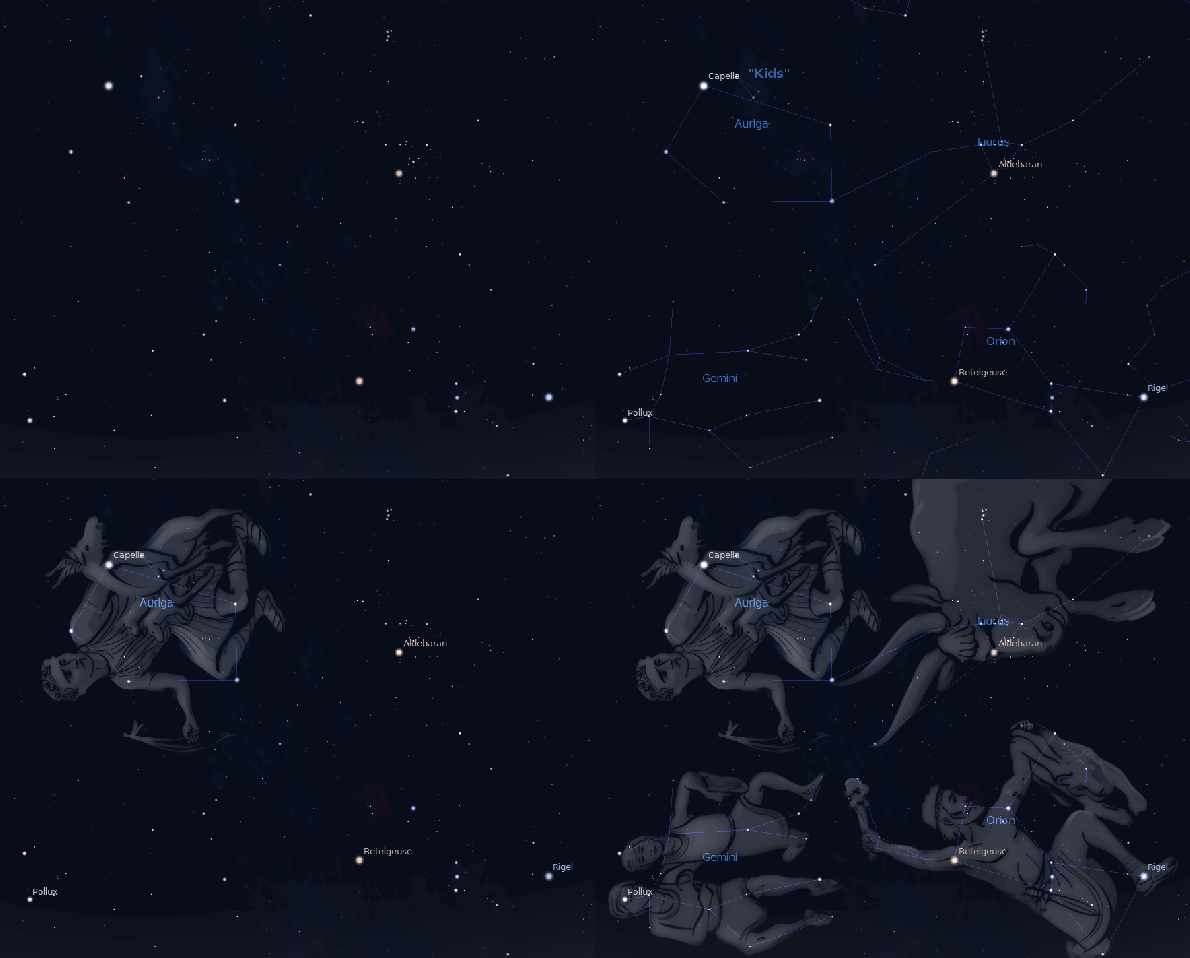
Auriga and neighboring constellations for 9 p.m. December 10, 2015. Created using Stellarium and GIMP.
02/16/2015 – Ephemeris – The Winter Circle
Feb 16. This is Bob Moler with Ephemeris for President’s Day, Monday, February 16th. The sun will rise at 7:42. It’ll be up for 10 hours and 30 minutes, setting at 6:12. The moon, 2 days before new, will rise at 6:25 tomorrow morning.
The winter skies are blessed with more first magnitude stars than any other season. That’s a full one-third of the total are seen is a relatively small area. Six of these stars lie in a large circle centered on the seventh. This circle is up at 9 p.m. Starting high overhead is Capella in Auriga the charioteer. Moving down clockwise is Aldebaran in the face of Taurus the Bull. Then down to Orion’s knee we find Rigel. Down and left is the brightest star of all Sirius the Dog Star in Canis Major, lowest of these stars in the south-southeast. Moving up and left is Procyon in Canis Minor, Above Procyon is Pollux in Gemini the twins. All these are centered on Betelgeuse the bright red star in Orion’s shoulder.
Times are for the Traverse City/Interlochen area of Michigan. They may be different for your location.
Addendum
The Winter Circle of 1st magnitude stars
02/13/2015 – Ephemeris – The stars Castor and Pollux
Ephemeris for Friday, February 13th. The sun will rise at 7:46. It’ll be up for 10 hours and 21 minutes, setting at 6:08. The moon, 2 days past last quarter, will rise at 3:51 tomorrow morning.
At 9 p.m. the constellation of Gemini the twins will be seen high in the southeast. The namesake stars of the two lads are the two bright stars at the top of the constellation. Pollux the pugilist, or boxer, is the lower of the two, while Castor, the horseman, is the other star, or rather a six star system. In telescopes two close stars may be seen each is a spectroscopic binary, meaning the lines of two stars can be seen in the spectrum. A faint nearby spectroscopic binary also belongs. Pollux, though a single star, does have at least one planet, one over twice the mass of Jupiter orbiting the star at a distance somewhat greater than Mars is from the sun. Pollux is 34 light years away while Castor is 50 light years away. Not too far away as stars go.
Times are for the Traverse City/Interlochen area of Michigan. They may be different for your location.
Addendum
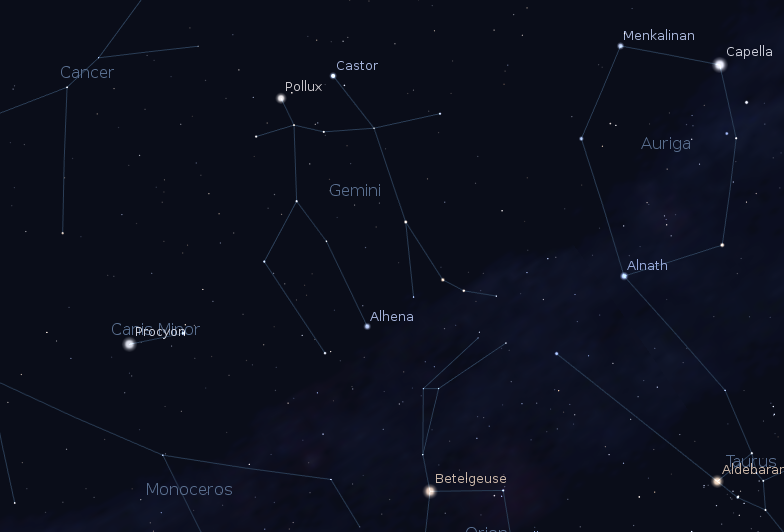
Gemini with the stars Castor and Pollux. Created using Stellarium.
11/20/2014 – Ephemeris – Constellation rotation from rise to set
Ephemeris for Thursday, November 20th. The sun will rise at 7:45. It’ll be up for 9 hours and 24 minutes, setting at 5:10. The moon, 2 days before new, will rise at 6:38 tomorrow morning.
At 9 p.m., if it’s clear tonight look to the east to see the bright winter constellation Orion the hunter mostly risen over the eastern horizon as Robert Frost told in his poem Star-Splitter. Orion’s throwing a leg up over the horizon, climbing into the sky. The three stars of Orion’s belt are nearly vertical as the mighty hunter rises. When in the spring he sets those stars will be horizontal. The same is true on the two namesake stars of the twins of Gemini Castor and Pollux to Orion’s left rising in then east-northeast. They rise vertically aligned and set horizontally. It’s due to our latitude and the fact that these stars are near the equator of the sky. At the poles the stars don’t change attitude, and don’t rise or set. Here they flip about 90 degrees, and at the equator they do a 180. Interesting.
Times are for the Traverse City/Interlochen area of Michigan. They may be different for your location.
Addendum
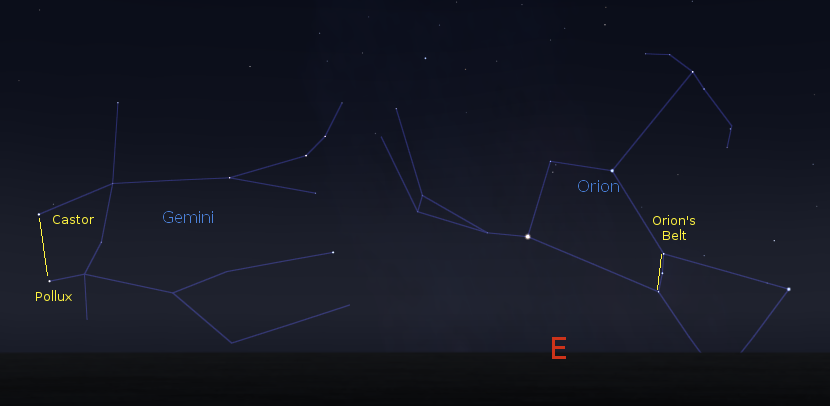
Orion rising at 9 p.m. on November 20, 2014. Note that Orion’s Belt stars and Gemini’s namesake stars are nearly vertically aligned. Created using Stellarium.
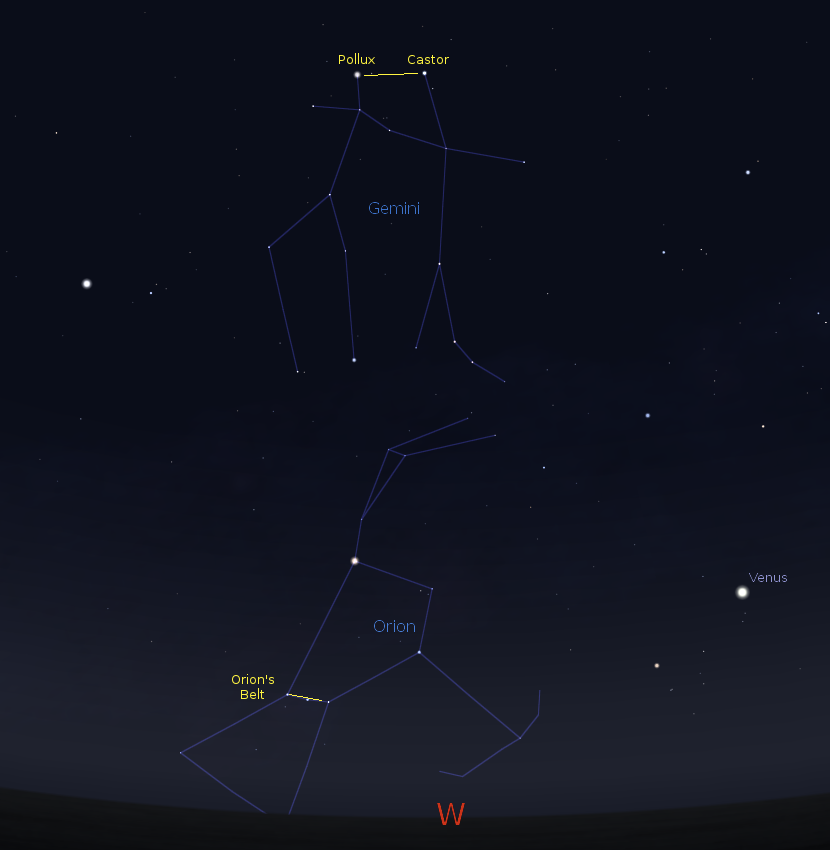
Orion setting near the end of twilight in April 2015. Note that Orion’s Belt stars and Gemini’s namesake stars are now nearly horizontally aligned. Created using Stellarium.
03/03/2014 – Ephemeris – The dim zodiacal constellation of Cancer the Crab
Ephemeris for Monday, March 3rd. The sun will rise at 7:16. It’ll be up for 11 hours and 16 minutes, setting at 6:33. The moon, 2 days past new, will set at 9:44 this evening.
At 9 this evening, the faint constellation, and member of the Zodiac, Cancer the crab is located in the south-southeast half way between the bright stars Castor and Pollux of the constellation Gemini, high in the south and the bright star Regulus in Leo the lion in the east Cancer is very dim, looking like an upside-down Y. In the center of Cancer is a fuzzy spot to the unaided eye. In binoculars or a low power telescope this fuzzy spot becomes a cluster of stars. It is the Beehive cluster. At 525 light years away, it is one of the closest star clusters, but more distant than the Pleiades and Hyades the face of Taurus the bull. Back a few thousand years ago Cancer was the farthest north of the constellations, Gemini has that honor today.
Times are for the Traverse City/Interlochen area of Michigan. They may be different for your location.
Addendum
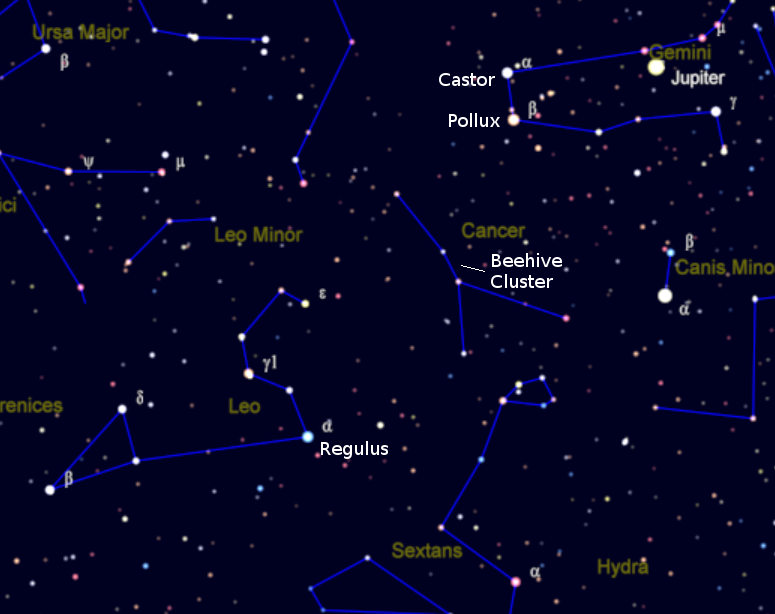
The constellation Cancer the crab at 9 p.m. March 3, 2014. Created using Cartes du Ciel (Skycharts).
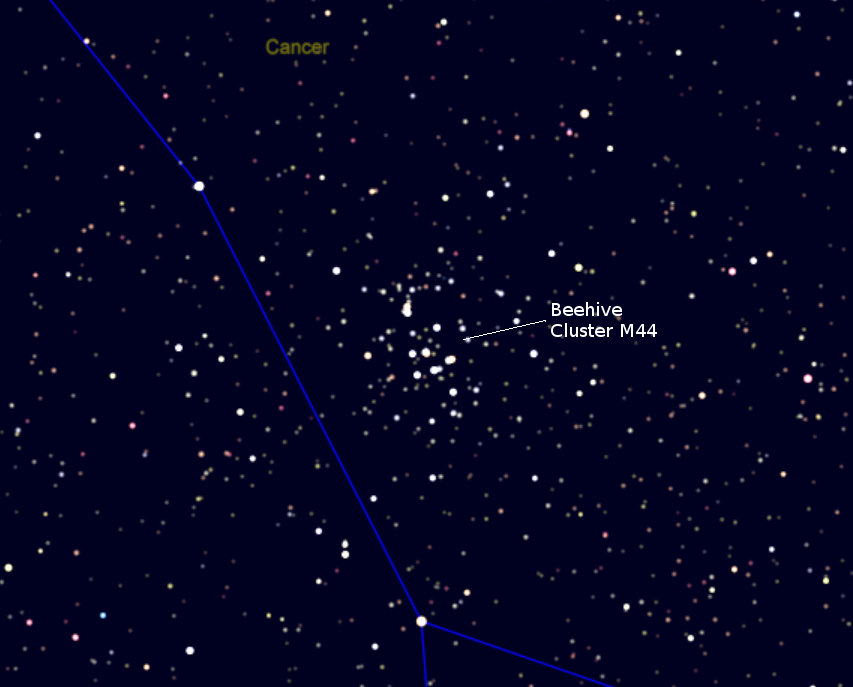
The Beehive star cluster, M44. Its ancient name was the Praesepe or manger when glimpsed by the naked eye. Created using Cartes du Ciel (Skycharts)
02/18/2014 – Ephemeris – Gemini and the summer solstice
Ephemeris for Tuesday, February 18th. The sun will rise at 7:38. It’ll be up for 10 hours and 37 minutes, setting at 6:15. The moon, half way from full to last quarter, will rise at 10:19 this evening.
The constellation Gemini lies above and left of Orion in the southern evening sky. Jupiter is now seen against its stars. Gemini is called the twins and its head stars at the upper left of the constellation are Castor and Pollux. Pollux is to the lower left of Castor. Stick figures of the lads can be seen extending to the lower right of these stars. Currently the place in the sky where the sun is on the winter solstice is just to the right of Castor’s big toe. So it would seem that the sun is entering Gemini on the first day of summer, not Cancer as the astrologers would tell you. That solstice point is moving westward at one degree every 71.6 years, a motion called precession. I checked two astronomy programs and that point has now moved into Taurus the bull.
Times are for the Traverse City/Interlochen area of Michigan. They may be different for your location.
Addendum
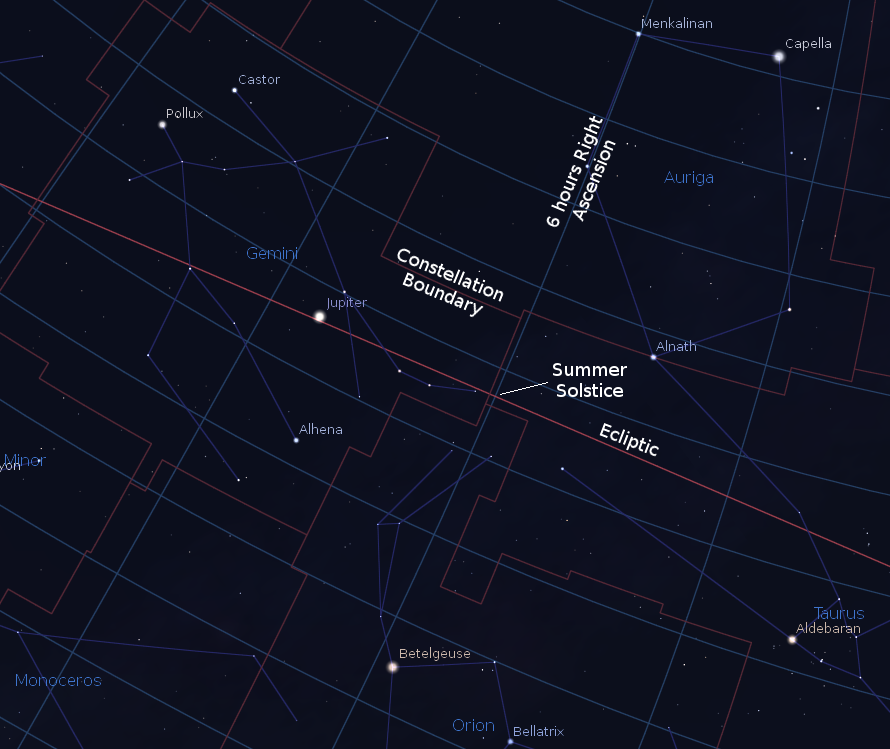
The constellation Gemini and the summer solstice point in the sky. Created using Stellarium.
The summer solstice point in the sky is the intersection of the ecliptic, the suns path in the sky and the 6 hour line of right ascension which is like longitude on the earth. The other blue lines are lines are lines of declination which is like latitude in the sky. Note also that the summer solstice point is the point on the ecliptic closest to the blue declination line which is the 25º north declination line. It’s at approximately 23½º north declination, right over the earth’s 23½º north latitude line also known as the Tropic of Cancer.
Back a couple of thousand of years ago the sun was entering the constellation of Cancer, off our image to the left, on the first day of summer. Since then the summer solstice point has moved westward against the stars at one degree every 71.6 years. This is due to what is called general precession, of the slow wobble of the earth’s axis caused by the pull of the Moon and Sun on the Earth’s equatorial bulge. This torques the earth and causes the 26,000 year wobble, like a spinning top. Since back then the solstice point passed all the way across Gemini and in 1989 entered the territory of Taurus.
 Bob Moler's Ephemeris Blog