Archive

Posts Tagged ‘Jupiter’

Ephemeris: 11/29/2023 – Where are the naked-eye planets this week?

November 29, 2023 Comments off

This is Ephemeris for Wednesday, November 29th. Today the Sun will be up for 9 hours and 7 minutes, setting at 5:04, and it will rise tomorrow at 7:58. The Moon, 2 days past full, will rise at 6:42 this evening.

Let’s find out where the naked-eye planets have wandered off to this week. Three of those five planets are now visible, but Mercury sets too close to sunset to be seen, and Mars rises too close to sunrise. Saturn and Jupiter are the only evening planets visible. Saturn can be seen moving from the south-southwest to setting in the west-southwest in the evening. Ringed planet will be setting at 11:34 pm. Jupiter will be moving from the east-southeast to southwest and will be much higher in the sky during the evening hours than Saturn is, and will be up most of the night until 5:22 am. Venus, the brilliant morning star, will rise in the east-northeast at 4:09 am, and be a brilliant beacon in the morning.

The astronomical event times given are for the Traverse City/Interlochen area of Michigan (EST, UT –5 hours). They may be different for your location.

Addendum
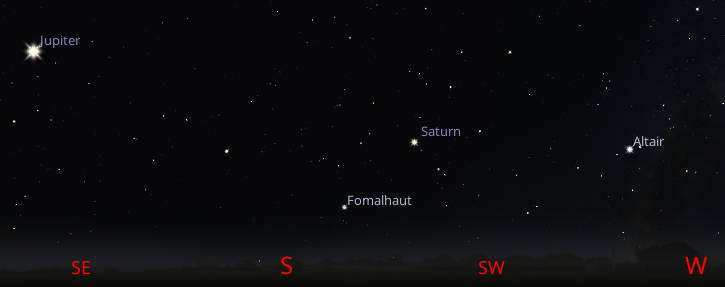
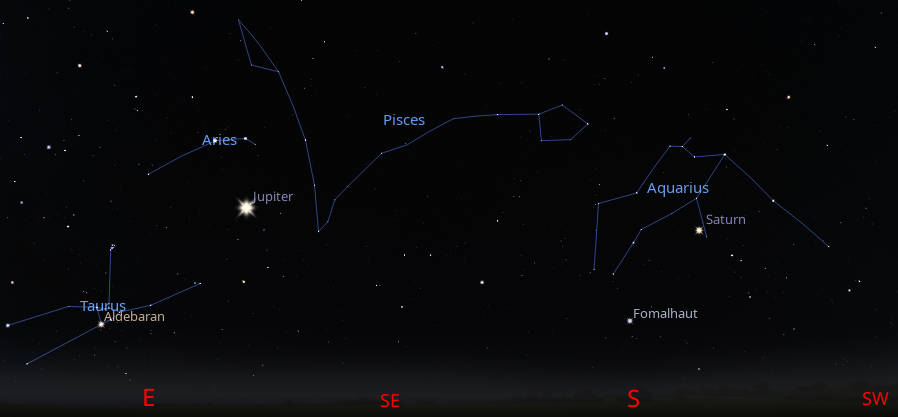
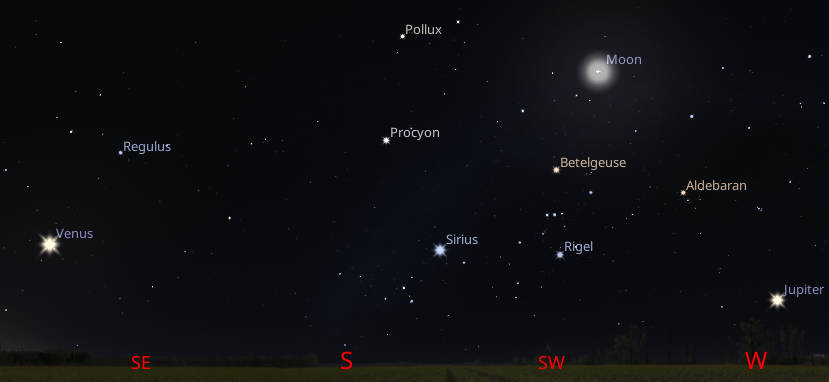
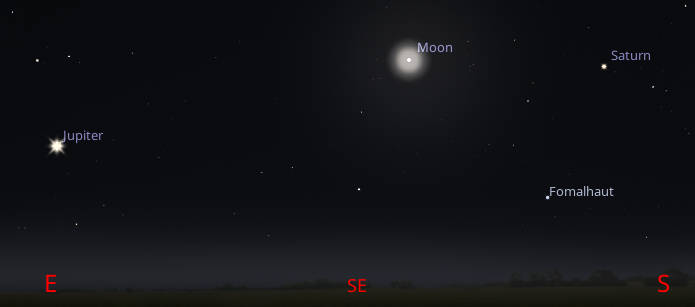
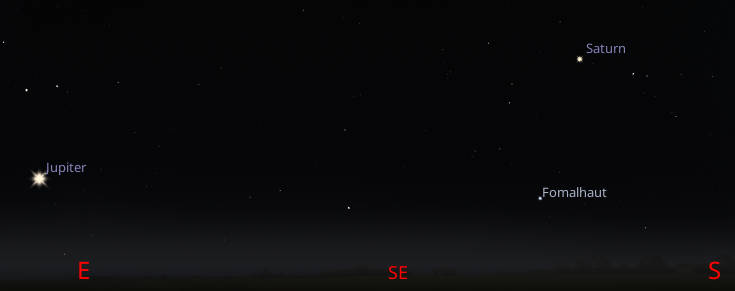
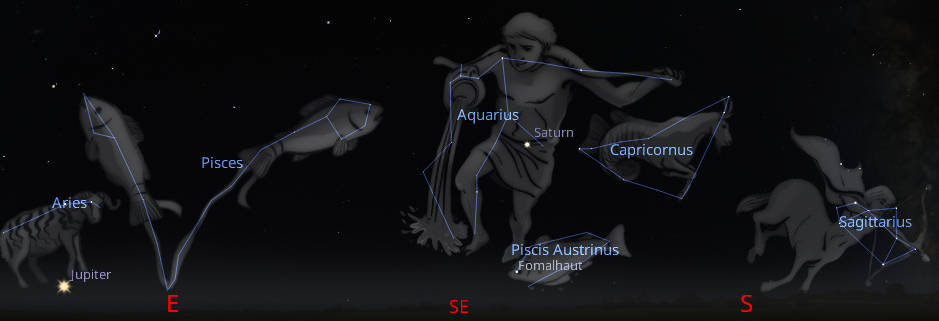
The evening planets Saturn and Jupiter
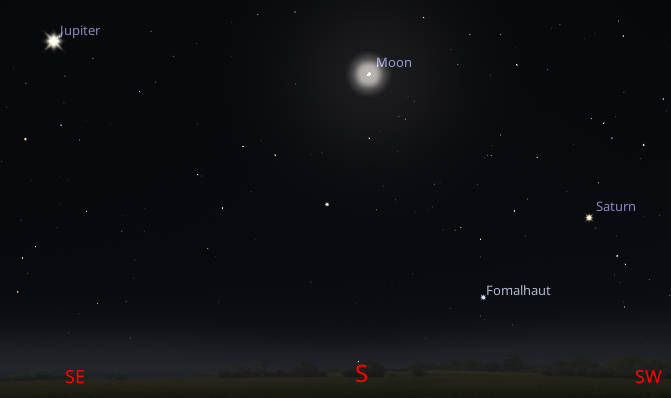
The evening planets Saturn and Jupiter at 8 pm tonight, November 29, 2023. Created using Stellarium.
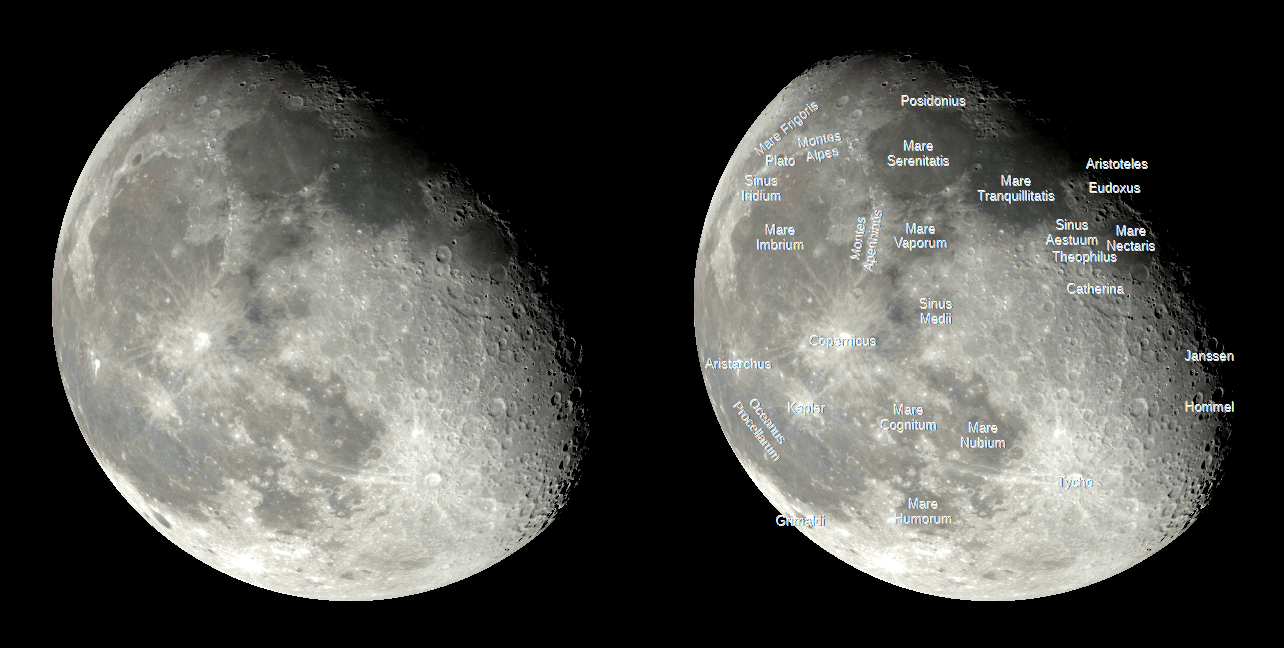
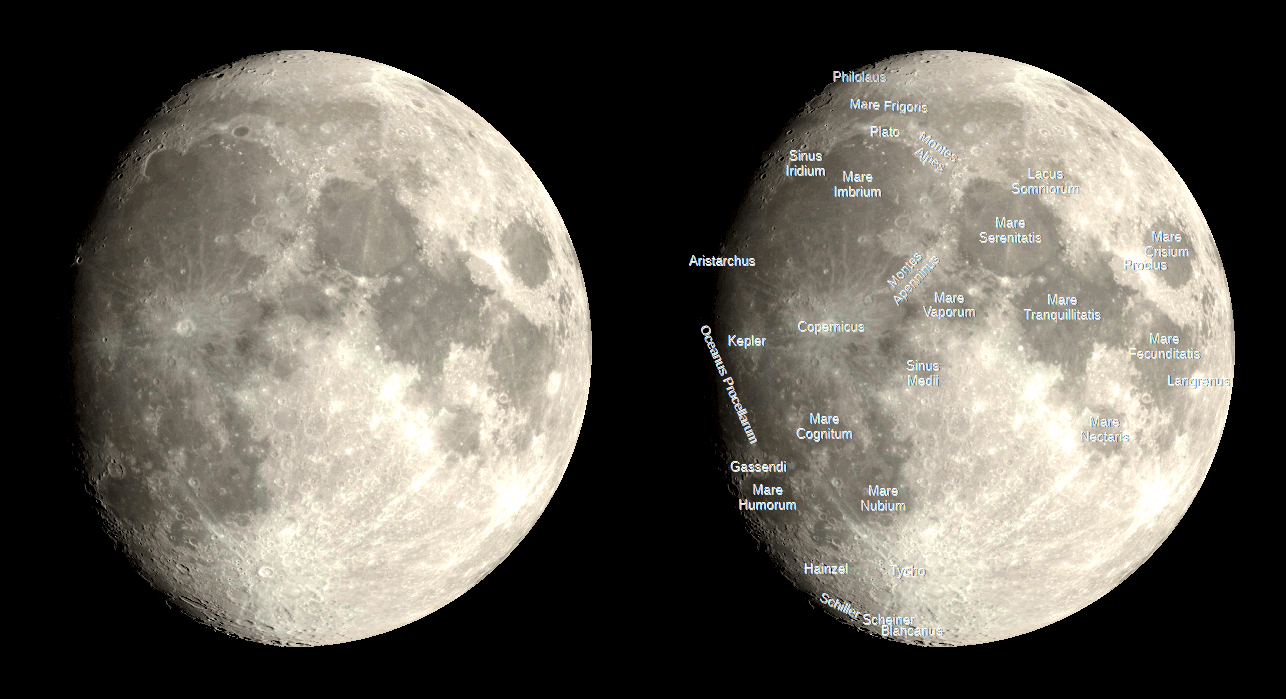
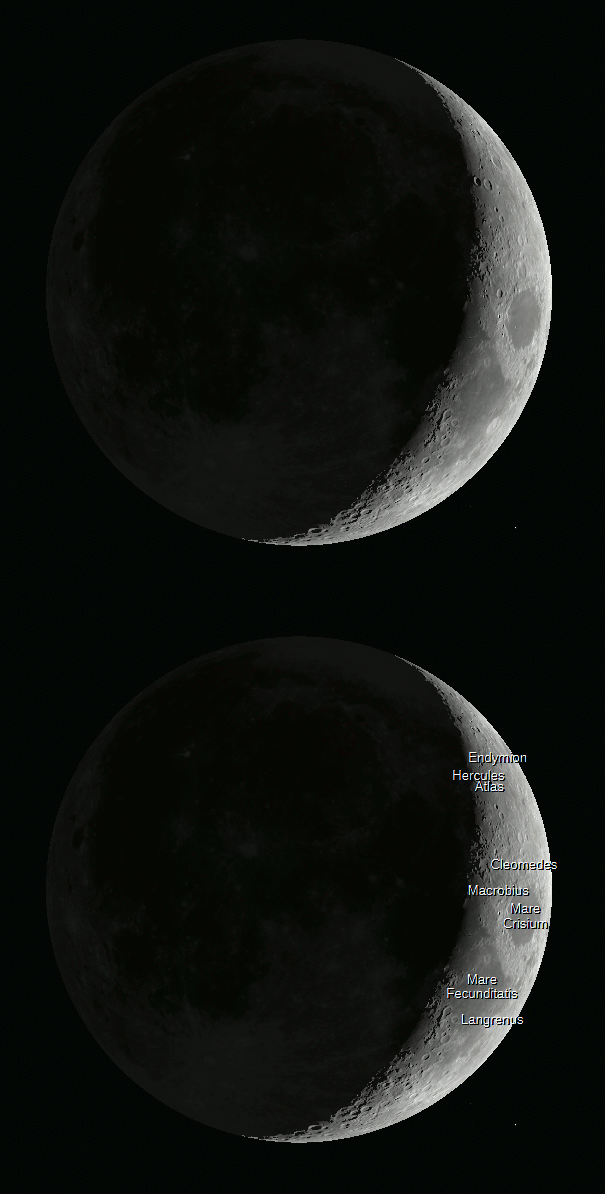
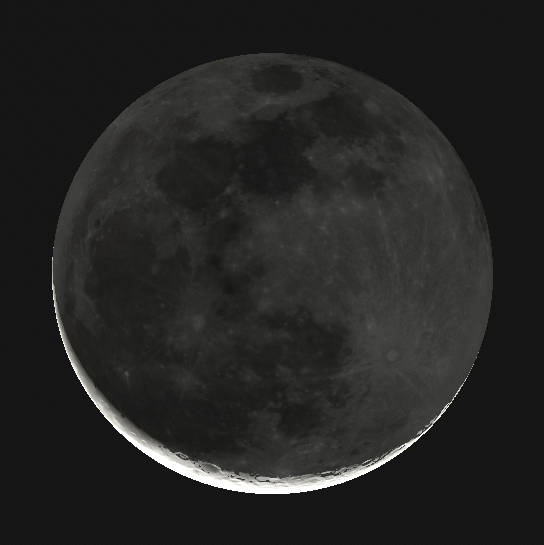
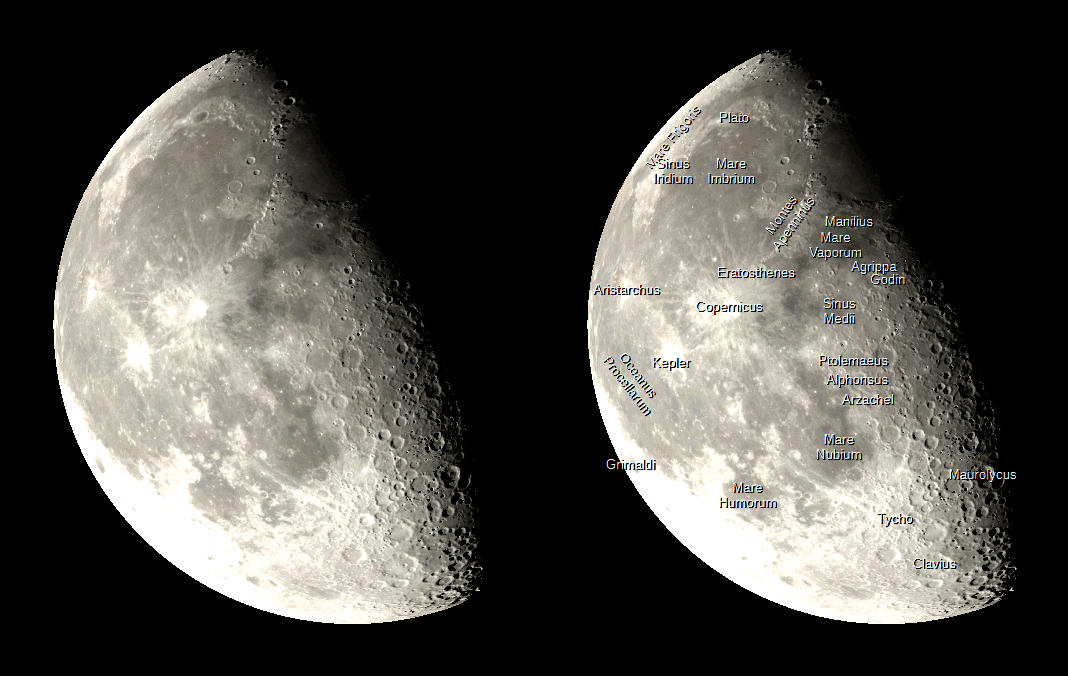
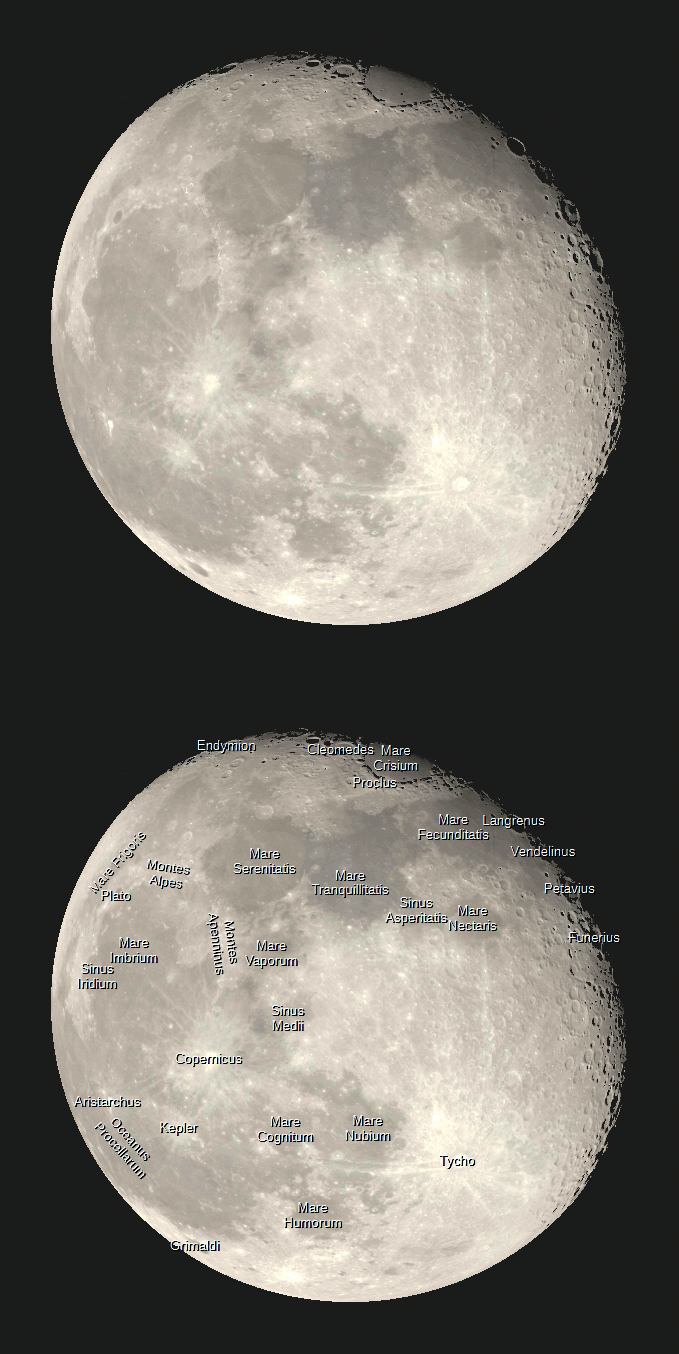
The moon as seen in binoculars or low power telescope tonight, November 29, 2023, at 9 pm.
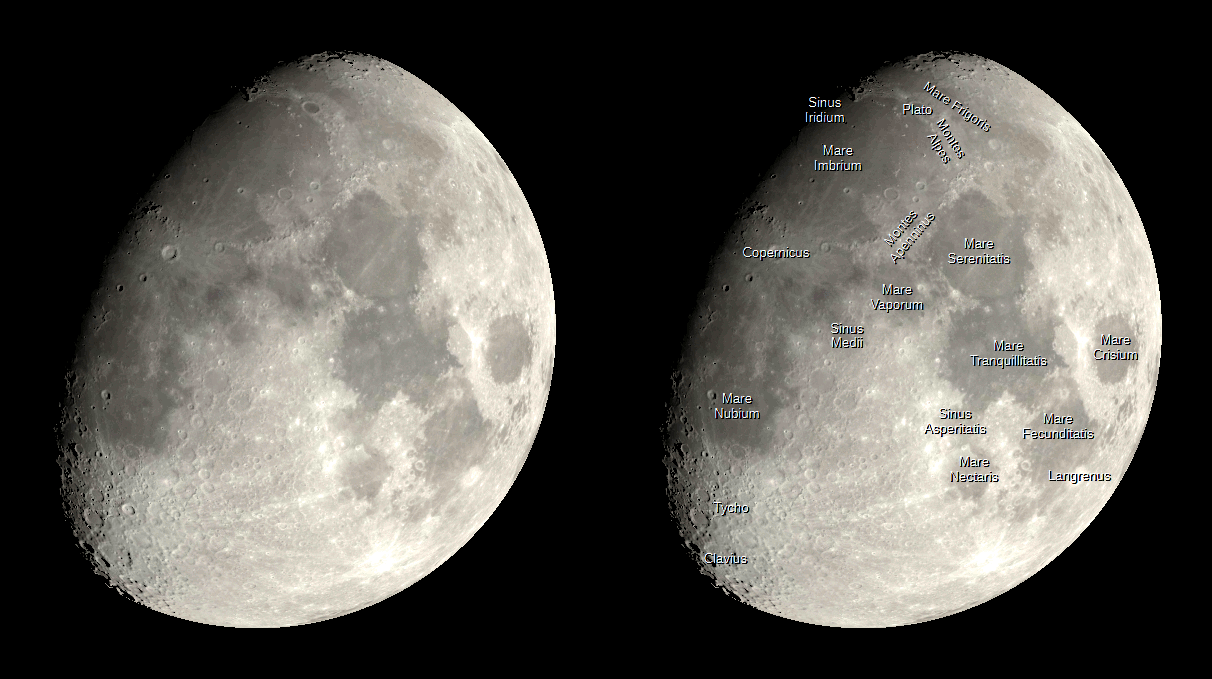
The moon as seen in binoculars or low power telescope tonight, November 29, 2023, at 9 pm. Click or tap on the image to enlarge it. Created using Stellarium, LibreOffice Draw and GIMP.
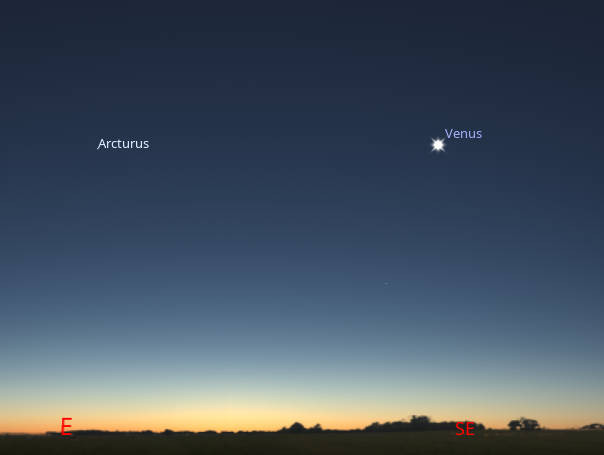
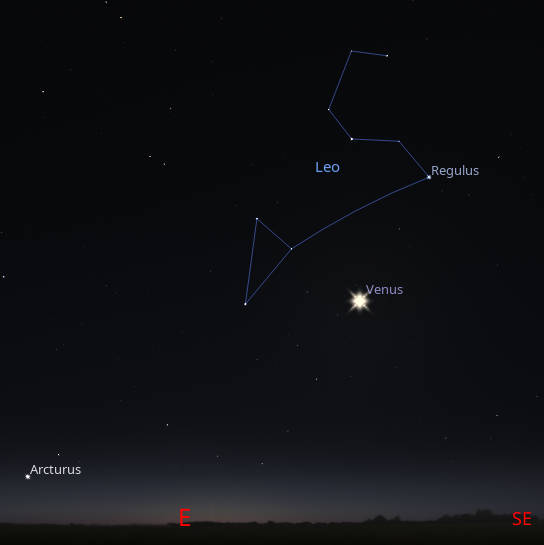
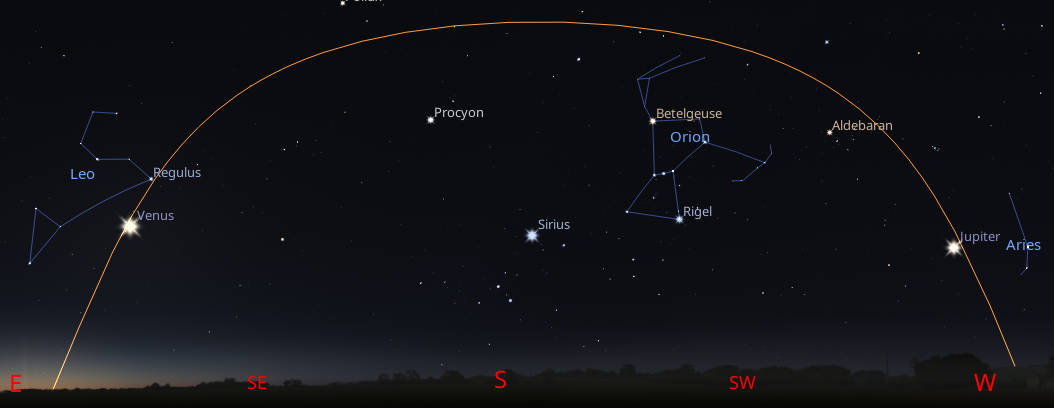
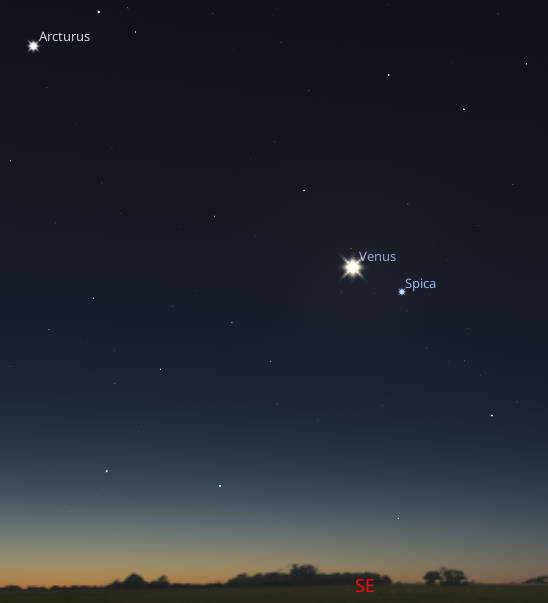
Venus in morning twilight
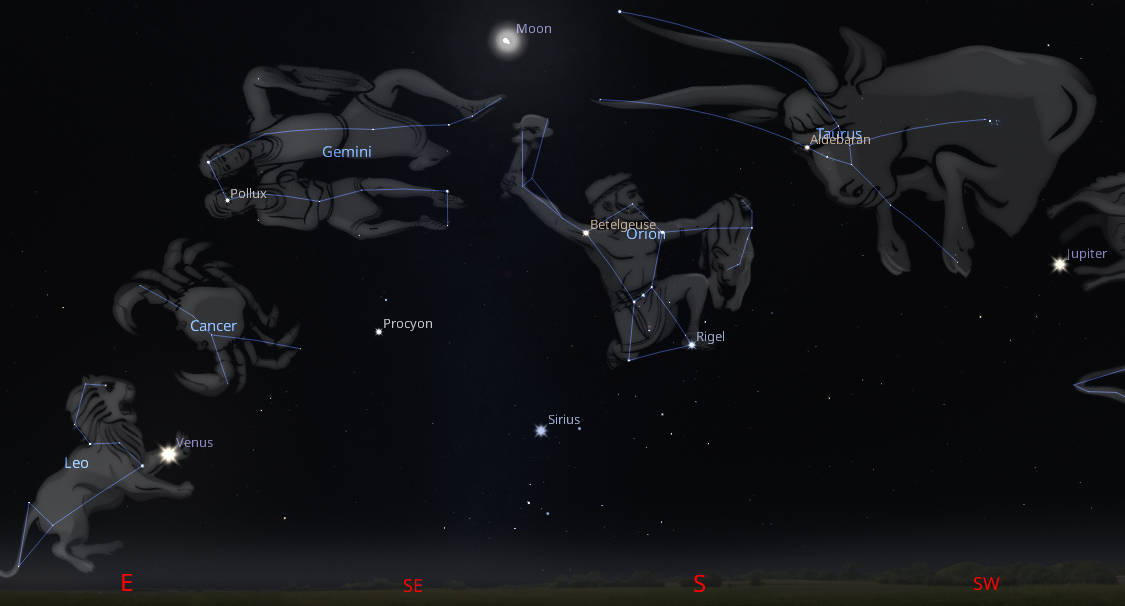
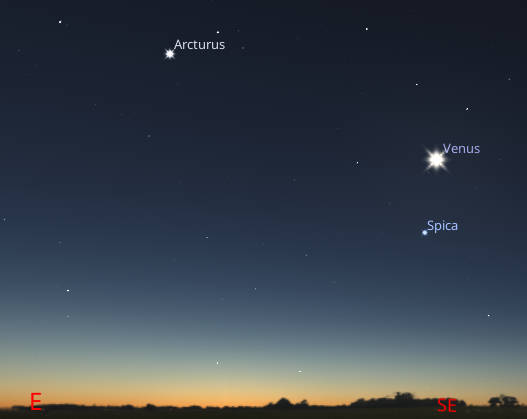
The morning star Venus near Spica at 7 o’clock tomorrow morning, November 30, 2023. Created using Stellarium.
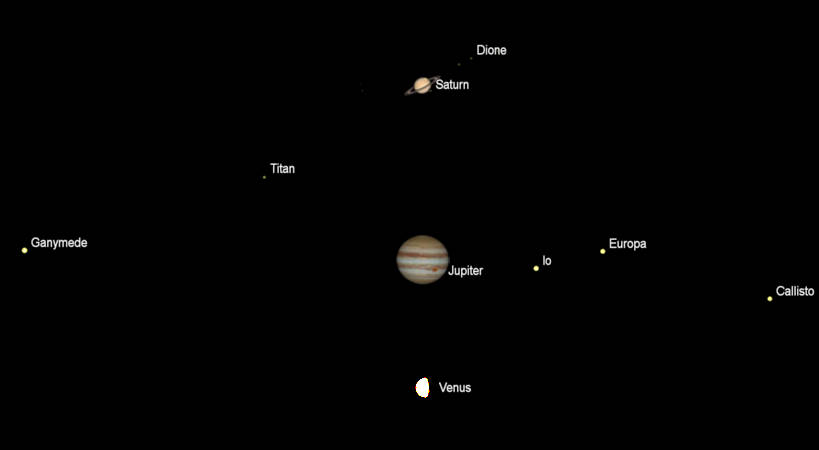
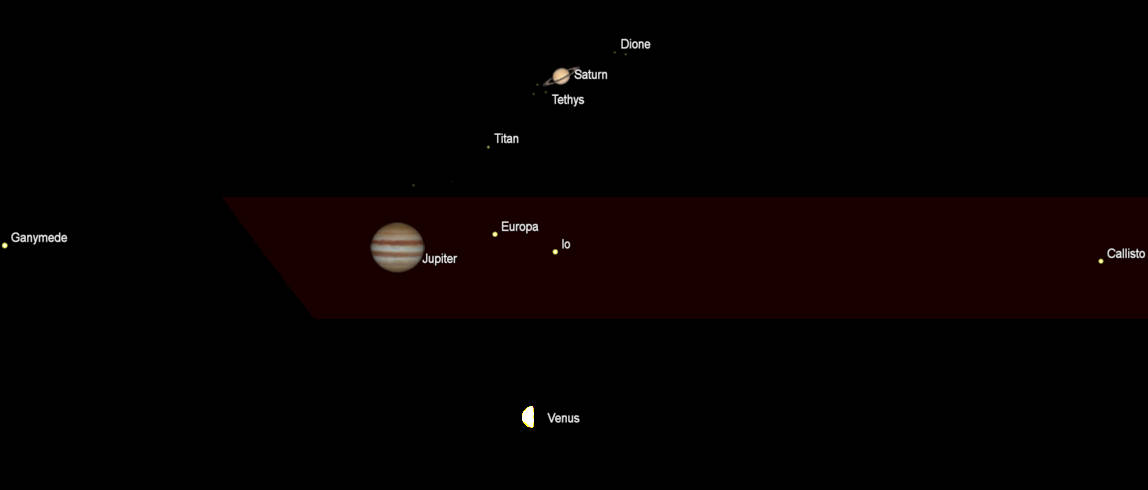
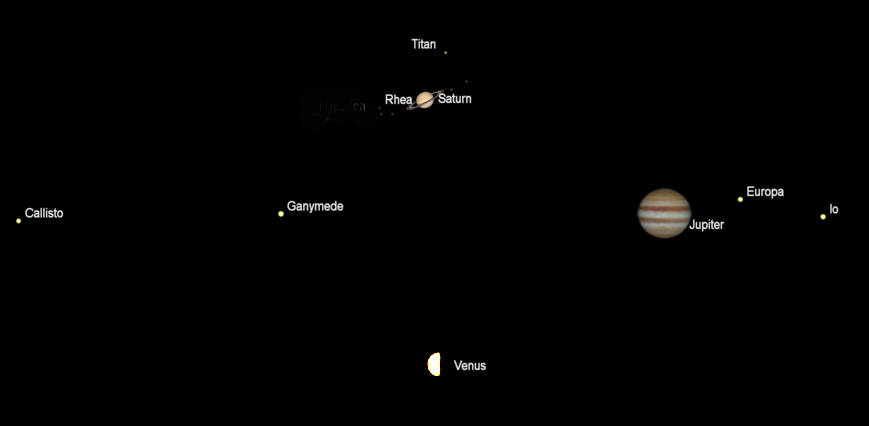
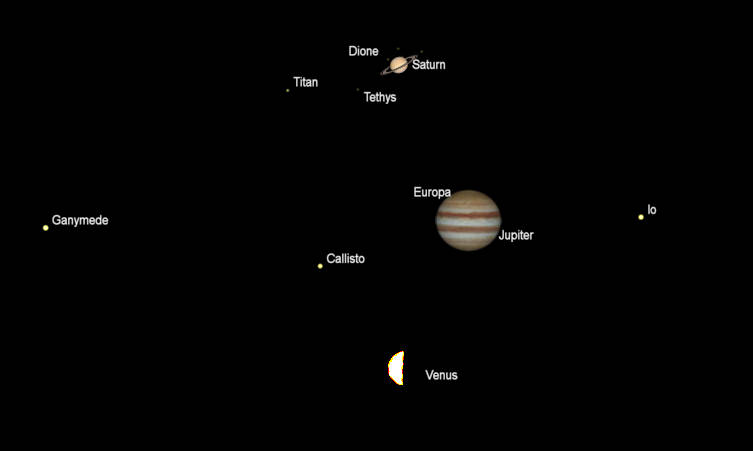
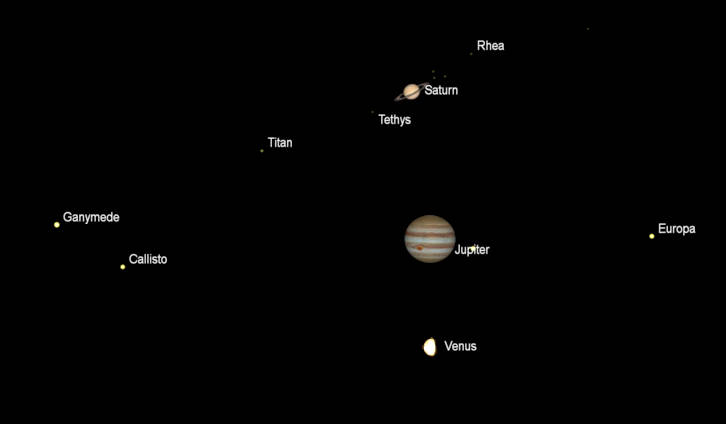
Telescopic Saturn, Jupiter and Venus
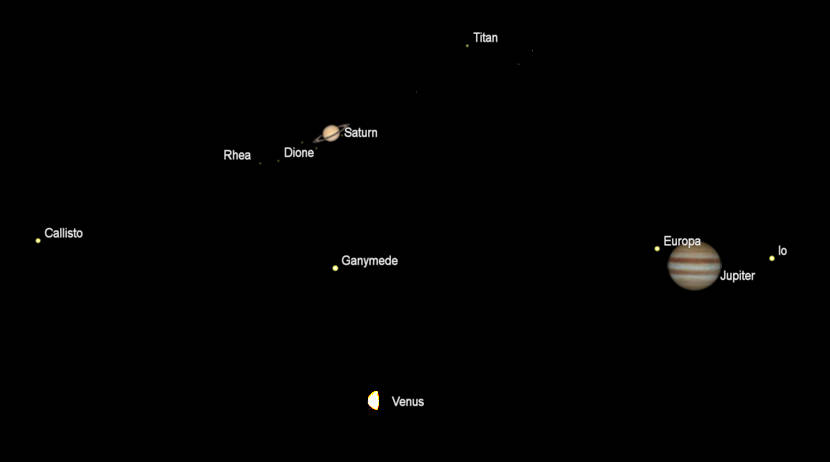
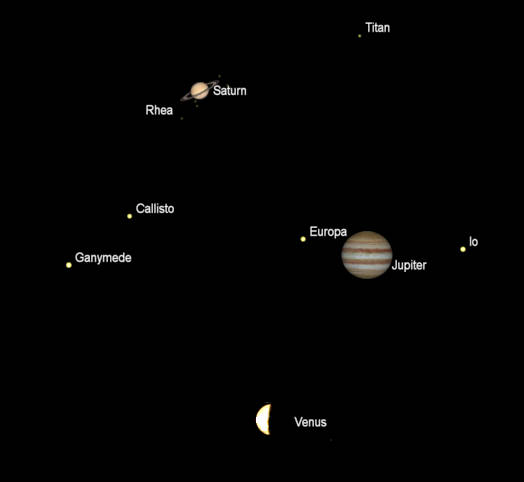
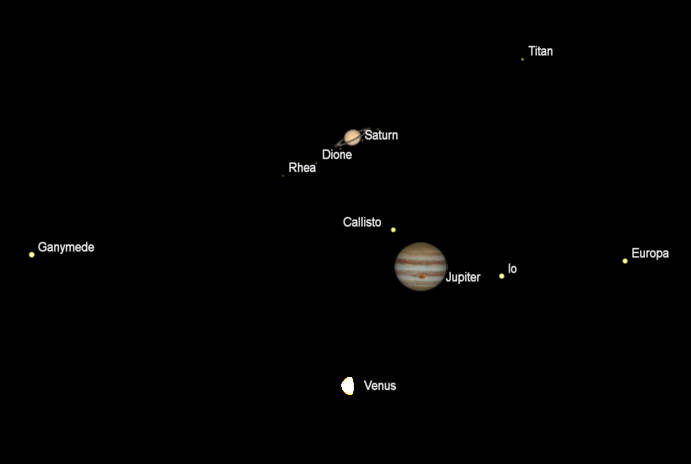
Telescopic Saturn, Jupiter and Venus (north up) as they would be seen in a small telescope, with the same magnification. At 8 pm November 29, 2023, for Saturn and Jupiter, and 7 am on the 30th, for Venus. Apparent diameters: Saturn 16.95″, its rings 39.47″; Jupiter 48.05″; and Venus 19.19, and is 67.4% illuminated. The unlabeled Jovian moon under the Jupiter label is Io. The ” symbol means seconds of arc (1/3600th of a degree). Created using Cartes du Ciel (Sky Charts) and GIMP.
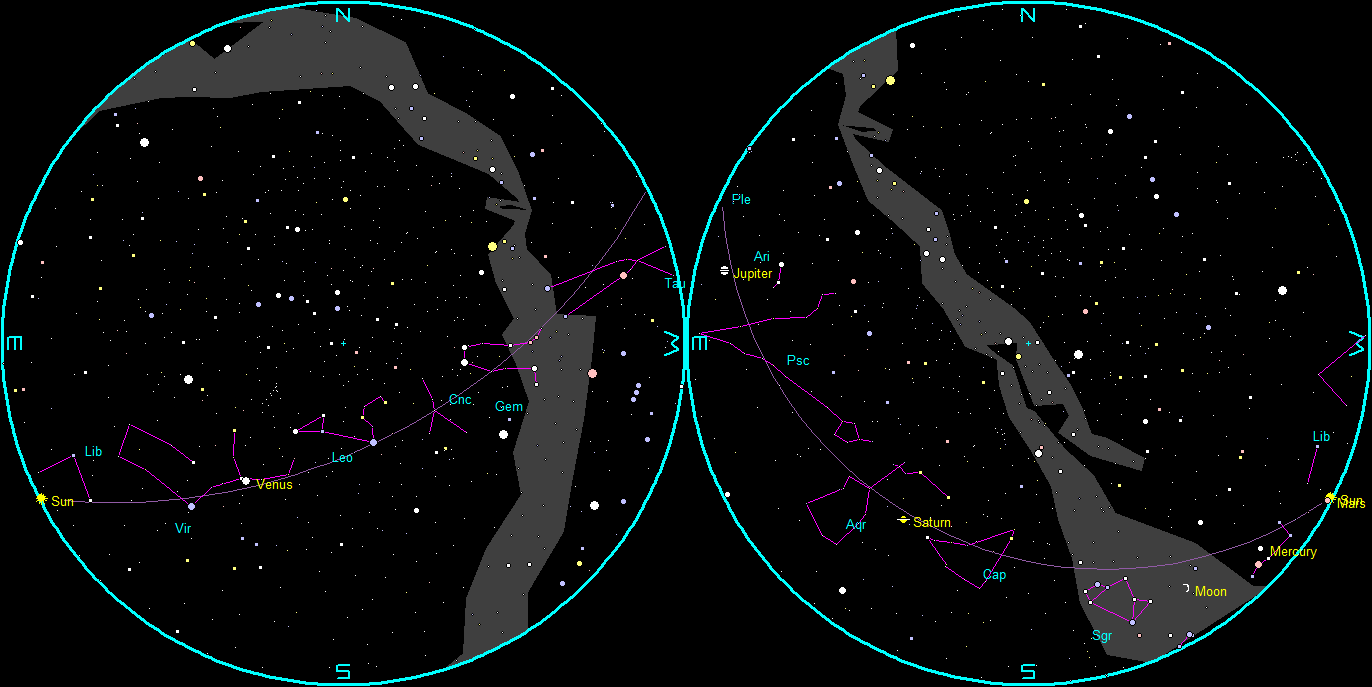
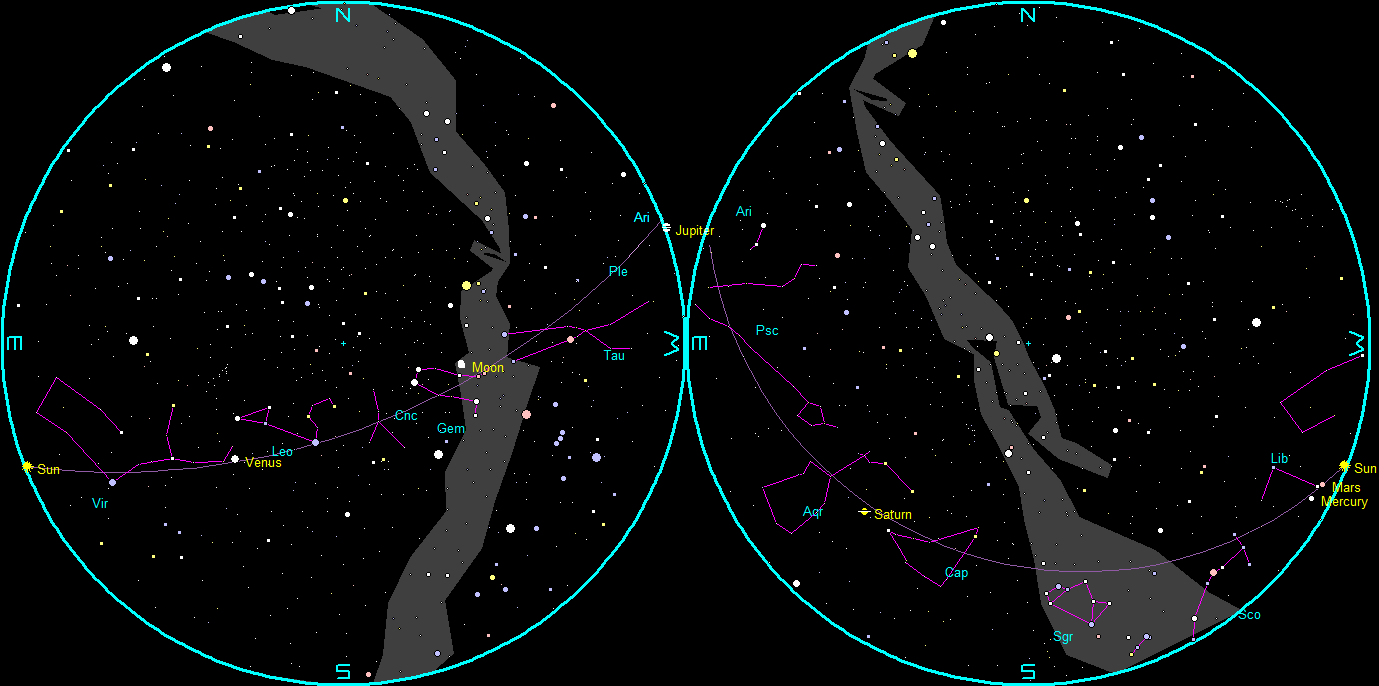
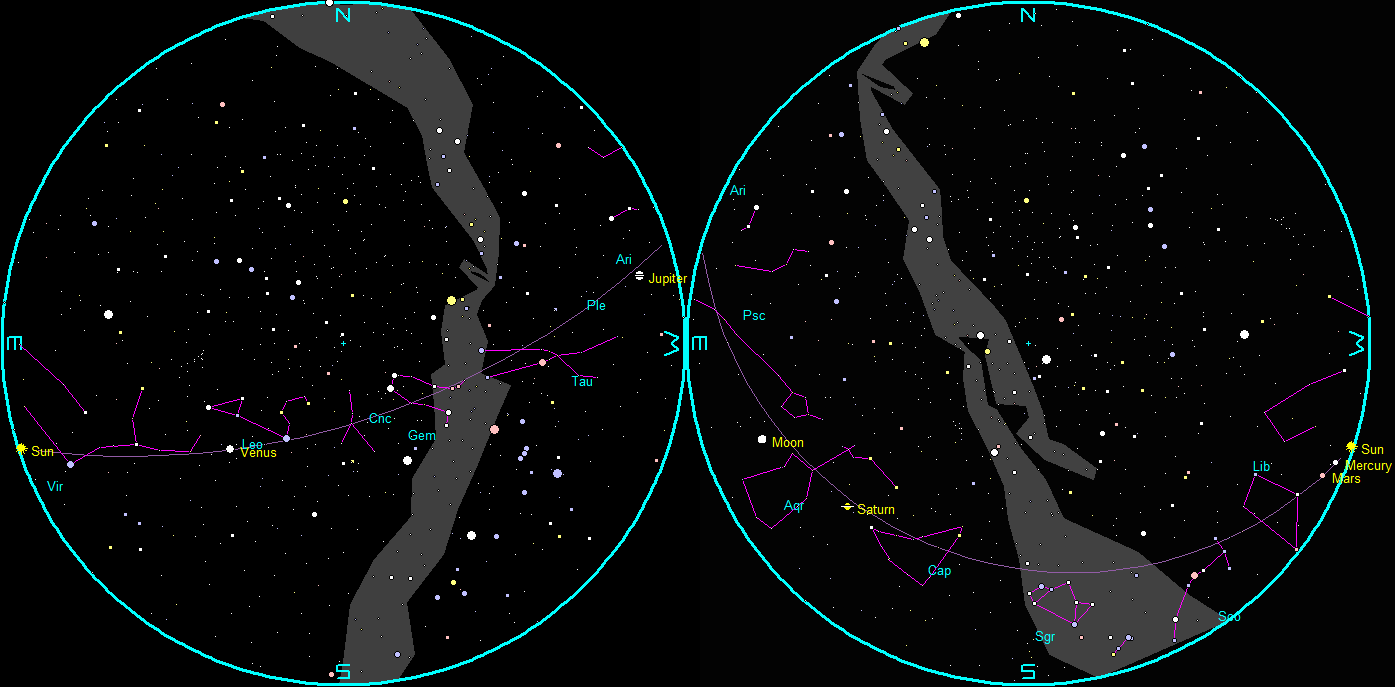
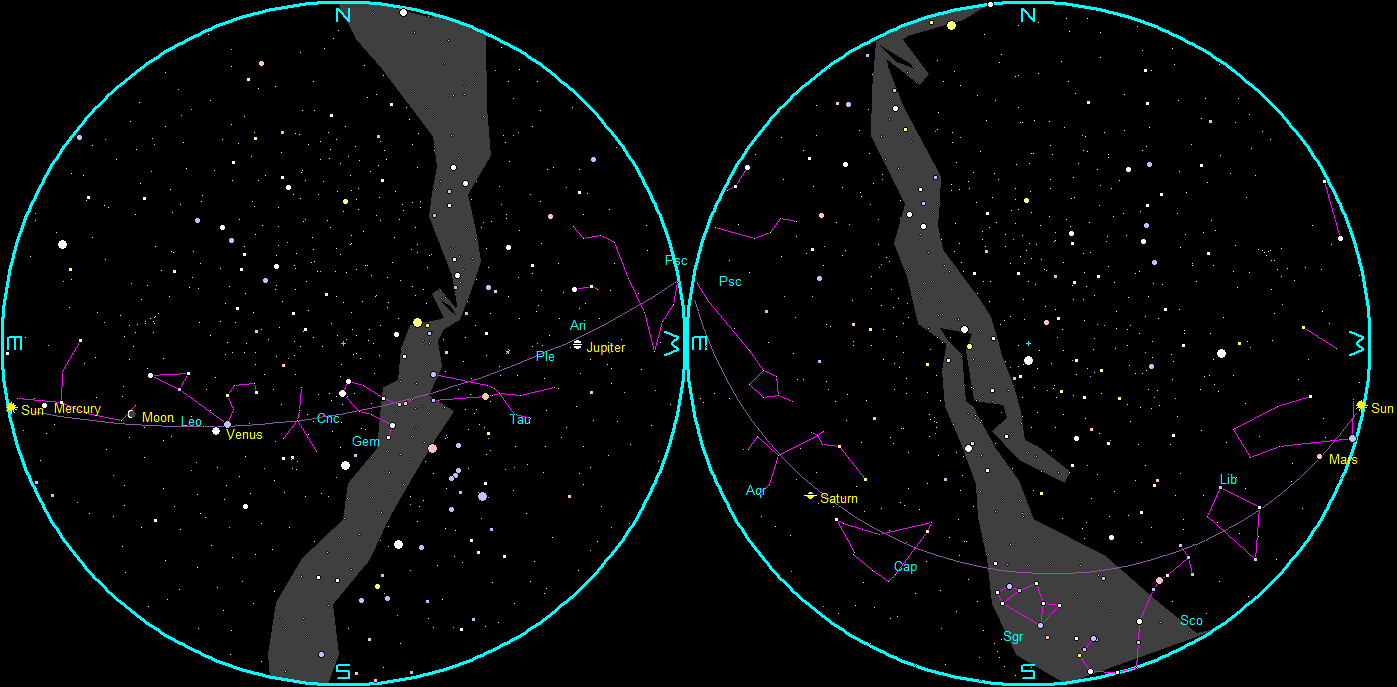
The naked-eye planets and the Moon at sunset and sunrise
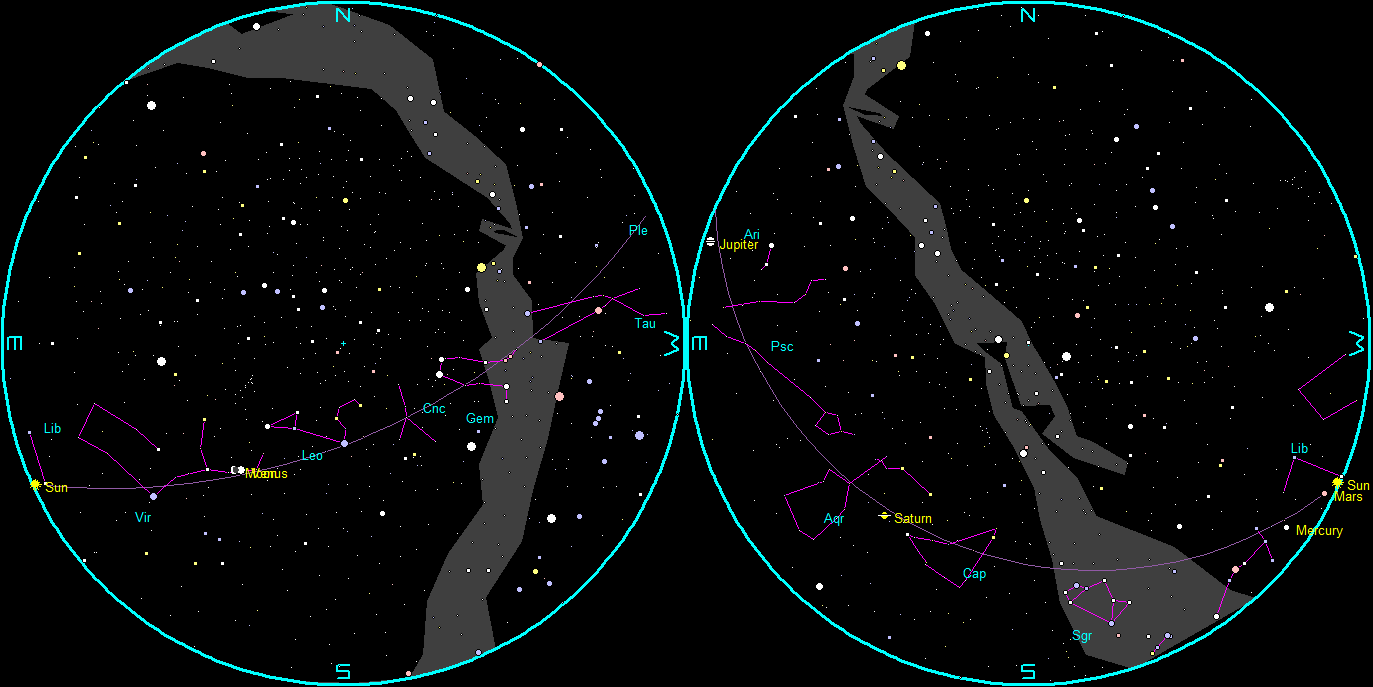
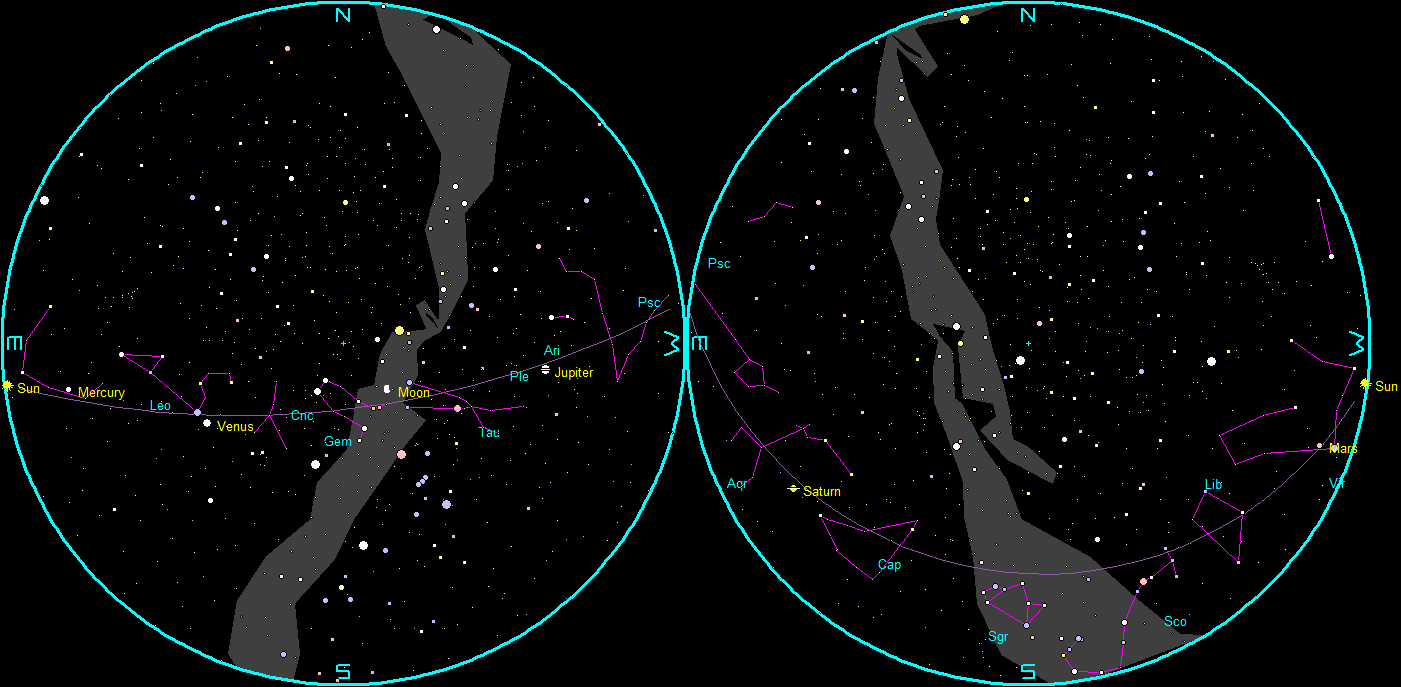
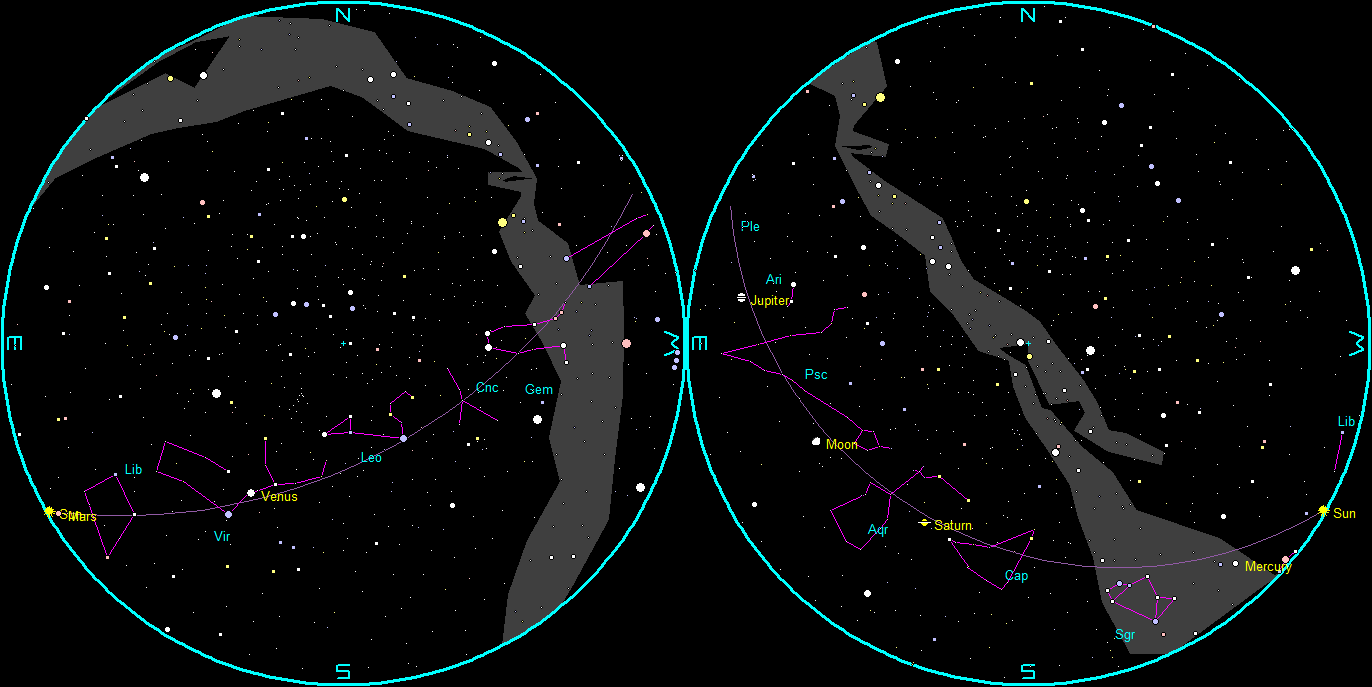
The naked-eye planets and the Moon at sunset and sunrise on a single night, starting with sunset on the right on November 29, 2023. The night ends on the left with sunrise on the 30th. Click or tap on the image to enlarge it. Created using my LookingUp app and GIMP.

Ephemeris: 11/22/2023 – Where have the naked-eye planets wandered off to this week?

November 22, 2023 Comments off

This is Ephemeris for Wednesday, November 22nd. Today the Sun will be up for 9 hours and 20 minutes, setting at 5:08, and it will rise tomorrow at 7:50. The Moon, 2 days past first quarter, will set at 3:17 tomorrow morning.

Let’s find out where the naked-eye planets have wandered off to this week. Three of those five planets are now visible, but Mercury sets too close to sunset to be seen. Mars is now a morning planet after passing conjunction with the Sun last Friday. So, Saturn and Jupiter are the only evening planets visible. Saturn can be seen moving from the south to the southwest in the evening. Saturn will be visible until 12:04 am. Jupiter is seen moving from low in the east-southeast to south-southeast in the evening. Only the Moon is brighter in the evening. Jupiter will be up most of the night until 5:54 am. The gibbous Moon is almost exactly centered between Saturn and Jupiter. Venus, the brilliant morning star, will rise in the east-northeast at 3:57 am.

The astronomical event times given are for the Traverse City/Interlochen area of Michigan (EST, UT –5 hours). They may be different for your location.

Addendum
The evening planets Saturn and Jupiter with the Moon between them
The evening planets Saturn and Jupiter with the Moon between them at 8 pm tonight, November 22, 2023. Created using Stellarium.
The moon 2 days past first quarter.
The moon 2 days past first quarter. As it might appear tonight, November 22, 2023, with selected features labeled. Created using Stellarium, LibreOffice Draw and GIMP.
Venus and the first magnitude stars at 7 am, or about 50 minutes before sunrise. Created using Stellarium.
Telescopic Saturn, Jupiter and Venus (north up) as they would be seen in a small telescope, with the same magnification. At 8 pm November 22, 2023, for Saturn and Jupiter, and 7 am on the 23rd, for Venus. Apparent diameters: Saturn 17.15″, its rings 39.95″; Jupiter 48.66″; and Venus 18.12″. The ” symbol means seconds of arc (1/3600th of a degree). Created using Cartes du Ciel (Sky Charts) and GIMP.
The naked-eye planets and the Moon at sunset and sunrise on a single night, starting with sunset on the right on November 22, 2023. The night ends on the left with sunrise on the 23rd. Note that the labels for the Sun and Mars overlap each other. Click or tap on the image to enlarge it. Created using my LookingUp app and GIMP.

Ephemeris: 11/15/2023 – Where have the naked-eye planets wandered off to this week

November 15, 2023 Comments off

This is Ephemeris for Wednesday, November 15th. Today the Sun will be up for 9 hours and 35 minutes, setting at 5:14, and it will rise tomorrow at 7:40. The Moon, 2 days past new, will set at 6:35 this evening.

Let’s find out where the naked-eye planets have wandered off to this week. Three of those five planets are now visible but both Mars and Mercury set too close to sunset to be seen. Mars will actually be in conjunction with the Sun Friday and become a morning planet thereafter. So, Saturn and Jupiter are the only evening planets visible. Saturn, seen against the stars of Aquarius, can be seen moving from the south to the southwest in the evening. Saturn will be visible till almost 12:45 am. Jupiter is seen moving from low in the east to the high south in the evening, the brightest object in the sky. In Aries this year, Jupiter will be up most of the night. Venus, the brilliant morning star, will rise in the east-northeast at 3:41 am.

The astronomical event times given are for the Traverse City/Interlochen area of Michigan (EST, UT –5 hours). They may be different for your location.

Addendum
The only naked-eye planets visible in the evening are Jupiter and Saturn
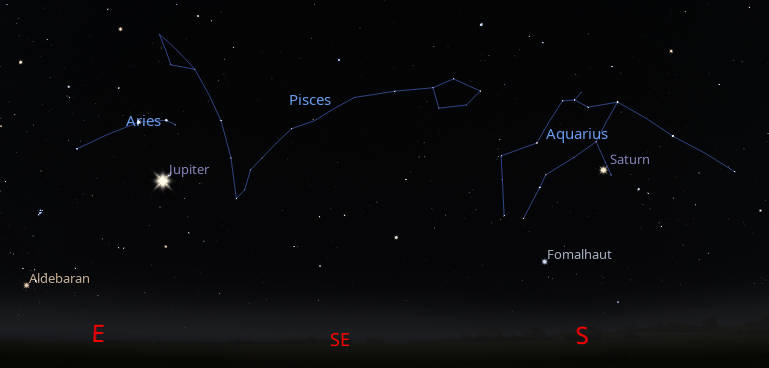
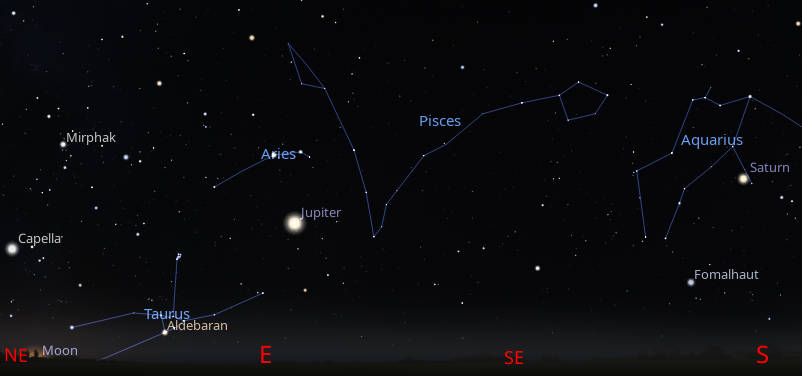
The only naked-eye planets visible in the evening are Jupiter and Saturn and facing southeast one can see Jupiter to the left and Saturn to the right at 8 pm tonight, November 15, 2023. Also showing are the constellations of the Zodiac that they are in or near. Click or tap on the image to enlarge it. Created using Stellarium.
Venus at 7 am tomorrow
Venus at 7 am tomorrow, November 16, 2023. Created using Stellarium.
Telescopic Saturn, Jupiter and Venus
Telescopic Saturn, Jupiter and Venus (north up) as they would be seen in a small telescope, with the same magnification. At 8 pm November 15, 2023, for Saturn and Jupiter, and 7 am on the 16th, for Venus. Apparent diameters: Saturn 17.36″, its rings 40.43″; Jupiter 49.13″; and Venus 19.18″ and is 61.8% illuminated. The ” symbol means seconds of arc (1/3600th of a degree.) Click or tap on the image to enlarge it. Created using Cartes du Ciel (Sky Charts) and GIMP.
The naked-eye planets and the Moon at sunset and sunrise on a single night
The naked-eye planets and the Moon at sunset and sunrise on a single night, starting with sunset on the right on November 15, 2023. The night ends on the left with sunrise on the 16th. Note that the labels for the Sun and Mars overlap each other. Click or tap on the image to enlarge it. Created using my LookingUp app and GIMP.

Ephemeris: 11/08/2023 – Where have the naked-eye planets wandered off to this week?

November 8, 2023 Comments off

This is Ephemeris for Wednesday, November 8th. Today the Sun will be up for 9 hours and 52 minutes, setting at 5:22, and it will rise tomorrow at 7:31. The Moon, 3 days past last quarter, will rise at 3:26 tomorrow morning.

Let’s find out where the naked-eye planets have wandered off to this week. Three of those five planets are now visible but both Mars and Mercury set too close to sunset to be seen. So, Saturn and Jupiter are the only evening planets visible. Saturn, seen against the stars of Aquarius, can be seen in the south in the evening. Saturn will be visible till almost 1 am. Jupiter is seen rising in the eastern sky in the evening, the brightest object in the sky. In Aries this year, Jupiter will be up all night. Venus, the brilliant morning star, will rise in the east-northeast at 3:29 am. It will be seen above the waning crescent Moon. In the southeast at 7 am in the bright morning twilight.

The astronomical event times given are for the Traverse City/Interlochen area of Michigan (EST, UT –5 hours). They may be different for your location.

Addendum
The only planets visible in the evening are Jupiter and Saturn and facing southeast one can see Jupiter to the left and Saturn way off to the right just west of south. Also showing are the constellations of the Zodiac that they are in or near. Click or tap on the image to enlarge it. Created using Stellarium.
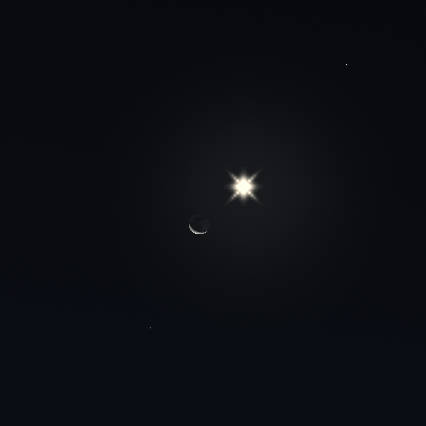
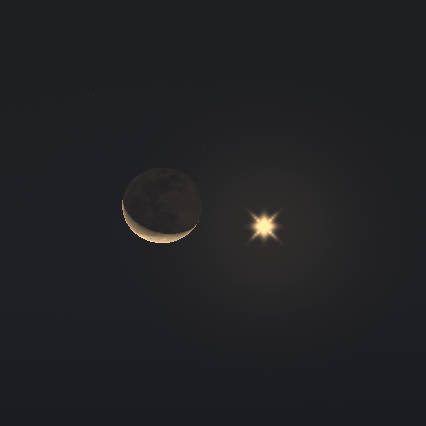
Here are Venus and the Moon at 6:45 am, when most people are up early enough to see them. It got me to thinking that maybe there may be an occultation (hiding) of Venus behind the Moon earlier in the morning, so I cranked it back three hours to just after Venus and the Moon rose. No occultation here (see below). Doing further checking I found out there is an area on the world that the occultation will be visible. Created using Stellarium.
Here are the moon and Venus at 3:45 AM about 15 minutes after they will rise tomorrow morning showing that we in Michigan are still too far south to see the occultation. Created using Stellarium.
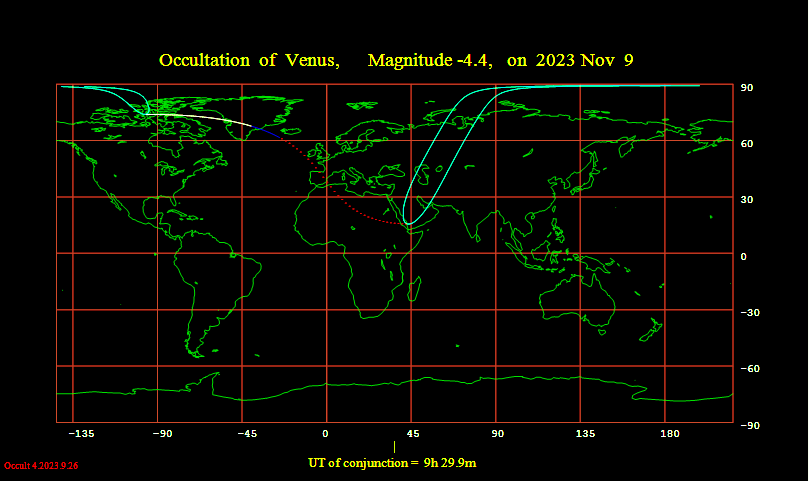
This is a map of where the occultation will be visible on the Earth. It will be seen on the northern part of this map. The left loop is where the occultation will occur around moonrise and the right loop is where the occultation will occur near moonset. The southern boundary of the occultation is the line between the loops. On the left it is a solid white line. North of that the occultation will be seen at night. There’s a little portion of blue in which the occultation will be seen during twilight and the red dots, which above that is where the occultation will be visible during the daytime. Europe will be able to see the occultation during the daytime, Greenland mostly at night and the occultation will be visible also from the very northern islands of Canada. Click or tap on the image to enlarge it. The map was created using Occult version 4.
Telescopic Saturn, Jupiter and Venus (north up) as they would be seen in a small telescope, with the same magnification. At 8 pm November 8, 2023, for Saturn and Jupiter, and 6:45 am on the 9th, for Venus. Apparent diameters: Saturn 17.56″, its rings 40.92″; Jupiter 49.33″; and Venus 20.42″ and is 58.7% illuminated. The ” symbol means seconds of arc (1/3600th of a degree.) Click or tap on the image to enlarge it. Created using Cartes du Ciel (Sky Charts) and GIMP.
The naked-eye planets and the Moon at sunset and sunrise on a single night, starting with sunset on the right on November 8, 2023. The night ends on the left with sunrise on the 9th. Note that the labels for Venus and the Moon overlap each other. Click or tap on the image to enlarge it. Created using my LookingUp app and GIMP.

Ephemeris: 11/02/2023 – Jupiter is at opposition from the Sun tonight

November 2, 2023 Comments off

This is Ephemeris for Thursday, November 2nd. The Sun will rise at 8:21. It’ll be up for 10 hours and 8 minutes, setting at 6:30. The Moon, 3 days before last quarter, will rise at 9:57 this evening.

Tonight the planet Jupiter is at opposition from the Sun. It is the time when the Earth is directly between the Sun and Jupiter, so that Jupiter rises at sunset and sets at sunrise. So for the next 6 or so months Jupiter will be in the evening sky and officially an evening planet. To the naked eye Jupiter is the second brightest planet after Venus and without Venus in the sky it may be mistaken for Jupiter. In binoculars Jupiter appears very bright and not quite star-like. It also has several of its moons that are visible in binoculars. These are its Galilean moons discovered by Galileo back in 1609. In telescopes four can be seen although not all of them may be visible at one time because the moons move back and forth from one side to the other of the planet.

The astronomical event times given are for the Traverse City/Interlochen area of Michigan (EDT, UT –4 hours). They may be different for your location.

Addendum
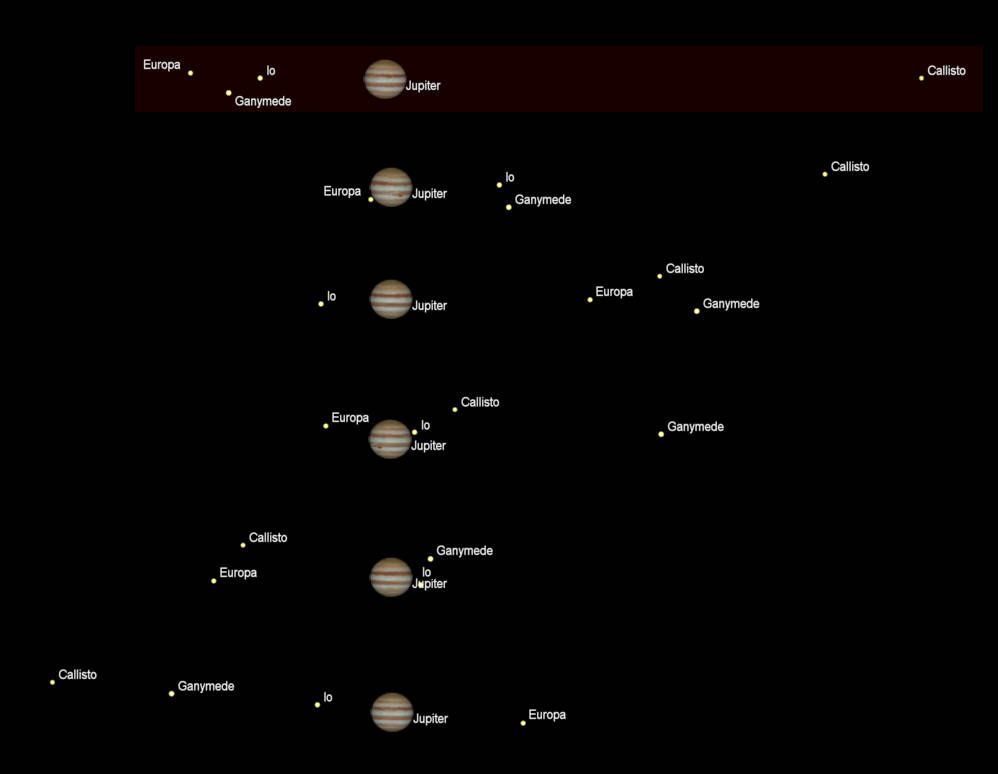
Jupiter and its four Galilean moons as seen for six consecutive nights starting tonight November 2nd (top) through November 7th, 2023 (bottom). Click or tap on the image to enlarge it. Created using Cartes du Ciel (Sky Charts) and GIMP.

Follow Jupiter’s moons with this tool: Sky & Telescope’s Interactive Tool for Observing Jupiter’s Moons.

Ephemeris: 11/01/2023 – It’s 11/1, do you know where your naked-eye planets are?

November 1, 2023 Comments off

This is Ephemeris for Wednesday, November 1st. The Sun will rise at 8:20. It’ll be up for 10 hours and 11 minutes, setting at 6:31. The Moon, halfway from full to last quarter, will rise at 8:58 this evening.

Let’s find out where the naked-eye planets have wandered off to this week. Three of those five planets are now visible, but Mars and Mercury set too close to sunset to be seen. Saturn is the sole official evening planet visible. It can be spotted in the southeast to south in the evening. And it will still be visible in the morning hours until it sets at 2:21 am. Saturn is seen against the stars of Aquarius this year and next. Jupiter and Venus are the visible morning planets. Jupiter, still a morning planet for one more day, will rise at 6:34 pm. It’s in Aries this year. Jupiter has to rise before sunset to be an evening planet. Venus, the brilliant morning star, will rise in the east-northeast at 4:18 am.

The astronomical event times given are for the Traverse City/Interlochen area of Michigan (EDT, UT –4 hours). They may be different for your location.

Addendum
Jupiter and Saturn with the rising waning gibbous Moon tonight at 9 pm, November 1st, 2023. Click or tap on the image to enlarge it. Created using Stellarium.
The waning gibbous Moon halfway from full to last quarter at 10 pm tonight, November 1, 2023. Created using Stellarium, LibreOffice Draw, and GIMP.
Morning planets and the Moon at 7 am tomorrow, November 2, 2023. Click or tap on the image to enlarge it. Created using Stellarium.
Telescopic Saturn, Jupiter and Venus (north up) as they would be seen in a small telescope, with the same magnification. At 10 pm November 1, 2023, for Saturn and Jupiter, and 7 am on the 2nd, for Venus. Apparent diameters: Saturn 17.77″, its rings 41.40″; Jupiter 49.50″; and Venus 21.80″ and is 55.4% illuminated. The ” symbol means seconds of arc (1/3600th of a degree.) Created using Cartes du Ciel (Sky Charts).
The naked-eye planets and the Moon at sunset and sunrise on a single night, starting with sunset on the right on November 1, 2023. The night ends on the left with sunrise on the 2nd. Click or tap on the image to enlarge it. Created using my LookingUp app and GIMP.

Ephemeris: 10/25/2023 – Where have the naked-eye planets wandered off to?

October 25, 2023 Comments off

This is Bob Moler with Ephemeris for Wednesday, October 25th. Today the Sun will be up for 10 hours and 30 minutes, setting at 6:42, and it will rise tomorrow at 8:12. The Moon, 3 days before full, will set at 5:16 tomorrow morning.

Let’s find out where the naked-eye planets have wandered off to this week. Three of those five planets are now visible, but Mars sets too close to sunset to be seen, and Mercury rises too close to sunrise. Saturn is the sole official evening planet visible. It can be spotted in the southeast to south in the evening. And it will still be visible in the morning hours until it sets at 2:49 am. Saturn is seen against the stars of Aquarius this year and next. Jupiter and Venus are the visible morning planets. Jupiter, still a morning planet for one more week, will rise at 7:04 pm. It’s in Aries this year. Jupiter has to rise before sunset to be an evening planet. Venus, the brilliant morning star, will rise in the east-northeast at 4:09 am.

The astronomical event times given are for the Traverse City/Interlochen area of Michigan (EDT, UT –4 hours). They may be different for your location.

Addendum
Jupiter and Saturn with the gibbous Moon tonight at 9 pm, October 25th 2023. Created using Stellarium.
The moon As it might be seen in a small telescope or binoculars, with selected features labeled, at 9 pm this evening, October 25th 2023. Created using Stellarium, LibreOffice Draw, and GIMP.
Venus as seen in the sky at 7:00 tomorrow morning, October 26th 2023. It’s seen below constellation of Leo the lion a constellation of spring evenings. Jupiter, not shown, is low in the west at that hour. Created using Stellarium.
Telescopic Saturn, Jupiter and Venus (north up) as they would be seen in a small telescope, with the same magnification. At 9 pm October 25, 2023, for Saturn and Jupiter, and 7 am October 26, for Venus. Apparent diameters: Saturn 17.97″, its rings 41.87″; Jupiter 49.41″; and Venus 23.41″ and is 51.9% illuminated. Note that for Jupiter Europa will disappear in Jupiter’s shadow at 11:33 pm and end its occultation by Jupiter on the other side at 2:16 am; Io will enter Jupiter’s shadow at 6:25 am. The ” symbol means seconds of arc (1/3600th of a degree.) Created using Cartes du Ciel (Sky Charts). Jupiter satellite event timings were taken from https://www.projectpluto.com/jevent.htm
The naked-eye planets and the Moon at sunset and sunrise on a single night, starting with sunset on the right on October 25, 2023. The night ends on the left with sunrise on the 26th. Click or tap on the image to enlarge it. Created using my LookingUp app and GIMP.

Ephemeris: 10/18/2023 – Where have the naked-eye planets wandered off to this week

October 18, 2023 Comments off

This is Ephemeris for Wednesday, October 18th. Today the Sun will be up for 10 hours and 51 minutes, setting at 6:53, and it will rise tomorrow at 8:03. The Moon, 3 days before first quarter, will set at 8:50 this evening.

Let’s find out where the naked-eye planets have wandered off to this week. Three of those five planets are now visible, but Mars sets too close to sunset to be seen, and Mercury rises too close to sunrise, and besides it will enter the evening sky after Friday. Saturn is the sole official evening planet visible. It can be spotted in the southeast to south in the evening. And it will still be visible in the morning hours until it sets at 3:17 am. Saturn is seen against the stars of Aquarius this year and next. Jupiter and Venus are the visible morning planets. Jupiter, still a morning planet, will rise at 7:34 pm. It’s in Aries this year. Jupiter has to rise before sunset to be an evening planet. Venus, the brilliant morning star, will rise in the east-northeast at 4:02 am.

The astronomical event times given are for the Traverse City/Interlochen area of Michigan (EDT, UT –4 hours). They may be different for your location.

Addendum
The Moon tonight
The waxing crescent Moon, as it might appear in binoculars or a small telescope tonight, October 18th 2023, before it sets. Created using Stellarium, LibreOffice Draw and GIMP.
Evening planets
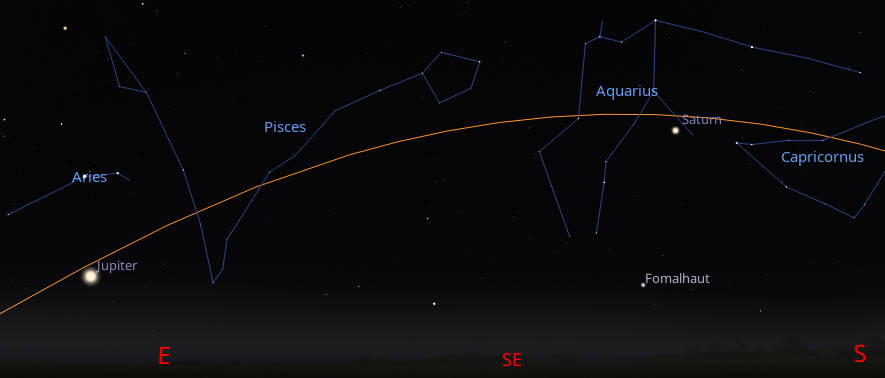
Jupiter and Saturn in the east and south-southeast respectively. They should be easy to spot due to the fact that they are in a relatively star poor region of the sky against the faint constellations of Aries, for Jupiter and Aquarius for Saturn. This year Saturn is keeping the normally loneliest star in the sky, Fomalhaut, company. Click or tap on the image to enlarge it. Created using Stellarium.
Morning planets
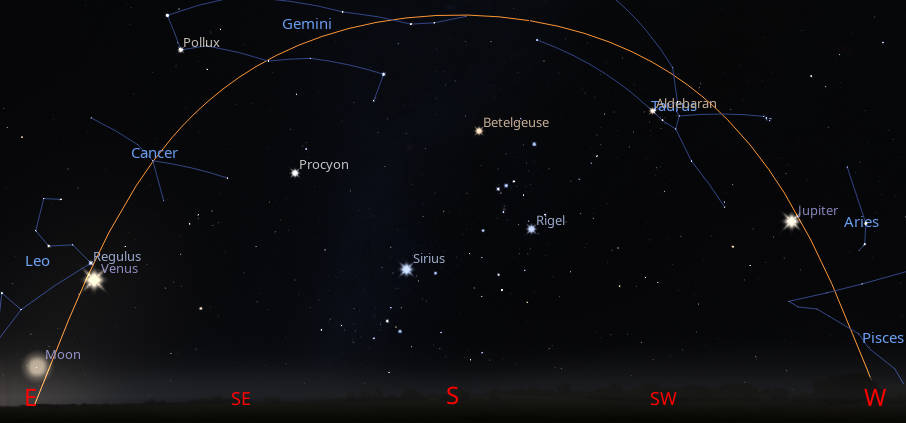
The morning planets Jupiter and Venus are on opposite sides of the sky at 7 am tomorrow, October 19, 2023, with the winter constellations and stars between them. The orange line is the ecliptic, the path of the Sun, also near which the planets hang out. We’re getting a preview of the winter skies, which will include Jupiter, but Venus will be gone, chasing the Sun. Click or tap on the image to enlarge it. Created using Stellarium.
Telescopic planets
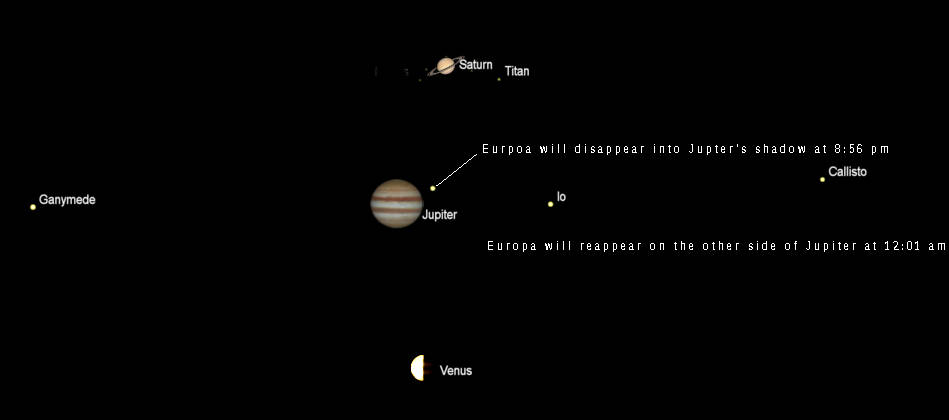
Telescopic Saturn, Jupiter and Venus (north up) as they would be seen in a small telescope, with the same magnification. At 9 pm October 18, 2023, for Saturn and Jupiter, and 7 am October 12, 2023, for Venus. Apparent diameters: Saturn 18.17″, its rings 42.32″; Jupiter 49.14″; and Venus 25.28″ and is 47.3% illuminated. Note that for Jupiter Europa is labeled but visible but labeled by me. It is in Jupiter’s shadow at 9 pm, having entered it at 8:56 pm, and it will reappear from behind Jupiter at 12.01 am. Io will continue to approach Jupiter throughout the evening and enter Jupiter’s shadow at 4:30 am and will reappear from occultation on the other side of the planet at 7:02 am. The ” symbol means seconds of arc (1/3600th of a degree.) Created using Cartes du Ciel (Sky Charts).
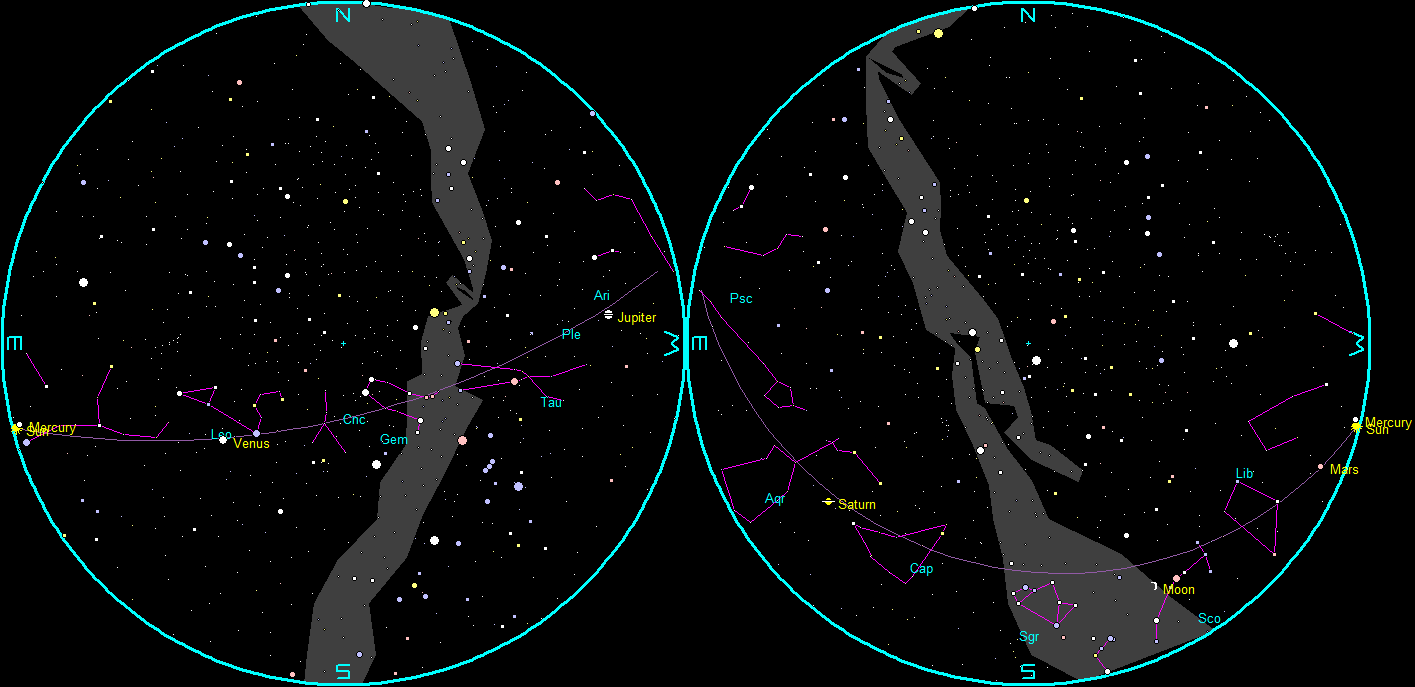
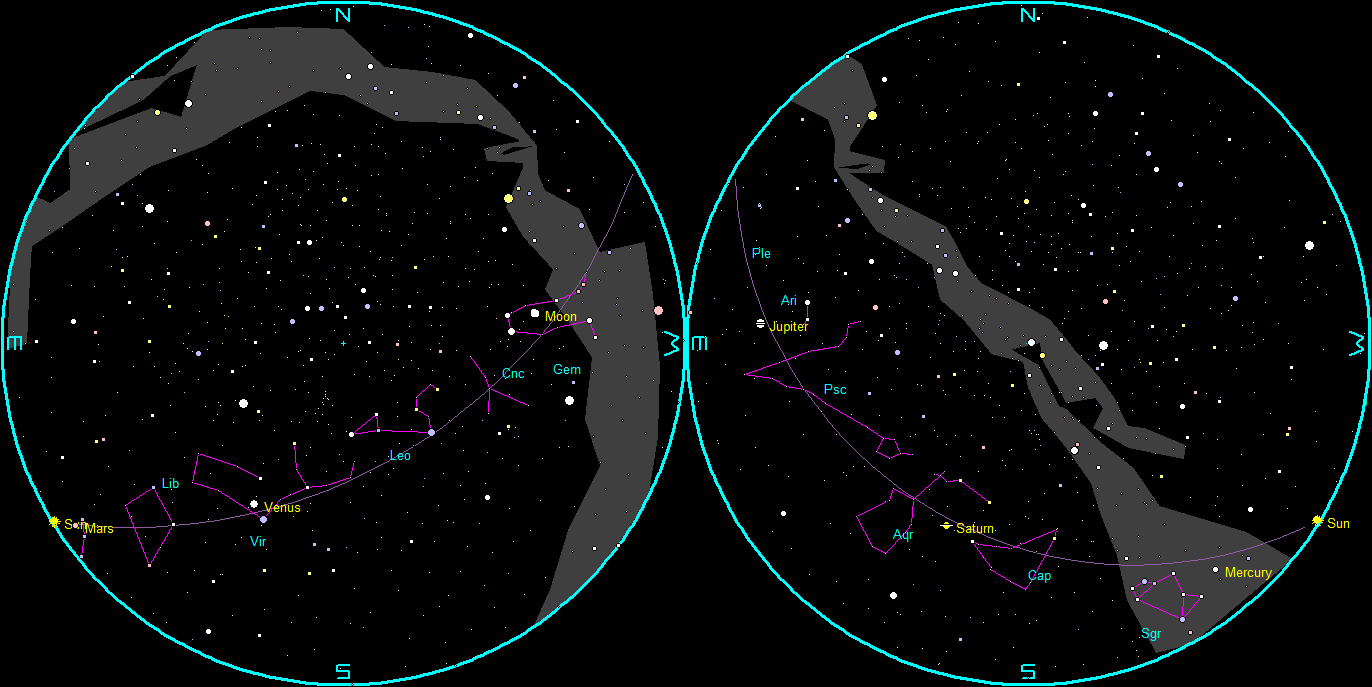
The naked-eye planets and the Moon at sunset and sunrise on a single night, starting with sunset on the right on October 18, 2023. The night ends on the left with sunrise on the 19th
The naked-eye planets and the Moon at sunset and sunrise on a single night, starting with sunset on the right on October 18, 2023. The night ends on the left with sunrise on the 19th. Click or tap on the image to enlarge it. Created using my LookingUp app and GIMP.

Ephemeris: 10/11/2023 – Where have the naked-eye planets wandered off to this week?

October 11, 2023 Comments off

This is Ephemeris for International Day of the Girl, Wednesday, October 11th. Today the Sun will be up for 11 hours and 12 minutes, setting at 7:05, and it will rise tomorrow at 7:54. The Moon, 3 days before new, will rise at 5:35 tomorrow morning.

Let’s find out where the naked-eye planets have wandered off to this week. Three of those five planets are now visible, but Mars sets too close to sunset to be seen, and Mercury rises too close to sunrise. Saturn is the sole official evening planet visible. It can be spotted in the southeast in the evening. And it will still be visible in the morning hours until it sets at 3:46 am. Saturn is seen against the stars of Aquarius this year and next. Jupiter and Venus are the visible morning planets. Jupiter, still a morning planet, will rise at 8:04 pm. It’s in Ares this year. It has to rise before sunset to be an official evening planet. Venus, the brilliant morning star, will rise in the east-northeast at 3:57 am, and be seen in the east thereafter.

The astronomical event times given are for the Traverse City/Interlochen area of Michigan (EDT, UT –4 hours). They may be different for your location.

Addendum
Jupiter and Saturn and the constellations of the Zodiac
Jupiter and Saturn and the constellations of the Zodiac with the ecliptic for 9 pm tonight October 11th 2023. Click or tap on the image to enlarge it. Created using Stellarium.
Venus and Jupiter, with the constellations of the Zodiac
Venus and Jupiter, with the constellations of the Zodiac and the ecliptic, at 6:30 am tomorrow morning, October 12th, 2023. Click or tap on the image to enlarge it. Created using Stellarium.
The Moon, with earthshine
The Moon, with earthshine, as it might appear in binoculars at 6:30 tomorrow morning, a bit more than 2 days before the annular solar eclipse. Created using Stellarium.
Telescopic Saturn, Jupiter and Venus
Telescopic Saturn, Jupiter and Venus (north up) as they would be seen in a small telescope, with the same magnification at 9 pm October 11, 2023, for Saturn and Jupiter, and 6:30 am October 12, 2023, for Venus. Apparent diameters: Saturn 18.32″, its rings 42.68″; Jupiter 48.77″; and Venus 27.47″ and is 44.0% illuminated. Note that for Jupiter Europa is labeled but not visible. It is in occultation behind Jupiter at 9 pm, and will reappear from behind Jupiter at 9:47 pm. Io will continue to approach Jupiter throughout the evening and enter Jupiter’s shadow at 2:35 am tomorrow morning and will reappear from occultation on the other side of the planet at 5:19 am. The ” symbol means seconds of arc (1/3600th of a degree.) Created using Cartes du Ciel (Sky Charts).
The naked-eye planets and the Moon at sunset and sunrise
The naked-eye planets and the Moon at sunset and sunrise on a single night, starting with sunset on the right on October 11, 2023. The night ends on the left with sunrise on the 12th. Click or tap on the image to enlarge it. Created using my LookingUp app and GIMP.

Ephemeris: 10/04/2023 – Let’s find out where the naked-eye planets have wandered off to this week

October 4, 2023 Comments off

This is Ephemeris for Wednesday, October 4th. Today the Sun will be up for 11 hours and 33 minutes, setting at 7:18, and it will rise tomorrow at 7:45. The Moon, 2 days before last quarter, will rise at 10:18 this evening.

Let’s find out where the naked-eye planets have wandered off to this week. Three of those five planets are now visible, but Mars sets too close to sunset to be seen, and Mercury rises too late. Saturn is the sole evening planet visible. It can be spotted in the southeast in the evening. And it will still be visible most of the morning hours morning until it sets at 4:15 am. Saturn is in retrograde or westward motion now, against the stars of Aquarius, and will continue to do so until November 5th. Jupiter and Venus are the visible morning planets. Jupiter, in Aries, will rise at 8:29 pm. It, like Saturn is in retrograde, which will last the rest of this year. Venus is our brilliant morning star which will rise in the east-northeast at 3:56 am.

The astronomical event times given are for the Traverse City/Interlochen area of Michigan (EDT, UT –4 hours). They may be different for your location.

Addendum
Jupiter and Saturn among the constellations of the Zodiac, plus Piscis Austrinus with the loneliest star in the sky, Fomalhaut, at 9 pm tonight, October 4, 2023. Click or tap on image to enlarge it. Created using Stellarium.
Jupiter and Venus and the Moon with the constellations of the Zodiac, plus Orion, at 6 am tomorrow morning, October 5, 2023. Click or tap in the image to enlarge it. Created using Stellarium.
The waning Moon about 1 day before last quarter at 6 am tomorrow, October 5, 2023. Created using Stellarium, LibreOffice Draw, and GIMP.
Telescopic Saturn, Jupiter and Venus (north up) as they would be seen in a small telescope, with the same magnification at 10 pm October 4, 2023, for Saturn and Jupiter, and 6 am October 5, 2023, for Venus. Apparent diameters: Saturn 18.51″, its rings 43.17″; Jupiter 48.02″; and Venus 30.46″ and is 38.8% illuminated. The ” symbol means seconds of arc (1/3600th of a degree.) Created using Cartes du Ciel (Sky Charts).

The naked-eye planets and the Moon at sunset and sunrise on a single night, starting with sunset on the right on October 4, 2023. The night ends on the left with sunrise on the 5th. Click or tap on the image to enlarge it. Created using my LookingUp app and GIMP.