Archive

Posts Tagged ‘Jupiter’

Ephemeris: 04/10/2024 – Where have the naked-eye planets wandered off to?

April 10, 2024 Comments off

This post was updated due to it being uploaded late, and without illustrations. This was due to my recovery from the mad dash eclipse trip Sunday through Tuesday. By the way it was glorious! I shall recount it soon in an Ephemeris Extra post.

This is Ephemeris for Wednesday, April 10th. Today the Sun will be up for 13 hours and 16 minutes, setting at 8:22, and it will rise tomorrow at 7:04. The Moon, 2 days past new, will set at 11:21 this evening.

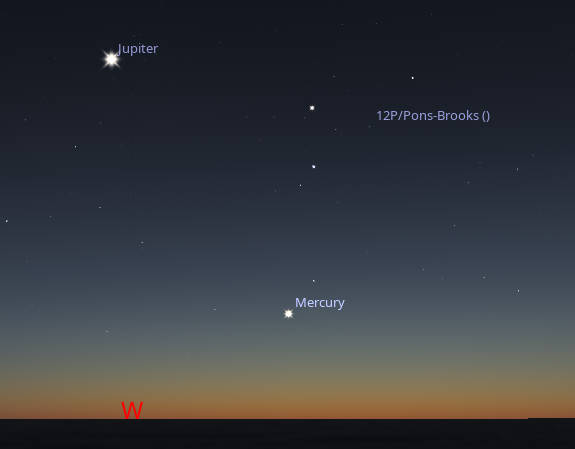
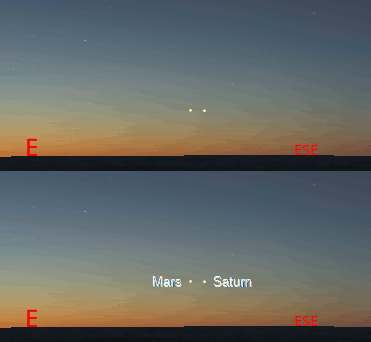
Let’s find out where the naked-eye planets have wandered off to this week, and see what planets are left. Bright Jupiter is low and in the west, and tonight only can be seen below the crescent Moon. It will set at 10:25 pm. We are getting close to losing Jupiter in the evening sky. Comet 12P/Pons-Brooks is just below-right of it. Though officially naked-eye brightness, one has to have very good eyes, binoculars or telescope to spot it. In my Wednesday blog posts at bobmoler.wordpress.com I have finder charts. In the morning Mars, and Saturn will be very close together in the east southeastern sky at 6:30. They will be fighting the bright morning twilight and low altitude then.

The astronomical event times given are for the Traverse City/Interlochen area of Michigan (EDT, UT–4 hours). They may be different for your location.

Addendum
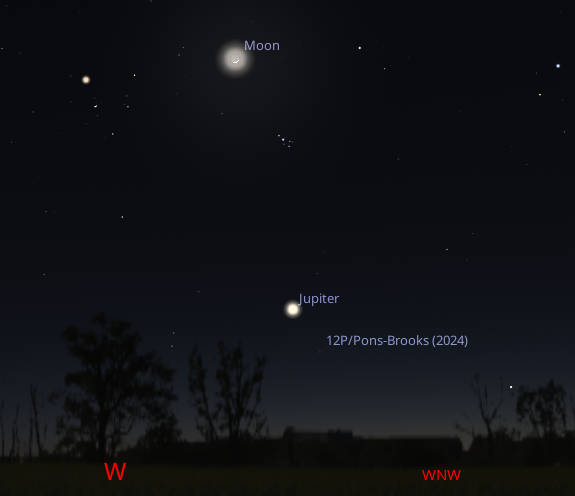
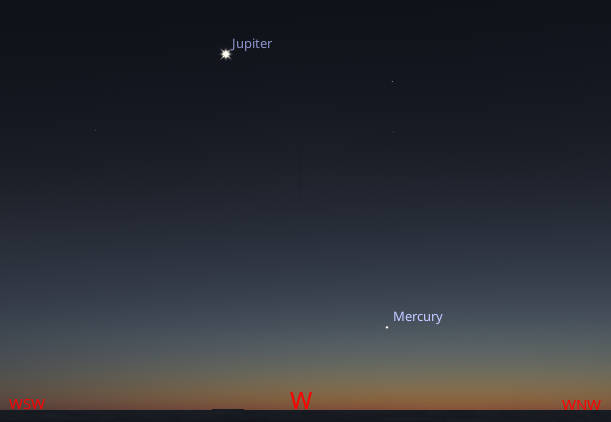
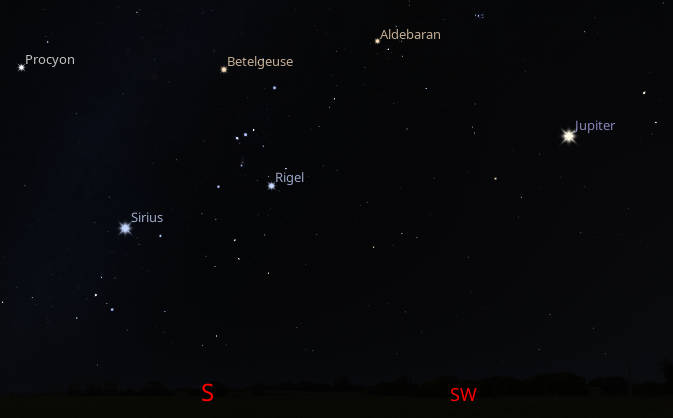
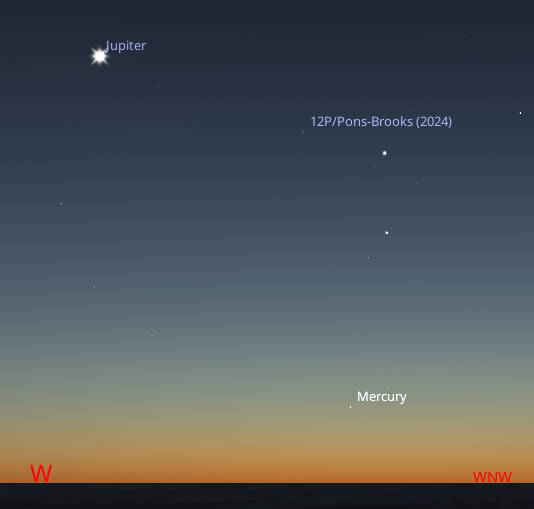
The Moon, Jupiter and Comet Pons-Brooks for 9:30 PM Thursday April 11th 2024. Due to the late post I’m showing this for tomorrow night. Created using Stellarium .
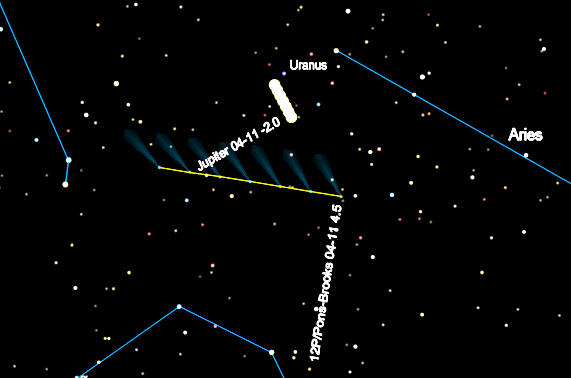
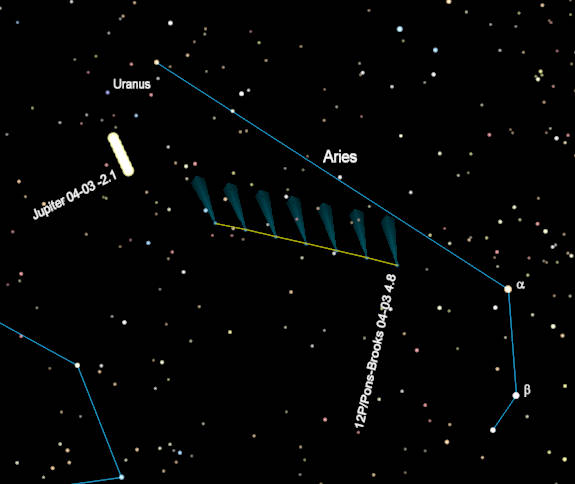
Here is a finder chart for Comet Pons-Brooks for the next week at 9:30 PM. Jupiter is also in the field. The first position is marked with the name, month and day, and the approximate magnitude. The chart shows a comet tail. The tail will probably not be visible visually, however if it is visible, that is the direction it will be pointing. Created using Cartes du Ciel (Sky Charts).
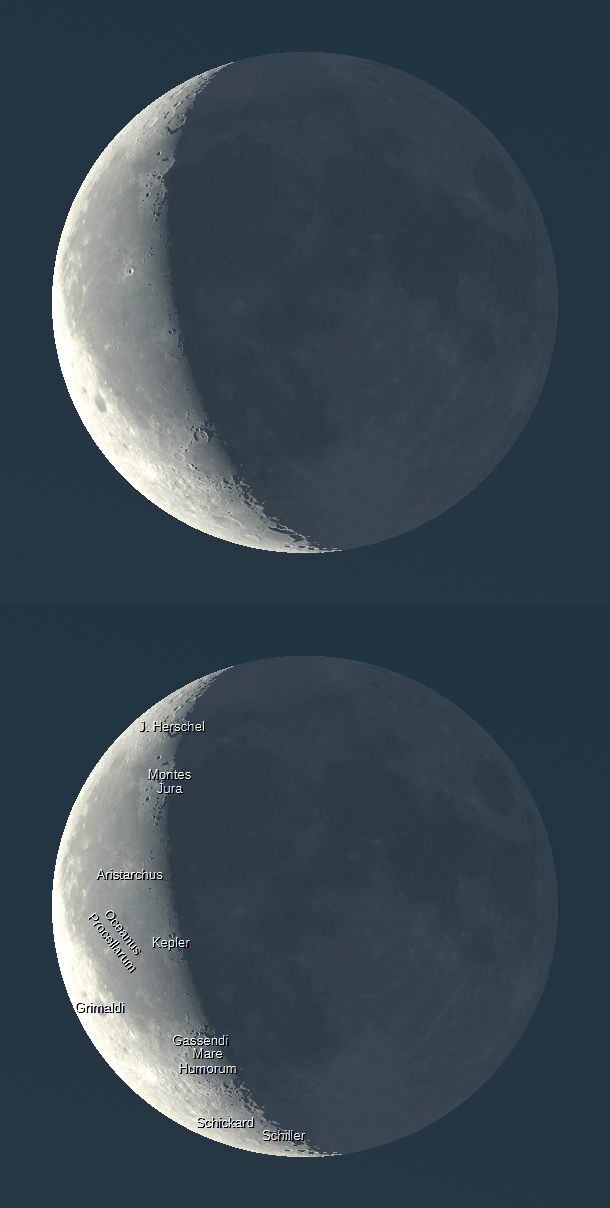
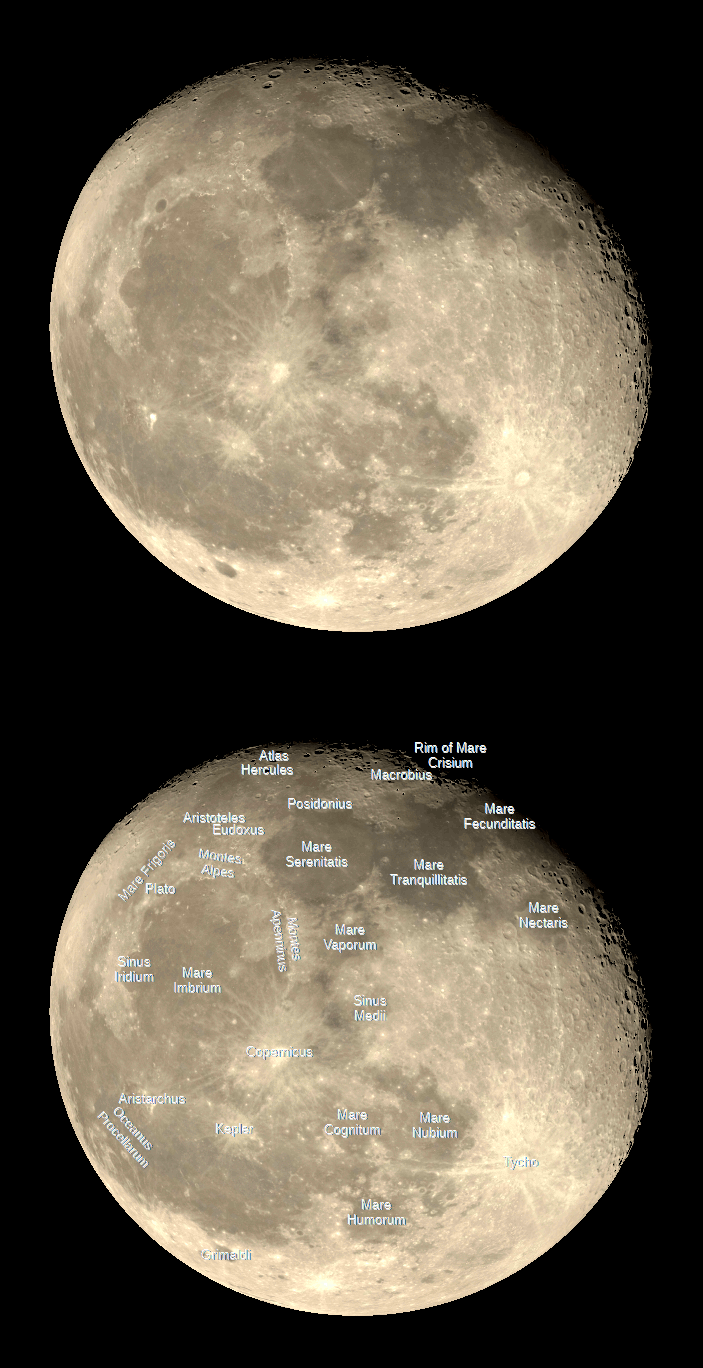
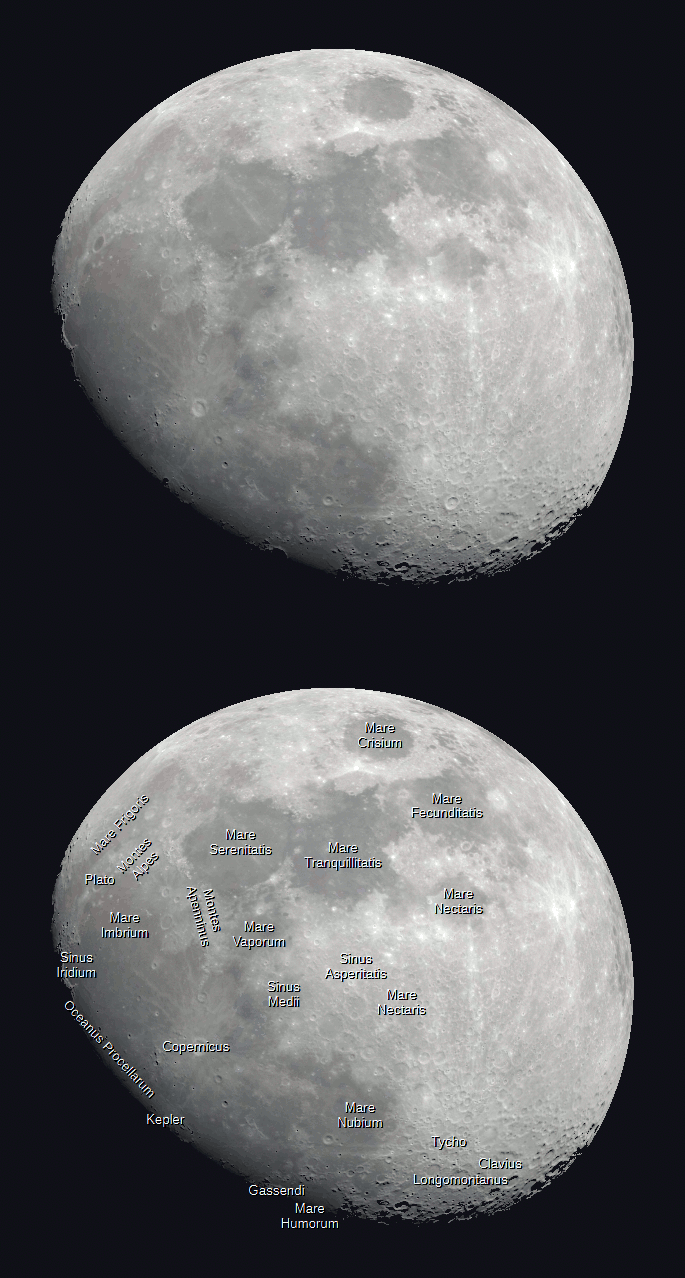
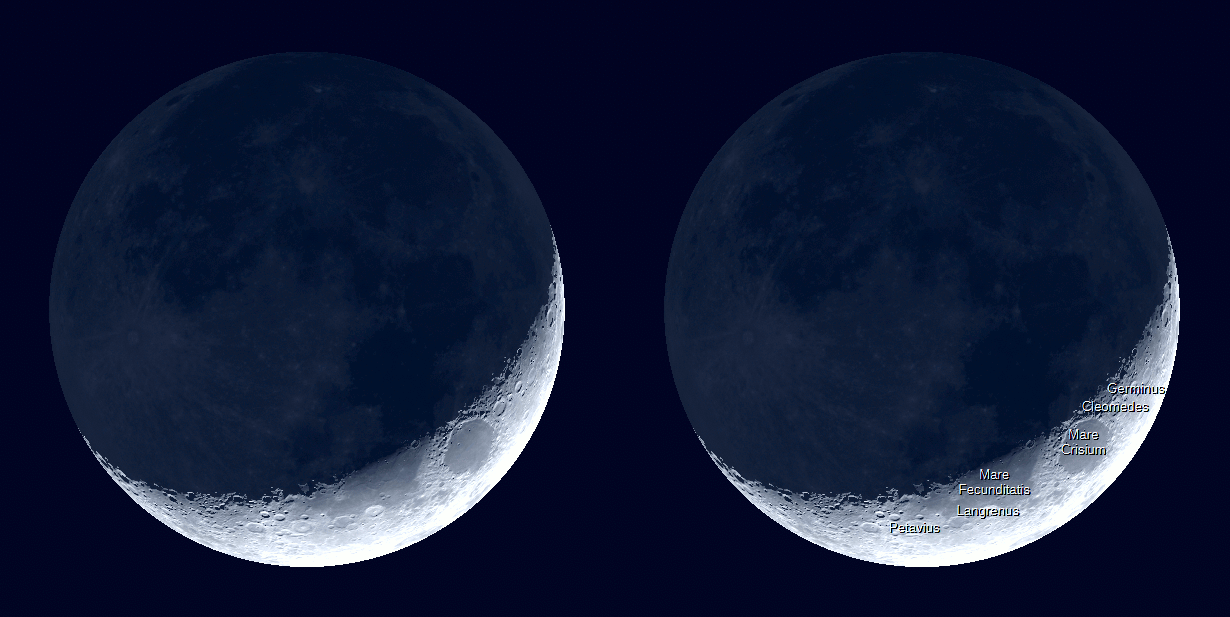
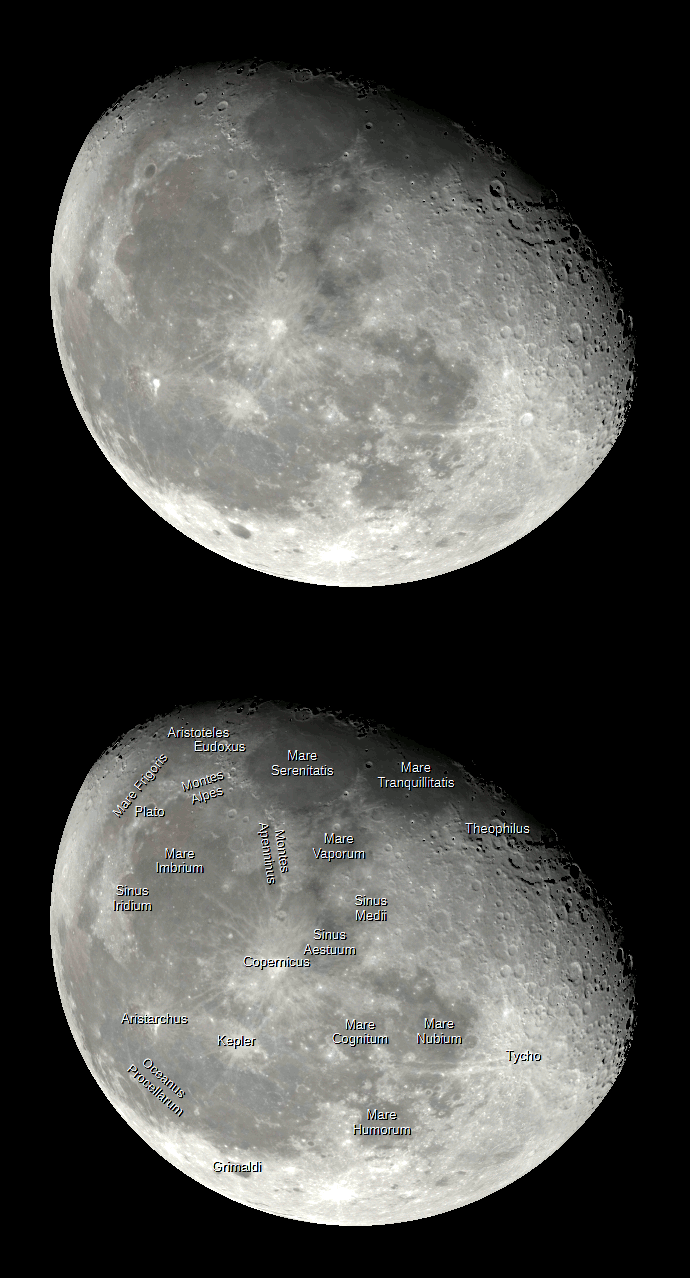
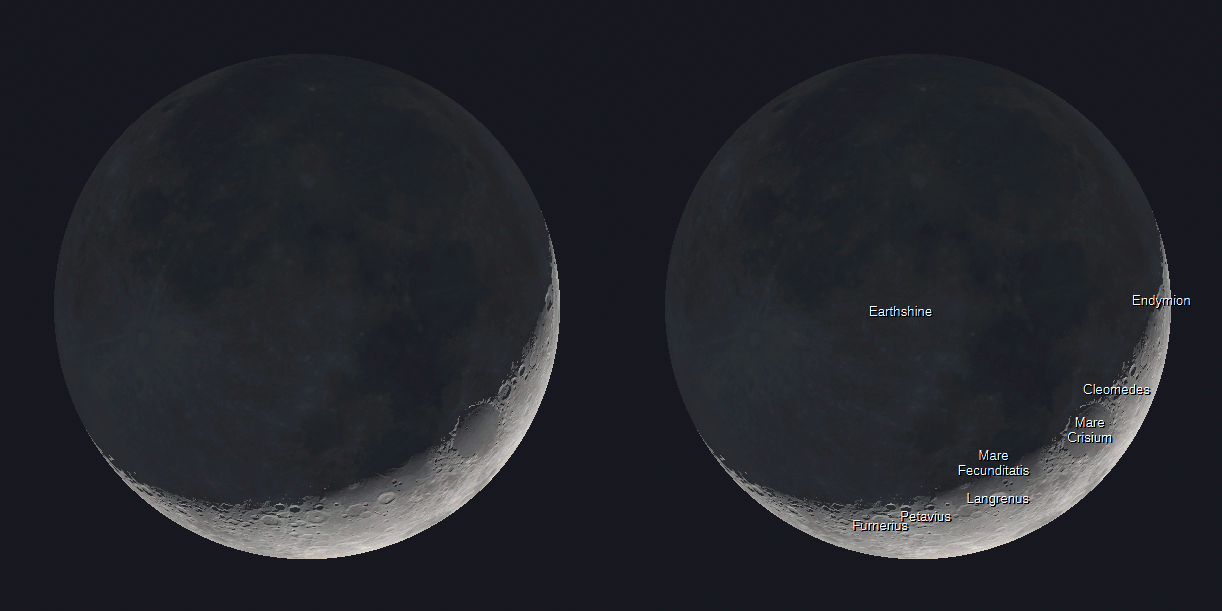
The three day old Moon as it might appear Thursday at 9:30 PM April 11th 2024 through binoculars or a small telescope. Selected features are labeled. Created using Stellarium, LibreOffice Draw, and GIMP.
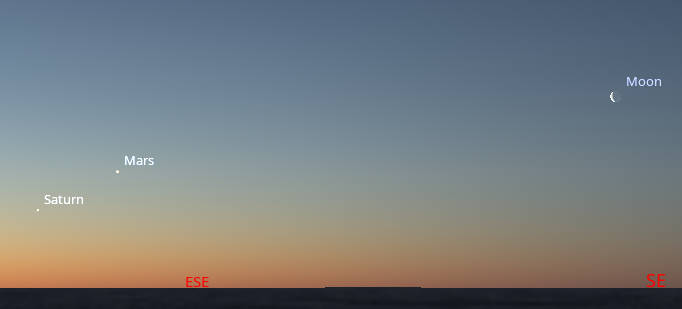
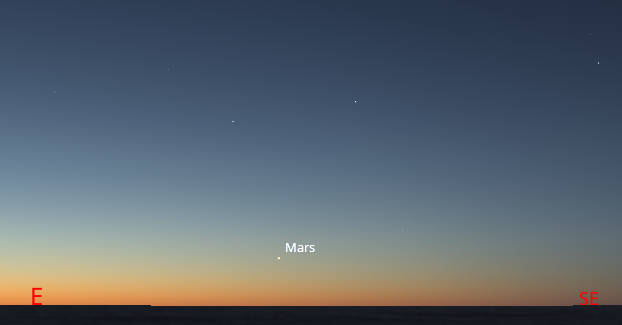
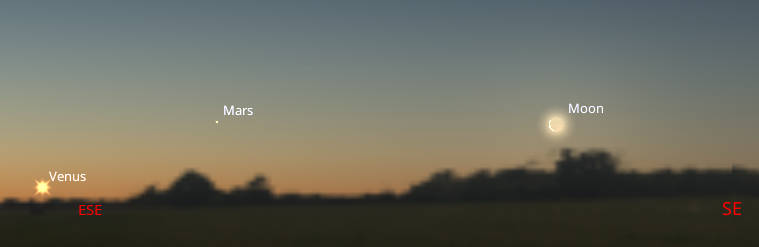
Mars and Saturn as they may appear side by side tomorrow morning April 12th 2024 at about 6:15 AM. They are probably shown somewhat brighter than they would normally appear in the sky. Created using Stellarium , LibreOffice Draw, and GIMP.
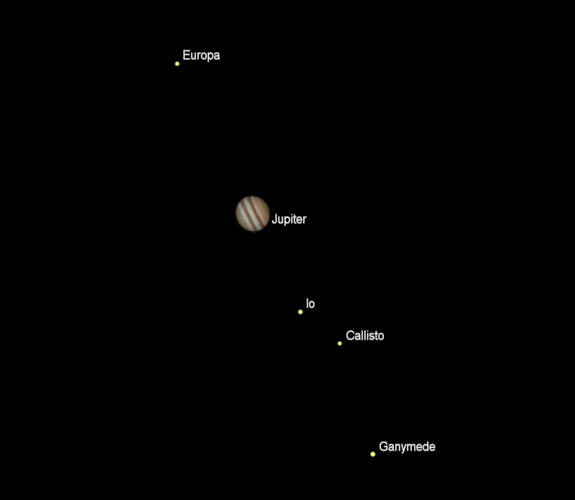
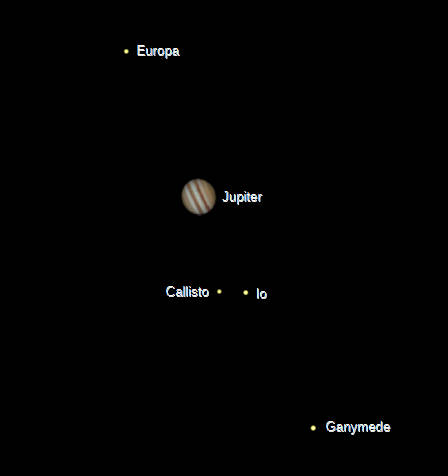
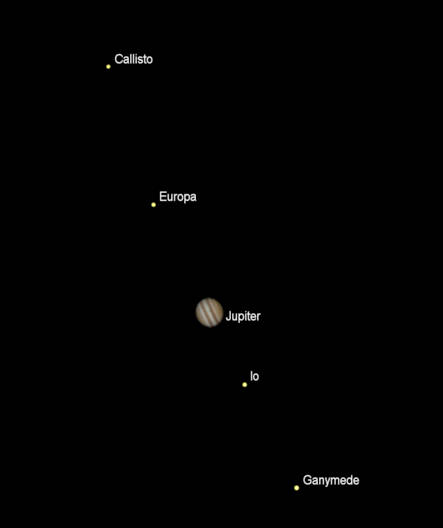
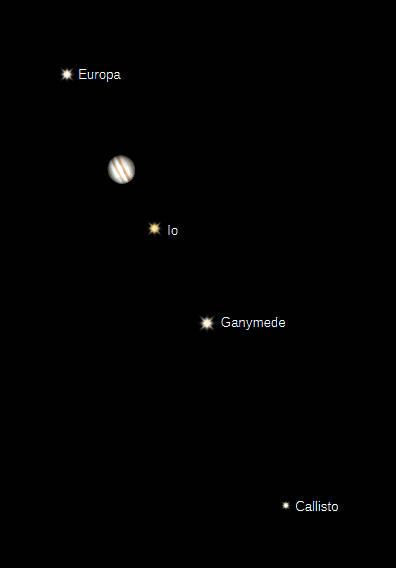
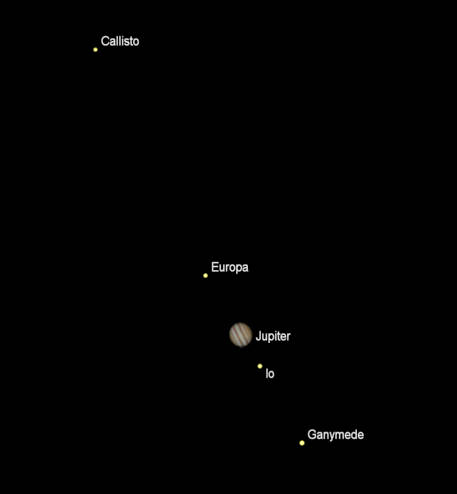
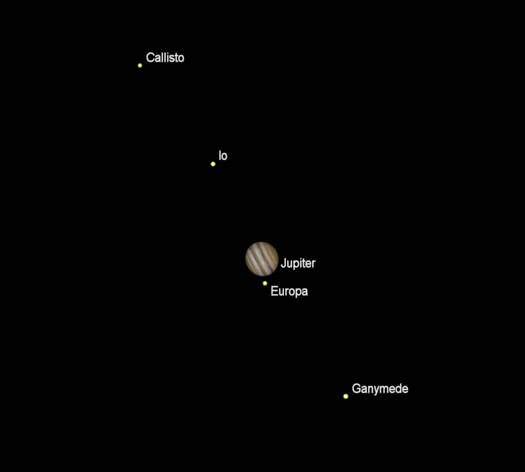
Jupiter as it might appear in a telescope at 9:30 April 11, 2024 in this erect image, showing the position of its Galilean moons. Jupiter’s apparent diameter is 33.54″. Created using Cartes du Ciel (Sky Charts).
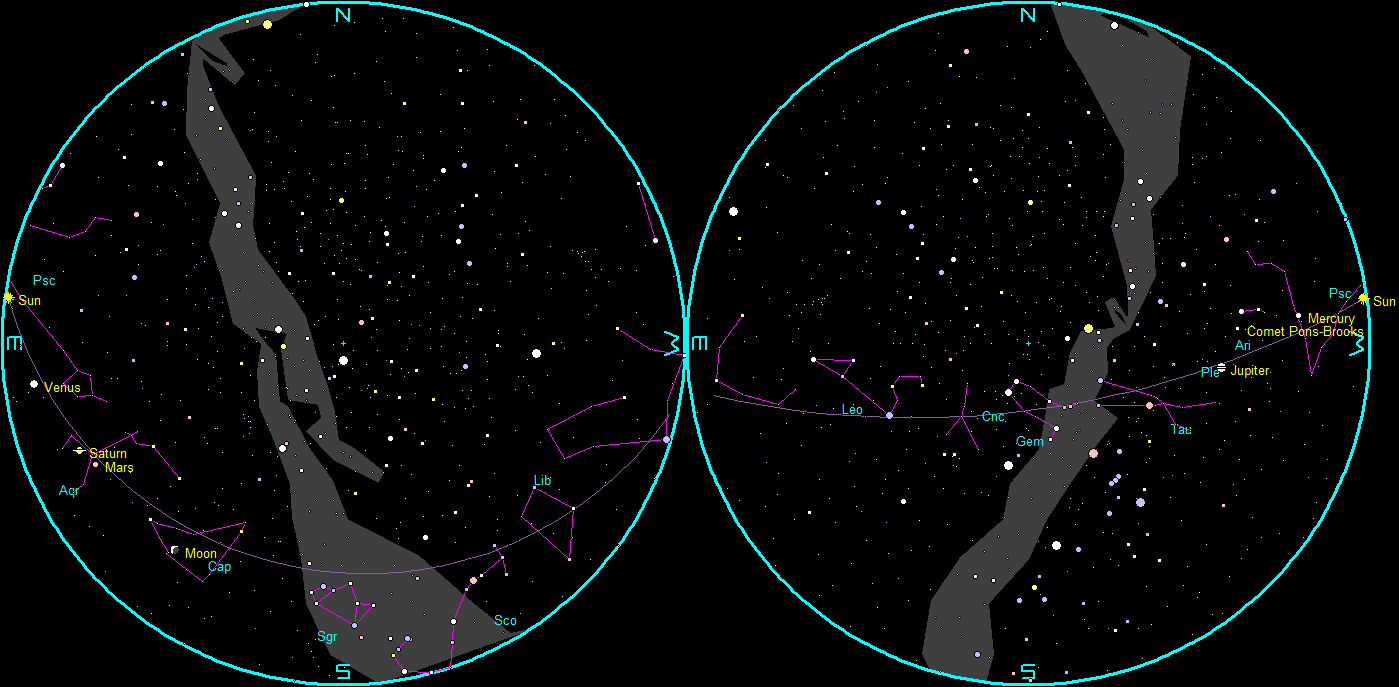
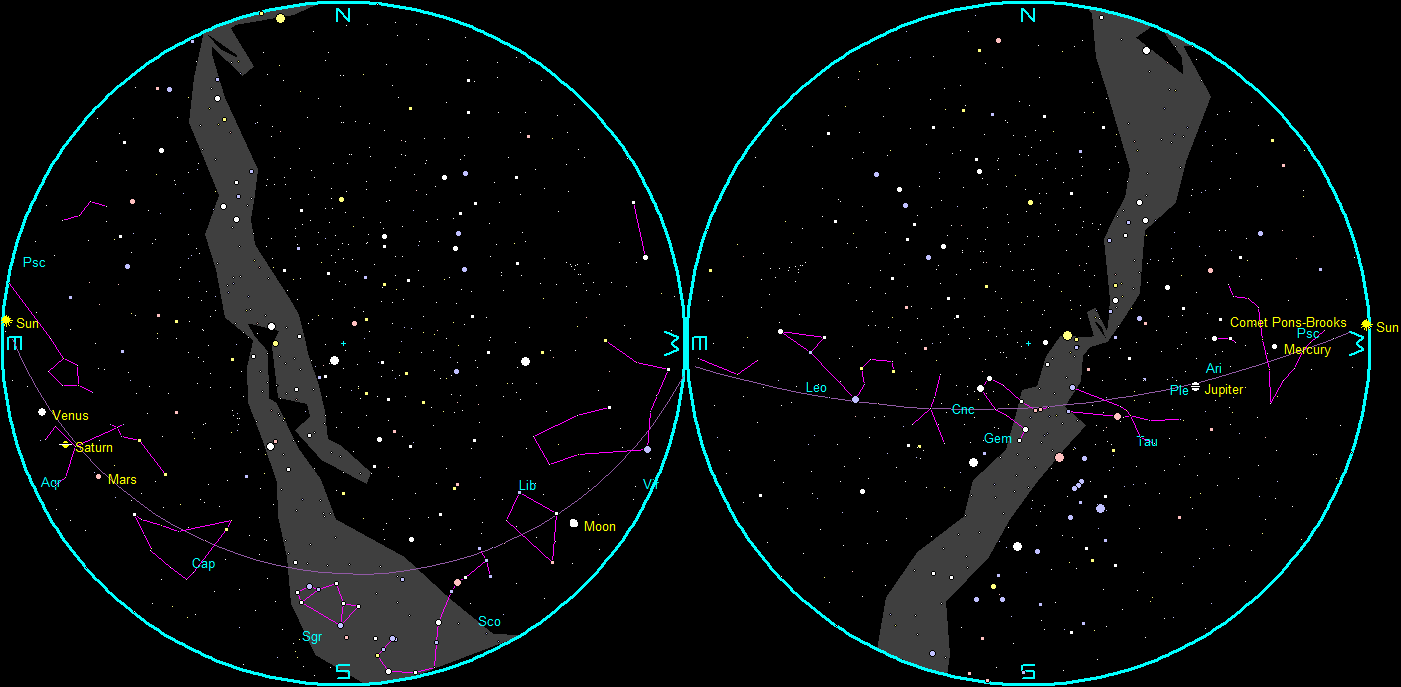
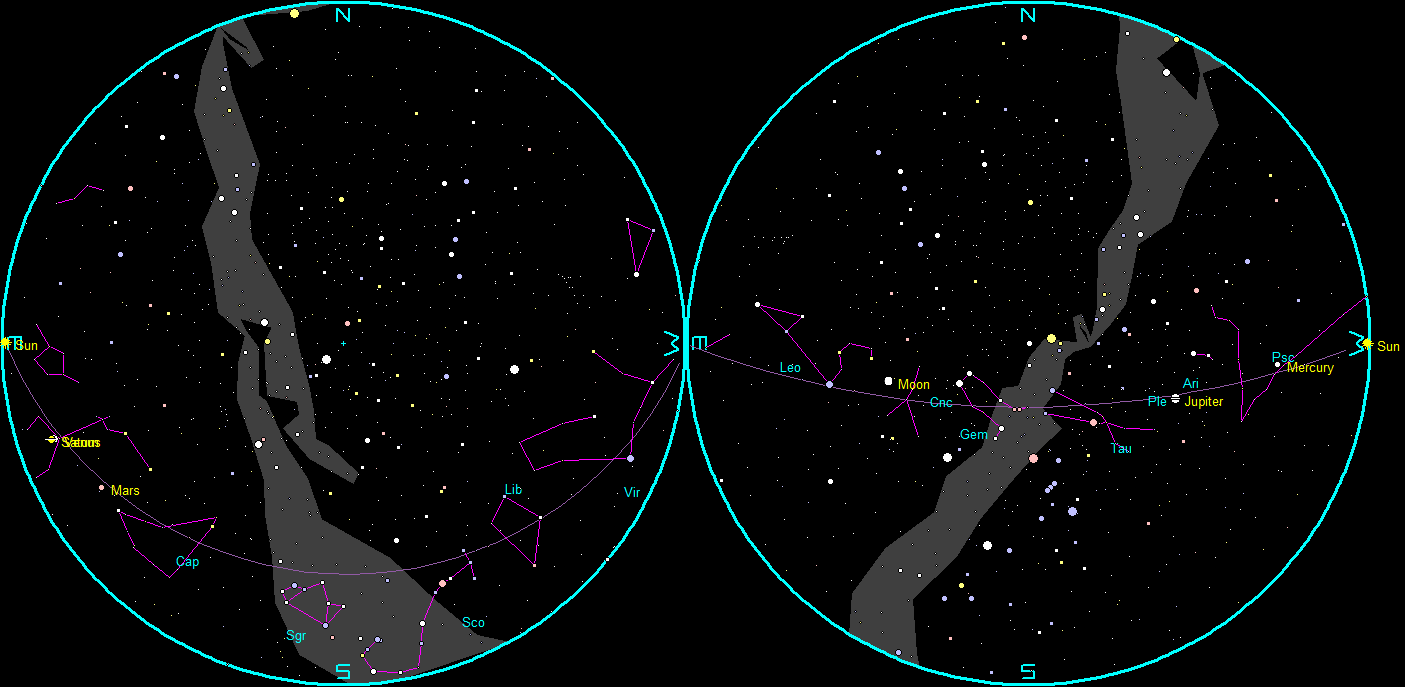
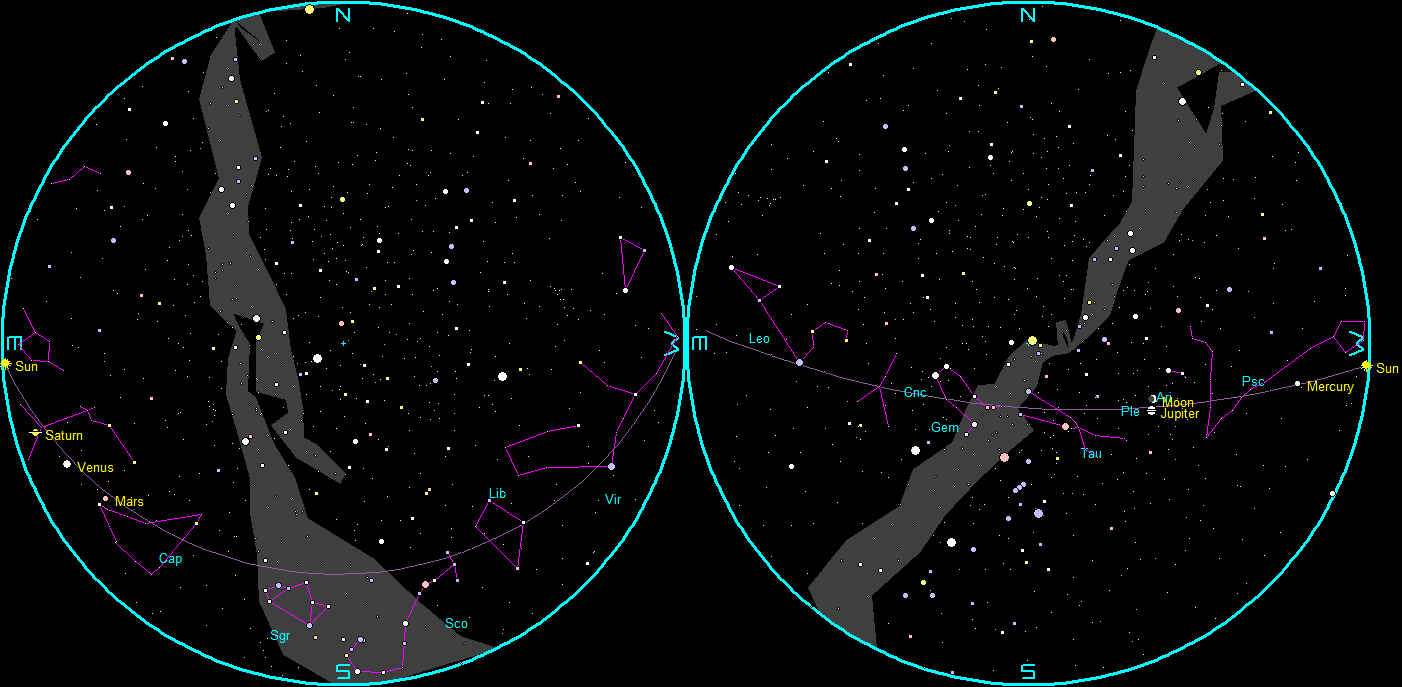
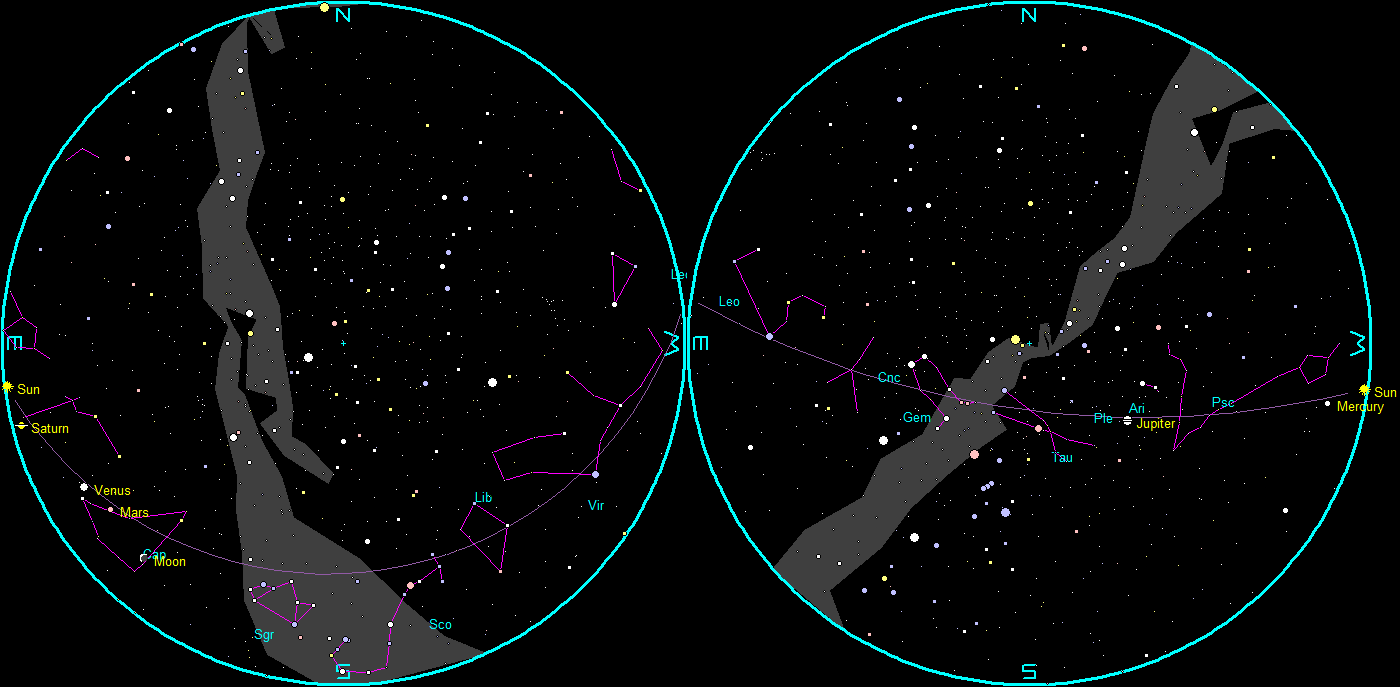
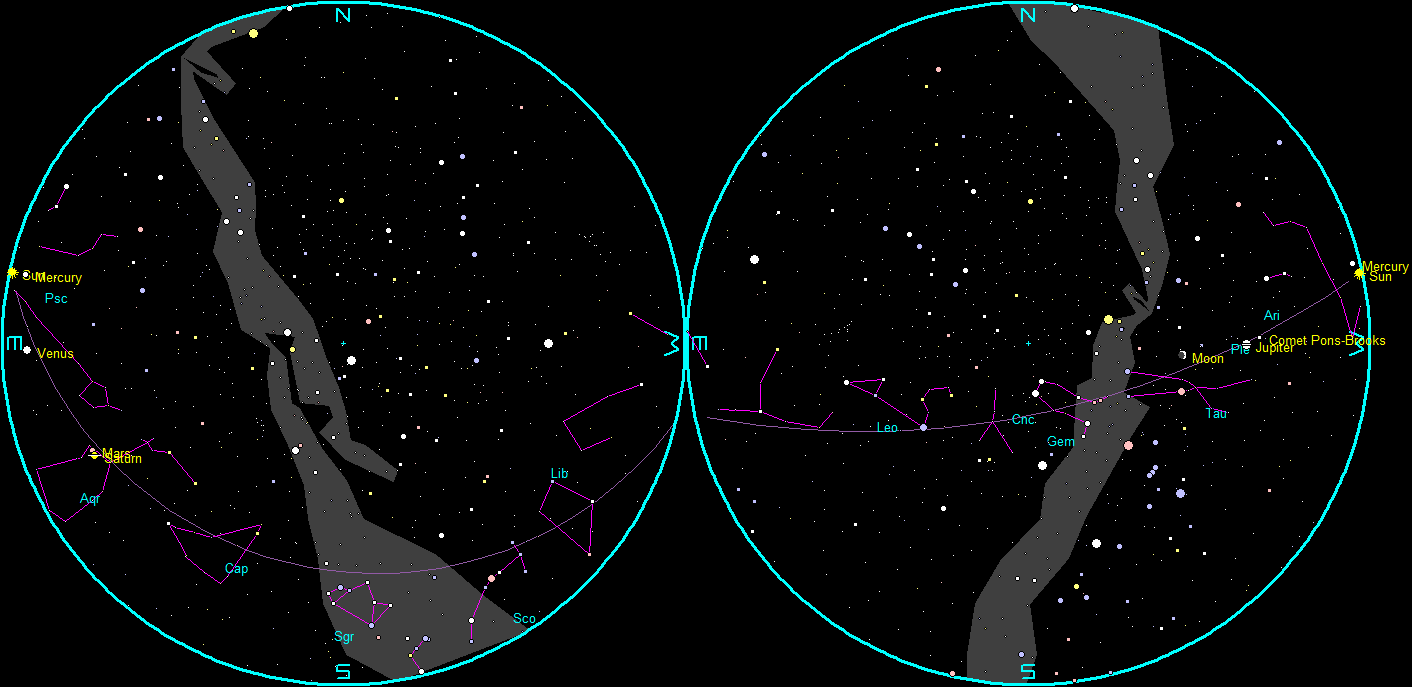
The naked-eye planets, Comet Pons-Brooks, and the Moon at sunset and sunrise on a single night, starting with sunset on the right tonight, April 11th 2024. The night ends on the left with sunrise tomorrow morning on the 12th. Click or tap on the image to enlarge it. Created using my LookingUp app and GIMP.

Ephemeris: 04/03/2024 – Where have the naked-eye planets wandered off to this week?

April 3, 2024 Comments off

This is Ephemeris for Wednesday, April 3rd. Today the Sun will be up for 12 hours and 54 minutes, setting at 8:13, and it will rise tomorrow at 7:17. The Moon, 2 days past last quarter, will rise at 5:33 tomorrow morning.

Let’s find out where the naked-eye planets have wandered off to this week, and see what planets are left. Mercury is now too close to the Sun to be spotted. Bright Jupiter is due west at 8:45 pm or a half hour after sunset. It will set at 11:05 pm. We are getting close to losing Jupiter in the evening sky. Comet 12P/Pons-Brooks is right of and a bit below Jupiter in the evening. Though officially naked-eye brightness, one has to have very good eyes, binoculars or telescope to spot it. In my Wednesday blog posts at bobmoler.wordpress.com I have finder charts. In the morning Mars, and especially Venus and Saturn may be impossible to spot, in the east-southeast in the bright twilight. Mars will rise at 6:10, and will be very low in the east-southeast at 6:45 am.

The astronomical event times given are for the Traverse City/Interlochen area of Michigan (EDT, UT–4 hours). They may be different for your location.

Addendum
Jupiter and Mercury as might be seen at 9:00 PM, or nearly three quarters of an hour after sunset, tonight April 3rd 2024 . Also Comet Pons-Brooks is in the same general area of the sky. It is 5th magnitude, and probably not visible without binoculars or a small telescope. Mercury is definiotely not visible wothout a telescope. Created using Stellarium.
A finder chart for Comet Pons-Brooks for the next week
Here is a finder chart for Comet Pons-Brooks for the next week at 9:30 PM. Jupiter is also in the field. The first position is marked with the name, month and day, and the approximate magnitude. The chart shows a comet tail. The tail will probably not be visible visually, however if it is visible, that is the direction it will be pointing. Created using Cartes du Ciel (Sky Charts).

During the solar eclipse on the 8th, during totality, the comet will be located around the 2nd to the last position of its track. However, unless it is obviously noticeable, totality time is too short to use trying to find it. Enjoy the glory of the sun’s corona for the brief time you have.

The Moon, Mars, and Saturn as they might appear about 6:45 in the morning about 1/2 an hour before sunrise low in the east-southeast to southeast. Mars and Saturn are shown brighter than they might appear, so don’t be discouraged if you can’t see them. Created using Stellarium.
The Moon as seen in a pair binoculars or telescope around 6:45 tomorrow morning April 4th 2024
The moon as seen in a pair binoculars or telescope around 6:45 tomorrow morning April 4th 2024. Selected features are labeled. Montes Jura or the Jura Mountains on the terminator surround 3 sides of the Bay of Rainbows (Sinus Iridium). The crater J. Herschel is named after John Herschel, son of William Herschel, a more famous astronomer, who has a small crater near the center of the disk of the moon just north of crater named for Ptolemy and near another crater named for the Greek astronomer Hipparchus. Created using Stellarium, LibreOffice Draw, and GIMP.
Jupiter as it might appear in a telescope
Jupiter as it might appear in a telescope at 9:30 this evening in this erect image, showing the position of its Galilean moons. Jupiter’s apparent diameter is 33.93″. Created using Cartes du Ciel (Sky Charts).
The naked-eye planets, Comet Pons-Brooks, and the Moon at sunset and sunrise on a single night
The naked-eye planets, Comet Pons-Brooks, and the Moon at sunset and sunrise on a single night, starting with sunset on the right tonight, April 3rd 2024. The night ends on the left with sunrise tomorrow morning on the 4th. Click or tap on the image to enlarge it. Created using my LookingUp app and GIMP.

Ephemeris: 03/28/2024 Comet Pons-Brooks can be seen near Jupiter with binoculars

March 28, 2024 Comments off

This is Ephemeris for Thursday, March 28th. Today the Sun will be up for 12 hours and 36 minutes, setting at 8:06, and it will rise tomorrow at 7:28. The Moon, 3 days past full, will rise at 11:59 this evening.

A dim naked eye comet is gracing our evening skies now. It’s called 12P/Pons Brooks. The 12P designation means it was the 12th periodic comet discovered. It was discovered in 1812 by French astronomer Jean-Louis Pons and rediscovered 71 years later on its return by William Brooks. Last July it had an outburst and gained about 100 times increase in brightness. It has held on to most of that. However, right now it’s 5th magnitude which makes it very difficult to spot even in binoculars. Comets always appear to be much dimmer than their magnitude suggests. It was last seen in 1954 and has a 71-year orbit of the Sun that takes it out to Neptune’s orbit. It currently appears below-right of Jupiter.

The astronomical event times given are for the Traverse City/Interlochen area of Michigan (EDT, UT–4 hours). They may be different for your location.

Addendum
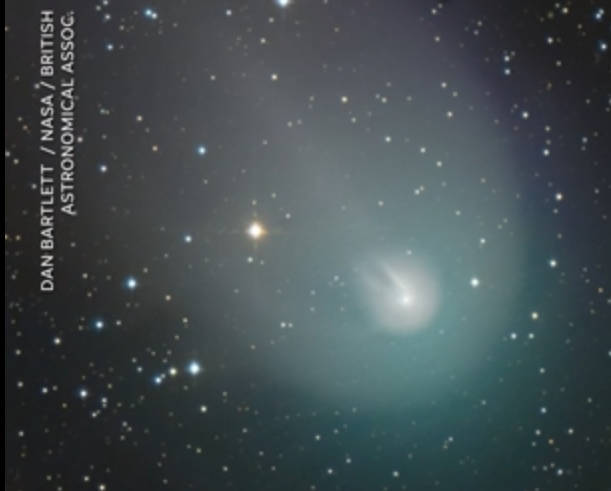
This is the head or coma of Comet 12P/Pons-Brooks after an eruption occurred in its nucleus and a gain 100 fold in brightness. The appearance of the coma is that of either the Millennium Falcon or a devil. I don’t want to ascribe any religious significance here. This kind of thing does happen to some comets from time to time. It’s not a miracle or anything special, just a comet doing its thing just like all comets do. Photo via Space.com
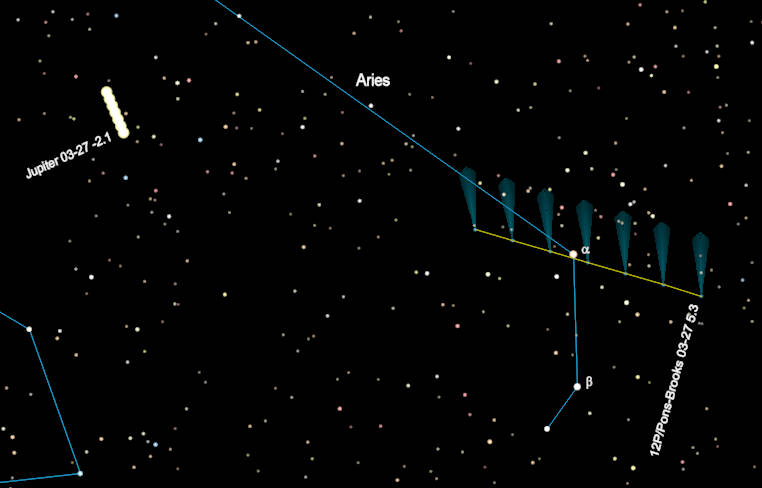
Here is a finder chart for Comet Pons-Brooks for the next week at 9:30 PM. Jupiter is also in the field. The first position is marked with the name, month and day, and the approximate magnitude. The chart shows a comet tail. The tail will probably not be visible visually, however if it is visible, that is the direction it will be pointing. Click or tap on the image to enlarge it. Created using Cartes du Ciel (Sky Charts).

Ephemeris: 03/27/2024 – Let’s find out where the naked-eye planets have wandered off to this week

March 27, 2024 Comments off

This is Ephemeris for Wednesday, March 27th. Today the Sun will be up for 12 hours and 33 minutes, setting at 8:04, and it will rise tomorrow at 7:30. The Moon, 2 days past full, will rise at 10:50 this evening.

Let’s find out where the naked-eye planets have wandered off to this week, and see what planets are left. Mercury is visible in the evening sky shortly after sunset appearing very low in the west. It will be visible for the next few days or so, slowly heading back toward the Sun since this past Sunday. Higher up in the sky is bright Jupiter in the west southwest. It will set at 11:25 pm. Jupiter will be visible in the evening for only about another month or so. In the morning Mars, and especially Venus and Saturn may be impossible to spot, in the east-southeast in the bright twilight. Mars will rise at 6:28, and will be very low in the east-southeast. Comet 12P/Pons-Brooks is below-right of Jupiter in the evening. I’ll have more about it tomorrow.

The astronomical event times given are for the Traverse City/Interlochen area of Michigan (EDT, UT–4 hours). They may be different for your location.

Addendum
upiter and Mercury
Jupiter and Mercury as might be seen at 9:00 PM, or nearly an hour after sunset, tonight March 27th 2024 . Also Comet Pons-Brooks is in the same general area of the sky. It is 5th magnitude almost 6th, and probably not visible without binoculars or a small telescope . Created using Stellarium.
Finder chart for Comet Pons-Brooks
Here is a finder chart for Comet Pons-Brooks for the next week at 9:30 PM. Jupiter is also in the field. The first position is marked with the name, month and day, and the approximate magnitude. The chart shows a comet tail. The tail will probably not be visible visually, however if it is visible, that is the direction it will be pointing. Click or tap on the image to enlarge it. Created using Carts du Ciel (Sky Charts).
The waning gibbous Moon tonight
The waning gibbous Moon tonight at midnight, March 27th 2024, with and without annotations of selected features . Created using Stellarium, LibreOffice Draw, and GIMP.
Mars as seen about 6:50 in the morning
Mars as seen about 6:50 in the morning or about 40 minutes before sunrise, looking east-southeast. It may not look as bright as this. Click or tap on the image to enlarge it. Created using Stellarium.
Jupiter as it might appear in a telescope
Jupiter as it might appear in a telescope at 9:30 this evening in this erect image, showing the position of its Galilean moons. Jupiter’s apparent diameter is 34.3″. Created using Cartes du Ciel (Sky Charts). Labels via Libre Office Draw.
The naked-eye planets, Comet Pons-Brooks, and the Moon at sunset and sunrise on a single night
The naked-eye planets, Comet Pons-Brooks, and the Moon at sunset and sunrise on a single night, starting with sunset on the right tonight, March 27th 2024. The night ends on the left with sunrise tomorrow morning on the 28th. The symbols and labels for Saturn and Venus in the morning overlay each other. Click or tap on the image to enlarge it. Created using my LookingUp app and GIMP.

Ephemeris: 03/20/2024 – Let’s find out where the naked-eye planets have wandered off to this week

March 20, 2024 Comments off

This is Ephemeris for Wednesday, March 20th. Today the Sun will be up for 12 hours and 11 minutes, setting at 7:56, and it will rise tomorrow at 7:43. The Moon, 3 days past first quarter, will set at 6:38 tomorrow morning.

Let’s find out where the naked-eye planets have wandered off to this week, and see what planets are left. Mercury is visible in the evening sky shortly after sunset appearing very low in the west. It will be visible for the next week or so, moving away from the Sun, but getting dimmer, and starting back toward the Sun after Sunday. Higher up in the sky is bright Jupiter in the west southwest. It will set at 11:45 pm. Jupiter will be visible in the evening for only about another month or so. In the morning Mars, Venus and Saturn may be impossible to spot, in the east-southeast in the bright twilight. Mars will rise at 6:43 am, followed by Venus at 7:13, with Saturn right below it.

The astronomical event times given are for the Traverse City/Interlochen area of Michigan (EDT, UT–4 hours). They may be different for your location.

Addendum
Jupiter and Mercury as they might appear in the West at around 45 minutes after sunset.
Jupiter and Mercury as they might appear in the West at around 45 minutes after sunset or about 8:40 PM. Created using Stellarium.
The gibbous Moon  as it might be visible this evening in binoculars or a small telescope
The gibbous Moon as it might be visible this evening in binoculars or a small telescope around 9 PM tonight, March 20th, 2024. Selected features are annotated. Created using Stellarium, LibreOffice Draw, and GIMP.
Jupiter and its moons tonight
We are down to one naked eye planet worth looking at in a telescope, and that is Jupiter. This is Jupiter and its moons as they would appear at 9 pm tonight, March 20th 2024. Jupiter and its moons are tilted at an angle as they would appear in the sky due to the angle of the ecliptic to the western horizon. In previous views, where I’ve looked at more than multiple planets at a time, I’ve shown them in relationship to the ecliptic or plane of the Earth’s orbit. Jupiter’s apparent diameter is 34.86 seconds of arc. Created using Stellarium, and LibreOffice Draw for labels.
The naked-eye planets and the Moon at sunset and sunrise on a single night
The naked-eye planets and the Moon at sunset and sunrise on a single night, starting with sunset on the right tonight, March 20th 2024. The night ends on the left with sunrise tomorrow morning on the 21st. The symbols and labels for Saturn and Venus in the morning overlay each other. Click or tap on the image to enlarge it. Created using my LookingUp app and GIMP.

Ephemeris: 03/14/2024 – It’s Pi Day!

March 14, 2024 Comments off

This is Ephemeris for Pi Day, Thursday, March 14th. Today the Sun will be up for 11 hours and 52 minutes, setting at 7:48, and it will rise tomorrow at 7:54. The Moon, 3 days before first quarter, will set at 1:47 tomorrow morning.

Yes, it’s Pi day that’s the Greek letter π for 3.14 approximating the ratio of the circle’s circumference to its diameter, which scientific and technical people celebrate by baking a pie P-I-E and carving the Greek letter π on the top.

Tonight around 9 or 9:30 when it gets dark, is a good time to use the Moon to find the Pleiades, the Seven Sisters star cluster. The Pleiades will appear above the crescent Moon this evening, so it’s a good time to locate them if you haven’t already. We only have about another month viewing the Pleiades in the evening. And we have one more passage of the Moon by the Pleiades next month before they disappear from the evening sky.

The astronomical event times given are for the Traverse City/Interlochen area of Michigan (EDT, UT–4 hours). They may be different for your location.

Addendum
Have a slice of Pi Day pie
Here’s a link to NASA’s Pi Day Challenge: https://www.jpl.nasa.gov/edu/nasapidaychallenge/. This link also has a link for educators for STEM related challenges.
There’s another Pi day that some celebrate. A well-known approximation of pi is the fraction 22/7ths. Europeans and others write dates in day/month order, so July 22nd is also a Pi Day: 22/7.
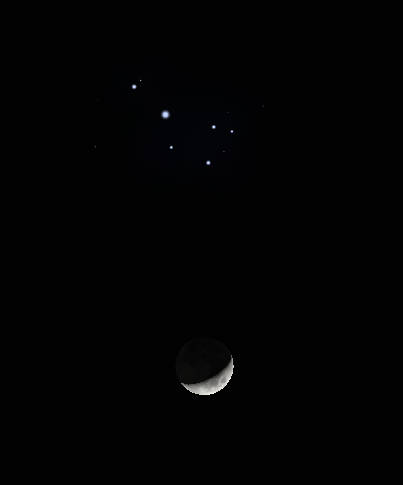
The moon and the Pleiades as they might be seen this evening in binoculars at 9:00 PM . Jupiter will continue to approach the Pleiades until it sets at 1:44 AM. For locations west of us (Michigan) Jupiter will get even closer. Created using Stellarium.

Ephemeris: 03/13/2024 – Where have the naked-eye planets wandered off to this week?

March 13, 2024 Comments off

This is Ephemeris for Wednesday, March 13th. Today the Sun will be up for 11 hours and 49 minutes, setting at 7:47, and it will rise tomorrow at 7:55. The Moon, 3 days past new, will set at 12:28 tomorrow morning.

Let’s find out where the naked-eye planets have wandered off to this week, and see what planets are left. Mercury is beginning to become visible in the evening sky shortly after sunset appearing very low in the west. It will be visible for the next week or so, moving away from the Sun, but getting dimmer. Higher up in the sky Jupiter and the moon are close together this evening With Jupiter to the left and below the crescent Moon in the west southwest. It will set at 12:08 am. Jupiter will be visible in the evening for only about another month or so. In the morning Mars and Venus may be impossible to spot, in the east-southeast in the bright twilight. Mars will rise at 6:57 am, followed by Venus at 7:21.

The astronomical event times given are for the Traverse City/Interlochen area of Michigan (EDT, UT–4 hours). They may be different for your location.

Addendum
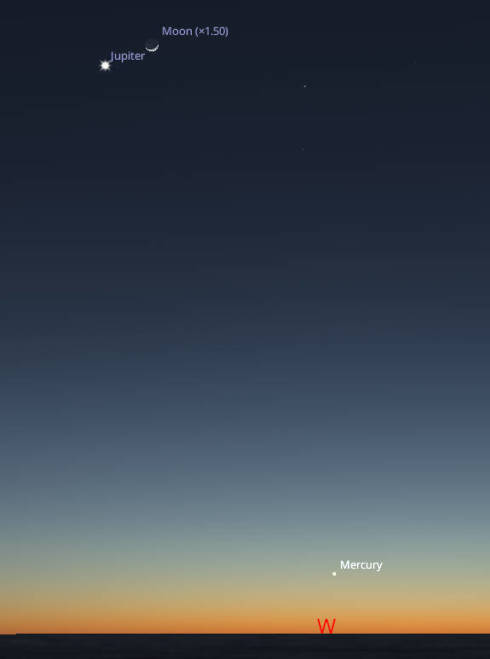
Looking westward at 8:30 pm or about 45 minutes after sunset tonight, March 13, 2024, Mercury is low in the west. Jupiter and the Moon are much higher in the west-southwest. The Moon has been enlarged to better show its phase. Created using Stellarium.
The moon tonight as it may appear tonight, March 13th 2024, in binoculars or a small telescope with selected features labeled. Created using Stellarium, LibreOffice Draw, and GIMP.
We are down to one naked eye planet worth looking at in a telescope, and that is Jupiter. This is Jupiter and its moons as they would appear at 8:30 pm tonight, March 13th 2024. Jupiter and its moons are tilted at an angle as they would appear in the sky due to the angle of the ecliptic to the western horizon. In previous views, where I’ve looked at more than multiple planets at a time, I’ve shown them in relationship to the ecliptic or plane of the Earth’s orbit. Jupiter’s apparent diameter is 35.31 seconds of arc. Created using Stellarium, and LibreOffice Draw for labels.
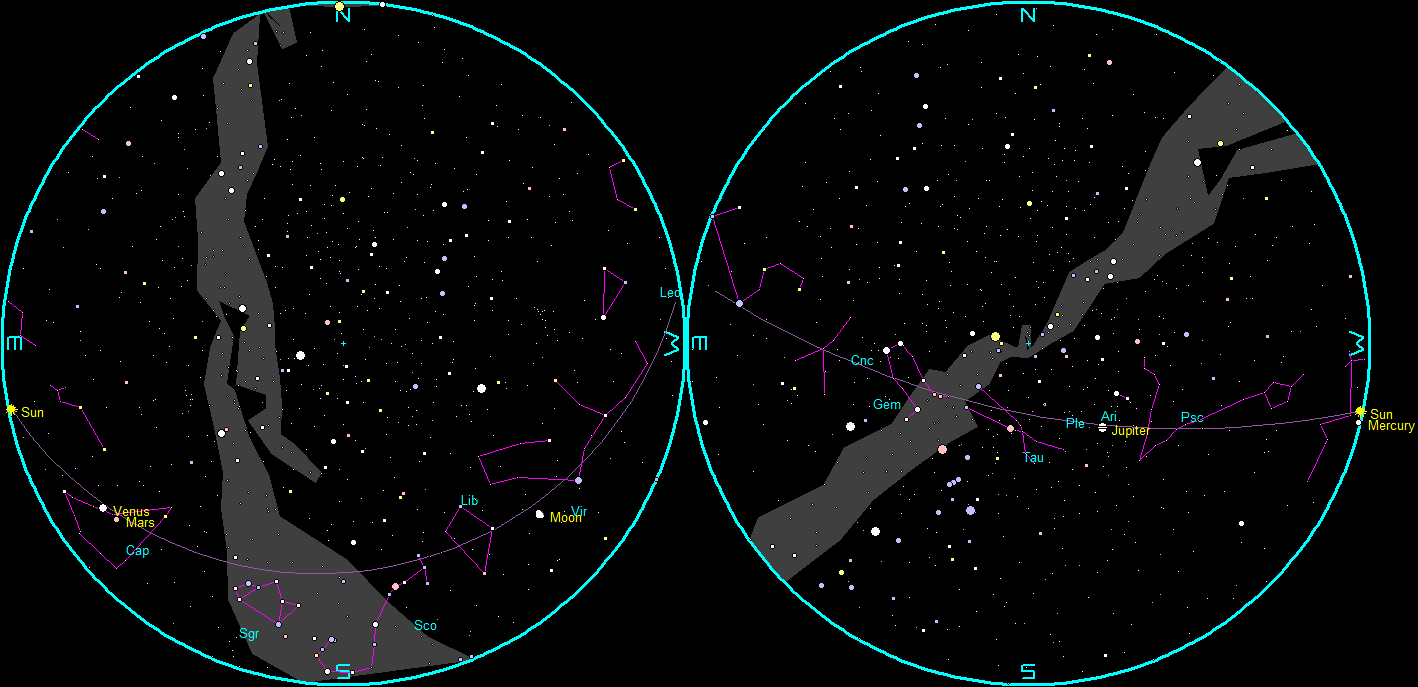
The naked-eye planets and the Moon at sunset and sunrise on a single night, starting with sunset on the right on March 13, 2024. The night ends on the left with sunrise on the 14th. Click or tap on the image to enlarge it. Created using my LookingUp app and GIMP.

Ephemeris: 03/06/2024 – Where have the naked-eye planets wandered off to this week?

March 6, 2024 Comments off

This is Ephemeris for Wednesday, March 6th. Today the Sun will be up for 11 hours and 27 minutes, setting at 6:37, and it will rise tomorrow at 7:08. The Moon, 3 days past last quarter, will rise at 6:03 tomorrow morning.

Let’s find out where the naked-eye planets have wandered off to this week, and see what planets are left. Saturn, and Mercury are gone, too close to the Sun to be seen. Jupiter will be in the west-southwest at 8 this evening. It will set at 11:25 pm in the west. Jupiter will be visible in the evening for only about another month or so. Venus, the morning star, will rise in the east-southeast at 6:23 am, but its brilliance is diminished by the bright twilight and its low position in the sky. It will be very low in the east-southeast at 6:45 am. Mars might be impossible to spot, being a bit to the right and above Venus. A pair of binoculars, at least, will be needed to spot it. It is about the width of the field of binoculars from Venus.

The astronomical event times given are for the Traverse City/Interlochen area of Michigan (EST, UT –5 hours). They may be different for your location.

Addendum
Jupiter seen with the bright stars of winter in the southwestern sky at 8 pm tonight, March 6th 2024
Jupiter seen with the bright stars of winter in the southwestern sky at 8 pm tonight, March 6th 2024. Currently, it is to the right of the stars of winter. But by the end of this year when it appears again in the evening sky Jupiter will be among the stars of winter, actually to the east of Aldebaran. Click or tap on the image to enlarge it. Created using Stellarium.
Venus, Mars and the Moon as they will be positioned at 6:30 am or about 40 minutes before sunrise. Tomorrow morning March 7th 2024
Venus, Mars and the Moon as they will be positioned at 6:30 am or about 40 minutes before sunrise. Tomorrow morning March 7th 2024. They will probably not be visible from our latitude of 45° north. However, the farther south one is the higher they will appear in the sky and the angle between Venus and the Moon will be steeper. Click or tap on the image to enlarge it. Created using Stellarium.
Jupiter and moons at 8 pm
We are down to one naked eye planet worth looking at in a telescope, and that is Jupiter. This is Jupiter and its moons as they would appear at 8 pm tonight, March 6th 2024. Jupiter and its moons are tilted at an angle as they would appear in the sky due to the angle of the ecliptic to the western horizon. In previous views, where I’ve looked at more than multiple planets at a time, I’ve shown them in relationship to the ecliptic or plane of the Earth’s orbit. Jupiter’s apparent diameter is 35.8 seconds of arc. Created using Cartes du Ciel (Sky Charts).
The naked-eye planets and the Moon at sunset and sunrise on a single night
The naked-eye planets and the Moon at sunset and sunrise on a single night, starting with sunset on the right on March 6, 2024. The night ends on the left with sunrise on the 6th. Click or tap on the image to enlarge it. Created using my LookingUp app and GIMP.

Ephemeris: 02/28/2024 – Where have the naked-eye planets wandered off to this week?

February 28, 2024 Comments off

This is Ephemeris for Wednesday, February 28th. Today the Sun will be up for 11 hours and 5 minutes, setting at 6:28, and it will rise tomorrow at 7:21. The Moon, halfway from full to last quarter, will rise at 10:52 this evening.

Let’s find out where the naked-eye planets have wandered off to this week, and see what planets are left to see. Saturn, and Mercury are gone, both actually in conjunction with the Sun today. Jupiter will be in the west-southwest at 8 this evening. It will set at 11:47 pm in the west. Jupiter will be visible in the evening for only about two more months. Venus, the morning star, will rise in the east-southeast at 6:27 am, but its brilliance is diminished by the bright twilight and its low position in the sky. It will be very low in the east-southeast at 7 am. Mars might be impossible to spot, being a bit to the right and above Venus. A pair of binoculars, at least, will be needed to spot it in the morning twilight.

The astronomical event times given are for the Traverse City/Interlochen area of Michigan (EST, UT –5 hours). They may be different for your location.

Addendum
Jupiter and the bright stars of winter as they might appear about 8 pm
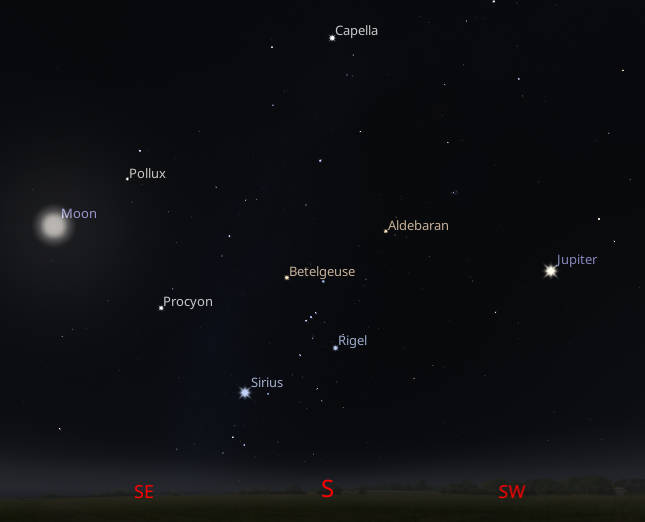
Jupiter and the bright stars of winter as they might appear about 8 pm tonight, February 28th 2024. Created using Stellarium.
Annotated waning gibbous Moon
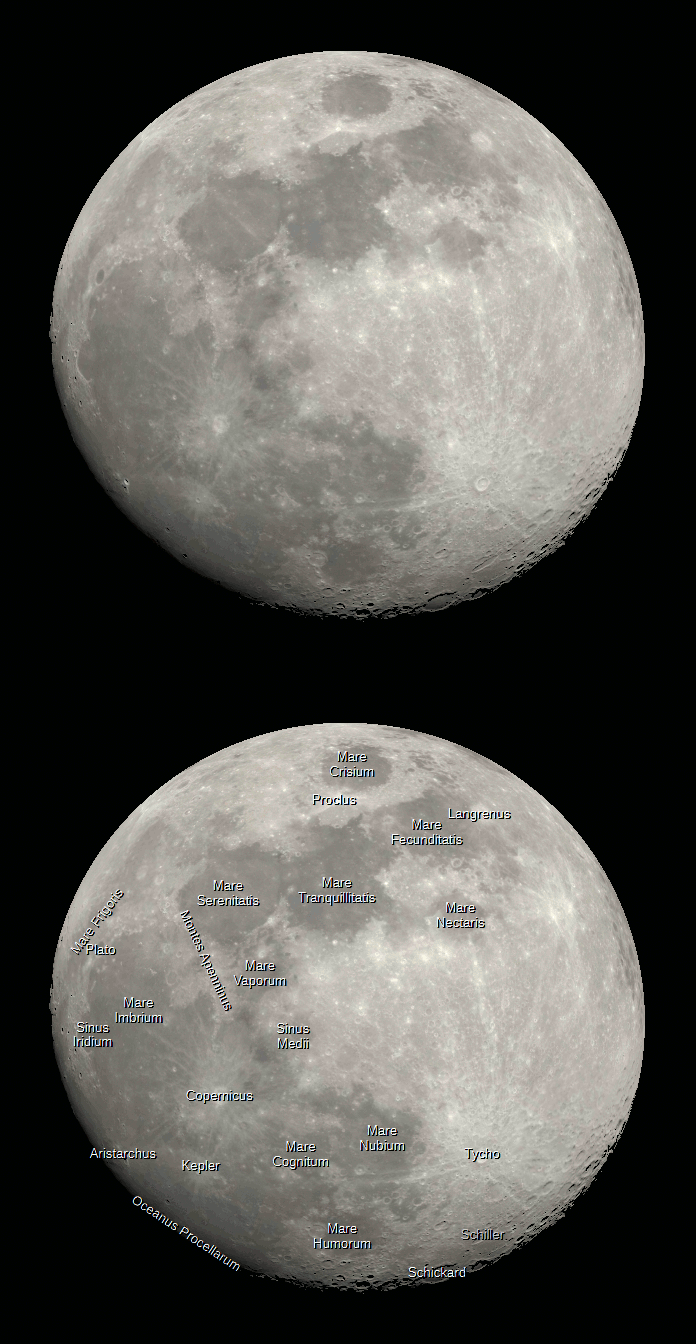
The moon is it might appear tonight at midnight a little over an hour after it rises. Selected features are labeled. Click or tap on the image to enlarge it. Created using Stellarium , LibreOffice Draw, and GIMP.
Venus and Mars as they might appear in a pair of binoculars
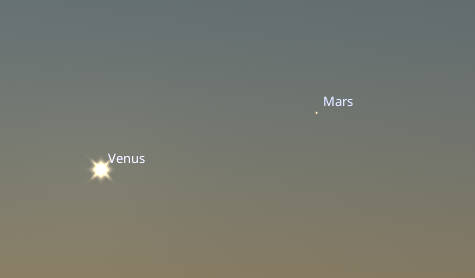
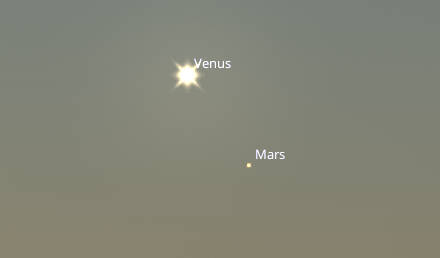
Venus and Mars as they might appear in a pair of binoculars low in the southeast at 7 am or a bit before, tomorrow morning, February 29th 2024. The planets are about 3° apart, which works out to be six widths of the moon or maybe half the width of the binocular field of view. Created using Stellarium.
Telescopic Jupiter and Venus
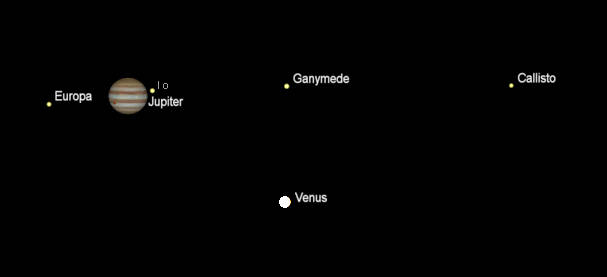
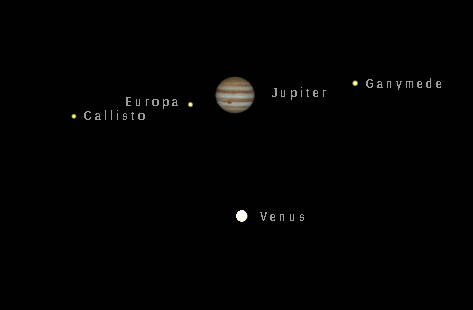
Telescopic Jupiter and Venus (north up) as they would be seen in a small telescope, with the same magnification. At 8 pm EST February 28, 2024, for Jupiter, and 7 am on the 29th for Venus. Apparent diameters: Jupiter 36.53″; and Venus 11.11″, 91.2% illuminated.
Jupiter’s moon Io will pass behind (be occulted by) the planet at 8:17 pm EST. It will reappear at 11:39 pm away from the planet because until then it’ll still be in Jupiter’s shadow.
The ” symbol means seconds of arc (1/3600th of a degree). Created using Cartes du Ciel (Sky Charts) and GIMP.
The naked-eye planets and the Moon at sunset and sunrise on a single night
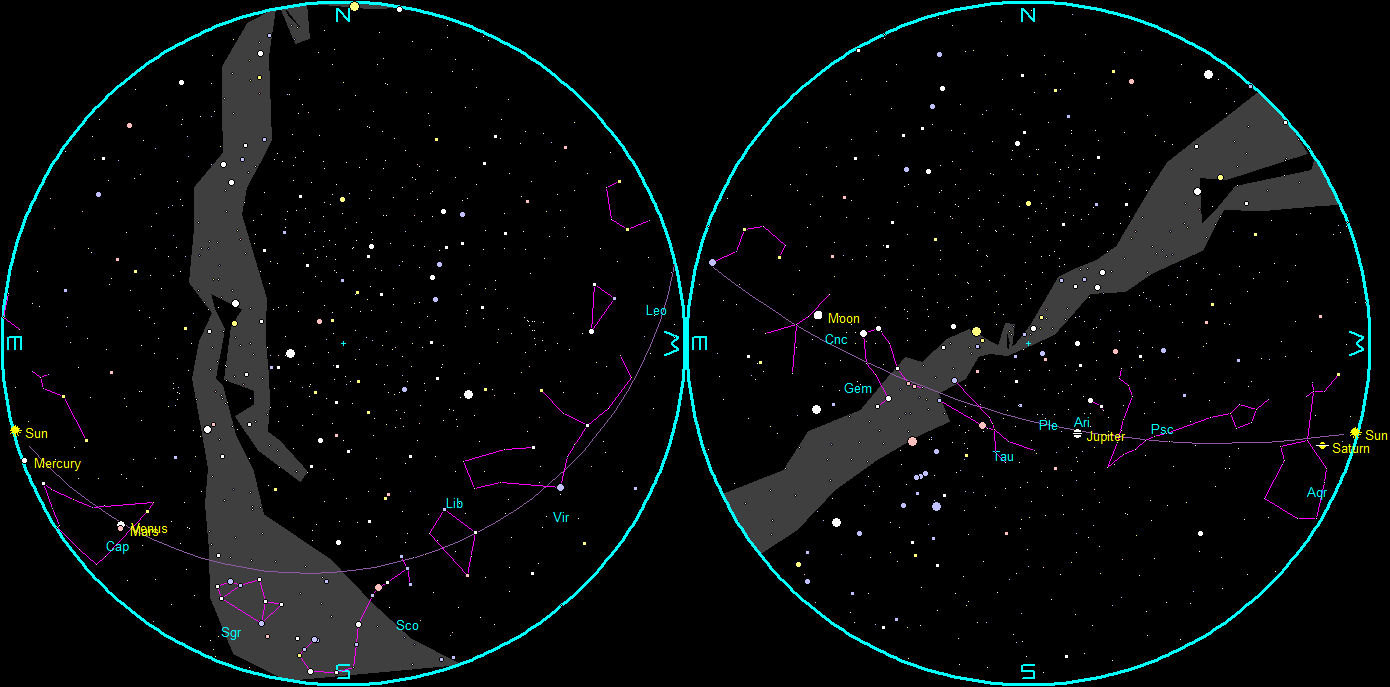
The naked-eye planets and the Moon at sunset and sunrise on a single night, starting with sunset on the right on February 28, 2024. The night ends on the left with sunrise on February 29th. Saturn is not shown because, at solar conjunction it happens to be below the horizon in both views. Click or tap on the image to enlarge it. Created using my LookingUp app and GIMP.

Ephemeris: 02/21/2024 – Where have the naked-eye planets wandered off to this week?

February 21, 2024 Comments off

This is Ephemeris for Wednesday, February 21st. Today the Sun will be up for 10 hours and 44 minutes, setting at 6:19, and it will rise tomorrow at 7:32. The Moon, 3 days before full, will set at 7:09 tomorrow morning.

Let’s find out where the naked-eye planets have wandered off to this week, and see what planets are left. Saturn, and Mercury are gone, being too close to the Sun to be visible. Jupiter will be in the west-southwest at 8 this evening. It will set at 12:11 am in the west. Jupiter will be visible in the evening for only about two more months. Venus, the morning star, will rise in the east-southeast at 6:33 am, but its brilliance is diminished by the bright twilight and its low position in the sky. It will be very low in the southeast at 7 am. This might be our first chance to spot Mars in the morning sky because tomorrow morning it will be just below Venus by about 1 1/2 moon diameters. A pair of binoculars may be needed to spot it.

The astronomical event times given are for the Traverse City/Interlochen area of Michigan (EST, UT –5 hours). They may be different for your location.

Addendum
Jupiter, the Moon and the bright stars of winter as they might appear about 8:00 pm tonight
Jupiter, the Moon and the bright stars of winter as they might appear about 8:00 pm tonight, February 21st 2024. Created using Stellarium.
The moon is it might appear at 8:00 pm tonight
The moon is it might appear at 8:00 pm tonight February 21st 2024. Selected features are labeled. Created using Stellarium, LibreOffice Draw, and GIMP.
Venus and Mars as they might appear in a pair of binoculars low in the southeast at about 7 a
Venus and Mars as they might appear in a pair of binoculars low in the southeast at about 7 am, or about a half hour before sunrise, tomorrow morning, February 22nd 2024. The planets are about the width of the Moon apart and Mars will be very difficult to spot. In fact both will be very low in the sky and any amount of obscured horizon may prevent them from being visible. Created using Stellarium.
Telescopic Jupiter and Venus
(north up) as they would be seen in a small telescope, with the same magnification. At 8 pm EST February 21, 2024, for Jupiter, and 7 am on the 22nd, for Venus. Apparent diameters: Jupiter 37.23″; and Venus 11.35″, 99.0% illuminated.
Jupiter’s missing moon is Io, which is behind the planet. It will reappear at 9:43 pm away from the planet because until then it’ll still be in Jupiter’s shadow. At 10:02 pm Europa will begin to transit across the face of the planet.
The ” symbol means seconds of arc (1/3600th of a degree). Created using Cartes du Ciel (Sky Charts) and GIMP.
The naked-eye planets and the Moon at sunset and sunrise on a single night
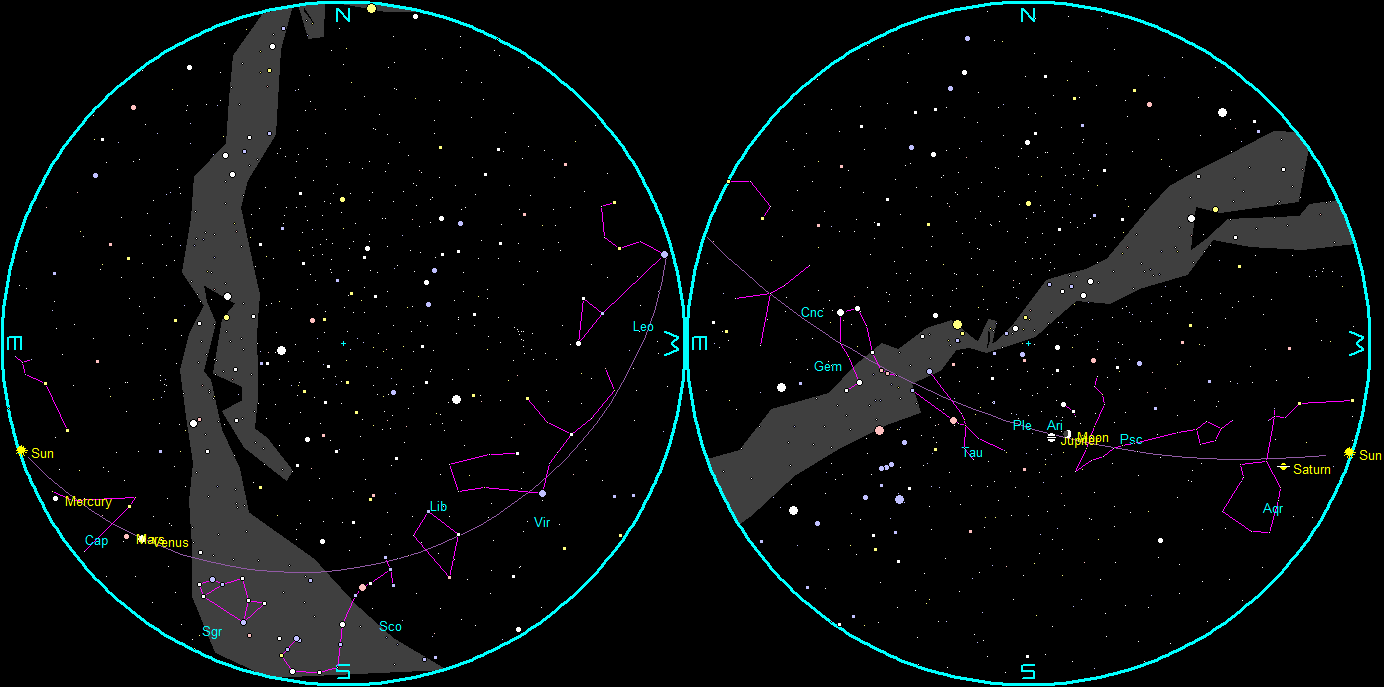
The naked-eye planets and the Moon at sunset and sunrise on a single night, starting with sunset on the right on February 21, 2024. The night ends on the left with sunrise on February 22nd. The label for Mars overlays the image of Venus. Click or tap on the image to enlarge it. Created using my LookingUp app and GIMP.