Archive
11/09/2016 – Ephemeris – Your mid-week bright planet report
Ephemeris for Wednesday, November 9th. The Sun will rise at 7:32. It’ll be up for 9 hours and 48 minutes, setting at 5:20. The Moon, 2 days past first quarter, will set at 2:23 tomorrow morning.
Low in the east-southeast at 6 a.m. Jupiter can be glimpsed in the morning twilight. Jupiter will rise tomorrow at 4:25 a.m. We are approaching Jupiter, though it’s 5 times Earth’s distance from the Sun and will pass it April 7th. Venus, Saturn and Mars are in the evening sky. At 6 p.m. these planets will be seen in the southwest and low in the sky. Venus will be the brightest, Saturn might be picked out of the twilight to the right and a bit below Venus, and Mars will be higher to the left. Saturn will set first at 6:54, with Venus setting a half and hour later at 7:24. Mars will hang on a bit longer and will set at 10:07. Venus is almost at its farthest south in the sky, and will be slowly heading northward for the rest of it’s evening appearance.
Times are for the Traverse City/Interlochen area of Michigan. They may be different for your location.
Addendum
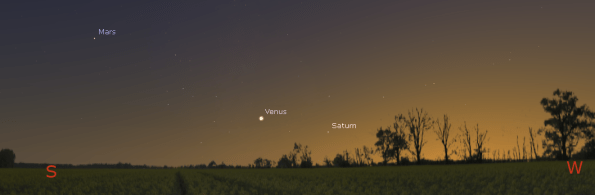
The evening planets in twilight in the southwestern sky at 6 p.m. November 9, 2016. Created using Stellarium.
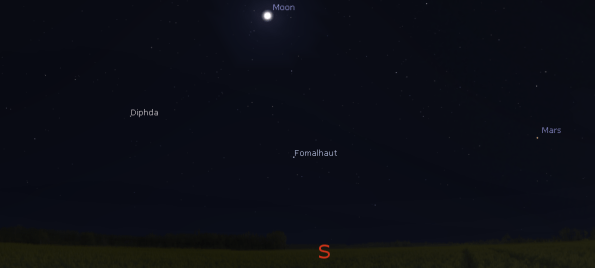
Looking south at Mars, two bright stars, and the Moon at 8 p.m. November 9, 2016. Created using Stellarium.
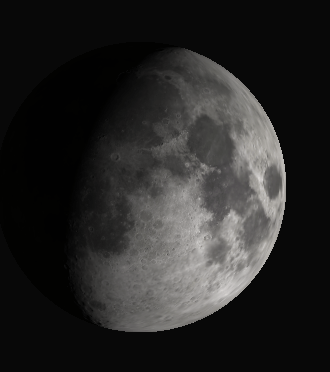
The Moon as it might be seen in binoculars at 8 p.m. November 9, 2016. Created using Stellarium.
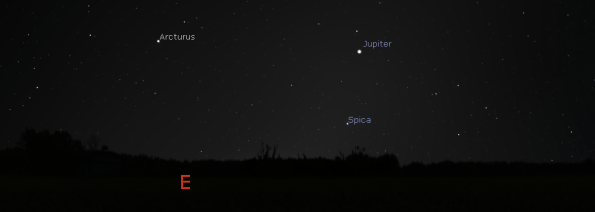
Jupiter in the morning sky at 6:30 a.m. November 10, 2016. Created using Stellarium.
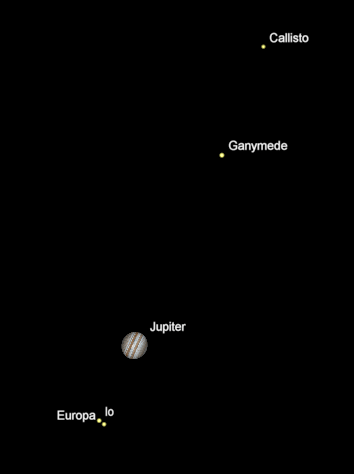
Jupiter and its Galilean moons, as they might be seen in a telescope at 6 a.m. November 11, 2016. Created using Cartes du Ciel (Sky Charts). Note the image is not inverted.
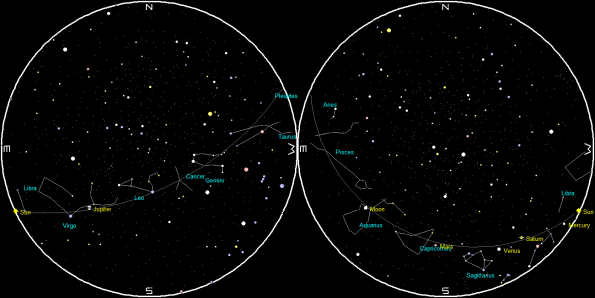
Planets and Moon at sunset and sunrise of a single night starting with sunset on the right on November 9, 2016. The night ends on the left with sunrise on November 10. If you are using Firefox right-click on the image and select View Image to enlarge the image. That goes for all the large images. Created using my LookingUp program.
11/02/2016 – Ephemeris – Venus, Saturn and the Moon make a tight triangle in the southwest tonight
Ephemeris for Wednesday, November 2nd. The Sun will rise at 8:22. It’ll be up for 10 hours and 6 minutes, setting at 6:29. The Moon, 3 days past new, will set at 8:42 this evening.
Low in the east this morning at 7 Jupiter can be glimpsed in the twilight. Jupiter rose this morning at 5:48 a.m. Venus, Saturn and Mars are in the evening sky. Venus, Saturn and the Moon will appear together tonight with Saturn to the right of the much brighter Venus. The thin crescent Moon will appear above Saturn. Venus will set at 8:18 p.m. and Saturn a minute later. Venus continues to move southward and will still be hugging the southwestern horizon for the next week, but it’s high enough to spot with a reasonably low horizon. Mars can be seen in the darkened sky after Venus and Saturn set. The Red Planet will enter the constellation of Capricornus in a week and moves into the southwest by 8 p.m. Mars will set at 11:07 p.m.
Times are for the Traverse City/Interlochen area of Michigan. They may be different for your location.
Addendum
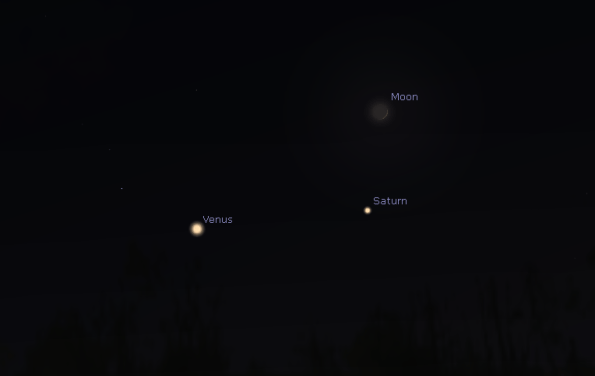
The Moon, Saturn and Venus low in the southwest tonight at 7:30 p.m., November 2, 2016. Created using Stellarium.
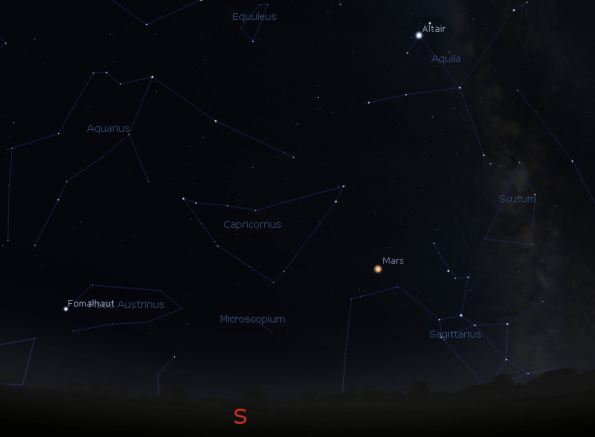
Mars and the evening constellations tonight at 8 p.m., November 2, 2016. Created using Stellarium.
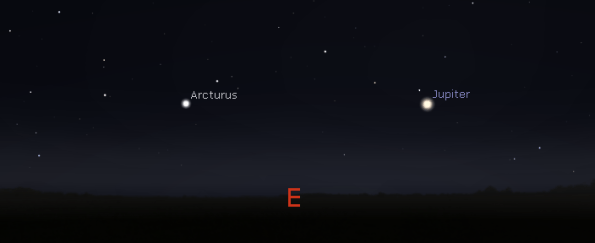
Jupiter rising in the morning sky this morning at 7 a.m. November 2, 2016. Created using Stellarium.
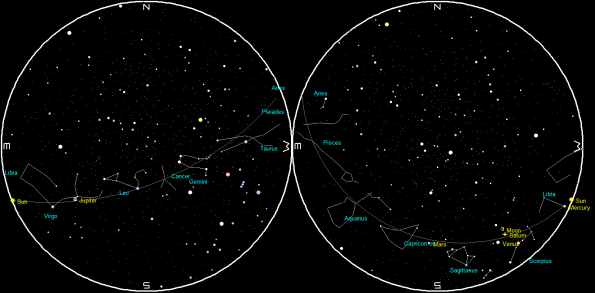
Planets and Moon at sunset and sunrise of a single night starting with sunset on the right on November 2, 2016. The night ends on the left with sunrise on November 3. If you are using Firefox right-click on the image and select View Image to enlarge the image. That goes for all the large images. Created using my LookingUp program.
Bob King has an excellent article in Universe Today about the planet and Moon grouping in the southwest tonight: http://www.universetoday.com/131700/november-opens-splendid-gathering-moon-planets/
10/26/2016 – Ephemeris – Bright planet count: 1 in the morning, 3 in the evening, 1 behind the Sun
Ephemeris for Wednesday, October 26th. The Sun will rise at 8:13. It’ll be up for 10 hours and 26 minutes, setting at 6:39. The Moon, half way from last quarter to new, will rise at 5:03 tomorrow morning.
Low in the east this morning at 7 Jupiter can be glimpsed in the twilight. Jupiter’s rose this morning at 6:09 a.m. Venus, Saturn and Mars are in the evening sky. Venus is briefly visible after sunset, low in the west-southwest. It will set at 8:16 p.m. Venus is still moving a bit southward and will still be hugging the southwestern horizon for the next month or so, but it’s high enough to spot with a reasonably low horizon. Saturn is above and left of Venus, It will set at 8:44 p.m. Mars can be seen in the darkened sky after Venus sets. Mars is way out to the left of Saturn, above and left of the setting Teapot of Sagittarius at 9 p.m. in the southwest. Mars will set at 11:08 p.m. Mercury will pass behind the Sun tomorrow.
Times are for the Traverse City/Interlochen area of Michigan. They may be different for your location.
Addendum
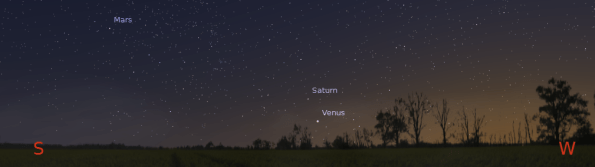
The evening planets in twilight at 7:30 p.m. Venus and Mars are easily spotter, but Saturn is problematic. Created using Stellarium.
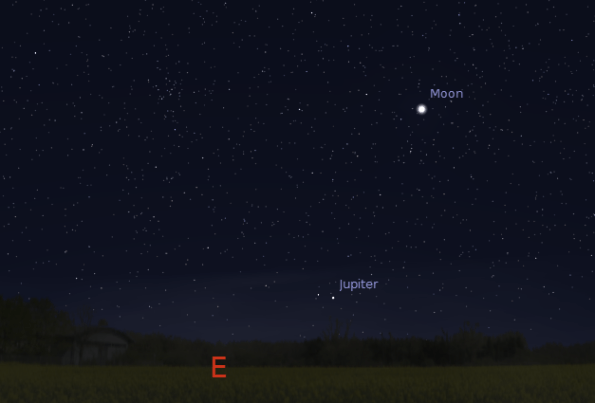
Jupiter and the Moon at 7 a.m. this morning, October 26, 2016. Created using Stellarium.
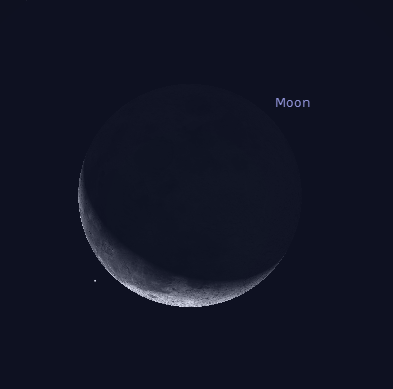
The Moon as it might appear in binoculars at 7 a.m. this morning, October 26, 2016. The Mood will also show a faint earthshine on its normally hidden light side to the right of the crescent. Created using Stellarium.
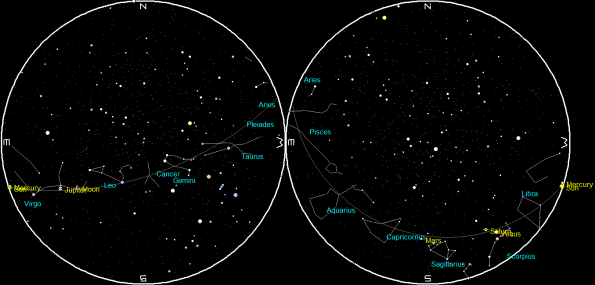
Planets and Moon at sunset and sunrise of a single night starting with sunset on the right on October 26, 2016. The night ends on the left with sunrise on October 27. If you are using Firefox right-click on the image and select View Image to enlarge the image. That goes for all the large images. Created using my LookingUp program.
10/19/2016 – Ephemeris – Jupiter is in morning twilight, Venus in evening twilight
Ephemeris for Wednesday, October 19th. The Sun will rise at 8:04. It’ll be up for 10 hours and 46 minutes, setting at 6:50. The Moon, half way from full to last quarter, will rise at 9:58 this evening.
Low in the east this morning at 7:15 Jupiter might be glimpsed in the twilight. Jupiter’s rise time is at 6:28 a.m. Venus, Saturn and Mars are in the evening sky. Venus is briefly visible after sunset, low in the west-southwest. It will set at 8:16 p.m., following the Sun’s earlier setting times. Venus is still moving a bit southward and will still be hugging the southwestern horizon for the next month or so, but it’s high enough to spot with a reasonably low horizon. Mars and Saturn can be seen in the darkened sky after Venus sets. Mars is way out to the left of Saturn passing above the Teapot of Sagittarius. Saturn, spectacular in telescopes with its rings, will set at 9:09 p.m. Mars will set at 11:11 p.m,
Times are for the Traverse City/Interlochen area of Michigan. They may be different for your location.
Addendum
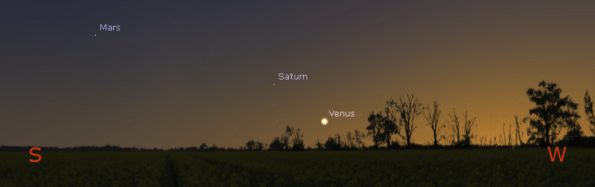
Venus, Saturn and Mars at 7:30 p.m. October 19, 2016. Last night I saw Venus and Mars, but not Saturn with the naked eye at that hour. Created using Stellarium.
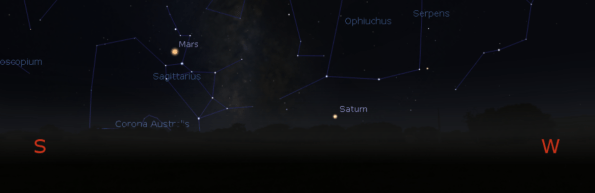
Saturn and Mars at 8:30 p.m. October 19, 2016. Created using Stellarium.
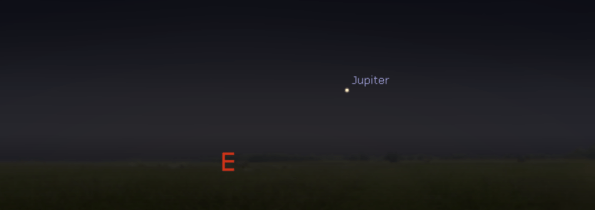
Jupiter rising at 7 a.m. this morning, October 19, 2016. Created using Stellarium.
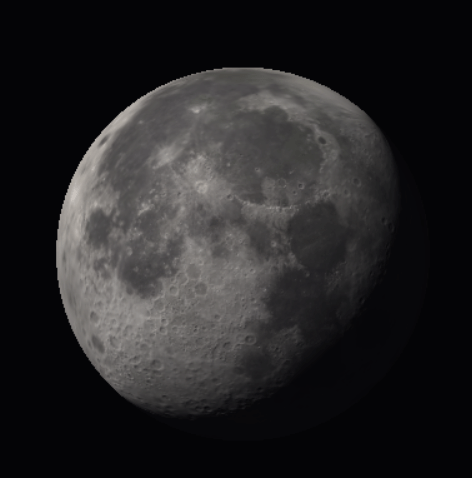
The Moon as it might be seen in binoculars at 7 a.m. this morning, October 19, 2016. Created using Stellarium.
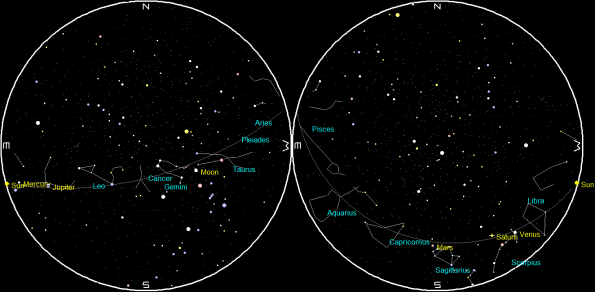
Planets and Moon at sunset and sunrise of a single night starting with sunset on the right on October 19, 2016. The night ends on the left with sunrise on October 20. If you are using Firefox right-click on the image and select View Image to enlarge the image. That goes for all the large images. Created using my LookingUp program.
10/12/2016 – Ephemeris – Jupiter joins Mercury in the morning sky22
Ephemeris for Wednesday, October 12th. The Sun will rise at 7:55. It’ll be up for 11 hours and 7 minutes, setting at 7:02. The Moon, 3 days past first quarter, will set at 4:35 tomorrow morning.
Low in the east this morning at 7:15 both Mercury and Jupiter might be glimpsed, with Mercury just below Jupiter which is a bit brighter. Jupiter will rise at 6:38 a.m. and Mercury will rise at 6:47 a.m. Venus, Saturn and Mars are in the evening sky. Venus is briefly visible after sunset, low in the west. It will set at 8:20 p.m., following the Sun’s earlier setting times. Venus is still moving a bit southward and will still be hugging the southwestern horizon for the next month or so. Mars and Saturn can be seen in the darkened sky after Venus sets. Mars is way out to the left of Saturn passing above the Teapot of Sagittarius. Saturn, spectacular in telescopes with its rings, will set at 9:35 p.m. Mars will set at 11:14 p.m.
Times are for the Traverse City/Interlochen area of Michigan. They may be different for your location.
Addendum
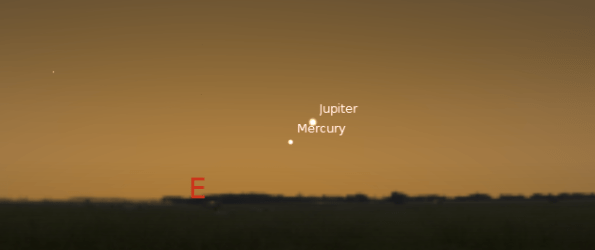
Jupiter and Mercury at 7:15 a.m. low in the east today October 12, 2016. Created using Stellarium.
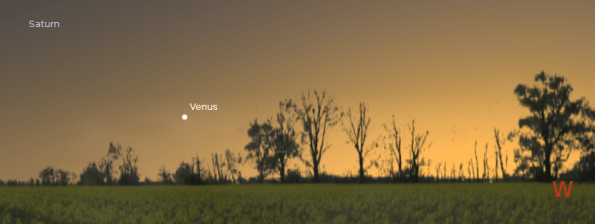
Venus and Saturn at 7:22 p.m. tonight October 12, 2016, looking to the southwest. I doubt if you could spot Saturn at this time. Created using Stellarium.
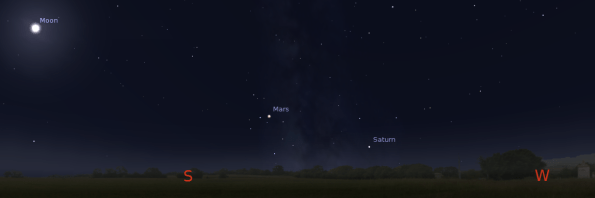
Saturn, Mars and the Moon at 8:30 p.m. October 12, 2016. Created using Stellarium.
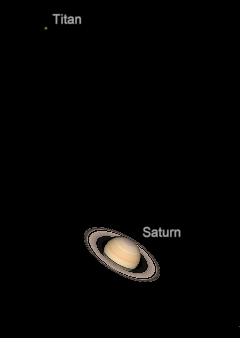
Saturn and moon as it might be seen in a telescope. at 8:30 p.m. October 12, 2016. More than likely only the satellite Titan would be seen with Saturn. Created using Cartes du Ciel (Sky Charts).
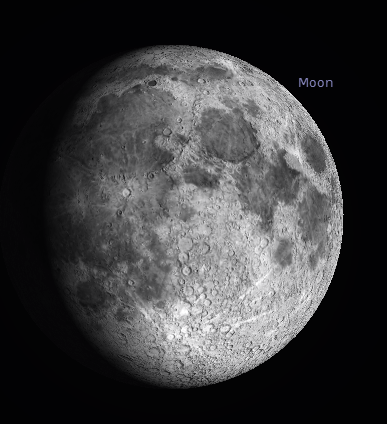
The Moon as it might be seen with binoculars tonight at 8:30 p.m. October 12, 2016. Created using Stellarium.
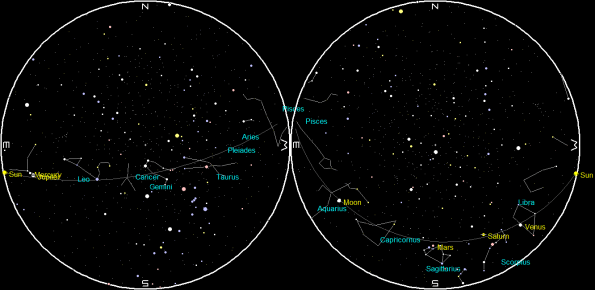
Planets and Moon at sunset and sunrise of a single night starting with sunset on the right on October 12, 2016. The night ends on the left with sunrise on October 13. If you are using Firefox right-click on the image and select View Image to enlarge the image. That goes for all the large images. Created using my LookingUp program.
09/21/2016 – Ephemeris – Mercury escaped to the morning sky and Jupiter will soon follow
Ephemeris for Wednesday, September 21st. The Sun will rise at 7:29. It’ll be up for 12 hours and 11 minutes, setting at 7:41. The Moon, 2 days before last quarter, will rise at 11:15 this evening.
Tonight we have four of the five bright classical planets in the evening sky. Mercury crossed into the morning sky last week, and Jupiter will follow next Monday. Jupiter is too close to the Sun to be seen. We are left with Venus, Saturn and Mars. Venus is briefly visible after sunset, low in the west. It will set at 8:42 p.m., following the Sun’s earlier setting times. Mars, Saturn and the star Antares start the evening in the southwestern sky in a lengthening triangle, with Saturn on top, Mars below and way out to the left, and Antares below Saturn. Saturn, spectacular in telescopes with its rings, will set at 10:52 p.m. And Mars, moving rapidly to the east against the stars will set at 11:31 p.m.
Times are for the Traverse City/Interlochen area of Michigan. They may be different for your location.
Addendum
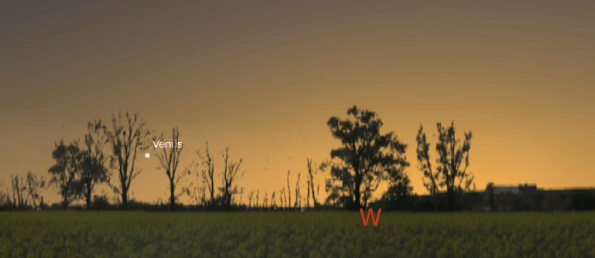
Looking very low in the west at 8:01 p.m., 20 minutes after sunset, September 21, 2016. To see how Venus’ position changes from week to week, check out the last few Wednesday’s posts. I’m using the same landscape for each which is supplied by Stellarium. Created using Stellarium.
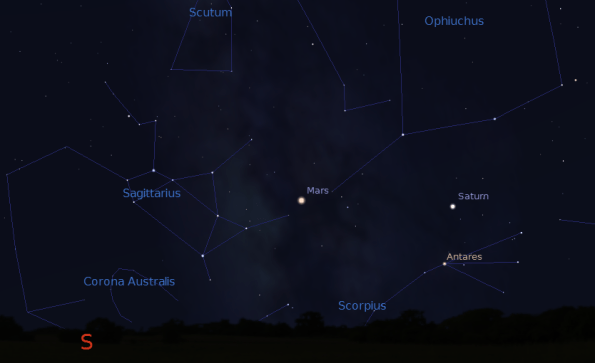
The lengthening Mars-Saturn-Antares triangle and the background constellations at 9 p.m., September 21, 2016. Created using Stellarium.
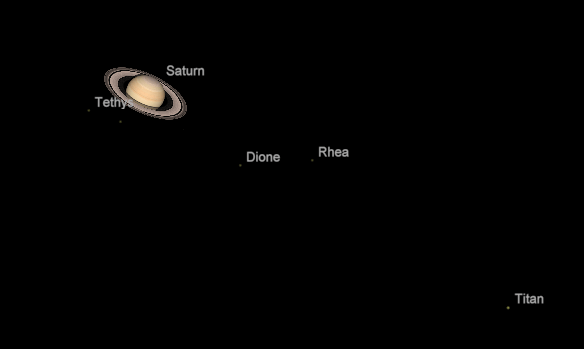
Saturn and some of its moons at 9 p.m. September 21, 2016. Created using Cartes du Ciel (Sky Charts).
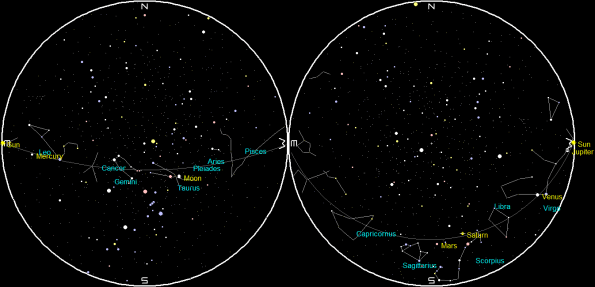
Planets and Moon at sunset and sunrise of a single night starting with sunset on the right on September 21, 2016. The night ends on the left with sunrise on September 22. Mercury has escaped to the Morning sky and will rise at 614 a.m. on the 22nd. If you are using Firefox right-click on the image and select View Image to enlarge the image. That goes for all the large images. Created using my LookingUp program.
09/14/2016 – Ephemeris – Then there were four… Evening planets that is.
Ephemeris for Wednesday, September 14th. The Sun will rise at 7:21. It’ll be up for 12 hours and 33 minutes, setting at 7:54. The Moon, 2 days before full, will set at 5:49 tomorrow morning.
Tonight we have only four of the bright classical planets in the evening sky. Mercury crossed into the morning sky Monday, Jupiter will follow shortly. Jupiter is impossible to spot being very close to the direction of the Sun. We are left with Venus, Saturn and Mars. Venus is briefly visible after sunset, low in the west. It will set at 8:52 p.m., following the Sun’s earlier setting times. Mars, Saturn and the star Antares start the evening in the southwestern sky in a triangle, with Saturn on top, Mars below and to the left, and Antares below Saturn and right of and below Mars. Saturn, spectacular in telescopes with its rings, will set at 11:18 p.m. And Mars, moving rapidly to the east against the stars will set at 11:39 p.m.
Times are for the Traverse City/Interlochen area of Michigan. They may be different for your location.
Addendum
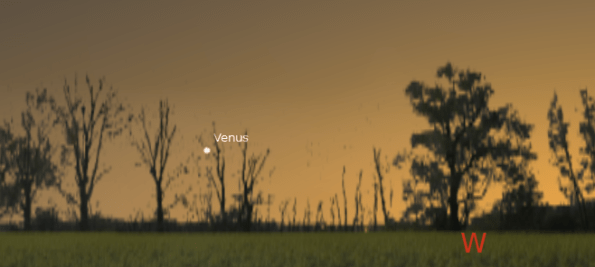
Looking very low in the west at 8:14 p.m., 20 minutes after sunset, September 14, 2016. Created using Stellarium.
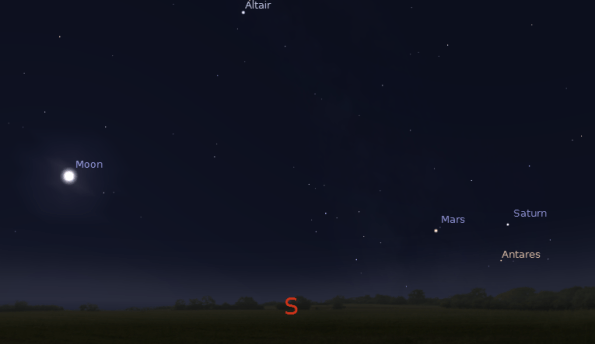
The Moon and the lengthening Mars-Saturn-Antares triangle at 9:30 p.m., September 14, 2016. Created using Stellarium.
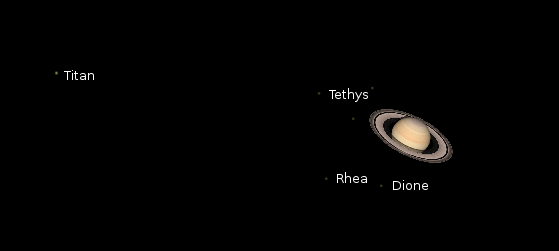
Saturn and some of its moons at 9:30 p.m. September 14, 2016. Created using Cartes du Ciel (Sky Charts).
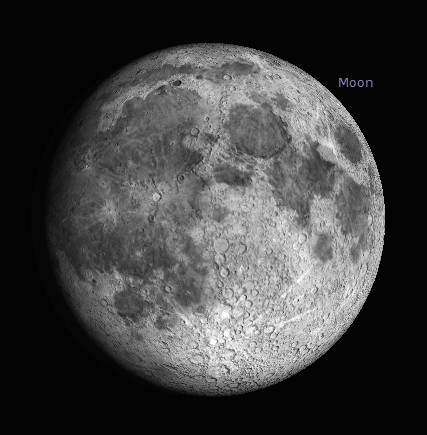
The Moon tonight as it might be seen in binoculars at 9:30 p.m. September 14, 2016. Created using Stellarium.
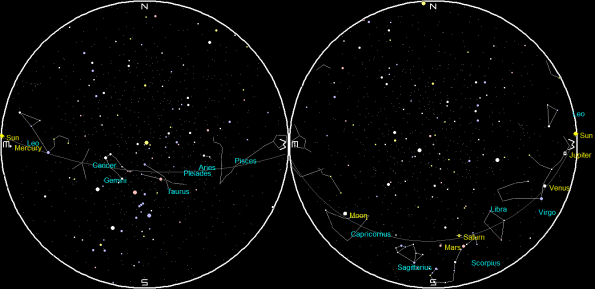
Planets and Moon at sunset and sunrise of a single night starting with sunset on the right on September 14, 2016. The night ends on the left with sunrise on September 14. Mercury has escaped to the morning sky. If you are using Firefox right-click on the image and select View Image to enlarge the image. That goes for all the large images. Created using my LookingUp program.
09/07/2016 – Ephemeris – Then there was one in the west and two in the southwest
Ephemeris for Wednesday, September 7th. The Sun will rise at 7:12. It’ll be up for 12 hours and 54 minutes, setting at 8:07. The Moon, 2 days before first quarter, will set at 11:29 this evening.
Tonight we still have all the bright classical planets in the evening sky, barely. Venus, Mercury, Jupiter are very low in the west, but only Venus is briefly visible after sunset. It will set at 9:03 p.m. Later this month Mercury and Jupiter will pass the Sun to become visible in the morning sky. Venus alone will remain in the evening sky, slowly pulling away from the Sun. Mars, Saturn and the star Antares start the evening in the southwestern sky in a triangle, with Saturn on top, Mars below and to the left, and Antares below and right of Mars. Saturn, spectacular in telescopes with its rings, will set at 11:45 p.m. And Mars, moving rapidly to the east against the stars will set at 11:50 p.m.
Times are for the Traverse City/Interlochen area of Michigan. They may be different for your location.
Addendum
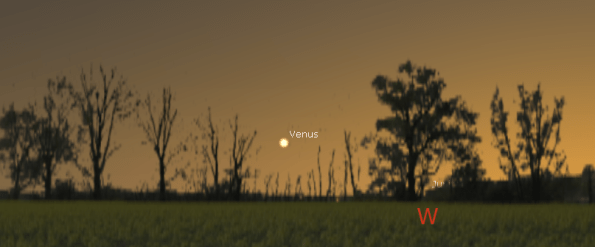
Looking very low in the west at 8:30 p.m., 20 minutes after sunset, September 7, 2016. Created using Stellarium.
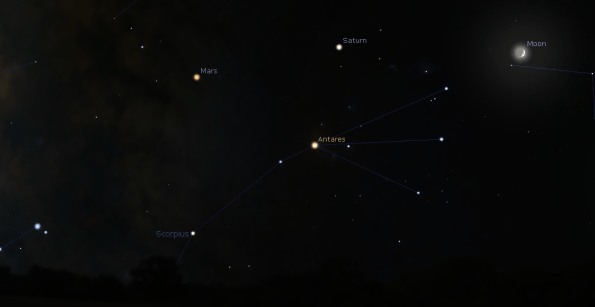
The Moon and the Mars-Saturn-Antares triangle at 9:30 p.m., September 7, 2016. Created using Stellarium.
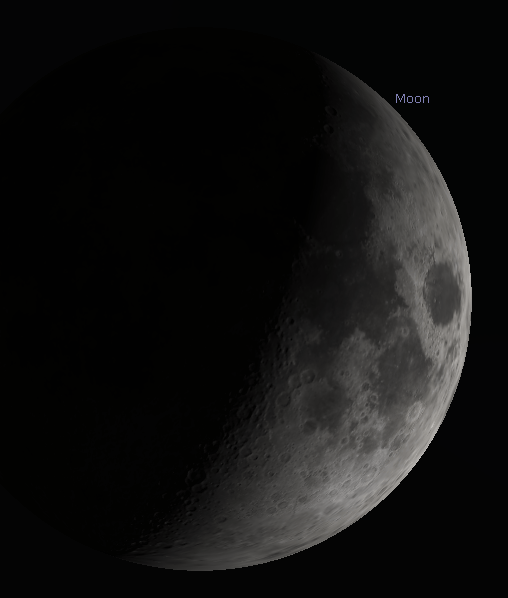
The Moon tonight as it might be seen in binoculars at 9:30 p.m. September 7, 2016. Created using Stellarium.
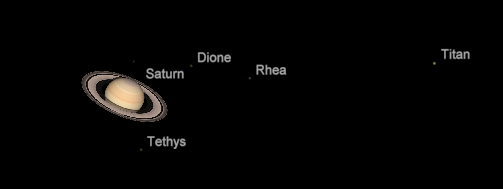
Saturn and some of its moons at 9:30 p.m. September 7, 2016. Created using Cartes du Ciel (Sky Charts).
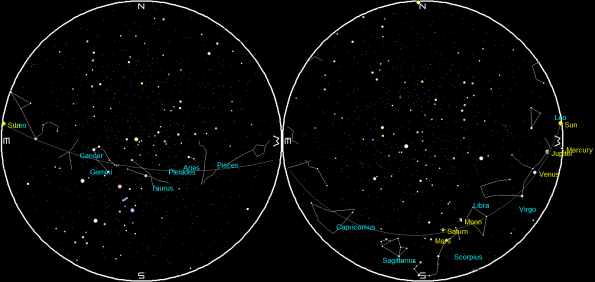
Planets and Moon at sunset and sunrise of a single night starting with sunset on the right on September 7, 2016. The night ends on the left with sunrise on September 8. Actually all the naked eye planets are in the evening sky. If you are using Firefox right-click on the image and select View Image to enlarge the image. That goes for all the large images. Created using my LookingUp program.
08/31/2016 – Ephemeris – Two of the evening planets are easily visible, the other three, not so much
Ephemeris for Wednesday, August 31st. The Sun will rise at 7:04. It’ll be up for 13 hours and 15 minutes, setting at 8:20. The Moon, 1 day before new, will rise at 7:17 tomorrow morning.
Tonight we still have all the bright classical planets in the evening sky, barely. Mercury, Jupiter and Venus are very low in the west and will set at 9:02, 9:05 and 9:13 p.m. respectively. They are all but invisible. Next month Mercury and Jupiter will pass the Sun to become visible in the morning sky. Venus alone will remain in the evening sky, slowly pulling away from the Sun. Mars, Saturn and the star Antares start the evening in the southwestern sky in a triangle, with Saturn on tip, Mars below and to the left, and Antares below and right of Mars. Mars, moving rapidly to the east against the stars will set at 12:15 a.m. Saturn, spectacular in telescopes with its rings, will set at 12:39 a.m.
Times are for the Traverse City/Interlochen area of Michigan. They may be different for your location.
Addendum
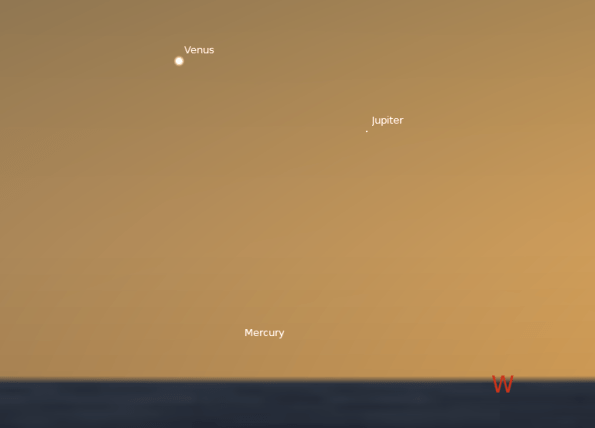
Looking very low in the west at 8:40 p.m., 20 minutes after sunset, August 31, 2016. Created using Stellarium.
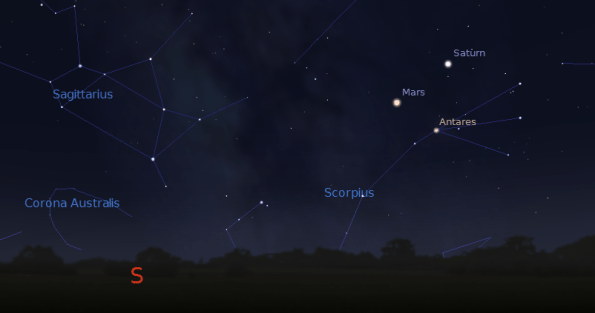
Mars-Saturn-Antares triangle at 9:30 p.m., August 31, 2016. Created using Stellarium.
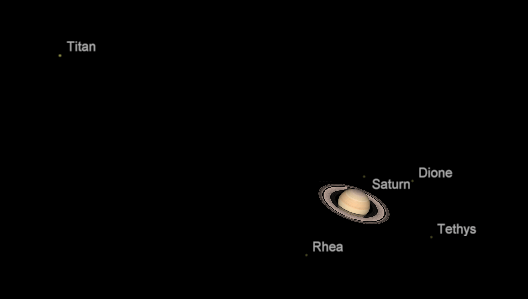
Saturn and some of its moons at 9:30 p.m. August 31, 2016. Created using Cartes du Ciel (Sky Charts).
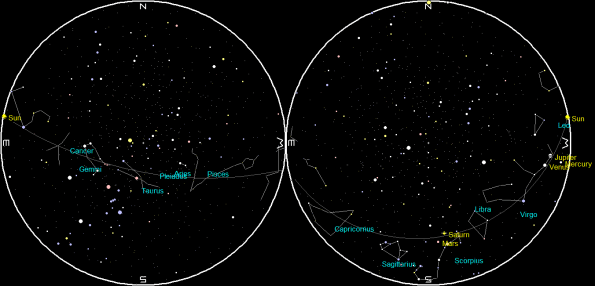
Planets at sunset and sunrise of a single night starting with sunset on the right on August 31, 2016. The night ends on the left with sunrise on September 1. Actually all the naked eye planets are in the evening sky. If you are using Firefox right-click on the image and select View Image to enlarge the image. That goes for all the large images. Created using my LookingUp program.
08/26/2016 – Ephemeris – Friday Night Live tonight, Star Party tomorrow
Ephemeris for Friday, August 26th. The Sun rises at 6:58. It’ll be up for 13 hours and 30 minutes, setting at 8:29. The Moon, 2 days past last quarter, will rise at 2:10 tomorrow morning.
The Grand Traverse Astronomical Society finishes off August with another busy weekend. Tonight the society members will bring their telescopes to downtown Traverse City and Friday Night Live, staying after to view the planets Saturn and Mars if it’s clear. Saturn’s rings are, of course, spectacular. Tomorrow night society members will be at Northwestern Michigan College’s Rogers Observatory beginning at 9 p.m. for a star party viewing of the planets, especially Saturn. That later as it gets really dark, the summer Milky Way will appear with its great telescopic treasures. Tomorrow, right after sunset the planets Venus and Jupiter will appear very close together. Observers far south of us will have a better shot at it than we do.
Times are for the Traverse City/Interlochen area of Michigan. They may be different for your location.
Addendum
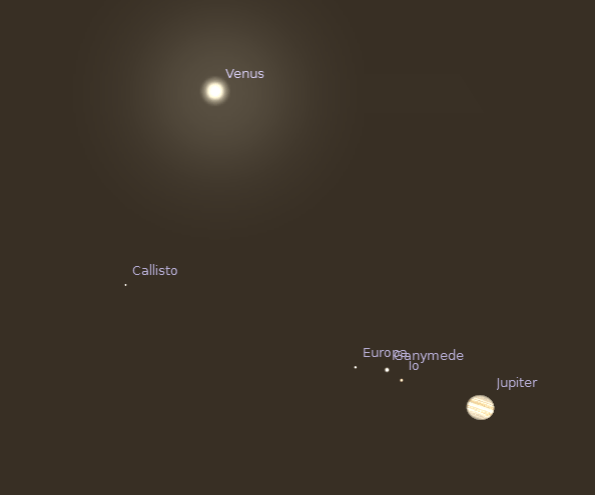
Venus near Jupiter at 9 p.m., or a half hour after sunset, August 27, 2016. I doubt if you could see the Jovian satellites against the bright twilight. It all but requires a big lake or ocean horizon, or a location far south of northern Michigan to raise these planets higher in the sky. Created using Stellarium.
 Bob Moler's Ephemeris Blog