Archive
Ephemeris: 03/03/2026 – Eclipse prospects for the rest of the year
This is Ephemeris for Tuesday, March 3rd. Today the Sun will be up for 11 hours and 16 minutes, setting at 6:33, and it will rise tomorrow at 7:14. The Moon, at full today, will rise at 7:04 this evening.
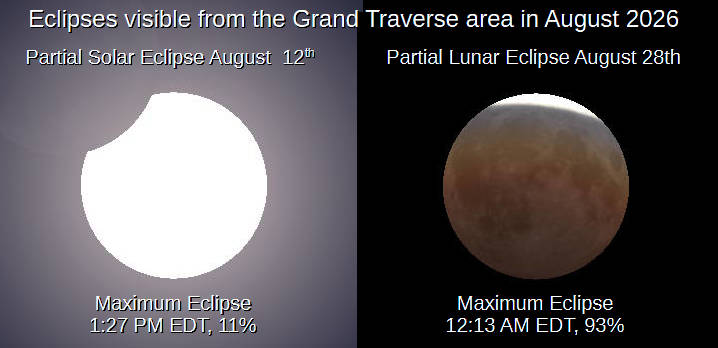
If you’re listening to me right now the total lunar eclipse this morning has ended or will shortly end. In any case it’s invisible because, even if it’s ongoing, twilight has wiped it out. Then there is the possibility of clouds, which I can’t predict from when I’m recording this Sunday night. We do have another chance to view a lunar eclipse, this year, on the night of August 27-28th. It’ll be a little bit earlier. It will start late in the evening and be almost total after midnight. There’s also going to be a solar eclipse on August 12th, but it will be just a little nibble of the moon on the sun for us. It’s going to be total for the east coast of Greenland, the northern Atlantic, and northern Spain, before ending at sunset in the Mediterranean Sea.
The astronomical event times given in this blog are for the Traverse City/Interlochen area of Michigan (Lat 44.7° N, Long 85.7° W; EST, UT – 5 hours) unless stated otherwise. Times will be different for other locations.
Addendum
Ephemeris: 03/14/2025 – Viewing today’s eclipse from the Moon
This is Ephemeris for Pi Day, Friday, March 14th. Today the Sun will be up for 11 hours and 51 minutes, setting at 7:48, and it will rise tomorrow at 7:54. The Moon, at full today, will rise at 8:27 this evening.
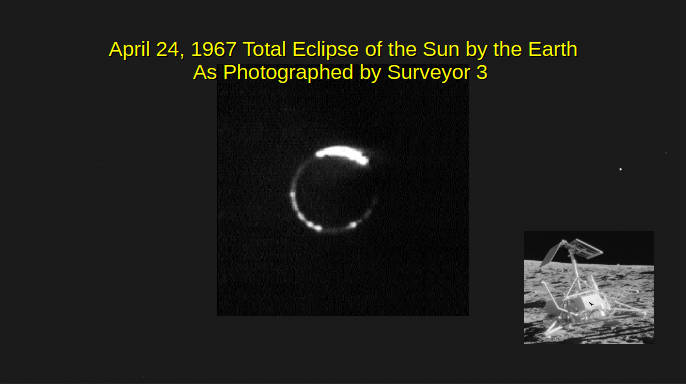
I hope you had a good look at the eclipse this morning I don’t know if it was clear or cloudy because I’m recording this last Sunday night. One entity got a cloudless shot at seeing the eclipse without any obstructions. That was the Blue Ghost lander on Mare Crisium on the Moon. However, it was on the Moon so it was seeing a total eclipse of the Sun. I’ll be really interested to see the photographs coming back from that. There was a satellite and one lander, the Surveyor 3 Lander on the Moon that took pictures of the Earth during the solar eclipse. Of course, we saw a lunar eclipse. It just saw a ring of light around the Earth where the Sun’s light was being bent through the Earth’s atmosphere into it’s shadow to dully illuminate the Moon.
The astronomical event times given are for the Traverse City/Interlochen area of Michigan (EDT, UT – 4 hours). Times will be different for other locations.
Addendum
Sorry, I couldn’t spend any time on the program to celebrate Pi day, so I’ll give it a token appreciation here:

Update
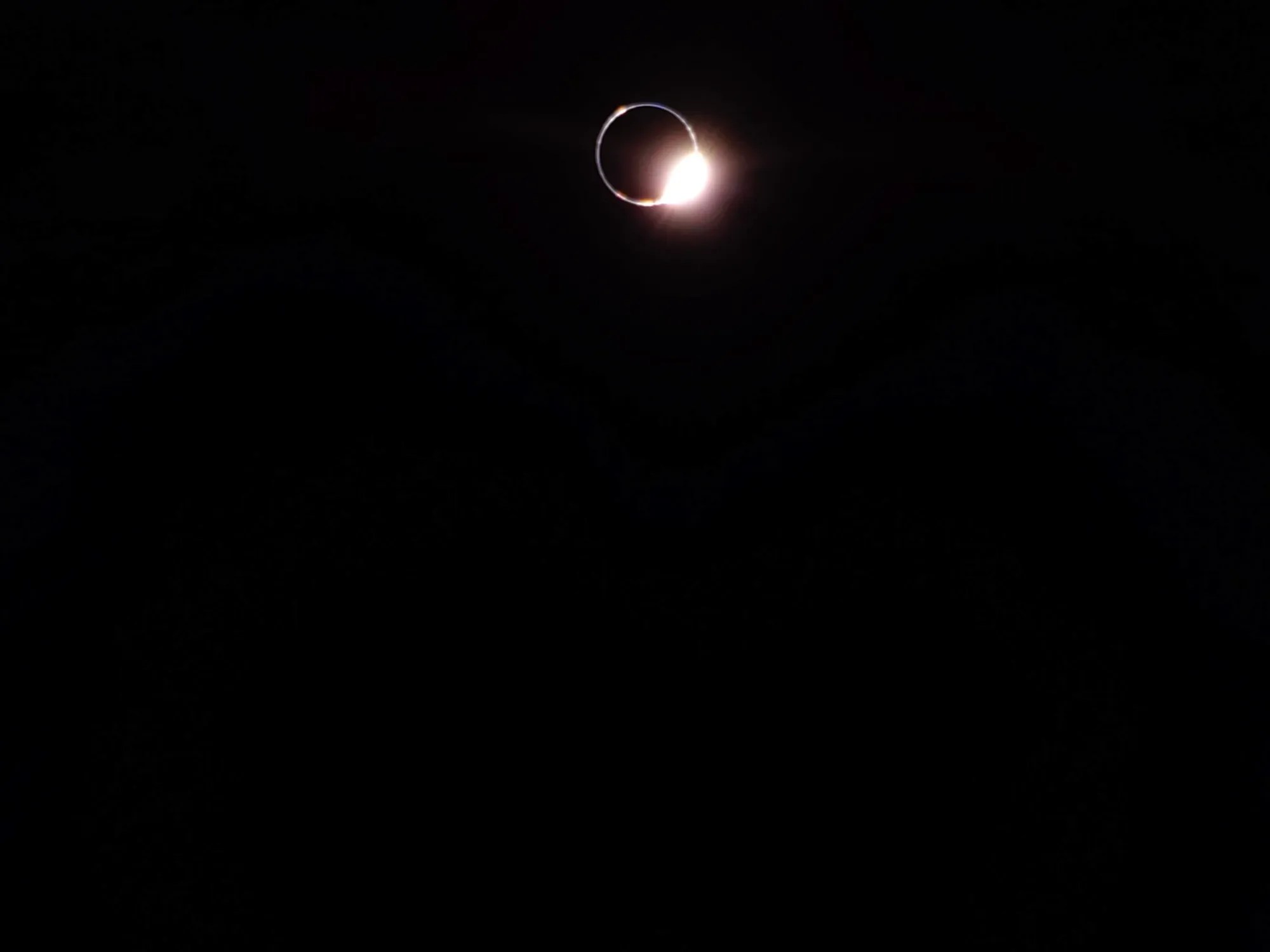
Firefly Aerospace.
Ephemeris: 09/16/2024 – Quadruple lunar events tomorrow night!
This is Ephemeris for Monday, September 16th. Today the Sun will be up for 12 hours and 26 minutes, setting at 7:50, and it will rise tomorrow at 7:24. The Moon, 1 day before full, will set at 6:34 tomorrow morning.
Tomorrow night there will be 4 lunar events occurring at the same time. Coincidence? I think not. The Moon will be full. The other events can only occur at full moon. It’s the Harvest Moon, the closest full moon to the autumnal equinox. It also happens to be a supermoon with the Moon reaching perigee, it’s closest to the Earth of the month a few hours later. Finally, the Moon will be partially eclipsed. By 9:45 PM the Moon may appear somewhat duller to the upper left than to the lower right. This is the Moon deep inside the Earth’s outer shadow called the penumbra. The actual partial phase of the eclipse will occur from 10:13 PM to 11:16 PM with the maximum occurring at 10:44 PM. With only 8 1/2 % of the Moon’s diameter covered.
The astronomical event times given are for the Traverse City/Interlochen area of Michigan (EDT, UT – 4 hours). Times will be different for other locations.
Addendum
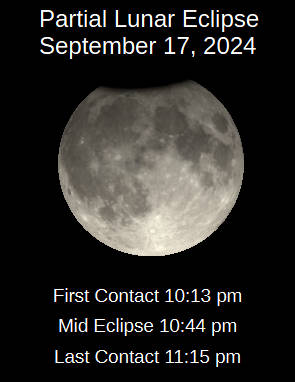
The eclipse will be visible in whole or in part for North America except for extreme western Alaska, also South America, Europe, Africa, and Western Asia. The times in Universal Time (UT): September 18, 2024, first contact 02:13, mid-eclipse 02:44, last contact 03:15.
12/20/2022 – Ephemeris – Hunting for the Star of Bethlehem: When did Herod the Great Die – Part 1
This is Ephemeris for Tuesday, December 20th. Today the Sun will be up for 8 hours and 48 minutes, setting at 5:04, and it will rise tomorrow at 8:16. The Moon, 3 days before new, will rise at 6:20 tomorrow morning.
In looking for the year Jesus was born and the appearance of the Star of Bethlehem, we look to the latter years of Herod the Great’s reign. Jewish historian Josephus recounts that Herod died shortly after an eclipse of the Moon occurred. The date of that eclipse, according to many historians, was March 13th, of 4 BCE and before Passover, a month later. The Greek text of Matthew states that Herod’s visitors, looking for the newborn King of the Jews, were Magi. Magi were priest-astrologers of the Zoroastrian Religion of Persia. That being the case, the Star could have been the triple conjunction of Jupiter and Saturn against the constellation of Pisces, when three times Jupiter passed Saturn between the end of May and early December of 7 BCE.
The astronomical event times given are for the Traverse City/Interlochen area of Michigan (EST, UT –5 hours). They may be different for your location.
Addendum
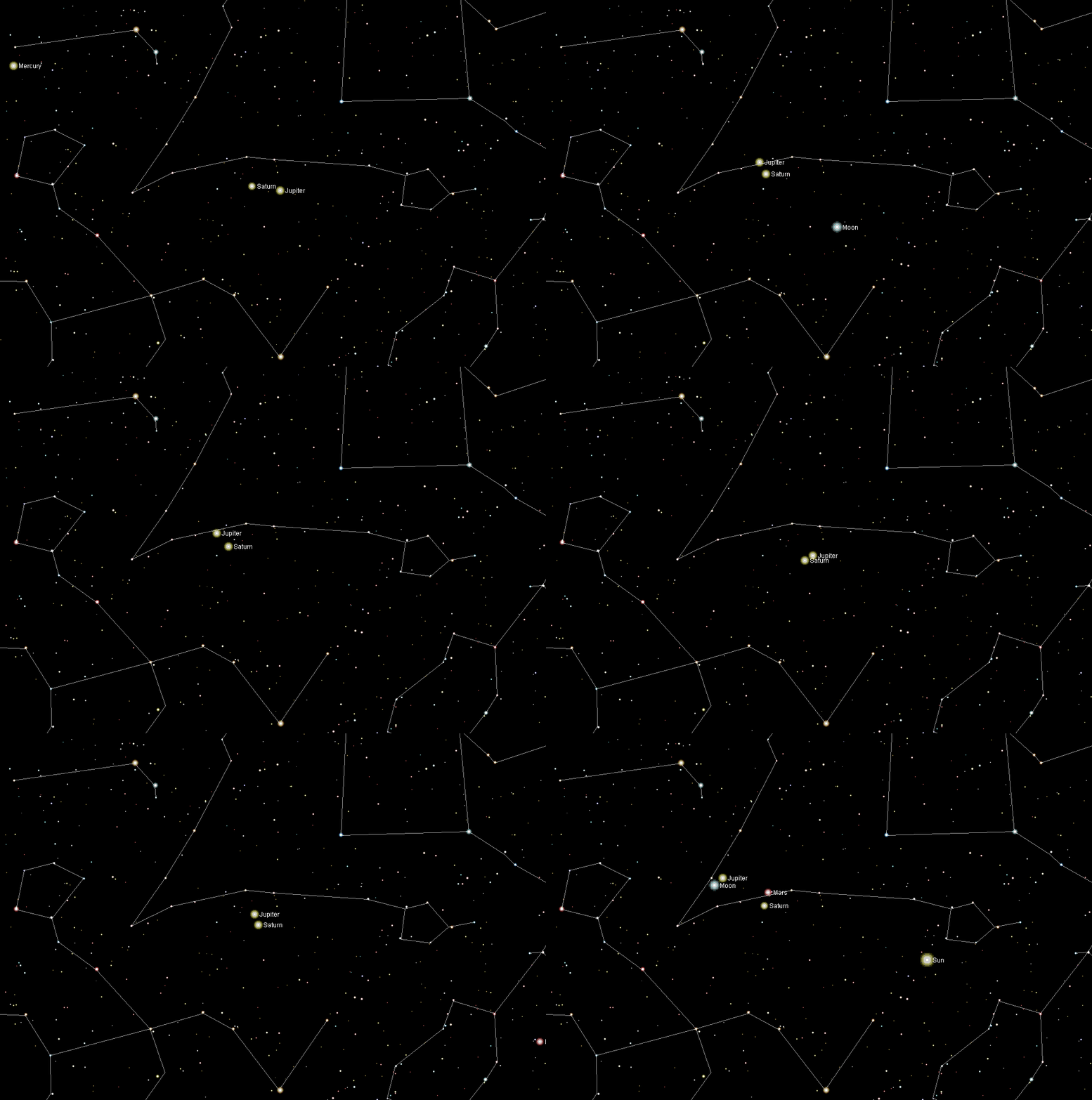
The Jupiter-Saturn triple conjunction of 7 BC. Click on the image to enlarge and animate. This animation is at 5-day intervals. The conjunctions took place against the stars of Pisces the fish, a constellation thought, in those days, to be associated with the Jews. The Moon will be popping in and out of the view. It ends in February of 6 BC, when Mars and the Moon enters the picture. Click on the image to enlarge it. Created using Cartes du Ciel and GIMP.
Above is an animation of the triple conjunction of Jupiter and Saturn of 7 BCE in 5 day steps. The body popping in and frame is the Moon. The first conjunction was on May 29th. Both planets stopped their eastward motion around July 6th. Astrologically, they became stationary and began their westward or retrograde motion. The second conjunction was on October 11th. Both planets stopped their westward or retrograde motion on November 1st. Again they were stationary to resume their normal eastward motion. The third and last conjunction was on December 8th. Two months later, on February 21st, of 6 BCE, Mars joined the group as they all move off to the western sky in the evening. Using this triple conjunction as the Star of Bethlehem, Jesus would have been born in the late autumn of 7 BCE or early winter of 6 BCE.
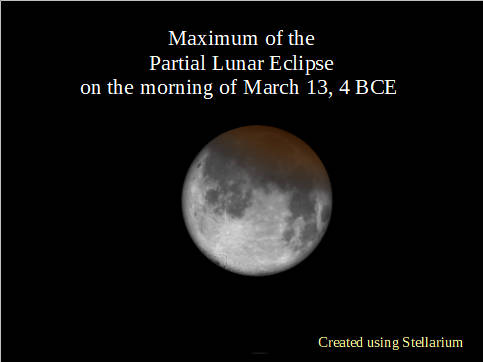
This lunar eclipse candidate for the eclipse that heralded the death of Herod the Great, and the favorite, since the time of Johannes Kepler, is the lunar eclipse of March 13, 4 BCE. It was a partial eclipse, only visible in the predawn hours. This eclipse occurred one lunar month before Passover.
Too little time for all the events Josephus describes. A better lunar eclipse occurred a bit less than three years later. Those defending the 4 BCE eclipse sometimes suggest that the Passover mentioned by Josephus was the next year’s Passover of 3 BCE. If it was the next year’s Passover, why mention Passover at all?
Tomorrow I’ll take a break to look to the naked eye planets, and to the winter solstice. Winter begins tomorrow! Thursday I’ll look to a better lunar eclipse and begin to explore another Bethlehem Star candidate.
07/28/2022 – Ephemeris – Why don’t we have solar eclipses every new moon?
This is Bob Moler with Ephemeris for Thursday, July 28th. Today the Sun will be up for 14 hours and 48 minutes, setting at 9:13, and it will rise tomorrow at 6:25. The Moon is new today, and won’t be visible.
The actual time when the moon is New will be 1:55 pm. The Moon will not eclipse the Sun this time. Why? Because the Moon is nearly 5 degrees, or 10 moon-diameters, north of the Sun. If the Moon orbited the Earth nearly in the same plane that the Earth orbited the Sun, we could have solar eclipses for somewhere on the Earth every new moon. As it is, the Moon orbits the Earth with about a 5-degree tilt to the Earth’s orbit of the Sun. So we get eclipse opportunities of eclipses about one in six new moons for solar eclipse and about the same for full moons and lunar eclipses. Of course, one has to be at the proper location to see them. If the Moon orbited the Earth over the Earth’s equator, like many other moons of other planets, eclipses would be much more rare and only occur around the equinoxes.
The astronomical event times given are for the Traverse City/Interlochen area of Michigan (EDT, UT – 4 hours). They may be different for your location.
Addendum
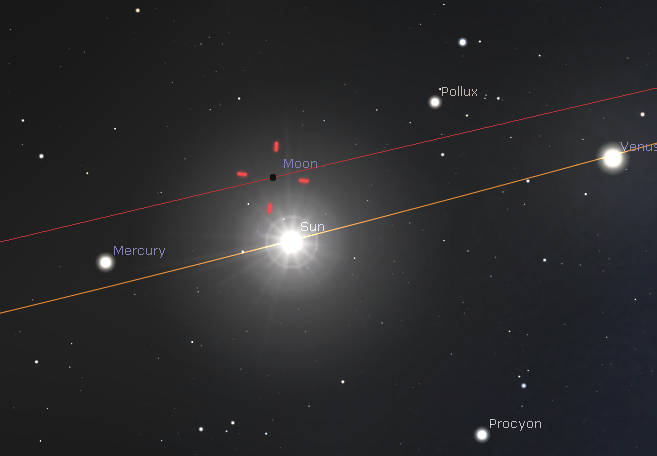
The Sun and Moon at New Moon at 1:55 pm today, seen as if the Earth had no atmosphere and one could see the Sun and stars at the same time. The orange line is the path of the Sun in the sky, called the ecliptic. The red line is the orbit of the Moon. Created using Stellarium.
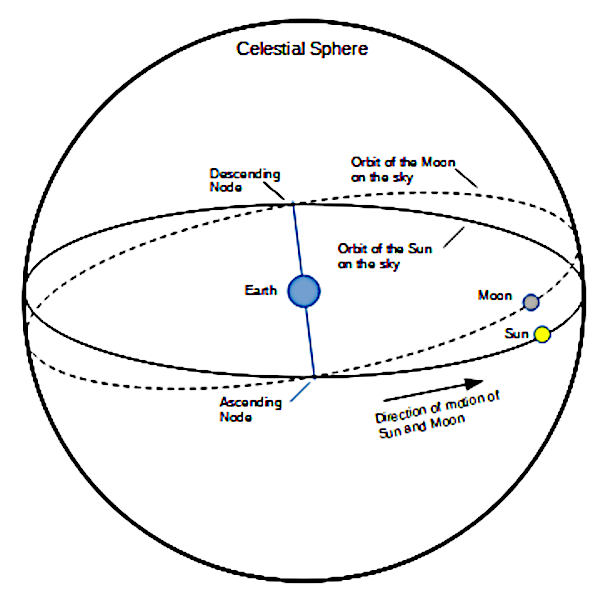
Earth centered (geocentric) diagram of the heavens called the celestial sphere, showing the apparent orbits of the Sun and Moon. The Moon’s orbit has about a 5-degree tilt (exaggerated here) to the Sun’s apparent orbit, which we call the ecliptic. Solar eclipses occur when the new moon and Sun are near a node. Lunar eclipses occur when the full moon and Sun are near opposite nodes. My diagram.
The orbit of the Moon precesses, so the line of the nodes regresses, that is slowly rotating clockwise, backwards to the motion of the Sun and Moon (and all the rest of the planets), one rotation in 18.6 years.
09/13/2021 – Ephemeris – The Greeks knew the size and shape of the Earth and estimated the distance to the Moon a long time ago
This is Bob Moler with Ephemeris for Monday, September 13th. Today the Sun will be up for 12 hours and 37 minutes, setting at 7:56, and it will rise tomorrow at 7:20. The Moon, at first quarter today, will set at 11:57 this evening.
The Ancient Greeks used lunar eclipses to determine that Earth is a sphere, and worked on determining the distance to the Moon. From ancient times, the Greeks knew that an eclipse of the Moon was caused by the Earth’s shadow falling on the Moon. Since the Earth’s shadow was always circular, no matter where the Moon was in the sky during an eclipse, the Earth must be a sphere since that’s the only three-dimensional body that always casts a circular shadow. They also used the size of the Earth’s shadow to estimate the distance to the Moon. The lunar distance, on average, is 60.8 times the Earth’s radius away. The first estimates were about one third of that. Hipparchus in the 2nd century BC got much closer. It got even better from there.
The astronomical event times given are for the Traverse City/Interlochen area of Michigan (EDT, UT – 4 hr). They may be different for your location.
Addendum
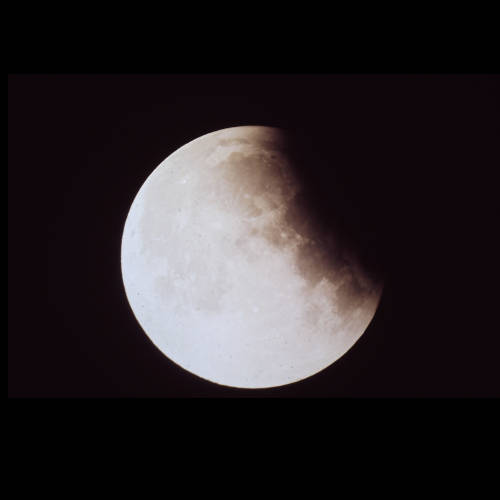
Partial Lunar Eclipse showing circular arc of the Earth’s shadow. Taken 04:15 UT August 17, 1970. Credit: the author.
The size of the Earth was unknown until Eratosthenes did in 240 BC. He came up with the circumference of the Earth to a fairly high degree. The Circumference is equal to the radius of a sphere or circle by 2πr.
12/20/2019 – Ephemeris – The Star of Bethlehem, the problem of when
Ephemeris for Thursday, December 20th. The Sun will rise at 8:16. It’ll be up for 8 hours and 48 minutes, setting at 5:04. The Moon, 2 days before full, will set at 6:46 tomorrow morning.
In looking at the possible origin of the Star of Bethlehem, the latest Jesus could have been born is before the death of Herod the Great. The Jewish historian Josephus says that Herod died between a lunar eclipse and Passover, with most Star investigators pointing to the partial eclipse of March 13, 4 BC, one month before Passover that year. Problem is that Josephus devotes 4 chapters of the 17th book of Jewish Antiquities to the events in that span. I think they chose that eclipse to fit in with the triple conjunction of Jupiter and Saturn in 7 BC that was the big favorite for the star. There is another, better total lunar eclipse on January 10, 1 BC that is 3 months before Passover that would better fit Josephus’ narrative and a different Star possibility. More Monday.
The times given are for the Traverse City/Interlochen area of Michigan. They may be different for your location.
Addendum
The passage about Herod’s death from the eclipse of the Moon to Passover is in Josephus’ Antiquities of the Jews is in Book 17, Chapter 6, Paragraph 4 through Chapter 9, paragraph 3.
In doing some additional research since recording the program, the footnotes in William Whiston’s translation suggests a period between the eclipse and Passover at 13 months. Antiquities of the Jews can be found here: https://www.gutenberg.org/files/2848/2848-h/2848-h.htm. Of course I could extend the time frame of Herod’s death for the 1 BC eclipse to the Passover 16 months later. That would solve one of the problems I had with the timing of the visit of the Magi. But you’ll have to wait until Monday to find out what that is.
Ephemeris for the real Columbus Day for once, Monday, October 12th. The Sun will rise at 7:54. It’ll be up for 11 hours and 9 minutes, setting at 7:03. The Moon is new today, and won’t be visible.
On Columbus’ 4th voyage to the Caribbean he was stranded on Jamaica. For a while the natives of the island fed Columbus and his men. However due to the thievery of some of his crew, these people no longer trusted Columbus any refused them any more supplies. Columbus consulted a table of eclipses and found that a lunar eclipse was to occur on February 29th that year (1504), and that at his location the moon would rise in eclipse. He went to the leader of the people and said that they had displeased their god by refusing his crew food, and that the god would turn the Moon red in anger. It worked. As Arthur C. Clarke once wrote: “Any sufficiently advanced technology is indistinguishable from magic.”
Times are for the Traverse City/Interlochen area of Michigan. They may be different for your location.
Addendum
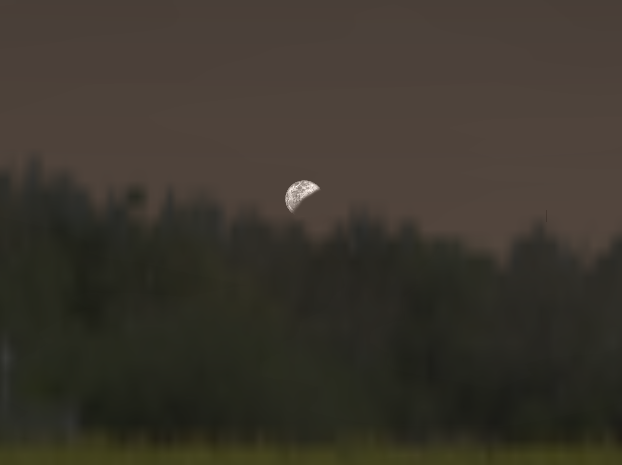
The moon rising from Jamaica February 29, 1504 as shown by Stellarium with some additional shadow darkening by myself.
Tomorrow I’ll look at what Columbus got wrong… Beside being lost.
I note for the record that Stellarium calendar dating includes what I call the Gregorian discontinuity. It drops the 10 days between October 4, 1582 and October 15th, which was the adjustment the Gregorian calendar makes to move ahead the actual vernal equinox from March 11 to the 21st. Christian churches always use the tabular value of March 21 as the vernal equinox for the calculation of the date of Easter. The old Julian calendar let that slip back about 3/4 of a day every century.
My 9/27/2015 lunar eclipse experience
This is an elaboration of an email sent to a fellow amateur astronomer who was completely clouded out and asked how we did.
From mid-eclipse, about 10:45, to the end of totality it was almost perfectly clear, We had light clouds after that to the end of the partial phase. Then it clouded up again. My impressions of the eclipse brightness at totality was that it was a bit darker than usual, but I may be wrong. However, I have had wretched luck in being able to view lunar eclipses. We were virtually wiped out by clouds with the two lunar eclipses last year, and we’ve had the same luck for the many eclipses occurring before. I may be out of practice.
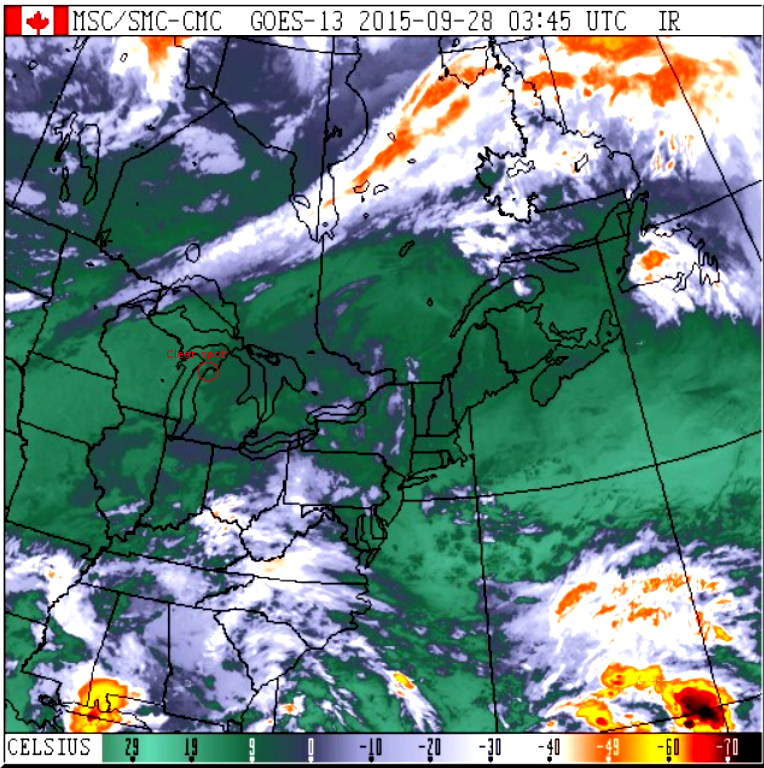
From the animation of the satellite images from Sunday night. The red circle points to the hole, really a notch in the clouds that allowed us to see the last part of the lunar eclipse. Our low clouds were warm in the infrared, so show as a very light gray. Credit NOAA/Environment Canada.
How to view tonight’s lunar eclipse if you are clouded out or on the wrong side of the planet
There will be a live webcast of the lunar eclipse from the Coca Cola Space Science Center in Columbus, Georgia if they’re not cloudy. Go here.
Tip of the old observer’s cap to spaceweather.com. If you haven’t yet subscribe to their free email notification service.
The partial phase of the eclipse starts at 9:07 p.m. EDT. Totality lasts from 10:11 p.m. to 11:23 p.m. when the ending partial phase commences. The partial phase will end at 12:27 a.m.
 Bob Moler's Ephemeris Blog