Archive
Ephemeris: 07/24/2025 – Vega, nearing the zenith in the evening now
This is Ephemeris for Thursday, July 24th. Today the Sun will be up for 14 hours and 56 minutes, setting at 9:17, and it will rise tomorrow at 6:21. The Moon is new today, and won’t be visible.
Vega, in the constellation Lyra the harp, is the highest bright star In the east and brightest star of the Summer Triangle also rising in that direction. It is an important and much studied star, first as a standard for brightness for the magnitude scale at almost exactly zero. In 1983 the Infrared Astronomy Satellite, IRAS, discovered an excess of infrared radiation coming from the star. It seems now that there are two orbiting rings around the star, an inner warm ring and an outer cold ring. This is somewhat like the two disks of material the Sun has: The asteroid belt between Mars and Jupiter and the Kuiper belt, beyond Neptune. No planets have yet been discovered around Vega, but I wouldn’t bet against it.
The astronomical event times given in this blog are for the Traverse City/Interlochen area of Michigan (Lat 44.7° N, Long 85.7° W; EDT, UT – 4 hours) unless stated otherwise. Times will be different for other locations.
Addendum
Ephemeris: 06/26/2025 – Finding the famous Double-Double Star
This is Ephemeris for Thursday, June 26th. Today the Sun will be up for 15 hours and 33 minutes, setting at 9:32, and it will rise tomorrow at 5:59. The Moon, 1 day past new, will set at 11:12 this evening.
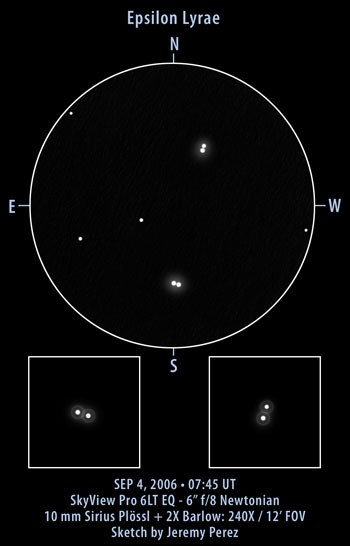
I generally will talk about observing something in the sky, in this program, if it can be seen with the naked eye, or can be seen in binoculars near something that can be seen with the naked eye, or something that can be seen in a small telescope that is visible in binoculars, near a naked eye object. This is of the latter type. High in the east at 11:00 PM or so is the bright star Vega. Just to the left of it in is a faint star, best seen in binoculars. It’s barely visible to the naked eye as a single star. But binoculars will show that it’s two star of equal brightness. However, viewing it with a telescope using probably the most power the telescope is capable, each of those stars is doubled again so Epsilon Lyrae is the famous Double-Double Star. It’s quite a challenge for a small telescope. This is also the time of the latest sunset and end of evening twilight. The last vestige of the glow moves to the north and ends just after midnight.
The astronomical event times given in this blog are for the Traverse City/Interlochen area of Michigan (Lat 44.7° N, Long 85.7° W; EDT, UT – 4 hours) unless stated otherwise. Times will be different for other locations.
Addendum
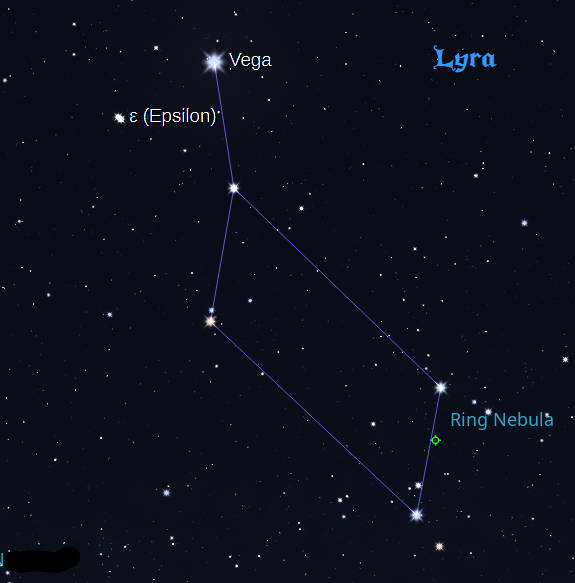
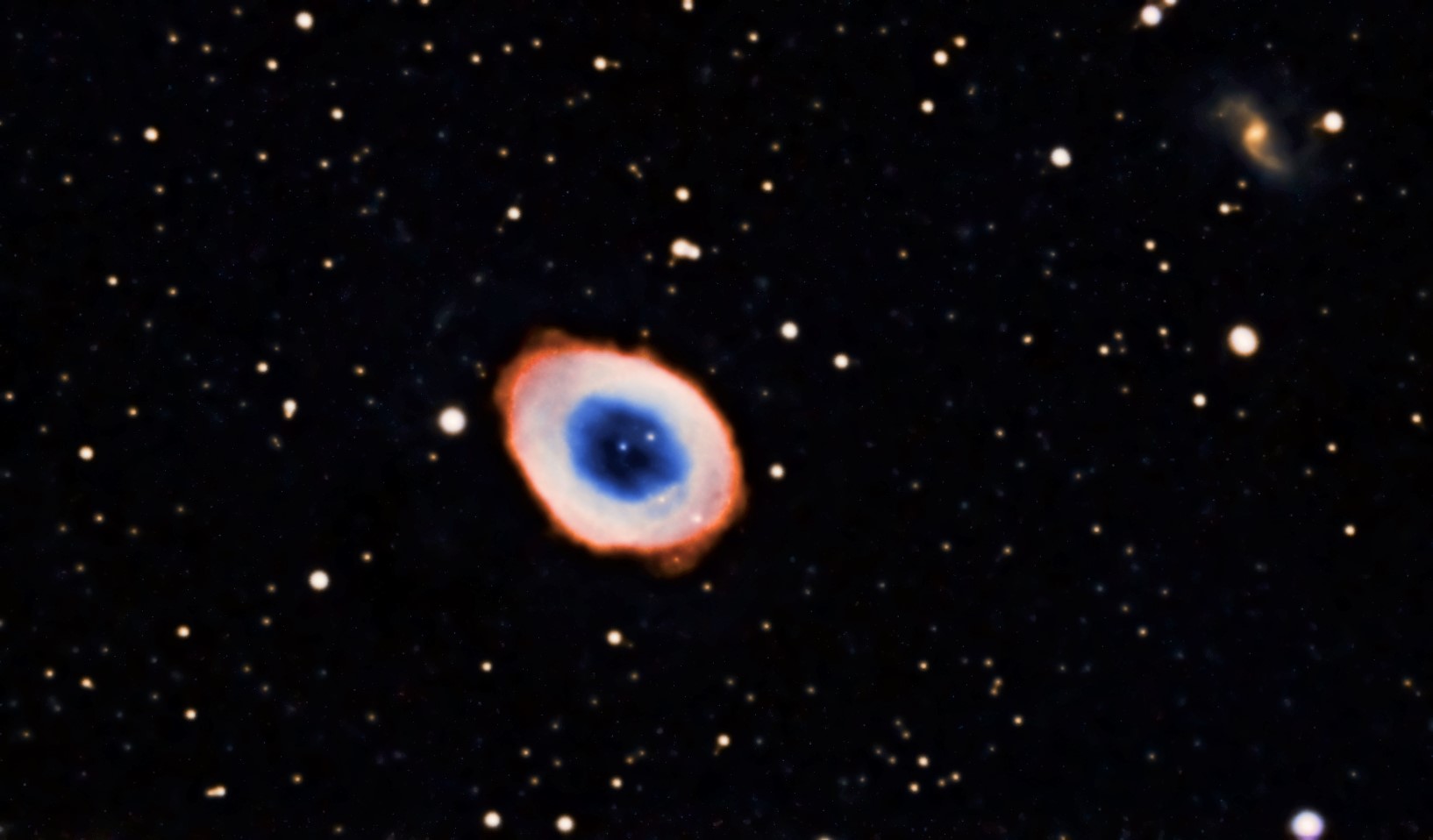
Bonus: A telescope capable of splitting the components of Epsilon should be capable of spotting the Ring Nebula (M57). It is not, however, visible in binoculars or a telescope finder. But it’s easily found by pointing the telescope between the two bottom stars of the Lyra parallelogram. Created using Stellarium, LibreOffice Draw and GIMP.
Ephemeris: 06/13/2025 – Finding the Summer Triangle
This is Ephemeris for Friday, June 13th. Today the Sun will be up for 15 hours and 32 minutes, setting at 9:29, and it will rise tomorrow at 5:56. The Moon, 2 days past full, will rise at 11:59 this evening.
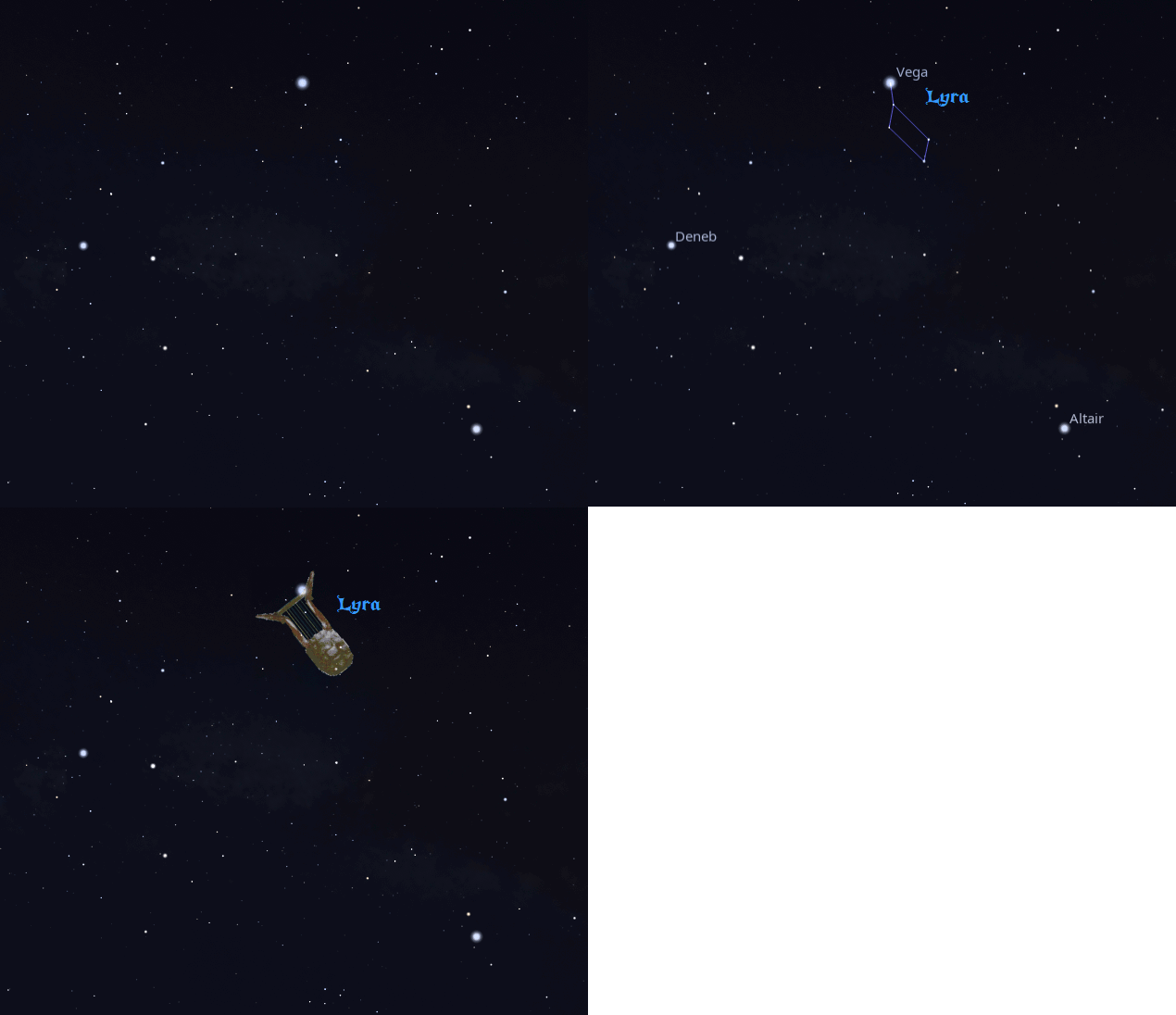
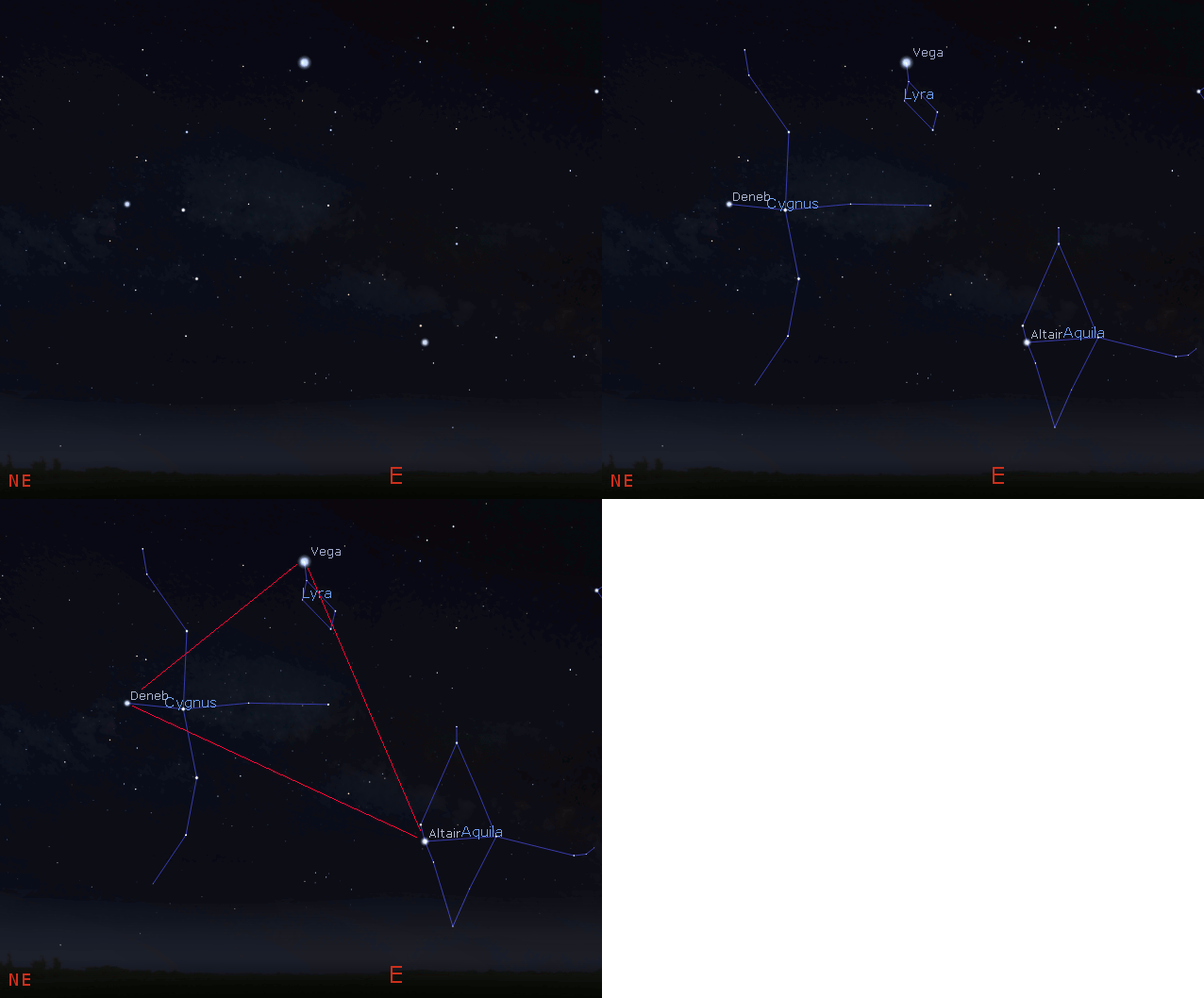
Summer skies are coming. It’s only 7 days until summer officially arrives. Looking to the eastern sky at 11 pm are three of the brightest stars in a large triangle. The top star Vega is about halfway up the sky to the zenith, and the brightest of the three. It’s in the small constellation of Lyra the harp. Lowest of the stars and just about due east is Altair in Aquila the eagle. Completing the triangle is Deneb in the northeast in the tail of Cygnus the swan or the head of the horizontal Northern Cross. These three stars make up the Summer Triangle, which isn’t an official constellation. It’s one of the many informal star patterns called asterisms. The Summer Triangle will be in our evening sky moving slowly westward until December.
The astronomical event times given in this blog are for the Traverse City/Interlochen area of Michigan (Lat 44.7° N, Long 85.7° W; EDT, UT – 4 hours) unless stated otherwise. Times will be different for other locations.
Addendum
Ephemeris: 07/30/2024 – The heavenly harp
This is Ephemeris for Tuesday, July 30th. Today the Sun will be up for 14 hours and 42 minutes, setting at 9:10, and it will rise tomorrow at 6:28. The Moon, 3 days past last quarter, will rise at 2:08 tomorrow morning.
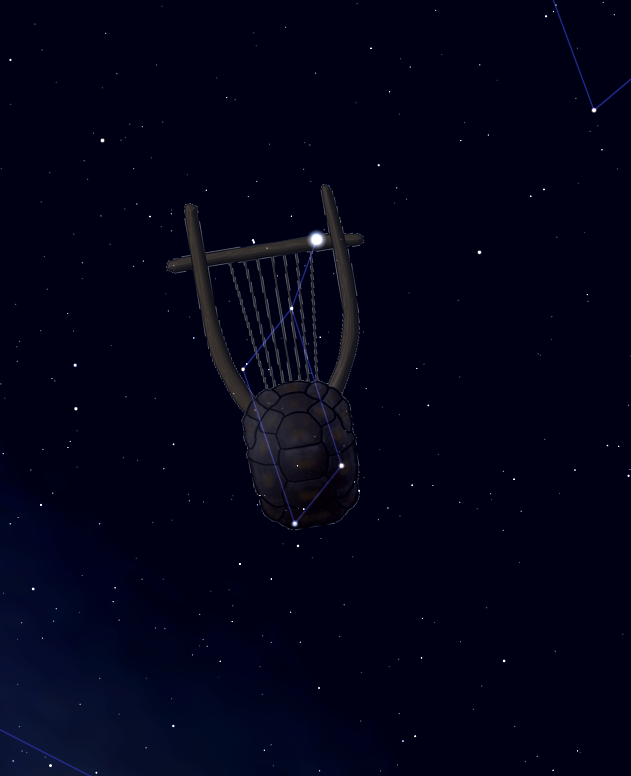
After it gets dark, nearly overhead, appears the bright star Vega, the brightest of the stars of the Summer Triangle. It is part of the constellation called Lyra the harp. The form of the harp is a lyre, which has a U-shaped frame with a bar across the top, the strings are strung from the bar down to the base of the U. According to Greek myth it was invented by the god Hermes who used a tortoise shell as the base of the U. He gave it to Apollo, who in turn gave it to Orpheus. Orpheus had the greatest musical talent. His singing and lyre playing would make animals and even inanimate objects dance. The constellation itself consists of Vega and a parallelogram of four stars which are seen below it.
The astronomical event times given are for the Traverse City/Interlochen area of Michigan (EDT, UT–4 hours). They may be different for your location.
Addendum
Ephemeris: 07/18/2023 – Vega, the brightest star of the Summer Triangle
This is Ephemeris for Tuesday, July 18th. Today the Sun will be up for 15 hours and 9 minutes, setting at 9:23, and it will rise tomorrow at 6:15. The Moon, 1 day past new, will set at 10:30 this evening.
Vega, in the constellation Lyra the harp, is the highest bright star In the east and brightest star of the Summer Triangle also rising in that direction. It is an important and much studied star, first as a standard for brightness for the magnitude scale at almost exactly zero. In 1983 the Infrared Astronomy Satellite, IRAS, discovered an excess of infrared radiation coming from the star. It seems now that there are two orbiting rings around the star, an inner warm ring and an outer cold ring. This is somewhat like the two disks of material the Sun has: The asteroid belt between Mars and Jupiter and the Kuiper belt, beyond Neptune. No planets have yet been discovered around Vega, but I wouldn’t bet against it.
The astronomical event times given are for the Traverse City/Interlochen area of Michigan (EDT, UT –4 hours). They may be different for your location.
Addendum
07/07/2022 – Ephemeris – A closer look at the bright star Vega
This is Bob Moler with Ephemeris for Thursday, July 7th. Today the Sun will be up for 15 hours and 25 minutes, setting at 9:30, and it will rise tomorrow at 6:05. The Moon, 1 day past first quarter, will set at 1:53 tomorrow morning.
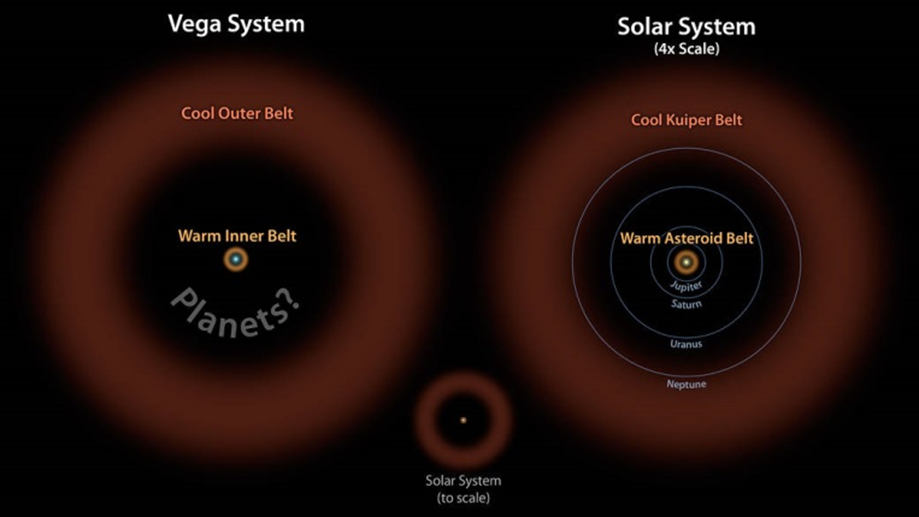
Vega, in the constellation Lyra the harp, is the highest star In the east and brightest star of the Summer Triangle also rising in that direction. It is an important and much studied star, first as a standard for brightness for the magnitude scale at almost exactly zero. It also has two fields of debris orbiting it. In 1983 the Infrared Astronomy Satellite, IRAS, discovered an excess of infrared radiation coming from the star. It seems now that there are two orbiting rings, one warm, and the other cold. This is somewhat like the two disks the Sun has: The asteroid belt between Mars and Jupiter and the Kuiper belt, beyond Neptune. No planets have yet been discovered around Vega, but I wouldn’t bet against it.
The astronomical event times given are for the Traverse City/Interlochen area of Michigan (EDT, UT – 4 hours). They may be different for your location.
Addendum
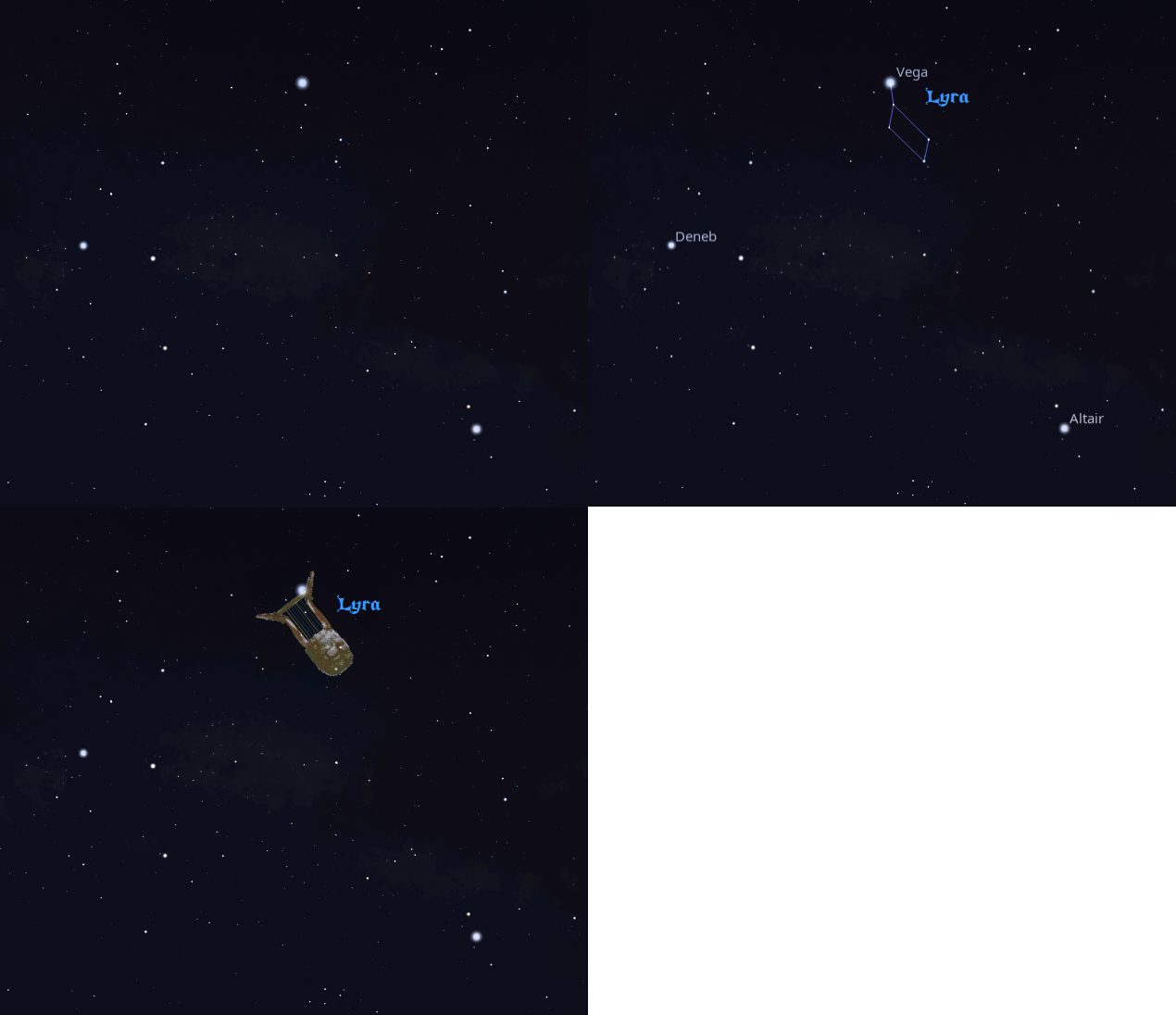
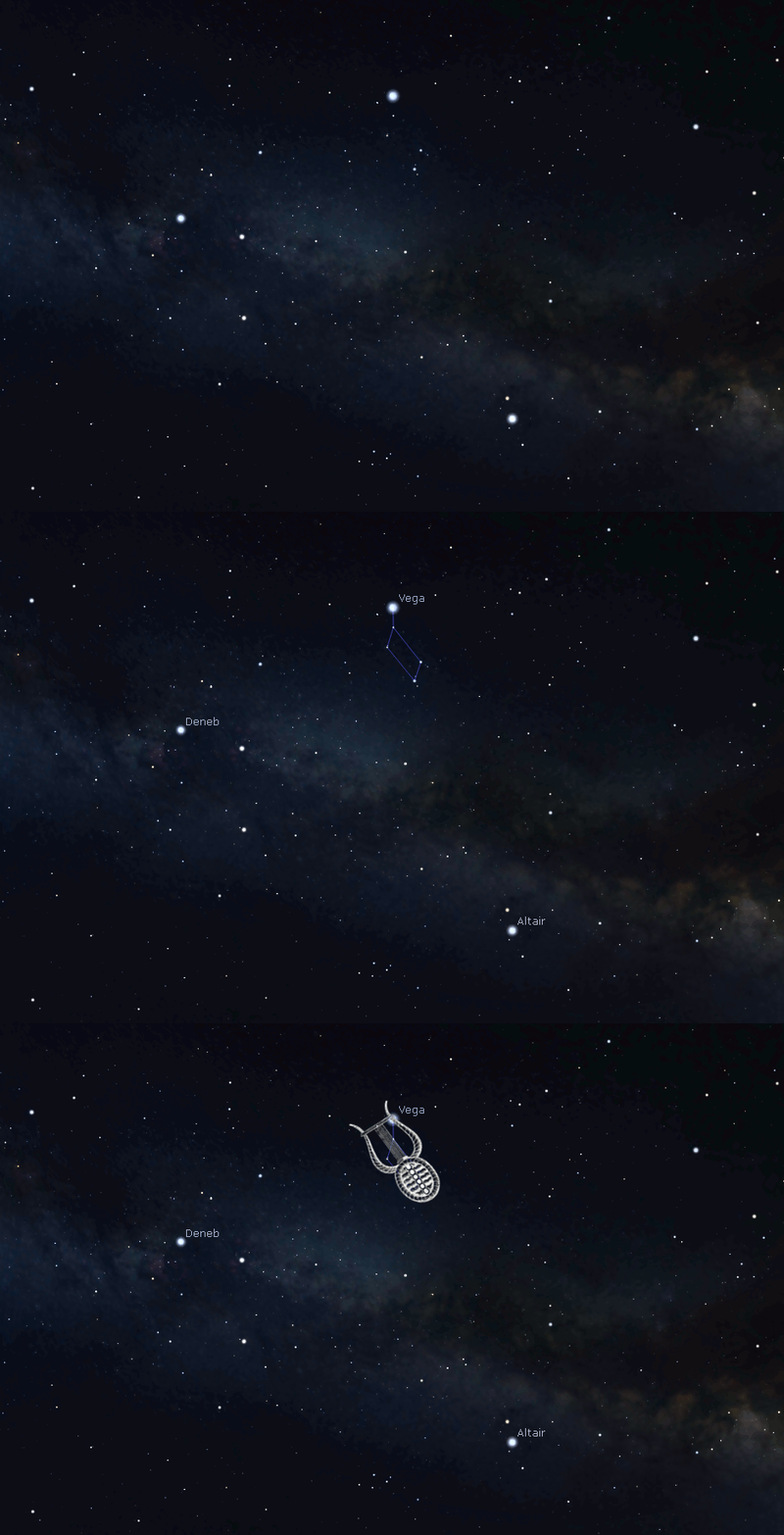
Animated Lyra finder chart. The lyre image not supplied by Stellarium but is from The World’s Earliest Music by Hermann Smith, Figure 60, A Project Gutenberg E-Book, and captioned “The Chelys or Greek Tortoiseshell Lyre”. Vega is the brightest star in Lyra, and the brightest star of the Summer Triangle. The other stars of the triangle are Deneb and Altair. Created using Stellarium.
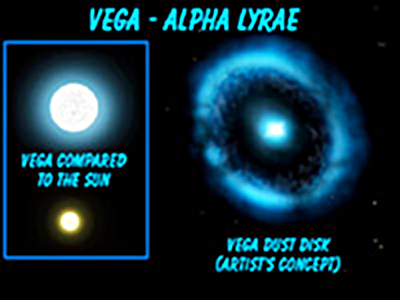
Vega possesses two debris fields, similar to our own solar system’s asteroid and Kuiper belts. Astronomers continue to hunt for planets orbiting Vega, but as of May 2020 none have been confirmed. More info: bit.ly/VegaSystem Credit: NASA/JPL-Caltech
06/28/2022 – Ephemeris – Finding the celestial harp
This is Ephemeris for Tuesday, June 28th. Today the Sun will be up for 15 hours and 32 minutes, setting at 9:32, and it will rise tomorrow at 6:00. The Moon is new today, and won’t be visible.
High in the east at 11 p.m. can be found a bright star just above a small, narrow, but very distinctive parallelogram of stars. They are the stars of the constellation Lyra the harp. The bright star is Vega, the 4th or 5th brightest nighttime star*, and currently the topmost star of the Summer Triangle. To the Romans, the star Vega represented a falling eagle or vulture. Apparently they never made the distinction between the two species. It is a pure white star and serves as a calibration star for color and brightness. In the evening, it is the top-most star of the Summer Triangle. The harp, according to Greek mythology, was invented by the god Hermes. The form of the harp, in the sky, is as he had invented it: by stretching strings across a tortoise shell. Hermes gave it to his half-brother Apollo, who in turn gave it to the legendary musician Orpheus.
The astronomical event times given are for the Traverse City/Interlochen area of Michigan (EDT, UT – 4 hours). They may be different for your location.
*Vega’s rival for the fourth spot on the brightness list is Arcturus to it’s west. Wikipedia’s source says that Arcturus is slightly brighter. Stellarium’s source says Vega is brighter. The difference is a few hundredths of a magnitude. However, they are of different colors. Vega is pure white, while Arcturus is yellow-orange because it has a cooler surface temperature than Vega. Check them out for yourself.
Addendum
Animated Lyra finder chart. The lyre image not supplied by Stellarium but is from The World’s Earliest Music by Hermann Smith, Figure 60, A Project Gutenberg E-Book, and captioned “The Chelys or Greek Tortoiseshell Lyre”. The three names stars are the stars of the Summer Triangle in the eastern sky these evenings of late June. Created using Stellarium.
06/27/2022 – Ephemeris – Finding the Summer Triangle
This is Ephemeris for Monday, June 27th. Today the Sun will be up for 15 hours and 33 minutes, setting at 9:32, and it will rise tomorrow at 5:59. The Moon, 1 day before new, will rise at 5:13 tomorrow morning.
We’re nearly a week into summer, and the asterism or informal constellation called the Summer Triangle can be seen rising in the east as it gets dark. Highest of the three bright stars is Vega in the constellation Lyra the harp, whose body is seen in a narrow parallelogram nearby. The second star of the triangle is Deneb, in Cygnus the swan, lower and left of Vega, It appears dimmer than Vega because it is by far the most distant of the three. The third star of the Summer Triangle is seen farther below and a right of Vega. It is Altair in Aquila the eagle, and the closest. Altair is 16.5 light years away, Vega is 27 light years, while Deneb may be a whopping 2,600 light years away. One light year is 6 trillion miles (9 trillion kilometers).
The astronomical event times given are for the Traverse City/Interlochen area of Michigan (EDT, UT – 4 hours). They may be different for your location.
Addendum
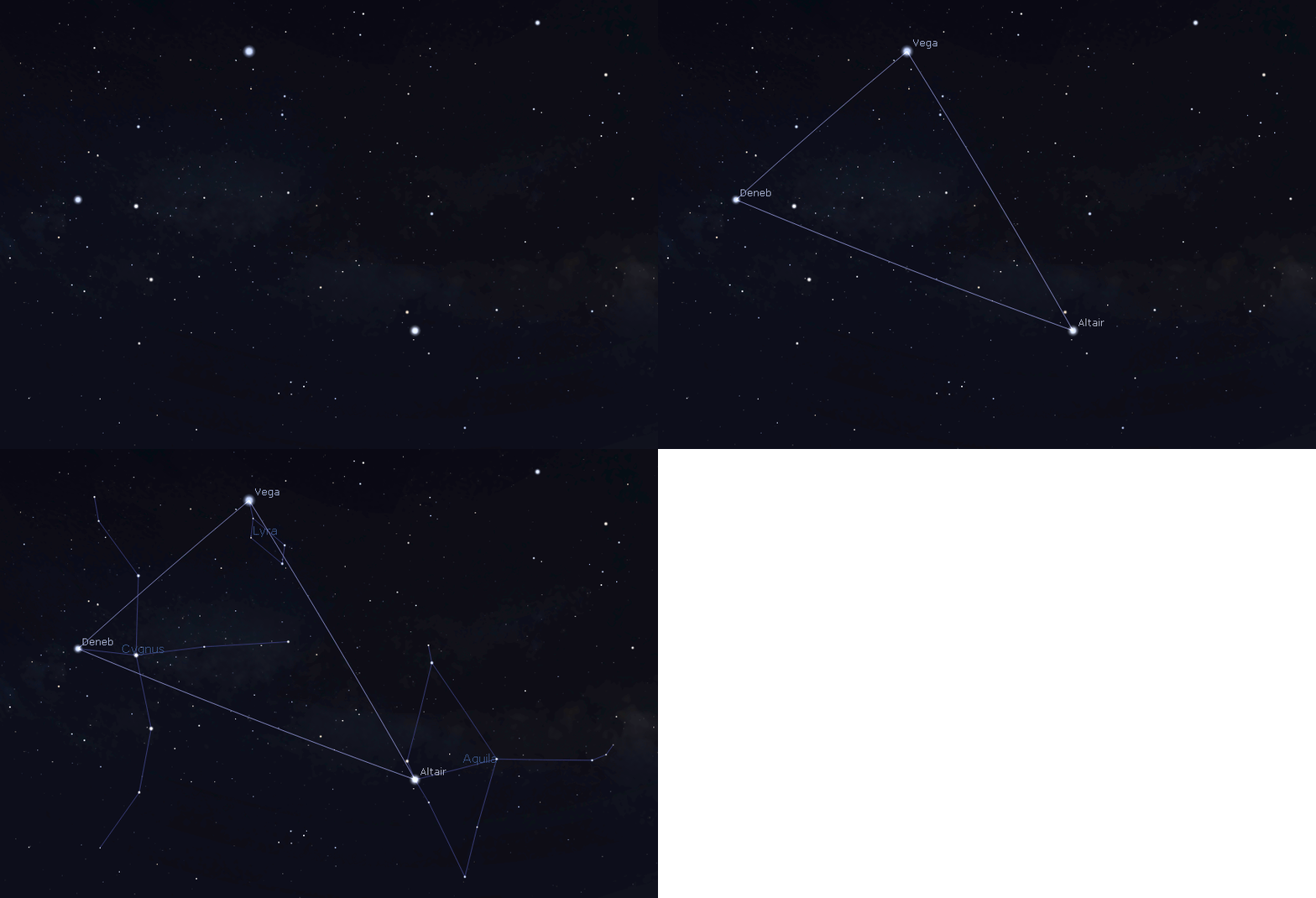
The Summer Triangle finder animation showing first the unlabeled sky, Then the Summer Triangle with the stars labeled, then the constellations of those stars. Created using Stellarium and GIMP.
07/06/2021 – Ephemeris – Looking at the constellation of Lyra the harp
This is Ephemeris for Tuesday, July 6th. Today the Sun will be up for 15 hours and 26 minutes, setting at 9:30, and it will rise tomorrow at 6:05. The Moon, 3 days before new, will rise at 3:56 tomorrow morning.
High in the east at 11 p.m. can be found a bright star just above a small, narrow, but very distinctive parallelogram of stars. They are the stars of the constellation Lyra the harp. The bright star is Vega, the 5th brightest night-time star. To the Romans, the star Vega represented a falling eagle or vulture. Apparently they never made the distinction between the two species. It is a pure white star and serves as a calibration star for color and brightness. In the evening, it is the top-most star of the Summer Triangle. The harp, according to Greek mythology, was invented by the god Hermes. The form of the harp, in the sky, is as he had invented it: by stretching strings across a tortoise shell. Hermes gave it to his half-brother Apollo, who in turn gave it to the legendary musician Orpheus.
The astronomical event times given are for the Traverse City/Interlochen area of Michigan (EDT, UT-4). They may be different for your location.
Addendum
Animated Lyra finder chart. The lyre image not supplied by Stellarium but is from The World’s Earliest Music by Hermann Smith, Figure 60, A Project Gutenberg E-Book, and captioned “The Chelys or Greek Tortoiseshell Lyre”. Click on the image to enlarge it. Created using Stellarium and GIMP.
06/29/2021 – Ephemeris – The Summer Triangle
This is Ephemeris for Tuesday, June 29th. Today the Sun will be up for 15 hours and 32 minutes, setting at 9:32, and it will rise tomorrow at 6:00. The Moon, 2 days before last quarter, will rise at 1:14 tomorrow morning.
Dominating the eastern sky at 11 pm are three bright stars. These are all first magnitude stars, members of the group of 21 brightest stars in the night sky. Highest, in the east, is Vega, the brightest of the three. It and a small, slim parallelogram of stars below it belong to the constellation of Lyra the harp. Below it to the northeast is Deneb, dimmest of the three at the head of the horizontally appearing Northern Cross, an informal constellation or asterism. Properly, Deneb is in the tail of Cygnus the swan flying south through the Milky Way. The third star of the three is Altair, lower still, but in the east-southeast at the head of Aquila the Eagle. These three stars are in a large asterism called the Summer Triangle, which will be with us through summer and fall.
The astronomical event times given are for the Traverse City/Interlochen area of Michigan (EDT, UT-4). They may be different for your location.
Addendum
The Summer Triangle finder animation showing first the unlabeled sky, Then the Summer Triangle with the stars labeled, then the constellations of those stars. Click on the image to enlarge it. Created using Stellarium and GIMP.
 Bob Moler's Ephemeris Blog