Archive
07/21/2015 – Ephemeris – Vega, the brightest star of the Summer Triangle
Ephemeris for Tuesday, July 21st. Today the Sun will be up for 15 hours and 3 minutes, setting at 9:20. The Moon, 3 days before first quarter, will set at 12:01 tomorrow morning. Tomorrow the Sun will rise at 6:17.
The bright star high in the east is Vega, one of the stars of the Summer Triangle an informal constellation called an asterism. Vega belongs to the official constellation Lyra the harp, which includes a narrow parallelogram of stars to its south. Vega was regarded by astronomers as a standard calibration star. Though a first magnitude star, its actual magnitude is 0.03 and slightly variable. It is a type A0 (A-zero) pure white star, and is 25 light years away. Astronomers however got a shock in 1983 when calibrating the Infrared Astronomy Satellite (IRAS) on it: Vega showed an excess of Infrared radiation that means the star is orbited by a disk of dust, perhaps the beginnings of a planetary system. Due to the slow wobble of the earth’s axis Vega will be our pole star in 14 thousand years.
Times are for the Traverse City/Interlochen area of Michigan. They may be different for your location.
Addendum
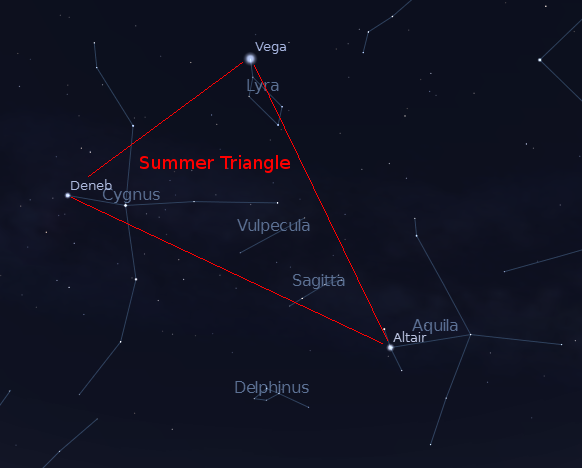
The Summer Triangle. Created using Stellarium and The Gimp.
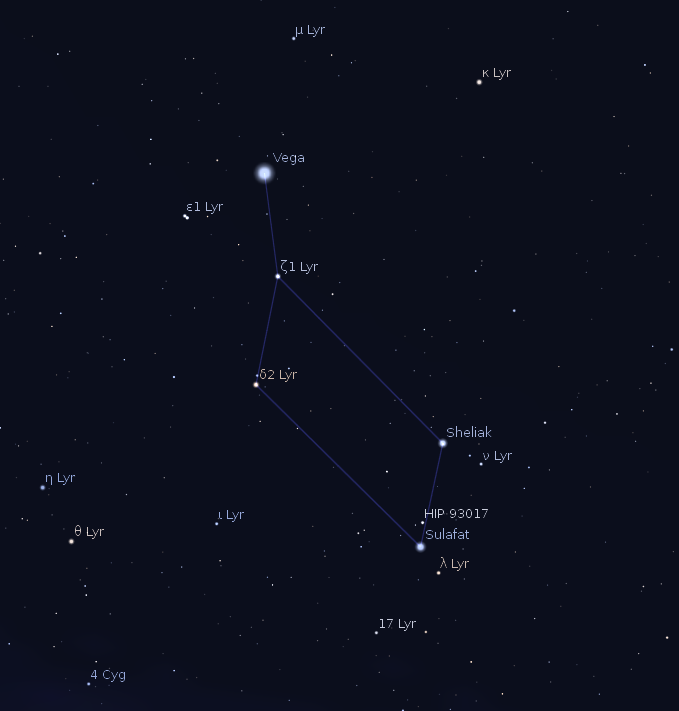
Magnified view of Lyra. Created using Stellarium.
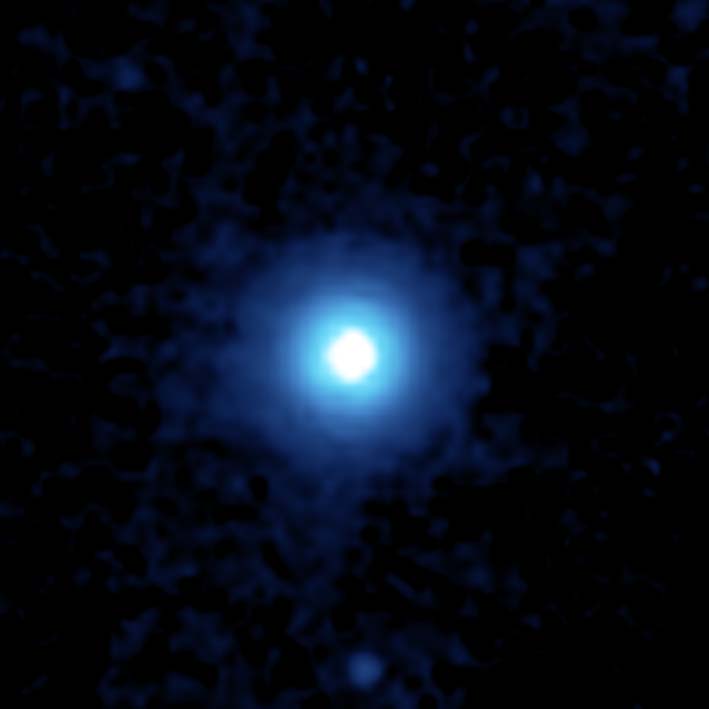
Vega in the mid-infrared from the Spitzer Infrared Satellite. Credit: NASA/JPL-Caltech/University of Arizona
07/16/2015 – Ephemeris – The Summer Triangle is the sign of the season
Ephemeris for Thursday, July 16th. Today the Sun will be up for 15 hours and 12 minutes, setting at 9:25. The Moon, 1 day past new, will set at 9:32 this evening, and tomorrow the Sun will rise at 6:13.
We’re almost a month into summer, and the asterism or informal constellation called the Summer Triangle can be seen midway up the sky in the east as it gets dark. Highest of the three bright stars is Vega in the constellation Lyra the harp, whose body is seen in a narrow parallelogram nearby. The second star of the triangle is Deneb lower and left of Vega, It appears dimmer than Vega because it is by far the most distant of the three. The third star of the Summer Triangle is seen farther below and a right of Vega. It is Altair in Aquila the eagle, and the closest. Altair is 16.5 light years away, Vega is 27 light years while Deneb is so far away that it’s distance is in some doubt and may be 2,600 light years away.
Times are for the Traverse City/Interlochen area of Michigan. They may be different for your location.
Addendum
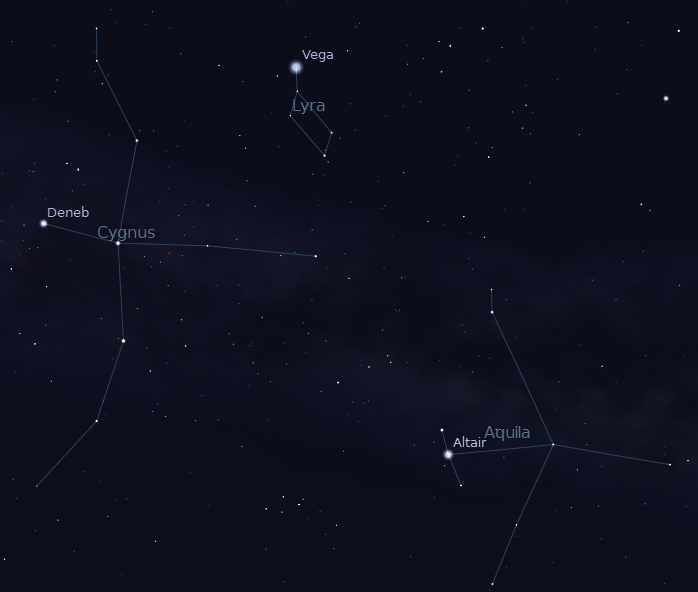
Summer Triangle. Created using Stellarium.
04/20/2015 – Ephemeris – The Lyrid meteor shower will reach peak Wednesday evening
Ephemeris for Monday, April 20th. The Sun rises at 6:50. It’ll be up for 13 hours and 43 minutes, setting at 8:33. The Moon, 2 days past new, will set at 10:57 this evening.
This week the Lyrid meteor shower will reach its peak. The expected peak will be Wednesday the 22nd at 8 p.m. (24 hr UT). Unfortunately the radiant point will not have risen by then. The radiant, near the star Vega in the constellation of Lyra will rise in the northeast by 10 p.m. It will approach the zenith by 6 a.m. as morning twilight brightens. The normal peak hourly rate is about 18 when the radiant is at the zenith, This year it could be as many as 90 per hour. However Europe and Asia will be prime locations to view the shower near the zenith at peak. The shower is caused by the debris of Comet Thatcher, seen only once in 1861. When comets approach the Sun they shed gas, dust and small bits of rock. When the Earth passes through it we get a meteor shower.
Times are for the Traverse City/Interlochen area of Michigan. They may be different for your location.
Addendum
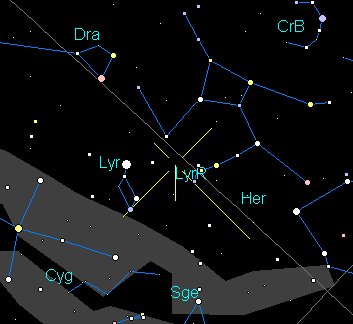
Lyrid meteor radiant is near Lyra and the bright star Vega. Th bright star by “Lyr” is Vega. Create by Bob Moler’s LookingUp program.
08/25/2014 – Ephemeris – Cool treasures in the constellation of Lyra
Ephemeris for Monday, August 25th. The sun rises at 6:56. It’ll be up for 13 hours and 34 minutes, setting at 8:31. The moon is new today, and won’t be visible.
The bright star Vega will be nearly overhead tonight at 10 p.m. It will be about 6 degrees south of the zenith. That’s quite a stretch of the neck to spot, with its accompanying stars in a small parallelogram that make up the constellation of Lyra the harp. Lyra has some interesting features for a serious observer with and without a telescope. The bottom right star of the parallelogram, if south is toward the bottom, is a star called Beta Lyrae that changes brightness by a factor of 3 in a period of 13 days. Another star near Vega looks like two close stars in binoculars, in telescopes each is again a double stars. That’s Epsilon Lyrae. The jewel of this constellation needs a telescope to find between the two bottom stars of the parallelogram, the famous Ring Nebula.
Times are for the Traverse City/Interlochen area of Michigan. They may be different for your location.
Addendum
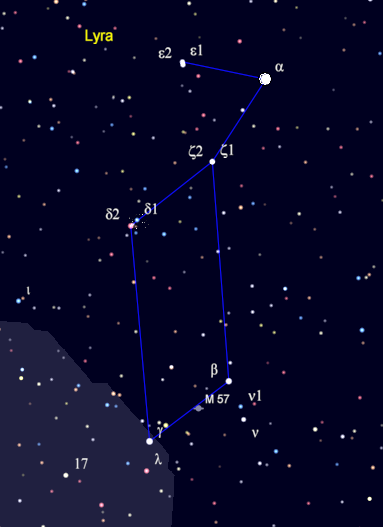
A bi more stars than what will be seen in binoculars of the constellation Lyra. Created using Cartes du Ciel (Sky Charts).
In the chart above:
The star designated α is Vega
The star designated β is Beta Lyrae
The stars designated ε1 and ε1 is Epsilon Lyrae
The object designated M57 is the Ring Nebula
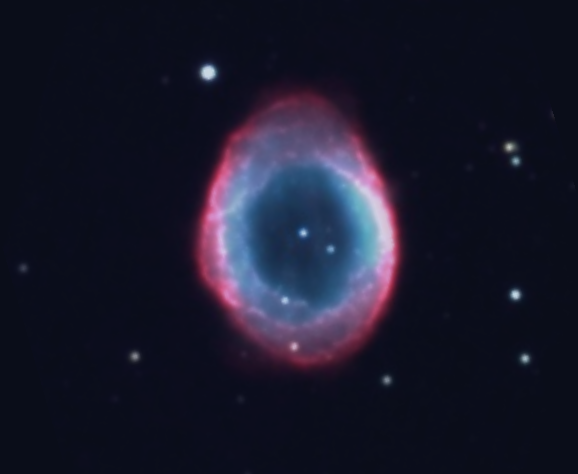
The Ring Nebula. Visually one cannot detect the color. It takes a large telescope to see the central star. Credit: Stellarium.
The Ring Nebula, AKA M57 by amateur astronomers, is a planetary nebula. The name planetary is a misnomer. Many of these objects look like the dim planets Uranus and Neptune. They are really stars like the sun, in their death throes puffing out their outer layers of gas at the end of their red giant stage. See below the latest image of the Ring Nebula I recently found on the Phil Plait’s Bad Astronomy Blog. It includes an explanation of what’s in the image.
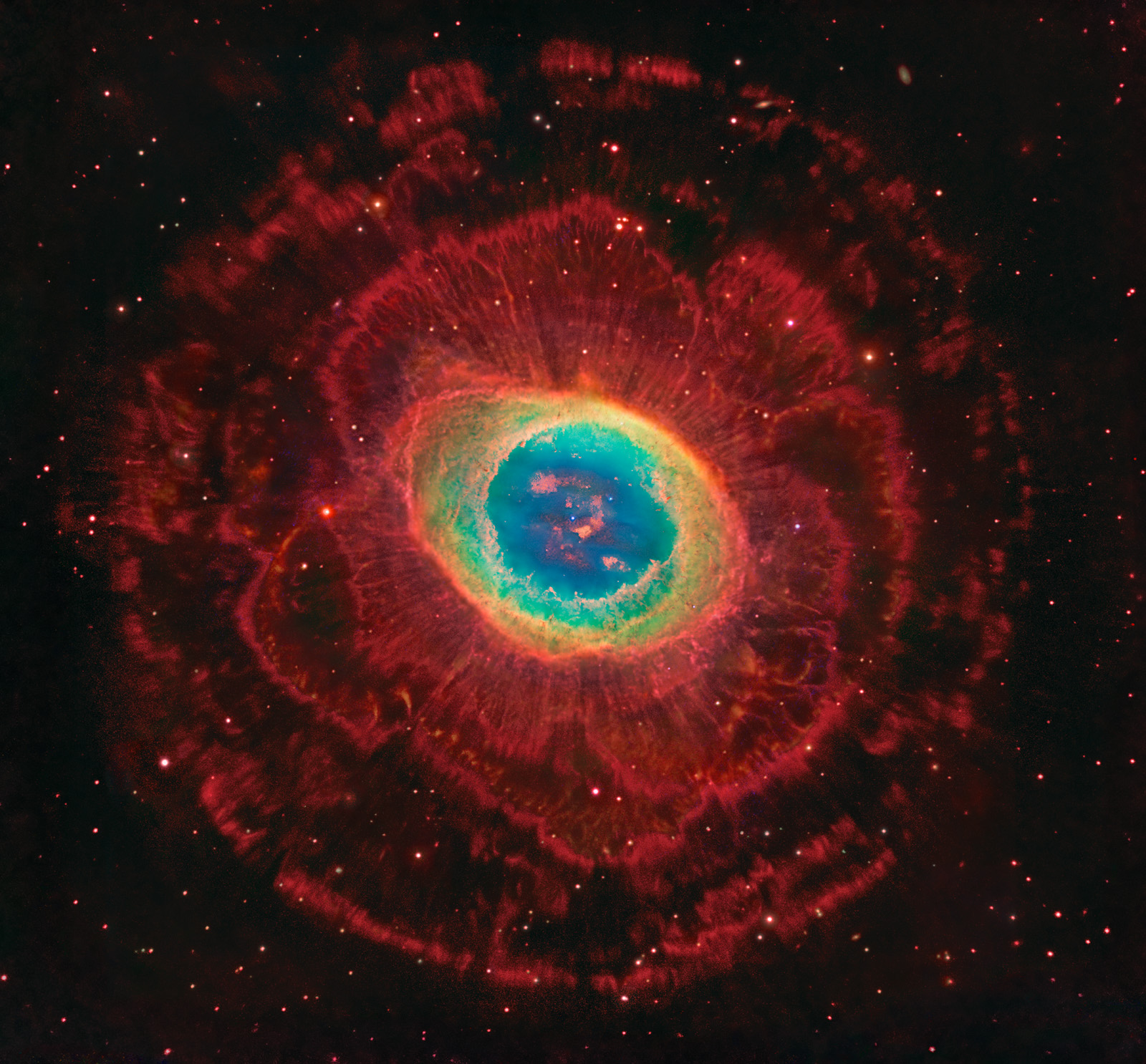
Photo by NASA, ESA, and C. R. O’Dell (Vanderbilt University) and Robert Gendler
Click on the image to get lost in the Ring Nebula!
07/15/2014 – Ephemeris – The constellation of Lyra the harp
Ephemeris for Tuesday, July 15th. Today the sun will be up for 15 hours and 13 minutes, setting at 9:24. The moon, half way from full to last quarter, will rise at 11:19 this evening. Tomorrow the sun will rise at 6:12.
Very high up in the eastern sky at 11 p.m. can be found a bright star just north of a small, narrow, but very distinctive parallelogram of stars. They are the stars of the constellation Lyra the harp. The bright star is Vega, one of the twenty one brightest first magnitude stars. Vega is actually the 5th brightest night-time star. The harp, according to Greek mythology, was invented by the Greek god Hermes. The form of the harp in the sky, is as he had invented it: by stretching strings across a tortoise shell. Hermes gave it to his half-brother Apollo, who in turn gave it to the great musician Orpheus. The sun has a motion with respect to most stars around it. Its direction is towards the vicinity of Lyra.
Times are for the Traverse City/Interlochen area of Michigan. They may be different for your location.
Addendum
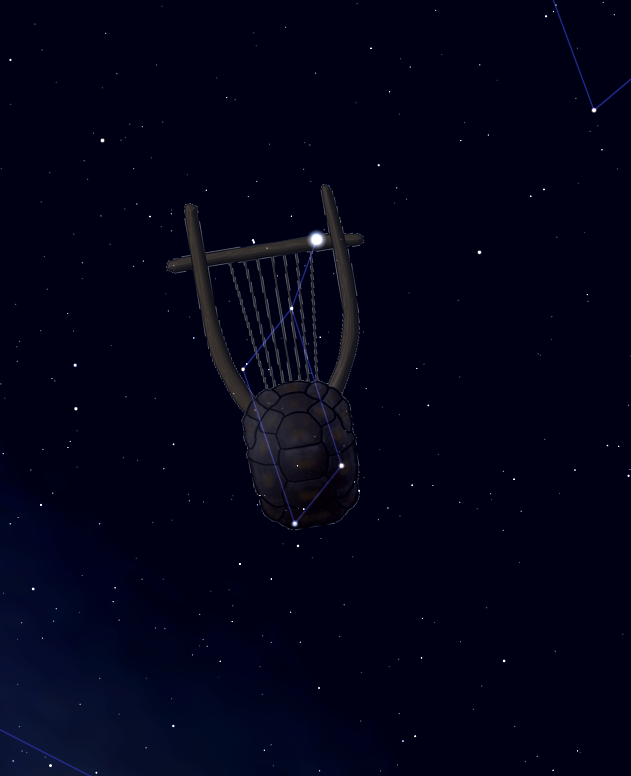
Lyra as a tortoise shell harp. Created using Stellarium and free clip art.
06/24/2014 – Ephemeris – The bright star Vega is high in the east
Ephemeris for Tuesday, June 24th. Today the sun will be up for 15 hours and 33 minutes, setting at 9:31. The moon, 3 days before new, will rise at 4:53 tomorrow morning. Tomorrow the sun will rise at 5:58.
The bright star high in the east is Vega, one of the stars of the Summer Triangle an informal constellation called an asterism. Vega belongs to the official constellation Lyra the harp, which includes a narrow parallelogram of stars to its south. Vega is regarded by astronomers as a standard calibration star. Though a first magnitude star, its actual magnitude is 0.03. It is a type A0 pure white star, and is 27 light years away. Astronomers however got a shock in 1983 when calibrating the Infrared Astronomy Satellite (IRAS) on it: Vega showed an excess of Infrared radiation that means the star is orbited by a disk of dust, perhaps the beginnings of a planetary system. Due to the slow wobble of the earth’s axis Vega will be our pole star in 14 thousand years.
Times are for the Traverse City/Interlochen area of Michigan. They may be different for your location.
Addendum
The Summer Triangle. Created using Stellarium and The Gimp.
Vega in the mid-infrared from the Spitzer Space Telescope. Credit: NASA/JPL-Caltech/University of Arizona
07/25/2013 – Ephemeris – Vega, the fifth brightest night-time star
Ephemeris for Thursday, July 25th. The sun rises at 6:21. It’ll be up for 14 hours and 54 minutes, setting at 9:15. The moon, 3 days past full, will rise at 10:43 this evening.
The star Vega, which is nearly overhead or the zenith is a special star for astronomers. It’s part of the small constellation of Lyra the harp, which includes the parallelogram of stars near it. Vega is kind of a standard calibration star. It is the 5th brightest night-time star with a brightness of 0 magnitude, although recent measurements place it at 0.03. Of the spectral types which denote the star’s color and surface temperature, Vega comes out to be pure white, with a surface temperature nearly twice the sun’s. It’s almost exactly 25 light years away, and so is one of the closer stars. It’s a tenth the sun’s age and 40 times the sun’s brightness. It has perhaps a Jupiter sized planet, and a Kuiper belt of Pluto like objects orbiting it.
Times are for the Traverse City/Interlochen area of Michigan. They may be different for your location.
Addendum
Magnified view of Lyra showing Vega. Created using Stellarium.
07/08/2012 – Ephemeris – How to find the Ring Nebula (M57)
Ephemeris for Monday, July 8th. Today the sun will be up for 15 hours and 22 minutes, setting at 9:28. The moon is new today, and won’t be visible. | Tomorrow the sun will rise at 6:06.
The constellation of Lyra is high in the east when it gets dark tonight. Its bright star Vega and the thin parallelogram of stars depict the harp it represents. Between the two stars at the bottom of the parallelogram opposite Vega hides a celestial wonder that can be seen in a small telescope, though the larger the telescope the better. It is the Ring Nebula, a smoke ring blown by a dying star. The telescope’s finder cannot show the ring. Center the finder between those two stars. The nebula will appear as a small dim gray spot in the telescope. Closer inspection may reveal that the center of the nebula is darker than the edges. It is about 2,300 light years away, but that’s a very approximate distance, which could be a thousand light years off.
Times are for the Traverse City/Interlochen area of Michigan. They may be different for your location.
Addendum
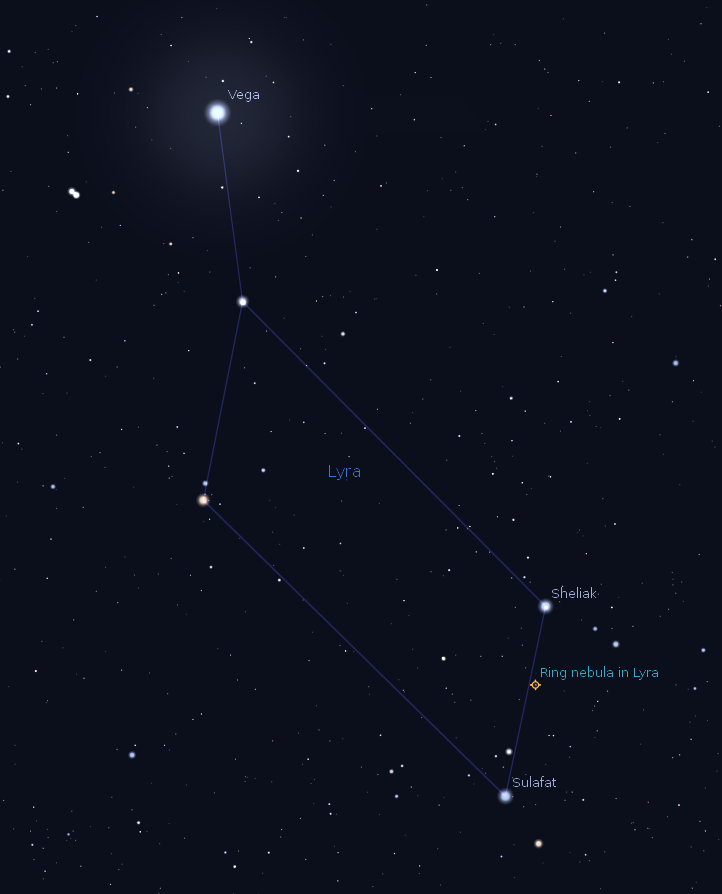
The constellation Lyra with the location of the Ring Nebula shown. Created using Stellarium.
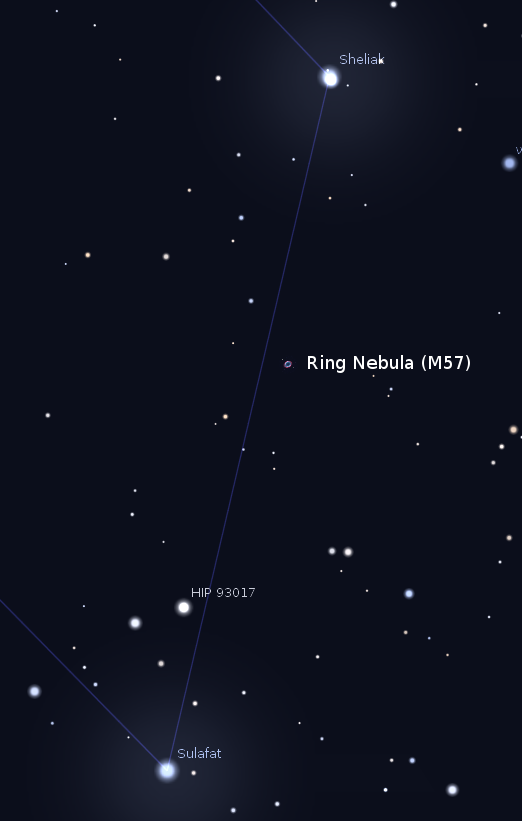
A closer look at the location of the Ring Nebula. Created using Stellarium.
07/02/2013 – Ephemeris – Lyra the harp in Greek mythology
Ephemeris for Tuesday, July 2nd. Today the sun will be up for 15 hours and 29 minutes, setting at 9:31. The moon, 2 days past last quarter, will rise at 2:45 tomorrow morning. Tomorrow the sun will rise at 6:02.
High in the east at 11 p.m. can be found a bright star just above a small, narrow, but very distinctive parallelogram of stars. They are the stars of the constellation Lyra the harp. The bright star is Vega the 5th brightest night-time star. To the Romans the star Vega represented a falling eagle or vulture. Apparently they never made the distinction between the two. It is a pure white star and serves as a calibration star for color and brightness. The harp, according to Greek mythology, was invented by the god Hermes. The form of the harp in the sky, is as he had invented it: by stretching strings across a tortoise-shell. Hermes gave it to his half-brother Apollo, who in turn gave it to the great musician Orpheus.
Times are for the Traverse City/Interlochen area of Michigan. They may be different for your location.
Addendum
Lyra as a tortoise-shell harp. Created using Stellarium and free clip art.
Annotated Lyra:
Magnified view of Lyra. Created using Stellarium.
06/28/2013 – Ephemeris – Vega and Lyra the harp
Ephemeris for Friday, June 28th. Today the sun will be up for 15 hours and 31 minutes, setting at 9:31. The moon, 2 days before last quarter, will rise at 12:43 tomorrow morning. Tomorrow the sun will rise at 6:00.
One of the first stars visible when twilight fades is Vega. It will be east of the zenith and is perfectly white. Another bright star with a yellow-orange hue is to the west of the zenith. That’s Arcturus. We’re concentrating on Vega now. It is in a small constellation called Lyra the harp or lyre. Just off to the southeast of Vega as it gets dark is a narrow parallelogram of stars that make up the body of this celestial instrument. A dim star next to Vega completes the constellation. Take good look at it in binoculars and the star near Vega appears as two. It’s Epsilon Lyrae. Each can be split again in a telescope. Lyra has another wonder, but that will have to wait for another time.
Times are for the Traverse City/Interlochen area of Michigan. They may be different for your location.
Addendum
Magnified view of Lyra. Created using Stellarium.
Epsilon Lyra is the closest star to Vega. Look closely, because it’s double. The funny characters next to “Lyr” are lower case Greek letters Epsilon is the Greek letter “e”. The one next to it is the slightly brightest star of the pair. The Greek letter designations are from Johannes Bayer’s 1603 atlas. The number designations are Flamsteed numbers. There’s other stars with proper names. The HIP number is from the Hipparcos catalog, a relatively new catalog.
 Bob Moler's Ephemeris Blog