Archive
06/13/2018 -Ephemeris – Time to check out the bright planets
Ephemeris for Wednesday, June 13th. Today the Sun will be up for 15 hours and 32 minutes, setting at 9:29, and it will rise tomorrow at 5:56. The Moon is new today, and won’t be visible.
It’s Wednesday again and time to look for and at the bright planets. Two of them are visible in the evening sky. The brilliant beacon of Venus will be visible in the western twilight from about 9:50 p.m. until it sets at 11:59 p.m. Jupiter will be in the south-southeast as it gets dark. Jupiter is only outshone by Venus and the Moon. And after Venus sets will have the night to itself as the brightest star-like object until it sets at 4:03 a.m. Binoculars will show it to be bigger than star-like in size flanked by several little star-like moons to either side. Saturn will rise at 10:16 p.m. in the east-southeast. Mars will rise at 12:29 a.m. and is now outshining Saturn, and in July and August will even outshine Jupiter.
The times given are for the Traverse City/Interlochen area of Michigan. They may be different for your location.
Addendum
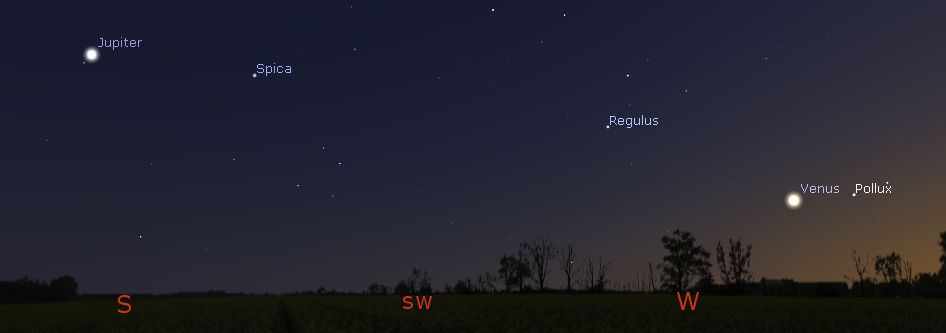
Venus and Jupiter at 10:30 p.m. June 13, 2018. Click on image to enlarge. Created using Stellarium.
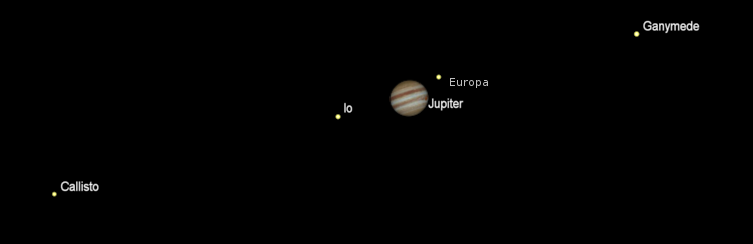
Jupiter and moons at 10:30 p.m. June 13, 2018. Created using Cartes du Ciel (Sky Charts).
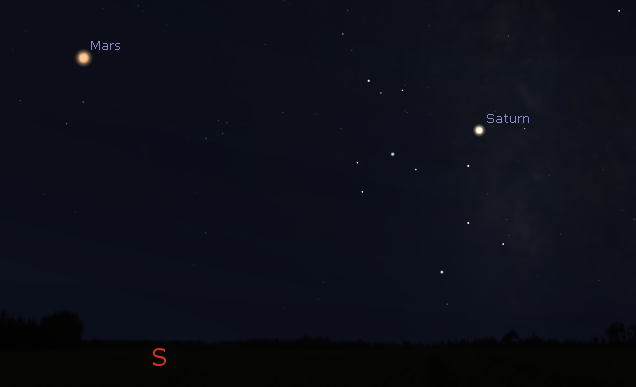
Morning planets at 4:30 a.m. June 14, 2018. Click on image to enlarge. Created using Stellarium.
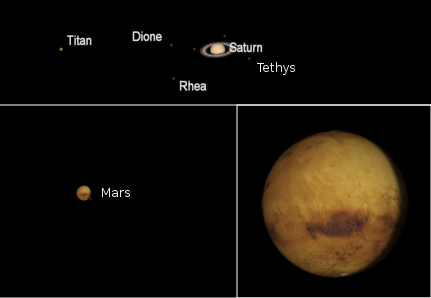
Saturn and Mars with the same magnification with an inset of Mars at higher magnification at 4:30 a.m. June 14, 2018. Created using Cartes du Ciel (Sky Charts).
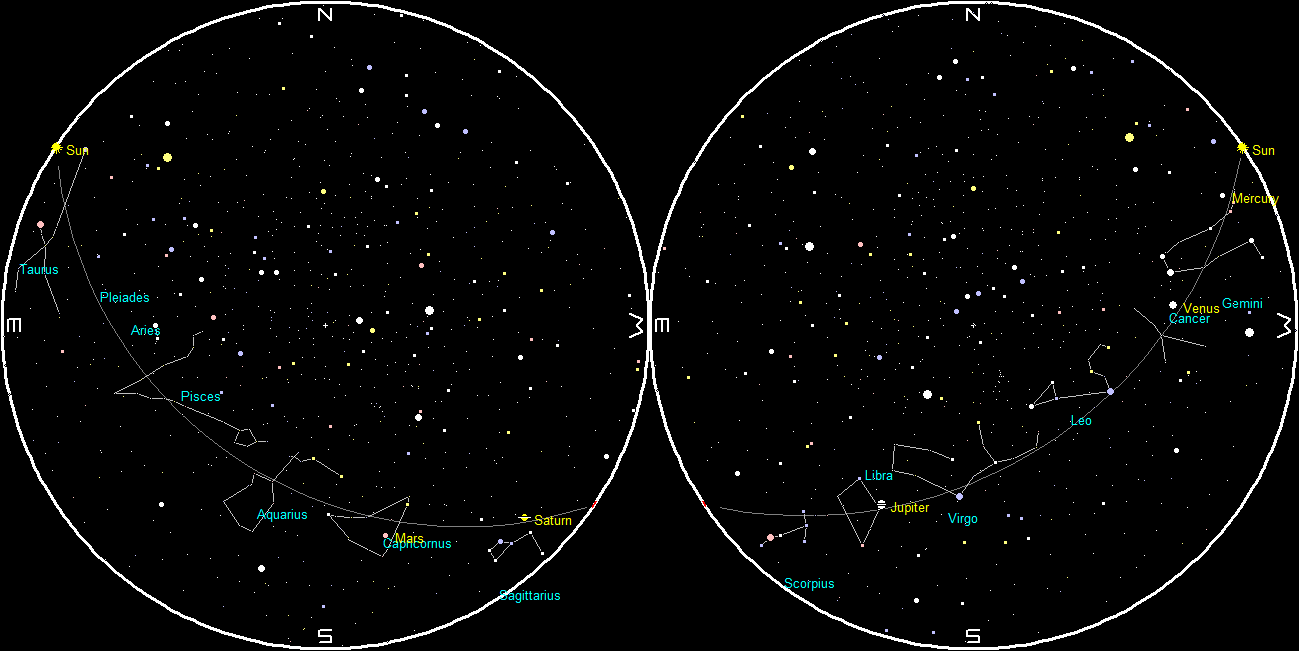
Planets and the Moon at sunset and sunrise of a single night starting with sunset on the right on June 13, 2018. The night ends on the left with sunrise on the 14th. Click on the image to enlarge. Created using my LookingUp program.
06/06/2018 – Ephemeris – Our weekly look at the bright planets
Ephemeris for Wednesday, June 6th. Today the Sun will be up for 15 hours and 27 minutes, setting at 9:25, and it will rise tomorrow at 5:57. The Moon, at last quarter today, will rise at 2:43 tomorrow morning.
It’s Wednesday again and time to look for and at the bright planets. Two of them are visible in the evening sky. The brilliant beacon of Venus will be visible in the western twilight from about 9:45 p.m. until it sets at 12:07 a.m. Jupiter will be in the south-southeast as it gets dark. Jupiter is only outshone by Venus and the Moon. And after Venus sets will have the night to itself as the brightest star-like object until it sets at 4:32 a.m. Binoculars will show it to be bigger than star-like in size flanked by little star-like moons. Saturn will rise at 10:45 p.m. in the east-southeast. Mars will rise at 12:50 a.m. and is now outshining Saturn, and will, in July and August even outshine Jupiter.
The times given are for the Traverse City/Interlochen area of Michigan. They may be different for your location.
Addendum
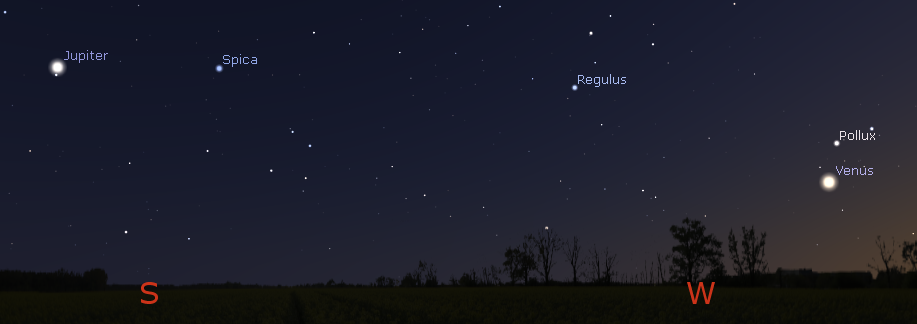
Venus and Jupiter at 10:30 p.m. June 6, 2018. Click on image to enlarge. Created using Stellarium.
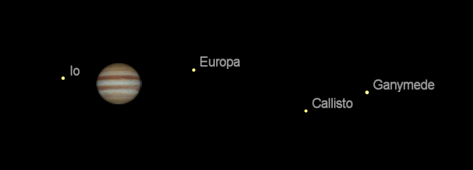
Jupiter and moons at 10:30 p.m. June 6, 2018. Created using Cartes du Ciel (Sky Charts).
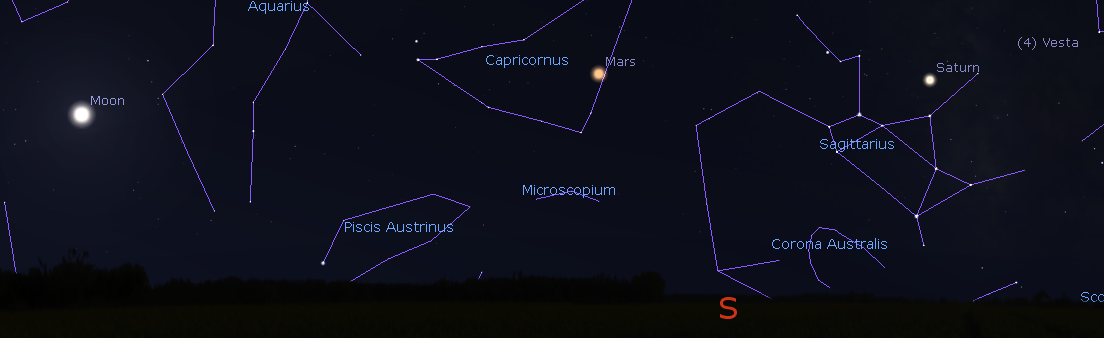
Morning planets and the Moon at 4:30 a.m. June 7, 2018. Click on image to enlarge. Created using Stellarium.
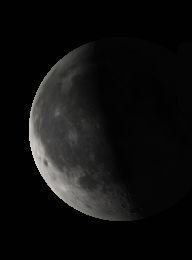
The moon as it might be seen in binoculars at 4:30 a.m. June 7, 2018. Created using Stellarium.
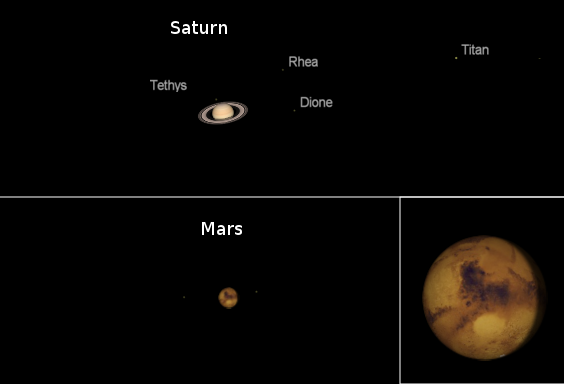
Saturn and Mars with the same magnification with an inset of Mars at higher magnification at 4:30 a.m. June 7, 2018. Created using Cartes du Ciel (Sky Charts).
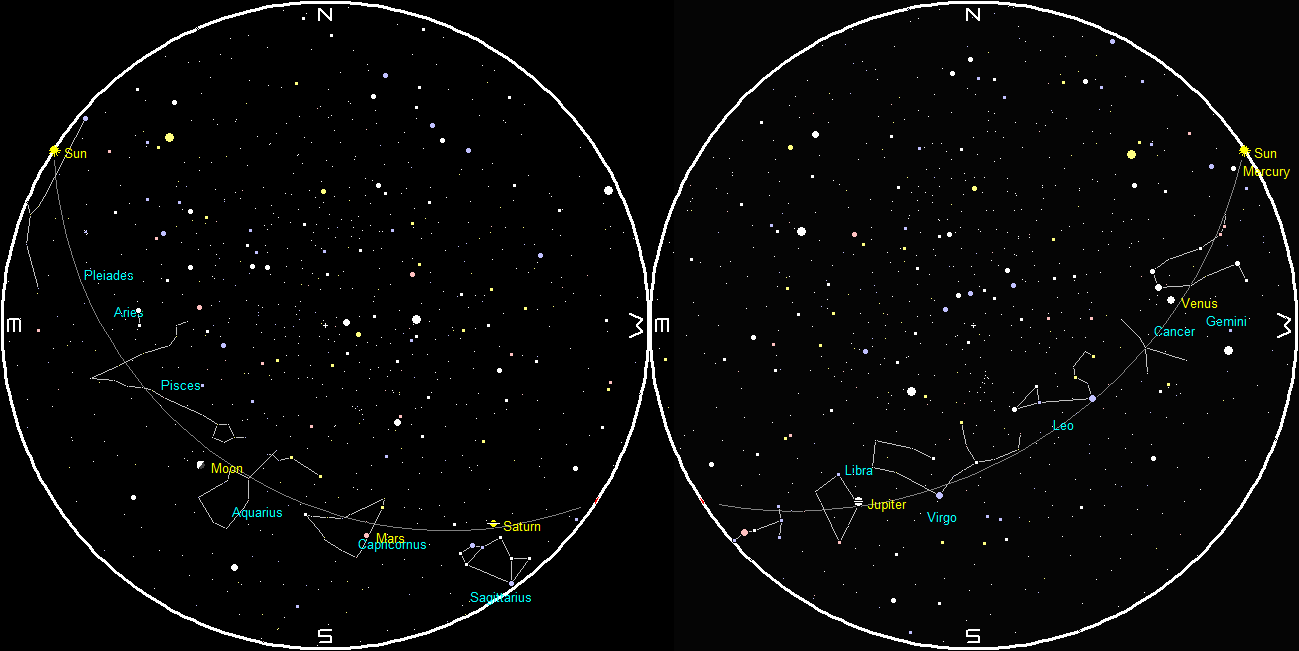
Planets and the Moon at sunset and sunrise of a single night starting with sunset on the right on June 6, 2018. The night ends on the left with sunrise on the 7th. Click on the image to enlarge. Created using my LookingUp program.
05/30/2018 – Ephemeris – Its Wednesday, time to locate the bright planets
Ephemeris for Wednesday, May 30th. Today the Sun will be up for 15 hours and 18 minutes, setting at 9:19, and it will rise tomorrow at 6:00. The Moon, 1 day past full, will rise at 10:18 this evening.
It’s Wednesday again and time to look for the bright planets. Two of them are in the evening sky. The brilliant beacon of Venus will be visible in the western twilight from about 9:40 p.m. until it sets at 12:04 a.m. Jupiter will be in the southeast as it gets dark. Jupiter is only outshone by Venus and the Moon. And after Venus sets will have the night to itself as the brightest star-like object until it sets at 5:02 a.m. Binoculars will show it to be bigger than star-like in size, that is it will appear as a tiny orb flanked by little star-like moons. Saturn will rise at 11:14 p.m. in the east-southeast. Mars will rise at 1:28 a.m. and is now outshining Saturn, and will, this summer even outshine Jupiter.
The times given are for the Traverse City/Interlochen area of Michigan. They may be different for your location.
Addendum
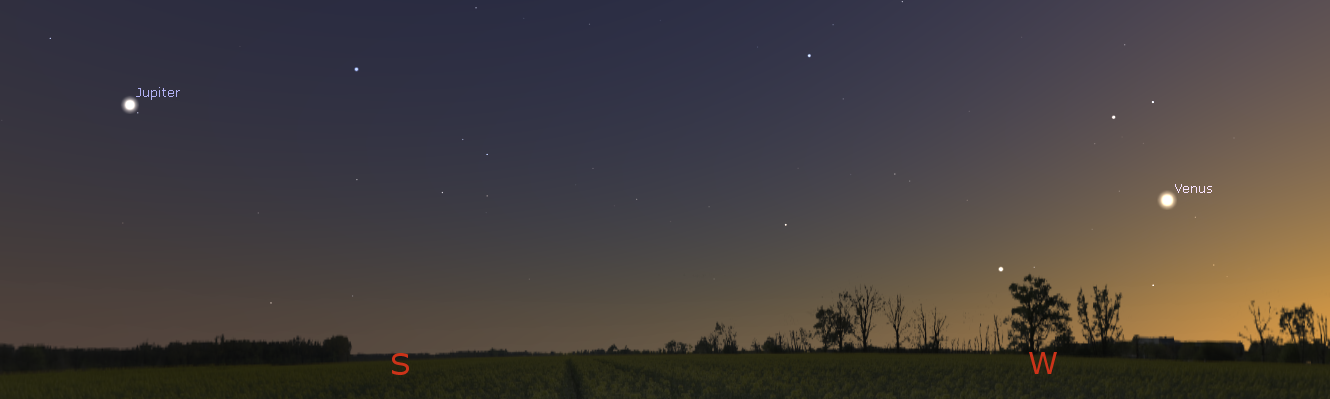
Venus and Jupiter tonight May 30 2018. at 10 p.m. Click on image to enlarge. Created using Stellarium.
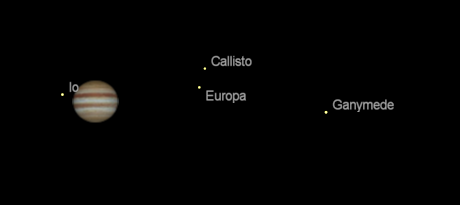
Jupiter and moons in a telescope at 10 p.m., May 30, 2018 Created using Cartes du Ciel.
Io is in front of the planet. Its transit will begin at 10:37 p.m. EDT (2:37 UT May 31)
Io’s shadow will start to cross Jupiter at 11:07 p.m. EDT (3:07 UT May 31)
Io’s transit og Jupiter will end at 12:45 a.m. May 31 (4:45 UT)
Io’s Shadow will leave the face of Jupiter at 1:16 a.m. May 31 (5:16 UT)
Times above from https://www.projectpluto.com/jevent.htm
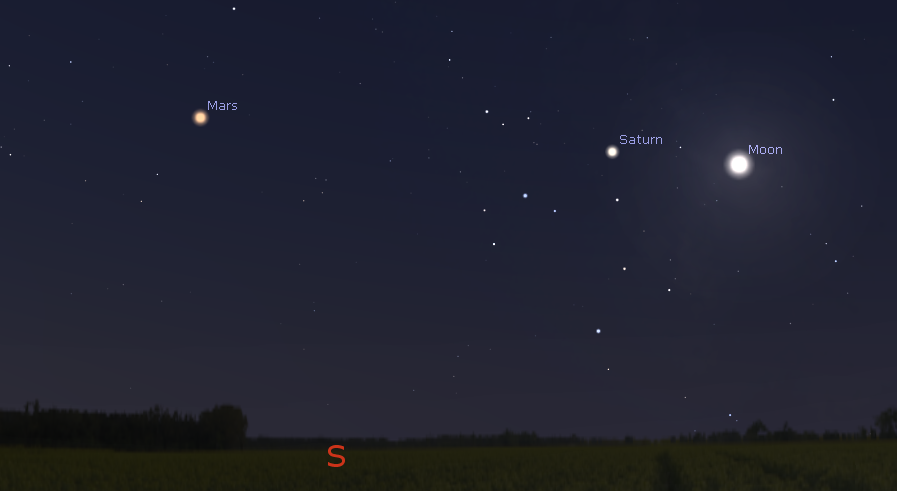
Morning planets Saturn and Mars plus the Moon at 5 a.m. May 31, 2018. Created using Stellarium.
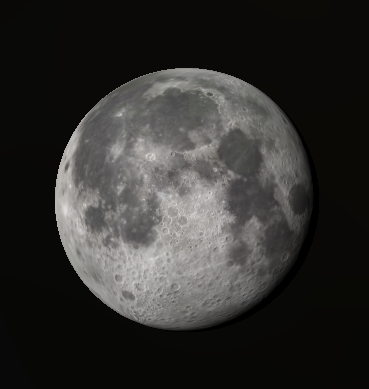
The Moon as it might appear in binoculars at 5 a.m. May 31, 2018. Created using Stellarium.
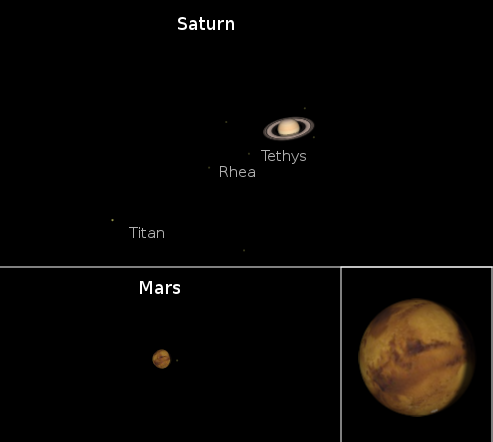
Saturn and Mars with the same magnification with an inset of Mars at higher magnification at 5 a.m. May 31, 2018. Created using Cartes du Ciel (Sky Charts).
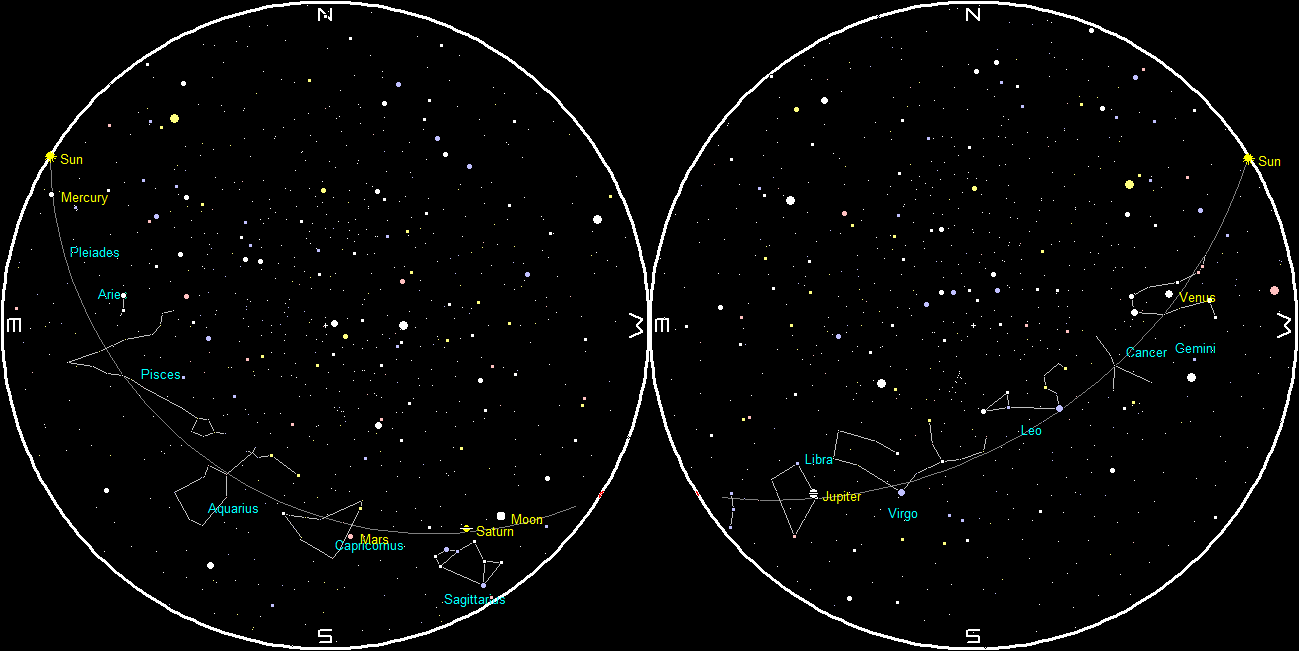
Planets and the Moon at sunset and sunrise of a single night starting with sunset on the right on May 30, 2018. The night ends on the left with sunrise on the 31st. Click on the image to enlarge. Created using my LookingUp program.
05/23/2018 – Ephemeris – Wednesday is bright planet day on Ephemeris
Ephemeris for Wednesday, May 23rd. Today the Sun will be up for 15 hours and 6 minutes, setting at 9:13, and it will rise tomorrow at 6:05. The Moon, 2 days past first quarter, will set at 3:56 tomorrow morning.
It’s Wednesday again and time to look for the bright planets. Two of them are in the evening sky. The brilliant beacon of Venus will be visible in the western twilight from about 9:35 p.m. until it sets at 11:54. Jupiter will be in the southeast as it gets dark. Jupiter is only out shown by Venus and the Moon. And after Venus sets will have the night to itself as the brightest star-like object until it sets at 5:31 a.m. Binoculars will show it to be not quite star-like in size, that is it will appear as a tiny orb flanked by little star-like moons. Saturn will rise at 11:43 p.m. in the east-southeast. Mars will rise at 1:28 a.m. and is now outshining Saturn, and will, this summer even outshine Jupiter.
The times given are for the Traverse City/Interlochen area of Michigan. They may be different for your location.
Addendum
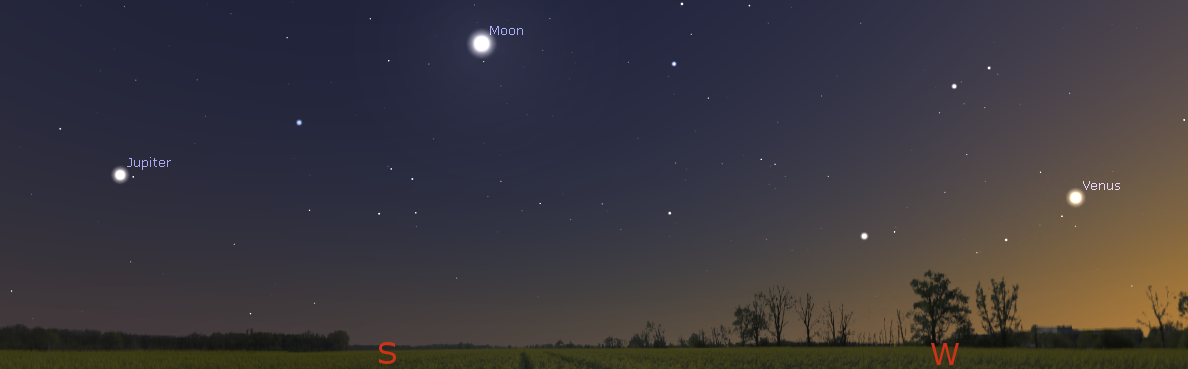
Panorama of the Moon and planets Venus and Jupiter at 10 p.m. May 23, 2018. Click on image to enlarge. Created using Stellarium.
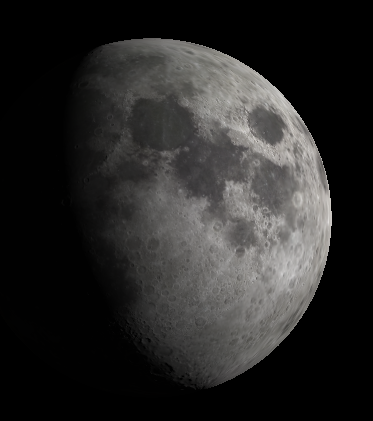
The Moon as it might appear in a small telescope or binoculars tonight May 23, 2018 at 10 p.m. Created using Stellarium.
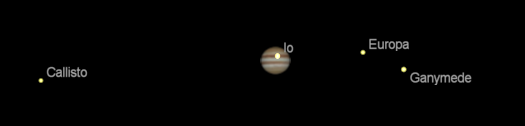
Jupiter and its 4 Galilean moons at 10 p.m. EDT May 23, 2018 (2:00 UT, May 24, 2018) Io is transiting the face of Jupiter at that time. Io transit begins at 8:52 p.m. EDT ():52 UT, Shadow start 9:13 p.m. EDT 1:13 UT, Transit ends 11:00 p.m. EDT, 3:00 UT, Shadow ends at 11:22 p.m. EDT, 3:22 UT. Io actually will be practically invisible during its transit, but its shadow may be spotted in small telescopes. Created using Stellarium.
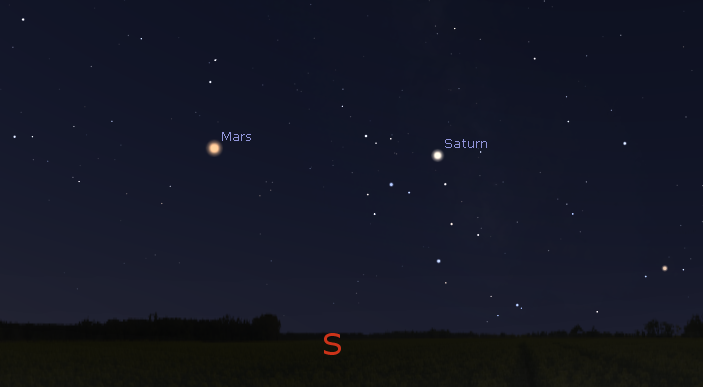
The morning planets Mars and Saturn at 5 a.m. May 24, 2018. Created using Stellarium.
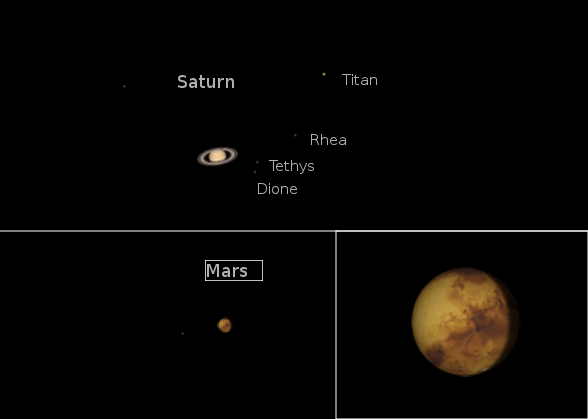
Saturn and Mars with the same magnification with an inset of Mars at higher magnification at 5 a.m. May 24, 20`8. Created using Cartes du Ciel (Sky Charts).
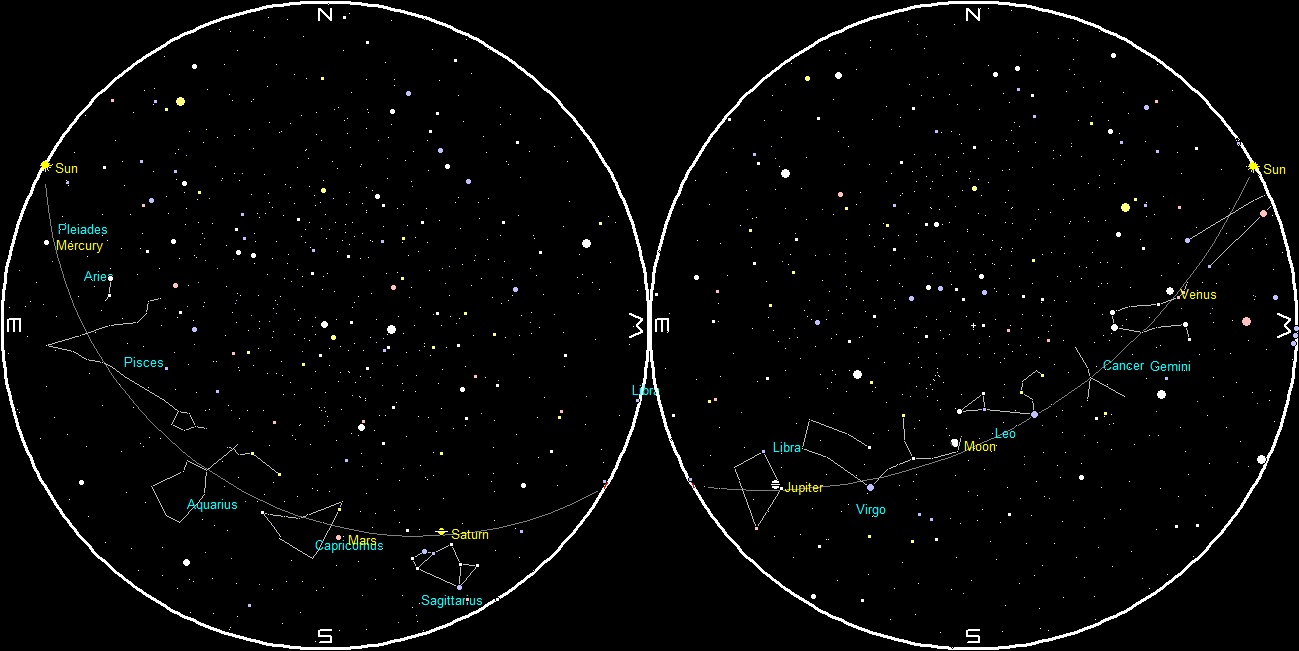
Planets and the Moon at sunset and sunrise of a single night starting with sunset on the right on May 23, 2018. The night ends on the left with sunrise on the 24th. Click on the image to enlarge. Created using my LookingUp program.
05/16/2018 – Ephemeris – Let’s check out the whereabouts of the bright planets
Ephemeris for Wednesday, May 16th. Today the Sun will be up for 14 hours and 52 minutes, setting at 9:05, and it will rise tomorrow at 6:12. The Moon, 1 day past new, will set at 10:32 this evening.
It’s Wednesday again and time to look for the bright planets. Two of them are in the evening sky. The brilliant beacon of Venus will be visible in the western twilight from about 9:25 p.m. until it sets at 11:44. Jupiter will be low in the southeast as it gets dark. Jupiter is only out shown by Venus and the Moon. And after Venus sets will have the night to itself as the brightest star-like object. Binoculars will show it to be not quite star-like in size, that is it will appear as a tiny orb. It will be accompanied by several satellites which will shift positions night to night. Saturn will rise at 12:12 a.m. in the east-southeast. Mars will rise at 1:46 a.m. and is now outshining Saturn, and will, this summer even outshine Jupiter.
The times given are for the Traverse City/Interlochen area of Michigan. They may be different for your location.
Addendum
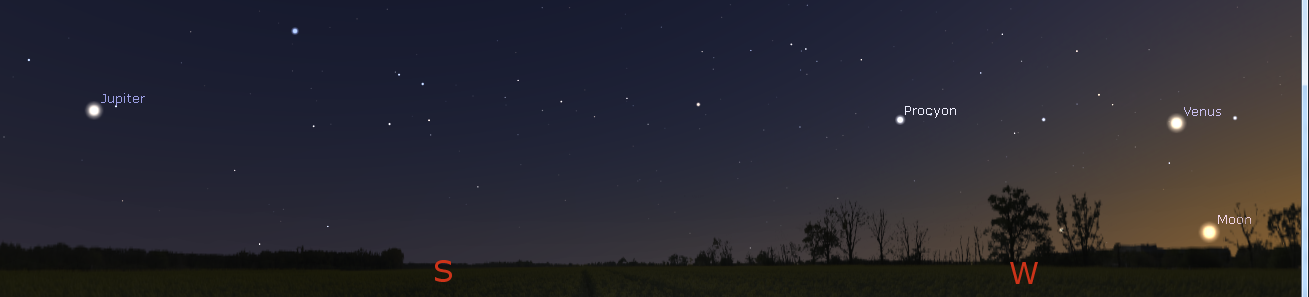
Jupiter and Venus at 10 p.m. May `6, 2018. Click on image to enlarge. Created using Stellarium.
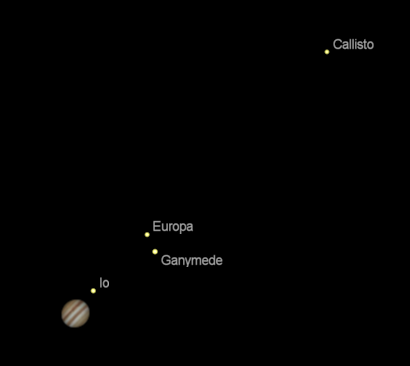
Jupiter and its moons at 10:30. May 16, 2018. Created using Cartes du Ciel (Sky Charts).
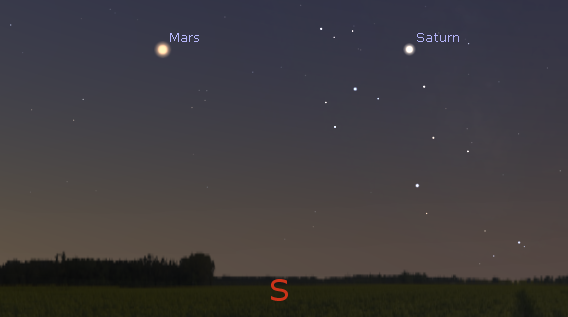
Morning planets at 5:30 a.m. May 17, 2017. Created using Stellarium.
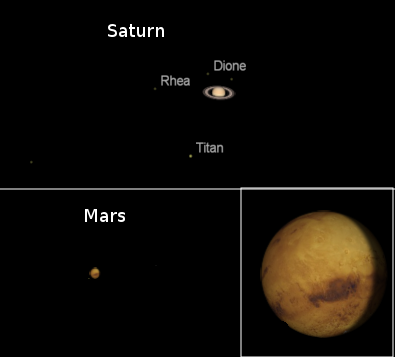
Telescopic Saturn and Mars with the same magnification at 5:30 a.m. May 17, 2018. Inset shows Mars at higher magnification. Created using Cartes du Ciel (Sky Charts).
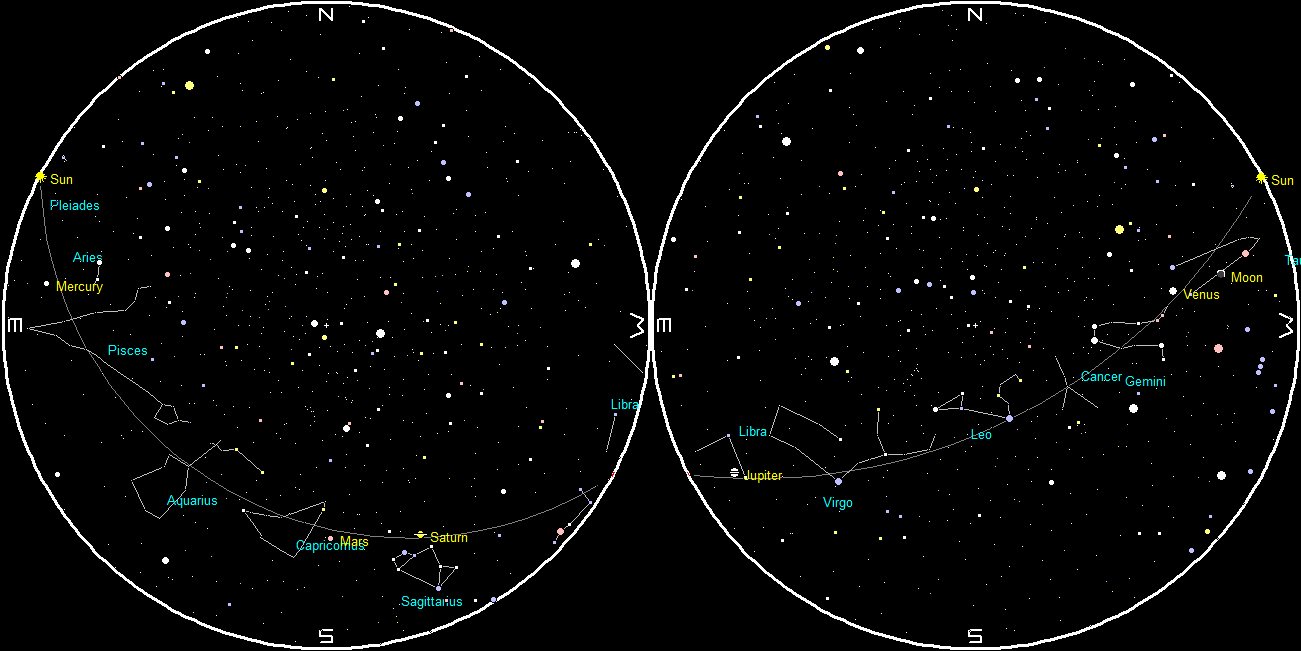
Planets and the Moon at sunset and sunrise of a single night starting with sunset on the right on May 16, 2018. The night ends on the left with sunrise on the 17th. Click on the image to enlarge. Created using my LookingUp program.
05/09/2018 – Ephemeris – We’ve got two evening planets now
Ephemeris for Wednesday, May 9th. The Sun rises at 6:21. It’ll be up for 14 hours and 35 minutes, setting at 8:57. The Moon, 2 days past last quarter, will rise at 4:14 tomorrow morning.
It’s Wednesday again and time to look for the bright planets. Tada! We now have a second planet in the evening sky. More on that in a moment. Venus will be visible low in the western twilight from about 9:15 p.m. until it sets at 11:29. Jupiter is up before sunset in the southeast. Which makes it an evening planet. It is at its closest and its brightest at magnitude -2.5. Venus is at magnitude -3.9. Magnitudes are like golf scores, the lower the magnitude the brighter the object. Saturn will rise at 12:49 a.m., while Mars will rise at 2:05 a.m. At 5:30 tomorrow morning these three planets will be strung across the southern sky. Bright Jupiter will be in the southwest, dimmer Mars and Saturn will be in the south, with Mars to the left of Saturn.
The times given are for the Traverse City/Interlochen area of Michigan. They may be different for your location.
Sorry, no graphics this time. I’m still fighting the flu bug. It’s not a cold as I reported with Monday’s post but a full blown case of the flu.
05/02/2018 – Ephemeris – We’re taking our weekly look at the bright planets
Ephemeris for Wednesday, May 2nd. The Sun rises at 6:31. It’ll be up for 14 hours and 17 minutes, setting at 8:49. The Moon, 3 days past full, will rise at 11:31 this evening.
It’s Wednesday again and time to look for the bright planets. One bright planet is in the evening sky, the brightest, Venus. It will be visible low in the western twilight from about 9:10 p.m. until it sets at 11:15. The star Aldebaran will be seen below and left of Venus tonight. Jupiter will rise this evening at 9:11 p.m. That doesn’t make it an evening planet. It has to rise before sunset to be an evening planet, which it will be next Wednesday. Saturn will rise at 1:09 a.m., while Mars will rise at 2:18 a.m.
At 5:30 tomorrow morning these three planets will be strung across the southern sky. Bright Jupiter will be in the southwest, dimmer Mars and Saturn will be in the south, with Mars to the left of Saturn with the Moon between Jupiter and Saturn.
The times given are for the Traverse City/Interlochen area of Michigan. They may be different for your location.
Addendum
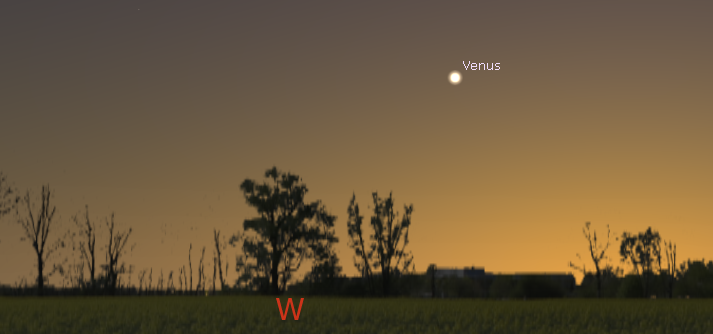
Venus in evening twilight at 9:15 p.m, tonight May 2, 2018. Click on the image to enlarge. Created using Stellarium.
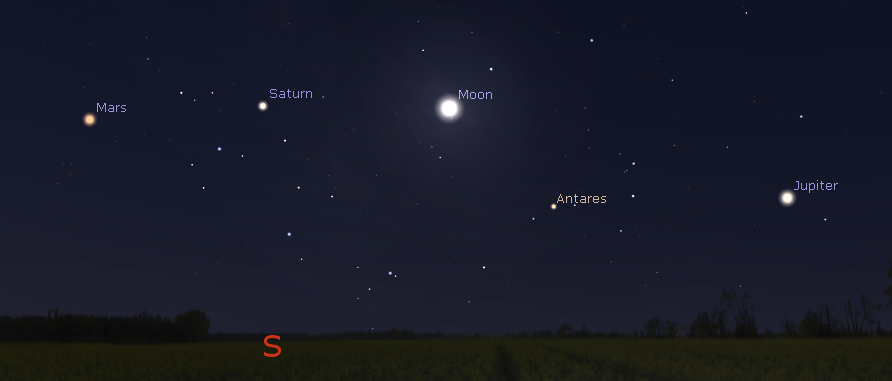
The morning planets at 5:30 a.m. May 3, 2018. Click on the image to enlarge. Created using Stellarium.
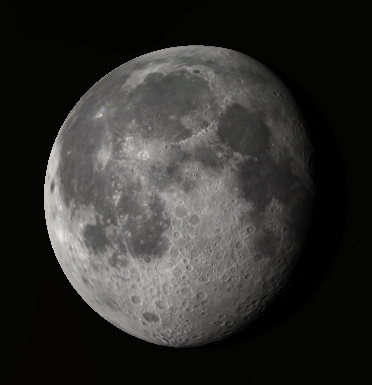
The waning gibbous Moon at 5:30 a.m. May 3, 2018. Created using Stellarium.
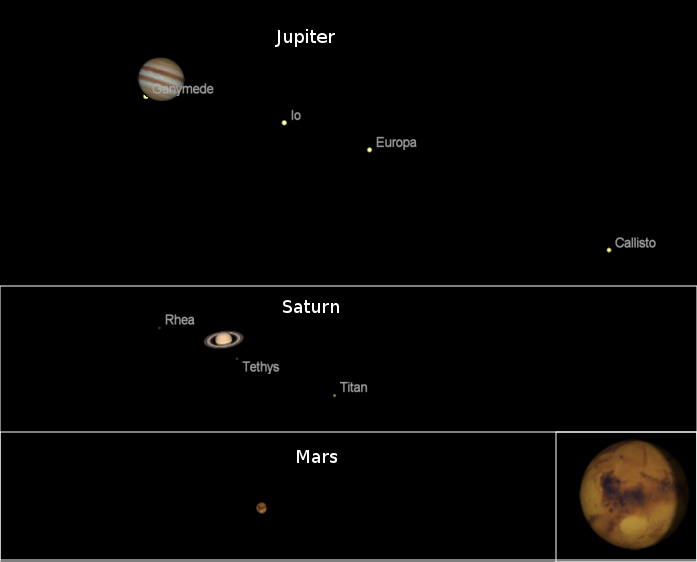
The morning planets as seen in a telescope using the same magnification at 5:30 a.m. May 3, 2018. A magnified image of Mars is inset showing some of the features that may be visible under higher magnification. Created using Cartes du Ciel (Sky Charts).
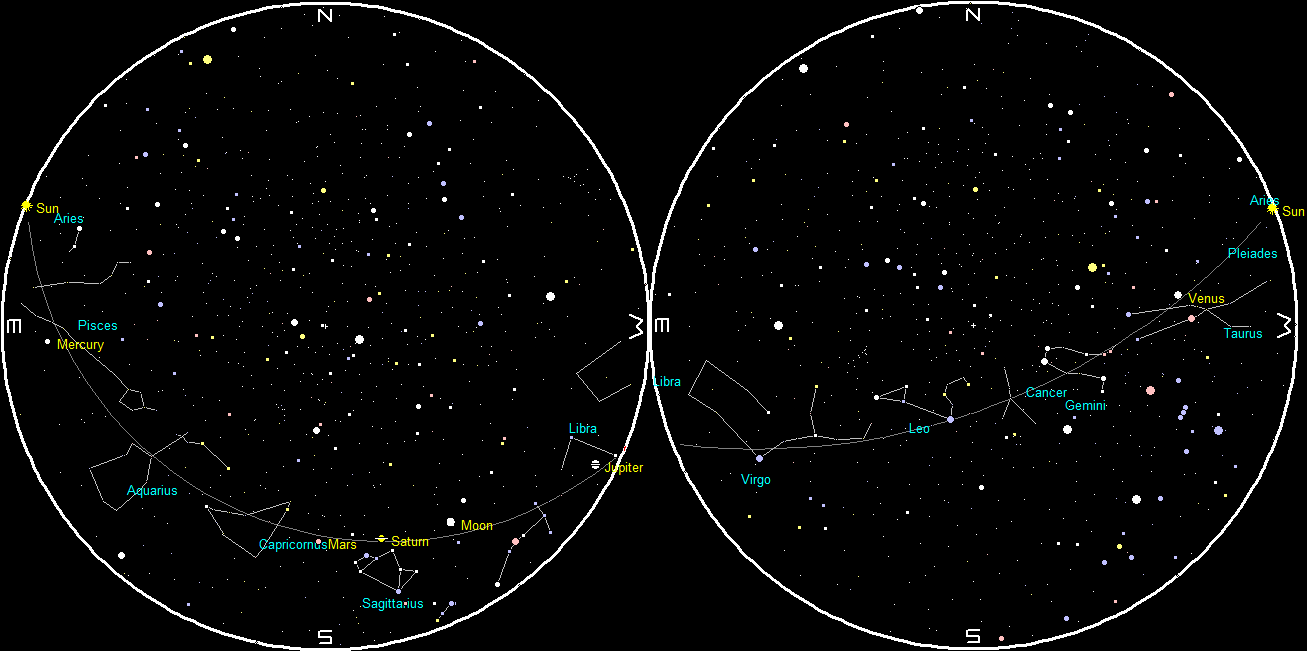
Planets and the Moon at sunset and sunrise of a single night starting with sunset on the right on May 2, 2018. The night ends on the left with sunrise on the 3rd. Click on the image to enlarge. Created using my LookingUp program.
04/25/2018 – Ephemeris – It’s bright planet Wednesday
Ephemeris for Wednesday, April 25th. The Sun rises at 6:41. It’ll be up for 13 hours and 58 minutes, setting at 8:40. The Moon, 3 days past first quarter, will set at 5:22 tomorrow morning.
It’s Wednesday again and time to look for the bright planets. One bright planet is in the evening sky, the brightest, Venus. It will be visible low in the western twilight from about 9:10 p.m. until it sets at 10:58. Venus is blindingly bright in binoculars or a small telescope. Jupiter will rise this evening at 9:42 p.m. That doesn’t make it an evening planet. It has to rise before sunset to be an evening planet. Give it a couple of weeks. Saturn will rise at 1:37 a.m., while Mars will rise at 2:33 a.m.
At 6 tomorrow morning these three planets will be strung across the southern sky. Bright Jupiter will be in the southwest, dimmer Mars and Saturn will be in the south, with Mars to the left of Saturn in the morning twilight.
The times given are for the Traverse City/Interlochen area of Michigan. They may be different for your location
Addendum
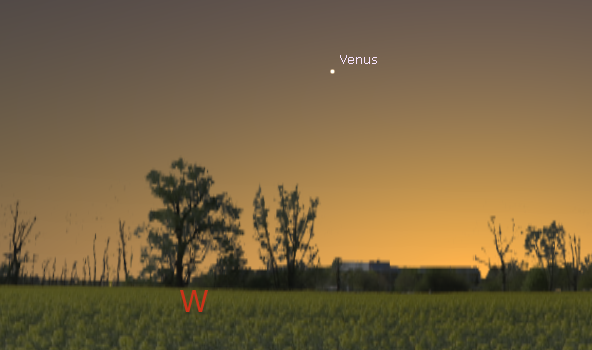
Venus in evening twilight at 9 p.m, tonight April 25, 2018. Created using Stellarium.
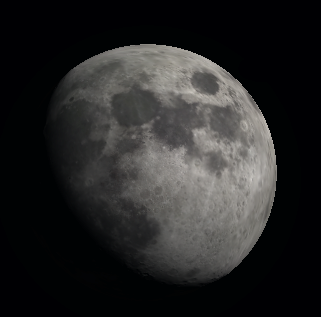
The Gibbous Moon tonight at 10 p.m., April 25, 2018. Created using Stellarium.
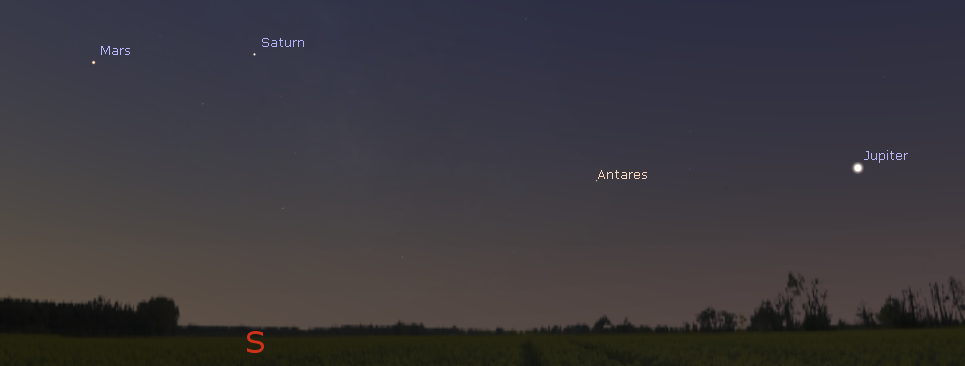
The morning planets at 6 a.m. April 26, 2018. Click on the image to enlarge. Created using Stellarium.
The morning planets as seen in a telescope using the same magnification. A magnified image of Mars is inset showing some of the features that may be visible under higher magnification. Created using Cartes du Ciel (Sky Charts).
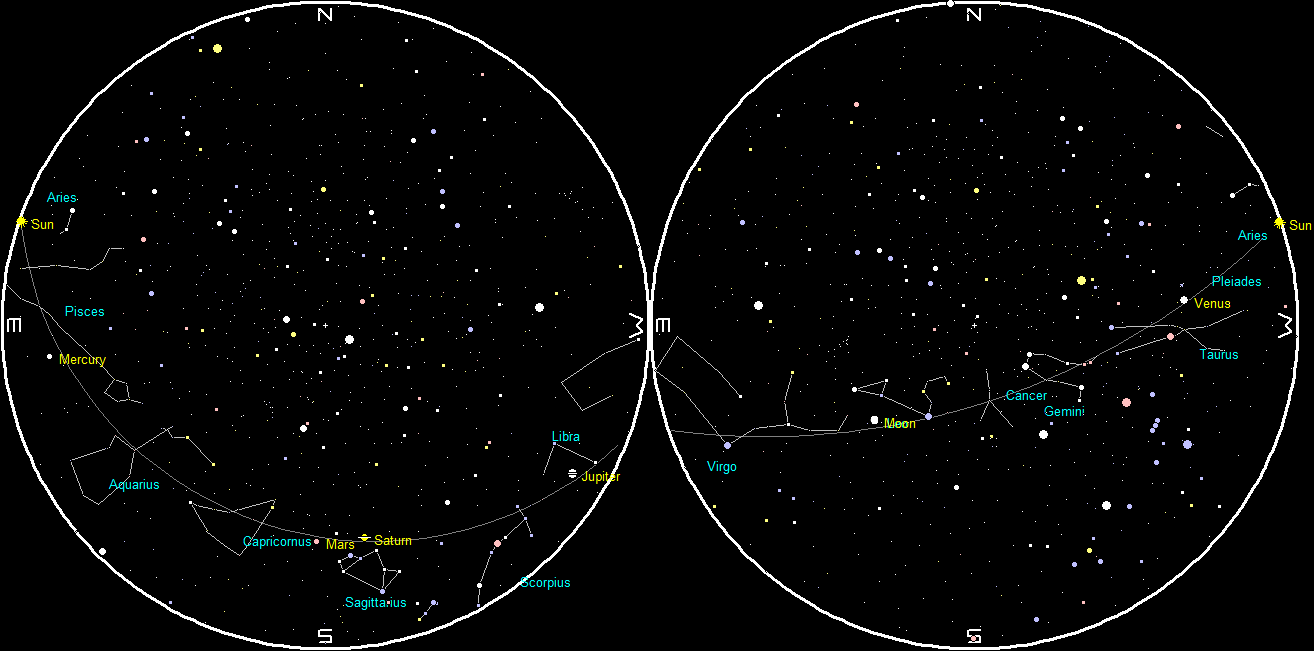
Planets and the Moon at sunset and sunrise of a single night starting with sunset on the right on April 25, 2018. The night ends on the left with sunrise on the 26th. Click on the image to enlarge. Created using my LookingUp program.
04/18/2018 – Ephemeris – It’s Wednesday, do you know where the bright planets are?
Ephemeris for Wednesday, April 18th. The Sun rises at 6:53. It’ll be up for 13 hours and 38 minutes, setting at 8:31. The Moon, 3 days past new, will set at 11:38 this evening.
It’s Wednesday again and time to look for the bright planets. One bright planet is in the evening sky, the brightest, Venus. It will be visible low in the Western twilight from about 8:40 p.m. until it sets at 10:34. Venus is blindingly bright in binoculars or a small telescope.
Jupiter will rise late this evening at 10:23 p.m. That doesn’t make it an evening planet. It has to rise before sunset to be an evening planet. Saturn will rise at 2:17 a.m., while Mars will rise at 2:52 a.m. At 6 tomorrow morning these three planets will be strung across the southern sky. Bright Jupiter will be in the southwest, dimmer Mars and Saturn will be in the south-southeast, with Mars to the left of Saturn in the morning twilight.
The times given are for the Traverse City/Interlochen area of Michigan. They may be different for your location.
Addendum
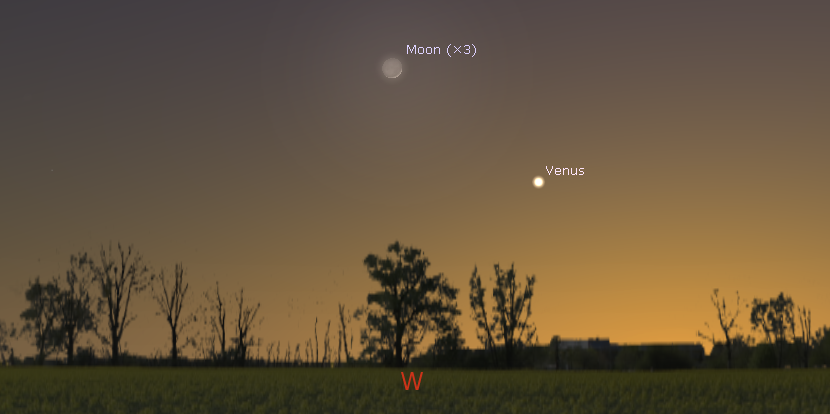
Venus and the Moon in evening twilight at 9 p.m, tonight April 18, 2018. The Moon is shown at 3 times its actual size for clarity. Click on the image to enlarge. Created using Stellarium.
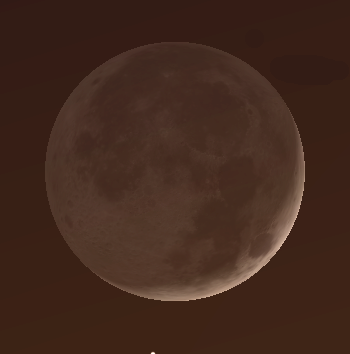
The Moon as it might be seen in binoculars at 9 p.m. April 18, 2018. Earth shine should be visible. Created using Stellarium.
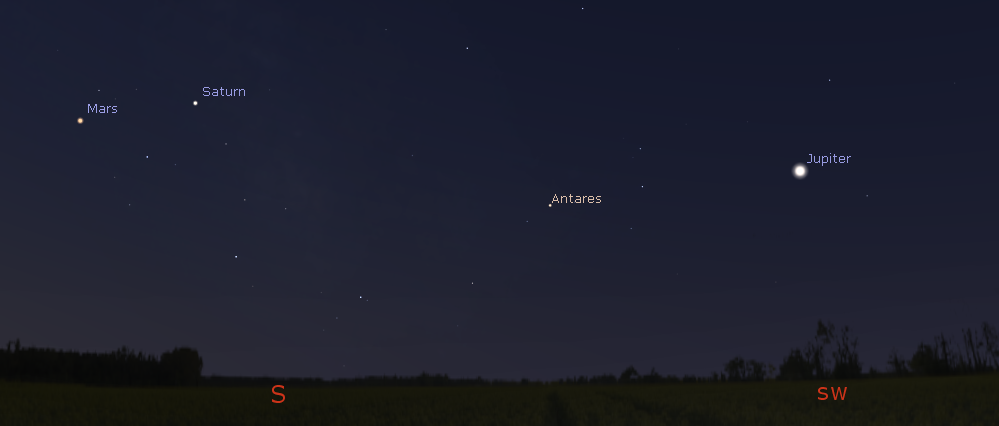
The morning planets at 6 a.m. April 19, 2018. Click on the image to enlarge. Created using Stellarium.
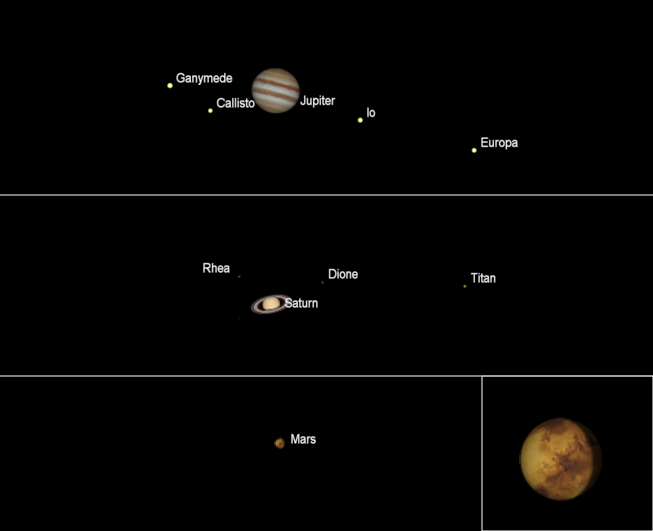
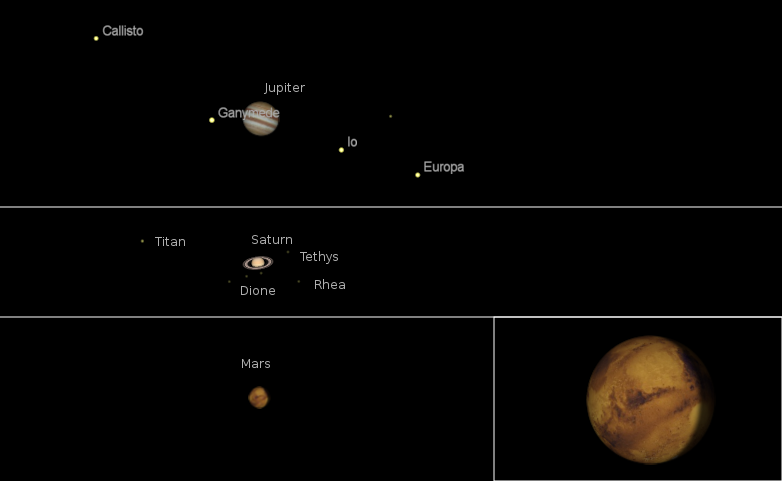
The morning planets as seen in a telescope using the same magnification. A magnified image of Mars is inset showing some of the features that may be visible under higher magnification. The large dark area below right of center on Mars is Syrtis Major “The Great Swamp”. It sounds so much better in the original Latin. Of course there probably hasn’t been a swamp on Mars in 3 billion years, give or take. Today the disc of Mars attained a diameter of 9.9 seconds of arc. Created using Cartes du Ciel (Sky Charts).
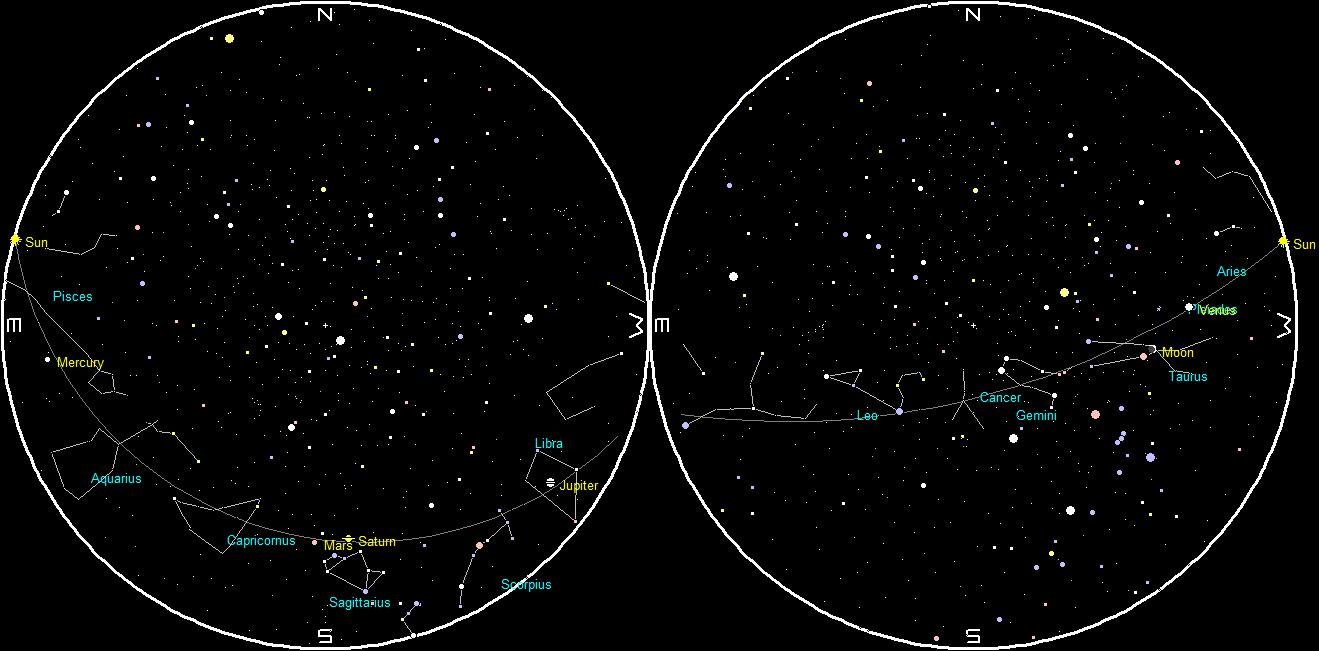
Planets and the Moon at sunset and sunrise of a single night starting with sunset on the right on April 18, 2018. The night ends on the left with sunrise on the 19th. Click on the image to enlarge. Created using my LookingUp program.
04/11/2018 – Ephemeris – Looking at the bright planets for this week
Ephemeris for Wednesday, April 11th. The Sun will rise at 7:05. It’ll be up for 13 hours and 17 minutes, setting at 8:22. The Moon, 3 days past last quarter, will rise at 5:45 tomorrow morning.
It’s Wednesday again and time to look for the bright planets. One bright planet is in the evening sky, the brightest, Venus. It will be visible low in the Western twilight from about 8:40 p.m. until it sets at 10:20. Venus is blindingly bright in binoculars or a small telescope. Jupiter will rise late this evening at 10:45 p.m. That doesn’t make it an evening planet. It has to rise before sunset to be an evening planet. Saturn will rise at 2:32 a.m., while Mars will rise at 3 a.m. At 6 tomorrow morning these three planets will be strung across the southern sky. Bright Jupiter will be in the southwest, dimmer Mars and Saturn will be in the south-southeast, with Mars below-left of Saturn.
The times given are for the Traverse City/Interlochen area of Michigan. They may be different for your location.
Addendum
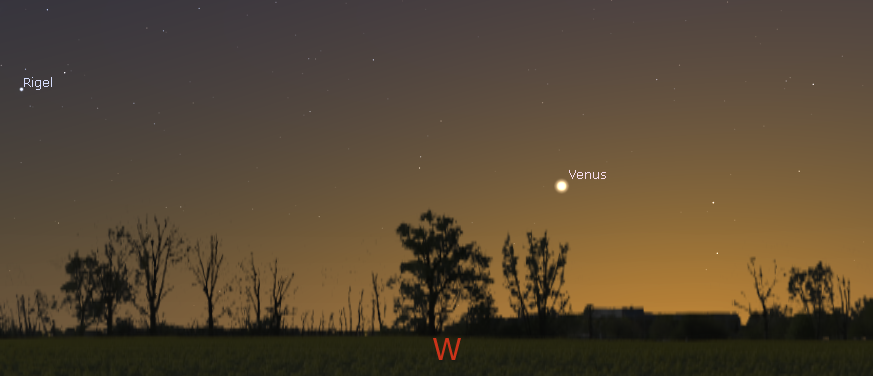
Venus in evening twilight at 9 p.m, tonight April 11, 2018. Click on the image to enlarge. Created using Stellarium.
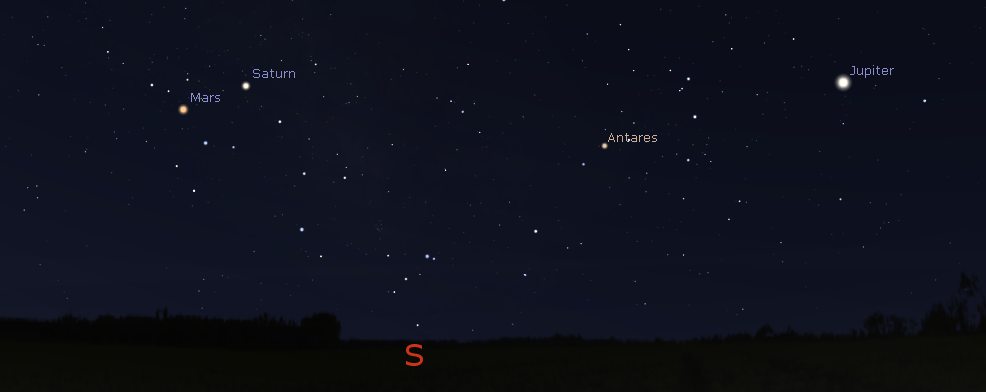
The morning planets at 6 a.m. April 12, 2018. Click on the image to enlarge. Created using Stellarium.
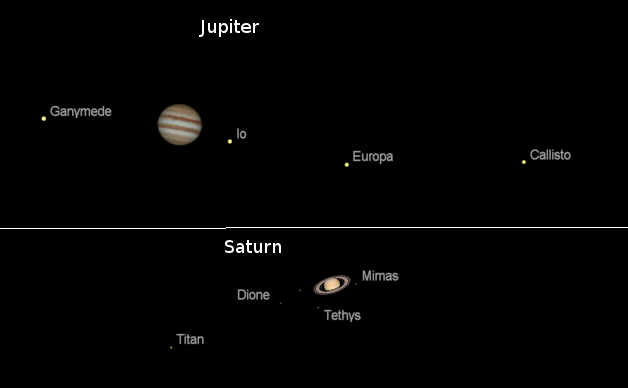
The morning planets Jupiter and Saturn as seen by a telescope using the same magnification for both at 6 a.m. April 12, 2018. a.m. Created using Cartes du Ciel (Sky Charts).
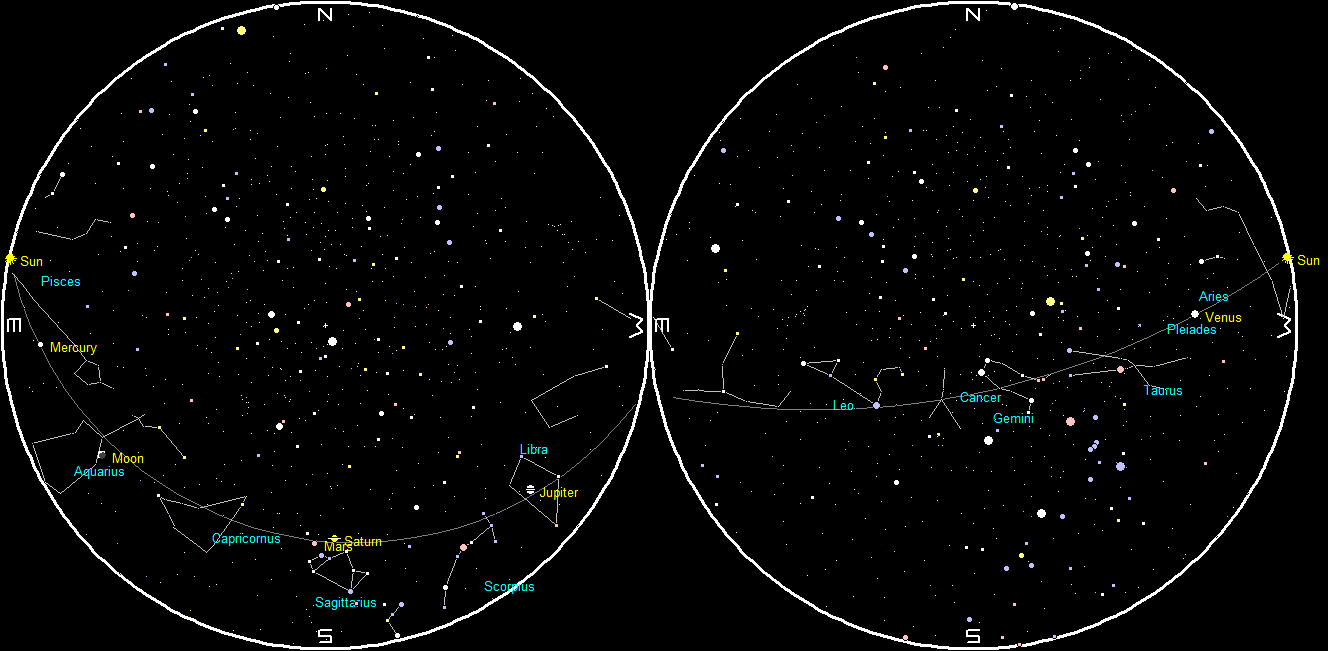
Planets and the Moon at sunset and sunrise of a single night starting with sunset on the right on April 11, 2018. The night ends on the left with sunrise on the 12th. Click on the image to enlarge. Created using my LookingUp program.
 Bob Moler's Ephemeris Blog