Archive
06/19/2019 – Ephemeris – Checking out the bright planets for tonight
Ephemeris for Wednesday, June 19th. Today the Sun will be up for 15 hours and 34 minutes, setting at 9:31, and it will rise tomorrow at 5:56. The Moon, 2 days past full, will rise at 11:34 this evening.
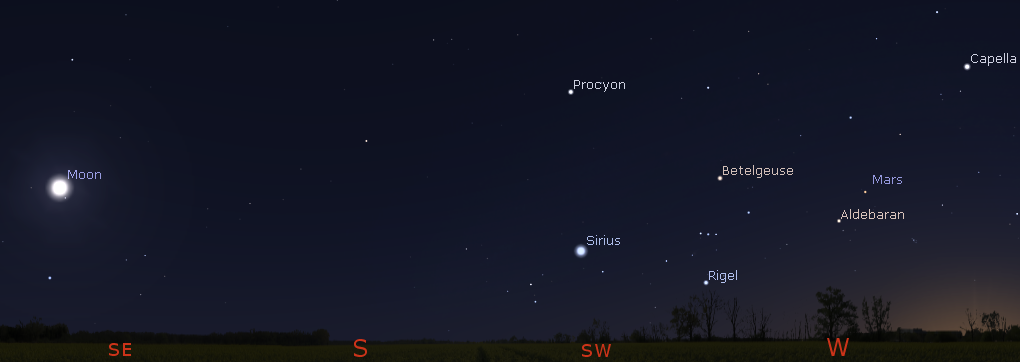
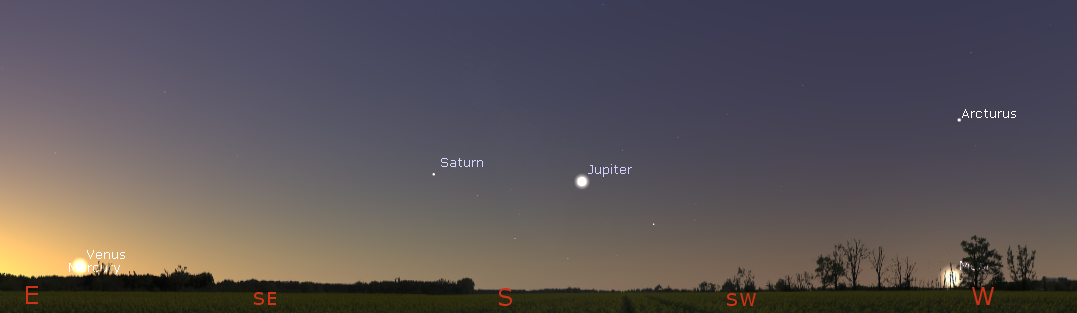
Let’s look at the planets for this week. Mars and Mercury will be low in the west-northwestern sky below and left of the star Pollux. Mercury is somewhat brighter than Pollux tonight with dimmer Mars a bit right of and below Mercury. Mercury is separating from Mars rapidly, It not named for the messenger of the gods for nothing. Mercury will set at 11:13 p.m., three minutes after Mars. Jupiter will start the evening low in the southeast. It far brighter than any star and will be visible all night, setting at 5:30 a.m. It’s in Ophiuchus the serpent bearer now, just above Scorpius the scorpion. In the morning sky we have Saturn which will rise at 10:41 p.m., in the east-southeast. It’s in Sagittarius the archer. Venus is too close to the Sun to be seen.
The times given are for the Traverse City/Interlochen area of Michigan. They may be different for your location.
Addendum
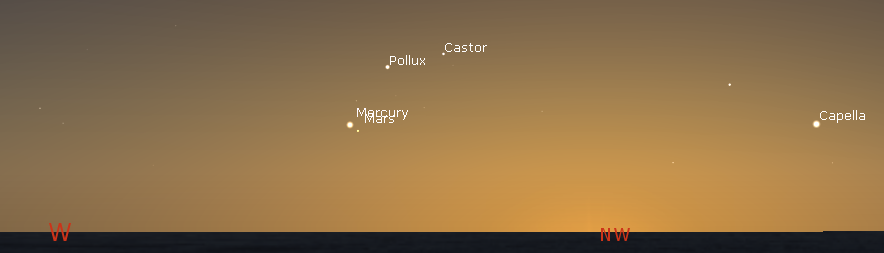
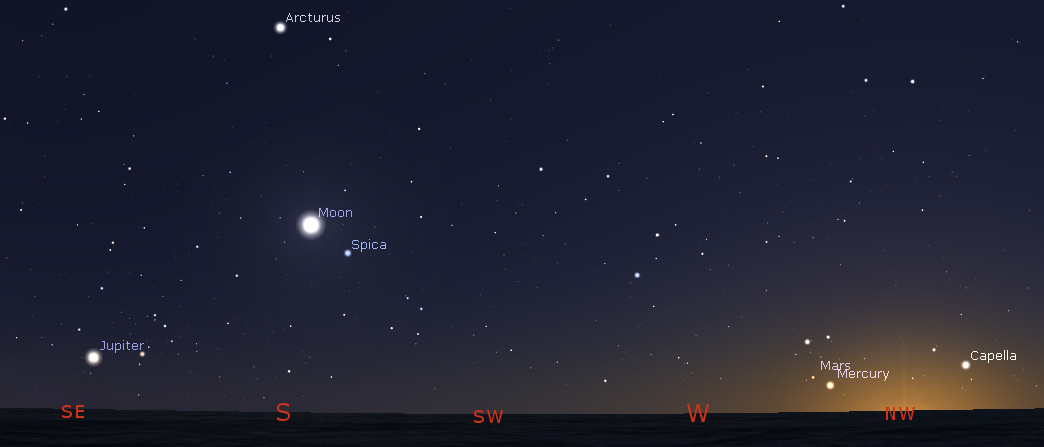
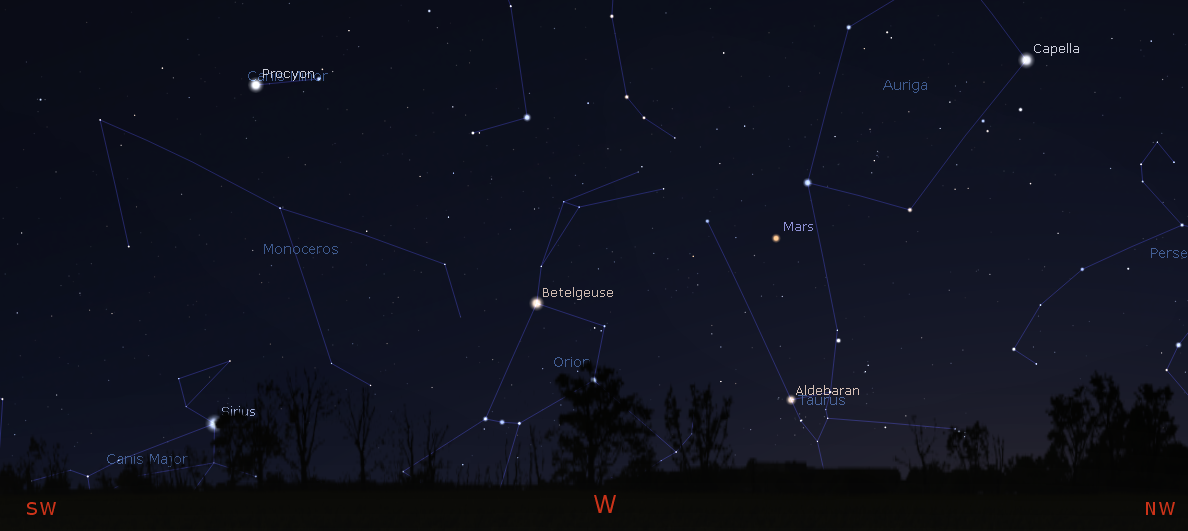
Mercury and Mars with the brighter stars at 10:15 p.m., June 19, 2019. Click on the image to enlarge. Created using Stellarium.
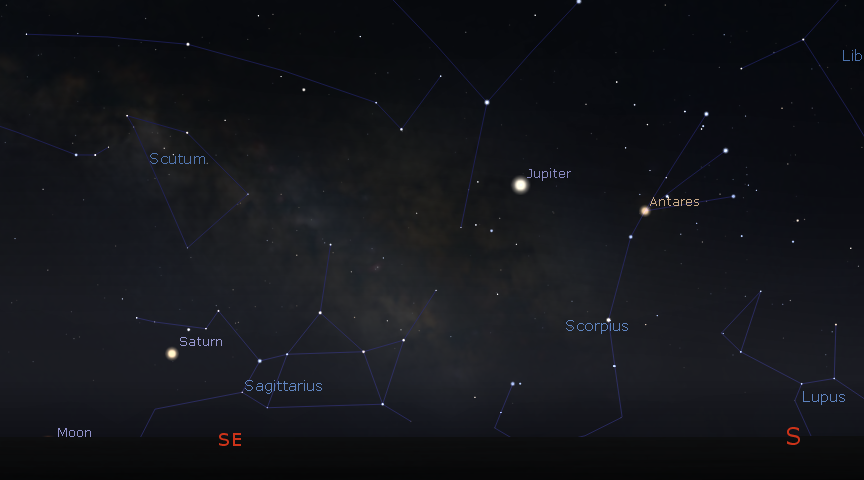
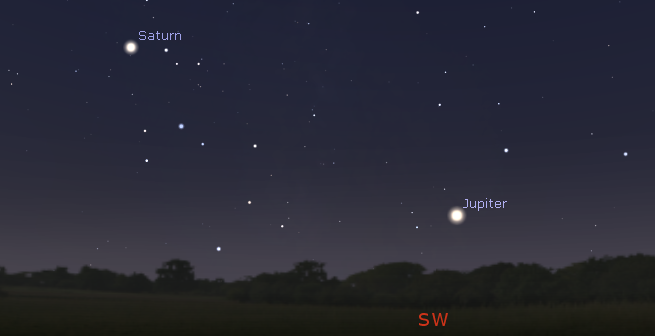
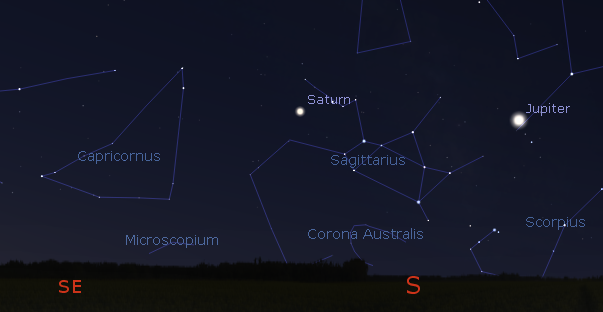
Jupiter and Saturn before moonrise at 11:30 p.m. June 19, 2019. Click on the image to enlarge. Created using Stellarium.
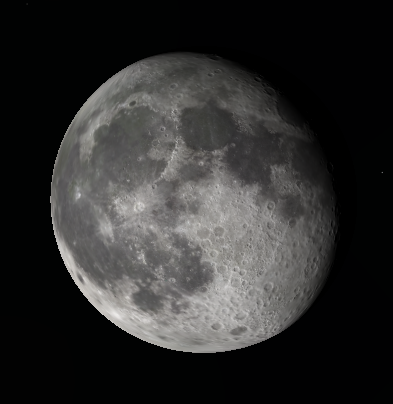
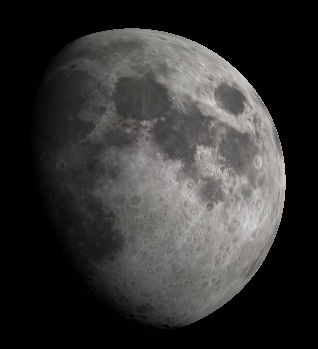
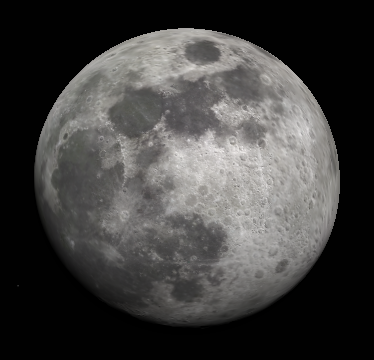
The waning gibbous Moon at midnight as it might be seen in binoculars or a small telescope.. Created using Stellarium.
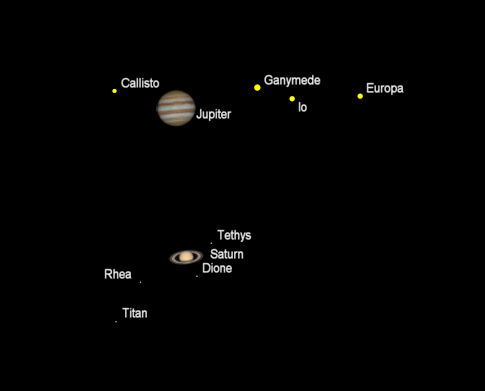
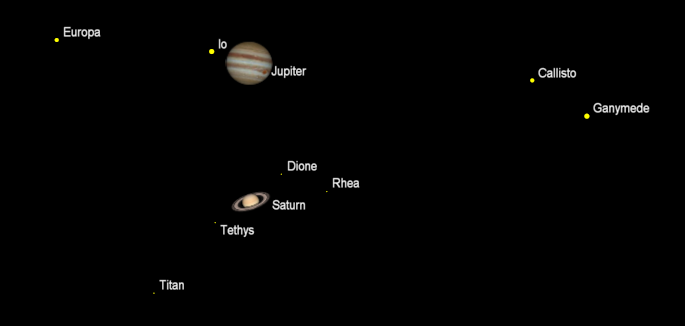
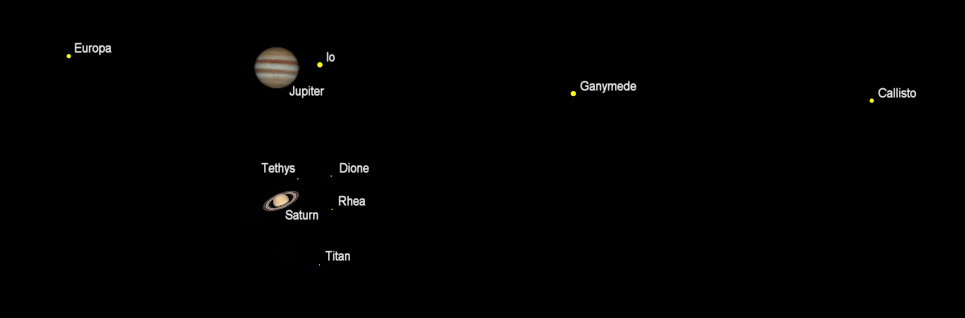
Jupiter and Saturn with the same magnification at 11:30 p.m., June 19, 2019. Created using Cartes du Ciel (Sky Charts).
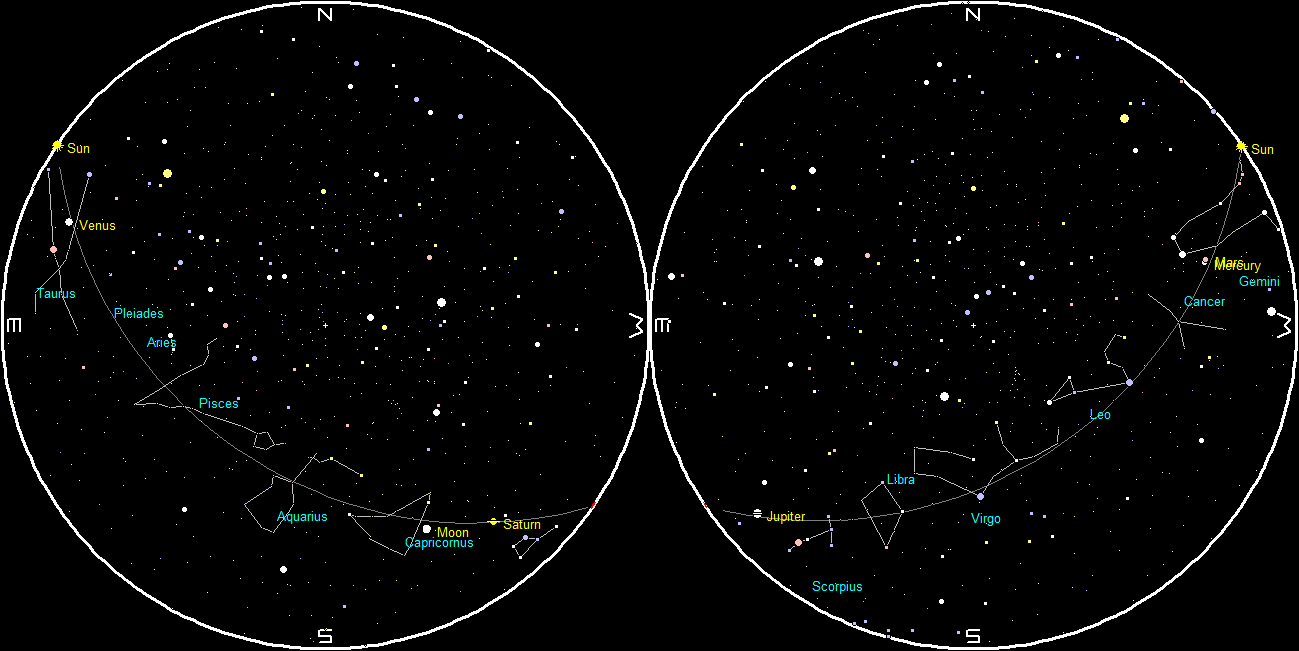
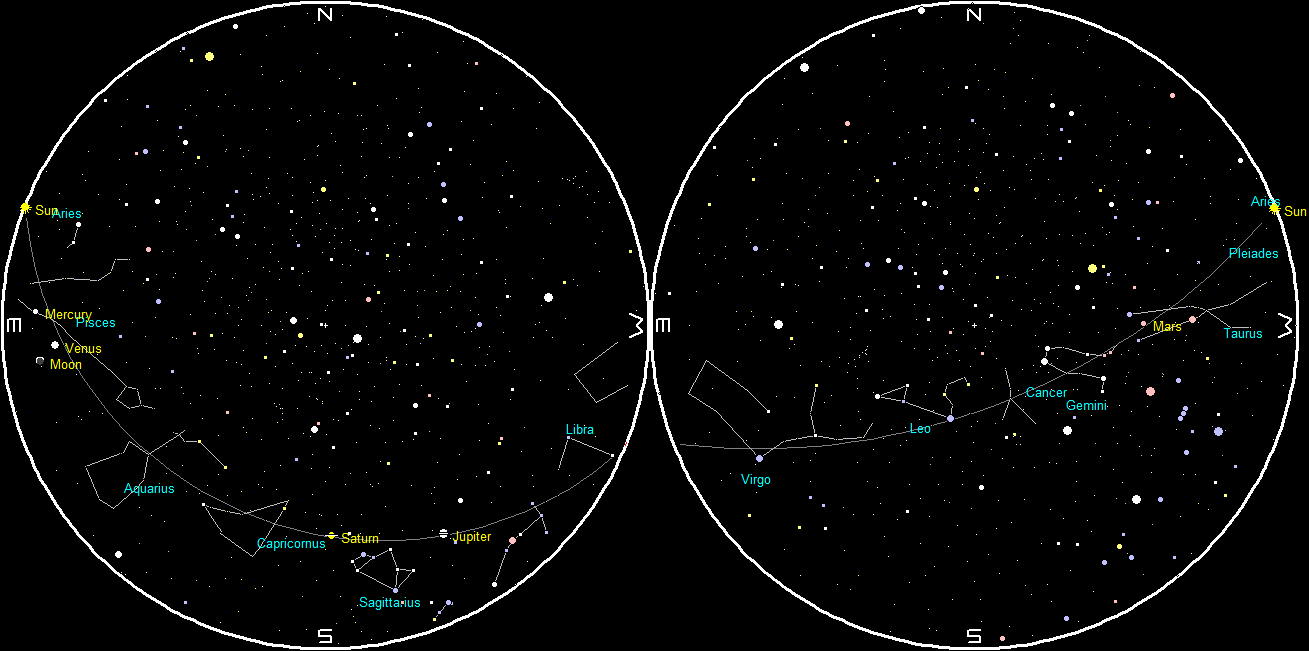
Planets and the Moon at sunset and sunrise of a single night starting with sunset on the right on June 19, 2019. The night ends on the left with sunrise on the 20th. Click on the image to enlarge. Created using my LookingUp program.
06/12/2019 – Ephemeris – Let’s look at the bright planets for this week
Ephemeris for Wednesday, June 12th. Today the Sun will be up for 15 hours and 31 minutes, setting at 9:28, and it will rise tomorrow at 5:56. The Moon, 2 days past first quarter, will set at 3:53 tomorrow morning.
Let’s look at the bright planets for this week. Mars and Mercury will be low in the west-northwestern sky under the stars Castor and Pollux, which are nearly horizontally arraigned this evening. Mercury is 5 times brighter than Mars, which is a bit above and left of it. Mercury will set at 11:11 p.m. with Mars setting shortly after. Jupiter will start the evening low in the southeast. It far brighter than any star and will be visible all night, setting shortly before sunrise. It’s in Ophiuchus. In the morning sky we have Saturn which will rise at 11:06 p.m., in the east-southeast. It’s in Sagittarius. Both Jupiter and Saturn are easily visible in the predawn skies for very early risers. Venus is too close to the Sun to be seen.
The times given are for the Traverse City/Interlochen area of Michigan. They may be different for your location.
Addendum
The Moon and the evening planets at 10:30 p.m. June 12, 2019. Click on the image to enlarge. Created using Stellarium.
The gibbous Moon as it might appear in binoculars or a small telescope tonight at 10:30 p.m. June 12, 2019. Created using Stellarium.
Jupiter and Saturn at 4:30 a.m. June 13, 2019. Click on the image to enlarge. Created using Stellarium.
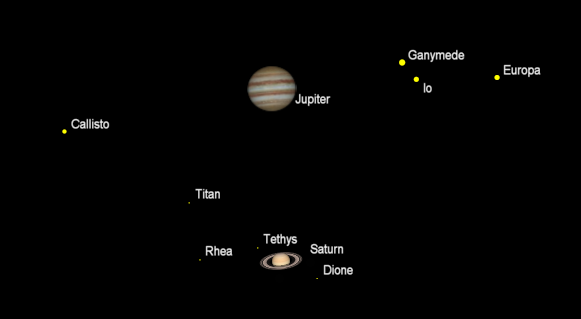
Jupiter and Saturn with the same magnification but at different times. Jupiter at 10:30 p.m. June 12 2019 while Saturn is for tomorrow morning.. Created using Cartes du Ciel (Sky Charts).
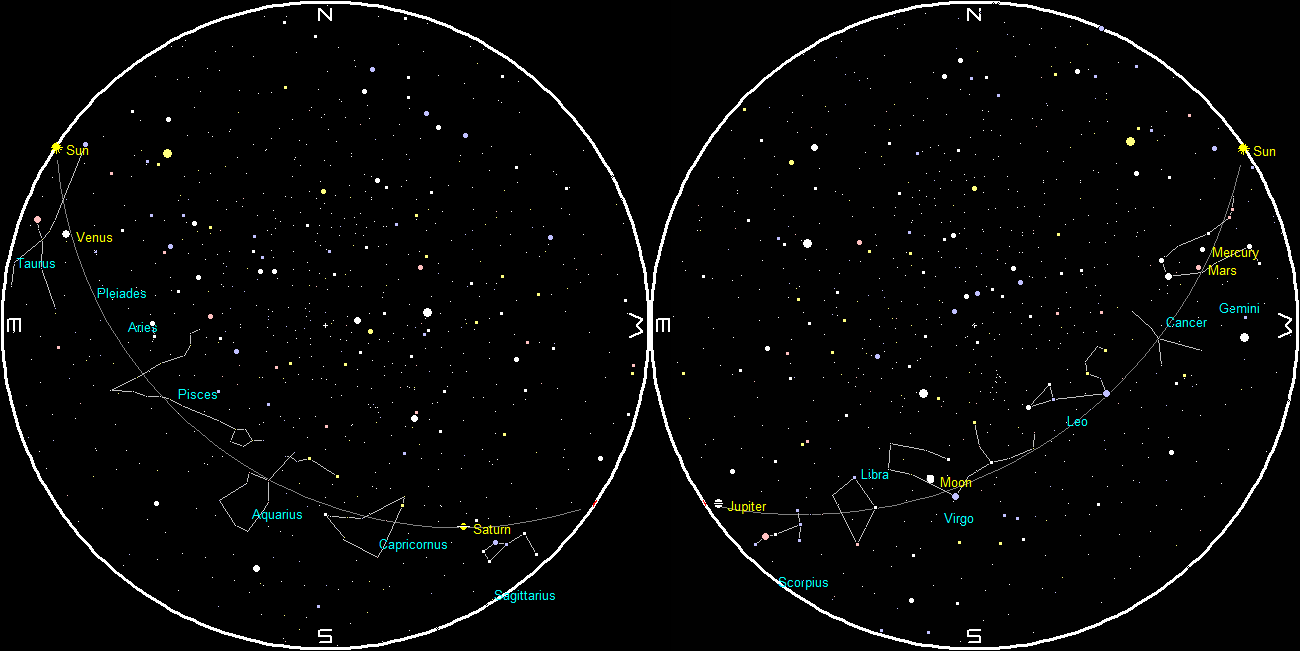
Planets and the Moon at sunset and sunrise of a single night starting with sunset on the right on June 12, 2019. The night ends on the left with sunrise on the 13th. Click on the image to enlarge. Created using my LookingUp program.
06/05/2019 – Ephemeris – Where are the bright planets for this week?
Ephemeris for Wednesday, June 5th. Today the Sun will be up for 15 hours and 25 minutes, setting at 9:24, and it will rise tomorrow at 5:58. The Moon, 2 days past new, will set at 11:49 this evening.
Let’s look at the bright planets for this week. Mars will be low in the west-northwestern sky this evening, below and right of the crescent Moon. It will set at 11:33 p.m. In the morning sky we have Jupiter, in Ophiuchus, which will actually rise at 9:35 tonight in the east-southeast. Jupiter will reach opposition from the Sun next Monday and thereafter rise before sunset and officially become an evening planet. Saturn will be next to rise at 11:39 p.m., also in the east-southeast. It’s in Sagittarius. Both planets are easily visible in as morning twilight grows. Mercury will become visible in the evening sky below Mars in a few days. It’s greatest separation from the Sun will be on the 23rd. Venus, is too close to the Sun to be seen.
The times given are for the Traverse City/Interlochen area of Michigan. They may be different for your location.
Addendum
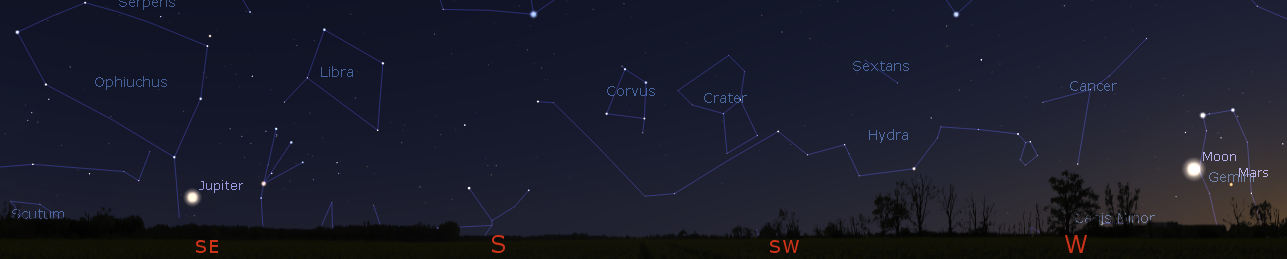
Mars, the Moon, and Jupiter tonight at 10:30 p.m. June 5, 2019. Click on the image to enlarge. Created using Stellarium.
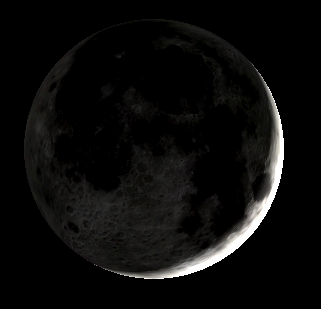
The Moon as it might appear in binoculars or a small telescope tonight at 10:30 p.m. June 5, 2019. Created using Stellarium.
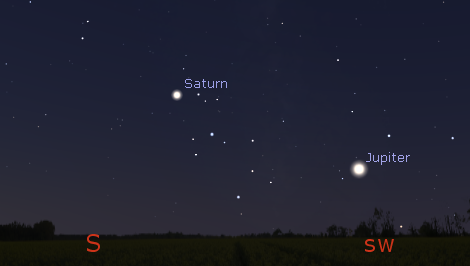
Jupiter and Saturn at 5 a.m. June 6, 2019. Created using Stellarium.
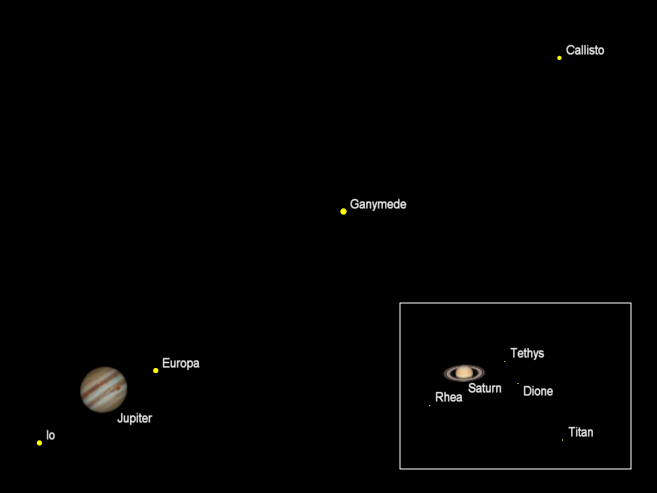
Jupiter and Saturn with the same magnification but at different times. Jupiter at 11 p.m. June 5, 2019 while Saturn is for tomorrow morning.. Created using Cartes du Ciel (Sky Charts).
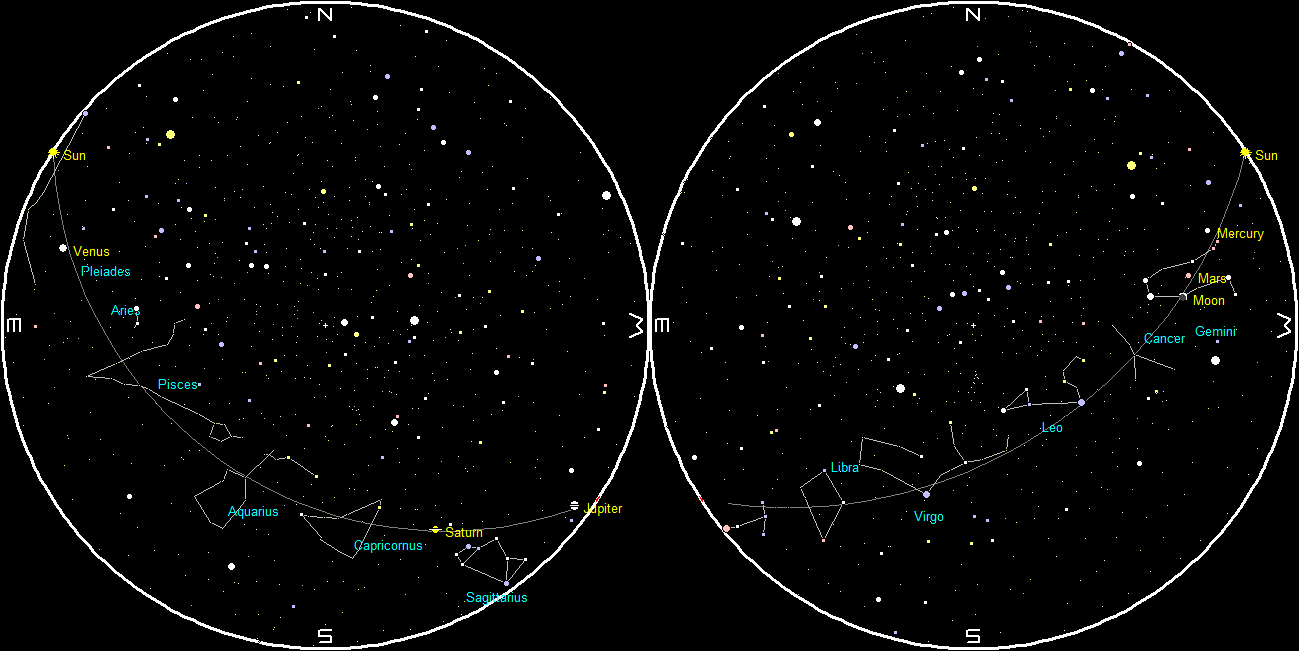
Planets and the Moon at sunset and sunrise of a single night starting with sunset on the right on June 5, 2019. The night ends on the left with sunrise on the 6th. Click on the image to enlarge. Created using my LookingUp program.
05/09/2019 – Ephemeris – The USA: Step by step to the Moon
Ephemeris for Thursday, May 9th. Today the Sun will be up for 14 hours and 35 minutes, setting at 8:57, and it will rise tomorrow at 6:20. The Moon, 2 days before first quarter, will set at 1:54 tomorrow morning.
The Apollo 11 manned landing on the Moon 50 years ago was the culmination of a series of incremental steps. The Mercury program was in progress when President Kennedy announce the goal to land on the Moon. Following that was Gemini a two man capsule to test long duration flight, rendezvous and docking of two spacecraft, and EVA’s or spacewalks. There was the Ranger program attempted to photograph the Moon close up by sending probes to crash into the Moon. The Lunar Orbiter program to map the entire Moon, the Surveyor program to soft land on the Moon and test its surface. All this leading up to the three man Apollo program to test out the strategy and equipment and to land humans on the Moon.
The times given are for the Traverse City/Interlochen area of Michigan. They may be different for your location.
Addendum
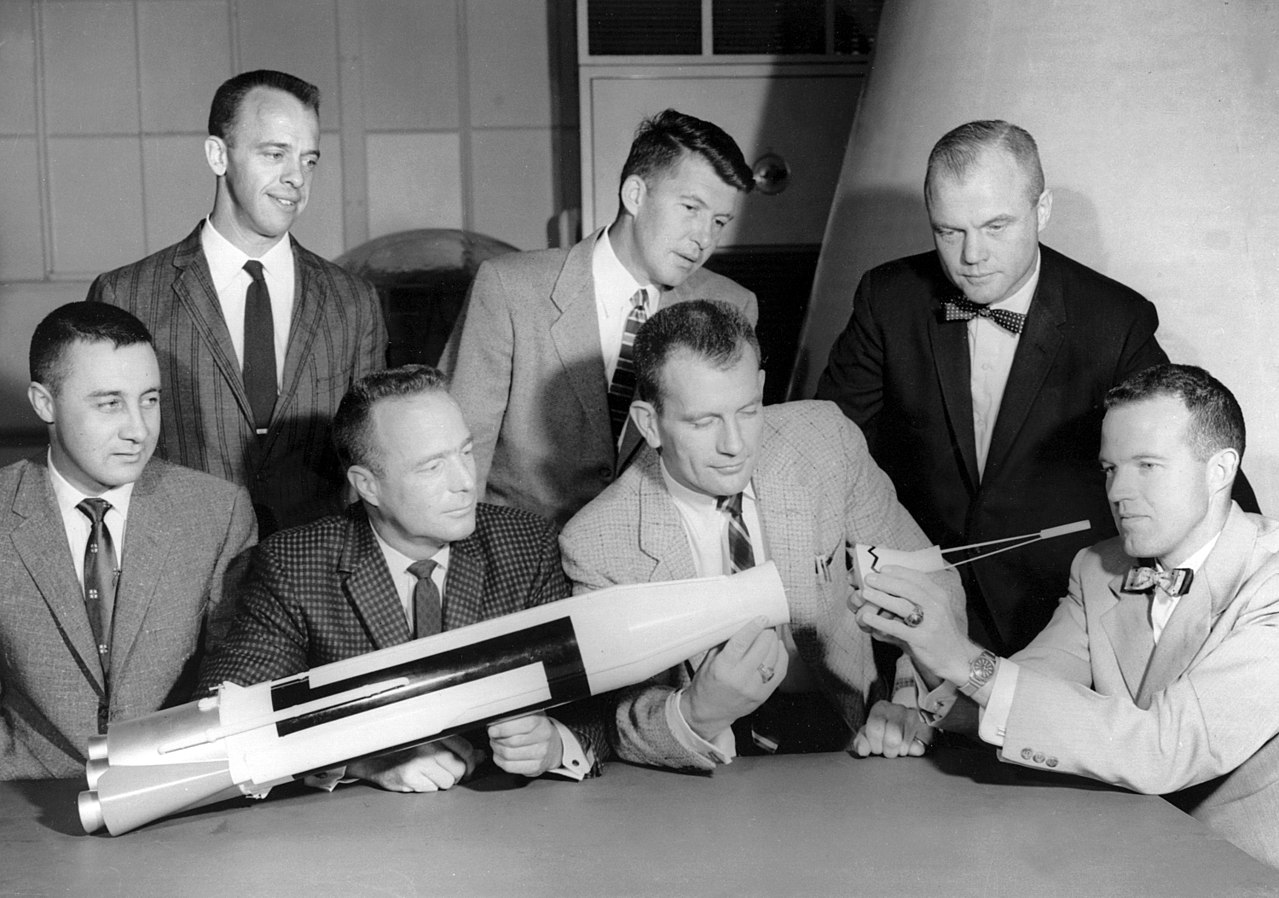
Project Mercury astronauts and a model of the Mercury-Atlas rocket and capsule. Left to right: Grissom, Shepard, Carpenter, Schirra, Slayton, Glenn and Cooper, in 1962. Click on the image to enlarge. Credit NASA.
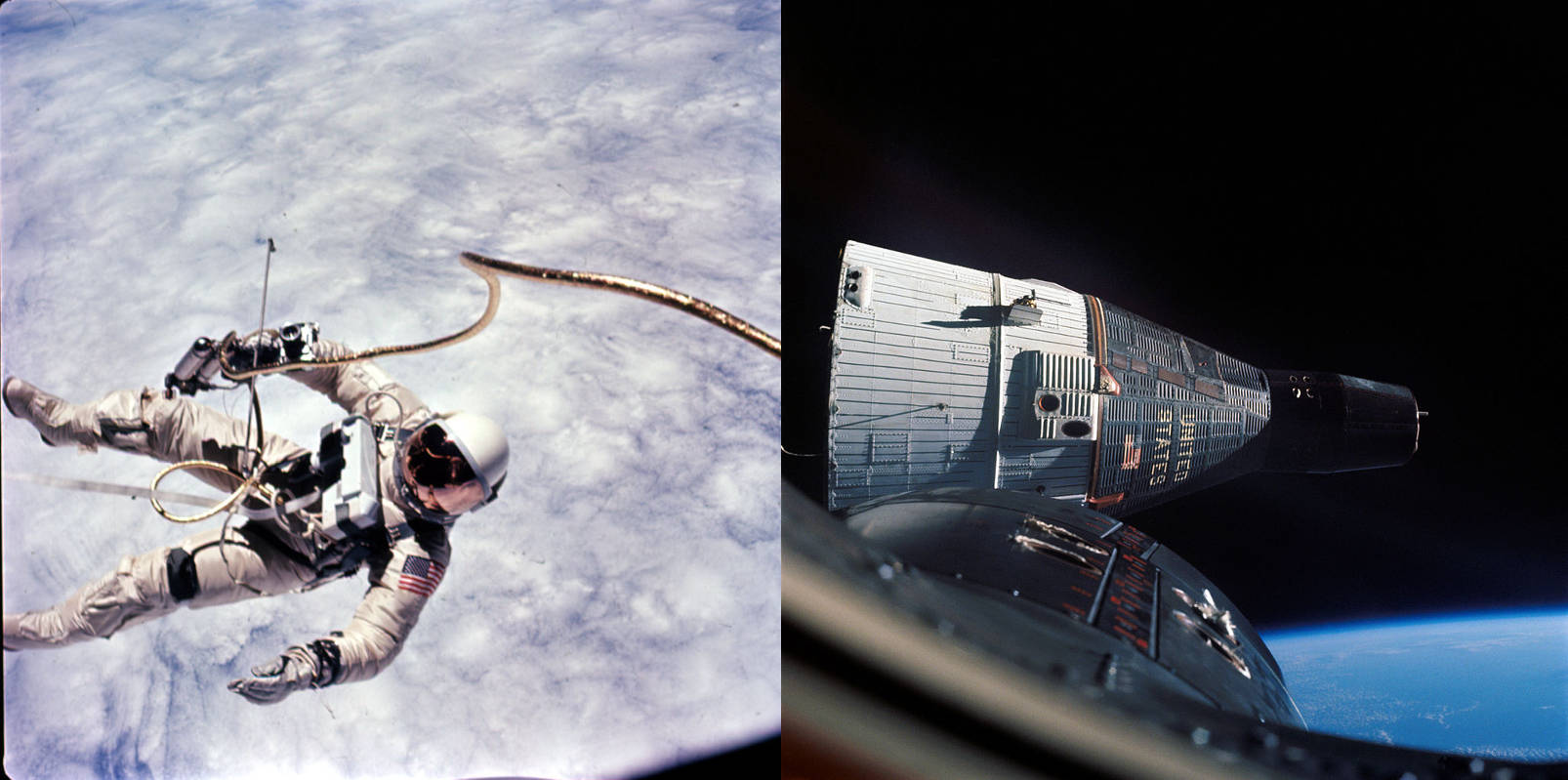
Project Gemini: Left Ed White during the US first space walk during Gemini 4 in June of 1965. Right The rendezvous of Gemini 6 & 7 in December of 1965. Click on the image to enlarge. Credit NASA.
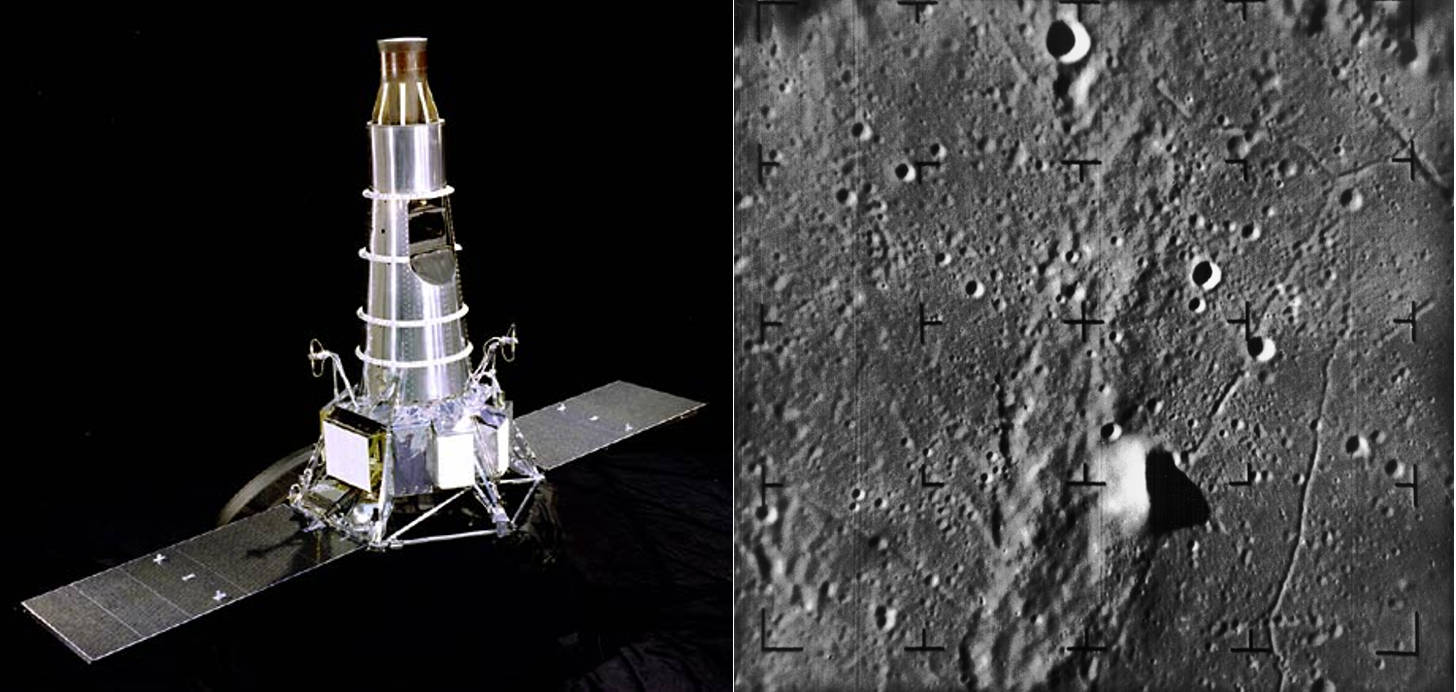
Left: The Ranger spacecraft. Right: The floor of the crater Alphonsus from Ranger 9. Only the last 3 spacecraft were successful. They transmitted images all the way down as they crashed into the Moon. Click on the image to enlarge. Credit NASA.
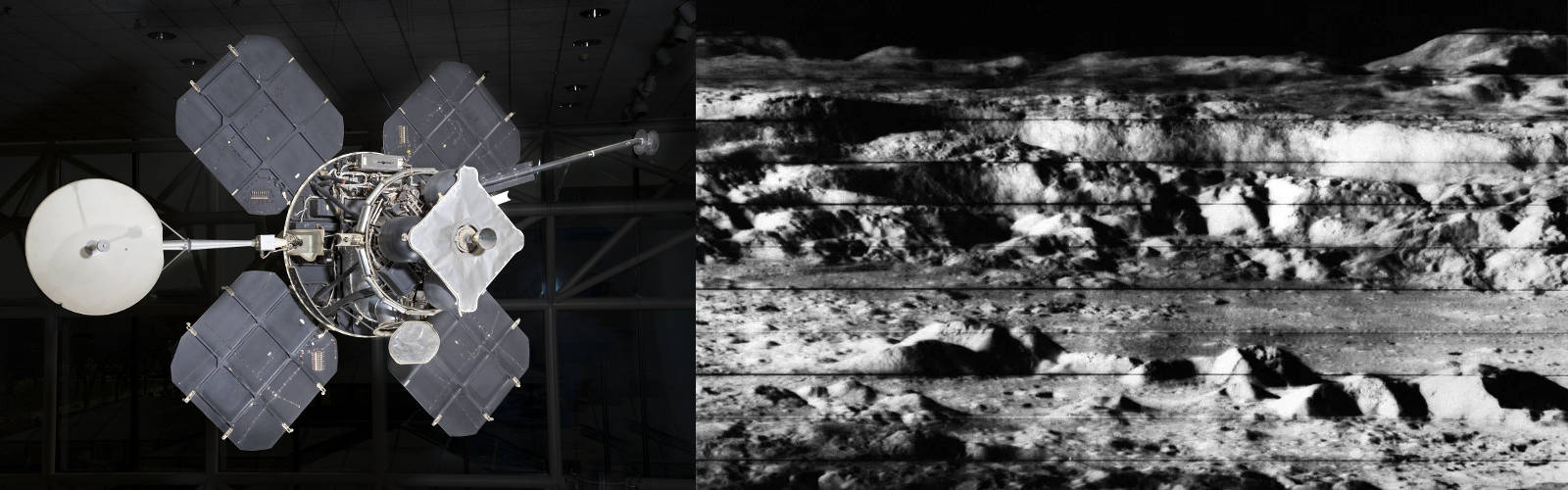
In the most unheralded of the lunar programs the 5 successful Lunar Orbiter satellites photographed 99% of the Moon. from 1966 to 1967. The Moon was photographed on film in strips, developed and the images scanned and transmitted back to Earth. Right: The oblique view of the crater Copernicus was dubbed at the time “The Picture of the Century”. Click on the image to enlarge. Credit NASA.
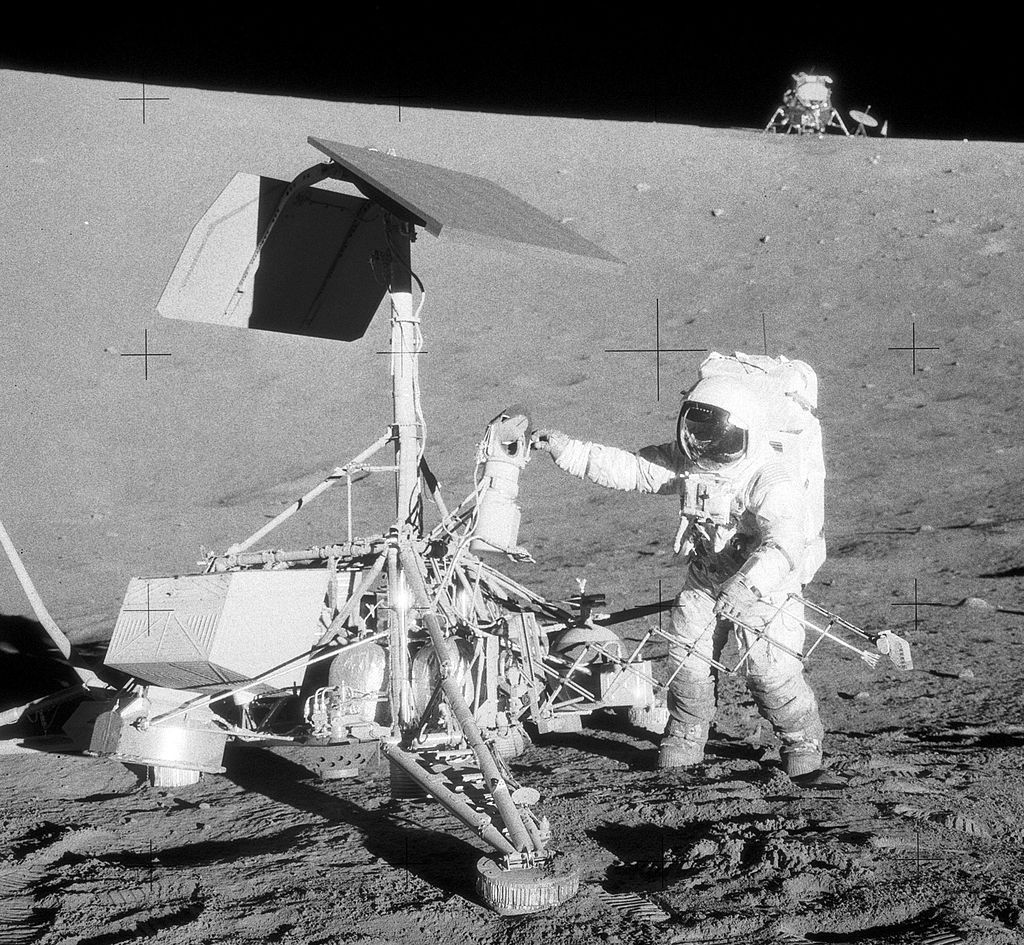
Surveyor 3, visited by astronaut Pete Conrad during the Apollo 12 mission. Click on the image to enlarge. Credit: NASA / Alan Bean.
05/01/2019 – Ephemeris – Checking out the bright planets for May Day
Ephemeris for Wednesday, May 1st. Today the Sun will be up for 14 hours and 14 minutes, setting at 8:47, and it will rise tomorrow at 6:31. The Moon, 3 days before new, will rise at 5:54 tomorrow morning.
Let’s look at the planets for this first day of May. Mars will be in the western sky this evening, in the horns above the V-shaped stars of the face of Taurus the bull. It will set at 12:13 a.m. In the morning sky we have Jupiter, in Ophiuchus, which will rise tomorrow at 12:09 a.m. in the east-southeast. Saturn will be next to rise at 2 a.m., also in the east-southeast. It is in Sagittarius. Venus will rise 57 minutes before the Sun in the east. It will remain in our morning sky, though too close to the rising Sun to be easily glimpsed. In August it will pass behind the Sun to enter the evening sky. It will be in position later this year to be our bright evening Christmas Star. Mercury will rise only 32 minutes before the Sun.
The times given are for the Traverse City/Interlochen area of Michigan. They may be different for your location.
Addendum
Mars and the setting winter stars tonight at 10 p.m. May 1, 2019. Click on the image to enlarge. Created using Stellarium.
Morning planets and Moon at 5:30 a.m. May 1, 2019. Click on the image to enlarge. Note that at this time for the Grand Traverse area the International Space Station will be visible, crossing from the southwest starting at 5:25 and ending in the east-northeast at 5:31 a.m. Created using Stellarium.
Jupiter and Saturn with the same magnification at 5:30 a.m. tomorrow morning May 2, 2019. Created using Cartes du Ciel (Sky Charts).
Io’s shadow will start to cross Jupiter’s disk at 9:27 UT or 5:27 a.m. EDT.
Io’s will start to transit the planet at 10:19 UT or 6:19 a.m. EDT.
Io events for observers west of here can be accessed from Project Pluto: https://www.projectpluto.com/jevent.htm#may.
Planets and the Moon at sunset and sunrise of a single night starting with sunset on the right on May 1, 2019. The night ends on the left with sunrise on the 2nd. Click on the image to enlarge. Created using my LookingUp program.
04/17/2019 – Ephemeris – Let’s look for the bright planets
Ephemeris for Wednesday, April 17th. Today the Sun will be up for 13 hours and 34 minutes, setting at 8:30, and it will rise tomorrow at 6:53. The Moon, 2 days before full, will set at 6:53 tomorrow morning.
Let’s look at the planets for this week. Mars will be in the western sky this evening, above the V-shaped stars of the face of Taurus the bull. It will set at 12:23 a.m. In the morning sky we have Jupiter, in Ophiuchus, which will rise tomorrow at 1:07 a.m. in the east-southeast. Saturn will be next to rise at 2:54 a.m., also in the east-southeast. It is in Sagittarius. Venus will rise at 5:56 a.m. again in the east-southeast. By 6:30 in the morning they will be strung out from the south down to the eastern horizon. Venus will remain in our morning sky, though more difficult to see until August when it passes behind the Sun to enter the evening sky. Tiny Mercury may be glimpsed a bit left and just below Venus in the bright twilight.
The times given are for the Traverse City/Interlochen area of Michigan. They may be different for your location.
Addendum
Mars and the Moon tonight at 9:30 p.m. April 17, 2019. Click on the image to enlarge. Created using Stellarium.
The waxing gibbous nearly full Moon at 9:30 p.m. April 17, 2019. Created using Stellarium.
Morning planets and Moon at 6:30 a.m. April 18, 2019. Click on the image to enlarge. Created using Stellarium.
Jupiter and Saturn with the same magnification at 6:30 a.m. tomorrow morning April 18, 2019. Click on the image to enlarge. Created using Cartes du Ciel (Sky Charts).
Jupiter’s moon Io events earlier in the morning
| Moon | Event | Date | U.T. | EDT |
| Io | Shadow start | 18 Apr 2019 | 05:40 | 1:40 AM |
| Io | Transit start | 18 Apr 2019 | 06:44 | 2:44 AM |
| Io | Shadow end | 18 Apr 2019 | 07:51 | 3:51 AM |
| Io | Transit end | 18 Apr 2019 | 08:56 | 4:56 AM |
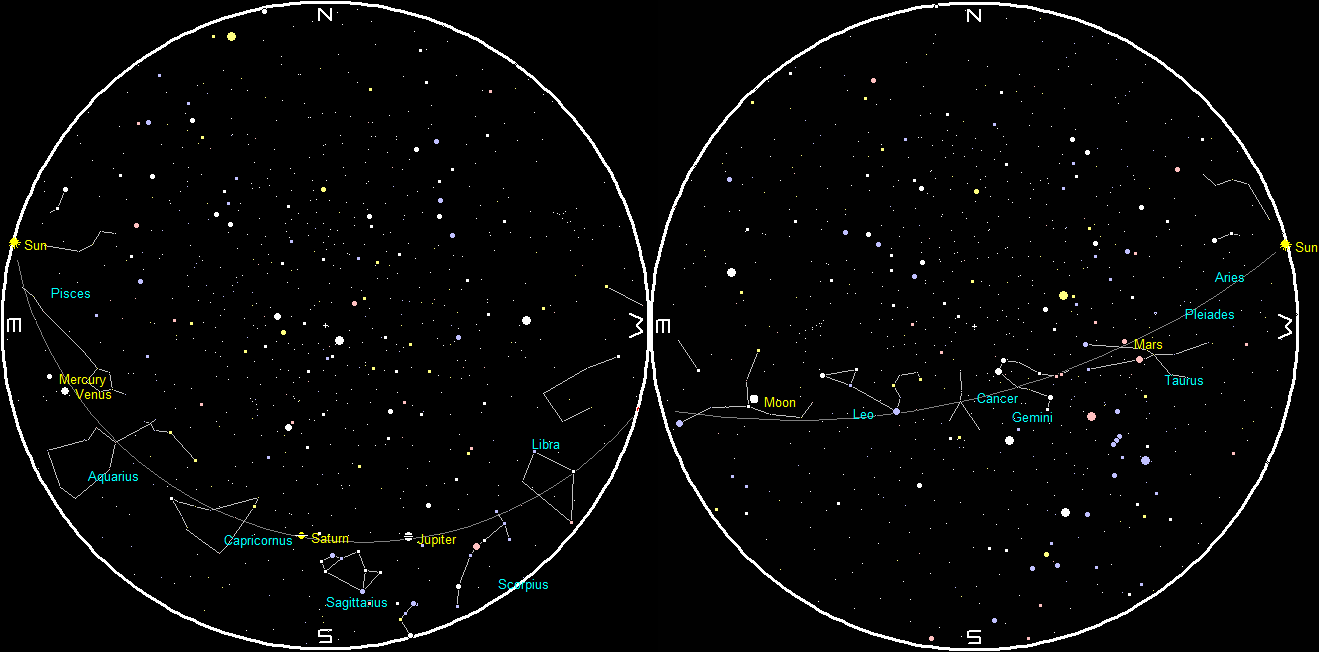
Planets and the Moon at sunset and sunrise of a single night starting with sunset on the right on April 17, 2019. The night ends on the left with sunrise on the 18th. Click on the image to enlarge. Created using my LookingUp program.
04/10/2019 – Ephemeris – Looking for the bright planets for this week
Ephemeris for Wednesday, April 10th. Today the Sun will be up for 13 hours and 13 minutes, setting at 8:21, and it will rise tomorrow at 7:05. The Moon, 2 days before first quarter, will set at 2:04 tomorrow morning.
Let’s look at the planets for this week. Mars will be in the western sky this evening, to the right of the V-shaped stars of the face of Taurus the bull. It will set at 12:27 a.m. In the morning sky we have Jupiter which will rise tomorrow at 1:35 a.m. in the east-southeast. It is second to Venus in brightness. Saturn will be next to rise at 3:21 a.m., also in the east-southeast. Venus will rise at 6:05 a.m. again in the east-southeast. By 6:30 in the morning they will be strung out from the southeast to the south. Venus will remain in our morning sky until August when it passes behind the Sun. Tiny Mercury may be glimpsed a bit left and just below Venus in the bright twilight.
The times given are for the Traverse City/Interlochen area of Michigan. They may be different for your location.
Addendum
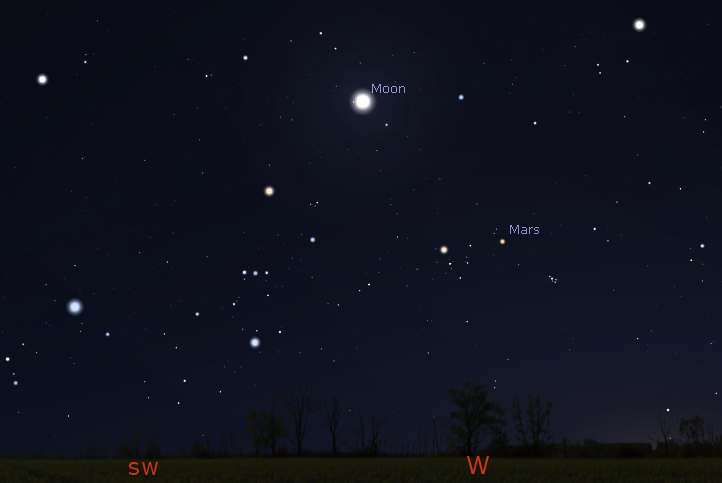
Mars and the Moon in the evening at 9:30 p.m. April 10, 2019. Click on the image to enlarge. Created using Stellarium.
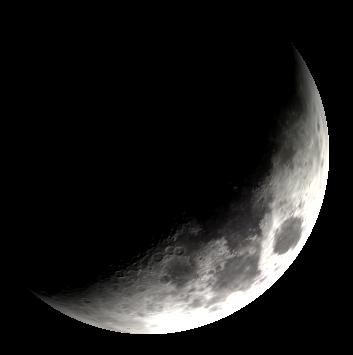
The Moon as it might appear in binoculars or a small telescope tonight at 9 p.m. April 10, 2019. Created using Stellarium.
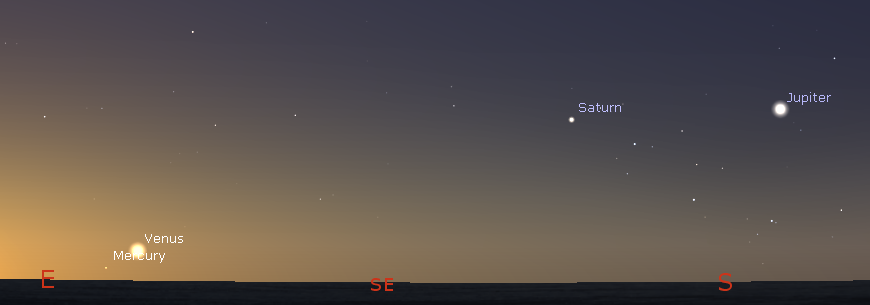
Morning planets at 6:30 a.m. April 11, 2019. Click on the image to enlarge. Created using Stellarium.
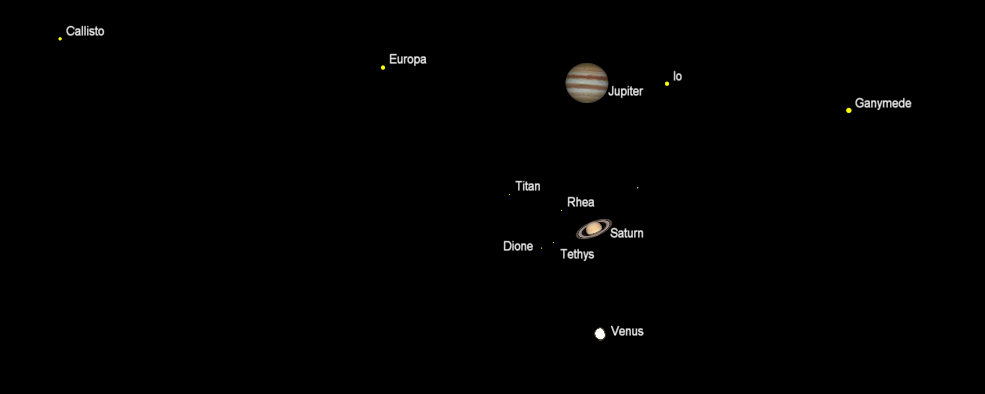
Jupiter, Saturn and Venus with the same magnification at 6:30 a.m. tomorrow morning April 11, 2019. Created using Cartes du Ciel (Sky Charts).
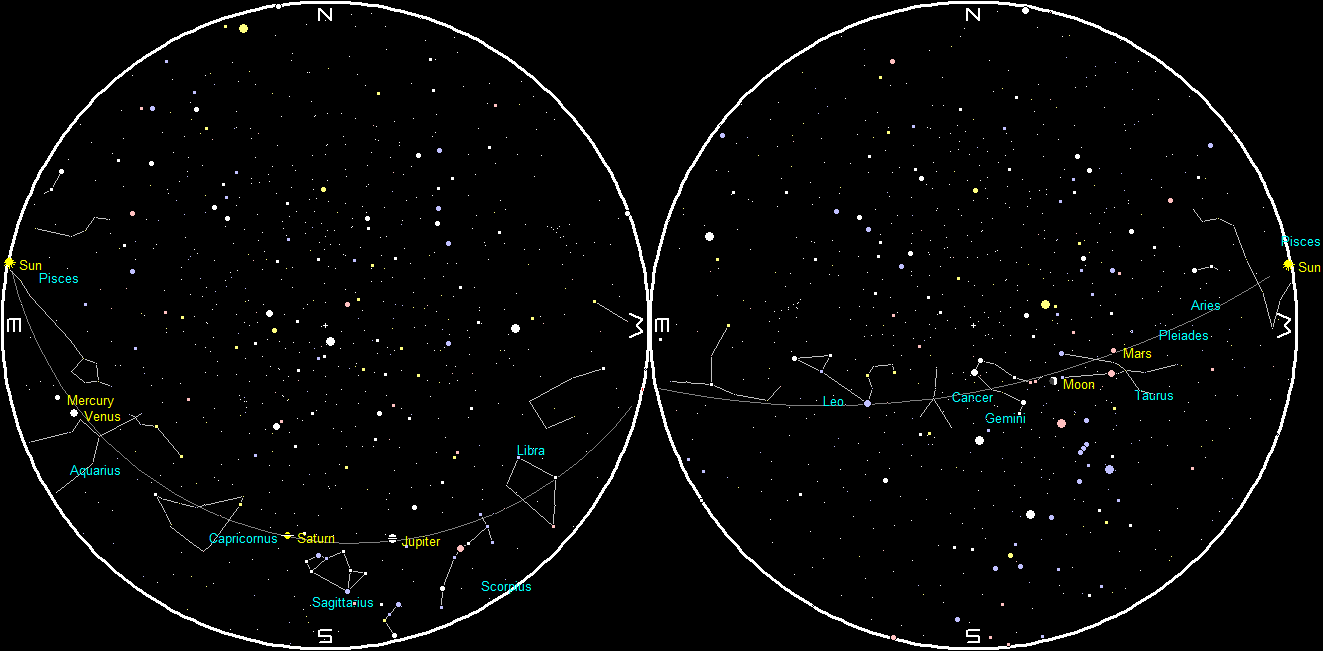
Planets and the Moon at sunset and sunrise of a single night starting with sunset on the right on April 10, 2019. The night ends on the left with sunrise on the 11th. Click on the image to enlarge. Created using my LookingUp program.
04/03/2019 – Ephemeris – Let’s check out the bright planets for this week
Ephemeris for Wednesday, April 3rd. Today the Sun will be up for 12 hours and 52 minutes, setting at 8:12, and it will rise tomorrow at 7:18. The Moon, 2 days before new, will rise at 7:27 tomorrow morning.
Let’s look at the planets for this week. Mars will be in the western sky this evening, to the right of the V shaped stars of the face of Taurus the bull. It will set at 12:31 a.m. In the morning sky we have Jupiter which will rise tomorrow at 2:02 a.m. in the east-southeast. It is second to Venus in brightness. Saturn will be next to rise at 3:48 a.m., also in the east-southeast. Venus will rise at 6:13 a.m. again in the east-southeast. By 7 in the morning they will be strung out from the southeast to the south. Venus will remain in our morning sky until August when it passes behind the Sun. It will emerge to become a bright addition to our winter and spring evening skies later this year and next. Mercury will be
The times given are for the Traverse City/Interlochen area of Michigan. They may be different for your location.
Addendum
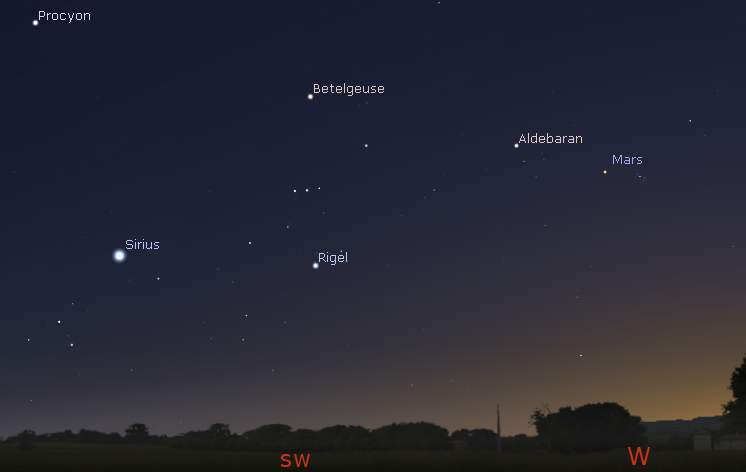
Mars in the evening at 9 p.m. April 3, 2019. Click on the image to enlarge. Created using Stellarium.
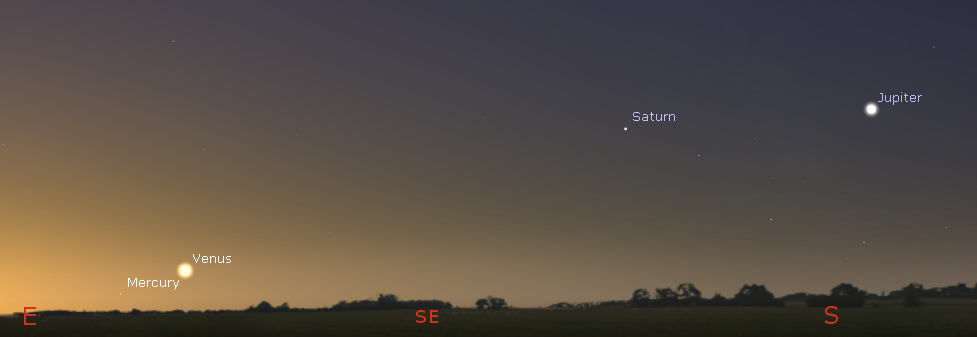
Morning planets at 6:45 a.m. April 4, 2019. Click on the image to enlarge. Created using Stellarium.
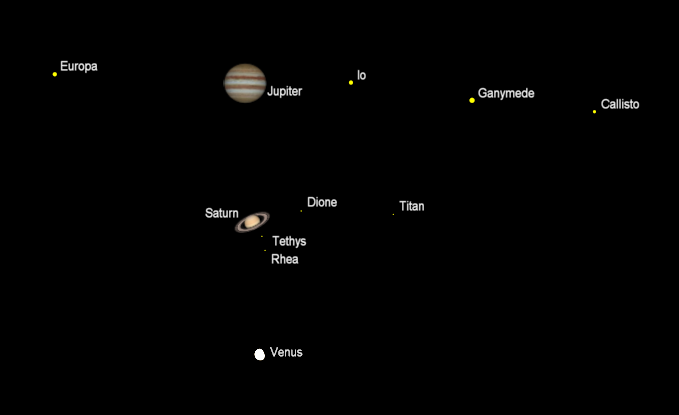
Jupiter, Saturn and Venus with the same magnification at 6:45 a.m. tomorrow morning April 4, 2019. Created using Cartes du Ciel (Sky Charts).
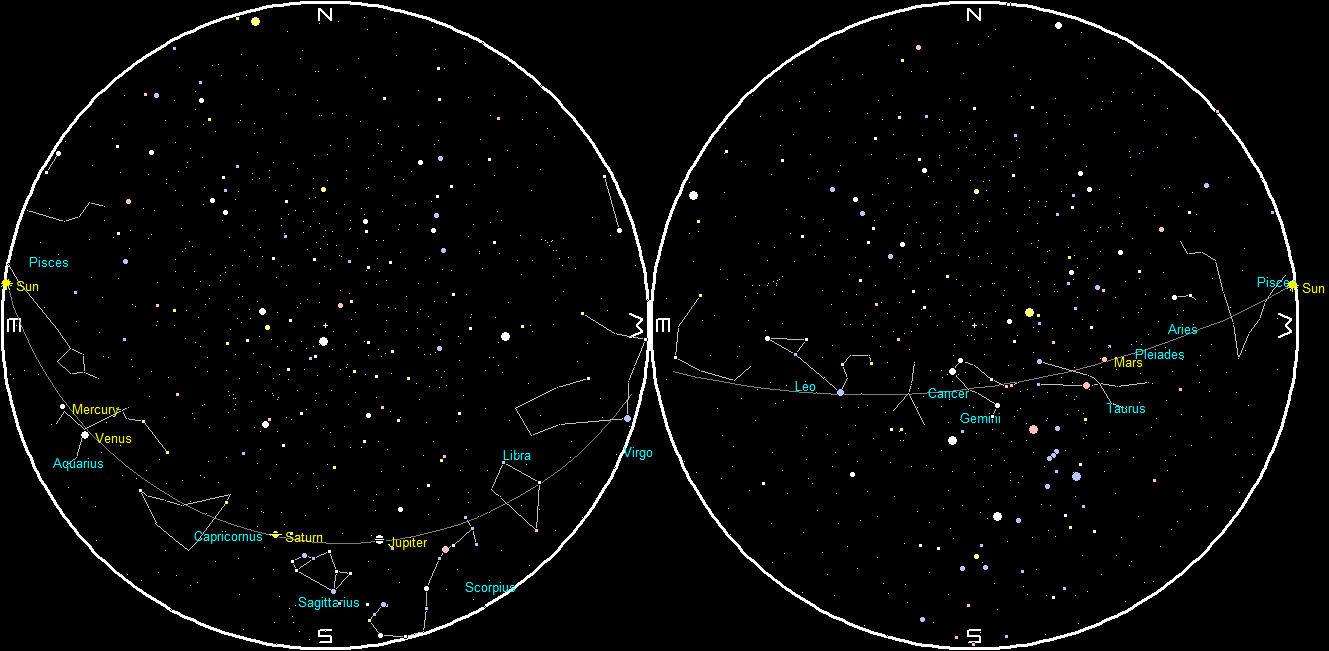
Planets and the Moon at sunset and sunrise of a single night starting with sunset on the right on April 3, 2019. The night ends on the left with sunrise on the 4th. Click on the image to enlarge. Created using my LookingUp program.
03/06/2019 – Ephemeris – Looking at the bright naked eye planets for this week
Ephemeris for Ash Wednesday, March 6th. Today the Sun will be up for 11 hours and 25 minutes, setting at 6:36, and it will rise tomorrow at 7:10. The Moon is new today, and won’t be visible.
Let’s look at the planets for this week. We have two evening planets visible now. Tiny and elusive Mercury is really hard to spot low in the west from about 7 p.m. until it sets at 7:52 p.m. It is fading fast. Binoculars are the only way to spot it now. Mars will be in the west-southwestern sky this evening and will set at 11:42 p.m. Mars too is fading. In the morning sky we have Jupiter which will rise tomorrow at 2:45 a.m. It is second to Venus in brightness. Saturn will be next to rise at 4:32 a.m. It will be to the upper right of Venus which will rise at 5:32 a.m. tomorrow. By 6 in the morning they will be string out from the southeast to the south. They will be a beautiful sight as morning twilight advances.
The times given are for the Traverse City/Interlochen area of Michigan. They may be different for your location.
Addendum
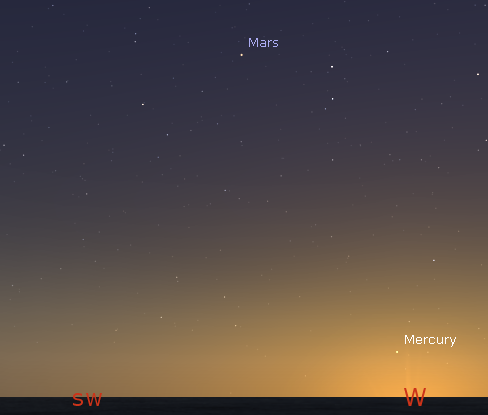
Mars and Mercury at 7:15 p.m. tonight March 6, 2019. I had to increase the star and planet brightness to make Mercury appear in the bright twilight because it has dropped to second magnitude. Created using Stellarium.
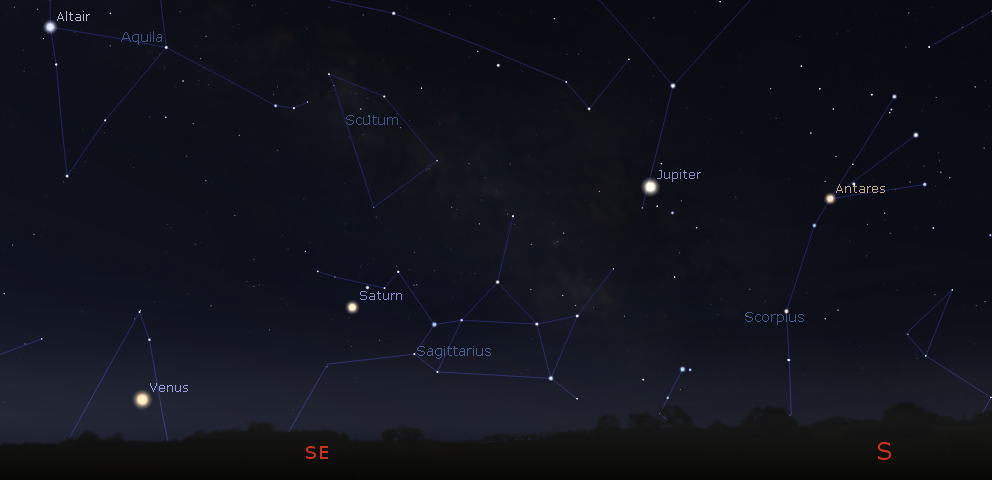
Morning planets and the constellations at 6 a.m. Tomorrow March 7, 2019. Click on image to enlarge. Created using Stellarium.
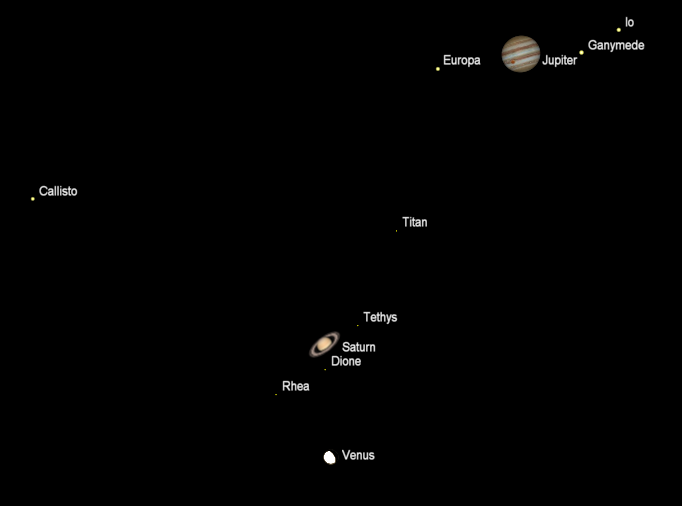
Jupiter, Saturn and Venus with the same magnification at 6 a.m. tomorrow morning March 7, 2019. Created using Cartes du Ciel (Sky Charts).
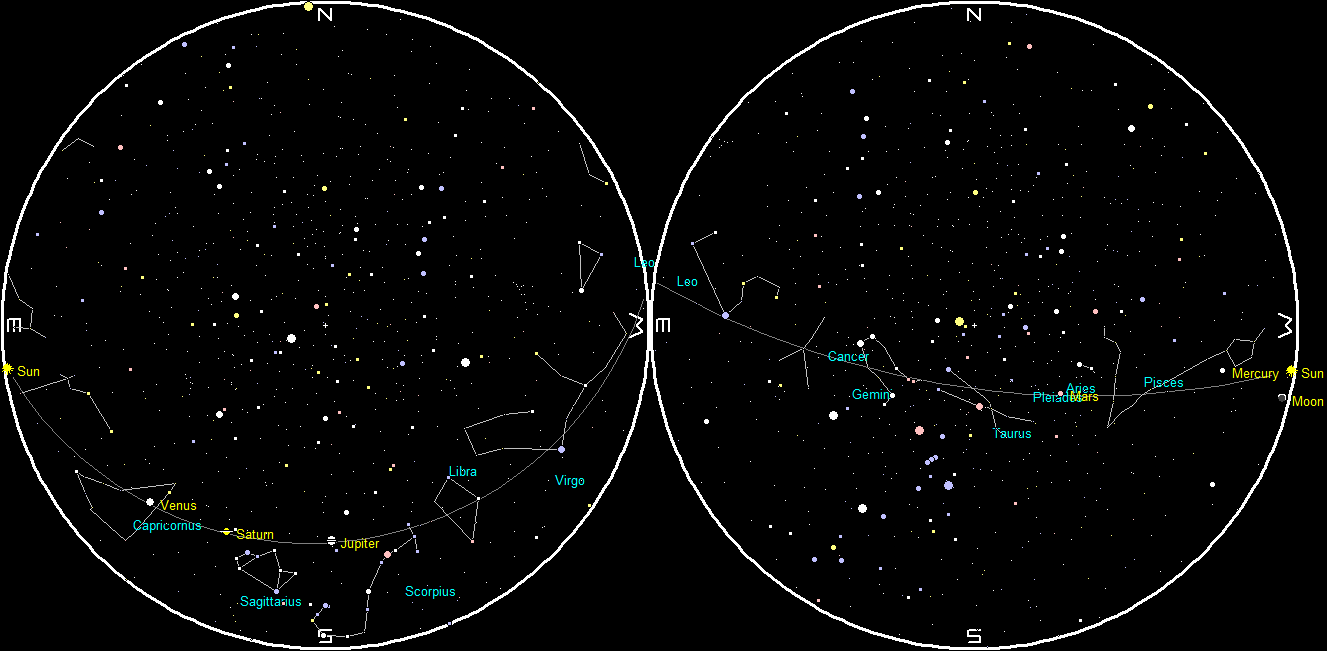
Planets and the Moon at sunset and sunrise of a single night starting with sunset on the right on March 6, 2019. The night ends on the left with sunrise on the 7th. Click on the image to enlarge. Created using my LookingUp program.
02/27/2019 – Ephemeris – All the classical planets from antiquity are now visible
Ephemeris for Wednesday, February 27th. Today the Sun will be up for 11 hours and 3 minutes, setting at 6:27, and it will rise tomorrow at 7:22. The Moon, 1 day past last quarter, will rise at 3:46 tomorrow morning.
Let’s look at the planets for this week. We have two evening planets visible now. Tiny and elusive Mercury should be visible low in the west from about 7 p.m. to about 7:45 p.m. It should be visible for the next few days. Binoculars are a big help in spotting it. Mars will be in the west-southwestern sky this evening and will set at 11:44 p.m. In the morning sky we have Jupiter which will rise tomorrow at 3:05 a.m. It is second to Venus in brightness. Saturn will be next to rise at 4:57 a.m. It will be to the upper right of Venus which will rise at 5:31 a.m. tomorrow. In small telescopes Saturn will show its rings and Venus will show a small slightly gibbous moon shape which will shrink and grow more full over the next months
The times given are for the Traverse City/Interlochen area of Michigan. They may be different for your location.
Addendum
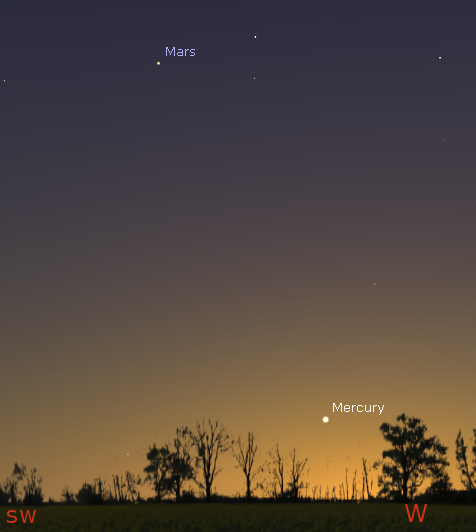
Mars and Mercury at 7 p.m. tonight February 17, 2019. Created using Stellarium.
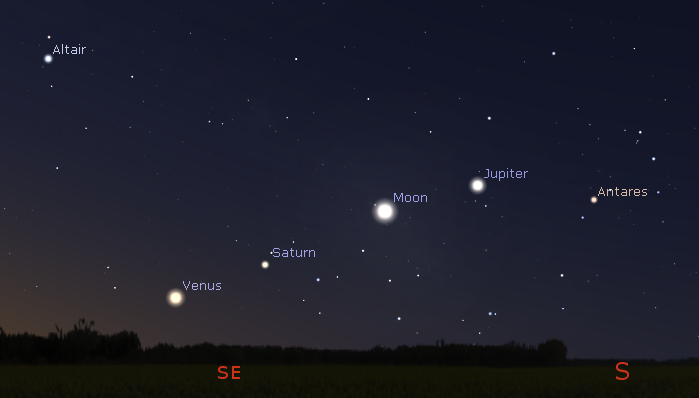
Morning planets and the Moon at 6:30 a.m. Tomorrow February 28, 2019. The actual Moon image is below. Created using Stellarium.
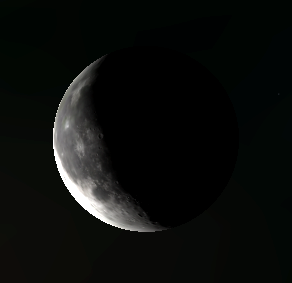
The moon as it might appear in binoculars tomorrow morning, February 28, 2019. Created using Stellarium.
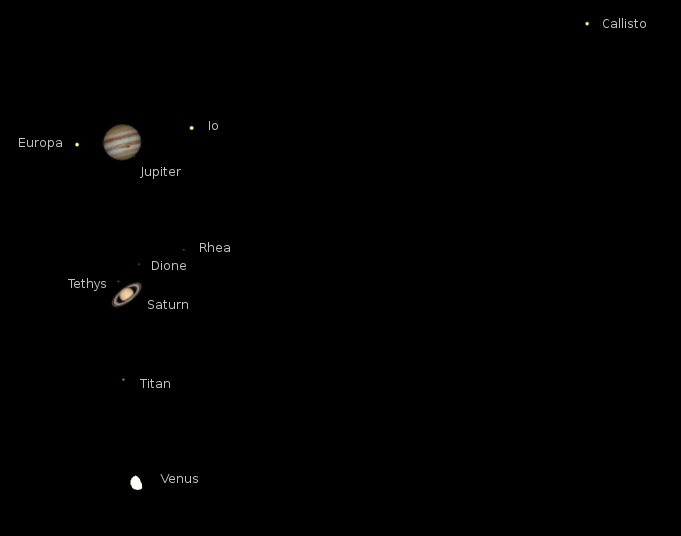
Jupiter, Saturn and Venus with the same magnification at 6:30 a.m. tomorrow morning February 28, 2019. Ganymede is behind Jupiter at that hour. See the table of Jupiter moon events tomorrow morning. Created using Cartes du Ciel (Sky Charts).
| Satellite | Event | Date | UT | EST |
| Ganymede | Eclipse start | 28 Feb 2019 | 06:16 | — |
| Ganymede | Eclipse end | 28 Feb 2019 | 08:21 | 3:21 a.m. |
| Europa | Shadow start | 28 Feb 2019 | 11:09 | 6:09 a.m. |
| Ganymede | Occultation start | 28 Feb 2019 | 11:13 | 6:13 a.m. |
| Ganymede | Occultation end | 28 Feb 2019 | 13:23 | — |
| Europa | Shadow end | 28 Feb 2019 | 13:31 | — |
| Europa | Transit start | 28 Feb 2019 | 13:34 | — |
| Io | Eclipse start | 28 Feb 2019 | 13:42 | — |
| Europa | Transit end | 28 Feb 2019 | 15:58 | — |
| Io | Occultation end | 28 Feb 2019 | 17:06 | — |
Jupiter satellites will have a busy morning. Events with EST times are visible from Northern Michigan. Events with UT only times are visible in other longitudes in the western hemisphere.
Times are provided by the Project Pluto: https://www.projectpluto.com/jevent.htm.
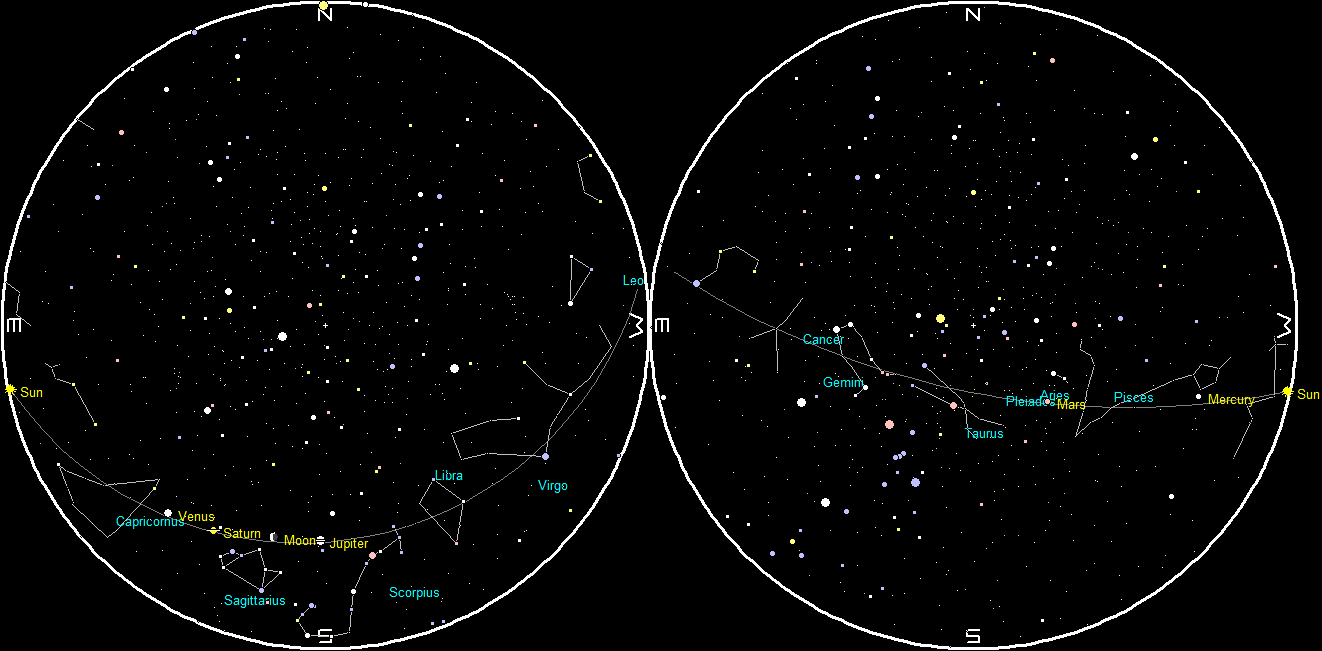
Planets and the Moon at sunset and sunrise of a single night starting with sunset on the right on February 27, 2019. The night ends on the left with sunrise on the 28th. Click on the image to enlarge. Created using my LookingUp program.

