Archive
06/27/2018 – Ephemeris – Our Wednesday look at the bright planets
Wednesday, June 27th. Today the Sun will be up for 15 hours and 33 minutes, setting at 9:32, and it will rise tomorrow at 5:59. The Moon, 1 day before full, will set at 6:27 tomorrow morning.
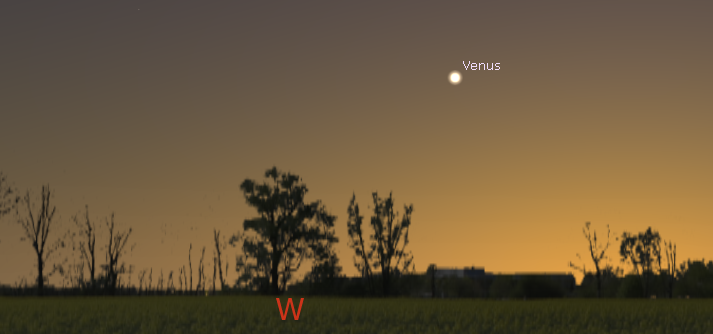
It’s Wednesday again and time to look for and at the bright planets. Three of them are in the evening sky. The brilliant beacon of Venus will be visible in the western twilight from about 9:50 p.m. until it sets at 11:53 p.m. Mercury is far below and right of it, setting at 10:59 p.m. Jupiter will be in the south as it gets dark. Jupiter is only outshone by Venus and the Moon, though Mars will outshine it next month at its closest. Jupiter will set at 3:05 a.m. Binoculars will show it to be bigger than star-like in size. Saturn which is opposite the Sun in the sky today will rise as the Sun sets. It’s right below the Moon tonight. Mars will rise at 11:39 p.m. and is now outshining Saturn.
The times given are for the Traverse City/Interlochen area of Michigan. They may be different for your location.
Addendum
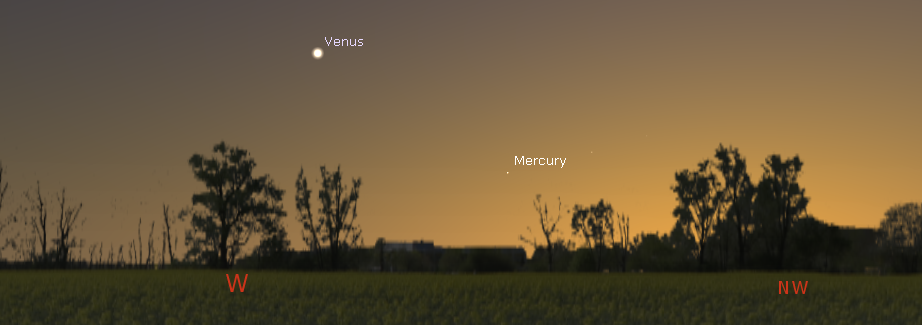
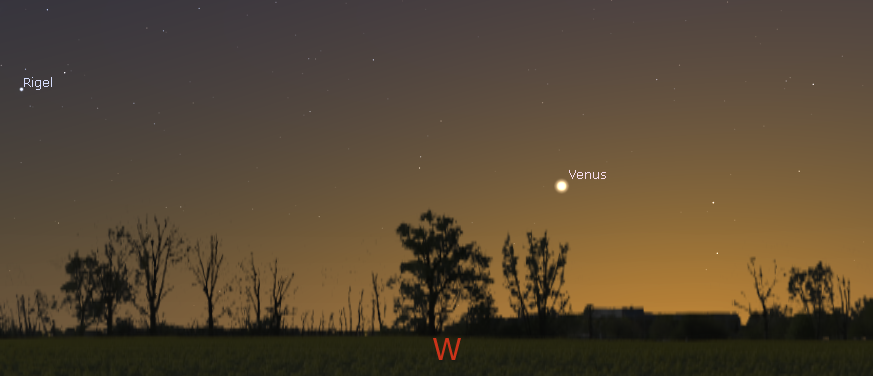
Venus and Mercury low in the western sky ay 10 p.m. June 27, 2018. Click on image to enlarge. Created using Stellarium.
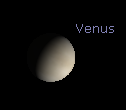
Telescopic appearance of Venus on June 27, 2018. A moon filter helps cut down the glare to be able to more easily see the phase. Created using Stellarium.
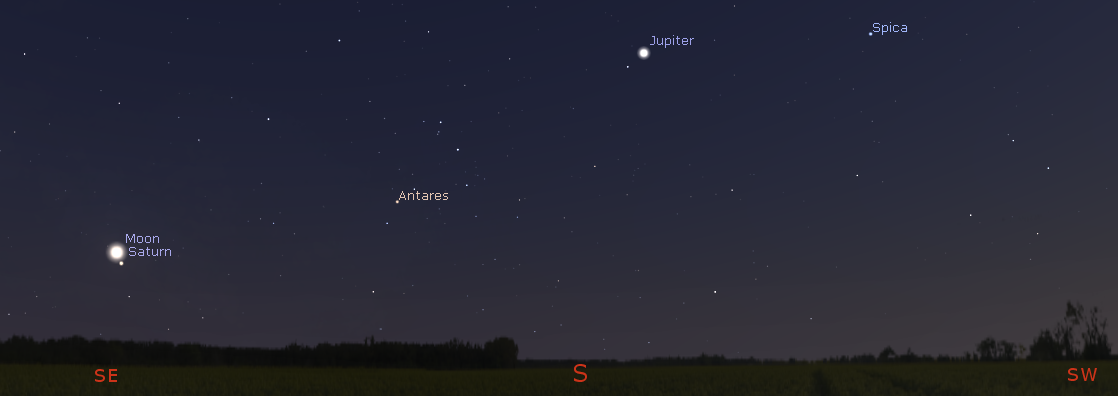
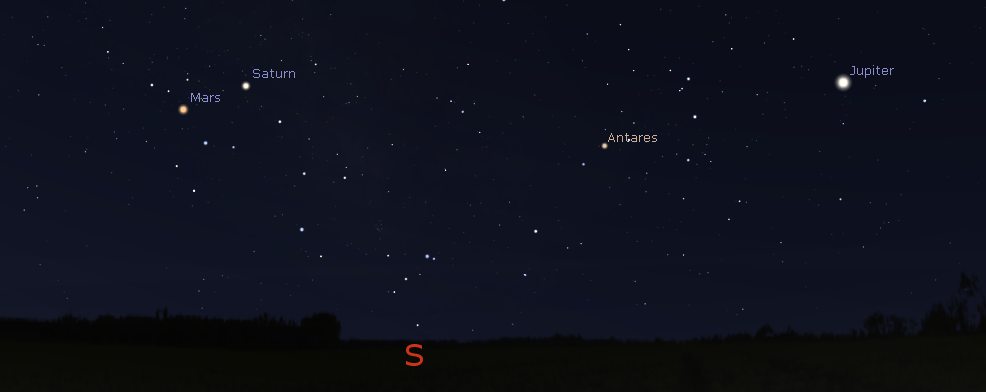
Jupiter, Saturn and the Moon tonight at 10:30 p.m. on June 27, 2018. Click on the image to enlarge. Created using Stellarium.
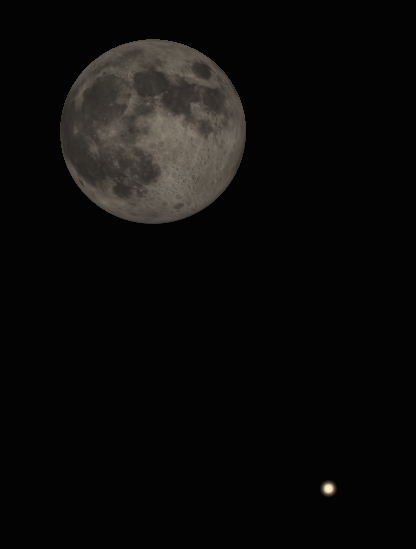
The Moon and Saturn as they might appear in binoculars at 10:30 p.m. June 27, 2018. Created using Stellarium.
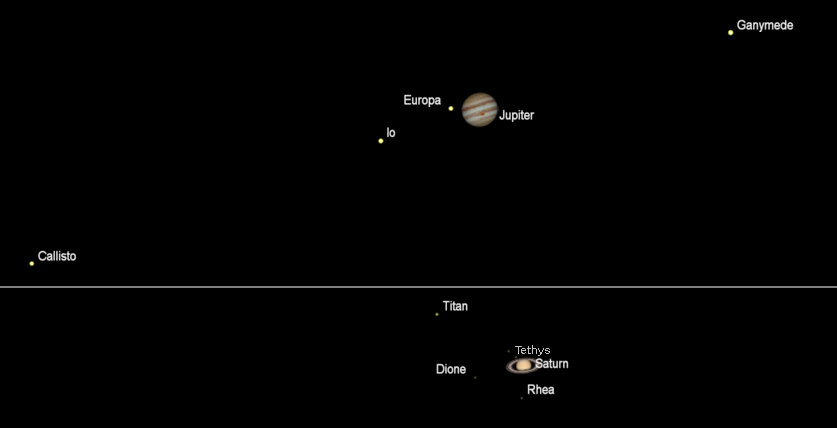
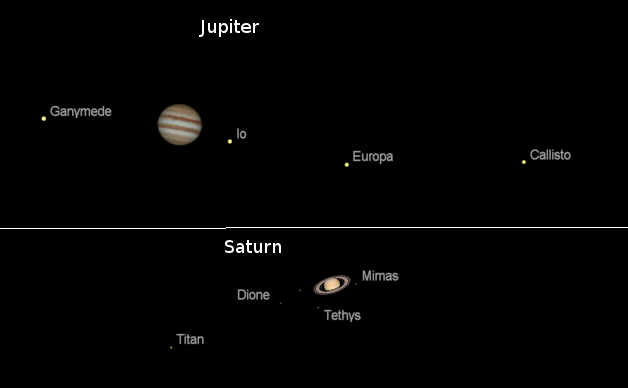
Jupiter and Saturn with the same magnification at 10:30 p.m. June 27, 2018. Information on Europa events and the Great Red Spot is below. Created using Cartes du Ciel (Sky Charts).
Moon   Event            Universal Time    Local Time
Europa Transit start    28 Jun 2018 3:30  27 Jun 2018 11:30 p.m.
Europa Shadow start     28 Jun 2018 5:34  28 Jun 2018  1:34 a.m.
Europa Transit end      28 Jun 2018 5:44  28 Jun 2018  1:44 a.m.
Europa Shadow end       28 Jun 2018 7:49  28 Jun 2018  3:49 a.m.
Great Red Spot Transit  28 Jun 2018 2:32  27 Jun 2018 10:32 p.m.
Source of Jovian events: https://www.projectpluto.com/jevent.htm
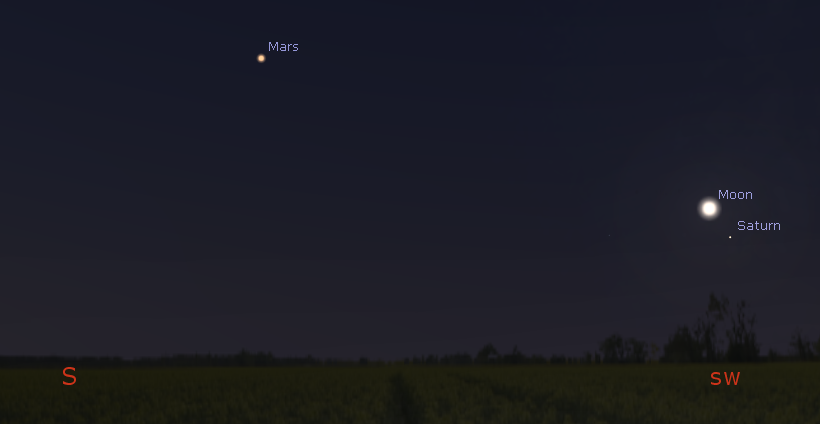
Mars, Saturn and the Moon at 5 a.m. June 28, 2018. Click on the image to enlarge. Created using Stellarium.
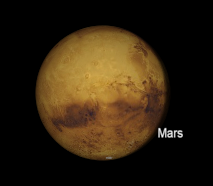
Greatly enlarged telescopic Mars at 5 a.m. June 28, 2018. Note that the dark albedo features may be covered by a global dust storm currently raging on the Red Planet. Created using Cartes du Ciel (Sky Charts).
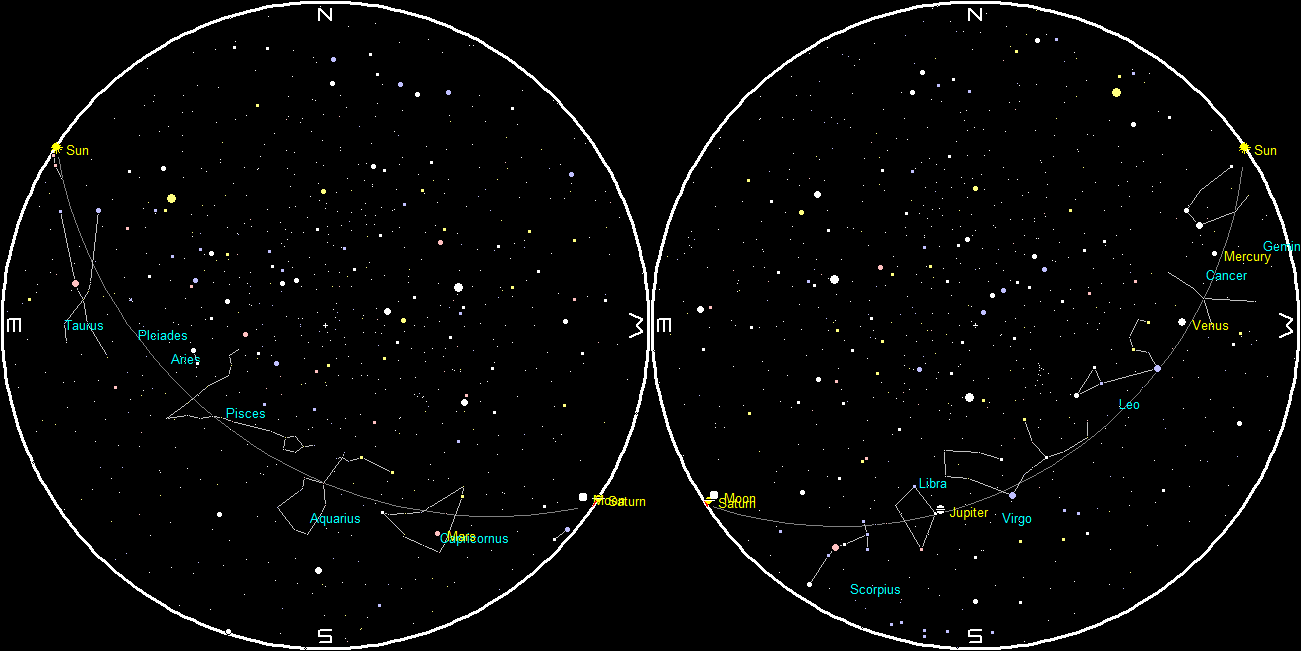
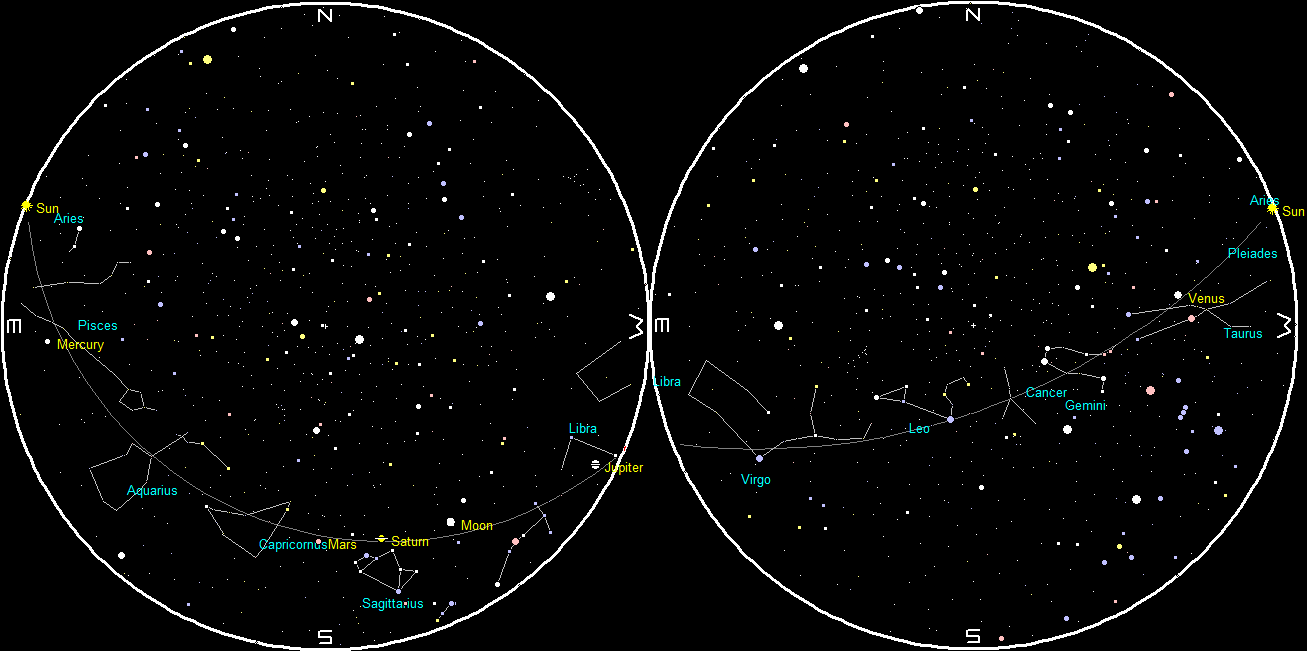
Planets and the Moon at sunset and sunrise of a single night starting with sunset on the right on June 27, 2018. The night ends on the left with sunrise on the 28th. Click on the image to enlarge. Created using my LookingUp program.
06/20/2018 – Ephemeris – Let’s check out the bright planets for this week
Ephemeris for Wednesday, June 20th. Today the Sun will be up for 15 hours and 34 minutes, setting at 9:31, and it will rise tomorrow at 5:57. The Moon, at first quarter today, will set at 2:29 tomorrow morning.
It’s Wednesday again and time to look for and at the bright planets. Three of them are in the evening sky. The brilliant beacon of Venus will be visible in the western twilight from about 9:50 p.m. until it sets at 11:59 p.m. Mercury is far below and right of it, setting at 10:48 p.m. Jupiter will be in the south as it gets dark. Jupiter is only outshone by Venus and the Moon. And after Venus sets will have the night to itself as the brightest star-like object until it sets at 3:34 a.m. Binoculars will show it to be bigger than star-like in size. Saturn will rise at 9:46 p.m. in the east-southeast. Mars will rise at 12:07 a.m. and is now outshining Saturn, and in July and August will even outshine Jupiter.
The times given are for the Traverse City/Interlochen area of Michigan. They may be different for your location.
Addendum
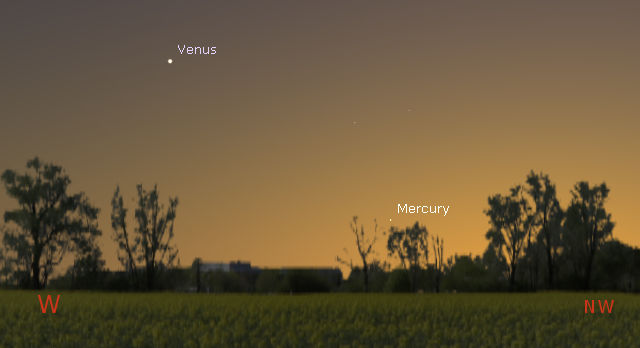
Venus and Mercury at 10 p.m., about a half hour after sunset, June 20, 2018. Created using Stellarium.
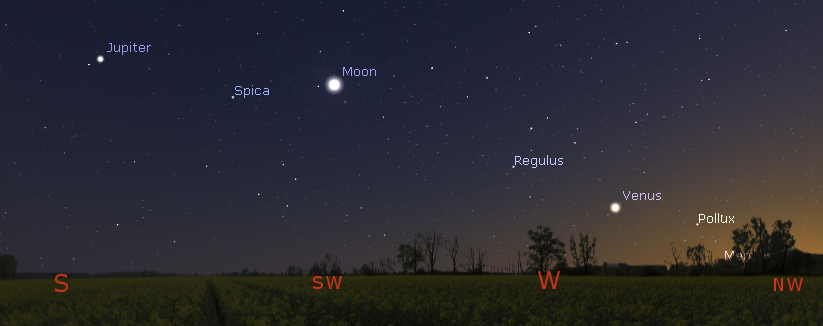
Venus, the Moon and Jupiter at 10:30 p.m., about an hour after sunset, on June 20, 2018. Created using Stellarium.
The phase exhibited by Venus in a telescope on June 20, 2018. Created using Stellarium.
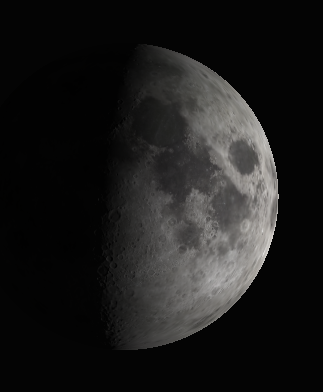
The moon as it might be seen in binoculars at 10:30 p.m. June 20, 2018. Created using Stellarium.
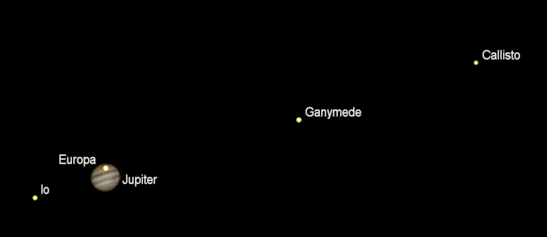
Jupiter and moons at 10:30 p.m. June 20, 2018. The image shows Europa in transit of Jupiter. A satellite is normally invisible against the face of Jupiter, but its shadow can be seen falling on the planet. Created using Cartes du Ciel (Sky Charts).
Satellite  Event        Local Date/Time       Universal Date/Time
Europa:   Transit start 20 Jun 2018  9:06 pm  21 Jun 2018 1:06
Europa:   Shadow start  20 Jun 2018 10:57 pm  21 Jun 2018 2:57
Europa:   Transit end   20 Jun 2018 11:20 pm  21 Jun 2018 3:20
Europa:   Shadow end    21 Jun 2018  1:12 am  21 Jun 2018 5:12
Source of satellite events: https://www.projectpluto.com/jevent.htm
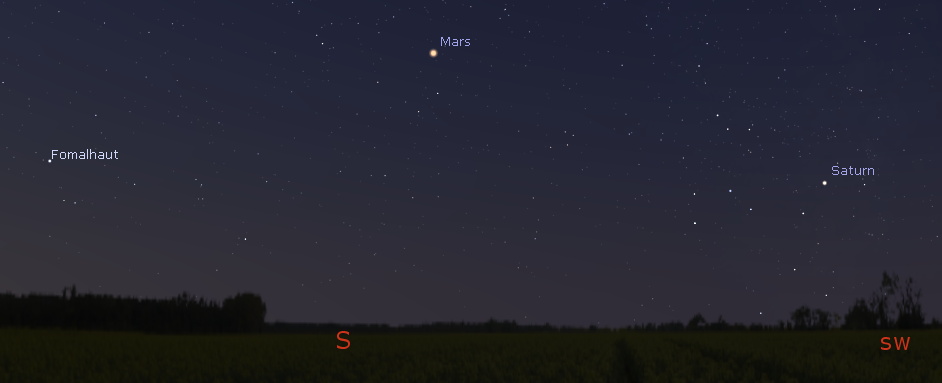
Morning planets at 5 a.m. June 21, 2018. Click on image to enlarge. Created using Stellarium.
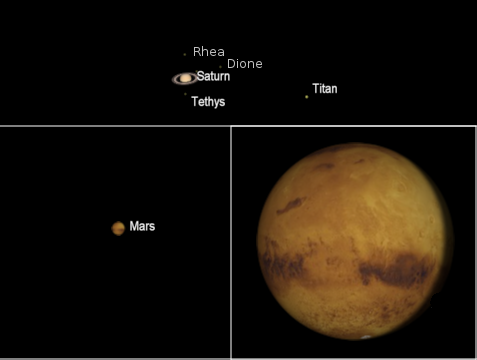
Saturn and Mars with the same magnification with an inset of Mars at higher magnification at 5 a.m. June 21, 2018. Created using Cartes du Ciel (Sky Charts).
Note on the inset image. The south polar cap is probably larger than shown. Also with the dust storm in progress the dark features may be obscured. The dust storm clouds appear brighter than the normal surface of the planet.
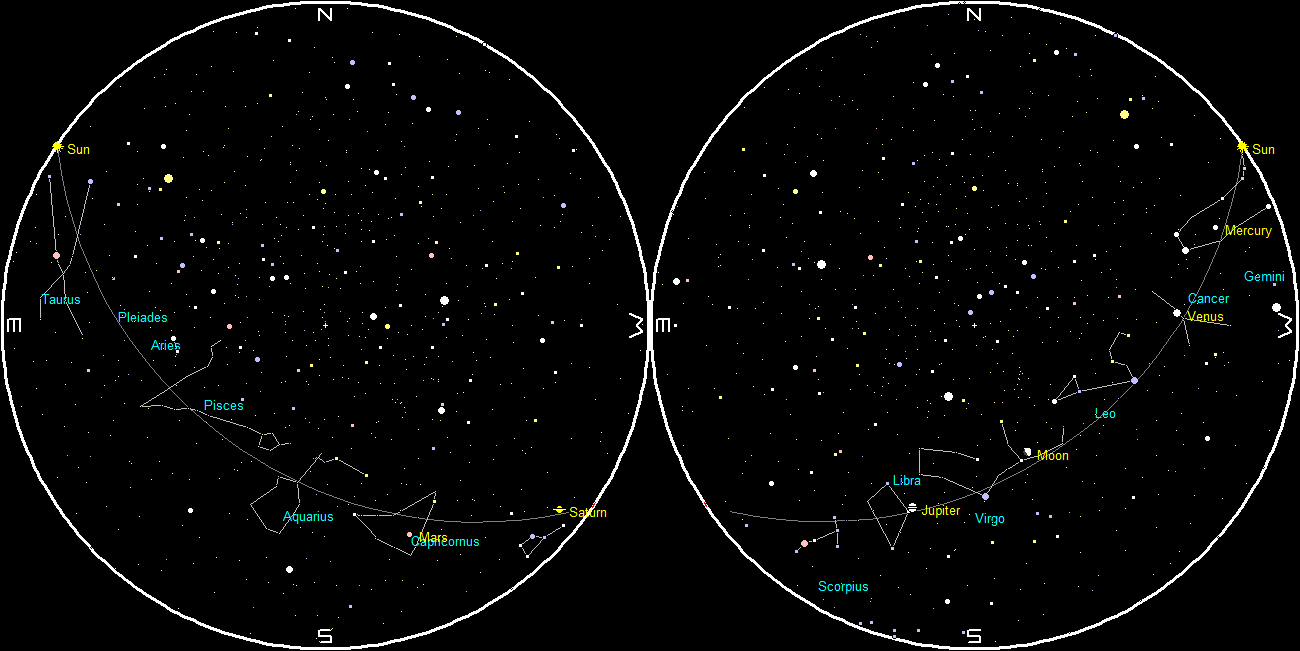
Planets and the Moon at sunset and sunrise of a single night starting with sunset on the right on June 20, 2018. The night ends on the left with sunrise on the 21st. Click on the image to enlarge. Created using my LookingUp program.
05/02/2018 – Ephemeris – We’re taking our weekly look at the bright planets
Ephemeris for Wednesday, May 2nd. The Sun rises at 6:31. It’ll be up for 14 hours and 17 minutes, setting at 8:49. The Moon, 3 days past full, will rise at 11:31 this evening.
It’s Wednesday again and time to look for the bright planets. One bright planet is in the evening sky, the brightest, Venus. It will be visible low in the western twilight from about 9:10 p.m. until it sets at 11:15. The star Aldebaran will be seen below and left of Venus tonight. Jupiter will rise this evening at 9:11 p.m. That doesn’t make it an evening planet. It has to rise before sunset to be an evening planet, which it will be next Wednesday. Saturn will rise at 1:09 a.m., while Mars will rise at 2:18 a.m.
At 5:30 tomorrow morning these three planets will be strung across the southern sky. Bright Jupiter will be in the southwest, dimmer Mars and Saturn will be in the south, with Mars to the left of Saturn with the Moon between Jupiter and Saturn.
The times given are for the Traverse City/Interlochen area of Michigan. They may be different for your location.
Addendum
Venus in evening twilight at 9:15 p.m, tonight May 2, 2018. Click on the image to enlarge. Created using Stellarium.
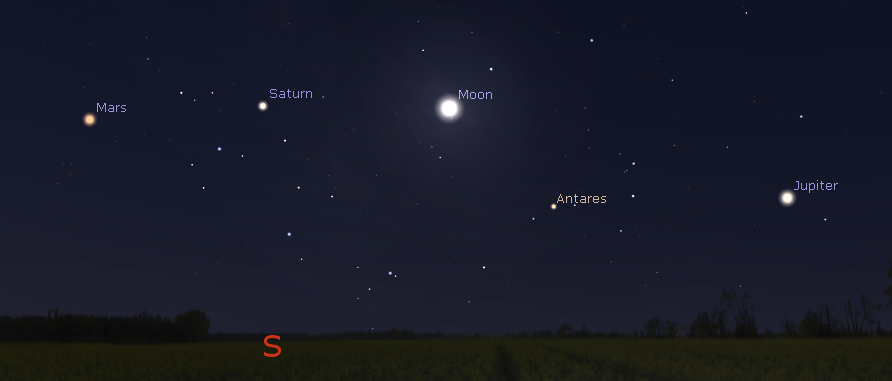
The morning planets at 5:30 a.m. May 3, 2018. Click on the image to enlarge. Created using Stellarium.
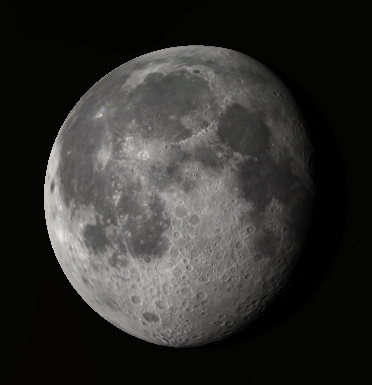
The waning gibbous Moon at 5:30 a.m. May 3, 2018. Created using Stellarium.
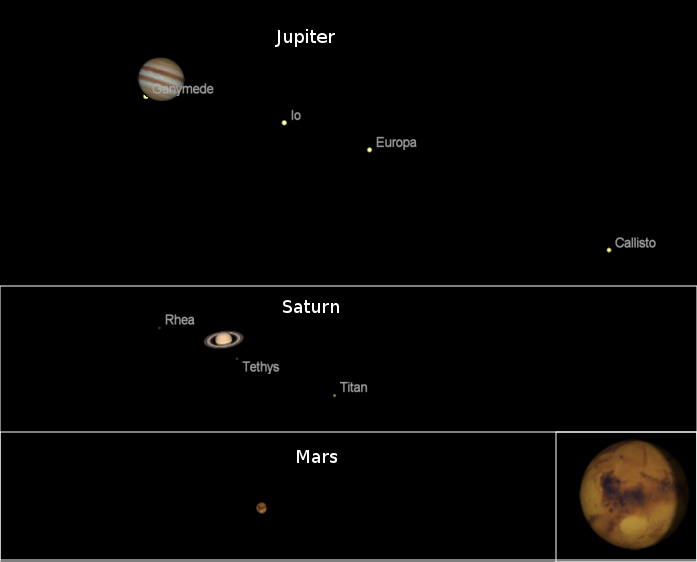
The morning planets as seen in a telescope using the same magnification at 5:30 a.m. May 3, 2018. A magnified image of Mars is inset showing some of the features that may be visible under higher magnification. Created using Cartes du Ciel (Sky Charts).
Planets and the Moon at sunset and sunrise of a single night starting with sunset on the right on May 2, 2018. The night ends on the left with sunrise on the 3rd. Click on the image to enlarge. Created using my LookingUp program.
04/11/2018 – Ephemeris – Looking at the bright planets for this week
Ephemeris for Wednesday, April 11th. The Sun will rise at 7:05. It’ll be up for 13 hours and 17 minutes, setting at 8:22. The Moon, 3 days past last quarter, will rise at 5:45 tomorrow morning.
It’s Wednesday again and time to look for the bright planets. One bright planet is in the evening sky, the brightest, Venus. It will be visible low in the Western twilight from about 8:40 p.m. until it sets at 10:20. Venus is blindingly bright in binoculars or a small telescope. Jupiter will rise late this evening at 10:45 p.m. That doesn’t make it an evening planet. It has to rise before sunset to be an evening planet. Saturn will rise at 2:32 a.m., while Mars will rise at 3 a.m. At 6 tomorrow morning these three planets will be strung across the southern sky. Bright Jupiter will be in the southwest, dimmer Mars and Saturn will be in the south-southeast, with Mars below-left of Saturn.
The times given are for the Traverse City/Interlochen area of Michigan. They may be different for your location.
Addendum
Venus in evening twilight at 9 p.m, tonight April 11, 2018. Click on the image to enlarge. Created using Stellarium.
The morning planets at 6 a.m. April 12, 2018. Click on the image to enlarge. Created using Stellarium.
The morning planets Jupiter and Saturn as seen by a telescope using the same magnification for both at 6 a.m. April 12, 2018. a.m. Created using Cartes du Ciel (Sky Charts).
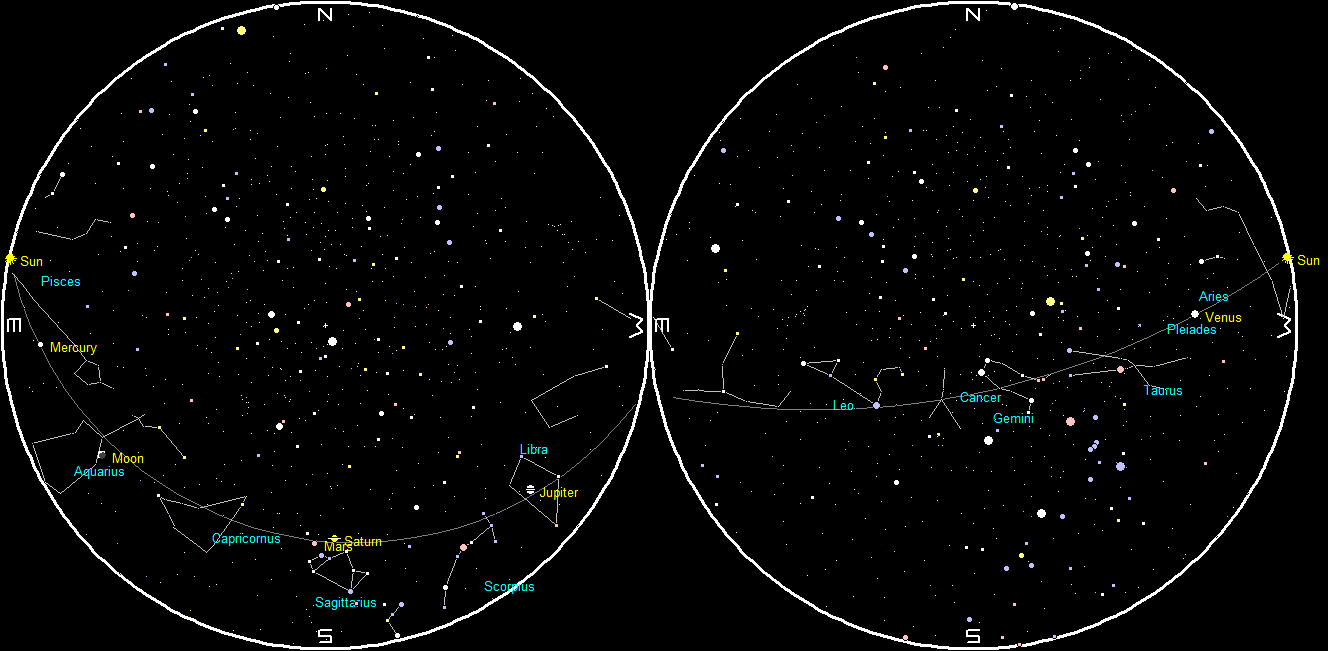
Planets and the Moon at sunset and sunrise of a single night starting with sunset on the right on April 11, 2018. The night ends on the left with sunrise on the 12th. Click on the image to enlarge. Created using my LookingUp program.
03/28/2018 – Ephemeris – Four bright planets are visible
Ephemeris for Wednesday, March 28th. The Sun will rise at 7:31. It’ll be up for 12 hours and 34 minutes, setting at 8:05. The Moon, 3 days before full, will set at 6:49 tomorrow morning.
Let’s take our weekly look at the bright planets. We’re down to 4 the naked eye planets are visible now. One is in the evening sky. Venus will be visible low in the Western twilight from about 8:30 p.m. until before it sets at 9:43. Mercury is heading between the Earth and the Sun, not directly but will enter the morning sky Sunday. It’s morning appearance later next month will not be a good one for us in the northern hemisphere. Late this evening Jupiter will rise at 11:46. Mars will rise at 3:23 a.m. Saturn will end the procession, rising 3 minutes later. At 6 tomorrow morning these three planets will be strung across the southern sky. Bright Jupiter will be in the south-southwest, dimmer Mars will be in the south-southeast, just right of and a bit below Saturn.
The times given are for the Traverse City/Interlochen area of Michigan. They may be different for your location.
Addendum
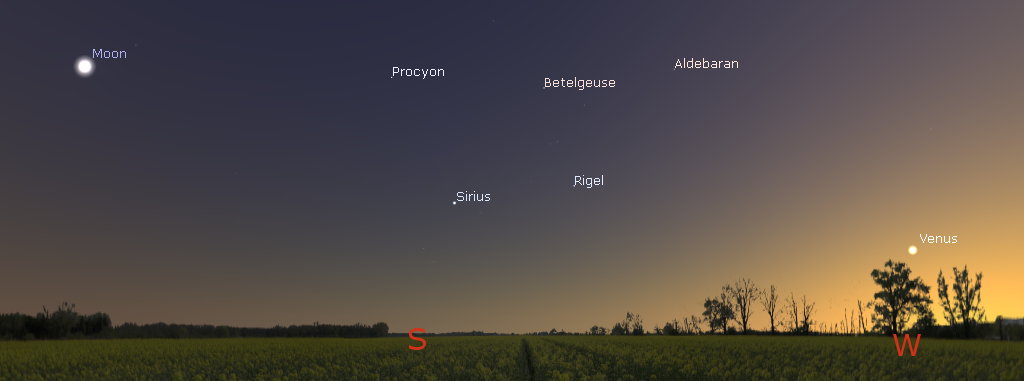
Venus, the bright winter stars and the Moon at 8:30 p.m. tonight March 28, 2018. Click on the image to enlarge. Created using Stellarium.
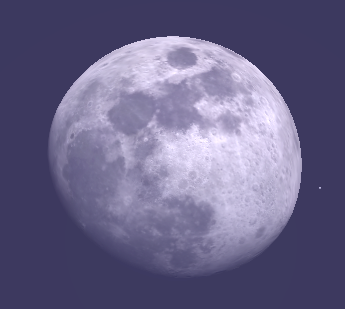
The Gibbous Moon tonight at 8:30 p.m., March 28, 2018. Created using Stellarium.
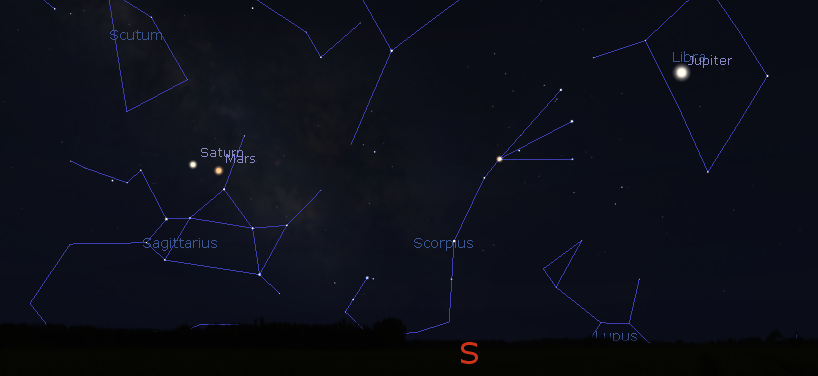
The morning planets and constellations at 6 a.m. March 29, 2018. Click on the image to enlarge. Created using Stellarium
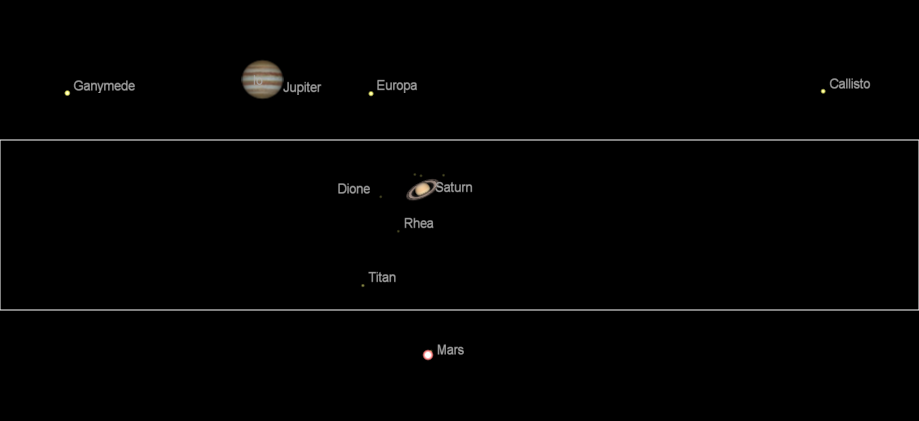
The morning planets as seen by a telescope using the same magnification for all at 6 a.m. March 29, 2018. At 6 a.m. Jupiter’s moon Io is behind the planet. See the table below for Io events in the morning. Click on the image to enlarge. Created using Cartes du Ciel (Sky Charts).
Moon  Event            Date        Time      Local Time
Io:   Eclipse start:   29 Mar 2018  7:10 UT  3:10 a.m. EDT
Io:   Occultation end: 29 Mar 2018 10:11 UT  6:11 a.m. EDT
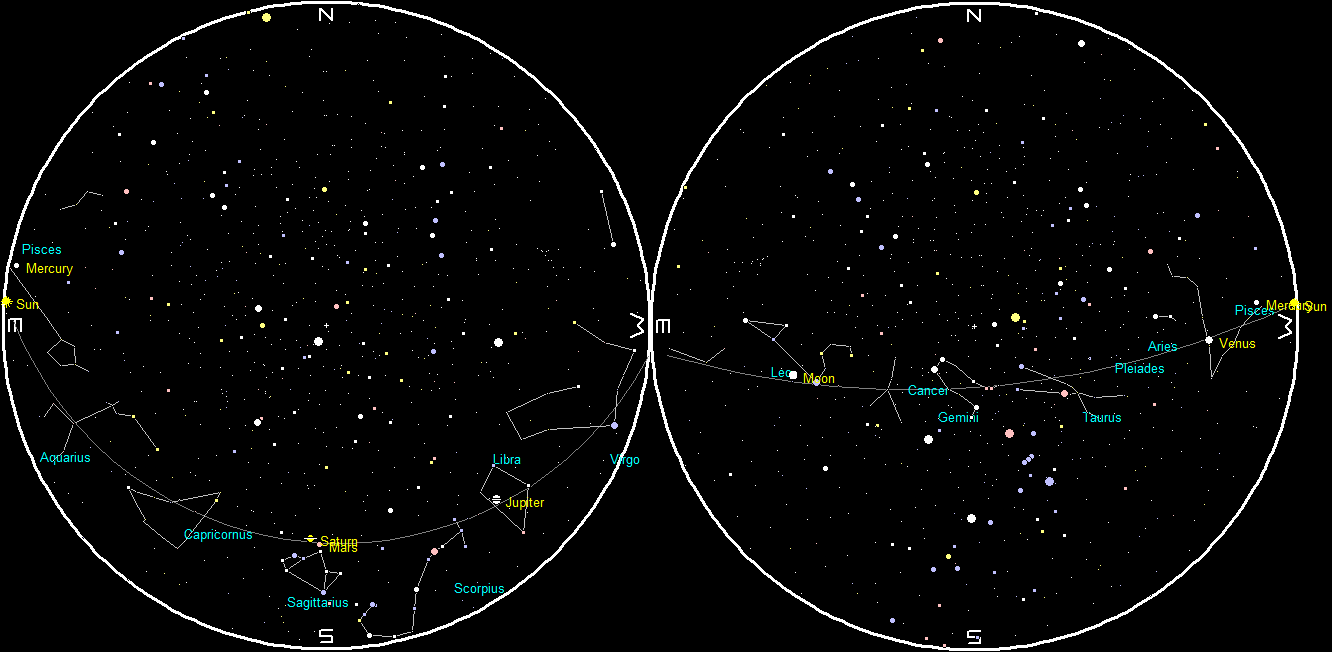
Planets and the Moon at sunset and sunrise of a single night starting with sunset on the right on March 28, 2018. The night ends on the left with sunrise on the 29th. Click on the image to enlarge. Created using my LookingUp program.
03/21/2018 – Ephemeris – The bright planets this week
Ephemeris for Wednesday, March 21st. The Sun will rise at 7:44. It’ll be up for 12 hours and 12 minutes, setting at 7:56. The Moon, 3 days before first quarter, will set at 12:39 tomorrow morning.
Let’s take our weekly look at the bright planets. All 5 of the naked eye planets are visible now. Two of them are in the evening sky, but very close to the Sun. Venus will be visible low in the Western twilight from about 8:10 p.m. until before it sets at 9:26. Mercury is much dimmer but at the same height and to the right of Venus, tonight by about 8 Moon widths. Mercury is dimming rapidly. In the morning Jupiter will rise at 12:20. Mars will rise at 3:33. Saturn will end the procession, rising at 3:53 a.m. At 7 tomorrow morning these three planets will be strung across the southern sky. Bright Jupiter will be in the southwest, dimmer Mars will be in the south. Saturn will be in the south-southeast.
The times given are for the Traverse City/Interlochen area of Michigan. They may be different for your location.
Addendum
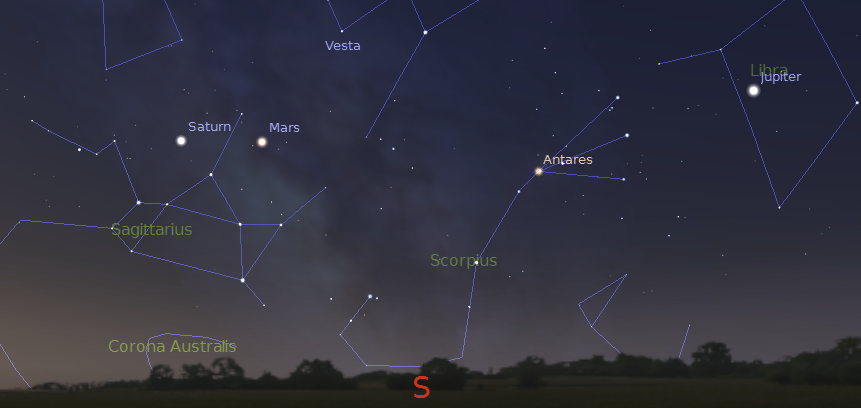
The morning planets of Jupiter, Mars and Saturn seen at 7 a.m. EDT this morning March 21, 2018. Click on image to enlarge. Created using Stellarium.
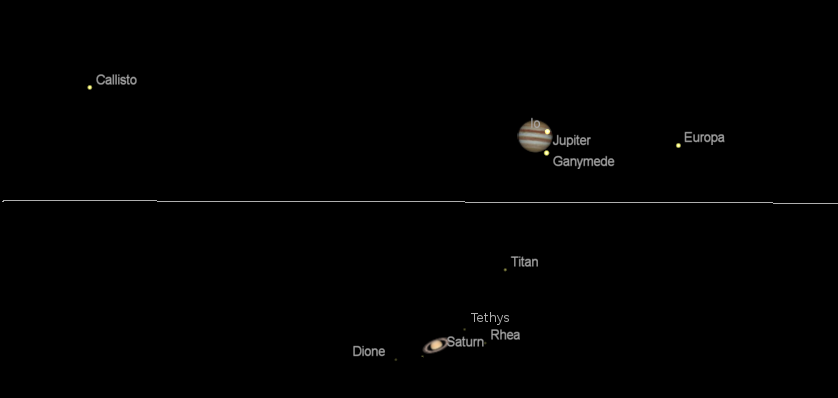
Jupiter and Saturn with their brighter satellites this morning at 7 a.m. March 21, 2018. They are displayed at the same scale. Saturn in about twice as far as Jupiter. Its disk is a bit smaller than Jupiter’s so it appears about half as large. The extent of the rings appear to be about the same as Jupiter’s diameter. Created using Cartes du Ciel (Sky Charts).
Jovian satellite events this morning
Satellite Event              Date       Universal  Local Time
Ganymede: Eclipse start:     21 Mar 2018  7:30 UT  3:30 am EDT
Io      : Shadow start:      21 Mar 2018  8:08 UT  4:08 am EDT
Io      : Transit start:     21 Mar 2018  9:09 UT  5:09 am EDT
Ganymede: Eclipse end :      21 Mar 2018  9:15 UT  5:15 am EDT
Io      : Shadow end :       21 Mar 2018 10:18 UT  6:18 am EDT
Io      : Transit end :      21 Mar 2018 11:17 UT  7:17 am EDT
Ganymede: Occultation start: 21 Mar 2018 11:50 UT  Not visible
Ganymede: Occultation end :  21 Mar 2018 12:54 UT  Not visible
An eclipse is when the moon passes through Jupiter’s shadow.
An occultation is when the moon is hidden behind the planet.
Shadow denotes the projection of a satellite’s shadow on the face of Jupiter.
Transit is the passage of a satellite across the face of Jupiter. It becomes hard to find against the.
Timings are from https://www.projectpluto.com.
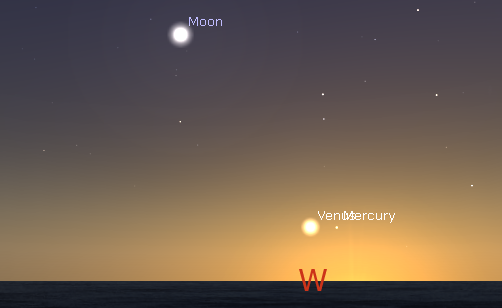
Venus and Mercury, low in the west at 8:30 p.m., March 21, 2018. Created using Stellarium.
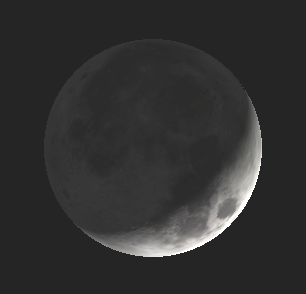
The waxing crescent Moon as it might be seen in binoculars at 9 p.m. tonight. March 21, 2018. Created using Stellarium.
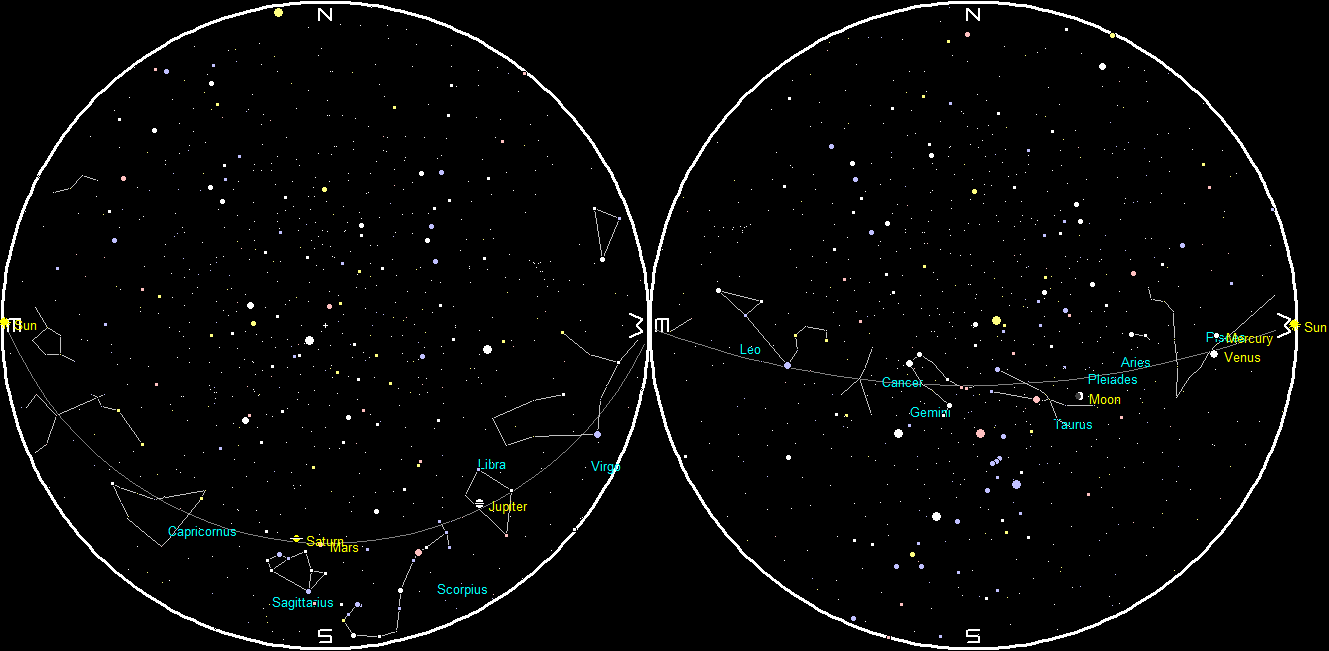
Planets and the Moon at sunset and sunrise of a single night starting with sunset on the right on March 21, 2018. The night ends on the left with sunrise on the 22nd. Click on the image to enlarge. Created using my LookingUp program.
03/16/2018 – Ephemeris – The Moon and evening planets this weekend
Ephemeris for Friday, March 16th. The Sun will rise at 7:53. It’ll be up for 11 hours and 56 minutes, setting at 7:50. The Moon, 1 day before new, will rise at 8:13 tomorrow morning.
The Moon will very close to new this weekend, so the dark skies can be enjoyed after 9:30 in the evening for hard-core dark sky observers. However after 9 p.m. it’s dark enough for most of us. The Moon next week will rapidly push that back as its phase waxes over the next week toward first quarter. About the first appearance of the Moon will be Sunday night when it will be almost in line with Venus and Mercury. Top right will be Mercury, then Venus, then below and left of brilliant Venus will be the thin sliver of the crescent Moon, whose night side will be illuminated by the Earth. It will take binoculars to really appreciate this Earth shine on the Moon. The full Moon this lunation will fall on the 31st with Easter following the next day for western churches.
The times given are for the Traverse City/Interlochen area of Michigan. They may be different for your location.
Addendum
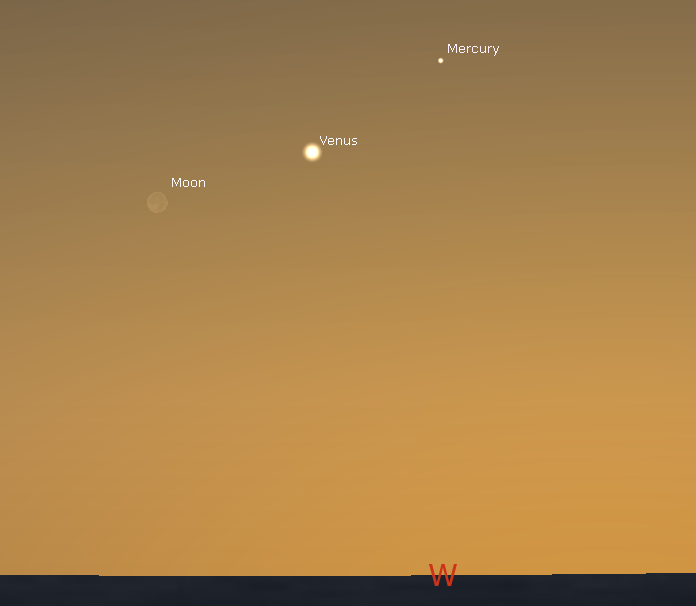
Mercury, Venus, and the Moon at 8:15 p.m. Sunday, March 18, 2018. Created using Stellarium, which was incapable of showing the very thin crescent of the Moon centered at the 5 o’clock limb of the Moon..
03/14/2018 – Ephemeris – A Pi Day look at the bright planets
Ephemeris for Pi Day, Wednesday, March 14th. The Sun will rise at 7:57. It’ll be up for 11 hours and 50 minutes, setting at 7:47. The Moon, 3 days before new, will rise at 7:15 tomorrow morning.
Pi day: the first three digits of the mathematical constant pi is 3-14. Let’s take our weekly look at the bright planets. All 5 of the naked eye planets are visible now. Three of them are visible this morning. Before it gets light Jupiter will be in the west-southwest, with Mars in the south and Saturn a bit left of the red planet. Jupiter will rise at 12:44 tomorrow morning. Mars will rise at 3:42. And Saturn will rise at 4:19 a.m. In the evening sky Venus will be visible low in the western twilight from about 8:15 p.m. until before it sets at 9:06. Mercury is much dimmer but above and a bit right of Venus, tonight about 8 Moon widths at 1 o’clock from Venus. It will set at 9:26. Mercury will appear higher than Venus in the sky for 6 more nights.
The times given are for the Traverse City/Interlochen area of Michigan. They may be different for your location.
Addendum
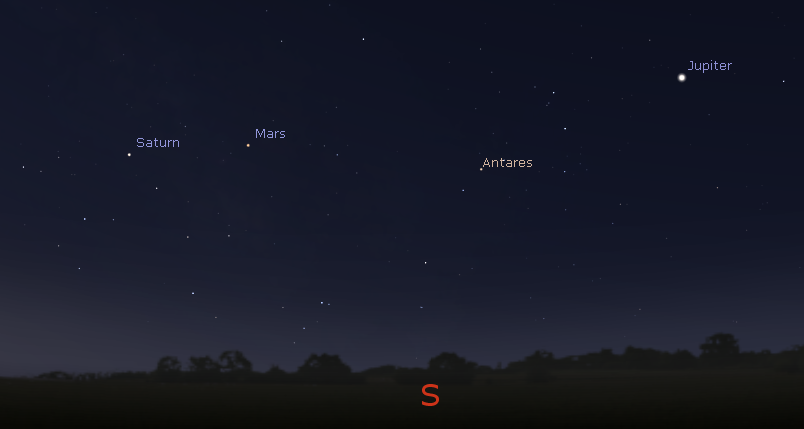
The morning planets of Jupiter, Mars and Saturn plus the Moon. Seen at 7 a.m. EDT this morning March 14, 2018. Click on image to enlarge. Created using Stellarium.
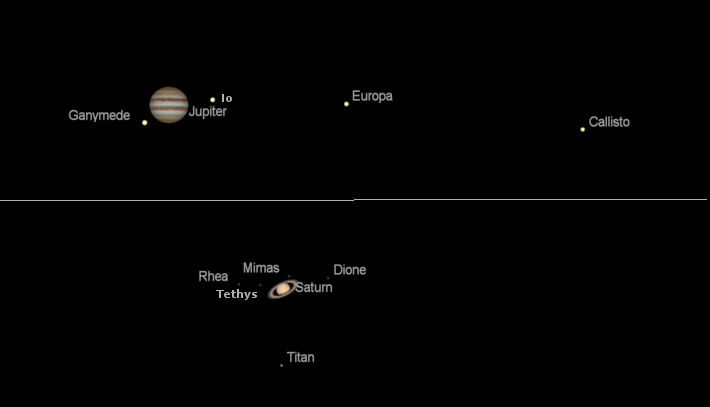
Jupiter and Saturn with their brighter satellites tomorrow morning at 6 a.m. March 8, 2018. They are displayed at the same scale. Saturn in about twice as far as Jupiter. Its disk is a bit smaller than Jupiter’s so it appears about half as large. The extent of the rings appear to be about the same as Jupiter’s diameter. Created using Cartes du Ciel (Sky Charts).

Venus and Mercury, low in the west at 8:15 p.m., March 14, 2018. Created using Stellarium.
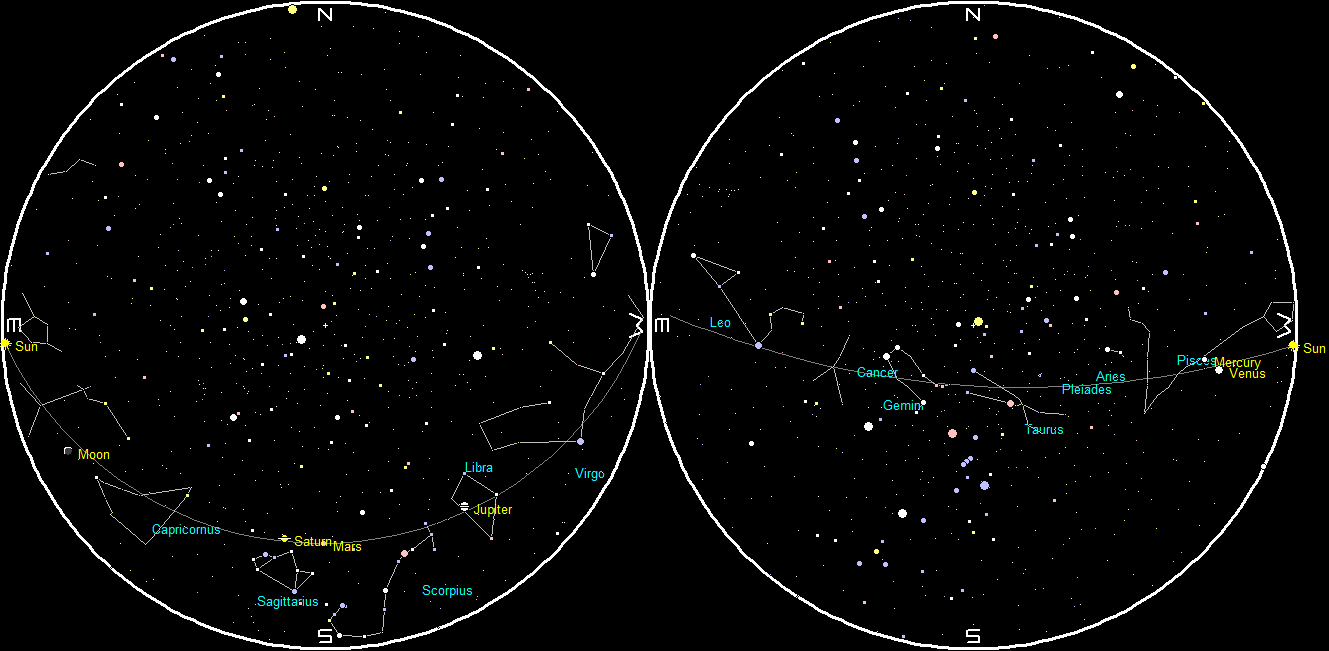
Planets at sunset and sunrise of a single night starting with sunset on the right on March 14, 2018. The night ends on the left with sunrise on the 15th. Click on the image to enlarge. Created using my LookingUp program.
03/07/2018 – Ephemeris – All 5 naked eye planets are now visible
Ephemeris for Wednesday, March 7th. The Sun will rise at 7:09. It’ll be up for 11 hours and 28 minutes, setting at 6:38. The Moon, 2 days before last quarter, will rise at 12:58 tomorrow morning.
Let’s take our weekly look at the bright planets. All 5 of the naked eye planets are visible now. Two of them are in the evening sky, but very close to the Sun. Venus will be visible low in the Western twilight from about 7 p.m. until before it sets at 7:47. Mercury is much dimmer but above and a bit right of Venus, tonight about 5 Moon widths at 1 o’clock from Venus. It will set at 7:59. Mercury will appear higher than Venus in the sky until about March 20th. In the morning Jupiter will rise at 12:12 tomorrow morning. Mars will rise at 2:51. Saturn will end the procession, rising at 3:45 a.m. At 6 tomorrow morning bright Jupiter will be in the south to the left of it is dimmer Mars. Saturn is low in the southeast.
The times given are for the Traverse City/Interlochen area of Michigan. They may be different for your location.
Addendum
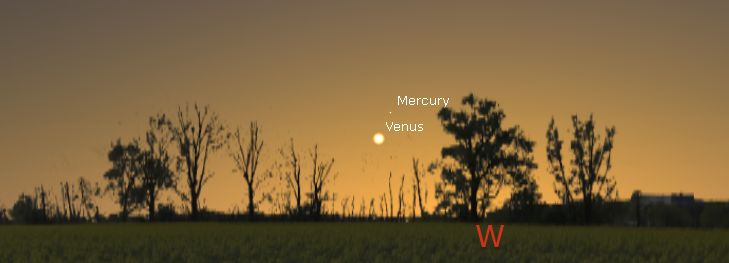
Venus and Mercury, low in the west at 7 p.m., March 7, 2018. Created using Stellarium.
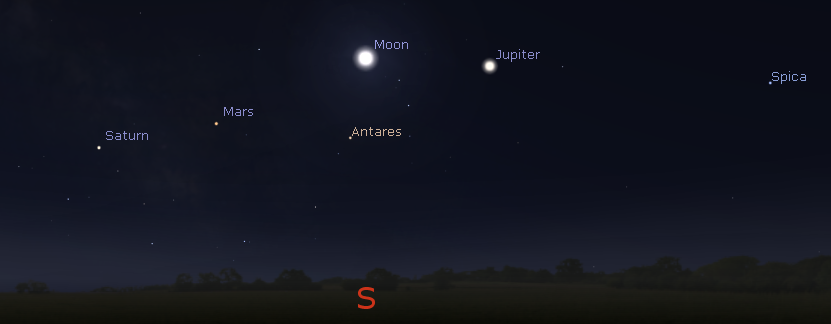
The morning planets of Jupiter, Mars and Saturn plus the Moon. Seen at 6 a.m. tomorrow morning March 8, 2018. Click on image to enlarge. Created using Stellarium.
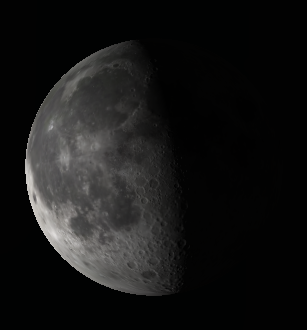
The waning gibbous Moon as it might be seen in binoculars at 6 a.m. tomorrow morning, March 8, 2018. Created using Stellarium.
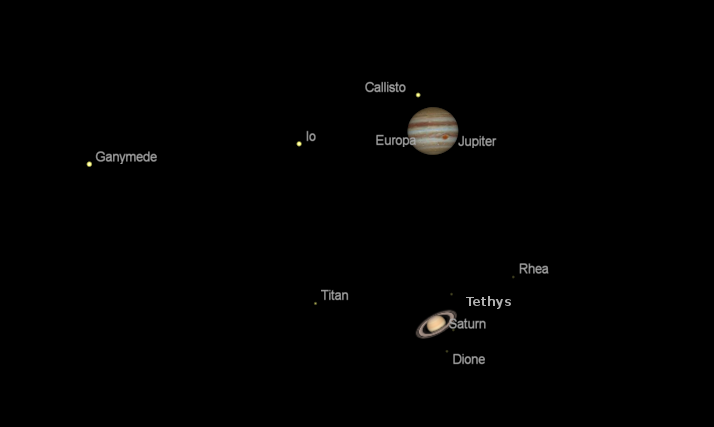
Jupiter and Saturn with their brighter satellites tomorrow morning at 6 a.m. March 8, 2018. They are displayed at the same scale. Saturn in about twice as far as Jupiter. Its disk is a bit smaller than Jupiter’s so it appears about half as large. The extent of the rings appear to be about the same as Jupiter’s diameter. Created using Cartes du Ciel (Sky Charts).
The Great Red Spot should be visible on Jupiter.
Europa is labeled but unseen at 6 a.m. EST
Here is what’s happening
Moon    Event              Date        UT       Local time
Europa: Eclipse start:     8 Mar 2018  7:12 UT  2:12 a.m. EST
Europa: Eclipse end:       8 Mar 2018  9:28 UT  4:28 a.m. EST
Europa: Occultation start: 8 Mar 2018  9:34 UT  4:34 a.m. EST
Europa: Occultation end:   8 Mar 2018 11:43 UT  6:43 a.m. EST
An eclipse is when the moon passes through Jupiter’s shadow. An occultation is when the moon is hidden behind the planet.
Note the 6 minutes between the end of the eclipse and the start of the occultation.
Timings are from https://www.projectpluto.com.
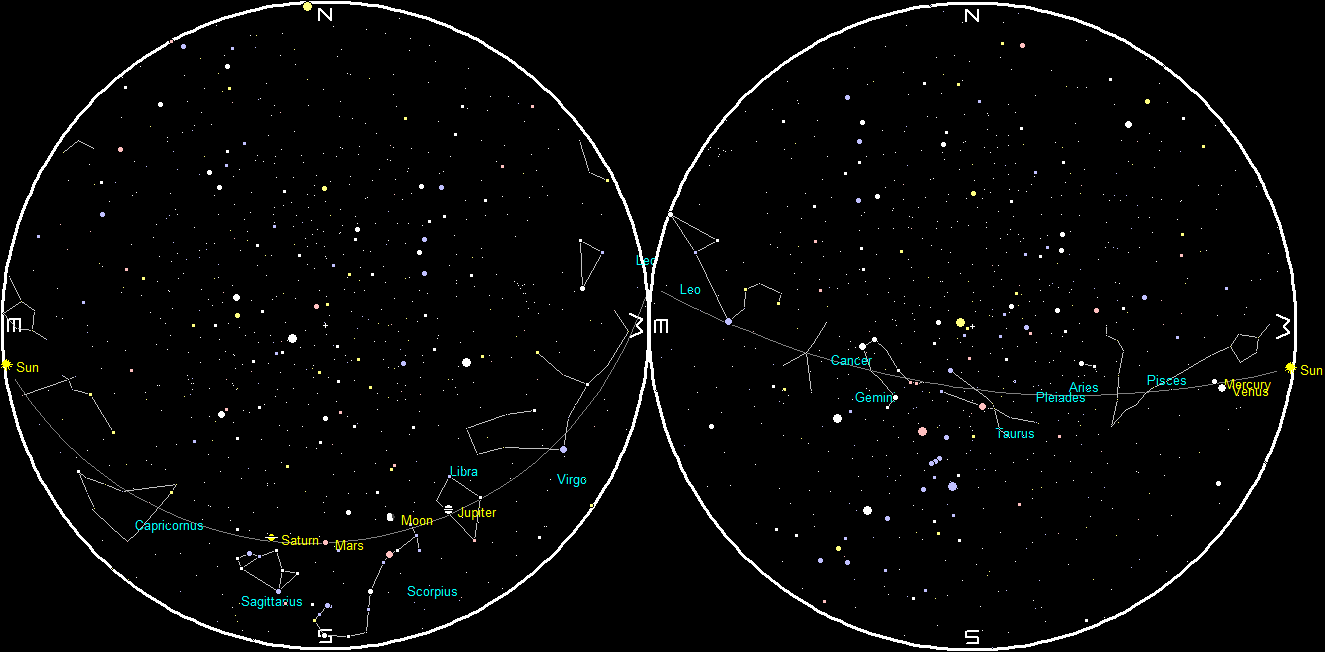
Planets at sunset and sunrise of a single night starting with sunset on the right on March 7, 2018. The night ends on the left with sunrise on the 8th. Click on the image to enlarge. Created using my LookingUp program.
03/06/2018 – Ephemeris – The Moon will pass the morning planets for the rest of the week
Ephemeris for Tuesday, March 6th. The Sun will rise at 7:11. It’ll be up for 11 hours and 25 minutes, setting at 6:37. The Moon, 3 days before last quarter, will rise at 11:57 this evening.
From tomorrow morning through the rest of the week the Moon will be passing above the morning planets one by one. Tomorrow morning the waning gibbous Moon will appear above and left of Jupiter the brightest of the morning planets in the south at 6 a.m. By Friday morning the then last quarter Moon will be approaching Mars and will be to the right and above the red planet. Saturday morning the then waning crescent Moon will appear above and right between Mars and Saturn. Sunday morning the waning crescent Moon will be left of Saturn. I love waning crescent Moons in morning twilight. In a couple of weeks, on the evening of the 19th to be exact the waxing crescent moon will pass Venus and Mercury.
The times given are for the Traverse City/Interlochen area of Michigan. They may be different for your location.
Addendum
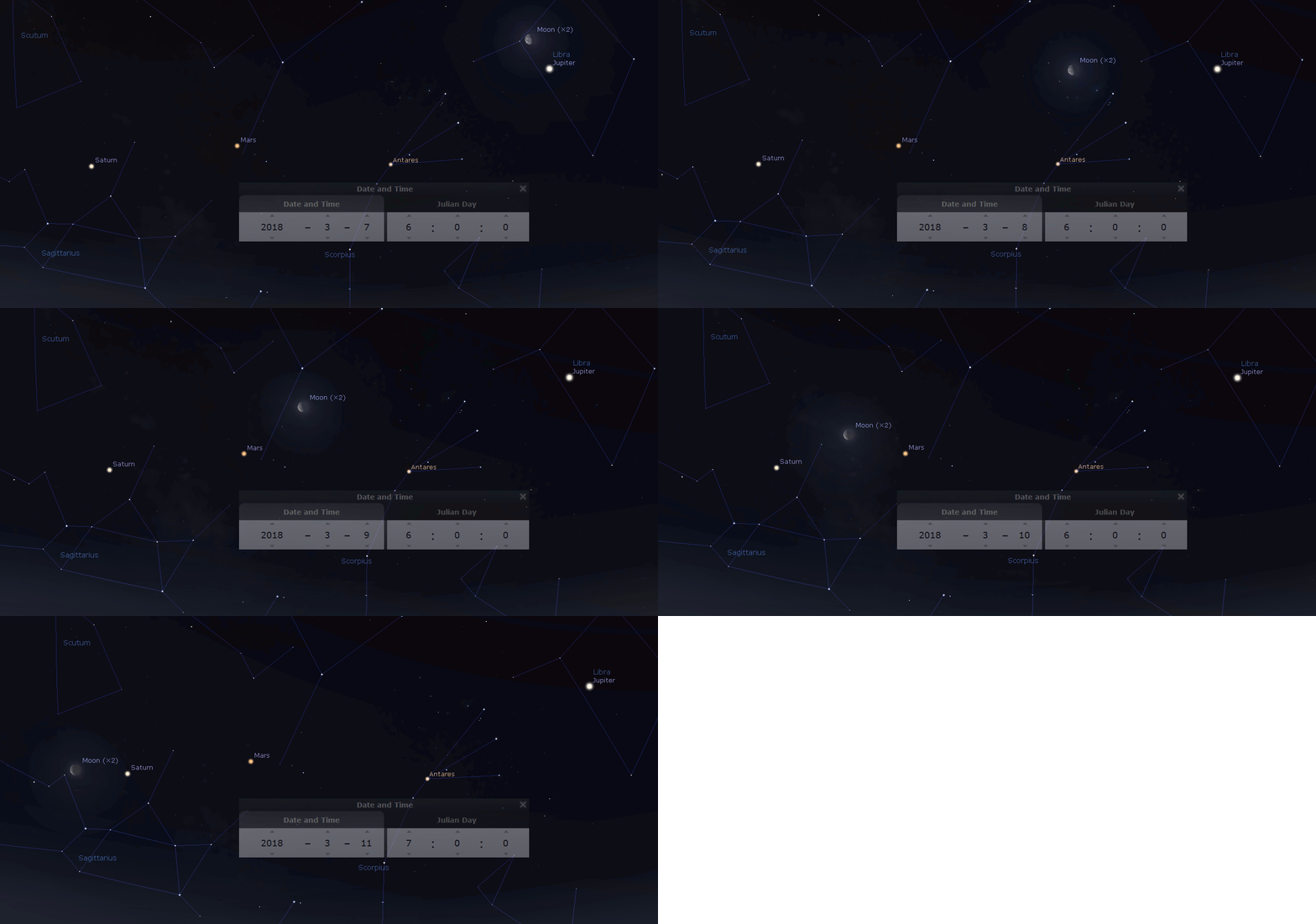
The Moon and morning planets at 6 a.m. each morning Wednesday through Sunday March 7-11, 2018. The Moon’s size has been doubled to show its phase. Note that due to Earth’s revolution of the Sun, that the sky will rotate about one degree westward per day. Click on the image to enlarge. Created using Stellarium and GIMP.

