Archive

Posts Tagged ‘Moon’

Ephemeris: 07/03/2024 – Where have the naked-eye planets wandered off to this week?

July 3, 2024 Comments off

This is Ephemeris for Wednesday, July 3rd. Today the Sun will be up for 15 hours and 28 minutes, setting at 9:31, and it will rise tomorrow at 6:03. The Moon, 2 days before new, will rise at 4:13 tomorrow morning.

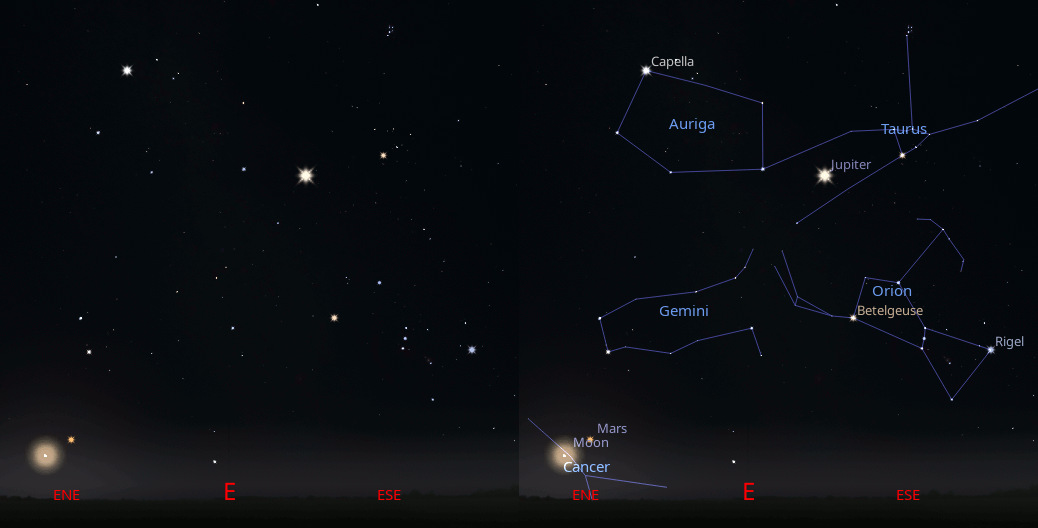
Let’s find out where the naked-eye planets have wandered off to this week,. Venus is too close to the direction of the Sun to be seen. Mercury just might be seen very low in the west-northwest by 10 pm or so. Venus will appear in the evening sky next month. By 5:15 tomorrow morning, or about 45 minutes before sunrise, Saturn will be in the south-southeast and Mars will be lower in the east, and Jupiter will be low in the east-northeast. The skinny waning crescent Moon may be seen halfway between Jupiter and the northeastern horizon. Saturn will be a bit dimmer this year and next due to its rings being nearly edge on to us and not reflecting as much light. Saturn will rise at 12:40 am, Mars at 2:48 am, and Jupiter at 3:51 am.

The astronomical event times given are for the Traverse City/Interlochen area of Michigan (EDT, UT–4 hours). They may be different for your location.

Addendum

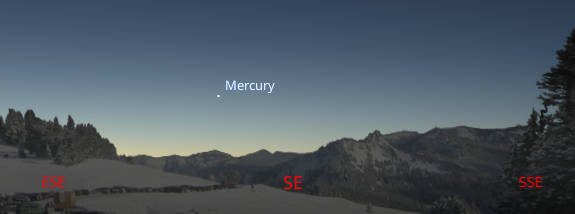
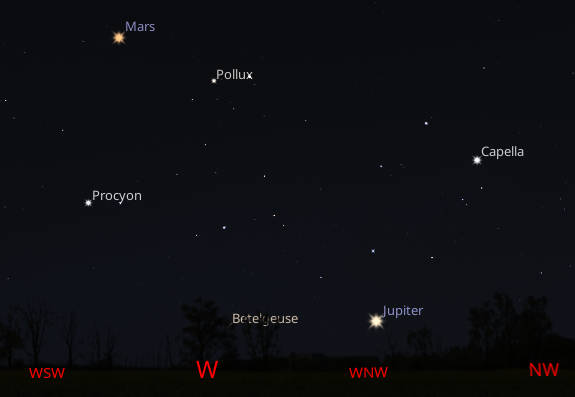
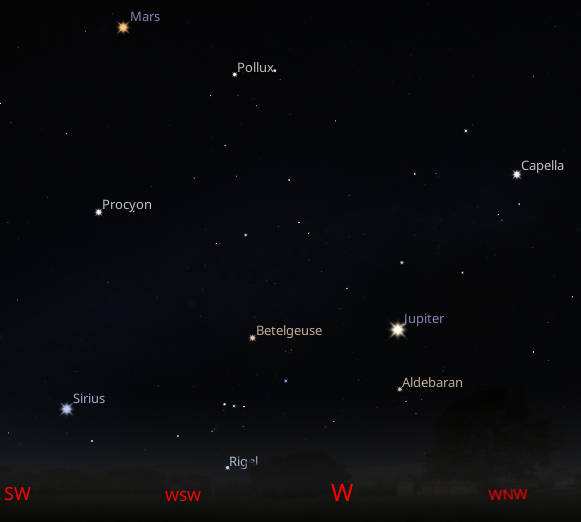
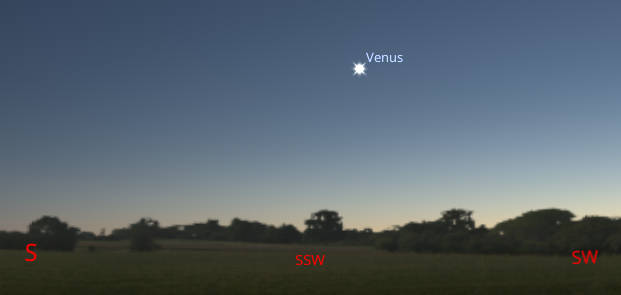
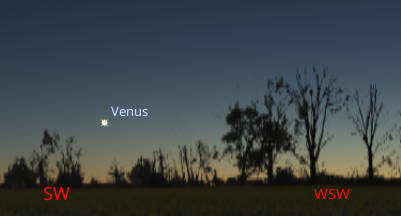
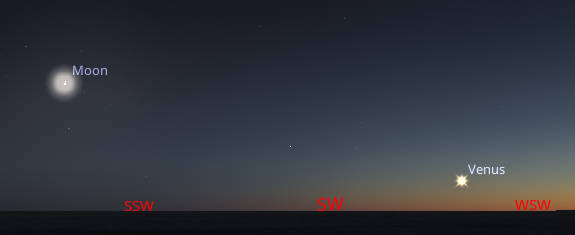
Mercury and Venus in the evening sky 1/2 an hour after sunset or 10 PM according to Stellarium . Spotting Mercury will be a real challenge and probably require binoculars. This is not a good elongation of Mercury for observers in the northern hemisphere so don’t worry if you can’t spot it. Venus, basically, is too close to the horizon to be spotted. Created using Stellarium.
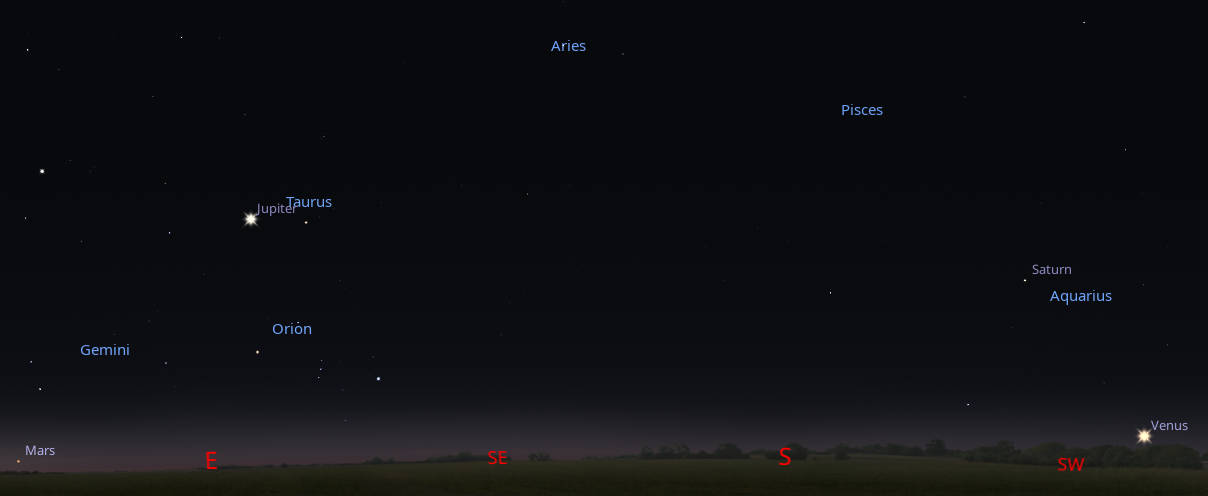
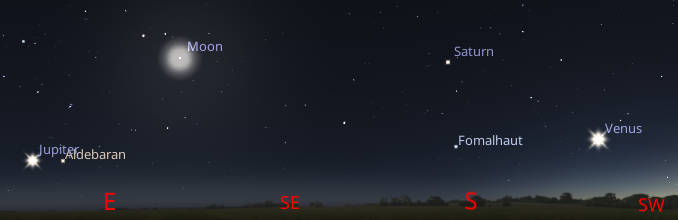
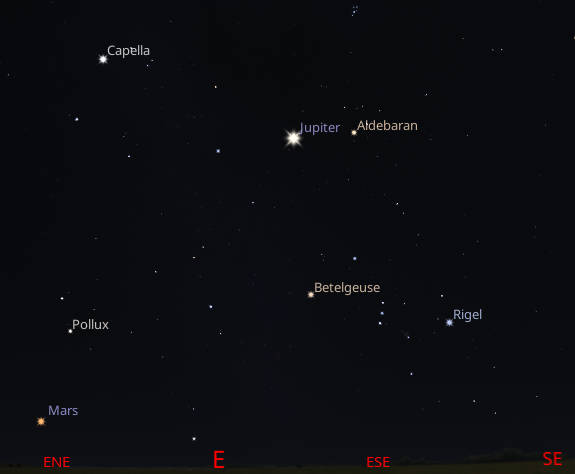
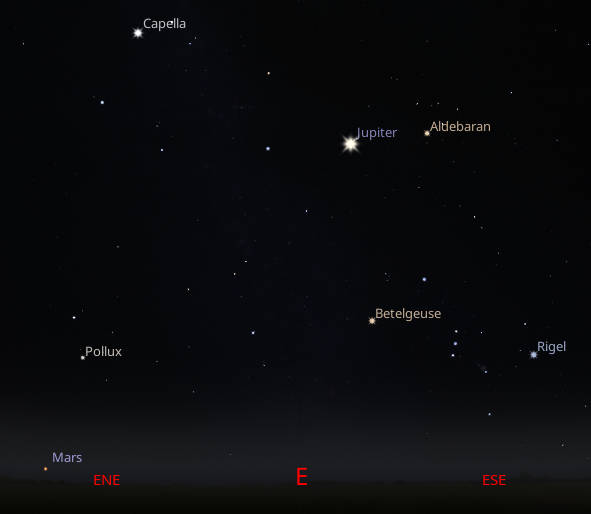
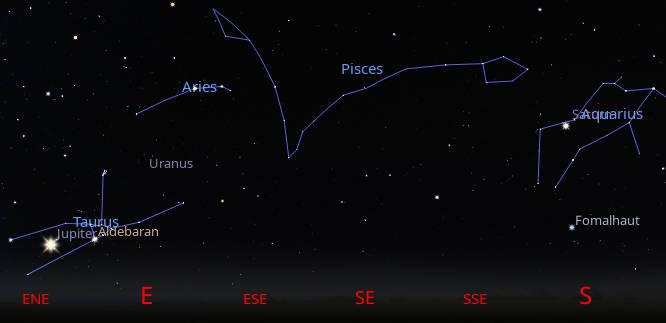
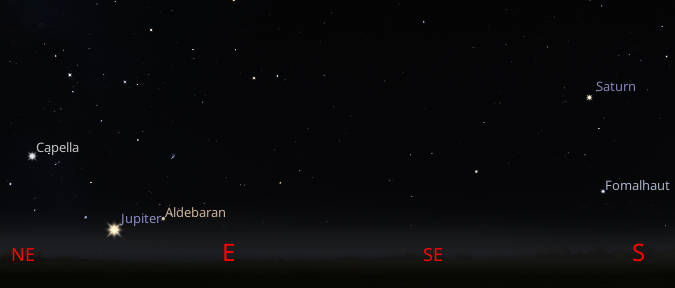
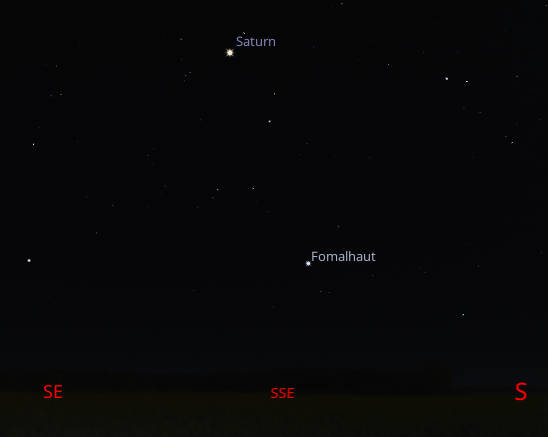
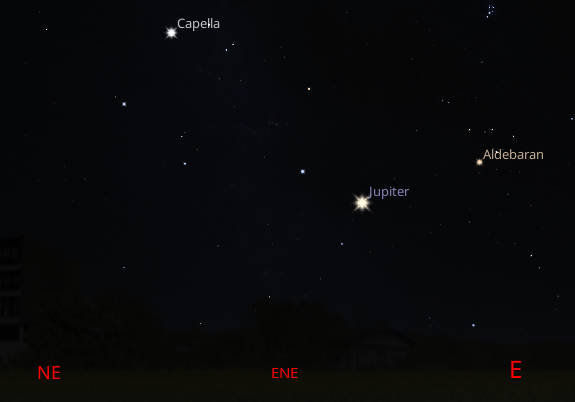
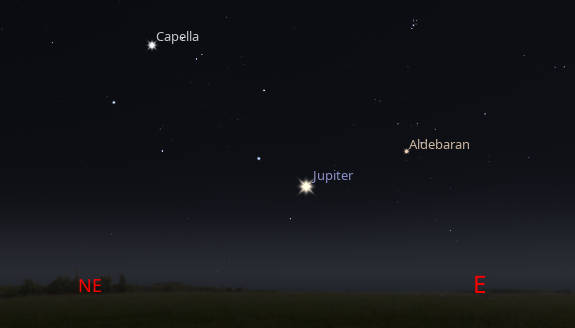
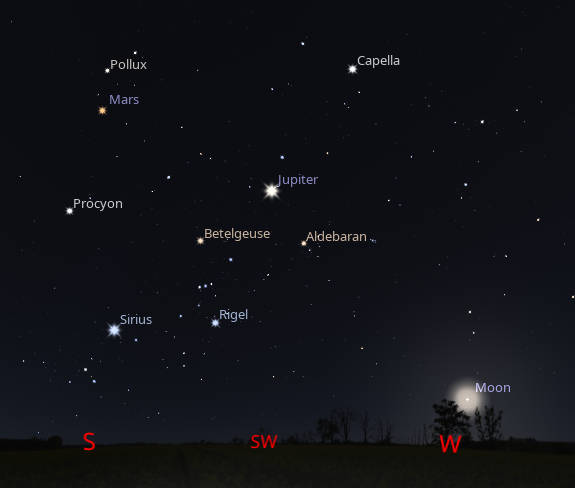
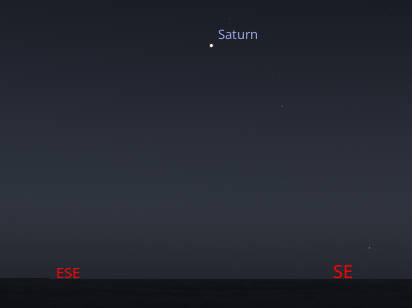
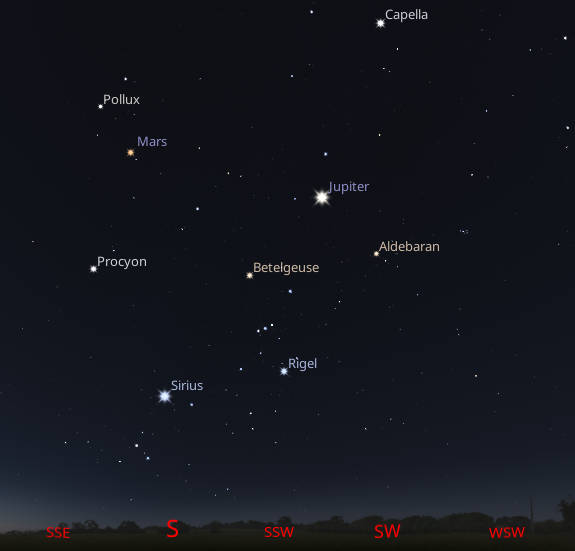
The morning planets and the Moon are spread out from the east-northeast to the south in the morning sky at 5:15 AM, or about 45 minutes before sunrise, July 4, 2024. Also visible is the bright star Capella. Created using Stellarium.
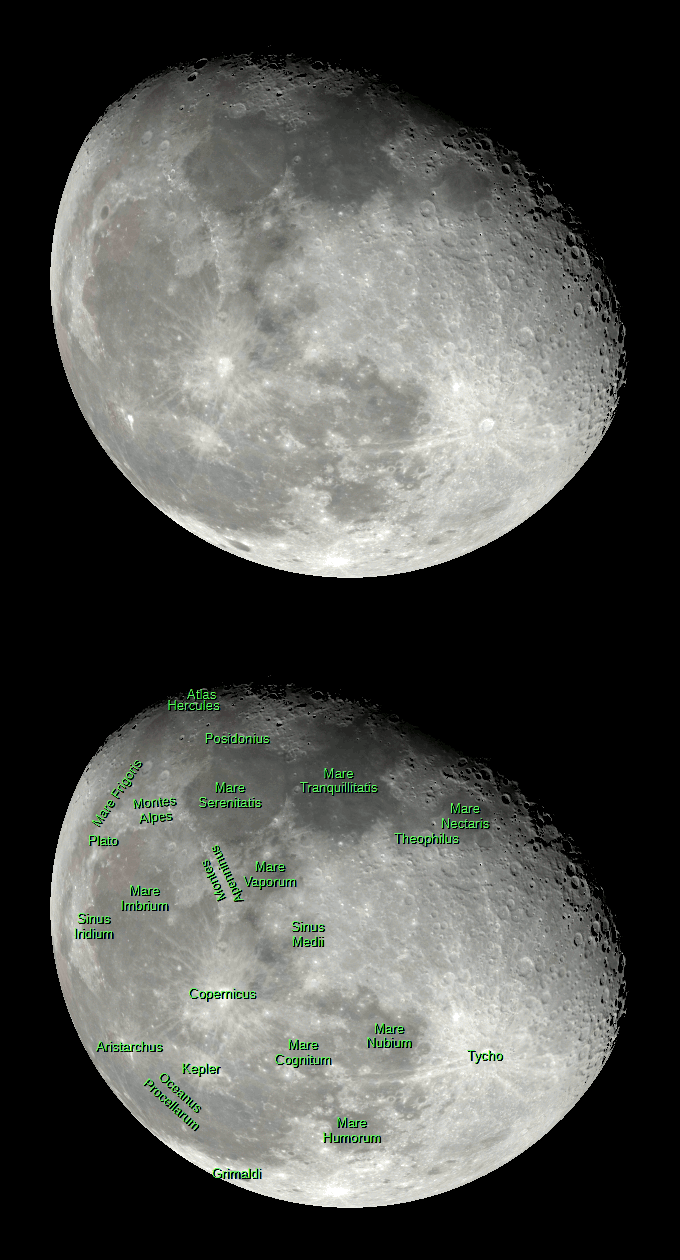
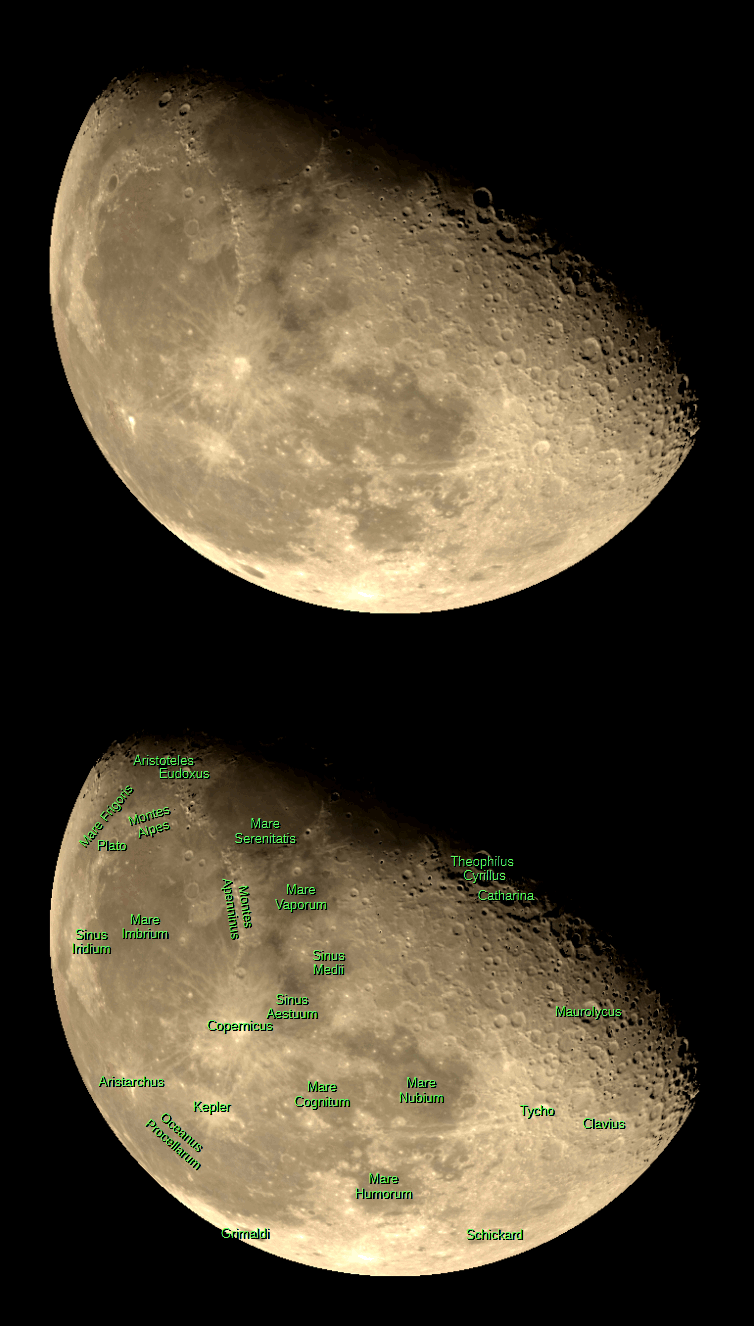
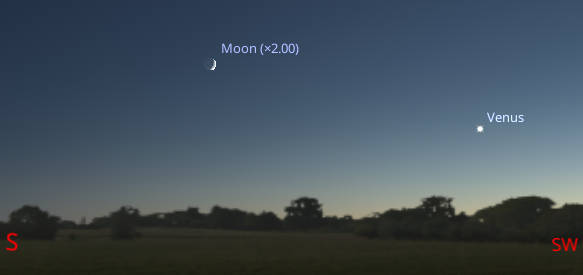
This is the Moon according to Stellarium a day before new as it might appear tomorrow morning, July 4th 2024. The night side of the Moon will appear to be illuminated by earthshine, the reflection of the Sun’s light from off the Earth in the Moon’s sky. Created using Stellarium.
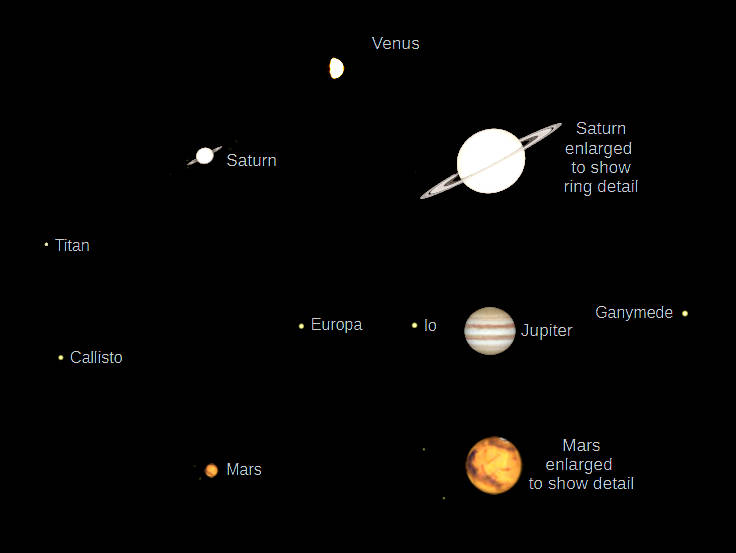
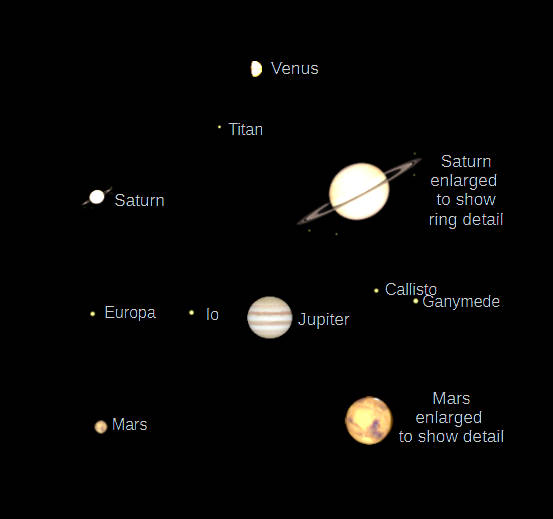
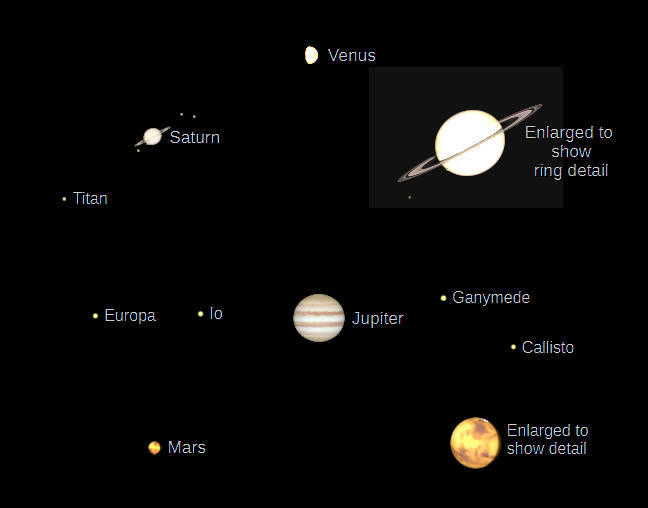
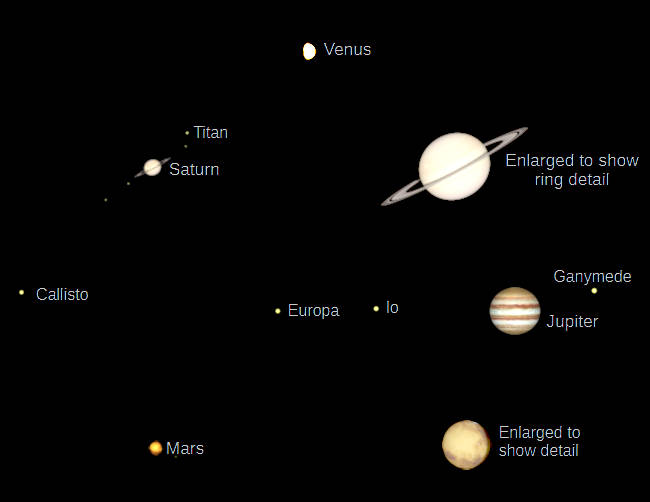
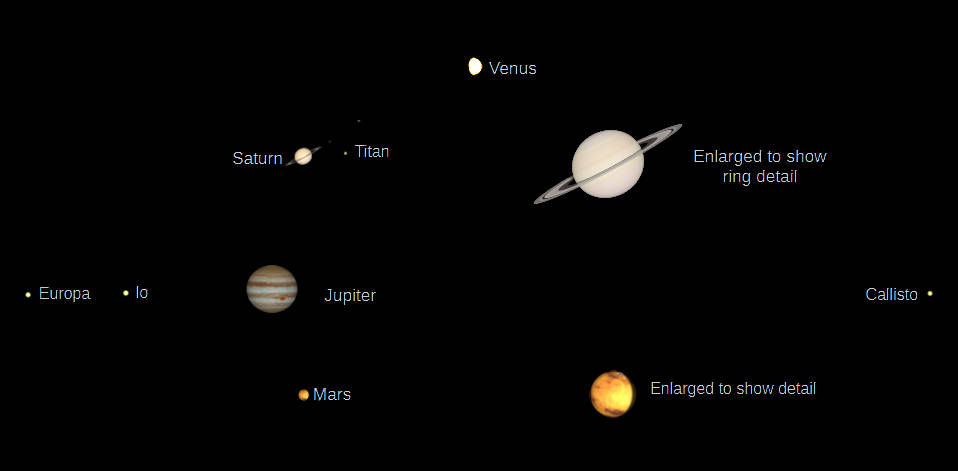
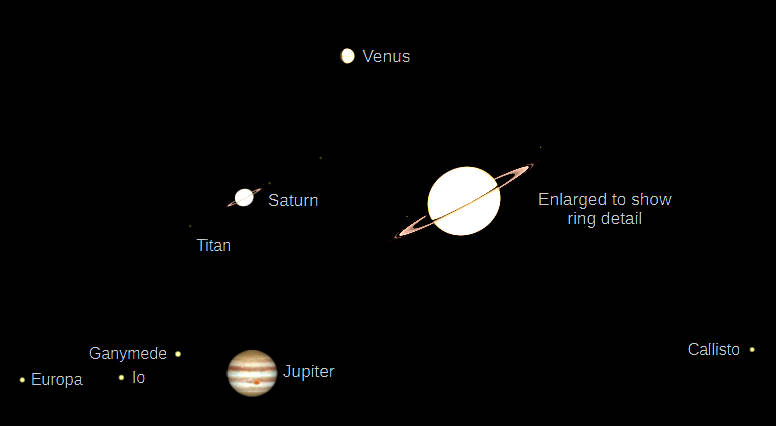
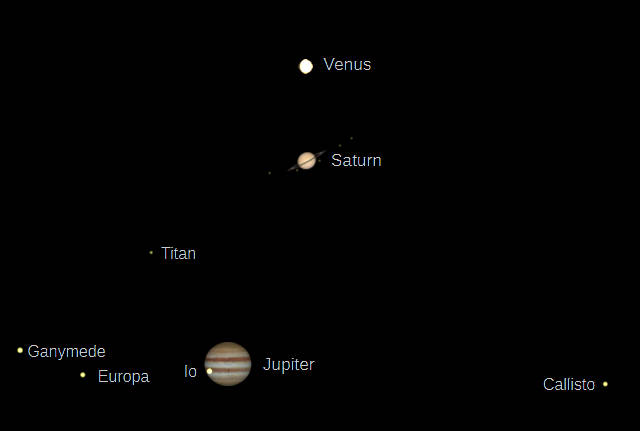
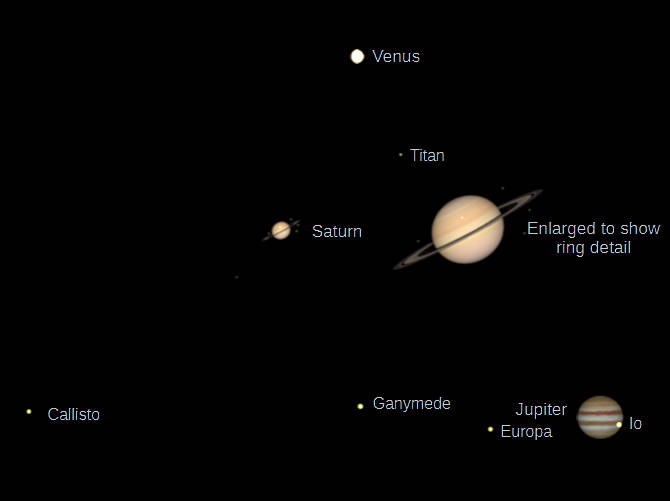
Telescopic Saturn and Jupiter (north up) as they would be seen in a small telescope at 5 AM July 4th 2024 with the same magnification. Apparent diameters: Saturn 18.0″, its rings 41.9″; Mars, too small to be represented here, is 5.4″; Jupiter 33.7″. Note the ” means seconds of arc, or 1/3600th of a degree. Created using Cartes du Ciel (Sky Charts).
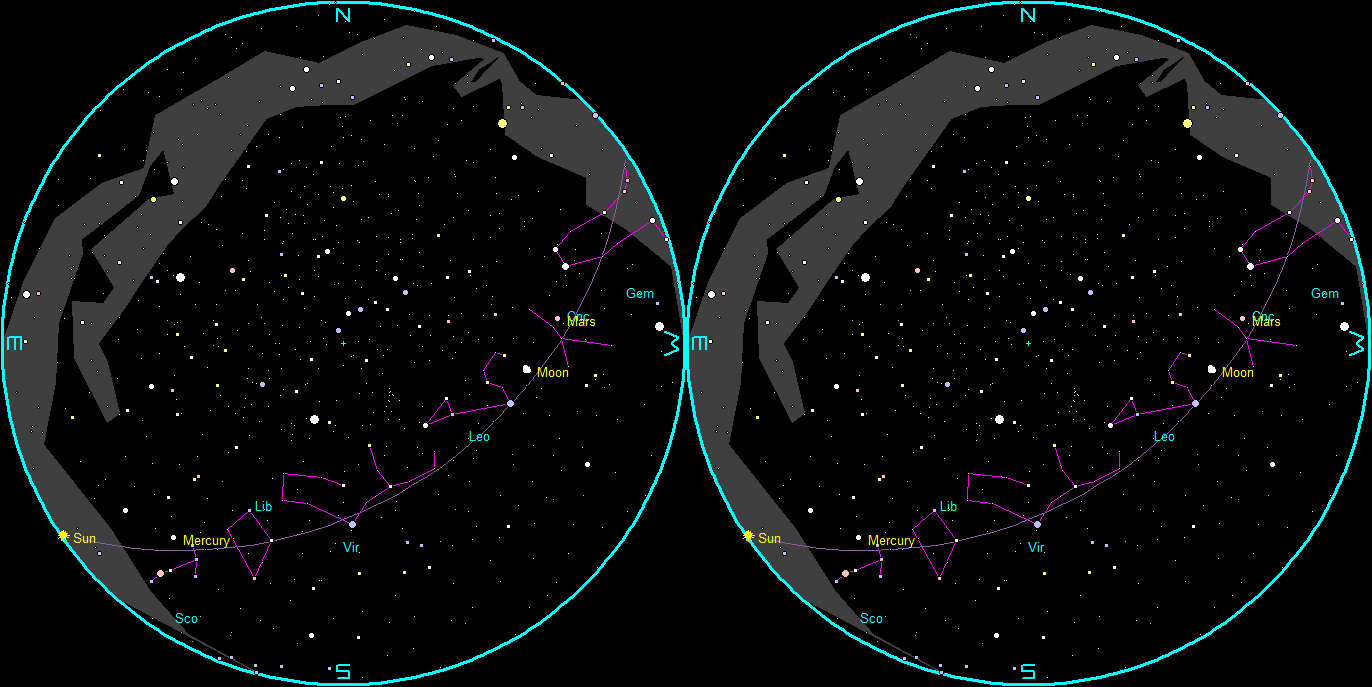
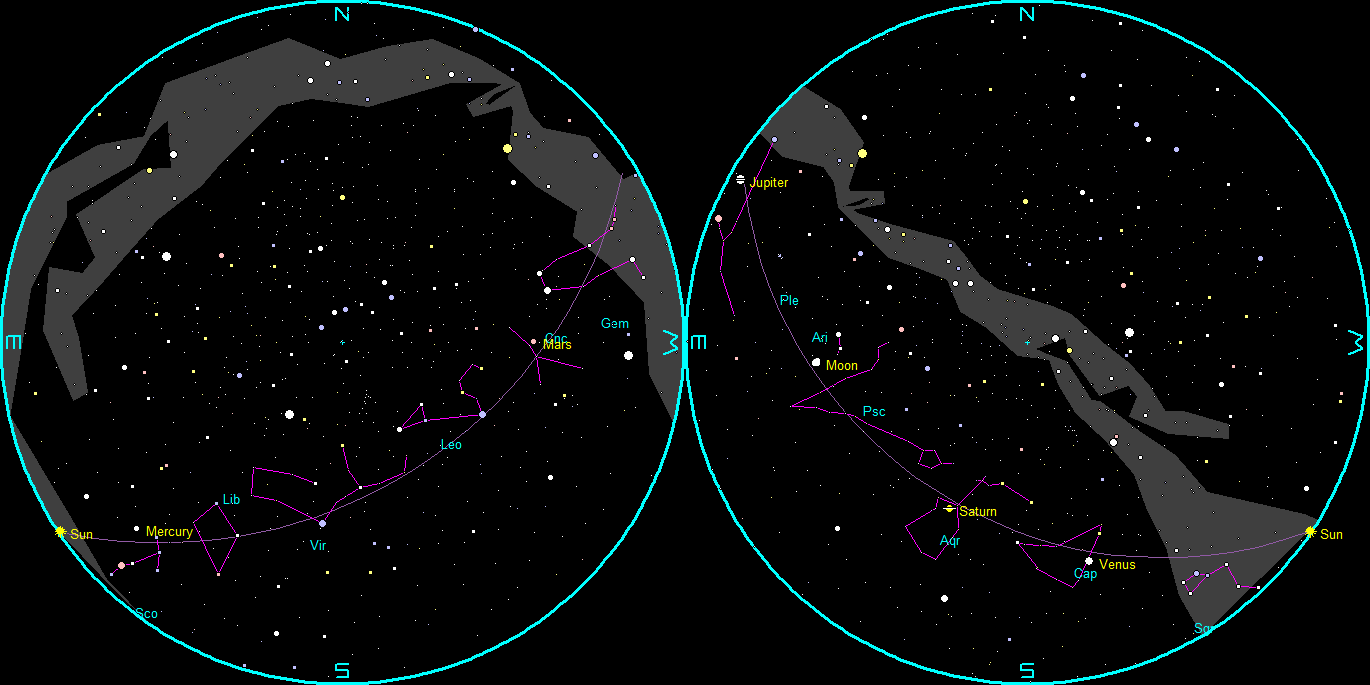
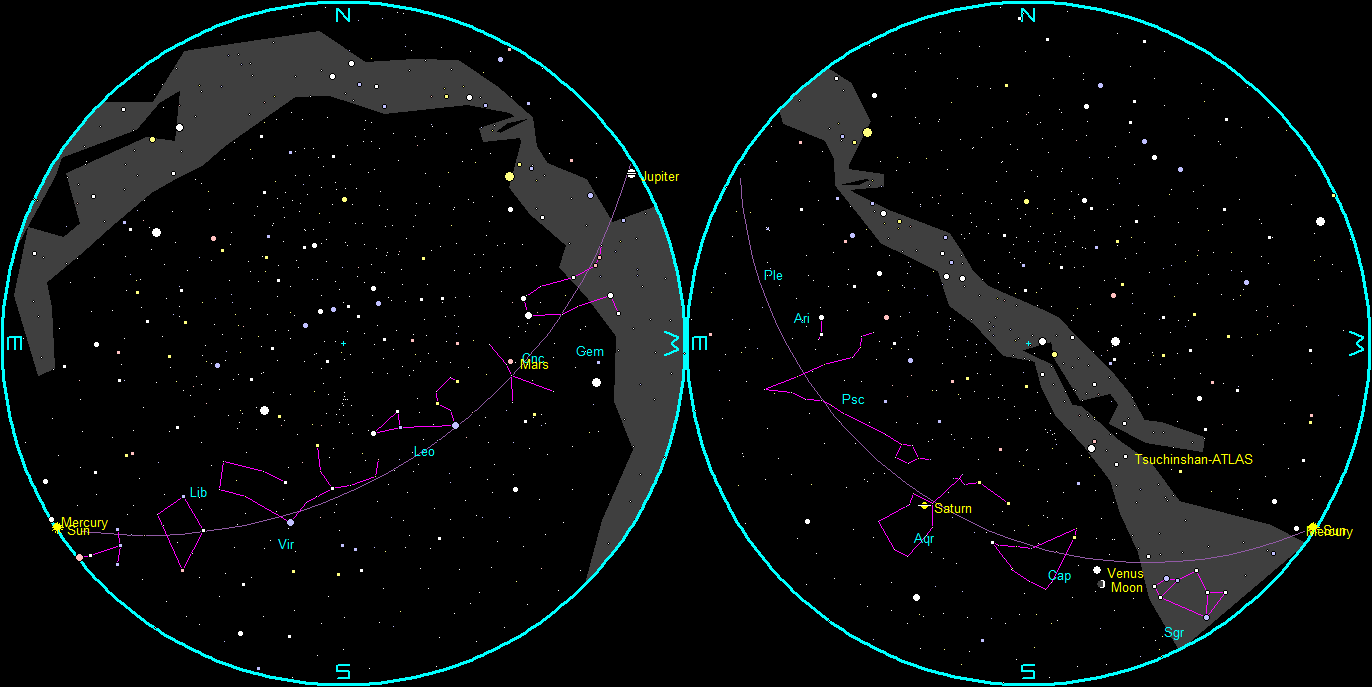
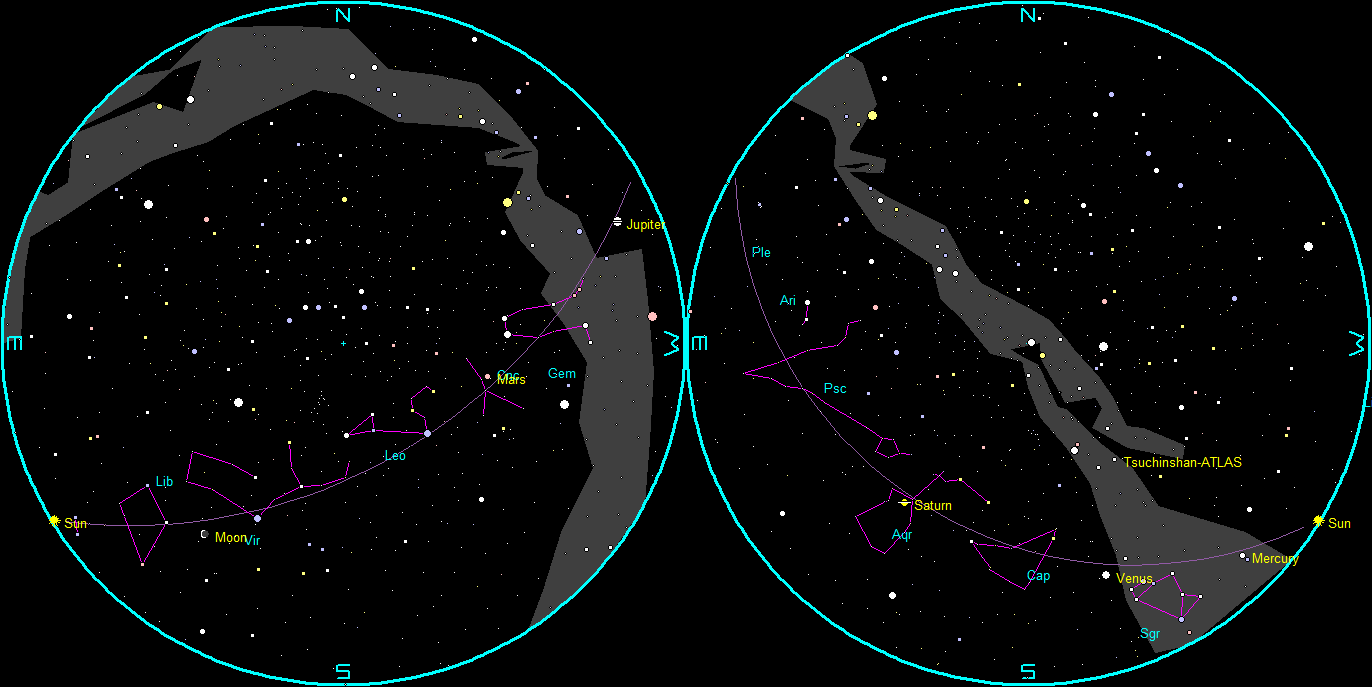
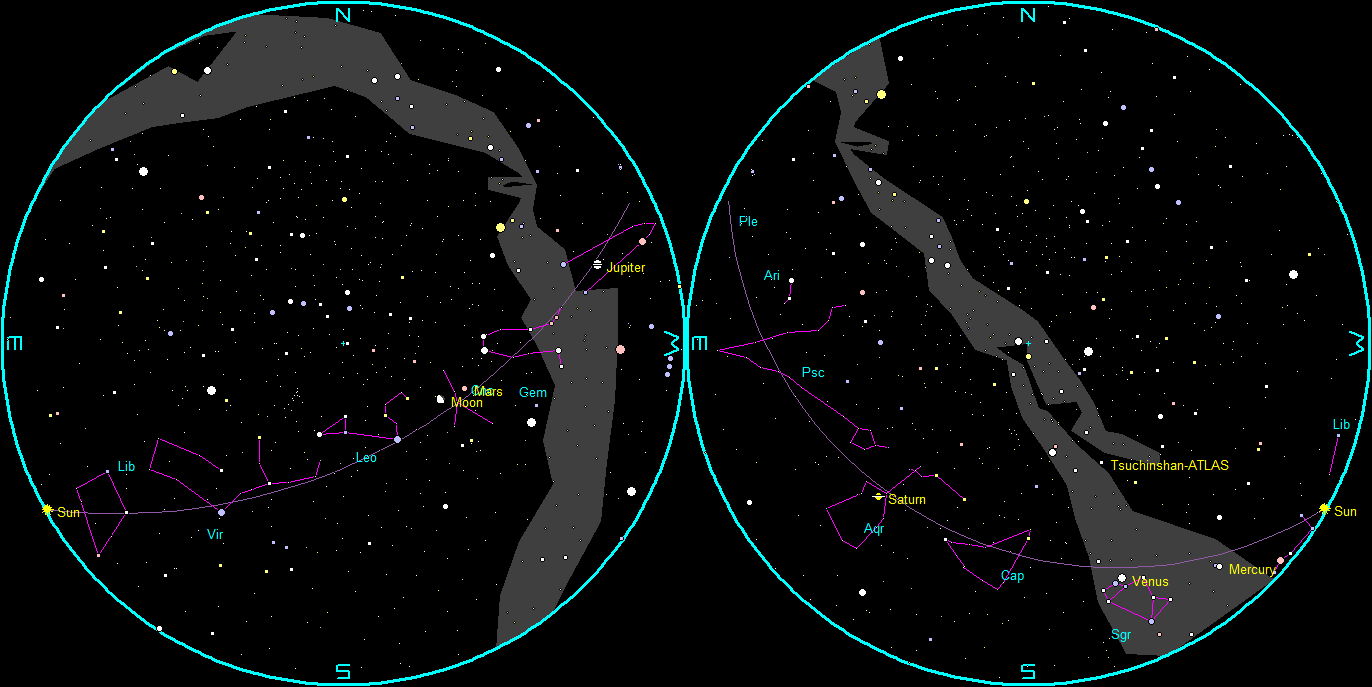
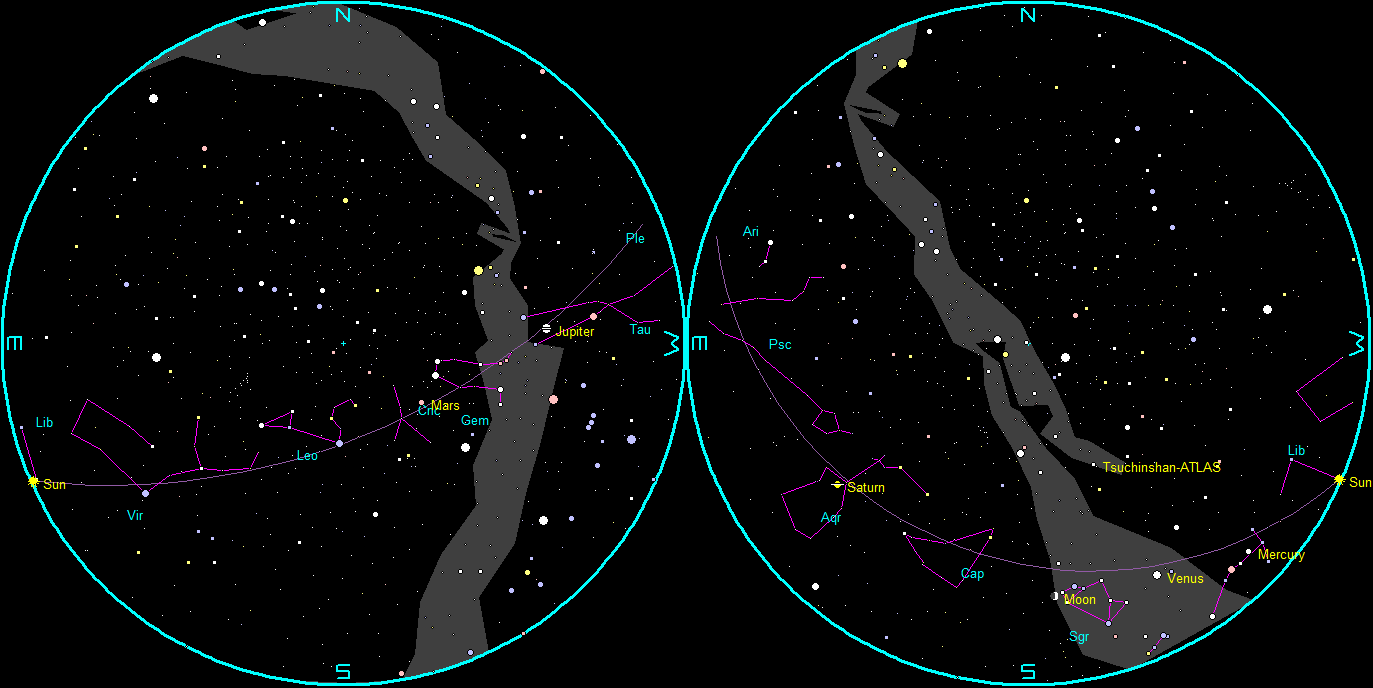
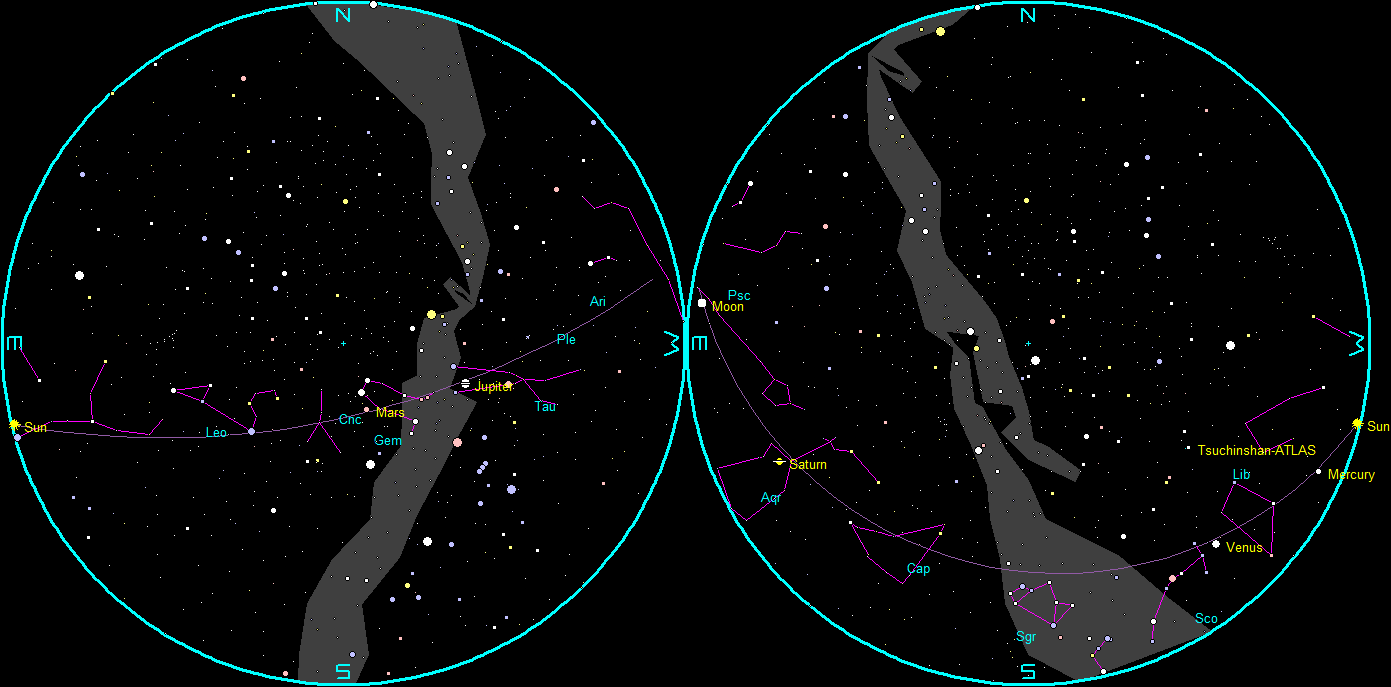
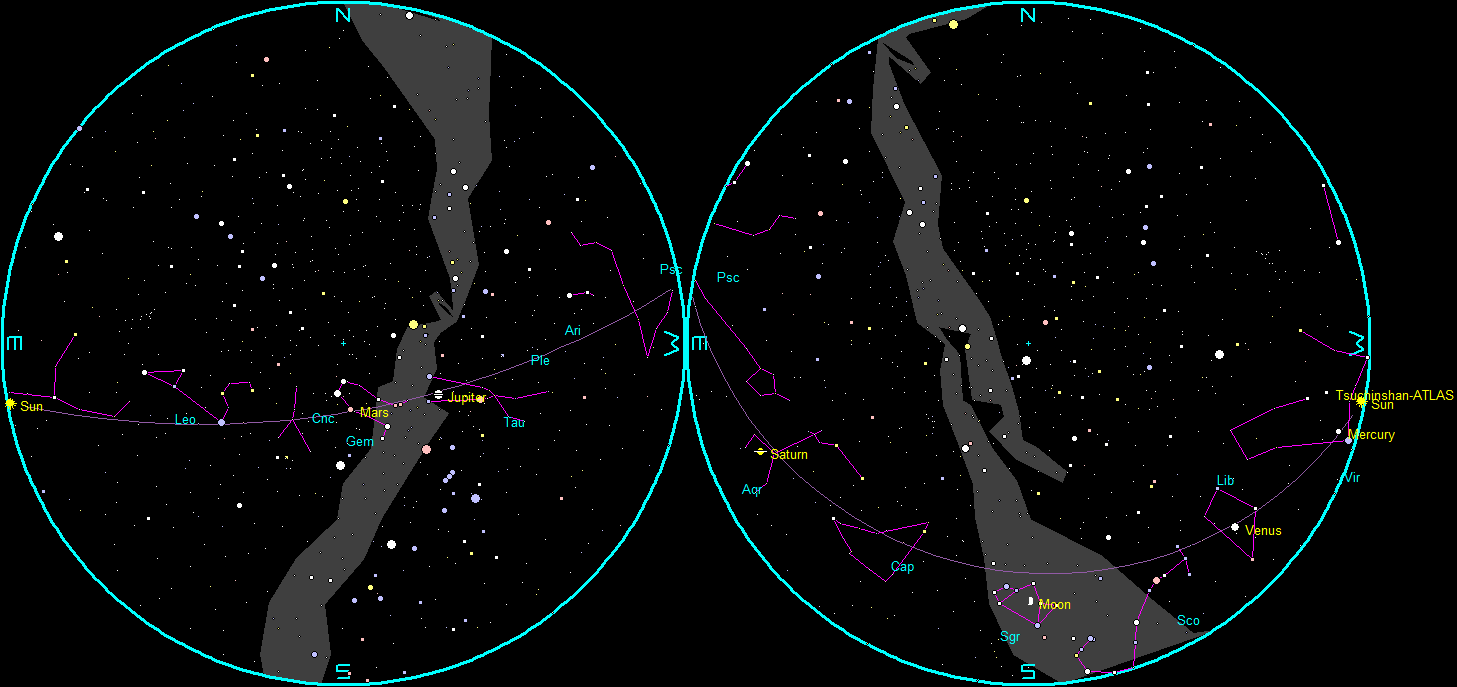
The naked-eye planets and the Moon at sunset and sunrise on a single night, starting with sunset on the right on July 3, 2024. The night ends on the left with sunrise on the 4th. Click or tap on the image to enlarge it. Created using my LookingUp app and GIMP.
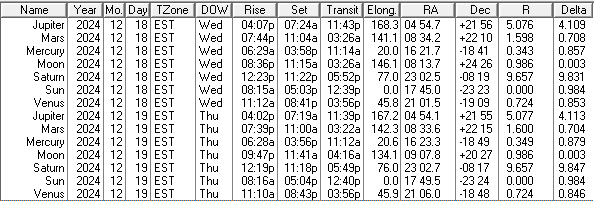
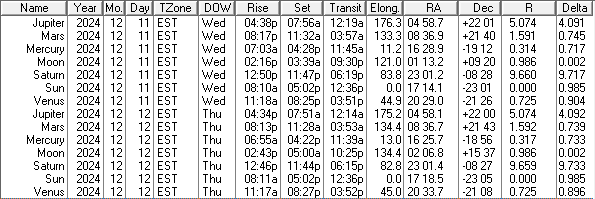
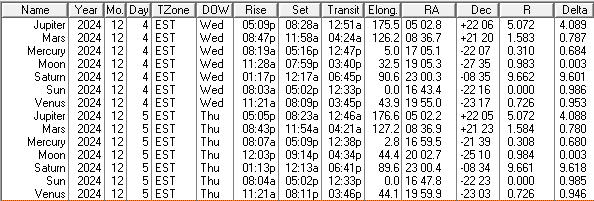
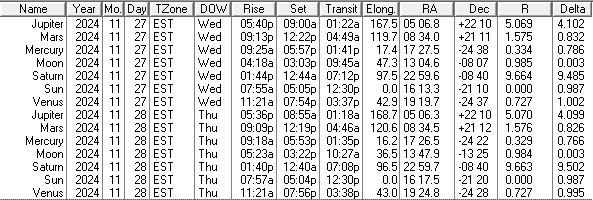
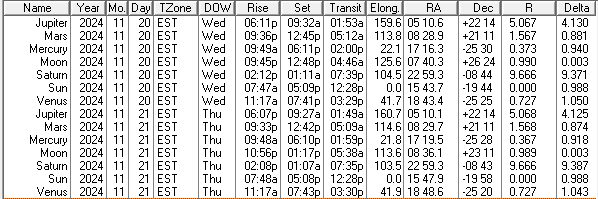
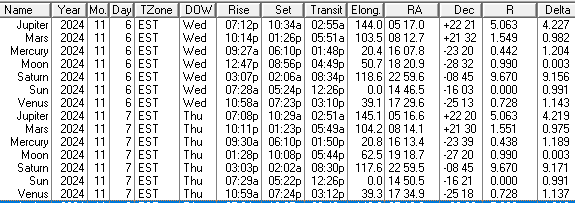
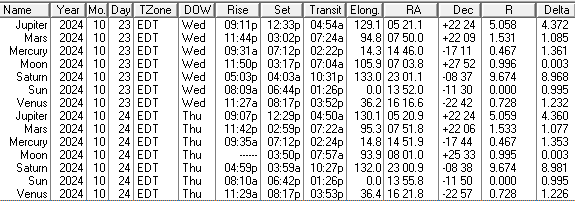
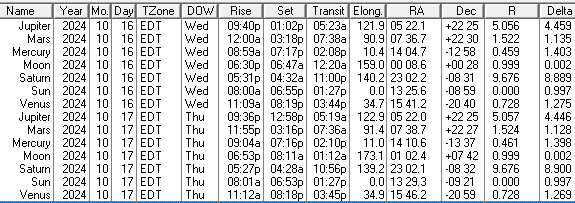
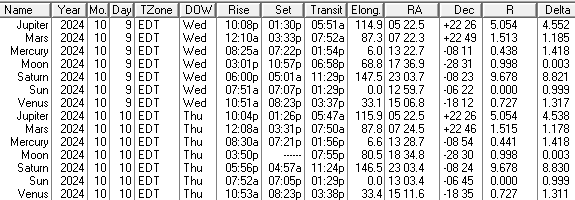
This is an ephemeris of the Sun Moon and naked eye planet positions for today and tomorrow, July 3rd and 4th 2024. Some of the columns are self-explanatory, others not. The transit column is the time that the body crosses the meridian and is due south. Elong, for elongation, is the angle between the Sun and that body. RA is right ascension, which is the object’s east-west position on the celestial sphere. Dec is declination which is the north-south position of the object on the celestial sphere. The time of the positions is 8 pm EDT, (0 hr UT the next date). R is the distance of that object from the Sun in astronomical units. An astronomical unit is about 93 million miles or 150 million kilometers. And Delta is the distance of that object from the Earth, also in astronomical units. I omit the ‘m’ in am and pm for compactness. The data was generated using my LookingUp for DOS app and displayed by my Ephemeris Helper app.

Ephemeris: 06/26/2024 – Where are the naked-eye planets this week?

June 26, 2024 Comments off

This is Bob Moler with Ephemeris for Wednesday, June 26th. Today the Sun will be up for 15 hours and 33 minutes, setting at 9:32, and it will rise tomorrow at 5:59. The Moon, 2 days before last quarter, will rise at 12:58 tomorrow morning.

Let’s find out where the naked-eye planets have wandered off to this week. Venus and Mercury are too close to the direction of the Sun to be seen. Both are on the evening side of the Sun, but lost in its glare. Venus will appear in the evening sky next month. By 5:15 tomorrow morning, or about 45 minutes before sunrise, Saturn will be in the southeast just above and left of the Moon, and Mars will be lower in the east, and Jupiter will be very low in the east-northeast. Saturn will be a bit dimmer this year and next due to its rings being nearly edge on to us and not reflecting as much light. Saturn will rise at 1:15 am, Mars at 3:07 am, and Jupiter at 4:19 am.

The astronomical event times given are for the Traverse City/Interlochen area of Michigan (EDT, UT–4 hours). They may be different for your location.

Addendum

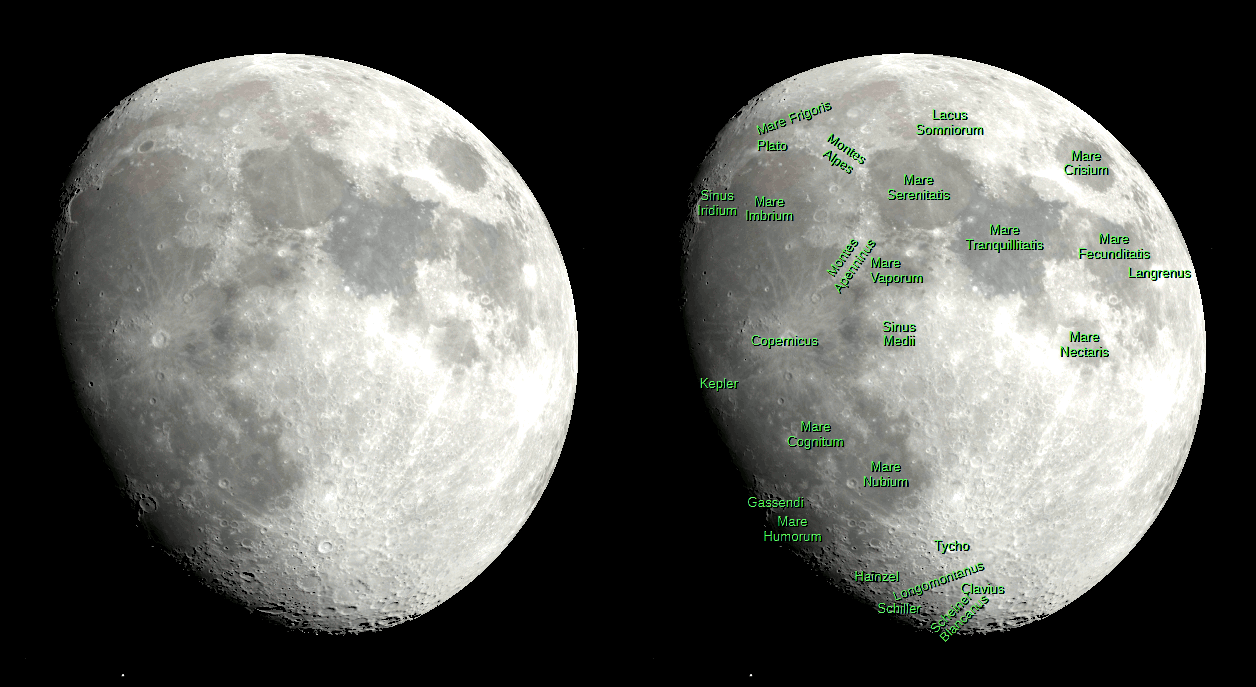
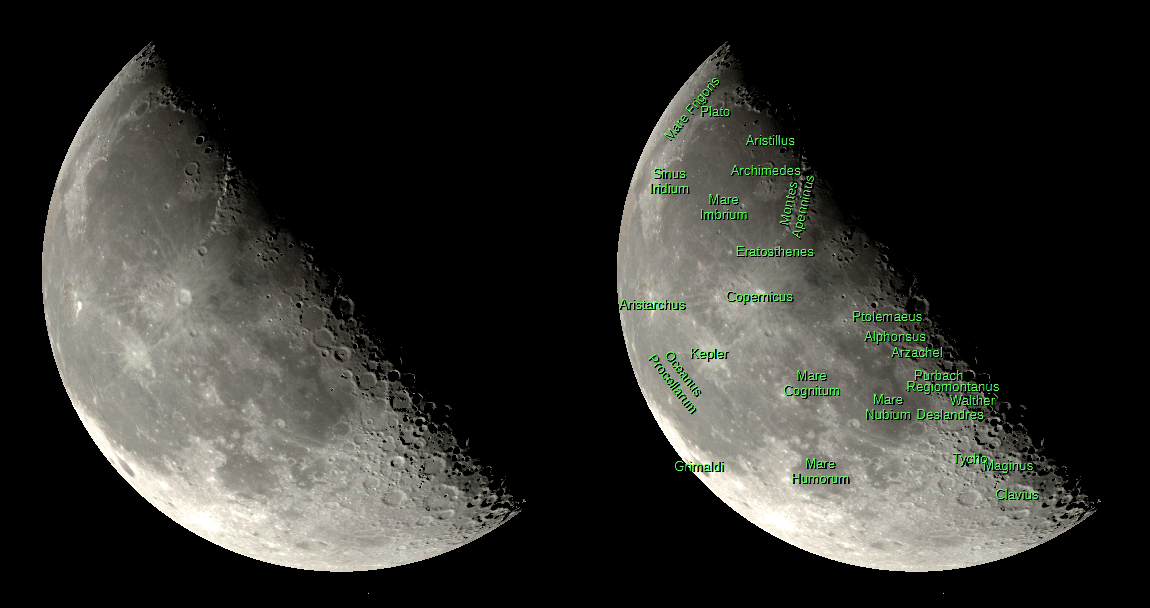
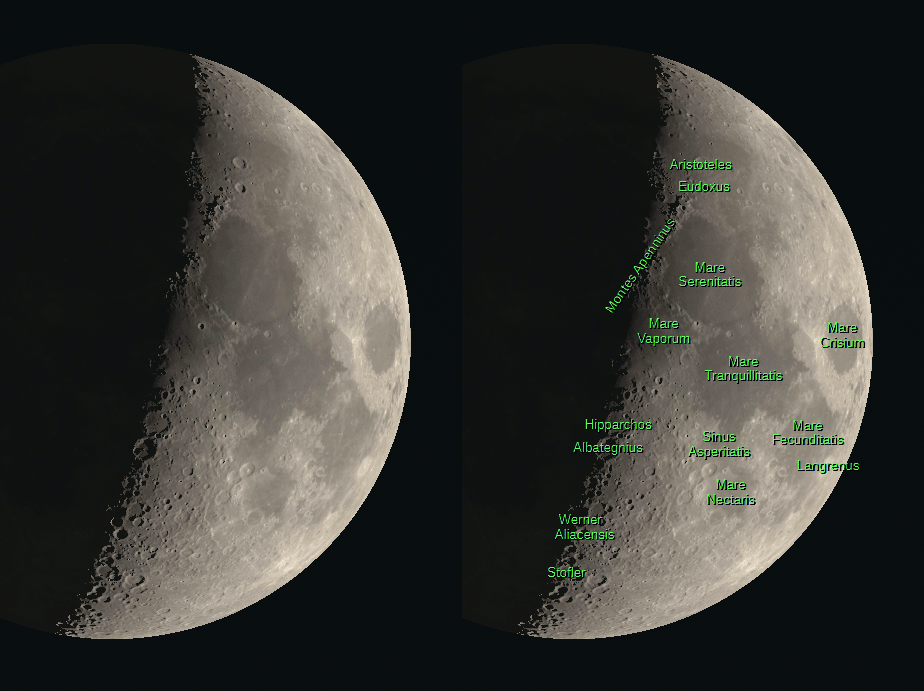
The Moon as it might appear in binoculars or a small telescope at 5 AM tomorrow morning, June 27th 2024. Selected features are labeled. Created using Stellarium, LibreOffice Draw, and GIMP.
The Moon, Saturn, Mars and Jupiter as they might be seen low in the east and southeastern sky at 5:15 AM, or about 45 minutes before sunrise, tomorrow morning June 27, 2024. Saturn will rise at 1:03 AM, Mars at 2:59 AM, and Jupiter at 4:09 AM. Click or tap on the image to enlarge it. Created using Stellarium.
Telescopic Saturn and Jupiter (north up) as they would be seen in a small telescope at 5 AM June 27th 2024 with the same magnification. Apparent diameters: Saturn 17.8″, its rings 41.4″; Mars, too small to be represented here, is 5.3″; Jupiter 33.5″. Note the ” means seconds of arc, or 1/3600th of a degree. Created using Cartes du Ciel (Sky Charts).
The naked-eye planets and the Moon at sunset and sunrise on a single night, starting with sunset on the right on June 26, 2023. The night ends on the left with sunrise on the 27th. Click or tap on the image to enlarge it. Created using my LookingUp app and GIMP.
This is an ephemeris of the Sun Moon and naked eye planet positions for today and tomorrow, June 26th and 27th 2024. Some of the columns are self-explanatory, others not. The transit column is the time that the body crosses the meridian and is due south. Elong, for elongation, is the angle between the Sun and that body. RA is right ascension, which is the object’s east-west position on the celestial sphere. Dec is declination which is the north-south position of the object on the celestial sphere. R is the distance of that object from the Sun in astronomical units. An astronomical unit is about 93 million miles or 150 million kilometers. And Delta is the distance of that object from the Earth, also in astronomical units. I omit the ‘m’ in am and pm for compactness. The data was generated using my LookingUp for DOS app and displayed by my Ephemeris Helper app.

Ephemeris: 06/19/2024 – Where have the naked-eye planets wandered off to this week?

June 19, 2024 Comments off

This is Ephemeris for Juneteenth, Wednesday, June 19th. Today the Sun will be up for 15 hours and 34 minutes, setting at 9:31, and it will rise tomorrow at 5:57. The Moon, 2 days before full, will set at 4:15 tomorrow morning.
Let’s find out where the naked-eye planets have wandered off to this week, and see what planets are left. Venus and Mercury are too close to the direction of the Sun to be seen. Both are on the evening side of the Sun, but lost in its glare. It will appear in the evening sky next month. By 5:15 tomorrow morning, or about 45 minutes before sunrise, Saturn will be in the southeast and Mars will be lower in the east, and Jupiter will be very low in the east-northeast. In telescopes, Saturn will look fairly different this year and next with its rings nearly edge on to us. Saturn will rise at 1:35 am, Mars at 3:19 am, and Jupiter, making its first morning appearance, will rise at 4:38 am.

The astronomical event times given are for the Traverse City/Interlochen area of Michigan (EDT, UT–4 hours). They may be different for your location.

Addendum

The Moon as it might appear in binoculars or a small telescope tonight
The Moon as it might appear in binoculars or a small telescope at 11 PM tonight, June 19th 2024. Selected features are labeled. Created using Stellarium, LibreOffice Draw, and GIMP.

Translations of some lunar feature names according to Virtual Moon Atlas

Lacus Mortis – Lake of Death
Lacus Somniorum – Lake of Dreams
Mare Cognitum – Sea of Knowledge
Mare Crisium – Sea of Crises
Mare Fecunditatis – Sea of Fruitfulness
Mare Frigoris – Sea of Cold
Mare Humorum – Sea of Moisture
Mare Imbrium – Sea of Showers
Mare Nectaris – Sea of Nectar
Mare Nubium – Sea of Clouds
Mare Serenitatis – Sea of Serenity
Mare Tranquillitatis – Sea of Tranquility
Mare Vaporum – Sea of Vapors
Montes Alpes – Alps Mountains
Montes Apenninus – Apennines Mountains
Oceanus Procellarum – Ocean of Storms
Sinus Iridium – Bay of Rainbows
Sinus Medii – Central Bay
Sinus Roris – Bay of Moisture

Craters are named for persons, real or otherwise.

Saturn, Mars and Jupiter as they might be seen low in the east and southeastern sky about 45 minutes before sunrise, tomorrow morning
Saturn, Mars and Jupiter as they might be seen low in the east and southeastern sky at 5:15 AM, or about 45 minutes before sunrise, tomorrow morning June 20, 2024. Saturn will rise at 1:31 AM, Mars at 3:14 AM, and Jupiter at 4:31 AM. Click or tap on the image to enlarge it. Created using Stellarium.
Telescopic Saturn and Jupiter
Telescopic Saturn and Jupiter (north up) as they would be seen in a small telescope at 5 AM June 20th 2024 with the same magnification. Apparent diameters: Saturn 17.57″, its rings 40.95″; Mars, too small to be represented here, is 5.25″; Jupiter 33.20″. Note the ” means seconds of arc, or 1/3600th of a degree. Created using Cartes du Ciel (Sky Charts).
Telescopic Saturn and Jupiter
The naked-eye planets and the Moon at sunset and sunrise on a single night, starting with sunset on the right on June 19, 2023. The night ends on the left with sunrise on the 20th. Click or tap on the image to enlarge it. Created using my LookingUp app and GIMP.

Ephemeris: 06/14/2024 – Star Party at the Sleeping Bear Dunes tomorrow night*

June 14, 2024 Comments off

* if it’s clear or mostly clear.

This is Bob Moler with Ephemeris for Flag Day, Friday, June 14th. Today the Sun will be up for 15 hours and 33 minutes, setting at 9:30, and it will rise tomorrow at 5:56. The Moon, at first quarter today, will set at 2:22 tomorrow morning.

Tomorrow night, Saturday, June 15th, the Sleeping Bear Dunes National Lakeshore will team up with the Grand Traverse Astronomical Society to host a star party at the Dune Climb from 9 to 11 PM. It won’t be a star party exactly, because the featured attraction will be the Moon, nearly two days after first quarter. To my mind, this is about the best time to view the Moon showing its craters with deep shadows near the terminator or sunrise line which crosses the moon slowly over the month. There are no planets out in the evening, but we do have some interesting stars to look at besides the Moon. The fairly bright Chinese Tiangong Space Station will pass below the position of the Moon at 10:22 that evening.**

The astronomical event times given are for the Traverse City/Interlochen area of Michigan (EDT, UT–4 hours). They may be different for your location.

Addendum

Simulated image of the Moon
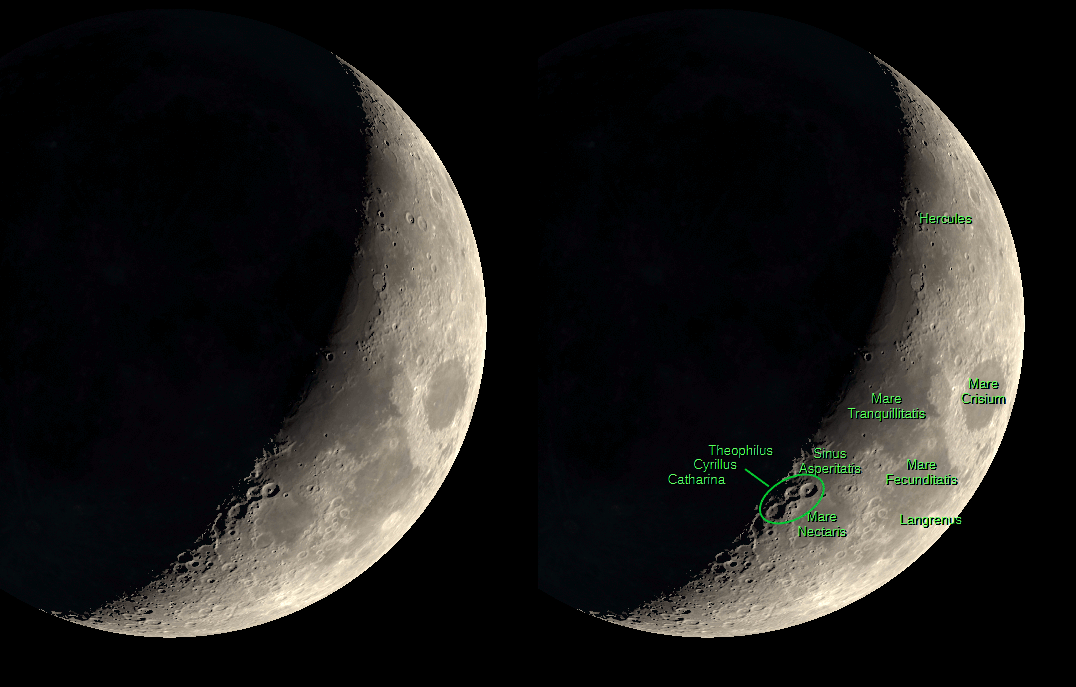
This is a simulated image from Stellarium of what the Moon might look like tomorrow night. This is the right side up view that one might see in binoculars. However, depending on the telescope one is looking through, the image could be rotated or even be a mirror image. So be aware of that. The craters are named after persons. The other features are English translations of the Latin names. Created using Stellarium, LibreOffice Draw, and GIMP.

** The information of the Tiangong space station pass came from heavens-above.com. The space station was also displayed in Stellarium when set to the proper time. Tiangong was predicted to be first magnitude by both sources, but Heavens-Above predicted a magnitude twice as bright as Stellarium.

Ephemeris: 06/12/2024 – Where are the naked-eye planets this week?

June 12, 2024 Comments off

This is Ephemeris for Wednesday, June 12th. Today the Sun will be up for 15 hours and 32 minutes, setting at 9:29, and it will rise tomorrow at 5:56. The Moon, 2 days before first quarter, will set at 1:49 tomorrow morning.

Let’s find out where the naked-eye planets have wandered off to this week, and see what planets are left. Venus and Mercury are too close to the direction of the Sun to be seen. Venus just entered the evening sky last week when it passed behind the Sun in conjunction. It will appear in the evening sky next month. Jupiter, the second-brightest planet still is a week or so from being spotted in the morning, since it rises about an hour before the Sun. By 5 tomorrow morning, or about an hour before sunrise, Saturn will be in the southeast and Mars will be lower in the east. In telescopes, Saturn will look fairly different this year and next with its rings nearly edge on to us. They will open up a bit through October before closing again. They are only 2 degrees from being edge on to us.

The astronomical event times given are for the Traverse City/Interlochen area of Michigan (EDT, UT–4 hours). They may be different for your location.

Addendum

The moon as it might appear in binoculars or a small telescope at 11:00 PM tonight, June 12th 2024. Selected features are labeled. Created using Stellarium, LibreOffice Draw, and GIMP.
Saturn and Mars as they might be seen low in the east and southeastern sky at 5 AM
Saturn and Mars as they might be seen low in the east and southeastern sky at 5 AM, or about an hour before sunrise,tomorrow morning June 13, 2024. Saturn will rise at 3:48 AM, Mars at 4:36 AM. Created using Stellarium.
A simulated telescopic view of Saturn
A much enlarged telescopic view of Saturn, much larger than is available in the small telescope . I did this to better show the almost edge on rings. The apparent diameter of Saturn is 17.36″, and the rings extend to 40.44″. The tilt of the rings is only about 2° from being edge on . When the rings are tilted to their maximum extent, this was seven years ago, Saturn was much brighter because the rings can reflect more light from the sun than the planet does. Created using Cartes du Ciel (Sky Charts).
The naked-eye planets and the Moon at sunset and sunrise on a single night
The naked-eye planets and the Moon at sunset and sunrise on a single night, starting with sunset on the right tonight, June 12th 2024. The night ends on the left with sunrise tomorrow morning on the 13th. Click or tap on the image to enlarge it. Created using my LookingUp app and GIMP.

Ephemeris: 05/29/2024 – Where have the naked-eye planets wandered off to this week?

May 29, 2024 Comments off

This is Ephemeris for Wednesday, May 29th. Today the Sun will be up for 15 hours and 17 minutes, setting at 9:19, and it will rise tomorrow at 6:01. The Moon, 1 day before last quarter, will rise at 2:31 tomorrow morning.

Let’s find out where the naked-eye planets have wandered off to this week, and see what planets are left. Venus, Mercury and Jupiter are now too close to the direction of the Sun to be seen. Venus will appear in the evening sky by July, while Jupiter may be visible in the morning in late June. By 5:15 tomorrow morning, or about 45 minutes before sunrise, Saturn will be low in the southeast and Mars will be lower still in the east. In telescopes, Saturn will look fairly different this year and next with its rings nearly edge on to us. They will open up a bit through October before closing again. We won’t see the rings go exactly edge on because Saturn will be too close to the Sun in the sky on March 23rd next year. After that, the rings will open up again.

The astronomical event times given are for the Traverse City/Interlochen area of Michigan (EDT, UT–4 hours). They may be different for your location.

Addendum

Saturn, Mars and the Moon as they might be seen low in the southeastern horizon at 5 AM
Saturn, Mars and the Moon as they might be seen low in the southeastern horizon at 5 AM, or about an hour before sunrise, tomorrow morning May 30, 2024. Saturn will rise at 2:52 AM, Mars at 4:04 AM. Created using Stellarium.
The Moon as it might appear in binoculars or a small telescope at 5 AM tomorrow morning
The Moon as it might appear in binoculars or a small telescope at 5 AM tomorrow morning, May 30th 2024. Selected features are labeled. Created using Stellarium, LibreOffice Draw, and GIMP.
The planet Saturn and its satellite Titan as might be seen in the telescope at 5 am Tomorrow morning, although greatly enlarged from what would be seen in the small telescope since, Saturn is almost a billion miles away. It’s apparent diameter is 16.95″ (seconds of arc) and it’s rings span 39.48″. The rings, as can be seen, are very thin and present a 2° 12′ tilt to us. Mars is too small to be represented here, it’s 5.02″ in diameter . My usual policy is to show planets that are 10″ or greater because they will actually show a decent disc in a small telescope. Created using Cartes du Ciel (Sky Charts).
The naked-eye planets and the Moon at sunset and sunrise on a single night
The naked-eye planets and the Moon at sunset and sunrise on a single night, starting with sunset on the right tonight, May 29th 2024. The night ends on the left with sunrise tomorrow morning on the 30th. Click or tap on the image to enlarge it. Created using my LookingUp app and GIMP.

Ephemeris: 05/22/2024 – Where have the naked-eye planets wandered off to this week?

May 22, 2024 Comments off

This is Ephemeris for Wednesday, May 22nd. Today the Sun will be up for 15 hours and 5 minutes, setting at 9:12, and it will rise tomorrow at 6:06. The Moon, 1 day before full, will set at 5:42 tomorrow morning.

Let’s find out where the naked-eye planets have wandered off to this week, and see what planets are left. Jupiter now is too close to the direction of the Sun to be seen. It is on the morning side of the Sun, and by late June may be visible in the morning sky in twilight. By 5 tomorrow morning, about 66 minutes before sunrise, Saturn will be low in the east-southeast and Mars will be lower still in the east. In telescopes, Saturn will look fairly different this year and next with its rings nearly edge on to us. They will open up a bit through October before closing again. We won’t see the rings go exactly edge on because Saturn will be too close to the Sun in the sky on March 23rd next year. After that the rings will open up again.

The astronomical event times given are for the Traverse City/Interlochen area of Michigan (EDT, UT–4 hours). They may be different for your location.

Addendum

The Moon as it may be seen in binoculars or a small telescope
The Moon as it may be seen in binoculars or a small telescope about 10:30 this evening, May 22nd 2024. Selected features are labeled. Shadows can be seen in some craters on the extreme east side of the Moon. The crater Tycho’s rays are especially prominent this time of the lunar month. Created using Stellarium, LibreOffice Draw, and GIMP. Information on the labels comes from Virtual Moon Atlas.
Saturn and Mars as they might be seen low in the southeastern horizon in 5 AM, or a bit more than an hour before sunrise, tomorrow morning May 23, 2024. Saturn will rise at 3:19 AM, Mars at 4:20 AM. Created using Stellarium.
The planet Saturn and its satellite Titan as might be seen in the telescope
The planet Saturn and its satellite Titan as might be seen in the telescope, although greatly enlarged from what would be seen in the small telescope since, Saturn is almost a billion miles away. It’s apparent diameter is 16.75″ (seconds of arc) and it’s rings span 39.3″. The rings, as can be seen, are very thin and present a 2° 22′ tilt to us. Mars is too small to be represented here, it’s 4.95″ in diameter . My usual policy is to show planets that are 10″ or greater because they will actually show a decent disc in a small telescope. Created using Cartes du Ciel (Sky Charts).
The naked-eye planets and the Moon at sunset and sunrise on a single night, starting with sunset on the right tonight, May 22nd 2024. The night ends on the left with sunrise tomorrow morning on the 23rd.
The naked-eye planets and the Moon at sunset and sunrise on a single night, starting with sunset on the right tonight, May 22nd 2024. The night ends on the left with sunrise tomorrow morning on the 23rd. The symbols of Jupiter and Venus overlap at this scale. Click or tap on the image to enlarge it. Created using my LookingUp app and GIMP.

Ephemeris: 05/15/2024 – Where have naked-eye planets wandered off to this week?

May 15, 2024 Comments off

This is Ephemeris for Wednesday, May 15th. Today the Sun will be up for 14 hours and 51 minutes, setting at 9:05, and it will rise tomorrow at 6:12. The Moon, at first quarter today, will set at 3:28 tomorrow morning.

Let’s find out where the naked-eye planets have wandered off to this week, and see what planets are left. Jupiter now is too close to the direction of the Sun to be seen. It will move to be in conjunction with the Sun on Saturday and by late June may be visible in the morning sky in twilight. By 5:30 tomorrow morning, about 40 minutes before sunrise, Saturn will be low in the east-southeast and Mars will be lower still in the east. In telescopes, Saturn will look fairly different this year and next with its rings nearly edge on to us. They will open up a bit through October before closing again. We won’t see the rings go exactly edge on because Saturn will be too close to the Sun in the sky on March 23rd next year. After that the rings will open up again.

The astronomical event times given are for the Traverse City/Interlochen area of Michigan (EDT, UT–4 hours). They may be different for your location.

Addendum

Two of the planets are moving behind the sun. Jupiter is on the left, while Venus is on the right. They will both pass behind the Sun with Jupiter entering the morning sky and Venus entering the evening sky. These images we’re taken by the Solar and Heliospheric Observatory or SOHO, which is a satellite that’s orbiting the Earth-Sun L1 point, a million miles sunward of the Earth. Notice that toward the end of the sequence of images a whole lot of what looks like snow shows up on the image. That is the CME of the 8th reaching SOHO and all the subatomic particles hit the imager in the satellite causing all the snow. An hour later of the of these the CME will tangle with the Earth’s magnetic field. Credit: ESA, NASA.
The moon as it might appear in binoculars or a small telescope at 10:00 PM tonight, May 15th 2024. Selected features are labeled. Created using Stellarium, LibreOffice Draw, and GIMP.
Saturn and Mars as they might be seen low in the southeastern horizon in 5:30 AM, or about 45 minutes before sunrise,tomorrow morning May 16, 2024. Saturn will rise at 3:48 AM, Mars at 4:36 AM. Created using Stellarium.
The planet Saturn and its satellite Titan as might be seen in the telescope
The planet Saturn and its satellite Titan as might be seen in the telescope, although greatly enlarged from what would be seen in the small telescope since, Saturn is almost a billion miles away. It’s apparent diameter is 16.57″ (seconds of arc) and it’s rings span 38.6″. The rings, as can be seen, are very thin and present a 2 1/2° tilt to us. Mars is too small to be represented here, it’s 4.88″ in diameter . My usual policy is to show planets that are 10″ or greater because they will actually show a decent disc in a small telescope. Created using Cartes du Ciel (Sky Charts).
The naked-eye planets and the Moon at sunset and sunrise on a single night
The naked-eye planets and the Moon at sunset and sunrise on a single night, starting with sunset on the right tonight, May 15th 2024. The night ends on the left with sunrise tomorrow morning on the 16th. Click or tap on the image to enlarge it. Created using my LookingUp app and GIMP.

Ephemeris: 05/08/2024 – Saturn comes tottering into the morning twilight

May 8, 2024 Comments off

This is Ephemeris for Wednesday, May 8th. Today the Sun will be up for 14 hours and 34 minutes, setting at 8:56, and it will rise tomorrow at 6:21. The Moon, 1 day past new, will set at 10:12 this evening.

Let’s find out where the naked-eye planets have wandered off to this week, and see what planets are left. Jupiter now is too close to the direction of the Sun to be seen. It will move to be in conjunction with the Sun on the 18th of this month and by late June may be visible in the morning sky in twilight. By 5:30 tomorrow morning, about 40 minutes before sunrise, Saturn will be low in the east-southeast and Mars will be lower yet in the east. In telescopes, Saturn will look fairly different this year and next with its rings nearly edge on to us. They will open up a bit through October before closing again. We won’t see the rings go exactly edge on because Saturn will be too close to the Sun in the sky on March 23rd next year. After that the rings will open up again.

The astronomical event times given are for the Traverse City/Interlochen area of Michigan (EDT, UT–4 hours). They may be different for your location.

Addendum

You may wonder why I use the word tottering in title. The planet Saturn is named after the Roman god of old age, probably because it takes nearly 30 years to orbit the Sun. Even though it’s moving away from twilight faster than Mars is, it’s just the fact that the Sun and Mars are moving faster to the east than it is, leaving him in the dust, so to speak.

Looking to the east-southeast at 5:30 in the morning, less than an hour before sunrise, Saturn and Mars will be visible very low in the sky
Looking to the east-southeast at 5:30 in the morning, less than an hour before sunrise, Saturn and Mars will be visible very low in the sky. Click or tap on the image to enlarge it. Created using Stellarium.
A telescopic view of Saturn
A telescopic view of Saturn. It’s a bit larger than I normally show it when we look at several planets, to show you the rings which are tilted a little less than 3° to our line of sight. Saturn appears 16.4″ diameter, while it’s rings are 38.2″ in extent. Created using Cartes du Ciel (Sky Charts).
The naked-eye planets and the Moon at sunset and sunrise on a single night
The naked-eye planets and the Moon at sunset and sunrise on a single night, starting with sunset on the right tonight, May 8th 2024. The night ends on the left with sunrise tomorrow morning on the 9th. Click or tap on the image to enlarge it. Created using my LookingUp app and GIMP.

Ephemeris: 04/24/2024 – Where have the naked-eye planets wandered off to this week?

April 24, 2024 Comments off

This is Bob Moler with Ephemeris for Wednesday, April 24th. Today the Sun will be up for 13 hours and 57 minutes, setting at 8:39, and it will rise tomorrow at 6:41. The Moon, 1 day past full, will rise at 9:49 this evening.

Let’s find out where the naked-eye planets have wandered off to this week, and see what planets are left. Jupiter, looking not-so bright in twilight is very low and in the west. It will set at 10:23 pm. I’m giving Jupiter another week of evening visibility. Comet 12P/Pons-Brooks now only visible to observers south of the equator. In the morning, Mars and Saturn will be close together in the east southeastern sky at 6 am. They will be fighting the bright morning twilight and low altitude then. Saturn will be difficult to see right now in the twilight. Mars will be harder to spot. Saturn will look fairly different this year and next with its rings nearly edge on to us. They will look more like a line through the planet.

The astronomical event times given are for the Traverse City/Interlochen area of Michigan (EDT, UT–4 hours). They may be different for your location.

Addendum

Jupiter appears very low in the West northwest at 9:30 PM which is about 50 minutes after sunset. Created using Stellarium.
The Moon a day after full at 10:30 PM tonight, April 24th 2024. At this time it’s still low in the sky showing its coloring. Selected features are labeled. Created with Stellarium, LibreOffice Draw and GIMP.
Saturn and Mars is they might appear tomorrow morning at 6:00 AM, April 25th 2024. They might be difficult or impossible to pick out low in the east southeast because they are much dimmer than Jupiter. In fact Saturn is dimmer than it normally is because its rings are nearly edge on and will be edge on to us in 11 months, before opening up again. The rings, when they’re open, contribute a great deal to Saturn’s brightness. Created using Stellarium , LibreOffice Draw, and GIMP.
This is Saturn as it might appear in a telescope at 6:00 AM tomorrow, April 25th 2024. It is larger than I usually present it, to show off it’s rings or nearly lack thereof. Created using Cartes du Ciel (Sky Charts).
The naked-eye planets, Comet Pons-Brooks, and the Moon at sunset and sunrise on a single night, starting with sunset on the right tonight, April 24th 2024. The night ends on the left with sunrise tomorrow morning on the 25th. Click or tap on the image to enlarge it. Created using my LookingUp app and GIMP.