Archive
10/14/2020 – Ephemeris – Let’s look for the naked-eye planets for this week
This is Bob Moler with Ephemeris for Wednesday, October 14th. Today the Sun will be up for 11 hours and 1 minute, setting at 6:58, and it will rise tomorrow at 7:58. The Moon, 2 days before new, will rise at 6:10 tomorrow morning.
Let’s look for the naked-eye planets for this week. Jupiter and Saturn are both low in the south-southwestern sky at 9 pm. Jupiter is the very bright one. Left and a bit above it will be the somewhat dimmer Saturn. They are closing slowly, so they will cross paths on December 21st and be in the same telescope field that evening. Jupiter will set first tonight at 11:52 with Saturn following at 12:29 am. Off in the east-southeast at 9 pm will be Mars. Since the Earth passed it yesterday its distance is slowly increasing to 38.9 million miles (62.7 million kilometers) away. Brilliant Venus will rise at 4:39 am in the east as it retreats slowly toward the Sun. It’s brilliant and looks like a tiny featureless gibbous moon in telescopes.
The event times given are for the Traverse City/Interlochen area of Michigan. They may be different for your location.
Addendum
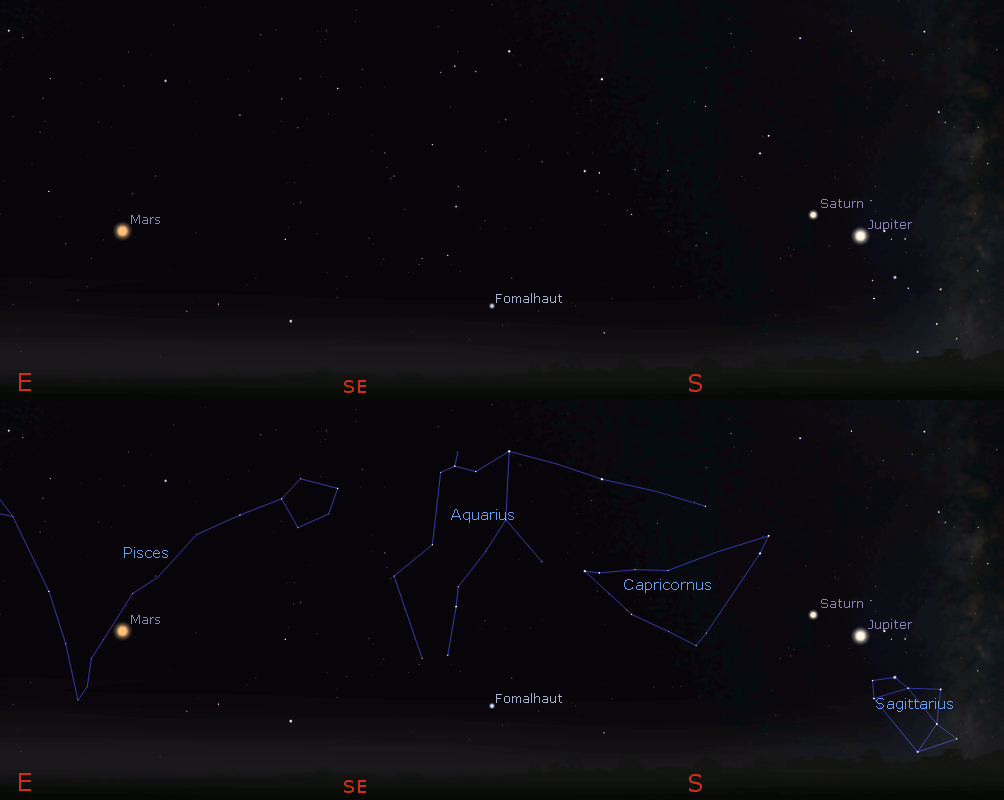
Evening Planets animation showing Jupiter, Saturn and Mars with the constellations of the zodiac for 9 pm October 14, 2020. Click on the image to enlarge. Created using Stellarium.
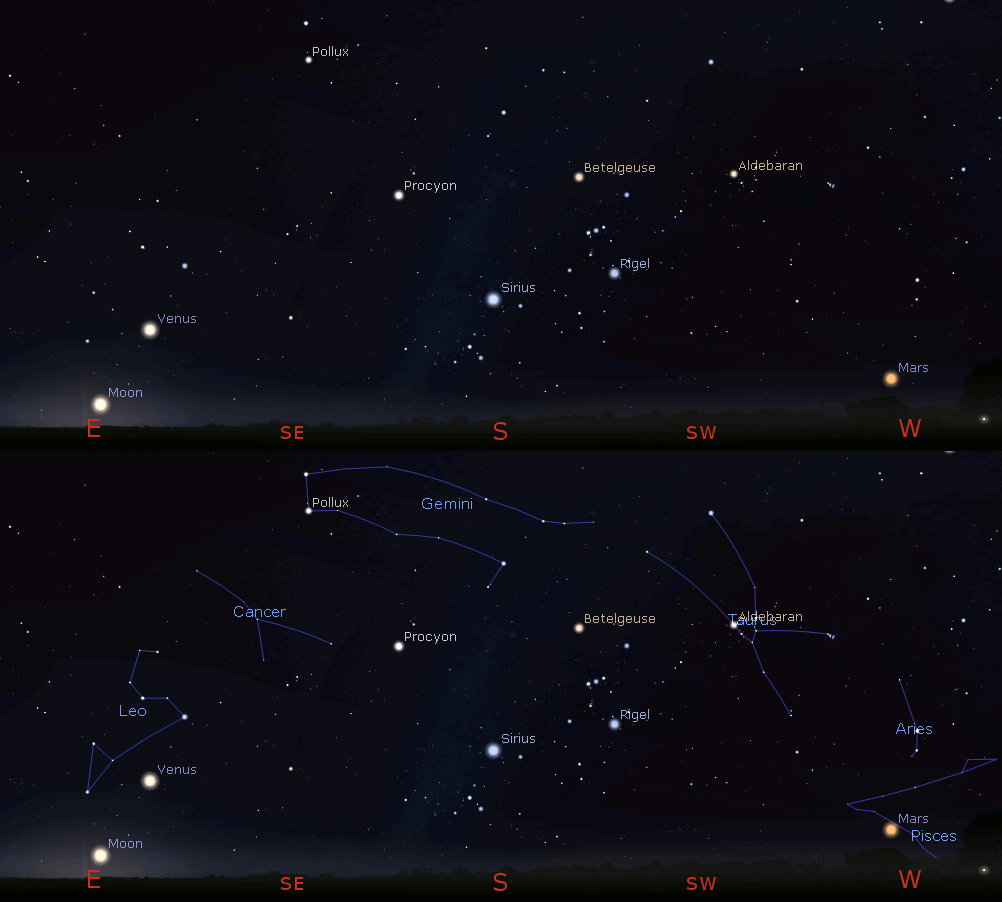
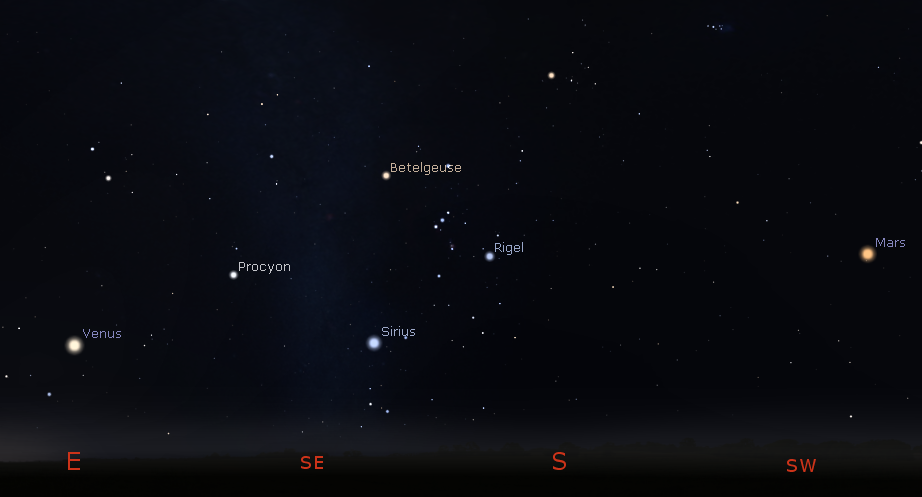
Morning planet animation for 6:45 am tomorrow October 15, 2020. Click on the image to enlarge. Created using Stellarium.
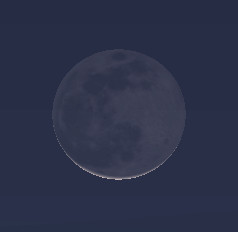
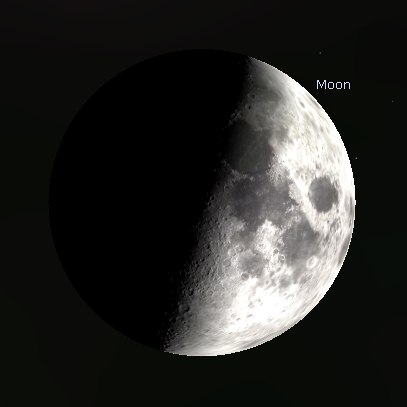
The waning thin crescent Moon about a day and a half from new. as it might be seen in binoculars with earthshine at 6:45 am tomorrow morning October 15, 2020. Created using Stellarium.
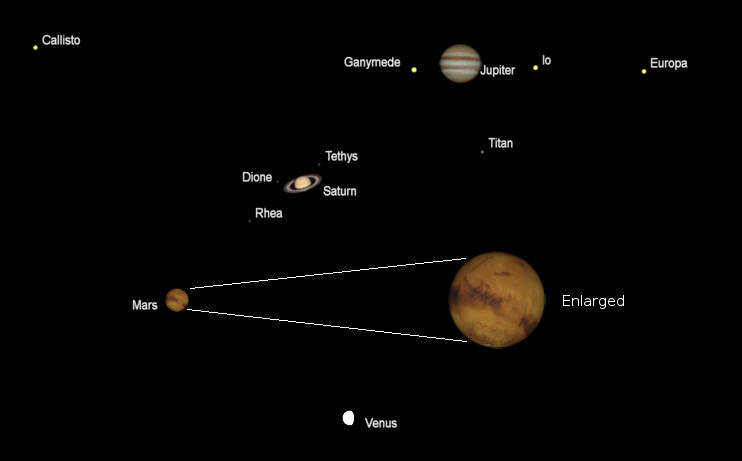
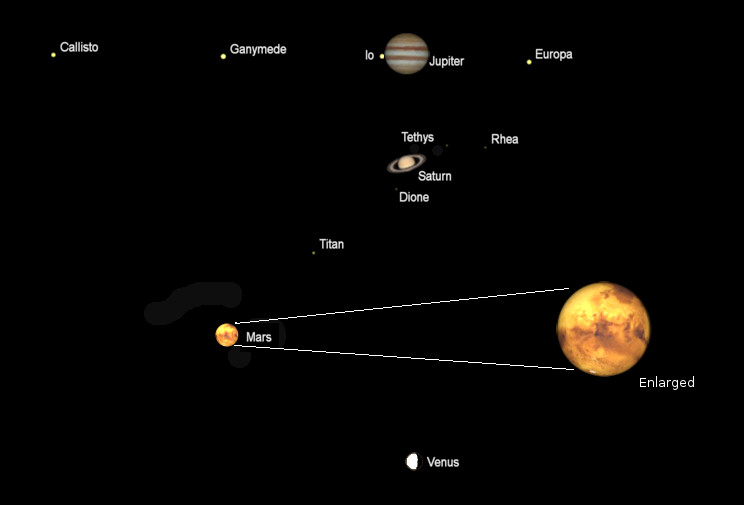
The planets as seen in a telescope (north up) with the same magnification for the night of October 14/15, 2020. Times of the display are: Jupiter and Saturn, 9 pm; Mars, 11 pm; Venus, 7 am. Apparent diameters: Jupiter, 38.82″; Saturn, 16.81″, rings, 39.15″; Mars, 22.27″; and Venus 14.27″. Mars also displays an enlargement showing surface detail. Mars was closest to the Earth this go-a-round on October 6, and at opposition yesterday. The ” symbol means seconds of arc (1/3600th of a degree.) Created using Cartes du Ciel (Sky Charts).
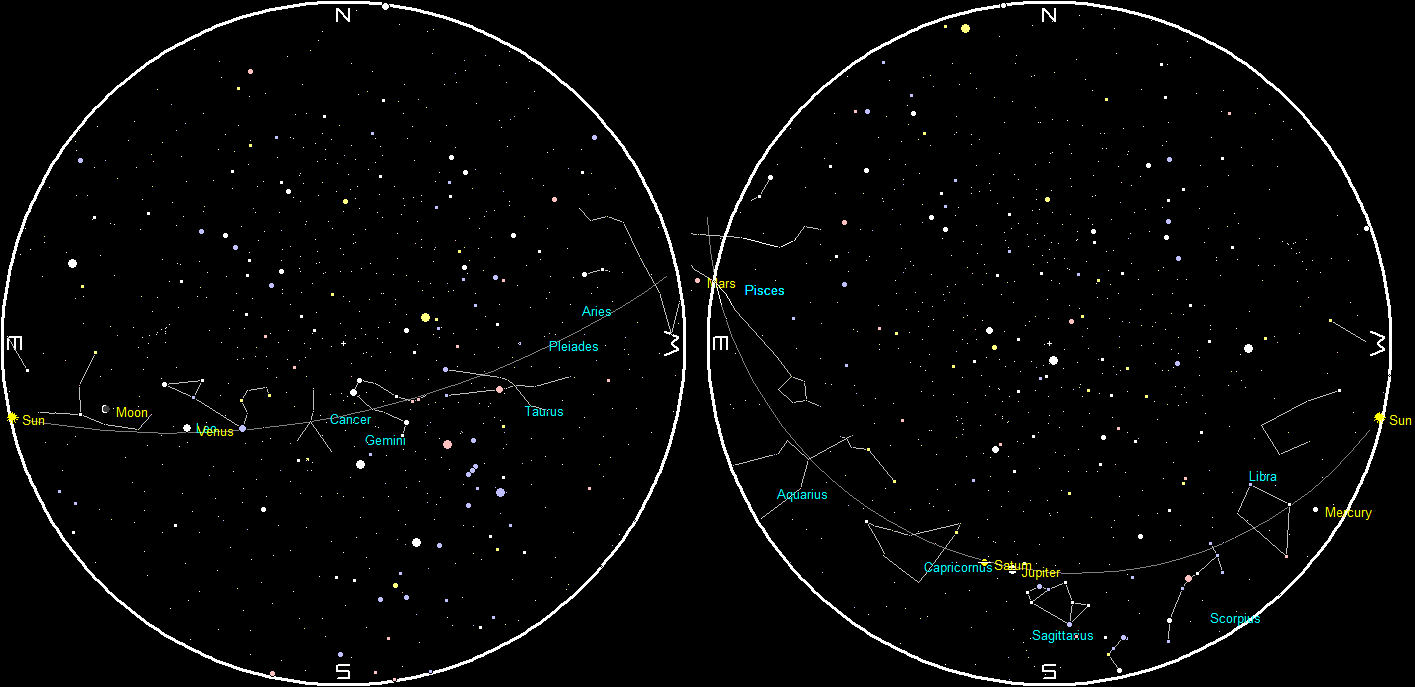
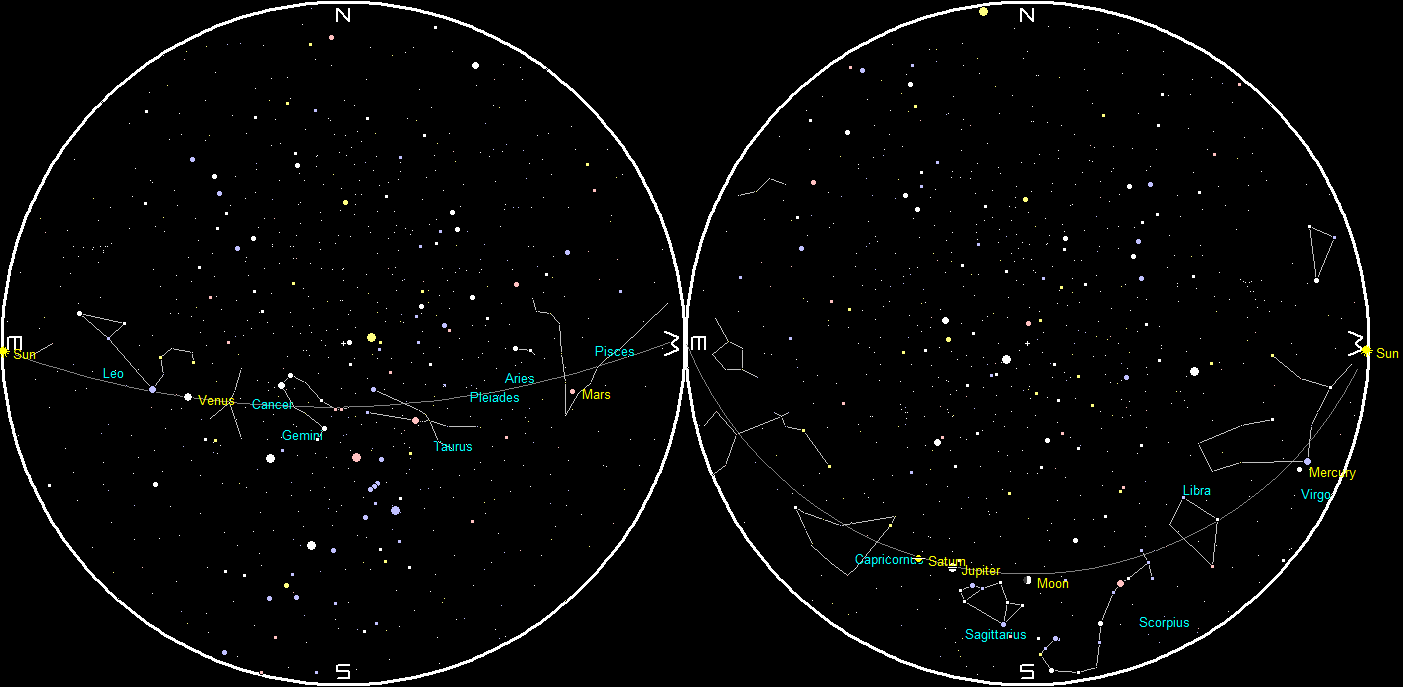
Planets and the Moon at sunset and sunrise of a single night starting with sunset on the right on October 14, 2020. The night ends on the left with sunrise on 15th. Click on the image to enlarge. Mars, near opposition and a bit south of the ecliptic, actually rises after sunset, so I included it in the sunset chart even though it is below the horizon at sunset. Created using my LookingUp program.
10/07/2020 – Ephemeris – Let’s look for the naked-eye planets for this week
This is Ephemeris for Wednesday, October 7th. Today the Sun will be up for 11 hours and 22 minutes, setting at 7:11, and it will rise tomorrow at 7:50. The Moon, 2 days before last quarter, will rise at 10:23 this evening.
Let’s look for the naked-eye planets for this week. Jupiter and Saturn are both low in the southern sky at 9 pm. Jupiter is the very bright one. To the left of it will be the somewhat dimmer Saturn which is just about due south at that hour. They are closing slowly, so they will cross paths on December 21st. Jupiter will set first at 12:23 tomorrow morning with Saturn following at 1 am. Off in the east will be Mars which will rise at 7:33 pm. It’s now down to 38.6 million miles (62.1 million km) away, as the Earth is about to overtake it. Brilliant Venus will rise at 4:24 am as it retreats slowly toward the Sun. It looks like a tiny featureless gibbous moon in telescopes. Its clouds of sulfuric acid are quite featureless in visible light.
The event times given are for the Traverse City/Interlochen area of Michigan. They may be different for your location.
Addendum
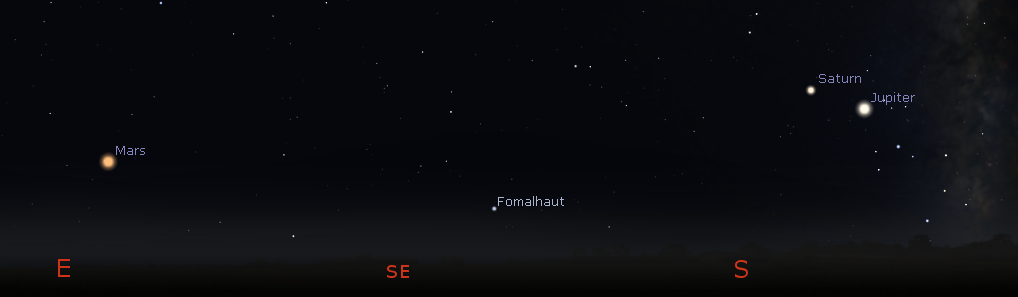
Jupiter, Saturn, and Mars arrayed from south-southwest to east at 9 pm tonight October 7, 2020. Click on the image to enlarge. Created using Stellarium.
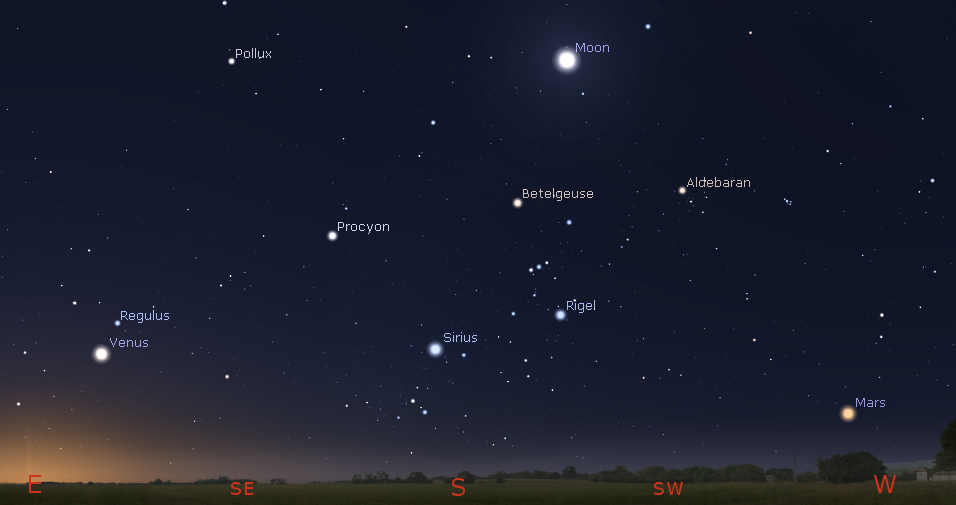
Venus, the Moon and Mars among the stars of winter but at 7 am October 8, 2020. Click on the image to enlarge. Created using Stellarium.
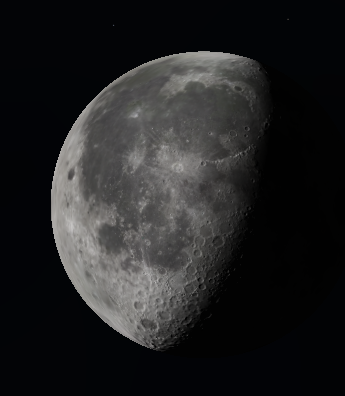
The waning gibbous Moon as it might be seen in binoculars at 7 am tomorrow October 8, 2020. Created using Stellarium.
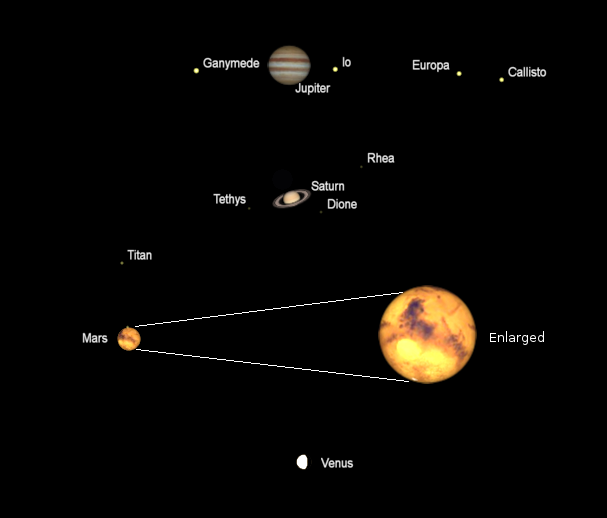
The planets as seen in a telescope (north up) with the same magnification for the night of October 7/8, 2020. Times of the display are: Jupiter and Saturn, 9 pm; small Mars, 9 pm; enlarged Mars, 11 pm, Venus, 7 am. Apparent diameters: Jupiter, 39.64″; Saturn, 17.00″, rings, 39.60″. Mars, 22.56″, and Venus 14.86″. Mars also displays an enlargement showing surface detail. On the Mars enlargement the large dark feature to the upper left of center is Syrtis Major, and the bright area below it is the Hellas Basin. Mars was closest to the Earth this go-a-round on October 6. The ” symbol means seconds of arc (1/3600th of a degree.) Created using Cartes du Ciel (Sky Charts).
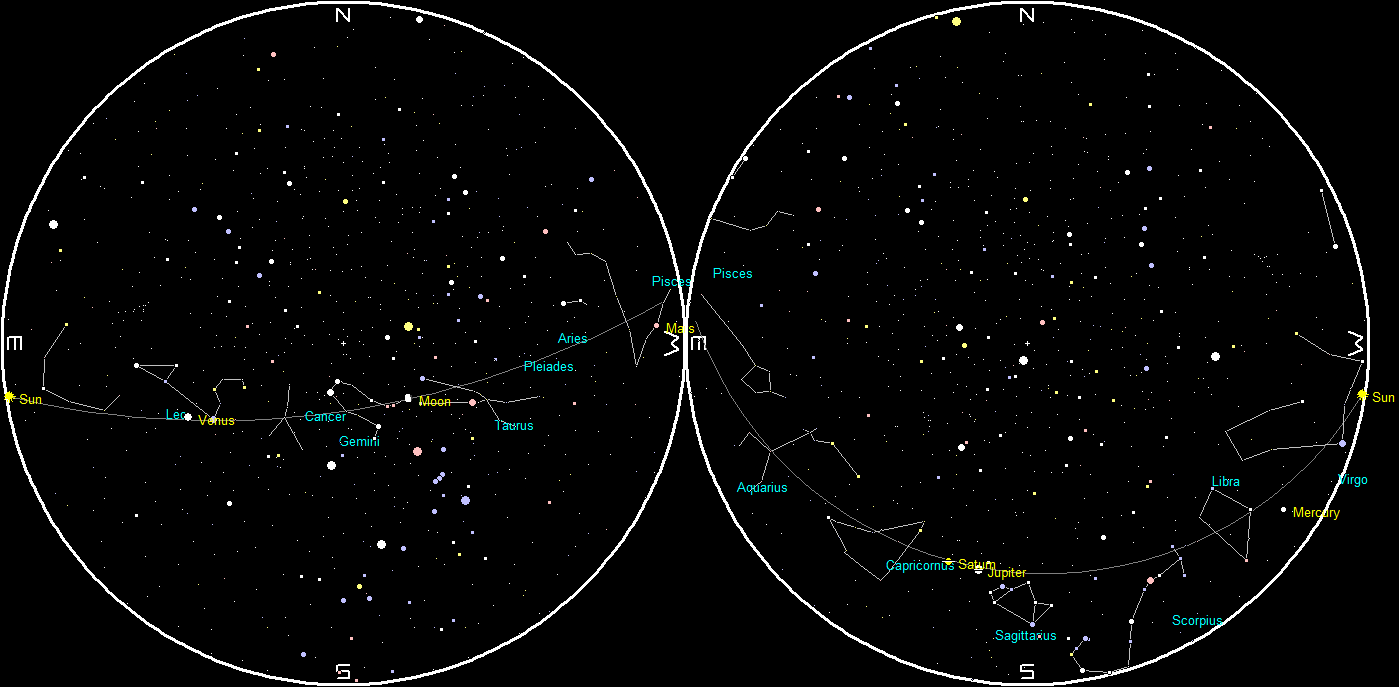
Planets and the Moon at sunset and sunrise of a single night starting with sunset on the right on October 7, 2020. The night ends on the left with sunrise on 8th. Click on the image to enlarge. Created using my LookingUp program.
09/29/2020 – Ephemeris – Let’s look for the naked-eye planets for this week
This is Ephemeris for Wednesday, September 30th. Today the Sun will be up for 11 hours and 43 minutes, setting at 7:24, and it will rise tomorrow at 7:41. The Moon, 1 day before full, will set at 7:11 tomorrow morning.
Let’s look for the naked-eye planets for this week. Jupiter and Saturn are both low in the southern sky at 9 pm. Jupiter is the very bright one. To the left of it will be the somewhat dimmer Saturn which is just about due south at that hour. They are now seemly to close a tiny bit, and they will cross paths on December 21st. Jupiter will set first at 12:48 tomorrow morning with Saturn following at 1:27 am. The next planet visible will be Mars which will rise at 8:12 pm. It’s now down to 38.8 million miles (62.5 million km) away, as the Earth very slowly overtook it by 1.0 million miles (1.5 million km) last week as the Mars will be at its closest in 7 days. Brilliant Venus will rise at 4:07 am as it retreats slowly toward the Sun.
The event times given are for the Traverse City/Interlochen area of Michigan. They may be different for your location.
Addendum
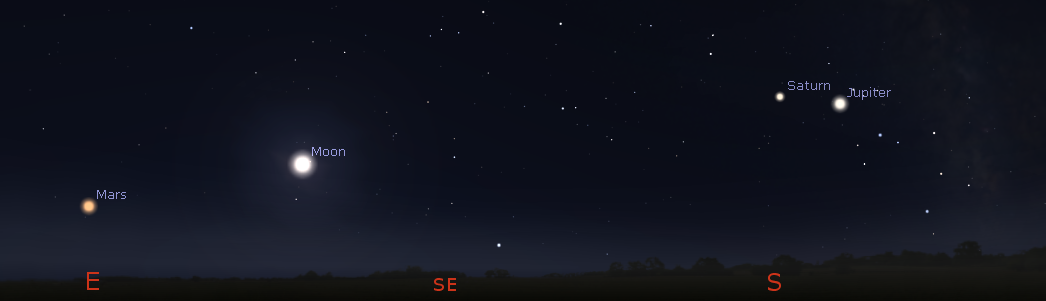
Jupiter, Saturn, the Moon and Mars arrayed from south-southwest to east at 9 pm tonight September 30, 2020. Click on the image to enlarge. Created using Stellarium.
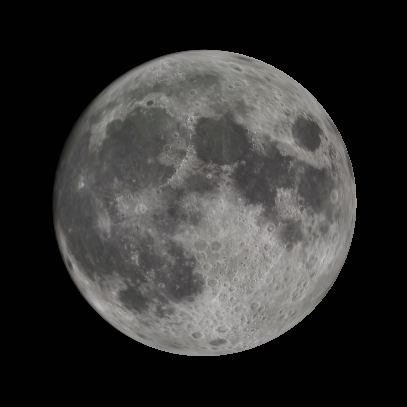
The Moon as it might appear in binoculars or a small telescope tonight at 9 pm, September 30, 2020. Created using Stellarium.
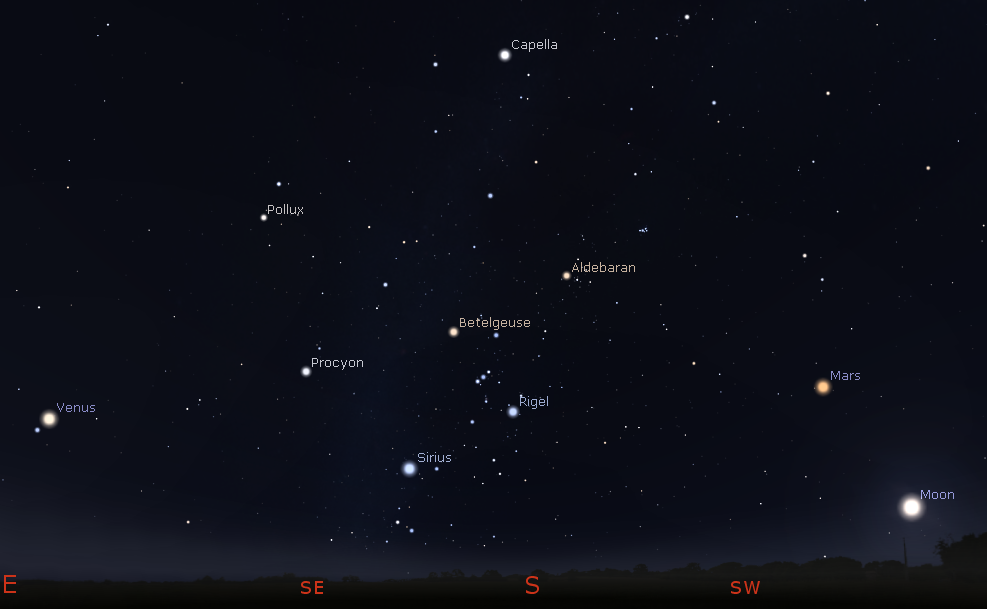
Venus, Mars, the Moon and the stars of winter but at 6 am October 1, 2020. The bright star under Venus is Regulus in Leo the lion. Click on the image to enlarge. Created using Stellarium.
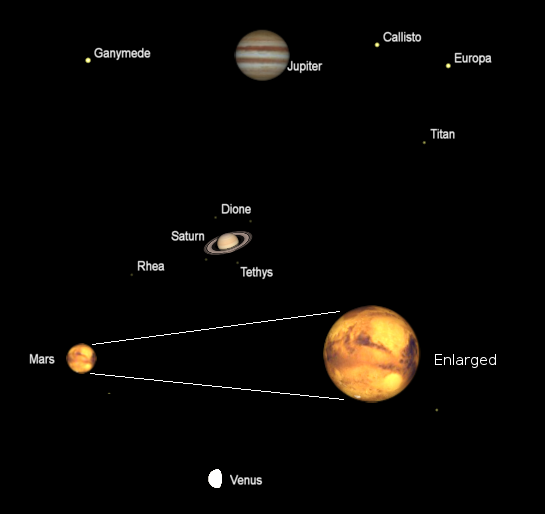
The planets as seen in a telescope (north up) with the same magnification for the night of September 30/October 1, 2020. Times of the display are: Jupiter and Saturn, 9 pm; Mars, Midnight; Venus, 6 am. Apparent diameters: Jupiter, 40.53″; Saturn, 17.20″, rings, 40.07″. Mars, 22.45″, and Venus 15.52″. Jupiter’s moon Io is behind the planet and will reappear at 12:02 am. Mars also displays an enlargement showing surface detail. Mars will be closest to the Earth this go-a-round on October 6. The ” symbol means seconds of arc (1/3600th of a degree.) Created using Cartes du Ciel (Sky Charts).
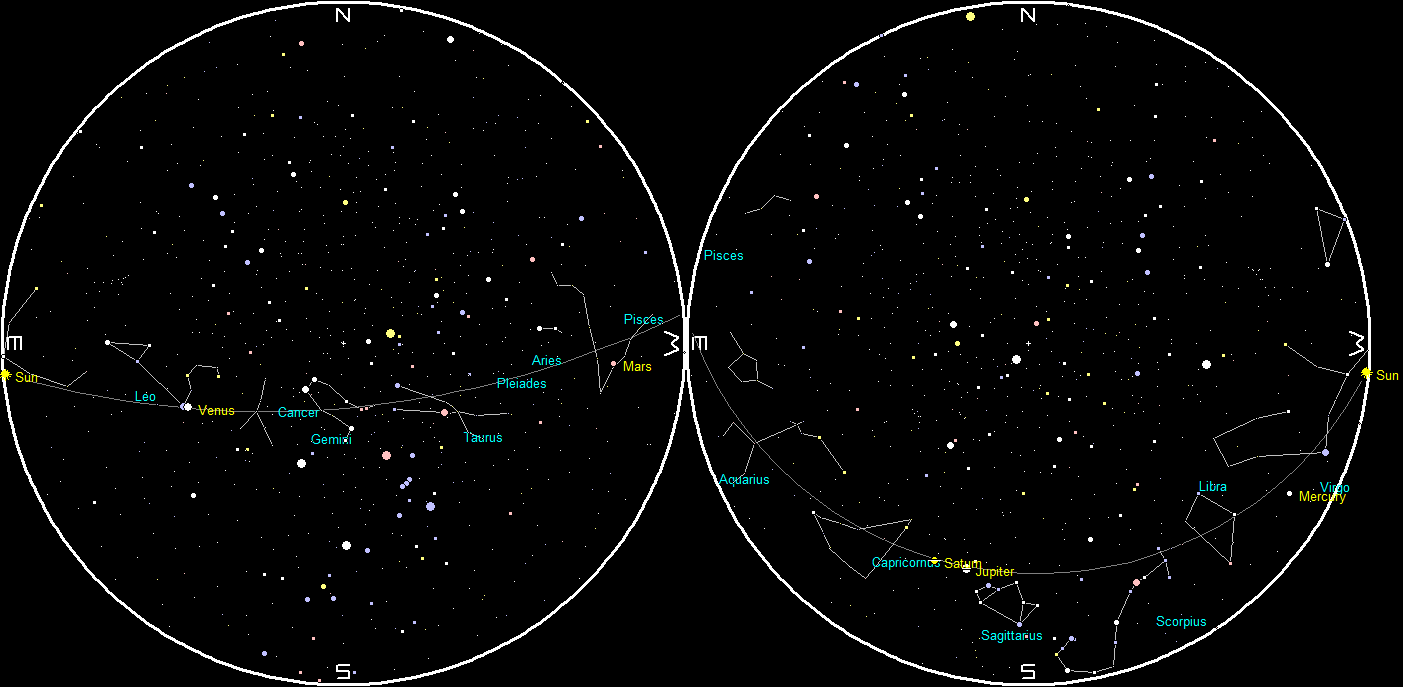
Planets and the Moon at sunset and sunrise of a single night starting with sunset on the right on September 30, 2020. The night ends on the left with sunrise on October 1st. Click on the image to enlarge. Created using my LookingUp program.
09/23/2020 – Ephemeris – Let’s look at a the naked-eye planets for this week
This is Ephemeris for Wednesday, September 23rd. Today the Sun will be up for 12 hours and 5 minutes, setting at 7:37, and it will rise tomorrow at 7:32. The Moon, at first quarter today, will set at 11:53 this evening.
Let’s look at a the naked-eye planets for this week. Jupiter and Saturn are both low in the southern sky at 9 pm. Jupiter is the very bright one. To the left of it will be the somewhat dimmer Saturn. They are now seemly to close a tiny bit since Jupiter is resuming its eastward motion, and they will cross paths in December. Jupiter will set first at 1:11 tomorrow morning with Saturn following at 1:51. The next planet visible will be Mars which will rise at 8:44 pm. Its now down to 39.8 million miles (64.0 million km) away, as the Earth very slowly overtook it by 1.5 million miles (2.6 million km) last week as the Earth is moving nearly abreast of it. Brilliant Venus will rise at 3:53 am as it retreats toward the Sun.
The event times given are for the Traverse City/Interlochen area of Michigan. They may be different for your location.
Addendum
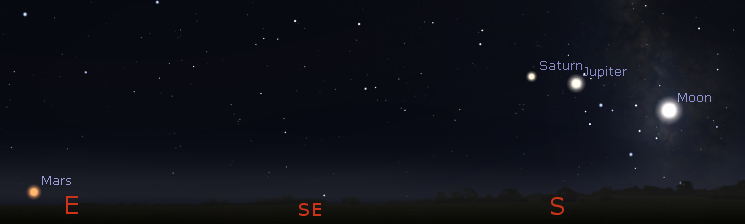
The planets visible at 9 pm or about an hour and a half after sunset tonight September 23, 2020. Click on the image to enlarge. Created using Stellarium and GIMP.
The first quarter Moon tonight as it might appear in binoculars or a low power telescope. Created using Stellarium.
Mars, and Venus and the morning stars at 6 am or an hour and a half before sunrise tomorrow morning September 24, 2020. Click on the image to enlarge. Created using Stellarium and GIMP.
The planets as seen in a telescope (north up) with the same magnification for the night of September 23/24, 2020. Times of the display are: Jupiter and Saturn, 9 pm; Mars, Midnight; Venus, 6 am. Apparent diameters: Jupiter, 41.42″; Saturn, 17.40″, rings, 40.52″. Mars, 21.96″, and Venus 16.25″. Mars also displays an enlargement showing surface detail. Mars will be closest to the Earth this go-a-round on October 6. The ” symbol means seconds of arc (1/3600th of a degree.) Created using Cartes du Ciel (Sky Charts).
Planets and the Moon at sunset and sunrise of a single night starting with sunset on the right on September 23, 2020. The night ends on the left with sunrise on the 24th. Click on the image to enlarge. Created using my LookingUp program.
09/09/2020 – Ephemeris – Let’s look at a the naked-eye planets for this week
This is Bob Moler with Ephemeris for Wednesday, September 9th. Today the Sun will be up for 12 hours and 48 minutes, setting at 8:03, and it will rise tomorrow at 7:16. The Moon, 1 day before last quarter, will rise at 11:48 this evening.
Let’s look at a the naked-eye planets for this week. Jupiter and Saturn are both low in the southern sky at 10 pm. Jupiter is the very bright one. To the left of it will be the somewhat dimmer Saturn. They seem to be separating a teeny bit due to the Earth’s motion now, but they will cross paths in December. Both planets will be up until the morning hours with Jupiter setting first at 2:05 tomorrow morning and Saturn following at 2:47 am. The next planet visible will be Mars which will rise at 9:44 pm. Its now down to 43.3 million miles (69.7 million km) away, as the Earth slowly overtakes it at the rate of about 2.3 million miles (3.8 million km) a week as the Earth begins to pull abreast of it. Brilliant Venus will rise at 3:30 am as it retreats toward the Sun.
The event times given are for the Traverse City/Interlochen area of Michigan. They may be different for your location.
Addendum
Jupiter and Saturn with the zodiacal constellations at 9 pm tonight September 9, 2020. Click on the image to enlarge. Created using Stellarium and GIMP.
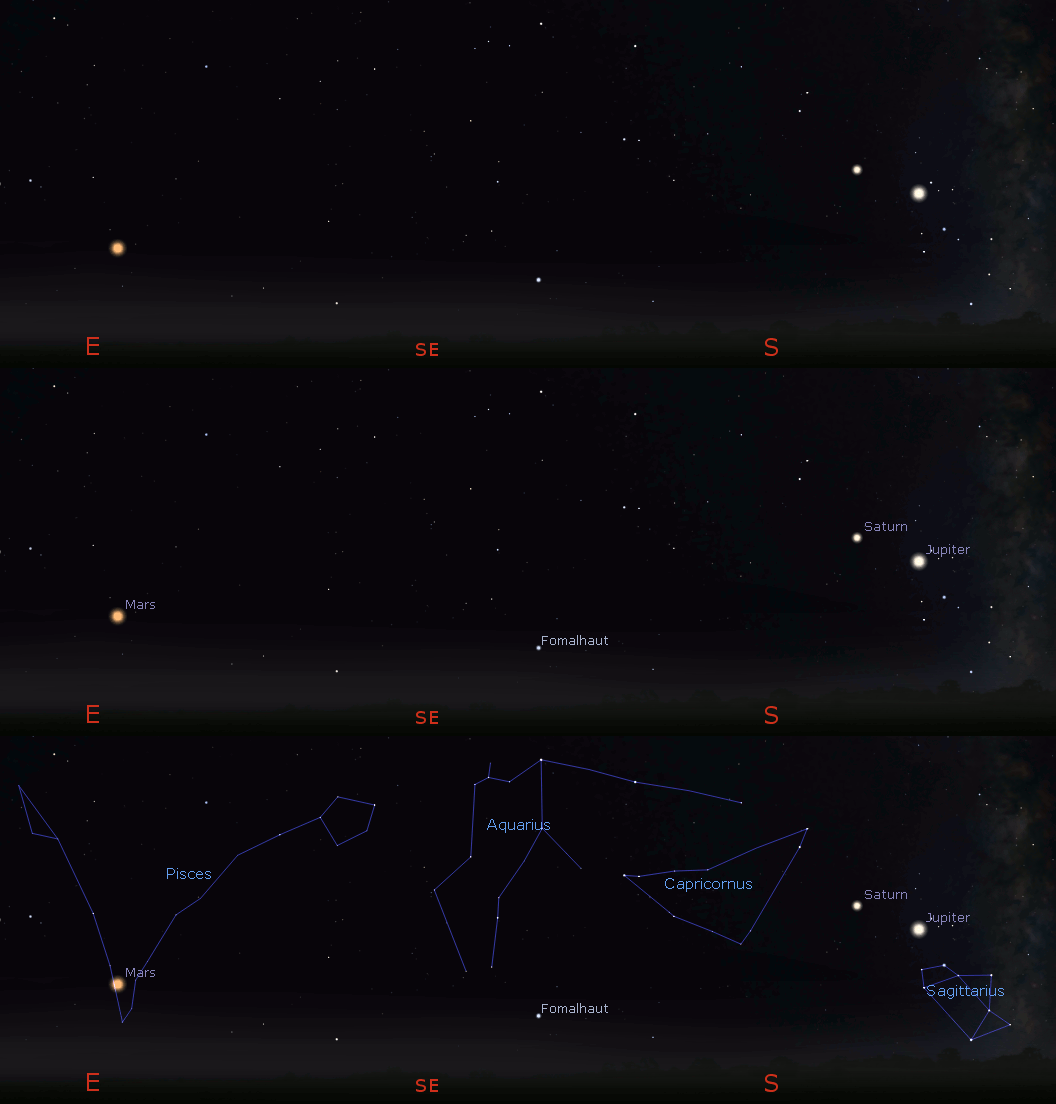
Jupiter, Saturn and Mars with the zodiacal constellations at 11 pm tonight September 9, 2020. Click on the image to enlarge. Created using Stellarium and GIMP.
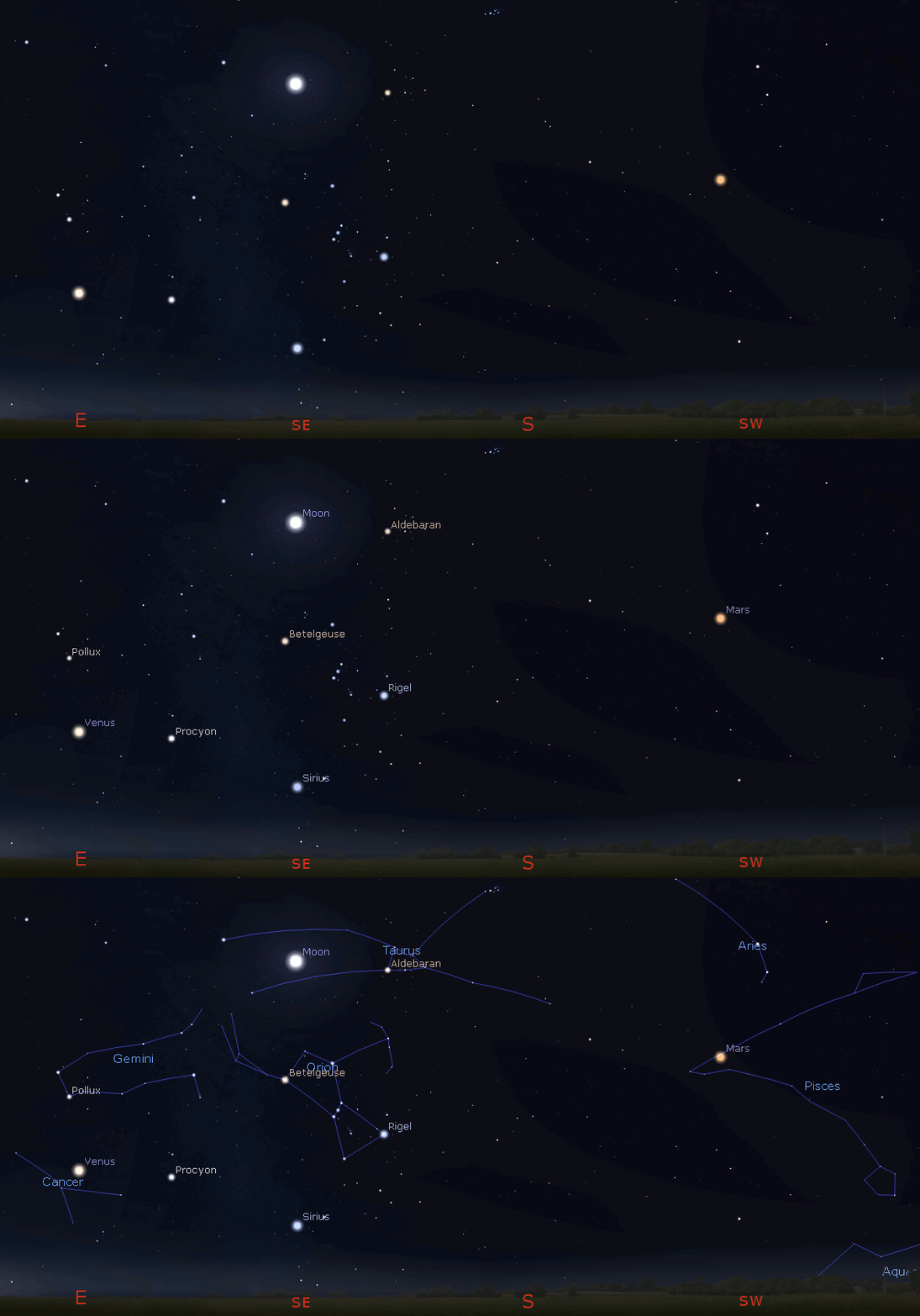
Mars, the Moon, Venus and the zodiacal constellations and Orion at 6 am tomorrow morning September 10, 2020. Click on the image to enlarge. Created using Stellarium and GIMP.
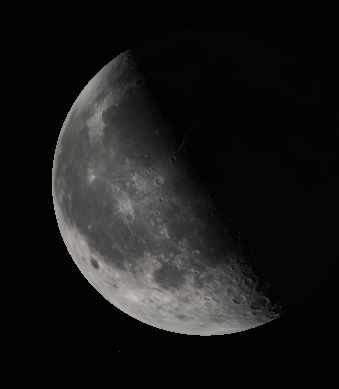
The last quarter Moon as it might be seen in binoculars at 6 am tomorrow September 10, 2020. Created using Stellarium.
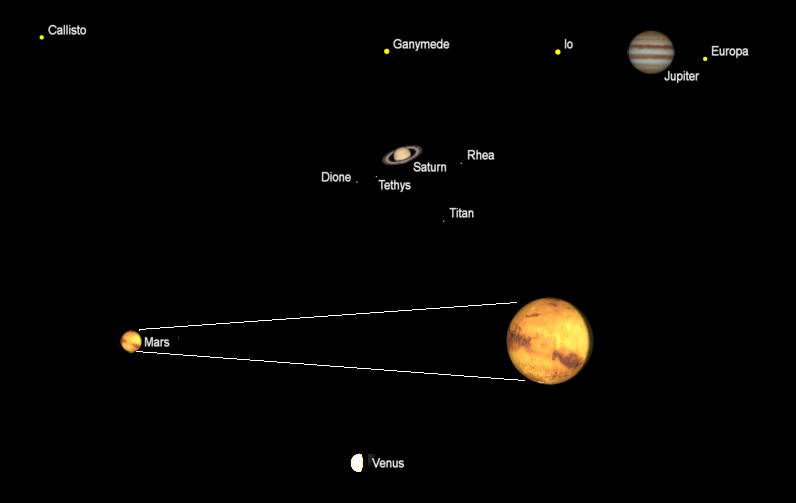
The planets as seen in a telescope (north up) with the same magnification for the night of September 9/10, 2020. Times of the display are: Jupiter and Saturn, 9 pm; Mars, Midnight; Venus, 6 am. Apparent diameters: Jupiter, 43.21″; Saturn, 17.77″, rings, 41.39″. Mars, 20.26″, and Venus 18.04″. Mars also displays an enlargement showing surface detail. The ” symbol means seconds of arc (1/3600th of a degree.) Created using Cartes du Ciel (Sky Charts).
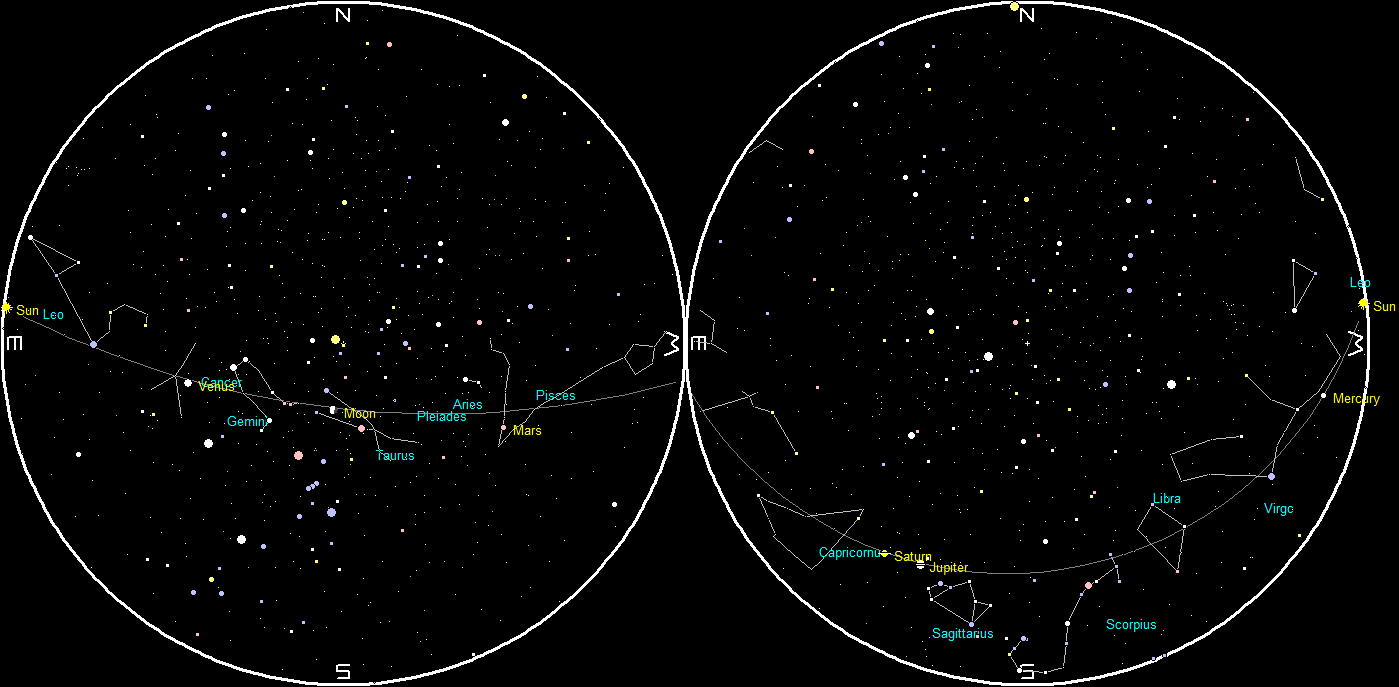
Planets and the Moon at sunset and sunrise of a single night starting with sunset on the right on September 9, 2020. The night ends on the left with sunrise on the 10th. Click on the image to enlarge. Created using my LookingUp program.
09/02/2020 – Ephemeris – Let’s look at a the naked-eye planets for this week
This is Ephemeris for Wednesday, September 2nd. Today the Sun will be up for 13 hours and 9 minutes, setting at 8:16, and it will rise tomorrow at 7:08. The Moon, at full today, will rise at 8:58 this evening.
Let’s look at a the naked-eye planets for this week. Jupiter and Saturn are both low in the south-southeastern sky at 10 pm. Jupiter is the very bright one. To the left of it will be Saturn. They now seem to be separating a bit due to the Earth’s motion now, but they will cross paths in December. Both planets will be up until the morning hours with Jupiter setting first at 2:33 tomorrow morning and Saturn following at 3:16 am. The next planet visible will be Mars which will rise at 10:11 pm. Its now down to 45.6 million miles (73.5 million kilometers) away, as the Earth slowly overtakes it at the rate of about 2.7 million miles (4.3 million kilometers) a week as the Earth begins to pull abreast of it. Brilliant Venus will rise at 3:14 am.
The event times given are for the Traverse City/Interlochen area of Michigan. They may be different for your location.
Addendum
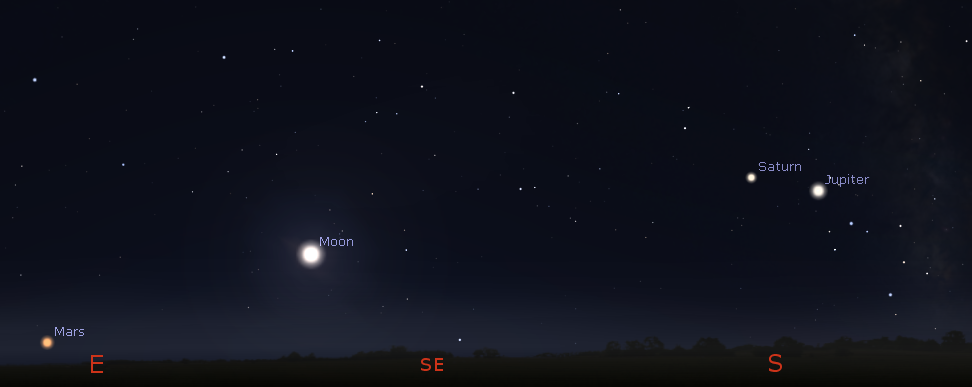
Planets and the Moon in the evening at 10:30 tonight, September 2, 2020. Click on the image to enlarge. Created using Stellarium.
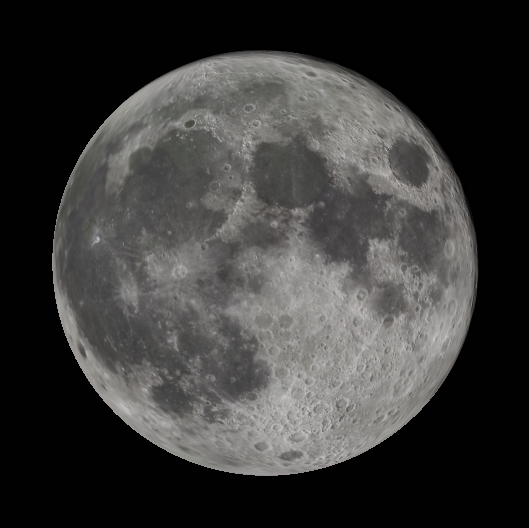
The full Moon tonight September 2, 2020 as it might appear at 10 pm in a low power telescope. Created using Stellarium.
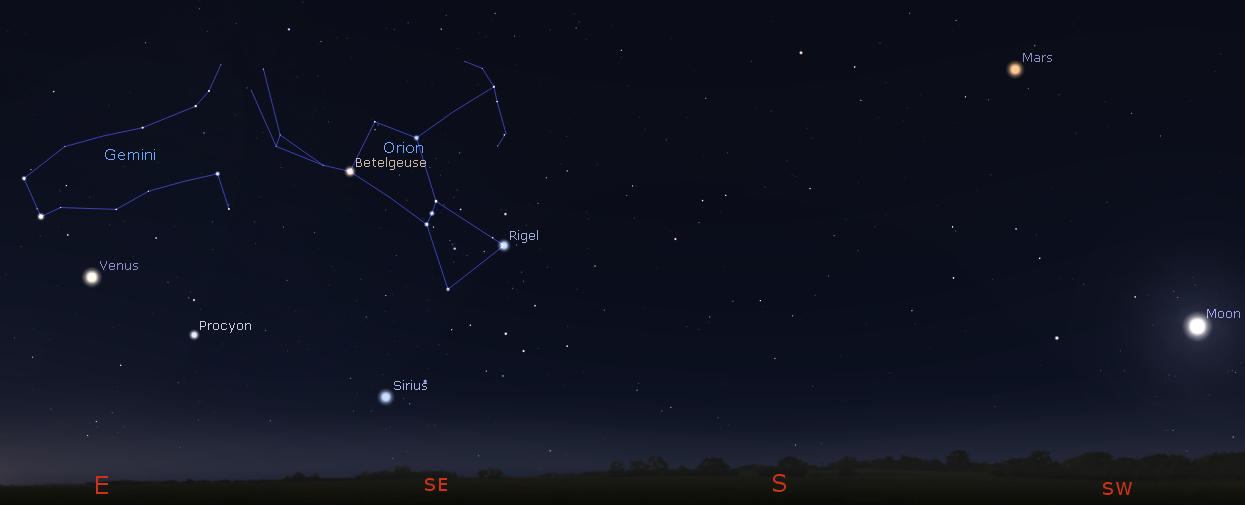
Planets and the Moon in the morning tomorrow, September 3, 2020. Click on the image to enlarge. Created using Stellarium.
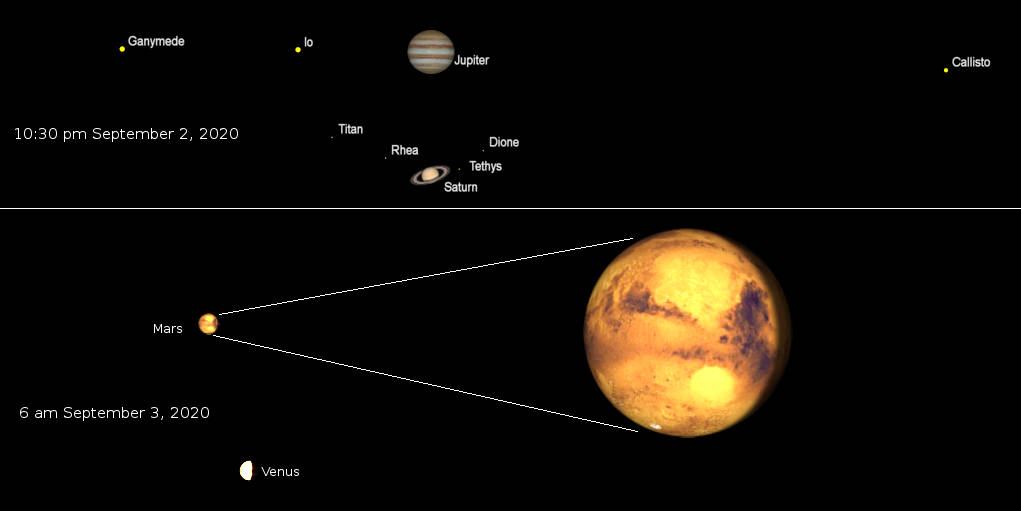
The planets as seen in a telescope (north up) with the same magnification Apparent diameters: Jupiter, 44.07″; Saturn, 17.93″, rings, 41.77″. Mars, 19.26″, and Venus 19.12″. At 6 am. Mars also displays an enlargement showing surface detail. The ” symbol means seconds of arc (1/3600th of a degree.) Created using Cartes du Ciel (Sky Charts).
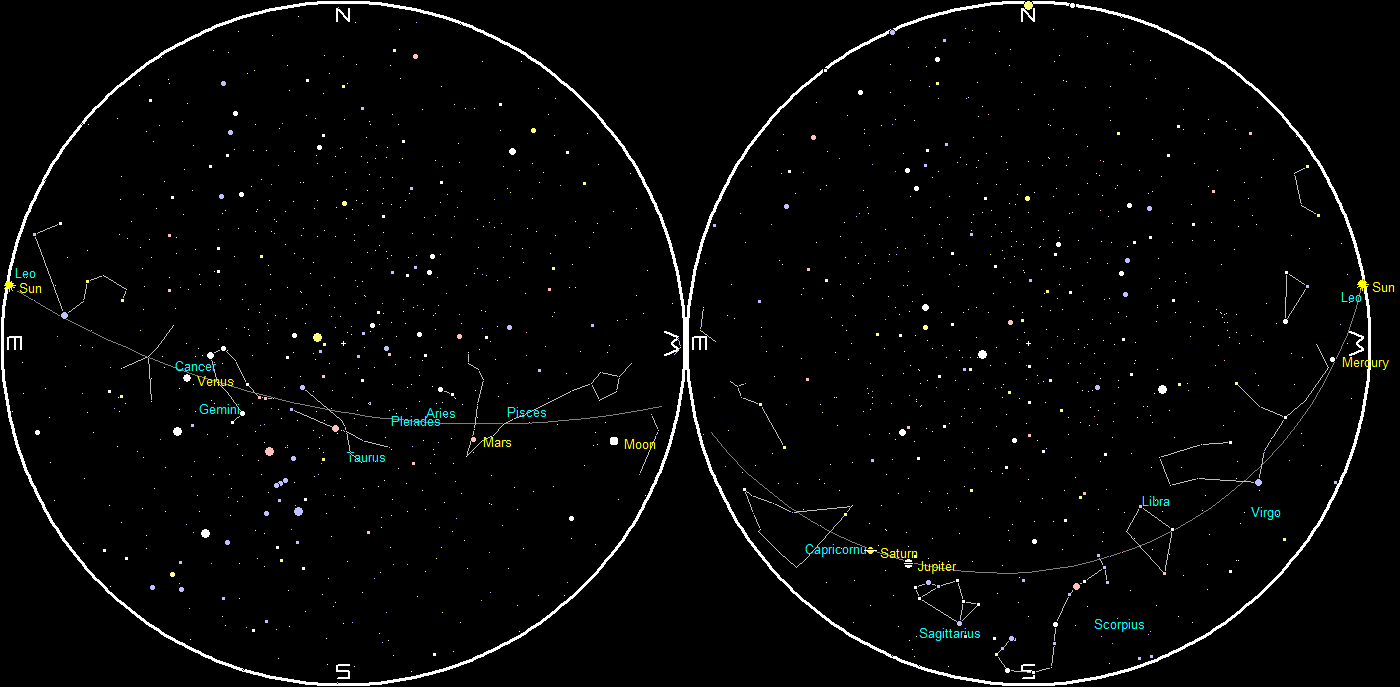
Planets and the Moon at sunset and sunrise of a single night starting with sunset on the right on September 2, 2020. The night ends on the left with sunrise on the 3rd. Click on the image to enlarge. Created using my LookingUp program.
08/26/2020 – Ephemeris – Let’s look at a the naked-eye planets for this week
This is Ephemeris for Wednesday, August 26th. Today the Sun will be up for 13 hours and 30 minutes, setting at 8:29, and it will rise tomorrow at 6:59. The Moon, 1 day past first quarter, will set at 1:09 tomorrow morning.
Let’s look at a the naked-eye planets for this week. Jupiter and Saturn are both low in the south-southeastern sky at 10 pm. Jupiter is the very bright one. To the left of it will be Saturn. They now seem to be separating a bit due to the Earth’s motion now, but they will cross paths in December. Both planets will be up most of the night with Jupiter setting first at 3:02 tomorrow morning and Saturn following at 3:45 am. The next planet visible will be Mars which will
rise at 10:36 pm. Its now down to 48.3 million miles (77.8 million kilometers) away, as the Earth slowly overtakes it at the rate of about 3.0 million miles (4.8 million kilometers) a week. Brilliant Venus will rise at 3:14 am and is moving ahead of the Earth in its orbit.
The event times given are for the Traverse City/Interlochen area of Michigan. They may be different for your location.
Addendum
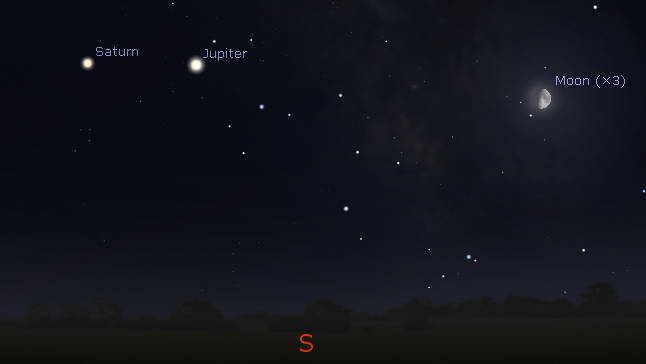
Jupiter, Saturn and the Moon at 10 pm August 26, 2020. Note that the Moon is enlarged 3 times to show its phase. Click on the image to enlarge. Created using Stellarium.
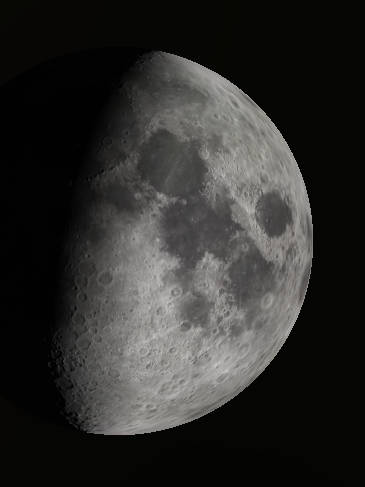
The gibbous Moon as it might be seen tonight at 10 pm August 26, 2020. Created using Stellarium.
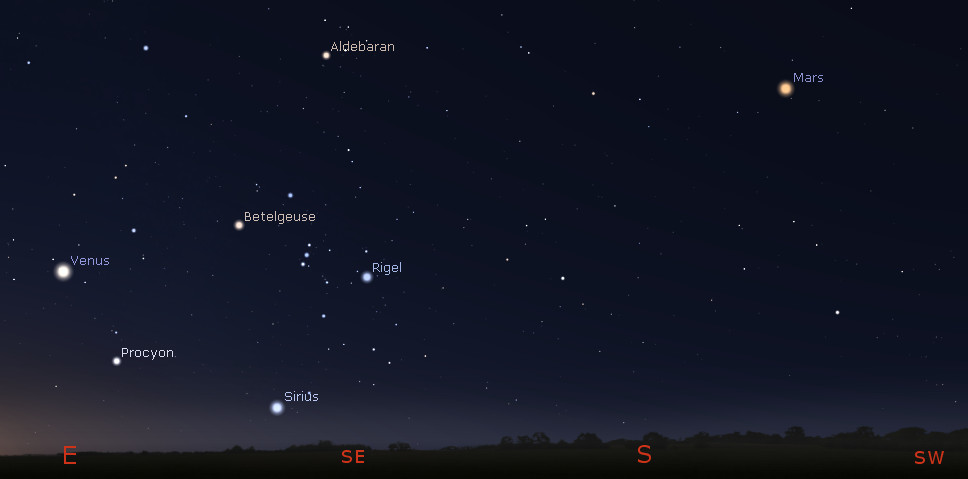
Venus and Mars at 6 am tomorrow morning August 27, 2020. Click on the image to enlarge. Created using Stellarium.
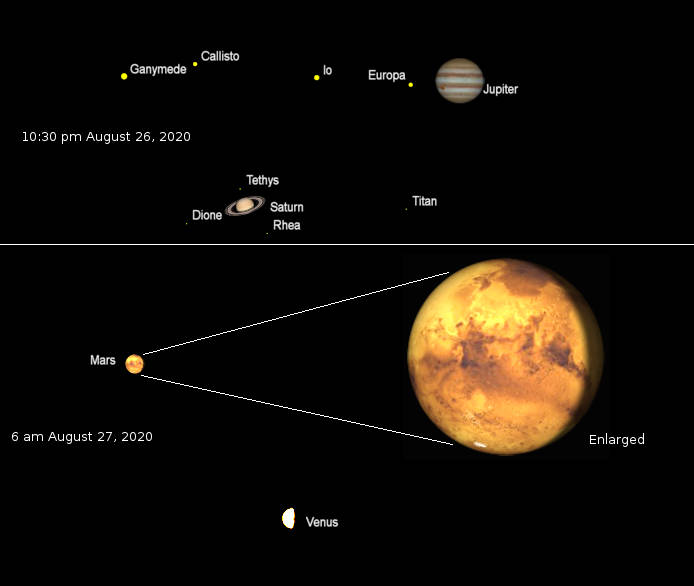
The planets as seen in a telescope (north up) with the same magnification Apparent diameters: Jupiter, 44.89″; Saturn, 18.08″, rings, 42.12″. Mars, 18.21″, and Venus 20.37″. At 6 am. Mars also displays an enlargement showing surface detail. The ” symbol means seconds of arc (1/3600th of a degree.) Created using Cartes du Ciel (Sky Charts).
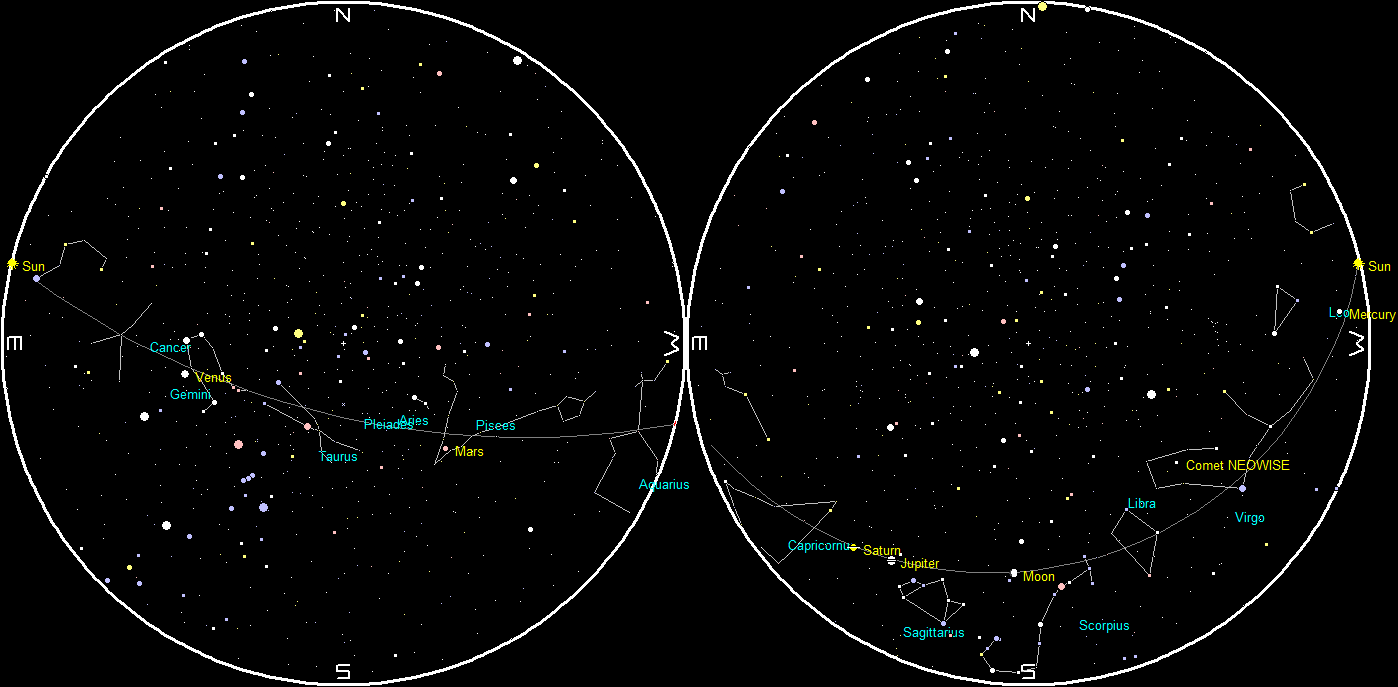
Planets and the Moon at sunset and sunrise of a single night starting with sunset on the right on August 26, 2020. The night ends on the left with sunrise on the 27th. Comet NEOWISE is now 8th magnitude, almost too faint for binoculars. Click on the image to enlarge. Created using my LookingUp program.
08/12/2020 – Ephemeris – Let’s look at a the naked-eye planets for this week
This is Ephemeris for Wednesday, August 12th. Today the Sun will be up for 14 hours and 10 minutes, setting at 8:52, and it will rise tomorrow at 6:43. The Moon, 1 day past last quarter, will rise at 1:16 tomorrow morning.
Let’s look at a the naked-eye planets for this week. Jupiter and Saturn are both low in the south-southeastern sky at 10 pm. Jupiter is the very bright one. To the left of it will be Saturn. They now seem to be separating a bit due to the Earth’s motion now, but they will cross paths in December. Both planets will be up most of the night with Jupiter setting first at 4:02 tomorrow morning and Saturn following at 4:44 am. The next planet visible will be Mars which will rise at 11:22 pm. Its now down to 54.3 million miles (87.5 million kilometers) away, as the Earth slowly overtakes it at the rate of about 3.4 million miles (5.4 million kilometers) a week. Brilliant Venus will rise at 3:09 am in the east-northeast and is as far west from the Sun as it can get today.
The event times given are for the Traverse City/Interlochen area of Michigan. They may be different for your location.
Addendum
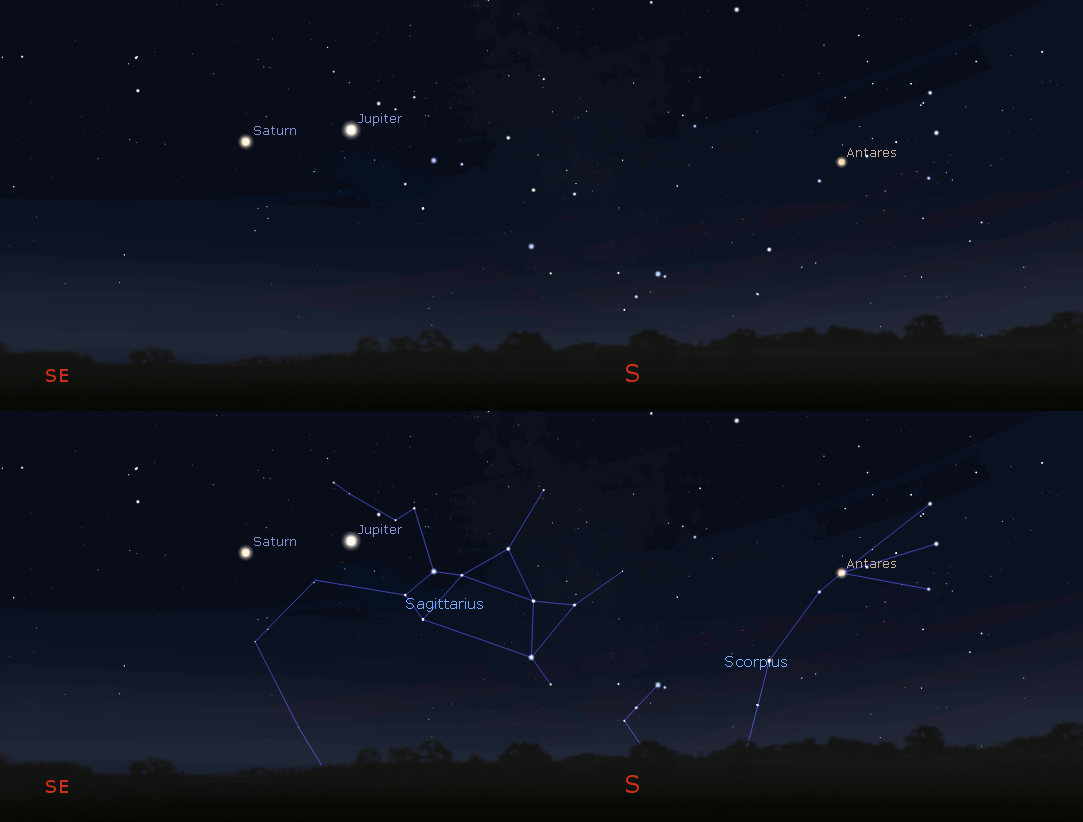
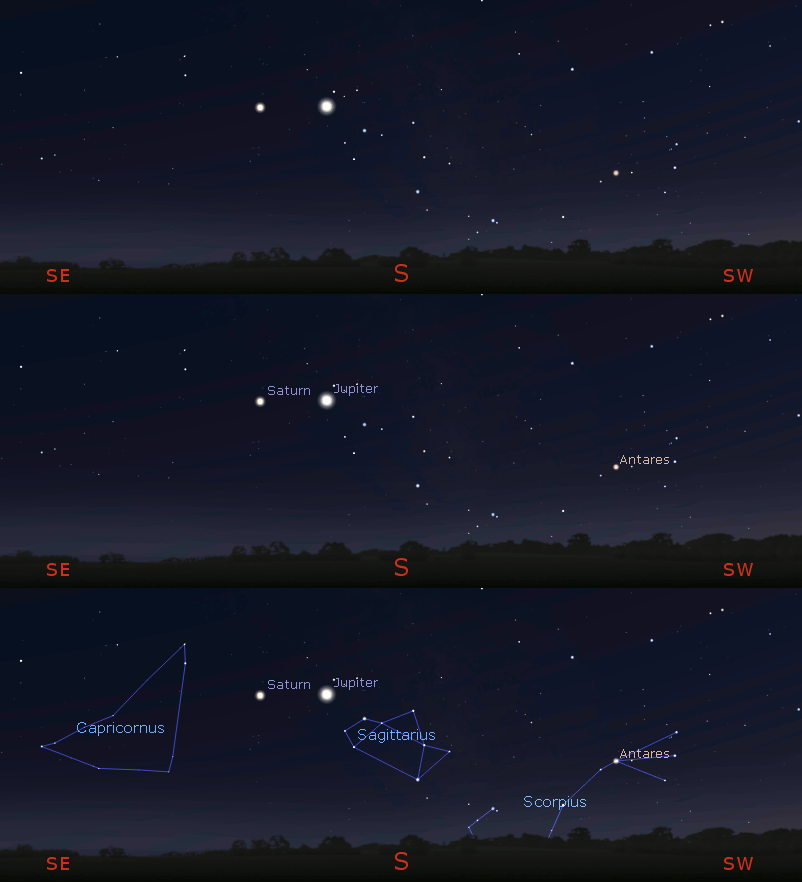
Jupiter and Saturn animation at 10 pm with Sagittarius and Scorpius constellation lines. Click on the image to enlarge. Created using Stellarium and GIMP.
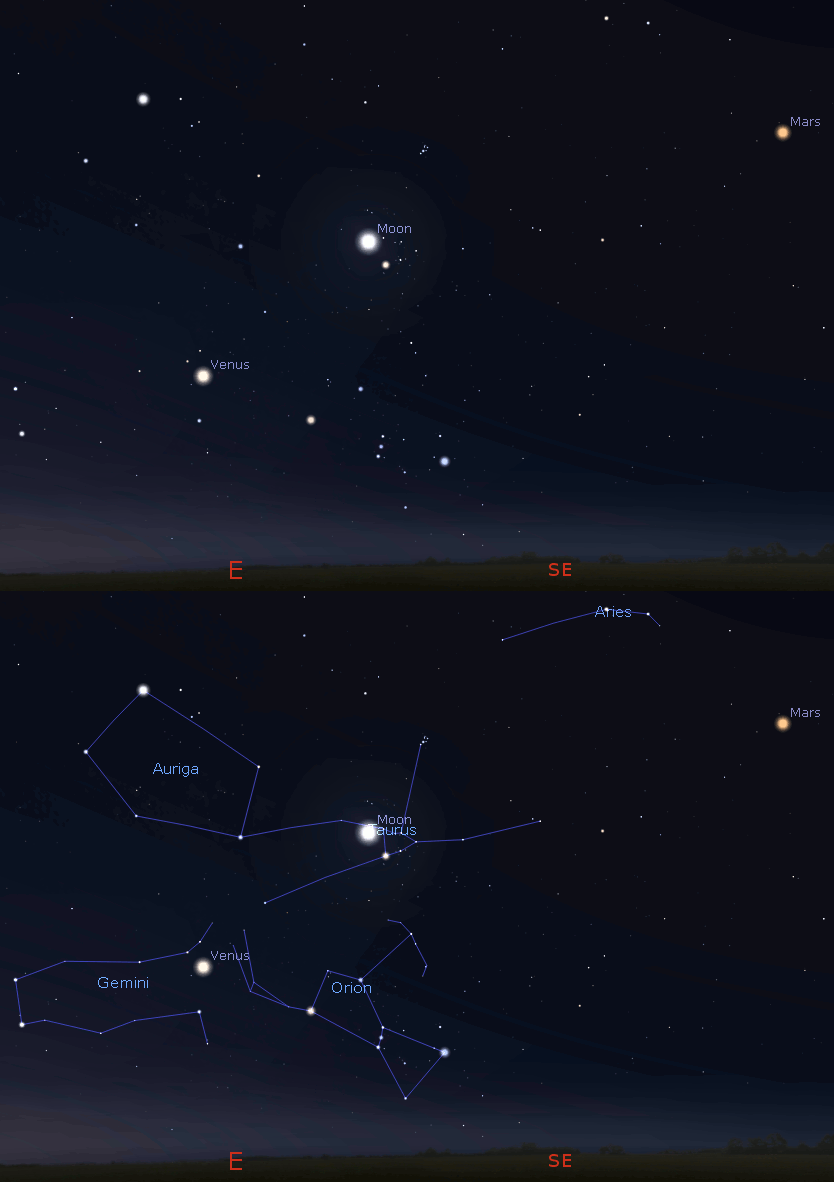
The morning planets and the Moon as seen at 5:30 am or about an hour before sunrise tomorrow morning August 13, 2020 with and without the lines delineating nearby constellations. Click on the image to enlarge. Created using Stellarium.
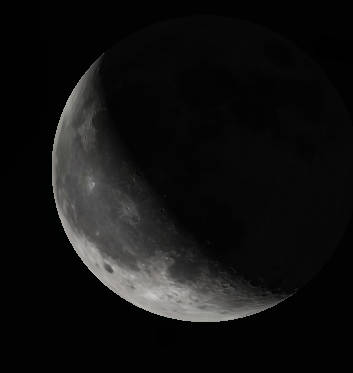
The Moon as it might be seen in binoculars at 5:30 am tomorrow August 13, 2020. Created using Stellarium.
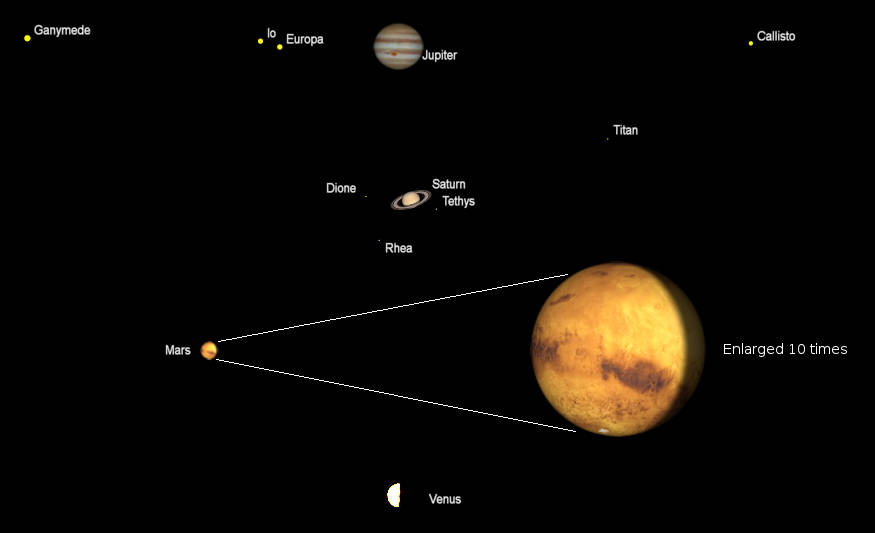
The planets as seen in a telescope (north up) with the same magnification (Jupiter and Saturn) tonight at 10 pm August 12 and (Venus and Mars) 5:30 am tomorrow August 13, 2020. Apparent diameters: Jupiter, 46.31″; Saturn, 18.32″, rings, 42.67″, Mars, 16.18″, and Venus 23.49″. Mars also displays an enlargement showing surface detail. The ” symbol means seconds of arc (1/3600th of a degree.) Created using Cartes du Ciel (Sky Charts).
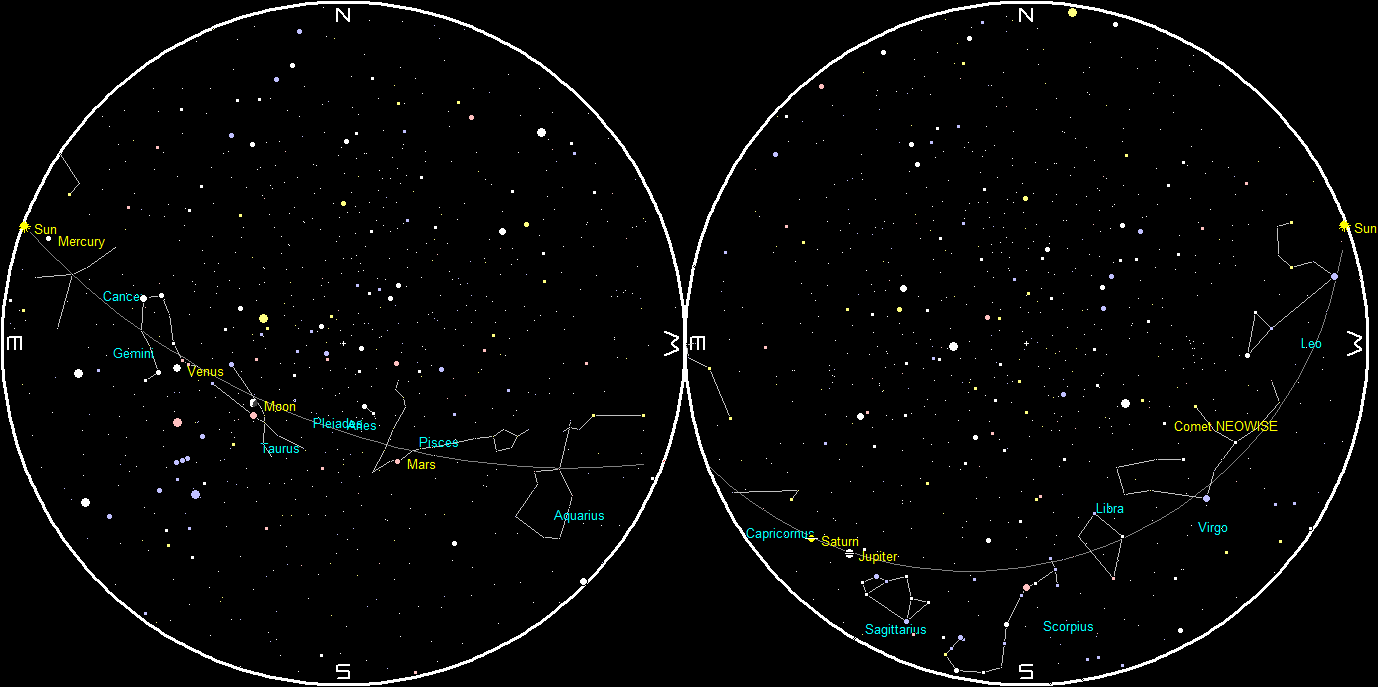
Planets and the Moon at sunset and sunrise of a single night starting with sunset on the right on August 12, 2020. The night ends on the left with sunrise on the 13th. Click on the image to enlarge. Created using my LookingUp program.
08/05/2020 – Ephemeris – Let’s look at the naked-eye planets for this week
This is Bob Moler with Ephemeris for Wednesday, August 5th. Today the Sun will be up for 14 hours and 28 minutes, setting at 9:02, and it will rise tomorrow at 6:35. The Moon, 2 days past full, will rise at 10:32 this evening.
Let’s look at the naked-eye planets for this week. Jupiter and Saturn are both low in the southeastern sky in the evening. Jupiter is the very bright one. To the left of it will be Saturn. They now seem to be separating a bit due to the Earth’s motion now, but they will cross paths in December. Both planets will be up most of the night with Jupiter setting first at 4:33 am tomorrow morning and Saturn following at 5:14 am. The next planet visible will be Mars which will rise at 11:43 pm. Its now down to 57.7 million miles (92.9 million km) away, as the Earth slowly overtakes it at the rate of about 3.4 million miles (5.5 million km) a week. Brilliant Venus will rise at 3:09 am in the east-northeast as our Morning Star.
The event times given are for the Traverse City/Interlochen area of Michigan. They may be different for your location.
Addendum
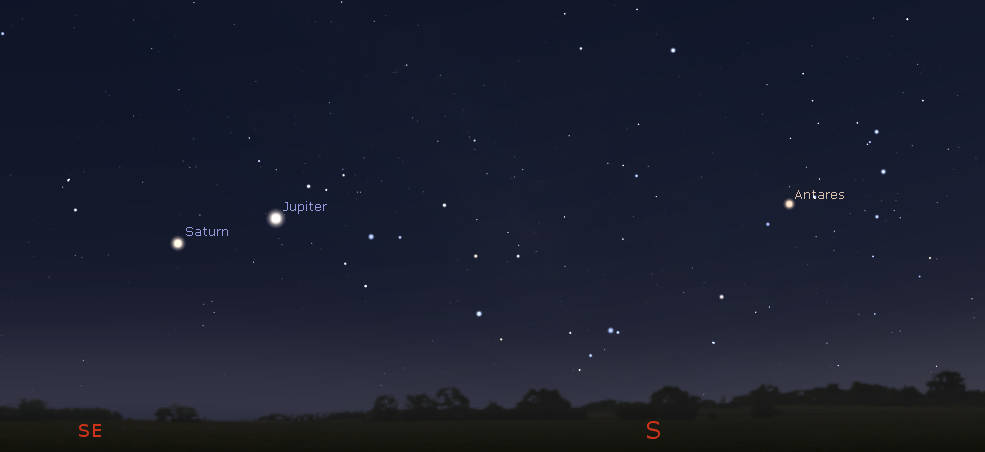
Evening planets Jupiter and Saturn seen in the southeast along with the constellations of Sagittarius (looks like a teapot) and Scorpius at 10 pm, about 45 minutes after sunset tonight August 5, 2020. Click on the image to enlarge. Created using Stellarium.
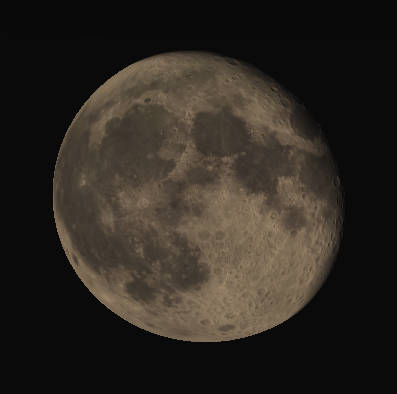
The Moon as it might be seen in binoculars at 11 pm tonight August 5, 2020, about a half hour after it rises. Created using Stellarium.
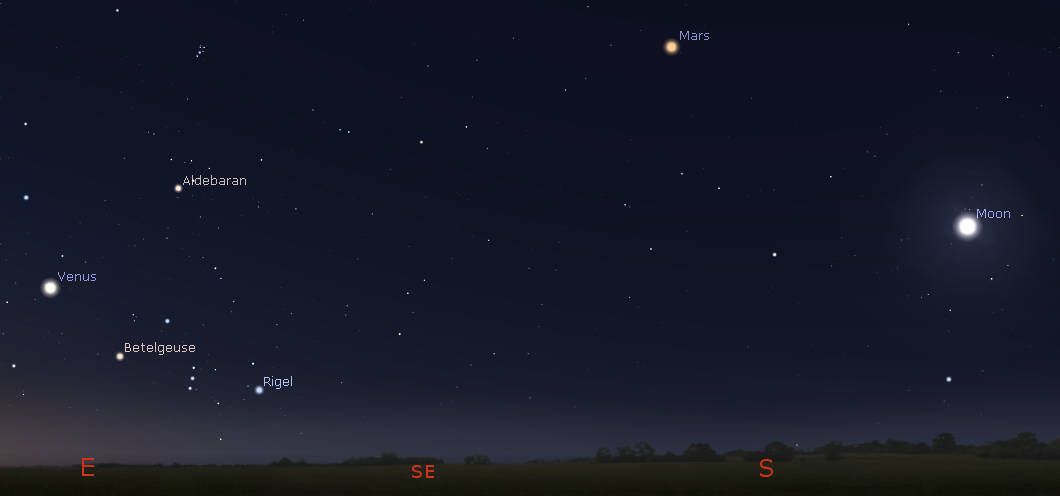
The morning planets and the Moon as seen at 5:30 am or about an hour before sunrise tomorrow morning August 6, 2020. Note the winter constellation of Orion rising in the east with its two brightest stars Betelgeuse and Rigel labeled. Click on the image to enlarge. Created using Stellarium.
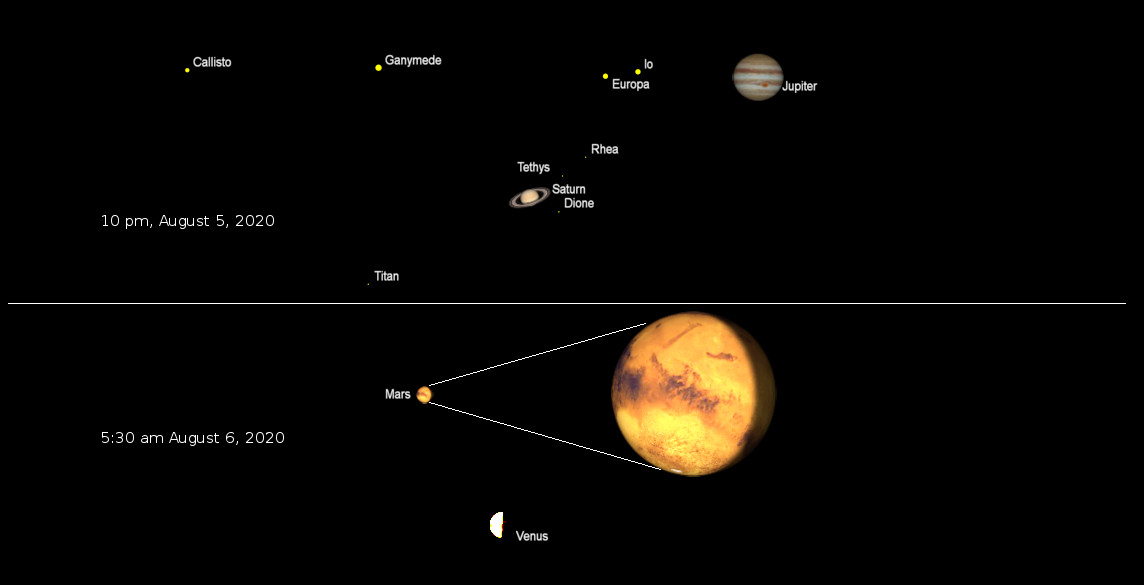
The planets as seen in a telescope (north up) with the same magnification tonight and tomorrow, August 5/6, 2020. Apparent diameters: Jupiter, 46.85″; Saturn, 18.40″, rings, 42.85″ at 10 pm. Mars, 15.26″, and Venus 25.46″. At 5:30 am. Mars also displays an enlargement showing surface detail. The ” symbol means seconds of arc (1/3600th of a degree.) Created using Cartes du Ciel (Sky Charts).
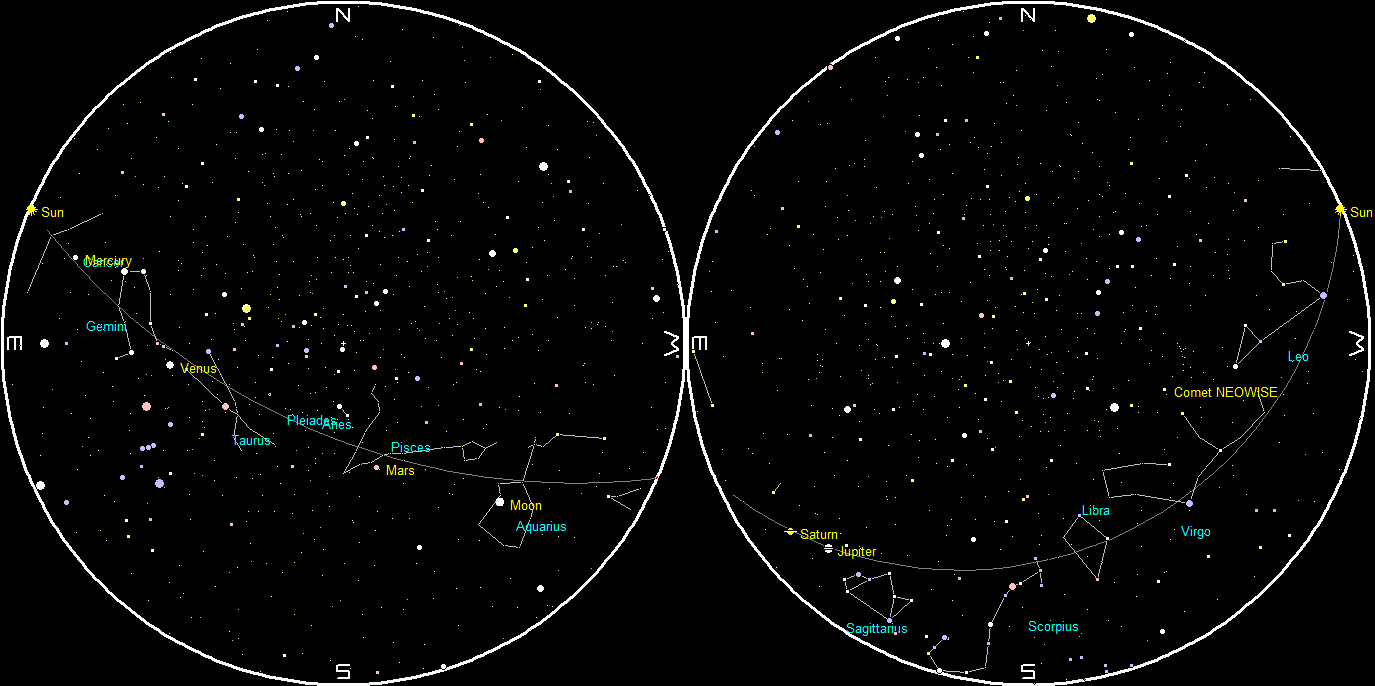
Planets and the Moon at sunset and sunrise of a single night starting with sunset on the right on August 5, 2020. The night ends on the left with sunrise on the 6th. Click on the image to enlarge. Created using my LookingUp program.
07/15/2020 – Ephemeris – Let’s look at a comet and the naked-eye planets for this week
This is Ephemeris for Wednesday, July 15th. Today the Sun will be up for 15 hours and 13 minutes, setting at 9:25, and it will rise tomorrow at 6:12. The Moon, 3 days past last quarter, will rise at 2:47 tomorrow morning.
Let’s look at a comet and naked-eye planets for this week. Jupiter now rises before sunset and now is an official evening planet. It’s seen low in the southeast in the evening. To the left of it will be Saturn. The next planet up will be Mars which will rise at 12:41 am. Its now down to 67.8 million miles (109.2 million km) away, as the Earth slowly overtakes it at the rate of about 3.7 million miles (6 million km) a week. Venus will rise at 3:33 am in the east-northeast as our Morning Star. Newly discovered Comet NEOWISE is now visible in the evening sky A good time to start looking would be about 10:45 pm toward the northwest. The comet is trending brighter than early predictions and sports a wide tail. The comet gets its name from the NASA Satellite and mission to detect near Earth objects or NEOs in the infrared.
The event times given are for the Traverse City/Interlochen area of Michigan. They may be different for your location.
Addendum
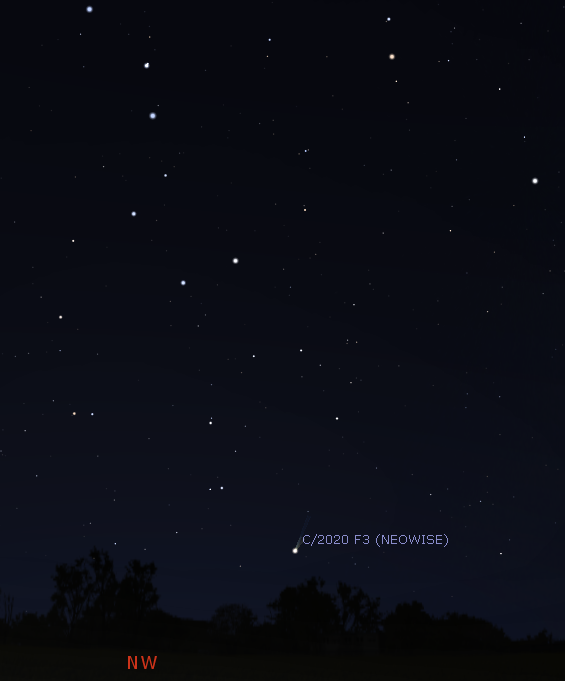
Comet NEOWISE in the evening tonight July 15, 2020 at 11 pm. The comet’s head or coma is shown somewhat brighter than it actually appears. What shows up first is the streak oa the tail. 11 pm here in western Michigan is equivalent to about an hour and a half after sunset. Created using Stellarium.
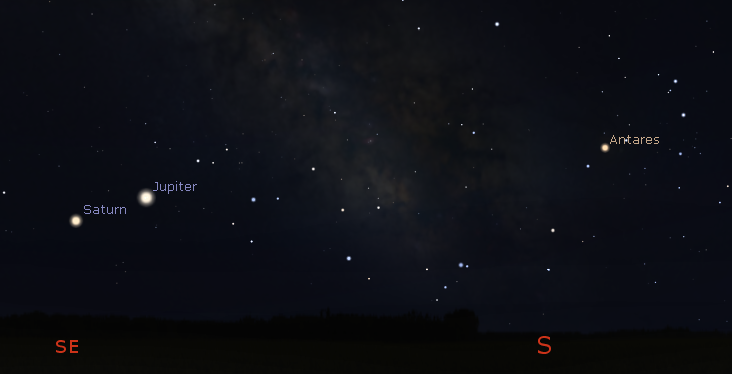
Saturn and Jupiter in the evening tonight at 11 pm July 15, 2020. Also shown are the stars of the Teapot of Sagittarius and Scorpius to the right. Click on the image to enlarge. Created using Stellarium.
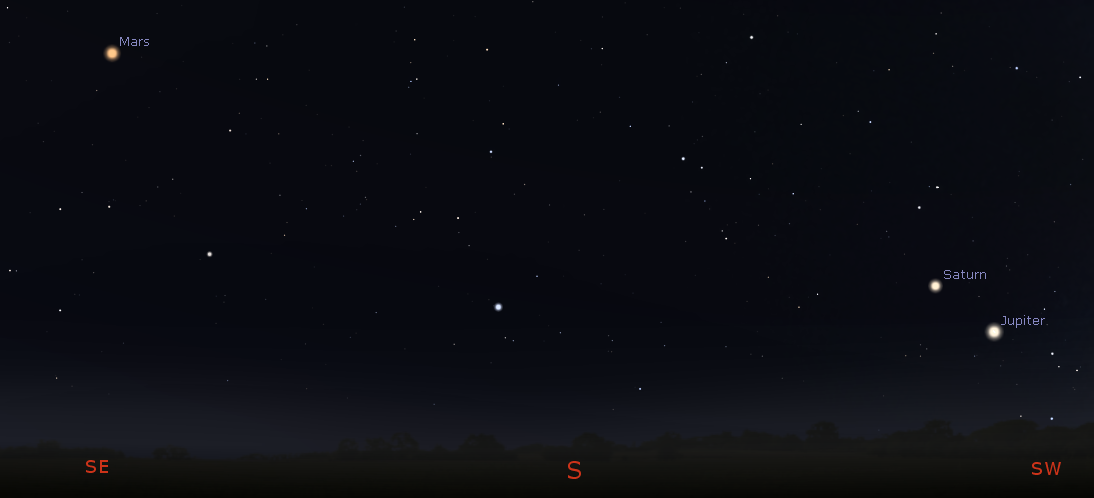
Mars, Saturn and Jupiter at 4:30 tomorrow morning July 16, 2020. Click on the image to enlarge. Created using Stellarium.
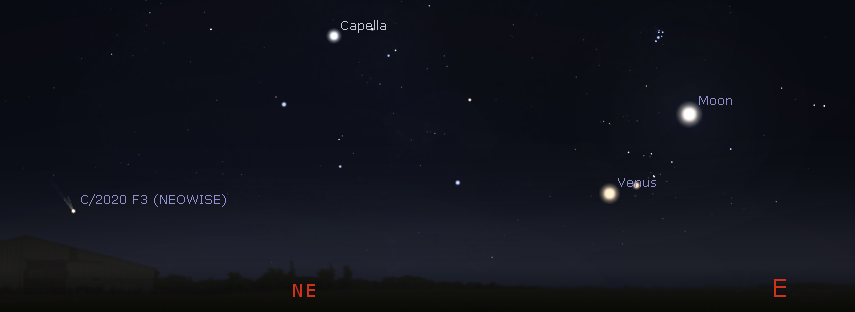
Venus, the Moon and the comet in the morning at 4:30 am or about an hour, 45 minutes before sunrise. Click on the image to enlarge. Created using Stellarium.
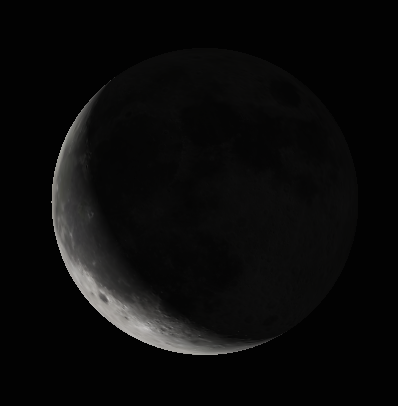
Binocular Moon tomorrow morning at 4:30 a.m. July 16, 2020. The large dark gray area centered on the 9 o’clock position that dominates the crescent is Oceanus Procellarum (Ocean of Storms). The dark floored crater near the limb at the 8 o’clock position is Grimaldi. Created using Stellarium.
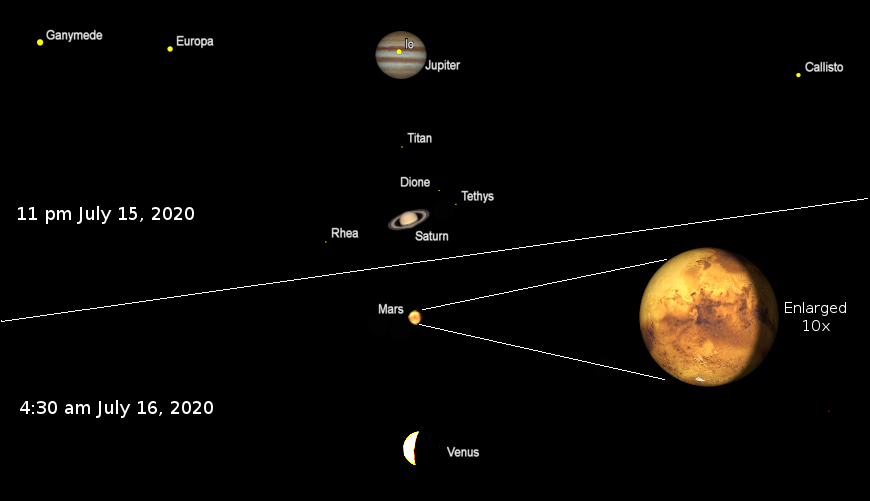
The planets as seen in a telescope (north up) with the same magnification tonight and tomorrow July 15/16, 2020. Apparent diameters: Jupiter, 47.63″; Saturn, 18.47″, rings, 43.02″, Mars, 12.87″, and Venus 33.81″. At 11 pm the moon Io is transiting the face of Jupiter. I’ve ever been able to spot a moon in transit, though I can sometimes see the shadow cast on the planet. By 4:30 am Io will appear next to Jupiter on the same side as Callisto. Mars also displays an enlargement showing surface detail. The ” symbol means seconds of arc (1/3600th of a degree.) Created using Cartes du Ciel (Sky Charts).
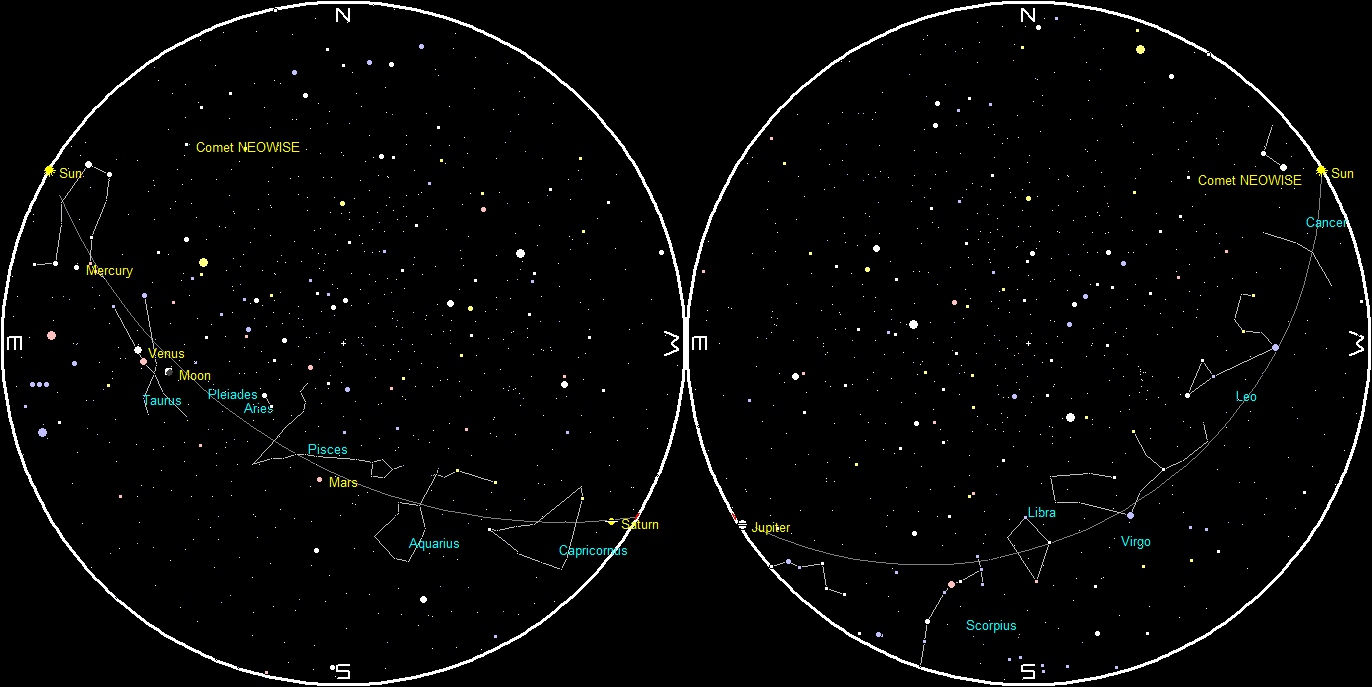
Planets, a comet, and the Moon at sunset and sunrise of a single night starting with sunset on the right on July 15, 2020. The night ends on the left with sunrise on the 16th. Jupiter made it into the evening sky yesterday when it passed opposition. Saturn will do the same on the 20th. Click on the image to enlarge. Created using my LookingUp program.
 Bob Moler's Ephemeris Blog