Archive
04/14/2020 – Ephemeris – The Moon will be hanging out with the morning planets tomorrow
This is Ephemeris for Tuesday, April 14th. Today the Sun will be up for 13 hours and 28 minutes, setting at 8:27, and it will rise tomorrow at 6:57. The Moon, at last quarter today, will rise at 3:56 tomorrow morning.
Tomorrow morning the Moon will be in the midst of passing the three morning planets, from right to left: Jupiter, Saturn and Mars. Specifically, the last quarter Moon will be below Saturn at 6 a.m. Mars is traveling east rapidly. Its rise times decrease by only two minutes a day compared to the 4 minutes a day for the stars, so it won’t enter the evening sky until October, while Jupiter and Saturn will enter the evening sky in July. A planet is considered to be in the morning sky if it rises after sunset, and in the evening sky if it rises before sunset. Rising in the morning is definitely after sunset. The dividing point is when a superior* planet is at opposition from the Sun when it enters the evening sky, or in conjunction with the Sun when it enters the morning sky.
The event times given are for the Traverse City/Interlochen area of Michigan. They may be different for your location.
* Superior planets have orbits outside the Earth’s orbit: Mars, Jupiter, Saturn, Uranus and Neptune.
Addendum
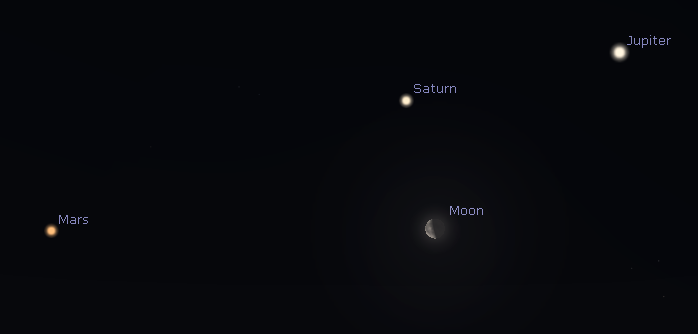
Morning planets and Moon in the south-southeast tomorrow morning at 6 a.m. April 15, 2020. Click on image to enlarge. Created using Stellarium.
04/08/2020 – Ephemeris – Morning planets are not practicing social distancing
Note: It seems the title is appropriate to our current predicament even though I hadn’t thought about it when I wrote and recorded the radio script that follows last Sunday.
This is Ephemeris for Wednesday, April 8th. Today the Sun will be up for 13 hours and 9 minutes, setting at 8:19, and it will rise tomorrow at 7:08. The Moon, 1 day past full, will rise at 9:16 this evening.
Let’s look at the naked-eye planets for this week. Venus is our evening star shining brightly in the west above the Pleiades. It will set at 12:33 a.m. The rest of the planet action is in the morning sky where there are three planets nearly evenly spread out in the southeast. Bright Jupiter will rise first at 3:46 a.m. Followed by Saturn at 4:05 a.m. Mars, left and below Saturn will rise at 4:27 a.m. It’s now as bright as a first magnitude star because it’s down to 130 million miles (209 million km) away, as the Earth slowly overtakes it at the rate of about 5 million miles (8 million km) a week. It’s brighter than the star Antares in the southwest. Mars will be closest to us in October, which makes a good time to launch spacecraft to it few months before then.
The event times given are for the Traverse City/Interlochen area of Michigan. They may be different for your location.
Addendum
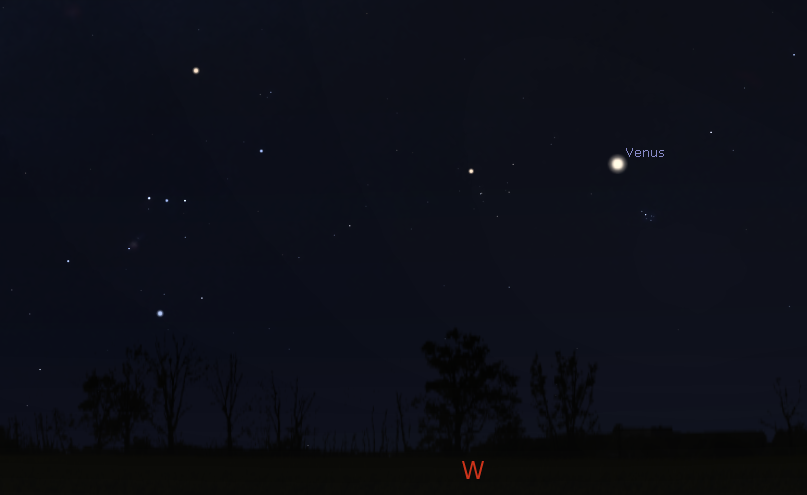
Venus in the evening with the setting winter stars including those in Orion and Taurus at 10 p.m. April 8, 2020. Click on the image to enlarge. Created using Stellarium.
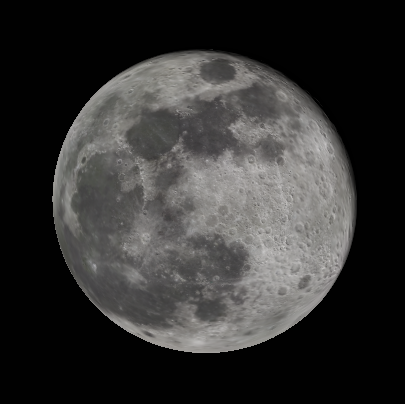
The Moon as it might be seen in binoculars at 10 p.m. April 8, 2020. Created using Stellarium.
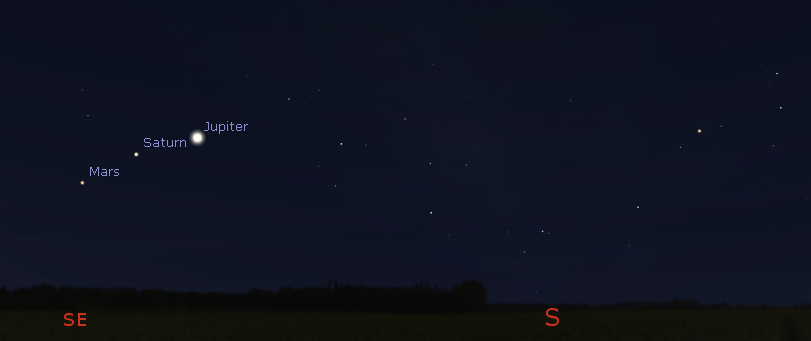
The morning planets and the southern summer stars in the moonlight at 6 a.m. April 9, 2020. The bright star on the right is Antares. Click on the image to enlarge. Created using Stellarium.
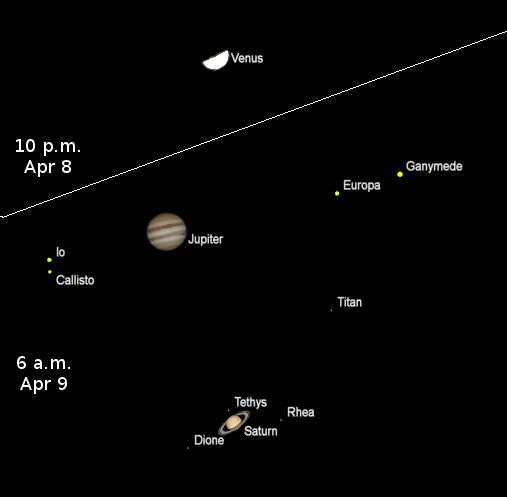
The planets as seen in a telescope with the same magnification. Venus in the evening and Jupiter and Saturn in the morning on the night of April 8/9, 2020. Apparent diameters: Venus, 28.21″; Jupiter, 38.00″; Saturn, 16.34″, rings, 38.07″. Mars at 6.72″ won’t be added until it reaches 10″. The ” symbol means seconds of arc (1/3600th of a degree.) Created using Cartes du Ciel (Sky Charts).
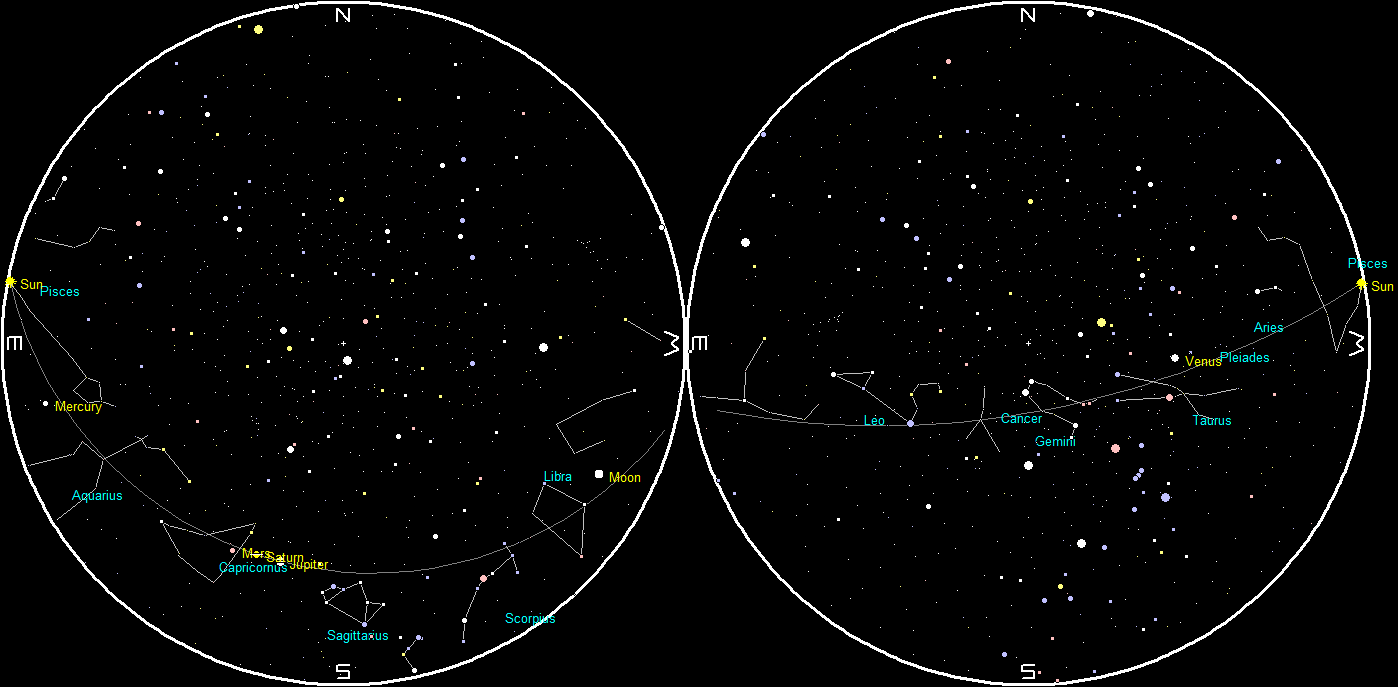
Planets and the Moon at sunset and sunrise of a single night starting with sunset on the right on April 8, 2020. The night ends on the left with sunrise on the 9th. The planet traffic jam in the morning sky unfortunately overlays planets and labels. Click on the image to enlarge. Created using my LookingUp program.
04/01/2020 – Ephemeris – Looking at the naked-eye planets for this week
Ephemeris for April Fools Day, Wednesday, April 1st. Today the Sun will be up for 12 hours and 48 minutes, setting at 8:11, and it will rise tomorrow at 7:20. The Moon, at first quarter today, will set at 4:23 tomorrow morning.
Let’s look at the naked-eye planets for this week. Venus is our evening star shining brightly in the west just below the Pleiades. It will set at 12:26 a.m. The rest of the planet action is in the morning sky where there are three planets close together in the southeast. Bright Jupiter will rise first at 4:11 a.m. Followed by Saturn 4:31 a.m. Mars, left and below Saturn will rise at 4:39 a.m. It’s now as bright as a first magnitude star because it’s down to 135 million miles (217 million km) away, as the Earth slowly overtakes it at the rate of about 5 million miles (8 million km) a week. It’s brighter than the star Antares in the south-southwest. Mars passed Saturn yesterday afternoon moving eastward much faster than Saturn was.
The event times given are for the Traverse City/Interlochen area of Michigan. They may be different for your location.
Addendum
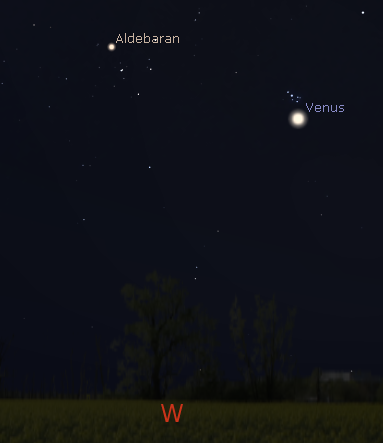
Venus under the Pleiades tonight at 10 p.m. April 1, 2020. Created using Stellarium.
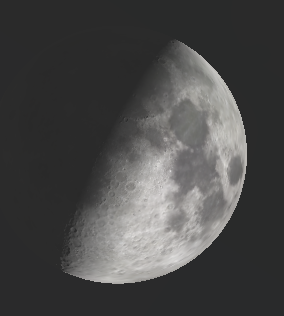
The Moon as it might look like in binoculars this evening April 1, 2020. Created using Stellarium.
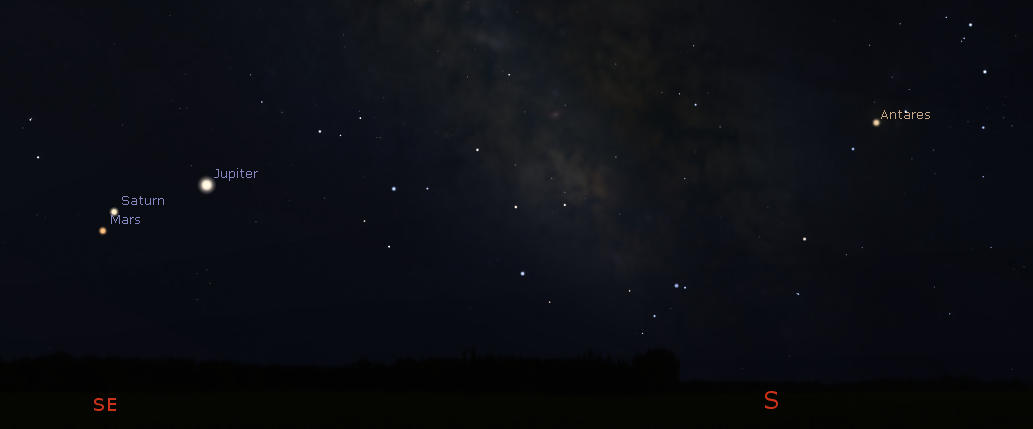
Morning planets and the southern stars of summer at 6 a.m. tomorrow morning April 2, 2020. Click on the image to enlarge. Created using Stellarium.
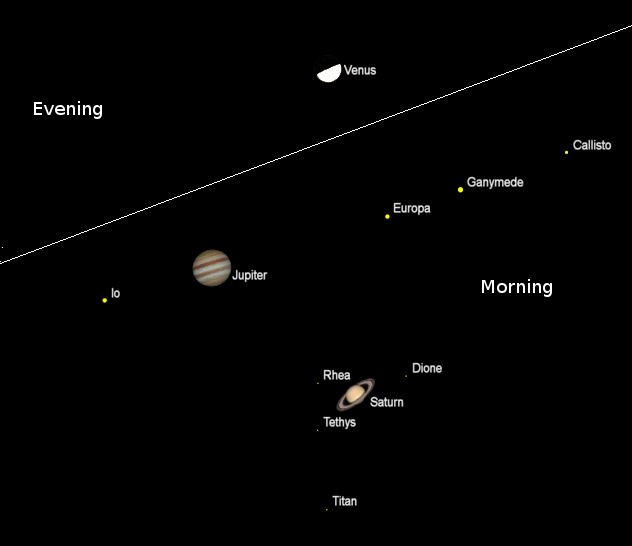
The planets as seen in a telescope with the same magnification. Venus in the evening and Jupiter and Saturn in the morning on the night of April 1/2, 2020. Apparent diameters: Venus, 25.85″; Jupiter, 37.21″; Saturn, 16.16″, rings, 37.65″. Mars at 6.46″ won’t be added until it reaches 10″. The ” symbol means seconds of arc (1/3600th of a degree.) Created using Cartes du Ciel (Sky Charts).
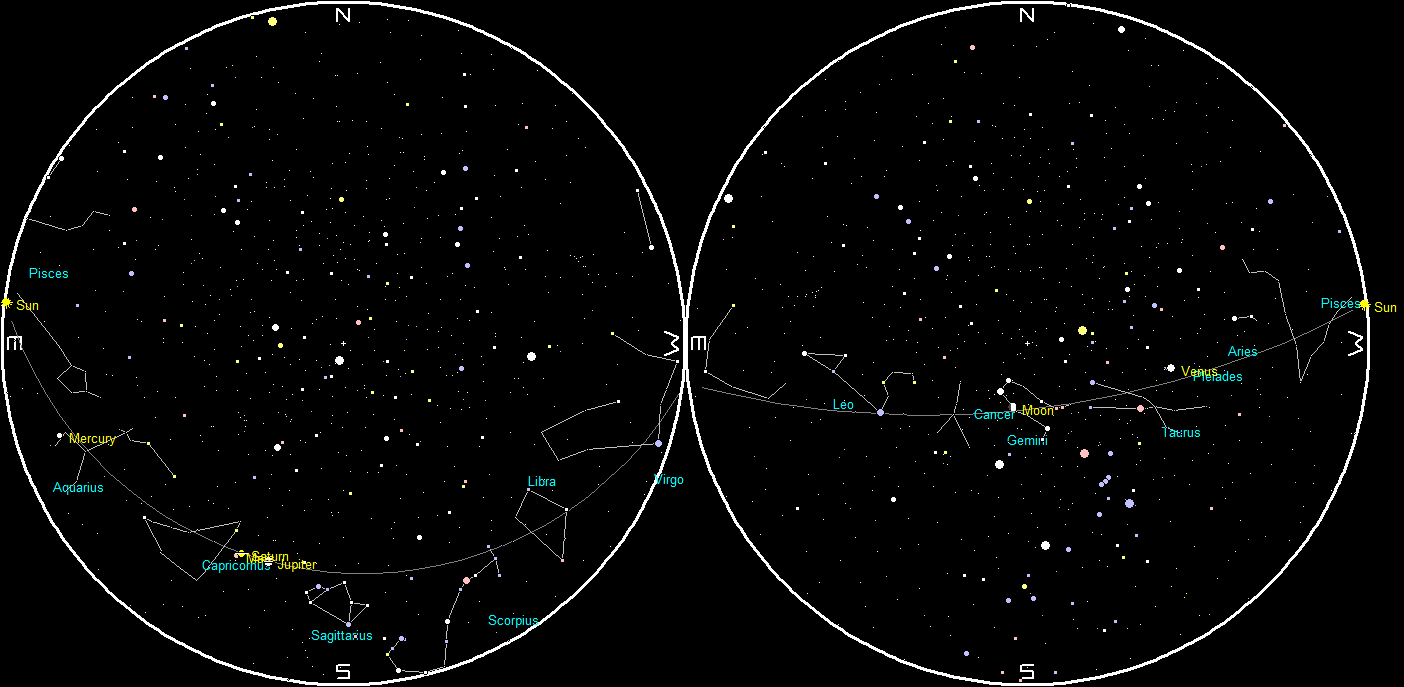
Planets and the Moon at sunset and sunrise of a single night starting with sunset on the right on April 1, 2020. The night ends on the left with sunrise on the 2nd. The planet traffic jam in the morning sky unfortunately overlays planets and labels. Click on the image to enlarge. Created using my LookingUp program.
03/25/2020 – Ephemeris – Let’s look at the naked-eye planets for this week
Ephemeris for Wednesday, March 25th. Today the Sun will be up for 12 hours and 26 minutes, setting at 8:02, and it will rise tomorrow at 7:33. The Moon, 1 day past new, will set at 9:21 this evening.
Let’s look at the naked-eye planets for this week. Venus is our evening star shining brightly in the west. It will set at 12:14 a.m. The rest of the planet action is in the morning sky where there are three planets close together in the southeast. Bright Jupiter will rise first at 4:35 a.m. Followed by Mars, left and below, rising at 4:50 a.m. It’s now as bright as a first magnitude star because it’s down to 140 million (226 million km) miles away, as the Earth slowly overtakes it at the rate of about 5 million miles (8 million km) a week. It’s brighter than the star Antares in the south-southwest. And lastly, Saturn will rise at 5:01 a.m. Mars is about half way between Jupiter and Saturn. It will pass Saturn next Tuesday.
The event times given are for the Traverse City/Interlochen area of Michigan. They may be different for your location.
Addendum
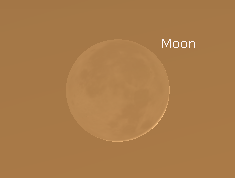
Day and a half old Moon low over a Lake Michigan horizon tonight at 8:30 p.m. March 25, 2020. The bright edge of the Moon will be a sit brighter, and the earthshine on the night side of the Moon a bit dimmer. Created using Stellarium.
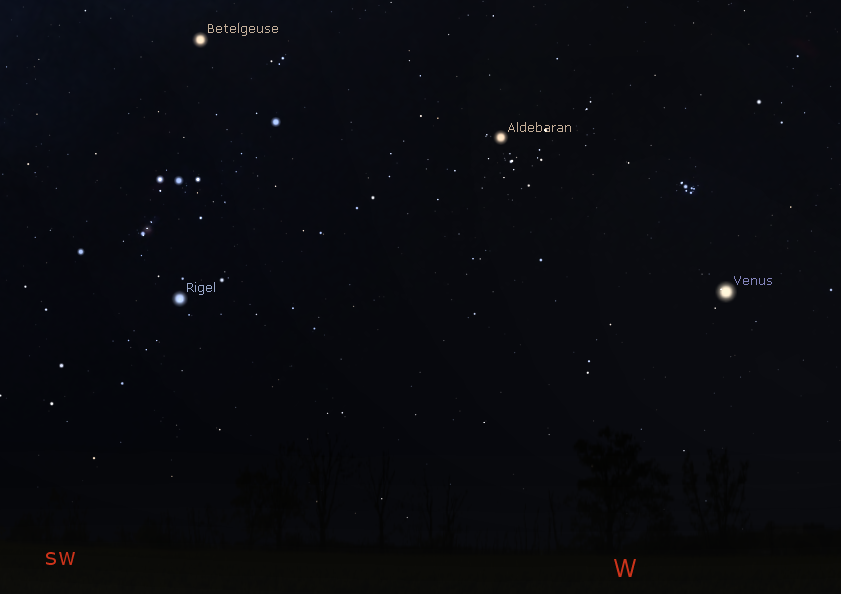
Venus and the setting winter stars tonight at 10 p.m. March 25, 2020. Click on the image to enlarge. Created using Stellarium.
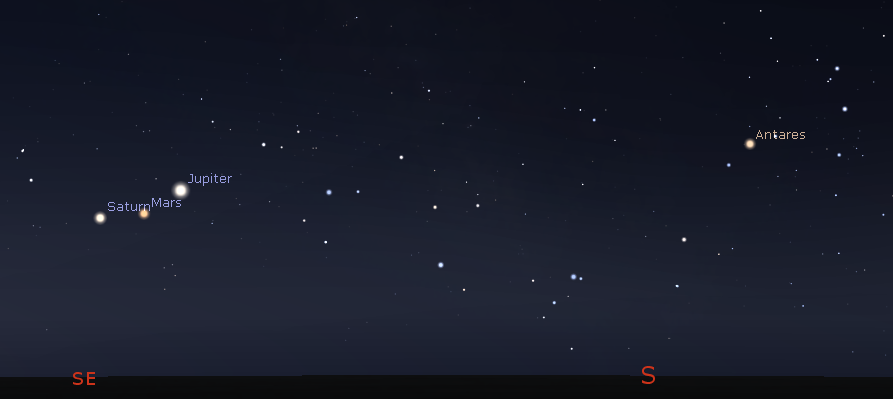
Saturn, Mars and Jupiter with the southern summer stars at 6:30 a.m. tomorrow March 26, 2020. Mars will pass Saturn on the 31st. Click on the image to enlarge. Created using Stellarium.
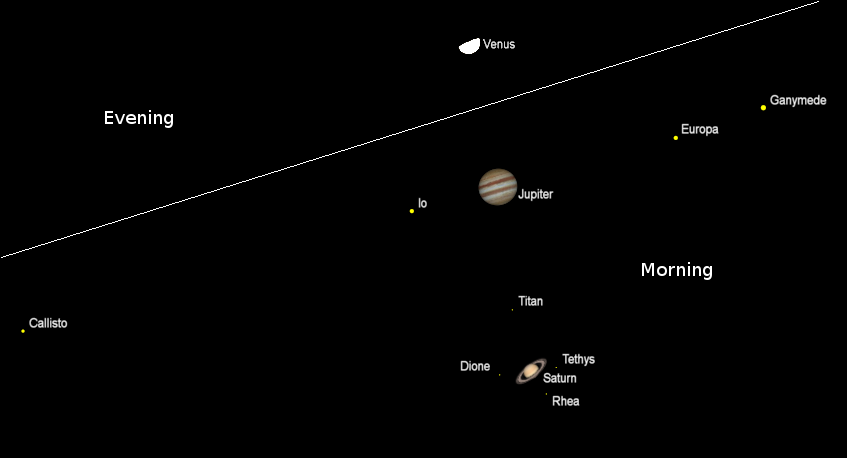
The planets as seen in a telescope with the same magnification. Venus in the evening and Jupiter and Saturn in the morning on the night of March 25/26, 2020. Apparent diameters: Venus, 23.85″; Jupiter, 36.46″; Saturn, 15.99″, rings, 37.26″. Mars at 6.22″ won’t be added until it reaches 10″. The ” symbol means seconds of arc (1/3600th of a degree.) Click on the image to enlarge. Created using Cartes du Ciel (Sky Charts).
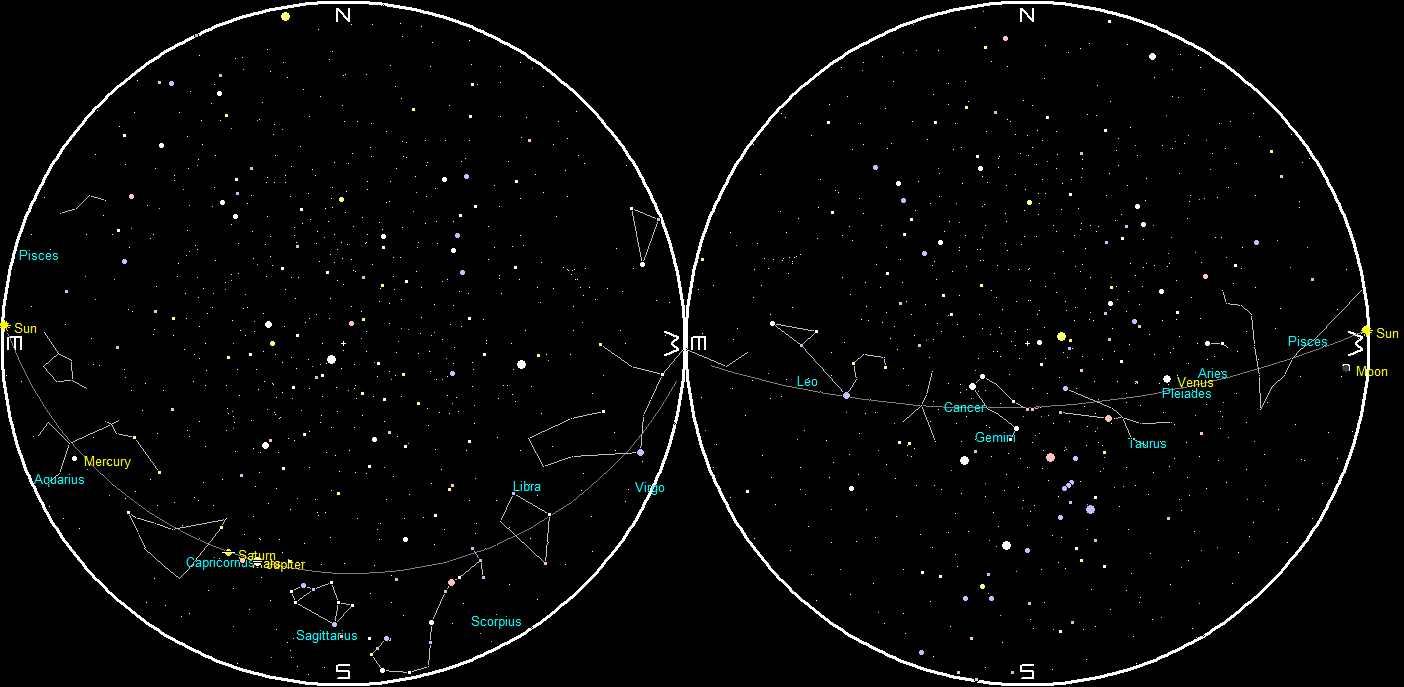
Planets and the Moon at sunset and sunrise of a single night starting with sunset on the right on March 25, 2020. The night ends on the left with sunrise on the 26th. Click on the image to enlarge. Created using my LookingUp program.
03/18/2020 – Ephemeris – Let’s look at the naked-eye planets for this week
Ephemeris for Wednesday, March 18th. Today the Sun will be up for 12 hours and 4 minutes, setting at 7:53, and it will rise tomorrow at 7:46. The Moon, 2 days past last quarter, will rise at 5:55 tomorrow morning.
Let’s look at the naked-eye planets for this week. Venus is our evening star shining brightly in the west. It will set at 12:07 a.m. The rest of the planet action is in the morning sky where there are three planets close together in the southeast. Mars will rise first at 5:01 a.m. It’s now as bright as a first magnitude star because it’s down to 145 million (234 million km) miles away, as the Earth slowly overtakes it at the rate of about 6 million miles (9 million km) a week. It’s brighter than the star Antares in the southwest. Bright Jupiter will rise at 5:03 a.m. And lastly, Saturn will rise at 5:27 a.m. Mars is catching up to Jupiter and Saturn. It will pass south of Jupiter in two days, and Saturn on the 31st.
The event times given are for the Traverse City/Interlochen area of Michigan. They may be different for your location.
Addendum
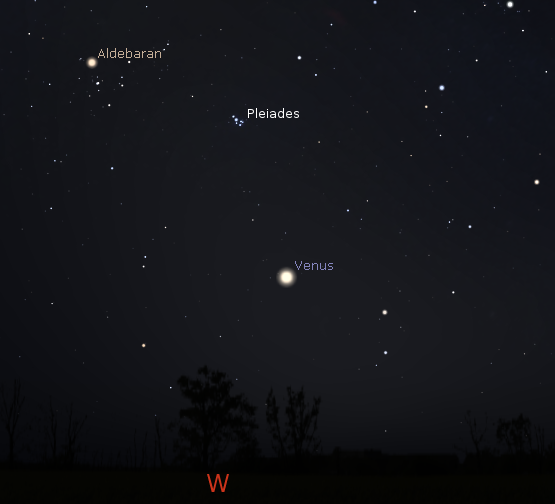
Venus in a very faint zodiacal light at 10 p.m. March 18, 2020. Created using Stellarium.
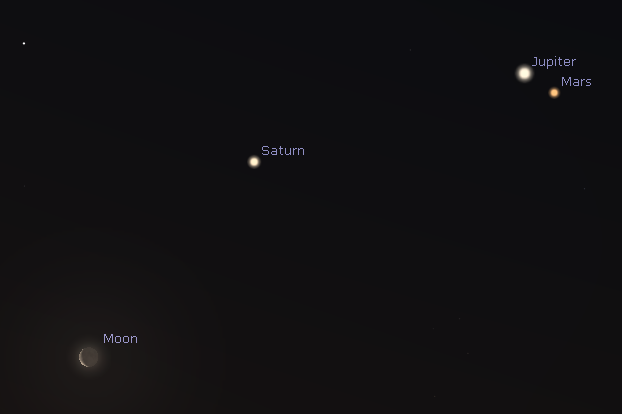
Morning planets and the Moon for 7 a.m. Thursday, March 19, 2020. Created using Stellarium.
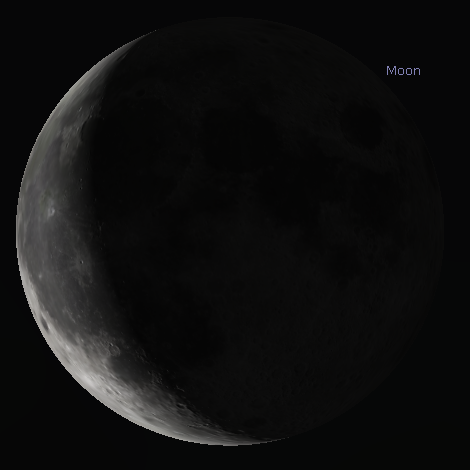
The Moon as it might be seen in binoculars at 7 a.m. tomorrow March 19, 2020. Created using Stellarium.
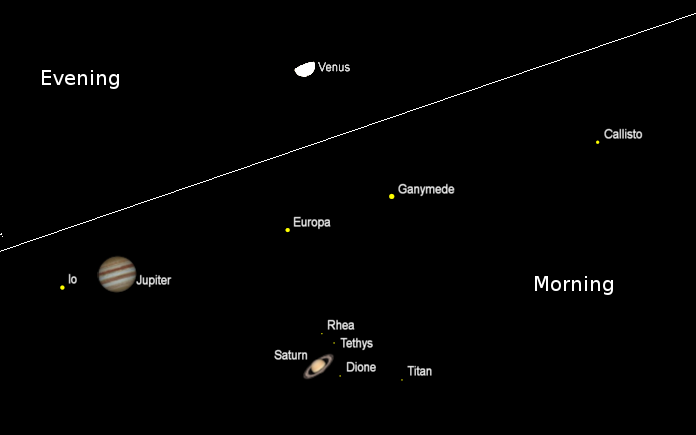
The planets as seen in a telescope with the same magnification. Venus in the evening and Jupiter and Saturn in the morning on the night of March 18/19, 2020. Apparent diameters: Venus, 22.2″; Jupiter, 35.8″; Saturn, 15.8″, rings, 36.9″. Mars at 6.0″ won’t be added until it reaches 10″. The ” symbol means seconds of arc (1/3600th of a degree.) Created using Cartes du Ciel (Sky Charts).
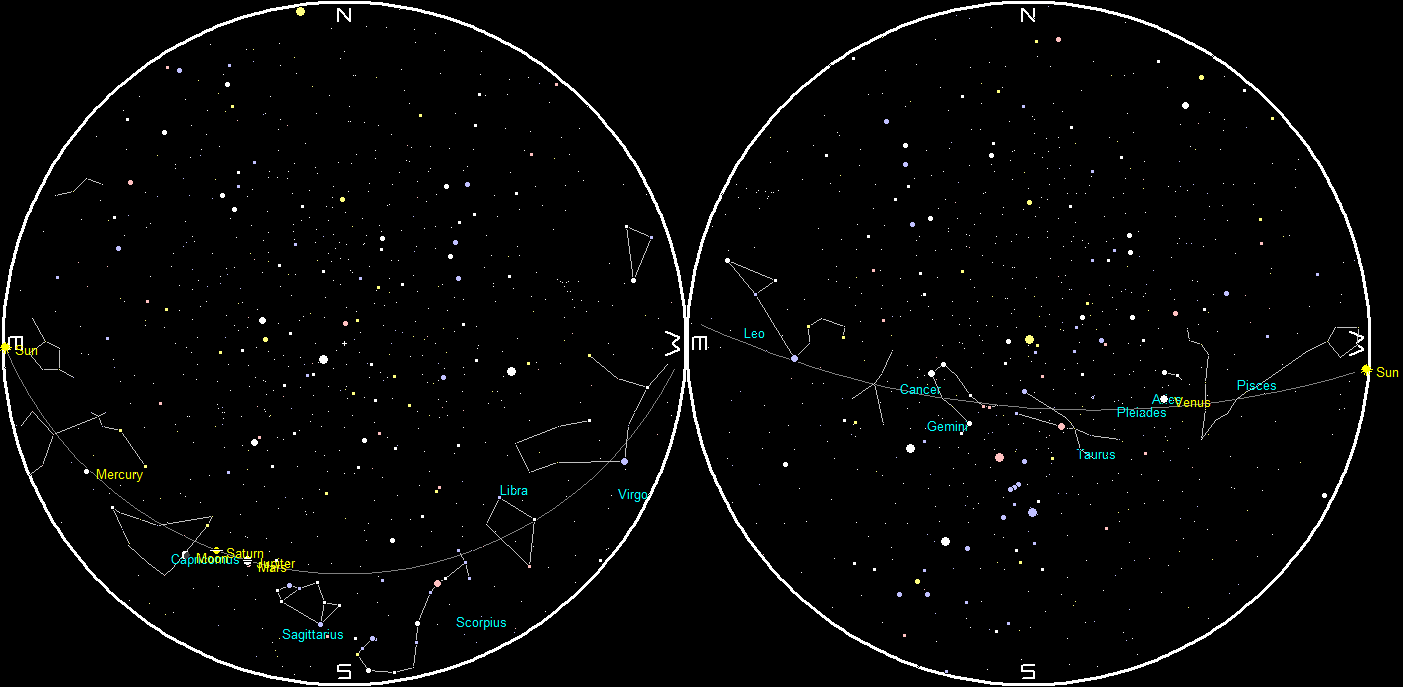
Planets and the Moon at sunset and sunrise of a single night starting with sunset on the right on March 18, 2020. The night ends on the left with sunrise on the 19th. Click on the image to enlarge. Created using my LookingUp program.
03/17/2020 – Ephemeris – A planetary traffic jam tomorrow morning
Ephemeris for St. Patrick’s Day, Tuesday, March 17th. Today the Sun will be up for 12 hours and 1 minute, setting at 7:52, and it will rise tomorrow at 7:48. The Moon, 1 day past last quarter, will rise at 5:12 tomorrow morning.
What I’m going to talk about today is the confluence of the Moon and planets, none of which is green for St. Patrick’s day. The event actually takes place tomorrow morning, which looks like a real planet traffic jam. Of course it just looks like it. The Moon is about 240 thousand miles (390 thousand km) away, Mars is 146 million miles (235 million km), and Jupiter is three and a half times farther away than Mars, and Saturn is twice as far away as Jupiter. These are seen in the southeast, from right to left are Mars, and Jupiter, close together and Saturn a bit farther away. The crescent Moon will pass south of Mars at 4:19 a.m., and Jupiter at 6:18 a.m. The Moon will pass south of Saturn at 8 p.m. tomorrow night while they are below the horizon. By the time they rise Thursday morning the Moon will be a ways left and below Saturn.
The event times given are for the Traverse City/Interlochen area of Michigan. They may be different for your location.
Addendum
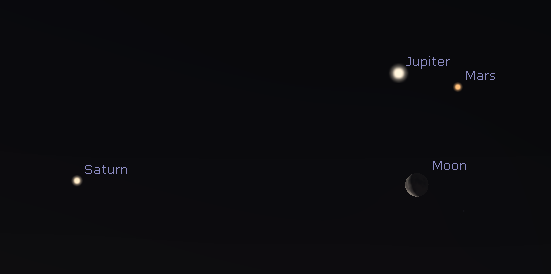
Mars, Jupiter, Saturn and Moon traffic Jam as it will appear in the southeast at 7 a.m. March 18, 2020. Created using Stellarium.
03/11/2020 – Ephemeris – Let’s look at the naked-eye planets for this week
Ephemeris for Wednesday, March 11th. Today the Sun will be up for 11 hours and 42 minutes, setting at 7:44, and it will rise tomorrow at 7:59. The Moon, 2 days past full, will rise at 10:26 this evening.
Let’s look at the naked-eye planets for this week. Venus is our evening star shining brightly in the west for most of the evening. It will set at 11:49 p.m. The rest of the planet action is in the morning sky where there are three planets close together in the southeast. Mars will rise first at 5:11 a.m. It’s getting as bright as a first magnitude star because it’s down to 151 million (243 million km) miles away, as the Earth slowly overtakes it at the rate of about 6 million miles (9 million km) a week. It’s brighter than the star Antares in the southwest. Bright Jupiter will rise at 5:23 a.m. And lastly, Saturn will rise at 5:43 a.m. Mars is catching up to Jupiter and Saturn. It will pass south of Jupiter on the 20th, and Saturn on the 31st. It might be worth getting up for before 7 a.m. to view.
The event times given are for the Traverse City/Interlochen area of Michigan. They may be different for your location.
Addendum
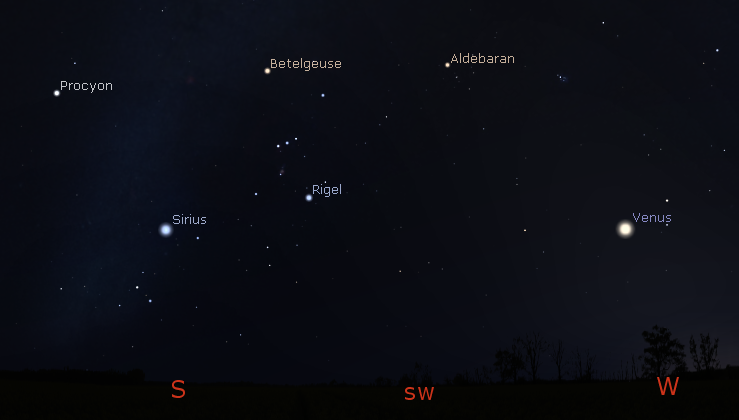
Venus and evening bright stars tonight at 9 p.m., March 11, 2020. Click on the image to enlarge. Created using Stellarium.
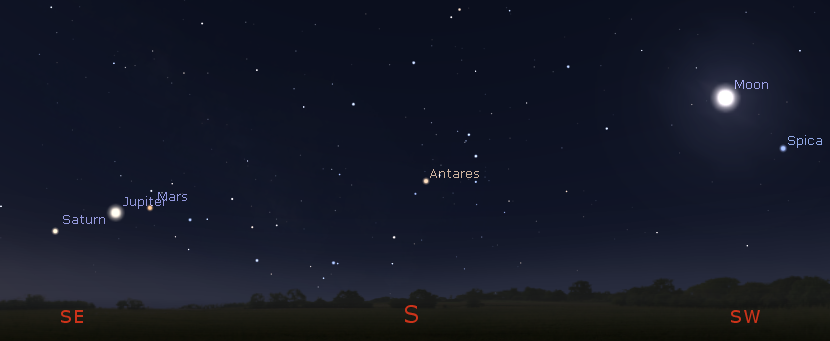
Morning Planets and the Moon at 7 a.m. tomorrow morning March 12, 2020. Click on the image to enlarge. Created using Stellarium.
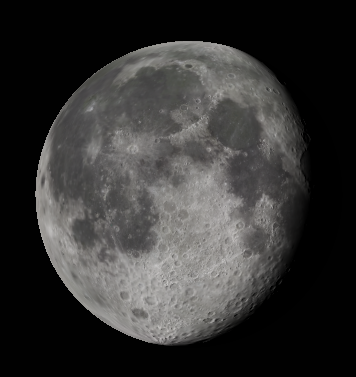
Binocular Moon tomorrow morning at 7 a.m. March 12, 2020. Created using Stellarium.
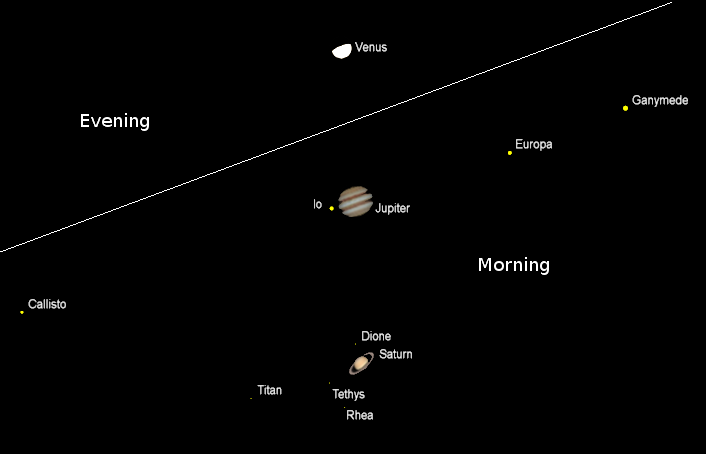
The planets as seen in a telescope with the same magnification. Venus in the evening and Jupiter and Saturn in the morning on the night of March 11/12, 2020. Apparent diameters: Venus, 20.7″; Jupiter, 35.1″; Saturn, 15.7″, rings, 36.6″. Mars at 5.8″ won’t be added until it reaches 10″. The ” symbol means seconds of arc (1/3600th of a degree.) Created using Cartes du Ciel (Sky Charts).
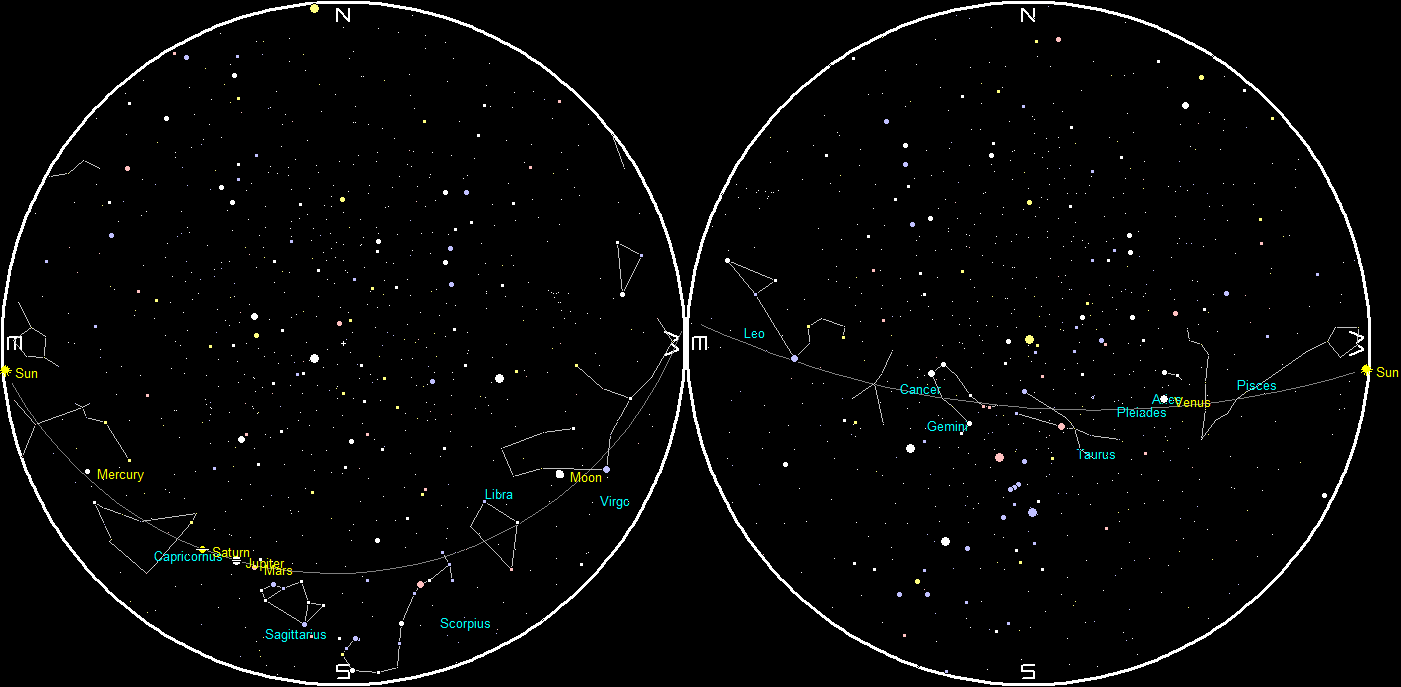
Planets and the Moon at sunset and sunrise of a single night starting with sunset on the right on March 11, 2020. The night ends on the left with sunrise on the 12th. Click on the image to enlarge. Created using my LookingUp program.
03/04/2020 – Ephemeris – Let’s look at the naked-eye planets for this week
Ephemeris for Wednesday, March 4th. Today the Sun will be up for 11 hours and 21 minutes, setting at 6:35, and it will rise tomorrow at 7:12. The Moon, 2 days past first quarter, will set at 4:39 tomorrow morning.
Let’s look at the naked-eye planets for this week. Venus is our evening star shining brightly in the west for most of the evening. It will set at 10:34 p.m. The rest of the planet action is in the morning. Mars will rise in the southeast at 4:19 a.m. It’s getting as bright as a first magnitude star because it’s 157 million (253 million km) miles away, and it’s getting slowly closer to the Earth at the rate of about 6 million miles (9 million km) a week. However it’s brighter than Betelgeuse. Jupiter will rise at 4:46 a.m. Lastly, Saturn will rise at 5:14 tomorrow morning. Mars is catching up to Jupiter and Saturn. It will pass south of Jupiter on the 20th, and Saturn on the 31st. It might be worth getting up for before 6 a.m. to spot.
The times given are for the Traverse City/Interlochen area of Michigan. They may be different for your location.
Addendum
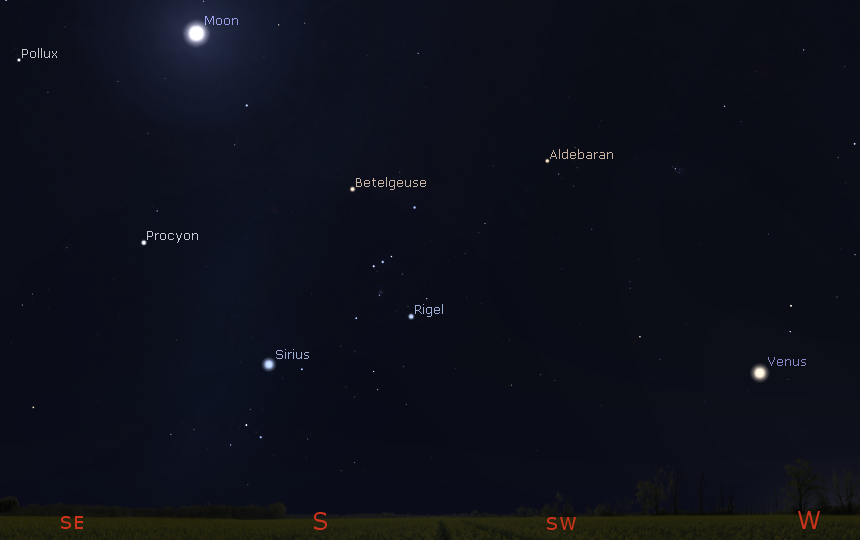
Venus, the bright winter stars and the Moon tonight, 8 p.m. March 4, 2020. Click on the image to enlarge. Created using Stellarium.
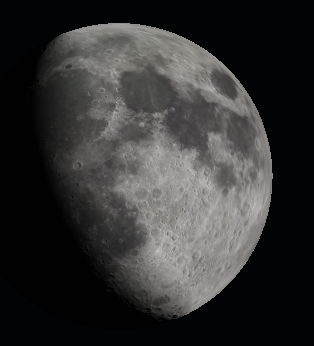
The gibbous Moon as it might appear in binoculars at 8 p.m. March 4, 2020. Created using Stellarium.
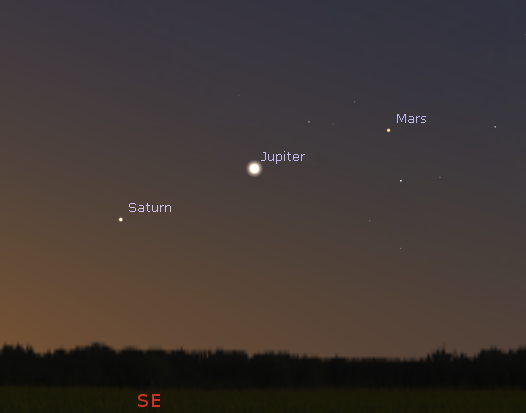
The naked-eye planets visible in the morning at 6:30 a.m. tomorrow, March 5, 2020. Created using Stellarium.
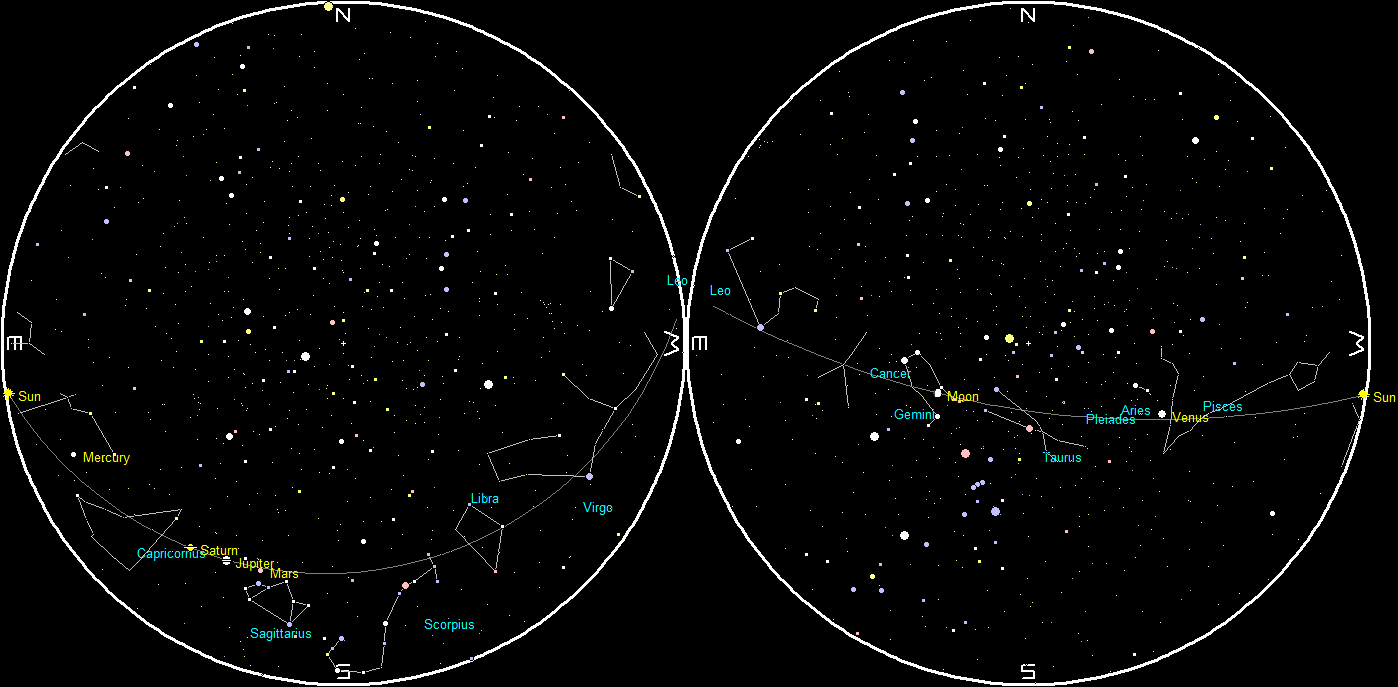
Planets and the Moon at sunset and sunrise of a single night starting with sunset on the right on March 4, 2020. The night ends on the left with sunrise on the 5th. Click on the image to enlarge. Created using my LookingUp program.
02-26-2020 – Ephemeris – Let’s look at the naked-eye planets for this week
Ephemeris for Ash Wednesday, February 26th. Today the Sun will be up for 10 hours and 59 minutes, setting at 6:25, and it will rise tomorrow at 7:24. The Moon, 3 days past new, will set at 9:28 this evening.
Let’s look at the naked-eye planets for this week. Venus is our evening star shining brightly in the southwest in the early evening. It will set at 10:19 p.m. Mars is visible in the morning sky and will rise in the southeast at 4:27 a.m. It’s not very bright because it’s 161 million (260 million km) miles away, but it’s getting slowly closer to the Earth at the rate of about 6 million miles (9 million km) a week. However it’s brighter than Betelgeuse. Jupiter will rise at 5:06 a.m. Lastly, Saturn will rise at 5:39 tomorrow morning. Jupiter is currently about 9 degrees away from Saturn, a bit less than the width of your fist held at arms length. It will continue to approach Saturn until their paths cross on December 21st.
The times given are for the Traverse City/Interlochen area of Michigan. They may be different for your location.
Addendum
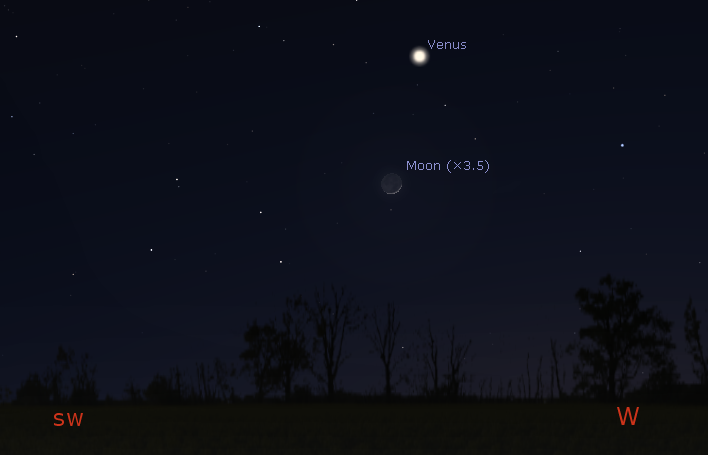
Venus and the Moon in the western sky at 7:30 p.m. or about an hour after sunset. February 26, 2020. Created using Stellarium.
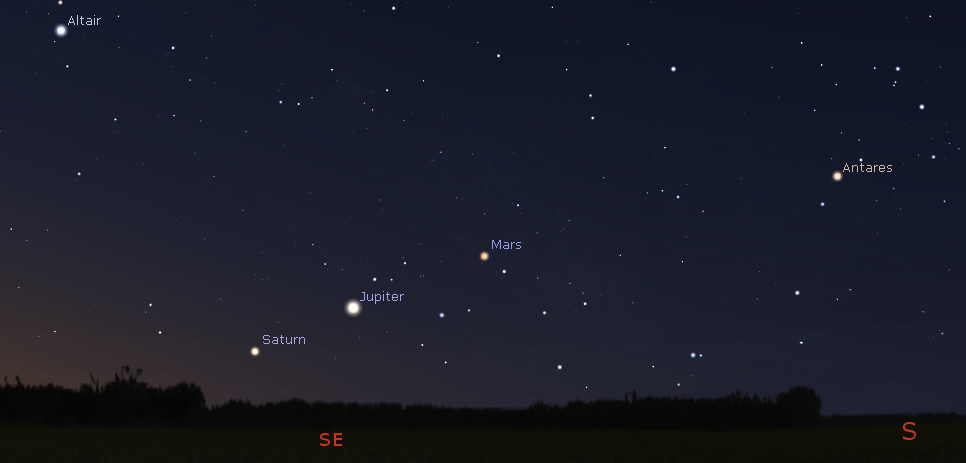
The morning planets and stars visible in the southern sky at 6:30 a.m. tomorrow morning February 37, 2020. The star Antares is in the constellation of Scorpius. Mars sits on top of the lid of the Teapot asterism of the constellation of Sagittarius the archer. Jupiter and Saturn are seen to the lower left. Click on the image to enlarge. Created using Stellarium.
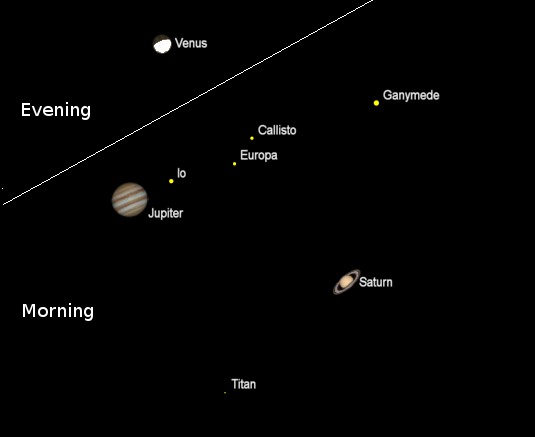
The planets as seen in a telescope with the same magnification. Venus in the evening and Jupiter and Saturn in the morning on the night of February 26/27, 2020. Apparent diameters: Venus, 18.3″; Jupiter, 34.0″; Saturn, 15.4″, rings, 36.0″. Mars at 5.4″ won’t be added until it reaches 10″. The ” symbol means seconds of arc (1/3600th of a degree.) Created using Cartes du Ciel (Sky Charts).
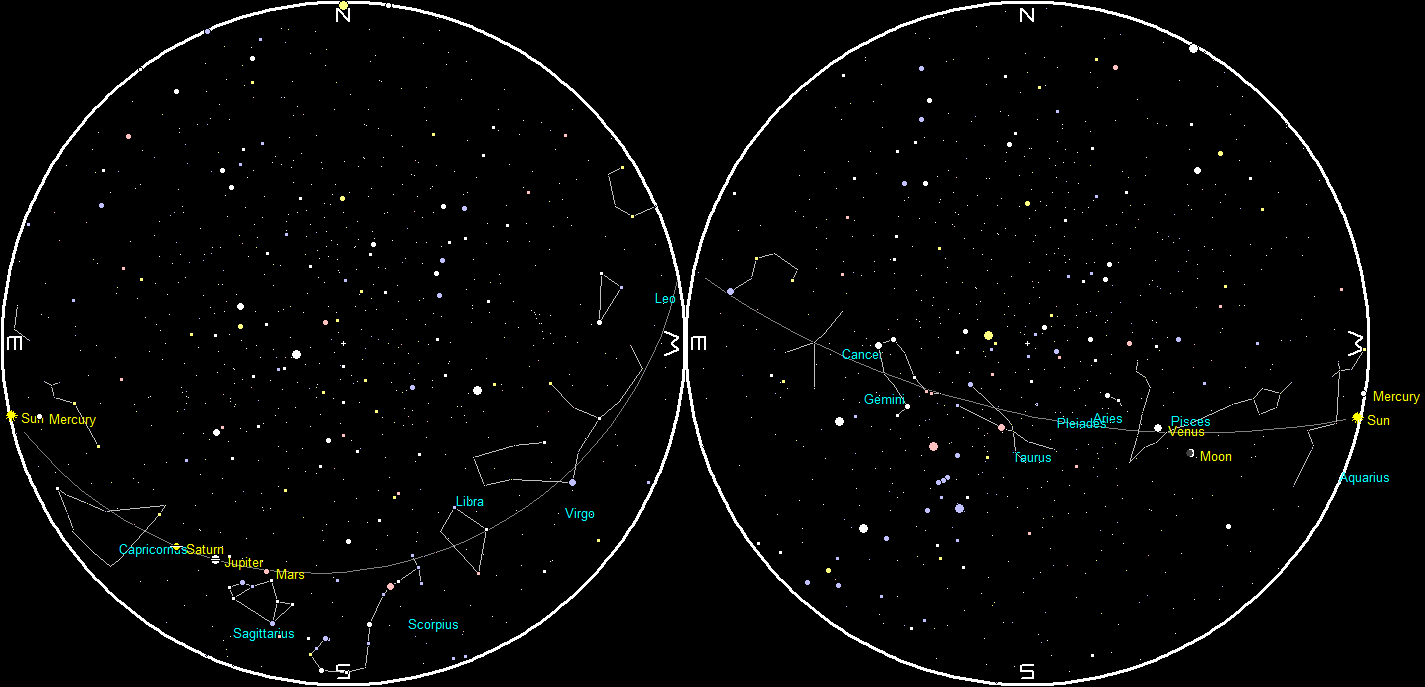
Planets and the Moon at sunset and sunrise of a single night starting with sunset on the right on February 26, 2020. The night ends on the left with sunrise on the 27th. Click on the image to enlarge. Created using my LookingUp program.
02/19/2020 -Ephemeris – Let’s take a look at the bright planets
Ephemeris for Wednesday, February 19th. Today the Sun will be up for 10 hours and 38 minutes, setting at 6:16, and it will rise tomorrow at 7:36. The Moon, half way from last quarter to new, will rise at 6:12 tomorrow morning.
Let’s look at the naked-eye planets for this week. Venus is our evening star shining brightly in the southwest in the early evening. It will set at 10:03 p.m. Mercury is fading and will set only 58 minutes after the Sun. Mars is visible in the morning sky and will rise in the southeast at 4:34 a.m. It’s not very bright because it’s 167 million (268 million km) miles away, but it’s getting slowly closer to the Earth at the rate of about 4 million miles (6 million km) a week. Jupiter will rise at 5:32 a.m. Lastly, Saturn will rise at 6:04 tomorrow morning with the thin crescent Moon underneath it*. Jupiter will continue to approach Saturn throughout this year until their paths cross on December 21st.
The times given are for the Traverse City/Interlochen area of Michigan. They may be different for your location.
* Moon placement in this morning’s program was in error. The Moon is near Jupiter this morning, not tomorrow morning.
Addendum
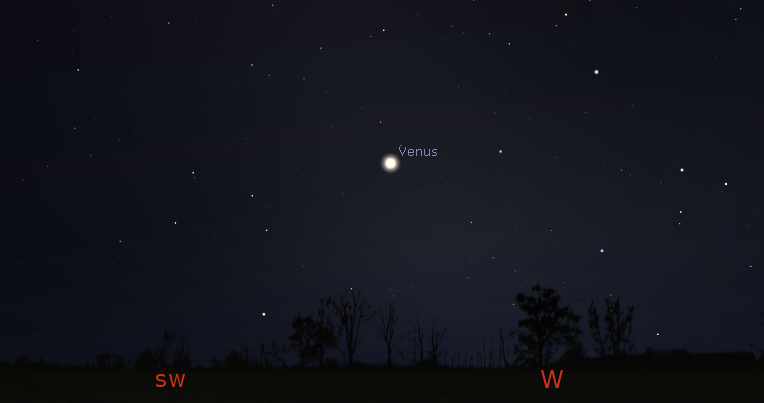
Venus and zodiacal light at 7:30 p.m. this evening February 19, 2020. The zodiacal light will appear more prominent in the next month or so. Here it’s mostly silhouetting the foreground trees. Check my prior posts for zodiacal light. I’ll cover it again in about a month. Created using Stellarium.
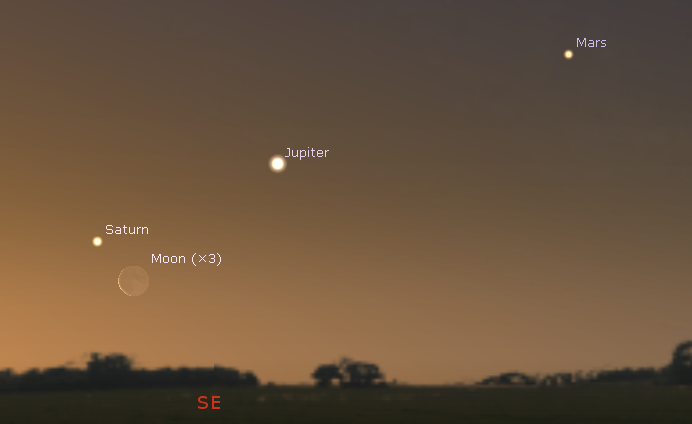
Morning planets and the Moon tomorrow morning at 7 a.m. February 20, 2020. Note that the Moon is 3 times its normal size. Created using Stellarium.
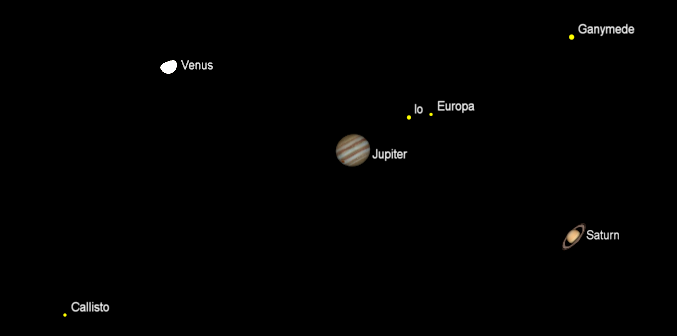
The planets as seen in a telescope with the same magnification. Venus in the evening and Jupiter and Saturn in the morning. Apparent diameters: Venus, 17.5″; Jupiter, 33.5″; Saturn, 15.4″, rings, 35.7″.
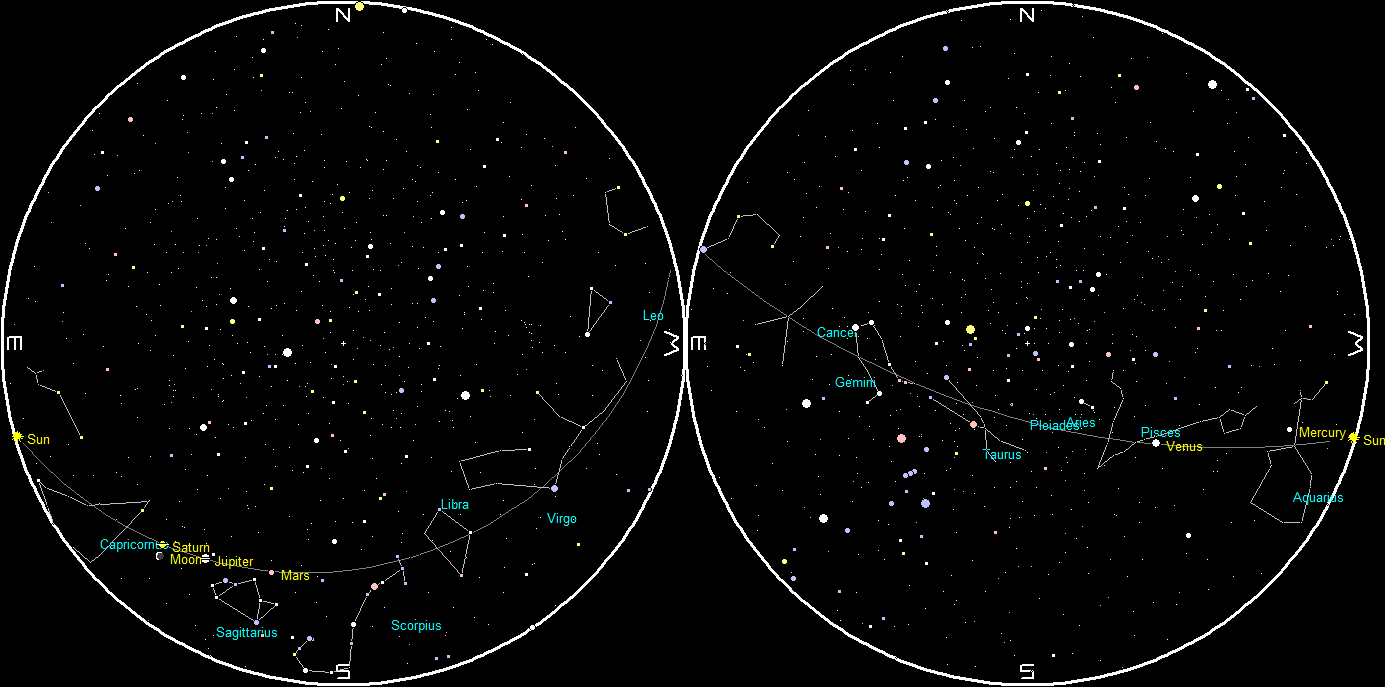
Planets and the Moon at sunset and sunrise of a single night starting with sunset on the right on February 19, 2020. The night ends on the left with sunrise on the 20th. Click on the image to enlarge. Created using my LookingUp program.
 Bob Moler's Ephemeris Blog