Archive
01/16/2019 – Ephemeris – Let’s check out the whereabouts of the bright planets
Ephemeris for Wednesday, January 16th. Today the Sun will be up for 9 hours and 13 minutes, setting at 5:29, and it will rise tomorrow at 8:15. The Moon, 2 days past first quarter, will set at 4:20 tomorrow morning.
Let’s look at the planets for this week. Our only evening planet Mars will be in the southwestern sky this evening and will set at 11:57 p.m. It’s too far away to see much detail in a small telescope. In the morning sky we have Venus rising at 4:49 a.m. tomorrow and is prominent in the southeastern sky as our morning star. In small telescopes it is a featureless slight gibbous moon shape. Its phase will now grow more gibbous as its size shrinks as it continues its long journey around and behind the Sun. Jupiter will rise tomorrow at 5:22 a.m. It is second to Venus in brightness, but second to no planet in size. Binoculars can see some of its biggest moons. Telescopes can see all four.
The times given are for the Traverse City/Interlochen area of Michigan. They may be different for your location.
Addendum
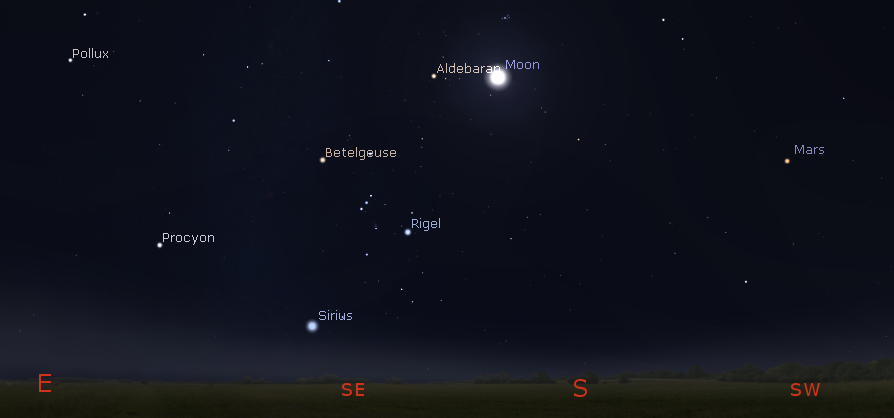
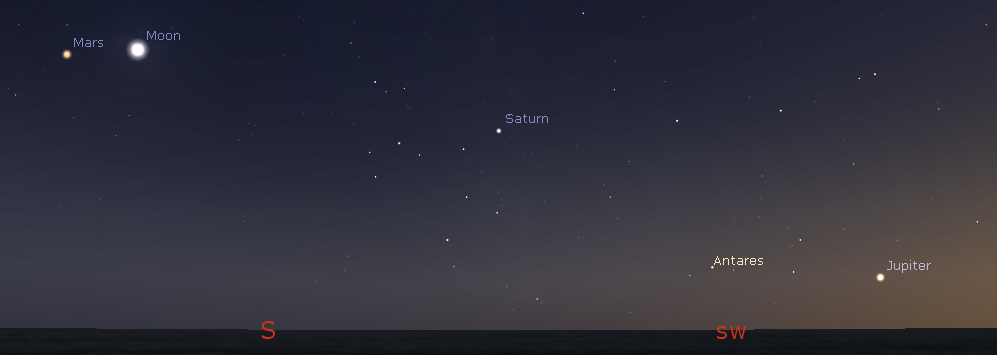
Mars and the Moon with the evening stars tonight at 8 p.m. January 16, 2019. Click on the image to enlarge. Created using Stellarium.
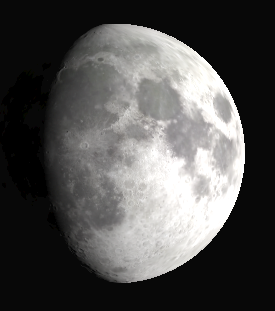
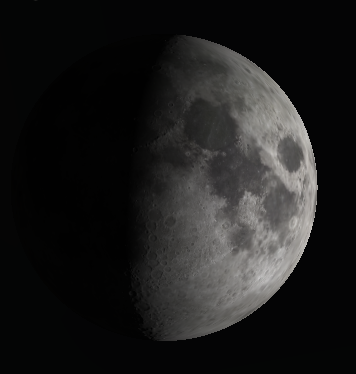
The waxing gibbous Moon as it should appear tonight in binoculars. Created using Stellarium.
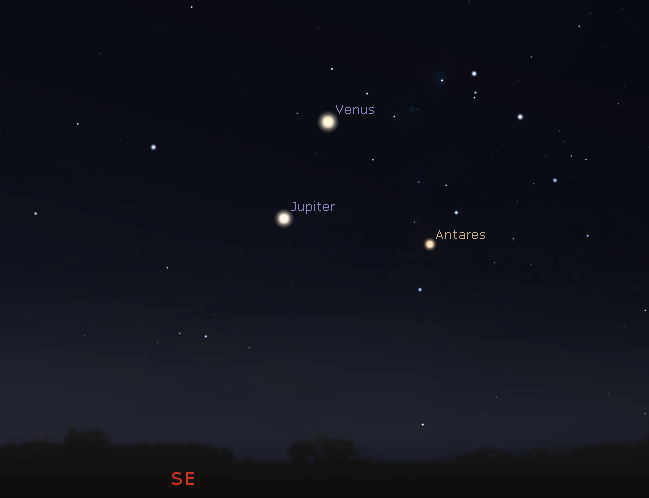
Venus and Jupiter in the morning at 6 a.m. tomorrow morning January 17, 2019. Created using Stellarium.
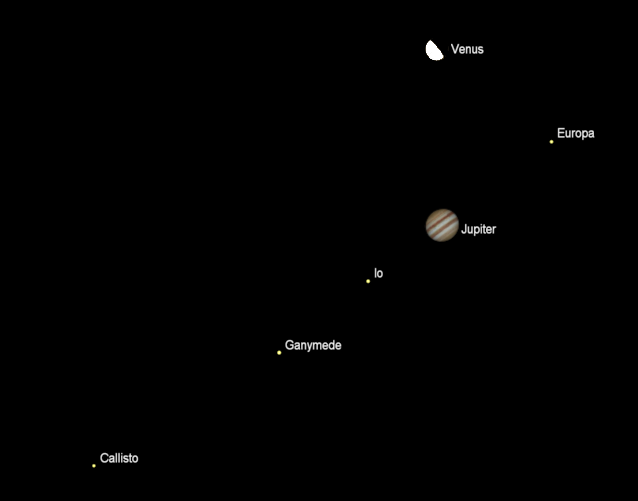
Venus and Jupiter with the same magnification at 6 a.m. tomorrow morning January 17, 2019. Created using Cartes du Ciel (Sky Charts).
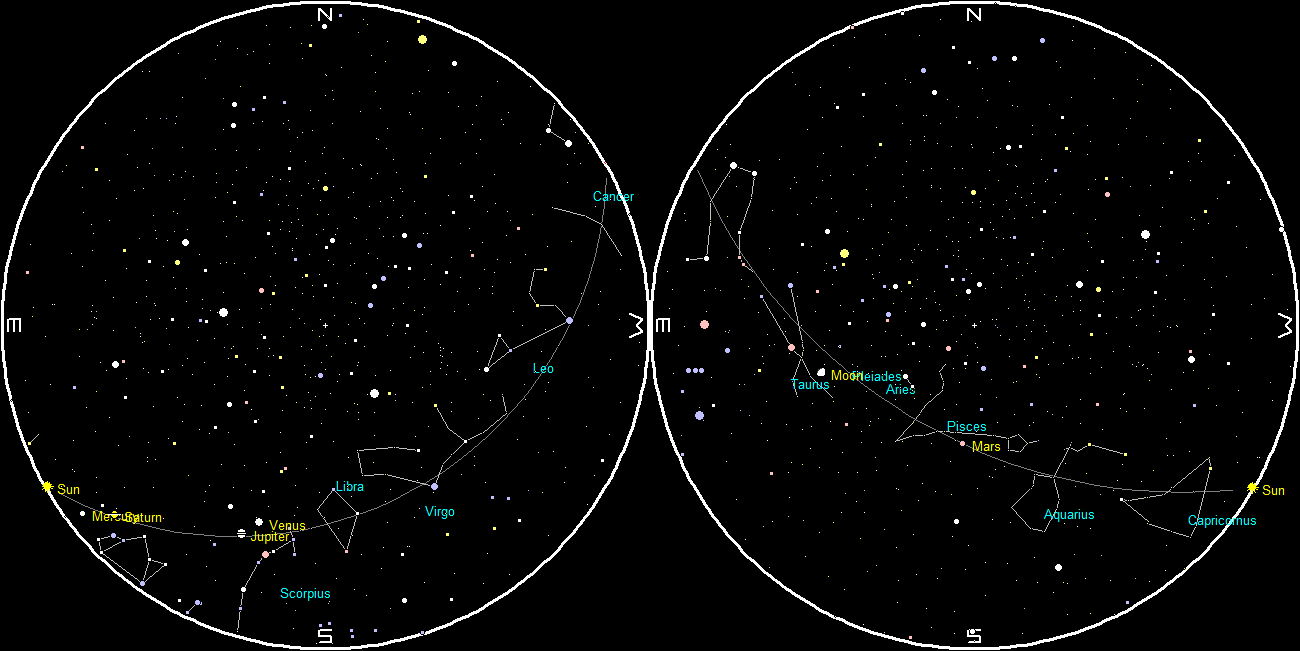
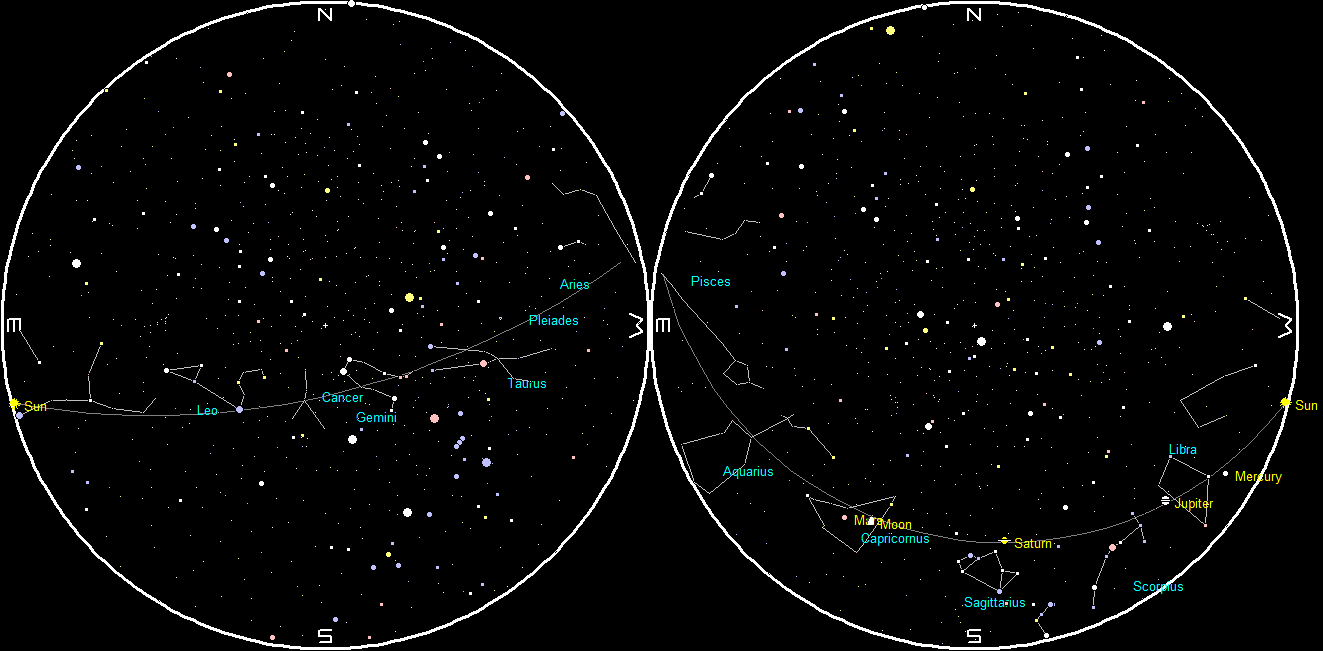
Planets and the Moon at sunset and sunrise of a single night starting with sunset on the right on January 16, 2019. The night ends on the left with sunrise on the 17th. Click on the image to enlarge. Created using my LookingUp program.
01/09/2019 – Ephemeris – Where are the planets tonight?
Ephemeris for Wednesday, January 9th. The Sun will rise at 8:19. It’ll be up for 9 hours and 1 minute, setting at 5:20. The Moon, 4 days past new, will set at 8:55 this evening.
Let’s look at the planets for this week. Our only evening planet Mars will be in the southwestern sky this evening and will set at 11:59 p.m. It’s too far away to see much detail in a small telescope. In the morning sky we have Venus rising at 4:40 a.m. tomorrow and this morning is prominent in the southeastern sky as our morning star. In small telescopes it is half illuminated, having its greatest western elongation last Saturday. Its phase will now grow to be gibbous as its size shrinks as it continues its long journey around behind the Sun. Jupiter will rise tomorrow at 5:43 a.m. It is second to Venus in brightness, but second to no planet in size. Binoculars can see some of its biggest moons. Telescopes can see all four.
The times given are for the Traverse City/Interlochen area of Michigan. They may be different for your location.
Addendum
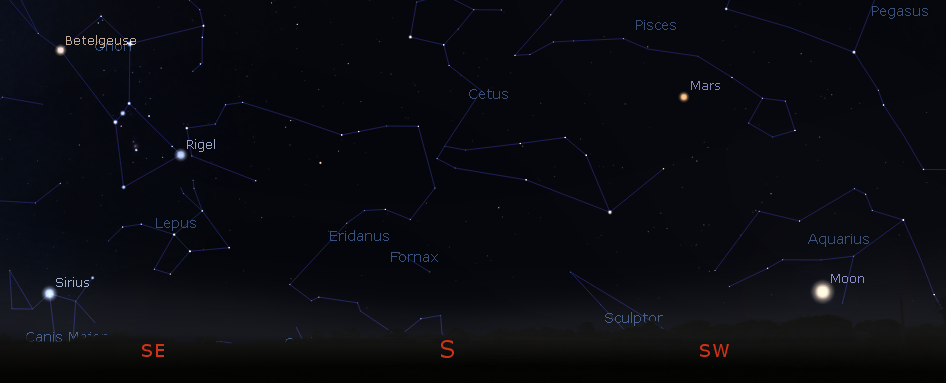
Mars and the Moon with the evening constellations tonight at 8 p.m. January 9, 2019. Click on the image to enlarge. Created using Stellarium.
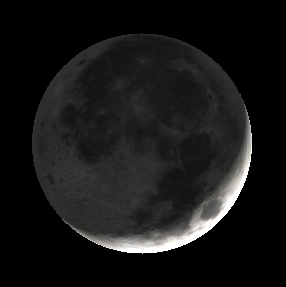
The Moon as it might appear in binoculars including earthshine this evening. Created using Stellarium.
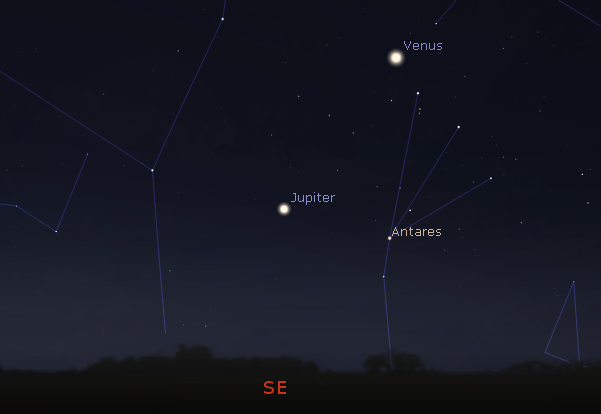
Venus and Jupiter in the morning at 7 a.m. tomorrow morning January 10, 2019. Created using Stellarium.
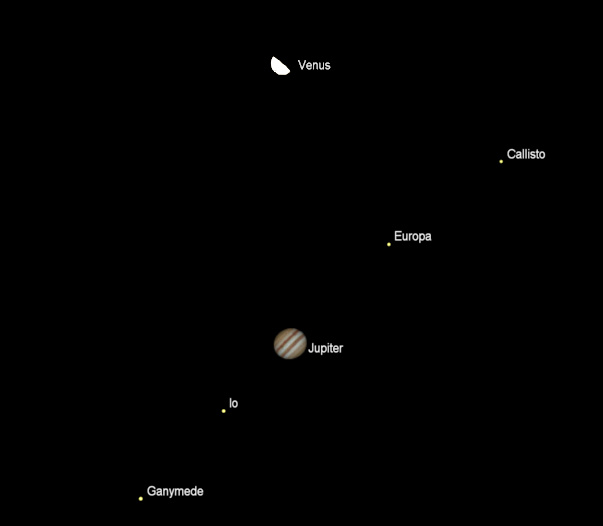
Venus and Jupiter with the same magnification at 7 a.m. tomorrow morning January 10, 2019. Created using Cartes du Ciel (Sky Charts).
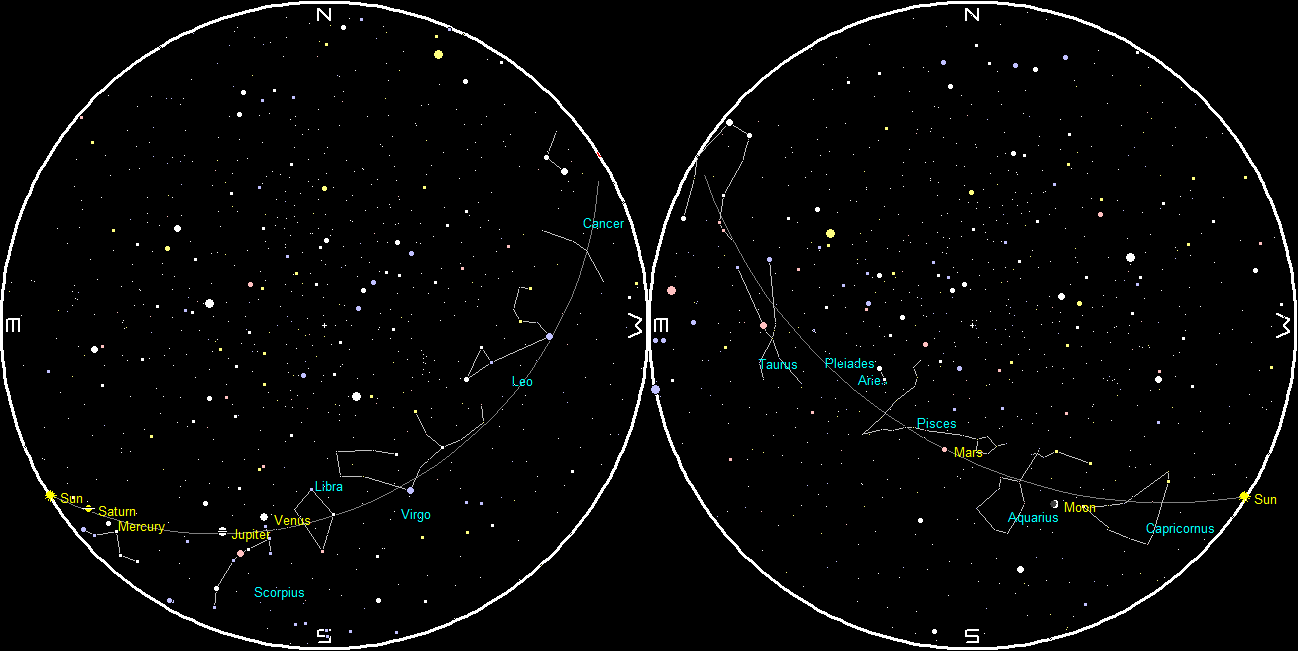
Planets and the Moon at sunset and sunrise of a single night starting with sunset on the right on January 9, 2019. The night ends on the left with sunrise on the 10th. Click on the image to enlarge. Created using my LookingUp program.
01/02/2019 – Ephemeris – The first look at the bright planets for the new year
Ephemeris for Wednesday, January 2nd. The Sun will rise at 8:20, the latest sunrise. It’ll be up for 8 hours and 53 minutes, setting at 5:13. The Moon, 3 days before new, will rise at 6:02 tomorrow morning.
Let’s look at the planets for this week. We start with the Earth which will reach perihelion, its closest to the Sun of the year at 4:49 tomorrow morning at 91.3 million miles (147.1 million kilometers). Mars will be in the southwestern sky this evening and will set at 11:59 p.m. It’s too far away to see much detail in a small telescope. In the morning sky we have Venus rising at 4:31 a.m. tomorrow and this morning is prominent in the southeastern sky as our morning star. In small telescopes it is a fat crescent. Jupiter will rise tomorrow at 6:04 a.m. will be to the right of the Moon then. Mercury and Saturn are not visible, though the latter passed behind the Sun yesterday to become a morning planet.
The times given are for the Traverse City/Interlochen area of Michigan. They may be different for your location.
Addendum
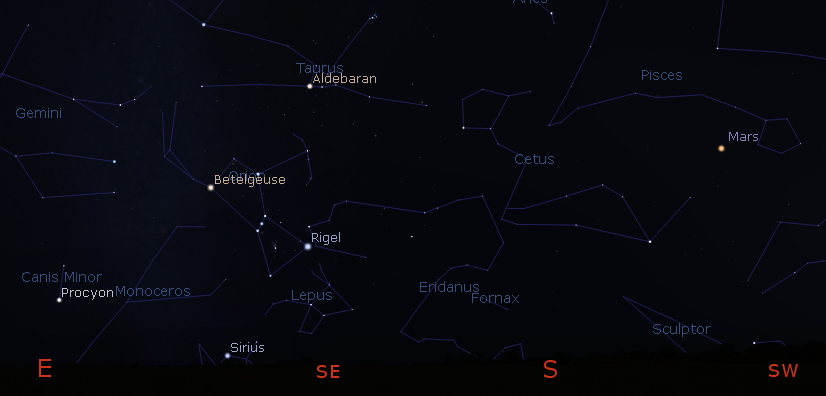
Mars and the constellations at 8 p.m. tonight January 2, 2019. Click on the image to enlarge. Created using Stellarium.
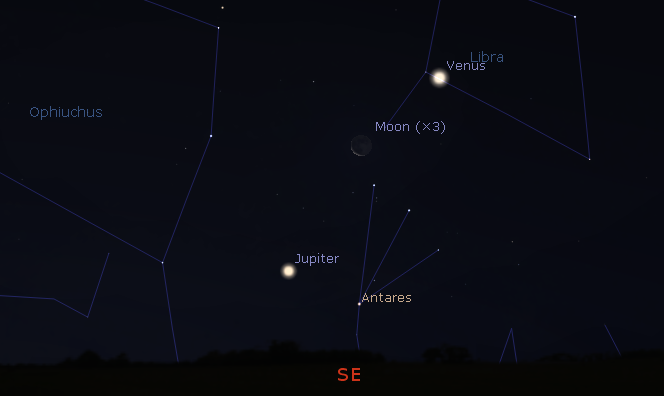
Morning planets Venus and Jupiter this morning, January 2, 2019, at 7 a.m.. Created using Stellarium.
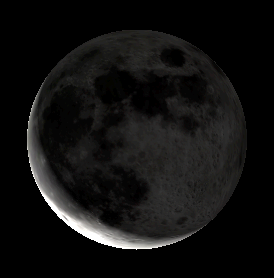
The waning crescent Moon as it should appear this morning with earthshine in binoculars. Created using Stellarium.
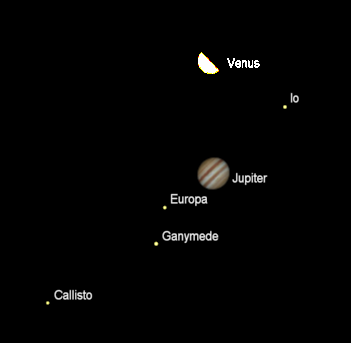
Venus and Jupiter with the same magnification at 7 a.m. this morning January 2, 2019. Created using Cartes du Ciel (Sky Charts).
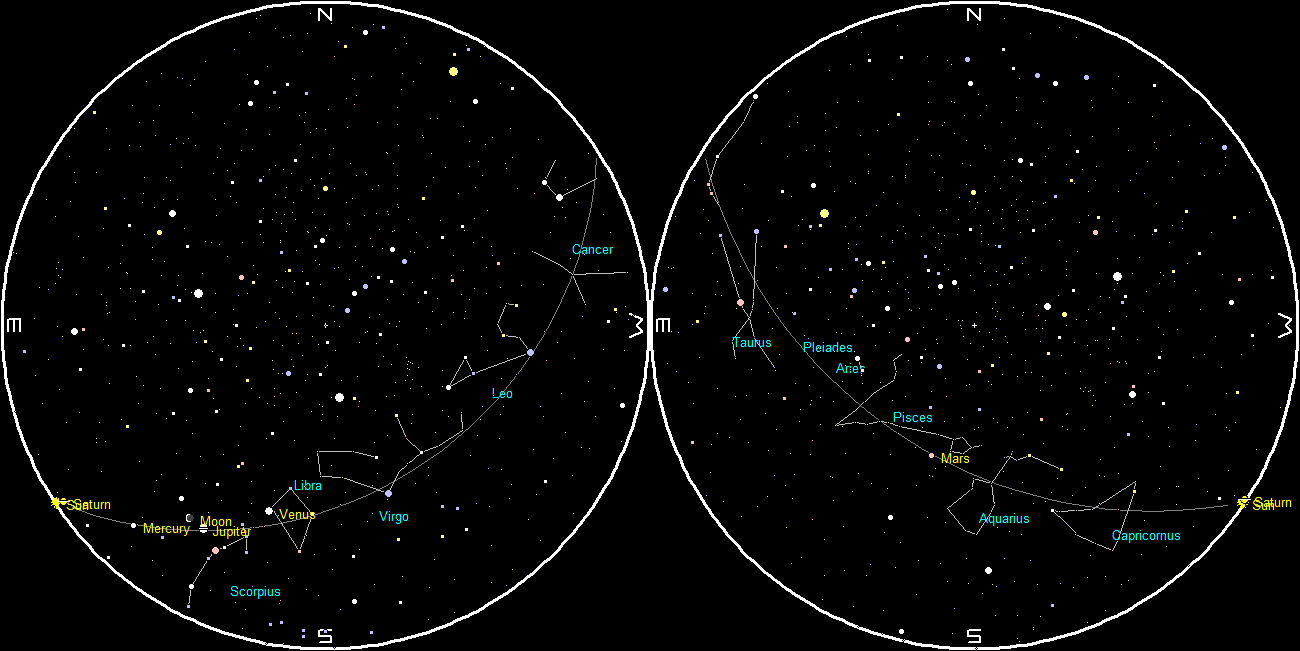
Planets and the Moon at sunset and sunrise of a single night starting with sunset on the right on January 2, 2019. The night ends on the left with sunrise on the 3rd. Click on the image to enlarge. Created using my LookingUp program.
12/26/2018 – Ephemeris – Looking at the bright planets for the last time in 2018
Ephemeris for Wednesday, December 26th. The Sun will rise at 8:19. It’ll be up for 8 hours and 48 minutes, setting at 5:08. The Moon, 3 days before last quarter, will rise at 10:05 this evening.
Let’s look at the bright planets for the last time in 2018. In the evening sky we have Mars still visible, but Saturn is lost in the bright twilight. It will pass conjunction with the Sun on New Years day. Mars will be due south at 6:09 p.m., and it will set at 12:05 a.m. Mars is moving eastward, crossing the constellation of Pisces. Comet Wirtanen is moving northward and to the lower left of Capella, in dark skies again in the early evening, but is fading as it moves away from both the Earth and Sun. It should be visible in binoculars as a faint fuzzy spot. Venus, our brilliant morning star, will rise at 4:24 a.m. in the east-southeast. Jupiter will rise at 6:24 a.m. also in the east-southeast.
The times given are for the Traverse City/Interlochen area of Michigan. They may be different for your location.
Addenda
Planets and the Moon
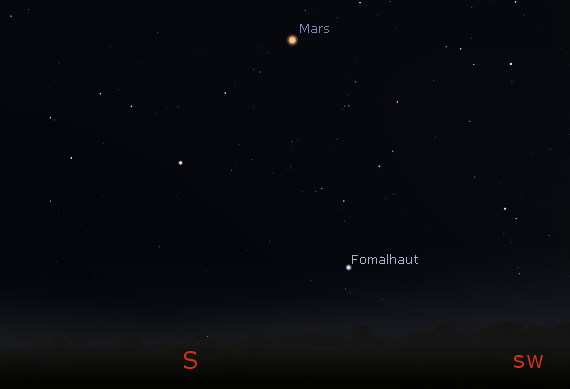
Mars at 7 p.m. tonight December 26, 2018. Created using Stellarium.
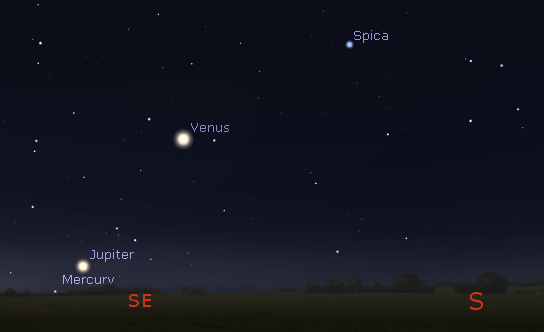
Morning planets Venus Jupiter this morning, December 26, 2018, at 7 a.m.. Created using Stellarium.
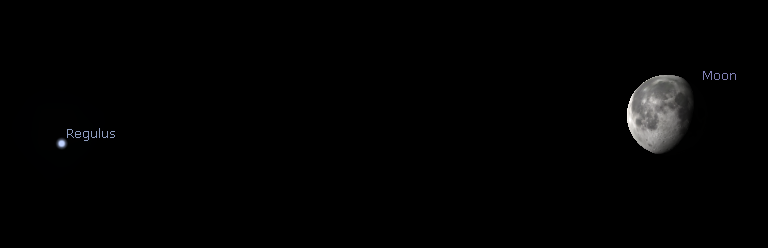
The Moon with the bright star Regulus in Leo the lion at 7 this morning, December 26, 2018.

Telescopic view of Venus this morning December 26, 2018. Created using Stellarium.
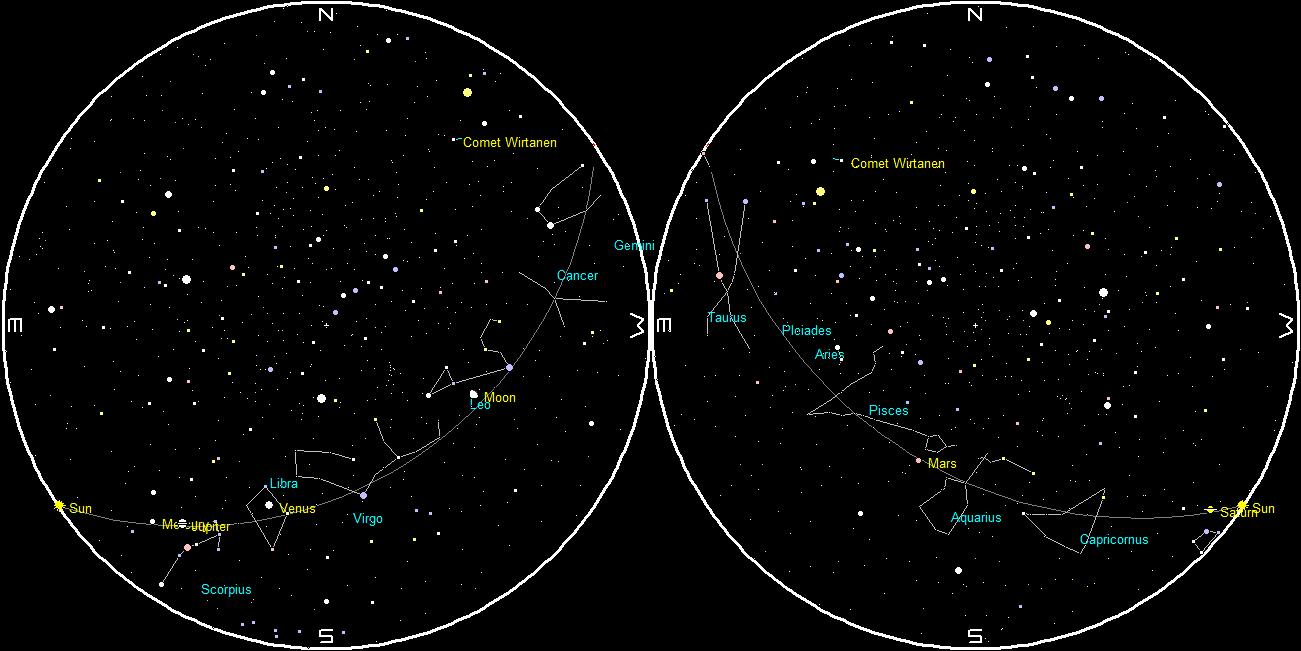
Planets, a comet and the Moon at sunset and sunrise of a single night starting with sunset on the right on December 20, 2018. The night ends on the left with sunrise on the 27th. Click on the image to enlarge. Created using my LookingUp program.
Comet Wirtanen
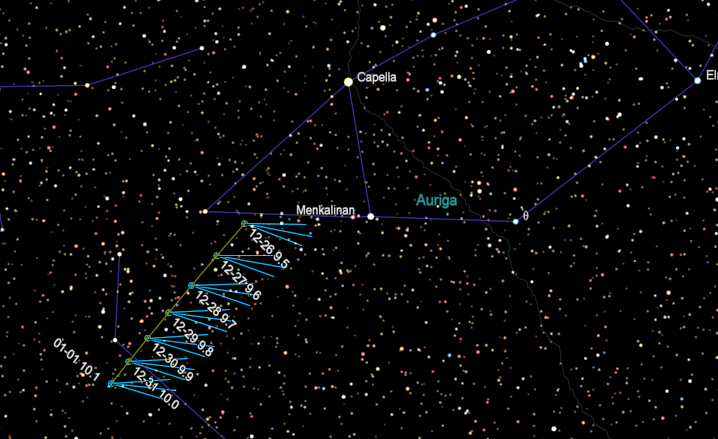
Comet 46P/Wirtanen positions for the next week. Positions are marked with month-date and magnitude. The observations are about 5 magnitudes brighter than shown here. Star field position is for 9 p.m. on the 26th. The comet is circumpolar, so it will not set overnight. Click on the image to enlarge. Created using Cartes du Ciel (Sky Charts).
12/19/2018 -Ephemeris – The Bright planets and a departing comet for this week
Ephemeris for Wednesday, December 19th. The Sun will rise at 8:15. It’ll be up for 8 hours and 48 minutes, setting at 5:04. The Moon, 3 days before full, will set at 5:34 tomorrow morning.
Let’s look at the bright planets for tonight. In the evening sky we have Mars still visible, but Saturn is lost in the bright twilight. It will pass conjunction with the Sun on New Years day. Mars will be due south at 6:19 p.m., and it will set at 12:08 a.m. Mars is moving eastward, crossing the constellation of Aquarius until the 21st, when it enters Pisces. Comet Wirtanen is moving northward, to the left of the Pleiades and fading as the moonlight gets brighter. On the 23rd at 9 p.m. it will be a degree and a half, that’s 3 moon widths below and a bit left of the star Capella. Venus, our brilliant morning star, will rise at 4:20 a.m. in the east-southeast. The planets Jupiter and Mercury will be low on the southeastern horizon by 7 a.m. tomorrow..
The times given are for the Traverse City/Interlochen area of Michigan. They may be different for your location.
Addenda
Bright planets and the Moon
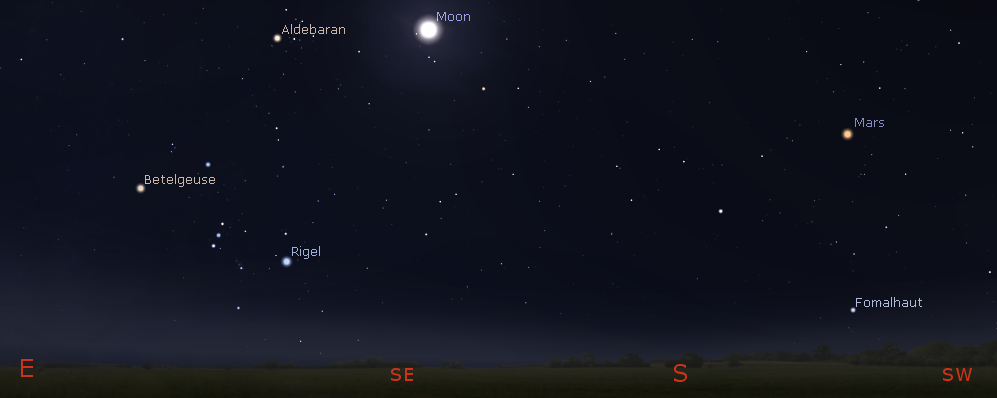
Mars, and the Moon at 8 p.m. tonight December 19, 2018. Click on image to enlarge. Created using Stellarium.
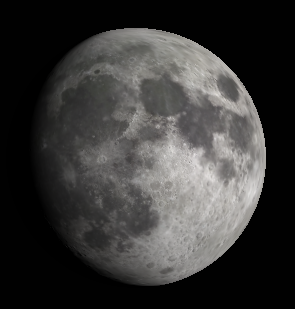
The waxing gibbous Moon as it should appear tonight in binoculars. Created using Stellarium.
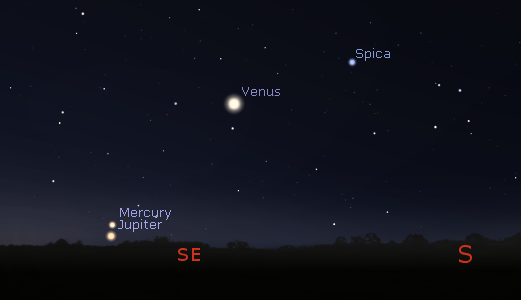
Morning planets Venus, Mercury and Jupiter on December 20, 2018, 7 a.m.. Created using Stellarium.

Telescopic view of Venus tomorrow morning December 20, 2018. Created using Stellarium.
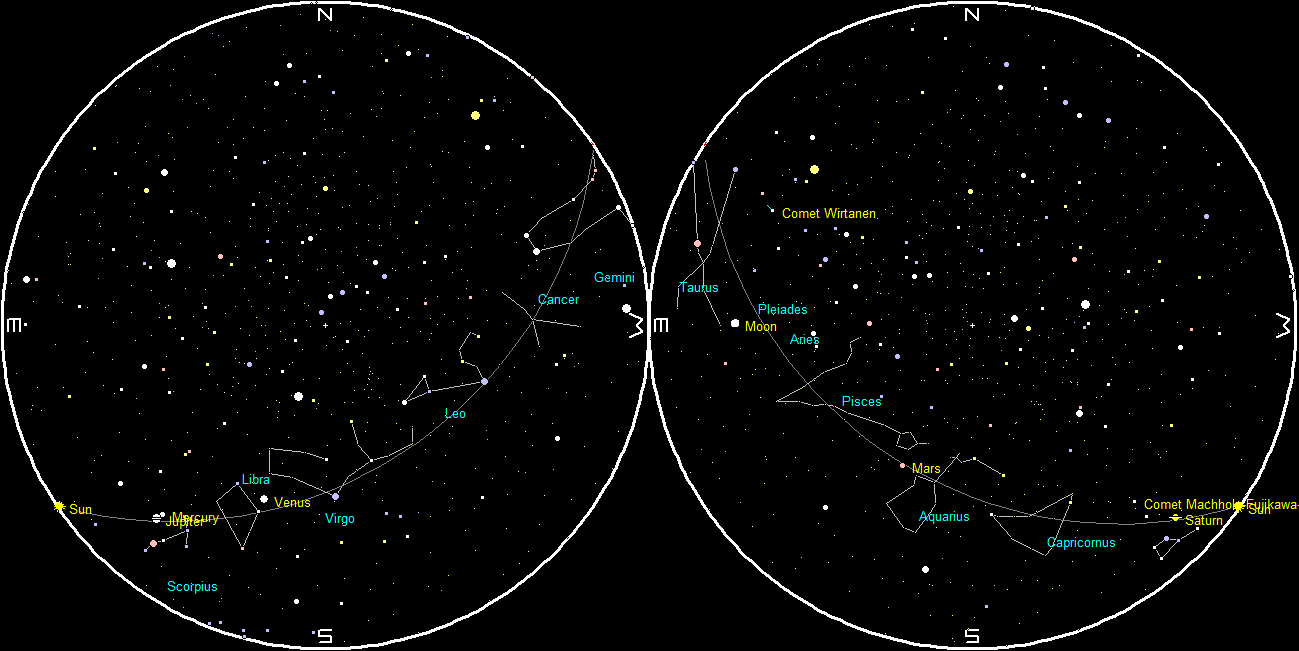
Planets, two comets and the Moon at sunset and sunrise of a single night starting with sunset on the right on December 19, 2018. The night ends on the left with sunrise on the 20th. Click on the image to enlarge. Created using my LookingUp program.
Comets
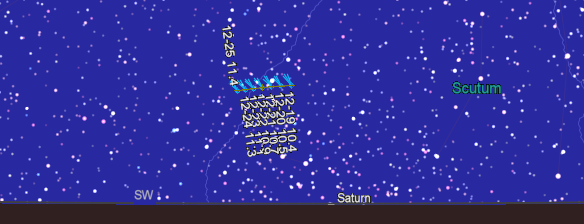
Comet C/2018 V1 (Machholz-Fijikawa-Iwamoto) in twilight starting tonight December 19, 2018. This comet is basically invisible in the evening twilight of 6 p.m. on the rest of the nights because the stars in the field will set 4 minutes earlier each successive evening. The latest magnitude observed is two magnitudes brighter than shown here. Created using Cartes du Ciel (Sky Charts).
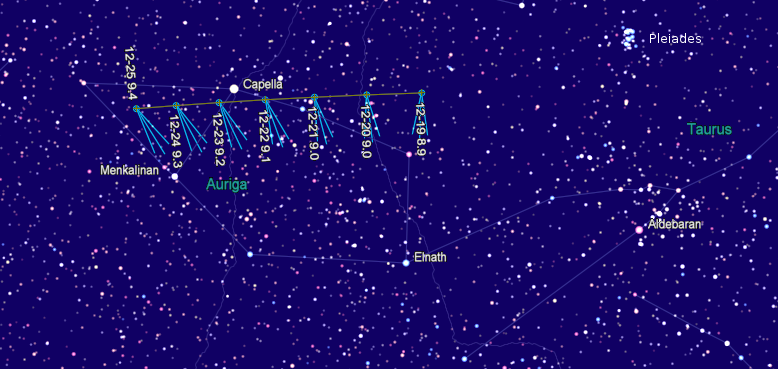
Comet 46P/Wirtanen positions for the next week in a bright moonlit sky. Positions are marked with month-date and magnitude. The observations are about 5.5 magnitudes brighter than shown here. Star field position is for 9 p.m. on the 19th. Click on the image to enlarge. Created using Cartes du Ciel (Sky Charts).
12/12/2018 – Ephemeris – The bright planets and a comet this week
Ephemeris for Wednesday, December 12th. The Sun will rise at 8:10. It’ll be up for 8 hours and 51 minutes, setting at 5:02. The Moon, 3 days before first quarter, will set at 10:05 this evening.
Let’s look at the bright planets for tonight. In the evening sky we have Mars still visible, but Saturn is all but lost in the bright twilight, setting at 6:22 p.m. It will pass conjunction with the Sun on New Years day. Mars will be due south at 6:30 p.m., and it will set at 12:10 a.m. Mars is moving eastward, crossing the constellation of Aquarius until the 21st, when it enters Pisces. Comet Wirtanen is moving northward, to the right of the V of stars that’s the head of Taurus the bull, and should be an excellent binocular object. On the 15th and 16th it will pass to the left of the Pleiades or Seven Sisters. Venus, our brilliant morning star, will rise at 4:19 a.m. in the east-southeast. The elusive planet Mercury will be seen below and left of Venus after it rises at 6:20 a.m.
The times given are for the Traverse City/Interlochen area of Michigan. They may be different for your location.
Addenda
Planets and the Moon
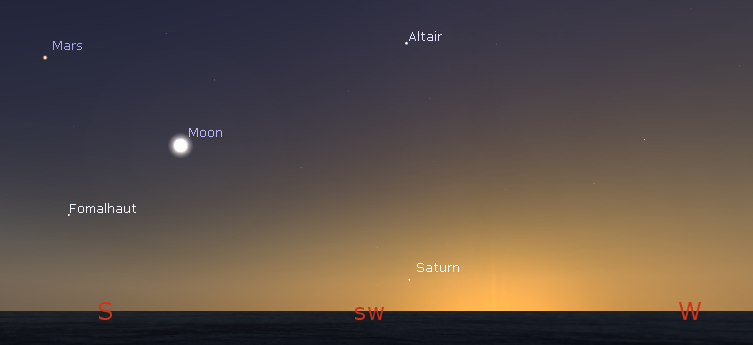
Mars, and Saturn over a Lake Michigan horizon seen at 5:45 p.m. tonight December 12, 2018. Created using Stellarium.
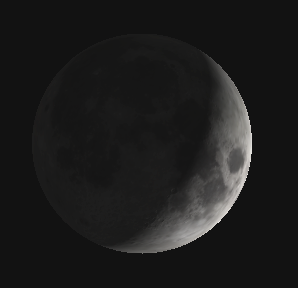
The waxing crescent Moon as it should appear tonight in binoculars. Created using Stellarium.
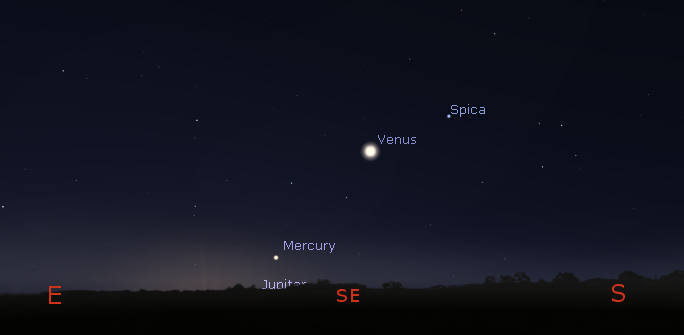
Morning planets Venus and Mercury. Jupiter is rising. December 13, 2018, 7:15 a.m.. Created using Stellarium.
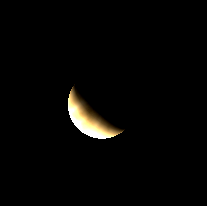
Telescopic view of Venus tomorrow morning December 13, 2018. Created using Stellarium.
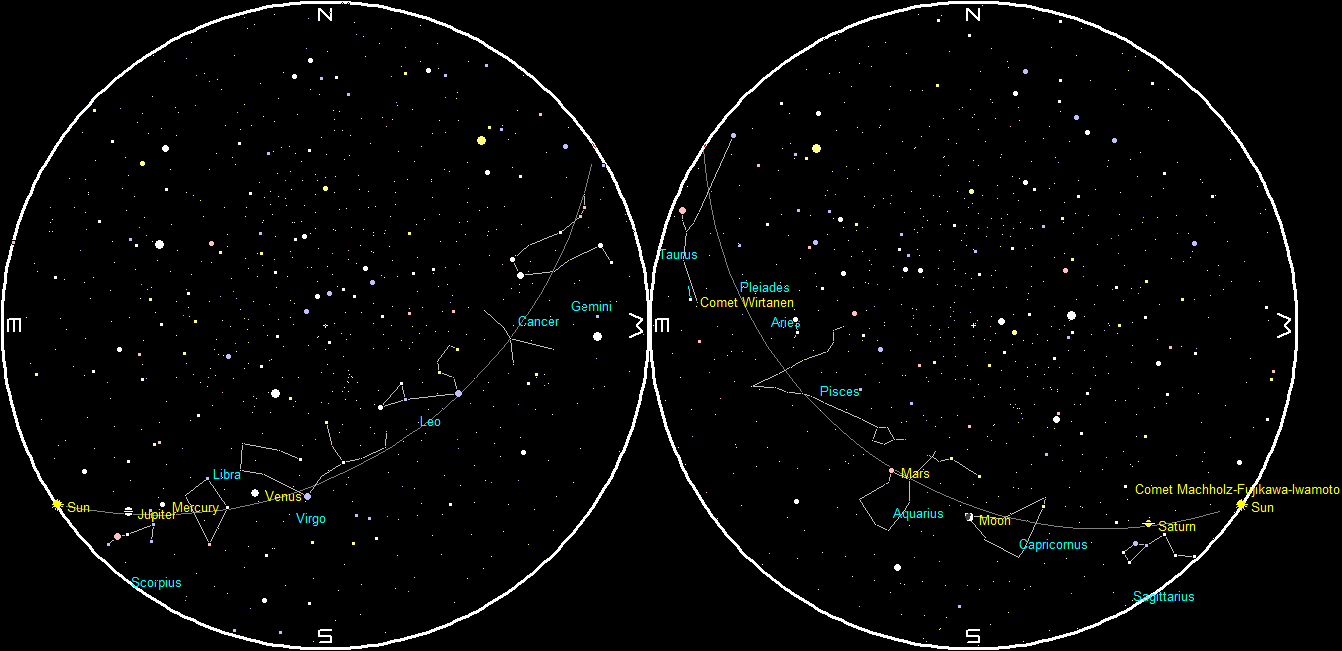
Planets, two comets and the Moon at sunset and sunrise of a single night starting with sunset on the right on December 12, 2018. The night ends on the left with sunrise on the 13th. Click on the image to enlarge. Comet Wirtanen is very close to opposition and to the south, so it rises after sunset and sets before sunrise. Created using my LookingUp program.
Two comets
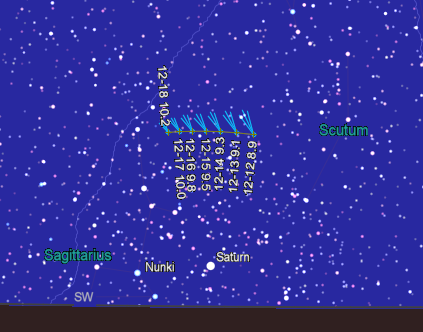
Comet C/2018 V1 (Machholz-Fijikawa-Iwamoto) in twilight starting tonight December 12, 2018. The comet won’t climb that dramatically at 6 p.m. on the rest of the nights because the stars in the field will set 4 minutes earlier each successive evening. The latest magnitude estimate of the comet on December 15 is 7.3, two magnitudes brighter than shown here. It is just about impossible to spot in twilight. Created using Cartes du Ciel (Sky Charts).
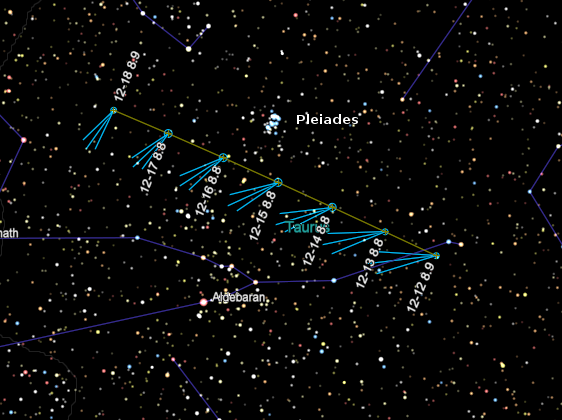
Comet 46P/Wirtanen positions for the next week. Positions are marked with month-date and magnitude. The latest magnitude prediction for December 15th is 3.3, 5.5 magnitudes brighter than shown here. Star field position is for 9 p.m. on the 12th. Click on the image to enlarge. Created using Cartes du Ciel (Sky Charts).
11/21/2018 – Ephemeris – The bright planets and two comets for this week
Ephemeris for Wednesday, November 21st. The Sun will rise at 7:47. It’ll be up for 9 hours and 21 minutes, setting at 5:09. The Moon, 2 days before full, will set at 6:47 tomorrow morning.
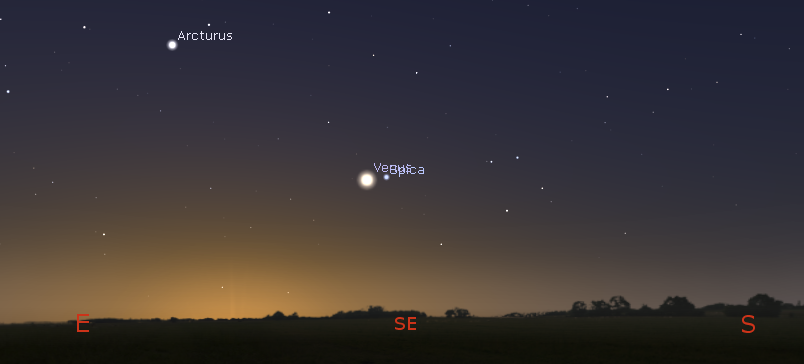
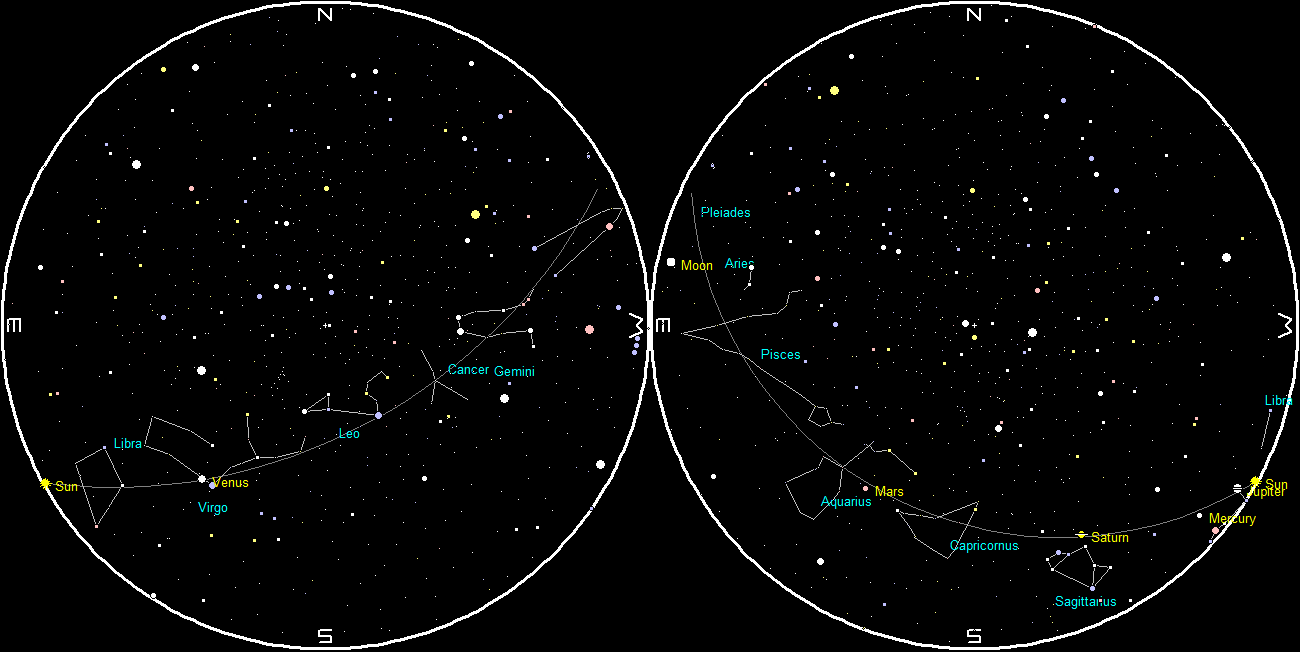
Let’s look at the bright planets for tonight. Two of them are visible in the evening sky. Jupiter is 5 days from passing behind the Sun, and will officially be a morning planet next Monday. Saturn, the ringed planet, will start the evening low in the southwestern sky and will set at 7:35 p.m. Mars will be in the south as the skies darken tonight. Mars will be due south at 7:03 p.m., and it will set at 12:20 a.m. Mars is moving eastward, crossing the constellation of Aquarius this month. It’s currently about midway through Aquarius, moving eastward and northward, so its setting time won’t change much over this month. Venus, our brilliant morning star, will rise at 4:50 a.m. in the east southeast. The blue-white star Spica is to the right and a bit above it.
The times given are for the Traverse City/Interlochen area of Michigan. They may be different for your location.
Addenda
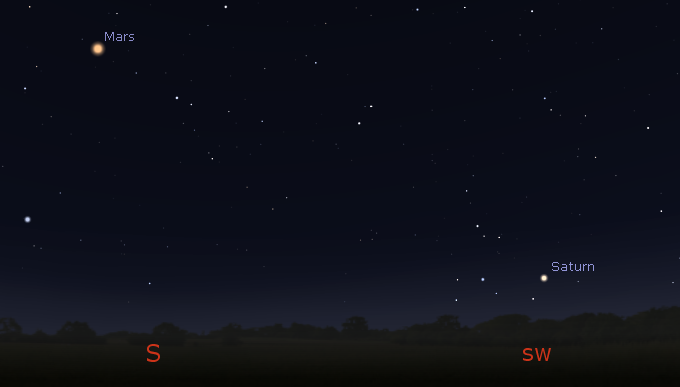
Planets and the Moon
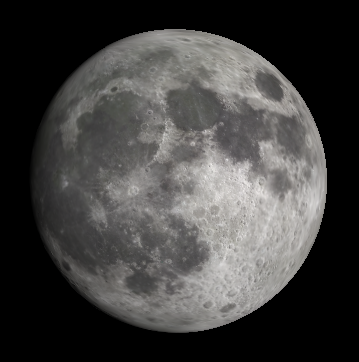
Click on images to enlarge
Current relatively bright comets
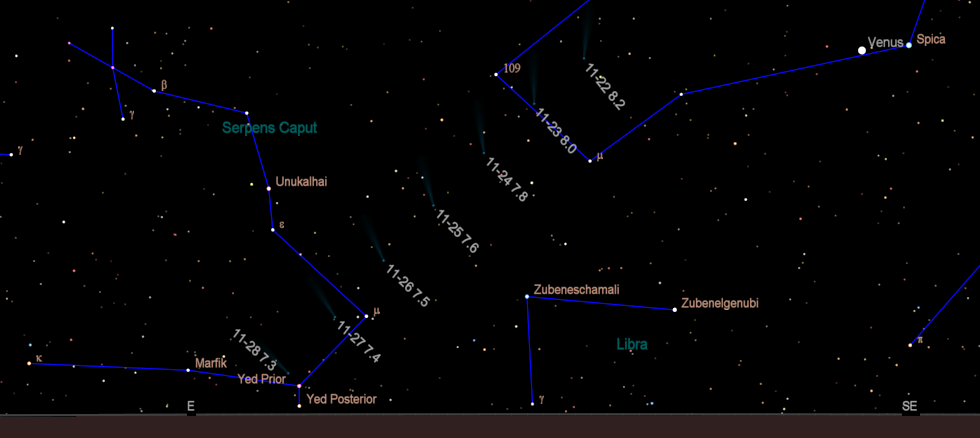
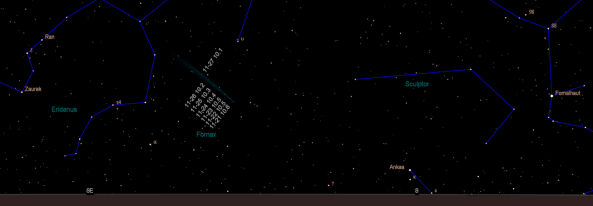
The new magnitude estimates are from Seiichi Yoshida’s website and his Weekly Information about Bright Comets: http://www.aerith.net/comet/weekly/current.html
10/31/2018 – Ephemeris – The bright planets tonight
Ephemeris for Halloween, Wednesday, October 31st. The Sun will rise at 8:19. It’ll be up for 10 hours and 13 minutes, setting at 6:32. The Moon, at last quarter today, will rise at 1:02 tomorrow morning.
Let’s look at the bright planets for tonight. Three of them are visible in the evening sky. Jupiter will be barely visible very low in the west-southwest after sunset. It will set at 7:30 p.m. Saturn, the ringed planet, will start the evening low in the south-southwestern sky and will set at 9:49 p.m. Mars will be low in the south-southeast as the skies darken tonight. and is now 73.2 million miles (117.9 million km) away. Mars will be due south at 8:39 p.m., and it will set at 1:33a.m. Mars is picking up speed moving eastward, crossing the constellation of Capricornus this month. It’s currently in eastern Capricornus. Venus, now a morning planet, will rise at 7:45 tomorrow morning, 34 minutes after the Sun.
The times given are for the Traverse City/Interlochen area of Michigan. They may be different for your location.
Addendum
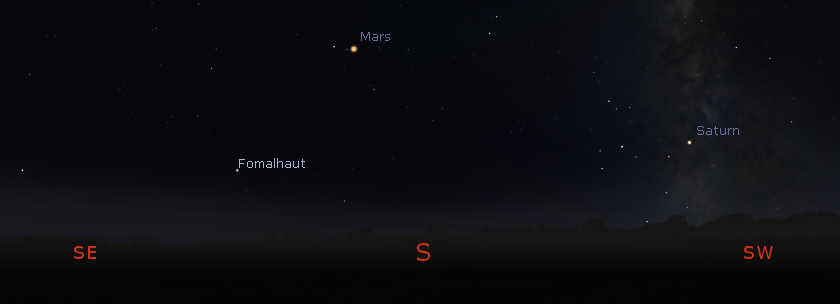
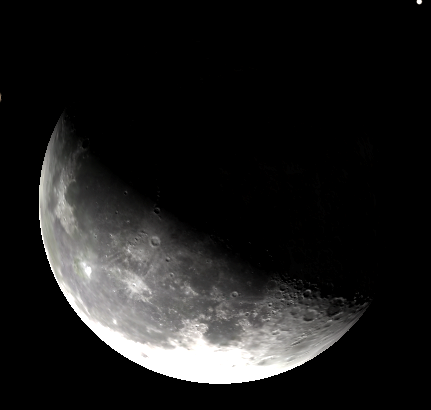
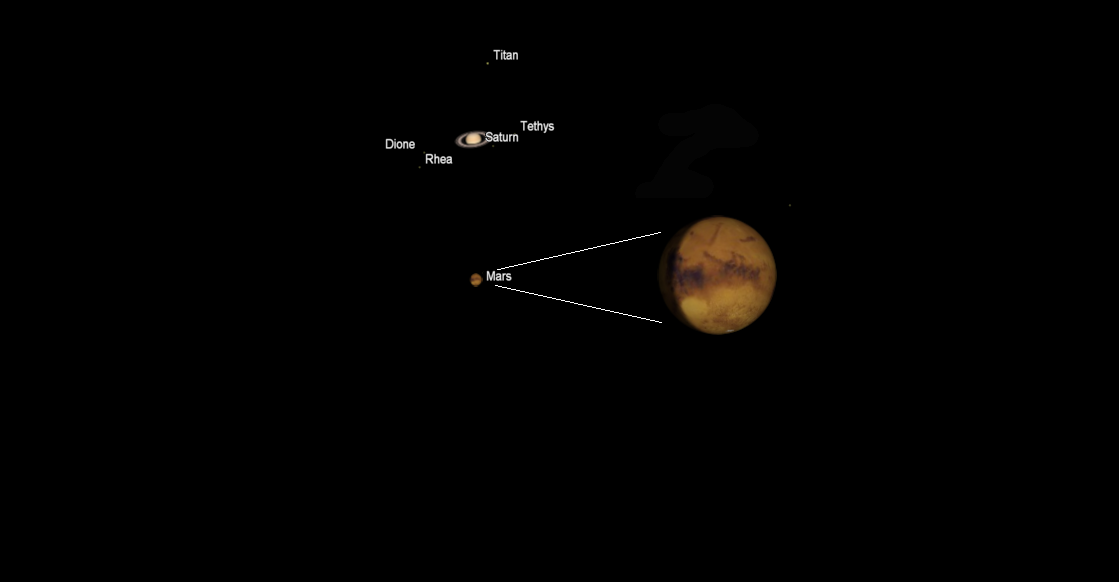
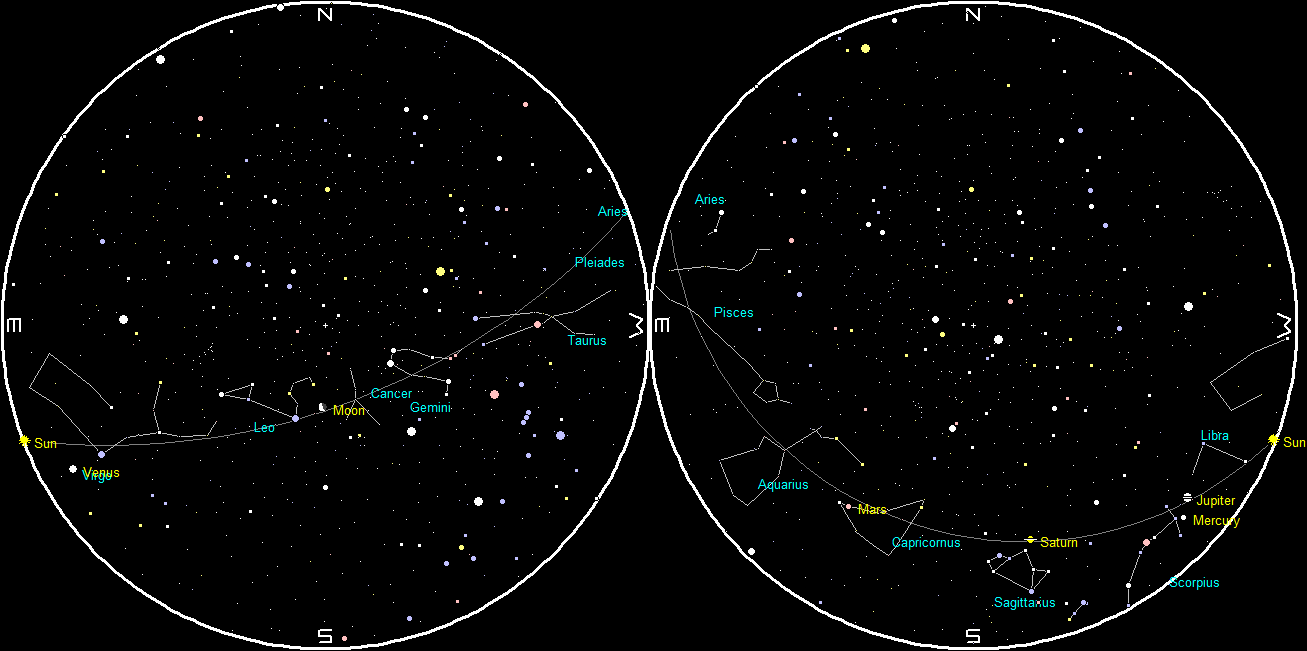
Update
I know, the content above isn’t very spooky for Halloween. However, NASA came to the rescue with their Halloween Special: Universe of Monsters. Fitting with our theme today, it’s about planets… of the Exo variety. Click here!
10/24/2018 – Ephemeris – Looking for the bright planets tonight
Ephemeris for Wednesday, October 24th. The Sun will rise at 8:10. It’ll be up for 10 hours and 33 minutes, setting at 6:43. The Moon, at full today, will rise at 7:13 this evening.
Let’s look at the bright planets for tonight. Three of them are visible in the evening sky. Venus, though still officially an evening planet for two more days sets before the Sun because it is south of the Sun’s path. Jupiter will be very low in the west-southwest after sunset. It will set at 7:53 p.m. Saturn, the ringed planet, will start the evening low in the southwestern sky and will set at 10:14 p.m. Mars will be low in the south as the skies darken tonight. and is now 68.9 million miles (111.0 million km) away. Mars will be due south at 8:51 p.m., and it will set at 1:39 a.m. Mars is picking up speed moving eastward, crossing the constellation of Capricornus this month. It’s currently in eastern Capricornus.
The times given are for the Traverse City/Interlochen area of Michigan. They may be different for your location.
Addendum
10/17/2018 – Ephemeris – Where are the bright planets tonight?
Ephemeris for Wednesday, October 17th. The Sun will rise at 8:00. It’ll be up for 10 hours and 53 minutes, setting at 6:54. The Moon, 1 day past first quarter, will set at 1:33 tomorrow morning.
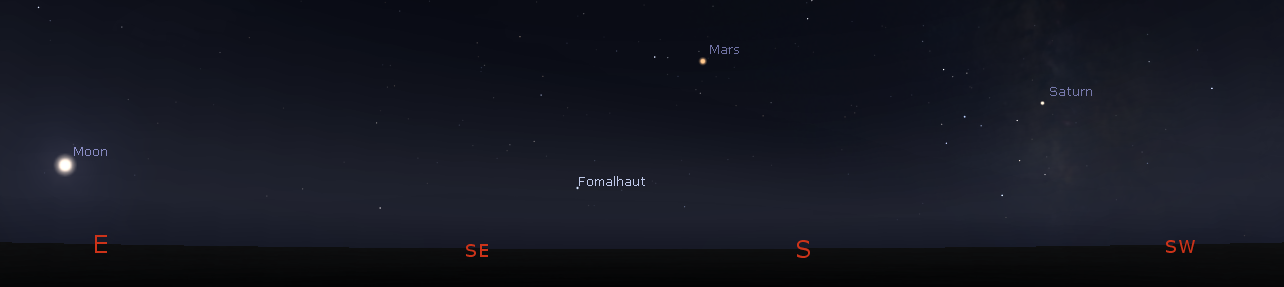
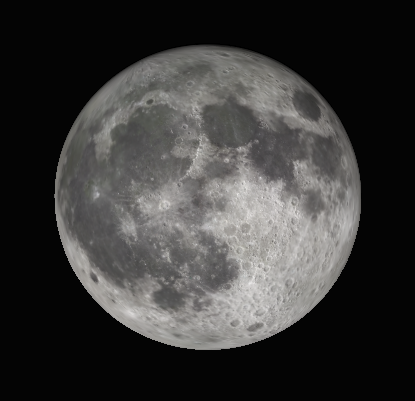
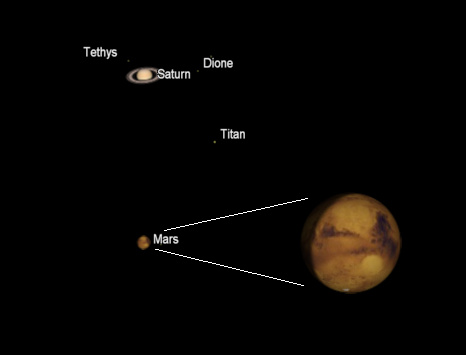
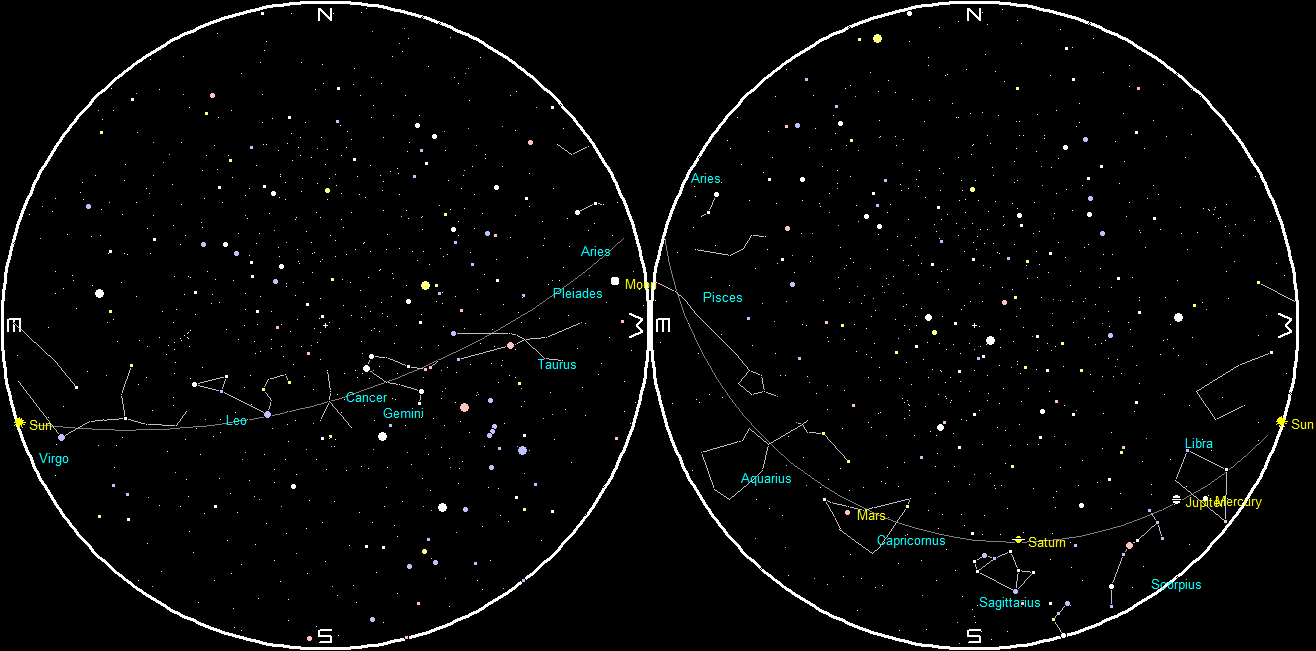
Let’s look at the bright planets for tonight. Three of them are visible in the evening sky. Venus though still officially an evening planet sets before the Sun because it is south of the Sun’s path. Jupiter will be very low in the west-southwest as skies darken. It will set at 8:16 p.m. Saturn, the ringed planet, will start the evening low in the southwestern sky and will set at 10:39 p.m. Mars will be low in the south as the skies darken tonight. and is now 64.6 million miles (104.0 million km) away. Mars will be due south at 9:04 p.m., and it will set at 2:03 a.m. Tonight Mars will be east or left of the waxing gibbous Moon. Mars is picking up speed moving eastward, crossing the constellation of Capricornus this month.
The times given are for the Traverse City/Interlochen area of Michigan. They may be different for your location.
Addendum
 Bob Moler's Ephemeris Blog