Archive
05/10/2017 – Ephemeris – Our weekly look at the bright planets
Wednesday, May 10th. The Sun rises at 6:20. It’ll be up for 14 hours and 38 minutes, setting at 8:58. The Moon, at full today, will rise at 8:44 this evening.
Let’s take our weekly look at the bright planets. Mars is still in the west after sunset and fading. It appears above the brighter star Aldebaran in Taurus now. It will set at 10:58 p.m. Not quite dominating the evening sky now due to the Moon is Jupiter in the south-southeast. The bright blue-white star Spica is seen below and left of it. In even the smallest telescopes Jupiter’s four largest moons can be seen. They shift positions night from to night and even as you watch. Jupiter will set at 5:11 a.m. At 6 a.m. both Saturn and Venus will be in the morning twilight. Saturn will appear to be a bit to the west of south compass point. It will rise in the east-southeast at 11:44 p.m. Venus will be low in the east at 6 a.m. tomorrow morning after rising at 4:41.
The times given are for the Traverse City/Interlochen area of Michigan. They may be different for your location.
Addendum
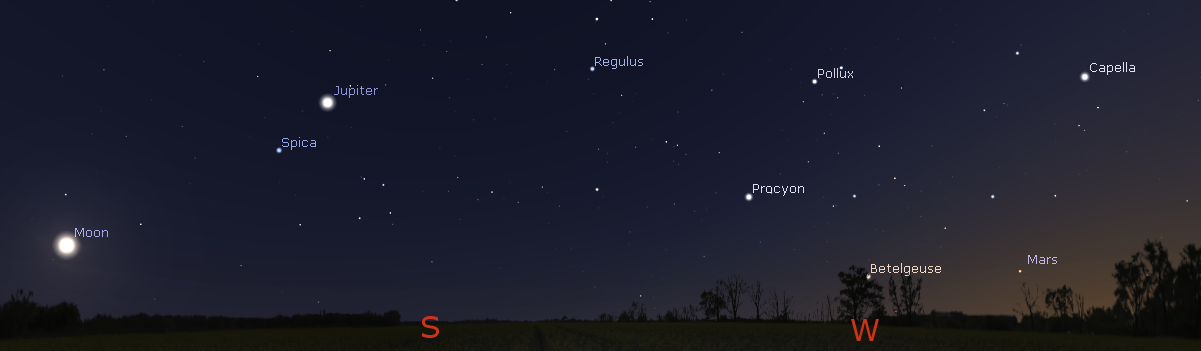
Mars, Jupiter and the full Moon with the brighter stars at 10 p.m., May 10, 2017. Created using Stellarium. Click on the image to enlarge.
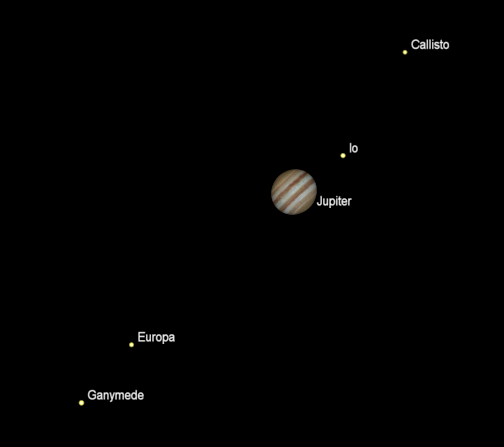
Jupiter and its four Galilean moons as they might be seen in a telescope at 10 p.,. May 10, 2017. Created using Cartes du Ciel (Sky Charts).
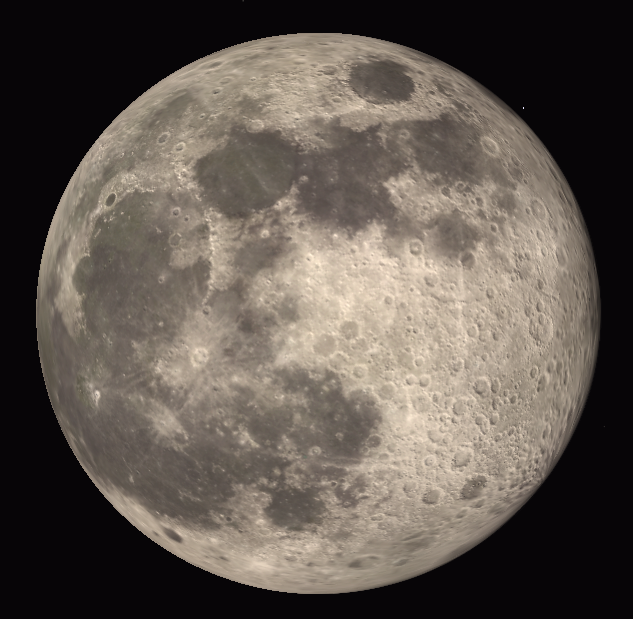
The Full Moon at 10 p.m., May 10, 2017. Created using Stellarium.
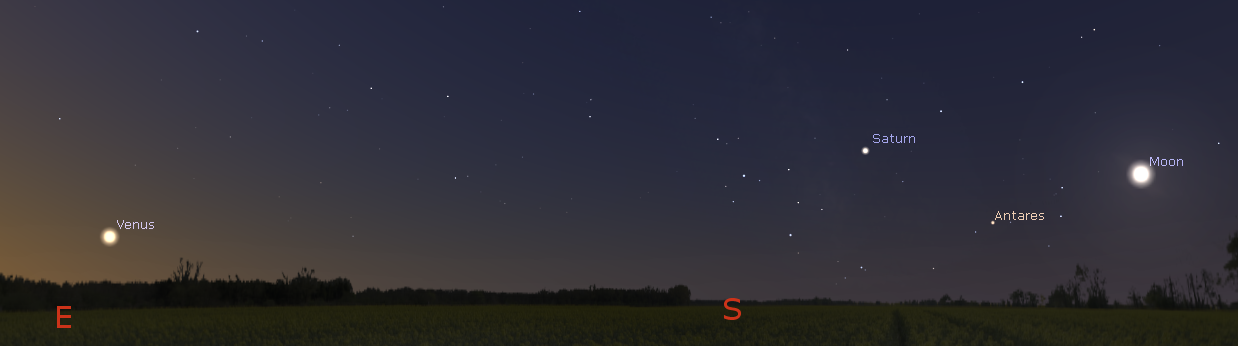
Venus, Saturn and the Moon at 5:30 a.m. May 11, 2017. Created using Stellarium. Click on the image to expand.
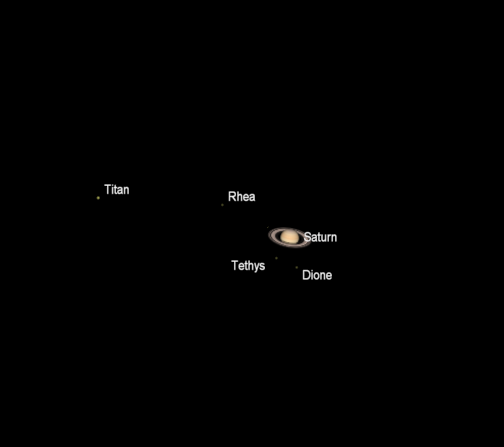
Saturn and its brightest 4 moons at 5:30 a.m. May 11, 2017. This is displayed at the same scale/magnification as the Jupiter image above. Created using Cartes du Ciel (Sky Charts).
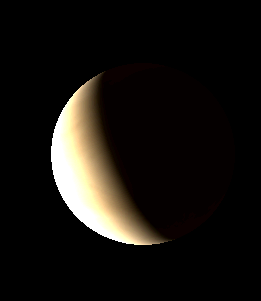
Venus as seen through a telescope at 5:30 a.m. May 11, 2017. This is displayed at a larger scale/magnification than the Jupiter and Saturn images above. Created using Stellarium.
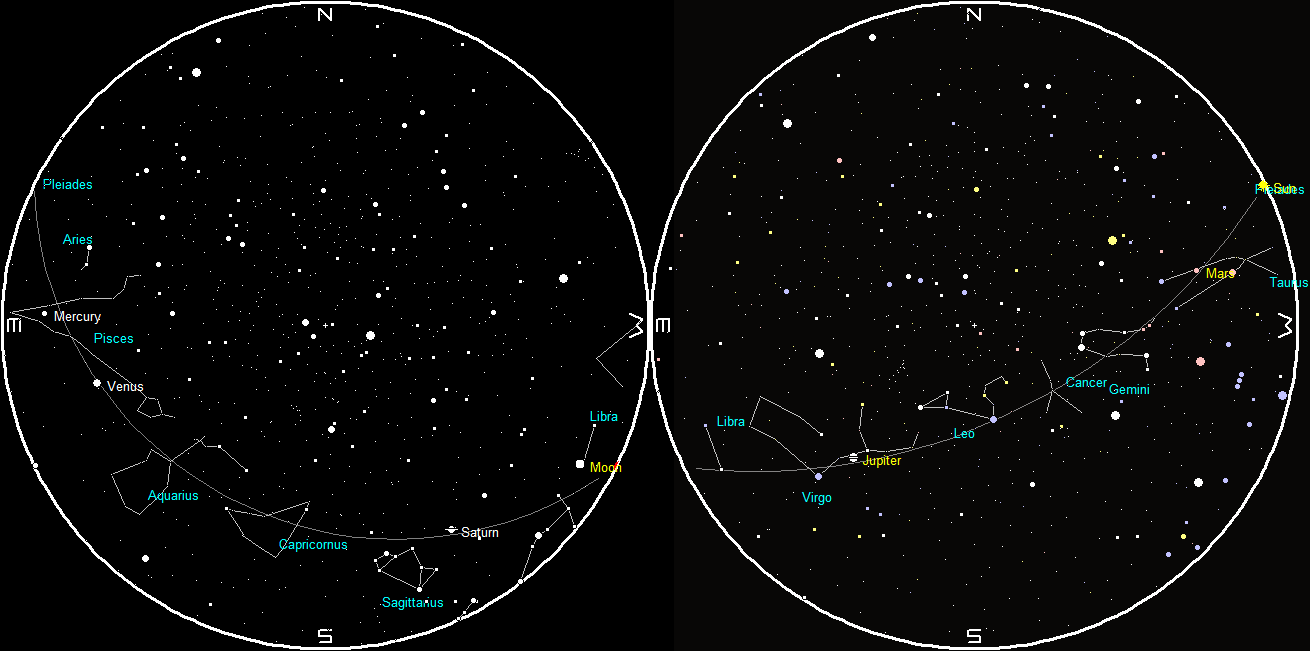
Planets and the Moon at sunset and sunrise of a single night starting with sunset on the right on May 10, 2017. The night ends on the left with sunrise on May 11. Click on the image to enlarge. Created using my LookingUp program.
05/03/2017 – Ephemeris – First look at the bright planets for May
Ephemeris for Wednesday, May 3rd. The Sun rises at 6:29. It’ll be up for 14 hours and 20 minutes, setting at 8:49. The Moon, 1 day past first quarter, will set at 3:43 tomorrow morning.
Let’s take our weekly look at the bright planets. Mars is still in the west after sunset and fading. It’s approaching the star Aldebaran in Taurus now. It will set at 11:01 p.m. Not quite dominating the evening sky now due to the Moon is Jupiter in the southeast. It’s seen above the bright blue-white star Spica. In even the smallest telescopes Jupiter’s four largest moons can be seen. They shift positions night to night and even as you watch. Tonight early in the evening all 4 bright moons can be seen, but the one closest to Jupiter will disappear behind the planet at 10:11 p.m. It will reappear on the other side at 12:48 a.m. Jupiter will set at 5:36 a.m. At 6 a.m. both Saturn and Venus will be in the morning twilight. At 6 a.m. Saturn will appear to be a bit to the west of south compass point. It will rise in the east-southeast at 12:13 a.m. tomorrow. Venus will be low in the east at 6 a.m. tomorrow morning after rising at 4:52.
The times given are for the Traverse City/Interlochen area of Michigan. They may be different for your location.
Addendum
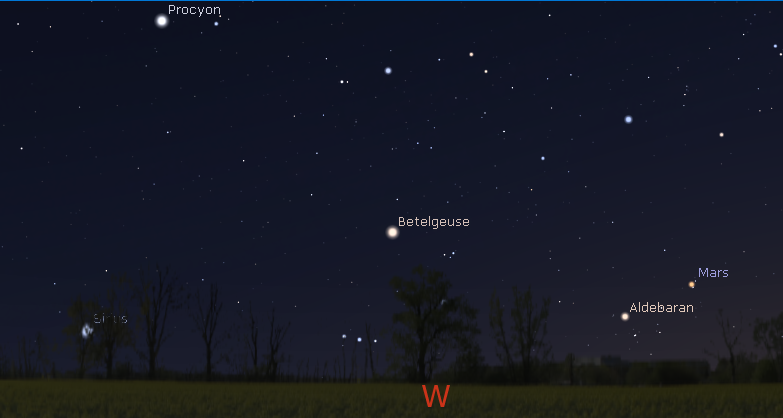
Mars in the west with bright stars at 10 p.m. May 3, 2017. Created using Stellarium.
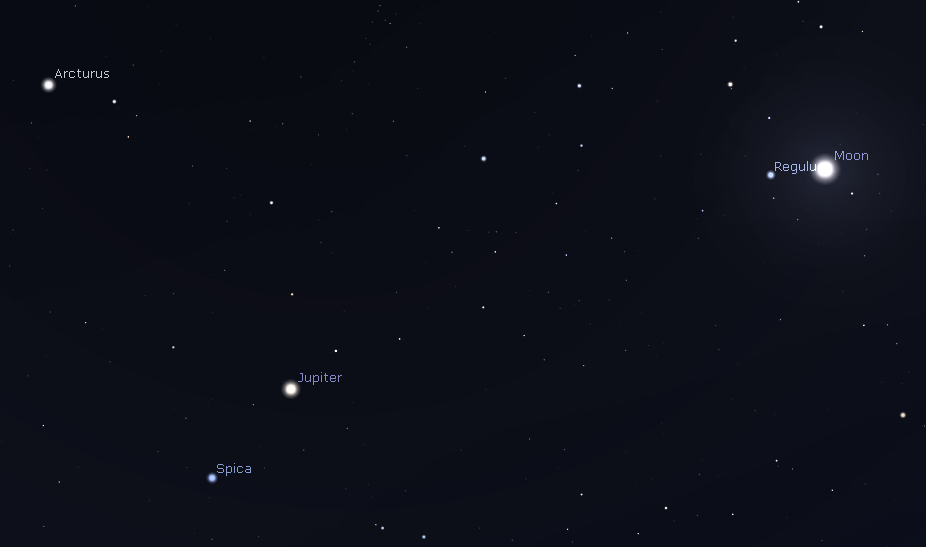
Jupiter above Spica and the Moon with the bright stars 10 p.m. May 3, 2017. Created using Stellarium.
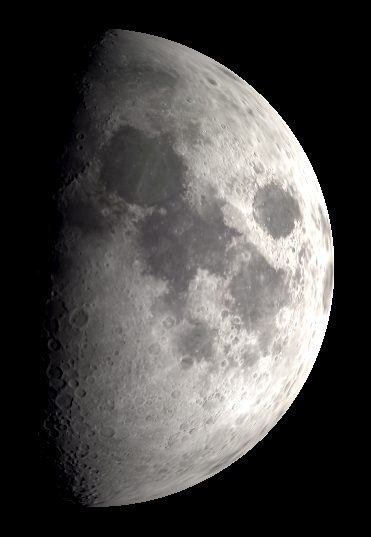
The Moon as it might be seen in binoculars at 10 p.m. May 3, 2016. Created using Stellarium.
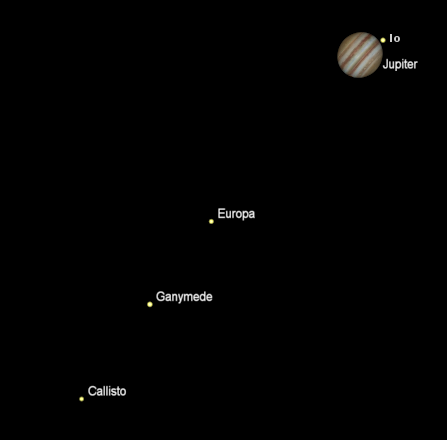
Jupiter and its moons at 10 p.m. May 3, 2017. The moon Io here is about to be occulted, that is pass behind Jupiter, which it will do at 10:11 p.m. (2:11 UT the 4th) It will reappear at 12:58 a.m. (4:58 UT). Created using Cartes du Ciel (Sky Charts).
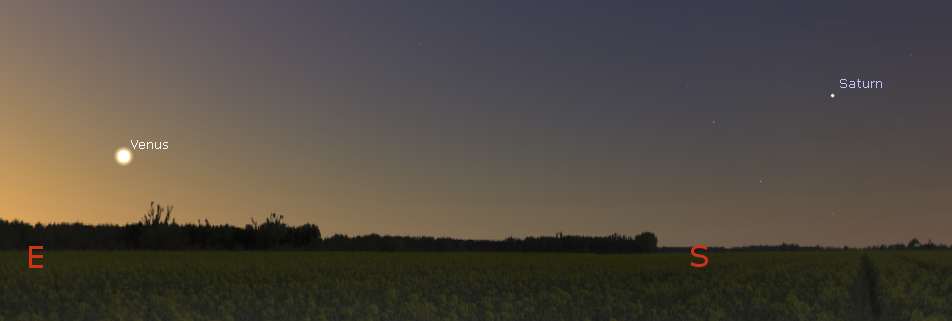
Saturn and Venus at 6 a.m. May 4, 2017 in morning twilight. Created using Stellarium.
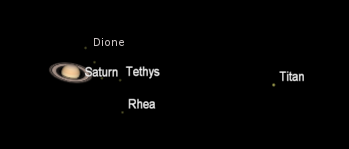
Saturn and its moons at 6 a.m. May 4, 2017. Created using Cartes du Ciel (Sky Charts).
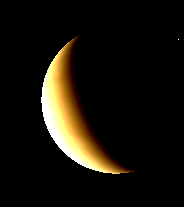
Venus as seen in a telescope at 6 a.m., May 4, 2017. Magnified much more than the other planet images seen here. Created using Stellarium.
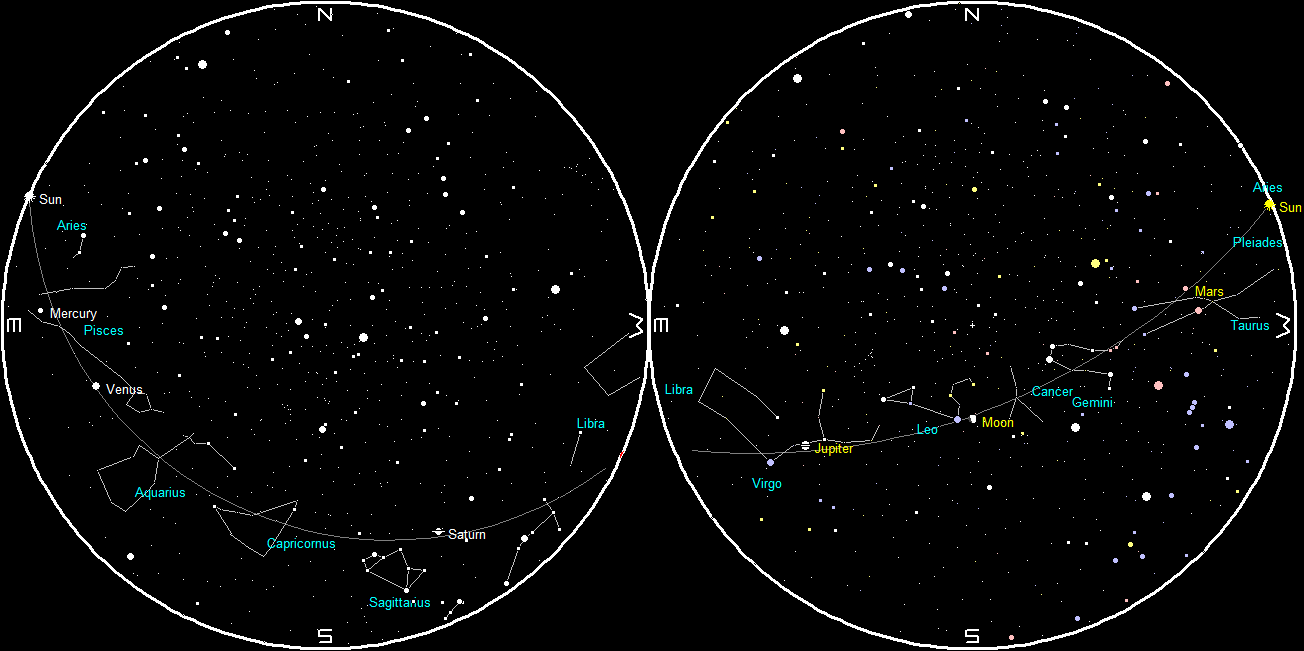
Planets and the Moon at sunset and sunrise of a single night starting with sunset on the right on May 3, 2017. The night ends on the left with sunrise on May 4. Click on the image to enlarge. Created using my LookingUp program.
04/19/2017 – Ephemeris – Let’s take our weekly look at the bright planets
Ephemeris for Wednesday, April 19th. The Sun rises at 6:51. It’ll be up for 13 hours and 41 minutes, setting at 8:32. The Moon, at last quarter today, will rise at 3:44 tomorrow morning.
Let’s take our Wednesday weekly look at the bright planets. Mars is still in the west after sunset and fading. It’s near the Pleiades star cluster now. It will set at 11:06 p.m. Coming to dominate the evening sky low in the southeast in evening twilight is Jupiter. It’s seen near the bright blue-white star Spica this year. At 6 a.m. Jupiter is still hanging on very low on the western horizon, and will set at 6:36 a.m. At the same time Saturn be about due south. It will rise in the east-southeast at 1:38 a.m. tomorrow. The Moon will be seen in the southeast at that hour. Venus will be low in the east at 6 a.m. tomorrow morning after rising at 5:22 a.m. It will appear as a tiny crescent moon in binoculars.
The times given are for the Traverse City/Interlochen area of Michigan. They may be different for your location.
Addendum
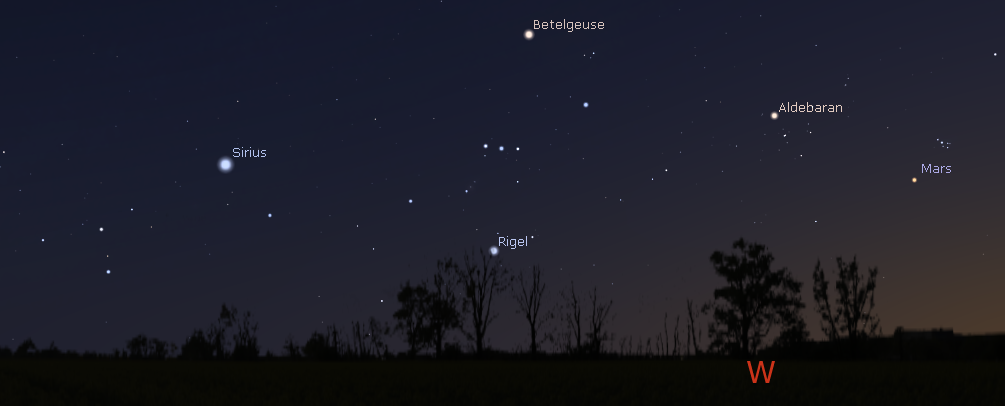
Mars in the west with bright stars at 9:30 p.m. April 19, 2017. Created using Stellarium.
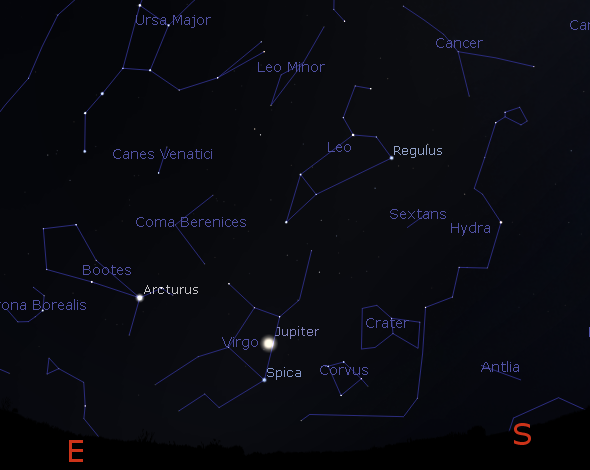
Jupiter in dark skies with some southern spring constellations on April 19, 2017 at 10 p.m. Created using Stellarium.
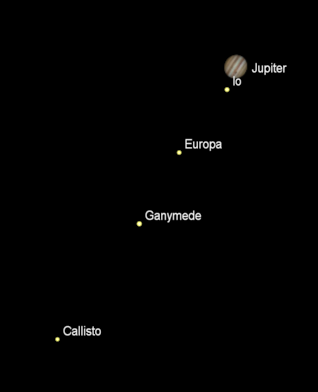
Jupiter and moons at 10 p.m. April 19, 2017. Created using Cartes du Ciel (Sky Charts).
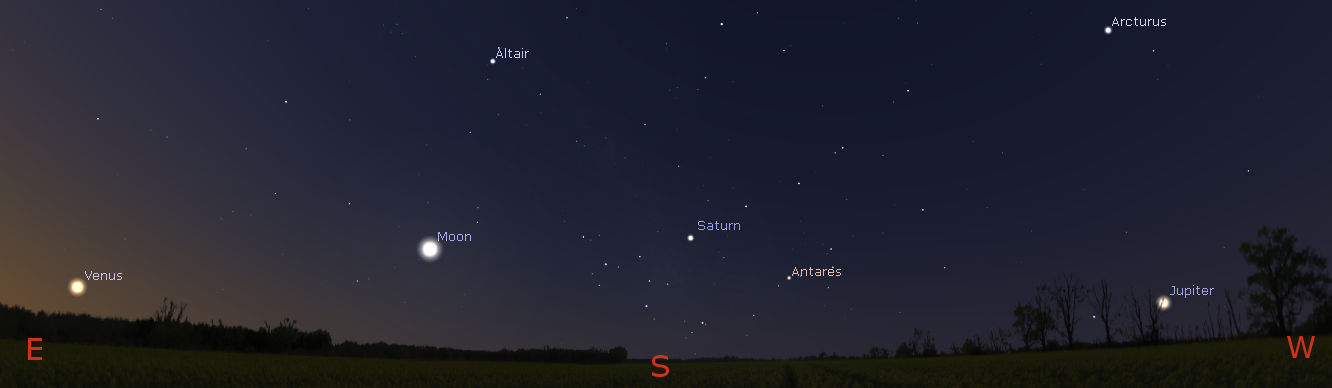
Jupiter, Saturn, the Moon, and Venus at the eastern horizon at 6 a.m. April 20, 2017. Created using Stellarium.
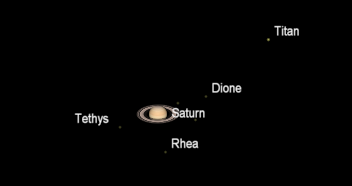
Saturn and moons in telescopes at 6 a.m. April 20, 2017. Created using Cartes du Ciel (Sky Charts).
Telescopic Venus as created with Stellarium for early morning April 20, 2017. Stellarium is coloring Venus as it would be colored low in the sky.
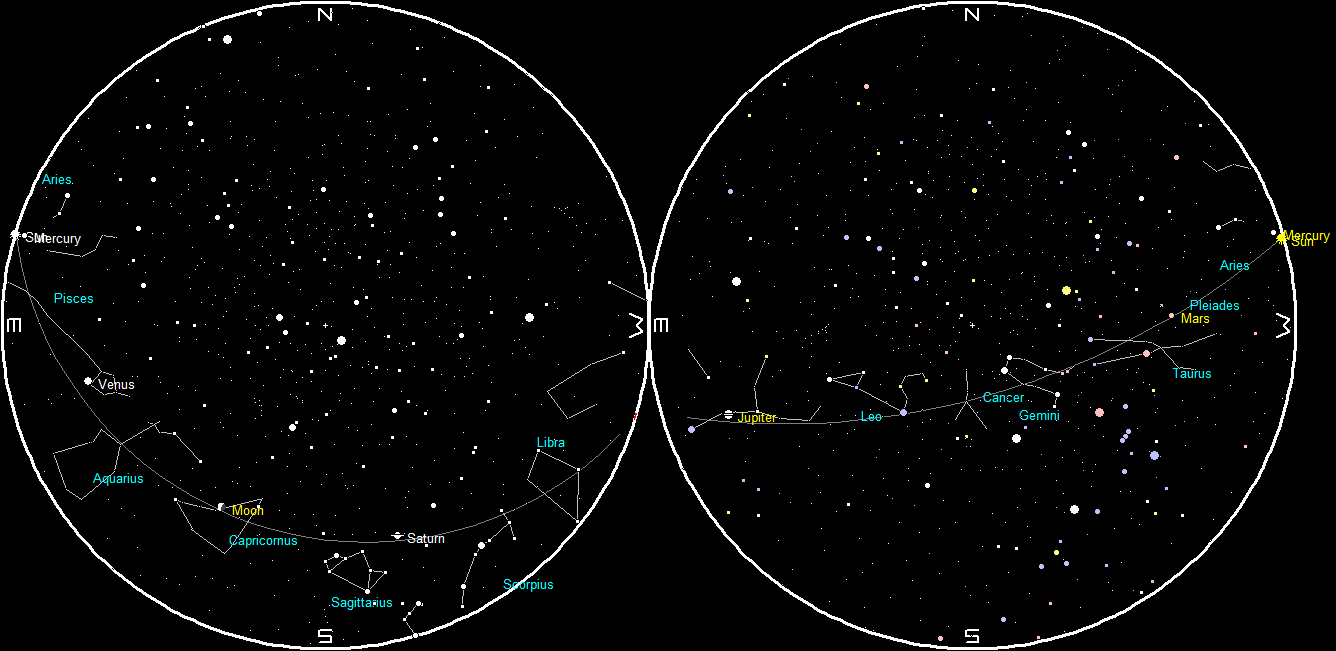
Planets and the Moon at sunset and sunrise of a single night starting with sunset on the right on April 19, 2017. The night ends on the left with sunrise on April 20. Click on the image to enlarge. Created using my LookingUp program.
04/12/2017 – Ephemeris – It’s Wednesday, do you know where your bright planets are?
Ephemeris for Wednesday, April 12th. The Sun will rise at 7:03. It’ll be up for 13 hours and 20 minutes, setting at 8:23. The Moon, 1 day past full, will rise at 9:53 this evening.
Tonight is Yuri’s Night the anniversary of Yuri Gagarin’s first human orbital flight in 1961. Now celebrated around the world. Mars is still in the west after sunset and fading. It will set at 11:08 p.m. Coming to dominate the evening sky low in the east in evening twilight is Jupiter. It will rise to be low in the east-southeast at 10 p.m. At 6 a.m. Jupiter is still hanging on in the western sky, and will be below and right of the Moon at that time. At the same time Saturn be about due south. It will rise in the east-southeast at 1:38 a.m. tomorrow. Venus is beginning to make an appearance in the morning sky. It will rise at 5:40 tomorrow morning but will have to compete with the ever brightening twilight in the morning, but each morning it will rise about 6 minutes earlier.
The times given are for the Traverse City/Interlochen area of Michigan. They may be different for your location.
Addendum
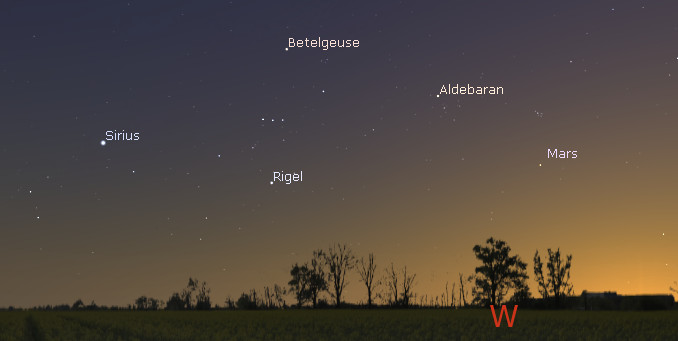
Mars in the west with bright stars at 9 p.m. April 12, 2017. Created using Stellarium.
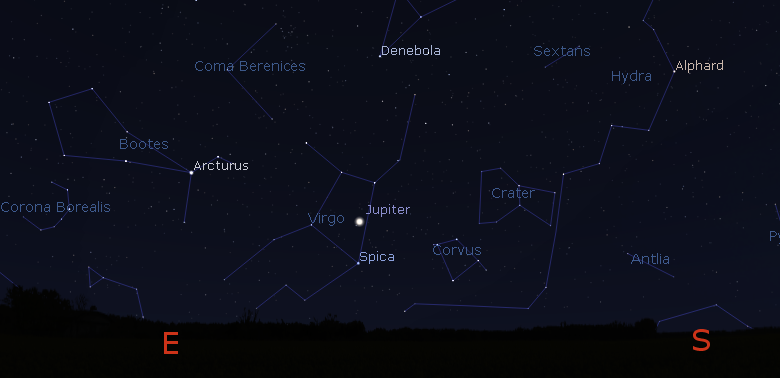
Jupiter in dark skies with some southern spring constellations on April 12, 2017. Created using Stellarium.
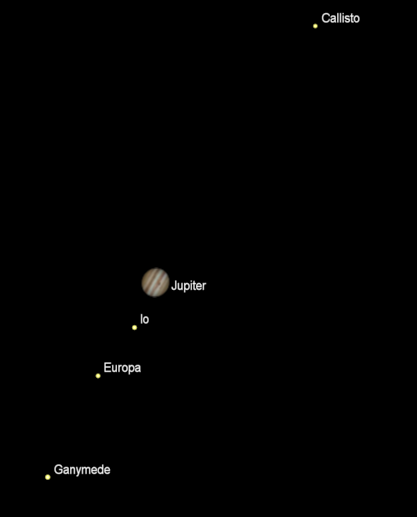
Jupiter and moons at 10 p.m. April 12, 2017 The Great Red Spot is near the central meridian of the planet at that time. Created using Cartes du Ciel (Sly Charts).
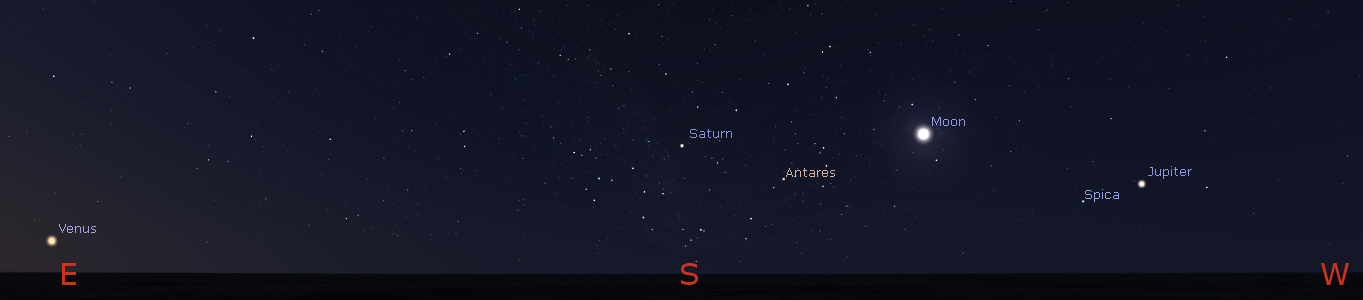
Jupiter, the Moon, Saturn and Venus at the eastern horizon at 6 a.m. April 13, 2017. Created using Stellarium.
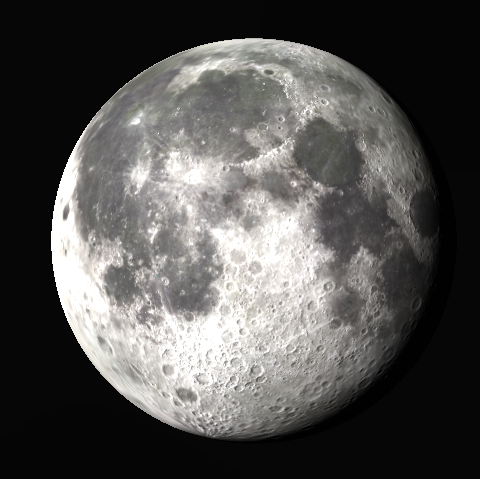
The waning gibbous Moon as it might be seen in binoculars at 6 a.m. April 13, 2017. Created using Stellarium.
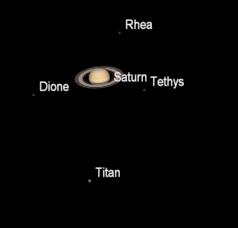
Saturn and moons in telescopes at 6 a.m. April 13, 2017. Created using Cartes du Ciel (Sky Charts).
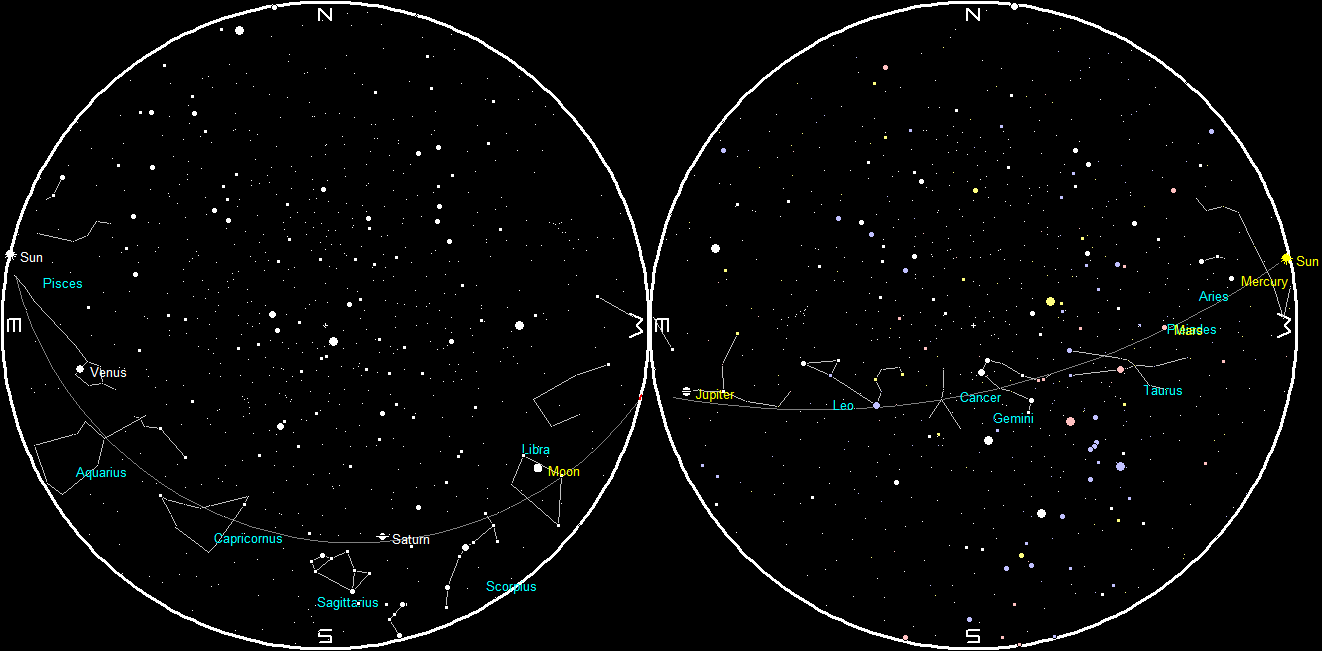
Planets and the Moon at sunset and sunrise of a single night starting with sunset on the right on April 12, 2017. The night ends on the left with sunrise on April 13. Click on the image to enlarge. Created using my LookingUp program.
04/05/2017 – Ephemeris – It’s Wednesday, do you know where your bright planets are?
Ephemeris for Wednesday, April 5th. The Sun will rise at 7:15. It’ll be up for 12 hours and 59 minutes, setting at 8:15. The Moon, 2 days past first quarter, will set at 5:04 tomorrow morning.
In the evening twilit sky tonight will feature the elusive planet Mercury. This tiny planet might be seen to the upper right of the Sun’s setting point starting about 9 p.m. It will set at 9:55 p.m. Mercury is getting rapidly fainter because it’s now exhibiting a diminishing crescent to us. It takes a good telescope and very steady skies to spot Mercury’s phase. Mars is still hanging on, in the west above and left of Mercury, and will set at 11:09 p.m. Jupiter will rise about sunset a half hour before the star Spica, which it will be seen to hang out with this year. Jupiter will be still seen in the morning sky low in the southwest at 6 a.m. Saturn then is in the south above the Teapot figure of Sagittarius. It will rise at 2:06 a.m. in the east-southeast.
Times are for the Traverse City/Interlochen area of Michigan. They may be different for your location.
Addendum
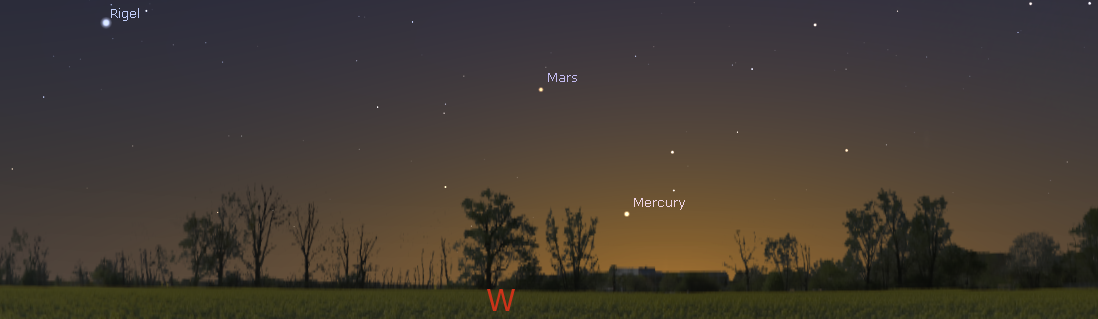
Mercury and Mars low in the west at 9 p.m. April 5, 2017. Created using Stellarium.
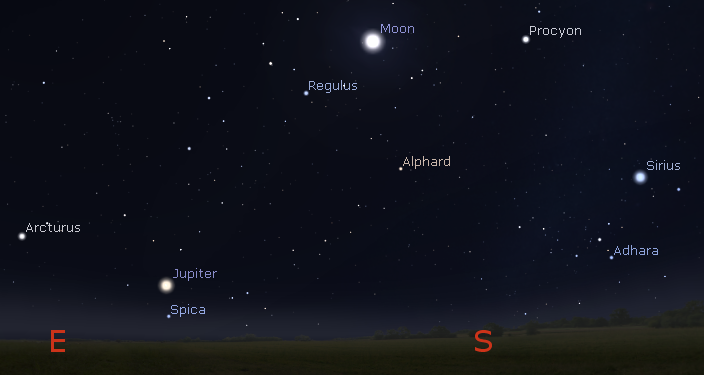
Jupiter and the Moon at 9:30 p.m. Created using Stellarium.
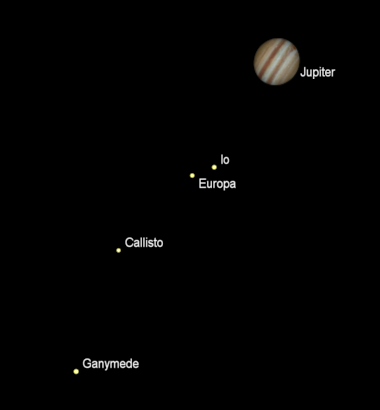
Jupiter and its moons as they might be seen in a telescope at 11 p.m. April 5, 2017. It is usually best to let planets rise a bit to minimize the atmospheric effects on the image. Created using Cartes du Ciel.
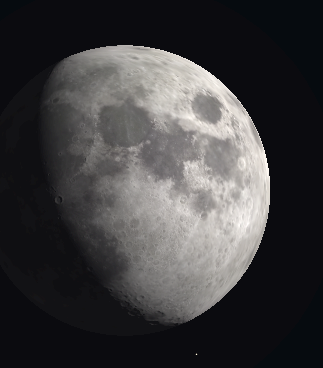
The Moon as it might be seen in binoculars at 9:30 p.m. April 5, 2016. Note the prominent crater Copernicus emerging into sunlight on the left of the Moon. Created using Stellarium.
If you’d like to check out the Moon in a telescope tonight, check out this posting : https://bobmoler.wordpress.com/2014/03/10/03102014-ephemeris-observibg-the-moon-tonight-and-the-crater-copernicus/
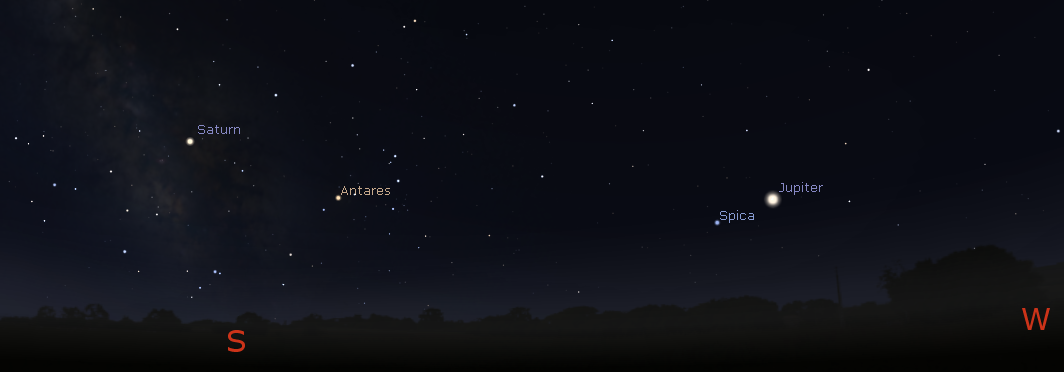
The planets visible at 6 a.m. April 6, 2017 Venus is just below the eastern horizon at this hour. Created using Stellarium.
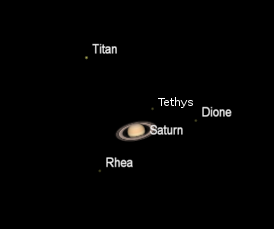
Saturn and its moons at 6 a.m. April 6th, 2017. Created using Cartes du Ciel (Sky Charts).
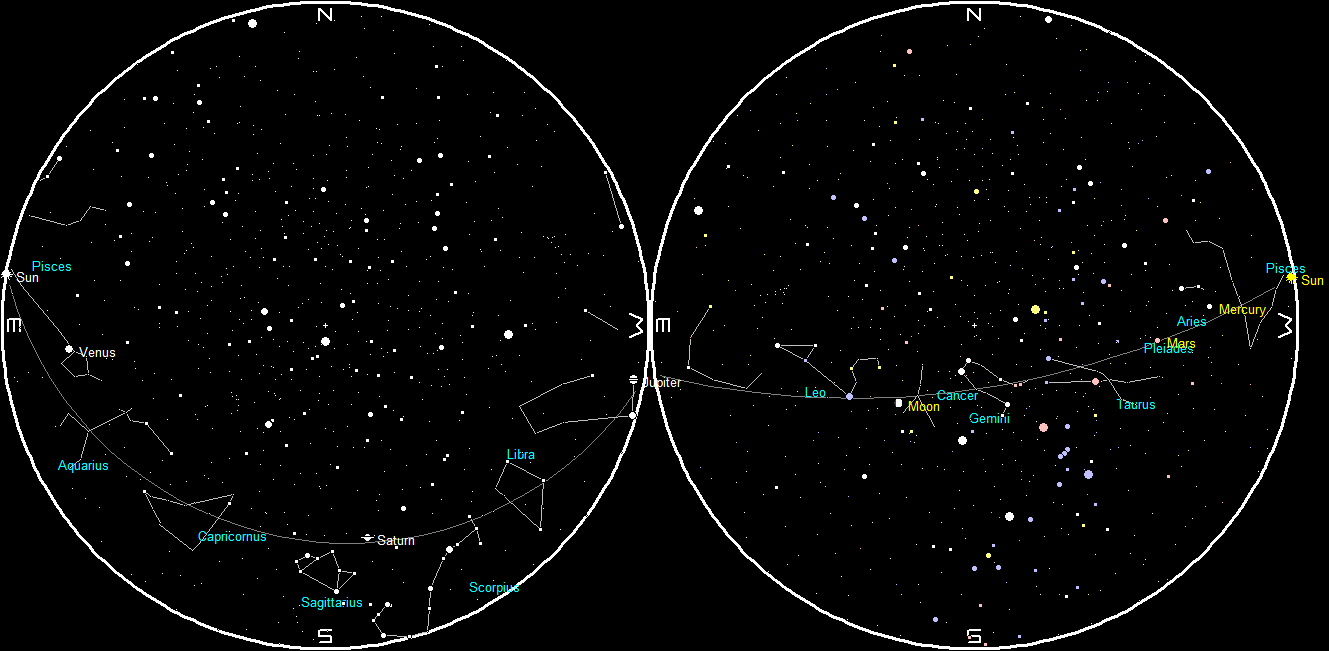
Planets and the Moon at sunset and sunrise of a single night starting with sunset on the right on April 5, 2017. The night ends on the left with sunrise on April 6. Click on the image to enlarge. Created using my LookingUp program.
A comet dramatically brightens
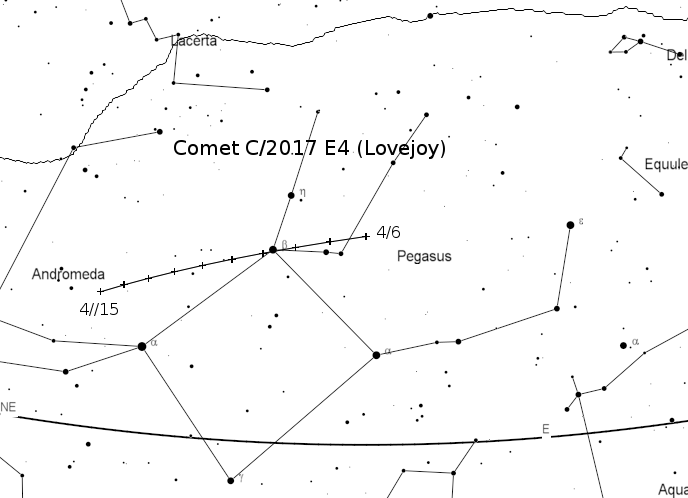
Here is the track for Comet 2017 E4 Lovejoy. This comet was expected to be 14th magnitude, but it’s brightness shot up to around 6.5, within range of binoculars. I’m only plotting 10 days. It should be brightest about mid-month, but is poorly placed for observation, plus we’re fighting a bright Moon. The curved horizontal line near the bottom is the Horizon on April 4, 2017. Created using Cartes du Ciel.
Universe today has lots more on the new Comet Lovejoy here: https://www.universetoday.com/134848/surprise-comet-e4-lovejoy-brightens/
03/29/2017 – Ephemeris – It’s Wednesday, do you know where your bright planets are?
Ephemeris for Wednesday, March 29th. The Sun will rise at 7:28. It’ll be up for 12 hours and 38 minutes, setting at 8:06. The Moon, 2 days past new, will set at 10:10 this evening.
In the evening sky tonight, replacing Venus will be the elusive planet Mercury. This tiny planet might be seen to the upper right of the Sun’s setting point starting about 9 p.m. It will set at 9:49 p.m. Mars is still hanging on, in the west, and will set at 11:10 p.m. The thin sliver of a crescent Moon is seen left of and above Mercury and Below Mars tonight. This might be a good time to spot Earth shine on it’s night side. Jupiter will rise in the east at 8:47 p.m. a half hour before the star Spica, which it will be seen to hang out with this year. Jupiter will be still seen in the morning sky low in the southwest at 6 a.m. Saturn at the same time is in the south above the Teapot figure of Sagittarius. It will rise tomorrow at 2:33 a.m. in the east-southeast.
Times are for the Traverse City/Interlochen area of Michigan. They may be different for your location.
Addendum
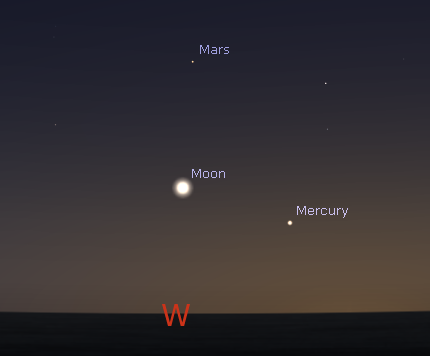
Mercury, Mars and the Moon low in the west at 9 p.m. March 29, 2017. Note the Moon as seen below is a thin crescent which cannot be displayed properly at this scale. Created using Stellarium.
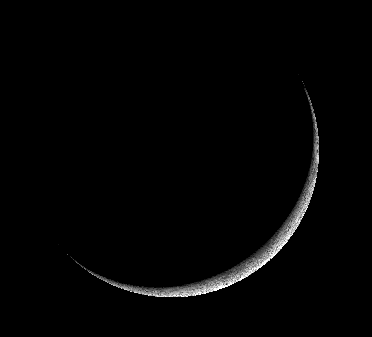
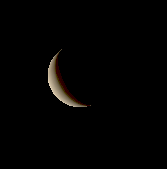
The thin crescent Moon at 9 p.m. March 29, 2017. Created using Hallo Northern Sky. The program does not have the capability to show earth shine to fill out the rest of the sphere which may be detected with the naked eye or in binoculars.
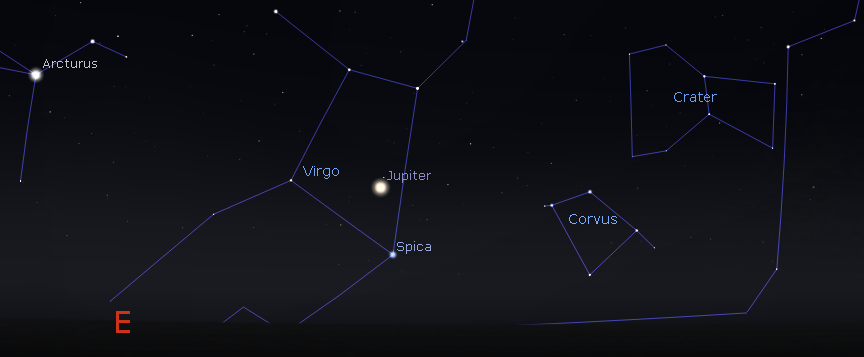
Jupiter low in the east-southeast at 10 p.m. tonight, March 28, 2017. Created using Stellarium.
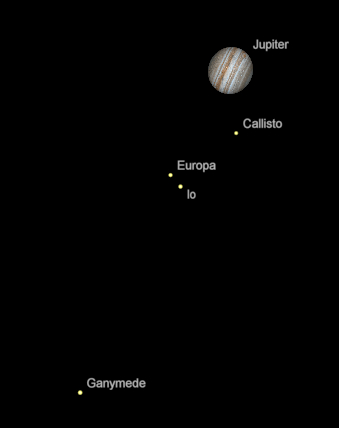
Jupiter and its moons tonight March 29, 2017 at 10 p.m. Created using Cartes du Ciel (Sky Charts).
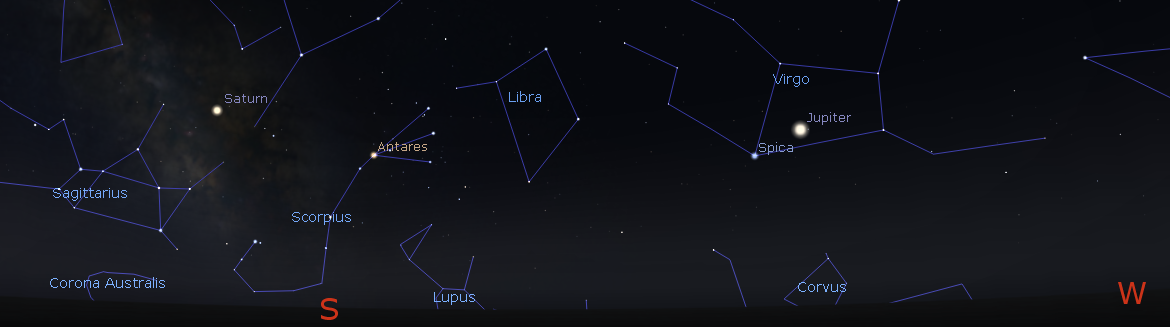
Jupiter and Saturn with the morning constellations of summer at 6 a.m. tomorrow morning March 30, 2017. Created using Stellarium.
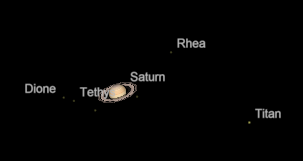
Saturn and its moons at 6 a.m. March 30, 2017. It is shown at the same scale as Jupiter above. Created using Cartes du Ciel (Sky Charts).
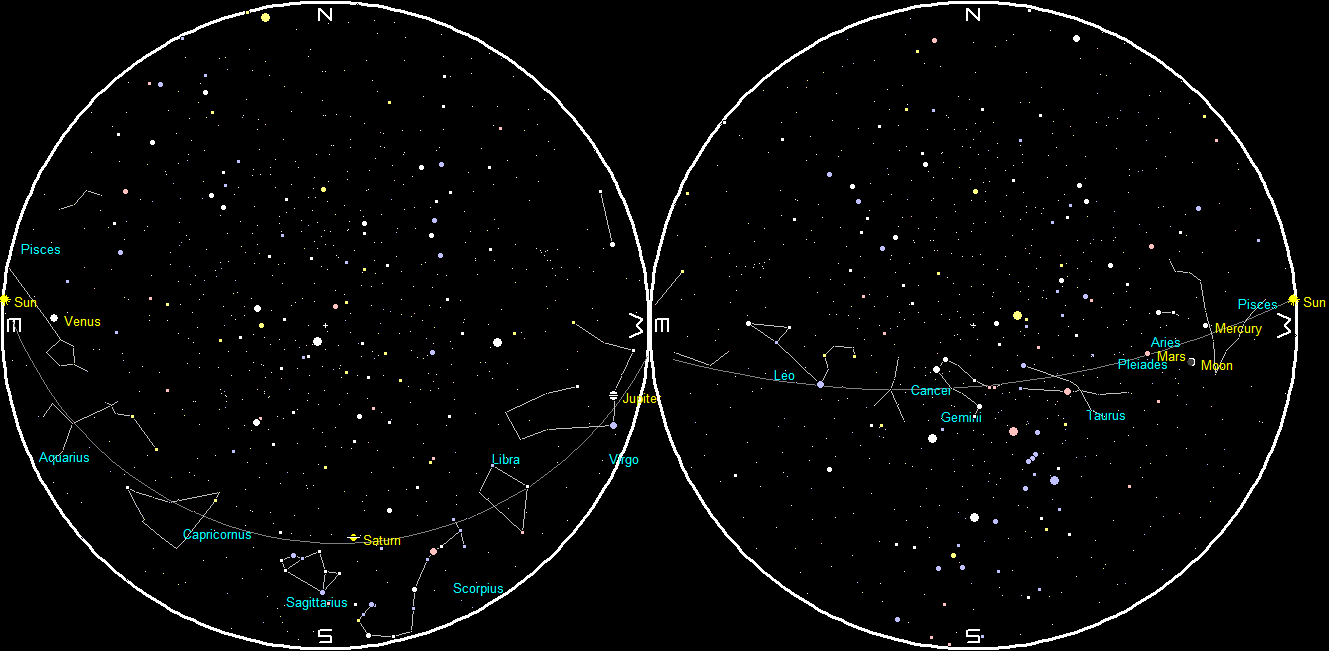
Planets and the Moon at sunset and sunrise of a single night starting with sunset on the right on March 29, 2017. The night ends on the left with sunrise on March 30. Click on the image to enlarge. Created using my LookingUp program.
03/22/2017 – Ephemeris – Wednesday is bright planet day but we seem to be missing one of them
Ephemeris for Wednesday, March 22nd. The Sun will rise at 7:41. It’ll be up for 12 hours and 16 minutes, setting at 7:57. The Moon, 2 days past last quarter, will rise at 5:09 tomorrow morning.
It’s still dark enough to see the morning planets again during these Ephemeris play times. But it won’t last. Jupiter will be seen in the morning in the southwest above the star Spica. It will rise tonight at 9:19 p.m. in the East. Saturn can be glimpsed this morning above the Teapot figure of Sagittarius in the south. It will rise tomorrow at 3 a.m. in the east-southeast. The crescent Moon will be in the east-southeast. In the evening sky tonight Venus is essentially gone, just 3 days from passing inferior conjunction, it might be seen to the upper right of the Sun’s setting point. I once spotted it this close to conjunction in the bright twilight. It will set at 8:35 p.m. Mars is still hanging on, in the west, and will set at 11:11 p.m.
Times are for the Traverse City/Interlochen area of Michigan. They may be different for your location.
Addendum
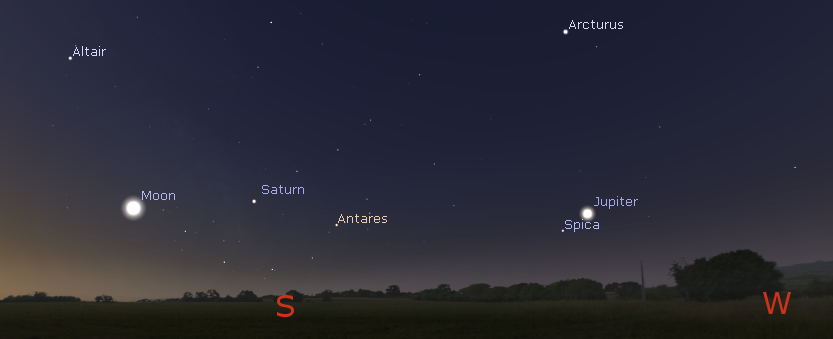
Jupiter, Saturn and the crescent Moon at 7 a.m. this morning March 22, 2017. Created using Stellarium.
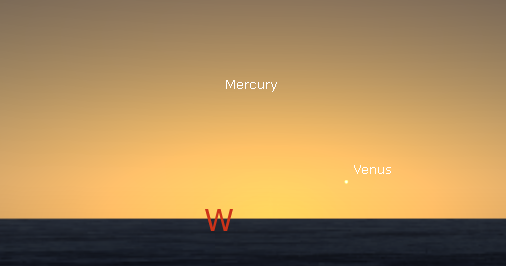
Venus at 15 minutes after sunset on a flat horizon 3 days before inferior conjunction from 45 degrees north latitude. Venus is seen at 3 degrees, 24 minutes above the horizon and practically invisible. Mercury is getting ready for its appearance in the west next week. We will visit it in more detail on Friday. Created using Stellarium.
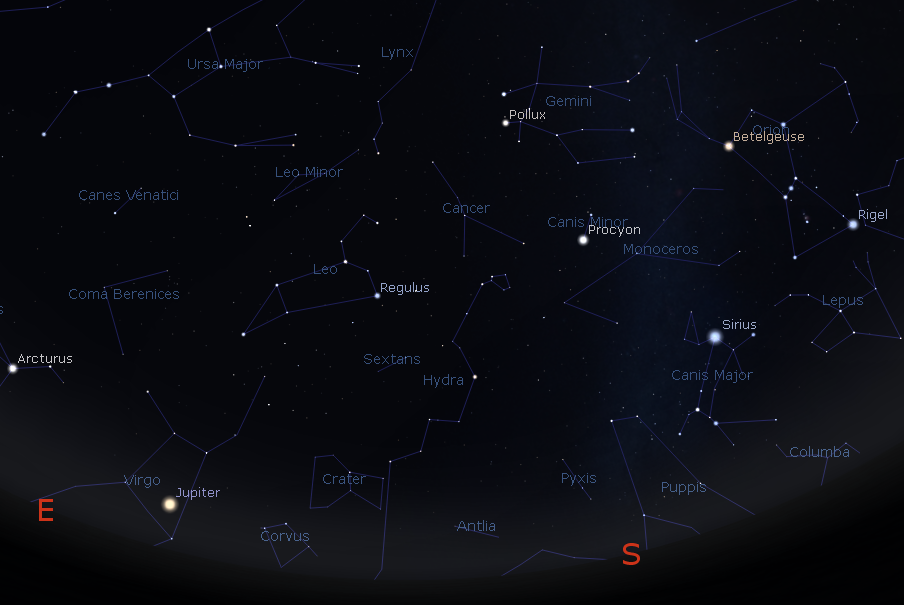
Jupiter rising and the constellations of winter and spring at 10 p.m. this evening March 22, 2017. Created using Stellarium.
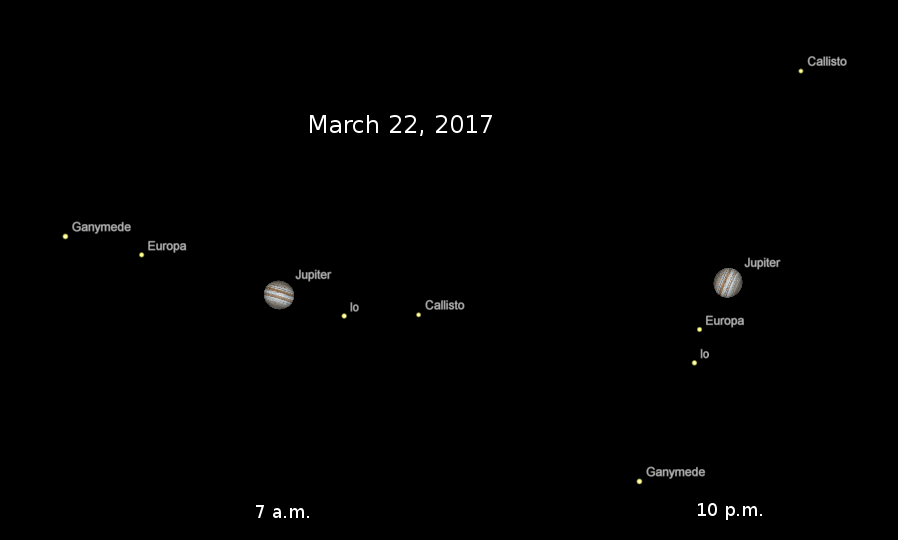
Jupiter and its moons at 7 a.m. and 10 p.m. today, March 22, 2017. orientation of Jupiter is as it appears on the sky at those times. Created using Cartes du Ciel (Sky Charts).
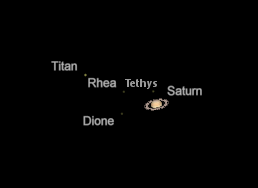
Saturn and its moons at 7 a.m. March 22, 2017. It is shown at the same scale as Jupiter above. Created using Cartes du Ciel (Sky Charts).
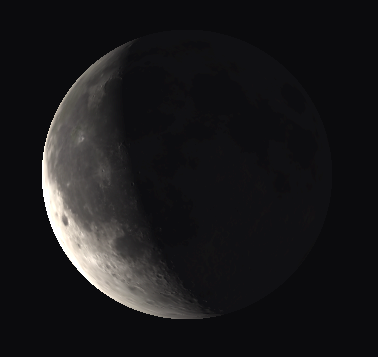
The waning crescent Moon at 7 a.m. as it might be seen in binoculars. Created using Stellarium.
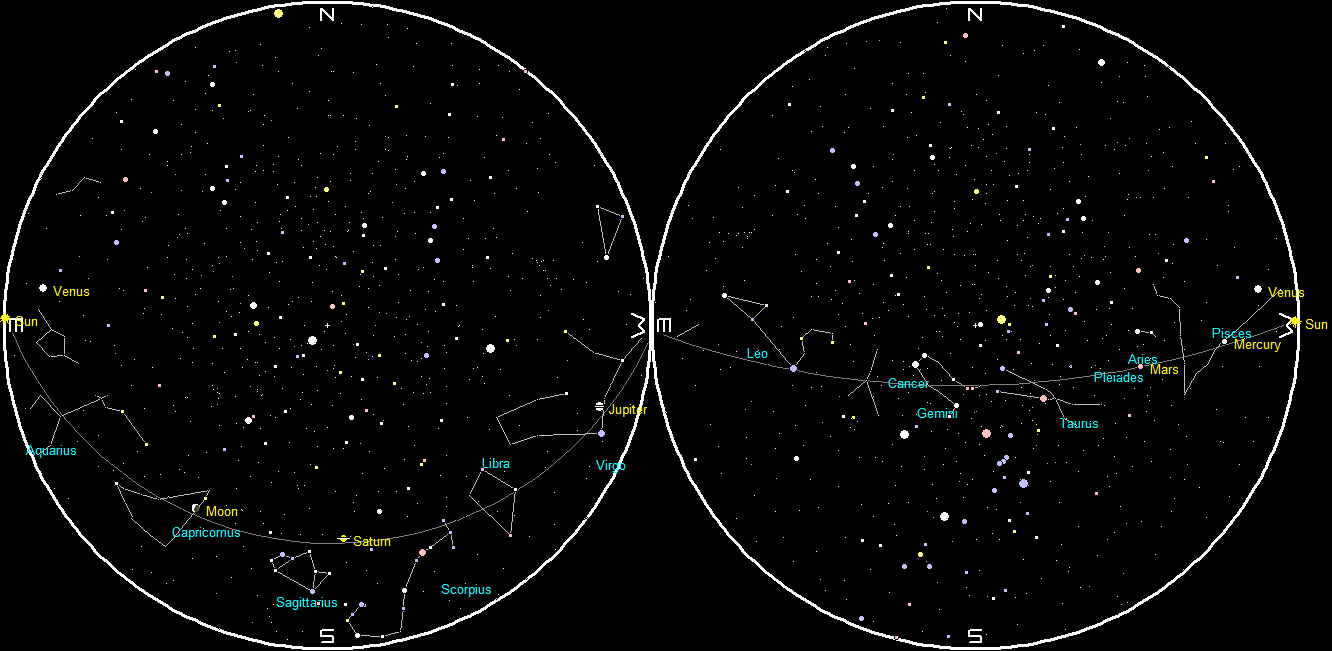
Planets and the Moon at sunset and sunrise of a single night starting with sunset on the right on March 22, 2017. The night ends on the left with sunrise on March 23. Note that Venus is visible at both sunrise and sunset at least on these charts. Click on image to enlarge. Created using my LookingUp program.
03/15/2017 – Ephemeris – Wednesday is bright planet day. Do you know where your planets are?
Ephemeris for Wednesday, March 15th. The Sun will rise at 7:54. It’ll be up for 11 hours and 54 minutes, setting at 7:48. The Moon, 3 days past full, will rise at 11:04 this evening.
It’s dark enough to see the morning planets during these Ephemeris programs again. But it won’t last. Jupiter will be seen in the morning in the southwest above the star Spica, with the bright waning gibbous moon above and left of them. It will rise tonight at 9:50 p.m. in the east. Saturn can be glimpsed this morning above the Teapot figure of Sagittarius. It will rise tomorrow at 3:37 a.m. in the east-southeast. In the evening sky tonight Venus, low in the west, is diving toward the Sun, though it will pass north of the Sun. Actually the thin crescent is showing it, canted a bit to the left, rather than to the right as you’d expect. Ten days and it’s officially outta here, and into the morning sky. Mars is still hanging on, way above Venus in the west.
Times are for the Traverse City/Interlochen area of Michigan. They may be different for your location.
Addendum
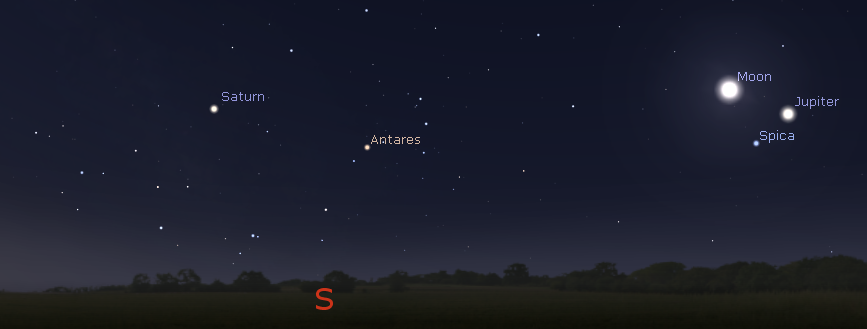
Jupiter, Saturn and the Moon at 7 a.m. this morning, March 15, 2017. Created using Stellarium.
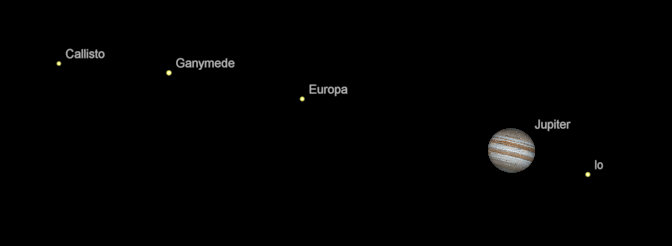
Jupiter and its moons at 7 a.m. (11:00 UT) March 15, 2017. Created using Cartes du Ciel (Sky Charts).
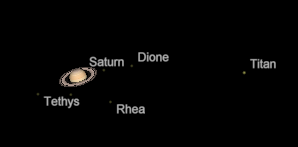
Saturn and its brightest moons as they might appear in telescopes this morning at 7:00 a.m. (11:00 UT) March 15, 2017. Shown at the same magnification as Jupiter above for comparison of apparent sizes. Created using Cartes du Ciel (Sky Charts).
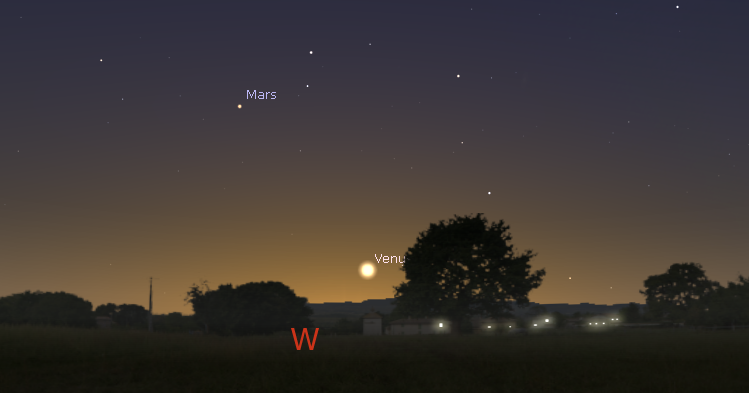
Venus and Mars in the west at 8:30 p.m. this evening March 15, 2016. Venus is only 10 days from inferior conjunction with the Sun. Created using Stellarium.
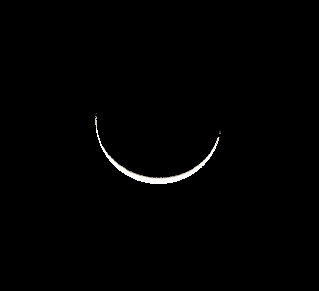
Venus as it might appear in a telescope at 8:30 p.m. March 15, 2017. Created using Hallo Northern Sky.
This is the first time I’ve used an image from Hallo Northern Sky (HNSKY) I found Hallo Northern Sky a few years ago and found it difficult to use, but its operation has improved with newer releases. It looks bare bones, like my LookingUp program, but I have yet to plumb all its depths. It’s really quite sophisticated. More clinical than pretty. I have a link to it on the right under Free Astronomical Software. It produces a better skinny crescent Venus than the other software I have.
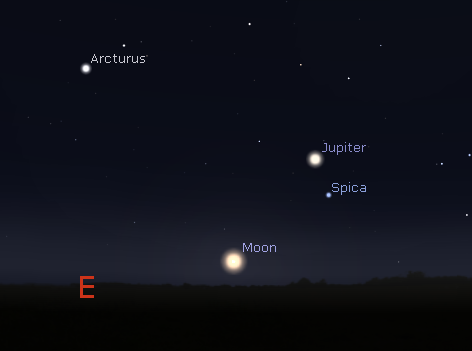
Jupiter, Spica and the Moon in the eastern sky at 11:30 p.m. tonight March 15, 2017. Created using Stellarium.
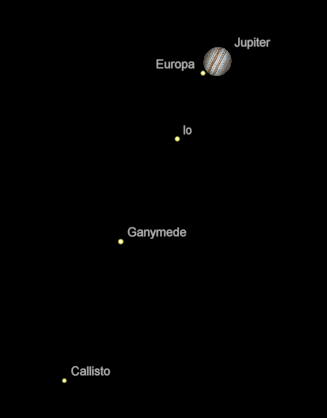
Jupiter and its Moons tonight March 15, 2017 at 11:30 p.m.. I noticed Europa’s shadow was cast on the planet. It’s a bit too low in the sky to be seen here in northern Michigan, but easier to see east of here, and as it rises higher. See the table of events below. Created using Cartes du Ciel (Sky Charts).
Europa: Shadow crossing start: 16 Mar 2017 2:46 UT
Europa: Transit start: 16 Mar 2017 3:55 UT, 15 Mar 11:55 p.m. EDT
Europa: Shadow crossing end : 16 Mar 2017 5:15 UT, 1:15 a.m. EDT
Europa: Transit end : 16 Mar 2017 6:15 UT, 2:15 a.m. EDT
Satellite events were obtained from Project Pluto.
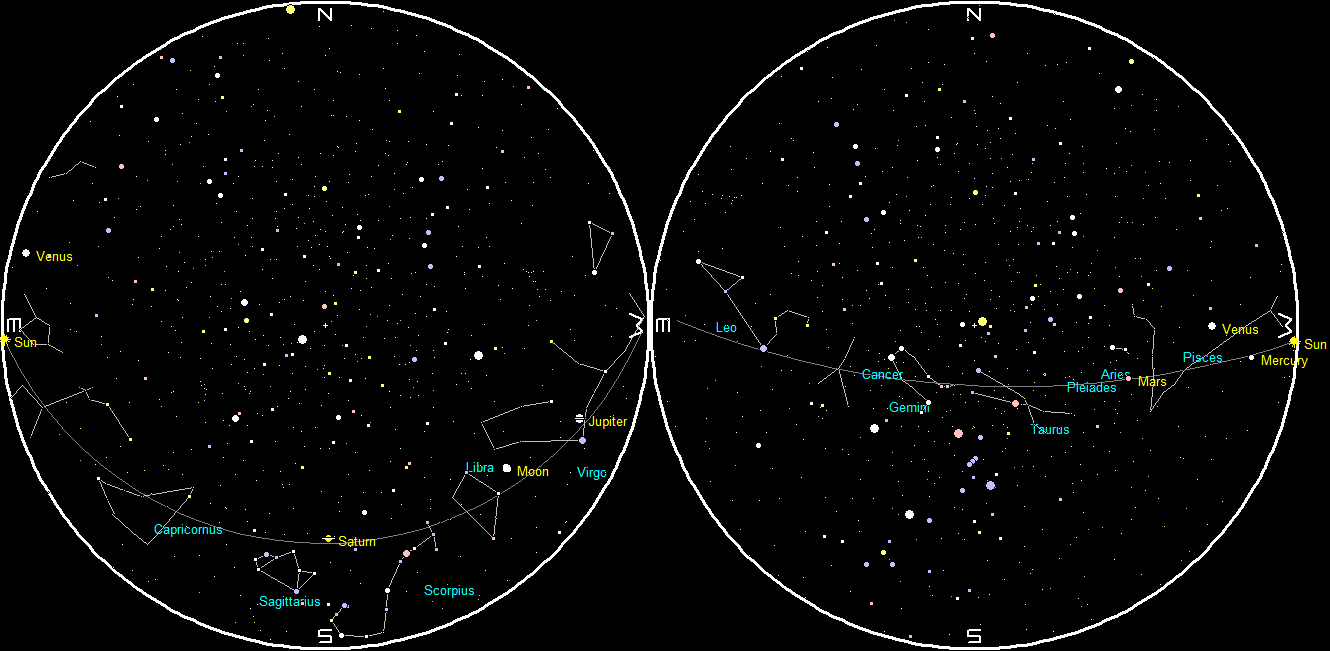
Planets and the Moon at sunset and sunrise of a single night starting with sunset on the right on March 15, 2017. The night ends on the left with sunrise on March 16. Note that Venus is visible at both sunrise and sunset at least on these charts. It will rise only 13 minutes before the Sun, so would not actually be visible. Click on image to enlarge. Created using my LookingUp program.
Venus appears 8° 20′ north of the ecliptic (path of the Sun in the sky) now. This is due to the fact that Venus’ orbit is slightly tilted to the Earth’s orbit by 3.3 degrees, and now it is extremely close to us at only 27 million miles (43.5 million km) from us, a lot closer than Mars ever gets to us.
03/01/2017 – Ephemeris – It’s Bright Planet Wednesday!
Ephemeris for Ash Wednesday, Wednesday, March 1st. The Sun will rise at 7:19. It’ll be up for 11 hours and 11 minutes, setting at 6:30. The Moon, 3 days past new, will set at 10:14 this evening.
Let’s check out the bright planets for this week. Saturn can be glimpsed this and tomorrow mornings in the southeast before 6:30 a.m. It will rise tomorrow at 3:19 a.m. in the east-southeast. Jupiter can be seen in the southwest these mornings above the star Spica, and later tonight. The giant planet will rise in the east at 9:52 p.m. Venus and Mars are in the evening sky. At 7:30 p.m. these planets will be seen in the western sky. Venus is unmistakable as the brilliant evening star, Mars will be left and above it and much dimmer. The Moon will be left of it tonight.. Venus will set at 9:26 p.m. while Mars will set at 10:13. Venus exhibits a dazzling crescent in small telescopes and binoculars now.
Times are for the Traverse City/Interlochen area of Michigan. They may be different for your location.
Addendum
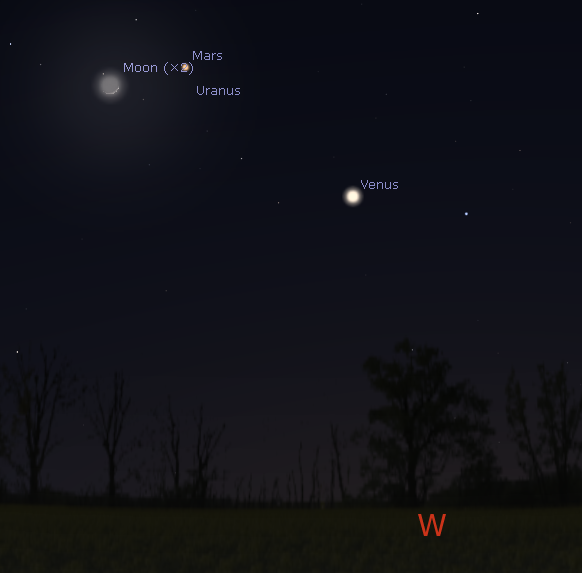
Venus. Mars and the Moon in the west at 7:30 p.m. March 1, 2017. The Moon is twice its actual size for clarity. Created using Stellarium.
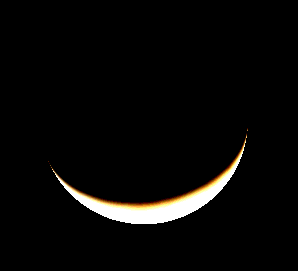
Venus as it might appear in a telescope tonight March 1, 2017. I processed the image to overexpose it as it would appear in a telescope. Created using Stellarium.
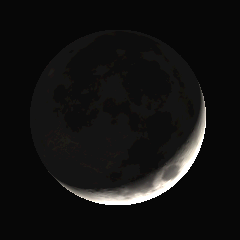
The crescent Moon with earth shine as it might look in binoculars. 7:30 p.m. March 1, 2017. Created using Stellarium.
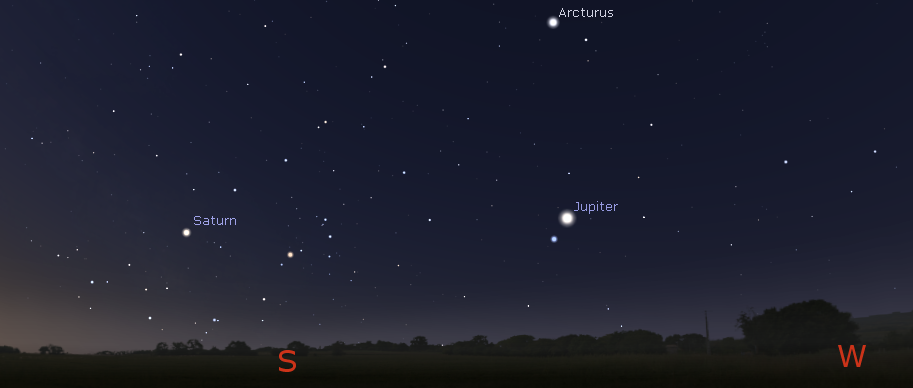
Jupiter in the southwest above the star Spica with Saturn in the south at 6:30 a.m. tomorrow morning, Match 2, 2017. Created using Stellarium.
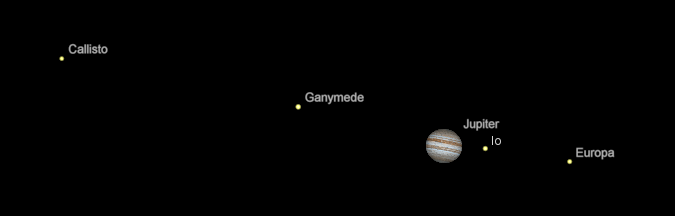
Jupiter and its moons as they might appear in telescopes tomorrow morning at 6:30 a.m. March 2, 2017. Created using Cartes du Ciel (Sky Charts).
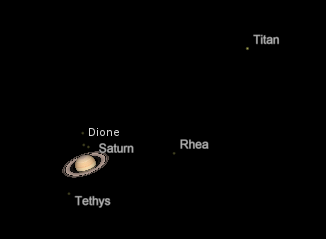
Saturn and its brightest moons as they might appear in telescopes tomorrow morning at 6:30 a.m. March 2, 2017. Created using Cartes du Ciel (Sky Charts).
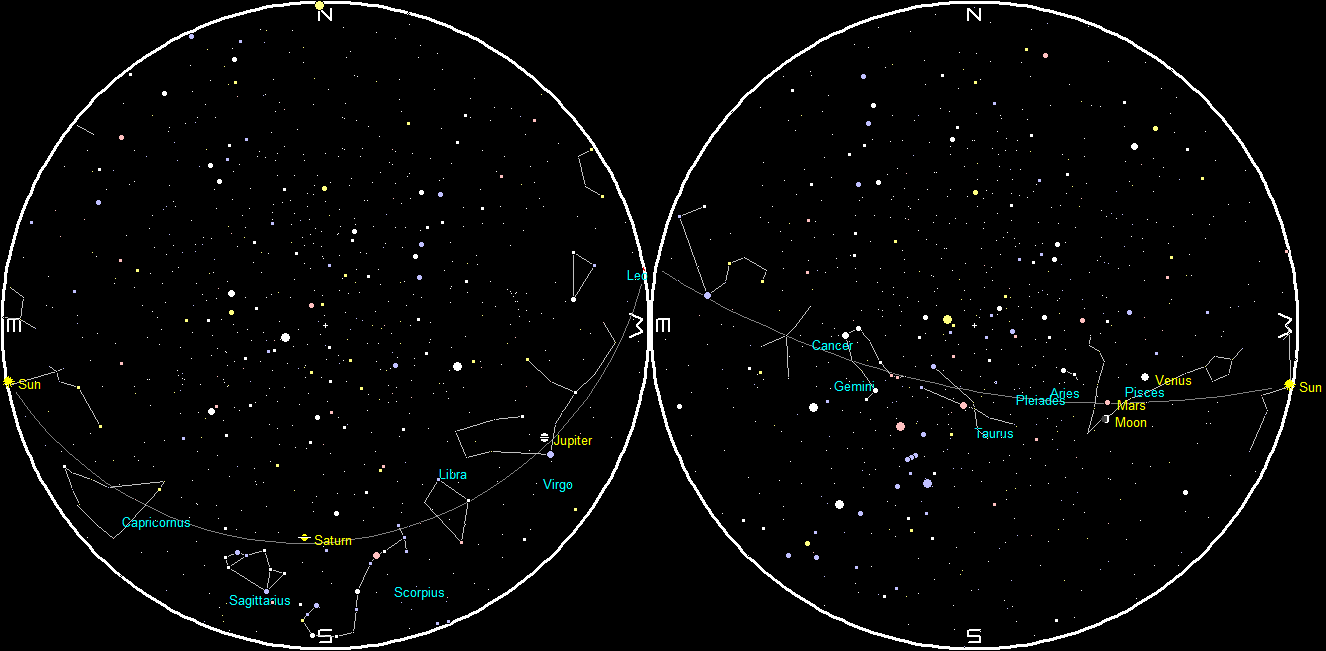
Planets and Moon at sunset and sunrise of a single night starting with sunset on the right on March 1, 2017. The night ends on the left with sunrise on March 2. Click on image to enlarge. Created using my LookingUp program.
 Bob Moler's Ephemeris Blog