Archive
09/05/2017 – Ephemeris – Neptune’s at opposition from the Sun today
Ephemeris for Tuesday, September 5th. The Sun will rise at 7:09. It’ll be up for 13 hours and 1 minute, setting at 8:11. The Moon, 1 day before full, will set at 7:22 tomorrow morning.
The sea green eighth planet from the Sun is named for the Roman god of the sea, Neptune. Today it is at opposition from the Sun, meaning it is opposite the Sun in the sky, rising at sunset. It resides at 30 times the Earth’s distance from the Sun. It is seen now against the stars of the constellation of Aquarius. While it is barely visible in binoculars the bright Moon will serve as a pointer to it tonight, but also make it hard to find. It will be three and a half moon widths left of the Moon* at 10 p.m. In telescopes it shows a tiny disk, so it’s not quite star-like. The large dark spot seen on Neptune in 1989 by Voyager 2 soon disappeared, however two years ago Neptune began to show activity again as seen from Earth and by the Hubble Space Telescope.
The times given are for the Traverse City/Interlochen area of Michigan. They may be different for your location.
* For the Eastern Daylight Time zone (0200 UT, 2017/09/06). Add one Moon diameter for every hour prior to 0200 UT, subtract one for every hour after 0200 UT.
Addendum
Click on the charts to enlarge
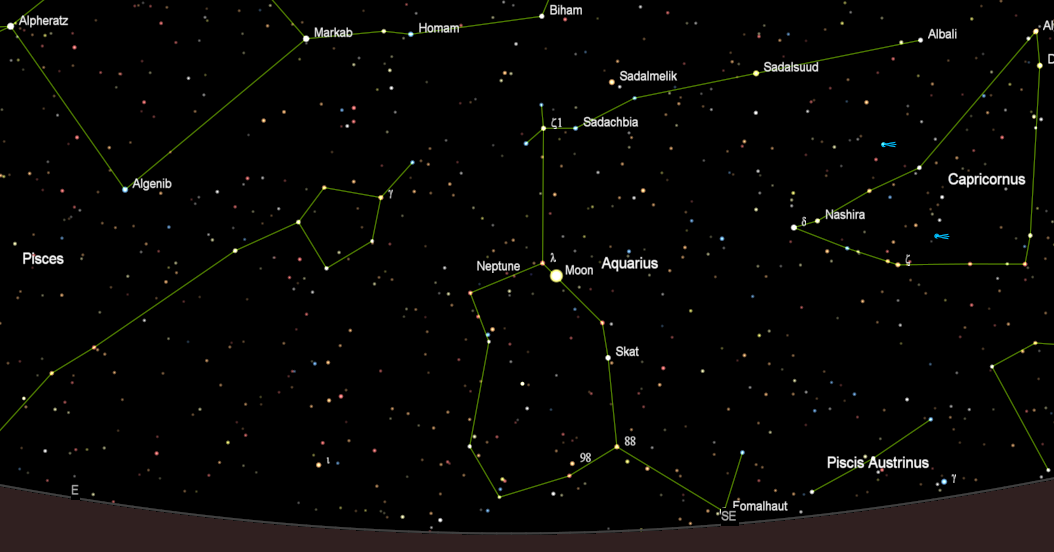
The constellations around Neptune at 10 p.m. September 5, 2017. Created using Cartes du Ciel (Sky Charts).
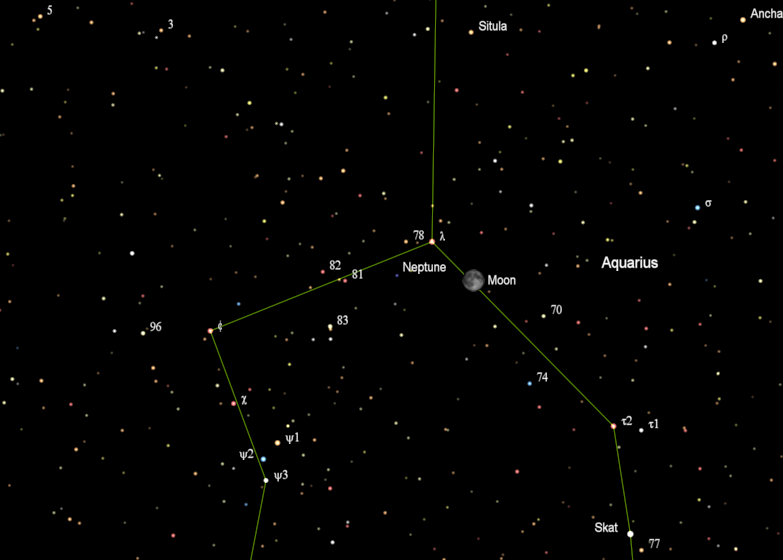
Finding Neptune tonight, September 5, 2017. Neptune moves slowly, so this finder chart, without the Moon, will work for a few months, Created using Cartes du Ciel (Sky Charts).
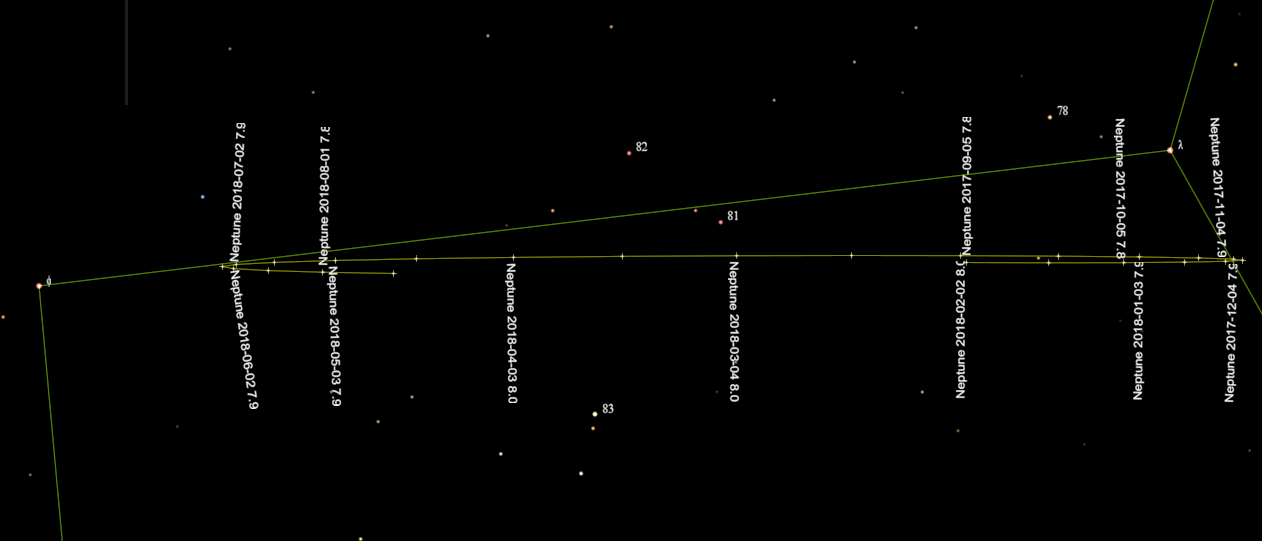
A 300 day track for Neptune with positions every 15 days starting September 5, 2017. Created using Cartes du Ciel (Sky Charts).
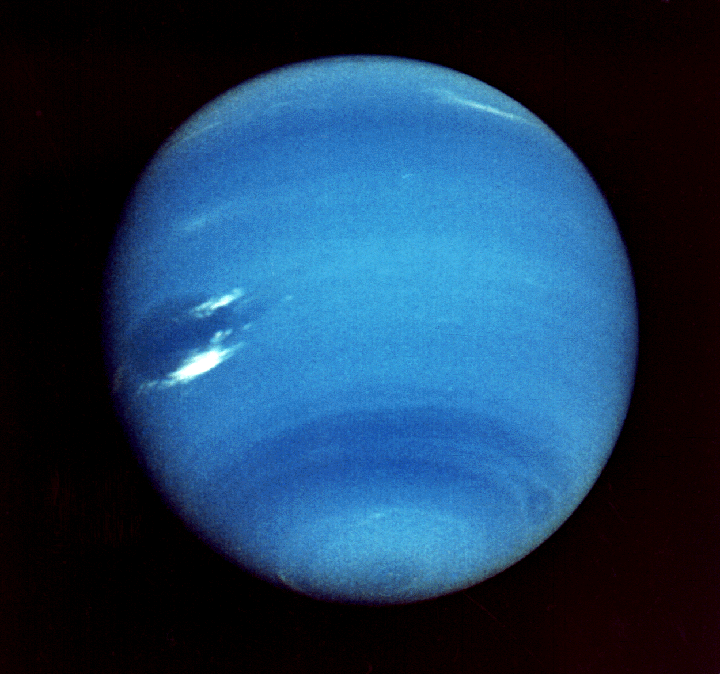
Neptune with the Great Dark Spot in 1979 as seen by Voyager 2. Credit NASA/JPL
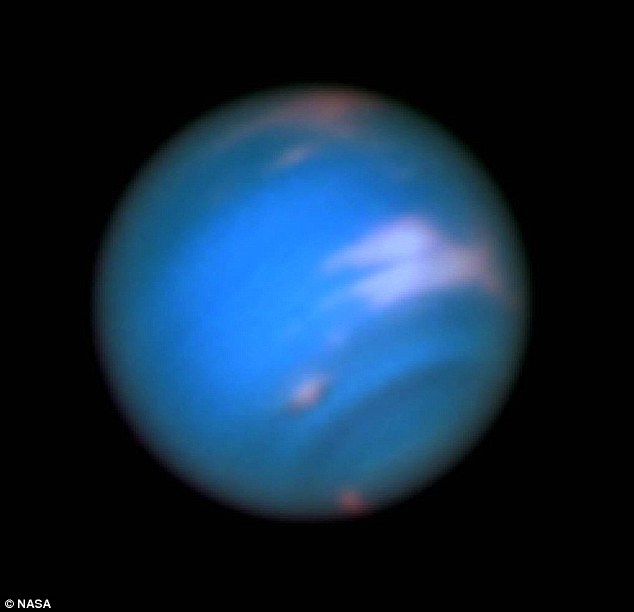
Neptune from the Hubble Space Telescope in 2016. Credit NASA/ESA.
01/22/2015 – Ephemeris – Let’s spot the Moon and Mars with a bonus look at Neptune
Ephemeris for Thursday, January 22nd. The sun will rise at 8:11. It’ll be up for 9 hours and 25 minutes, setting at 5:37. The moon, 2 days past new, will set at 8:44 this evening.
Tonight the crescent moon is nearing Mars low in the southwest in the early evening. The motion of Mars has been interesting for the last few months. Even though the Sun is overtaking it in the sky, it has been setting later each night, not earlier. This is due to the fact Mars is moving northeasterly in the sky, and the sun also is setting later. The moon, is a thin crescent. In binoculars, the terminator is crossing the small, near circular Sea of Crises near the top of the crescent. Lower down, in binoculars and especially in small telescopes a beautiful crater of Langrenus is fully visible. I have a picture of it from Apollo 8, a photograph from orbit. It looks pretty much like it will be visible tonight only a lot clearer.
Times are for the Traverse City/Interlochen area of Michigan. They may be different for your location.
Addendum
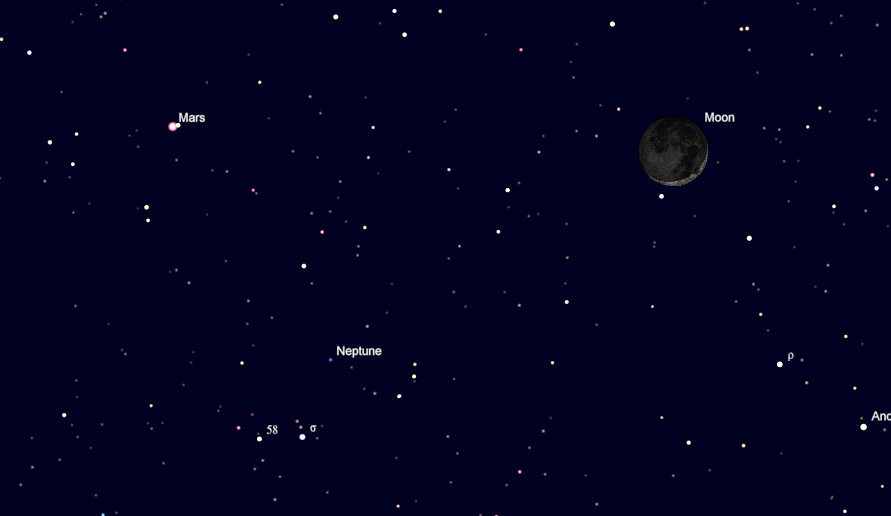
Magnified field with Mars, and the Moon. Neptune is also in the field for 7 p.m. January 22, 2015. Created using Cartes du Ceil (Sky Charts).
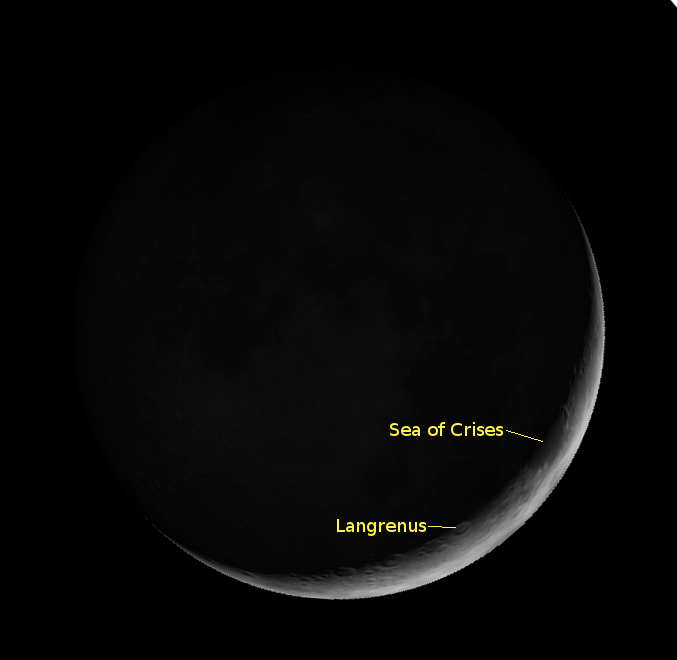
The Moon with Earth shine at 7 p.m. January 22, 2015. Created using Virtual Moon Atlas and GIMP.
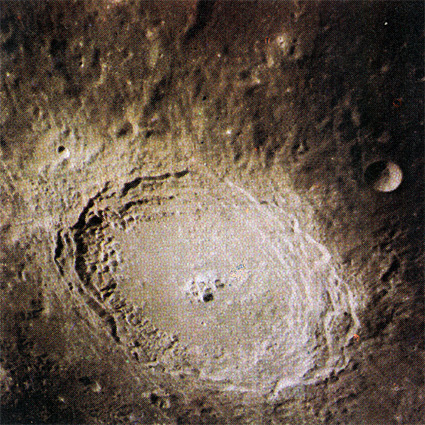
The crater Langrenus as imaged by the Apollo 8 crew on their historic orbiting of the Moon Christmas Eve 1968. Credit: NASA.
Here’s your chance to find Neptune – tonight only
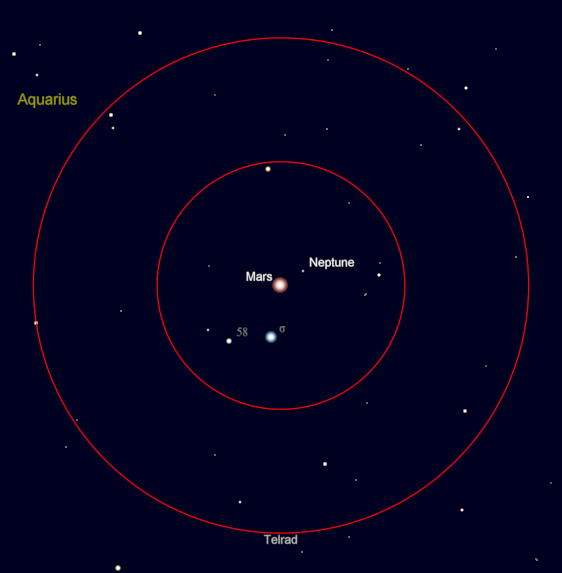
Mars and Neptune tonight only. Here is where Cartes du Ceil (Sky Charts) puts them at 7 p.m. January 19, 2015. They will be low in the southwest. Mars is second magnitude, Neptune is 8th.
The outer red circle matches that of the popular Telrad telescope finder and is a bit smaller (4º) than 7 or 10 power binoculars. The smaller circle is a 2° circle. It will take binoculars at least and a clear sky to spot this outermost planet.
Galileo actually recorded Neptune with his primitive telescope when Jupiter passed it. But to Galileo it was simply a background star.
Note: The 7 p.m. time in the caption is local to western lower Michigan. My location is 43 minutes behind Eastern Standard Time. If you are near your time meridian the time is more likely 6:15 p.m. This normally isn’t a big deal, but These planets are close to setting.
 Bob Moler's Ephemeris Blog