Archive
Ephemeris: 02/16/2026 – The Dog Star
This is Bob Moler with Ephemeris for President’s Day, Monday, February 16th. Today the Sun will be up for 10 hours and 31 minutes, setting at 6:12, and it will rise tomorrow at 7:39. The Moon, 1 day before new, will rise at 7:51 tomorrow morning.
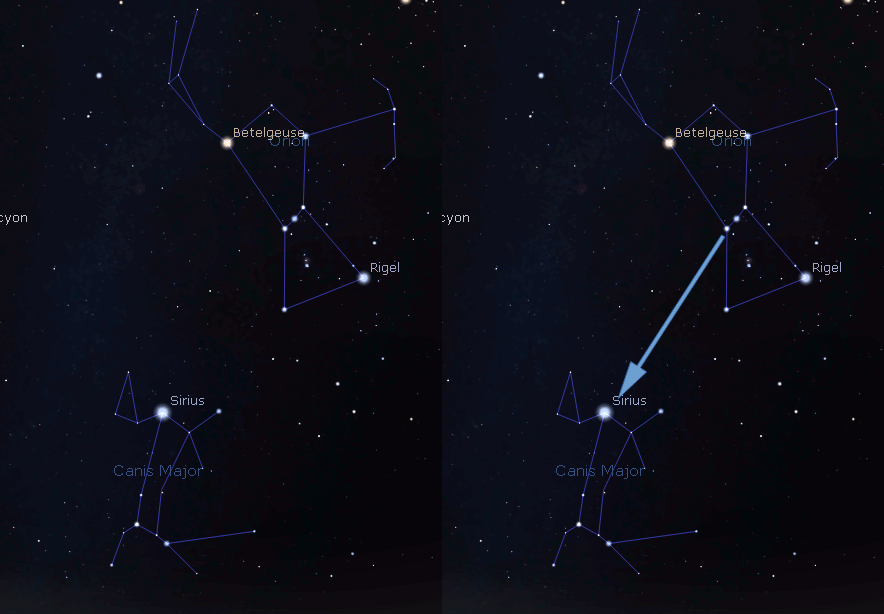
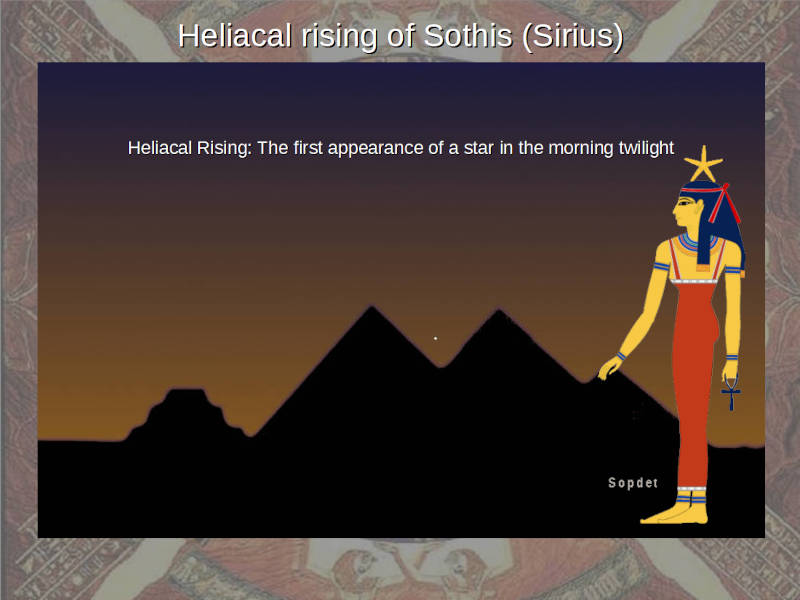
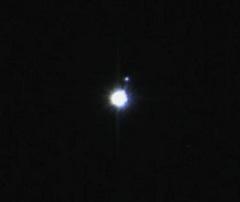
The second-brightest star-like object in the evening sky is Sirius, also known as the Dog Star. It also is the brightest nighttime star in our skies period. Tonight at 9 p.m. it’s located in the southern sky. The Dog Star name comes from its position at the heart of the constellation Canis Major, the great dog of Orion the hunter. The three stars of Orion’s belt tilt to the lower left to Sirius. Sirius means ‘Dazzling One’, because of its great brilliance and twinkling. Its Egyptian name was Sopdet, and its first appearance in the dawn skies around July 20th signaled the flooding of the Nile, and the beginning of the agricultural year. The relationship of the heliacal rising of Sirius and the seasonal or tropical year lasted from about 2900 BCE to the start of the Common Era. Sirius owes much of its brilliance to the fact that it lies close to us, only 8.6 light years away.
The astronomical event times given in this blog are for the Traverse City/Interlochen area of Michigan (Lat 44.7° N, Long 85.7° W; EST, UT – 5 hours) unless stated otherwise. Times will be different for other locations.
Addendum
Trivia Note
The Greeks invented the term “Dog days of summer” for the hottest days of July because they thought that Sirius added its intensity to the heat of the Sun to make it hotter out. So why doesn’t Sirius help warm our winter nights? Just asking.
Ephemeris: 02/03/2026 – Canis Major, Orion’s greater hunting dog
This is Ephemeris for Tuesday, February 3rd. Today the Sun will be up for 9 hours and 55 minutes, setting at 5:54, and it will rise tomorrow at 7:58. The Moon, 2 days past full, will rise at 8:14 this evening.
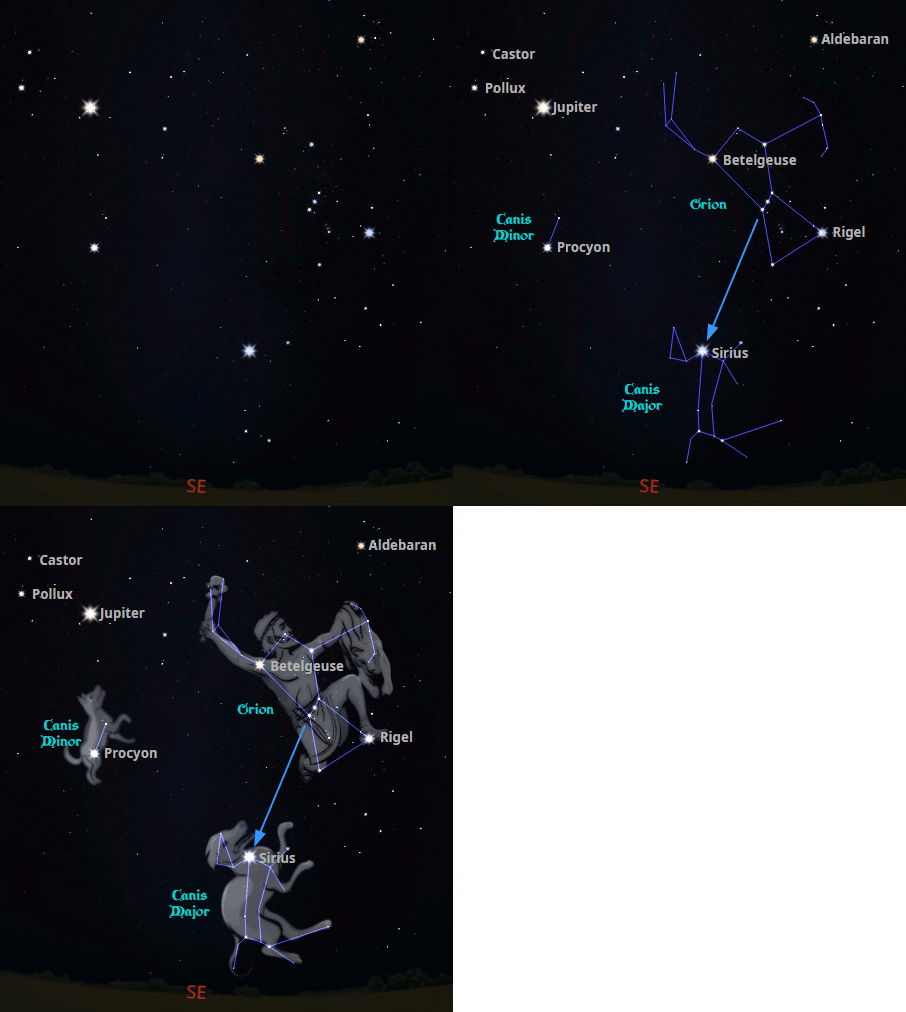
What kind of hunter would the constellation Orion be without his trusty hunting dogs. The larger of his two dogs is Canis Major which can be found if you extend Orion’s belt stars down to the left. There in the southeast by 8 PM, will appear the brightest nighttime star Sirius the Dog Star. It is in the heart of the dog, which appears to be begging. Well it’s tilted funny. Other than that it’s a pretty good representation of a dog as a stick figure. The name Sirius doesn’t mean Dog Star, but means Dazzling One due to its great brightness. It outshines all other nighttime stars, only to be out shown by the planets Venus, Jupiter and occasionally, Mars. Binoculars will show a nice little star cluster a short ways below Sirius known as M41.
The astronomical event times given in this blog are for the Traverse City/Interlochen area of Michigan (Lat 44.7° N, Long 85.7° W; EST, UT – 5 hours) unless stated otherwise. Times will be different for other locations.
Addendum
Ephemeris: 01/16/2026 – Comparing Orion’s two brightest stars
This is Ephemeris for Friday, January 16th. Today the Sun will be up for 9 hours and 13 minutes, setting at 5:29, and it will rise tomorrow at 8:15. The Moon, 2 days before new, will rise at 7:54 tomorrow morning.
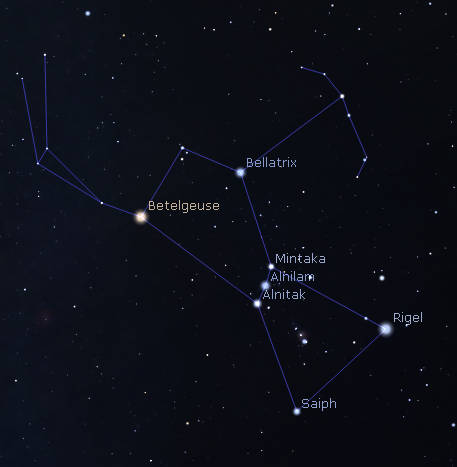
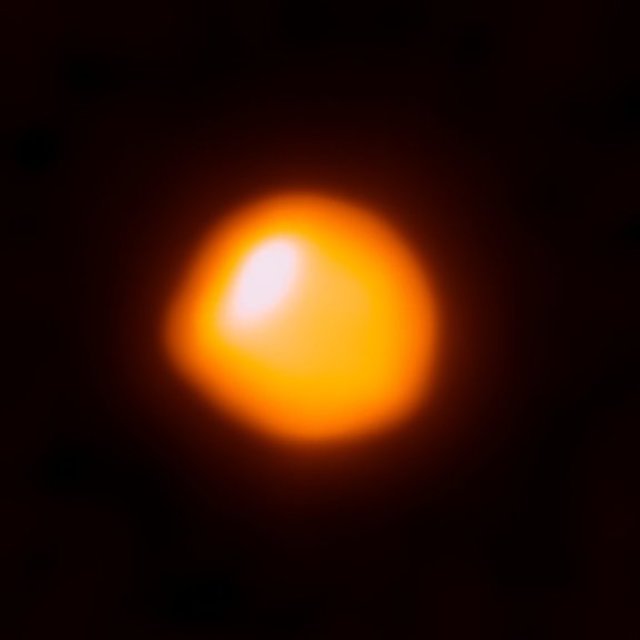
Orion’s two brightest stars are kind of the same but different. Let me explain. Betelgeuse is a red giant star, extremely massive, maybe 14 to 19 times the sun’s mass. It is somewhere between 8 and 14 million years old, which compared to the sun is just a baby, except it is so massive that it is in the last million or so years of its life. Rigel is a bluish white and a bit more massive, about 21 times the mass of the sun, and maybe 8 million years old. It has used most of the hydrogen in its core, and is beginning to transition into its final years which is a few more millions of years. So it’s not as far along in its evolution as Betelgeuse and has not bloated out and turned red. Betelgeuse is 500 light years away, while Rigel is almost 900.
The astronomical event times given in this blog are for the Traverse City/Interlochen area of Michigan (Lat 44.7° N, Long 85.7° W; EST, UT – 5 hours) unless stated otherwise. Times will be different for other locations.
Addendum
Ephemeris: 01/15/2026 – Orion’s great cloud
This is Ephemeris for Thursday, January 15th. Today the Sun will be up for 9 hours and 12 minutes, setting at 5:28, and it will rise tomorrow at 8:15. The Moon, 3 days before new, will rise at 7:09 tomorrow morning.
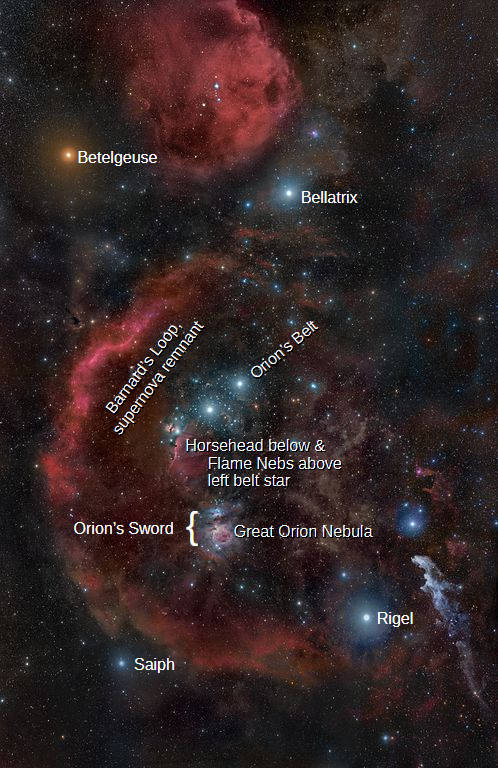
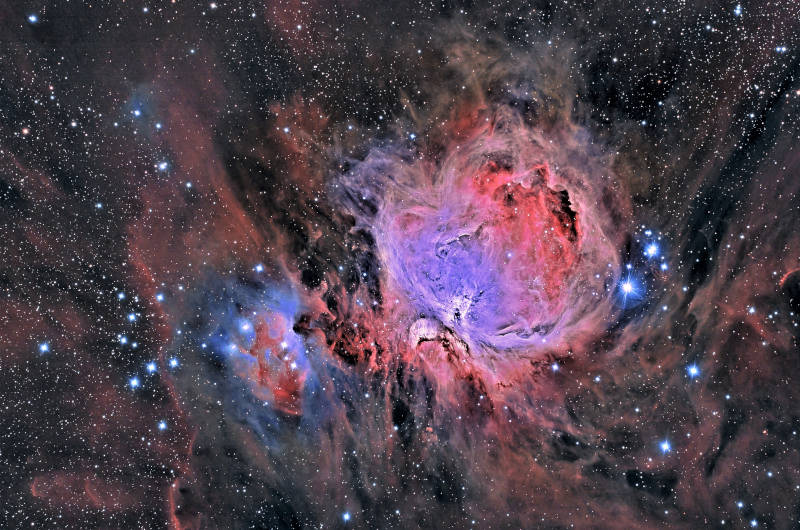
The brightest interstellar cloud visible in our skies is the Great Orion Nebula. The word nebula is from the Latin “nebulum” for cloud. The constellation of Orion is filled with nebulae, most of it are dim or dark. The Great Orion Nebula is in Orion’s sword. The sword is what looks like three stars that look dimmer than the three belt stars hanging from the belt. There are actually more than three stars here. Around the stars that appear as the center of the sword stars, to the eye, can be seen a haze in binoculars. A telescope with a wider aperture and low power can see detail in the cloud. With more magnification, a clutch of four baby stars can be spotted in the brightest part of the nebula. They light up the nebula and are called the Trapezium.
The astronomical event times given in this blog are for the Traverse City/Interlochen area of Michigan (Lat 44.7° N, Long 85.7° W; EST, UT – 5 hours) unless stated otherwise. Times will be different for other locations.
Addendum
Ephemeris: 01/13/2026 – Orion is too preoccupied to notice Lepus the hare
This is Ephemeris for Tuesday, January 13th. Today the Sun will be up for 9 hours and 8 minutes, setting at 5:26, and it will rise tomorrow at 8:17. The Moon, 3 days past last quarter, will rise at 5:13 tomorrow morning.
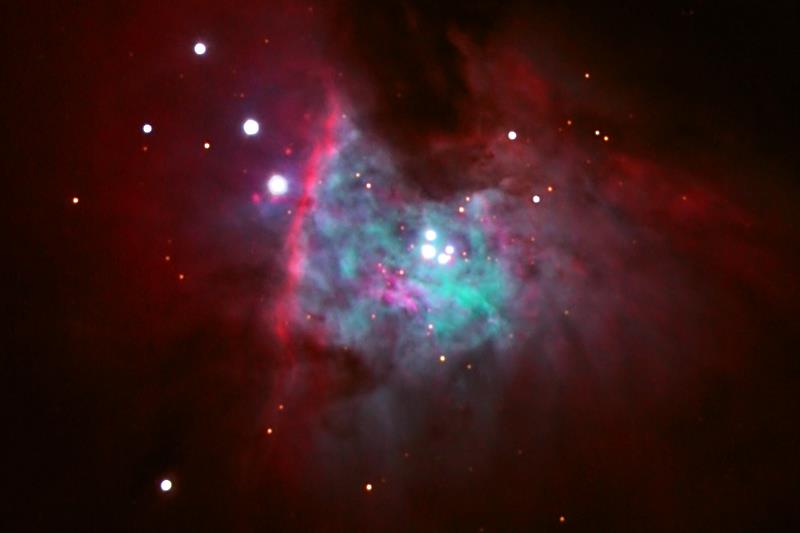
Orion, the central winter constellation is seen in the southern sky this evening. He is a hunter, as artists depict him, however, he is preoccupied with the charge of Taurus the bull from the upper right. At Orion’s feet, and unnoticed by him is the small constellation of Lepus the hare. It’s very hard to see a rabbit in its dim stars: however, I can see a rabbit’s head ears and shoulders. A misshapen box is the head and face of this critter facing to the left. His ears extend upwards from the upper right star of the box, and they bend forward a bit. Two stars to the right of the box and a bit farther apart hint at the front part of the body. Others see a whole rabbit facing the other direction, with additional stars to depict his long ears.
The astronomical event times given in this blog are for the Traverse City/Interlochen area of Michigan (Lat 44.7° N, Long 85.7° W; EST, UT – 5 hours) unless stated otherwise. Times will be different for other locations.
Addendum
Ephemeris: 01/06/2026 – A river in the sky
This is Ephemeris for Tuesday, January 6th. Today the Sun will be up for 8 hours and 58 minutes, setting at 5:18, and it will rise tomorrow at 8:19. The Moon, 3 days past full, will rise at 9:25 this evening.
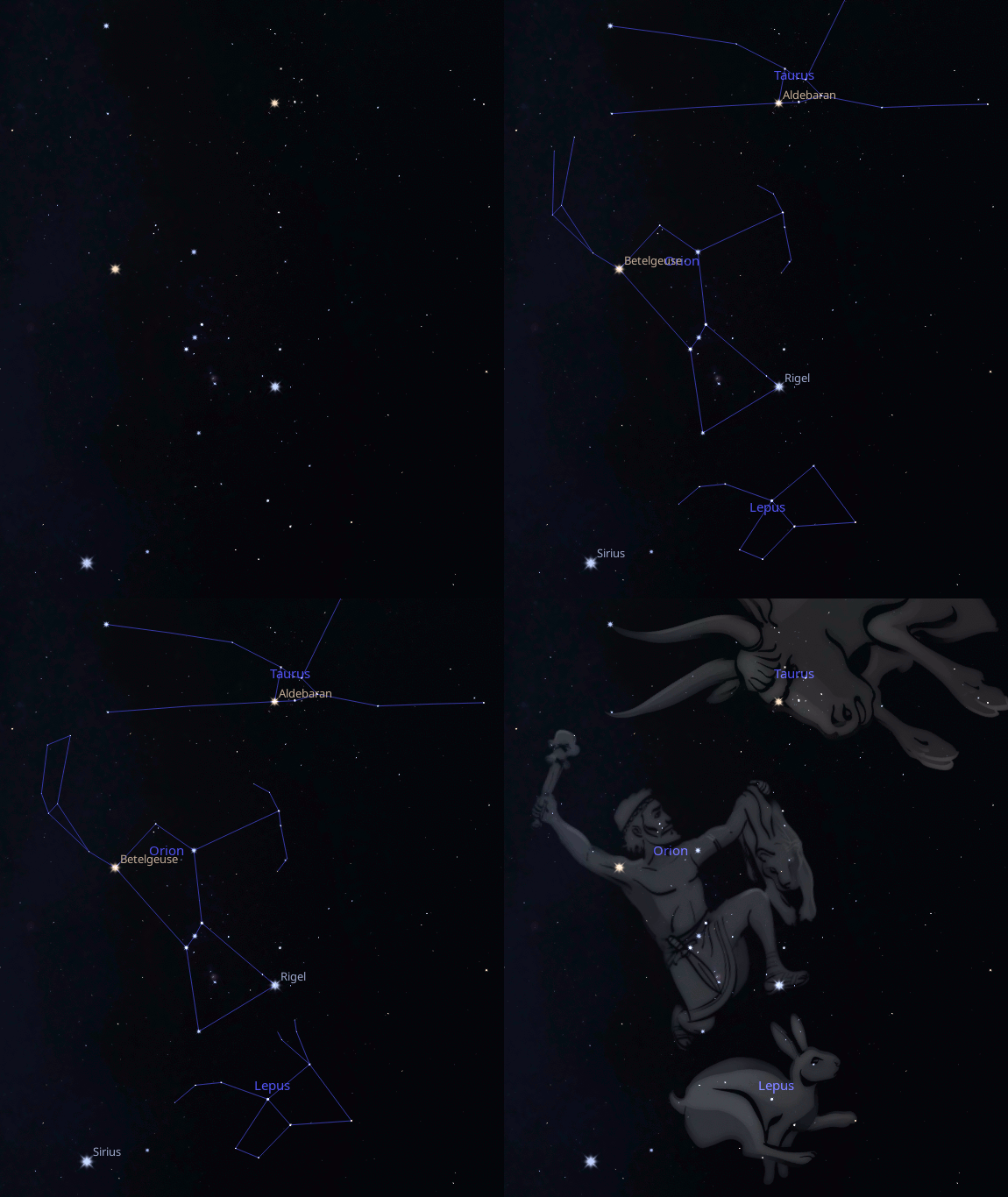
One of the more obscure constellations around is Eridanus, which depicts a river. At 8 PM the river, marked by dim stars, starts near the lower right corner of Orion, near the bright star Rigel and flows to the right then down a little way, then to the lower left, and again to the right, to the southern horizon. One has to travel to the far south to see the southern terminus of the river, the bright star Achernar. Writers over the ages have seen here the Nile, the Rhine and the Earth circling river Ocean of the flat earth days. To most Greeks, including Ptolemy it was simply the River. The earlier Greek astronomer Hipparchus called it the River of Orion, alluding to Orion’s star Rigel as its source. The southern part of the river was added when astronomers made it far enough south.
The astronomical event times given in this blog are for the Traverse City/Interlochen area of Michigan (Lat 44.7° N, Long 85.7° W; EST, UT – 5 hours) unless stated otherwise. Times will be different for other locations.
Addendum
Ephemeris: 12/18/2025 – Orion and Scorpius
This is Ephemeris for Thursday, December 18th. Today the Sun will be up for 8 hours and 48 minutes, setting at 5:03, and it will rise tomorrow at 8:16. The Moon, 1 day before new, will rise at 8:22 tomorrow morning.
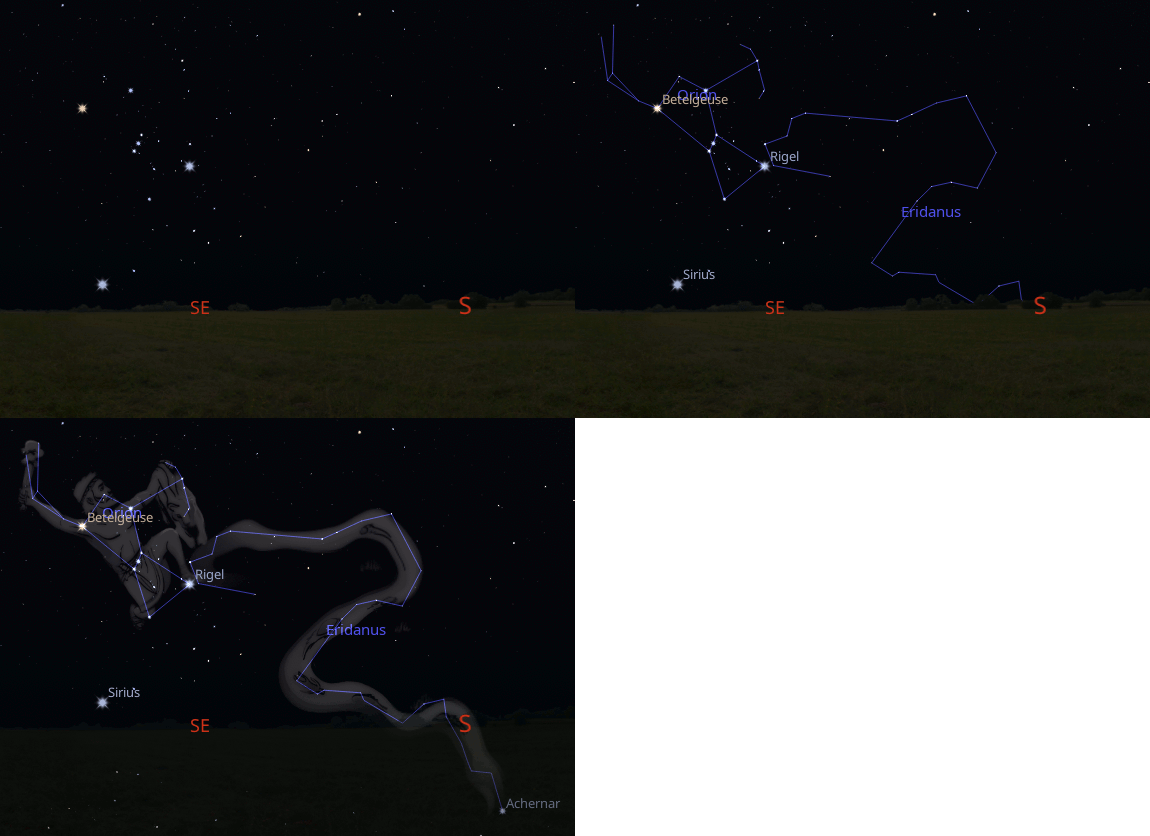
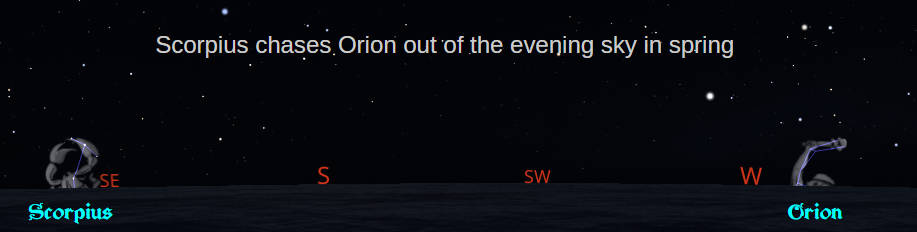
The wonderful constellation of Orion the hard luck hunter is seen rising in the east as twilight fades. According to one Greek myth he was killed by the sting of a giant scorpion, thus he can only rise after the summer constellation of Scorpius the scorpion sets in the southwest, and he must set as the scorpion rises on early spring evenings. By 9 pm, he is located in the southeast. His three belt stars are nearly vertically arranged in a line and equally spaced. They point down to the horizon, at the brightest nighttime star Sirius which rose 13 minutes before. The belt stars lie within a large rectangle of stars tilted to the left. His shoulders and knees. The top left star is the bright red Betelgeuse. The bottom right star is blue-white Rigel.
The astronomical event times given in this blog are for the Traverse City/Interlochen area of Michigan (Lat 44.7° N, Long 85.7° W; EST, UT – 5 hours) unless stated otherwise. Times will be different for other locations.
Addendum
Ephemeris: 12/16/2025 – Finding Orion and the Wintermaker
This is Ephemeris for Tuesday, December 16th. Today the Sun will be up for 8 hours and 49 minutes, setting at 5:03, and it will rise tomorrow at 8:14. The Moon, 3 days before new, will rise at 6:19 tomorrow morning.
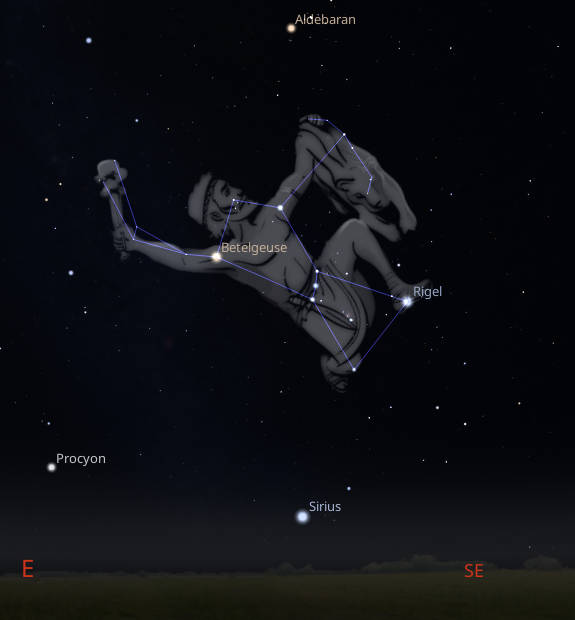
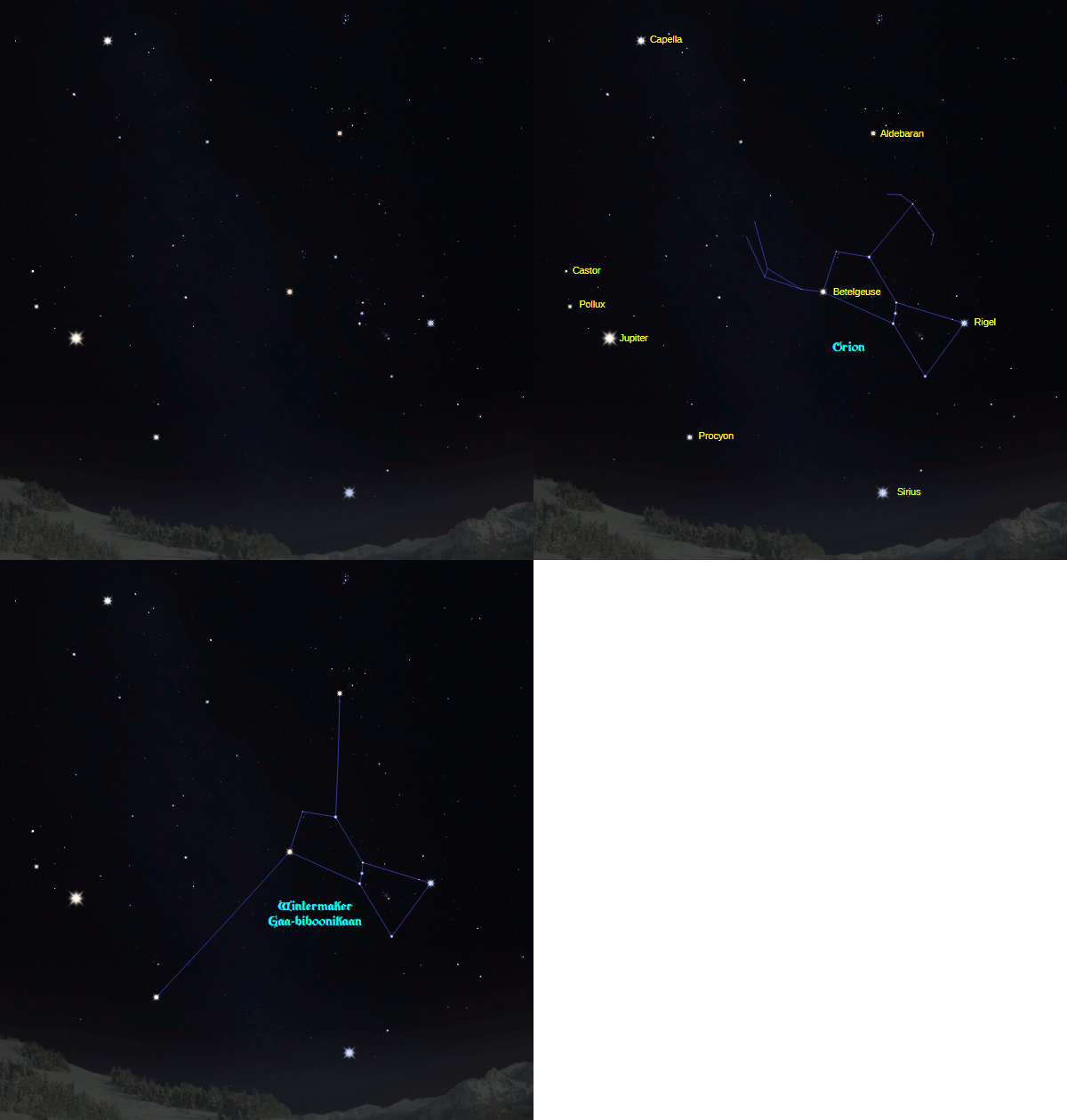
In the east, the central winter constellation Orion the hunter throws a leg over the horizon around 7 PM as Robert Frost told in his poem Star-Splitter. The upright rectangle that is his body is tilted to the left as he rises on December evenings. A bright red star, Betelgeuse, is at the top left of the rectangle, his shoulder. At the opposite corner is blue-white Rigel, a knee. In the center of the rectangle is a line of three stars nearly vertically aligned as he rises, which represents his belt. The stars of Orion’s belt are how many folks can find him. The Anishinaabe native peoples of this area call him the Wintermaker whose arms are held wide to encompass the winter stars. His rising in the evening heralds the coming of winter, five days from now.
The astronomical event times given in this blog are for the Traverse City/Interlochen area of Michigan (Lat 44.7° N, Long 85.7° W; EST, UT – 5 hours) unless stated otherwise. Times will be different for other locations.
Addendum
Ephemeris: 12/08/2025 – Hyades, half sisters of the Pleiades
This is Ephemeris for Monday, December 8th. Today the Sun will be up for 8 hours and 54 minutes, setting at 5:02, and it will rise tomorrow at 8:08. The Moon, 3 days before last quarter, will rise at 9:19 this evening.
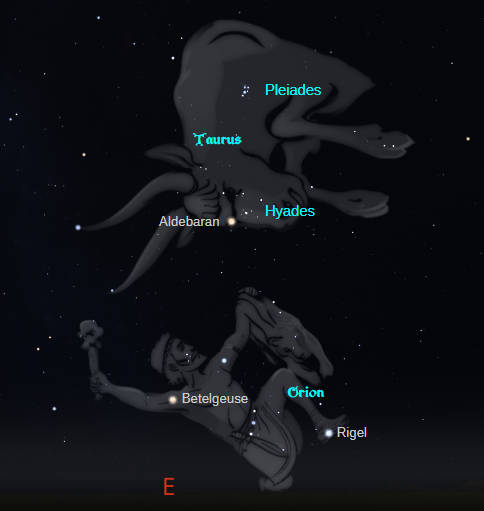
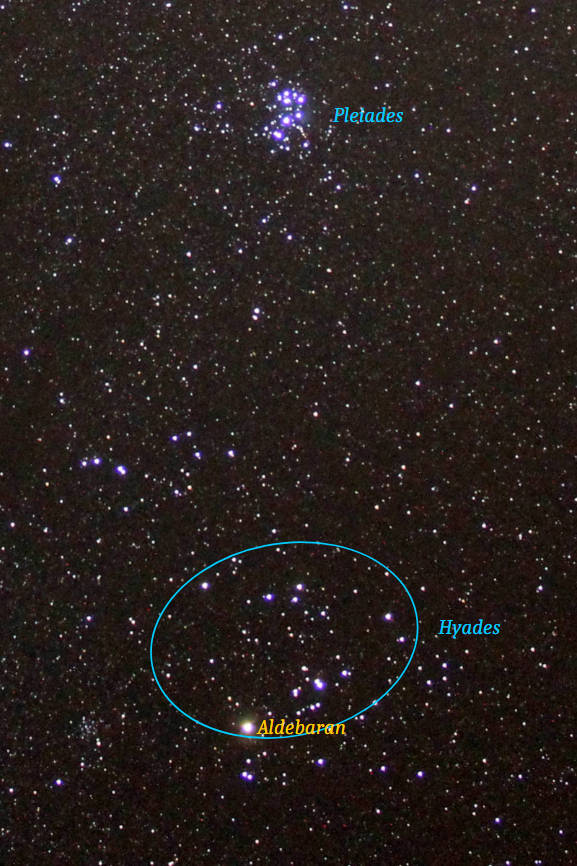
At 8 o’clock this evening the constellation of Orion the hunter is still in the act of rising with one leg still stuck in the snow. What is above him is the constellation of Taurus the bull. His face is a letter V of stars or as a letter A, is the star cluster called the Hyades. In Greek myth the stars are the half sisters of the Pleiades, which are right above them. The Hyades star cluster is very special. They don’t look as splashy as the Pleiades which are younger and still have their hot blue white stars. However, the Hyades are much closer, a third as far as the Pleiades. In fact they’re close enough to be measured by trigonometry using Earth’s orbit as the base of a triangle, before satellites. Which was critical in measuring distances beyond the solar system.
The astronomical event times given in this blog are for the Traverse City/Interlochen area of Michigan (Lat 44.7° N, Long 85.7° W; EDT, UT – 4 hours) unless stated otherwise. Times will be different for other locations.
Addendum
Ephemeris: 12/04/2025 – Orion survives a full moon
This is Ephemeris for Thursday, December 4th. Today the Sun will be up for 8 hours and 59 minutes, setting at 5:02, and it will rise tomorrow at 8:04. The Moon, at full today, will rise at 4:24 this evening.
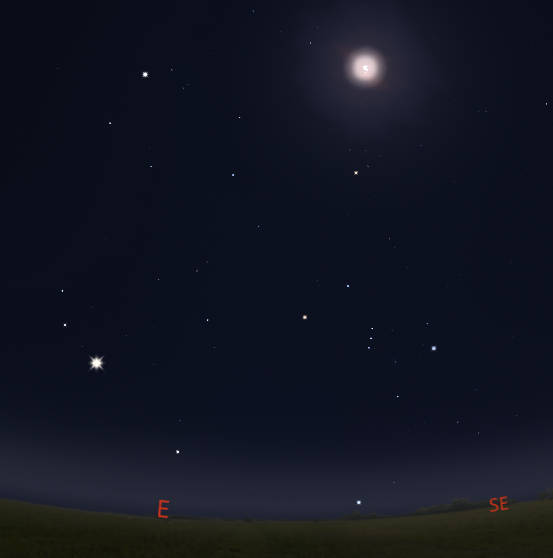
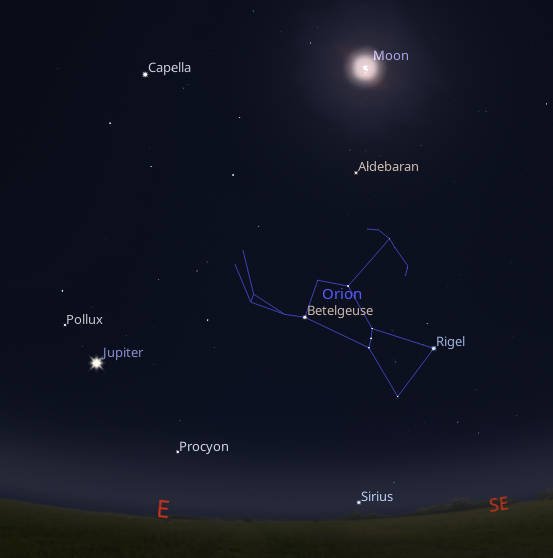
While the full moon overpowers most stars, the bright stars of winter persist. This is even true with tonight’s supermoon, a bit larger and brighter than average. Nowhere in the sky is there a concentration of bright stars as there is in the winter sky. I know it’s not winter yet, but if you stay up late enough, say 10 PM, all the winter stars will be in the sky. Last to rise is the brightest star of all, Sirius. And by 10 o’clock will be low in the southeast. Jupiter has joined the winter stars this year, outshining them all. As a constellation the mighty hunter Orion is easiest to spot on a full moon night, containing seven very bright stars, with three bright stars in a straight line as his belt, which most folks find as his most distinctive feature.
The astronomical event times given in this blog are for the Traverse City/Interlochen area of Michigan (Lat 44.7° N, Long 85.7° W; EDT, UT – 4 hours) unless stated otherwise. Times will be different for other locations.
Addendum
 Bob Moler's Ephemeris Blog