Archive
Ephemeris: 02/21/2025 – Orion’s most distinctive feature
This is Bob Moler with Ephemeris for Friday, February 21st. Today the Sun will be up for 10 hours and 46 minutes, setting at 6:20, and it will rise tomorrow at 7:31. The Moon, 1 day past last quarter, will rise at 4:09 tomorrow morning.
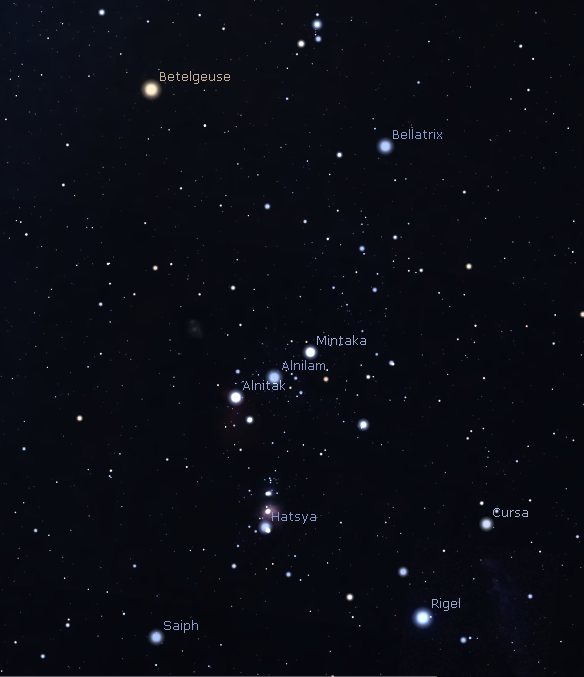
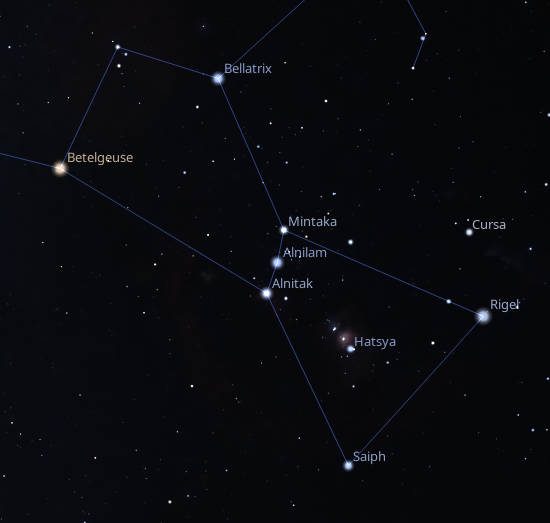
Orion’s belt of three stars is one of the most noticeable star groupings in the sky. There are no other groups of three bright stars in a straight line visible anywhere else in the sky. The star’s names from left to right are Alnitak, Alnilam and Mintaka. They are actually a bit farther away than the other bright stars of Orion. Alnilam, the center star, is over three times the distance of red giant Betelgeuse above it and over twice as far as blue white giant star Rigel below it. Alnilam is 375 thousand times brighter than the Sun. These three stars were also known as Frigga’s Spindle by the Norsemen. Frigga, also known as Freya, is the goddess from whom we get the name of the day of the week we call Friday.
The astronomical event times given are for the Traverse City/Interlochen area of Michigan (EST, UT – 5 hours). Times will be different for other locations.
Addendum
Ephemeris: 12/02/2024 – Orion is rising in the evening
This is Ephemeris for Monday, December 2nd. Today the Sun will be up for 9 hours and 1 minute, setting at 5:03, and it will rise tomorrow at 8:02. The Moon, 1 day past new, will set at 5:47 this evening.
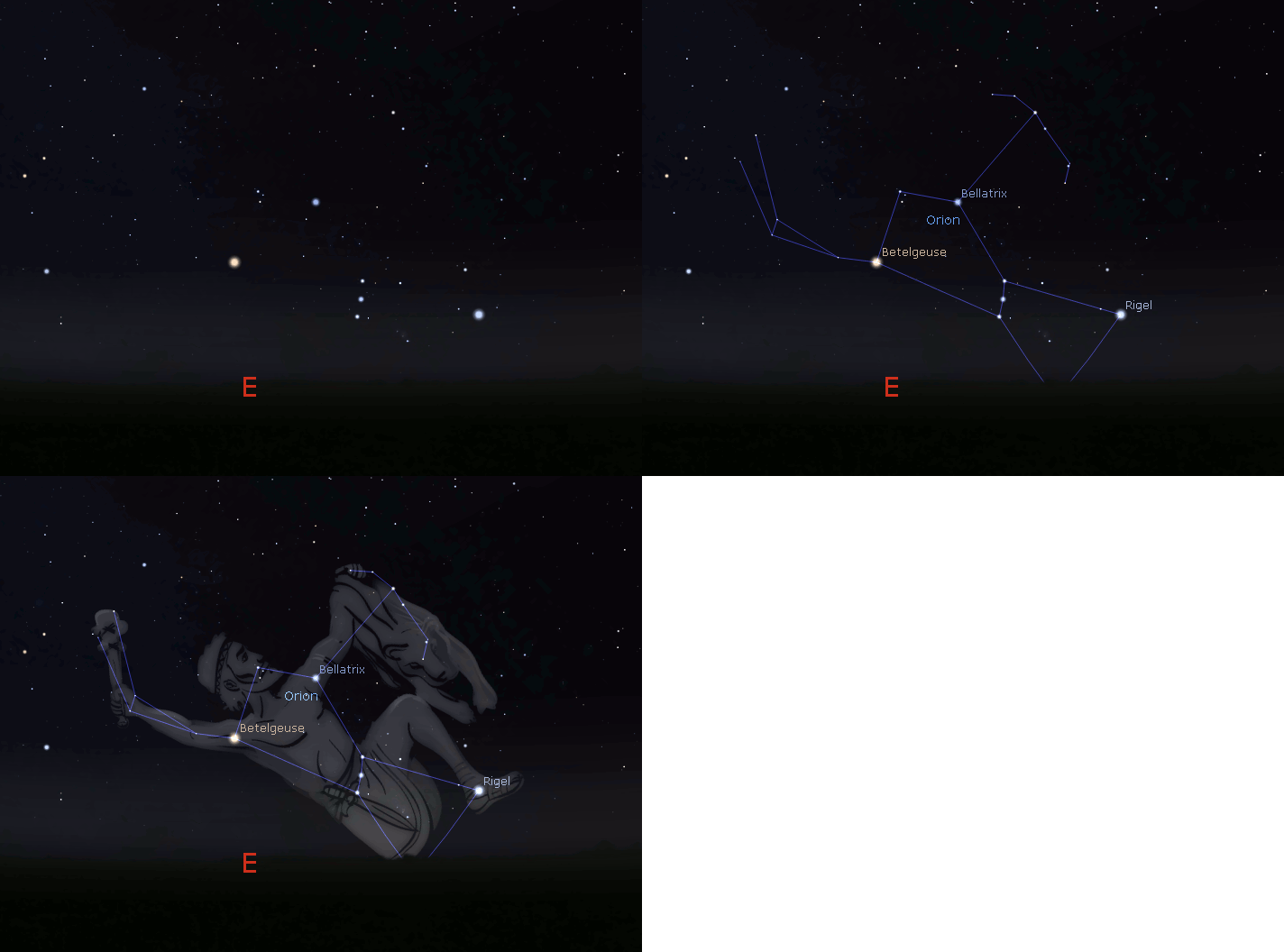
In the east, the central winter constellation Orion the hunter throws a leg over the horizon between 8 and 9 p.m. as Robert Frost told in his poem Star-Splitter. The upright rectangle that is his body on December evenings is tilted to the left as he rises, with a bright red star Betelgeuse at the top left of the rectangle, his shoulder. At the opposite corner is blue-white Rigel, a knee. In the center of the rectangle is a line of three stars nearly vertically aligned as he rises, which represents his belt. The stars of Orion’s belt are how many folks can find him. The Anishinaabek native peoples of this area call him the Wintermaker whose arms are held wide to encompass the winter stars. His rising in the evening heralds the coming of winter.
The astronomical event times given are for the Traverse City/Interlochen area of Michigan (EST, UT – 5 hours). Times will be different for other locations.
Addendum
Ephemeris: 01/29/2024 – Canis Major, Orion’s larger hunting dog
This is Ephemeris for Monday, January 29th. Today the Sun will be up for 9 hours and 41 minutes, setting at 5:46, and it will rise tomorrow at 8:04. The Moon, halfway from full to last quarter, will rise at 9:50 this evening.
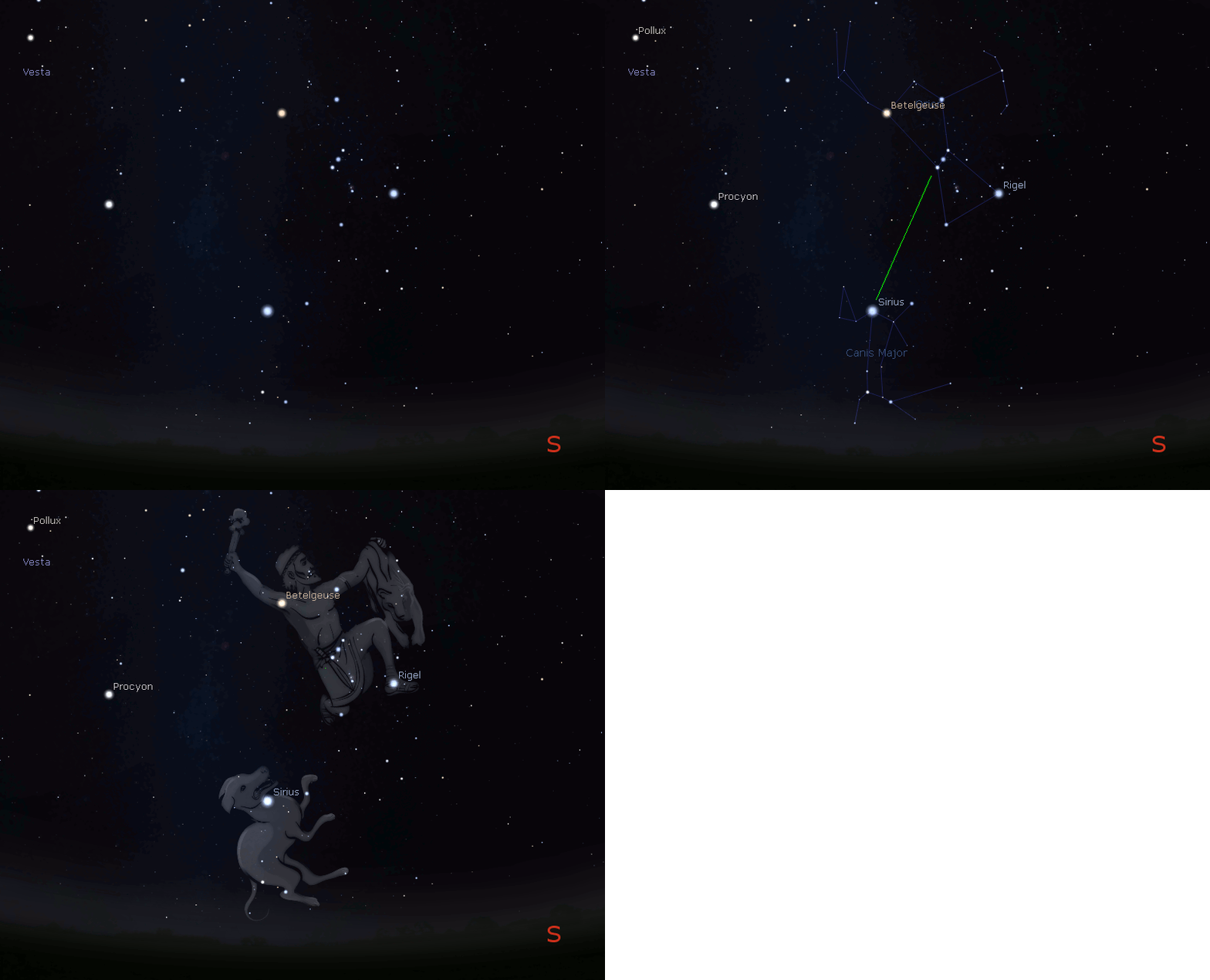
The great winter constellation or star group, Orion the hunter, is located in the south-southeastern sky at 9 p.m. His elongated rectangle of a torso is nearly vertical. In the center of the rectangle are three stars in a line that make his belt. As a hunter, especially one of old, he has two hunting dogs. The larger, Canis Major, can be found by following the three belt stars of Orion down and to the left. They point to Sirius, the brightest nighttime star, also known as the Dog Star. It’s in the heart of a stick figure dog low in the southeast facing Orion that appears to be begging. There’s a fine star cluster, called Messier 41, or M41, the Little Beehive Cluster, at the 5 o’clock position from Sirius. It’s easily visible in binoculars or a small telescope.
The astronomical event times given are for the Traverse City/Interlochen area of Michigan (EST, UT –5 hours). They may be different for your location.
Addendum
Ephemeris: 01/19/2024 – Finding the Dog Star
This is Bob Moler with Ephemeris for Friday, January 19th. Today the Sun will be up for 9 hours and 18 minutes, setting at 5:33, and it will rise tomorrow at 8:13. The Moon, 2 days past first quarter, will set at 3:59 tomorrow morning.
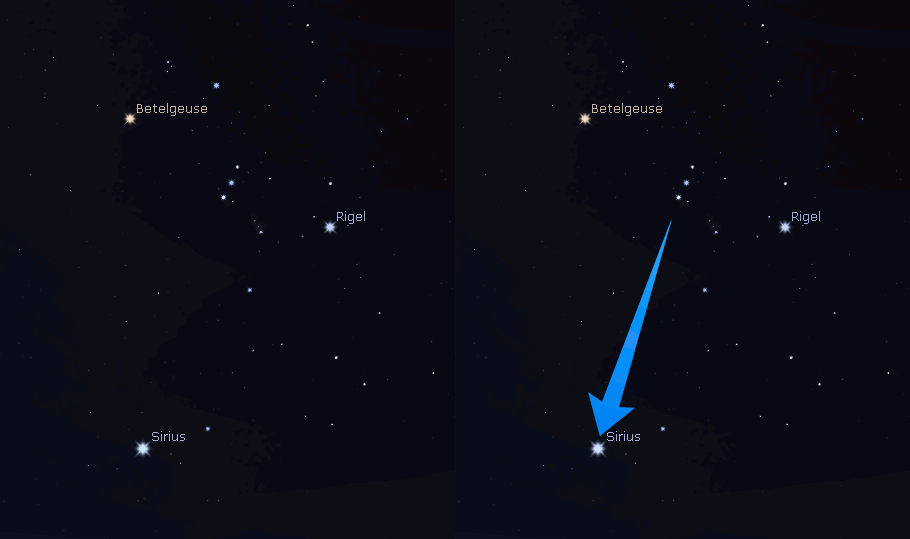
In the evening, the great constellation of Orion the hunter can be seen to slowly move from the south-east to the south. Its large rectangle of bright stars is easily visible, even with a full moon. The three stars in a straight line, his belt, tilt downward to the left to a very bright star merrily twinkling lower in the sky. This star is called Sirius, also known as the Dog Star because it’s in the heart of Orion’s larger hunting dog, Canis Major. It is an arc light white star as seen in binoculars or telescope. It is the brightest star in the night sky, and a neighboring star, just twice the distance of the closest star to the Sun at 8.6 light years. Its name, Sirius, has nothing to do with a dog, but is from the Greek meaning scorching for its brightness and sparkling, due to its intense twinkling.
The astronomical event times given are for the Traverse City/Interlochen area of Michigan (EST, UT –5 hours). They may be different for your location.
Addendum
Ephemeris: 01/04/2024 – Viewing Orion’s Belt
This is Ephemeris for Thursday, January 4th. The Sun will rise at 8:20. It’ll be up for 8 hours and 55 minutes, setting at 5:15. The Moon, 1 day past last quarter, will rise at 2:10 tomorrow morning.
Orion’s belt of three stars is one of the most noticeable star groupings in the sky. There are no other groups of three bright stars in a straight line visible anywhere else in the sky. The star’s names from left to right are Alnitak, Alnilam and Mintaka. They are actually a bit farther away than the other bright stars of Orion. Alnilam, the center star, is over three times the distance of red giant Betelgeuse above them and over twice as far as blue white giant star Rigel below them. Alnilam is 375 thousand times brighter than the Sun. These three stars were also known as Frigga’s Spindle by the Norsemen. Frigga, also known as Freya, is the goddess from which we get the name of the day of the week we call Friday.
The astronomical event times given are for the Traverse City/Interlochen area of Michigan (EST, UT –5 hours). They may be different for your location.
Addendum
04/18/2023 – Ephemeris – Orion rotates 90 degrees from rising to setting
This is Bob Moler with Ephemeris for Tuesday, April 18th. Today the Sun will be up for 13 hours and 37 minutes, setting at 8:31, and it will rise tomorrow at 6:52. The Moon, 2 days before new, will rise at 6:43 tomorrow morning.
As the constellation of Orion the hunter, that dominated our winter skies, moves into the west in the evening, it will have rotated 90 degrees from its rising orientation. As we saw it rising last November, its three belt stars were nearly vertically aligned. Now, as Orion nears the western horizon, those belt stars have rotated to be almost horizontal. The same is true of Gemini’s two brightest stars, Castor and Pollux. They are the two stars above red Mars, which is now halfway through Gemini on its eastward travels. Orion, a minor Greek hero, is most famous for how he died. I know of three versions, all different. The one that fits Orion’s current setting is that he was killed by the sting of a giant scorpion. So he must flee the sky before Scorpius the scorpion rises, which is around midnight tonight.
This amount of rotation between rising and setting is only true for latitudes near 45 degrees north or south, such as Northern Michigan, and objects near the celestial equator. The rotation for other latitudes would be 2 x (90 – latitude) for equatorial celestial objects. The name given for the term (90 – latitude) is colatitude. 90 degrees is the latitude of the Earth’s poles.
The astronomical event times given are for the Traverse City/Interlochen area of Michigan (EST, UT –4 hours). They may be different for your location.
Addendum
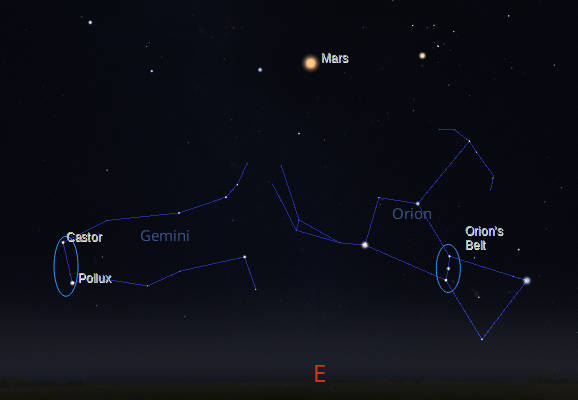
When Orion is rising, its belt stars are nearly vertically aligned. Castor and Pollux, too, appear nearly vertically aligned. This was for November 30, 2022, at 9 pm. Mars was near opposition then and quite close to the Earth, so it had shown quite brightly. Created using Stellarium and LibreOffice Draw.
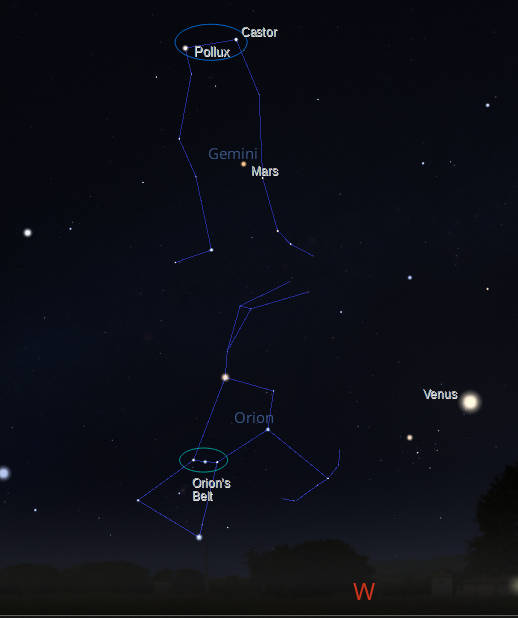
Orion’s belt stars show that the constellation has rotated about 90 degrees from their rising orientation. This is for 10 pm, April 18, 2023. Note that Venus is the Evening Star now, and Mars is much dimmer, as the Earth has moved ahead and away from it. Created using Stellarium and LibreOffice Draw, for the added labels.
02/10/2023 – Ephemeris – Finding Orion’s greater hunting dog, Canis Major
This is Bob Moler with Ephemeris for Friday, February 10th. Today the Sun will be up for 10 hours and 13 minutes, setting at 6:04, and it will rise tomorrow at 7:49. The Moon, 3 days before last quarter, will rise at 11:14 this evening.
The great winter constellation or star group, Orion the hunter, is located in the southern sky at 9 p.m. His elongated rectangle of a torso is vertical. In the center of the rectangle are three stars in a line that make his belt. As a hunter, especially one of old, he has two hunting dogs. The larger, Canis Major, can be found by following the three belt stars of Orion down and to the left. They point to Sirius, the brightest nighttime star, also known as the Dog Star. It’s in the heart of a stick figure dog low in the southeast facing Orion that appears to be begging. There’s a fine star cluster, called Messier, or M 41, at the 5 o’clock position from Sirius. It’s easily visible in binoculars or a small telescope.
The astronomical event times given are for the Traverse City/Interlochen area of Michigan (EST, UT –5 hours). They may be different for your location.
Addendum
Orion and Canis Major animation for earlier than 9 in the evening. Created using Stellarium and GIMP.
02/09/2023 – Ephemeris – Orion’s Belt stars
This is Ephemeris for Thursday, February 9th. Today the Sun will be up for 10 hours and 10 minutes, setting at 6:02, and it will rise tomorrow at 7:50. The Moon, halfway from full to last quarter, will rise at 10:07 this evening.
Orion’s belt of three stars is one of the most noticeable star groupings in the sky. There are no other groups of three bright stars in a straight line visible anywhere else in the sky. The star’s names from left to right are Alnitak, Alnilam and Mintaka. They are actually a bit farther away than the other bright stars of Orion. Alnilam, the center star, is over three times the distance of red giant Betelgeuse above them and over twice as far as blue white giant star Rigel below them. Alnilam is 375 thousand times brighter than the Sun according to the SIMBAD Astronomical Database. These three stars were also known as Frigga’s Spindle by the Norsemen. Frigga also known as Freya is the goddess from which we get the name of the day of the week Friday.
The astronomical event times given are for the Traverse City/Interlochen area of Michigan (EST, UT –5 hours). They may be different for your location.
Addendum
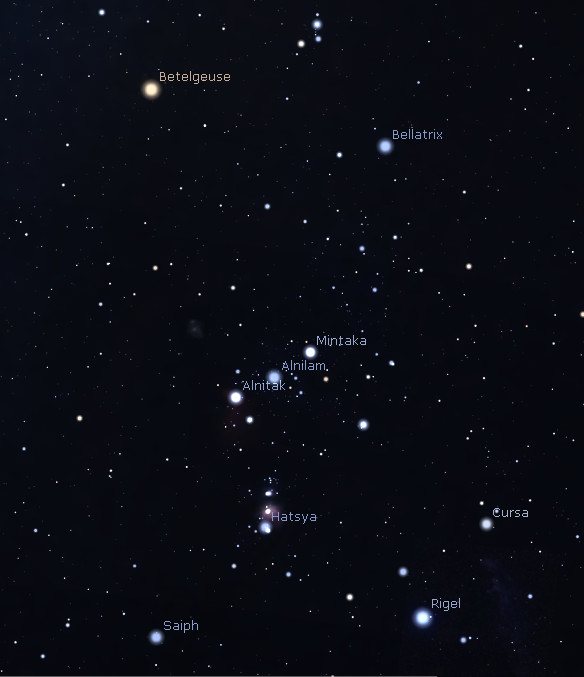
Orion’s named stars, including the belt stars. Created using Stellarium.
01/10/2023 – Ephemeris – The constellation of Orion the hunter, unlucky in love
This is Bob Moler with Ephemeris for Tuesday, January 10th. Today the Sun will be up for 9 hours and 3 minutes, setting at 5:22, and it will rise tomorrow at 8:18. The Moon, halfway from full to last quarter, will rise at 9:01 this evening.
Before the Moon rises tonight, we will have two hours of darkness. Winter’s central constellation, Orion the hunter, doesn’t need the Moon to be absent to see its principal stars. He’s in the southeast before the Moon rises with red Betelgeuse in one shoulder and dimmer Bellatrix on the other, Saiph at one knee and bright blue-white Rigel at the other. Between his shoulders and knees runs his belt of three stars in a line. Above Betelgeuse, he is holding a club aloft and from Bellatrix he holds a lion skin shield to defend himself from the charge of Taurus the bull, above and right of him. I consider him a hard luck hero, with three different stories on how he died. Unlucky in love, he’s consigned to chase the Seven Sisters of the Pleiades throughout eternity.
The astronomical event times given are for the Traverse City/Interlochen area of Michigan (EST, UT –5 hours). They may be different for your location.
Addendum
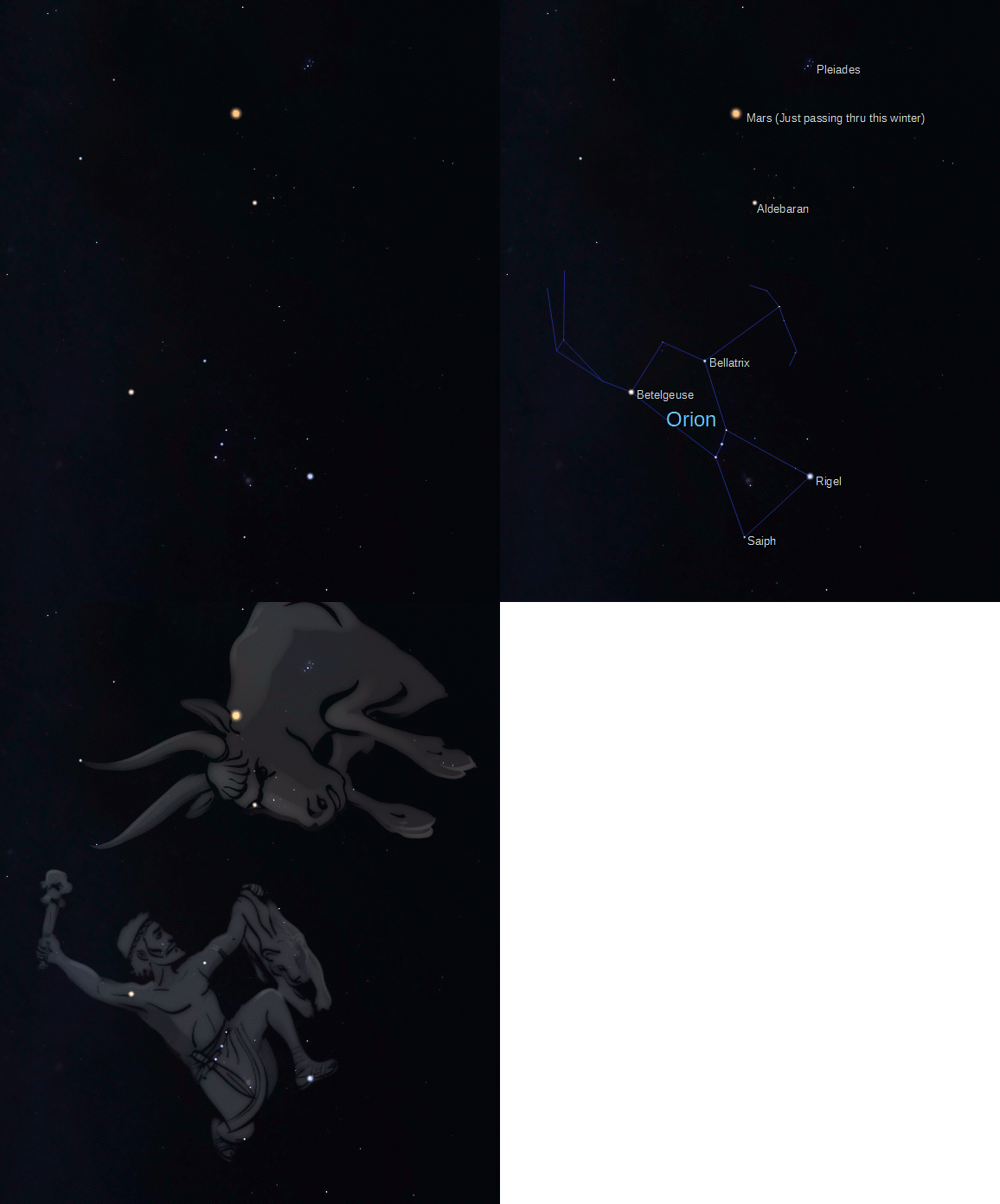
Orion finder animation with Mars. First, showing the unannotated sky looking southeast at Orion. Second, Orion with lines and labels of the stars at the corners of his body, and other bright stars in the view, plus the Pleiades and bright planet Mars, that’s just happening to be passing through this year. Third, the constellation art for Orion and Taurus the bull. Created using Stellarium, LibreOffice Draw and GIMP.
Here are the three stories of how Orion died: One: Orion raped the goddess Artemis, and so she killed him. Two: Orion was betrothed to Artemis, but her twin brother Apollo was jealous and caused her to kill him in a hunting “accident”. Three: Orion was killed by the sting of a scorpion, which is the reason Orion and Scorpius are never in the sky at the same time.
01/05/2023 – Ephemeris – I’m Sirius about this being the brightest nighttime star!
Jan 5. This is Bob Moler with Ephemeris for Thursday, January 5th. Today the Sun will be up for 8 hours and 56 minutes, setting at 5:16, and it will rise tomorrow at 8:19. The Moon, 1 day before full, will set at 8:33 tomorrow morning.
The brightest nighttime star, Sirius, rises before 8 pm tonight. It can be found by following the constellation Orion’s three belt stars downward to near the east-southeastern horizon. As far as star-like objects go, Jupiter and Venus can always outshine Sirius. Mars can too, but only when it is near the Earth and this early evening when Mars is high in the sky and Sirius is low in the sky. When the Moon clears out of the evening sky, and Sirius rises higher, the other stars of its constellation will become visible. That constellation is Canis Major, Orion’s great hunting dog, from which it gets its nickname: Dog Star. The name Sirius means Dazzling One, an allusion to its great brightness and, being low in the sky, it twinkles mightily.
The astronomical event times given are for the Traverse City/Interlochen area of Michigan (EST, UT –5 hours). They may be different for your location.
Addendum
A Sirius finder animation for January/early February at around 8 pm. Even in bright moonlight, the seven bright stars of Orion can be seen. The three stars of Orion’s belt make a great pointer to Sirius. Created using Stellarium, GIMP and LibreOffice (for the arrow).
 Bob Moler's Ephemeris Blog