Archive
12/15/2015 – Ephemeris – Procyon the star that’s “Before the dog”
Ephemeris for Tuesday, December 15th. The Sun will rise at 8:13. It’ll be up for 8 hours and 49 minutes, setting at 5:02. The Moon, 3 days before first quarter, will set at 9:48 this evening.
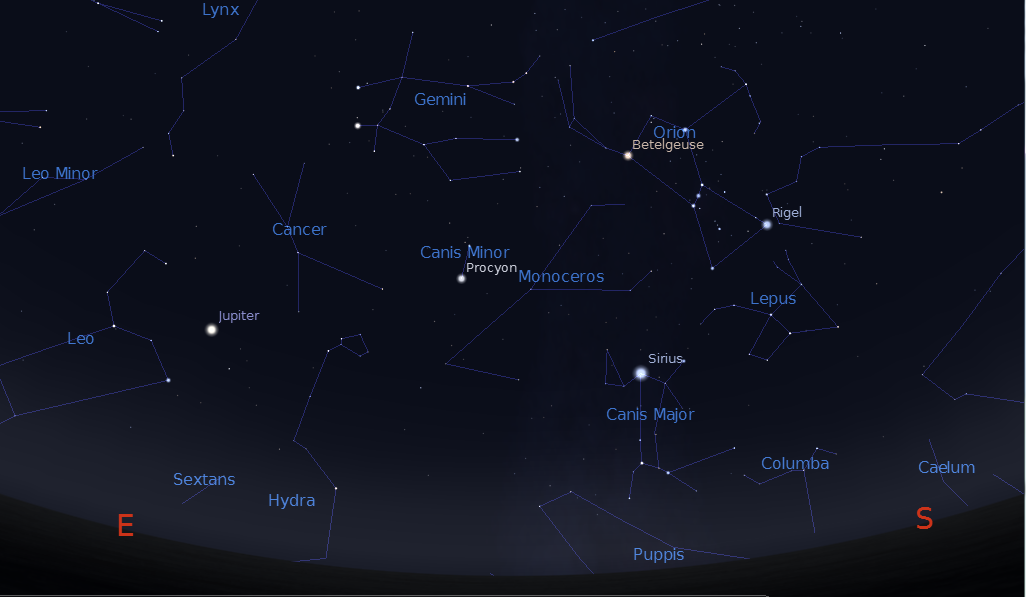
Visible low in the east at 9:30 p.m. appears the star Procyon to its lower left is Sirius the brightest night-time star. Procyon is the bright star in the constellation Canis Minor, or lesser dog. I can find only one other star in Canis Minor. Perhaps it’s a hot dog. If Sirius, in Canis major is the Dog Star then Procyon should be the Little Dog Star. However Procyon is an interesting name. It means “Before the dog”, which is an allusion to the fact that Procyon, though east of Sirius actually rises before it. This is due to Procyon’s more northerly position. This effect doesn’t work south of the equator, however. Sirius will rise at about 9 tonight. Procyon is a star much like Sirius but is 32% farther away. It’s 11.4 to Sirius’ 8.6 light years away.
Times are for the Traverse City/Interlochen area of Michigan. They may be different for your location.
Addendum
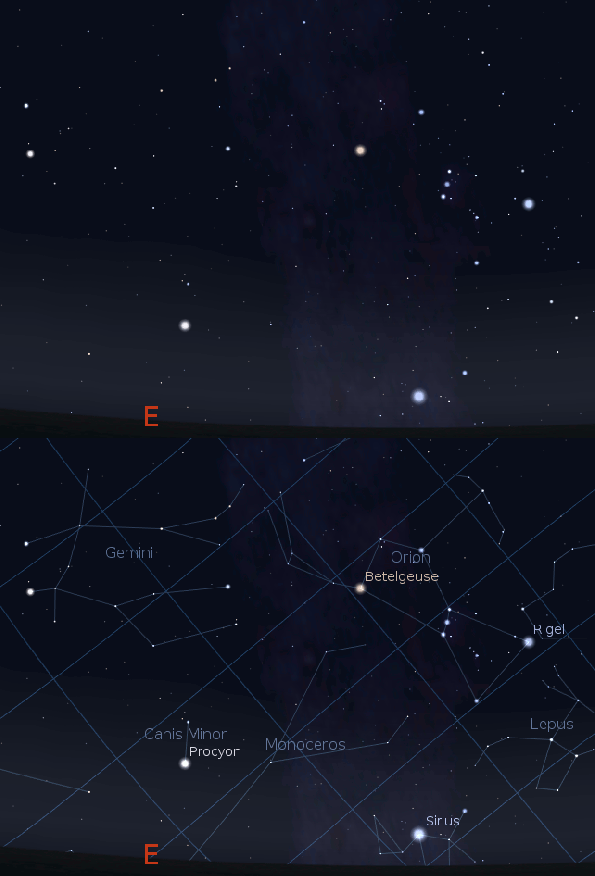
Procyon, Sirius and the stars of winter. Created using Stellarium
In the above chart, beside the constellation lines, we have the grid of right ascension, from lower left to upper right; and declination, from upper left to lower right. right ascension lines are like longitude on the Earth, while declination lines are latitude lines. They are tipped because I don’t live at either the equator or one of the poles. As the Earth rotates the Sun, stars and planets slide westward in the direction of the declination lines. Note that Sirius is closer to the horizon than Procyon. Also that Sirius is west of the 7 hour right ascension line. (Take my word for it.) Procyon is east of that line, thus Sirius is west of Procyon.
Other cool things can be seen in the chart. Note the declination line that touches the horizon at the east compass point and runs just above Orion’s belt. It is 0º declination, or the celestial equator. It extends to the west compass point on the western horizon. The Sun on the equinoxes will rise due east and set due west. The 6 hour right ascension line runs past Betelgeuse in Orion. At 23½º north declination, near Castor’s big toe in Gemini is where the Sun appears on the first day of summer, the summer solstice.
P.S. It was cloudy and rainy the last two days. Didn’t see a Geminid meteor again this year, keeping my record intact.
11/30/2015 – Ephemeris – Orion Rising
Ephemeris for Monday, November 30th. The Sun will rise at 7:58. It’ll be up for 9 hours and 5 minutes, setting at 5:04. The Moon, 3 days before last quarter, will rise at 10:12 this evening.
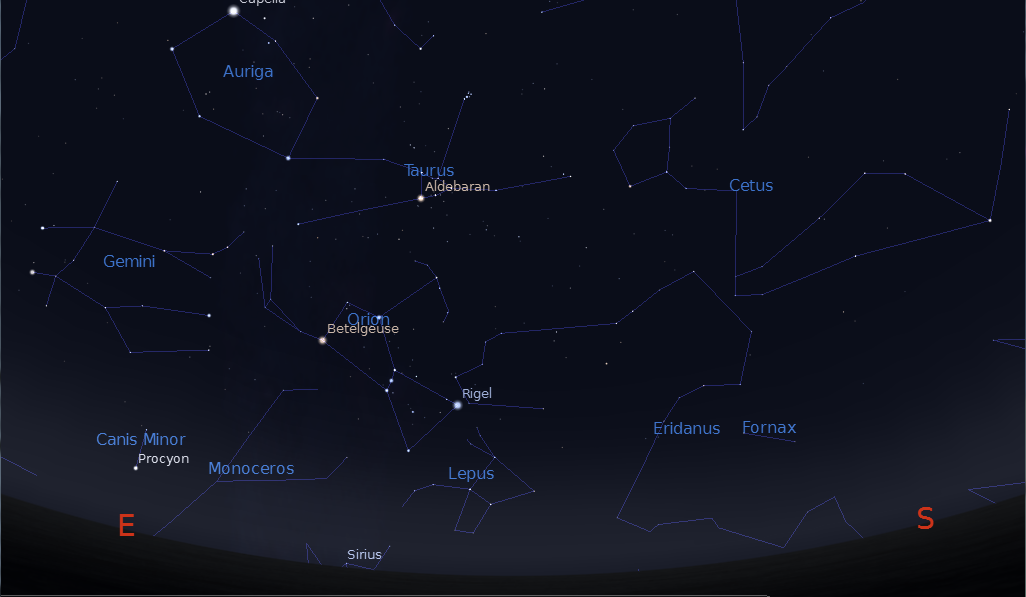
We have a few hours of darkness tonight before the Moon comes up. In the east the central winter constellation Orion the hunter throws a leg over the horizon between 8 and 9 p.m. as Robert Frost told in his poem Star-Splitter. The upright rectangle that is his body on January evenings is tilted to the left as he rises, with bright red star Betelgeuse at the top left of the rectangle, his shoulder. At the opposite corner is blue-white Rigel, a knee. In the center of the rectangle is a line of three stars nearly vertically aligned, which represents Orion’s belt. Above Orion is another bright orange star at one end of a letter V shape of stars. That’s Aldebaran the angry eye in the face if Taurus the bull who apparently is none to happy with Orion.
Times are for the Traverse City/Interlochen area of Michigan. They may be different for your location.
Addendum
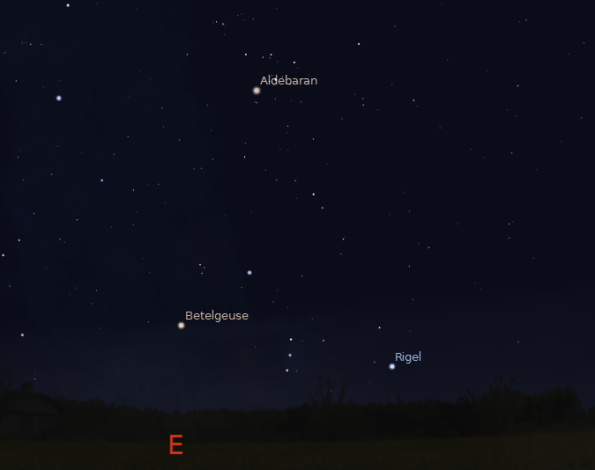
Orion Rising at 8:30 p.m. (3 1/2 hours after sunset) on November 30th. Created using Stellarium.
03/10/2015 – Ephemeris – The Great Orion Nebula
Ephemeris for Tuesday, March 10th. The Sun will rise at 8:04. It’ll be up for 11 hours and 37 minutes, setting at 7:42. The Moon, 3 days before last quarter, will rise at 12:43 tomorrow morning.
The constellation of Orion the hunter, now in the south at 9 p.m., contains the most beautiful star forming region in the northern sky. It is the Great Orion Nebula. A nebula is simply a cloud. Back in the early days of telescopes it was anything that appeared fuzzy. Today it’s any cloud, whether of gas or dust, light or dark. The Great Orion Nebula is made up of gas, which is ionized and shines by fluorescence by the ultraviolet light of a clutch of four stars in its heart called the Trapezium. The nebula can be glimpsed with binoculars surrounding what looks like the center star of the vertical line of three stars that appears as the sword hanging from Orion’s belt. It’s the bright end of a large dark cloud that’s behind the bright stars of Orion.
Times are for the Traverse City/Interlochen area of Michigan. They may be different for your location.
Addendum
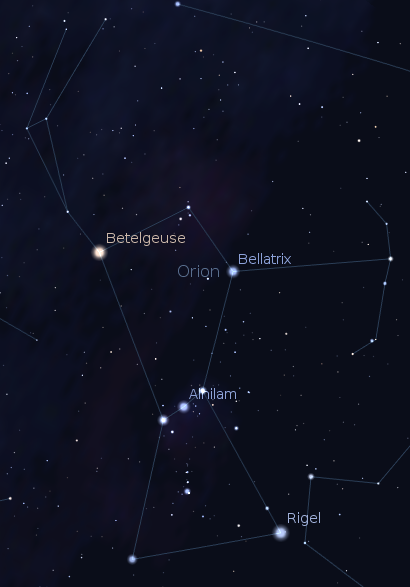
Orion upright and due south. Created using Stellarium.
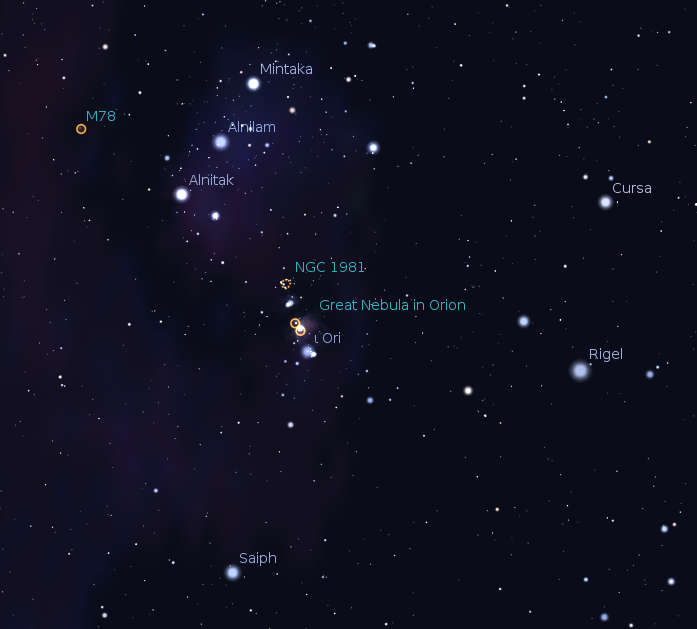
The lower part of Orion with the Great Orion Nebula. Created using Stellarium.
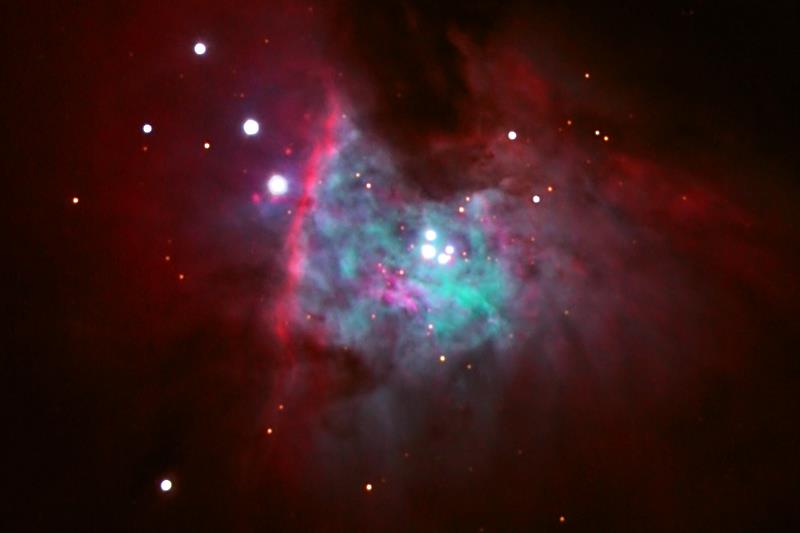
Inner part of the Great Orion Nebula with the Trapezium. Image by Scott Anttila
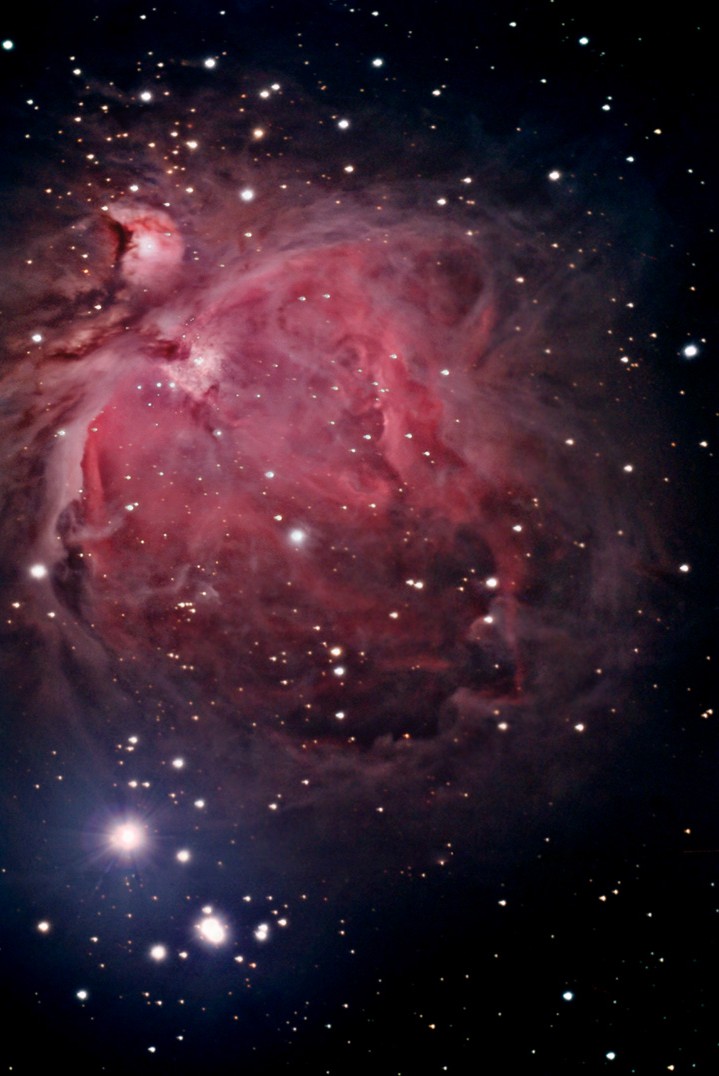
Great Orion Nebula by Scott Anttila
01/16/2015 – Ephemeris – Orion’s greater hunting dog: Canis Major
Ephemeris for Friday, January 16th. The sun will rise at 8:16. It’ll be up for 9 hours and 13 minutes, setting at 5:29. The moon, 3 days past last quarter, will rise at 5:09 tomorrow morning.
The great winter constellation or star group Orion the Hunter, is located in the south-southeastern sky at 9 p.m. His elongated rectangle of a torso is almost vertical. In the center of the rectangle are three stars in a line that make his belt. As a hunter, especially one of old, he has two hunting dogs. The larger, Canis Major can be found by following the three belt stars of Orion down and to the left. There lies the brilliant star called Sirius, also known as the Dog Star. It’s in the heart of a stick figure dog low in the southeast facing Orion that appears to be begging. I’ll have more to say about Sirius on Monday, but there’s a fine star cluster, caller M41, at the 5 o’clock position from Sirius easily visible in binoculars or a small telescope.
Times are for the Traverse City/Interlochen area of Michigan. They may be different for your location.
Addendum
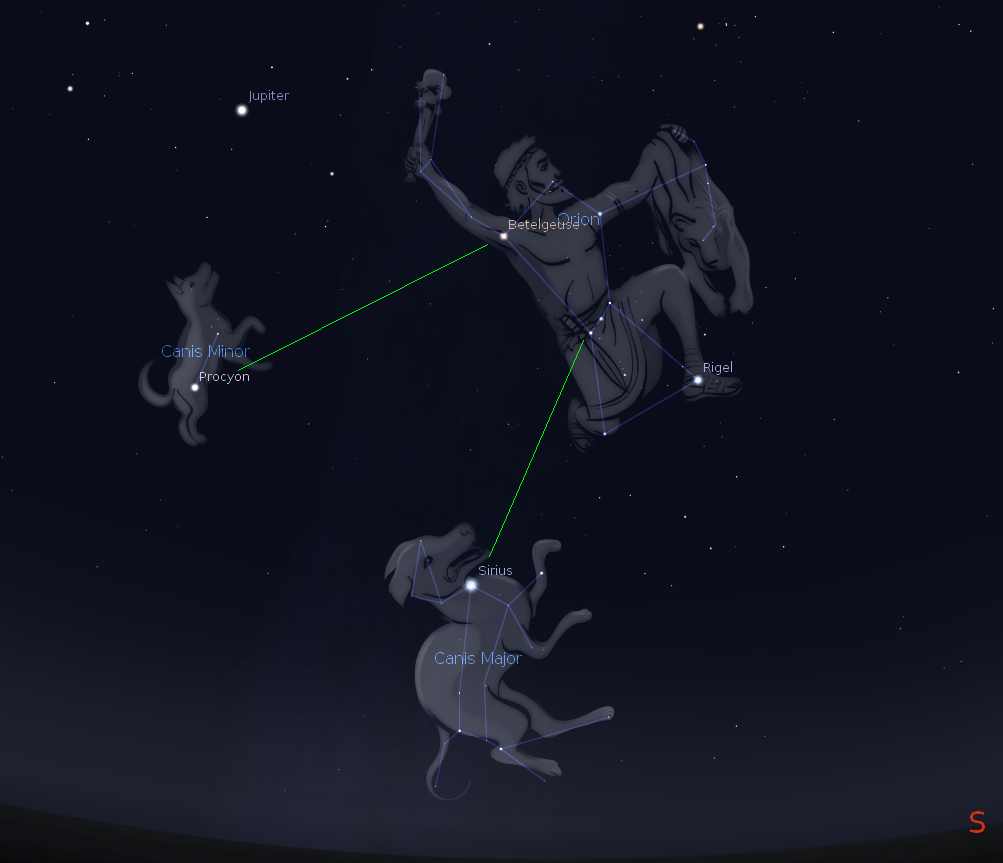
Orion and his hunting dogs with pointers as seen at 9 p.m. in the second half of January. Created using Stellarium.
12/15/2014 – Ephemeris – How to find Orion through the evening
Ephemeris for Monday, December 15th. The sun will rise at 8:12. It’ll be up for 8 hours and 50 minutes, setting at 5:02. The moon, 1 day past last quarter, will rise at 2:15 tomorrow morning.
At 7 p.m. tonight the great central constellation of winter Orion is struggling to rise, with the top half of him in the eastern sky. By 9 p.m. he’s whole and low in the east-southeast. By midnight he has taken his rightful place as the central winter constellation. In the evening now his distinctive belt of three stars in a straight line, by which most folks can find him, is more or less vertical in the sky. His brightest stars are Betelgeuse a red star to the left of the belt and blue-white Rigel to the right. When Orion’s the highest in the south we’ll explore the wonders within this constellation, the most famous constellation world over. Parts of it can be seen at the north and south poles of the Earth. The Big Dipper, which isn’t a real constellation, doesn’t hold a candle to it.
Times are for the Traverse City/Interlochen area of Michigan. They may be different for your location.
Addendum
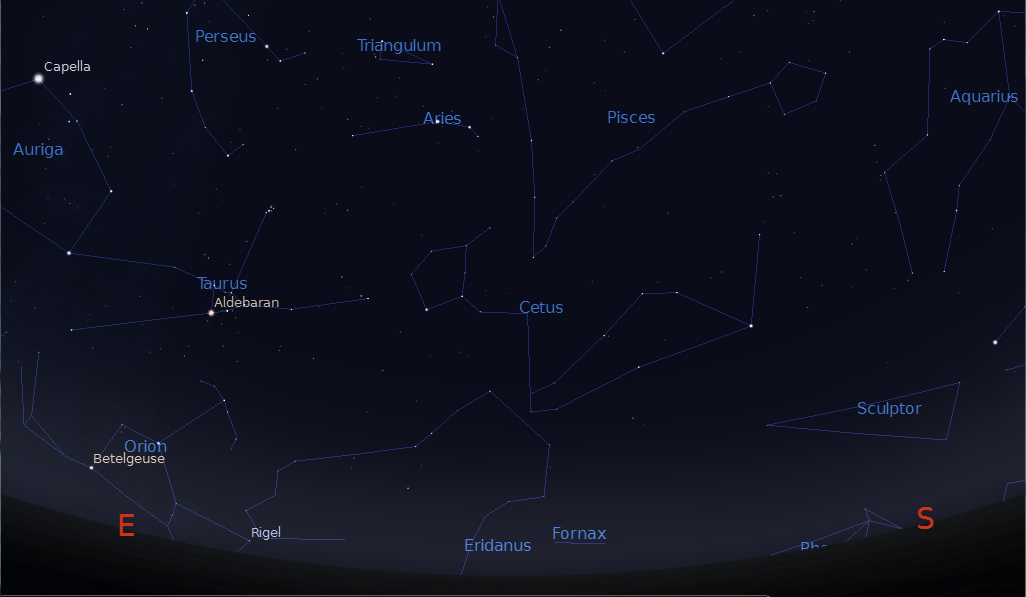
Orion rising at 7 p.m. December 15, 2014. Created using Stellarium.
Orion rising higher at 9 p.m. December 15, 2014. Created using Stellarium.
Orion close to the meridian at 12 midnight, December 16, 2014. There is distortion in this projection. Orion is standing straighter in the real sky than shown here. Created using Stellarium.
11/20/2014 – Ephemeris – Constellation rotation from rise to set
Ephemeris for Thursday, November 20th. The sun will rise at 7:45. It’ll be up for 9 hours and 24 minutes, setting at 5:10. The moon, 2 days before new, will rise at 6:38 tomorrow morning.
At 9 p.m., if it’s clear tonight look to the east to see the bright winter constellation Orion the hunter mostly risen over the eastern horizon as Robert Frost told in his poem Star-Splitter. Orion’s throwing a leg up over the horizon, climbing into the sky. The three stars of Orion’s belt are nearly vertical as the mighty hunter rises. When in the spring he sets those stars will be horizontal. The same is true on the two namesake stars of the twins of Gemini Castor and Pollux to Orion’s left rising in then east-northeast. They rise vertically aligned and set horizontally. It’s due to our latitude and the fact that these stars are near the equator of the sky. At the poles the stars don’t change attitude, and don’t rise or set. Here they flip about 90 degrees, and at the equator they do a 180. Interesting.
Times are for the Traverse City/Interlochen area of Michigan. They may be different for your location.
Addendum
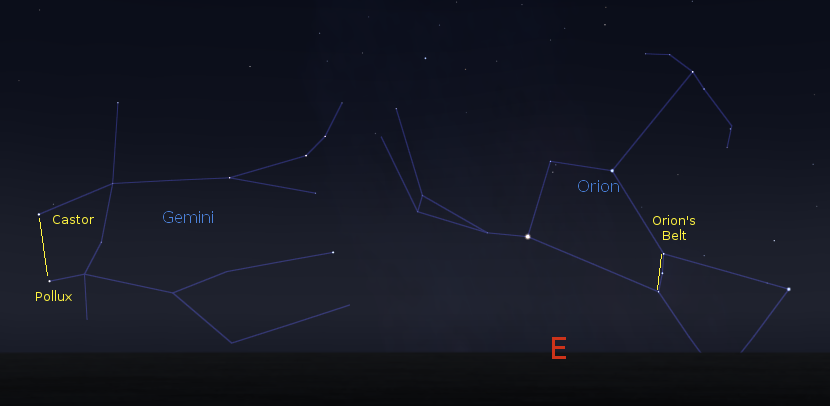
Orion rising at 9 p.m. on November 20, 2014. Note that Orion’s Belt stars and Gemini’s namesake stars are nearly vertically aligned. Created using Stellarium.
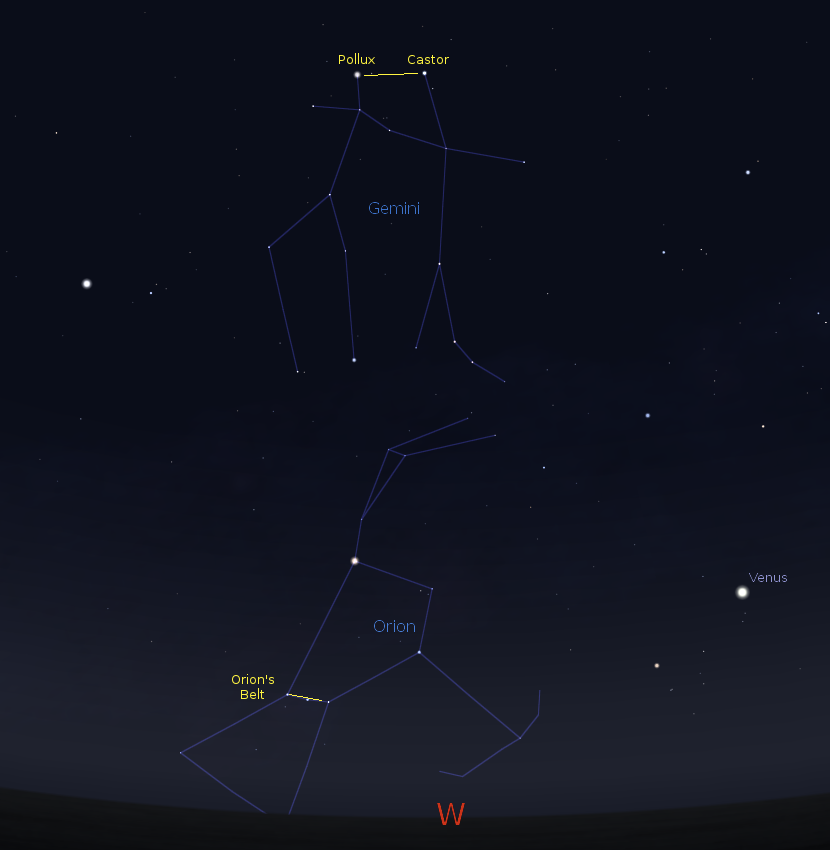
Orion setting near the end of twilight in April 2015. Note that Orion’s Belt stars and Gemini’s namesake stars are now nearly horizontally aligned. Created using Stellarium.
01/11/2013 – Ephemeris – Sirius the Dog Star
Ephemeris for Friday, January 11th. The sun will rise at 8:17. It’ll be up for 9 hours and 6 minutes, setting at 5:23. The moon is new today, and won’t be visible.
The brightest star-like object in the evening sky is Jupiter high in the south around 9 p.m. The second brightest star-like object is Sirius, also known as the Dog Star. It also is the brightest night-time star in our skies period. Tonight at 9 p.m. it’s located low in the south southeastern sky. The Dog Star name comes from its position at the heart of the constellation Canis Major, the great dog of Orion the hunter. The three stars of Orion’s belt tilt to the southeast and point to Sirius. The name Sirius means ‘Dazzling One’, a reference to its great brilliance and twinkling. Its Egyptian name was Sothis, and its appearance in the dawn skies in late June signaled the flooding of the Nile, and the beginning of the Egyptian agricultural year.
Times are for the Traverse City/Interlochen area of Michigan. They may be different for your location.
Addendum
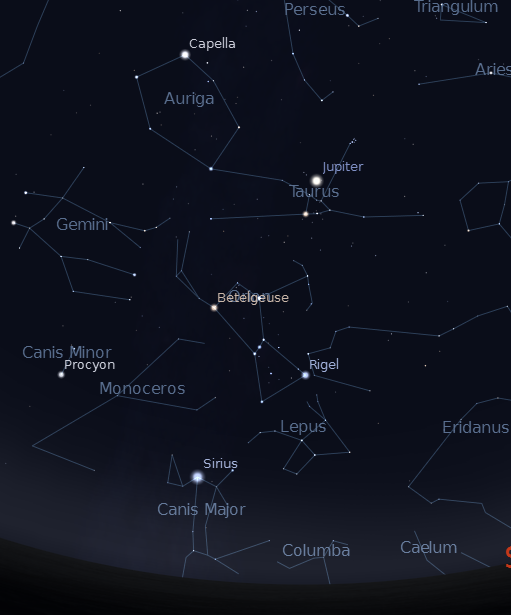
Sirius, Jupiter and the winter stars and constellations at 9 p.m. Created using Stellarium.
01/12/2012 – Ephemeris – Orion’s Belt
Thursday, January 12th. The sun will rise at 8:17. It’ll be up for 9 hours and 6 minutes, setting at 5:24. The moon, 3 days past full, will rise at 9:40 this evening.
Orion’s belt of three stars is one of the most noticeable star groupings in the sky. There are no other group of three bright stars in a straight line visible anywhere else in the sky. The star’s names from left to right are Alnitak, Alnilam and Mintaka. They are actually a bit farther away than the other bright stars of Orion. Alnilam, the center star is over three times the distance of red giant Betelgeuse above them and over twice as far as blue white giant star Rigel below them. Alnilam is 375 thousand times brighter than the sun according to the SIMBAD Astronomical Database. These three stars were also known as Frigga’s Spindle by the Norsemen. Frigga also known as Freya is the goddess we get the name of the day of the week Friday.
* Times, as always are for the Traverse City/Interlochen area of Michigan.
Addendum
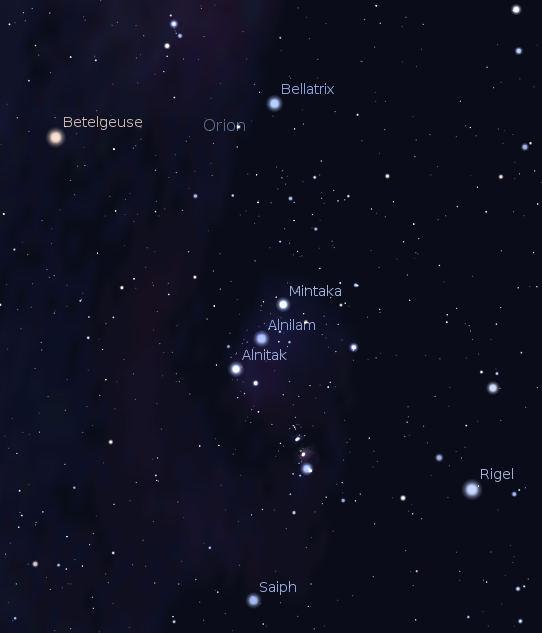
Torso of Orion centered on his belt. Created using Stellarium.
 Bob Moler's Ephemeris Blog