Archive
01/02/2015 – Ephemeris – Telescope Clinic tonight in Traverse City
Ephemeris for Friday, January 2nd. The sun will rise at 8:20, the latest sunrise of the year. It’ll be up for 8 hours and 53 minutes, setting at 5:13. The moon, 2 days before full, will set at 6:38 tomorrow morning.
Did you or someone in your family get a telescope for Christmas, or have one in a closet or attic because you don’t know how to put it together or operate? Or maybe you are trying to figure out which one to buy. Well, tonight’s your night. The Grand Traverse Astronomical Society will host a telescope clinic at Northwestern Michigan College’s Rogers Observatory on Birmley Road, south of Traverse City starting at 8 p.m. Telescope experts from the society will help you set up your telescope and give you observing tips. So bring ’em if you’ve got ’em. If it’s clear, at 9 p.m., there will be a star party to try out your telescope, or try them out on the lights of Traverse City. Can’t make it? We can help you after any meeting.
Times are for the Traverse City/Interlochen area of Michigan. They may be different for your location.
Addenda
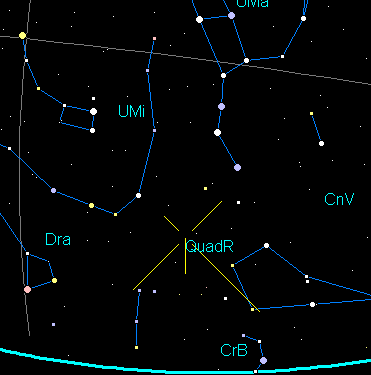
Remember the Quadrantid meteor shower tomorrow evening and into Sunday morning:
The moon will interfere with the meteor shower, so only the brightest will be visible. The radiant will rise from the northeast. The radiant will be nearly overhead at the start of twilight. On a dark night up to 120 meteors per hour may be seen according to the International Meteor Organization.
01/01/2015 – Ephemeris – Happy New Year – a look at January
Ephemeris for New Years Day, Thursday, January 1st. The sun will rise at 8:20. It’ll be up for 8 hours and 52 minutes, setting at 5:12. The moon, 3 days before full, will set at 5:43 tomorrow morning.
Happy New Year. Let’s preview the month of January. We’re a day from the latest sunrise at about the same time as today, 8:20 a.m. and will back down to 8:02 by the 31st. Sunset times are currently increasing by a minute a day from 5:12 p.m. today to 5:49 at month’s end. Listeners near the shore of Lake Michigan will have about the same sunrise time in Ludington, Interlochen/Traverse City, Petoskey and Mackinaw City, but the sunset times will vary markedly. The Quadrantid meteor shower whose radiant is near the end of the Big Dipper’s handle will reach peak on the 3rd, but it will have interference from the full moon,. On the 4th the Earth will be its closest to the sun of the entire year.
Times are for the Traverse City/Interlochen area of Michigan. They may be different for your location.
Addenda
Monthly Star Chart
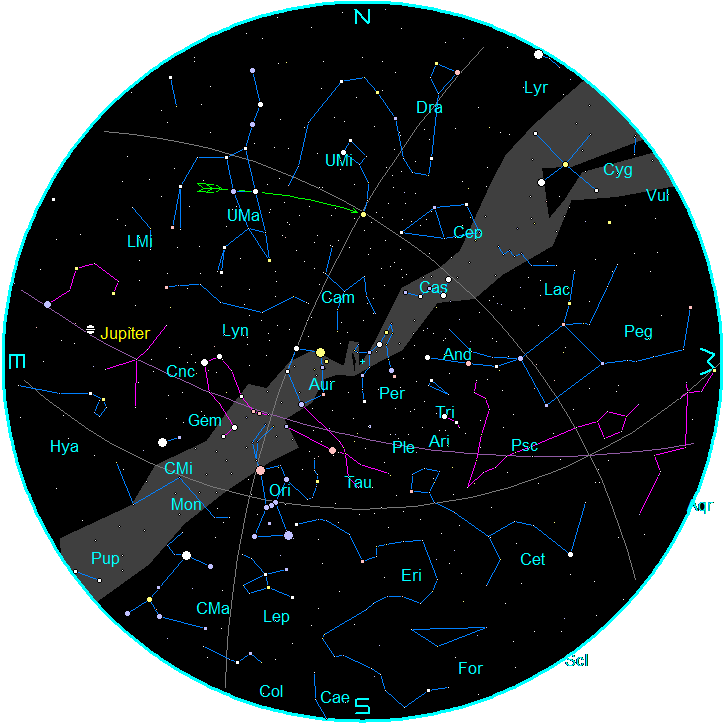
Star Chart for January 2015. Created using my LookingUp program.
The Moon is not plotted. The planets and stars are plotted for the 15th at 9 p.m. That is chart time.
Evening astronomical twilight ends at 6:58 p.m. on January 1st, and increasing to 7:30 p.m. on the 31st.
Morning astronomical twilight starts at 6:34 a.m. on January 1st, and decreasing to 6:22 a.m. on the 31st.
Add a half hour to the chart time every week before the 15th and subtract and hour for every week after the 15th.
For a list of constellation names to go with the abbreviations click here.
The green pointer from the Big Dipper is the pointer stars at the front of the bowl of the Big Dipper that point to Polaris the North Star.
The Quadrantid meteor shower
The moon will interfere with the meteor shower, so only the brightest will be visible. The radiant will rise from the northeast. The radiant will be nearly overhead at the start of twilight. On a dark night up to 120 meteors per hour may be seen according to the International Meteor Organization.
Quadrantid meteor shower radiant at 1:30 a.m.
The Earth at Perihelion
This is the closest the Earth gets to the Sun in its orbit this year. The Sun will be 91,402,000 miles or 147,096,000 kilometers away at around 1 a.m. January 4th, 2015 EST or 6 hr UT January 5th 2015. It makes winter the shortest season because the Earth is moving its fastest during perihelion. It’s only by a few days. And in northern Michigan where it seems that winter overlaps half of fall and spring besides, that few days difference is buried under snow.
Quasi-conjunction between Venus and Mercury on the evening of January 10th.
A quasi-conjunction. Conjunctions occur when two solar system bodies have the same right ascension. Mercury will get to within 0.6 degrees of Venus before retreating back sun-ward.
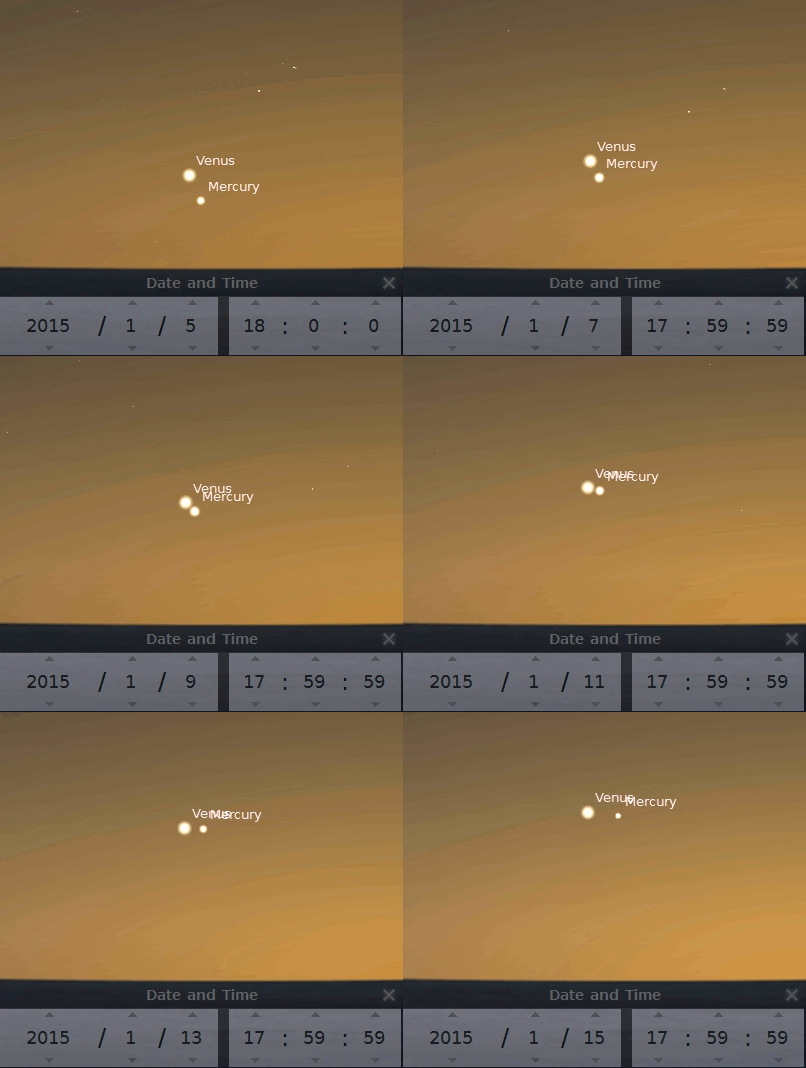
Animation of the Quasi-conjunction of Venus and Mercury. Time span 1/05/2015 to 1/15/2015 at 7 p.m. Created by Bob Moler using Stellarium and GIMP.
Comet C/2014 Q2 (Lovejoy)
Here is a finder chart for 9 p.m. for January. Every other position is marked with the month-day and predicted magnitude. Recently the comet has shown to be brighter than predicted by up to one magnitude. Note that magnitudes in astronomy are like golf scores – the lower the number, the brighter the object. So the comet should reach 4th magnitude.
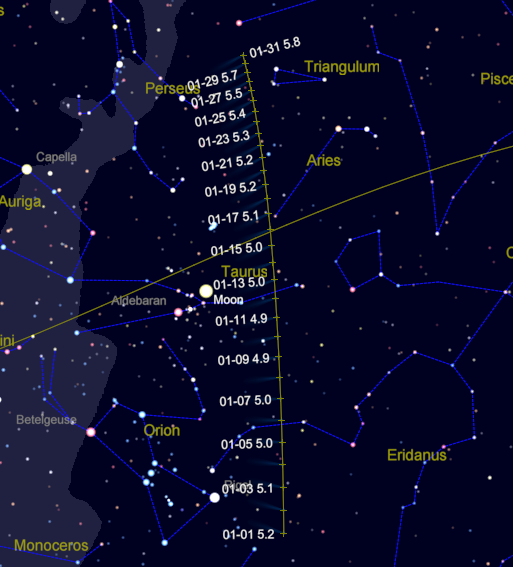
Nightly plot of Comet Lovejoy (C/2014 Q2) for the month of January, 2015 at 9 p.m.
Created using Cartes du Ceil (Sky Charts).
01/03/2014 – Ephemeris – Astronomy events in the Grand Traverse Region tonight.
Ephemeris for Friday, January 3rd. The sun will rise at 8:19. It’ll be up for 8 hours and 55 minutes, setting at 5:14. The moon, 2 days past new, will set at 8:32 this evening.
We have a big night ahead. At 1 a.m. the Earth will be closest to the Sun at perihelion. In the morning hours the Quadrantid meteor shower will reach peak. Before that the Grand Traverse Astronomical Society will hold its monthly meeting at Northwestern Michigan College’s Rogers observatory on Birmley Road south of Traverse City starting at 8 p.m. The program will be given by Richard Kuschell, who will talk about “Aristotle’s Big Mistake”. Afterward, starting at 9 p.m. there will be a star party. If its clear the winter wonders will be visible including the planet Jupiter and the Great Orion Nebula, the closest star nursery to us. The meeting is free to the public. There will be another program given during the star party.
Times are for the Traverse City/Interlochen area of Michigan. They may be different for your location.
Addendum
Quadrantid meteor shower radiant at 1:30 a.m.
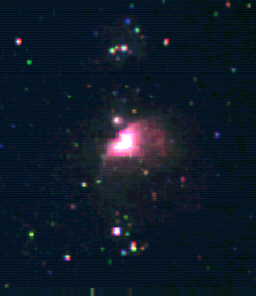
Great Orion Nebula in Orion’s sword. My old photograph. What you’ll see will actually be better than this except our eyes will not perceive the red color. It will look gray or greenish at best.
01/02/2014 – Ephemeris – Quadrantids and the Earth at Perihelion tomorrow night
Ephemeris for Thursday, January 2nd. The sun will rise at 8:19, the latest sunrise of the year. It’ll be up for 8 hours and 54 minutes, setting at 5:14. The moon, 1 day past new, will set at 7:16 this evening. | The Quadrantid meteor shower will be the best meteor shower of the year since the other showers will have to contend with the bright moon. The best time to see them will be between midnight and 6:30 in the morning Friday night through Saturday morning. They will seem to come from behind the Big Dipper’s handle. Weird though it seems. At 1 a.m. Saturday morning the Earth will be closest to the sun in it’s orbit. This is called perihelion. The earth at that instant will be 91.45 million miles away. On July 3rd it will be at its farthest, about 94 and a half million miles away. This slight distance variance doesn’t affect us much except to make winter shorter than summer by a few days. You probably won’t believe that either.
Times are for the Traverse City/Interlochen area of Michigan. They may be different for your location.
Addendum
Quadrantid meteor shower radiant low in the noirtheast at 1:30 a.m.
The Bad Astronomer’s take on perihelion is here.
Also for this and the rest of the year here is David Dickinson’s 101 Astronomical Events for 2014 on Universe Today.
01/01/2013 – Ephemeris – We start the year with the sun closest to us.
Ephemeris for New Years Day, Tuesday, January 1st 2013. The sun will rise at 8:19. It’ll be up for 8 hours and 53 minutes, setting at 5:13. The moon, 3 days before last quarter, will rise at 9:55 this evening.
Happy New Year and happy perihelion Day. What’s a perihelion? Well. It’s not two helions, whatever they are. Perihelion is the point in an orbit of the sun that is nearest to the sun. This evening the earth will reach that point in its travels around the sun. Since its winter time, the sun’s distance apparently doesn’t cause the seasons. Actually the sun now as about a million and a half miles closer than mean, which isn’t much out of 93 million miles. But, although we don’t notice it in northern Michigan, it makes winter the shortest season at 89 days. The real cause of the seasons is the tilt of the earth’s axis. Now the sun appears highest over the southern hemisphere. The sun’s up less than 9 hours here and hangs low over the southern horizon at noon.
Times are for the Traverse City/Interlochen area of Michigan. They may be different for your location.
01/04/2012 – Ephemeris – The planets this week and the earth at perihelion
Wednesday, January 4th. The sun will rise at 8:19. It’ll be up for 8 hours and 56 minutes, setting at 5:15. The moon, 3 days past first quarter, will set at 5:03 tomorrow morning.
It’s the first Wednesday of 2012 and time again to take a look at the whereabouts of the bright planets. The planet Venus is brilliant in the southwestern sky after sunset setting at 8:07. Jupiter is the most prominent planet of the evening sky, once Venus sets. It’s located high in the south and is seen against the stars of the constellation Aries. It will pass due south at 7:41 p.m. It will set at 2:26 a.m.. Mars will rise at 10:52 p.m in the east northeast and is below the hind end of the constellation Leo the lion. It is 92.4 million miles away and closing. Saturn will rise at 2:07 a.m. just to the left of the bright star Spica in the east southeast. The sun is its closest to earth of the entire year today. Only 91.3 million miles away.
* Times, as always are for the Traverse City/Interlochen area of Michigan.
 Bob Moler's Ephemeris Blog