Archive
12/18/2018 – Ephemeris – My observations and what to expect from Comet Wirtanen
Ephemeris for Tuesday, December 18th. The Sun will rise at 8:15. It’ll be up for 8 hours and 48 minutes, setting at 5:03. The Moon, 3 days past first quarter, will set at 4:23 tomorrow morning.
This past weekend the skies finally cleared so I could see and photograph Comet Wirtanen at its brightest and closest to the Earth. The Moon was interfering and will be making the sky brighter until this next weekend. Also the Moon will be moving toward the comet, coming closest to it on the 20th. The comet is rapidly moving away from the Earth, so its brightness is dropping as the skies brighten. Last weekend I could not say that I saw it with the naked eye. It was visible in my 10X50 binoculars as a faint smudge. The comet had no discernible tail. Even though it’s living up to its magnitude estimates, the problem is that the comet’s brightness is spread over a large area, making its surface brightness so much less than a star of the same magnitude.
The times given are for the Traverse City/Interlochen area of Michigan. They may be different for your location.
Addendum
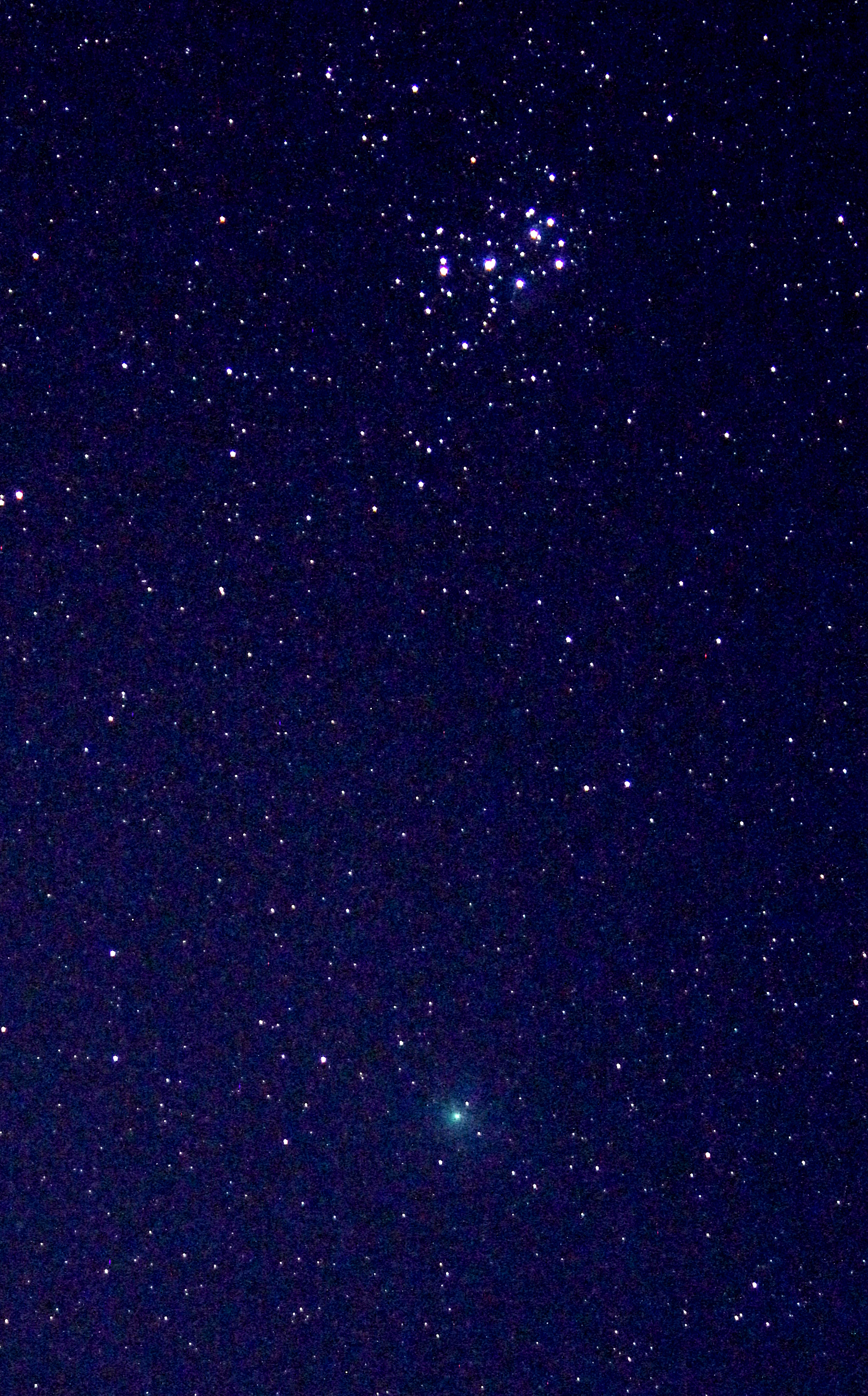
Comet Wirtanen below and the Pleiades above at 9:24 p.m. EST, December 14, 2018. Canon EOS Rebel T5, f/5.5, 30 second., ISO 3200, fl 55mm, tracking. I processed this image with GIMP. increasing the contrast and removing some of the moonlight. The greenish coma (head) is due to carbon (C2) emissions common in comets.
For more comet photographs go to http://spaceweather.com/.
12/14/2018 – Ephemeris – Bright Comet Wirtanen will be easy to find this weekend
Ephemeris for Friday, December 14th. The Sun will rise at 8:12. It’ll be up for 8 hours and 50 minutes, setting at 5:02. The Moon, 1 day before first quarter, will set at 12:06 tomorrow morning.
This weekend is the best time to spot Comet Wirtanen. Not only is near its brightest, but it will be passing just to the left of the beautiful star cluster the Pleiades from below. Comet Wirtanen will appear as a fuzzy spot, possibly to the naked eye, but is best seen in binoculars. The near first quarter Moon will be a bother, and make the comet harder to spot. On the 12th the comet passed its closest to the Sun, called perihelion, about 4.6 million miles outside the Earth’s orbit. On the 16th, Sunday, it will pass closest to the Earth at 7.2 million miles, as the 10th closest comet passage in modern times. Wirtanen is a member of the Jupiter family of comets captured by and orbit maintained by the planet Jupiter.
The times given are for the Traverse City/Interlochen area of Michigan. They may be different for your location.
Addendum
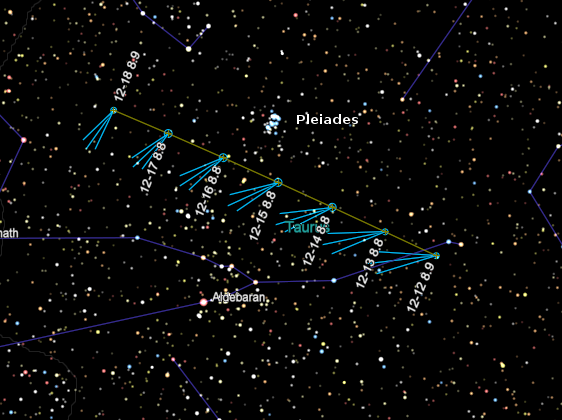
Comet 46P/Wirtanen positions for the next week. Positions are marked with month-date and magnitude. The latest magnitude prediction for December 15th is 3.3, 5.5 magnitudes brighter than shown here. Star field position is for 9 p.m. on the 12th. Click on the image to enlarge. Created using Cartes du Ciel (Sky Charts).
11/27/2018 – Ephemeris – The beautiful Pleiades or Seven Sisters
Ephemeris for Tuesday, November 27th. The Sun will rise at 7:55. It’ll be up for 9 hours and 10 minutes, setting at 5:05. The Moon, 2 days before last quarter, will rise at 9:52 this evening.
While I’ve mentioned the Pleiades with regard to its neighboring constellations several times this autumn I haven’t looked at this beautiful star cluster itself. The Pleiades appears as a group of six or seven stars visible to the naked eye, out of over a hundred stars, and is also known as the Seven Sisters. Some also mistake it for the Little Dipper, due to the little bowl shape in the center of the cluster. I call it the “tiny dipper”. The real Little Dipper is now hanging off Polaris in the north. There are a lot of stories about the Pleiades from many different cultures. From the Greek and Roman cultures we get our best known stories of them, that the seven sisters were the daughters of the god Atlas and Pleione. The 9 brightest stars bear the names of the sisters and their parents.
The times given are for the Traverse City/Interlochen area of Michigan. They may be different for your location.
Addendum
10/29/2018 – Ephemeris – Perseus the hero
Ephemeris for Monday, October 29th. The Sun will rise at 8:16. It’ll be up for 10 hours and 18 minutes, setting at 6:35. The Moon, 2 days before last quarter, will rise at 10:48 this evening.
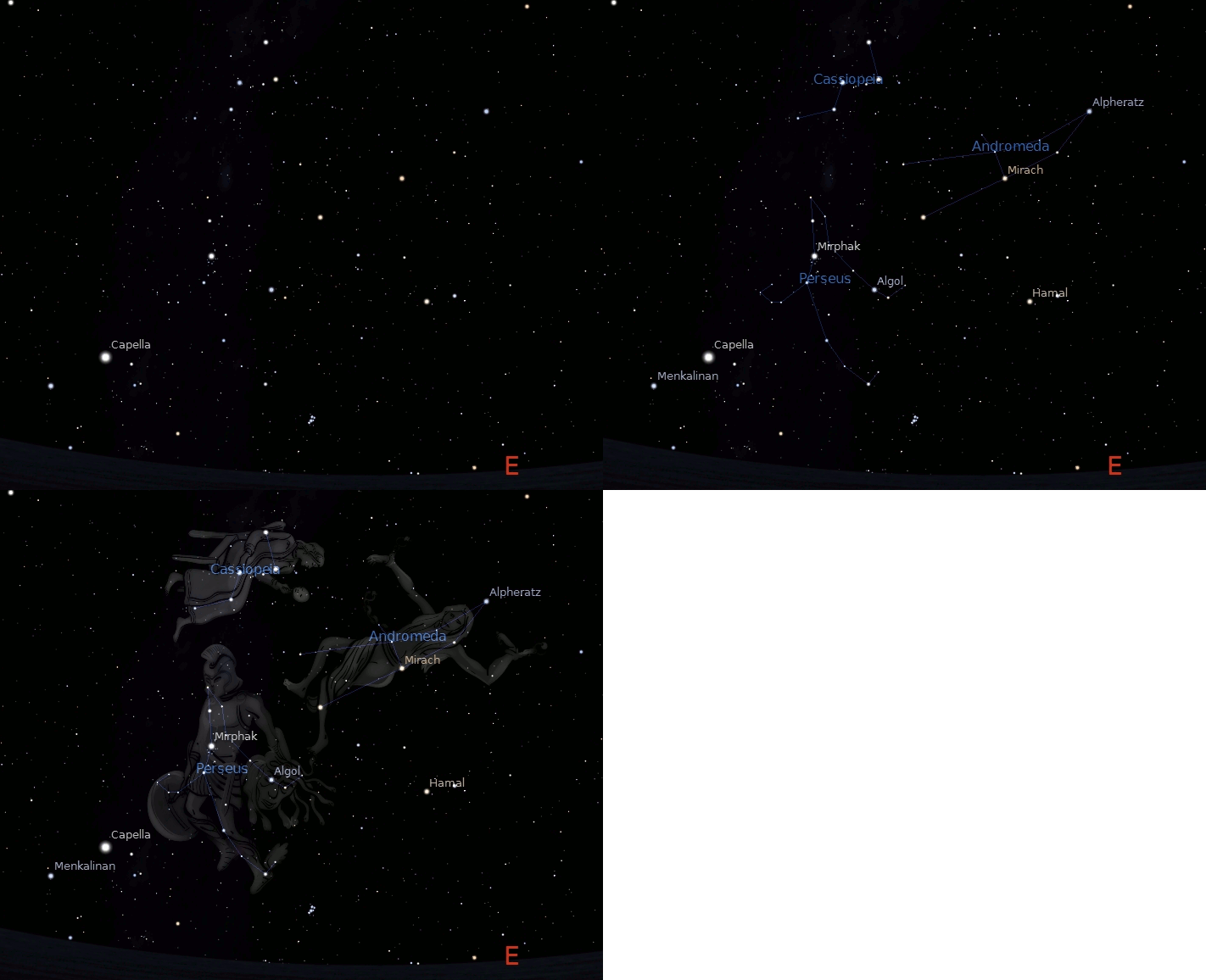
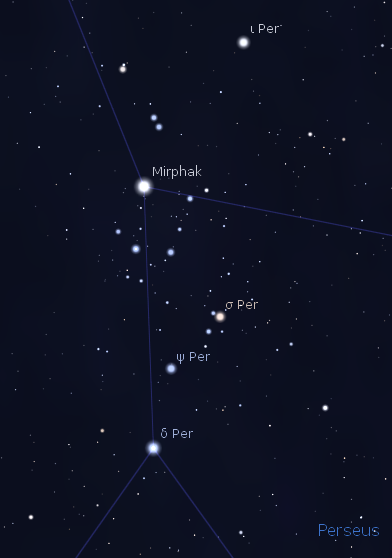
bout a third the way from the east northeastern horizon to the zenith at 9 p.m. and below the letter W shaped constellation of Cassiopeia the queen is Perseus the hero. It’s kind of a odd shape for a hero, To me it looks like the cartoon roadrunner. To those who’s imagination doesn’t run to cartoons, its shape is also like the Greek letter pi. It’s two brightest stars are Mirfak and Algol the demon star. Look at the area around Mirfak with binoculars and you will see a large group of stars just below naked eye visibility. It’s called the Alpha Persei association. That because Mirfak is Alpha Persei. The group is about 560 light years away, which means, though close, are farther away than the Pleiades, below and right of them.
The times given are for the Traverse City/Interlochen area of Michigan. They may be different for your location.
Addendum
04/24/2018 – Ephemeris – Venus will be south of the Pleiades tonight
Ephemeris for Tuesday, April 24th. The Sun rises at 6:43. It’ll be up for 13 hours and 55 minutes, setting at 8:39. The Moon, 2 days past first quarter, will set at 4:51 tomorrow morning.
Tonight the brilliant planet Venus will be just south of the Pleiades, also known as the Seven Sisters star cluster. From our cockeyed position on the Earth about half way from the equator and the North Pole. The sky in the east and west, low in the sky, is tilted about the same angle, namely about 45 degrees. If you’re listening to this program from other than Northern Michigan the angle will be the same as your latitude. So instead of south being down, as one would expect when looking to the south, south is to the lower left when looking to the west. On this program Thursday, Friday and Monday I’ll be talking about Venus and what the ancients found out about the planet in the days before the telescope was invented.
The times given are for the Traverse City/Interlochen area of Michigan. They may be different for your location.
Addendum
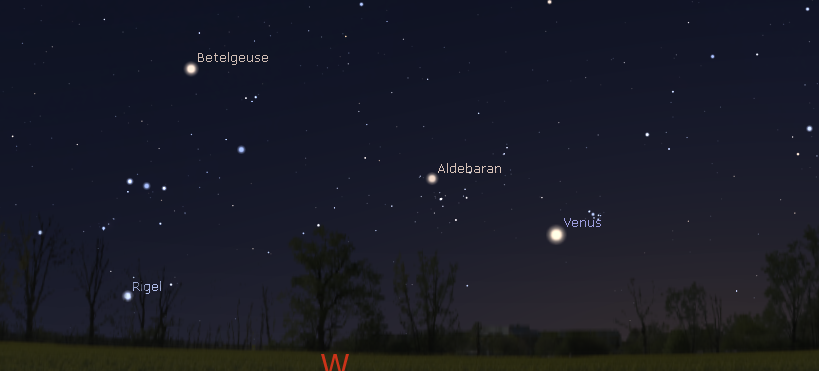
Venus, Pleiades, Aldebaran with the Hyades star cluster and Orion are seen in the west at 9:45 p.m. April 24, 2018. Venus is south of the Pleiades. Created using Stellarium.
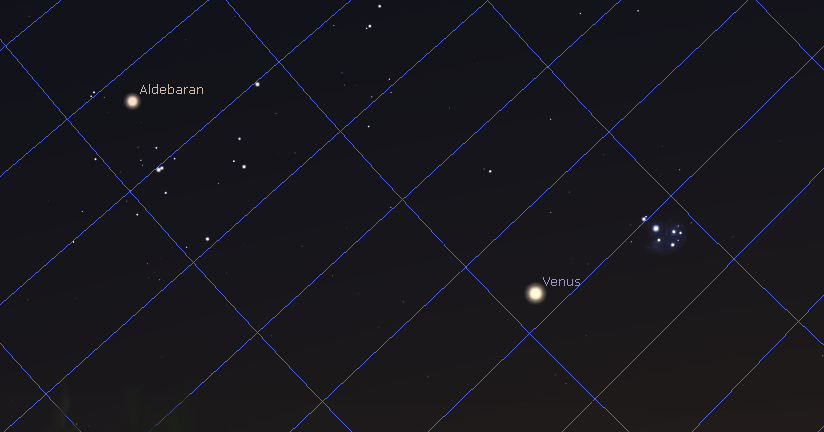
A closer look at Venus and the Pleiades with the coordinate grid added. The lines that run from upper right to lower left are lines of right ascension, analogous to longitude lines on the Earth. To the upper right is north and lower left is south. The other lines are those of declination. Like latitude lines on the Earth, they run east and west. Created using Stellarium.
01/08/2018 – Ephemeris – The Pleiades in Greek myth
Ephemeris for Monday, January 8th. The Sun will rise at 8:19. It’ll be up for 9 hours and 1 minute, setting at 5:20. The Moon, at last quarter today, will rise at 1:17 tomorrow morning.
The large and bright constellation of Orion is now in the southeast at 9 p.m. It is seen as an upright rectangle of bright stars, with a belt of three stars in the center. Orion is a minor character in Greek mythology. Orion was the son of Neptune, and was a hunter. He had an ill-fated romance with Merope, whose father King Oenopion, had him blinded. After having his sight restored, Orion became a companion of Diana goddess of the hunt and they wanted to marry. Apollo, Diana’s brother disapproved of Orion also and was able to trick Diana into accidentally killing Orion with an arrow. The heart-broken Diana then placed Orion in the sky with his hunting dogs, were we see him to this day.
The times given are for the Traverse City/Interlochen area of Michigan. They may be different for your location.
Addendum
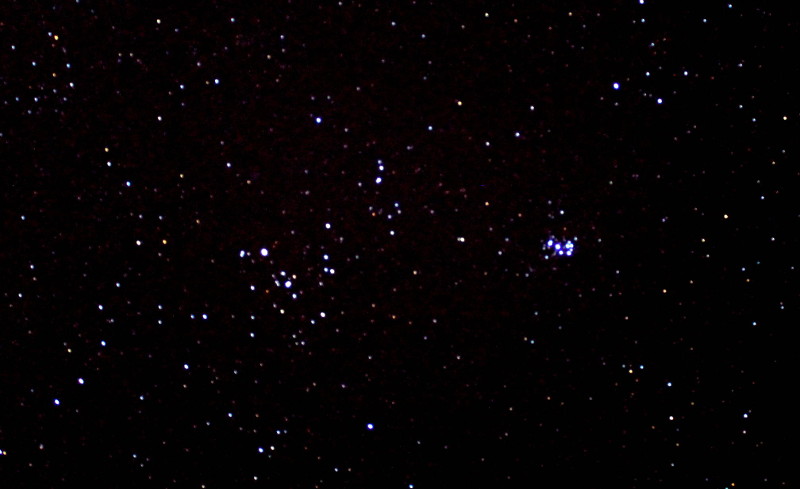
The Pleiades (right) and the Hyades (left) in this photograph I took January 4, 2016.
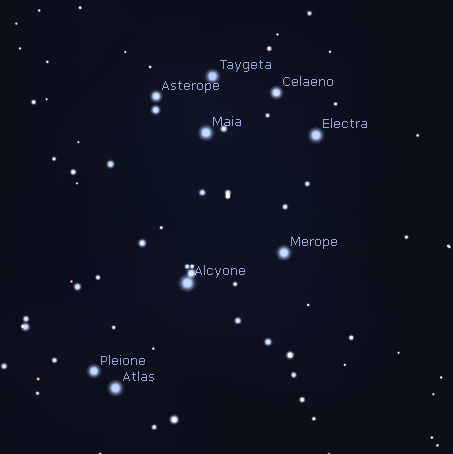
The named stars of the Pleiades. This is also showing more stars than can be seen with the naked eye. This is the number of stars that can be seen in binoculars, which is the best way to observe them. Most telescopes are offer too much magnification to fit all the stars in. A thirty power wide-angle eyepiece can just fit all the stars in. Created using Stellarium.
12/15/2017 – Ephemeris – Taurus, Bullish on Winter
Note: The title of this post I’ve taken from an article I wrote for the December 1999 issue of the Stellar Sentinel, the monthly newsletter of the Grand Traverse Astronomical Society, which I will reprint with some tweaks, as the addendum to this post. Winter will arrive in six days, though I’m not particularly bullish on it, but it fits the constellation I’m talking about today.
Ephemeris for Friday, December 15th. The Sun will rise at 8:12. It’ll be up for 8 hours and 50 minutes, setting at 5:02. The Moon, 3 days before new, will rise at 6:25 tomorrow morning.
Low in the east-southeast at 9 p.m. is the constellation of Orion the giant hunter. Above him is Taurus the bull. His face is a letter V shape of stars lying on its side with the bright orange-red star Aldebaran at the bottom tip of the V as its angry blood-shot eye. Orion is depicted in the sky facing him with club in one hand and a shield in the other the approaching and in some depictions charging Taurus. The V of stars is a star cluster called the Hyades. The Pleiades are in his shoulder above. Taurus, in Greek mythology, was the guise the god Zeus when he carried off the maiden Europa. Europa’s still with him, sort of, as the intriguing satellite with a buried ocean orbiting Zeus’ Roman equivalent the planet Jupiter.
The times given are for the Traverse City/Interlochen area of Michigan. They may be different for your location.
Addendum

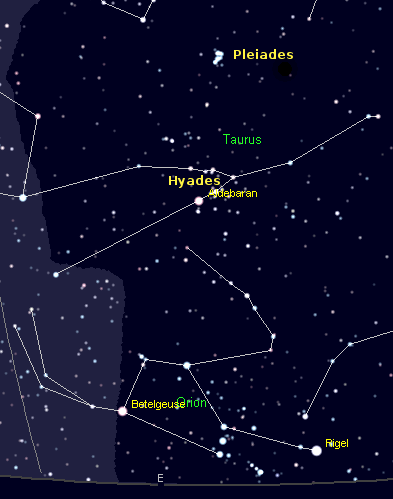
Three views of Taurus the bull and Orion the hunter for about p.m. in December.
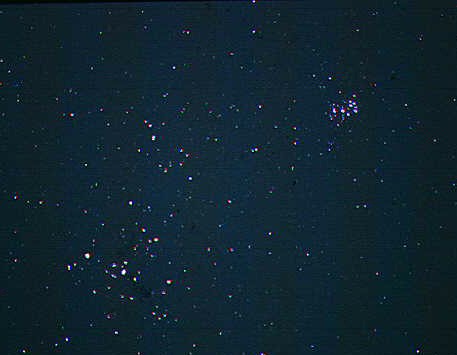
The Hyades (lower left) and the Pleiades (upper right). My photograph from many years ago BD (Before Digital).
The first constellation of winter to appear is probably a toss-up between Auriga the charioteer and Taurus the Bull. Auriga never quite disappears, or at least Capella its brightest star is circumpolar and never quite sets here in Northern Michigan. But Auriga sneaks up slowly in the northeast. Taurus on the other hand makes a grand entrance on autumn evenings preceded by the Pleiades, the Seven Sisters star cluster.
Taurus’ brightest star is Aldebaran, the bull’s angry bloodshot eye. It is at the left tip of a letter V of stars that is the bull’s face. Above the V are single stars that form the tips of its very long horns. Other stars below form the front legs of this beast. That’s it. Only the front part of the bull appears in the sky. In its shoulder are the Pleiades.
According to Greek mythology Taurus represents the god Zeus, the Roman Jupiter, who, in the disguise of a bull abducted the beautiful maiden Europa. This isn’t the only celestial disguise of Zeus. Cygnus is the disguise of Zeus in the famous Leda and the swan affair.
The Pleiades and the Hyades, the V-shaped star cluster of Taurus’ head also have their places in Greek Mythology. The Hyades and Pleiades are half sisters of each other who share Atlas as their father. But it is the Pleiades which are more prominent and have more stories about them. It is the Pleiades that are pursued by Orion the hunter, the central constellation of winter. And since the Pleiades are west of Orion it does appear that Orion continues to chase them around and around the sky daily. To the Kiowa Indians the Pleiades were also young maidens. As the story goes they were being chased by a large bear. The Great Spirit placed them on what we know today as Devil’s Tower in Wyoming to keep them out of reach of the bear. It is said that even today the sides of this tower show the scars of the bear’s claws. Devil’s Tower was the prominent landmark in the movie Close Encounters of the Third Kind. To the Anishinaabek native peoples around here the Pleiades is the “Hole in the Sky” or the seven sweating stones that are heated for the sweat lodge ceremony.
What do we know about Taurus today? Aldebaran is an orangish giant star which lies at a distance of 65 light years. It doesn’t belong to the Hyades, which is about 151 light years away. Aldebaran’s diameter is 40 times the Sun’s, about the diameter as the orbit of Mercury. It’s only 1.7 times tha mass of the Sun. Aldebaran shines at 153 times the Sun’s output.
Aldebaran appears to be part of the Hyades cluster, but it is less than half the distance to this most important star cluster. Though less prominent as the Pleiades, the Hyades is the most important star cluster in the heavens. The reason is because the Hyades was until recently the only star cluster close enough to get an accurate distance measurement by direct means. That direct means is parallax, measuring the shift of the star’s position in the sky due to the earth’s changing position in orbit of the Sun. The Hipparcos satellite has been refining these parallaxes over the past few years. Its measurement of the distance of the Hyades cluster is 151 light years give or take a bit less than a light year. The Hyades distance is the basis for all more distant measurements to the ends of the known universe.
The Hyades is a good binocular object with over 100 stars visible. The cluster actually overflows the binocular’s field of view. This cluster is also known as the Taurus Moving Cluster because its stars are receding towards a point northeast of Orion’s Betelgeuse.
Of course the splashiest part of Taurus is the Pleiades. For people with good vision 6 or more stars can be seen. I can see 4 or 5 stars and fuzz, which are unresolved stars. Many, who see the Pleiades for the first time, think the tiny pattern of stars is the Little Dipper. The stars do indeed look like a tiny dipper, with a nice bowl and a sawed off handle. And that’s what I call it: the Tiny Dipper. The big surprise of the Hipparcos distance measurements is the distance of the Pleiades. The generally accepted distance was about 410 light years. Hipparcos measured 375 light years. This means that the stars of the Pleiades are somewhat dimmer than believed before. Pleiades prior measurement was based on photometric or brightness measurements with the stars of the Hyades and other stars of the same type and known brightness and distance. So it turns out in the case of the Pleiades that the former measurements weren’t as accurate as thought, and means we have more to understand about stellar evolution as it relates to star brightness. Or perhaps Hipparcos is wrong. And interesting debate and more measurements are sure to follow.
The age of the Pleiades is thought to be around 100 million years, young compared to the Sun’s 4.6 billion years. Long exposure photographs and some telescopes can still spot the remaining wisp’s of the nebulae they were born from. The material is probably dust simply reflecting the light of the stars in the cluster.
Taurus is a great constellation to scan with a pair of binoculars.
11/10/2017 – Ephemeris – The North Taurid Meteors are reaching peak this weekend
Ephemeris for Friday, November 10th. The Sun will rise at 7:32. It’ll be up for 9 hours and 46 minutes, setting at 5:19. The Moon, at last quarter today, will rise at 12:07 tomorrow morning.
One of the little known meteor showers for most of us are the North and South Taurid meteor showers. The shower that will reach peak this weekend is the North Taurids. They may show only 5 an hour when their radiants are overhead, but they are reported to be very bright. The radiant, the place where the meteors will appear to come from is just south of the Pleiades, will be up just about all night. Saturday night the Moon will rise at 1:15 a.m. Sunday night it will rise at 2:21 a.m. Both Taurid meteor showers are thought to be related to Encke’s Comet, the periodic comet with a period of only 3.3 years, the shortest known. A posting on Space.com about this years shower talked about the possibility that one of these meteorites might reach the ground.
Space.com has an excellent article about the Taurid meteor showers: https://www.space.com/34587-taurid-meteor-shower-guide.html
The times given are for the Traverse City/Interlochen area of Michigan. They may be different for your location.
Addendum
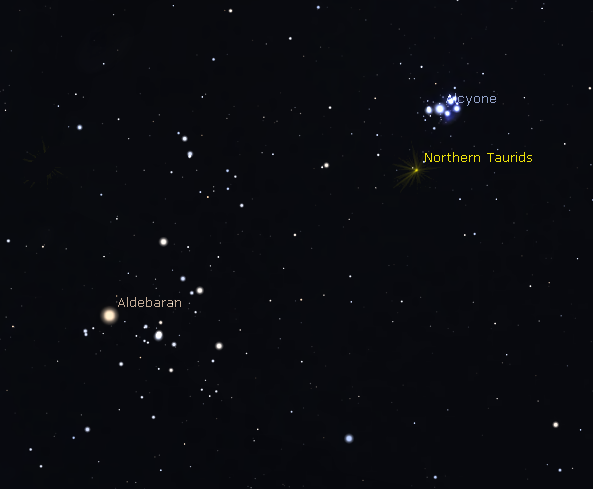
Northern Taurid meteor radiant near the Pleiades in Taurus the bull. Note the face of Taurus, the letter V or stars and Aldebaran. The stars in the face without Aldebaran is a star cluster called the Hyades. Created using Stellarium.
11/06/2017 – Ephemeris – Taurus’ angry red eye, Aldebaran
Ephemeris for Monday, November 6th. The Sun will rise at 7:27. It’ll be up for 9 hours and 57 minutes, setting at 5:24. The Moon, 3 days past full, will rise at 7:52 this evening.
Last night the Moon passed in front of or occulted the bright star Aldebaran. Above right of Moon tonight is Aldebaran the bright orange star with a V shape of other stars in the face of Taurus the bull. Aldebaran appears at the lower left tip of that letter V laying on it’s side. With the bright Moon, it might take binoculars to pull out the faint stars of the V. Aldebaran isn’t actually part of the group, called the Hyades star cluster. The cluster is about 153 light years away, while Aldebaran is 65 light years away. The star has an orange hue because its surface is cooler than the Sun’s. However Aldebaran is 44 times larger in diameter, and shines 425 times brighter than the Sun. The name Aldebaran means “Follower” because it follows the Pleiades star cluster above it.
The times given are for the Traverse City/Interlochen area of Michigan. They may be different for your location.
Addendum
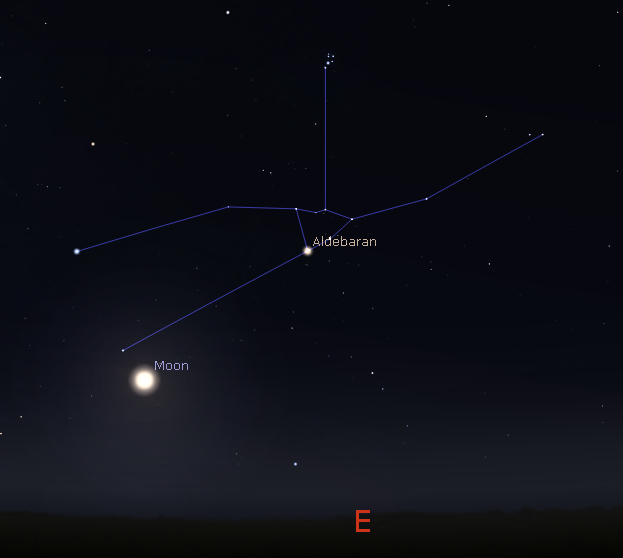
Aldebaran in the Hyades (unlabeled), with also the Pleiades, unlabeled, at the top and the Moon. at 9 p.m., November 6, 2017. Created using Stellarium.
07/04/2017 – Ephemeris – Happy birthday America! Tomorrow morning Venus will appear near the Pleiades
Ephemeris for Independence Day, Tuesday, July 4th. Today the Sun will be up for 15 hours and 27 minutes, setting at 9:30, and it will rise tomorrow at 6:03. The Moon, 4 days past first quarter, will set at 3:46 tomorrow morning.
This is the 241st anniversary of the signing of the Declaration of Independence. Venus is our morning star now, and back in 1776 it too was a morning planet, but a lot closer to the rising Sun, and harder to spot.
Tonight Venus will pass south of the famous Pleiades star cluster, so that tomorrow morning at about 4:30 it will be dark enough to see the Pleiades above and left of our brilliant Morning Star.
Planets to us appear as stars to the naked eye due to their distance, though they are close enough to appear as disks in small telescopes. Very few of the largest telescopes can ever see the disk of a star, other than the Sun,, and only if that star is really huge, like Betelgeuse in the winter constellation of Orion.
The times given are for the Traverse City/Interlochen area of Michigan. They may be different for your location.
Addendum
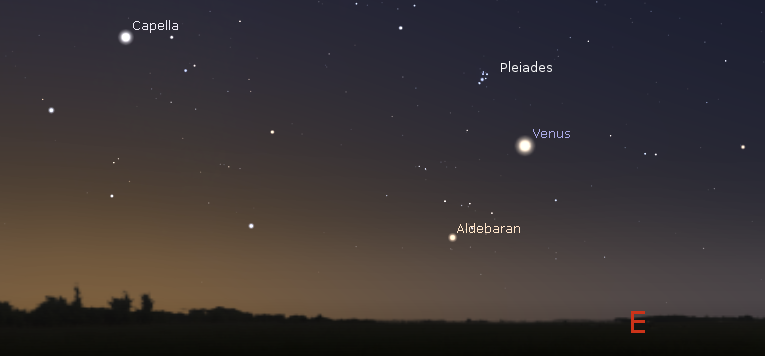
The eastern sky at 5 a.m. July 5, 2017 with the Pleiades above and left of Venus. Created using Stellarium.
We’ll be seeing the Pleiades in the evening sky in four months when summer is a memory.
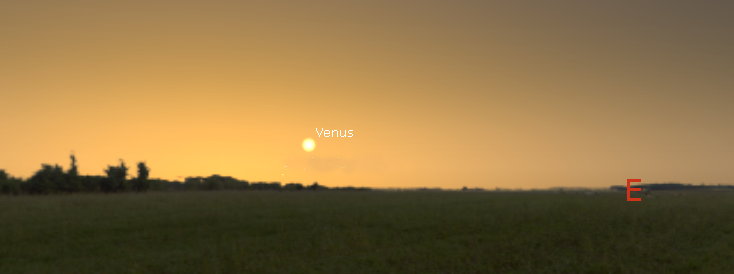
The morning sky to the east and Venus about 20 minutes before sunrise that auspicious morning July 4, 1776 from Philadelphia. Created using Stellarium.
Excuse the fact that the landscape is the same in both images.
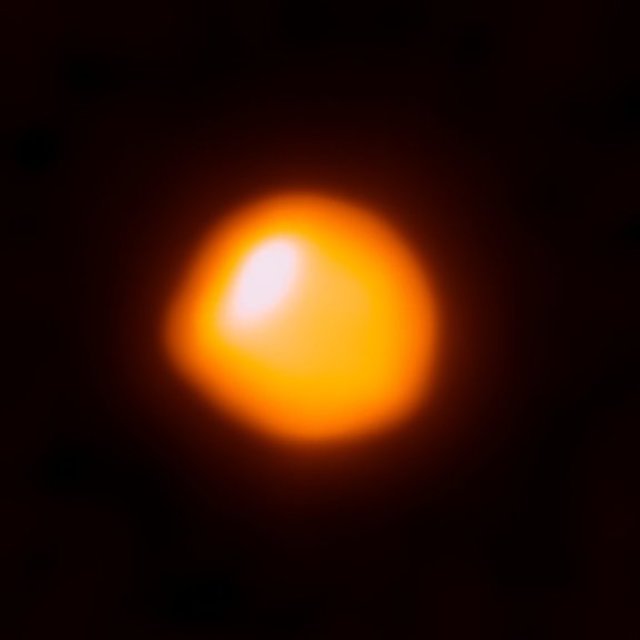
This is the disk of the star Betelgeuse in Orion. It is not an image from an optical telescope of an image created in submillimeter microwaves by the Atacama Large Millimeter/submillimeter Array (ALMA) in Chile. Credit: ALMA (ESO/NAOJ/NRAO)/E. O’Gorman/P. Kervella.
Betelgeuse, though it is 600 light years away has a radius of slightly more than the orbit of Jupiter. The bump on the left side of the image may be a plume of gas erupting from the star.
 Bob Moler's Ephemeris Blog