Archive
04/21/2015 – Ephemeris – The Moon will pass the Hyades star cluster today to pass near Venus tonight
Apr 21. This is Bob Moler with Ephemeris for Tuesday, April 21st. Today the Sun will be up for 13 hours and 46 minutes, setting at 8:35. The Moon, 3 days past new, will set at midnight. Tomorrow the Sun will rise at 6:47.
The moon, which was new last Saturday passed the face of the constellation Taurus the bull earlier today. The face of Taurus is a letter V shape of stars which is the star cluster called the Hyades. There’s a bright orange star that appears at the left tip of the V called Aldebaran, which actually doesn’t belong to the cluster. At 9:30 the crescent Moon will have also just passed the brilliant planet Venus. By then they will be nearly 8 degrees apart, which is a bit less than the width of a fist held at arm’s length. The Moon, Venus and all the planets move very close along the path of the Sun in the sky, called the ecliptic. Even so the Moon is now about 5 degrees south of the ecliptic and Venus about 2 degrees north of it.
Times are for the Traverse City/Interlochen area of Michigan. They may be different for your location.
Addendum
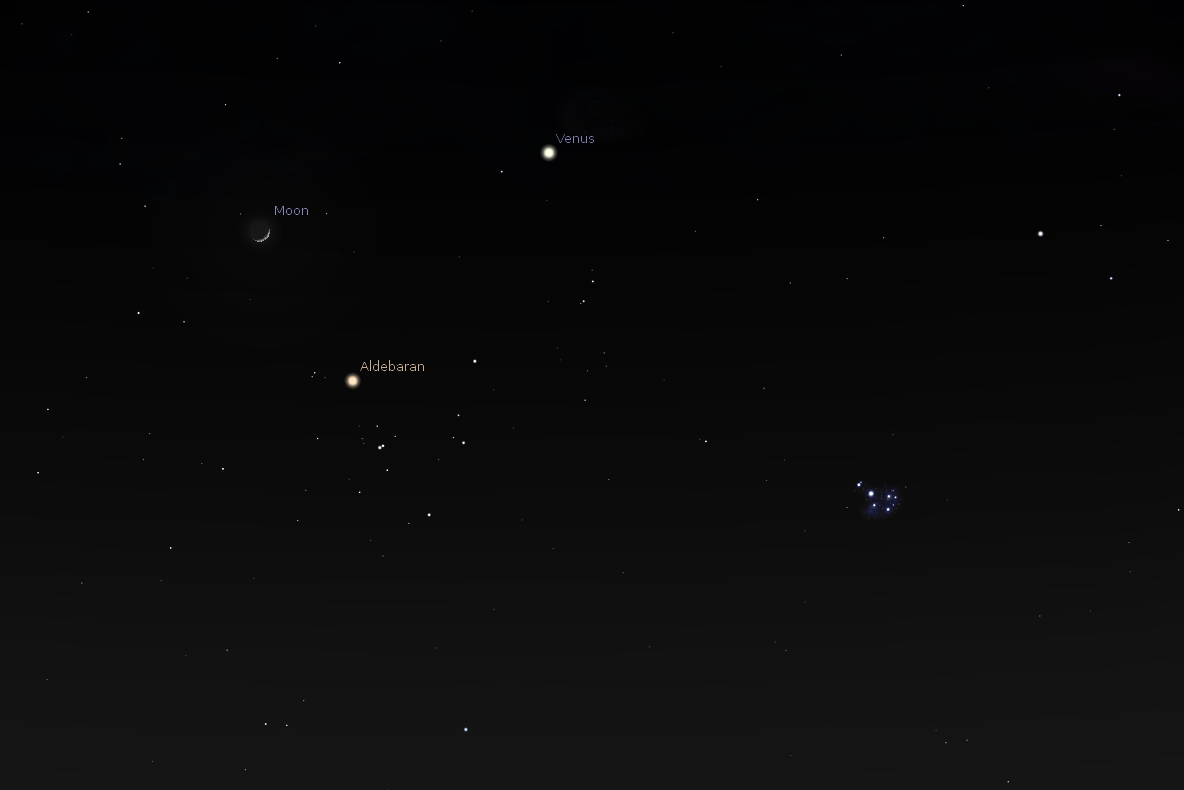
The Moon with Venus and the Hyades at 9:30 p.m. April 21, 2015. Note the Pleiades on the right. Created using Stellarium.
04/10/2015 – Ephemeris – Venus will pass the Pleiades tomorrow evening
Ephemeris for Friday, April 10th. The Sun will rise at 7:07. It’ll be up for 13 hours and 13 minutes, setting at 8:21. The Moon, 1 day before last quarter, will rise at 2:22 tomorrow morning.
Tomorrow evening, that’s Saturday the 11th, Venus will pass the Pleiades. Venus will appear below and left of that famous Seven Sisters star cluster by about 5 moon widths, or about a quarter of the width of your fist held at arm’s length. Venus is moving rapidly eastward against the stars and will be approaching Jupiter for the next two and a half months. It will catch up with Jupiter and on June 30th it will be only half of a degree away, the width of the full moon. Jupiter look really bright when seen away from Venus, but to compare them close together, Jupiter can’t hold a candle to Venus. This also the part of the sky, in Leo that one of the planetary events between these two planets occurred that could have been part of the Star of Bethlehem.
Times are for the Traverse City/Interlochen area of Michigan. They may be different for your location.
Addendum
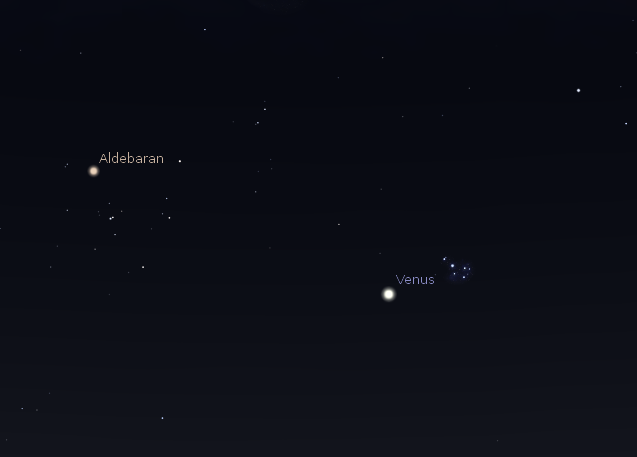
Venus passing the Pleiades at 10 p.m. on April 10, 2015. The Hyades, head of the constellation Taurus the bull, is to the left. Created using Stellarium.
10/28/2014 – Ephemeris – The Pleiades Distance Controversy
Ephemeris for Tuesday, October 28th. The sun will rise at 8:14. It’ll be up for 10 hours and 22 minutes, setting at 6:37. The moon, 2 days before first quarter, will set at 10:37 this evening.
Yesterday we looked at the Pleiades or Seven Sisters star cluster. The Pleiades is nearby. For a long time the Pleiades distance was calculated to be about 435 light years. It was beyond the distance that could be determined from the Earth by triangulation or parallax. In the early 1990s the European Space Agency satellite Hipparcos was launched to improve and extend the parallax measurement of nearby stars. However the distance determined to the Pleiades was 392 light years, 90 percent of the previous value. A lot of what we have determined about stars and their evolution was based on the original distance to the Pleiades. It meant that the Pleiades stars were dimmer than first calculated, affecting our ideas of stellar evolution. Many astronomers were wary of the supposed more accurate Hipparcos result. However recently using a network of radio telescopes that span the diameter of the Earth in a Very Long Base Interferometry Array, a new distance was determined, a more agreeable 444 light years.
Times are for the Traverse City/Interlochen area of Michigan. They may be different for your location.
Addendum
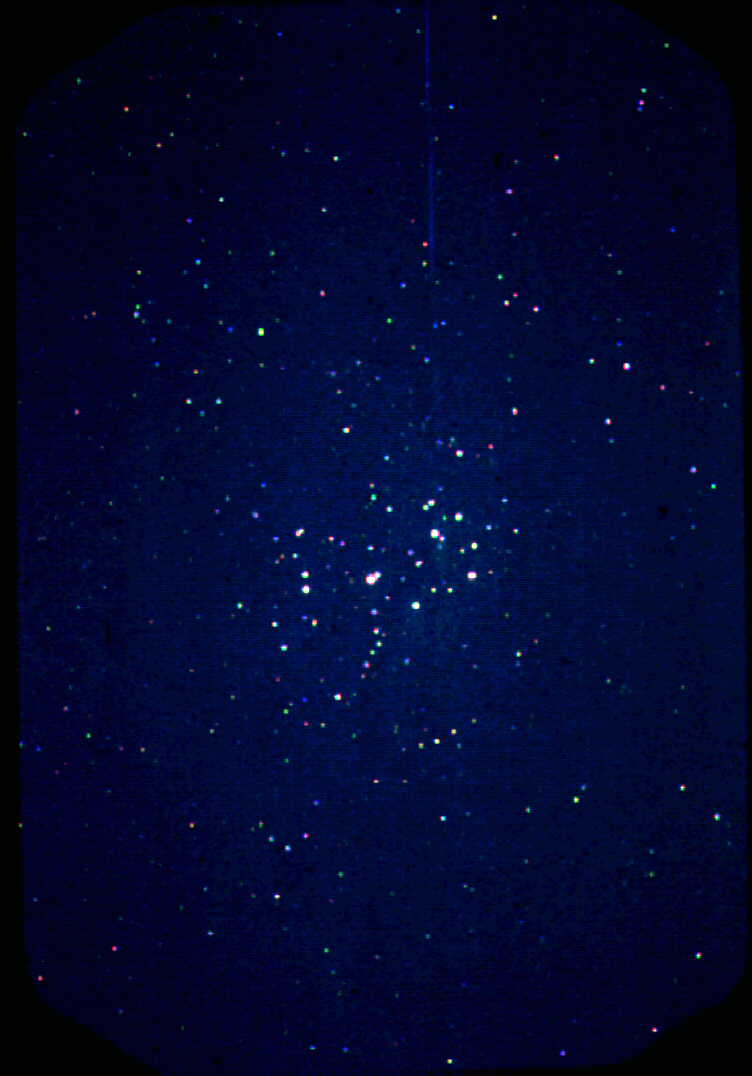
The Pleiades, about what you’d see in binoculars.

10/27/2014 – Ephemeris – The Pleiades in Greek and Native American mythology
Ephemeris for Monday, October 27th. The sun will rise at 8:13. It’ll be up for 10 hours and 25 minutes, setting at 6:38. The moon, 3 days before first quarter, will set at 9:38 this evening.
Visible low in the east at 10 in the evening sky can be spotted a small group of stars. It’s called the Pleiades or Seven Sisters. The Pleiades are really spectacular when seen in binoculars. It is remarkable that both the Greeks and the American Plains Indians saw this group as female stars fleeing from danger. In the former case they were fleeing the constellation Orion the giant hunter of the winter sky who will soon rise over the eastern horizon, and in the latter case a giant bear. Legend has it that the maidens fled to the top of Devils Tower in Wyoming. It’s said that the claw marks of this bear are seen in the walls of the tower. The maidens were then spirited from the top of the tower to the heavens, where we see them today. Whichever story you like the Pleiades is worth searching for.
Times are for the Traverse City/Interlochen area of Michigan. They may be different for your location.
Addendum
The Pleiades, about what you’d see in binoculars.
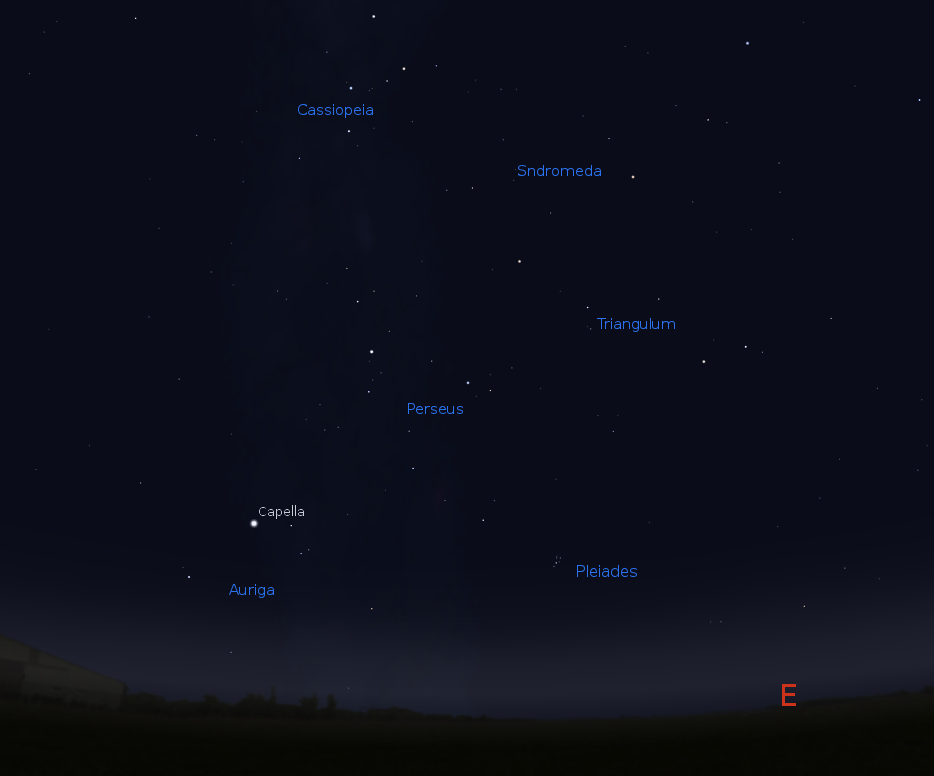
Looking to the east northeast at the Pleiades: 9 p.m. on October 27th. Created using Stellarium,
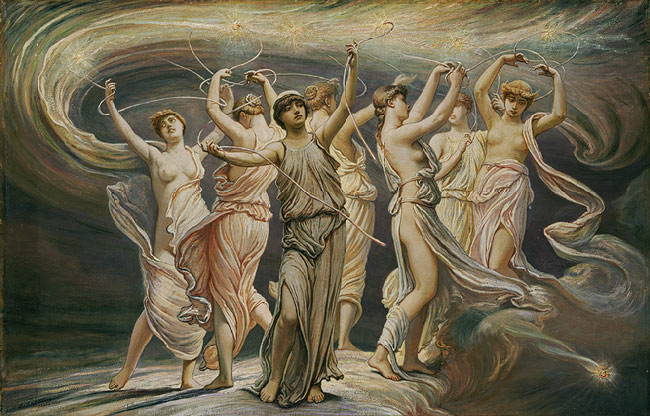
The Greek Pleiades a painting by Elihu Vedder in the Metropolitan Museum of Art, New York City. Public Domain.

Legend of Devils Tower Credit: Indian Country Today Media Network
This is the illustration from http://indiancountrytodaymedianetwork.com/article/the-legend-of-devils-tower-3273
10/20/2014 – Ephemeris – Looking for the Pleiades or Seven Sisters
Oct 20. This is Bob Moler with Ephemeris for Monday, October 20th. The sun will rise at 8:04. It’ll be up for 10 hours and 45 minutes, setting at 6:49. The moon, 3 days before new, will rise at 5:43 tomorrow morning.
A marvelous member of the autumn skies can be found low in the east northeast after 9 in the evening. It is the famous star cluster called the Pleiades or the Seven Sisters. I might also add the ‘Tiny Dipper’. Many people can spot a tiny dipper shape in its six or seven stars, and mistake it for the Little Dipper. As nearsighted as I am, though corrected, I’ve never been able to see more than a few stars and a bit of fuzz. However with binoculars, even I can see over a hundred stars appear along with the dipper shape of the brightest. The fuzz I saw was unresolved stars, but in photographs the Pleiades actually contain wisps of the gas they are passing through currently. In Greek mythology the sisters were daughters of the god Atlas.
Times are for the Traverse City/Interlochen area of Michigan. They may be different for your location.
Addendum
Looking to the east northeast at the Pleiades: 9 p.m.. Created using Stellarium.
The Pleiades, about what you’d see in binoculars.
10/17/2014 – Ephmeris – There’s a star party Saturday at the NMC Rogers Observatory
Ephemeris for Friday, October 17th. The sun will rise at 8:00. It’ll be up for 10 hours and 54 minutes, setting at 6:54. The moon, 2 days past last quarter, will rise at 2:47 tomorrow morning.
Tomorrow night the Grand Traverse Astronomical Society will host a Star Party at Northwestern Michigan College’s Rogers Observatory from 9 p.m. to 11 p.m. On tap, if it’s clear will be the wonders of both the summer and the autumn skies, The summer Milky Way is still visible moving off to the southwest with its star clusters and nebulae. The autumn sky has star clusters too, including the famous Pleiades, best seen in binoculars or telescope finders, and the wonderful Double Cluster. The autumn sky is also host to the closest spiral galaxy to us the Great Andromeda Galaxy, which will get a whole lot closer in 4 billion years. Come on out to the observatory on Birmley Road, about 2 miles south of South Airport Road.
Times are for the Traverse City/Interlochen area of Michigan. They may be different for your location.
Addendum
The Pleiades, about what you’d see in binoculars.
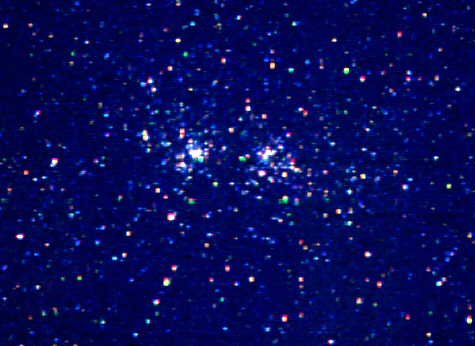
Double Cluster as it would be seen in a small telescope.
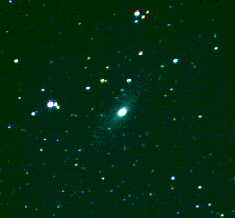
The Great Andromeda Galaxy (M31) as seen in binoculars. Visually even in a telescope the hub of this galaxy is all that is seen. However it also can be seen with the naked eye. However a telescope can also show its two satellite galaxies.
02/24/2014 – Ephemeris – Two more bright star clusters of winter
Ephemeris for Monday, February 24th. The sun will rise at 7:28. It’ll be up for 10 hours and 55 minutes, setting at 6:23. The moon, 2 days past last quarter, will rise at 4:27 tomorrow morning.
The Milky Way isn’t as bright in the winter as it is in the summer. That’s because we are looking away from the galactic center, the central part of the Milky Way. But there’s still a lot to see as can be attested to by the bright stars of winter that outshine those of summer. There are a lot of Galactic or open star clusters visible, such as the Pleiades. With binoculars one can spot at least two more. Just below Sirius the Dog Star the brightest night-time star which can be found by extending the line of the belt stars of Orion to the lower left. It’s Messier 41. Then off Castor’s toe in Gemini, where the sun would be on the first day of summer, as I mentioned last Tuesday, is another bright binocular star cluster cataloged as Messier 35.
Times are for the Traverse City/Interlochen area of Michigan. They may be different for your location.
Addendum
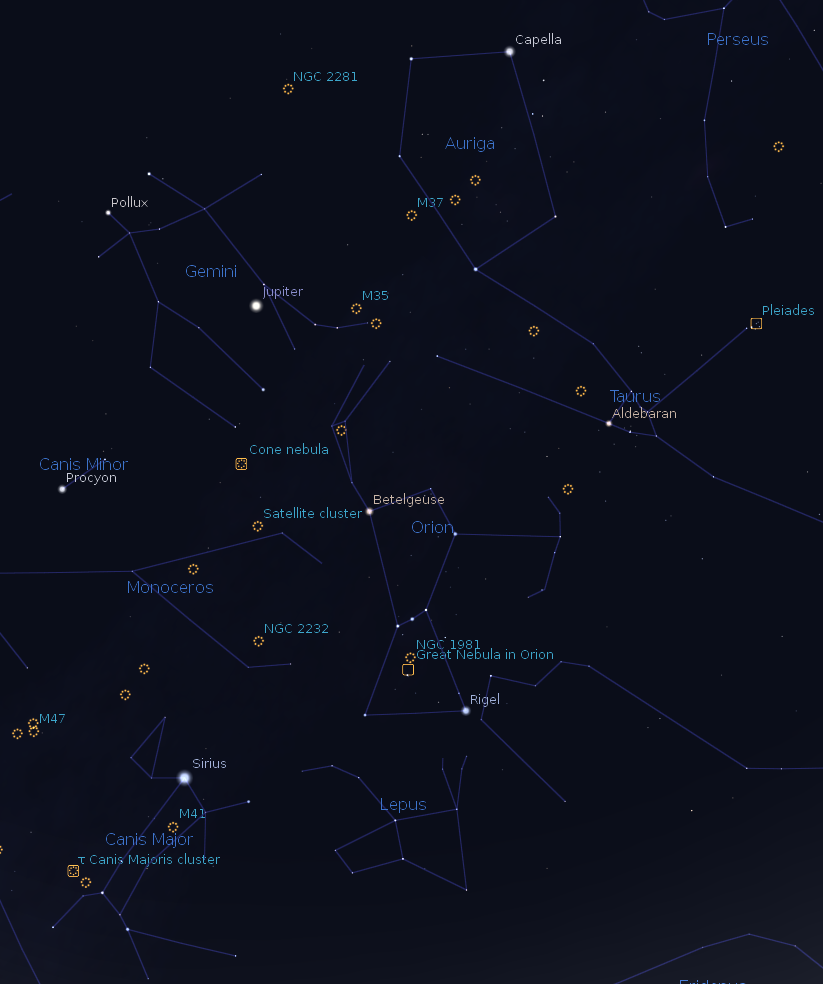
Winter Deep Sky Objects including the Pleiades, M35 and M41. Created using Stellarium.
12/10/2013 – Ephemeris – The bright star Aldebaran, the Follower
Ephemeris for Tuesday, December 10th. The sun will rise at 8:08. It’ll be up for 8 hours and 53 minutes, setting at 5:02. The moon, 1 day past first quarter, will set at 2:18 tomorrow morning.
The central constellation of winter, Orion, is in the east southeast at 9 p.m. Above it is Taurus the bull. The bright orange star in Taurus is Aldebaran. Aldebaran appears at the lower left tip of a letter V group of stars lying on its side that is the face of the bull. Aldebaran isn’t actually part of the group, called the Hyades star cluster. The cluster is about 153 light years away, while Aldebaran is 65. The star has an orange hue because its surface is cooler than the sun’s. However Aldebaran is 44 times larger in diameter, and shines 465 times brighter than the sun. The name Aldebaran means “Follower” because it follows the Pleiades star cluster through the skies. The Pleiades is above right of Aldebaran.
Times are for the Traverse City/Interlochen area of Michigan. They may be different for your location.
Addendum
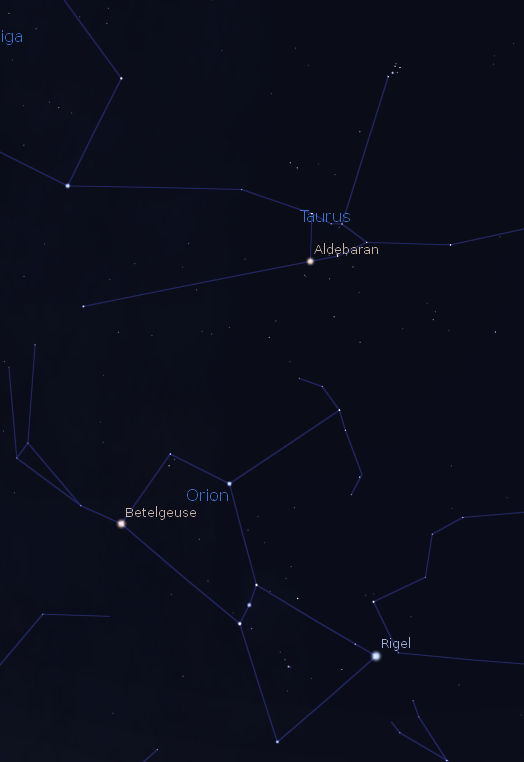
Aldebaran, the Hyades, of Taurus, Orion and the Pleiades at 10 p.m. December 10, 2013. Created using Stellarium.
12/05/2013 – Ephemeris – The constellation Taurus the bull
Ephemeris for Thursday, December 5th. The sun will rise at 8:03. It’ll be up for 8 hours and 58 minutes, setting at 5:02. The moon, 3 days past new, will set at 8:27 this evening.
Early in the evening the moon will appear above the bright planet Venus in the southwest. Low in the east at 9 p.m. is the constellation of Orion the giant hunter. Above him is Taurus the bull. His face is a letter V shape of stars lying on its side with the bright orange-red star Aldebaran at the bottom tip of the V as its angry blood-shot eye. Orion is depicted in the sky facing with club in one hand and a shield in the other the approaching and in some depictions charging Taurus. The V of stars is a star cluster called the Hyades. The Pleiades are in his shoulder above. Taurus in Greek mythology was the guise the god Zeus when he carried off the maiden Europa. Europa’s still with him, sort of, as the intriguing satellite orbiting Zeus’ Roman equivalent Jupiter.
Times are for the Traverse City/Interlochen area of Michigan. They may be different for your location.
Addendum
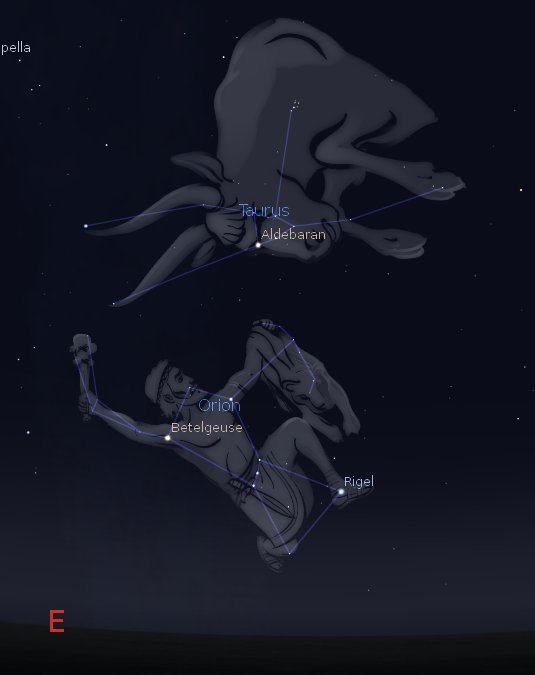
Taurus and Orion in the east at 9 p.m, December 5, 2013. Created using Stellarium.
10/24/2013 – Ephemeris – The Pleiades or Seven Sisters
Ephemeris for Thursday, October 24th. The sun will rise at 8:09. It’ll be up for 10 hours and 33 minutes, setting at 6:42. The moon, 2 days before last quarter, will rise at 11:01 this evening.
We’re a month into autumn. Looking to the east northeast low in the sky at 9 p.m. there will be a hazy patch of light, or a tiny dipper of stars, depending on your eyesight and sky conditions. This is the Pleiades or seven sisters of Greek mythology. The Pleiades has a rich mythology in all cultures, which we will check out occasionally until they leave the night skies in the spring. The Pleiades is a star cluster, where stars are formed at the same time, in this case about 100 million years ago. It has left its cloud of gas and dust from which the stars formed, however long exposure photographs show that the Pleiades is passing through another thin cloud of gas and dust. The Pleiades is one of the closest star clusters to us at 425 light years.
Times are for the Traverse City/Interlochen area of Michigan. They may be different for your location.
Addendum
Looking to the east northeast at the Pleiades: 9 p.m. on October 24, 2013. Created using Stellarium,
The Pleiades, about what you’d see in binoculars.
 Bob Moler's Ephemeris Blog