Archive
Ephemeris: 06/16/2025 – Mars meets Regulus tonight
This is Ephemeris for Monday, June 16th. Today the Sun will be up for 15 hours and 34 minutes, setting at 9:30, and it will rise tomorrow at 5:56. The Moon, 2 days before last quarter, will rise at 1:17 tomorrow morning.
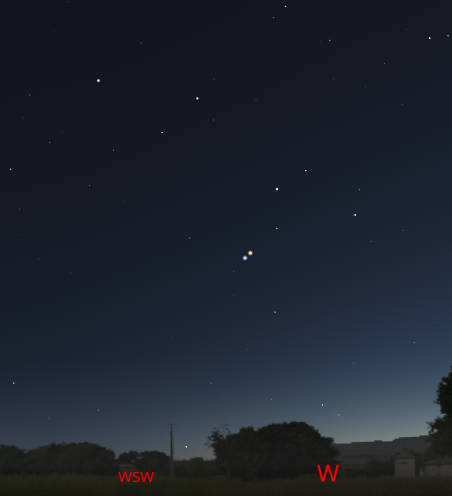
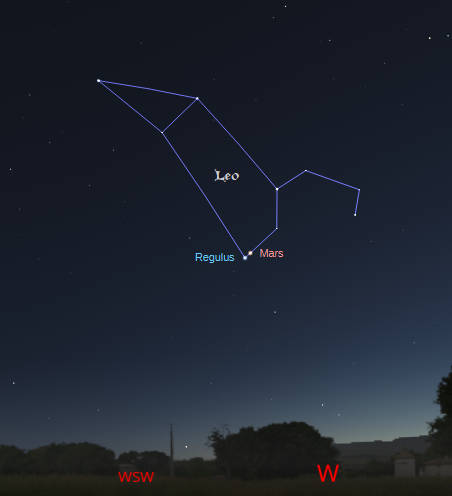
If one looks out tonight to the west after dark, two bright stars will appear very close together. One appears to the upper right of the other and very close, about one and a half moon-widths apart. The star to the upper right will have a reddish hue. It’s not a star at all but the planet Mars. The other one is a star, Regulus in Leo the lion. After tonight Mars will continue its trek eastward against the stars heading towards another bright star, Spica in Virgo. It will pass north of that star on September 11th. Mars will pass any particular star near the ecliptic on the average of one year, ten and a half months, which is its orbital period of the Sun. Since we’re viewing it from the moving Earth, along with Mars’ eccentric orbit, the interval can vary greatly.
The astronomical event times given in this blog are for the Traverse City/Interlochen area of Michigan (Lat 44.7° N, Long 85.7° W; EDT, UT – 4 hours) unless stated otherwise. Times will be different for other locations.
Addendum
Ephemeris: 04/25/2024 – Finding Hydra, the longest constellation
This is Ephemeris for Thursday, April 25th. Today the Sun will be up for 14 hours exactly, setting at 8:41, and it will rise tomorrow at 6:39. The Moon, 2 days past full, will rise at 11:00 this evening.
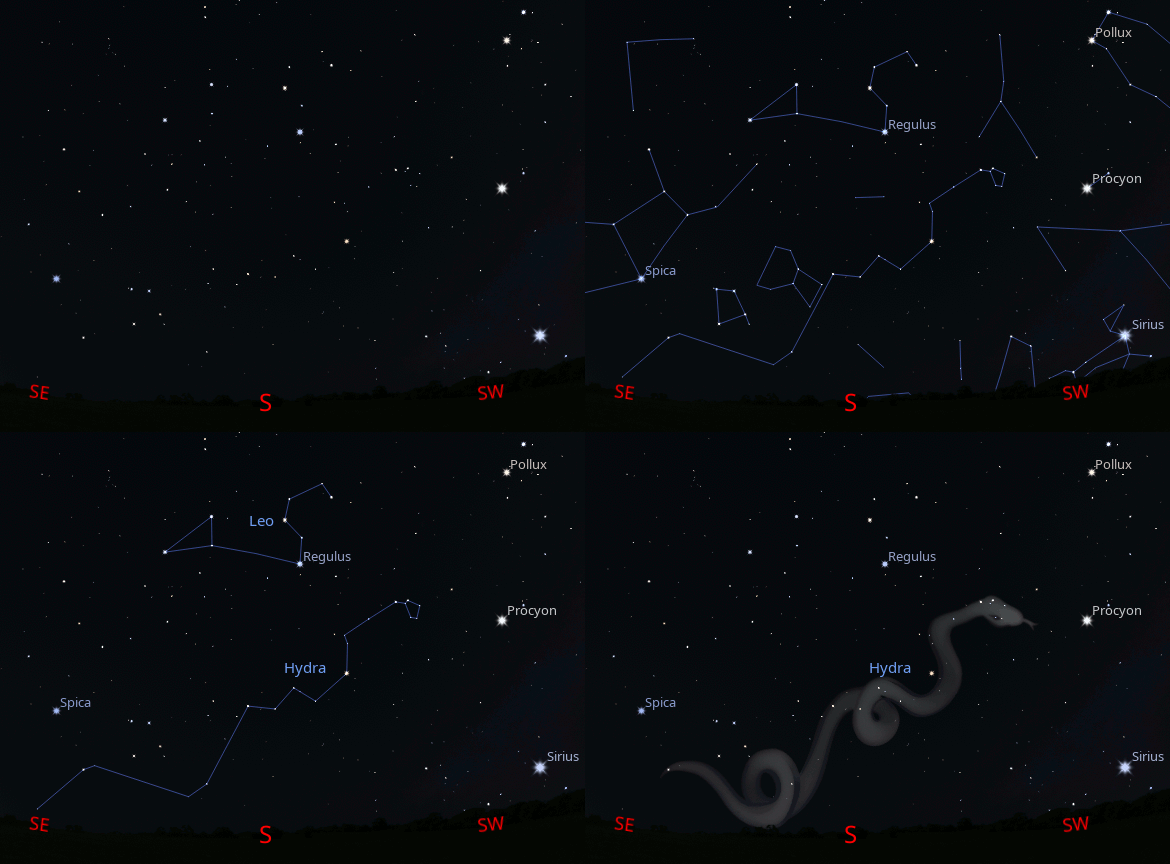
Stretching from midway up the sky in the southwest to low in the southeast at 10 p.m. can be found the constellation of Hydra the water snake, the longest constellation of all. Unlike the monster of the same name that Hercules slew, this Hydra has but one head, which is its most distinctive part. The head of Hydra is located between the bright stars Procyon in the southwest. Which is above the brighter star Sirius low in the sky, and Regulus in Leo the lion, higher in the south. Hydra’s head is a small but distinctive group of 6 stars that make a drooping loop to the right. The rest of Hydra wends its way in a reasonably straight line down to the southeastern horizon.
The astronomical event times given are for the Traverse City/Interlochen area of Michigan (EDT, UT–4 hours). They may be different for your location.
Addendum
05/16/2023 – Ephemeris – Regulus, the Little King Star
This is Ephemeris for Tuesday, May 16th. Today the Sun will be up for 14 hours and 51 minutes, setting at 9:05, and it will rise tomorrow at 6:12. The Moon, 3 days before new, will rise at 5:08 tomorrow morning.
Regulus is the brightest star in the constellation of Leo, the lion at the bottom of the backward question mark that is the head and mane of Leo. It’s in the southwest at 10 pm. Alluding to the lion’s status in the animal kingdom, Regulus is the little king star. It is dead last in order of brightness of the 21 brightest first magnitude stars, 1/13th the brightness of Sirius the brightest nighttime star, now lost in the evening twilight glow. To the Babylonians it was the king, the 15th of their constellations, that marked the passage of the Sun. Regulus is about 79 light years away, and 288 times the brightness of the sun. It is a rapidly spinning ellipsoid 3 times the sun’s diameter, rotating in just under 16 hours.
The astronomical event times given are for the Traverse City/Interlochen area of Michigan (EDT, UT –4 hours). They may be different for your location.
Addendum
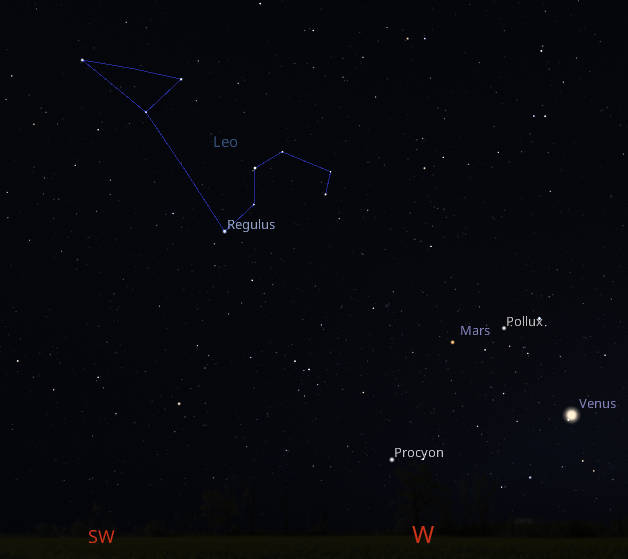
Regulus and Leo and the other stars and planets in the western sky at 11 pm, May 16, 2023. Created using Stellarium.
05/03/2022 – Ephemeris – Regulus, the “Little King Star”
This is Bob Moler with Ephemeris for Tuesday, May 3rd. Today the Sun will be up for 14 hours and 20 minutes, setting at 8:50, and it will rise tomorrow at 6:28. The Moon, 3 days past new, will set at 12:05 tomorrow morning.
Fairly high in the south-southwest at 10 p.m. is a pattern of stars that’s in the shape of a backward question mark. This informal star group or asterism is also called the sickle. It is the head and mane of the official zodiacal constellation of Leo the lion. To the left is a triangle of stars is his hind end. The bright star at the bottom of the question mark, or end of the sickle’s handle is Regulus, the “Little King Star”, alluding to the lion’s status as the king of the jungle. Regulus is about 79 light years away and is a 4 star system that exists as two star pairs. The bright star Regulus itself and a companion too close to be imaged directly in telescopes, and a nearby pair of dim stars make up the system. The Moon often passes in front of Regulus, since it’s close to the ecliptic. These occultations, as they are called, will occur monthly for a year and a half starting July
The astronomical event times given are for the Traverse City/Interlochen area of Michigan (EDT, UT – 4 hours). They may be different for your location.
Addendum

Animated finder chart for Leo and Regulus for early May at 10 pm or an hour after sunset. The orange line that appears is the ecliptic, the path of the Sun in the sky. The path of the Moon is tilted by about 5 degrees to that path. The paths cross at points called nodes. The nodes move slowly westward in an 18.6-year cycle called the regression of the nodes. Occultations of Regulus by the Moon occur during two periods in that cycle. The next period where occultations of Regulus will occur monthly from July 2025 to January 2027. Created using Stellarium and GIMP.
Occultations are like solar eclipses in that they can only be seen from a limited area. That area will shift southward during that period. Of the 21 occultations in that period, only 2 will be visible from the United States: February 3rd, and April 26th 2026.
03/21/2022 – Ephemeris – Finding the celestial lion
This is Ephemeris for Monday, March 21st. Today the Sun will be up for 12 hours and 12 minutes, setting at 7:56, and it will rise tomorrow at 7:42. The Moon, 3 days past full, will rise at 12:15 tomorrow morning.
At 10 p.m. the spring constellation of Leo the lion will be fairly high in the southeast. It can be found by locating the Big Dipper high in the northeast and imagining that a hole were drilled in the bowl to let the water leak out. It would drip on the back of this giant cat. The Lion is standing or lying facing westward. His head and mane are seen in the stars as a backwards question mark. This group of stars is also called the Sickle. The bright star Regulus is at the bottom, the dot at the bottom of the question mark. A triangle of stars, to the left of Regulus, is the lion’s haunches. Leo contains some nice galaxies visible in moderate sized telescopes. The stars in Leo’s part of the sky are fewer than those in the winter sky.
The astronomical event times given are for the Traverse City/Interlochen area of Michigan (EDT, UT – 4 hours). They may be different for your location.
Addendum
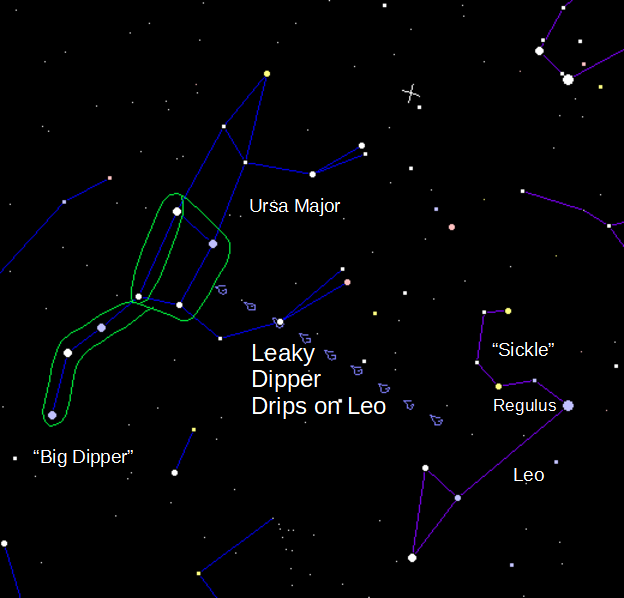
Leaky Big Dipper drips on Leo. The positions in the sky are for 10 pm local time, or about 2 hours after sunset. The little distorted cross at the top of the image marks the zenith. Look high in the east and southeast to see these stars. Created using my LookingUp program, GIMP and LibreOffice.
03/03/2022 – Ephemeris – Finding Cancer the crab
This is Ephemeris for Thursday, March 3rd. Today the Sun will be up for 11 hours and 16 minutes, setting at 6:33, and it will rise tomorrow at 7:15. The Moon, 1 day past new, will set at 7:46 this evening.
The constellation of Cancer the crab is made of dim stars, which are generally connected, in constellation charts, with lines that make either the letter K or an upside down Y, which lie directly between the star pair Castor and Pollux in Gemini and Regulus in Leo. In the center of the constellation is, what to the naked-eye is a fuzzy spot called Praesepe, or the manger. The two nearby stars, one to the northeast, and one to the southeast are Asellus Borealis, and Asellus Australis, the northern and southern donkey colts feeding out of the manger. Viewing that fuzzy spot with a pair of binoculars will reveal that it’s not fuzzy at all. It resolves into a cluster of stars, which astronomers, over the years, have called the Beehive cluster. Back in the first and second century CE, the Sun entered Cancer to begin the season of summer. It’s now just a transitional constellation between the winter and spring evening skies.
The astronomical event times given are for the Traverse City/Interlochen area of Michigan (EST, UT – 5 hours). They may be different for your location.
Addendum

Cancer, the crab finder chart. Note the beehive cluster, also known to amateur astronomers as M44, along with other catalog names. Prior to the invention of the telescope this cluster was known as Praesepe which means “Manger”. Click on the image to enlarge it. Created using Stellarium and GIMP.
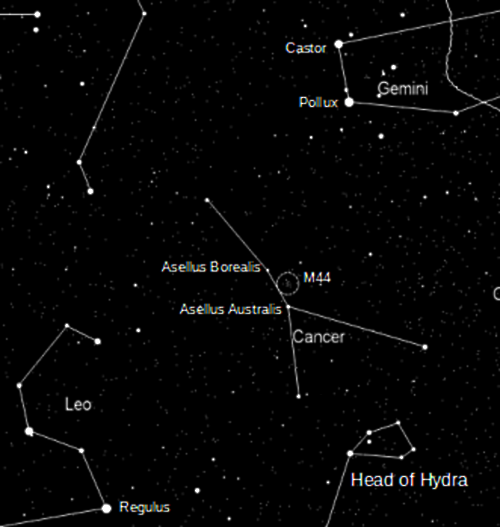
A closer look at Cancer, noting the donkey stars Asellus Borealis and Australis feeding at the manger, Praesepe or M44, aka: the Beehive Cluster. Created using Cartes du Ciel (Sky Charts) and LibreOffice for captions. Adapted from a chart I created for the March 2022 issue of the GTAS newsletter, the Stellar Sentinel.
04/20/2020 – Ephemeris – The Little King Star
This is Ephemeris for Monday, April 20th. Today the Sun will be up for 13 hours and 45 minutes, setting at 8:34, and it will rise tomorrow at 6:47. The Moon, 2 days before new, will rise at 6:37 tomorrow morning.
The brightest star in the constellation Leo, which is high in the south these evenings is Regulus, whose name means “Little King”. It is appropriate due to its position in the heart of the king of beasts Leo the lion. Regulus is dead last in brightness of the 21 first magnitude stars, the brightest night-time stars. Even so, it is much brighter than the Sun. It is 79 light years away. The Sun would require a telescope to be spotted at that distance. Regulus appears to be a quadruple star system. The bright star itself is really two stars with a bright star orbited by a much dimmer star every 40 days. There are two dimmer stars much further out that share Regulus’ motion through space. There are an infinite variety of star system arrangements in the galaxy and beyond.
The event times given are for the Traverse City/Interlochen area of Michigan. They may be different for your location.
Addendum
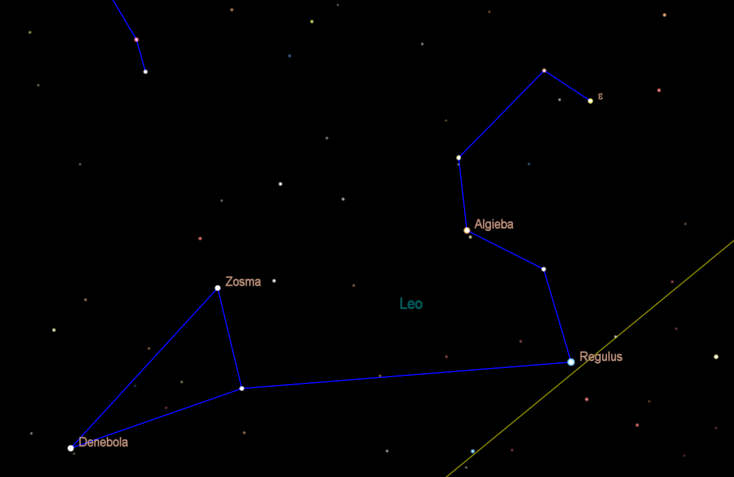
The naked eye stars of Leo, including Regulus at 9:30 p.m. April 20, 2020. Note that Algieba is a binary star that can be seen in small telescopes. The yellow line that passes Regulus is the ecliptic the apparent path of the Sun. The Moon and planets also hang out near that line. Created using Cartes du Ciel (Sky Charts).
02/25/2019 – Ephemeris – Cancer the crab
Ephemeris for Monday, February 25th. Today the Sun will be up for 10 hours and 57 minutes, setting at 6:24, and it will rise tomorrow at 7:25. The Moon, 1 day before last quarter, will rise at 1:46 tomorrow morning.
Between the stars Castor and Pollux in Gemini high in the southeast and the star Regulus in Leo the Lion in the east-southeast lies the dimmest constellation of the zodiac, Cancer the crab. To me its 5 brightest stars make an upside down Y. There’s the stars in the center of the constellation Asellus Borealis and Asellus Australis, the north and south donkeys. There’s a fuzzy spot between and just west of them called Praesepe, the manger. In binoculars it resolves into a cluster of stars called the Beehive cluster. We amateur astronomers also know it as M44, the 44th object on comet hunter Charles Messier’s list of objects that might be mistaken for comets.
The times given are for the Traverse City/Interlochen area of Michigan. They may be different for your location.
Addendum
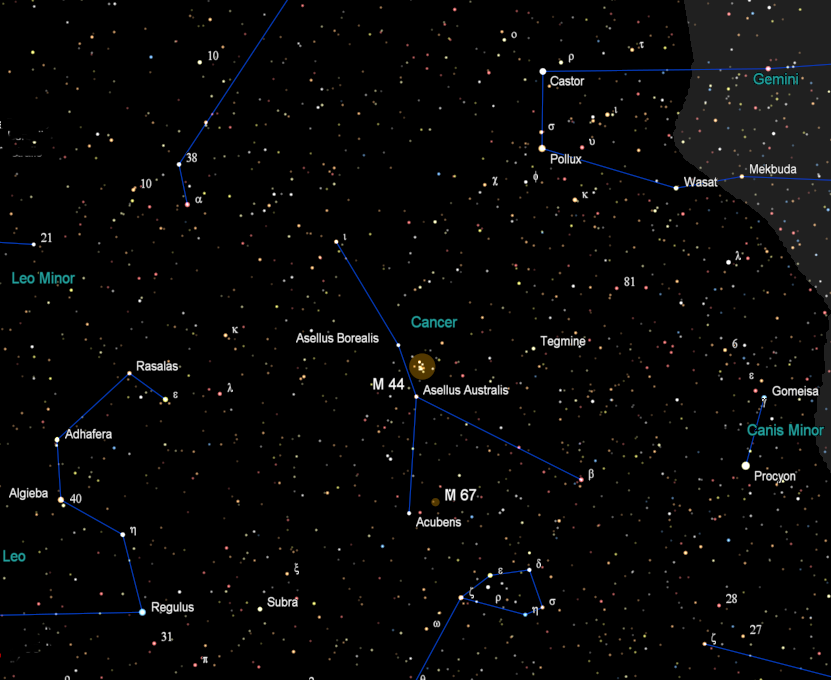
The constellation Cancer finder chart. Click on image to enlarge. Created using Cartes du Ciel (Sky Charts).
04/13/2018 – Ephemeris – Regulus, in Leo the lion, the “Little King” star.
Ephemeris for Friday, April 13th. The Sun will rise at 7:01. It’ll be up for 13 hours and 23 minutes, setting at 8:25. The Moon, 2 days before new, will rise at 6:42 tomorrow morning.
The brightest star in the constellation Leo, which is high in the south these evenings is Regulus, whose name means “Little King”. It is appropriate due to its position in the heart of the king of beasts Leo the lion. Regulus is dead last in brightness of the 21 first magnitude stars, the brightest night-time stars. Even so, it is much brighter than the Sun. It is 79 light years away. The Sun would require a telescope to be spotted at that distance. Regulus appears to be a quadruple star system. The bright star itself is really two stars with a bright star orbited by a much dimmer star every 40 days. There are two dimmer stars much further out that share Regulus’ motion through space. There are an infinite variety of star system arrangements in the galaxy and beyond.
The times given are for the Traverse City/Interlochen area of Michigan. They may be different for your location.
Addendum
The naked eye stars of Leo, including Regulus at 10 p.m. April 13, 2018. Note that Algieba is a binary star that can be seen in small telescopes. The yellow line that passes Regulus is the ecliptic the apparent path of the Sun. The Moon and planets also hang out near that line. Created using Cartes du Ciel (Sky Charts).
Note: The original scheduled topic for today was the announcement of a star party at the Sleeping Bear Dunes National Lakeshore tomorrow, April 14th. It seems the weather gods have a different plan. There’s a winter storm watch from late Friday night (tonight) to noon Sunday with 3-6 inches of slushy snow.
03/05/2018 – Ephemeris – Spring is coming: Leo is rising
Ephemeris for Monday, March 5th. The Sun will rise at 7:13. It’ll be up for 11 hours and 22 minutes, setting at 6:35. The Moon, half way from full to last quarter, will rise at 10:53 this evening.
The constellation Leo the lion is now rising in the east at 9 pm. It’s below and left of the Big Dipper higher up in the east-northeast. Leo is marked by two sets of easily recognizable stars. The front of him is a backward question mark of stars, also known as the Sickle that mark his head and mane, along with the front part of his body. Regulus is the star at the bottom of that backwards question mark. It’s the Little King Star. The hind end of him is a triangle of stars ending with another bright star, but not as bright as Regulus. It’s Denebola which means Lion’s tail. It is thought when the Sun was in this constellation long ago that the lions were driven by the heat to quench their thirst in the Nile river. Ancients physicians thought medicines were poison when the Sun was here also.
The times given are for the Traverse City/Interlochen area of Michigan. They may be different for your location.
Addendum
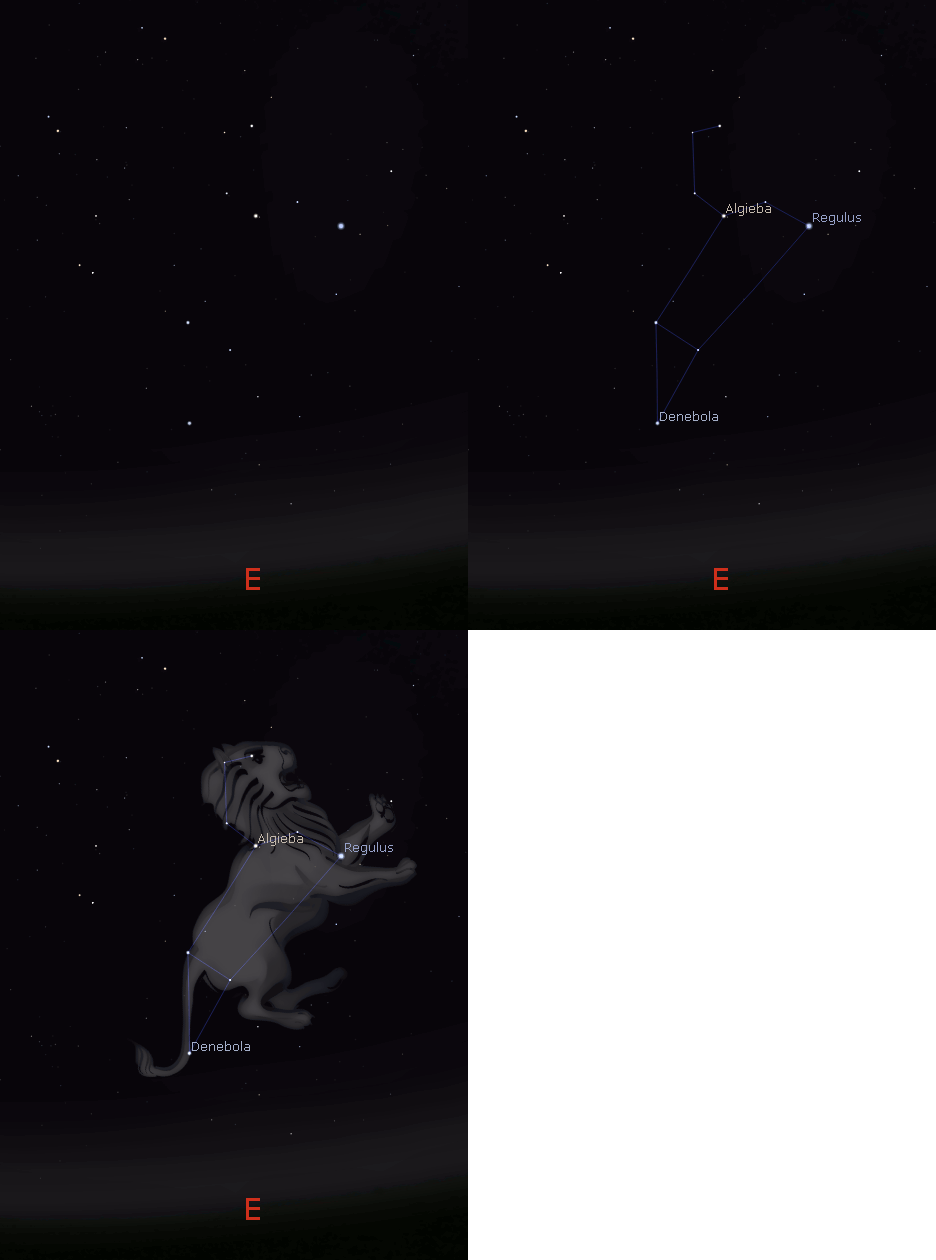
The constellation Leo animation. Created using Stellarium and GIMP.
Algieba is a binary star, which should be able to be split with any good telescope. The magnitude 2.4 and 3.6 components are separated by 4.6 arc seconds. Binary stars are one type of object that benefit from using high power to resolve. The stars are very close in temperature, so each appears a yellow-orange color offering no color contrast.
 Bob Moler's Ephemeris Blog