Archive
Ephemeris: 02/13/2026 – The real cause of a planet’s retrograde motion
This is Ephemeris for Friday, February 13th. Today the Sun will be up for 10 hours and 22 minutes, setting at 6:08, and it will rise tomorrow at 7:44. The Moon, halfway from last quarter to new, will rise at 6:30 tomorrow morning.
So what is the real reason that Jupiter is currently moving westward for a while in retrograde motion? Retrograde motion occurs in outer planets because the Earth is actually passing them. A simple analogy would be, if you were in a car that was passing another, the car you are passing would seem to move backwards compared to you. And that is exactly what’s happening. The Earth moves faster than the outer planets. Since the solar system is like a racetrack, and we get to lap these outer planets repeatedly when they are closest to us. For the inner planet it’s opposite. They go retrograde or backwards when they are passing us. This is a much simpler answer than all these circles upon circles the ancients invented.
The astronomical event times given in this blog are for the Traverse City/Interlochen area of Michigan (Lat 44.7° N, Long 85.7° W; EST, UT – 5 hours) unless stated otherwise. Times will be different for other locations.
Addendum
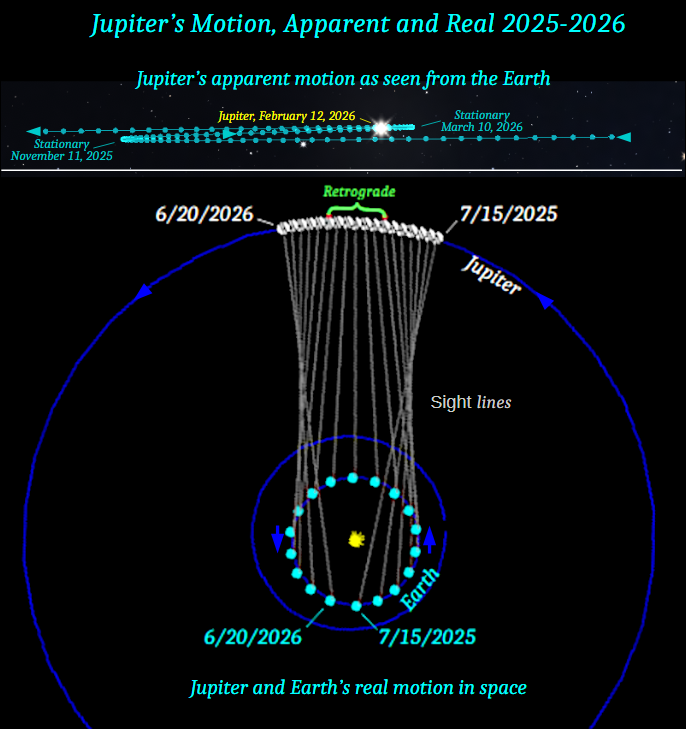
Ephemeris: 02/12/2026 – Why do planets stop and move backward for a time? Part 1
This is Ephemeris for Darwin Day, Thursday, February 12th. Today the Sun will be up for 10 hours and 19 minutes, setting at 6:07, and it will rise tomorrow at 7:45. The Moon, 3 days past last quarter, will rise at 5:49 tomorrow morning.
For the last month or so I’ve been talking about Jupiter in its retrograde or westward motion against the stars of Gemini. This motion isn’t due to just Jupiter itself. Jupiter orbits smoothly around the sun in one direction, in a little less than 12 years. The ancients thought that the earth was stationary, and everything in the sky orbited the earth. They thought that the planets orbited the earth in the same time that the planet orbits the sun, however every year and depending on where the planet was in the sky it would stop, reverse itself for a while and then resume its eastward motion through the sky. They thought that the planet moved on a small circle called an epicycle that rode on the larger circle called the deferent.
The astronomical event times given in this blog are for the Traverse City/Interlochen area of Michigan (Lat 44.7° N, Long 85.7° W; EST, UT – 5 hours) unless stated otherwise. Times will be different for other locations.
Addendum
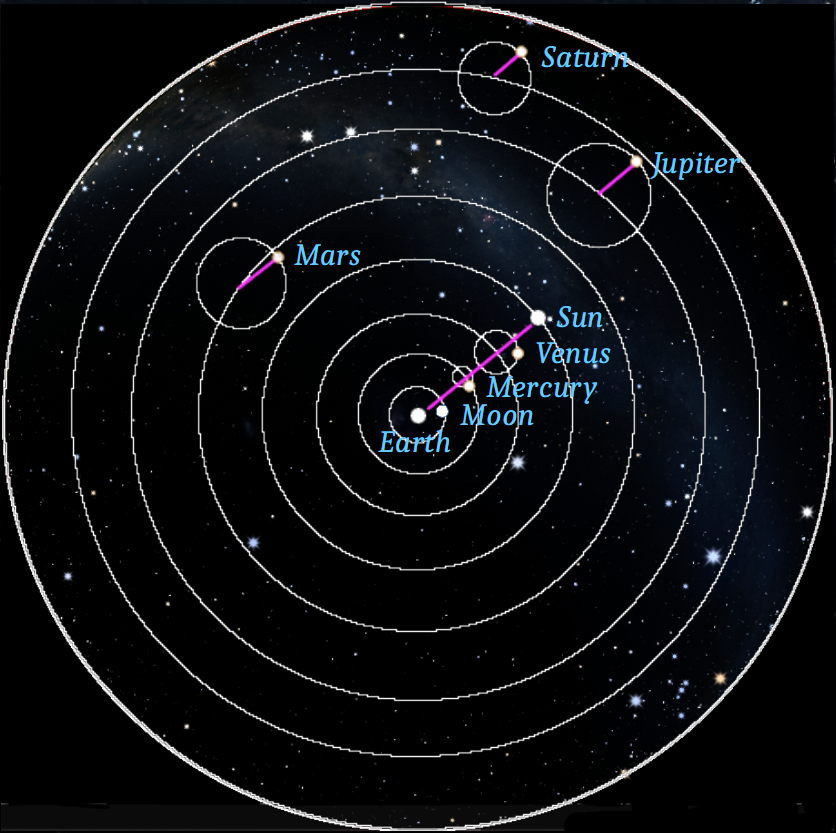
Tomorrow, we’ll find out what’s really going on.
Ephemeris: 03/24/2025 – Mercury crosses over to the morning side
This is Ephemeris for Monday, March 24th. Today the Sun will be up for 12 hours and 22 minutes, setting at 8:00, and it will rise tomorrow at 7:36. The Moon, 2 days past last quarter, will rise at 5:58 tomorrow morning.
Today, Mercury is at inferior conjunction with the Sun, two days after Venus. Mercury of course, this is in the middle of its retrograde motion period, moving westward against the stars, and for astrologers Mercury in retrograde is a big deal. I consider astrology is to astronomy as tea-leaf reading is to botany, so I dismiss it. Every once in a while Mercury, when it passes inferior conjunction, crosses in front of the face of the Sun for us. These are called transits, and are fairly rare. The last time was in November 2019 and the next time will be in November 2032 which is seven years from now. Mercury will move into the morning sky, where its appearance will not be favorable for us in the Northern Hemisphere.
The astronomical event times given are for the Traverse City/Interlochen area of Michigan (EDT, UT – 4 hours). Times will be different for other locations.
Addendum
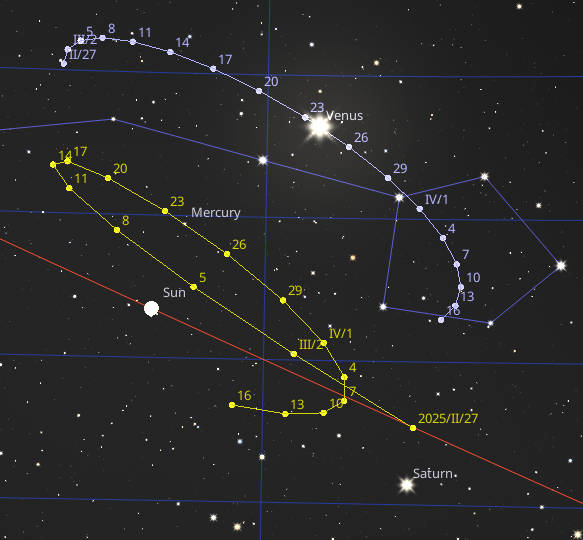
Retrograde loops are caused by looking at a moving planet from another moving planet, the Earth.
Ephemeris: 02/24/2025 – Mars stopped in its tracks!
This is Ephemeris for Monday, February 24th. Today the Sun will be up for 10 hours and 55 minutes, setting at 6:24, and it will rise tomorrow at 7:26. The Moon, 3 days before new, will rise at 6:30 tomorrow morning.
Today the planet Mars is said to be stationary. No, planets do not stop in their orbits of the Sun. It is because we are viewing them from the moving planet Earth. For the last few months Mars has been moving to the west, which is not its normal motion, so we call it retrograde motion. It does that because the Earth, moving faster on an inner orbit, is passing Mars moving slower on an outer orbit. This was a problem for the ancients of the western world because they thought all the moving objects, all seven of them, moved around a stationary Earth. Of those seven, two of them never went backwards, or westward against the stars. They were: the Moon which does orbit the Earth and the Sun which the Earth orbits.
The astronomical event times given are for the Traverse City/Interlochen area of Michigan (EST, UT – 5 hours). Times will be different for other locations.
Addendum
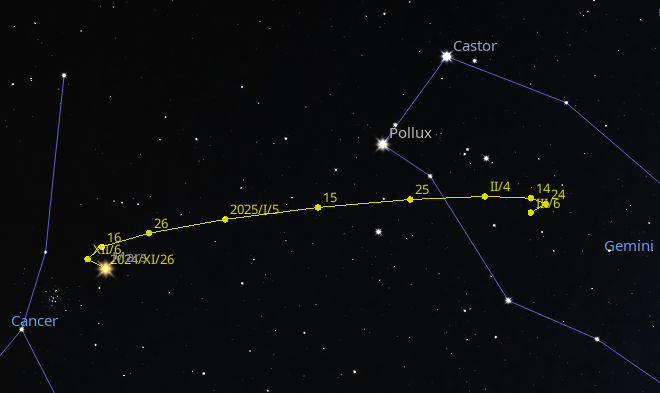
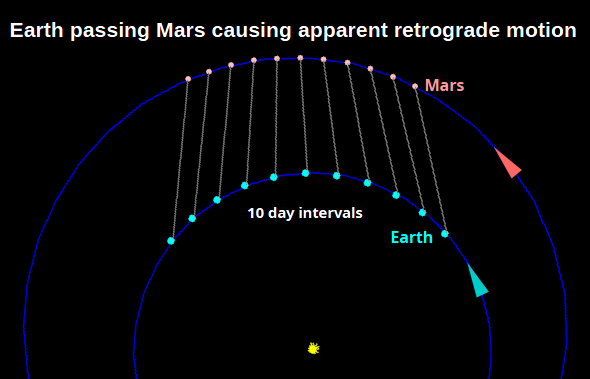
* For non astronomers: Inferior doesn’t refer to quality, but that the planet’s orbit is inside the Earth’s orbit. Superior planets orbit farther out from the Sun than the Earth.
10/28/2022 – Ephemeris – Mars is turning around this weekend
This is Bob Moler with Ephemeris for Friday, October 28th. Today the Sun will be up for 10 hours and 21 minutes, setting at 6:37, and it will rise tomorrow at 8:16. The Moon, 3 days past new, will set at 8:39 this evening.
This Sunday the 30th, the planet Mars will cease its normal eastward motion in relation to the stars, and backtrack to the west for a while. The instant Mars stops its eastward motion, it is said to be stationary. The backtracking is called retrograde motion, which was hard for ancient astronomers to explain because they thought the Earth was not moving and in the center of the universe. And the planets moved in uniform circular motion. So said the Greeks, because they thought that things in the heavens were perfect, not like the imperfect things of the Earth. Mars was a hard case. Its motion was definitely not uniform or circular. To Copernicus, the retrograde motion meant that the Earth was a planet passing another planet in their race around the Sun.
The astronomical event times given are for the Traverse City/Interlochen area of Michigan (EDT, UT – 4 hours). They may be different for your location.
Addendum
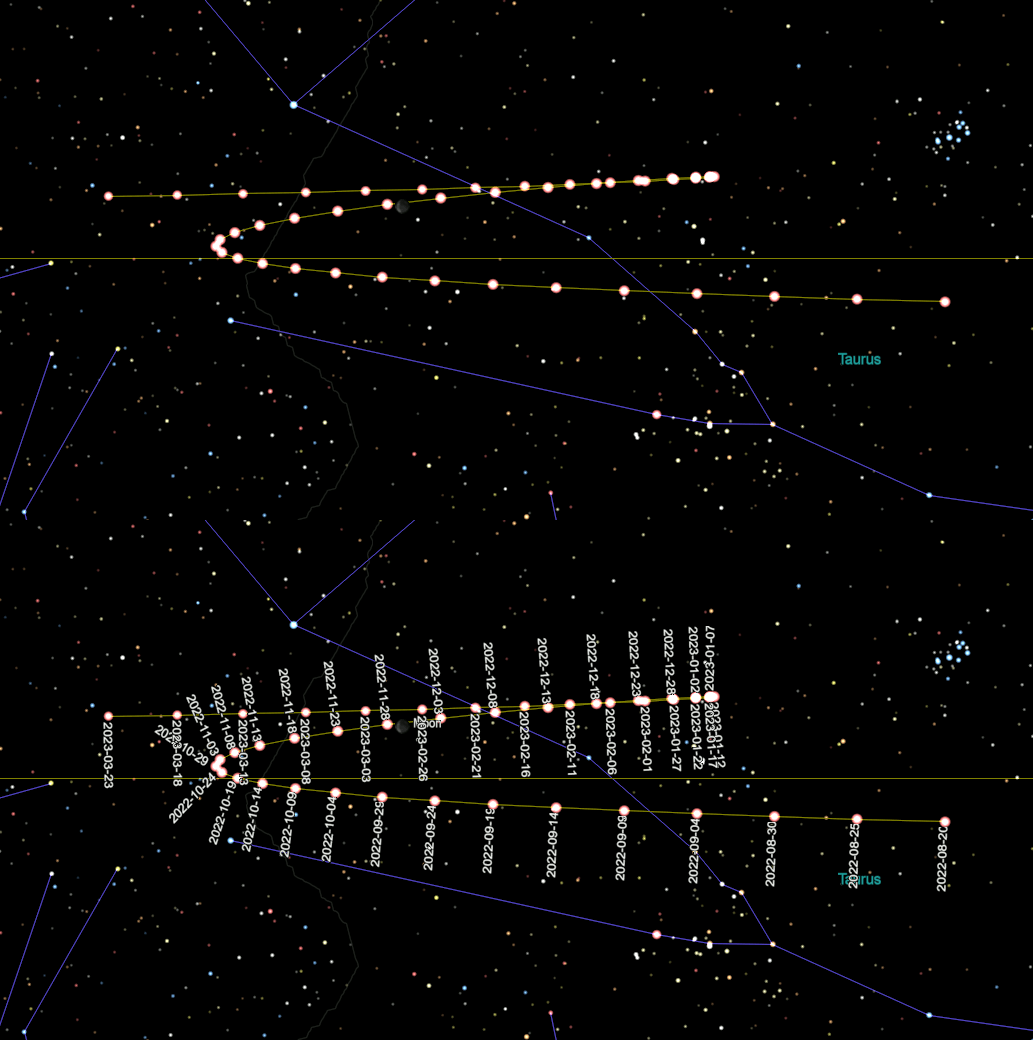
Mars retrograde path from October 29, 2022 to January 11, 2023 against the stars of Taurus the bull. It will be at opposition on December 7, and actually closest to the Earth on November 30 at 50.61 million miles or 81.45 million kilometers. In the upper right is the beautiful Pleiades star cluster, also known as the Seven Sisters. Below and right is the V shaped star cluster that represents the face of Taurus the bull, with the bright red star Aldebaran as the bull’s angry red eye. That V of stars is called the Hyades, who in mythology were the half sisters to the Pleiades. Click on the image to enlarge it. Created using Cartes du Ciel (Sky Charts) and GIMP.
04/27/2016 – Ephemeris – Mars is closing in on its rival, but backs off for now
Ephemeris for Wednesday, April 27th. The Sun rises at 6:38. It’ll be up for 14 hours and 5 minutes, setting at 8:43. The Moon, 2 days before last quarter, will rise at 1:36 tomorrow morning.
Let’s see what the bright naked eye planets are up to. Mercury is in the west-northwest, very low to the horizon, setting at 10:12 p.m. Mercury is really fading now. Jupiter is in the southeast in the early evening, and will pass due south at 10:17 p.m., and will set at 4:51 a.m. It’s below the stars of Leo this year. Binoculars can make out some of Jupiter’s moons, but a telescope is required to see all four bright moons and Jupiter’s cloud features. Mars will rise at 11:11 p.m. in the east-southeast. It’s now almost bu not quite directly north of its look-a-like star Antares, whose name means Rival of Mars. Saturn will rise at 11:40 p.m. in the east-southeast. It’s just left of Mars. Its rings are a telescopic treat. Venus is invisibly close to the Sun now.
Times are for the Traverse City/Interlochen area of Michigan. They may be different for your location.
Addendum
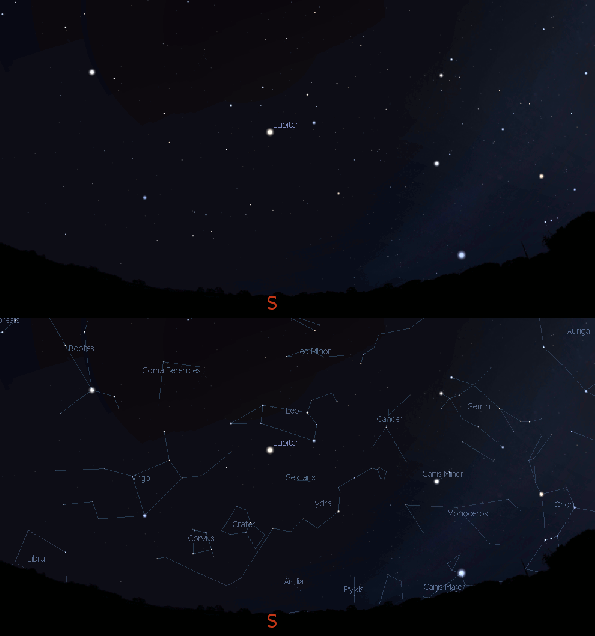
Jupiter and the spring stars animation. Set for 10 p.m. April 27, 2016. Created using Stellarium.
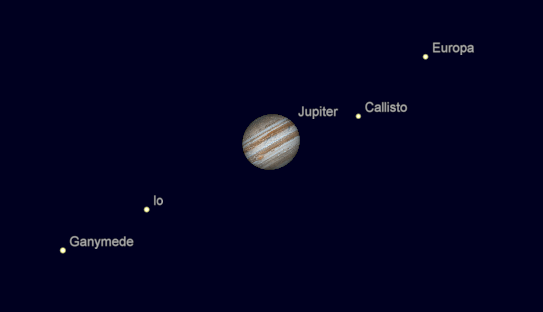
Jupiter and its moons as they might be seen in a telescope at 10 p.m., April 27, 2016. Jupiter’s apparent diameter is 41.2″ According to the Project Pluto web site the Great Red spot will cross Jupiter’s central meridian at 9:16 p.m., a half hour after sunset. If so, the position of the spot in this chart is incorrect. Created with Cartes du Ciel (Sky Charts).
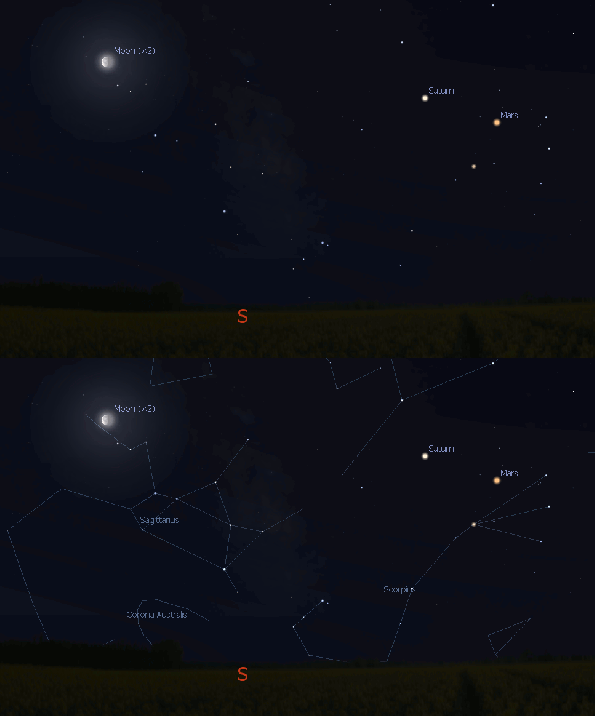
Mars, Saturn and the Moon at 5:30 a.m. April 28, 2016. Created using Stellarium.
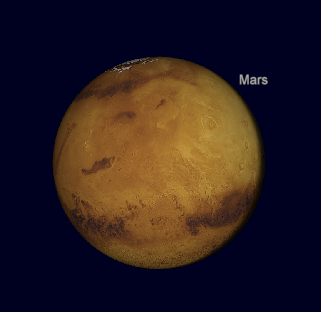
Mars as it might be seen in a large telescope with high power at 5:30 a.m., April 28 2016. Mars apparent diameter is 15.7″. The central meridian will be 169.90 degrees. Created using Cartes du Ciel (Sky Charts).
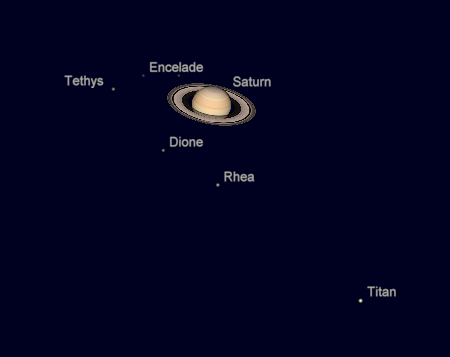
Saturn and its moons at 5:30 a.m., April 28, 2016. The apparent diameter of the planet will be 18.1″. The rings span 42.1″, a bit larger than the apparent diameter of Jupiter. Created using Cartes du Ciel (Sky Charts).
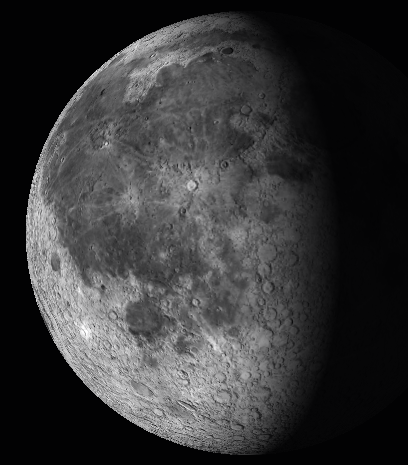
The Moon as it might appear in binoculars at 5:30 a.m. on April 28, 2016. Created using Stellarium.
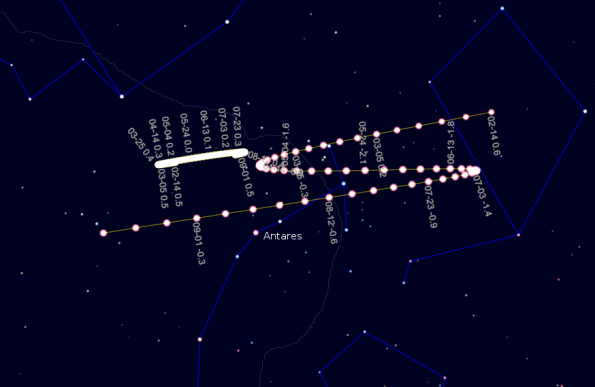
The retrograde tracks of Mars and Saturn as we pass both planets this year. The tracks start on February 14, 2016 and run to September 13, 2016 plotted at 4 day intervals and labeled every 20 days. I noticed when producing the Mars, Saturn & Moon plot above that Mars was not due north of Antares on the 27th. Mars actually became stationary and started it’s retrograde loop a few days ago before it got that far. However when Mars doubles back, it will have a much closer pass of Antares on August 27th. Saturn’s plots are so close together that they appear as a fat line. Created using Cartes du Ciel (Sky Charts).
Retrograde motion of the planets are caused when the Earth is either passing a superior planet (Mars, Jupiter, Saturn, etc.), or when being passed by an inferior planet (Venus and Mercury). It was a big problem with the old Earth center solar system, before Copernicus and Kepler.
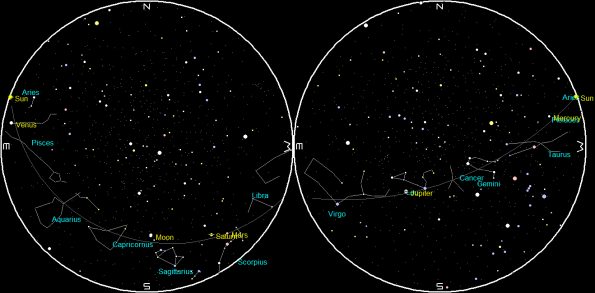
Planets at sunrise and sunset of a single night starting with sunset on the right on April 27, 2016. The night ends on the left with sunrise on April 28. If you are using Firefox right-click on the image and select View Image to enlarge the image. That goes for all the large images.
12/17/2014 – Ephemeris – Your weekly look at the bright planets
Ephemeris for Wednesday, December 17th. The sun will rise at 8:13. It’ll be up for 8 hours and 49 minutes, setting at 5:03. The moon, 3 days past last quarter, will rise at 4:19 tomorrow morning.
Venus is slowly moving from around the sun into the evening sky. It now sets at 5:55 p.m., 52 minutes after the sun. It will be tough to spot at all New Year’s Eve might be a good time to start to see it. Mars is still low in the southwest at 7 p.m. It’s now moving through the constellation of Capricornus and will set tonight at 8:32 p.m. Jupiter, which will be our Christmas Star this year will rise in the east at 9:32 p.m. It’s near the sickle-shaped head of Leo. Jupiter has just started to turn from eastward or direct motion to retrograde, or westward motion among the stars. This is an effect that happens because the Earth is passing Jupiter, a motion shared by all the planets that baffled the ancients who thought the Earth to be motionless. Saturn will rise in the east-southeast at 5:58 a.m.
Times are for the Traverse City/Interlochen area of Michigan. They may be different for your location.
Addendum
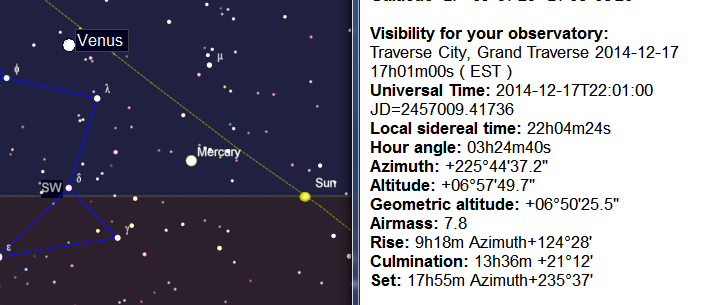
Venus at Sunset. Only 7 degrees above the horizon. Created using Cartes du Ceil (Sky Charts).
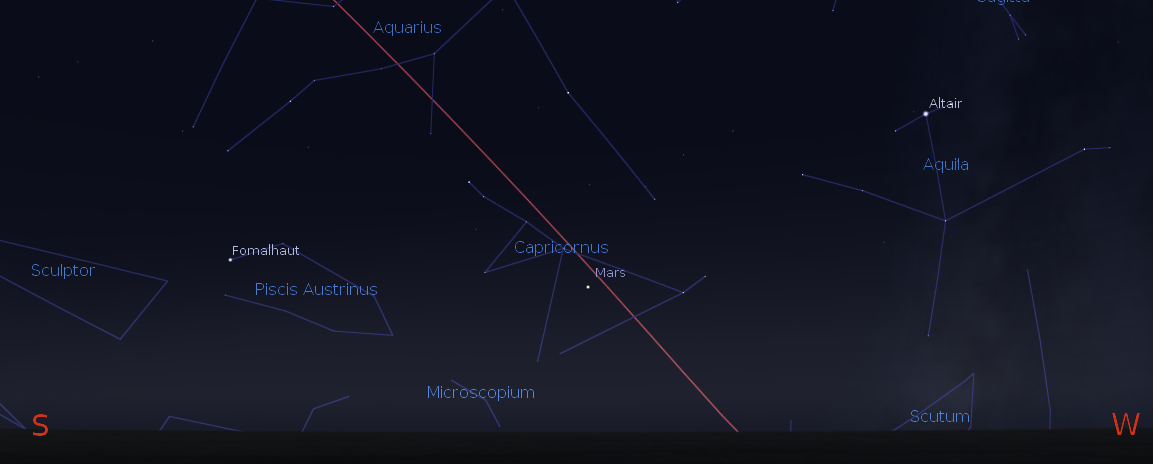
Mars and the constellations plus the ecliptic (red line) at 7 p.m. on December 17, 2014. Created using Stellarium.
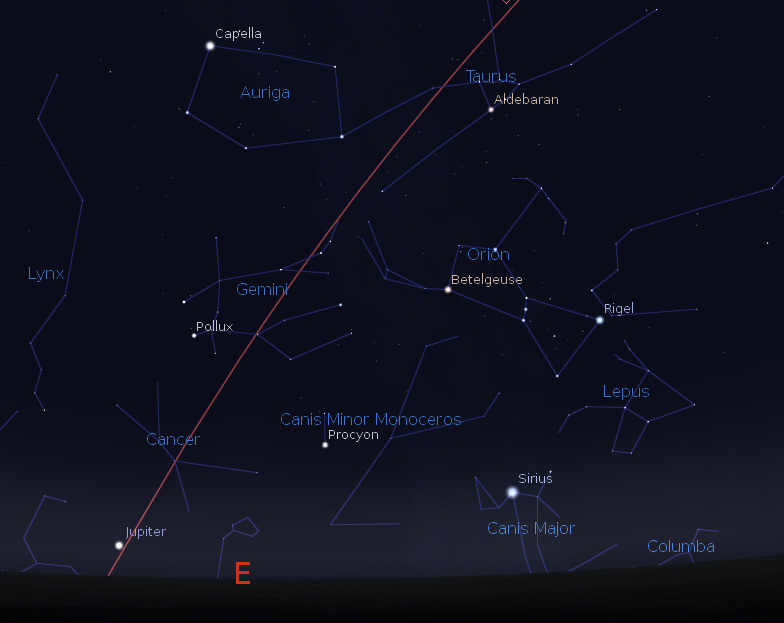
Jupiter and the winter constellations at 11 p.m. on December 17, 2014. Created using Stellarium.
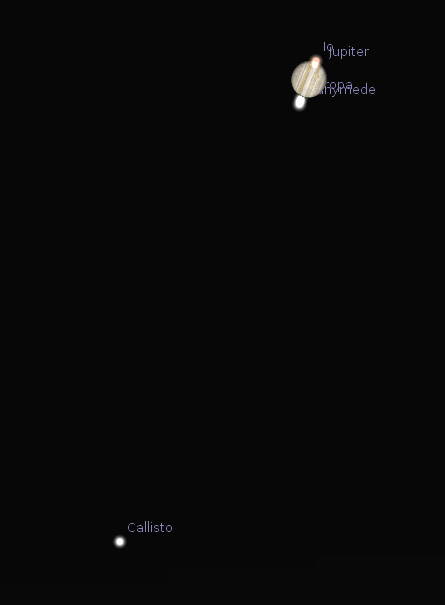
Jupiter and moons in a telescope. The moons Io, Europa and Ganymede all will be moving away from Jupiter over the evening and morning. Image as of 11 p.m. December 17, 2014. Created using Stellarium.
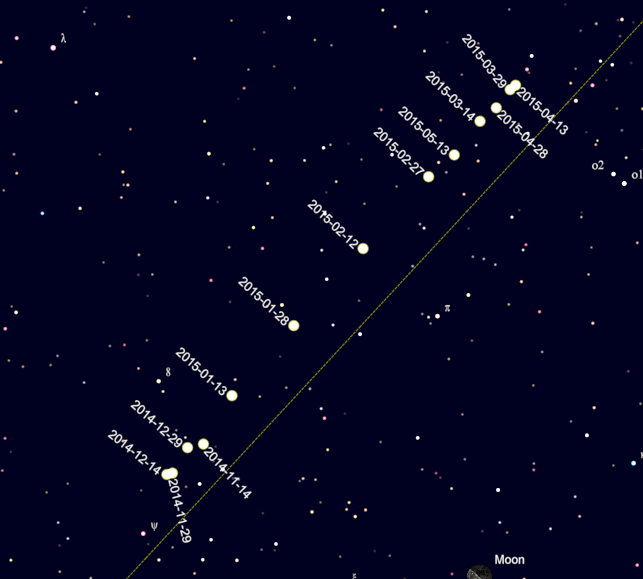
Jupiter’s Retrograde motion. Created using Cartes du Ceil (Sky Charts).
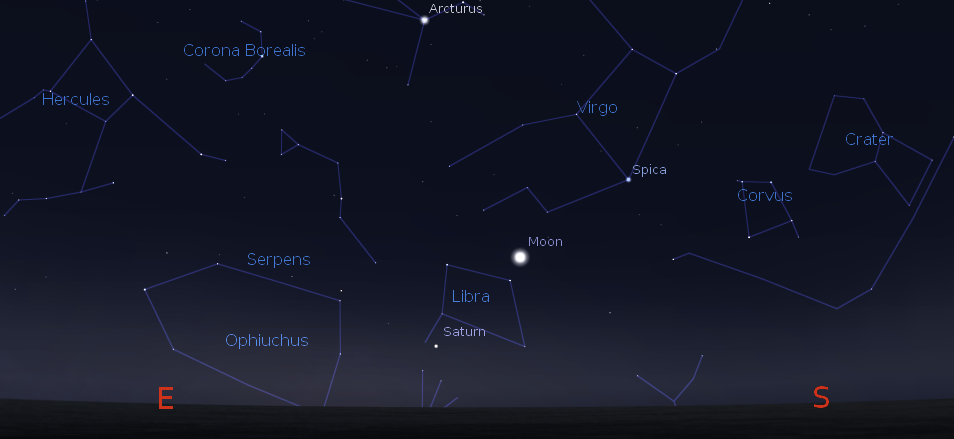
Saturn and the Moon at 7 a.m. on December 18, 2014. Created using Stellarium.
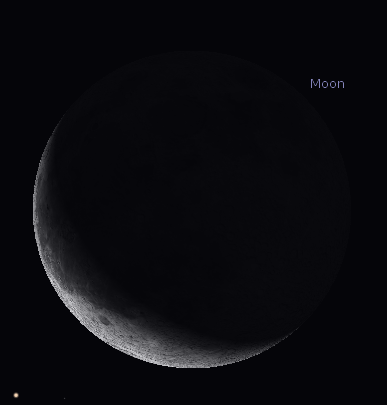
The Moon as it would appear in binoculars on December 18, 2014. Created using Stellarium.
06/12/2014 – Ephemeris – Jupiter is making up for lost time and is heading rapidly eastward
Ephemeris for Thursday, June 12th. Today the sun will be up for 15 hours and 31 minutes, setting at 9:28. The moon, 1 day before full, will set at 6:38 tomorrow morning. Tomorrow the sun will rise at 5:56.
The planet Jupiter which is the brilliant star-like object in the west is starting to pick up its eastward motion in the stars. Several months ago as the earth was passing Jupiter when it was rising in the east at sunset, it had stopped its eastward motion against the stars and headed westward. This retrograde motion was due to Earth in essence passing the slower moving Jupiter. Now that it’s on the other side of the sun Jupiter is making up for lost time because it and Earth are now moving in opposite directions. This I see in the week to week setting times of Jupiter. Stars rise and set 4 minutes earlier each night. For Jupiter its down to three minutes, meaning it’s moving eastward. When we see it again in December it will have blown past Cancer to Leo, but it will later backtrack into Cancer.
Times are for the Traverse City/Interlochen area of Michigan. They may be different for your location.
Addendum
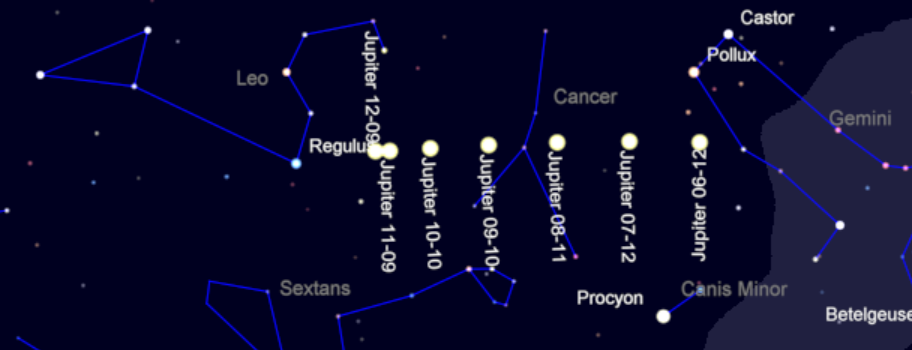
Jupiter’s apparent motion over the next 180 days. Note by December Jupiter will slow and will begin its retrograde loop as the Earth catches up with it again. Created using Cartes du Ciel (Sky Charts).
02/25/2014 – Ephemeris – Mars starts its retrograde motion this weekend
Ephemeris for Tuesday, February 25th. The sun will rise at 7:26. It’ll be up for 10 hours and 58 minutes, setting at 6:24. The moon, 3 days past last quarter, will rise at 5:15 tomorrow morning.
The planet Mars, which rises about 10:30 p.m. and is near the star Spica, is slowing its eastward motion as the Earth approaches it. Mars will stop and appear to reverse course on Saturday March 1st. It will begin what astronomers call retrograde motion. This westward motion will continue past Mars’ opposition with the sun on April 8th, and its closest approach to the Earth on April 14th. Mars retrograde motion will end on May 21st when Mars will resume its prograde or eastward motion. The ancient Greeks especially had a problem with this because they believed that celestial bodies traveled in uniform circular motion. They added a circle on the planet’s main circle called an epicycle to kind of solve the problem. The problem was solved centuries later by Copernicus who made the earth another planet and Kepler who made the planet orbits elliptical.
Times are for the Traverse City/Interlochen area of Michigan. They may be different for your location.
Addendum
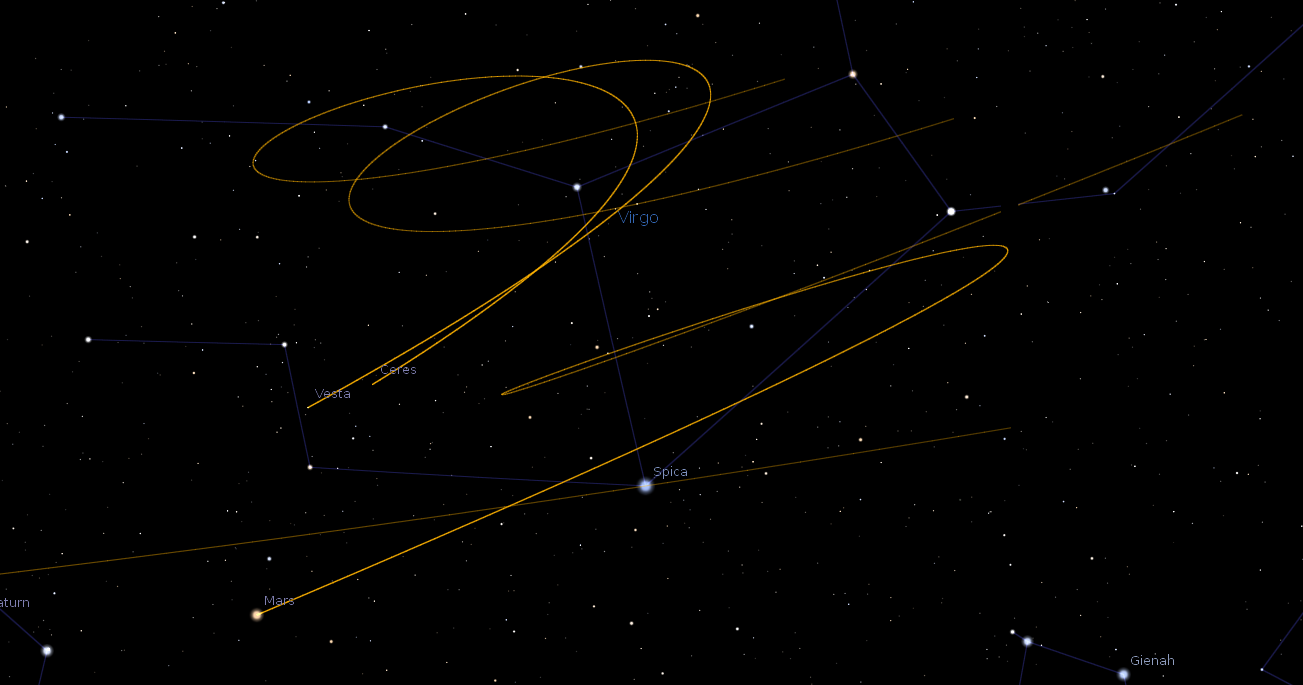
The trails of Mars and three asteroids from December 2013 to August 2014. Created using Stellarium.
Vesta and Ceres are going retrograde at the same time as Mars. The Dawn spacecraft traveling between Vesta to Ceres is about half way in between them. The other trail, not exhibiting retrograde is that of the small asteroid 2012 DA14 whose claim to fame is that it passed inside the ring of geosynchronous satellites on February 15, 2013. It was completely upstaged a few hours earlier by the meteor that exploded over Chelyabinsk, Russia. It looks like the orbital trail shown for 2012 DA14 has not been updated. As the result of the encounter with Earth that day the asteroid’s orbit was altered. 2012 DA14 is a provisional designation based on the year, half month and order of discovery. It’s permanent designation with a name is 367943 Duende. The name of the asteroid is usually up to the discoverer with the approval of the International Astronomical Union (IAU). It is the 367,943rd asteroid whose orbital elements are known. BTW Ceres is 1 Ceres, and Vesta is 4 Vesta. Though the 4th asteroid found, Vesta is the brightest, at the very limit of naked eye visibility.
 Bob Moler's Ephemeris Blog