Archive
07/25/2018 – Ephemeris – The bright planets this week
Ephemeris for Wednesday, July 25th. The Sun rises at 6:21. It’ll be up for 14 hours and 55 minutes, setting at 9:16. The Moon, 2 days before full, will set at 5:13 tomorrow morning.
It’s Wednesday and time to look for and at the bright planets. Three of them are visible in the evening sky. The brilliant beacon of Venus will be visible in the western twilight from about 9:40 p.m. until it sets at 11:07 p.m. Mercury, is now too close to the Sun be seen. Jupiter will be in the south-southwest as it gets dark. It is only outshone by Venus, the Moon, and for a few weeks by Mars at its closest. Jupiter will set at 1:15 a.m. Saturn will start the evening low in the southeast and will stay relatively low, above the Teapot of Sagittarius. It will be due south at 11:45 p.m. and will set at 4:10 a.m.. Mars will rise at 9:49 p.m. and is now only 36.0 million miles (57.9 million km) away. It will reach opposition early Friday morning.
The times given are for the Traverse City/Interlochen area of Michigan. They may be different for your location.
Addendum
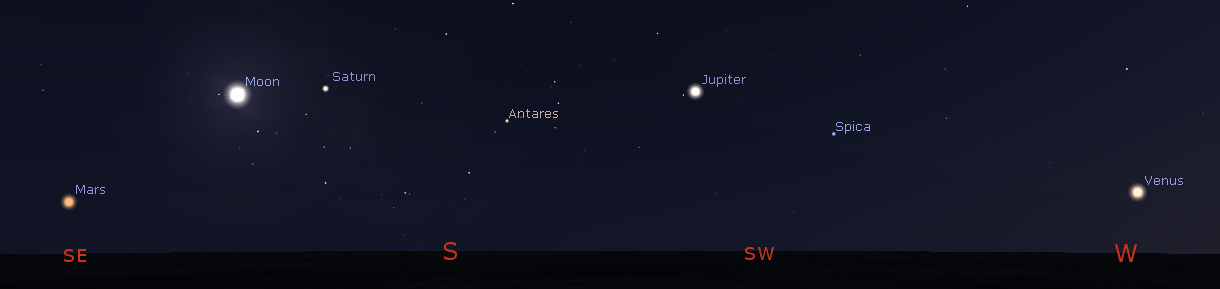
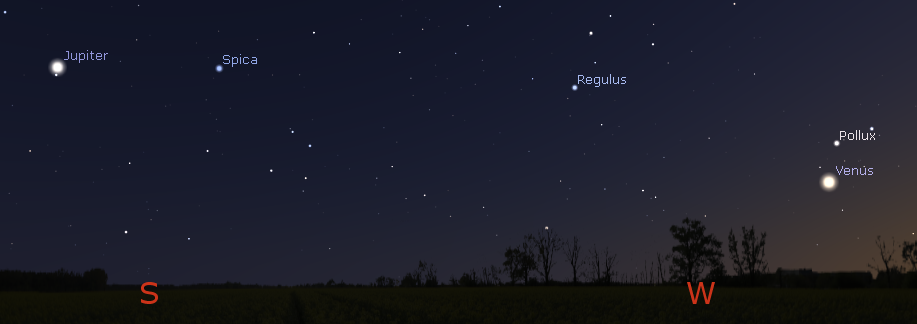
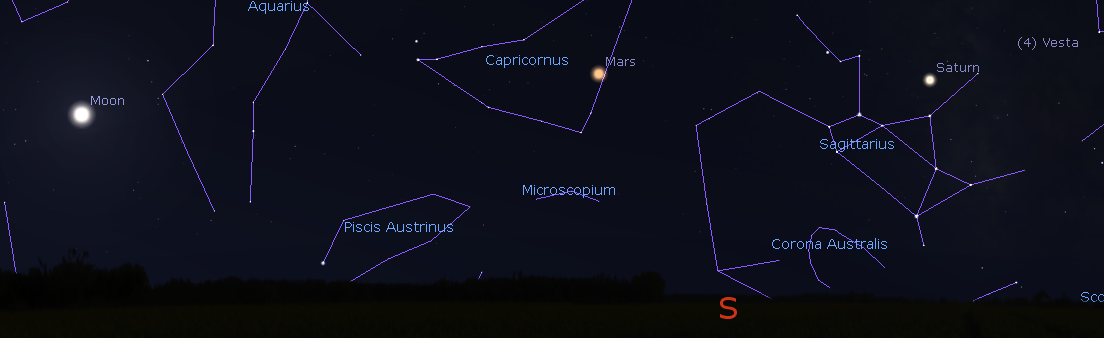
Evening planets from Venus to Saturn plus Moon and the officially morning planet (for two more days) Mars at 10:30 p.m., July 25, 2018. Click on image to enlarge. Created using Stellarium.
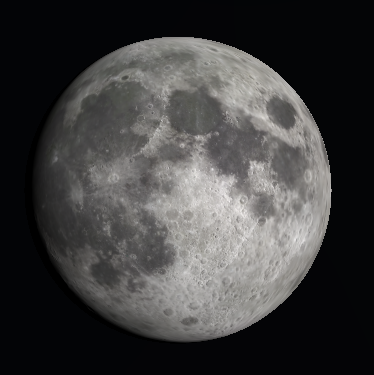
The Moon as it might be seen in binoculars this evening. Created using Stellarium.
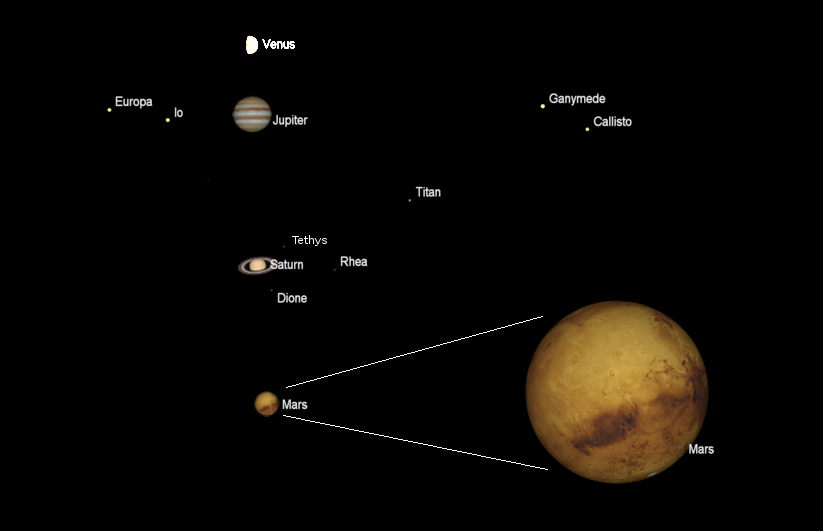
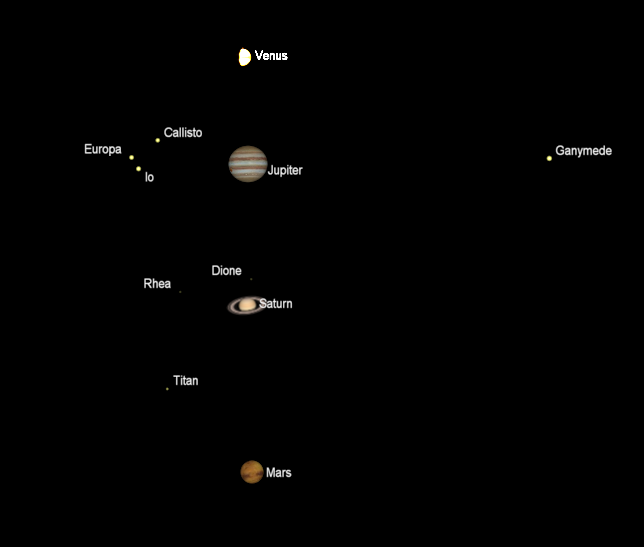
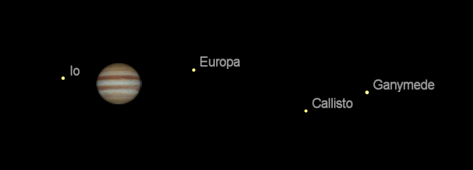
Venus, Jupiter, Saturn and Mars with the same magnification at 10:30 p.m. July 25, 2018.
Mars is also shown enlarged. It seems that the global dust storm may be abating according to one report I saw on Twitter. Created using Cartes du Ciel (Sky Charts).
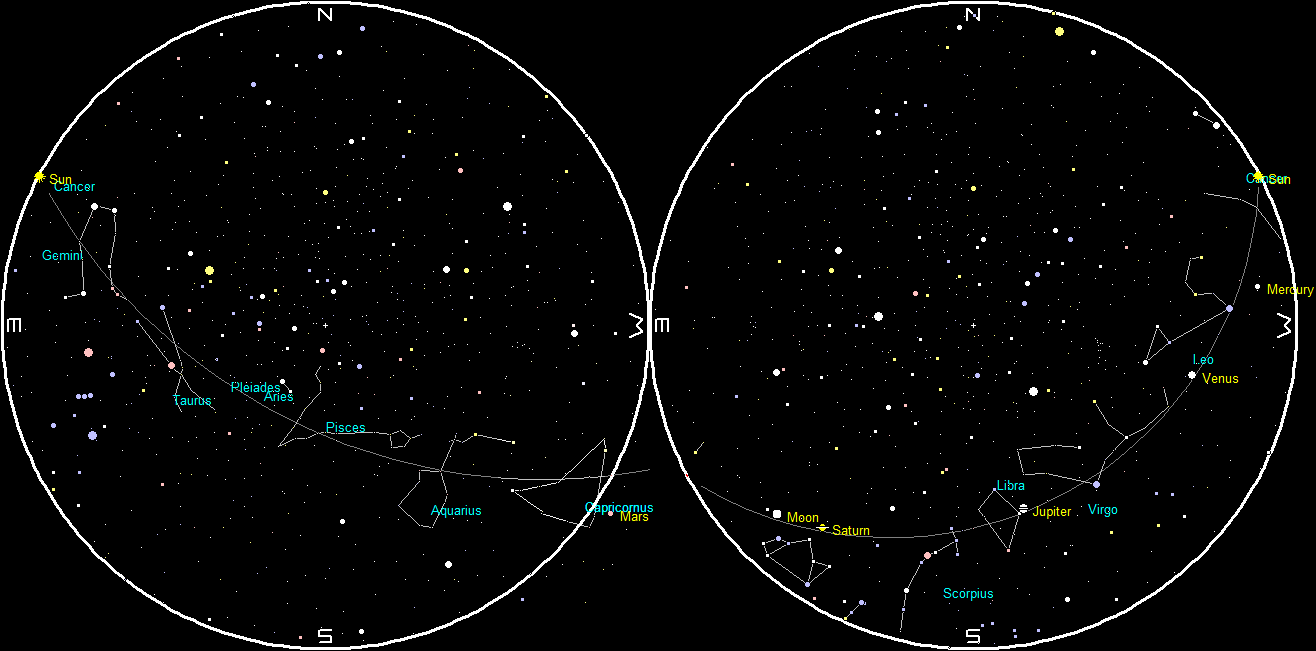
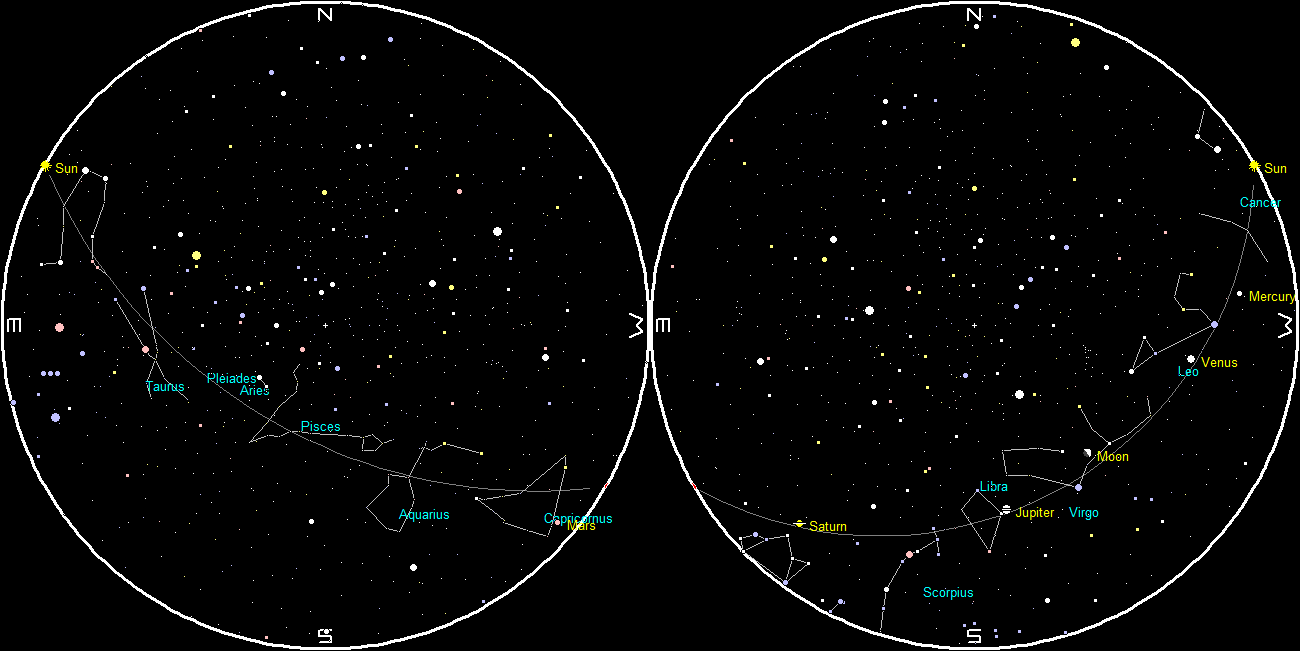
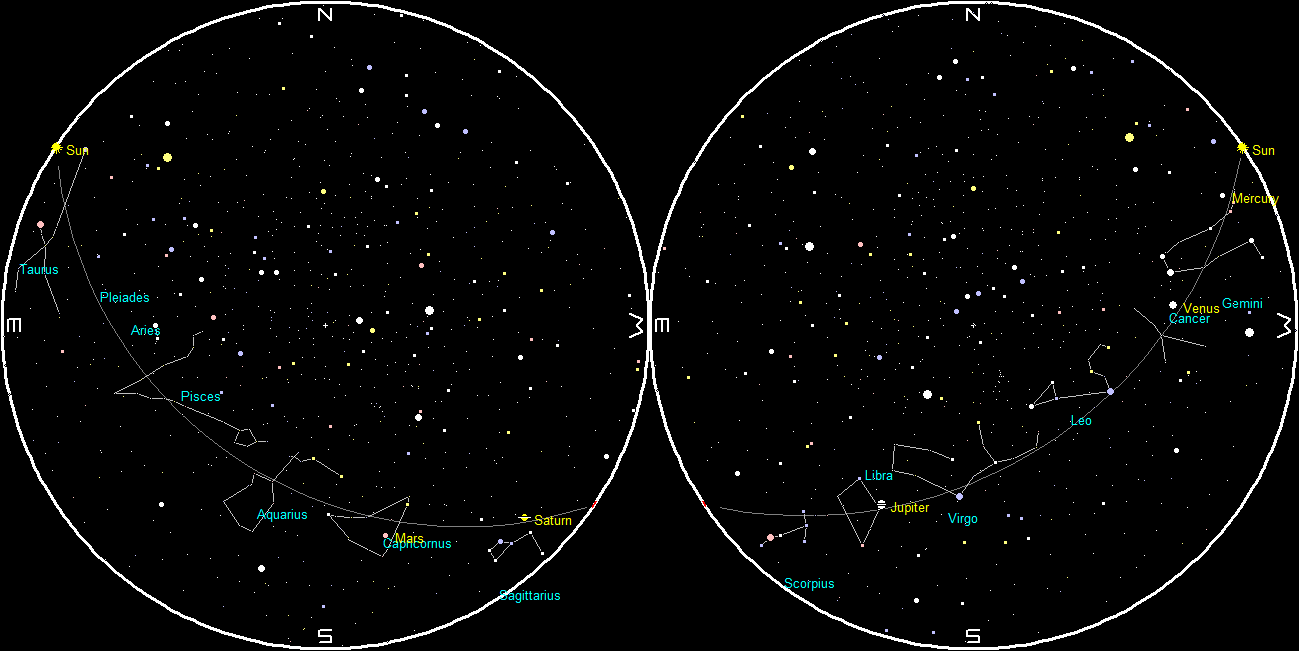
Planets and the Moon at sunset and sunrise of a single night starting with sunset on the right on July 25, 2018. The night ends on the left with sunrise on the 26th. Mars, being close to opposition and very much south of the ecliptic is not in the sky at either sunrise or sunset, I showed a patch of sky with Mars in it in the morning that was below the horizon. Click on the image to enlarge. Created using my LookingUp program.
07/19/2018 – Ephemeris – The Moon passes the evening planets one by one over the next week
Ephemeris for Thursday, July 19th. Today the Sun will be up for 15 hours and 7 minutes, setting at 9:22, and it will rise tomorrow at 6:16. The Moon, at first quarter today, will set at 1:29 tomorrow morning.
The Moon is making its monthly journey around the sky. Tonight it will be west or to the right of Jupiter. Tomorrow night Jupiter will be directly below the Moon. Next Tuesday night Saturn will appear below and left of the Moon. Next Thursday night Mars will appear below and to the left of the Moon. Mars at that time will be actually far south of the Moon, so that event usually doesn’t show in almanacs. Mars, being very close to us is in a part of its orbit that takes it south of the Earth’s orbital plane. We see that plane as the ecliptic or path of the Sun. We see the same situation when Venus is close to the Earth, and it is north or south of the ecliptic. The Moon can pass them without being listed as a conjunction.
The times given are for the Traverse City/Interlochen area of Michigan. They may be different for your location.
Addendum
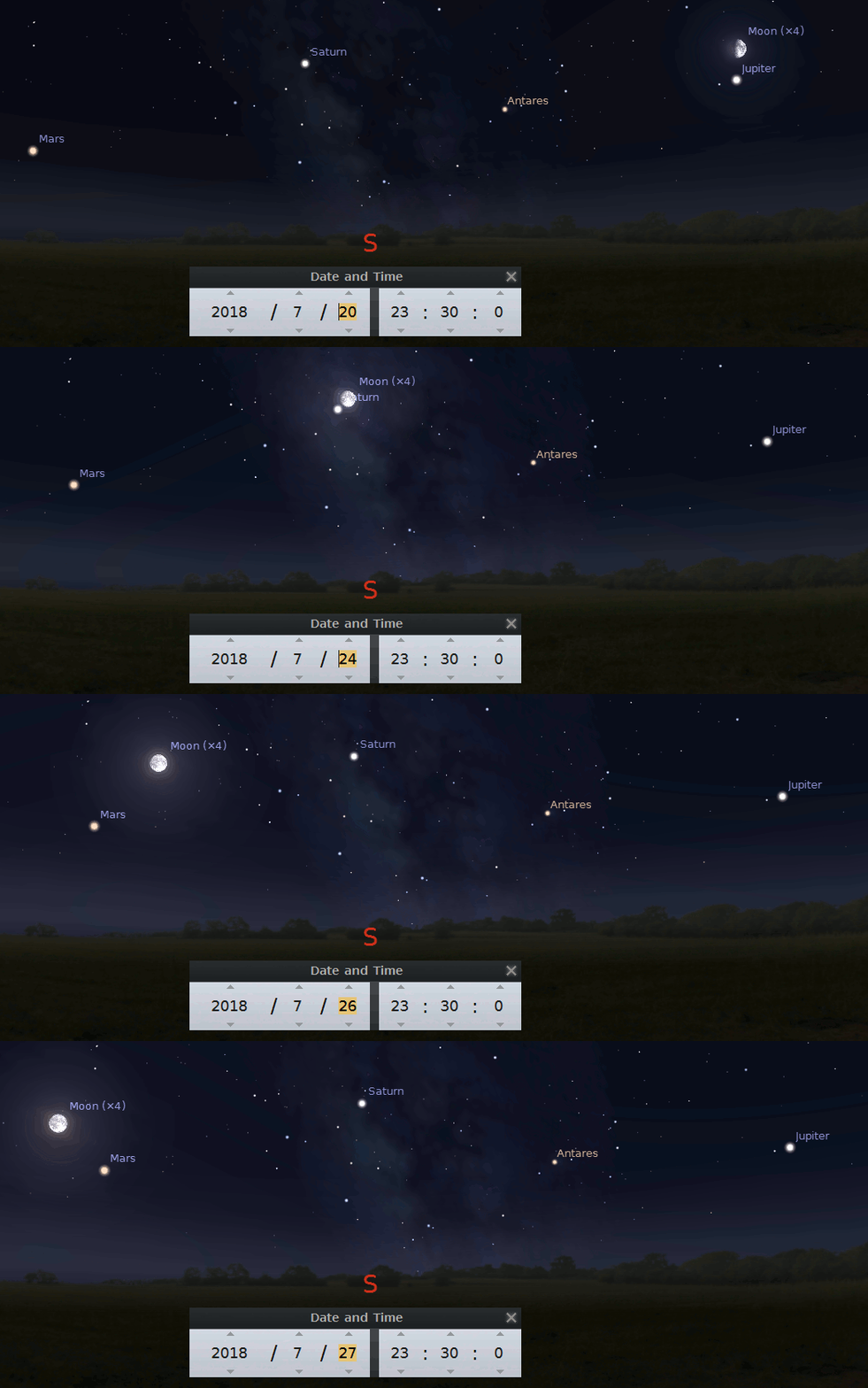
Here’s the Moon passing each of the superior evening planets in the 8 days from July 20 to July 27 2018. By the time the Mon will pass Mars it will truly be an evening planet. Mars will be at opposition with the Sun that day. Note that the Moon’s size is exaggerated by a factor of 4 to show its phase at this scale. Created using Stellarium and GIMP.
07/18/2018 – Ephemeris – Our weekly look at the bright planets
Ephemeris for Wednesday, July 18th. Today the Sun will be up for 15 hours and 8 minutes, setting at 9:23, and it will rise tomorrow at 6:15. The Moon, 1 day before first quarter, will set at 1:01 tomorrow morning.
It’s Wednesday and time to look for and at the bright planets. Four of them are in the evening sky. The brilliant beacon of Venus will be visible in the western twilight from about 9:40 p.m. until it sets at 11:21 p.m. Mercury, is fading and is far below and right of Venus, setting at 10:18 p.m. Jupiter will be in the south as it gets dark. It is only outshone by Venus, the Moon, and for a few weeks by Mars at its closest. Jupiter will set at 1:42 a.m. Saturn will start the evening low in the southeast and will stay relatively low, above the Teapot of Sagittarius. It will be due south at 12:14 a.m. and will set at 4:40 a.m.. Mars will rise at 10:20 p.m. and is now only 36.8 million miles (59.2 million km) away, in telescopes it appear to be 23.7″ (seconds of arc) in diameter. It will be due south and at its highest in the sky at 2:35 a.m. at 21 degrees altitude.
The times given are for the Traverse City/Interlochen area of Michigan. They may be different for your location.
Addendum
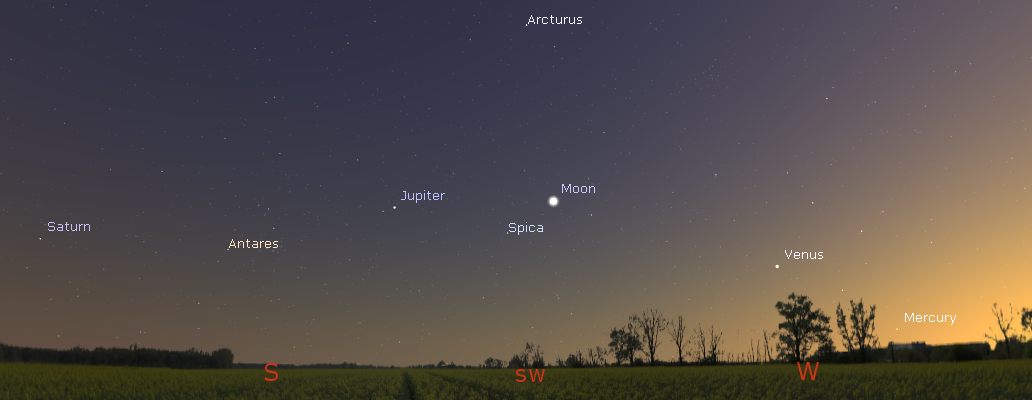
Evening planets from Mercury to Saturn and Moon at 9:50 p.m., July 18, 2018. Click on image to enlarge. Created using Stellarium.
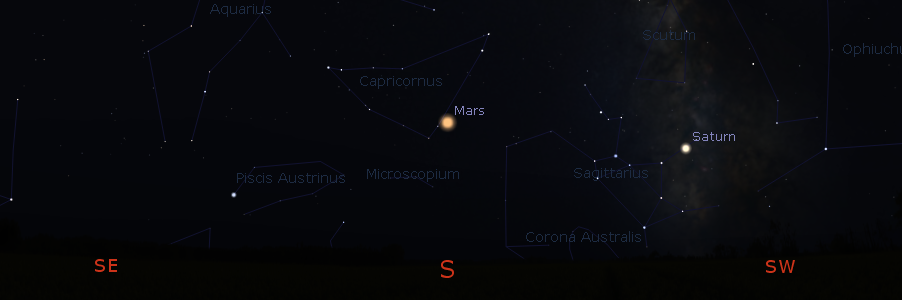
Mars at its highest in the south with Saturn at 2:35 a.m. Click on image to enlarge. Created using Stellarium.
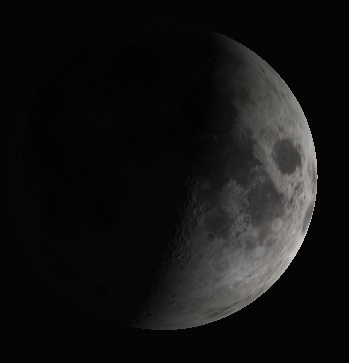
The moon as it might be seen in binoculars this evening. Created using Stellarium.
Telescopic view of Jupiter, Saturn and Mars at 11 p.m. on July 18. All at the same magnification. Created using Cartes du Ciel (Sky Charts).
Planets and the Moon at sunset and sunrise of a single night starting with sunset on the right on July 18, 2018. The night ends on the left with sunrise on the 19th. Click on the image to enlarge. Created using my LookingUp program.
07/11/2018 – Ephemeris – The bright planets for this week
Ephemeris for Wednesday, July 11th. Today the Sun will be up for 15 hours and 20 minutes, setting at 9:28, and it will rise tomorrow at 6:08. The Moon, 1 day before new, will rise at 5:36 tomorrow morning.
It’s Wednesday and time to look for and at the bright planets. Four of them are in the evening sky. The brilliant beacon of Venus will be visible in the western twilight from about 9:50 p.m. until it sets at 11:33 p.m. Mercury, reaching its greatest separation from the Sun just after midnight, is far below and right of it, setting at 10:44 p.m. Jupiter will be in the south as it gets dark. Jupiter is only outshone by Venus and the Moon, though Mars will outshine it later this month at its closest. Jupiter will set at 2:09 a.m. Saturn will start the evening low in the southeast will stay relatively low, above the Teapot of Sagittarius and will set at 5:10 a.m.. Mars will rise at 10:46 p.m. and is now outshining Saturn.
The times given are for the Traverse City/Interlochen area of Michigan. They may be different for your location.
Addendum
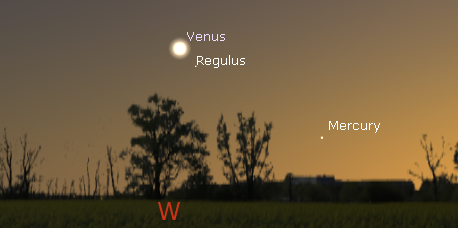
Venus and Mercury at 10 p.m. July 11, 2018. Created using Stellarium.
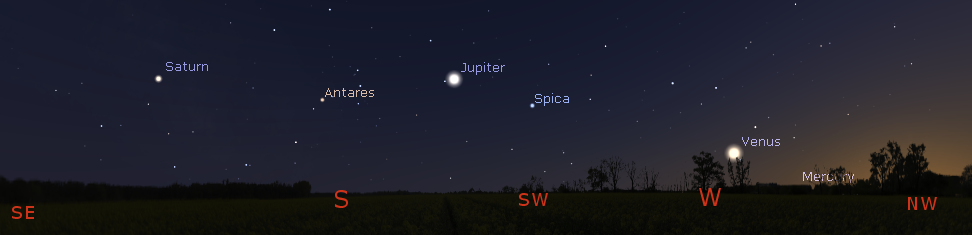
The evening planets except Mercury at 10:30 p.m. July 11, 2018. Click on the image to enlarge. Created using Stellarium.
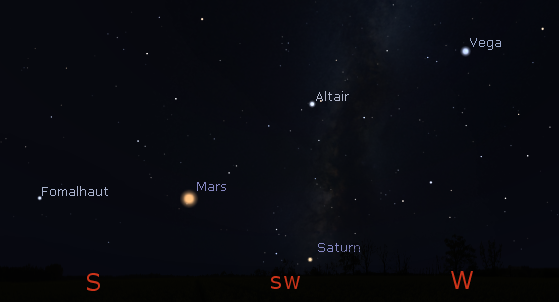
Mars and Saturn in the morning at 4:30 a.m. July 12, 2018. Created using Stellarium.
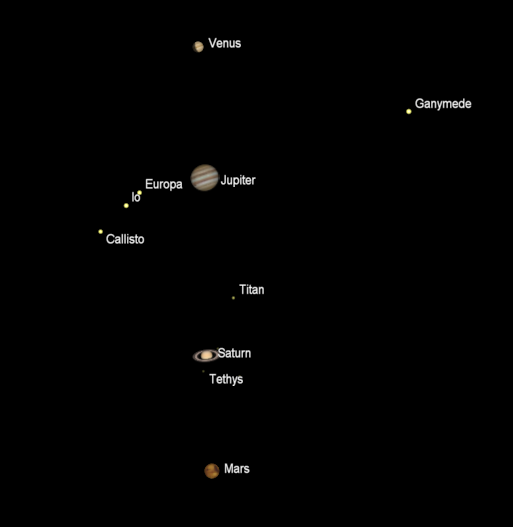
Telescopic views of Venus, Jupiter and Saturn at 10:30 p.m. on July 11, and Mars at 4:30 a.m. on July 12. All images are at the same magnification. Created using Cartes du Ciel (Sky Charts)
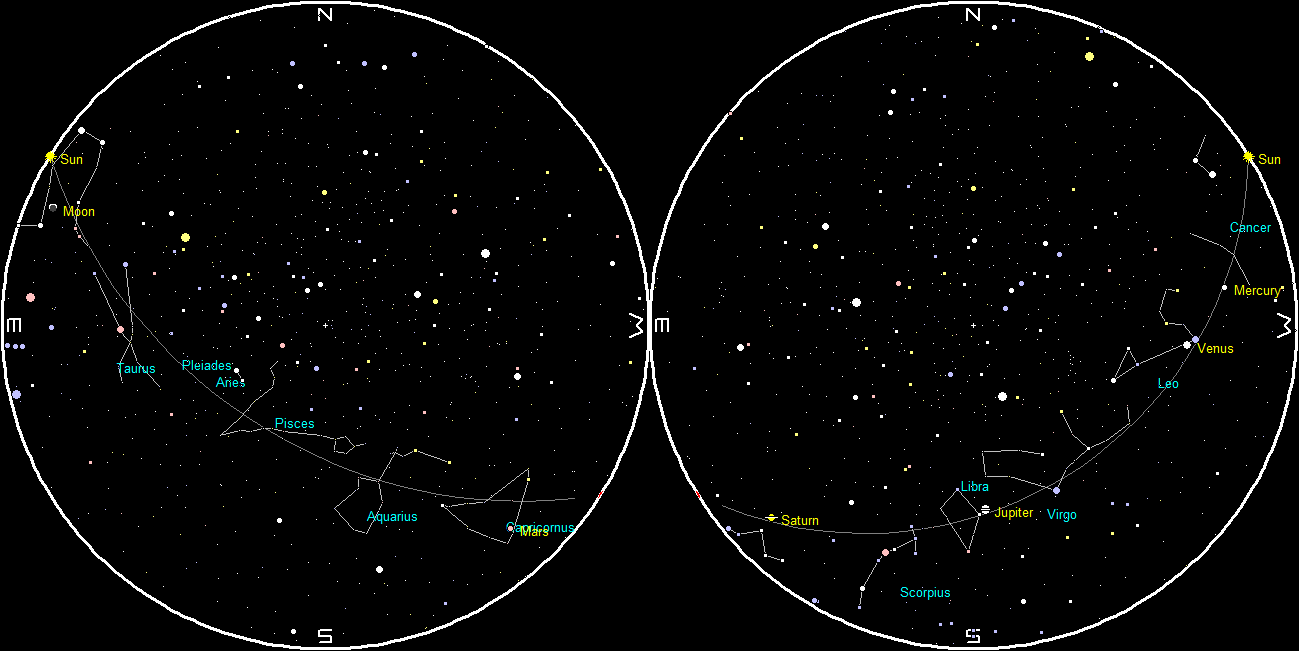
Planets and the Moon at sunset and sunrise of a single night starting with sunset on the right on July 11, 2018. The night ends on the left with sunrise on the 12th. Click on the image to enlarge. Created using my LookingUp program.
07/04/2018 – Ephemeris – The bright planets for the week of Independence Day
Ephemeris for Independence Day, Wednesday, July 4th. Today the Sun will be up for 15 hours and 28 minutes, setting at 9:31, and it will rise tomorrow at 6:03. The Moon, 2 days before last quarter, will rise at 1:13 tomorrow morning.
It’s Wednesday again and time to look for and at the bright planets. Four of them are in the evening sky. The brilliant beacon of Venus will be visible in the western twilight from about 9:50 p.m. until it sets at 11:42 p.m. Mercury is far below and right of it, setting at 10:57 p.m. Jupiter will be in the south as it gets dark. Jupiter is only outshone by Venus and the Moon, though Mars will outshine it next month at its closest. Jupiter will set at 2:37 a.m. Binoculars will show it to be bigger than star-like in size. Saturn will start the evening low in the southeast will stay relatively low, above the Teapot of Sagittarius and will set at 5:39 a.m.. Mars will rise at 11:17 p.m. and is now outshining Saturn.
The times given are for the Traverse City/Interlochen area of Michigan. They may be different for your location.
Addendum
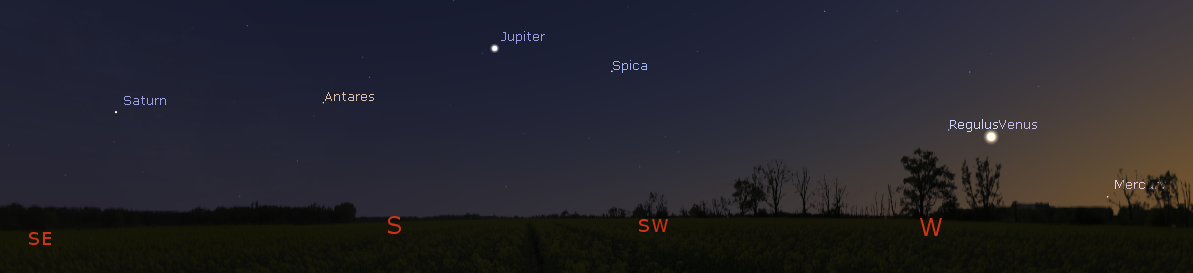
All the evening planets for July 4, 2018 at 10:30 p.m. Click on the image to enlarge. Created using Stellarium.
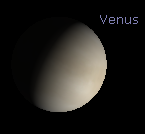
Telescopic appearance of Venus on July, 4, 2018. A moon filter helps cut down the glare to be able to more easily see the phase. Created using Stellarium.
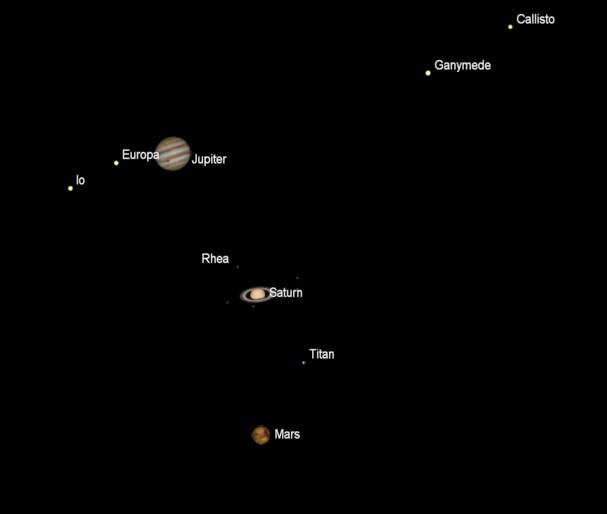
Telescopic views of Jupiter and Saturn at 10:30 p.m. on July 4, and Mars at 12 midnight on July 5, 2018 at the same magnification. Created using Cartes du Ciel (Sky Charts).
Europa’s transit of the face of Jupiter starts at 1:55 a.m. July 5th. The Great Red Spot will cross the central meridian of Jupiter at 11:19 p.m.
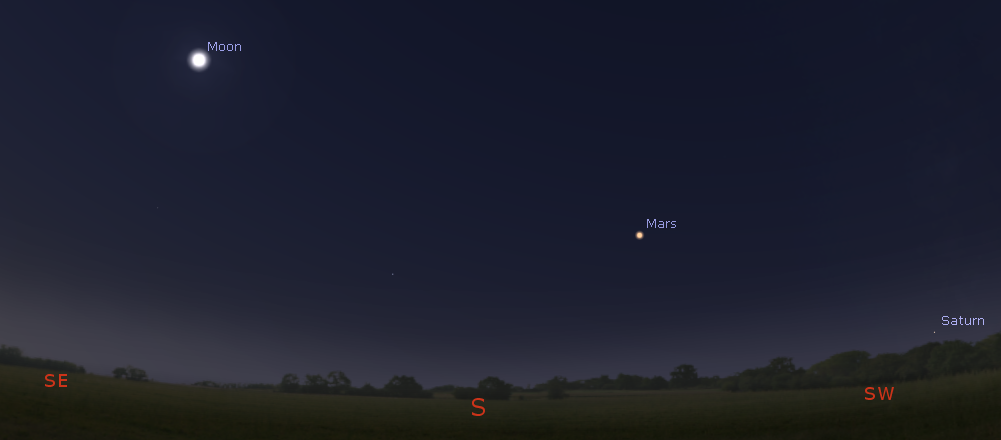
Mars Saturn and the Moon at 5 a.m. July 5, 2018. Click on the image to enlarge. Created using Stellarium.
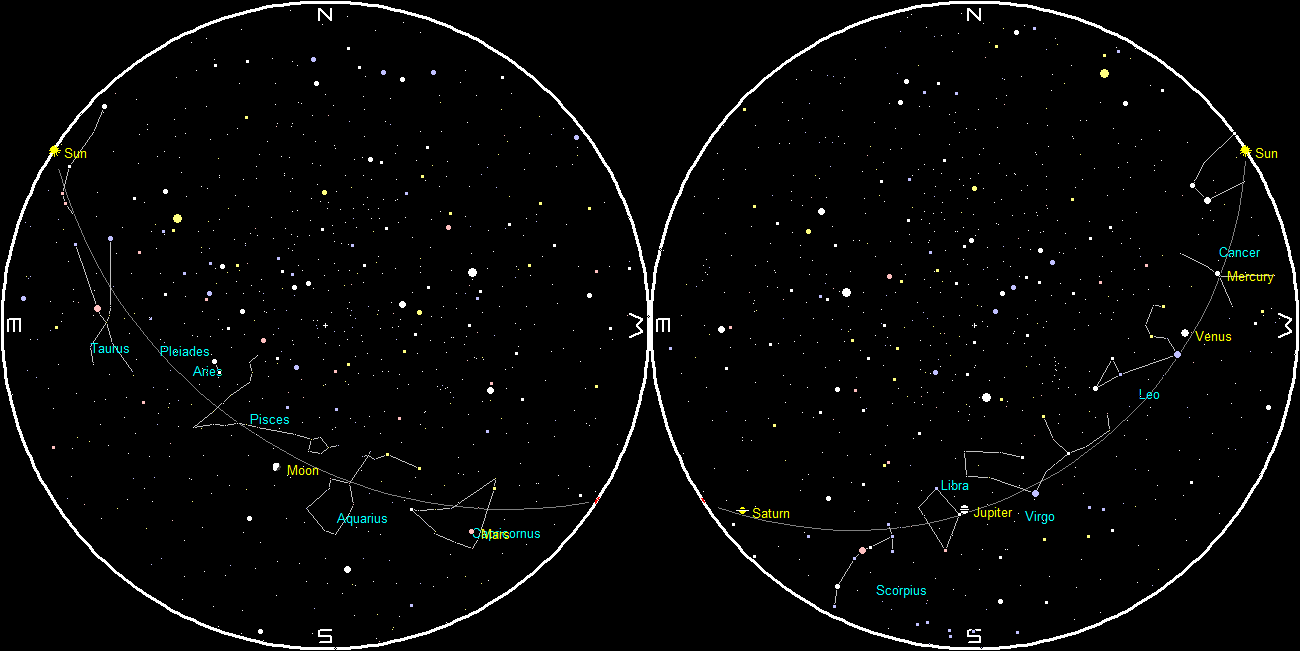
Planets and the Moon at sunset and sunrise of a single night starting with sunset on the right on July 4, 2018. The night ends on the left with sunrise on the 5th. Click on the image to enlarge. Created using my LookingUp program.
06/27/2018 – Ephemeris – Our Wednesday look at the bright planets
Wednesday, June 27th. Today the Sun will be up for 15 hours and 33 minutes, setting at 9:32, and it will rise tomorrow at 5:59. The Moon, 1 day before full, will set at 6:27 tomorrow morning.
It’s Wednesday again and time to look for and at the bright planets. Three of them are in the evening sky. The brilliant beacon of Venus will be visible in the western twilight from about 9:50 p.m. until it sets at 11:53 p.m. Mercury is far below and right of it, setting at 10:59 p.m. Jupiter will be in the south as it gets dark. Jupiter is only outshone by Venus and the Moon, though Mars will outshine it next month at its closest. Jupiter will set at 3:05 a.m. Binoculars will show it to be bigger than star-like in size. Saturn which is opposite the Sun in the sky today will rise as the Sun sets. It’s right below the Moon tonight. Mars will rise at 11:39 p.m. and is now outshining Saturn.
The times given are for the Traverse City/Interlochen area of Michigan. They may be different for your location.
Addendum
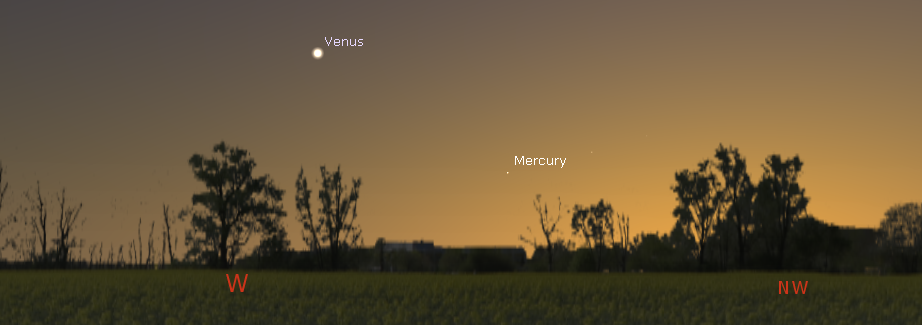
Venus and Mercury low in the western sky ay 10 p.m. June 27, 2018. Click on image to enlarge. Created using Stellarium.
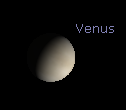
Telescopic appearance of Venus on June 27, 2018. A moon filter helps cut down the glare to be able to more easily see the phase. Created using Stellarium.
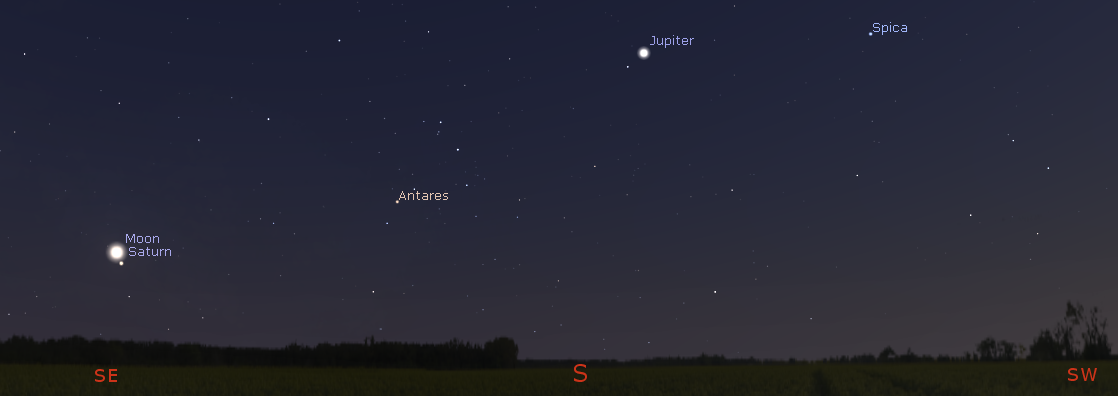
Jupiter, Saturn and the Moon tonight at 10:30 p.m. on June 27, 2018. Click on the image to enlarge. Created using Stellarium.
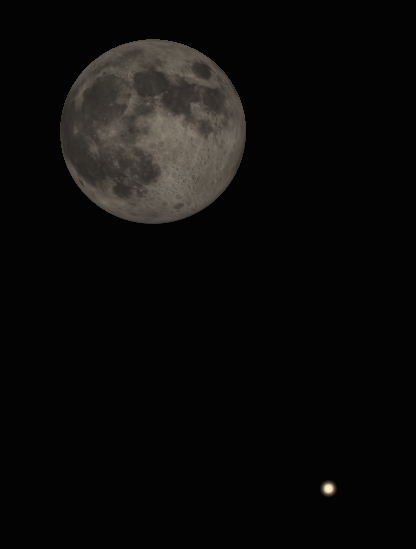
The Moon and Saturn as they might appear in binoculars at 10:30 p.m. June 27, 2018. Created using Stellarium.
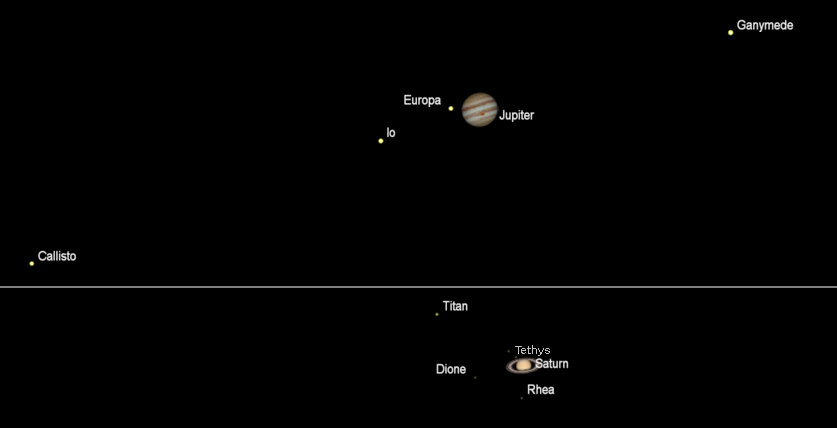
Jupiter and Saturn with the same magnification at 10:30 p.m. June 27, 2018. Information on Europa events and the Great Red Spot is below. Created using Cartes du Ciel (Sky Charts).
Moon   Event            Universal Time    Local Time
Europa Transit start    28 Jun 2018 3:30  27 Jun 2018 11:30 p.m.
Europa Shadow start     28 Jun 2018 5:34  28 Jun 2018  1:34 a.m.
Europa Transit end      28 Jun 2018 5:44  28 Jun 2018  1:44 a.m.
Europa Shadow end       28 Jun 2018 7:49  28 Jun 2018  3:49 a.m.
Great Red Spot Transit  28 Jun 2018 2:32  27 Jun 2018 10:32 p.m.
Source of Jovian events: https://www.projectpluto.com/jevent.htm
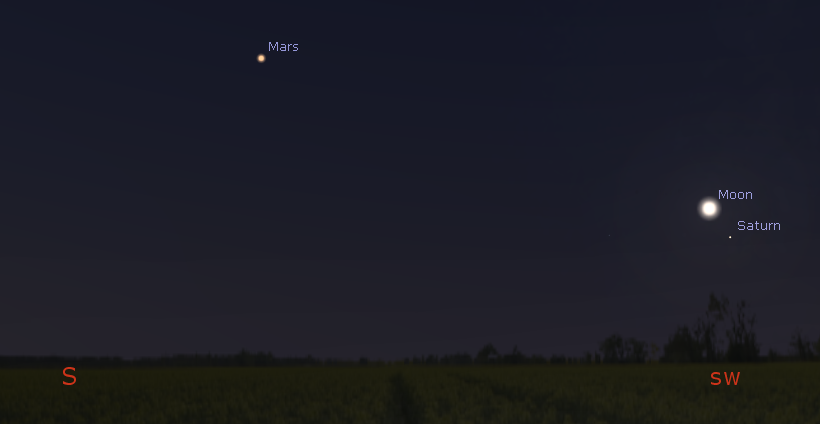
Mars, Saturn and the Moon at 5 a.m. June 28, 2018. Click on the image to enlarge. Created using Stellarium.
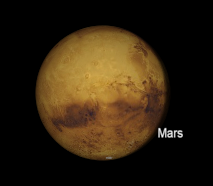
Greatly enlarged telescopic Mars at 5 a.m. June 28, 2018. Note that the dark albedo features may be covered by a global dust storm currently raging on the Red Planet. Created using Cartes du Ciel (Sky Charts).
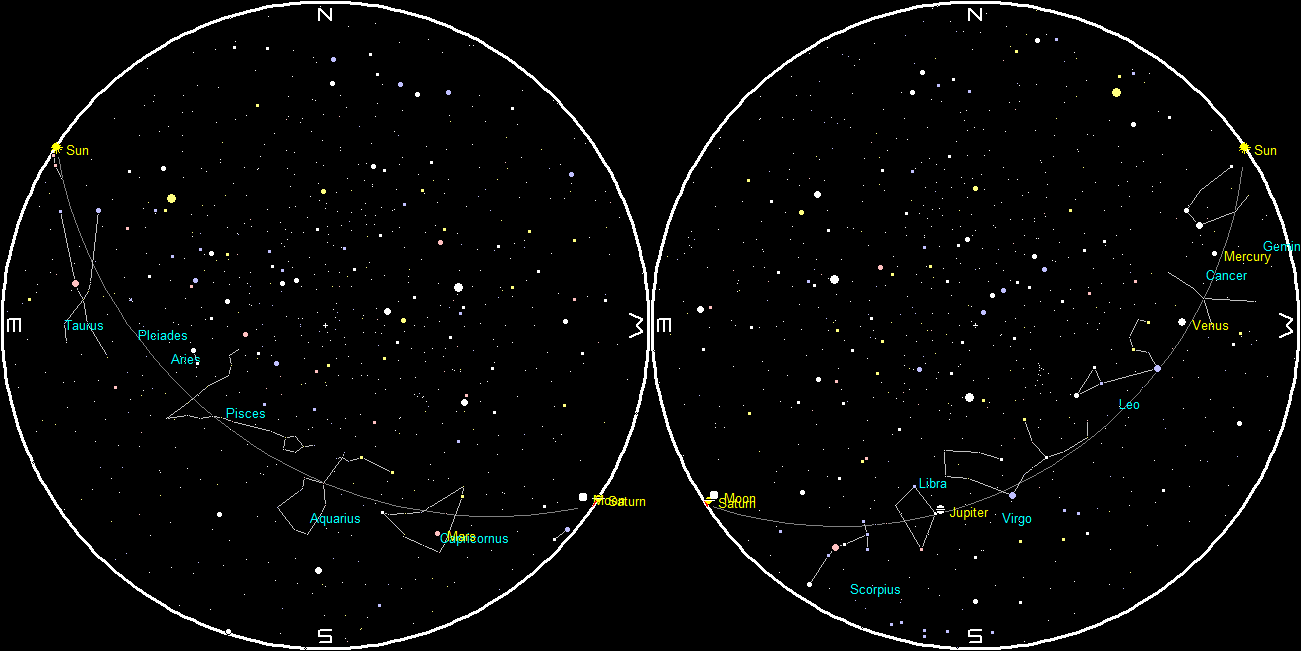
Planets and the Moon at sunset and sunrise of a single night starting with sunset on the right on June 27, 2018. The night ends on the left with sunrise on the 28th. Click on the image to enlarge. Created using my LookingUp program.
06/20/2018 – Ephemeris – Let’s check out the bright planets for this week
Ephemeris for Wednesday, June 20th. Today the Sun will be up for 15 hours and 34 minutes, setting at 9:31, and it will rise tomorrow at 5:57. The Moon, at first quarter today, will set at 2:29 tomorrow morning.
It’s Wednesday again and time to look for and at the bright planets. Three of them are in the evening sky. The brilliant beacon of Venus will be visible in the western twilight from about 9:50 p.m. until it sets at 11:59 p.m. Mercury is far below and right of it, setting at 10:48 p.m. Jupiter will be in the south as it gets dark. Jupiter is only outshone by Venus and the Moon. And after Venus sets will have the night to itself as the brightest star-like object until it sets at 3:34 a.m. Binoculars will show it to be bigger than star-like in size. Saturn will rise at 9:46 p.m. in the east-southeast. Mars will rise at 12:07 a.m. and is now outshining Saturn, and in July and August will even outshine Jupiter.
The times given are for the Traverse City/Interlochen area of Michigan. They may be different for your location.
Addendum
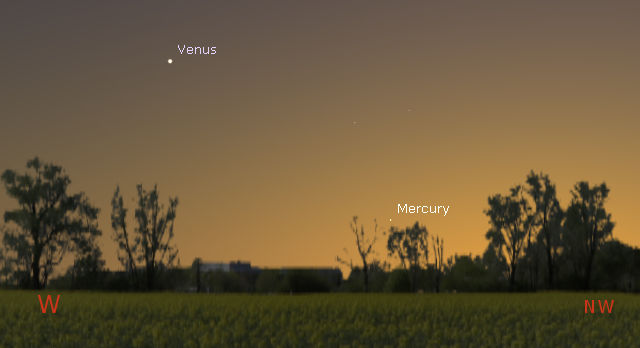
Venus and Mercury at 10 p.m., about a half hour after sunset, June 20, 2018. Created using Stellarium.
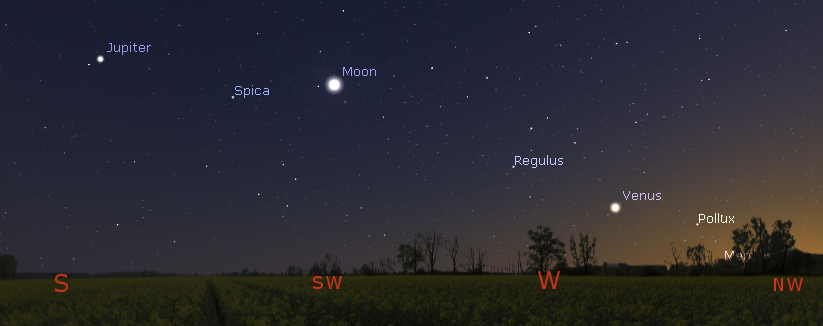
Venus, the Moon and Jupiter at 10:30 p.m., about an hour after sunset, on June 20, 2018. Created using Stellarium.
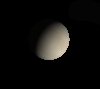
The phase exhibited by Venus in a telescope on June 20, 2018. Created using Stellarium.
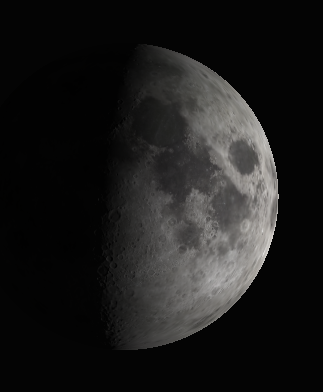
The moon as it might be seen in binoculars at 10:30 p.m. June 20, 2018. Created using Stellarium.
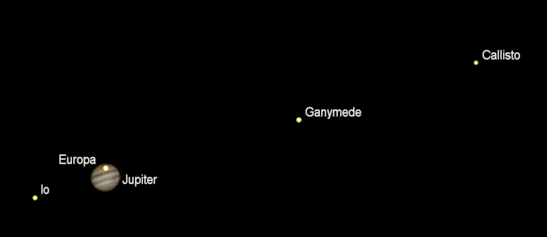
Jupiter and moons at 10:30 p.m. June 20, 2018. The image shows Europa in transit of Jupiter. A satellite is normally invisible against the face of Jupiter, but its shadow can be seen falling on the planet. Created using Cartes du Ciel (Sky Charts).
Satellite  Event        Local Date/Time       Universal Date/Time
Europa:   Transit start 20 Jun 2018  9:06 pm  21 Jun 2018 1:06
Europa:   Shadow start  20 Jun 2018 10:57 pm  21 Jun 2018 2:57
Europa:   Transit end   20 Jun 2018 11:20 pm  21 Jun 2018 3:20
Europa:   Shadow end    21 Jun 2018  1:12 am  21 Jun 2018 5:12
Source of satellite events: https://www.projectpluto.com/jevent.htm
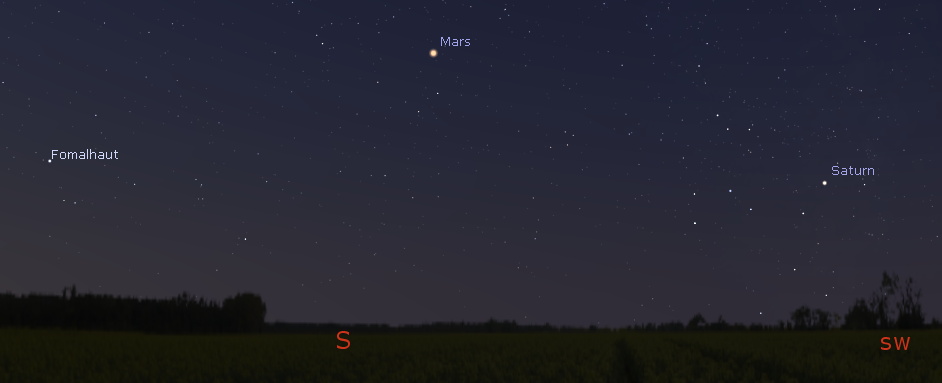
Morning planets at 5 a.m. June 21, 2018. Click on image to enlarge. Created using Stellarium.
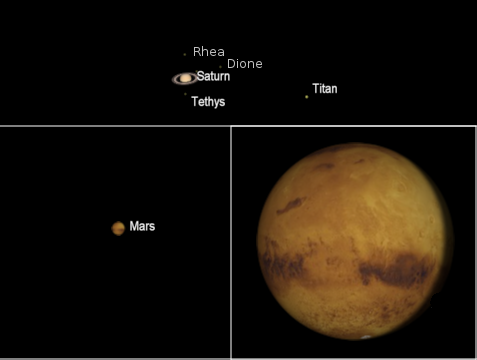
Saturn and Mars with the same magnification with an inset of Mars at higher magnification at 5 a.m. June 21, 2018. Created using Cartes du Ciel (Sky Charts).
Note on the inset image. The south polar cap is probably larger than shown. Also with the dust storm in progress the dark features may be obscured. The dust storm clouds appear brighter than the normal surface of the planet.
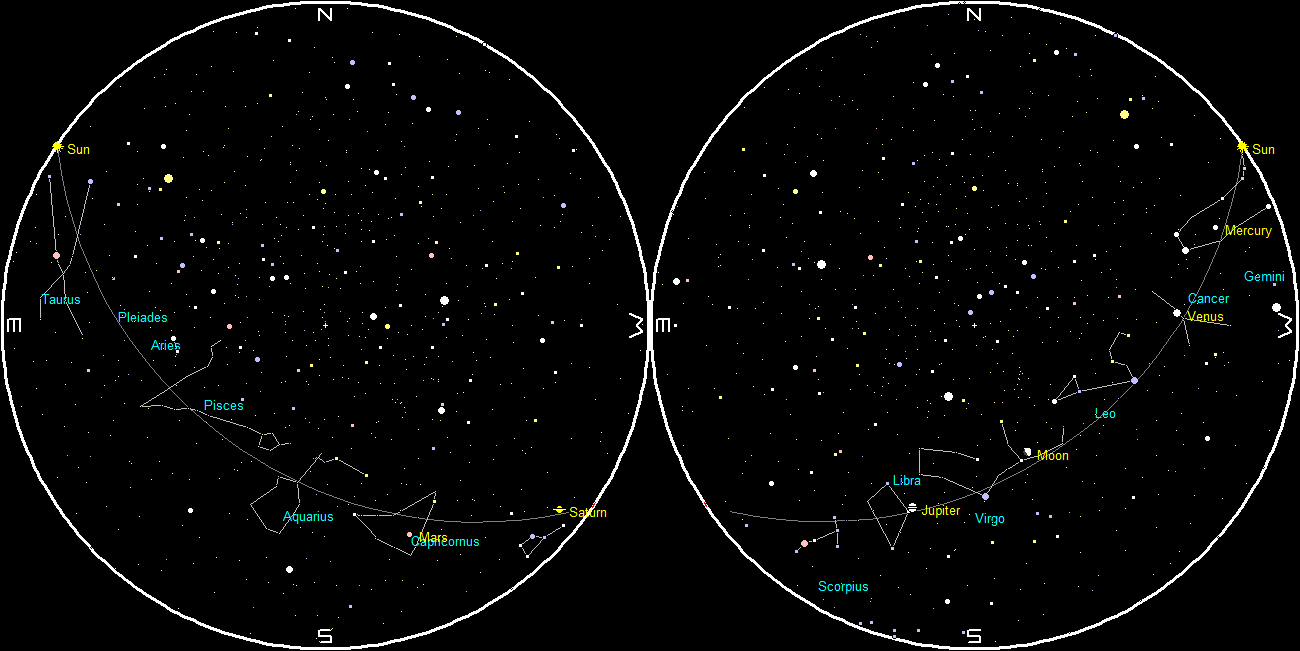
Planets and the Moon at sunset and sunrise of a single night starting with sunset on the right on June 20, 2018. The night ends on the left with sunrise on the 21st. Click on the image to enlarge. Created using my LookingUp program.
06/13/2018 -Ephemeris – Time to check out the bright planets
Ephemeris for Wednesday, June 13th. Today the Sun will be up for 15 hours and 32 minutes, setting at 9:29, and it will rise tomorrow at 5:56. The Moon is new today, and won’t be visible.
It’s Wednesday again and time to look for and at the bright planets. Two of them are visible in the evening sky. The brilliant beacon of Venus will be visible in the western twilight from about 9:50 p.m. until it sets at 11:59 p.m. Jupiter will be in the south-southeast as it gets dark. Jupiter is only outshone by Venus and the Moon. And after Venus sets will have the night to itself as the brightest star-like object until it sets at 4:03 a.m. Binoculars will show it to be bigger than star-like in size flanked by several little star-like moons to either side. Saturn will rise at 10:16 p.m. in the east-southeast. Mars will rise at 12:29 a.m. and is now outshining Saturn, and in July and August will even outshine Jupiter.
The times given are for the Traverse City/Interlochen area of Michigan. They may be different for your location.
Addendum
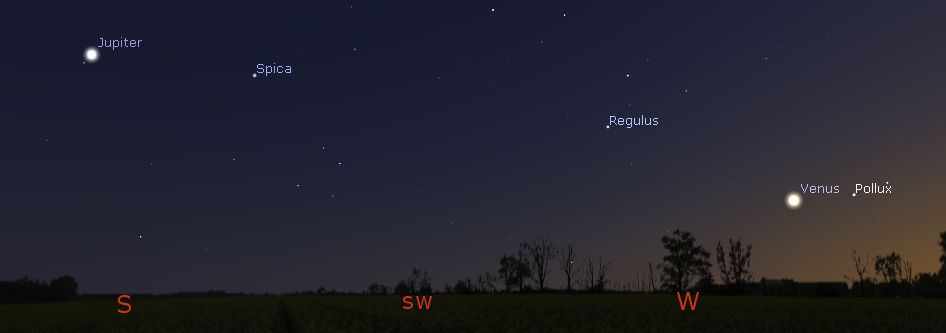
Venus and Jupiter at 10:30 p.m. June 13, 2018. Click on image to enlarge. Created using Stellarium.
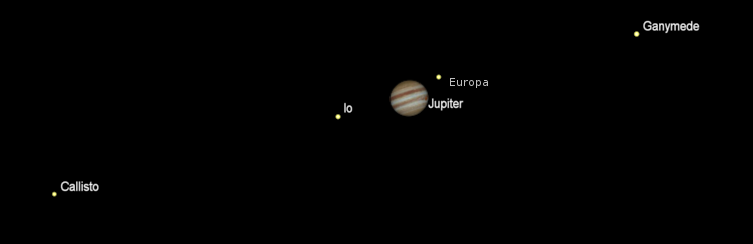
Jupiter and moons at 10:30 p.m. June 13, 2018. Created using Cartes du Ciel (Sky Charts).
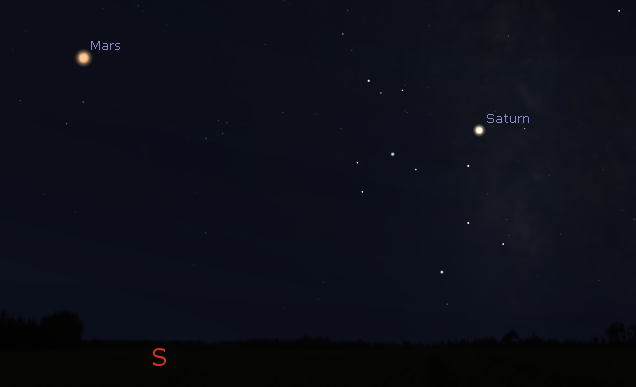
Morning planets at 4:30 a.m. June 14, 2018. Click on image to enlarge. Created using Stellarium.
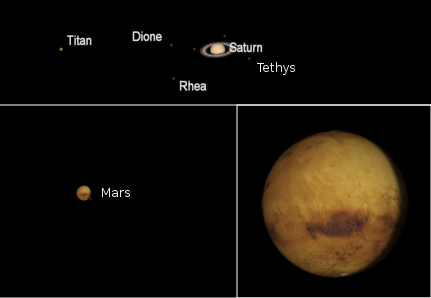
Saturn and Mars with the same magnification with an inset of Mars at higher magnification at 4:30 a.m. June 14, 2018. Created using Cartes du Ciel (Sky Charts).
Planets and the Moon at sunset and sunrise of a single night starting with sunset on the right on June 13, 2018. The night ends on the left with sunrise on the 14th. Click on the image to enlarge. Created using my LookingUp program.
06/06/2018 – Ephemeris – Our weekly look at the bright planets
Ephemeris for Wednesday, June 6th. Today the Sun will be up for 15 hours and 27 minutes, setting at 9:25, and it will rise tomorrow at 5:57. The Moon, at last quarter today, will rise at 2:43 tomorrow morning.
It’s Wednesday again and time to look for and at the bright planets. Two of them are visible in the evening sky. The brilliant beacon of Venus will be visible in the western twilight from about 9:45 p.m. until it sets at 12:07 a.m. Jupiter will be in the south-southeast as it gets dark. Jupiter is only outshone by Venus and the Moon. And after Venus sets will have the night to itself as the brightest star-like object until it sets at 4:32 a.m. Binoculars will show it to be bigger than star-like in size flanked by little star-like moons. Saturn will rise at 10:45 p.m. in the east-southeast. Mars will rise at 12:50 a.m. and is now outshining Saturn, and will, in July and August even outshine Jupiter.
The times given are for the Traverse City/Interlochen area of Michigan. They may be different for your location.
Addendum
Venus and Jupiter at 10:30 p.m. June 6, 2018. Click on image to enlarge. Created using Stellarium.
Jupiter and moons at 10:30 p.m. June 6, 2018. Created using Cartes du Ciel (Sky Charts).
Morning planets and the Moon at 4:30 a.m. June 7, 2018. Click on image to enlarge. Created using Stellarium.
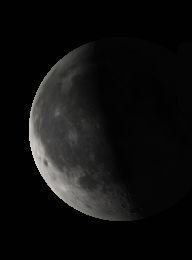
The moon as it might be seen in binoculars at 4:30 a.m. June 7, 2018. Created using Stellarium.
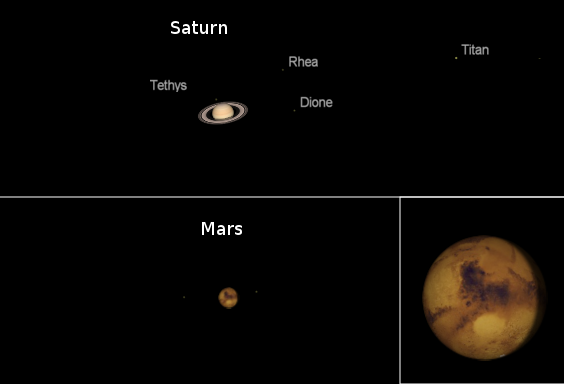
Saturn and Mars with the same magnification with an inset of Mars at higher magnification at 4:30 a.m. June 7, 2018. Created using Cartes du Ciel (Sky Charts).
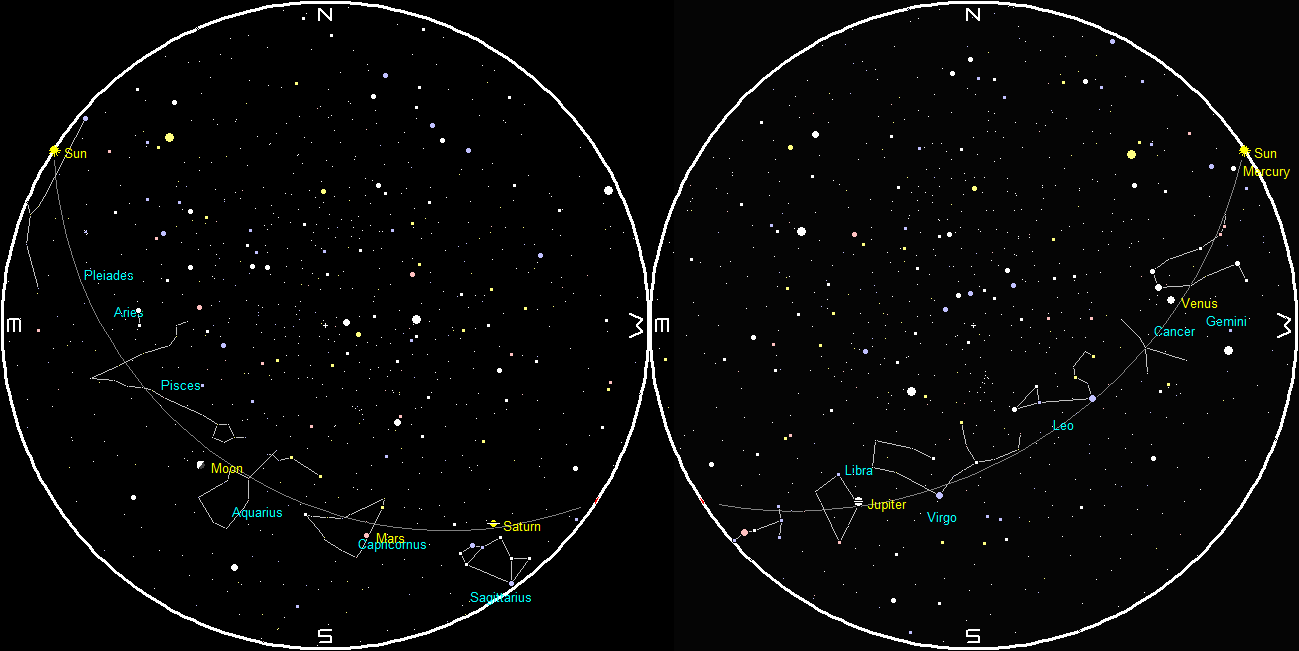
Planets and the Moon at sunset and sunrise of a single night starting with sunset on the right on June 6, 2018. The night ends on the left with sunrise on the 7th. Click on the image to enlarge. Created using my LookingUp program.
05/30/2018 – Ephemeris – Its Wednesday, time to locate the bright planets
Ephemeris for Wednesday, May 30th. Today the Sun will be up for 15 hours and 18 minutes, setting at 9:19, and it will rise tomorrow at 6:00. The Moon, 1 day past full, will rise at 10:18 this evening.
It’s Wednesday again and time to look for the bright planets. Two of them are in the evening sky. The brilliant beacon of Venus will be visible in the western twilight from about 9:40 p.m. until it sets at 12:04 a.m. Jupiter will be in the southeast as it gets dark. Jupiter is only outshone by Venus and the Moon. And after Venus sets will have the night to itself as the brightest star-like object until it sets at 5:02 a.m. Binoculars will show it to be bigger than star-like in size, that is it will appear as a tiny orb flanked by little star-like moons. Saturn will rise at 11:14 p.m. in the east-southeast. Mars will rise at 1:28 a.m. and is now outshining Saturn, and will, this summer even outshine Jupiter.
The times given are for the Traverse City/Interlochen area of Michigan. They may be different for your location.
Addendum
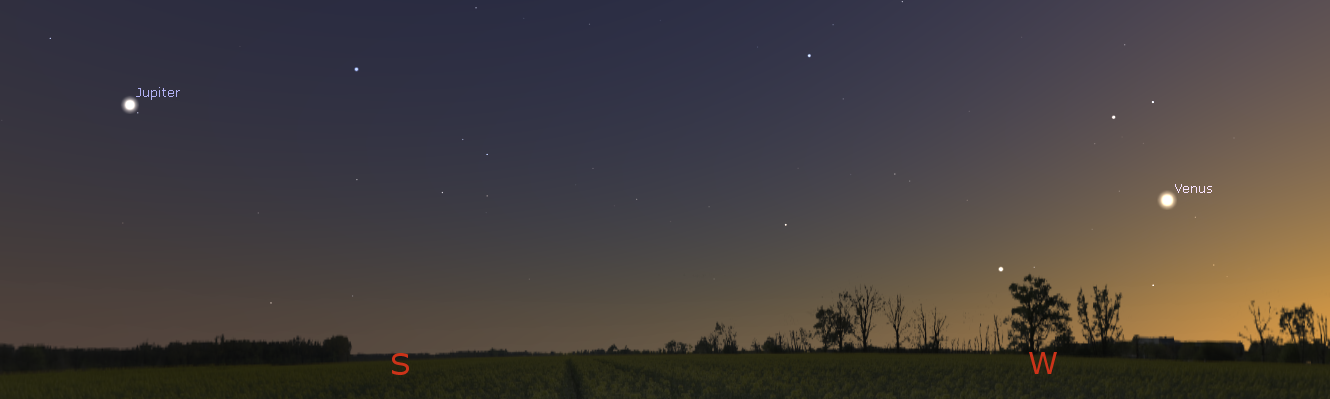
Venus and Jupiter tonight May 30 2018. at 10 p.m. Click on image to enlarge. Created using Stellarium.
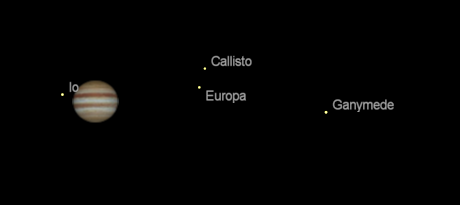
Jupiter and moons in a telescope at 10 p.m., May 30, 2018 Created using Cartes du Ciel.
Io is in front of the planet. Its transit will begin at 10:37 p.m. EDT (2:37 UT May 31)
Io’s shadow will start to cross Jupiter at 11:07 p.m. EDT (3:07 UT May 31)
Io’s transit og Jupiter will end at 12:45 a.m. May 31 (4:45 UT)
Io’s Shadow will leave the face of Jupiter at 1:16 a.m. May 31 (5:16 UT)
Times above from https://www.projectpluto.com/jevent.htm
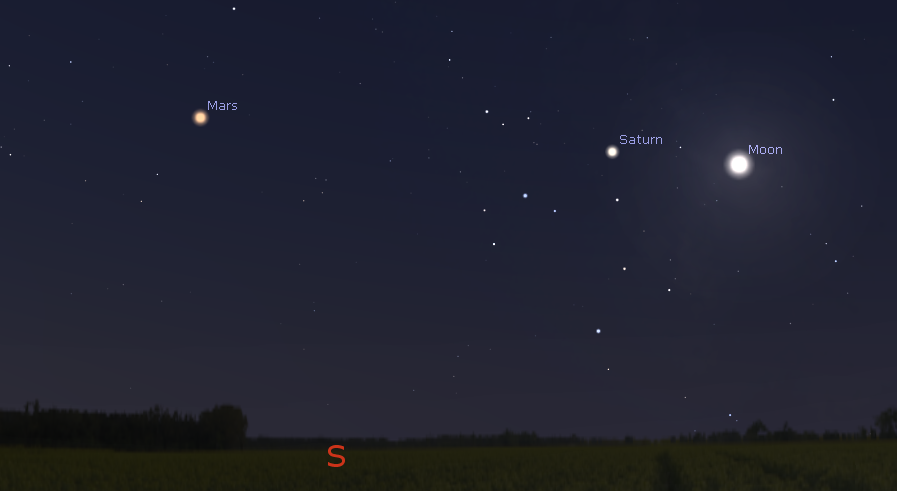
Morning planets Saturn and Mars plus the Moon at 5 a.m. May 31, 2018. Created using Stellarium.
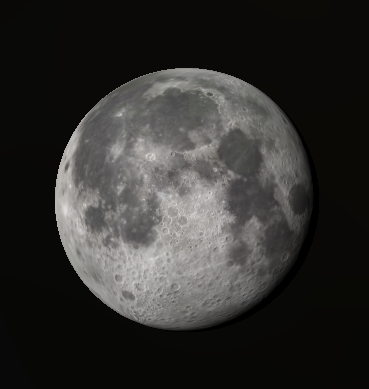
The Moon as it might appear in binoculars at 5 a.m. May 31, 2018. Created using Stellarium.
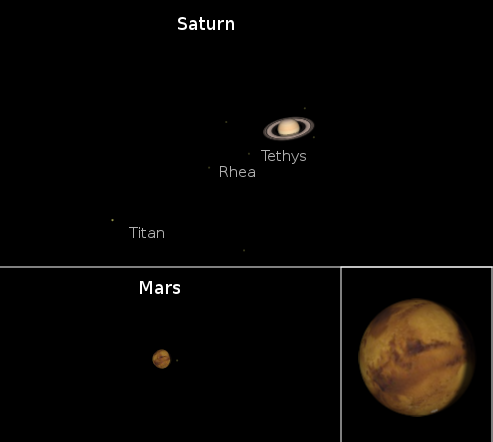
Saturn and Mars with the same magnification with an inset of Mars at higher magnification at 5 a.m. May 31, 2018. Created using Cartes du Ciel (Sky Charts).
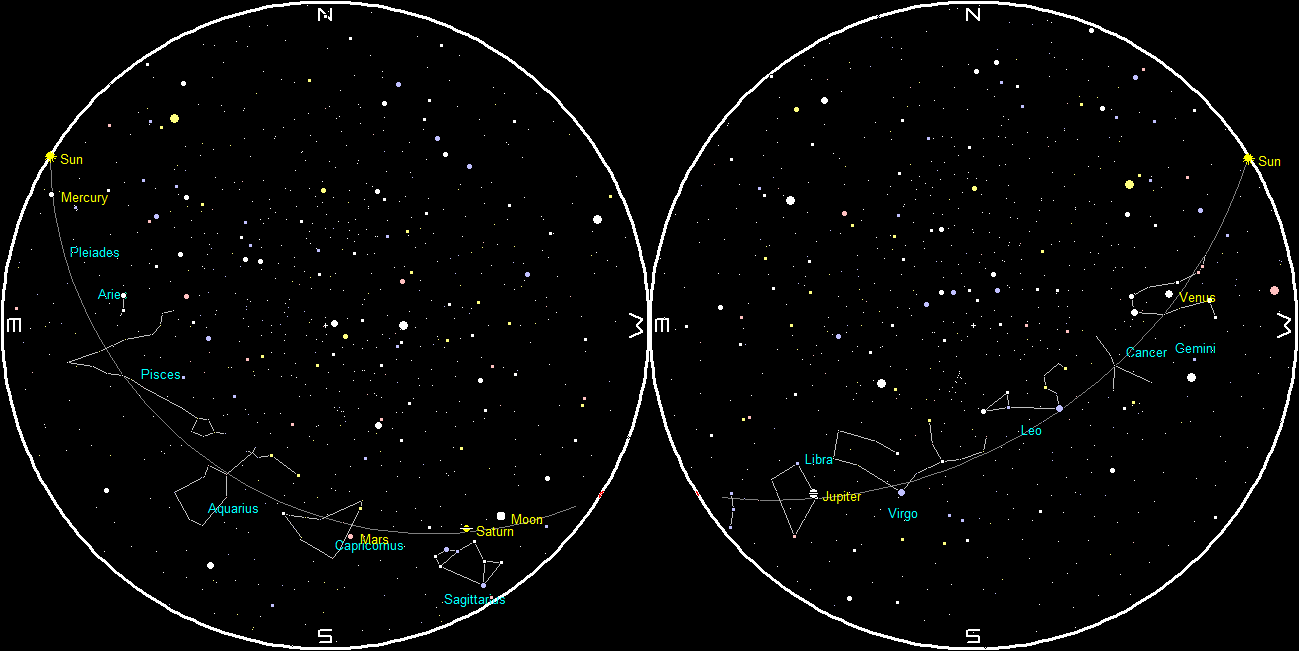
Planets and the Moon at sunset and sunrise of a single night starting with sunset on the right on May 30, 2018. The night ends on the left with sunrise on the 31st. Click on the image to enlarge. Created using my LookingUp program.

