Archive
05/25/11 – Ephemeris – The bright planets this week.
Wednesday, May 25th. Today the sun will be up for 15 hours and 8 minutes, setting at 9:13. The moon, 1 day past last quarter, will rise at 2:42 tomorrow morning. Tomorrow the sun will rise at 6:04.
It’s Wednesday and time again to take a look at the whereabouts of the bright planets. The ringed planet Saturn will be visible in the south southeast as it gets dark. It’s near the bright star Spica to its lower left. Spica has a blue tinge, while Saturn is yellowish. It will cross the meridian due south at 10:13 p.m. and will set at 4:08 a.m. The morning planet traffic jam is breaking up. Rising first will be Jupiter at 4:28 a.m. in the east. Mars will rise at 5:13 followed by Venus 3 minutes later. Unless we have very clear skies and you have a very flat eastern horizon, you’d have to wait until maybe 5:15 or later to try to spot Venus. It will take binoculars to first locate them.
* Times are for the Traverse City/Interlochen area of Michigan. They may be different for your location.
05/18/11 – Ephemeris – The bright planets visible this week
Wednesday, May 18th. Today the sun will be up for 14 hours and 55 minutes, setting at 9:06. The moon, 1 day past full, will rise at 10:54 this evening. Tomorrow the sun will rise at 6:10.
It’s Wednesday and time again to take a look at the whereabouts of the bright planets. The ringed planet Saturn will be visible in the south southeast as it gets dark. It’s near the bright star Spica to its lower left. Spica has a blue tinge, while Saturn is yellowish. It will cross the meridian due south at 10:42 p.m. and will set at 4:36 a.m. The morning planet traffic jam is breaking up. Rising first will be Jupiter at 4:52 on the east. Mars will rise at 5:13 followed by Venus 3 minutes later. Mercury will rise at 5:24. Unless we have very clear skies and you have a very flat eastern horizon, you’d have to wait until maybe 5:45 to try to spot them. It will take binoculars to first locate Venus and Jupiter. Good luck finding the others.
* Times are for the Traverse City/Interlochen area of Michigan. They may be different for your location.
05/04/11 – Ephemeris – The bright planets this week
Wednesday, May 4th. The sun rises at 6:28. It’ll be up for 14 hours and 21 minutes, setting at 8:50. The moon, 1 day past new, will set at 10:39 this evening.
It’s Wednesday and time again to take a look at the whereabouts of the bright planets. The ringed planet Saturn will be visible in the southeast as it gets dark. It’s near the bright star Spica to its lower left. Spica has a blue tinge, while Saturn is yellowish. It will cross the meridian due south at 11:40 p.m. and will set at 5:33 a.m. Our only other planet really visible is Venus which will rise at 5:34 a.m. in the east. Rising at 5:42 will be Mercury, followed a minute later by Jupiter. Dimmest is Mars, rising at 5:46. This is what I call a Planet Jam. If you can find Venus in the twilight and follow it until 7 a.m., you just might be able to spot Jupiter and Mercury. Mars will be problematic because it’s so dim.
* Times are for the Traverse City/Interlochen area of Michigan. They may be different for your location.
04/27/11 – Ephemeris – The bright planets for this week
Wednesday, April 27th. The sun rises at 6:39. It’ll be up for 14 hours and 2 minutes, setting at 8:41. The moon, 3 days past last quarter, will rise at 4:17 tomorrow morning.
It’s Wednesday and time again to take our weekly look at the whereabouts of the bright planets. The ringed planet Saturn will be visible in the southeast as it gets dark. It’s near the bright star Spica to its lower left. Spica has a blue tinge, while Saturn is yellowish. It will cross the meridian due south at 12:09 a.m. and will set at 6:01 a.m. In telescopes Saturn shows its rings which are slowly opening up along with at least one satellite, the large moon Titan. Our only other planet visible is Venus which is brilliant in the morning sky and will rise at 5:42 a.m. in the east.. It is really a beautiful sight in the morning twilight, though disappointingly small in a telescope. Jupiter, Mars and Mercury are all too close to the direction of the sun to be visible.
* Times are for the Traverse City/Interlochen area of Michigan. They may be different for your location.
04/20/11 – Ephemeris – The bright planets visible this week
Wednesday, April 20th. The sun rises at 6:50. It’ll be up for 13 hours and 42 minutes, setting at 8:33. The moon, 3 days past full, will rise at 12:13 tomorrow morning.
It’s Wednesday and time again to take a look at the whereabouts of the bright planets for this week. The ringed planet Saturn is rising before sunset and will be visible in the southeast as it gets dark. It’s near the bright star Spica to its lower left. Spica has a blue tinge, while Saturn is yellowish. It will cross the meridian due south at 12:38 a.m. and will set at 6:30 a.m. In telescopes Saturn shows its rings which are a year and a half along their seven and a half year period of opening along with at least one satellite, the large moon Titan. Venus is brilliant in the morning sky and will rise at 5:51 a.m. in the east.. It is really a beautiful sight in the morning twilight, though disappointingly small in a telescope. Jupiter, Mars and Mercury are all too close to the direction of the sun to be visible.
* Times are for the Traverse City/Interlochen area of Michigan. They may be different for your location.
04/12/11 – Ephemeris – Saturn and its moon Titan
Tuesday, April 12th. The sun will rise at 7:04. It’ll be up for 13 hours and 19 minutes, setting at 8:23. The moon, 1 day past first quarter, will set at 4:16 tomorrow morning.
The planet Saturn, now rising up in the southeastern sky is always the most wonderful sight in a small telescope. The rings are slowly opening to the sun, however for us on the earth, whose orbit is tilted by about 2 and a half degrees to the Saturn’s orbit of the sun, the rings appear to be closing just a bit right now. After June they will open up again. Tonight a small telescope will also reveal Saturn’s largest satellite or moon which will be off the edge of the longest extent of the rings to the east of Saturn. Titan is the second largest moon in the solar system, after Jupiter’s Ganymede. It is larger than the planet Mercury and the only moon with a substantial atmosphere. Titan’s surface atmospheric pressure is slightly greater than the earth’s.
* Times are for the Traverse City/Interlochen area of Michigan. They may be different for your location.
Addendum
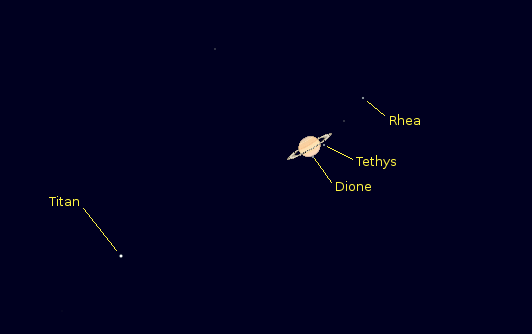
Saturn and some of its bright moons for April 12, 2011. Created using Cartes du Ciel
Titan is the easiest moon to see. Rhea is more difficult. The others being close to Saturn tonight may be impossible to spot. The free programs Cartes du Ciel and Stellarium will show the positions of Saturn’s satellites. See the Free Astronomical Software links in the right. Stellarium does have a problem getting the satellite brightness right, they’re too bright.
04/04/11 – Ephemeris – Saturn at opposition
Apr 4. This is Bob Moler with Ephemeris for Monday, April 4th. The sun will rise at 7:18. It’ll be up for 12 hours and 54 minutes, setting at 8:13. The moon, 1 day past new, will set at 9:43 this evening. | Last night Saturn passed opposition from the sun, that is Saturn was opposite the sun in the sky. That means the earth is nearly directly between them. Also Saturn is at its closest. That’s not as big a deal as with Mars. Saturn, nearly 10 times earth’s distance from the sun, will vary its distance from the earth by plus or minus 10 percent. Not a huge amount. With Jupiter its plus or minus 25 percent. With Mars it’s plus or minus 75 percent. That plus Mars’ eccentric orbit means we only have rare close approaches, every 15 or 17 years. So Saturn appears about the same size no matter were in its orbit or our orbit we see it. We’ll have nearly six months of Saturn viewing in the evening. And Saturn’s the one planet you have got to see in a telescope.
* Times are for the Traverse City/Interlochen area of Michigan. They may be different for your location.
Addendum
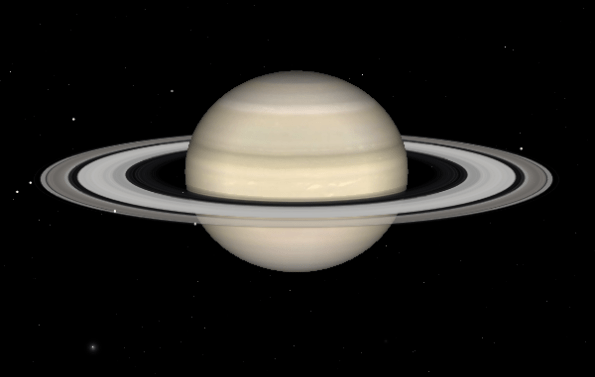
Saturn as seen in April 2011. Created by Celestia.
The above image isn’t a photograph, but was created using Celestia. This is roughly the view of Saturn we see now. Celestia is available free. See the link to the right.

