Archive
08/12/2015 – Ephemeris – One ringed planet and a sky full of meteors
Ephemeris for Wednesday, August 12th. The Sun rises at 6:41. It’ll be up for 14 hours and 12 minutes, setting at 8:53. The Moon, 2 days before new, will rise at 5:49 tomorrow morning.
Lets take a look for the bright planets for this week. Our brightest evening planets Venus and Jupiter are leaving the evening sky in the west. Venus is 3 days from inferior conjunction with the Sun. Saturn is in the south-southwest in the evening twilight. It can be spotted just to the right of the constellation of Scorpius the scorpion and its bright red star Antares below and right of it. Even small telescopes can see Saturn’s rings. The Perseid meteor shower will reach its peak overnight tonight. Your back yard is a fine spot to view the meteors, or for dark skies, I’ll be leading an all night meteor watch at the Sleeping Bear Dunes National Lakeshore’s Dune Climb if it’s clear. I’ll be there by 9 p.m. and it will be dark enough by 10:30.
Times are for the Traverse City/Interlochen area of Michigan. They may be different for your location.
Addendum
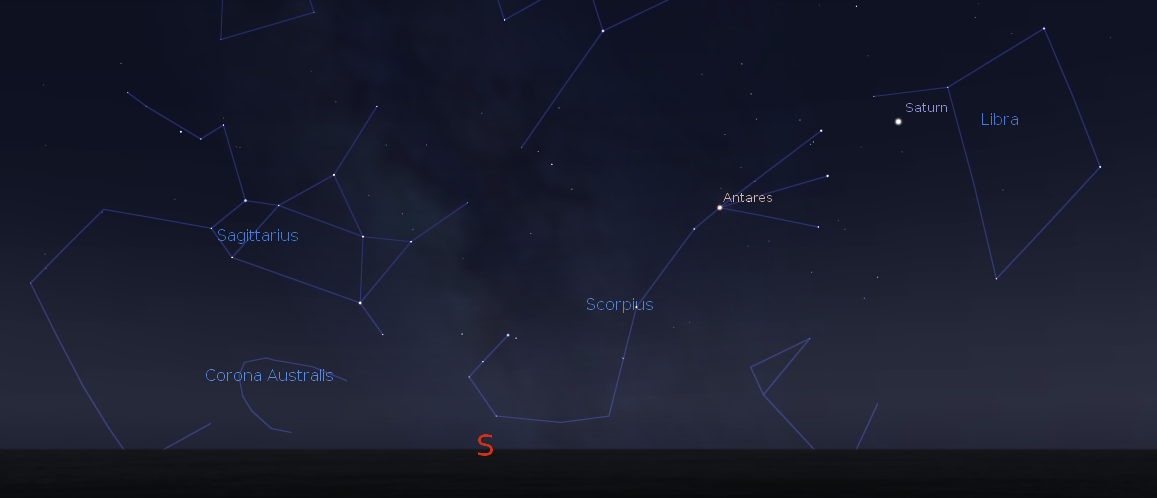
Saturn and the summer Zodiacal constellations in the south at 10 p.m. August 12, 2015. Created using Stellarium.
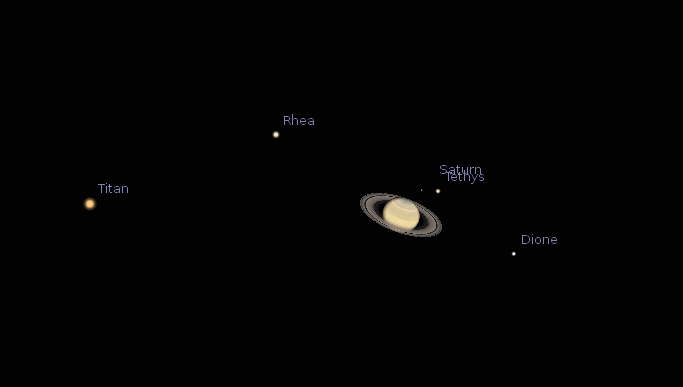
Saturn through a telescope at 10 p.m. on August 12, 2015. Created using Stellarium.
Next week Wednesday we will also turn to the morning sky looking for Mars and awaiting Venus’ grand entrance into the dawn skies.
All-sky meteor charts from yesterday’s post
“PerR” is the Perseid radiant.
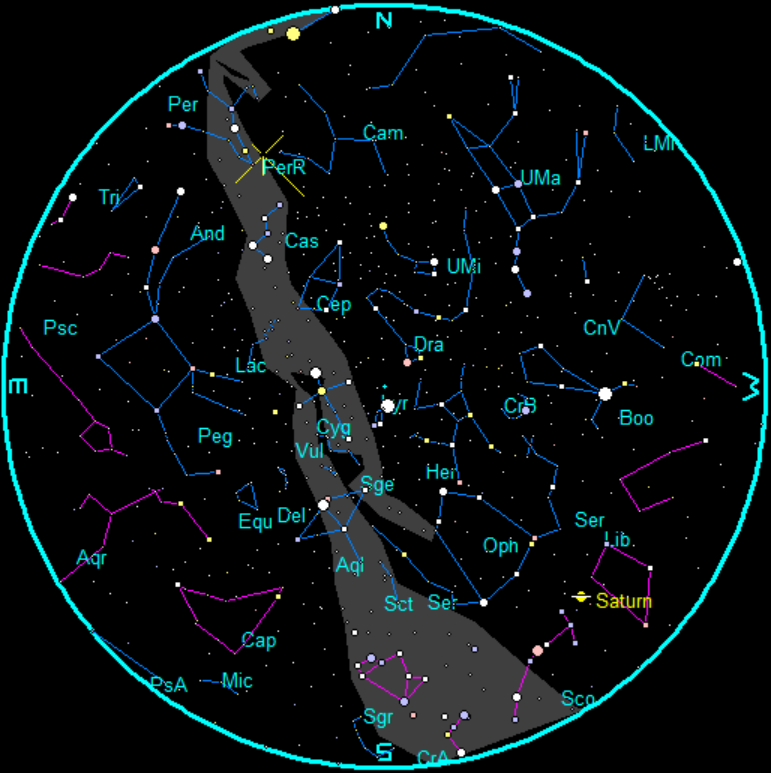
11 p.m. August 12, 2015. Created using Bob Moler’s LookingUp program for Windows.
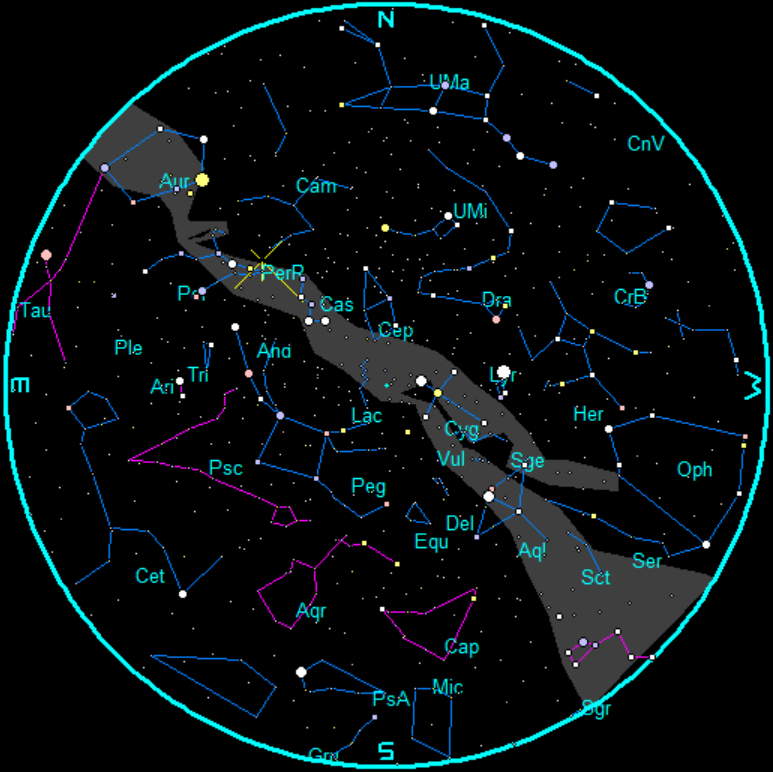
2 a.m. August 13, 2015. Previewing autumn stars. Created using Bob Moler’s LookingUp program for Windows.
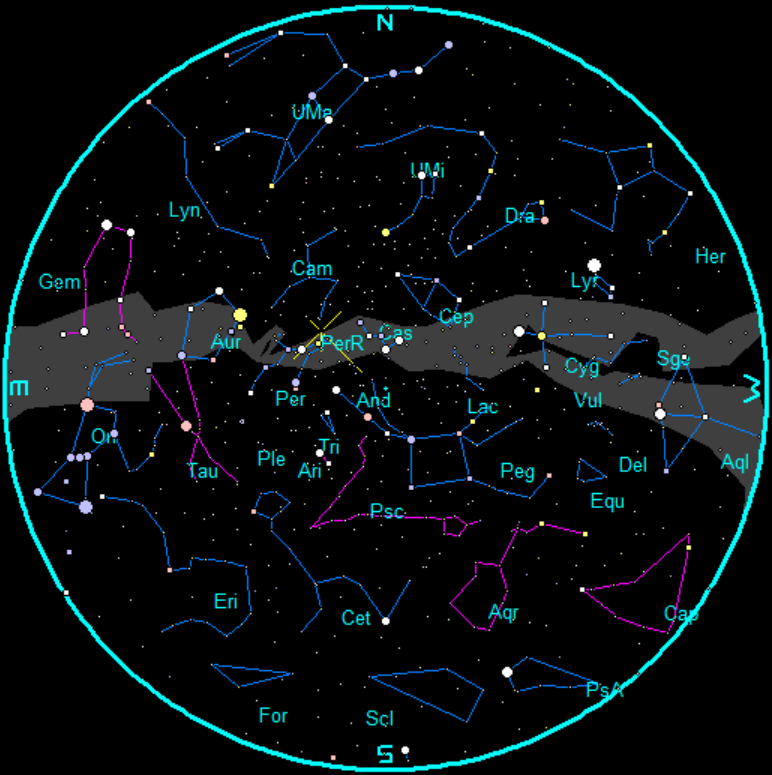
5 a.m. August 13, 2015. Good morning Orion! Created using Bob Moler’s LookingUp program for Windows.
08/11/2015 – Ephemeris – Perseid meteor shower is tomorrow night
Ephemeris for Tuesday, August 11th. The Sun rises at 6:40. It’ll be up for 14 hours and 14 minutes, setting at 8:55. The Moon, 3 days before new, will rise at 4:51 tomorrow morning.
The Perseid meteor shower is growing in numbers of meteors seen per hour. The expected peak is Thursday morning about a quarter after 2. However the peak time is only really known statistically after the event. The point in the sky from which the meteors or shooting stars seem to come from is called the radiant and it is near the constellation of Perseus. The meteors will appear all night from dusk to dawn. The peak number of meteors can be up to 90 an hour. No telescope is needed. Just lie down on a blanket and look up. The darker your sky the better. One of the darkest skies around is at the Sleeping Bear Dunes National Lakeshore. I will be leading an all night meteor shower watch at the Dune Climb Wednesday night til dawn if it’s clear.
Times are for the Traverse City/Interlochen area of Michigan. They may be different for your location.
Addendum
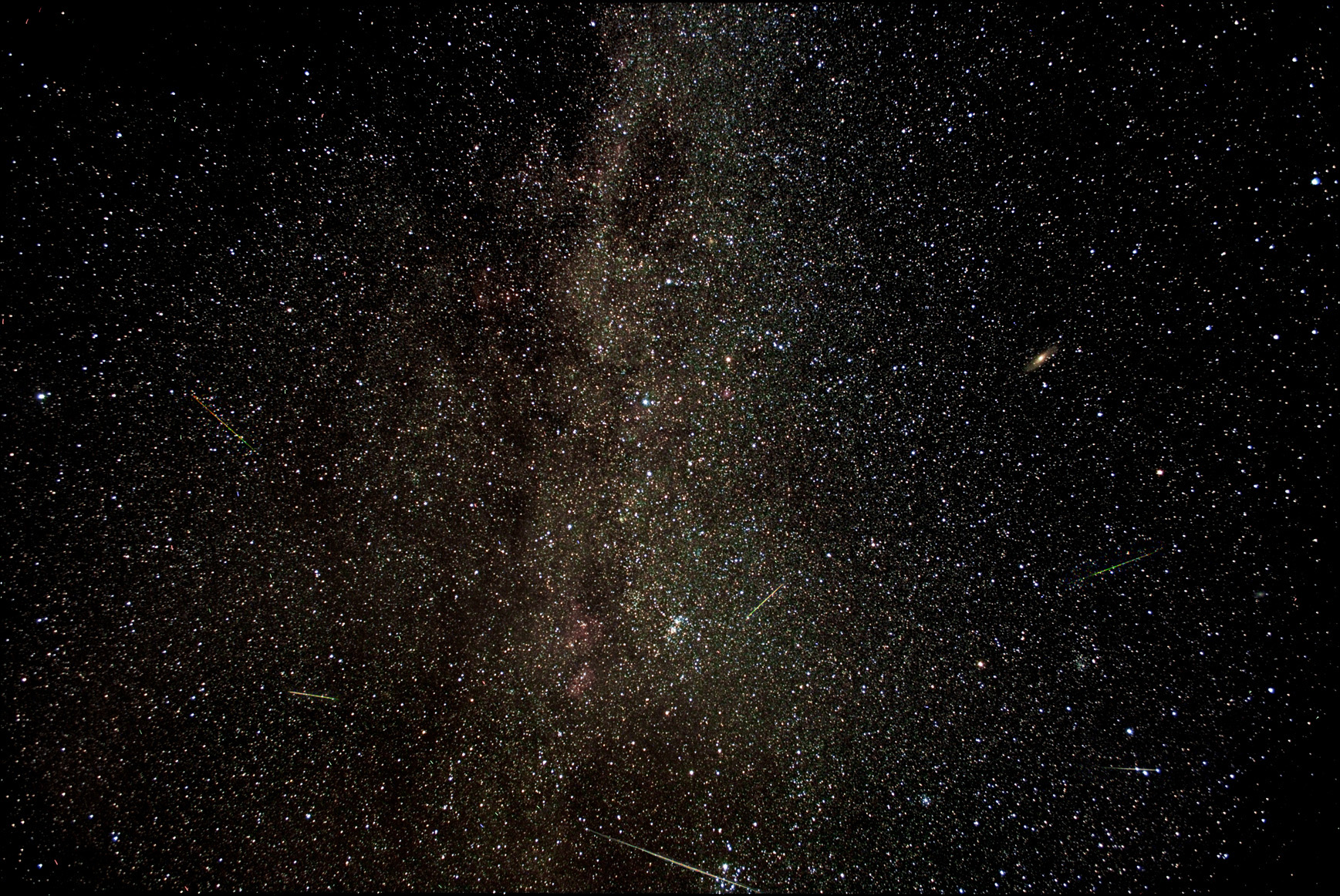
Here are some meteors seen in the 2007 Perseid meteor shower taken by Scott Anttila. The image is centered on Cassiopeia. The radiant is low and a bit left of center in the image. The Double Cluster is seen below center and the Great Andromeda Galaxy is seen on the right above center. Click on the image to enlarge.
Position of the Perseid radiant and stars in all-sky plots for 3 times during the night: 11 p.m., 2 a.m., & 5 a.m.
11 p.m. August 12, 2015. Created using Bob Moler’s LookingUp program for Windows.
2 a.m. August 13, 2015. Created using Bob Moler’s LookingUp program for Windows.
5 a.m. August 13, 2015. Created using Bob Moler’s LookingUp program for Windows.
07/24/2015 – Ephemeris – Astronomical viewing opportunities this weekend
Ephemeris for Monday, July 27th. The Sun rises at 6:23. It’ll be up for 14 hours and 51 minutes, setting at 9:14. The Moon, 3 days past first quarter, will set at 3:36 tomorrow morning.
This evening when it gets dark the bright star Deneb in Cygnus the swan will be high in the east northeast. Deneb is the dimmest star of the summer triangle. Of the other stars of the triangle, Vega is very high in the east, while Altair is lower in the southeast. While Deneb’s apparent magnitude, or brightness as seen from earth, makes it the dimmest of the three bright stars, Deneb’s vast distance of possibly 2,600 light years makes it over 100 times the distance of Vega. If brought as close as Vega, Deneb would be almost as bright as the full moon. It is as bright as two hundred thousand suns. It apparently has run out of hydrogen in its core. Once a blue super giant star, it’s currently evolving through the white giant stage.
Times are for the Traverse City/Interlochen area of Michigan. They may be different for your location.
Addendum
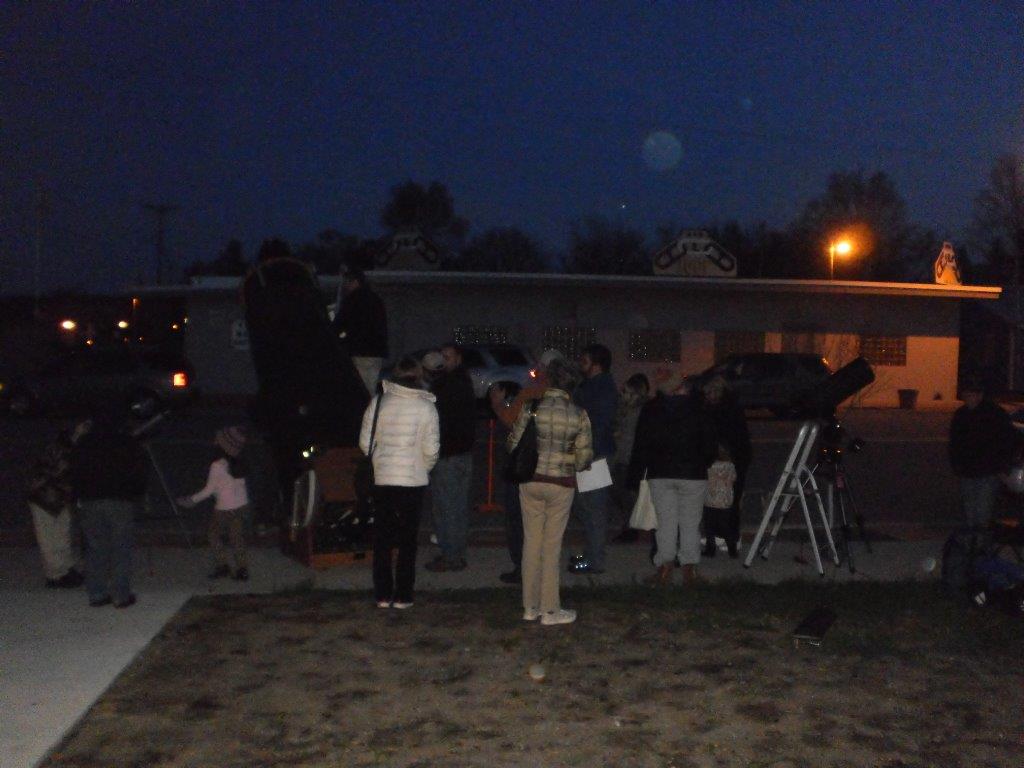
Betsie Valley District Library star party 2014. A crowd gathers to view Saturn and Jupiter. (Jupiter will be too low this time.) Credit: Betsie Valley District Library staff.
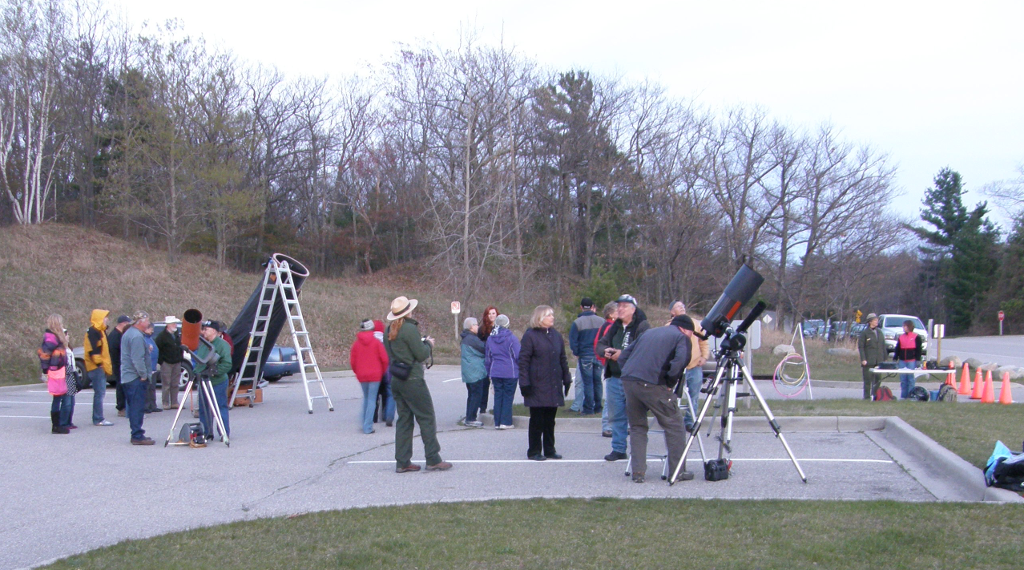
The GTAS at the Sleeping Bear Dunes National Lakeshore’s Platte River Point, April, 2012. This time there will be leaves on the trees. Credit Eileen Carlisle.
06/19/2015 – Ephemeris – Two events this weekend: one local, one global
Ephemeris for Friday, June 19th. Today the Sun will be up for 15 hours and 34 minutes, setting at 9:31. The Moon, 3 days past new, will set at 11:34 this evening. Tomorrow the Sun will rise at 5:56.
There’s a couple of astronomical events coming up this weekend. On Saturday there will be another Sun ‘n Star Party at the Sleeping Bear Dunes National Lakeshore if weather cooperates. This time the telescopes will be set up at the Pierce Stocking Scenic Drive, Stop 3, the Dunes Overlook from 4 to 6 p.m. and from 9 to 11 p.m. The best place to park is Picnic Mountain, just before the Dunes Overlook. On Sunday a truly global event, the Summer solstice will occur at 12:38 p.m. (16:38 UT), when the Sun will reach its farthest north signaling the start of summer in the northern hemisphere. For folks south of the equator it will be the winter solstice signaling the start of winter for them.
Times are for the Traverse City/Interlochen area of Michigan. They may be different for your location.
Addendum
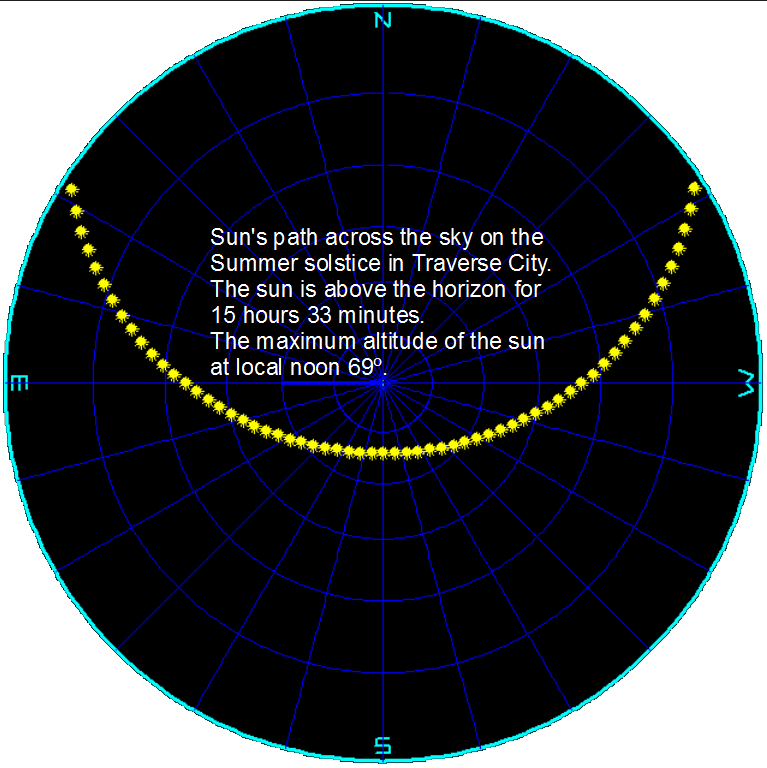
The Sun’s apparent path in the sky on the summer solstice. The cyan circle is the horizon and the Sun is plotted every 15 minutes throughout the day. Created by Bob Moler using LookingUp. This is a slide from his school program on the cause of the seasons.
05/22/2015 – Ephemeris – View the Sun and the Planets from the Sleeping Bear Dunes this Saturday
Ephemeris for Friday, May 22nd. Today the Sun will be up for 15 hours and 3 minutes, setting at 9:11. The Moon, 3 days before first quarter, will set at 1:00 tomorrow morning, and tomorrow the Sun will rise at 6:06.
Tomorrow the Grand Traverse Astronomical Society will be at the Sleeping Bear Dunes National Lakeshore for a Sun and Star Party at the Dune Climb. From 4 to 6 p.m. the Sun will be the attraction. Besides sunspots, visible in most well filtered telescopes, the society’s solar telescope will show the Sun in the light of hydrogen, showing a much more active part of the Sun. Starting about 9:30 Venus, and then Jupiter will appear, followed a bit later by the ringed planet Saturn. The event will take place only if the weather cooperates and it’s clear or partly cloudy. The society has scheduled monthly star parties at the Dunes through October plus a special meteor shower watch in August.
Times are for the Traverse City/Interlochen area of Michigan. They may be different for your location.
Addendum
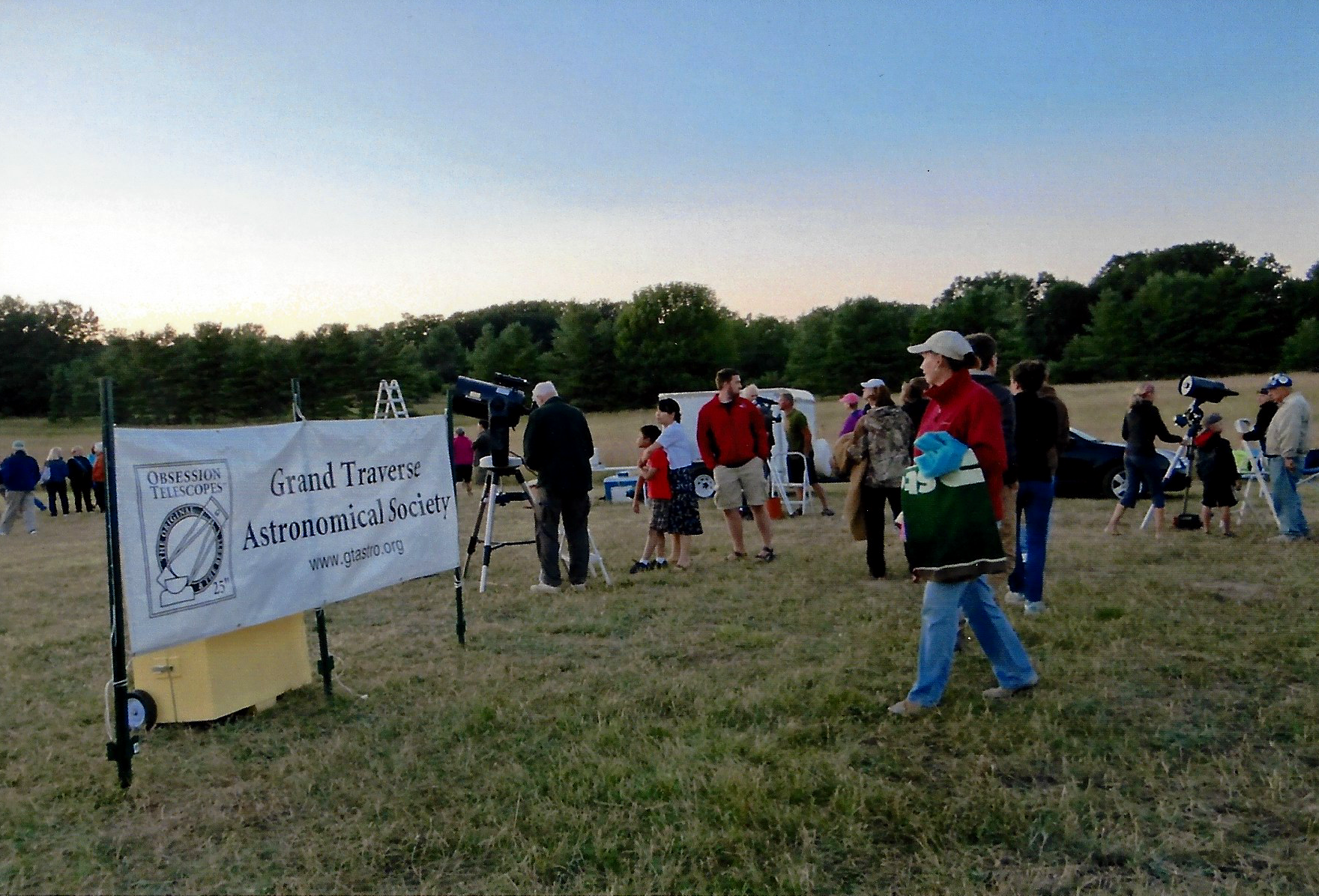
Star Party at the Sleeping Bear Dunes National Lakeshore, Thoreson Farm August 2013. Credit Eileen Carlisle.
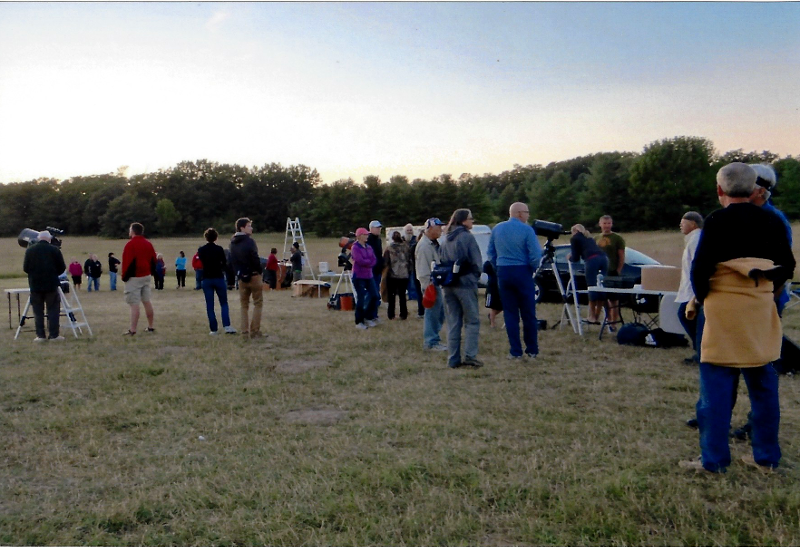
Star Party at the Sleeping Bear Dunes National Lakeshore, Thoreson Farm August 2013. Credit Eileen Carlisle.
Sorry we don’t have good pictures of a Dune Climb star party. The event shown above is near the maximum of the Perseid meteor shower, which is why some folks are carrying blankets. The Thoreson Farm event is part of the Port Oneida Fair at the Port Oneida Rural Historic District a small farming community on the eastern shore of Sleeping Bear Bay, and within the boundaries of the Sleeping Bear Dunes National Lakeshore.
04/17/2015 – Ephemeris – First Sleeping Bear Dunes star party of the year
Ephemeris for Friday, April 17th. The Sun rises at 6:55. It’ll be up for 13 hours and 34 minutes, setting at 8:30. The Moon, 1 day before new, will rise at 6:55 tomorrow morning.
Tomorrow, that’s Saturday night the 18th, the Grand Traverse Astronomical Society will host the first of nine viewing opportunities at the Sleeping Bear Dunes National Lakeshore this year. This one will be held at Platte River Point north parking lot, at the end of Lake Michigan Road, off M22, weather permitting. Viewing begins around 9 p.m. with Brilliant Venus and then Jupiter. Later on as it gets dark, other wonders among the stars will be visible. For a complete schedule of viewing opportunities check the park’s website or gtastro.org. They will include viewing the sun on the afternoons of the May through August star parties. Plus there will be an all night Perseid Meteor watch at the Dune Climb the night of August 12th and 13th, and a lunar eclipse watch the evening of September 27th.
Times are for the Traverse City/Interlochen area of Michigan. They may be different for your location.
Addendum
Sleeping Bear Dunes National Lakeshore Star Parties and other Events
|
Day |
Date |
Venue |
Time |
Comments |
|---|---|---|---|---|
|
Saturday |
April 18 |
SBDNL – Platte River Point |
9 – 11 p.m. |
Venus, Jupiter |
|
Saturday |
May 23 |
SBDNL – Dune Climb |
4 – 6 p.m ☼ & 9 – 11 p.m. |
Venus, Jupiter, Moon |
|
Saturday |
June 20 |
SBDNL – Pierce Stocking Drive Stop #3 |
4 – 6 p.m ☼ & 9 – 11 p.m. |
Park at Picnic Mountain. Venus, Jupiter, Moon, Saturn |
|
Saturday |
July 25 |
SBDNL – Platte River Point |
4 – 6 p.m ☼ & 9 – 11 p.m. |
Venus, Jupiter, Moon, Saturn |
|
Saturday |
August 8 |
SBDNL – Thoreson Farm |
4 – 6 p.m ☼ & 9 – 11 p.m. |
Port Oneida Fair. Mercury, Jupiter early, Saturn, Dark, Summer Milky Way |
|
Wednesday |
August 12 |
SBDNL – Dune Climb |
9 p.m. – 5 a.m. |
All night Perseid meteor watch |
|
Saturday |
September 12 |
SBDNL – Dune Climb |
9 – 11 p.m. |
Saturn, Dark skies, Summer Milky Way |
|
Sunday |
September 27 |
SBDNL – Platte River Point |
9 p.m. – 12 m |
Total Lunar Eclipse |
|
Wednesday |
October 21 |
SBDNL – Pierce Stocking Drive Stop #3 |
8 – 10 p.m. |
SBDNL 45th anniversary star party, Moon, bright star clusters and nebulae |
Explanation Key
☼ – Sun viewing
Conditions:
Dark – Dark skies. Deep Sky Objects (DSOs: star clusters, nebulae and galaxies) visible depending on the season.
Twilight – Twilight lasts through out the viewing period. Some Deep Sky Objects may be visible near the end of the viewing period.
Objects other than planets:
Summer Milky Way – Many Deep Sky Objects are visible in our galaxy. The Milky Way is best seen on August and September evenings with the moon out of the sky. This also means dark skies.
Cancellation
The monthly star party events will be cancelled if the sky is not visible due to weather conditions. An official decision will be made by the Lakeshore, usually, one hour before the event. To find out whether an event has been cancelled please check our Facebook page, or Twitter feed, or call park rangers at 231-326-4700, ext. 5005, for a voice mail message with the decision.
10/23/2014 – Ephemeris – Partial solar eclipse tonight for most of the US
Ephemeris for Thursday, October 23rd. The sun will rise at 8:08. It’ll be up for 10 hours and 36 minutes, setting at 6:44. The moon is new today, and won’t be visible.
This evening there will be a partial solar eclipse, in which we will see only the first part before the sun sets. The eclipse will be visible for all but the extreme eastern part of the country. It will be a partial eclipse for all who can see it because the core of the Moon’s shadow will miss the Earth to the north. For the Interlochen Public Radio listening area (Northwestern Lower Michigan) the eclipse will star a couple of minutes before or after 5:32 p.m. and will end at sunset around 6:44 p.m. The low position of the sun make a lack of cloud cover necessary to be able to see it. Proper approved solar filters, or a projection method are necessary to view the eclipse. Do Not Look Directly at the Sun! The NMC Observatory south of Traverse City will be open, weather permitting starting at 5 p.m. Also the Platte River Point location at the Sleeping Bear Dunes National Lakeshore will also be available.
An added attraction for this eclipse is the appearance of the largest sunspot group to appear on the sun in years.
Times are for the Traverse City/Interlochen area of Michigan. They may be different for your location.
Addendum
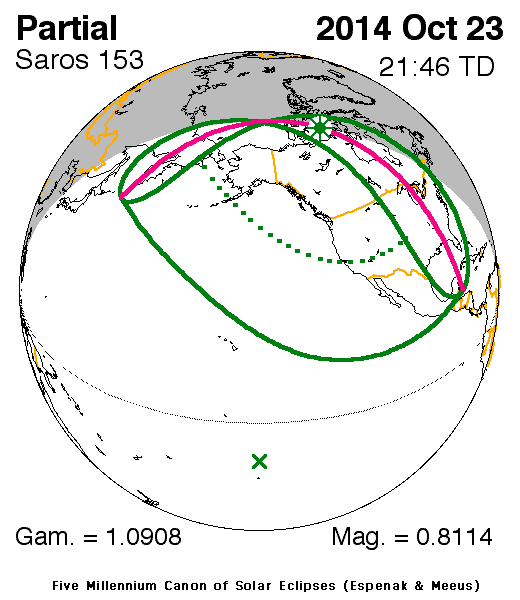
Coverage of the partial solar eclipse of October 23, 2014. Credit: NASA.

The setting partially eclipsed sun from Traverse City. Created using Stellarium.
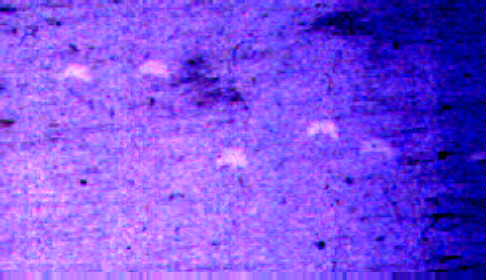
Partially eclipsed sun using a series of pinholes projected on a reasonably white surface.
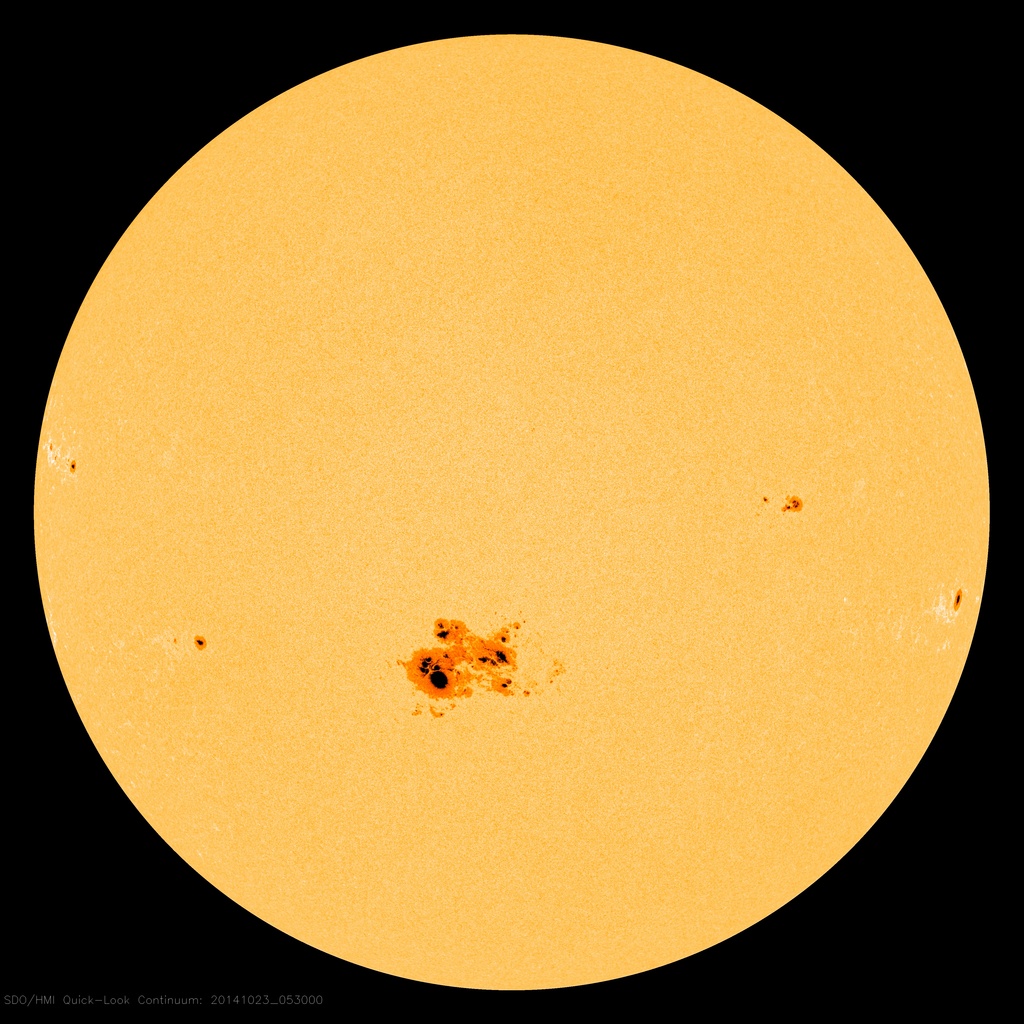
The Sun at 1:30 a.m. 10/23/2014 with large sunspot group AR 2192. Credit NASA – Solar Dynamics Observatory.
This baby gave off a X Class flare yesterday (10/22/2014). Could be more in store. Maybe we’ll see an aurora later this week.
10/21/2014 – Ephemeris – There’s a star party tonight at the Sleeping Bear Dunes National Lakeshore
Ephemeris for Tuesday, October 21st. The sun will rise at 8:05. It’ll be up for 10 hours and 42 minutes, setting at 6:47. The moon, 2 days before new, will rise at 6:44 tomorrow morning.
Tonight if it’s clear the Grand Traverse Astronomical Society will join the rangers at the Sleeping Bear Dunes National Lakeshore for their 44th anniversary celebration with a star party at Stop number 3, the Dunes Overlook on the Pierce Stocking Scenic Drive. The event will run from 8 to 10 p.m. featuring the wonders still visible among the northern summer stars along with those appearing in the autumn skies. To get a heads up on the status of the star party call 231-326-4700, extension. 5005, for a message after 4 p.m. The Orionid meteor shower is also at peak now with the meteors seeming to come from between the constellations Orion and Gemini. The Orionids are visible from 11 p.m. to 6:30 a.m. The Orionids will be visible in diminishing numbers through the first week in November.
Times are for the Traverse City/Interlochen area of Michigan. They may be different for your location.
Addendum
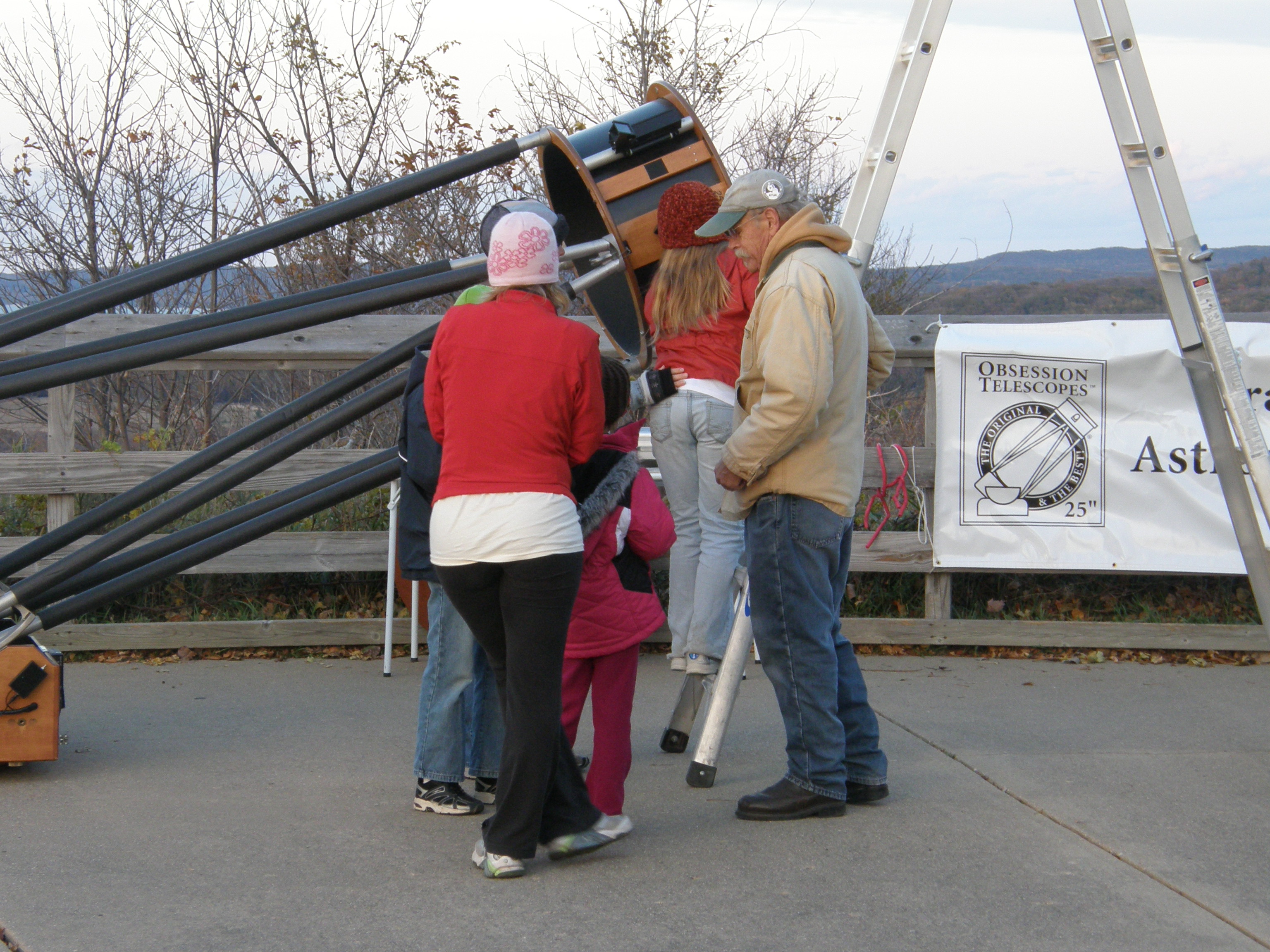
Views from the anniversary star party in 2010. Credit: Eileen Carlisle.
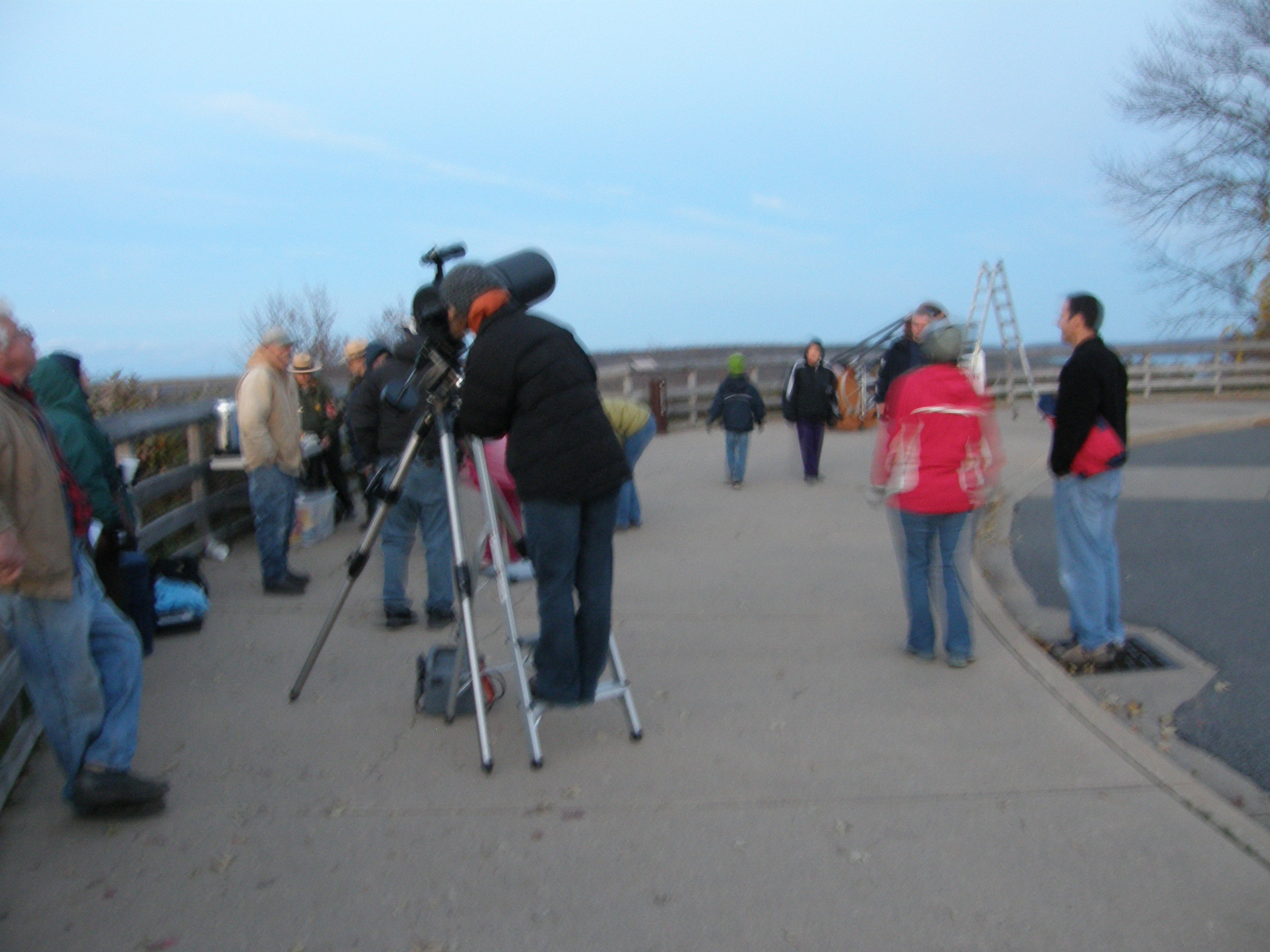
Views from the anniversary star party in 2010. Credit: Eileen Carlisle.
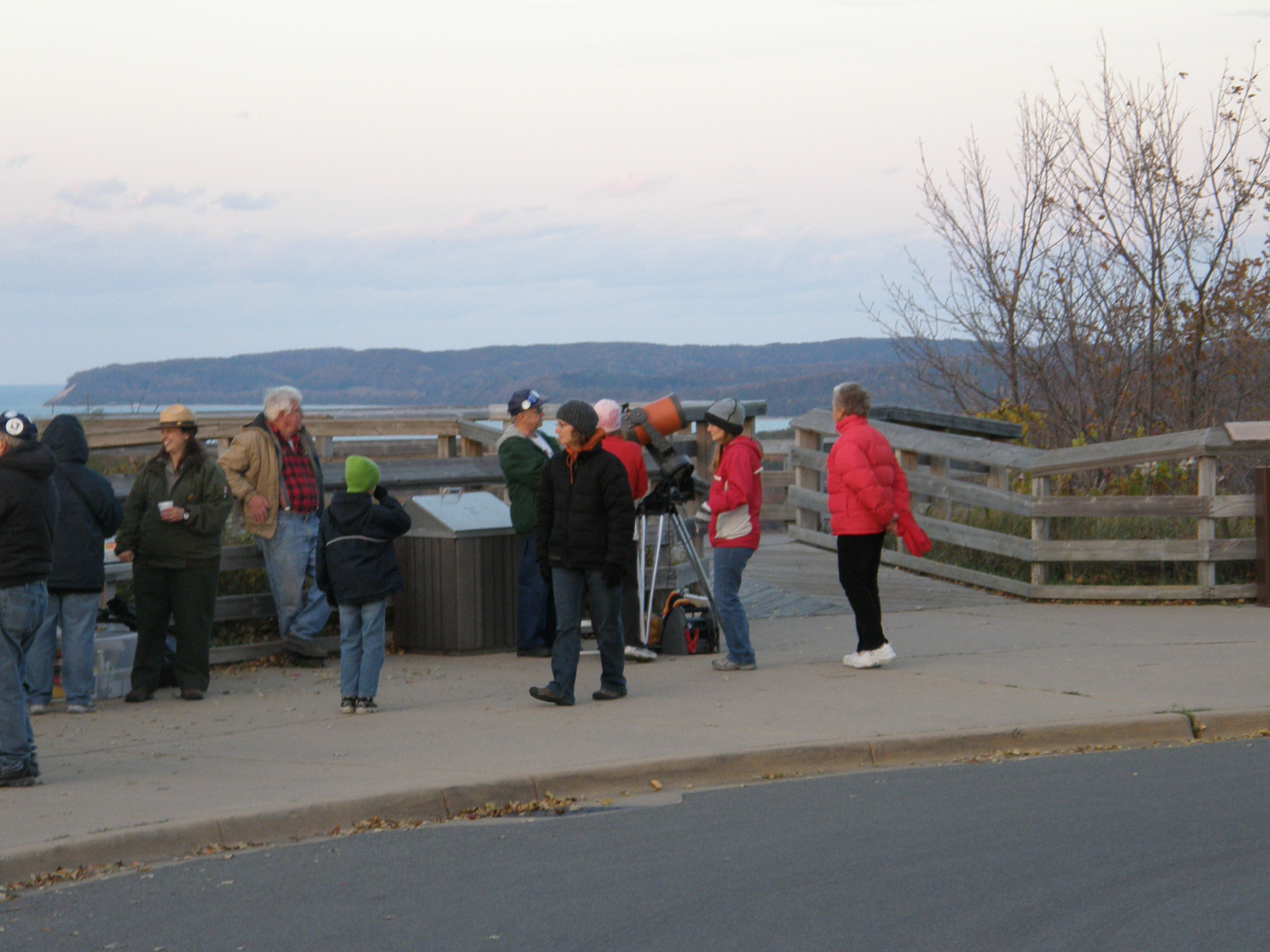
Views from the anniversary star party in 2010. Credit: Eileen Carlisle.
10/07/2014 – Ephemereis – One more day: Tomorrow’s total lunar eclipse
Note: Being a radio program, I do have to repeat the eclipse timings a couple of times.
Ephemeris for Tuesday, October 7th. The sun will rise at 7:47. It’ll be up for 11 hours and 24 minutes, setting at 7:12. The moon, 1 day before full, will set at 7:56 tomorrow morning.
Tomorrow’s Total Lunar Eclipse will be visible without losing too much sleep. Just set the alarm clock so you’ll be ready to view the start of the eclipse at 5:15 a.m. That’s when the partial phase starts when the upper left edge of the moon enters the Earth’s inner shadow called the umbra. The total phase or totality starts at 6:25 with morning twilight just beginning. The middle of the eclipse will occur at 6:54. Totality will end at 7:24 when twilight will be bright. The ending partial phase will not be completely visible from northern Michigan. From the Dakotas and westward the entire ending partial phase will be visible. Amazingly, next year we will have two more total lunar eclipses in the United States, April 4th and September 28th.
Times are for the Traverse City/Interlochen area of Michigan. They may be different for your location.
Addendum
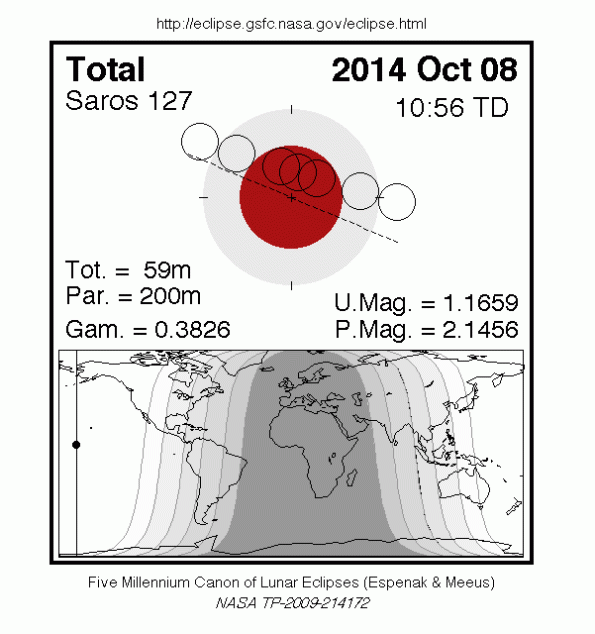 Click on the image above to display or download a more detailed Adobe Acrobat (PDF) image showing more information about the eclipse. The time shown will be Universal Time (UT). Subtract 4 hours for EDT, 5 hours for CDT, etc.
In the Grand Traverse area there are two locations the Grand Traverse Astronomical Society (GTAS) will be set up to view the eclipse if it is clear enough. Opens at 5 a.m.
- Northwestern Michigan College’s Joseph H. Rogers Observatory. located south of Traverse City on Birmley Road, between Garfield and Keystone roads. (One road south of Hammond)
- Sleeping Bear Dunes National Lakeshore at Platte River Point. It’s in several miles from the Platte River Campground off M22 on Lake Michigan Rd. Park in the big parking lot to the left. The GTAS will have their scopes in the small parking lot to the right.
If it’s cloudy, there is a place to view the lunar eclipse on the Internet from Griffith Observatory in Los Angeles. There will probably be more locations. I’ll put them up if and when I find them. Last eclipse, it was cloudy here, so I watched the eclipse Livestream from Griffith Observatory. They also have a running commentary and answer your questions. Though it still wasn’t as good as seeing it with your own eyeballs. Videos cannot duplicate the range of brightness and color that can be seen with your own eyes.
10/06/2014 – Ephemeris – Previewing Wednesday’s lunar eclipse
Ephemeris for Monday, October 6th. The sun will rise at 7:46. It’ll be up for 11 hours and 27 minutes, setting at 7:13. The moon, 2 days before full, will set at 6:42 tomorrow morning.
Wednesday’s Total Lunar Eclipse will be visible without losing too much sleep. Just set the alarm clock for about 5 a.m. The partial phase starts at 5:15 a.m. when the upper left edge of the moon enters the Earth’s inner shadow called the umbra. The total phase or totality starts at 6:25 with morning twilight just beginning. The middle of the eclipse will occur at 6:54. Totality will end at 7:24 when twilight will be bright. The ending partial phase will not be completely visible from northern Michigan. From the Dakotas and westward the entire ending partial phase will be visible. Amazingly, in the next eclipse season another lunar eclipse will be visible, though not as favorable as this one. That one is April 4th 2015 with a totality duration of only 5 minutes.
Times are for the Traverse City/Interlochen area of Michigan. They may be different for your location.
AddendumClick on the image above to display or download a more detailed Adobe Acrobat (PDF) image showing more information about the eclipse. The time shown will be Universal Time (UT). Subtract 4 hours for EDT, 5 hours for CDT, etc.
In the Grand Traverse area there are two locations the Grand Traverse Astronomical Society (GTAS) will be set up to view the eclipse if it is clear enough. Opens at 5 a.m.
- Northwestern Michigan College’s Joseph H. Rogers Observatory. located south of Traverse City on Birmley Road, between Garfield and Keystone roads. (One road south of Hammond)
- Sleeping Bear Dunes National Lakeshore at Platte River Point. It’s in several miles from the Platte River Campground off M22 on Lake Michigan Rd. Park in the big parking lot to the left. The GTAS will have their scopes in the small parking lot to the right.
 Bob Moler's Ephemeris Blog