Archive
Ephemeris: 10/11/2024 – Comet Tsuchinshan-ATLAS may be visible as early as tonight
This is Ephemeris for Friday, October 11th. Today the Sun will be up for 11 hours and 10 minutes, setting at 7:04, and it will rise tomorrow at 7:55. The Moon, 1 day past first quarter, will set at 1:22 tomorrow morning.
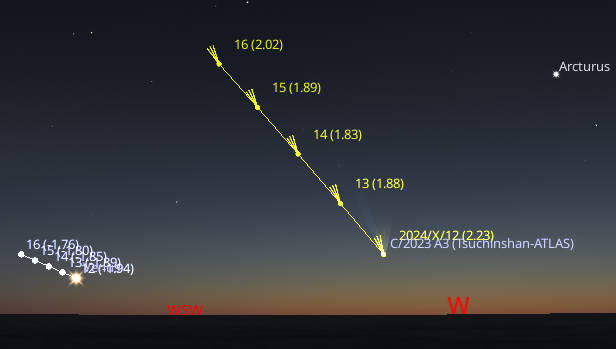
While I think the first time the spot Comet Tsuchinshan-ATLAS will be tomorrow night, sharp-eyed observers with binoculars might be able to find the comet tonight just about due west near the horizon after 7:30 PM it will be a difficult task being so close to the sun The comet will set at 8:09 PM, however if the tail is bright enough it may still be visible. The comet’s tail should be relatively short since it’s actually pointing back towards us. That may also make the tail somewhat brighter since we’re looking down through the thicker part of the tail rather than through its side. I’ve seen a lot of comets in my time, the first ones in 1957. There were two bright comets that year.
The astronomical event times given are for the Traverse City/Interlochen area of Michigan (EDT, UT – 4 hours). Times will be different for other locations.
Addendum
11/18/2015 – Ephemeris – The planet action is in the morning
Ephemeris for Wednesday, November 18th. The Sun will rise at 7:43. It’ll be up for 9 hours and 28 minutes, setting at 5:12. The Moon, 1 day before first quarter, will set at 11:57 this evening.
Let’s check out the whereabouts of the bright naked eye planets. Saturn is about to depart the evening sky. It’s too close to the direction of the Sun to spot. Mercury passed behind the Sun yesterday and is entering the evening sky. In the morning sky there are three bright planets. Jupiter will be the first to rise, at 1:50 a.m. in the east-northeast. Mars will rise next at 3:04 a.m. in the east, followed by Venus at 3:45 a.m. also in the east. Mars lies in line between Venus below and Jupiter above, a bit more than a third the way from Venus to Jupiter. These three planets will continue to pull apart. Nearly in line with the planets are the bright stars Regulus to the upper right and Spica to the lower left.
Times are for the Traverse City/Interlochen area of Michigan. They may be different for your location.
Addendum
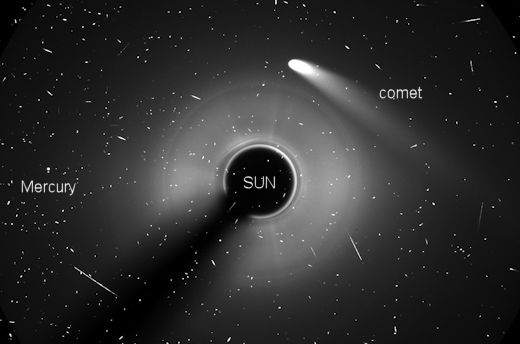
Mercury passed behind the Sun in a superior conjunction yesterday the 17th. The Sun actually occulted Mercury, though that couldn’t be seen. Below is a SOHO LASCO C2 coronagraph GIF animation from the 14th to the 17th showing Mercury entering on the right and disappearing behind the disk that hides the Sun’s photosphere. The white circle in the center shows the position and size of the Sun. The plane of Mercury’s orbit crosses the plane of the Earth’s orbit where the Earth is in early November and again 6 months later in early May. It happens that next May 9th Mercury will pass in front of the Sun, an event called a transit, that will be visible here. It will start at 7:13 a.m. (11:13 UT) and end at 2:44 p.m. (18:44 UT). Transits of Mercury are not as spectacular or as rare as those of Venus. I’ll have more on the transit when the date draws close.
A GIF animation from the Solar and Heliospheric Observatory LASCO C2 coronagraph for November 14th to the 17th. Mercury will enter from the right. Credit ESA/NASA – LASCO/NRL SOHO team.
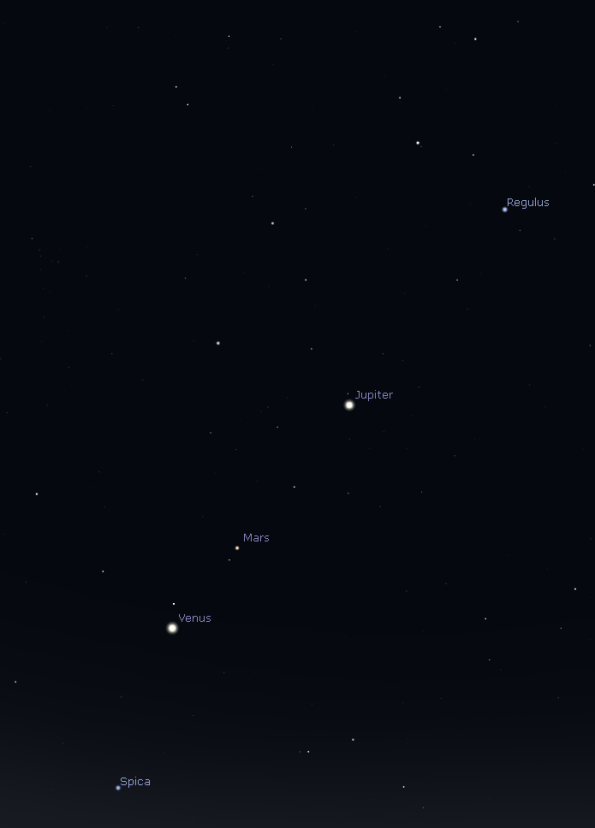
Jupiter, Mars and Venus appear in the southeast at 6 a.m., November 19, 2015. Created using Stellarium.
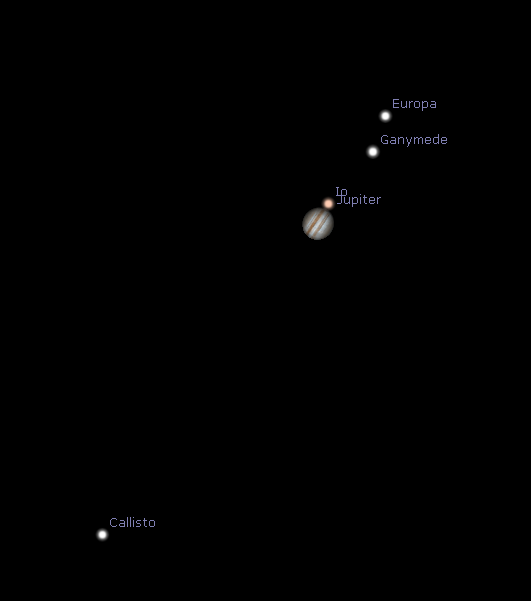
Jupiter and its moons in a telescope at 6 a.m., November 19, 2015. Created using Stellarium.
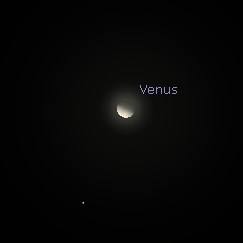
Venus as seen in a telescope at 6 a.m. November 19, 2015. This is at the same scale as the Jupiter image above. Created using Stellarium.
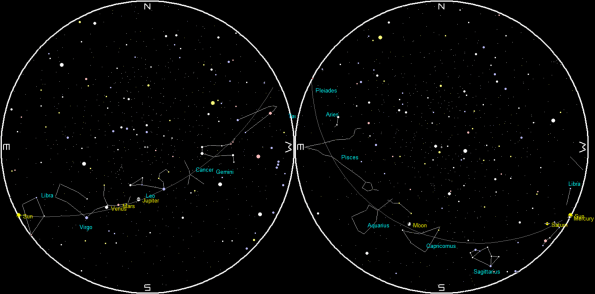
This is a chart showing the sunrise and sunset skies for November 18, 2015 showing the location of the planets and the Moon at that time. Created using my LookingUp program. Click on the image to enlarge.
Look quick! A new comet escapes the Sun
A sun grazing comet was discovered in SOHO chronograph images. And unlike Comet ISON 15 months ago which checked in but didn’t check out. This one escaped to possibly become visible in our evening sky. It was the 2875th comet discovered on SOHO chronograph images. Usually it ends there, but the comet, now named C/2015 D1 (SOHO).
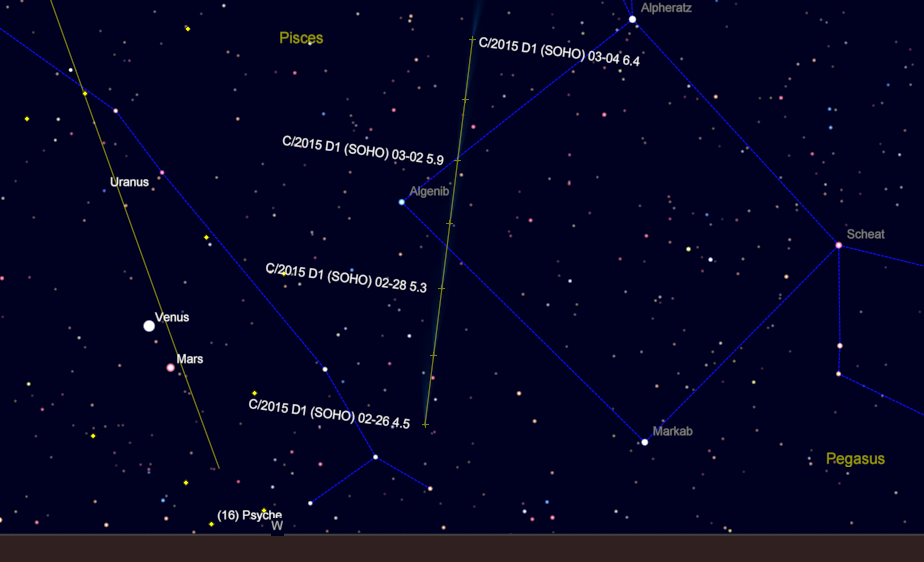
Hot off the press. Comet 2015 D1 was part of the download of comet elements this afternoon. Here’s the track with estimated magnitudes for tonight and the next week. Created using Cartes du Ceil (Sky Charts).
A more comprehensive post from Universe Today is here.
11/27/2013 – Ephemeris – Where are the bright planets and what’s up with Comet ISON?
Ephemeris for Wednesday, November 27th. The sun will rise at 7:54. It’ll be up for 9 hours and 10 minutes, setting at 5:05. The moon, 2 days past last quarter, will rise at 2:46 tomorrow morning.
Let’s see where the bright planets are this eventful week. Venus is brilliant in the southwest after sunset. It will set at 7:53 p.m. The giant planet Jupiter will rise at 8:01 p.m. in the east northeast. It’s cruising against the stars of Gemini now. It will pass due south at 3:38 a.m. Mars will rise at 1:47 a.m. also in the east northeast. Reddish Mars is midway between Regulus in Leo and Spica in Virgo and tomorrow morning will be about 12 moon diameters above left of the moon. Mercury and Saturn will be together in the east southeast by 7 a.m. Mercury is the lower and brighter of the two. Comet ISON is now too close to the sun to be seen. Check bobmoler.wordpress.com (see below) for how to view Comet ISON near the sun.
Times are for the Traverse City/Interlochen area of Michigan. They may be different for your location.
Addendum
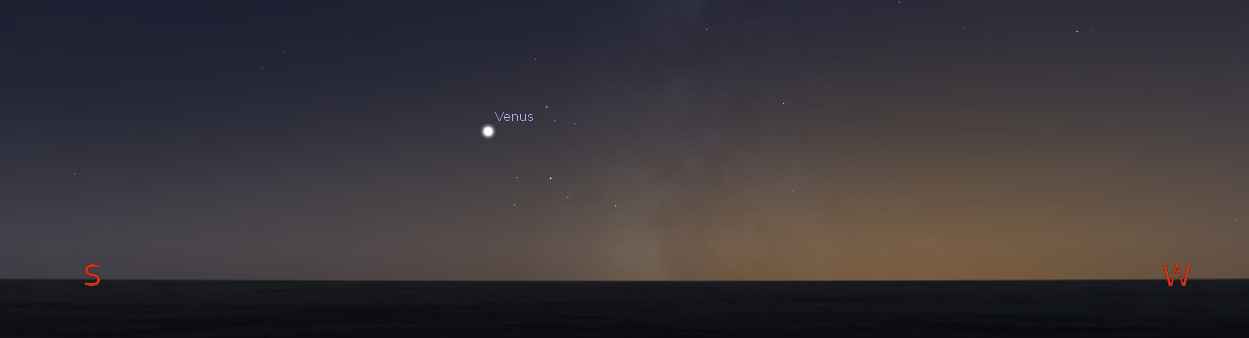
Venus as it should appear at 6 p.m. on 11/27/2013. Created using Stellarium.
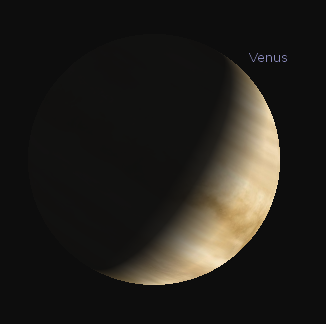
Telescopic view of Venus as it should appear at 6 p.m. on 11/27/2013. Created using Stellarium.
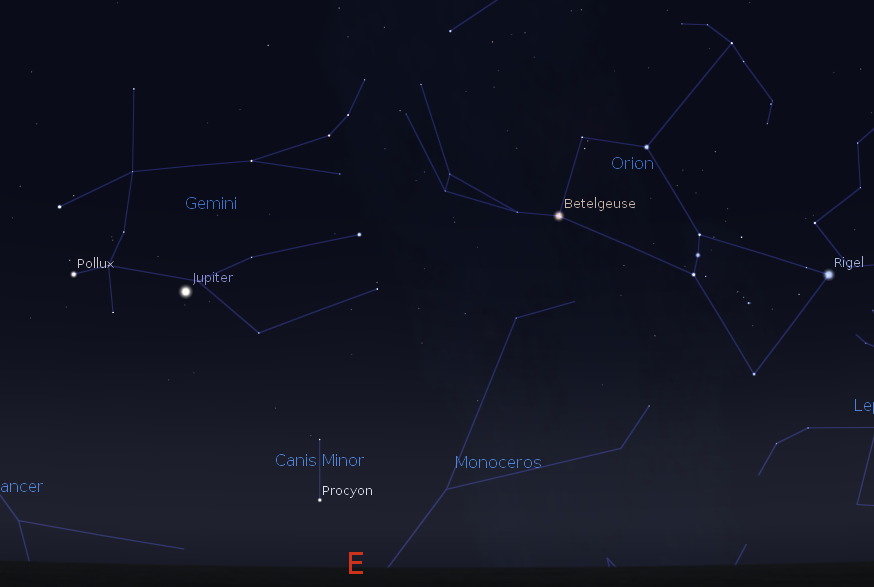
Jupiter and some winter constellations as they should appear at 10 p.m. on 11/27/2013. Created using Stellarium.
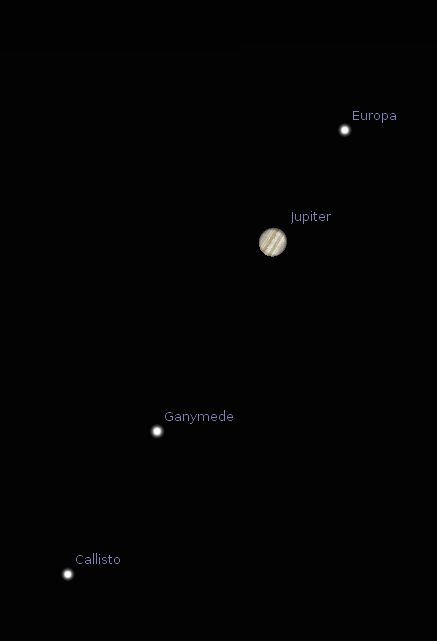
Telescopic view of Jupiter and its satellites as they should appear at 10 p.m. on 11/27/2013. The satellite Io is behind the planet and won’t appear until after midnight. Created using Stellarium.
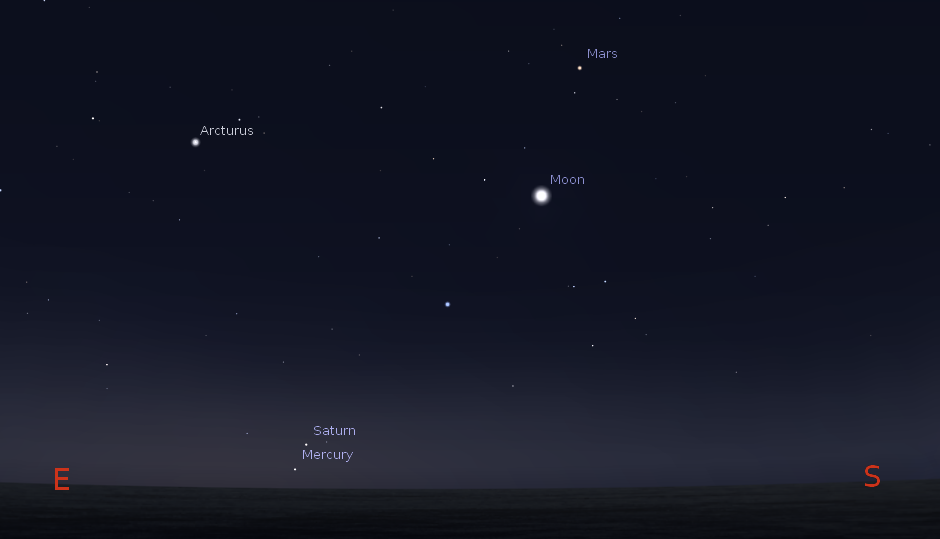
The morning planets Mars, Saturn and Mercury plus the Moon at 6:45 a.m. November 28, 2013. Created using Stellarium
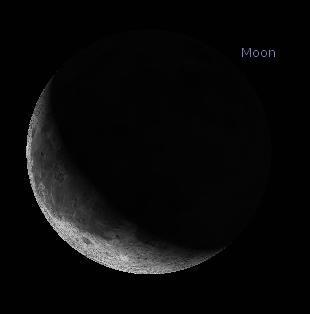
The Moon at 6:45 a.m. November 28, 2013. Created using Stellarium.
Comet ISON
Phil Plait the Bad Astronomer reported Monday that Comet ISON had suddenly decreased the amount of ices that it was emitting and pretty much simultaneously greatly increased the amount of dust it was producing. One of the possible explanations was that its nucleus had been disrupted. The comet’s nucleus is the small, maybe 2 km diameter, solid part of the comet. All the other parts of the comet are the thin ejected gas and dust from that nucleus. The head and tail of the comet is still a pretty good vacuum by earthly standards. There is still questions about it today. Here’s a YouTube video posted by the Planetary Society’s Emily Lakdawalla created by Emily from images taken by the STEREO Ahead spacecraft. It seems to be holding its own:
Here is the Planetary Society Blog entry that discusses Comet ISON’s then current status.
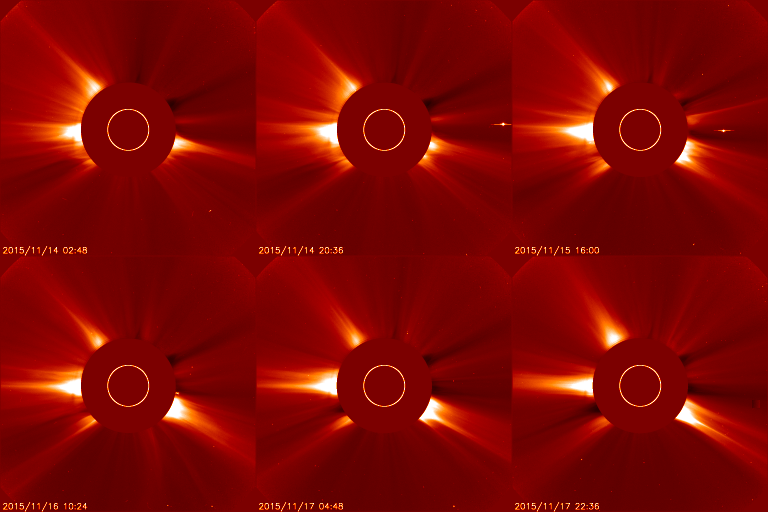
At the time of this posting (10 p.m. 11/26) the STEREO Behind COR 2 image shows Comet ISON entering on the lower left. Also SOHO’s LASCO C3 imager shows Comet ISON entering the view from the lower right. There’s also a coronal mass ejection (CME) erupting toward the comet. It could pass behind it, in front of it or actually toward it. It should be interesting.
Live programming of NASA-TV Thanksgiving Day
November 28, Thursday
1 – 3:30 p.m. – NASA Google+ Hangout: Comet ISON – GSFC (All Channels)
Here’s a link to NASA-TV: http://www.nasa.gov/multimedia/nasatv/
Planetary Society Blog has animation of Comet Lovejoy (C/2011W3) entering SOHO’s LASCO C3 field.
Emily Lakdawalla has the scoop. http://www.planetary.org/blog/article/00003301/
The comet should be closest to the sun (100,000 miles from the surface) tomorrow about 7 p.m. EST (0h U.T. December 16th). Supposedly about 600 feet in diameter. Do you think it’s got a snowball’s chance in hell of surviving? The sun’s surface (photosphere) is about 10,000 degrees F.
—
Bob Moler
12/13/11 – Ephemeris – Comet Lovejoy and Kreutz sungrazing comets
Tuesday, December 13th. The sun will rise at 8:10. It’ll be up for 8 hours and 51 minutes, setting at 5:02. The moon, 3 days past full, will rise at 8:21 this evening.
Comet Lovejoy which will pass close to the sun Thursday is not alone. It belongs to the Kreutz sungrazing group of comets. They are named after Heinrich Kreutz the 19th century astronomer who discovered some of the great comets of history were sungrazers and had similar orbits. Astronomers , trying to backtrack the comets, think the original comet broke up maybe in the 4th century AD into two unequal fragments, that have continued to fragment during close approached to the sun. The SOHO spacecraft can detect these comets toward the sun. Over 1,500 Kreutz sungrazer comets have been found on SOHO photographs. Comet Lovejoy should enter SOHO’s LASCO C3 image frame starting tomorrow morning. Google SOHO and NASA to locate the site on the internet.
http://sohowww.nascom.nasa.gov/data/realtime-images.html
* Times, as always are for the Traverse City/Interlochen area of Michigan.
Addendum
Here’s something like what we’ll see in the next two days.

A Kreutz Sungrazer in 1996 seen by SOHO. Credit: LASCO, SOHO Consortium, NRL, ESA, NASA
12/12/11 – Ephemeris – The Solar and Heliospheric Observatory (SOHO)
Monday, December 12th. The sun will rise at 8:09. It’ll be up for 8 hours and 52 minutes, setting at 5:02. The moon, 2 days past full, will rise at 7:15 this evening.
Most of this week will be on the topic of Comet Lovejoy which will pass a hundred thousand moles of the sun’s surface Thursday evening our time. It should be visible to the SOHO spacecraft orbiting the sun a million miles sunward of the earth starting Wednesday. Normally a spacecraft inside the earth’s orbit will orbit the sun in less time than the earth and move away from the earth. However SOHO is placed at a unique spot called L1, kind of a equilibrium point between the earth and sun SOHO means Solar and Heliospheric Observatory was launched in 1995 and has served as an early warning sentinel for solar storms approaching the earth pretty much ever since. It is with SOHO that we’ll see if Comet Lovejoy survives its plunge near the sun.
* Times, as always are for the Traverse City/Interlochen area of Michigan.
 Bob Moler's Ephemeris Blog