Archive
06/25/2020 – Ephemeris – The bright star Spica
This is Ephemeris for Thursday, June 25th. Today the Sun will be up for 15 hours and 33 minutes, setting at 9:32, and it will rise tomorrow at 5:58. The Moon, 3 days before first quarter, will set at 12:59 tomorrow morning.
Low in the southwest at 11 p.m. is the bright star Spica which can be found from all the way back overhead to the Big Dipper. Follow the arc of the handle of the Big Dipper to the bright star Arcturus high in the southwest. Then straighten the curve of the arc to a straight spike which points to Spica. Arcturus is much brighter than Spica and has an orange tint to Spica’s bluish hue. In fact Spica is the bluest of the 21 first magnitude stars. That means that it is hot. Actually Spica is really two blue stars orbiting each other in 4 days. Spica is 250 light years away, which is reasonably close. Spica was an important star to the ancient Greeks. One temple was built, and aligned to its setting point.
The event times given are for the Traverse City/Interlochen area of Michigan. They may be different for your location.
Addendum
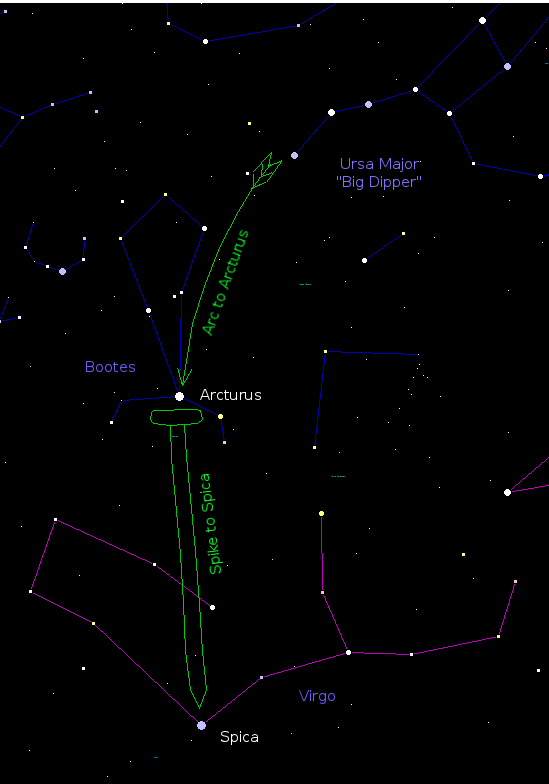
Spica finder chart using my LookingUp program fo 11 p.m. tonight June 25.
05/15/2020 – Ephemeris – Virgo and its cluster of galaxies
This is Ephemeris for Friday, May 15th. Today the Sun will be up for 14 hours and 50 minutes, setting at 9:04, and it will rise tomorrow at 6:12. The Moon, 1 day past last quarter, will rise at 4:01 tomorrow morning.
One of the large constellations we see in the south at 11 p.m. can be found using the Big Dipper overhead, follow the arc of the handle to the bright star Arcturus, the straighten the arc to a spike to reach Spica, a bright blue-white star in the south. Spica is the brightest star in the constellation Virgo the virgin. She represents the goddess of the harvest, Virgo is holding a sheaf of wheat in depictions of her, and Spica is placed at the head of the sheaf. In the space between Spica and Leo the lion to her upper right is, a great cluster of thousands of galaxies just below naked eye visibility. The Virgo Cluster. Inside that cluster is galaxy M87 in whose center lies a black hole with the mass of 6.5 billion suns that was imaged last year. The center of the cluster is at about 54 million light years away.
The event times given are for the Traverse City/Interlochen area of Michigan. They may be different for your location.
Addendum
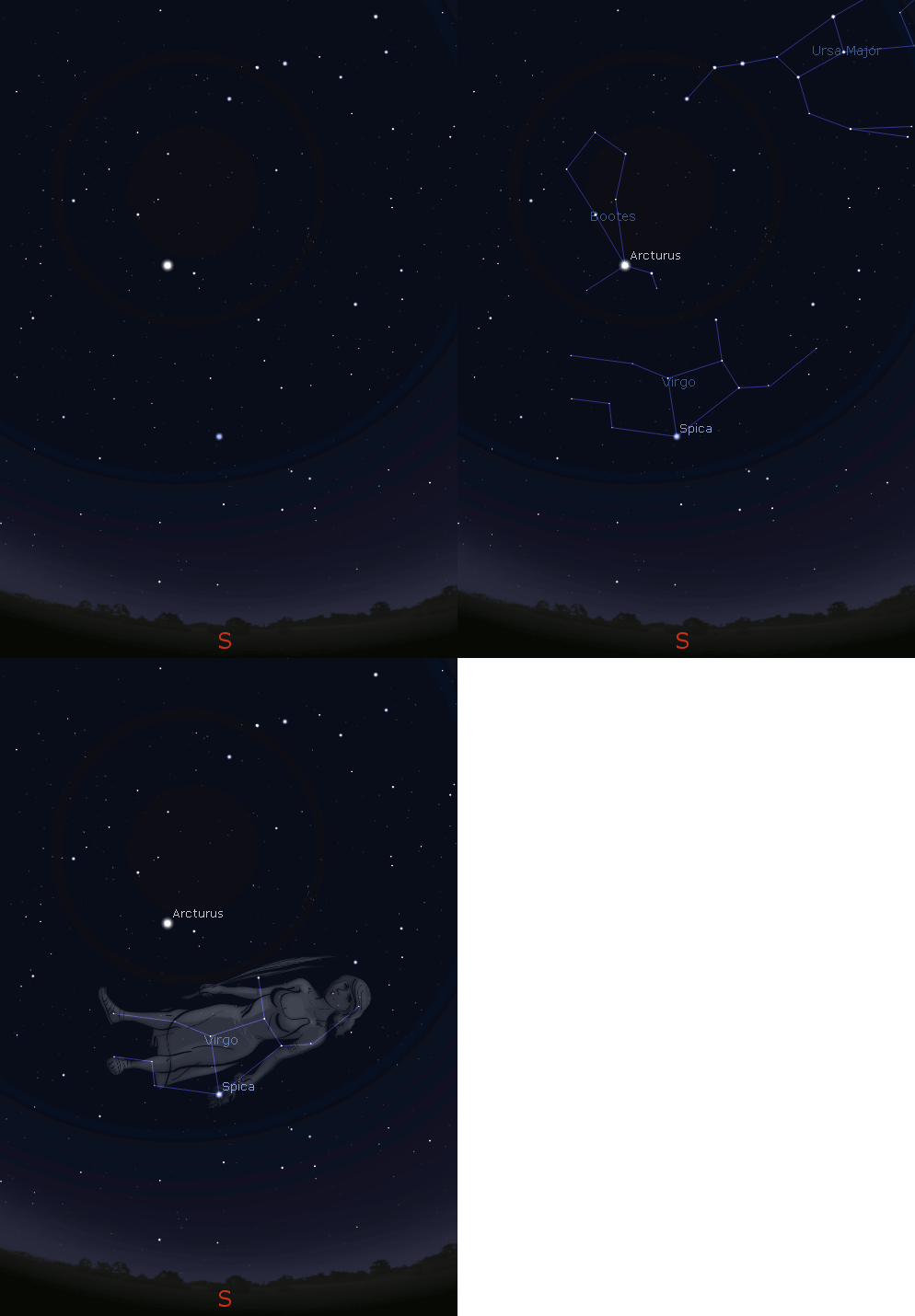
Spica finder animation . Click on the image to enlarge. Created using Stellarium and GIMP.
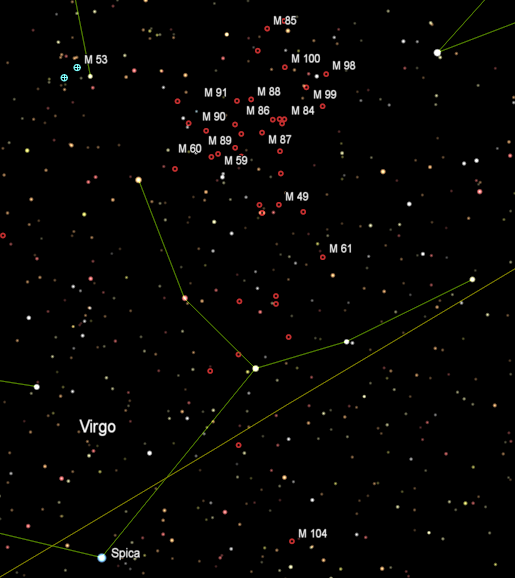
Some of the brighter members of the Virgo Cluster (of galaxies) as red ovals. The galaxies marked with an ‘M’ number are part of Charles Messier’s catalog. It took a telescope of 8 inch diameter for me to spot them. Someone with better vision, like Messier himself can spot them with a smaller telescope. M53 and the object next to it are globular star clusters in the outer reaches of our galaxy. Created using Cartes du Ciel (Sky Charts).
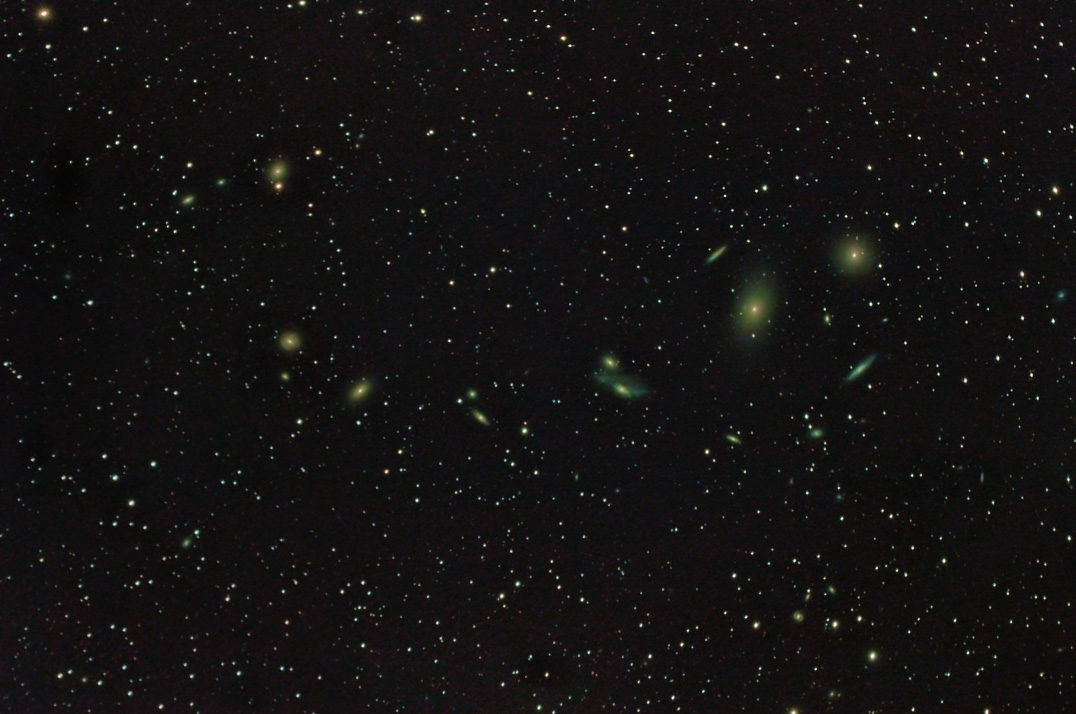
Markarian Chain of galaxies within the Virgo Cluster by Scott Anttila.

The first image of the black hole in M87. Credit Event Horizon Telescope.
04/24/2020 – Ephemeris – The Big Dipper can be used to point to other stars and constellations
This is Bob Moler with Ephemeris for Arbor Day, Friday, April 24th. Today the Sun will be up for 13 hours and 57 minutes, setting at 8:39, and it will rise tomorrow at 6:41. The Moon, 2 days past new, will set at 10:21 this evening.
The Big Dipper can be used to point to other stars and constellations. Right now the Big Dipper is nearly overhead. The front bowl stars point to Polaris, the North Star which never seems to move in the sky. The handle can be used to find two stars. First follow the arc of the handle away from the bowl to find the fourth brightest night-time star Arcturus in the base of the kite shaped constellation of Boötes. Straighten the arc to a spike and continue to the south and you will come to the bright blue-white star Spica in Virgo the virgin. You can remember these stars with the phrase “Follow the arc of the handle to Arcturus and then spike to Spica” or if you prefer the alternate pronunciation of the latter star “Speak to Speeka”.
The event times given are for the Traverse City/Interlochen area of Michigan. They may be different for your location.
Addendum
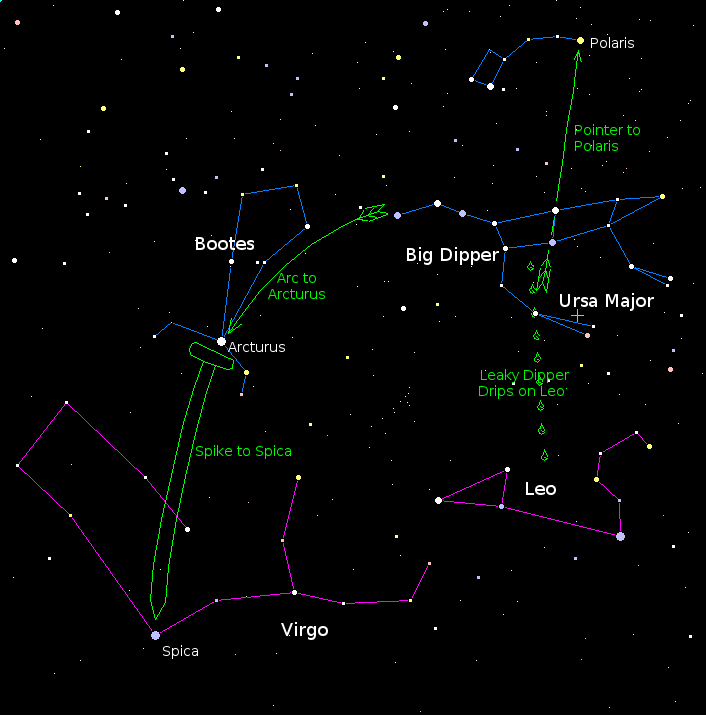
Finding stars and constellations using the Big Dipper. Click on the image to enlarge. Created using my LookingUp program for Windows.
05/27/2019 – Ephemeris – The bright star Spica
Ephemeris for Memorial Day, Monday, May 27th. Today the Sun will be up for 15 hours and 13 minutes, setting at 9:16, and it will rise tomorrow at 6:03. The Moon, 1 day past last quarter, will rise at 3:34 tomorrow morning.
Just about due south at 10:30 p.m. is the bright star Spica which can be found from all the way back overhead to the Big Dipper. Follow the arc of the handle of the Big Dipper to the bright star Arcturus high in the south-southeast. Then straighten the curve of the arc to a straight spike which points to Spica the brightest star in the zodiacal constellation of Virgo the virgin. Arcturus is much brighter than Spica and has an orange tint to Spica’s bluish hue. In fact Spica is the bluest of the 21 first magnitude stars. That means that it is hot. Actually Spica is really two blue stars orbiting each other every 4 days. Spica is 250 light years away, which is reasonably close. Spica was an important star to the ancient Greeks. One temple was built, and aligned to its setting point.
The times given are for the Traverse City/Interlochen area of Michigan. They may be different for your location.
Addendum
Spica finder animation for 10:30 p.m., May 27th. Click on the image to enlarge. Created using Stellarium and GIMP.
05/20/2019 – Ephemeris – Dark evening skies again and a look at Virgo
Ephemeris for Monday, May 20th. Today the Sun will be up for 15 hours even, setting at 9:09, and it will rise tomorrow at 6:08. The Moon, 2 days past full, will rise at 11:10 this evening.
One of the large constellations we see in the south at 11 p.m. can be found using the Big Dipper overhead, follow the arc of the handle to the bright star Arcturus, the straighten the arc to a spike to reach Spica, a bright blue-white star in the south. Spica is the brightest star in the constellation Virgo the virgin. She represents the goddess of the harvest, Virgo is holding a sheaf of wheat in depictions of her, and Spica is placed at the head of the sheaf. In the space between Spica and Leo the lion to her upper right is, a great cluster just below naked eye visibility. The Virgo cluster of galaxies. Inside that cluster is galaxy M87 in whose center lies a black hole with the mass of 6.5 billion suns that was imaged last month.
The times given are for the Traverse City/Interlochen area of Michigan. They may be different for your location.
Addendum
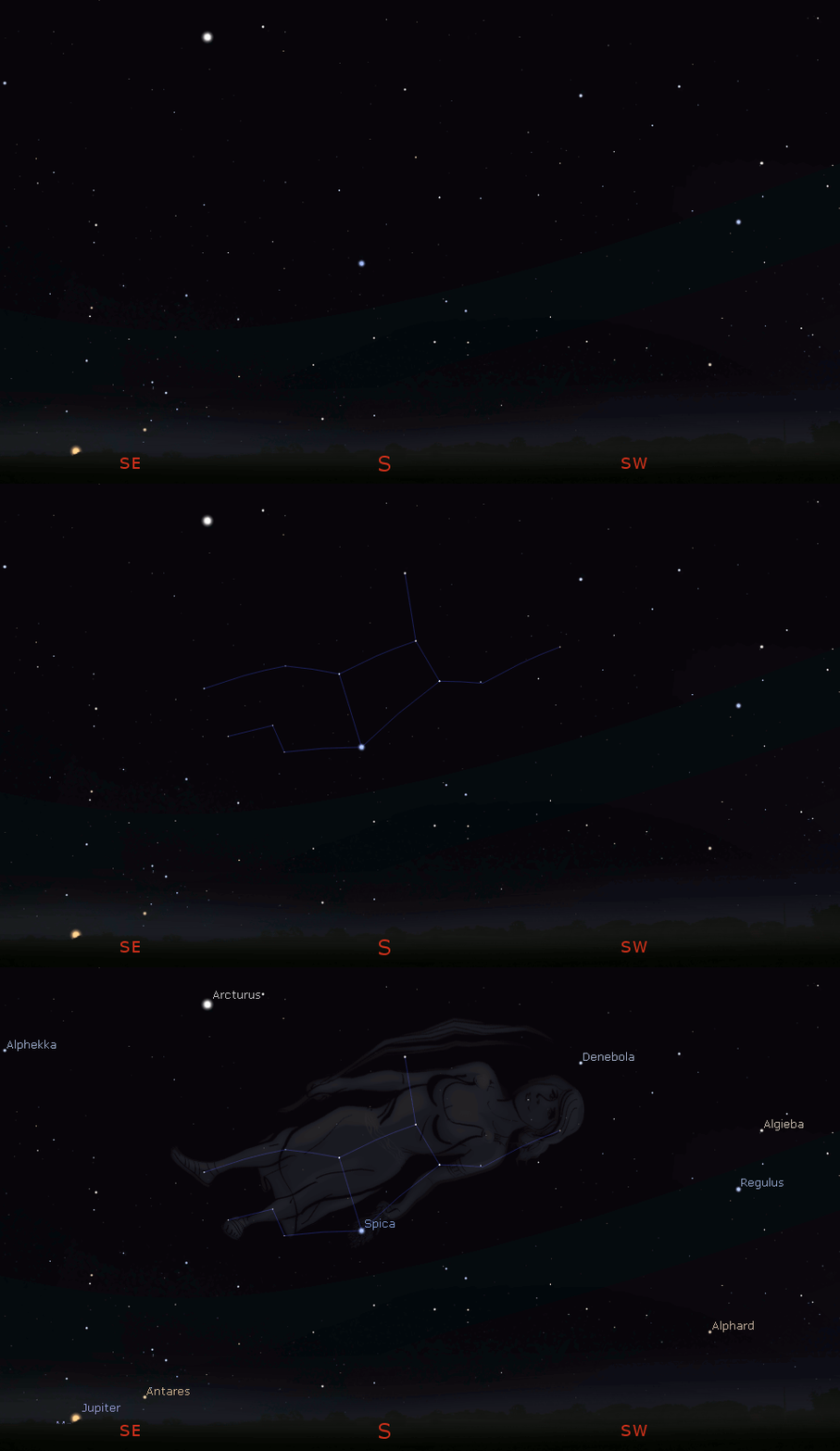
Virgo finder animation for 11 p.m. May 20, 2019. Click on the image to enlarge. Created using Stellarium.
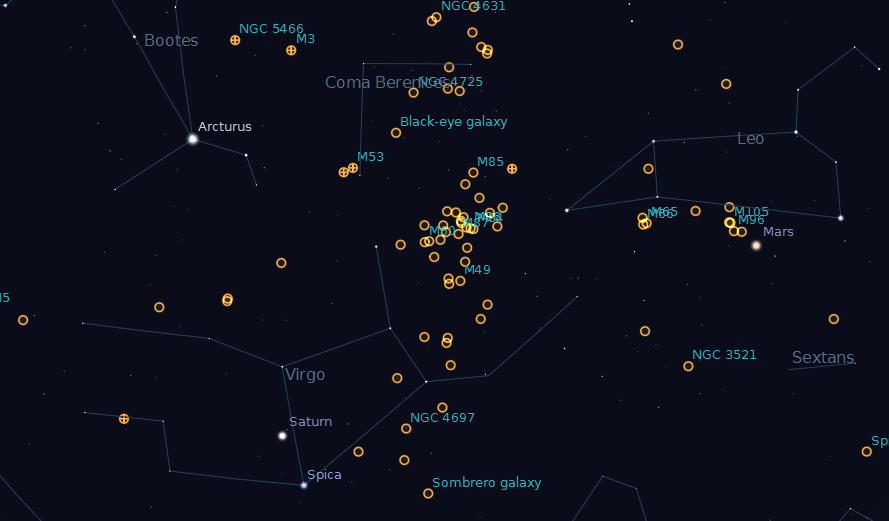
Brighter members of the Virgo Cluster. Created using Stellarium. Open circles are galaxies, circles with crosses are globular star clusters, outlying members of our Milky Way galaxy. M87 is just above center in that knot of galaxies. Created using Stellarium.
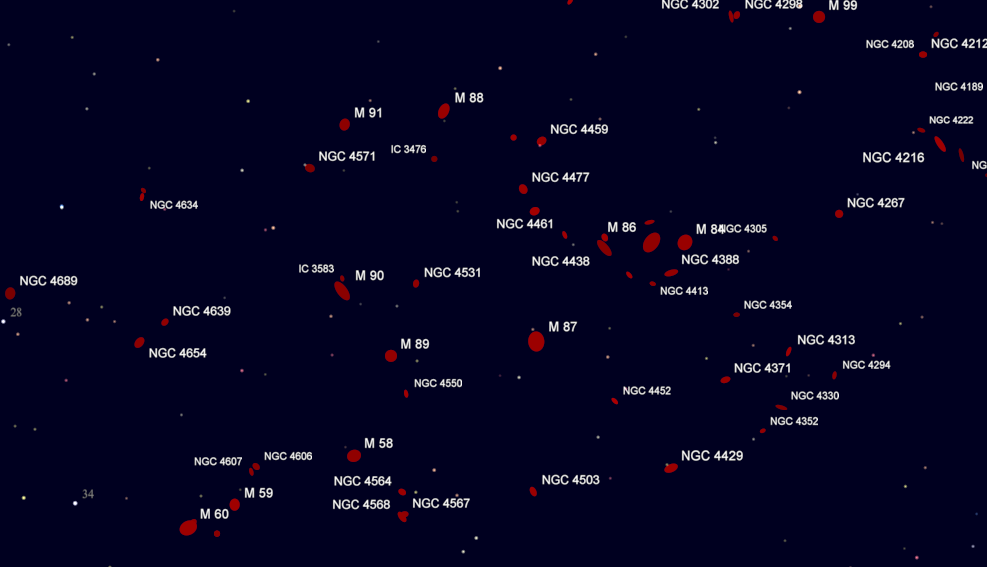
A closer look at some of the galaxies in the heart of the Virgo Cluster. M87 is near the center. Created with Cartes du Ciel (Sky Charts).
04/29/2019 – Ephemeris – Follow the arc to Arcturus
Ephemeris for Monday, April 29th. Today the Sun will be up for 14 hours and 8 minutes, setting at 8:45, and it will rise tomorrow at 6:34. The Moon, 3 days past last quarter, will rise at 5:06 tomorrow morning.
The Big Dipper, now nearing the zenith at 10 p.m. points to several stars and constellations. It’s handle points to two bright stars. First we follow the arc of the handle to the bright orange star Arcturus, the 4th brightest night-time star. The reason I say night-time is that the sun is a star also but by definition is not out at night. The arc to Arcturus is a how to find Arcturus and a clue to its name. Arcturus, midway up the sky in the east, lies at the base point of the kite shaped constellation of Boötes the herdsman. From Arcturus, straighten out the arc to a spike and one soon arrives at Spica a blue-white star in Virgo the virgin, now low in the southeast. Spica is also sometimes pronounced ‘Speeka’.
The times given are for the Traverse City/Interlochen area of Michigan. They may be different for your location.
Addendum
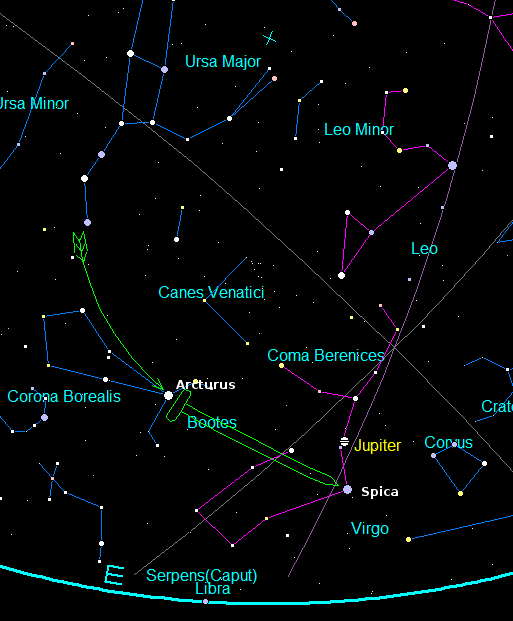
How to find the stars Arcturus and Spica from the Big Dipper in late April. Created using my LookingUp program.
05/14/2018 – Ephemeris – Big Dipper: Pointer to the Stars
Ephemeris for Monday, May 14th. Today the Sun will be up for 14 hours and 47 minutes, setting at 9:03, and it will rise tomorrow at 6:14. The Moon, 1 day before new, will rise at 6:45 tomorrow morning.
The Big Dipper points to other stars and constellations. Right now the Big Dipper is nearly overhead. The front bowl stars point to Polaris, the North Star which never seems to move in the sky. The handle can be used to find two stars. First follow the arc of the handle away from the bowl to find the fourth brightest night-time star Arcturus in the base of the kite shaped constellation of Boötes. Straighten the arc to a spike and continue to the south and you will come to the bright blue-white star Spica in Virgo the virgin. You can remember these stars with the phrase “Follow the arc of the handle to Arcturus and then spike to Spica” or if you prefer the alternate pronunciation of the latter star “Speak to Speeka”.
The times given are for the Traverse City/Interlochen area of Michigan. They may be different for your location.
Addendum
As can be seen below, there was one pointer function that didn’t make it into the program: A leaky dipper drips on Leo.
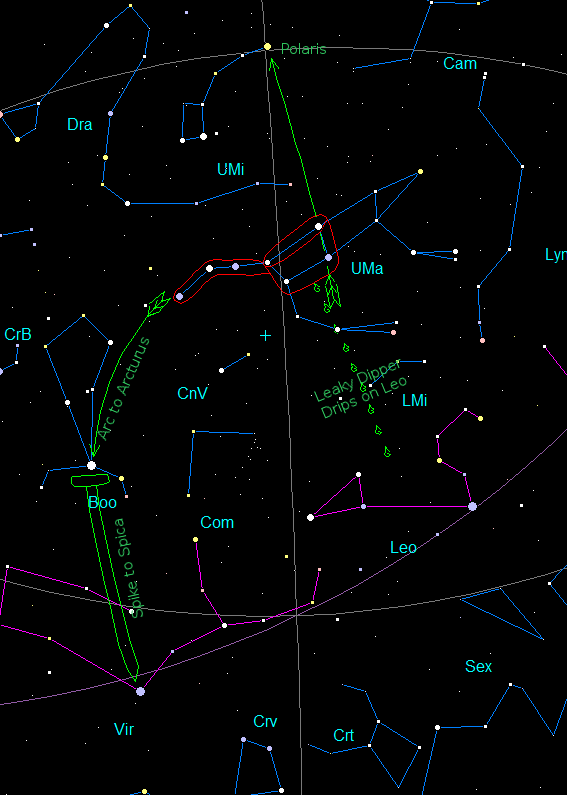
Using the Big Dipper as a pointer to other stars. The pointers to Polaris could be life saving, since it is always north. The view is southward. The cross displayed near the center is the zenith. One might want to lay down to take all this in. Created using my LookingUp program.
05/15/2017 – Ephemeris – A look at the constellation of Virgo the virgin
Ephemeris for Monday, May 15th. Today the Sun will be up for 14 hours and 49 minutes, setting at 9:03, and it will rise tomorrow at 6:13. The Moon, 3 days before last quarter, will rise at 1:03 tomorrow morning.
Tonight at 10 p.m. in the south-southeast, is the constellation and member of the of the zodiac: Virgo the virgin. Now Jupiter is seen against the constellation appearing above and right of its brightest star, Spica. Virgo is a large constellation of a reclining woman holding a stalk of wheat. Spica, is the head of that spike of wheat; and as such it ruled over the harvest in two of Virgo’s guises as the goddesses Persephone and Ceres. Virgo is also identified as Astraea the goddess of justice. The constellation of Libra, the scales, which she is associated with, is found just east of her low in the east-southeast. Early Christians who sought to de-paganize the heavens saw Virgo as the Virgin Mary. Virgo is the host to a grand cluster of galaxies.
The times given are for the Traverse City/Interlochen area of Michigan. They may be different for your location.
Addendum
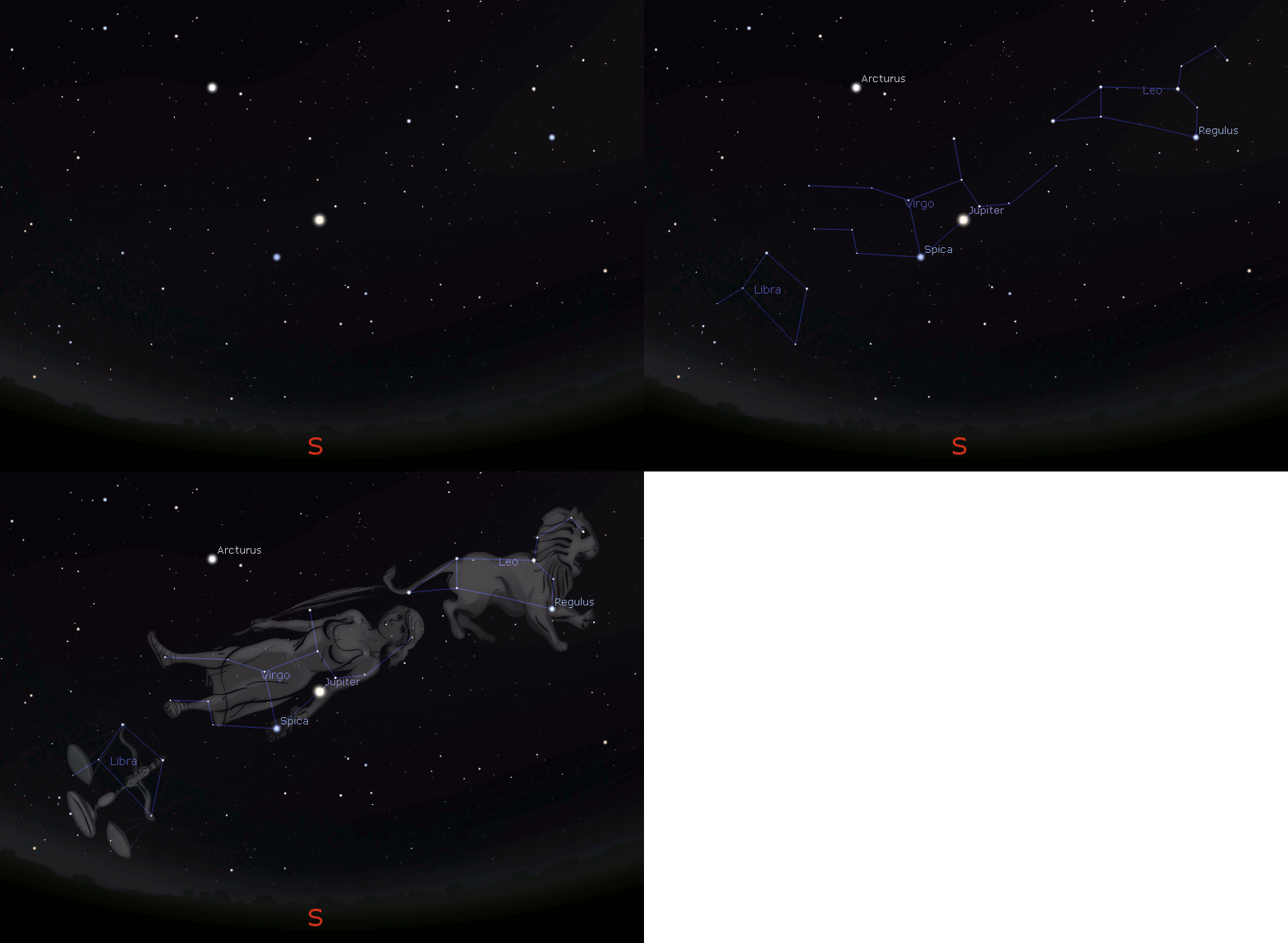
Animated Virgo finder chart for 11 p.m., May 15, 2017. Created using Stellarium and GIMP.
04/17/2017 – Ephemeris – How to find the stars Arcturus and Spica from the Big Dipper
Ephemeris for Monday, April 17th. The Sun rises at 6:54. It’ll be up for 13 hours and 35 minutes, setting at 8:30. The Moon, 2 days before last quarter, will rise at 2:21 tomorrow morning.
The Big Dipper, now nearing the zenith at 10 p.m. points to several stars and constellations. It’s handle points to two bright stars. First we follow the arc of the handle to the bright orange star Arcturus, the 4th brightest night-time star. The reason I say night-time is that the sun is a star also but by definition is not out at night. The arc to Arcturus is a how to find Arcturus and a clue to its name. Arcturus, midway up the sky in the east, lies at the base point of the kite shaped constellation of Boötes the herdsman. From Arcturus, straighten out the arc to a spike and one soon arrives at Spica a blue-white star in Virgo the virgin, now low in the southeast. It is below Jupiter this year. Spica is also sometimes pronounced ‘Speeka’.
The times given are for the Traverse City/Interlochen area of Michigan. They may be different for your location.
Addendum
How to find the stars Arcturus and Spica from the Big Dipper in April 2017. Created using my LookingUp program.
03.14/2017 – Ephemeris – It’s Pi Day!
Ephemeris for Pi Day 3.14, Tuesday, March 14th. The Sun will rise at 7:56. It’ll be up for 11 hours and 51 minutes, setting at 7:47. The Moon, 2 days past full, will rise at 10:04 this evening.
Welcome to Pi Day. I had some NASA inspired links posted on this blog this past Sunday for your enjoyment. Also simply do an Internet search for Pi Day and lots of fun information and activities will be listed. I remember an exercise in high school calculating pi with an inscribed polygon in a circle of ever increasing numbers of sides. Somewhere in there I messed up and came out with an answer that didn’t quite get there. This was in the years B.C. that is Before Calculators. Speaking of round things, Jupiter will rise this evening followed by the Moon and the star Spica in the east. They will all be up by 10:30. Jupiter is not yet an evening planet, since it is not up by sunset. It’s still seen in the morning sky.
Times are for the Traverse City/Interlochen area of Michigan. They may be different for your location.
Addenda
Had I known in the tenth grade this strategy to calculate pi, I could have saved myself a lot of grief. Simply google calculate pi with toothpicks. One of the hits was this from Science Friday: https://sciencefriday.com/articles/estimate-pi-by-dropping-sticks/*. Basically it’s by dropping lots of toothpicks on a piece of paper with parallel lines spaced the length of the toothpicks apart. The total number of toothpicks dropped times two divided by the number of toothpicks that cross a line will approximate pi. The more drops, the closer to pi one gets.
- In the formula in the link, if the length of the toothpicks equals the distance between the lines, those terms drop out of the formula.
Grouping of Jupiter, the Moon and the star Spica
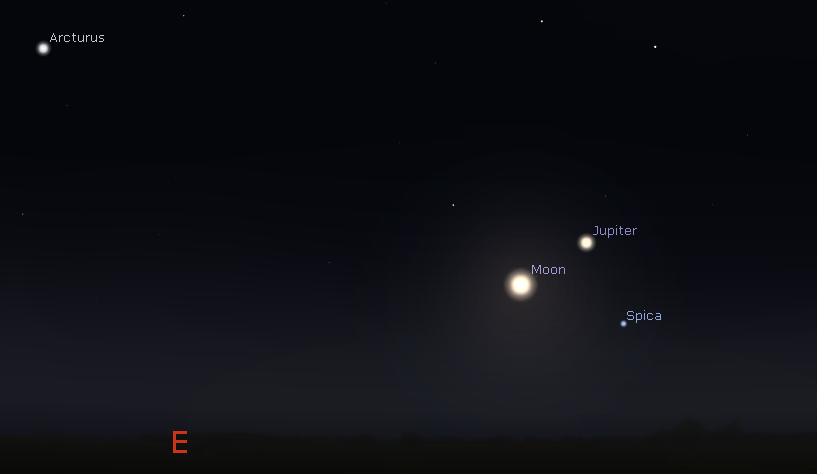
Jupiter, the Moon and the star Spica at 11 p.m. March 14, 2016. Since the Moon moves eastward about its diameter an hour. So observers east or west of here will see the Moon in a different position in relation to these other two bodies. Created using Stellarium.
 Bob Moler's Ephemeris Blog