Archive
10/11/2012 – Ephemeris – North American Nebula
Ephemeris for Thursday, October 11th. The sun will rise at 7:53. It’ll be up for 11 hours and 10 minutes, setting at 7:04. The moon, 3 days past last quarter, will rise at 4:30 tomorrow morning.
Most of what we see in the Milky Way are just masses of stars, but there are bright clouds of gas , or to name them properly: emission nebulae. These bright clouds are areas of star formation. It is the ultraviolet light from young massive stars that light up the clouds they were formed from. A bright one, easily visible in binoculars is just about overhead at 9 p.m. Called the North American Nebula, a glow shaped much like our continent just east of the star Deneb, the northernmost star of the Summer Triangle, and brightest star in Cygnus the swan or Northern Cross. There are many other nebulae in the Milky Way, visible in binoculars and small telescopes. Many enjoyable hours can be spent sweeping the Milky Way for nebulae and star clusters.
Times are for the Traverse City/Interlochen area of Michigan. They may be different for your location.
Addendum
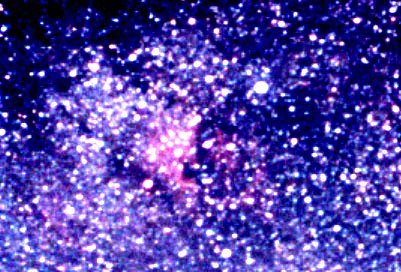
North American Nebula in Red. My old image.
The red object is the North American Nebula. Our eyes cannot perceive the color, due to hydrogen. This was a time exposure on film without telephoto. The bright star to the upper right is Deneb. The orientation is approximately correct if facing south. The photo also shows the stars that make up the glow of the Milky Way to the unaided eye.
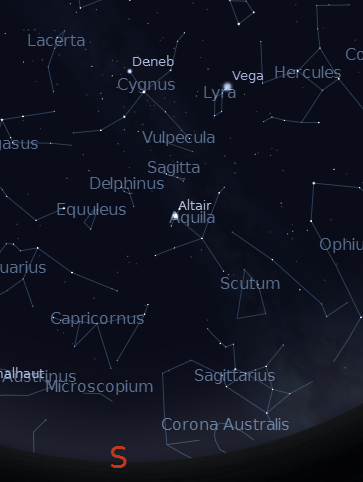
Deneb Overhead at 9 p.m. on October 11. Created using Stellarium.
The North American Nebula is about the size and position of the C in Cygnus.
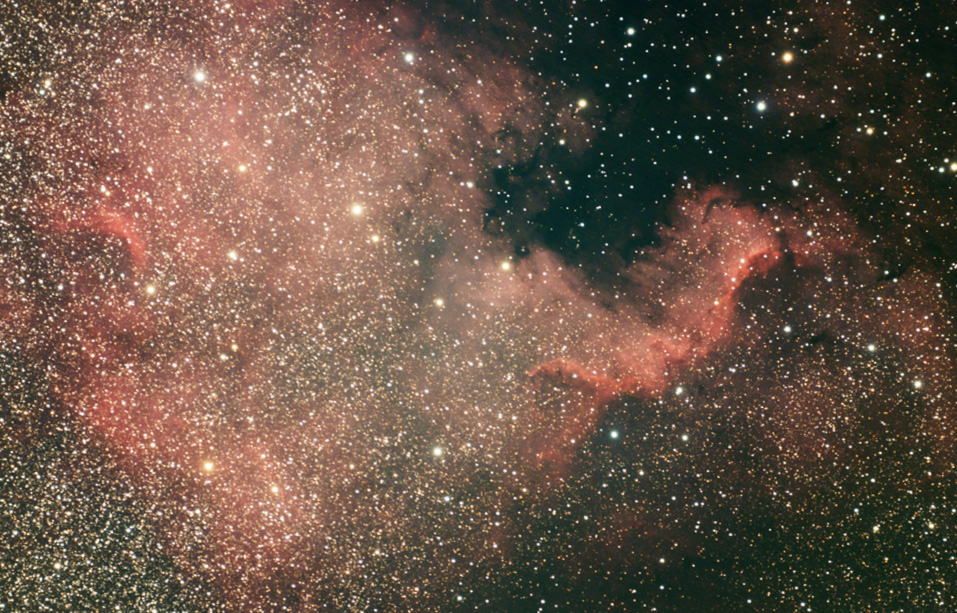
Better view of the North American Nebula taken by Scott Anttila.
This nebula is cataloged as NGC 7000.
07/05/2012 – Ephemeris – The Summer Triangle
Ephemeris for Thursday, July 5th. Today the sun will be up for 15 hours and 26 minutes, setting at 9:30. The moon, 2 days past full, will rise at 10:37 this evening. Tomorrow the sun will rise at 6:04.
Now that summer is here, the asterism or informal constellation called the Summer Triangle can be seen high in the east as it gets dark. Highest of the three bright stars is Vega in the constellation Lyra the harp, whose body is seen in a narrow parallelogram nearby. The second star of the triangle is Deneb lower and left of Vega, It appears dimmer than Vega because its is by far the most distant of the three. The third star of the Summer Triangle is seen farther below and right of Vega. It is Altair in Aquila the eagle, and the closest. Altair is 16.7 light years away, Vega is 25 light years while Deneb may be a whopping 1,550 light years away. [One light year is 6 about trillion miles. That’s 6 with 12 zeros after it.]
Times are for the Traverse City/Interlochen area of Michigan. They may be different for your location. Bracketed text was omitted from the broadcast due to time constraints.
Addendum
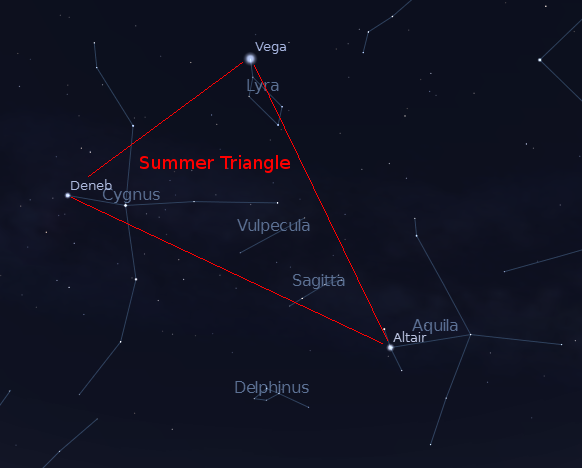
The Summer Triangle July 5, 2012 at 11 p.m. Created using Stellarium and The Gimp.
08/25/11 – Ephemeris – The Great Rift
Thursday, August 25th. The sun rises at 6:56. It’ll be up for 13 hours and 35 minutes, setting at 8:31. The moon, 3 days before new, will rise at 3:57 tomorrow morning.
High overhead the Milky Way is seen passing through the Summer Triangle of three bright stars. Here we find the Milky Way split into two sections. The split starts in the constellation of Cygnus the Swan or Northern Cross very high in the east. The western part of the Milky Way ends southwest of the Aquila the eagle. This dark dividing feature is called the Great Rift. Despite the lack of stars seen there, it doesn’t mean that there are fewer stars there than in the brighter patches of the Milky Way. The rift is a great dark cloud that obscures the light of the stars behind it. Sometimes binoculars can be used to find the edges of the clouds of the rift, as stars numbers drop off suddenly. This is especially easy in Aquila.
* Times are for the Traverse City/Interlochen area of Michigan. They may be different for your location.
Addendum
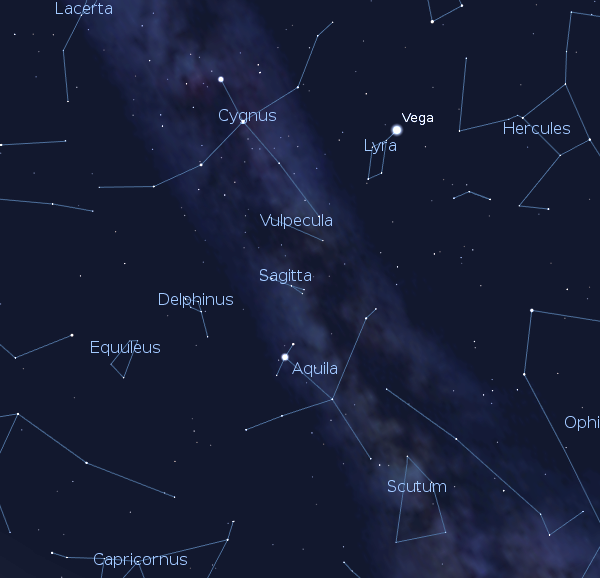
The Great Rift in the Milky Way. Created using Stellarium.
 Bob Moler's Ephemeris Blog