Archive
03/04/2015 – Ephemeris – Our weekly look at the bright planets
Ephemeris for Wednesday, March 4th. The Sun will rise at 7:15. It’ll be up for 11 hours and 18 minutes, setting at 6:34. The Moon, 1 day before full, will set at 6:59 tomorrow morning.
Lets take a look at the bright planets for this week. Brilliant Venus is in the west by 7:30 p.m. It will set at 9:13 p.m. It’s separating from Mars which appears below and right of it. The Red Planet will set tonight at 8:47 p.m. Jupiter will appear In the southeastern sky in the evening. It will be up just about all night, and will set at 6:16 a.m. It’s near the sickle-shaped head of Leo the lion, and it’s the brightest star-like object in the sky. In telescopes tonight the moon Io will be behind Jupiter and will pop into sunlight a bit away from the planet at 9:39 p.m. Tomorrow night the 5th the moon Europa will duck behind Jupiter at 8:48 p.m. After that only 3 of the moons will be visible, until 12:57 a.m. when Europa will appear on the other side.* Early risers will be able to spot Saturn which will rise in the east-southeast at 1:25 a.m. It’s in the south at 6 a.m.
Times are for the Traverse City/Interlochen area of Michigan. They may be different for your location.
* Due to a date mix up the radio program may be incorrect. The occultation of Europa on the 5th being set on the 4th. The Io occultation is since added.
Addendum
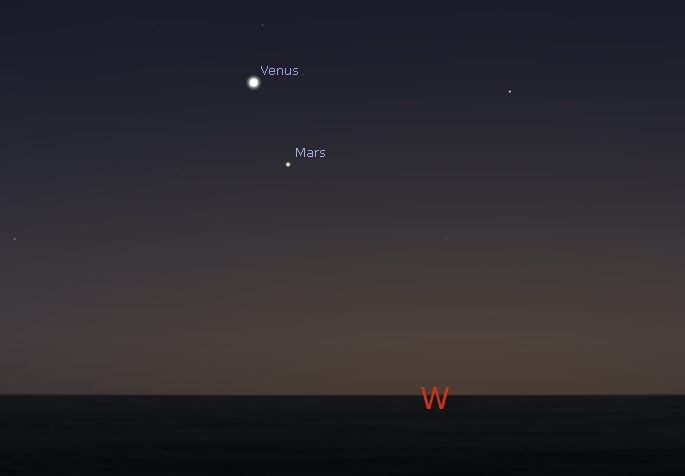
Venus and Mars in the west at 7:30 p.m. on March 4, 2015. Created using Stellarium.
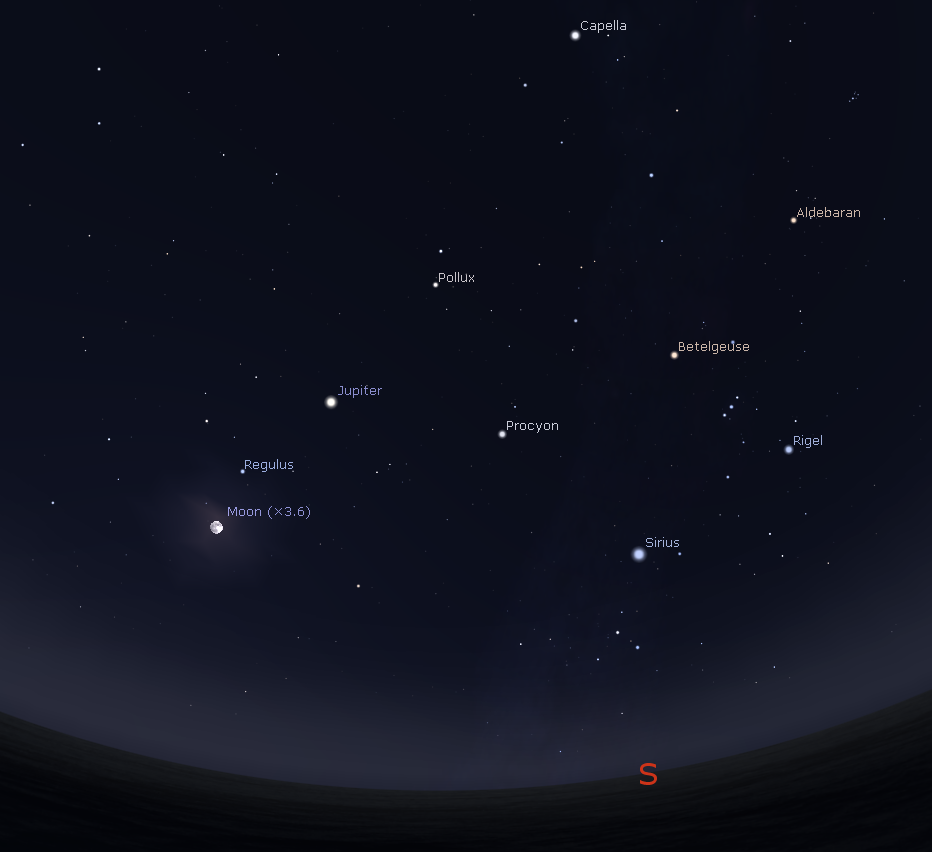
Jupiter, the full Moon and the winter stars at 9 p.m. on March 4, 2014. Created using Stellarium.
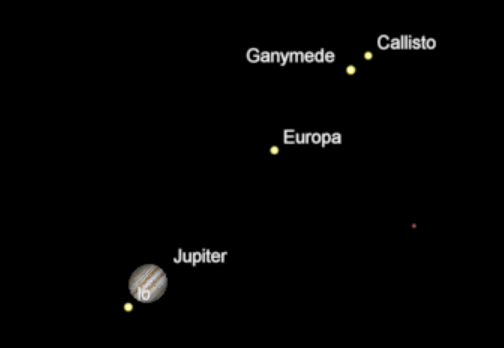
Jupiter and moons at 9:39 p.m., when Io leaves Jupiter’s shadow on March 4, 2015. Created using Cartes du Ceil (Sky Charts).
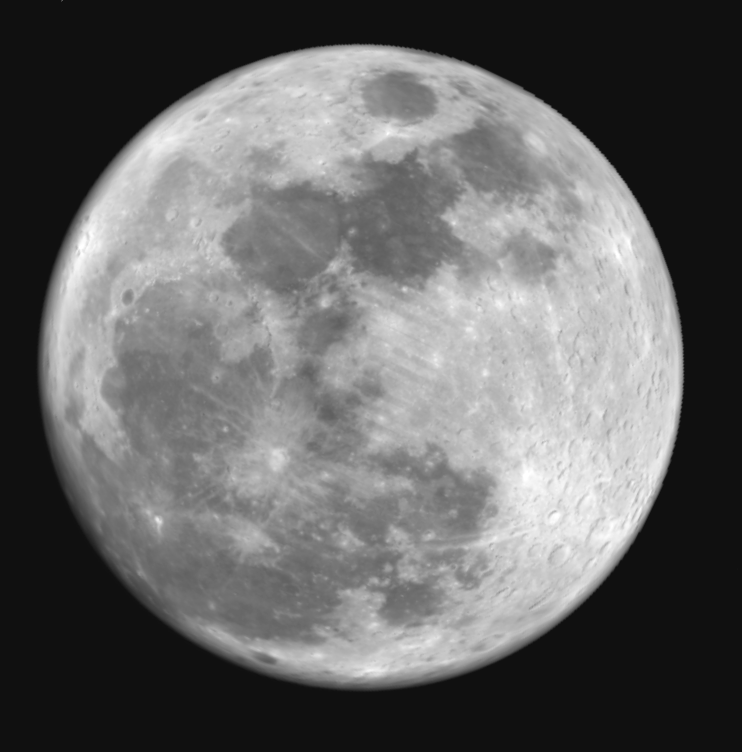
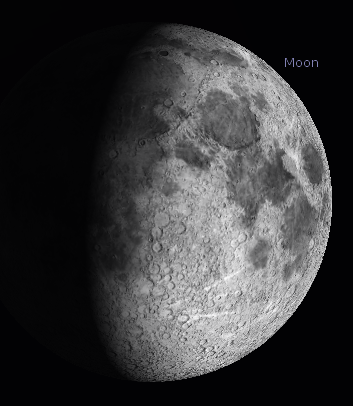
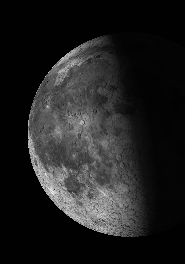
The nearly full moon at 9 p.m. on March 4, 2015. Created using Virtual Moon Atlas.
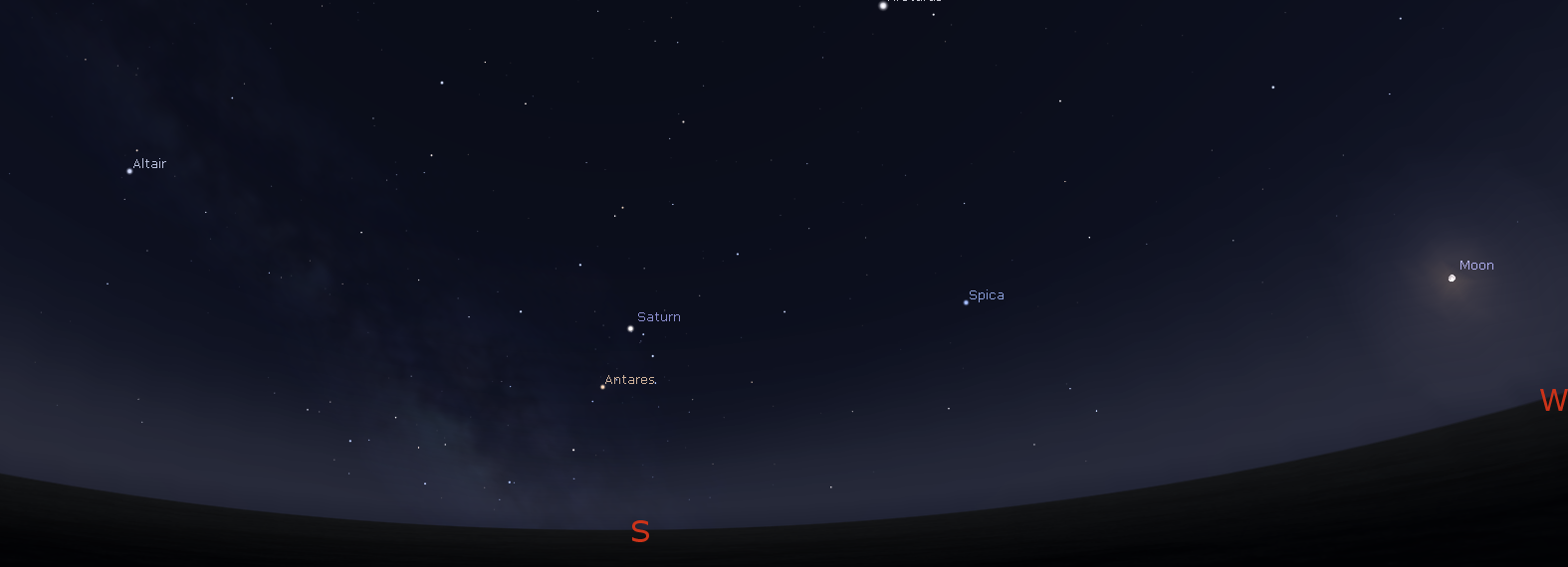
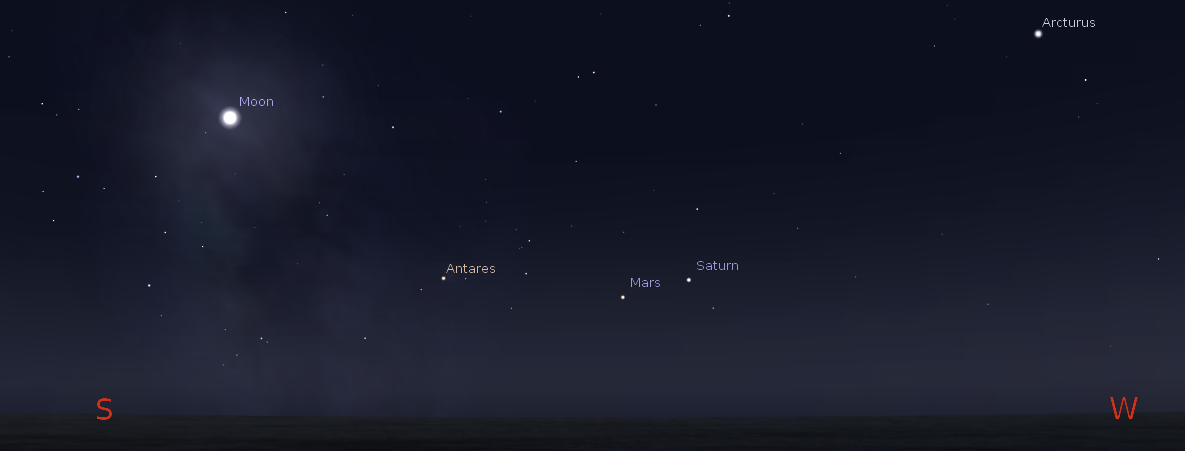
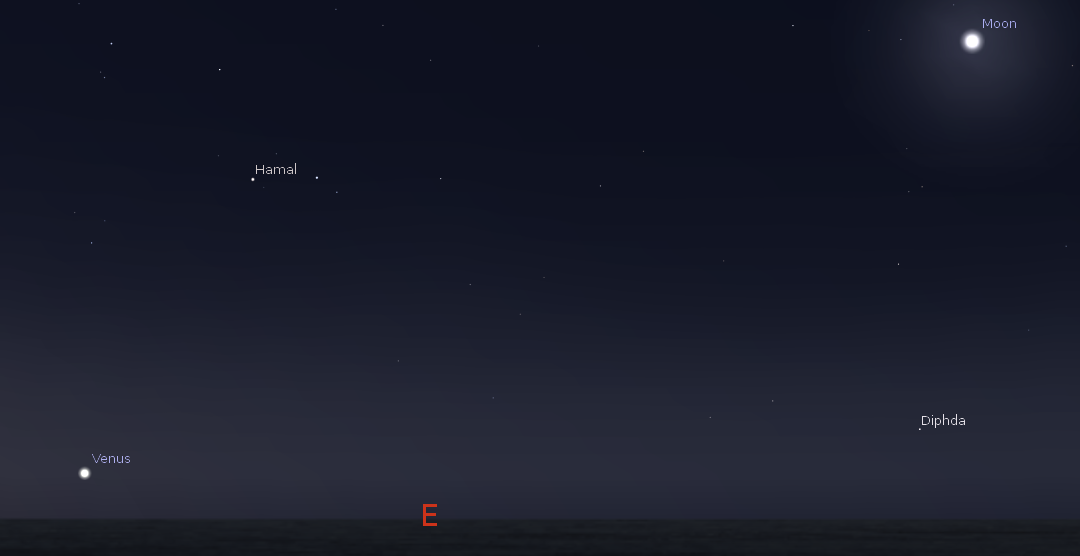
Looking south toward Saturn along with the summer stars and the setting Moon in the west at 6 a.m. March 5, 2015. Created using Stellarium.
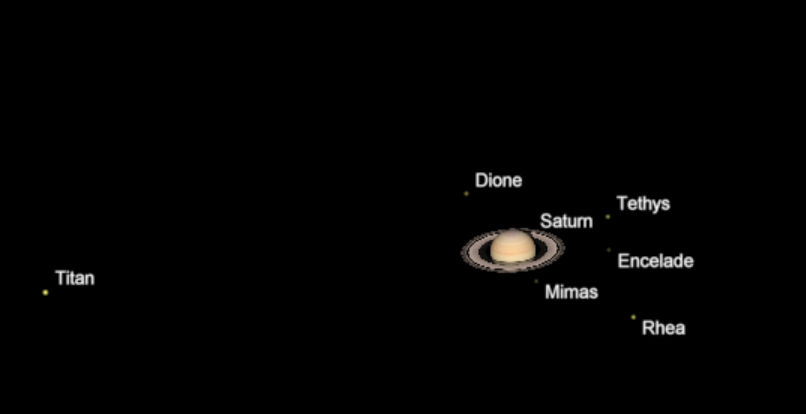
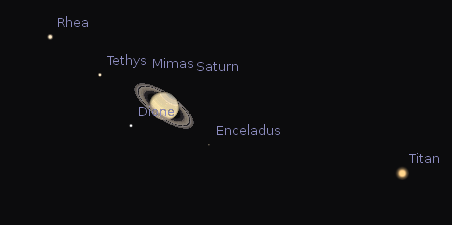
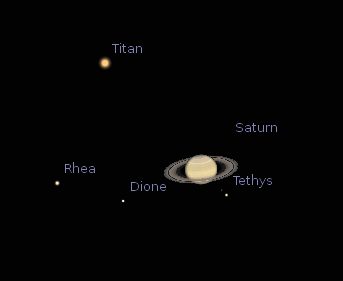
What Saturn and its moons might appear like in a telescope at 6 a.m., March 5, 2015. Small telescopes will show only the moon Titan. Created using Cartes du Ceil (Sky Charts).
02/25/2015 – Ephemeris – It’s planet day on Ephemeris
Ephemeris for Wednesday, February 25th. The sun will rise at 7:27. It’ll be up for 10 hours and 57 minutes, setting at 6:24. The moon, at first quarter today, will set at 2:28 tomorrow morning.
Lets take a look at the bright planets and a fading binocular comet for this week. Brilliant Venus is in the west-southwest by 7 p.m. It will set at 8:55 p.m. It’s separating from Mars which appears below and right of it. The Red Planet will set tonight at 8:46 p.m. Jupiter will appear In the southeastern sky in the evening. It will be up just about all night, and will set at 6:44 a.m. It’s near the sickle-shaped head of Leo the lion, and it’s the brightest star-like object in the sky. Early risers will be able to spot Saturn which will rise in the east-southeast at 1:48 a.m. It’s in the south at 6 a.m. Comet Lovejoy, visible in binoculars, is about half way from the star at the end of Andromeda, called Almaak and the “W” of Cassiopeia.
Times are for the Traverse City/Interlochen area of Michigan. They may be different for your location.
Addendum
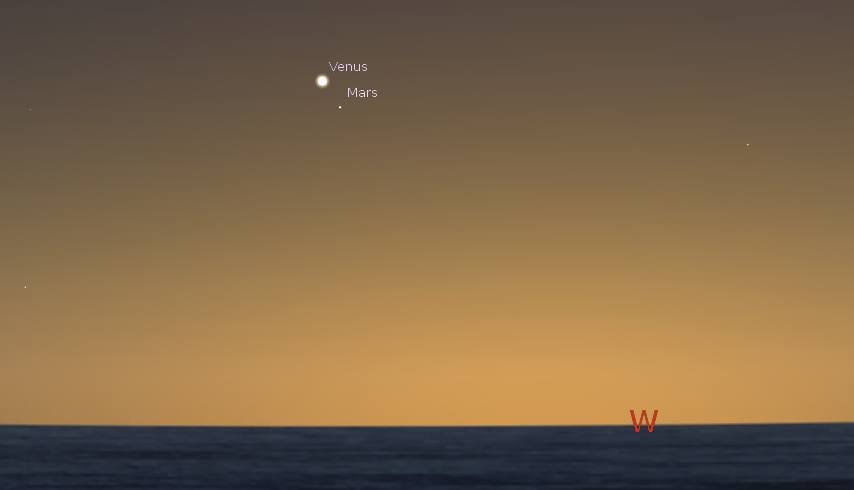
Venus and Mars low in the west after sunset. This is 7 p.m., February 25, 2015. Created using Stellarium.
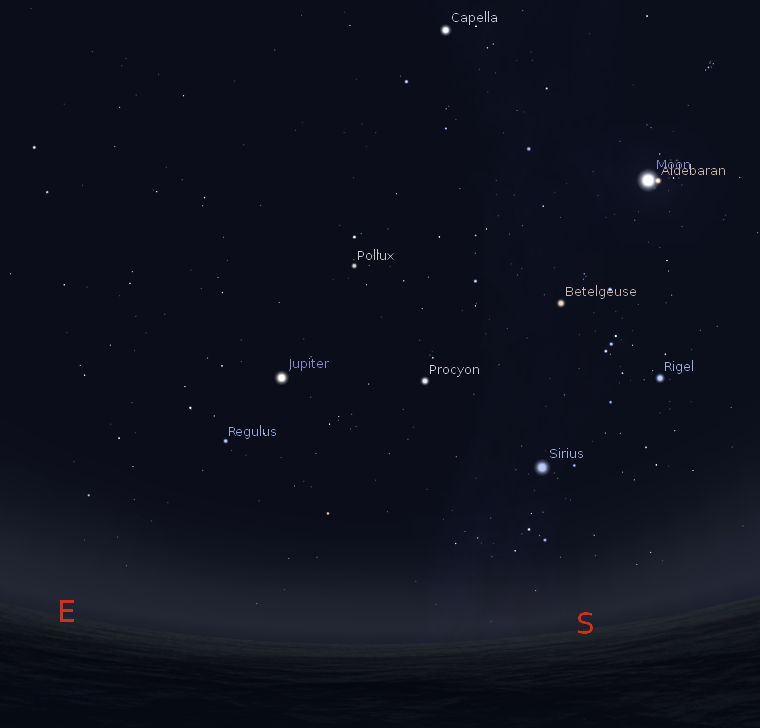
Jupiter with the first quarter moon and the winter stars at 9 p.m., February 25, 2015. Created using Stellarium.
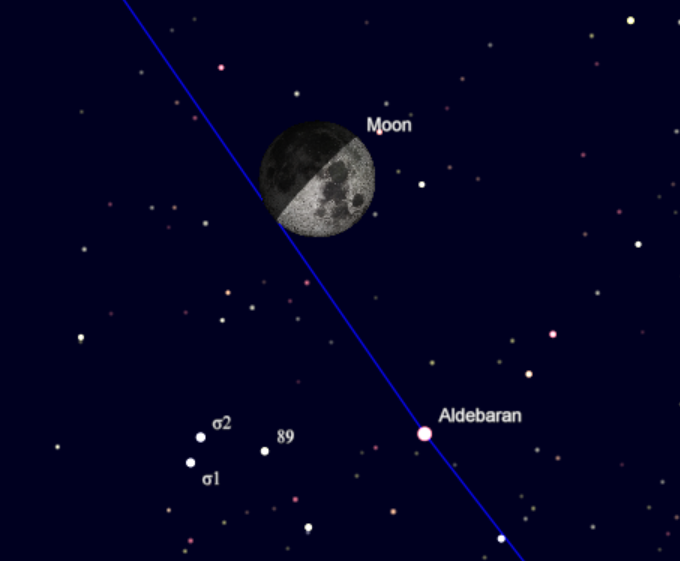
Closeup of the Moon and Aldebaran at 9 p.m. on February 25, 2015. They appeared their closest at 6 p.m. They might be glimpsed with binoculars or a small telescope at that time.
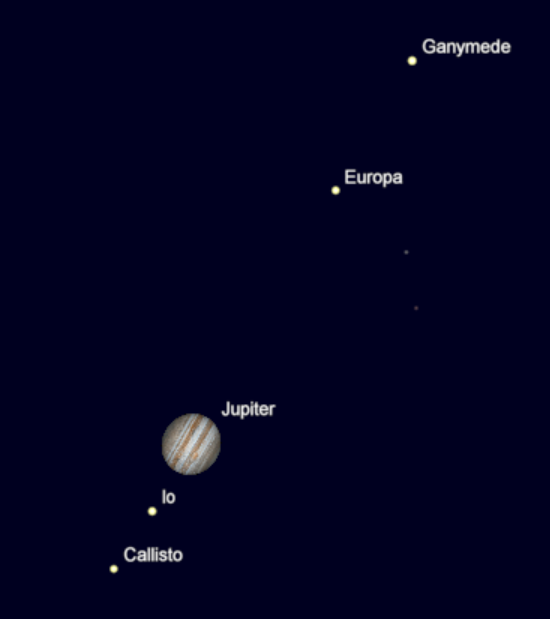
Jupiter and it’s moons at 9 p.m. February 25, 2015. Note that at this time the Great Red Spot is on the face if Jupiter. Created using Cartes du Ciel (Sky Charts).
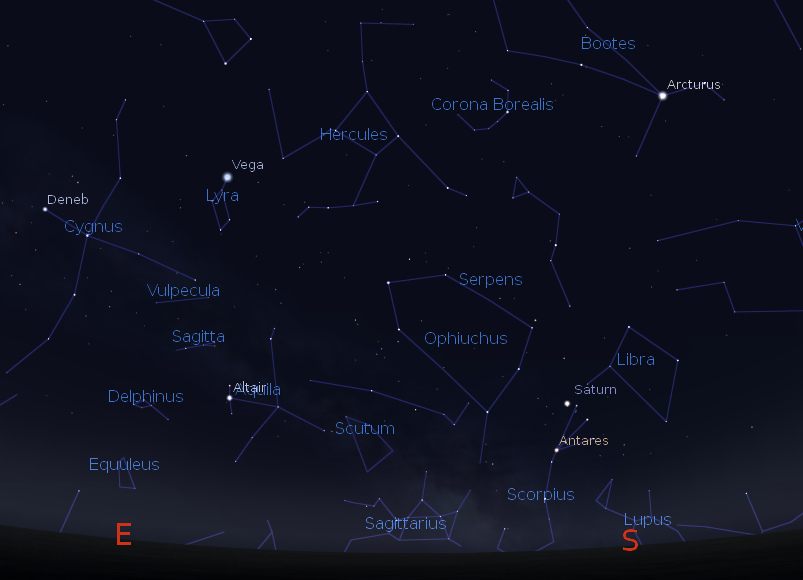
Looking southward at Saturn and a preview of the summer constellations at 6 a.m. February 26, 2015. Created using Stellarium.
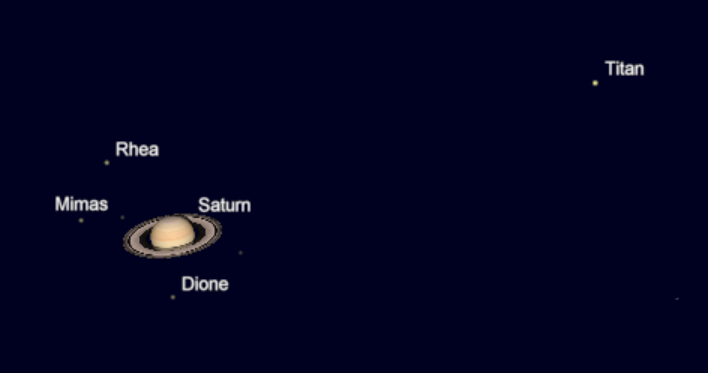
What Saturn and its moons might appear like in a telescope at 6 a.m., February 26, 2015. Small telescopes will show only the moon Titan. Created using Cartes du Ceil (Sky Charts).
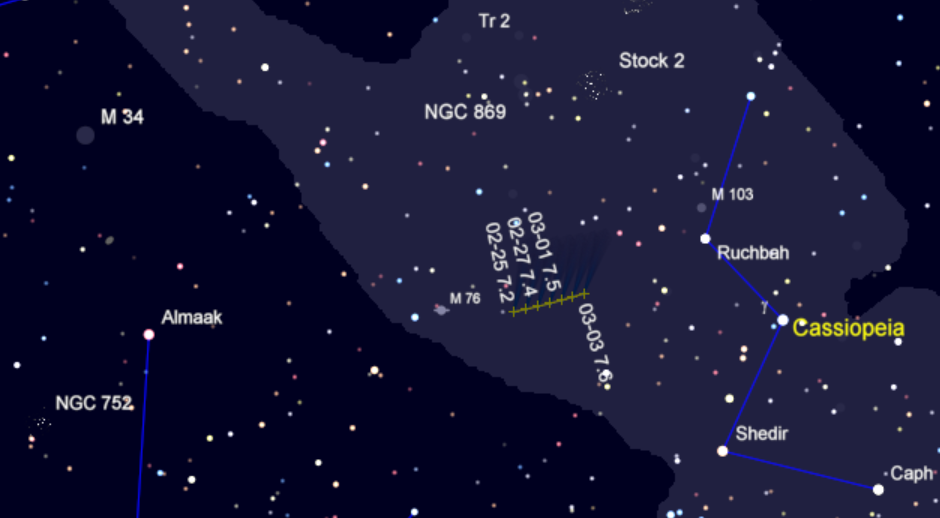
The track of Comet 2014 Q2 (Lovejoy) from 2/25/15 to 03/03/15 which will appear high in the west at 9 p.m. The comet is approaching Cassiopeia. The comet is dropping below binocular visibility, so this is the last time I will cover it on this blog. Created using Cartes du Ceil (Sky Charts).
01/28/2015 – Ephemeris – Wednesday is bright planet and comet day on Ephemeris
Ephemeris for Wednesday, January 28th. The sun will rise at 8:06. It’ll be up for 9 hours and 39 minutes, setting at 5:45. The moon, 2 days past first quarter, will set at 3:37 tomorrow morning.
Lets take a look at the bright planets and a pretty bright comet for this week. Venus is in the west-southwest by 6:30 p.m. It will set at 7:41. Mercury is now too close to the direction of the sun to be seen. Mars appears above and left of Venus in the southwest, and is in the constellation of Aquarius. The Red Planet will set tonight at 8:42 p.m. Jupiter, 9 days from being in opposition from the sun, and opposite the sun in the sky, when it will be rising at sunset and setting at sunrise will rise tonight in the east at 6:27 p.m. It’s near the sickle-shaped head of Leo the lion. Early risers will be able to spot Saturn which will rise in the east-southeast at 3:32 a.m. Comet Lovejoy, visible in binoculars, is near the short end of the constellation of Triangulum.
Times are for the Traverse City/Interlochen area of Michigan. They may be different for your location.
Addendum
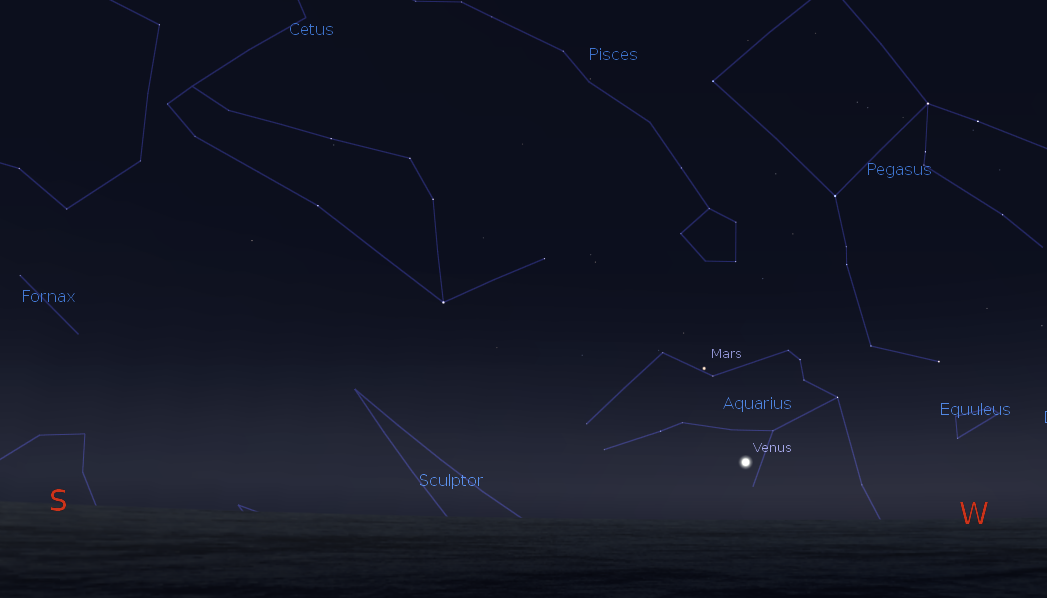
Venus and Mars with the setting autumn constellations at 7 p.m. January 28, 2015. Created using Stellarium.
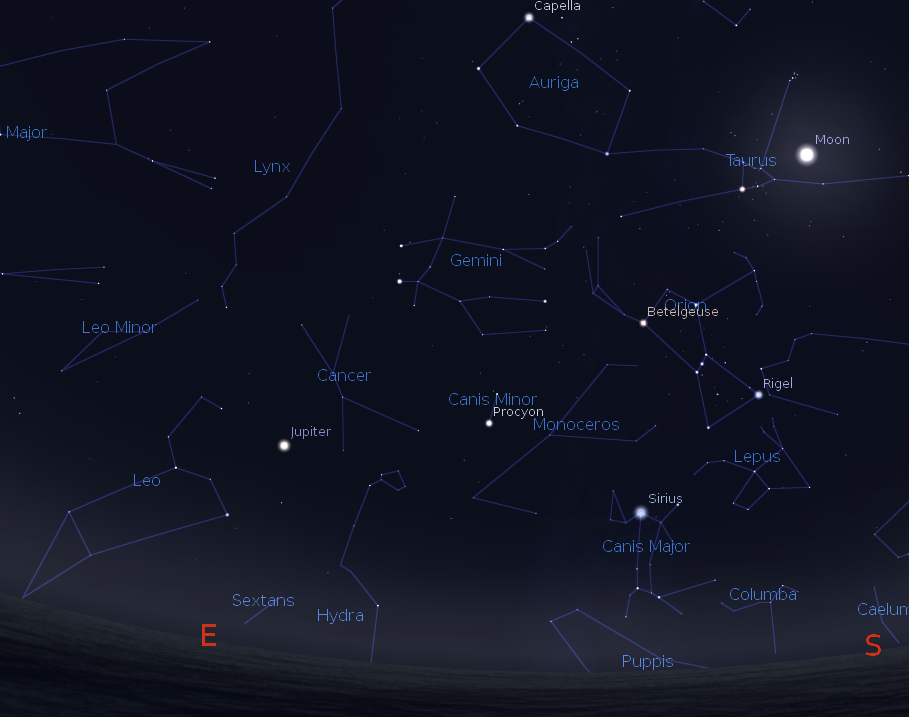
Jupiter, the Moon and the constellations of winter at 9 p.m. January 28, 2015. Created using Stellarium.
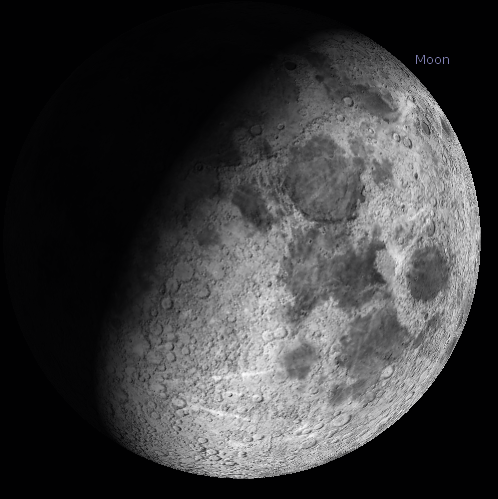
What the moon might look like in binoculars at 9 p.m. January 28, 2015. Created using Stellarium.
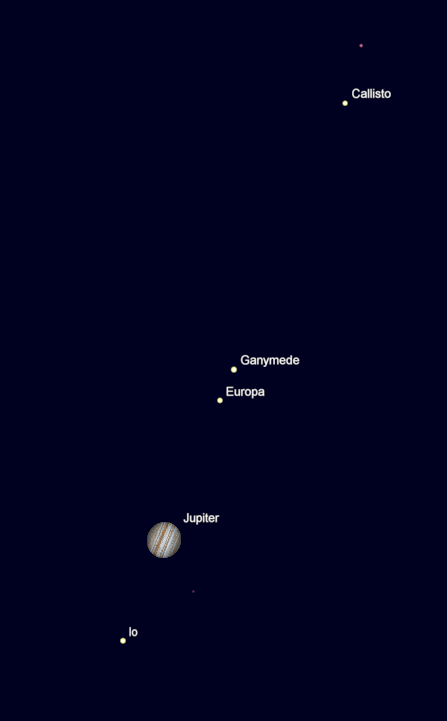
What Jupiter and its moons might appear like in a telescope at 9 p.m., January 28, 2015. Created using Cartes du Ceil (Sky Charts).
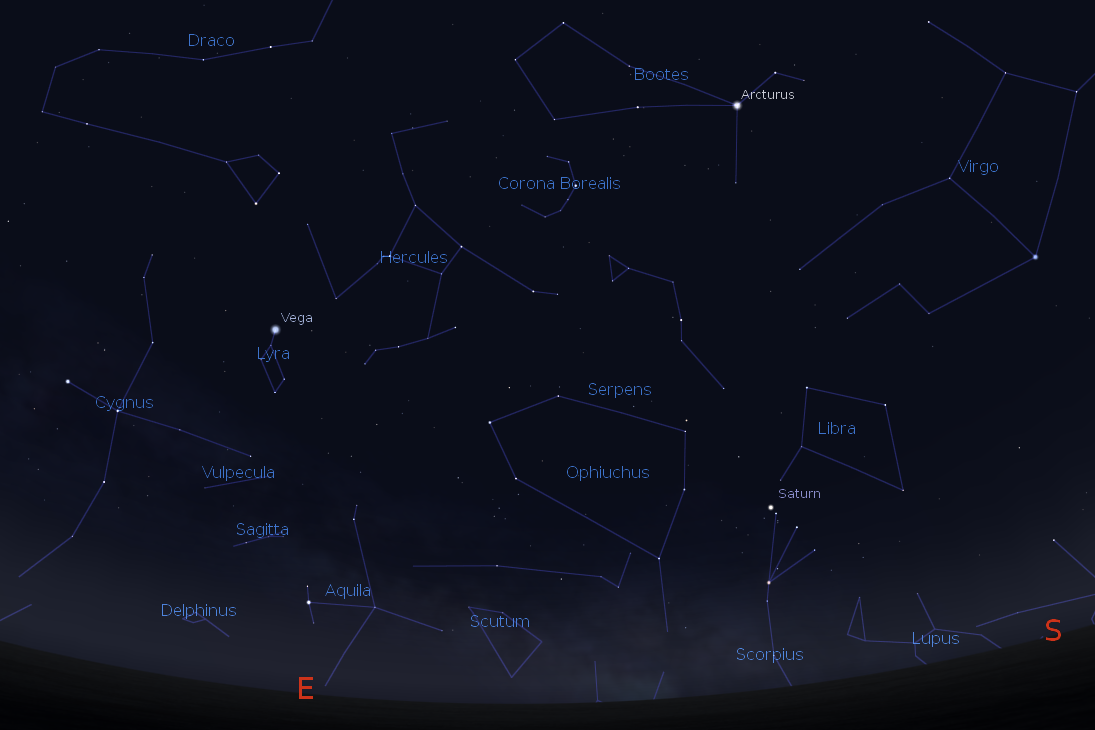
Saturn and a preview of the summer constellations at 6:30 a.m. January 29, 2015. Created using Stellarium.
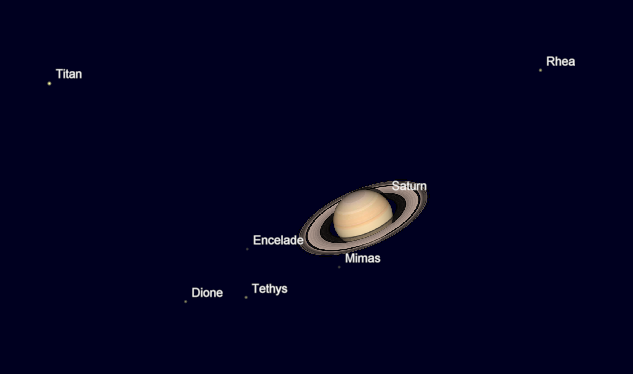
What Saturn and its moons might appear like in a telescope at 6:30 a.m., January 29, 2015. Small telescopes will show only the moon Titan. Created using Cartes du Ceil (Sky Charts).
Comet Lovejoy
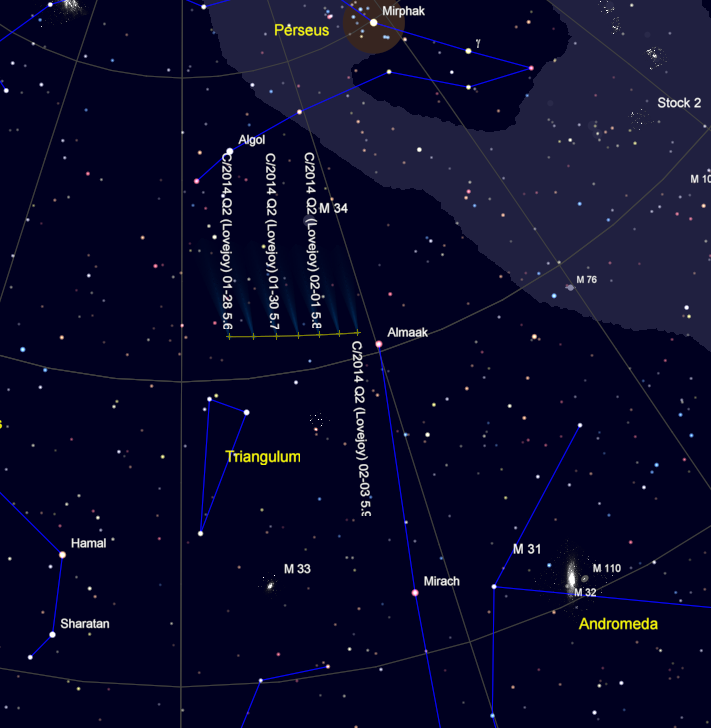
The track of Comet Lovejoy for the next week (from 1/28/2015 to 2/03/2015 at 9 p.m.) Created using Cartes du Ceil (Sky Charts).
There are some fuzzy objects in this part of the sky. However only M31, the Great Andromeda Galaxy, is bright enough to be mistaken for the comet. Next Tuesday and Wednesday the comet will appear close to Almaak (γ Andromedae), a 2nd magnitude star. Note: six of the seven Big Dipper stars are 2nd magnitude.
01/14/2015 – Ephemeris – Five bright planets and Comet Lovejoy are visible now
Ephemeris for Wednesday, January 14th. The sun will rise at 8:17. It’ll be up for 9 hours and 9 minutes, setting at 5:26. The moon, 1 day past last quarter, will rise at 3:05 tomorrow morning.
Lets take a look at the bright planets and a pretty bright comet for this week. Venus and Mercury are side by side low in the southwest by 6 p.m. Mercury is about 2 and a half moon widths to the right of the much brighter Venus. Mercury will set at 7:02, while Venus will set at 7:03 p.m. Mars is low in the southwest at 7 p.m. and is in the constellation of Aquarius. The Red Planet will set tonight at 8:39 p.m. Jupiter will rise in the east at 7:31 p.m. It’s near the sickle shaped head of Leo the lion. Early risers will be able to spot Saturn which will rise in the east-southeast at 4:21 a.m. Comet Lovejoy, visible in binoculars, makes an equilateral triangle with the V shaped head of Taurus and the Pleiades, to the right of both.
Times are for the Traverse City/Interlochen area of Michigan. They may be different for your location.
Addendum
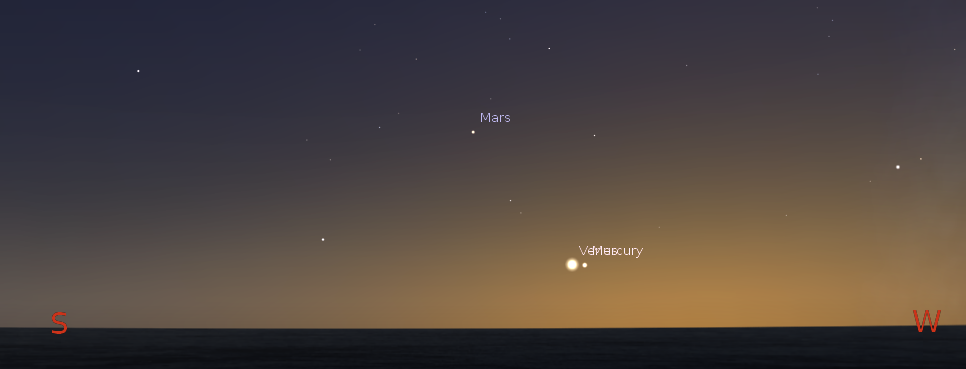
Venus, Mercury and Mars at 6:15 p.m. on January 14, 2015. Note that Mercury is getting dimmer, and Venus is overtaking Mars which is a bit more than a month away. Created using Stellarium.
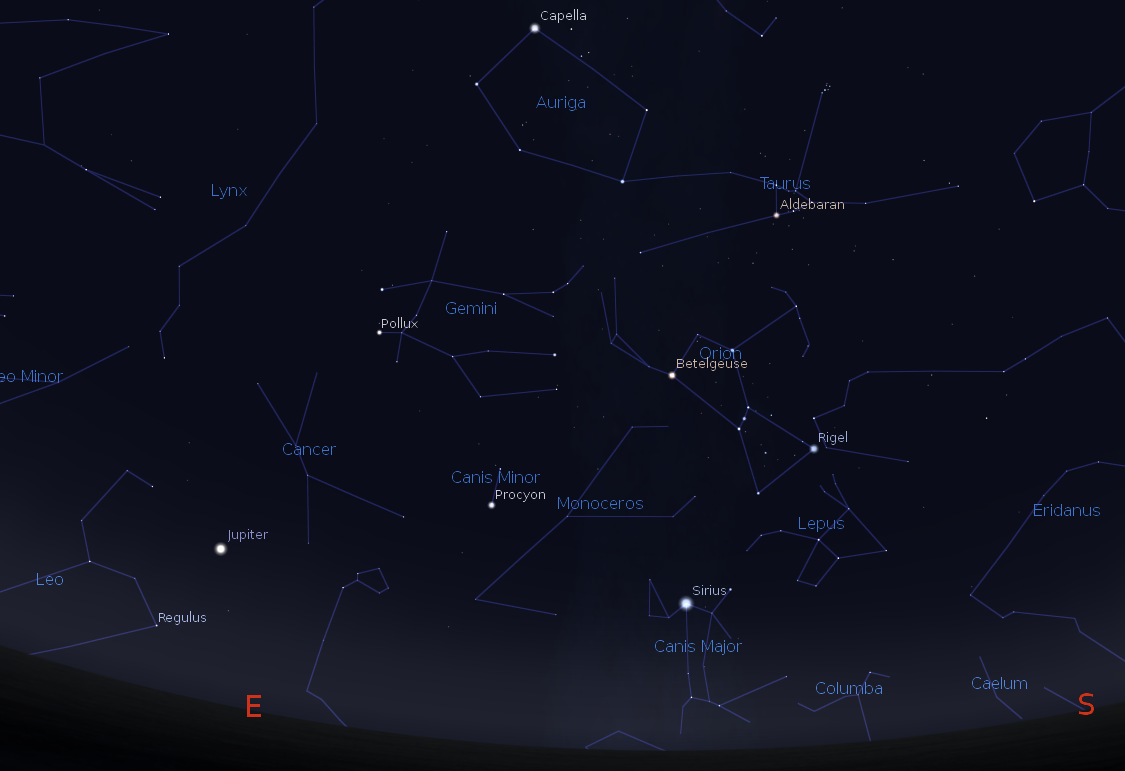
Jupiter and the winter constellations at 9 p.m. on January 14, 2015. Comet Lovejoy is not shown. Created using Stellarium.
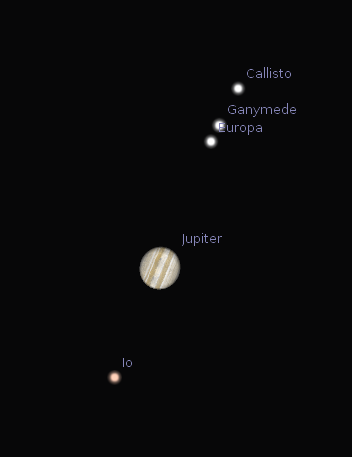
Jupiter and it’s Galilean satellites as seen in a telescope at 9 p.m. on January 14, 2015. Created using Stellarium.
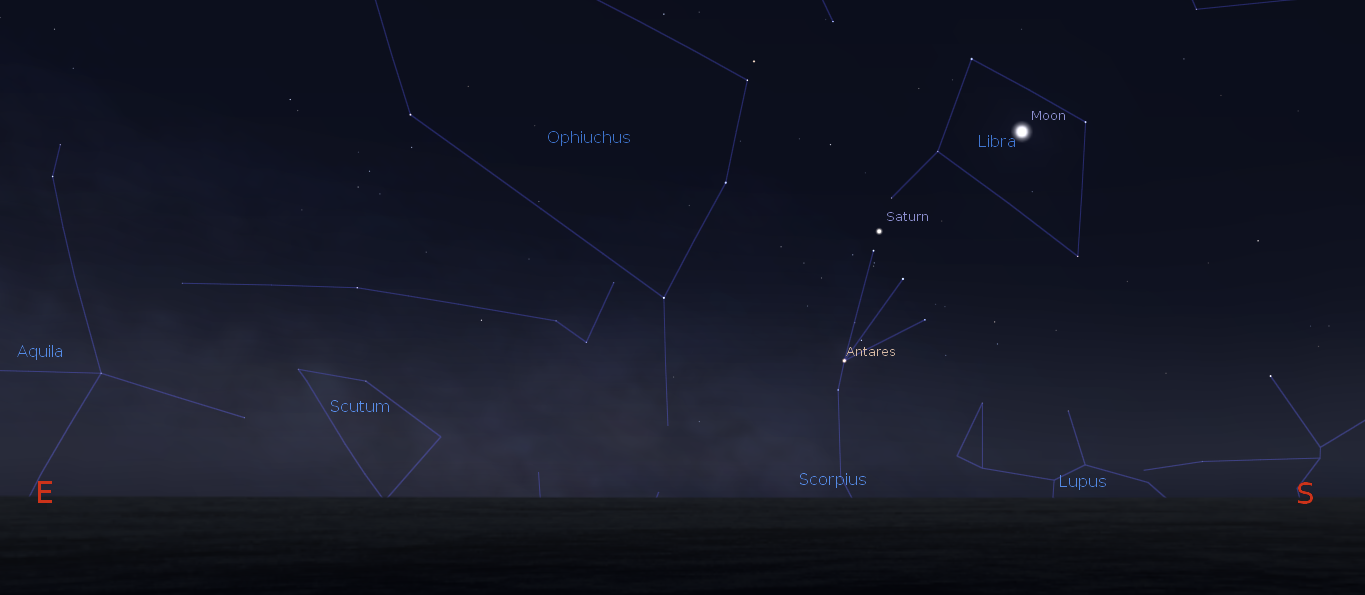
Saturn and the Moon at 7 a.m., January 15, 2015. Created using Stellarium.
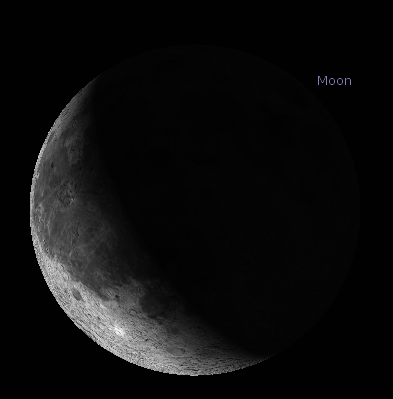
The Moon as it would be seen in binoculars at 7 a.m., January 15, 2015. Created using Stellarium.
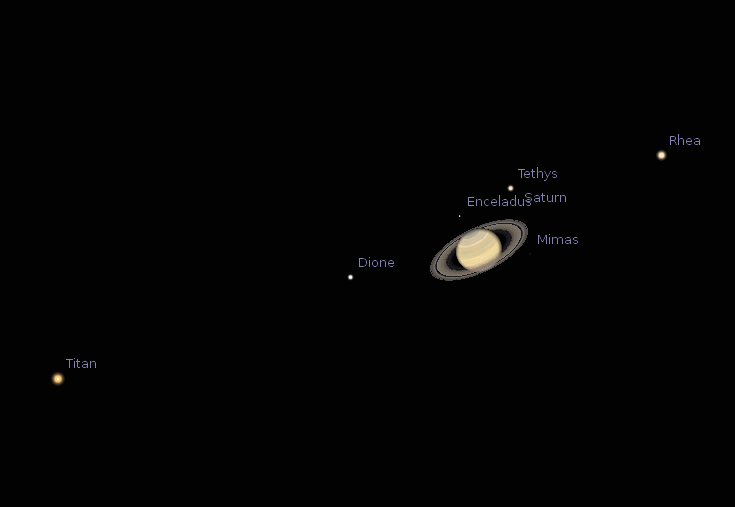
Saturn as seen with a telescope at 7 a.m., January 15, 2015. Titan is visible in most small telescopes. Created using Stellarium.
Comet Lovejoy
We finally had a clear night. Comet Lovejoy was not visible to me to the naked eye last night. But I thing an observer far from city lights and perfectly dark adapted might be able to spot it. It was a great sight in 10X50 binoculars. it was a bright featureless round blob of light. I couldn’t spot a tail, which I expected. My friend Scott Anttila, an excellent astrophotographer unfortunately has moved down to the Detroit area and is hindered by the lights down there. However he was able to get this image of the comet sans tail. But the green color of the come shows wonderfully. Unfortunately our eyes don’t register color at low light levels.
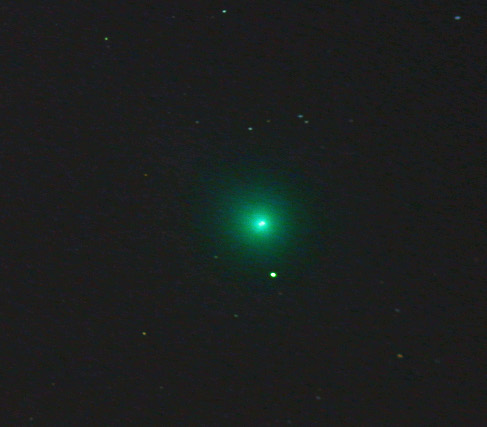
Scott Anttila’s photo of Comet Lovejoy from the light polluted skies of the Detroit area.
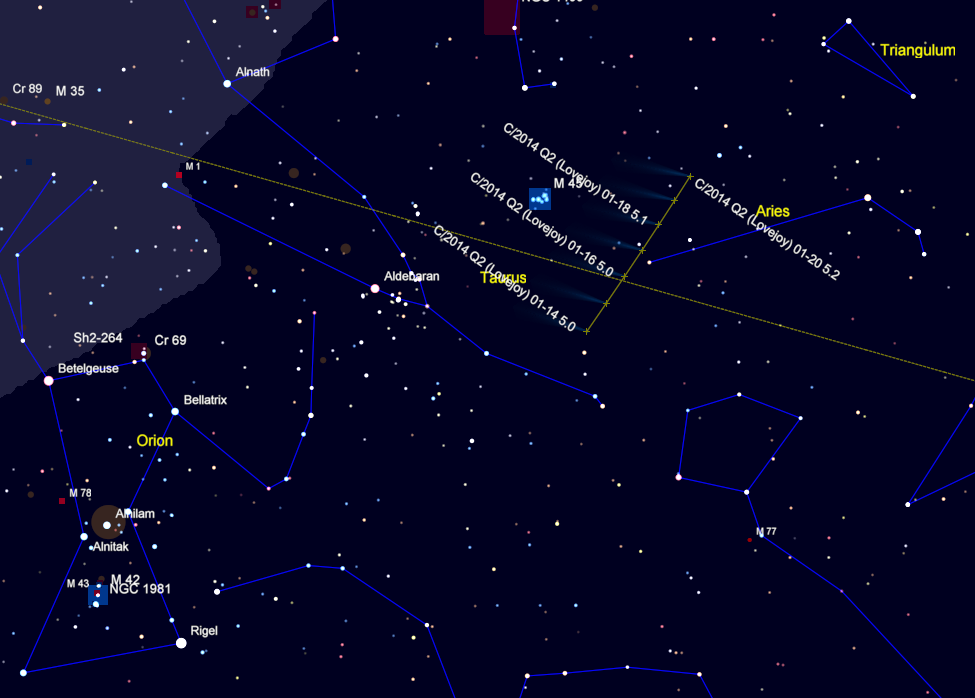
The track of Comet Lovejoy for the next week (from 1/14/2015 to 1/20/2015 at 9 p.m.) Created using Cartes du Ceil (Sky Charts).
10/15/2014 – Ephemeris – Looking for the bright planets this week
Ephemeris for Wednesday, October 15th. The sun will rise at 7:57. It’ll be up for exactly 11 hours, setting at 6:57. The moon, at last quarter today, will rise at 12:53 tomorrow morning.
Let’s check out the bright planets for this week. Saturn is very low in the west-southwestern sky at 8 p.m. and difficult to spot. It will set at 8:22 p.m. Mars is right of the spout of the Teapot of Sagittarius low in the southwest. Mars is in the constellation of Ophiuchus as astronomers draw constellation boundaries, it will set at 9:46. Comet Siding Spring will pass close to Mars this coming Sunday the 19th. More on that tomorrow. In the morning sky brilliant Jupiter will rise in the east-northeast at 2:18 a.m. It’s moving from Cancer to Leo now. Venus is too close to the sun to be seen. On the 25th of this month Venus will be in superior conjunction with the sun, that is it will move behind the sun, and will enter the evening sky.
Times are for the Traverse City/Interlochen area of Michigan. They may be different for your location.
Addendum
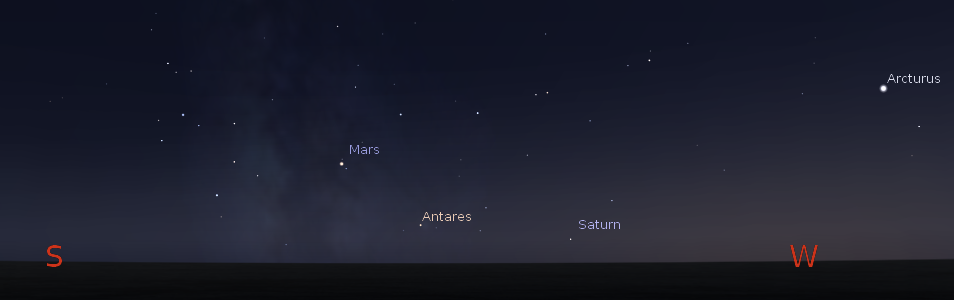
Saturn and Mars low near the setting southern summer stars at 8 p.m. October 15, 2014. Created using Stellarium.
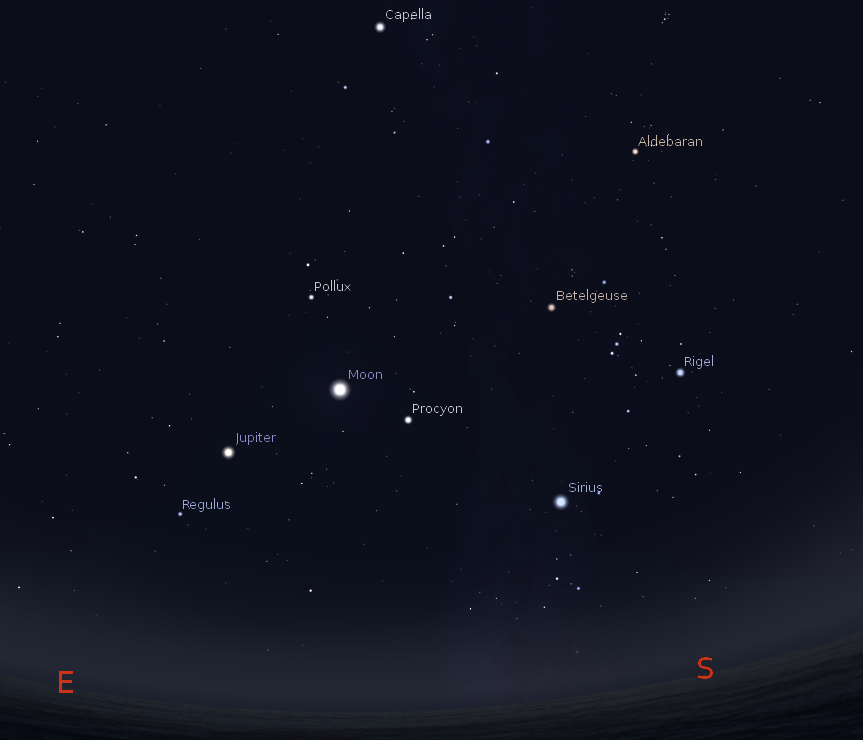
Jupiter and the Moon among the stars of winter at 6 a.m. October 16, 2014. Created using Stellarium.
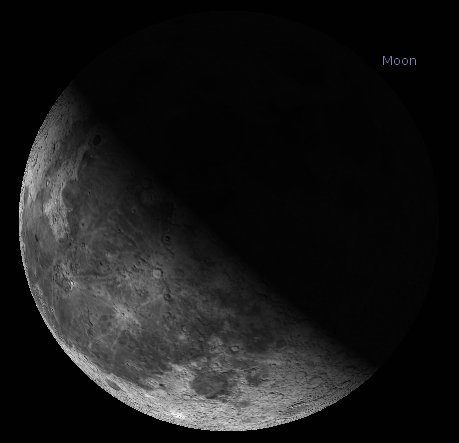
The Moon slightly after last quarter as seen in binoculars at 6 a.m. October 16, 2014. Created using Stellarium.
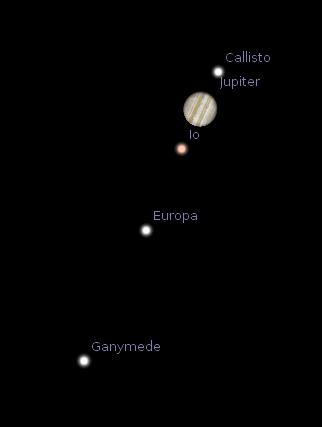
A telescopic view of Jupiter and its moons as they would be seen at 6 a.m. October 16, 2014. Created using Stellarium.
09/03/2014 – Ephemeris – This week’s bright planets
Ephemeris for Wednesday, September 3rd. The sun will rise at 7:07. It’ll be up for 13 hours and 8 minutes, setting at 8:15. The moon, 1 day past first quarter, will set at 1:50 tomorrow morning.
Let’s take our weekly look at the bright planets. Mars and Saturn are now nearly side by side with Saturn to the right by six and a half degrees of about 13 moon widths of the red planet. Saturn will set at 10:57 p.m. Viewing Saturn with a telescope will suffer because it’s getting close to the horizon but it’s still possible to see those fabulous rings and its large moon Titan. Reddish Mars is also in the constellation of Libra the scales and will set at 10:52 p.m. because it is slightly lower than Saturn. In the morning sky brilliant Jupiter will rise in the east-northeast at 4:24 a.m., while the brighter Venus, will rise at 5:53 a.m. Jupiter is increasing its distance from the sun, while Venus is retreating toward the Sun from our point of view.
Times are for the Traverse City/Interlochen area of Michigan. They may be different for your location.
Addendum
Saturn, Mars and the Moon at 9:30 p.m. September 3, 2014. Created using Stellarium.
Saturn through the telescope at 9:30 p.m. September 3, 2014. Created using Stellarium.
The Moon through binoculars at 9:30 p.m. September 3, 2014. Created using Stellarium.
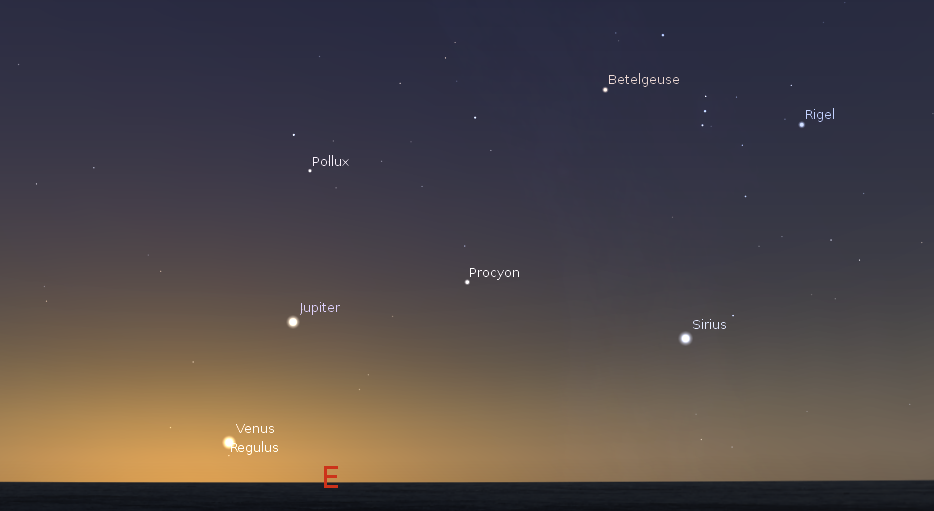
Jupiter, Venus and the rising stars of winter at 6:30 a.m. September 4, 2014. Created using Stellarium.
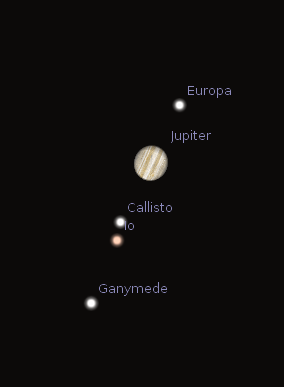
Jupiter and moons through the telescope at 6:30 a.m. September 4, 2014. Created using Stellarium.
06/18/2014 – Ephemeris – The bright planets for this week
Ephemeris for Wednesday, June 18th. Today the sun will be up for 15 hours and 33 minutes, setting at 9:30. The moon, 1 day before last quarter, will rise at 1:18 tomorrow morning. Tomorrow the sun will rise at 5:56.
It’s Wednesday and once again time to locate the bright planets for this week. Brilliant Jupiter will be in the west-northwestern sky in Gemini as darkness falls tonight. It’s getting lower each night and will set at 11:13 p.m. tonight. Reddish Mars is in Virgo in the southwest as darkness falls. It’s 83 million miles (135 million km) away now, and will set at 2:25 a.m. Saturn will be low in the south-southeast as darkness falls. It’s in the faint constellation of Libra the scales this year. It will pass due south at 10:57 p.m. It will set at 3:59 a.m. Saturn’s in perfect position for viewing with a small or large telescope. Brilliant Venus will rise in the east at 4:10 a.m. in morning twilight.
Times are for the Traverse City/Interlochen area of Michigan. They may be different for your location.
Addendum
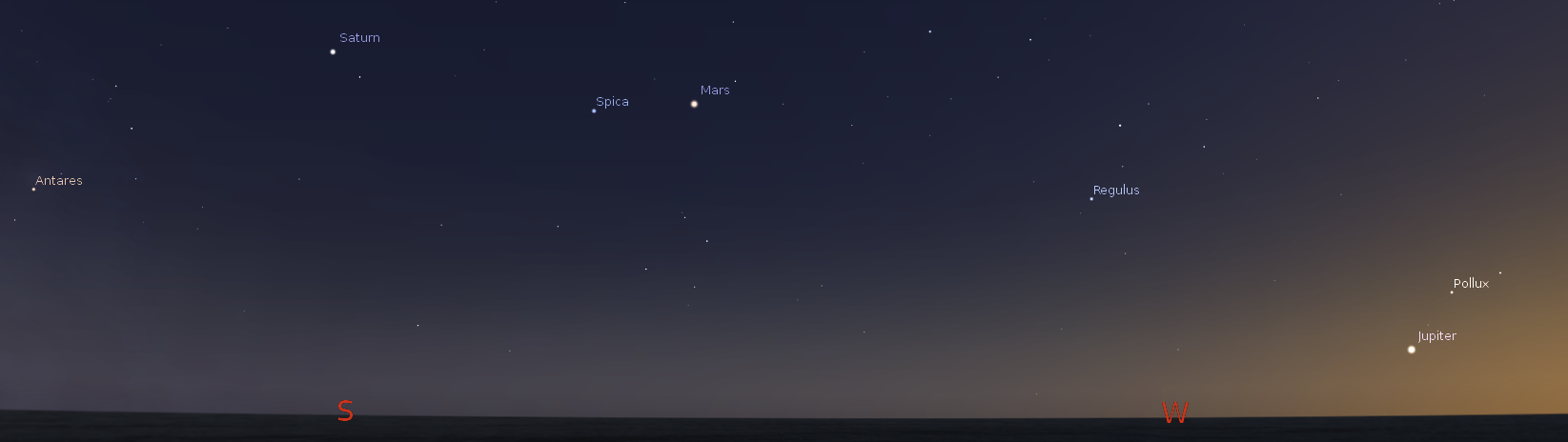
The bright evening planets and stars at 10:30 p.m., June 18, 2014. Created using Stellarium.
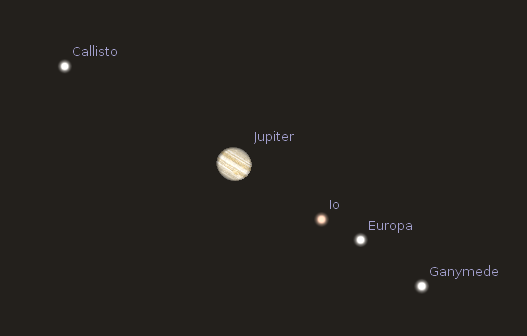
Jupiter and moons in a telescope on June 18, 2014. Due to the low altitude of Jupiter not all the moons may be visible and Jupiter will suffer color fringes due to atmospheric dispersion. Created using Stellarium.
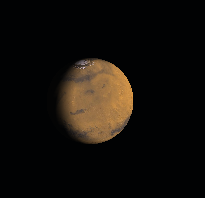
Mars through a telescope on June 18, 2018. Note that Mars is not fully illuminated, and appears as a gibbous disc. This effect will increase for another month. Created using Stellarium.
Saturn and its moons through a telescope on June 18, 2018. Titan is easy to spot, the other moons will be more difficult. Created using Stellarium.
Venus and the Moon at 4:30 a.m. on June 19, 2014. Created using Stellarium.
The Moon as seen in binoculars on June 19, 2014. Created using Stellarium.
Venus as seen in a telescope on June 19, 2014. Created using Stellarium.
06/11/2014 – Ephemeris – It’s 11 p.m., do you know where your bright planets are?
Actually yes we do. Three are visible at 11 p.m., One, Mercury is MIA too close to the sun to be seen. And the 5th bright planet is a morning person planet. Uranus and Neptune are beyond the scope of this radio program. Well, on with the transcript:
Ephemeris for Wednesday, June 11th. Today the sun will be up for 15 hours and 30 minutes, setting at 9:27. The moon, 2 days before full, will set at 5:40 tomorrow morning. Tomorrow the sun will rise at 5:56.
It’s Wednesday and once again time to locate the bright planets for this week. We have lost Mercury to the bright twilight glow, and the fact that it’s getting dimmer as a crescent. Brilliant Jupiter will be in the western sky in Gemini as darkness falls tonight. It’s getting lower each night and will set at 11:36 p.m. tonight. Reddish Mars is in Virgo in the south-southwest as darkness falls. It’s 80 million miles (128 million km) away now, and moving away, and will set at 2:49 a.m. Saturn will be low in the southeast as darkness falls. It’s in the faint constellation of Libra the scales this year. It will pass due south at 11:26 p.m. Brilliant Venus will rise in the east at 4:14 a.m. in morning twilight.
Times are for the Traverse City/Interlochen area of Michigan. They may be different for your location.
Addendum
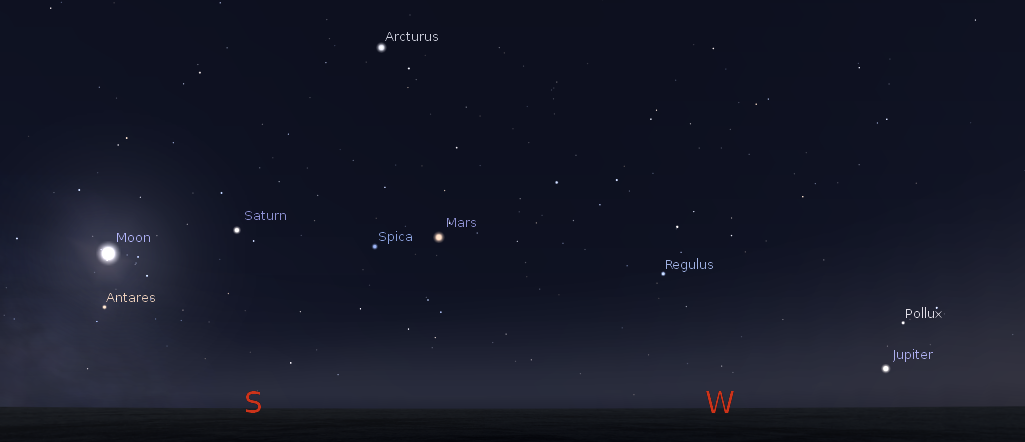
The evening planets at 11 p.m. on June 11, 2014. Created using Stellarium.
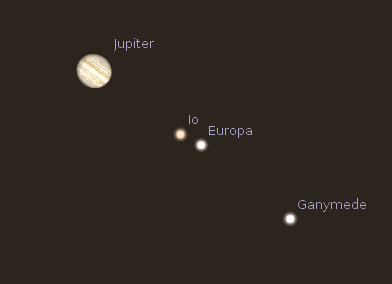
Jupiter and moons at 10 p.m., June 11, 2014 Callisto is in Jupiter’s shadow and wont emerge until 11:09 p.m. when Jupiter will be less than 5 degrees above the horizon in Michigan. Created using Stellarium.
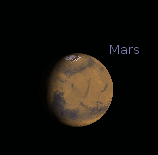
Mars through a telescope at 11 p.m., June 11, 2014. The large dark feature Syrtis Major is rotating onto the Earth side face of the planet from the left. Created using Stellarium.
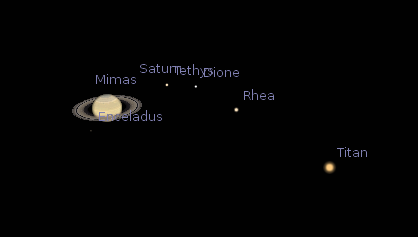
Saturn and some of its brighter moons at 11 p.m. June 11, 2014. The moon Titan can be seen in small telescopes, but larger scopes may be necessary to pick out the other satellites. Created using Stellarium.
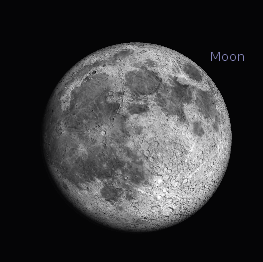
The Moon as seen in binoculars at 11 p.m., June 11, 2014. Created using Stellarium.
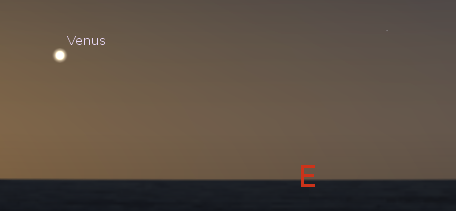
Venus in morning twilight at 5 a.m., June 12, 2014. Created using Stellarium.
A telescopic view of Venus as it would be seen at 5 a.m., June 12, 2014. Created using Stellarium.
05/14/2014 – Ephemeris – All 5 bright planets are visible this week
Ephemeris for Wednesday, May 14th. Today the sun will be up for 14 hours and 46 minutes, setting at 9:02. The moon, at full today, will rise at 9:05 this evening. Tomorrow the sun will rise at 6:14.
It’s Wednesday and once again time to locate the bright planets for this week. Mercury is beginning to show up in the west shortly after sunset, It will be at its farthest from the Sun on the 25th. It will set at 10:51. Brilliant Jupiter will be in the western sky as darkness falls tonight. It will set at 1:07 a.m. Reddish Mars is in Virgo in the southeast as darkness falls. It will pass due south at 10:47 p.m. It’s 64.6 million miles away now, and moving away, and will set at 4:38 a.m. Saturn will be low in the southeast as darkness falls. It’s in the faint constellation of Libra the scales this year. It will pass due south at 1:23 a.m. Brilliant Venus will rise in the east at 4:46 a.m. in twilight.
Times are for the Traverse City/Interlochen area of Michigan. They may be different for your location.
Addendum
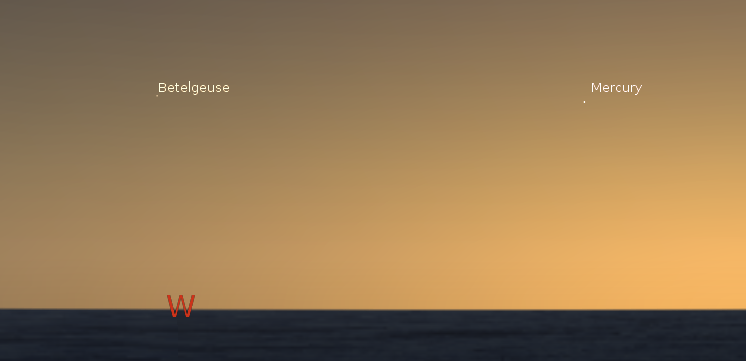
Mercury low in the west at 9:30 p.m. May 14, 2014. Created using Stellarium.
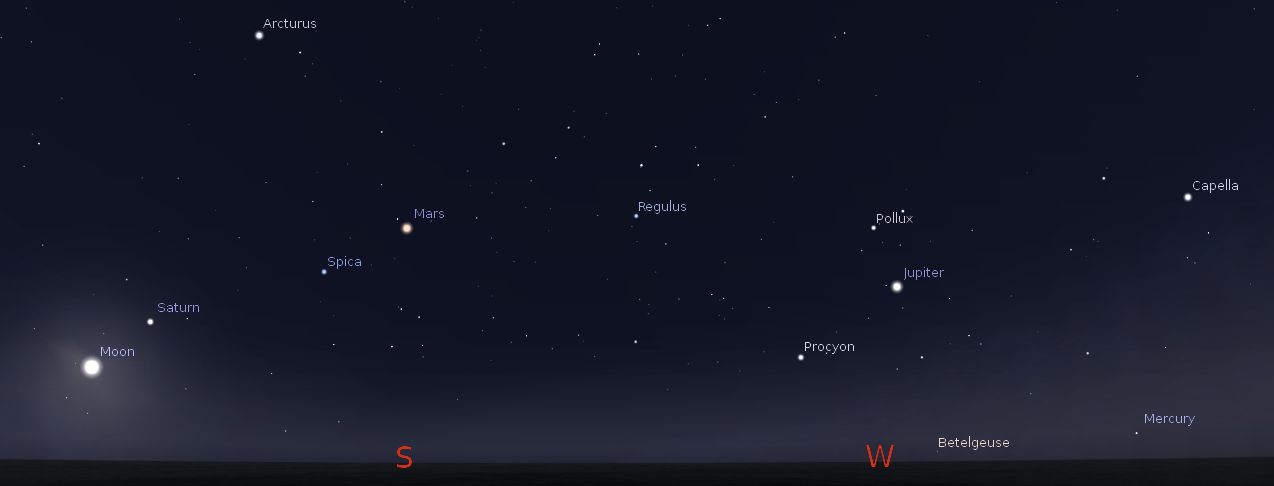
All the evening planets from Mercury to Saturn plus the moon at 10:30 p.m. May 14, 2014. Created using Stellarium.
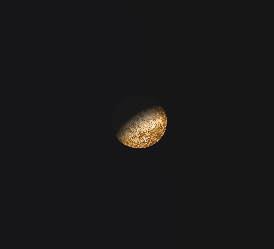
Mercury through a telescope on May 14, 2014. Created using Stellarium.
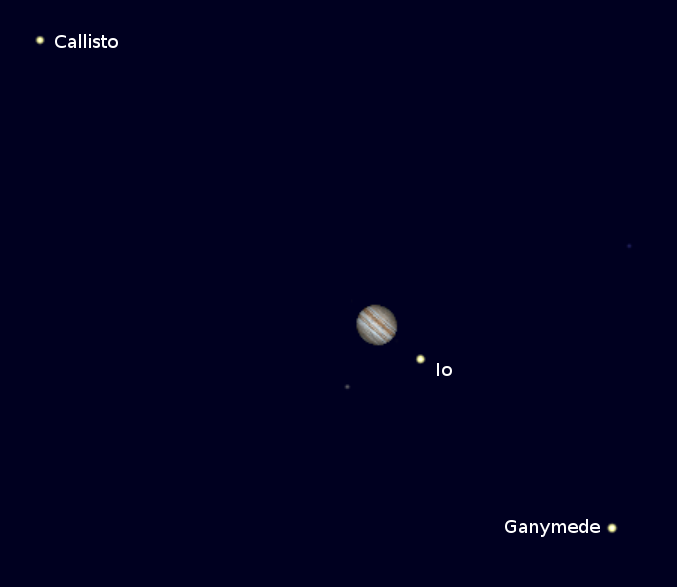
Jupiter and its moons at 10:30 p.m. May 14, 2014. Europa is being occulted by Jupiter. Created using Cartes du Ciel (Sky Charts).
Europa will disappear behind the moon at 9:48 p.m, and will reappear after Jupiter sets for northern Michigan. Places west of here will see Europa reappear before Jupiter sets.
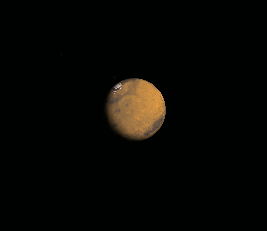
Mars through a telescope at 10:30 p.m. on May 14, 2014. Created using Stellarium.
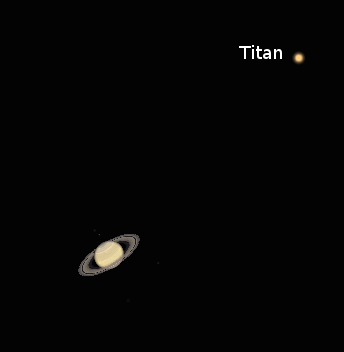
Saturn through a telescope. on May 14, 2014. Created using Stellarium.
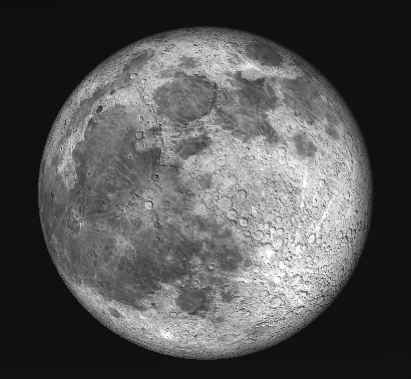
The Moon as it would appear through binoculars at 10:30 p.m. May 14, 2014. Created using Stellarium.
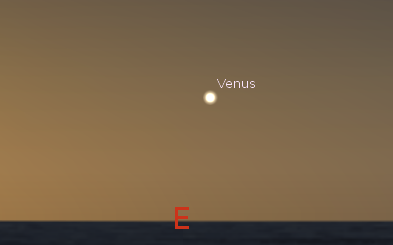
Venus in the east at 5:30 a.m. on May 15, 2014. Created using Stellarium.
Venus through a telescope on May 15, 2014. Created using Stellarium.
04/30/2014 – Ephemeris – It’s Wednesday, do you know where your planets are?
Ephemeris for Wednesday, April 30th. The sun rises at 6:34. It’ll be up for 14 hours and 11 minutes, setting at 8:45. The moon, 1 day past new, will set at 10:25 this evening.
It’s Wednesday and once again time to locate the bright planets for this week. Brilliant Jupiter will be in the western sky as darkness falls tonight. It will set at 1:54 a.m. Reddish Mars is in Virgo and outshines the bright bluish star Spica below left of it as darkness falls. Mars is in the south-east as it gets dark. It will pass due south at 11:51 p.m. It’s 59.5 million miles away now, and moving away, and will set at 5:41 a.m. Saturn will rise at 9:24 p.m. It’s in the faint constellation of Libra the scales this year. It will pass due south at 2:23 a.m. The telescope will bring out Saturn’s beautiful rings, whose short dimensions now are as wide as the planet. Brilliant Venus will rise in the east at 5:05 a.m. and will stay pretty low to the horizon.
Times are for the Traverse City/Interlochen area of Michigan. They may be different for your location.
Addendum
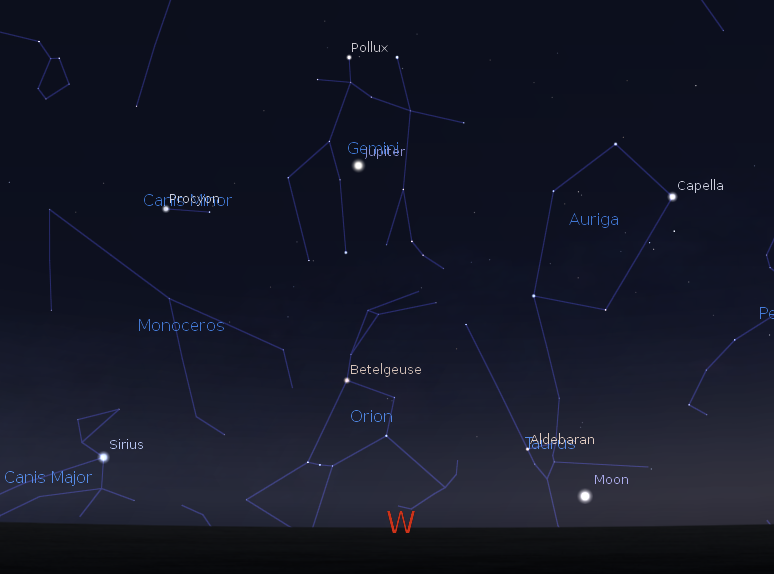
Jupiter, the Moon and the setting winter constellations in the west at 10 p.m. on April 30, 2014. Created using Stellarium.
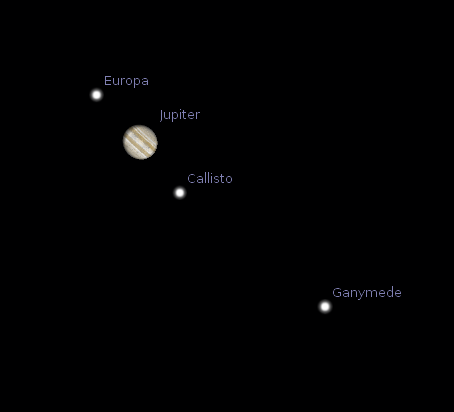
Jupiter and satellites through a telescope at 10 p.m. on April 30, 2014. The satellite Io is being occulted by Jupiter and will reappear at 11:56 p.m. (3:56 UT May 1, 2014). Created using Stellarium.
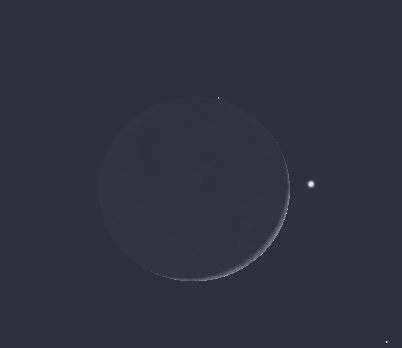
The crescent Moon at 10 p.m. on April 30, 2014. Created using Stellarium.
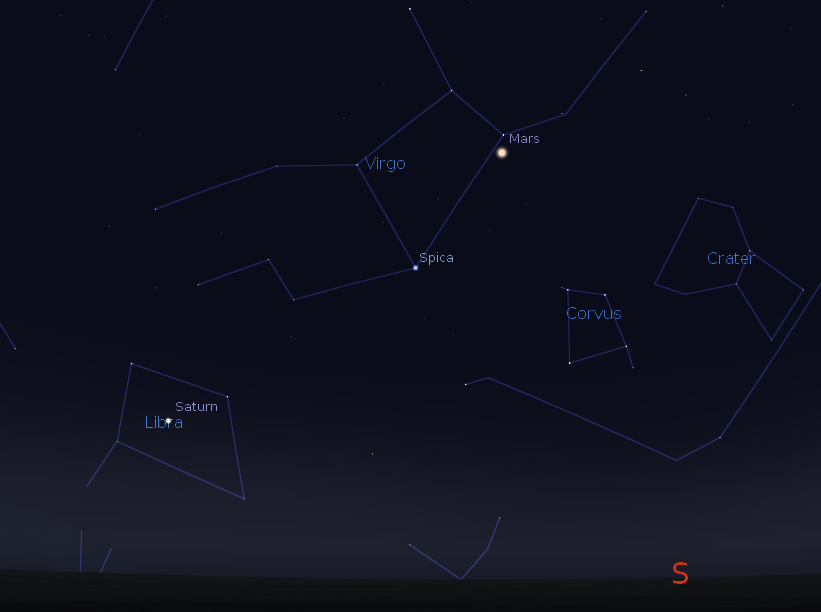
Mars, Saturn and some spring constellation at 11 p.m. April 30, 2014. Created using Stellarium.
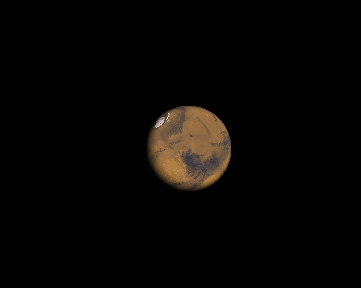
Telescopic view of Mars, 11 p.m. April 30, 2014. Created using Stellarium.
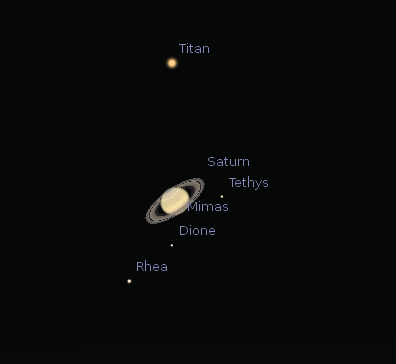
Telescopic view of Saturn and some of its moons at 11 p.m. April 30, 2014. Created using Stellarium.
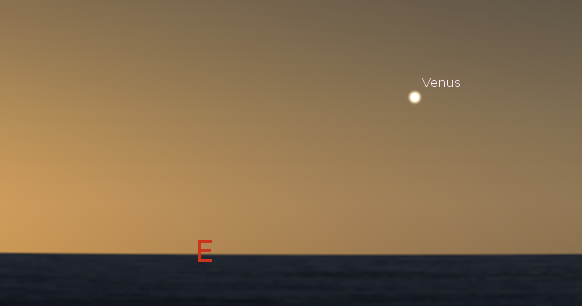
Venus in the twilight at 6 a.m. May 1, 2014. Created using Stellarium.
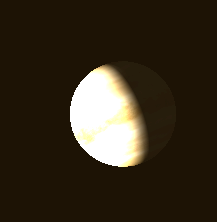
Telescopic view of Venus on May 1, 2014. Created using Stellarium.
 Bob Moler's Ephemeris Blog