Archive
08/06/2020 – Ephemeris – Looking at Saturn through a small telescope
This is Bob Moler with Ephemeris for Thursday, August 6th. Today the Sun will be up for 14 hours and 25 minutes, setting at 9:01, and it will rise tomorrow at 6:36. The Moon, 3 days past full, will rise at 10:55 this evening.
The planet Saturn is just to the left or east of Jupiter in the southeastern evening sky. In steadily held binoculars Saturn is not star-like, but it’s not round either. It’s a small oval dot. The oval or ellipse is due to its rings of small icy bodies that orbit the planet over its equator. A telescope in needed to appreciate those rings to their fullest extent. Saturn’s largest moon Titan will be visible tonight in line with the eastern extent of the rings. Saturn, like the Earth has an axial tilt. In its case it’s 26 degrees. And the rings orbit over Saturn’s equator. So as Saturn orbits the Sun in it’s nearly 30 year orbit the aspect of the rings change over that period. The ellipse shape of the rings are getting thinner now, and in 5 years they will be seen to disappear for a bit.
The event times given are for the Traverse City/Interlochen area of Michigan. They may be different for your location.
Addendum
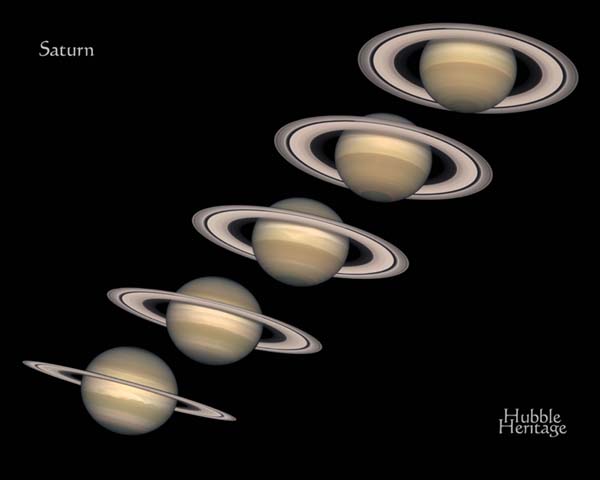
How the appearance of the rings change as Saturn orbits the Sun. The rings were at their widest in 2017. They are closing and will be edge-on again in 2025. When edge-on the rings literally disappear. Despite being 150,000 miles wide as we look at the planet, they are generally less than 66 feet (20 meters) in thickness. Credit: NASA Hubble.
05/28/2015 – Ephemeris – Saturn’s satellites
Thursday, May 28th. Today the Sun will be up for 15 hours and 14 minutes, setting at 9:17. The Moon, 3 days past first quarter, will set at 3:56 tomorrow morning and tomorrow the Sun will rise at 6:02.
Saturn has a lot of moons, even if you don’t count the billions of ring particles circling the planet. The count is up to 62, five short of Jupiter’s 67 at last count. The largest is Titan which is larger than Mercury, a world with a thick nitrogen atmosphere and liquid filled lakes. At its distance from the Sun, some 10 times Earth’s and receiving only one percent the heat we get the lakes are filled with methane and ethane while the surface rocks are water ice. The small moon Enceladus spews salty water geysers at its south pole. The more distant moon Iapetus is half black and half white and has an equatorial mountain range that rings it like a walnut. Another moon Hyperion appears like it’s honeycombed.
Times are for the Traverse City/Interlochen area of Michigan. They may be different for your location.
Addendum
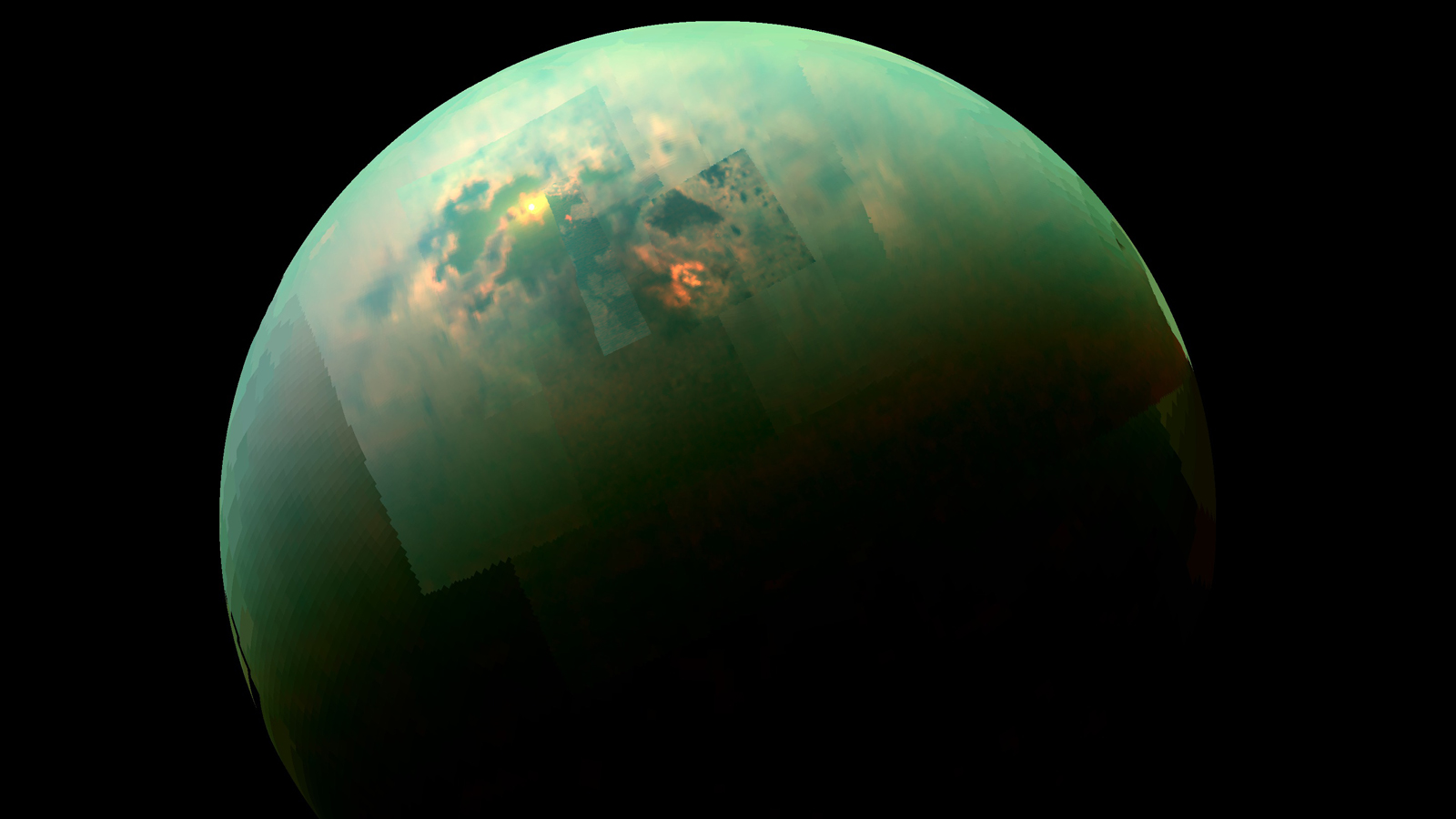
Titan in a false color near infrared view, showing the Sun’s light glinting off a north polar sea. Credit: NASA/JPL.
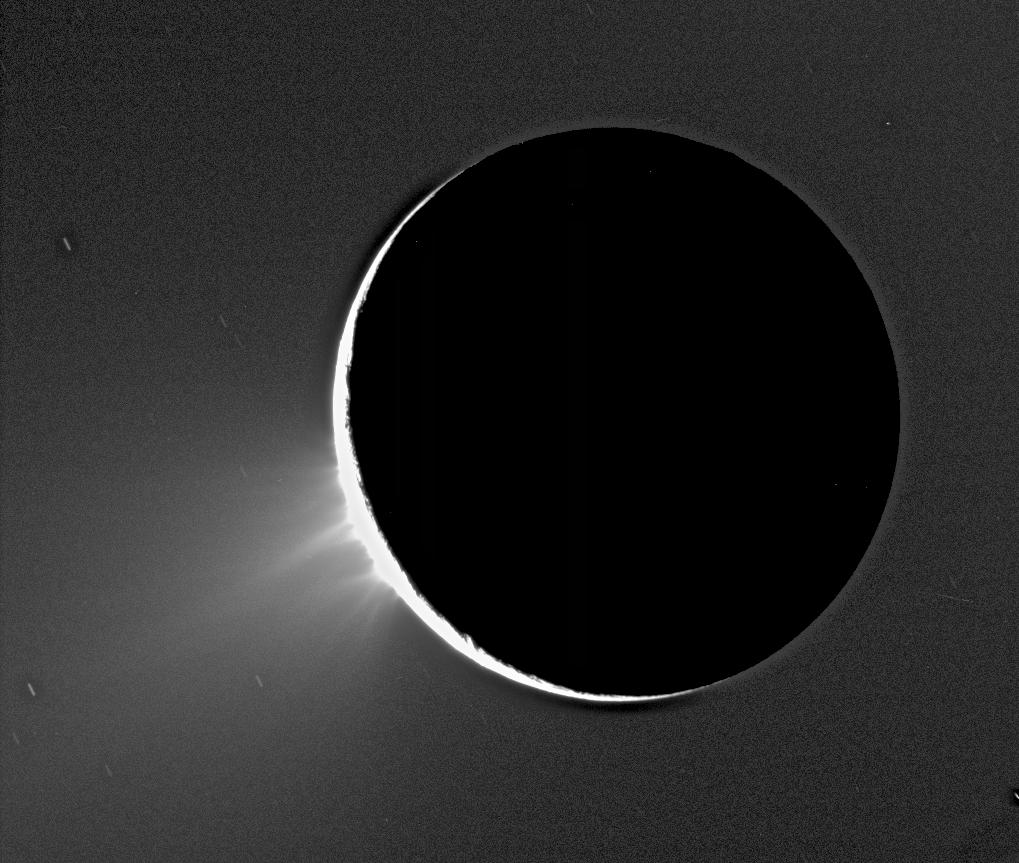
Enceladus’ south polar geysers create the E ring. Credit: NASA/JPL.
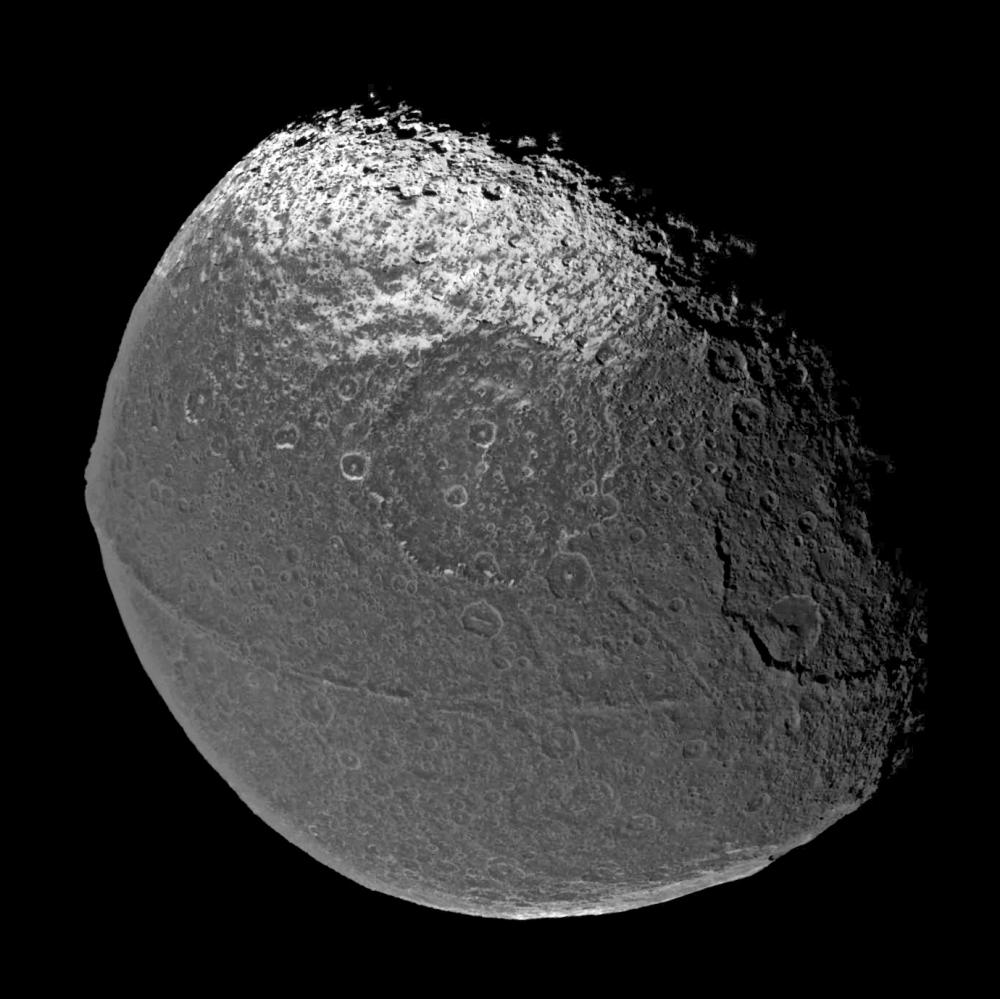
Iapetus showing mostly its dark side and equatorial mountain ridge. Credit: NASA/JPL.
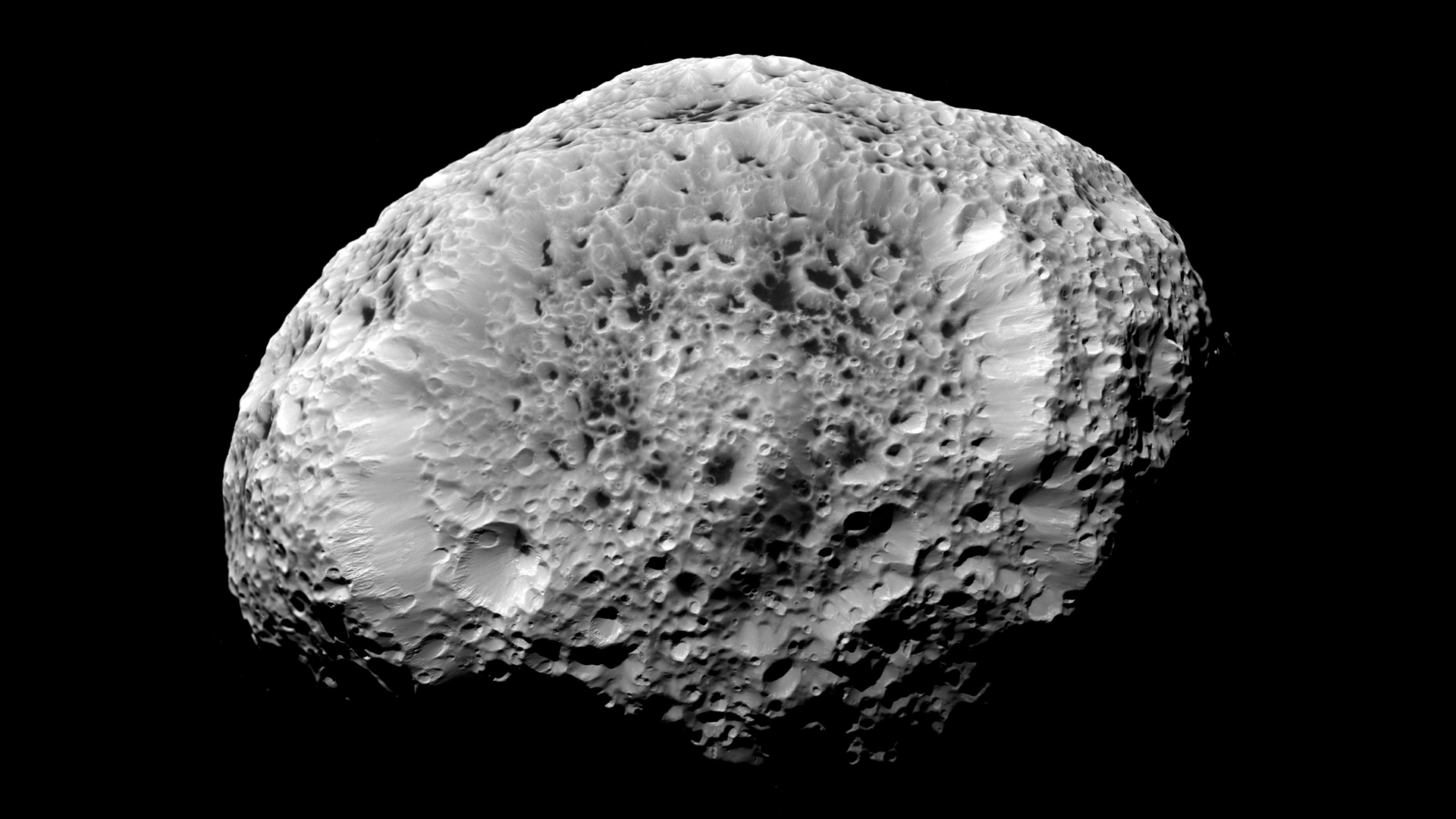
The weird moon Hyperion. It’s half as dense as ice. Credit: NASA/JPL:
06/10/2014 – Ephemeris – Our Moon and Saturn’s largest moon Titan
Ephemeris for Tuesday, June 10th. Today the sun will be up for 15 hours and 29 minutes, setting at 9:26. The moon, 3 days before full, will set at 4:51 tomorrow morning. Tomorrow the sun will rise at 5:57.
Tonight the planet Saturn will be near the bright gibbous Moon. One might need a bit of help locating it in the Moon’s glare. Saturn is to the right and slightly above the Moon. Saturn has a few moons of its own. The count’s up to 62, with another apparently forming from one of Saturn’s rings as monitored by the Cassini spacecraft now in orbit of Saturn. Cassini, which has about three years left in its mission, entered orbit of Saturn 10 years ago next month after a 7 year journey to get there. One of the most intensively studied moons is Titan, whose haze foiled the earlier Voyager spacecraft, Cassini and it’s Huygens lander have shown us earthly terrain and methane seas. Titan is easily seen in small telescopes near Saturn.
Addendum
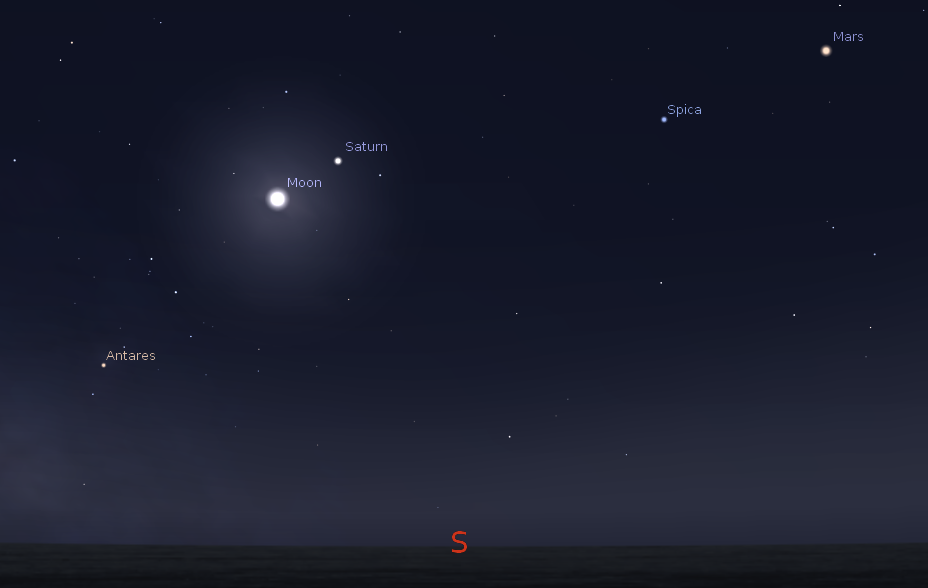
Saturn and the Moon tonight at 11 p.m., June 10, 2014. Created using Stellarium.
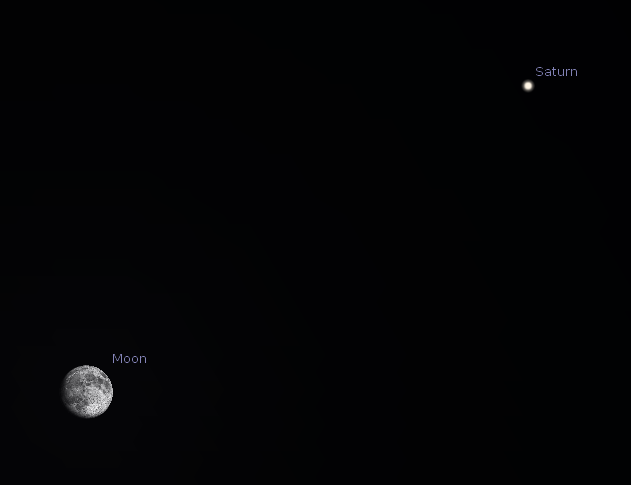
Just Saturn and the Moon showing the moon’s gibbous phase at 11 p.m. June 10, 2014. Created using Stellarium.
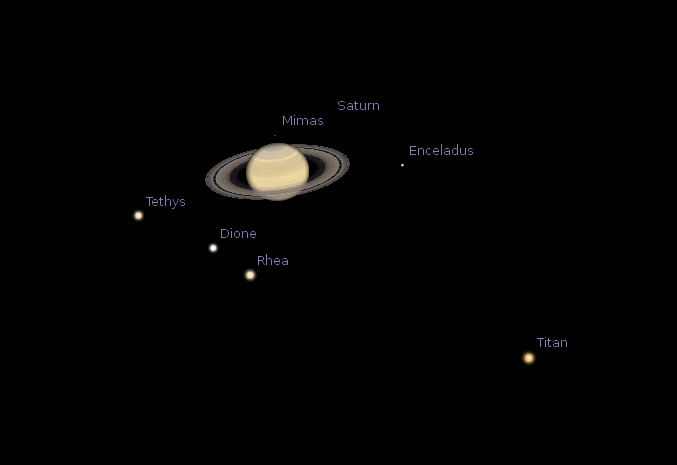
Saturn and its moons including Titan at 11 p.m. June 10, 2014. Created using Stellarium.
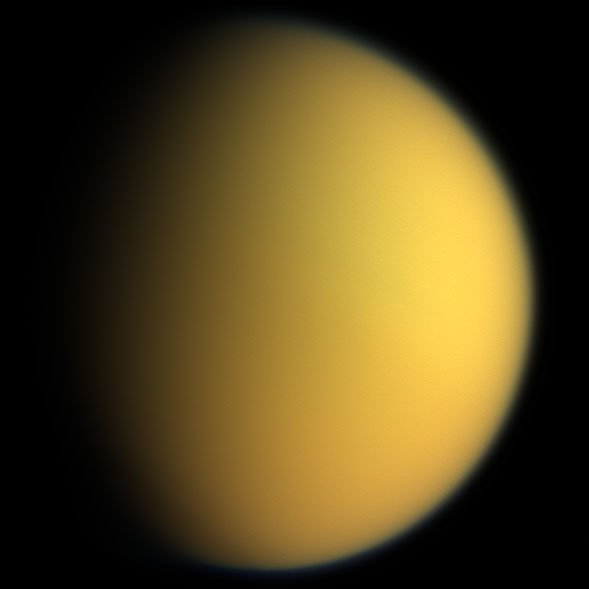
Titan, as Voyager would have seen it, but photographed by Cassini. Credit: NASA/JPL/Space Science Institute.
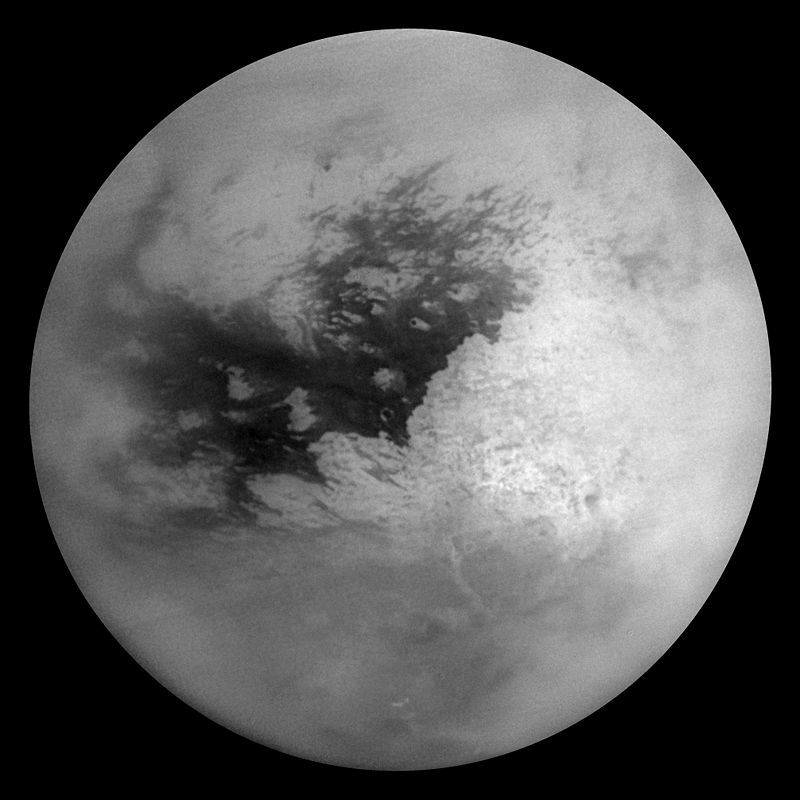
Titan as seen in the infrared by the Cassini spacecraft. Credit: NASA/JPL/Space Science Institute.
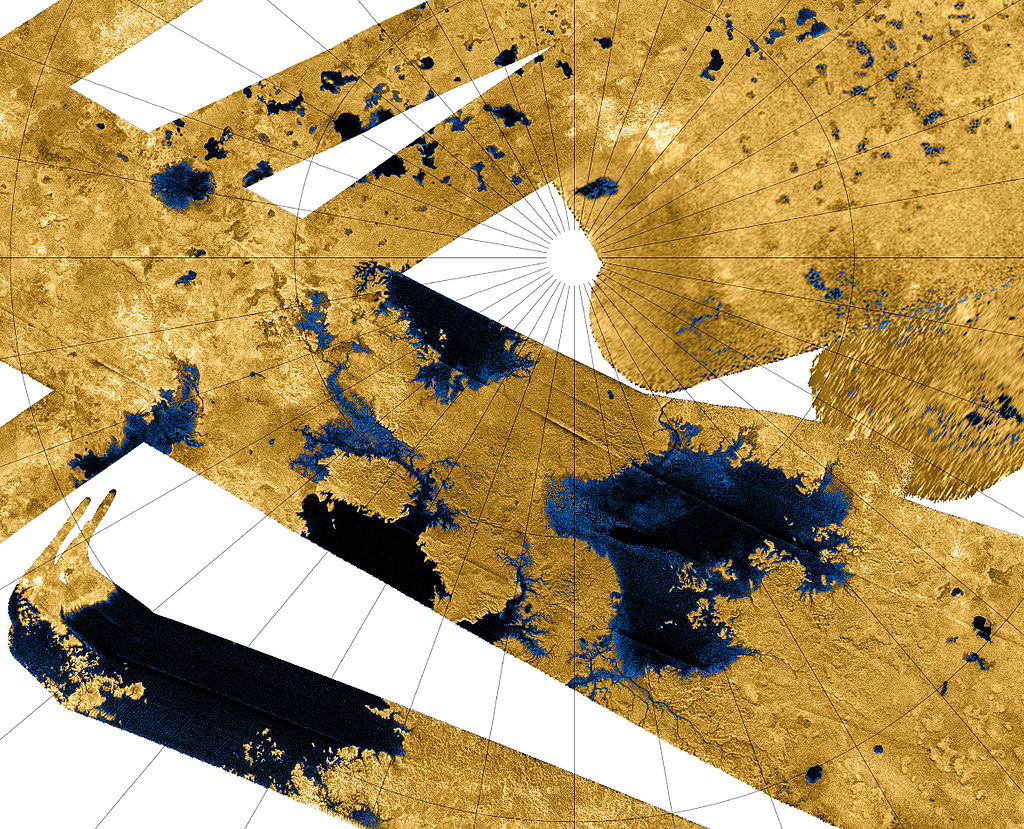
Seas and lakes at Titan’s north pole seen by radar from the Cassini spacecraft. Credit: NASA/JPL-Caltech/GSFC.

Image mosaic of Titan from the descending Huygens Lander. Credit: ESA/NASA/Univ. of Arizona.
06/26/2012 – Ephemeris – Saturn’s moon Titan
Ephemeris for Tuesday, June 26th. Today the sun will be up for 15 hours and 32 minutes, setting at 9:31. The moon, at first quarter today, will set at 1:09 tomorrow morning. Tomorrow the sun will rise at 5:59.
The planet Saturn appears above the bright blue-white stars Spica now. The moon to the right of then tonight will pass below them Thursday morning. Saturn is a wonderful sight in a small telescope and it’s largest satellite Titan will appear as a star nearby. The latest news about Titan concerns a lake of liquid methane located in the equatorial regions of that moon. The equatorial region seems too warm to support such a lake. At the poles, yes as we have seen, but not at the equator. The guess now is the that lake is fed from an underground aquifer. With its atmosphere, clouds, lakes, rains, rivers and hilly terrain Titan is a spooky analog of the earth that’s 300 degrees colder.
Times are for the Traverse City/Interlochen area of Michigan. They may be different for your location.
Addendum
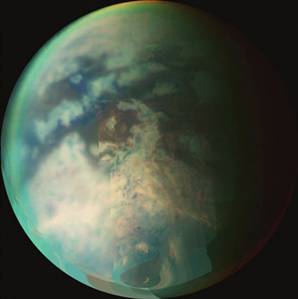
Seeing through the clouds at Titan’s surface. Credit: NASA – Cassini
04/12/11 – Ephemeris – Saturn and its moon Titan
Tuesday, April 12th. The sun will rise at 7:04. It’ll be up for 13 hours and 19 minutes, setting at 8:23. The moon, 1 day past first quarter, will set at 4:16 tomorrow morning.
The planet Saturn, now rising up in the southeastern sky is always the most wonderful sight in a small telescope. The rings are slowly opening to the sun, however for us on the earth, whose orbit is tilted by about 2 and a half degrees to the Saturn’s orbit of the sun, the rings appear to be closing just a bit right now. After June they will open up again. Tonight a small telescope will also reveal Saturn’s largest satellite or moon which will be off the edge of the longest extent of the rings to the east of Saturn. Titan is the second largest moon in the solar system, after Jupiter’s Ganymede. It is larger than the planet Mercury and the only moon with a substantial atmosphere. Titan’s surface atmospheric pressure is slightly greater than the earth’s.
* Times are for the Traverse City/Interlochen area of Michigan. They may be different for your location.
Addendum
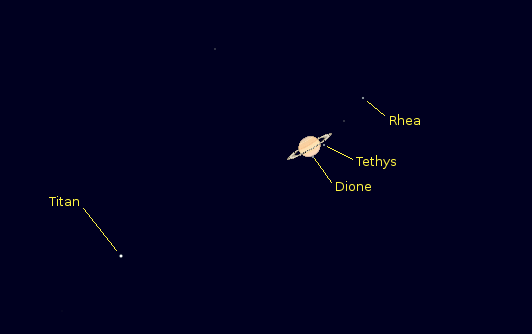
Saturn and some of its bright moons for April 12, 2011. Created using Cartes du Ciel
Titan is the easiest moon to see. Rhea is more difficult. The others being close to Saturn tonight may be impossible to spot. The free programs Cartes du Ciel and Stellarium will show the positions of Saturn’s satellites. See the Free Astronomical Software links in the right. Stellarium does have a problem getting the satellite brightness right, they’re too bright.
 Bob Moler's Ephemeris Blog